How diversity actually makes us smarter

In other words, diversity requires us to shift from automatic to deliberative thinking (from System 1 to System 2 in Kahneman’s terms):

In more homogenous parishes, towns, states and countries, residents aren’t necessarily obliged to take that extra intellectual step. In places where the overwhelming majority of residents share a common background, they are more likely to maintain an unspoken consensus about the meaning of institutions and practices. That consensus, Dutch philosopher Bart van Leeuwen reminds us, is enforced “through sayings and jokes, in ways of speaking and moving, and in subtle facial expressions that betray surprise or recognition.” In other words, the way things are is so self-evident that they don’t require a second thought.

Diversity, however, requires second thoughts. When the consensus is challenged in a homogenous place by the presence of new people, things get interesting. The familiar signs and symbols that undergird our implicit understanding of the world can change in meaning. The presence of conflicting worldviews causes confusion, uncertainty, and alienation for holdovers and newcomers alike. These feelings can either cause people to draw back into themselves — or force them to articulate and justify themselves to those who don’t share their view of the world. Or both.Because of our long history of immigration, the disruptions of diversity have been commonplace in American life. The late historian Timothy L. Smith famously called migration to the U.S. a “theologizing experience” that forced newcomers into the existential dilemma of having to “determine how to act in these new circumstances by reference not simply to a dominant ‘host’ culture but to a dozen competing subcultures, all of which were in the process of adjustment.”

How diversity actually makes us smarter – The Washington Post.

Chart of the Day: The amazing diversity of languages around the world by language families (2)

Primary_Human_Language_Families_Map


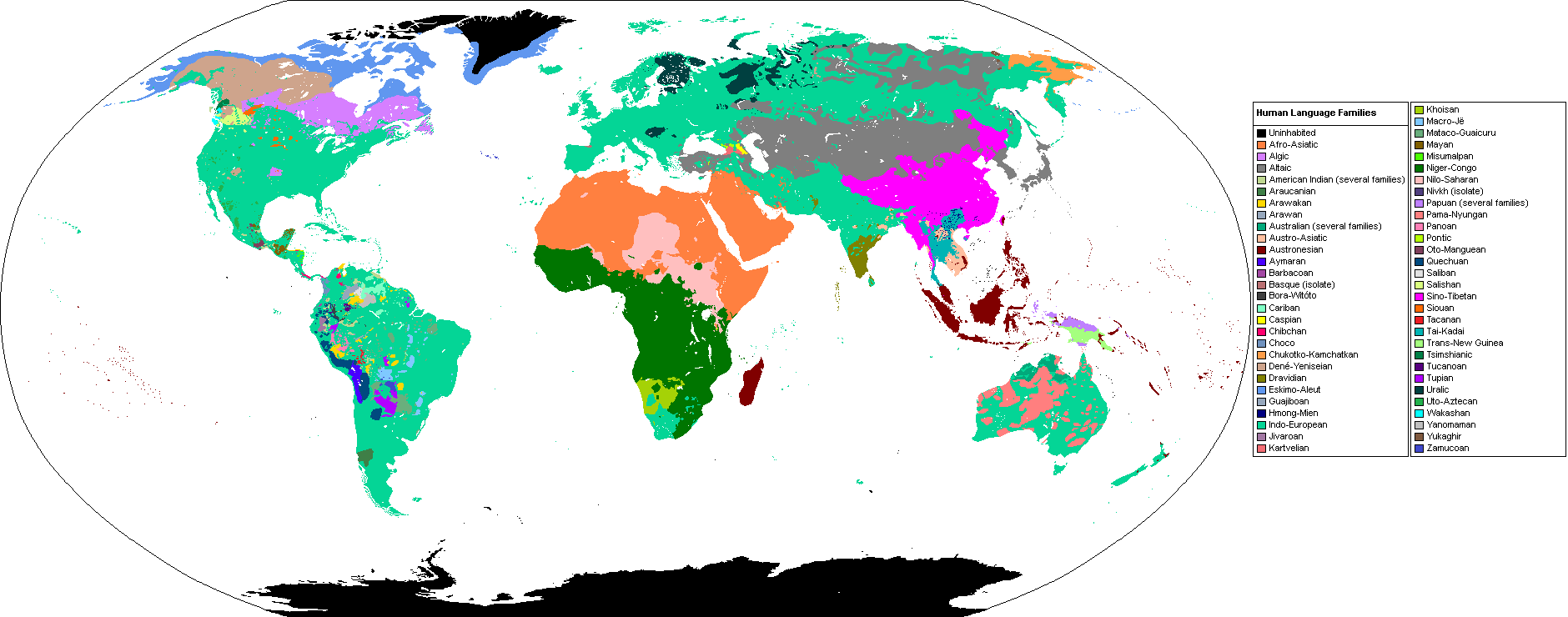
Another thing that’s interesting, though, is the global dominance of Indo-European languages. This category includes Romance languages, Germanic languages like English and German, Indic languages like Hindi, and even Iranian languages like Farsi. When you merge all of the Indo-European sub-families, you see how much of the globe that family represents:

One last note: though the globes linguistic diversity is impressive, its shrinking. In 2011, David Harmon, a scholar who runs the Index of Linguistic Diversity, warned of a potential for linguistic “mass extinction” in the 21st century. Though there were 7,000 spoken languages in 2011, global linguistic diversity has been in decline. Only 80 percent of languages spoken in 1970 still existed by 2005.

The amazing diversity of languages around the world, in one map – Vox.

Tinkering is not Jason Kenney’s style – Yakabuski

Good piece on the political astuteness of Jason Kenney by Konrad Yakabuski:

Friday’s Federal Court ruling labelling that latter move “cruel and unusual treatment” is a decidedly unflattering one for the practising Catholic that Mr. Kenney is. But even if Ottawa is forced to reinstate health care for these claimants, their numbers are now so low that it will still save hundreds of millions annually compared to what it cost to run the refugee system before Mr. Kenney got his hands on it.

Now, Mr. Kenney’s paws are all over the TFW program. Whether his reforms turn out to be good policy will depend on whether the market works, specifically whether more Canadians migrate to Alberta to fill what are supposed to become good-paying fast-food jobs. That’s a leap of faith not even the supposedly free-market business lobby is willing to make.

But you know Mr. Kenney is on the right track when Justin Trudeau, who railed against the pre-reform TFW program and whose father created the national energy program, confusingly calls the latest overhaul “one of the most anti-Alberta federal policies we’ve seen in decades.”

If that’s all the opposition’s got, the Smiling Buddha should be laughing.

Tinkering is not Jason Kenney’s style – The Globe and Mail.

Tribunal can deny in-person appeals in disability benefits cases – Citizenship Parallels

Similar situations are likely to occur with respect to the lack of oral hearings in cases of citizenship revocation. A number of witnesses, including some generally supportive of the Government, expressed concern over the lack of oral hearings and relying on a paper process (others argued for full access to the Courts):

And a retired doctor who heard appeals under the previous system says he could not have made fair decisions without meeting claimants face to face.

“I can tell you there were a couple of times when you would say to yourself, ‘This is a slam dunk for denial,’ until the human walked in,” said George Sapp, who lives near Halifax. “Then you would see the person that’s attached to the file. And sometimes it took you back. And you listened.”

Tribunal can deny in-person appeals in disability benefits cases – The Globe and Mail.

The life of a jihadi wife: Why one Canadian woman joined ISISs Islamic state

Another extremist perspective, that of the jihadi wife. Like many of the Canadian extremists who leave Canada to fight in Syria, Iraq, Somalia etc, moved to Canada as a child:

In a recent interview conducted by text message, Umm Haritha said she moved to Canada as a child and lived there for 14 years before deciding to move to Syria. She was a university student and said her upbringing was “normal” and “middle class.”

While she wouldn’t disclose where in Canada she lived, she said her decision to join the jihad in Syria was motivated by a desire to “live a life of honour” under Islamic law rather than the laws of the “kuffar,” or unbelievers.

Four months before she left for Syria, she began wearing a niqab, a veil that leaves only the eyes visible, and says she experienced harassment from fellow Canadians.

“I would get mocked in public, people shoved me and told me to go back to my country and spoke to me like I was mentally ill or didn’t understand English,” she said.

“Life was degrading and an embarrassment and nothing like the multicultural freedom of expression and religion they make it out to be, and when I heard that the Islamic State had sharia [Islamic law] in some cities in Syria, it became an automatic obligation upon me since I was able to come here.”

Since her husband’s death, Umm Haritha has been living in a house with the widows of other fallen jihadists in Manbij, a town of 200,000 people near the Turkish border controlled by ISIS, which recently declared a caliphate in eastern Syria and western Iraq.

The life of a jihadi wife: Why one Canadian woman joined ISISs Islamic state – World – CBC News.

Cruel to take health care away from refugee claimants – Globe and Star Editorials

Harper Flesh WoundNot much support for the Government on the refugee claimant healthcare cuts, starting with the Globe’s editorial:

The problems with the federal cuts to refugee health care begin with the rationale used by government to introduce them in the first place: cost, deterring false refugee claims and equity – the idea that refugees are receiving better health care than Canadians. The court found the government wrong on all counts.

Citizenship and Immigration Minister Chris Alexander defended the cuts by saying they would save taxpayers $100-million over five years. The calculation was always suspect. It never factored in hidden costs, such as those incurred by neglecting certain health conditions as a result of no coverage. Mr. Alexander consistently argued that any refugee with a serious illness could still turn to hospital emergency rooms, as if that came at no cost. The government also argued the cuts would reduce the number of bogus refugees coming to Canada simply to access the country’s health care. Ottawa’s decision to penalize potential offenders by depriving every claimant in that category of health care is a kind of collective punishment. A court of law presumes innocence until guilt is proven. When it comes to refugee claimants, Ottawa should at least extend the same benefit of the doubt.

The Federal Court ruling reverses the government’s dumb cuts to refugee health care. There’s a legitimate concern about bogus refugee claimants abusing the system. This health care policy, a weapon that has now come back to wound its creator, was never the right way to deal with the problem.

Cruel to take health care away from refugee claimants – The Globe and Mail.

Predictably, from the Star:

While the Canadian Medical Association cheered the ruling as “a victory for reasonable compassion and a big step for natural justice,” Citizenship and Immigration Minister Chris Alexander intends to appeal. A less obtuse government would have been shamed into retreat, given the string of humiliating court defeats the Conservatives have suffered over Harper’s clumsy attempt to shoehorn an unqualified judge onto the Supreme Court, his hugely flawed law-and-order agenda and his unlawful bid to change the Senate. But this government is shameless. Alexander has even attacked Ontario for trying to plug the gap, accusing officials of coddling “bogus claimants” and “fraudsters.”

Federal Court rightly strikes down Harper’s refugee health-care cuts: Editorial

And prior to the Federal Court ruling, from the Calgary Herald (not just the suspect Toronto media):

A national day of action was held Monday by health-care professionals, people one doesn’t usually associate with protests and public forms of advocacy. The federal government should live up to its obligations and reinstate medical coverage for all refugees — not just those with the greatest chance of having a legitimate claim. If it wants to protect taxpayers, the government can do so by handling refugees claims in a timely fashion and sending those who are found lacking back home as quickly as possible. But under no circumstances should refugees — many of them already victims of abuse — be made to needlessly suffer.

Editorial: Reinstate refugees’ medical coverage

And Jon Kay in the National Post:

The moral relativist tries to blur the line between us and them. The punitive moral absolutist, on the other hand, paints the line stark and thick, and turns politics into a game of inflicting symbolic cruelties on the people on the wrong side of it. Thus, Tory criminal-justice policy consists of finding new and gratuitous ways to make life harsher for convicts — including taking away their rights to receive visitors, and eliminating widely lauded prison-work programs. Canada is one of the safest countries in the world, and has been getting safer for decades. But prisoners — like diabetic migrants — have no politically influential constituency, so tightening the screws on them scores well at poll-driven Tory brainstorming sessions.

When it comes to performing the same stunt on migrants, the irony is that the current Immigration Minister, former ambassador to Afghanistan and UN official Chris Alexander, has done more than just about any other Canadian to help the population of one of the most destitute nations on earth. Yet now that he is back on Canadian soil, he has been tasked with a policy aimed at denying health benefits to vulnerable people who have come to our shores.

Canada’s valuable post-9/11 work in Afghanistan — building schools for girls, and creating a democracy — was a powerful rebuke to the moral relativist idea that no system of values is better than any other. But as last week’s Federal Court ruling demonstrates, not every issue should be treated with the same aggressive us-vs.-them spirit.

Jonathan Kay: The refugee health-care decision lays bare Harper’s creed — punitive moral absolutism
How public servants support democracy: a response to latest Canada 2020 study | hilltimes.com

More reaction from Maryantonett Flumian to Ralph Heintzman’s Canada 2020 report:

But doesn’t there come a point where a public servant—whose ethical code requires that he or she act “in the public interest”—must say no? Indeed there does. But the threshold is high, and the public servant’s responsibility to act in the public interest does not mean the public service determines the public interest.

For an unelected official, acting in the public interest essentially means three things:

  1. not acting in one’s private interest or in the special interests of those one personally favours;
  2. bringing one’s best professional expertise to bear on the tasks one performs; and
  3. acting consistently with the agenda and direction set by one’s minister, provided it is consistent with the law, with formal government policies, and with public service values and ethics.

So, yes, a public servant could and should refuse, say, to provide support for a partisan event. But he or she could not decline to implement a policy because he or she judged it not in the public interest….

Heintzman’s concerns here are fair enough, but the public service doesn’t operate in an ivory tower. Policies and practices that embarrass governments have never been matters of indifference for public servants. What has intensified in recent years is the pressure of the public environment. Instantaneous digital technology and 24/7 media are undercutting the deliberative, process-driven way in which governments have traditionally responded to issues. “Issues management” has emerged as a growing government need and perhaps the most in-demand skill for an up-and-coming public servant. This reality makes for fine lines that demand vigilance, but it does not mean that the public service has gone political.

Interesting relative lower emphasis on “fearless advice” (from someone who was fearless!) in favour of the softer “bringing one’s best professional expertise,” a not insignificant nuance in the current context of sometimes fraught government public service relations.

How public servants support democracy: a response to latest Canada 2020 study | hilltimes.com.

Which Country Would You Die For?

My take on dual loyalties:

We live in a globalized world. We have diverse identities, both individually and collectively. As Canada’s diversity continues to increase through immigration and intermarriage, our identities will continue to become more varied and blended.

Our ability to follow global events and to participate in political and other activities in other countries will also continue to increase.

But we do not expect interest in countries of origin to be exclusive. We expect citizens to vote in Canada. We expect citizens to participate in Canadian political, social and economic debates, and not only vote or advocate on behalf of “homeland” issues.

By and large, the government is comfortable with this approach. The only exception is with respect to citizenship revocation in cases of national security or comparable issues, where the revisions to the Citizenship Act distinguish between single and dual citizens. In other words, the existing long-standing policy that a Canadian-is-a-Canadian — whether single or dual national, whether born in Canada or naturalized — no longer applies.

As Canadians continue to navigate and develop their various identities, we expect them to find a balance between their ethnic or country of origin identity and their Canadian identity. We have few hard and fast rules, given the complexity of our lives and identities, and provide considerable scope for Canadians to express their country of origin. However, we expect this activity to be grounded in a commitment to participate in Canadian life.

Which Country Would You Die For? – New Canadian Media – NCM.

Blatchford: Government policy on refugee health care exposed as heartless and shameful – and other Commentary

Some of the first commentary in the mainstream media on the refugee claimant health ruling, starting with Christie Blatchford of the National Post and her savage teardown of the Government:

But, in fact, Judge Mactavish found, if any of that is true, the government can’t demonstrate it and hasn’t done so.

The government’s own witnesses admitted the changes to the program were based on various “perceptions” and “beliefs.” From a “cost containment” perspective, the government offered no evidence that the changes “will in fact result in any real savings to Canadian taxpayers.” And Ottawa conceded “it has not carried out any research in order to determine whether denying health care as a means of deterrence has any empirical validity or chance of success.”

And there you have it: The government brought in a cruel and inhumane program aimed squarely at the most vulnerable people in the country, sold it in the basest way imaginable by appealing to the least generous impulses in us all and hasn’t proved it will save one red cent of the $91-million cost of the program (as of 2009-10).

(The judge drily noted that if the government really wants to save money, perhaps it could speed up the bloody process by appointing more members to the Immigration and Refugee Board.)

With the changes, she said, “the executive branch of the Canadian government intentionally set out to make the lives of these disadvantaged individuals even more difficult. It has done this in an effort to force those who have sought the protection of this country to leave Canada more quickly, and to deter others from coming here to seek protection.”

Judge Mactavish agreed with Dr. Paul Caulford, a family doctor and co-founder of a clinic for those without insurance, who said that sooner or later, “a refugee claimant will eventually die as a result of inadequate access to health care.”

Well, maybe that would deter people.

Christie Blatchford: Government policy on refugee health care exposed as heartless and shameful

And Kate Heartfield in the Citizen:

A policy that “shocks the conscience and outrages our standards of decency” is not defensible, politically and morally, even if it is legal. It is hard to argue against the court’s opinion that the government “has intentionally set out to make the lives of these disadvantaged individuals even more difficult than they already are in an effort to force those who have sought the protection of this country to leave Canada more quickly, and to deter others from coming here.”

This judgment might not be the final word on the constitutionality of refugee health care, but it’s a damning critique not only of a particular policy, but also of the way our government makes policy in general.

Refugee rules are bad policy, legal or not | Ottawa Citizen.

In Macleans, Aaron Wherry asks the obvious:

Whatever the courts decide, there is probably here a good basis for a real debate about what the government has done with the Interim Federal Health Program. That we should hope to limit abuse of the immigration and health care systems seems like a reasonable goal. The question here is how—and particularly whether the changes to the IFHP are a good way to go about doing that.

That we should have this sort of analysis now is surely useful, even if it might be odd that we should have to get it from a judge. If only we had some kind of public forum for the consideration and debate of such stuff. Perhaps if we did, we could delegate a committee to pick up this ruling, independently study it at length and propose a comprehensive response. That at least seems like the sort of thing we might elect people to do.

Do the cuts to refugee health care amount to good policy?

Chart of the Day: The amazing diversity of languages around the world, in one map (1)

Human_Language_Families_Map


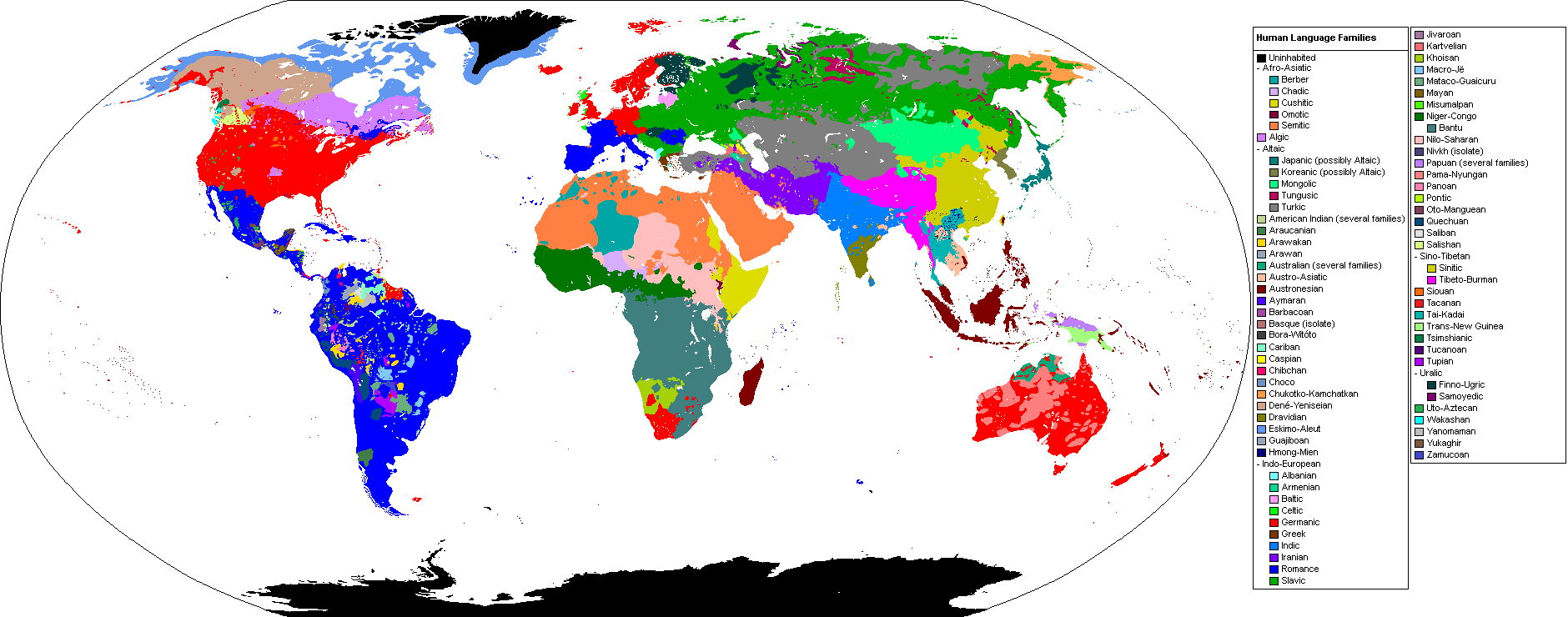
People on Earth speak thousands of different languages. But given the ubiquity of some languages, like English and Mandarin, its easy to forget just how many there are around the planet.

This map provides some great perspective. Instead of representing each language, the map groups territory by which broader language family the dominant local language falls into. For instance, western and southern Europe are deep blue, because most locals speak one of the Romance languages like French, Spanish, and Italian that descended from Latin. When you look globally, the diversity is dizzying:

The amazing diversity of languages around the world, in one map – Vox.