Misbahuddin Ahmed found guilty of 2 terrorism charges and ISIS Recruitment Video with Canadian

Yet another terrorism conviction. Born in Pakistan, raised in Montreal, radicalized in Canada, a likely candidate for citizenship revocation under the new Citizenship Act:

Conspiring to knowingly facilitate a terrorist activity carries a maximum sentence of 14 years in prison, while participation in the activities of a terrorist group has a 10-year maximum term.

Ahmed will be sentenced on Sept. 15.

Mark Ertel, Misbahuddin Ahmeds lawyer, said after the verdict that his client was misguided for a short period of his life but is a good man. “I’m devastated by the verdict, it’s never easy to lose a case and it’s especially hard to see someone like this be convicted of these types of offences,” said Ahmeds lawyer, Mark Ertel.

“He’s a good man, a family man, the jury obviously found that for a short period of time in his life he was misguided but the acquittal on the third count proves they realized if there was any danger to Canadians or anyone he put an end to it.”

Crown lawyers said during the trial that Ahmed was a “committed jihadist” with an eye on potential Canadian targets, pointing to a bag in his basement they alleged held bomb-making materials.

Misbahuddin Ahmed found guilty of 2 terrorism charges – Ottawa – CBC News.

And another example of a terrorist or extremist, born, raised and radicalized in Canada, and would not be subject to revocation (if he were still alive):

An Ontario janitor who died while fighting with an extremist group in Syria said in a posthumous video released Friday that he had left Canada because he could no longer live among non-Muslims.

“Life in Canada was good,” André Poulin, a Muslim convert who fled to Syria following a string of arrests in Timmins, Ont., said in an Islamic State of Iraq and Al-Sham recruitment video that encouraged others to follow his path.

“I had money, I had good family. But at the end of the day, it’s still dar al-kufr [a land of disbelief] and at the end of the day you cannot obey Allah fully as you can by living in a Muslim country, in an Islamic state,” he said.

…. But Poulin was hardly a regular Canadian. He was a troubled youth who had repeated brushes with the law for crimes such as uttering threats until he left to remake himself as a jihadist fighter. He was killed last summer in northern Syria.

“He accepted Islam in a land at war with Islam,” a narrator said in the video, referring to Canada, “in a land with few Muslims, in a land where evil, kufr [disbelief] and sin called him from every direction and corner to succumb to Satan and to his desires.”

It said he had married after arriving in Syria and that his wife was pregnant when he was killed while trying to capture the Mennegh airport. In his address from the grave, Poulin implored recruits to leave the West and join him.

“My brothers, how can you answer to Allah when you live on the same street, when you’re using their light and you’re paying taxes to them and they use these taxes to assist their war on Islam. You can’t live as a Muslim,” he said, adding those who can’t fight should “give money.”

The flow of radicalized youths to Syria has become a top priority for Canadian security and intelligence officials, who fear recruits could one day return home, bringing their paramilitary training and violent anti-Western ideology with them.

Parents of those lured to Syria have also becoming increasingly vocal, calling for government action to deal with radicalization and recruitment. Several dozen Canadians are fighting in Syria, and some have joined ISIS, which has seized parts of northern Syria and Iraq through a campaign of guerrilla warfare, suicide bombings and mass executions.

Concerned about the number of Canadians leaving to join armed factions in Syria, imams from across the country issued a statement last month warning Muslim youths against traveling abroad to fight in foreign conflicts.

The Canadian Council of Imams denounced the “narrow, bigoted, dogmatic distortions of the purveyors of violence and terror,” and called for “meaningful discussions, to engage in preventative strategies and to find meaningful solutions to this growing threat in our country.”

‘Regular Canadian’ killed in Syria conflict featured in slick, new ISIS propaganda video
Kenney to consider exemptions to temporary foreign worker plan – Macleans.ca

Kenney’s consistent messaging while suggesting some flexibility on the margins:

While Kenney attempted to strike a conciliatory note toward the provinces, he took a hard-line toward employers, whom he has criticized in the past as relying on relatively cheaper foreign workers as business model for success.

“We would encourage employers — I’m not talking about any region or industry in particular — we would encourage employers to redouble their efforts to hire and where necessary accommodate local unemployed workers,” Kenney said.

That could mean raising pay, allowing more flexible hours, investing in training or providing transport to work from hard-to-reach areas, he said.

“We think those options are all preferable than picking up the phone and calling a labour recruiter on the other side of the world and having someone fly you in from a developing country, into a region of double-digit unemployment.”

Kenney to consider exemptions to temporary foreign worker plan – Macleans.ca.

Jonathan Kay: Stop calling people ‘racialized minorities.’ It’s silly and cynical

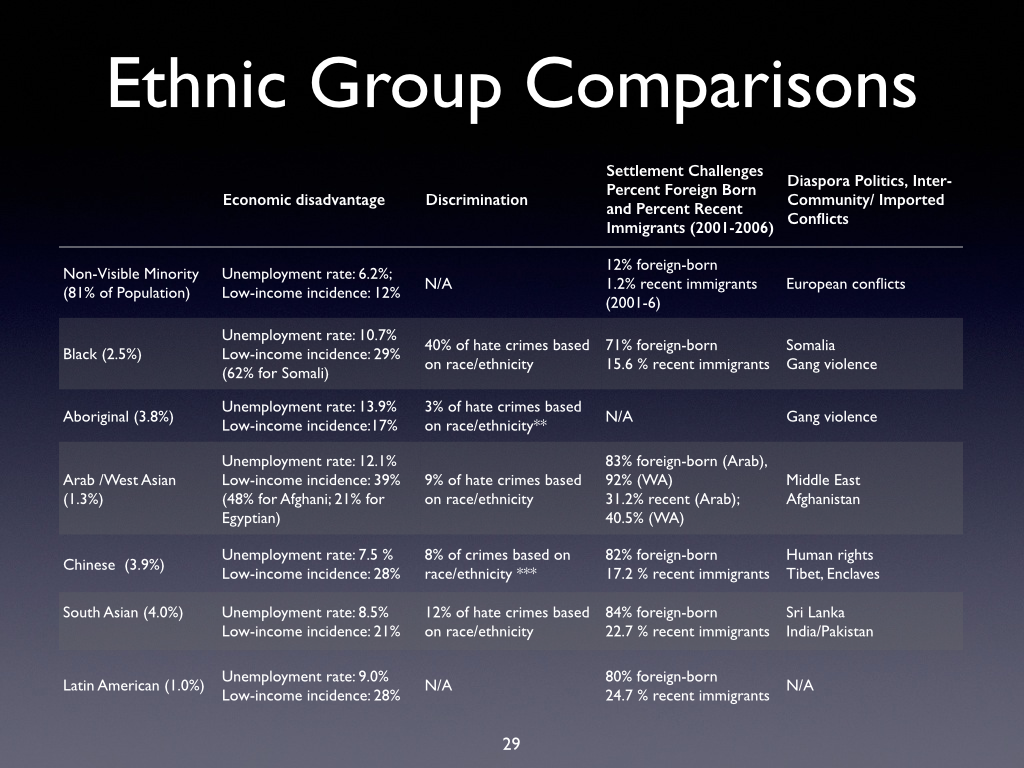
Ethnic Community Comparisons

From Policy Arrogance or Innocent Bias: Resetting Citizenship and Multiculturalism

Jon Kay takes the easy route out on faulting Carol Goar on her terminology, “racialized,” but ignores the broader, and more uncomfortable question she raised regarding inclusiveness and participation (Toronto is diverse but not as inclusive as it could be):

“Racialized Torontonians” as they call themselves?

Here’s a question for readers who live in Toronto: Do you know a single ordinary person — someone who is not either an activist, or enrolled in feminist film studies at Ryerson, or a “diversity consultant” hired by governments and big companies — who routinely refers to herself or anyone as a “racialized” person?

To be more specific, have these words ever escaped anyone’s lips within the 7,124 square kilometers of the Greater Toronto Area: “As a racialized Torontonian, I’m supporting Argentina over Germany in the World Cup final.” “As a racialized Torontonian, that shade of eye shadow really doesn’t go with my skin tone.” “As a racialized Torontonian, I’m having trouble finding a restaurant that serves authentic soul food.”

I suspect that most ordinary Torontonians would be utterly confused if Ms. Goar insisted on addressing them as a “racialized” person in a restaurant or store. They might assume she was taking some kind of ethnic census. If pressed to describe themselves through the lens of race-obsession, they might more simply respond: “If you really want to know, I’m half-black.” Or, “I’m Sephardic Jewish with a quarter Latino.” Or “I was both in The Philippines.” Or perhaps many might just avoid eye contact and say, “I’m a Canadian who lives in Toronto.”

Jason Kenney questioned the use of the term “racialized” along with “white power” and “oppression.” Grant and contribution proposals that included these terms, or websites of applicants with these terms, were routinely rejected.

While the underlying policy rationale was overdue – given Canada’s increased diversity, integration challenges within and among communities were equally significant – this change downplayed equity aspects of multiculturalism.

Jonathan Kay: Stop calling people ‘racialized minorities.’ It’s silly and cynical | National Post.

Refugee health cuts: Not cruel but unusual – Colby Cosh

Colby Cosh takes a self-critical look at journalists and commentators on how they influenced the refugee claimant healthcare decision:

This is pleasing to the ego, yet I am not as confident as Justice Mactavish that the Conservative cuts to the old refugee health arrangements are shocking to Canadians. One obvious problem with using pundits as an index of conscience is that people who are angry about something will write about it, and people who aren’t, won’t.

The old IFHP provided not only the health care ordinarily given free to citizens by the provinces, but also extra entitlements working Canadians typically devote part of their paycheques to, including drug coverage, vision care, dentistry and contraception. Refugee claimants typically became eligible for IFHP immediately upon setting foot in the country—and remained eligible until they were removed from Canada, even if their refugee claims failed. ….

These [diabetic Afghan, Colombian eye surgery] are hard cases that could have been rectified by means of modest tweaks. Justice Mactavish instead threw out the whole 2012 IFHP revision, citing a further panoply of ill-documented or downright hypothetical cases in which the effects of the revised IFHP might also be “cruel and unusual.”

This procedure has met with near-universal approval from journalists. We, after all, sort of helped write the ruling. But what if the Conservatives run against it in 2015, challenging the media’s reading of the nation’s “general conscience”. . . and they win? Should we really be so sure we speak for you?

Valid points, but part of the role of journalists is to draw issues to our attention, and the decision likely relied more on the testimony of doctors and healthcare experts than journalists. And the Government, as in so many cases, by aiming for simple and simplistic solutions, along with its apparent lack of evidence (not to mention rhetoric), did not help itself. Refugee health cuts: Not cruel but unusual.

Why far-right nativist political parties stand no chance in Canada

Bit of a flawed and limited analysis by James Yan.

Canada is more welcoming, accepting, tolerant than other immigration-based countries like the US and Australia. Europe is not a comparator region.

Our history influences who we are, and as Kymlicka and Ibbitson’s popularization (Why is Canada the most tolerant country in the world? Luck), there are unique factors to our history, particularly the (imperfect) accommodation to aboriginal Canadians and more significantly French-English accommodation that provide the backdrop and culture for a more accommodating political culture.

And we recognized, belatedly, many of the unfortunate incidents of our past.

So while demographics now make it impossible, how we got here, and the contrast with other immigrant-based societies, are equally important factors:

In the case of Canada, however, the proportion of Canadian citizens who are foreign-born and the proportion who are members of a visible minority, at 20.6 per cent and 19.1 per cent respectively as of 2011, is simply too high for a nativist party to even be politically viable. Political parties in Canada win elections only by winning the support of a broad coalition of voters, especially immigrants and second-generation immigrants who belong to visible minorities, since they form such a sizable chunk of the electorate. In Canada, any far-right nativist political party will inevitably self-destruct since it alienates the very voting bloc from whom it inescapably needs votes.

In Europe, on the other hand, nativist parties are doing well because the proportion of foreign-born people in most countries is nowhere near as high as that in Canada. According to the United Nations Population Division’s 2013 International Migration Report, the percentage of the population that is foreign-born in most European countries mentioned at the beginning of this article is between five and eight per cent. European countries are also more ethnically homogeneous. This is why nativist political parties in Europe can afford to lose the immigrant and visible minority vote yet still perform so well in elections.

So it seems that hostility towards “outsiders” resembles a bell-shaped curve. These perceived outsiders can be scapegoated up to a certain point, but once they have attained a critical mass in any given country, nativist political parties cease to be politically viable. Luckily, Canada today is positioned on the right side of this bell curve.

Those who ignore history are condemned to repeat it.

Why far-right nativist political parties stand no chance in Canada | Embassy – Canadas Foreign Policy Newspaper.

Canadian charities in limbo as tax audits widen to new groups – Politics – CBC News

Not quite sure whether the list below passes the “smell” test of being neutral and completely free of political direction:

“CRA audits occur at arm’s length from the government and are conducted free of any political interference. Our government is committed to ensuring that our tax system is fair for all Canadians.”

The tax agency acknowledges it has been auditing the political activities of a variety of charities whose work focuses on animal welfare, poverty, education, religion, health, human rights and others.

Canadian charities in limbo as tax audits widen to new groups – Politics – CBC News.

Canada’s immigration enforcement system suffers from ‘orchestrated mismanagement,’ whistleblower claims

Interesting read. Despite the Government’s efforts and messaging, deportations and removals have declined.

And yet, in the Toronto region, about 3,000 fewer deportations took place in the last fiscal year over the previous year, a drop of about 34%, he says. Nationally, there were about 5,000 fewer deportations, down about 26%. That follows year-after-year increases in deportations since the 2008-09 fiscal year, he says.

CBSA had projected removing 17,075 people nationally in the last fiscal year but only managed to remove 13,900 and is the first time in perhaps a decade CBSA’s target was missed, the letter says.

As to his allegations of “organizational mismanagement,” hard to comment without having a full picture. And performance pay reflects the range of responsibilities of senior executives, not just one file (unless it is one of those files that contaminates all those it touches!).

Canada’s immigration enforcement system suffers from ‘orchestrated mismanagement,’ whistleblower claims | National Post.

Homegrown jihadis: Canadians have always fought in other people’s wars – Granatstein

Jack Granatstein’s fine reminder that Canadians have often fought in other wars and conflicts:

The government of Mackenzie King tried to stop Canadians from going to Spain, and it passed the Foreign Enlistment Act in April, 1937, to prevent men from signing up for foreign wars. The volunteers went to Spain anyway, while countless others donated money to the cause. Most of the Canadians who went to fight – 76 per cent, according to Michael Petrou’s fine study of the Mac-Paps – were Communist Party members, most recent immigrants to the Dominion. The Mac-Paps earned a reputation for political unreliability and combat effectiveness, and at least 400 never returned home. These “premature anti-fascists” suffered for their political sins in the Second World War and Cold War years.

The Foreign Enlistment Act remained on the books, but it didn’t stop Canadian Jews from fighting for Israel or raising millions of dollars for its support. Ben Dunkelman, who had served with distinction with the Queen’s Own Rifles in Europe, went to Israel in 1948 and led a brigade with great success in Israel’s independence war. Many others did so, including George Buzz Beurling, a Royal Canadian Air Force fighter ace and a gentile, who joined the Israeli Air Force as a well-paid mercenary. Beurling died in an air crash in Rome on his way to the Middle East. Many other Canadian Jews served in the major Arab-Israeli wars of the following decades. Others serve in the Israeli military to this day, all presumably in violation of Canadian law.

Then there was the Vietnam War. While hard numbers are unavailable, estimates are that as many as 50,000 Canadians served in the U.S. military during that long, bloody struggle. Some enlisted out of the conviction that North Vietnam was an aggressor state, others presumably because of an adventurous spirit that could not be satisfied in the Canadian Forces because of Ottawa’s preference for United Nations peacekeeping. Once again, the law was not applied against Canadians who fought abroad.

None of those war veterans brought jihad home to Canada, a legitimate concern we live with today, although some communists who fought in Spain might have had attitudes inimical to the Canadian capitalist state. Most of the Islamist volunteers, if they survive to return to Canada, will likely settle down to a “normal” life. But so long as ideology, religion, adventurism and a soldier’s pay still matter, Canadians will likely continue going off to fight in other people’s wars.

Not sure where he stands on citizenship revocation in such cases, but clearly his expectation is that most will “grow out of it” and return to Canada, which may be a bit naive given the intensity of their beliefs and the nature of the organizations they are fighting with.

Homegrown jihadis: Canadians have always fought in other people’s wars – The Globe and Mail.

When the “Multicultural” Penny Dropped – NCM

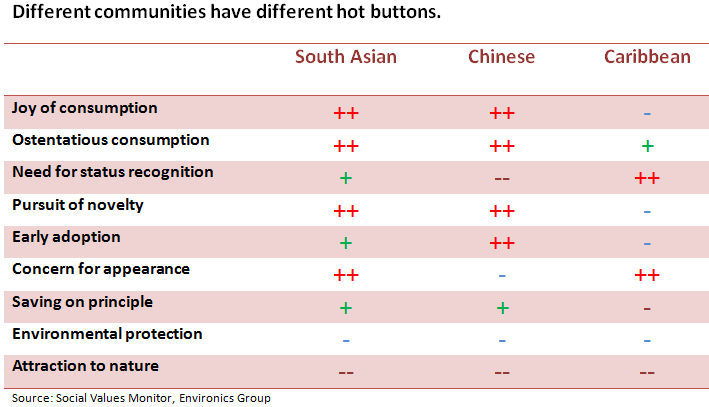
Diff comms have diff hot buttonsGautam Nath of Balmoral Multicultural Marketing on marketing to an increasingly diverse Canada:

Research was the backbone to facilitate professionalism in this market. There were but one or two long-established multicultural communication firms in Canada 20 years ago. Soon talent got together and a string of new agencies cut their teeth in the new space.

Today, there may be over 20 agencies, and in this digital era, each one looks very professional and established online.

The proof is in the pudding, however. Several agencies are literally one-man-shows operating from the confines of their basements looking to bag new business. A few have dedicated physical office space but operate with less than a handful of staff. And, literally, less than five agencies have dedicated in-house resources to support the full suite of client needs. However, this thin selection is supported by a contingent of planning, production, and other freelancers that give outside support to wherever the business goes.

Notwithstanding, over the years, the market has seen a wide range of companies wooing the multicultural consumer. In fact, it is estimated that the dollar spend of this community is about $40 billion annually and growing. But the challenge is that few marketers are constant spenders year on year.

With clients being erratic in their spending, each year is anybody’s guess.

Fortunes are made in a day and fortunes are lost with equal haste in the multicultural support services business. The long-standing, endurance-oriented and action-driven agencies will survive, others will truly shake in the wind.

Product groups that addressed these segments were the Big 5 banks initially and then the telecommunication providers. This was soon followed by large retailers, food products, real estate, automotive and entertainment. Education and settlement agencies are also growing in their spend in communicating to these audiences. But other than a handful with long-term vision and deep pockets, many are still in a pilot and a learning phase.

When the “Multicultural” Penny Dropped – New Canadian Media – NCM.

Canada’s new vision of citizenship: a privilege in two classes | The Migrationist

Louisa Taylor on the new Citizenship Act, starting off with a reminder just how moving citizenship ceremonies are to all who attend, criticizing the fundamental change in philosophy in differential treatment for single and dual nationals, and lamenting the lack of public debate.

Once we have a number of court cases and decisions, expect debate will pick up as the recent refugee claimant healthcare ruling illustrates:

There was no shortage of informed critique of the legislation, but the issue failed to catch fire with the general public. One migration advocate said privately last week she and her allies were shocked that the issue failed to move Canadians. It affected each one of us, after all, and a national survey in 2012 found that most of us – naturalized and citizens by birth alike – felt existing citizenship provisions were good enough. But to become bigger, the issue would have had to resonate not just with the quarter of Canadians who were born outside the country, but with the so-called “Canadian mainstream” of citizens by birth – exactly the people most likely to rarely think about citizenship at all.

The law will be in force soon, but the bitter aftertaste remains. Thousands more new Canadians will swear loyalty to the Queen this year, knowing – for better or for worse – their new home has put clear boundaries on their citizenship. Is that how we build a stronger sense of belonging?

Canada’s new vision of citizenship: a privilege in two classes | The Migrationist.