For the record: Romeo Dallaires last speech in the Senate

Romeo Dallaire’s call to arms and condemnation of “huff and puff” or “lecture and leave” diplomacy:

That is why Canada still has a role to play; it simply needs to reclaim its position as a leader in resolving international conflicts and preventing atrocities. Canada is not currently fulfilling that role.

What we do have, however, is a proud tradition of championing human rights and peace around the world. Indeed, Canadians played a key role in the creation of the Charter of the United Nations; the Universal Declaration of Human Rights; the International Criminal Court; the Convention on the Prohibition of the Use, Stockpiling, Production and Transfer of Anti-personnel Mines and on Their Destruction; and the Responsibility to Protect. We more or less invented modern peacekeeping.

We have exceptional armed forces, made up of bright and courageous young men and women — veterans nearly to the man and woman. We have a talented and dedicated diplomatic corps. We have development people and other whole-of-government agencies prepared to deploy and whose ingenuity is invaluable in today’s increasingly complex and ambiguous operations.

We have a vibrant civil society that won’t stop banging at the door even after we’ve changed the locks. Indeed, we have many tools we can deploy in our engagement with the world. We most definitely have a citizenry that takes pride in all of the above.

In recent years, however, things have changed. Today we have 43 peacekeepers deployed out of a possible 110,000 peacekeepers worldwide. Today we have to dance around the words “responsibility to protect” and the International Criminal Court, and even the term “child soldiers” to protect out of fear of having to actually maybe turn our alleged principled foreign policy into principled action.

Today we point to the humanitarian aid dollars we’ve given, which are never enough, and proclaim we’ve done our part. Today we have more sabre-rattling and less credibility; more expressions of concern and less contingency planning; more endless consultation with allies, or so we are told, and less real action being taken; and more empty calls for respect for human rights and less actual engagement with the violators.

I have said this before, but I cannot stress it enough: If we are to overcome the challenges facing the world today, we need transcendent leadership with the deepest conviction and the most honourable of intentions. In other words, we need statesmanship. There is a dearth of statesmanship, of taking risk, demonstrating flexibility, innovation and humility. The question is: When will Canada finally answer the call again?

For the record: Romeo Dallaire’s last speech in the Senate – Macleans.ca.
Farah Mohamed Shirdon of Calgary fighting with Islamic State of Iraq and Syria

The latest homegrown terrorist, Farah Mohamed Shirdon, Somali origin but raised in Calgary  (article does not say whether born here, but clear from his accent that spent most of his time in Canada). And the strong message from within the Muslim community against this:

“Our message to the youth has been crystal clear:  if someone is telling you that you will go to Paradise by blowing yourself up in a plane, a train or a public place taking your life and the lives of innocent people, then he is misleading you and committing a crime against the whole society and against the Islamic religion itself,” said Hacene Chebbani, the IISC’s director of religious affairs, in the news release.

Farah Mohamed Shirdon of Calgary fighting with Islamic State of Iraq and Syria – Canada – CBC News.

And on the silly – but dangerous – side:

Radical Islamists’ ideology marks soccer as enemy

Peter MacKay tries to explain lack of diversity on federal courts

More tone deafness on the Government’s judicial appointments. Only three non-white judges out of 200 appointments (Tories chastised for lack of racial diversity in judicial appointments – The Globe and Mail):

According to people in attendance last Friday, MacKay said that as a new father he understands women’s reluctance to leave their children because, while he didn’t want to downplay the role that fathers play, women have a special bond with their children.

Several of the men and women at the meeting of the Ontario Bar Association’s council described the remarks to the Star variously as “disappointing,” “bizarre,” “frustrating” or “offensive.”

In the first instance, they said the answer failed to address the issue of diversity. Secondly, they suggested it was presumptuous if not insensitive, and thirdly it betrayed a lack of understanding of, or commitment to, the goal of making the judiciary more representative, they said.

Today in a scrum he seemed to dig himself in deeper, to the discomfort of some of the women in the Conservative caucus. But surprising that gender diversity has been the main focus, when ethnic diversity is lacking as well.

Peter MacKay tries to explain lack of diversity on federal courts | Toronto Star.

Ottawa spends more on military history amid criticism over support for veterans

Seems a bit of a unidimensional celebration of Canada’s history in the lead-up to 2017:

The commemorative budget includes roughly $32-million for the Department of National Defence over seven years and nearly $50-million over three years at the Departments of Veterans Affairs for public education, ceremonies, events and remembrance partnerships, according to figures compiled by The Globe and Mail. The budget also includes several million dollars through the Department of Canadian Heritage, the figures show.

This funding is not a complete tally and is in addition to the tens of millions of dollars the Conservatives already dedicated to celebrate the 200th anniversary of the War of 1812, the conflict with the United States the government billed as “The Fight for Canada.”

National Defence has created a special program called “Operation Distinction” to oversee a spate of commemorations, chiefly important anniversaries of the First World War and Second World War. The initiative spans all the way to 2020, which will mark the 75th anniversary of the Second World War’s Victory in Europe Day and Victory over Japan Day.

Ottawa wants to use these occasions to build a “greater understanding that Canada’s development as an independent country with a unique identity stems in significant part from its achievement in times of war,” according to a January 2014 memo from Chief of the Defence Staff General Tom Lawson obtained under access-to-information law.

The government has made boosting appreciation of Canada’s military tradition a priority, in part to fashion a more conservative national identity. It’s cultivated an image as pro-military since taking power but in recent years has alienated a vocal group of veterans and their families, upset over what they consider insufficient federal support.

Ottawa spends more on military history amid criticism over support for veterans – The Globe and Mail.

And:

Return to old-style uniform insignia costs Canadian Forces millions

The new citizenship act is efficient. Is it fair?

Following the Parliamentary hearings and debates, without any amendments, my overall take on C-24 — the Strengthening of Canadian Citizenship Act. Full version below (both pay wall and open versions), excerpt on revocation:

Most fundamentally, revocation for dual nationals convicted of terrorism or treason, at home or abroad, changes a policy stance this country has held since Diefenbaker — that a citizen is a citizen, whether single or dual national.

The government and its supporting witnesses emphasized broad support for revocation in these cases. “Nobody wants a terrorist as a neighbour,” they said. Revocation is not “harsh”and is in line with other countries, they argued. Eight out of ten Canadians support revocation. Immigrants make a choice to come to Canada and accept the “fundamental social contract of citizenship”.

Let’s turn to a specific, theoretical case. Consider the two Calgarians that were killed in Syria fighting for extremist or terrorist groups.

Damian Clairmont and Salman Ashrafi were raised and lived in Calgary. Neither chose to be Canadian. Clairmont was born in Canada. Ashrafi immigrated with his parents when he was in Grade 5 or 6. He became Canadian but also has Pakistani citizenship.

Clairmont would keep his Canadian citizenship; Ashrafi would lose his even though he spent most of his youth in Canada.

Same crime, two different results. Hard to see how the courts would rule this as being charter-compliant.

While Clairmont and Asrafi are dead, similar cases will emerge — such as Mohamed Hersi, the Somali-Canadian convicted of attempting to participate in terrorist activity, who came to Canada as a child.

In the case of the Quebec Values Charter, general polling showed high levels of support — but polling focused on the question of forcing existing Quebec government employees to conform or quit showed less support. Would Canadians necessarily support treating cases like that of Clairmont and Asrafi differently? Someone born and raised in Canada but of dual nationality?

The new citizenship act is efficient. Is it fair? (iPolitics pay wall)

The new citizenship act is efficient. Is it fair? (open)

Metro Vancouver has highest ratio of mixed couples in Canada

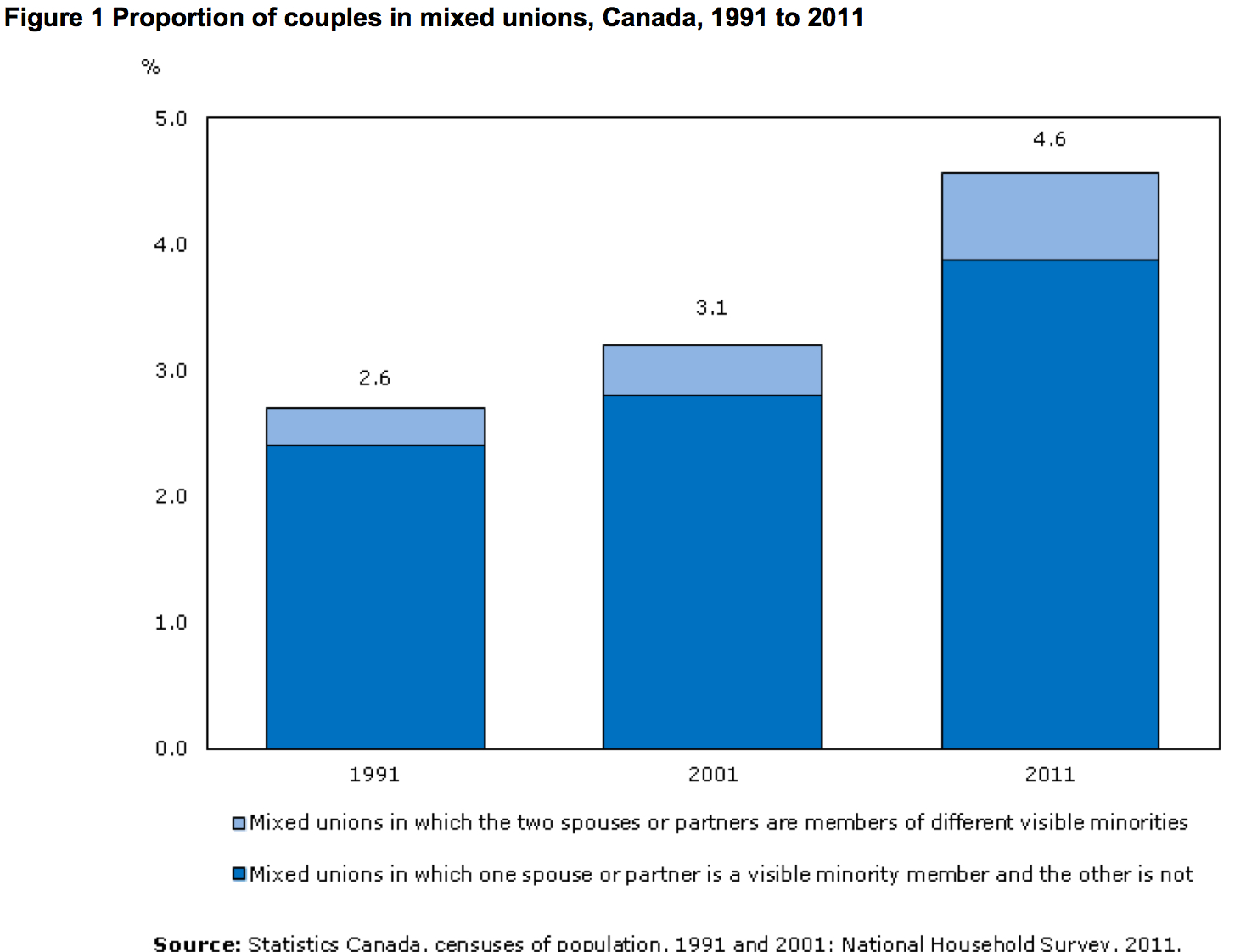
StatsCan_Mixed_Unions_Graph
Good summary report from the recent Statistics Canada study by Douglas Todd:

Faizal Sahukhan, a Fijian therapist who specializes in counselling “inter-cultural” couples, says he’s found far more people in Metro Vancouver engage in inter-ethnic dating than actually “make the leap into marriage.”

Despite the high proportion of visible minority immigrants and their offspring in Metro Vancouver, Sahukhan said the “biggest barrier to mixed unions is parental influence.”

Asked why the proportion of visible minorities entering mixed unions tends to go down when the size of their ethno-cultural group goes up in a city, Sahukhan said, “Many people who are immigrants to Canada want to preserve homogeneity when their children begin to marry.”

North Shore-raised Kate Worthy, who is married to Paul Chu, was a bit taken aback that multicultural Metro Vancouver doesn’t have a larger proportion of people in mixed unions. She knows quite a few such couples….

Despite high immigration rates to Canada, marriage habits are changing slowly. The Statistics Canada report said “couples in mixed unions in Canada accounted for 2.6 per cent of all couples in 1991, 3.1 per cent of couples in 2001 and 3.9 per cent in 2006.”

The visible minority group members most likely to be in mixed unions in Canada are those of Japanese descent (79 per cent), followed by Latin Americans (48 per cent), blacks (40 per cent) and Filipinos (30 per cent).

The two visible minority groups least likely to enter into mixed unions are the largest ones in Canada and Metro Vancouver.

Of the 352,000 couples involving Chinese people in Canada, 19 per cent were in mixed unions, and of the 407,000 involving South Asians, 13 per cent were in mixed unions.

The Statistics Canada study does not directly report on how many whites are in mixed unions, but it says 85 per cent of mixed couples in Canada include a white person.

Metro Vancouver has highest ratio of mixed couples in Canada.

Link to full study:

Mixed Unions in Canada

Conservatives’ downfall could be Stephen Harper’s dismissive tone: Walkom

Interesting choice of Minister Alexander as example:

Tone is something different.

What may eventually defeat Harper is that his government appears mean-spirited. It doesn’t just disagree with its critics. It mercilessly derides them.

Take, for example, Immigration Minister Chris Alexander’s defence of the government’s new citizenship bill. This sweeping bill would allow the government to revoke the Canadian citizenship of dual nationals deemed by the government to have acted against the national interest.

As such, it would include in its purview not only many new immigrants but those native-born Canadians who, through no action of their own, still hold the nationality of their parents. The Canadian-born child of an Egyptian-father, for instance, is automatically accorded Egyptian citizenship by the authorities in Cairo.

The Canadian Bar Association has called the proposed revocation provision “unfair and discriminatory.” Toronto lawyer Rocco Galati makes a convincing argument that it is also unconstitutional.Alexander’s substantive response has been that many other NATO countries reserve the right to revoke citizenship from the native-born.

But what has stood out is the minister’s take-no-prisoners tone. In the Commons, he called the Canadian Bar Association’s well-argued critique “hopelessly misguided.”

And when opposition MPs queried the bill, his response was to call into question former prime minister Pierre Trudeau, who, he said, had eliminated treason as grounds for citizenship revocation “at a time when the Liberal Party was playing footsie with Moscow.”

Conservatives’ downfall could be Stephen Harper’s dismissive tone: Walkom | Toronto Star.

When it comes to recruiting foreign students, Canada earns F for effort

On the lack of an effective international education strategy. Removal of credit for pre-permanent residency time in the new Citizenship Act is another disincentive compared to other countries (believe UK, Australia and other countries provide):

“Canada seems to think of education as a really crude export industry and we look at it in a really mercantilist fashion, where we want more people to come in and we don’t really care if people go out or not,” says Alex Usher, president of Higher Education Strategy Associates based in Toronto.

Jennifer Jeffs, president of the Canadian International Council, says international education should be part of Canada’s foreign policy strategy. As a tool of “soft diplomacy,” encouraging students to go abroad, where they form meaningful relationships, would improve foreign relations and Canada’s reputation.

While Canada may not have the highest standard of education and research or the most competitive fees, it still has an unmatched reputation as a tolerant, multicultural and safe society, which it should capitalize on.

“The overriding concern is that Canada is not getting as much as it deserves from international education,” says Simon. “All the building blocks are there to make Canada a real powerhouse in international education, and yet it hasn’t happened.”

When it comes to recruiting foreign students, Canada earns F for effort.

A Torontonians journey to the heart of Italian politics

Interesting example of dual loyalties: being in a foreign parliament representing expatriates:

“It’s a highly precarious political situation,” she [Francesca La Marca] says. “There’s always drama and controversy – but that’s Italy for you.”

Ms. La Marca grew up in west-end Toronto admiring Bob Rae and Jack Layton, but she was immersed in Italy’s dramatics from her earliest years. Her Sicilian-born father was active in Italy’s Socialist Party, and together they followed the latest developments from a fractured country that is perpetually critical of its political status quo.“

Like many Italian-Canadians, he had a strong sense of nostalgia,” she says. “He wanted to see Italy more just and more efficient.”

The dual citizen found the same desire welling in her as a worldly Toronto teenager in the 1990s when she watched her Sicilian contemporaries marching in the streets to protest the murder of crusading judges by the all-powerful Mafiosi – a transformative moment that prompted many Italians in her generation to enter politics and seek a culture shift, including the 39-year-old Prime Minister Renzi.

That level of political engagement, she says, marks a key difference from Canada.

“You look at Italian TV shows, you can’t get away from the constant debates. Politicians are there talking about issues and members of the public are putting them on the hot seat, and asking them very direct questions.

“I think it comes down to a different history and culture Italians are always on the streets conversing and arguing. They realize they have to fight to get somewhere, while we’re a more sheltered country that’s made up of different cultures, so we’re focused on getting along and getting things done.”

No matter how Italian she might feel in the more reticent parts of Toronto, her strong sense of Canadianness takes over in the unrepressed Italian system.

“There has to be a way to work effectively without all this excess,” she says. “Many people have this impression that Italy is very laid back and nothing gets done. Instead, it’s quite the opposite – really long hours, lots of meetings, and it’s not uncommon to finish at 10 or 11 at night. The stereotype of Italians being big talkers, meaning everything drags on and on, is absolutely true.”

She hopes to bring some Canadian efficiency to the competitive Italian political style by focusing on issues specific to the expatriate voters who elected her last year: She helps people obtain dual citizenship, get better access to health care when they return to Italy for extended periods, and source funding for teaching Italian language and culture in North America.

A Torontonians journey to the heart of Italian politics – The Globe and Mail.

C-24 Citizenship Act – Passed by Senate Committee 17 June

Clause-by-clause review of Bill C-24 by Senate Committee had no surprises, with Government using majority to approve Bill without amendment.

Debate started with Senator Eggleton’s motion to defer clause-by-clause review given the need for more discussion on the evidence regarding difficulties with the Bill. He noted:

The Bill is  “headed for nowhere. Even if passed, it will be challenged and go to the Supreme Court. It is better to come to grips with the changes needed. I don’t know what it is, the government decides or officials lead them down the garden path. It is not good for the country that so many bills are rejected by the Supreme Court.”

Eggleton contrasted the consultations that took place during the 1977 revisions to the Citizenship Act with the lack of public consultations on C-24, supported by Senator Cordy.

Senator Eaton for the Government countered:

“The Bill was very well thought out.” Department officials had laid out the steps required for revocation. Revocation has the court system to fall back upon.

She strongly disagreed on the likelihood of court challenges. If there be challenges, “so be it.” Those who are opposed have a “conflict of interest given that it involves their business” as lawyers. “I think it will go much more smoothly.”

Motion to defer clause by clause review was defeated along party lines.

Eggleton proposed 4 amendments, all defeated along party lines:

  • Elimination of intent-to-reside;
  • Reversal of language test requirements for those between 55-64 years old;
  • Restoration of pre-permanent residency time for temporary residents (international students, live-in caregivers, temporary foreign workers):
  • Restoration of full right of appeal to the Federal Court for any revocation decisions, whether for fraud or national security (treason or terror).

Eggleton proposed an observation to the report regarding the impact of the increase in fees, noting the burden this placed on low-income families and refugees, and that the US could waive fees in such cases. He proposed that the Minister should consider introducing a similar provision. This observation was supported unanimously.

With that, C-24 proceeds to a full vote by the Senate and Royal Assent.

And likely, sooner than later, some court challenges.