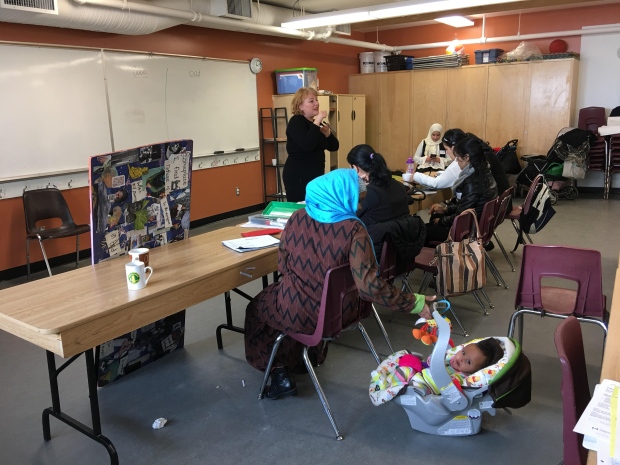
A unique English program for immigrants and refugees in Metro Vancouver is hoping to expand after finding success with women-only classes where participants can also bring their children.
The focus is not just on language, said teacher Diana Jeffries, but also on supporting mental health.
“So learning the language through taking care of yourself … making connections through community, through working together in this classroom.”
“We’re different in that we’re trauma informed, that we allow young children in the classroom, we don’t have the same kind of assessment processes the LINC has,” said program director Amea Wilbur.
“We are specific to women and also we can be a lot more responsive in terms of curriculum.”
The program is open to refugees and immigrants from any country.
Farzana Fakrhi said the flexible atmosphere is the main reason she’s able to attend the classes in Burnaby.
“It’s very helpful — especially for the women who have small kids. They have daycare for the small babies, which the other classes didn’t have it.”
Some federally funded classes do provide child minding for children, but they usually have to be 18 months or older.
The female-only language program in Metro Vancouver allows women to bring their children to class. (Bal Brach/CBC)
Outreach worker Zarmina Ali said some of the women have never stepped foot in a classroom before arriving in Canada.
“This program is very important for them because most people haven’t been at school in their life — this is the first time they come to school and they enjoy it so much.”
Sharing stories of loss
Jeffries said the supportive environment in the class has given students the confidence to share their stories of loss and struggle.
“[They talk about] the era of the Taliban and wearing burkas,” she said.
“And experiences of great loss, family members, of even children. They carry around a huge weight of their past but [they are] just looking to Canada as an opportunity for a better future for themselves and their children.”
Wilbur created the program after witnessing a gap in services for newcomers.
High housing prices in the Vancouver region stem from a variety of factors, with foreign buyers shouldering a disproportionate amount of blame, says the president of Canada Mortgage and Housing Corp.
Evan Siddall said he is concerned about “unhealthy tensions” pitting existing residents against recent arrivals, and also older homeowners against younger families priced out of the market.
“Who is to blame for Vancouver’s affordability problems? To some, the scapegoat is obvious – blame foreigners,” Mr. Siddall said Wednesday in prepared remarks to the Greater Vancouver Board of Trade.
“While it would be convenient to hang all of the blame for high prices on others – offshore buyers – it’s just not that simple. Sure, it makes for a tempting narrative. Them, not us. And while foreign investment clearly is a factor, it is not the only one.”
Mr. Siddall listed a wide range of factors that he sees as contributors to Vancouver’s expensive real estate: domestic residential investing, population and economic growth, low interest rates and housing supply constraints.
Some industry observers argue that buyers from China are the primary drivers behind Vancouver’s housing boom that spilled into the suburbs.
Mr. Siddall said evidence points to housing investor activity in Canada originating from predominantly domestic sources, yet foreign investment is often seen as the culprit in Vancouver. Going off script, he added: “When a white person buys a house, we don’t notice. If somebody of a different colour does, we do. And that’s not good economics.”
During a news conference after his speech, Mr. Siddall said the debate over housing affordability is contentious. “This contrast between us and them is a factor. We notice things that are different better than we notice things that are similar,” he said.
The CMHC president added that the federal government has policy tools, with the Minister of Finance knowing not to use economic stimulus to unduly influence the real estate market.
“Our analysis confirms that the most important factors accounting for house price increases over the long term are economic,” Mr. Siddall said in his prepared speech. “We believe two income-related factors are at play: An increase in high-paying jobs and a tendency of these jobs to concentrate in cities. This is an important and statistically robust factor in Toronto, less so in Vancouver. The impact in Vancouver may differ because wealth, rather than income, could play a much more pronounced part here.”
The B.C. government implemented a 15-per-cent tax on foreign buyers in Metro Vancouver in August. On Tuesday, the province said purchasers who are not Canadian citizens or permanent residents accounted for 7.1 per cent of the total deals in Metro Vancouver closed between June 10 and Oct. 31.
British Columbia, which began collecting data on June 10 on foreign purchasers, noted that in the seven weeks leading up to the tax’s implementation on Aug. 2, foreign purchasers accounted for 13.2 per cent of the region’s total. The regional statistics, including transactions that involve buyers from China, are based on closed deals registered with the province’s land title office.
The price for detached houses sold in October within the City of Vancouver averaged more than $2.6-million, or double the average price for detached properties in the City of Toronto. The market in and around Vancouver remains the most expensive in Canada, despite prices dropping recently for detached houses, condos and townhomes.
“Our attachment to low-density single-family housing in many neighbourhoods represents regressive urban planning and makes the problem worse. This is basic economics. The more we hold back supply, the faster prices will rise in response to increased demand. And Vancouver’s supply response is among the weakest in Canada,” Mr. Siddall said in his speech.
In a new survey released on Wednesday, CMHC said the share of foreign buyers in Canada’s major markets is still low. The federal housing agency said foreign condo ownership in the metropolitan area of Vancouver has declined to 2.2 per cent in its latest survey of property managers and condo boards, compared with 3.5 per cent in the fall of 2015. In the Toronto region, the proportion of condos owned by people whose primary residence is outside of the country decreased to 2.3 per cent from 3.3 per cent, while dropping to 1.1 per cent from 1.3 per cent in the Montreal area.
Beyond the three largest markets, CMHC found that the share of international condo buyers has remained small in places such as Saskatoon, Regina, Edmonton, Calgary and Halifax.
Good long read by Todd on some of the major policy and operational failures that have contributed to housing prices in Vancouver:
The main dereliction of duty by Immigration Canada has been its refusal, until it was too late, to properly assess the Business Immigrant Program (BIP).
Started in the mid-1980s, the BIP has arguably been the most crucial factor driving up Metro housing prices. UBC geographer David Ley estimates it has brought more than 400,000 well-off immigrants to Metro.
The first problem with the BIP, say Ley and others, is that it had extremely low standards.
It began by requiring an immigrant entrepreneur to invest only $150,000 in a business and hire one Canadian. The U.S., at the same time, was demanding business immigrants invest at least four times more money and hire at least 10 Americans.
One of the few high-level government officials to sound a warning about BIP applicants, whose first choice is to pour money into “safe” real estate, was David Mulroney, Canada’s former ambassador to China.
Asia-Pacific-trade boosters like Yuen Pau Woo, recently named a senator, have long said Canada should do everything it can to attract rich immigrants, calling them “the best and brightest.”
But Mulroney counters that liberally handing out passports “devalues the importance of Canadian citizenship.” And Justin Fung, with HALT (Housing Action for Local Taxpayers), concurs: “We’re practically giving away passports for free, and little benefit.”
In the meantime, Immigration Canada officials have not properly monitored the BIP. Their lax approach went on for decades as wealthy trans-nationals avoided being tested for compliance with even the BIP’s low standards.
A forensic auditor for the World Bank ended up called Canada’s BIP “a massive sham.”
The Conservatives finally killed it in 2014, which Fung called “years too late.”
Fung also worries a form of the BIP lives on in Quebec’s stand-alone immigrant-investor plan, which each year brings thousands more moneyed arrivals to Vancouver.
In addition, the federal Liberals are considering reviving a pilot program similar to the BIP.
Canada Revenue Agency
It gets worse.
While Canadian passports were being sold at bargain-basement prices, the Canada Revenue Agency has been ignoring another red flag — that many BIP newcomers and other owners of Metro mansions have been reporting strangely low incomes.
Even though the tax department had been warned, the politicians responsible did not want to face the reality that thousands of BIP investors and others were hiding most of their assets, which should have been taxed.
Officials have not wanted to admit to the widespread phenomenon of “astronaut” fathers who leave wives and student children in expensive homes in Metro to return to their homelands to do business — without declaring their offshore assets to Canadian tax officials.
An early attempt to bring in a national law requiring residents of Canada to disclose their foreign assets was opposed and not only by centre-right politicians, says Ley. B.C.’s centre-left NDP government of the 1990s also expressed concern such a law would be “culturally insensitive” and decrease B.C.’s attractiveness as a place for migrants to invest.
And even when a national foreign-assets disclosure tax law was finally brought into effect, it has often gone unenforced.
In the midst of Vancouver’s escalating housing crisis, in 2014, former Conservative prime minister Stephen Harper chopped 262 experienced tax auditors.
One of the first people to publicly expose ongoing tax avoidance by the trans-national elite was former Richmond Mayor Greg Halsey-Brandt.
In 2015 Halsey-Brandt directed Postmedia to data showing residents of one of Richmond’s most expensive neighbourhoods, where most of the population is foreign-born, were reporting poverty-level incomes — and thus putting themselves in position to pay virtually no taxes.
Another revelation came in the fall of 2015 when statistician Jens von Bergmann and UBC geographer Dan Hiebert independently unveiled census statistics showing high portions of mansion owners in ritzy Vancouver neighbourhoods were declaring almost no income.
The figures from von Bergmann and Hiebert showed several neighbourhoods, in which houses were selling in the $5-million to $7-million range, that were generally populated by immigrants, particularly ethnic Chinese.
In 2016, South China Morning Post journalist Ian Young broke open the tax department’s failures. The Hong-Kong-based newspaper revealed Canada Revenue Agency officials had been aware for decades of such tax-avoidance schemes.
CRA officials had admitted, in internal documents, they were not willing to devote auditors to catching these “highly sophisticated” tax-avoiding schemes by Metro Vancouver mansion owners and others.
‘They were scared,” the source said, “of being labelled racist.’”
In addition, a common real-estate scam has gone largely undetected as a direct result of the failure of Canada’s tax and immigration departments to share their information.
Because of the absence of cooperation, many Metro house owners have been avoiding paying capital gains taxes. They have been falsely claiming they are residents of Canada for tax and immigration purposes when they are actually mostly living outside the country and not disclosing their foreign income.
Unfortunately, it turns out that Canada’s immigration and tax departments have not been the only ones turning a blind eye to such unfairness and cheating in Vancouver’s exploding housing market.
Article would benefit from including the current diversity numbers (which Vancouver currently does not publish these):
Vancouver is launching the largest police recruiting drive in almost a decade, and the key word for this new class of officers will be diversity, officials said.
Deputy Chief Steve Rai said the police force wants hire 85 new officers by next spring, the largest recruiting figure since the pre-Olympics effort in 2008 and more than twice the size of a normal recruiting class.
Add in 20 recruits sworn in on Thursday, and that’s an addition of more than 100 officers to a police service of 1,400 — a big injection of new blood.
While the VPD has no quotas for members from specific communities, Rai said it is crucial that the police department reflects the multicultural community that it serves. With that in mind, VDP has been stepping up its outreach to cultural communities, hoping it will lead to a multicultural mix of recruits.
“You look at what happens when your police force don’t reflect the community, and you only have to look south of the border,” he said. “You see people feeling it’s ‘us-against-them,’ and there’s a lack of trust.
“It’s about acquiring, building and maintaining public trust … We are all in this together, so it starts with citizens seeing their police forces reflecting of them and the community. It has to reflect the fact it’s not ‘us-against-them,’ but ‘we.’”
According to the 2011 census, Vancouver has 18 languages identified as “most spoken at home” by more than 1,000 residents each. Besides English, the most spoken language at home for 98,855 Vancouverites were Chinese languages. Punjabi (10,500), Tagalog (9,345), Vietnamese (7,475), Korean (5,445) and Spanish (5,245) all topped 5,000 speakers.
Rai admits that there remains a stigma in some communities about policing, stemming from experiences and perceptions of police in other countries. He said the VPD is trying to break down the walls by attending as many community events as possible, and that as the second-generation acclimatizes to Canadian culture, the acceptance level has correspondingly risen.
“I know a lot of parents who aren’t supportive of their kids to go into policing because of the stigma that exists in their countries of origin,” Rai said. “But as time passes, barriers come down. You build that trust by talking to people and being sincere.
“We understand we have to flexible with changing society norms, and we want to make sure we hire the best,” he added. “We will mentor you to be successful, no matter what your background is. I’m a 25-year member, and there’s not one day that I’ve ever regretted my decision to become a police officer. The profession sells itself.”
The Vancouver Police Department says street checks are not on the rise, two weeks after the police complaint commissioner expressed concern about the department’s use of the practice.
The Office of the Police Complaint Commissioner, a provincial body that oversees complaints involving municipal police, in a report late last month cited “an increasing trend in complaint allegations involving the police practice of conducting street checks.” The report, however, did not provide a total.
Street checks, or carding, can refer to stopping individuals to gather information without a reasonable suspicion of an offence. The issue has drawn significant attention in Ontario, where the provincial government announced regulations restricting carding in March after complaints were raised about privacy violations and police were accused of disproportionately targeting minorities.
Vancouver Police Chief Adam Palmer said he has not seen any numbers to validate the police complaint commissioner’s claim.
“I’ve got no data to suggest that that is the case. I’d be happy to see data if someone is providing it,” he told reporters outside a police board meeting Thursday.
A Vancouver Police Department spokesman said it conducted about 6,200 street checks last year – compared with 6,900 two years ago, and 7,300 three years ago.
…Chief Palmer said he meets with his department’s professional standards section every week but has not seen an increase in complaints involving street checks.
A spokesperson for the Office of the Police Complaint Commissioner said it has observed an increase in such complaints, but is still working to pull the exact number from its files.
Good in-depth examination of Vancouver real estate practices by the Globe’s Kathy Tomlinson, showing the depth of the policy and regulatory failure:
Mr. Gu’s [real estate flipper/speculator] three corporations all reported losses, in unaudited financial statements ending last year. Photocopies of some cheques made out to his companies – a fraction of the total – show that those companies received a minimum of $7.6-million in large payments between 2014 and 2016, many marked as “loans” from clients.
When Mr. Gu flips a property, his contracts stipulate that lender clients get back what they put in, plus a set return – 15 per cent in one instance. After the mortgage and the bills are paid, Mr. Gu keeps whatever is left, which, in some cases, appears to be hundreds of thousands of dollars.
According to legal and tax experts, this arrangement would allow him to avoid taxes, because the properties are not in his name. Mr. Gu can also maximize financing, because individual clients applying for mortgages, ostensibly to buy the homes, can borrow more money collectively than Mr. Gu could if he tried to finance properties on his own.
On the tax front, records suggest that the clients classify some of the properties as their principal residences, even though they do not live in them. That’s despite the fact that Canadian rules stipulate that a taxpayer cannot call a home a principal residence and sell it tax-free, unless they purchased it to live in it, and didn’t sell it within the same year.
“If you are buying and selling these homes as a business practice, that is business income and it’s taxable,” says Toronto-area accountant David Cramer, one of several experts The Globe consulted while reporting this story. He suggests that both Mr. Gu and his clients should be declaring that income. “If these guys paid proper taxes, these transactions would not go on as they do,” he explains. “It wouldn’t be nearly as profitable as it is.”
Tax lawyer Jonathan Garbutt estimates that the tax revenue lost through such activity is massive, particularly in pricey Toronto and Vancouver. “I think this is yet another example of non-enforcement of penalties under the law. It’s pervasive and it’s systematic,” Mr. Garbutt says. “Unless it changes, this will get worse. We will have a corrupt system.”
Farid Rohani on Vancouver housing prices and foreign buyers.
His arguments, while superficially appealing, suffer from two major weaknesses:
He does not sufficiently distinguish between Canadian residents, whether citizens or permanent residents, and foreign investors and non-residents. The issues are largely with the latter group, where the scope and nature of needed policy interventions is greatest and needed. One cannot simply conflate the two; and,
One cannot, and I would argue, should not ignore the elephant in the room that the vast majority of foreign investors are from China (I suspect that Toronto numbers would show a greater diversity of source countries). These investors affect all Canadians whatever their ethnic origin. The question is how to have a more open discussion without being xenophobic. A mature multiculturalism should allow for more open frank discussions without descending into xenophobia or accusations of xenophobia. Much of the discussion and debate has not been xenophobic in nature. Particularly revealing has been increased coverage of second-generation immigrant concerns regarding foreign real estate investors, highlighting that while the origin of the concerns comes largely from one country and ethnicity, the impact is felt across all ethnicities.
A more interesting contribution from community leaders like Rohani would be how best to have these open discussions. Again, following many of the articles and commentary, I think this is happening and is possible.
…We accept the free market principles of supply and demand and we deal with price fluctuations as best we can.
So why do we blame immigrants, and specifically the Chinese, for spiking real estate prices when the real problem is lack of supply and increasing demand?
It’s a dangerous tendency, and one that threatens to undermine the very ideals of citizenship and plurality that have made Canada so admired around the world. Our country’s heritage includes every ethnicity on earth. The principles that define us as Canadians include those of dignity and kindness, tolerance and compassion. The elements that underpin our democracy include a respect for liberty, for freedom of movement and for the potential of a market driven economy under the rule of law.
But these principles and values are not guiding the current discussion. Instead we see outbursts of ignorant emotionalism and incipient racism.
It’s important, first, to define the immediate problem. The economic power of recent immigrants and foreign purchasers has showcased excessive economic advantage while denying many the ability to be part of a vibrant, growing cosmopolitan city. Many of the young people and professionals who make up our city’s core are feeling frustrated by our failure to find a solution to affordable housing.
Yet, instead of working together to address the challenges of inequity, many are retreating to the more familiar ground of racial accusations. They use the seeming intractability of these problems to build scapegoats. Even people who may have been acting in goodwill have been guilty of launching dubious studies that rely on selective facts and the dangerous sweep of ethnic stereotyping.
In an age when terrorism is also a serious social issue, and when certain people have chosen to target ethnicity or religion in that conversation, this raises a risk that I feel personally. I, who have been proud to call Canada my home for more than four decades, have an Arabic name — one that might easily become part of a database of potential security targets, not for anything I have done, but merely because of my heritage.
This is a perversion of the Canadian experiment, and one we must deal with quickly, and together. We cannot promote prejudice against any racial or ethnic group without betraying ourselves. The vitriolic accusations against “others” can lead only to hate and a division that will harm us all.
We need a solution, of the sort that can only be found through joint action. We cannot continue to speak from both sides of our mouths, on the one hand promising economic hope and jobs, while at the same time isolating recent immigrants and visitors from normal social intercourse based on mutual respect.
Certainly, government must be forceful in addressing issues such as the disruptive influence of laundered money. At the same time, we must all stay focused on the economic principles of a liberal democracy, of supply and demand. We must remember the values of immigration and the benefits of building a progressive society in which people of diverse backgrounds can live and prosper together as members of one city and country.
This responsibility rests upon all levels of government, as well as upon community leaders and the media. All must work together to refresh the spirit of optimism, while rejecting any narrative where facts are manipulated to become food for racist agitators or dismissive special interest groups.
The only way to resolve deep social and economic problems is by forging a unity of purpose.
Racism has deep roots. Without a conscious, deliberate, and sustained effort, we are all at risk from its destructive influences. It can only be overcome through open dialogue and close association among those of opposing points of view.
So, I address this appeal to all — politicians, pundits and community leaders: the realization of our collective potential depends on the character and initiative of every individual. No action plan can succeed if leaders fail respond in their own capacity. I respectfully and urgently call upon my fellow Vancouverites of whatever background to look at current real estate situation with new eyes and with a new resolve to set ethnicity aside — to embrace all of your neighbours, new and old, in the search for a lasting solution.
Will be interesting to track this religiosity over time and see which of the experts quoted proves to be more accurate in their predictions:
Between 2001 and 2011, about 39 per cent of the people who came to Canada arrived as Muslims, Hindus, Sikhs and Buddhists,” Bibby writes in the new book, Canada’s Catholics (Novalis), co-written with Angus Reid. “However, 44 per cent arrived as either Protestants (23 per cent) or Catholics (21 per cent). The remainder (17 per cent) had no religious affiliation.”With people outside the West becoming more religiously committed than ever, Bibby believes Canada’s unusually high immigration intake will prove a “windfall” for religion and some forms of Christianity, particularly Catholicism and evangelical Protestantism.
Father Rob Allore, priest at St. Mark’s Catholic parish at UBC, says the immigrants and foreign students who predominate at his church generally “stress the importance of community” more than Canadian-born British Columbians, who tend to be more individualistic.
Immigrants are also typically more socially conservative than Canadian-born people, particularly in regards to sex, marriage and relationships, said Allore, echoing research studies.
Farida Bano Ali, a prominent Vancouver Muslim, agrees that most immigrants are fairly religious in their early years in Canada.
“But once they become accustomed to freedom here, it’s a different story. Many drift away with their friends. And some are drawn to anti-social behaviour. Or just to making money.”
John Stackhouse, a Canadian professor specializing in Christianity and culture, believes many immigrants find practical value in joining a religious organization when they first arrive in Canada. It provides a sense of identity, plus job-market connections.
Unlike Bibby, Stackhouse questions whether most of the influx of immigrants — who account for 70 per cent of Canada’s population growth — will remain loyal to their faith groups long enough to have a lasting impact on religious attendance in Canada.
More on birth tourism – numbers cited still small in relation to overall live births (about 44,000 in British Columbia 2014/15 ) but the local impact on the Richmond Hospital and residents being turned away should raise some concerns (according to the reporter, Pamela Fayerman, Richmond has the highest numbers of such births).
The relatively small numbers involved do not support the elimination of birthright citizenship but it is valid to question whether governments should regulate or prohibit birth tourism agencies or brokers.
Federal authorities say foreign nationals coming to Vancouver to have babies aren’t breaking any laws as long as they can show they have money to pay for their medical care.
Birth tourism is becoming increasingly popular, especially in Richmond, where non-resident births are steadily rising, from just 18 in 2010 to 339 in the past fiscal year. Women primarily from China are seeking labour and delivery services at Richmond Hospital. Canada Border Services spokeswoman Sarah Lawley-Wakelin said pregnancy is “not a reason in itself to not admit a tourist.
“But if a foreigner is seeking entry to Canada for the express purpose of undergoing medical treatment and can’t show they have the money to pay for it, then that could be deemed by a CBSA officer as a potential excessive demand on health service, thus making that individual inadmissible.”
Chinese nationals must have a temporary (tourist/visitor) resident visa (TRV) to enter Canada and must state the purpose of travelling to Canada, said Nancy Caron, spokeswoman for Immigration, Refugees and Citizenship Canada (IRCC).
“People should always be honest about the purpose of their visit when applying to come to Canada. It is a serious crime to lie or to provide false information or documents when dealing with (IRCC). Lying on an application or during in an interview with an IRCC officer is fraud and it is a crime,” Caron said.
Asked if there have been any investigations, charges or convictions against foreigners who didn’t admit they were coming to Canada to have a baby, she said:
“Immigration, Refugees and Citizenship Canada isn’t aware of any investigations into foreigners who didn’t admit they were entering Canada solely for the purpose of giving birth to a baby.”
Vancouver immigration lawyer Steven Meurrens said the increasing popularity of birth tourism would appear to be so mothers can obtain Canadian citizenship, passports, birth certificates and other documents for their newborns. “You’ve got women who do it to help their child and those who think it will give them a leg up on their own immigration efforts. So these are so-called anchor babies, yes.”
Since 1947, the Citizenship Act has guaranteed Canadian citizenship for those born here, Meurrens said, and although the previous Conservative government under Stephen Harper explored changes to the Act, nothing was done.
Meurrens said while birth tourism may “leave a bad taste in some people’s mouths” Canada has forever been a “settler society” and birth on soil citizenship is “central to our laws.”
“Where the real problems arise is when people skip out on their medical bills,” he said.
Freedom of information documents supplied to Postmedia by the B.C. government show that half of non-resident bills related to births are paid. Meurrens said since there are agencies or birth tourism brokers running birth houses — 26 at last count that the government is aware of — it may be possible for authorities to collect funds from them.
Meanwhile, more than a dozen pregnant Richmond residents were turned away from their local hospital in the past 18 months because it was too full to accommodate them.
Good in-depth profile of some of the background and stories regarding mainland Chinese immigrants:
The mainlanders are the most recent of several waves of Chinese immigration to Vancouver. But they are not from the places familiar to Vancouverites for the past 160 years, like rural Guangdong, Hong Kong, Singapore and Taiwan.
The 139,890 who have arrived since 2000, according to federal statistics, are from Nanjing, Shanghai, Harbin, Beijing, Guangzhou, Qingdao.
And they are a kind of immigrant Canada has not seen before, at least not in these numbers. They are here with money and confidence after surfing the wave of one of the world’s biggest economic booms, the result of people from Regina to Rome buying stuff stamped “Made in China.” The boom produced 3.6 million millionaires by 2014, up from 2.4 million in 2013.
…But they wonder why Canadians are ready to take their money for their houses – perhaps more money than they thought they would ever get – and then complain.
“A woman I know, her house cost $400,000 19 years ago and she sold the house for more than $2-million. She was happy, she has a studio now for her painting,” Sherry Qin said over coffee at UBC’s Old Barn Community Centre with three of her friends, including Ms. Yin. They like to gather here because one member of the group lives in a townhouse nearby.
And they do not understand why, if Canadians do not like the way things are, their governments will not change the rules – for investment, for preserving old houses, for citizenship, for paying taxes, for charges on vacant houses – instead of blaming newcomers.
And they were as divided as others over B.C.’s new tax for foreign buyers. Sherry Qin said B.C. should remain a free market. Anita He said it will send a message to all Chinese: “We don’t like you.” Alan Yu said it was a good idea. “I think it’s good to suppress the speculation in the real-estate market and it helps to fulfill the needs of affordable housing. I hope it could lower the housing price in Vancouver.”
But such government regulation is not new to them.
Chinese cities, which control who can be defined as a legal resident, are imposing their own restrictions. Shanghai has strict rules. In February, after house prices had jumped by 21 per cent in the previous years, it tightened the approvals for non-resident buyers even more.
Vancouver’s new arrivals also are puzzled why Canadians complain about wealthy people moving here when their government decided which kinds of immigrants it wanted.
“The government just chose rich people so they have lots of money,” said Mr. Liu, who immigrated to Canada in 2005 through the skilled-worker stream, not as an investor, even though he owned a chain of Best Buy-like stores in China. He is doing well, with a home he bought in Kerrisdale so the family could be close to Crofton House, where his daughter went to school.
(The proportion of immigrant-investors to Canada never exceeded more than 4.1 per cent of the total number of permanent residents. About 8,500 immigrant investors came from mainland China to B.C. between 2000 and 2015, along with 23,000 family members. In the same period, B.C. accepted 23,000 skilled workers and their 33,000 family members.)
I had coffee this week with three Canadian friends — one of us was born in Egypt, one in Hong Kong, one in Iran and one in Canada (me) — and the subject arose: Is there a relationship between Metro Vancouver’s out-of-control housing prices and racism?
We battered around a few arguments, including that the hundreds of thousands of transnational migrants and investors who have discovered Metro Vancouver in the past decade cannot be morally blamed, individually, for the city’s astronomical housing costs. That is, except for those involved in corruption or tax evasion.
In most cases, transnational migrants, many wealthy and with dual citizenship, are simply doing what anyone in their situation would do if they could afford it: Investing in Canadian real estate to create a safe economic landing for their families outside their often-troubled countries of origin.
While our coffee group recognized some people might scapegoat migrants from certain countries, especially Mainland China, we acknowledged the most crucial thing is to get up to speed on the multiple factors behind runaway housing prices — so we can encourage governments to finally do something to ease them.
Our discussion led me to conclude that the debate over housing affordability does not need to be dominated by race or ethnicity.
It should zero in on public policies that will help Metro Vancouver be a real community — a place not only of ethnic diversity, but of economic diversity, where power is mostly in the hands of the people and the gap between the poor, middle class and rich does not widen more than it has already.
That means discussing policy options, such as whether and how to impose a tax on foreign speculators, tax empty houses, stop international money laundering and tax avoidance, curtail Quebec’s immigrant-investor program, enforce rules in the real-estate industry, add social housing, increase zoning density, adjust immigration levels, shift interest rates and stop foreign donations to B.C. politicians.
But many Canadians don’t seem comfortable with such debates, unlike many in Europe and elsewhere, where it’s generally expected one will be up for a rousing dinner-table discussion about politics, money and power.
Rather than talking about overriding issues such as economic equality and justice, Canadians seem to find it easier, more socially acceptable, to talk about so-called identity politics; which emphasizes ethnicity, gender and individual freedoms.
As a result, in Canada, racial discrimination, or the possibility of it, is often the go-to topic. That’s so even while international agencies continue to rank Canada the most “tolerant” country in the world in regards to immigration. See the recent global surveys by Britain’s respected Legatum Institute and the Social Progress Imperative, a U.S.-based non-profit.
When it comes to housing, why do a relative few British Columbian voices remain fixated on racial issues?
It’s easy to dismiss real estate industry lobbyists who accuse those worried about high housing prices as racist or xenophobic — since their vested interest for the past three decades has been to distract politicians from imposing policies that might cool the flow of foreign money into the market.
Some other Canadians concerned about racism don’t have such dubious motives, but I’m convinced much of their super-vigilance arises out of a misunderstanding of the definition of racism.
The Oxford Dictionary understanding of racism is quite specific. It’s not as sweeping as believed by some people, including the liberal arts academics who build their careers on alleging that “undertones” of racism exist where they may not.
The Oxford Dictionary defines racism as: “Prejudice, discrimination or antagonism directed against someone of a different race based on the belief that one’s own race is superior.”
While the housing crisis may trigger some hard-core racists — people who actually do discriminate based on the belief their ethno-cultural group is superior — there is no evidence such behaviour is widespread in Canada or Metro Vancouver.
Residents of Metro would have a right to be morally concerned no matter where the billions of dollars flooding into the city’s housing market was coming from.
If, theoretically, it were pouring in from tens of thousands of Caucasians based in Kelowna, strong feelings, including resentment, and ethical concerns, including in regards to equality, would be justified.
A number of prominent Canadians who are committed to ethnic diversity and social justice tend to agree.
Vancouver’s housing debate “is not about racism. It’s about a difference in economic power,” said Clarence Cheng, former chief executive officer of B.C.’s SUCCESS Foundation, which supports program for immigrants. “It’s about the rich becoming richer and the poor becoming poorer.”
Albert Lo, head of the Canada Race Relations Foundation, says there’s nothing wrong with collecting information on the national origins of people buying and selling houses in Metro Vancouver, in part because it could combat tax evasion.
“In Canada, we are so used to the idea of tolerance that we sometimes find it odd to look at nationalities. That causes some people to jump up and start using the word ‘racism.’ I don’t think it’s helpful,” says Lo.
Ujjal Dosanjh, a former federal Liberal cabinet minister, lambastes politicians and property developers who misuse the word “racist” to stifle debate over important issues. He says people have to acknowledge the great distance Canadians have come in overcoming bigotry of the early 20thcentury.
UBC planning professor emeritus Setty Pendakur, who has advised the Chinese government, says hyper-vigilant worries about inter-cultural tensions provide a convenient coverup for wealthy investors, whether Canadian-born or from abroad, who “park illegal money here or avoid Canadian taxes.”
Vancouver’s Justin Fung, a member of Housing Action for Local Taxpayers or HALT, says “cries of racism” sidetrack British Columbians from facing the hard policy decisions that will be necessary if we are to ever again link Metro Vancouver wages to housing costs.
So, if as a society we can manage to stay focused on the central issue, how do we institute policies that will help Metro Vancouver become a place where average families can afford to buy or rent decent housing?
Even though it’s ethically fine to collect data on the nationalities of buyers and sellers — and, more importantly, on the country in which they are “residents for tax purposes” — any policies to cool down the housing market must, of course, be universal.
We should expect colour-blindness in all policies designed to counter runaway housing prices — including those that deal with speculation, empty houses, international money laundering, real estate trickery, social housing, political party financing or immigration policy.
The problem is that some hyper-vigilant peoples’ understanding of racism is so sweeping that even after I wrote last week about how B.C. politicians should stop being among the few in the world to accept political donations from foreign companies — someone suggested such a ban may be “xenophobic.”
If that’s the case, virtually the entire world is xenophobic. That includes those who operate The Organization for Economic Cooperation and Development, which covers 35 countries, including Canada.
The OECD, a defender of democracy and sovereignty, recently made it clear that citizens of a nation have a perfect right to protect themselves from transnational powers and money.
As a February OECD report plainly said: “Political parties need to be responsive to their constituents and not influenced by foreign interests.”

 Multicultural Meanderings