‘White-Collar Quarantine’ Over Virus Spotlights Class Divide

Not unique to the USA but gaps wider:

For about $80,000, an individual can purchase a six-month plan with Private Health Management, which helps people with serious medical issues navigate the health care system.

Such a plan proved to be a literal lifesaver as the coronavirus pandemic descended. The firm has helped clients arrange tests in Los Angeles for the coronavirus and obtained oxygen concentrators for high-risk patients.

“We know the top lab people and the doctors and nurses and can make the process efficient,” said Leslie Michelson, the firm’s executive chairman.

In some respects, the pandemic is an equalizer: It can afflict princes and paupers alike, and no one who hopes to stay healthy is exempt from the strictures of social distancing. But the American response to the virus is laying bare class divides that are often camouflaged — in access to health care, child care, education, living space, even internet bandwidth.

In New York, well-off city dwellers have abandoned cramped apartments for spacious second homes. In Texas, the rich are shelling out hundreds of thousands of dollars to build safe rooms and bunkers.

And across the country, there is a creeping consciousness that despite talk of national unity, not everyone is equal in times of emergency.

“This is a white-collar quarantine,” said Howard Barbanel, a Miami-based entrepreneur who owns a wine company. “Average working people are bagging and delivering goods, driving trucks, working for local government.”

Some of those catering to the well-off stress that they are trying to be good citizens. Mr. Michelson emphasized that he had obtained coronavirus tests only for patients who met guidelines issued by the Centers for Disease Control and Prevention, rather than the so-called worried well.

Still, a kind of pandemic caste system is rapidly developing: the rich holed up in vacation properties; the middle class marooned at home with restless children; the working class on the front lines of the economy, stretched to the limit by the demands of work and parenting, if there is even work to be had.

“I do get that there are haves and have-nots,” said Carolyn Richmond, a Manhattan employment lawyer who is advising restaurant industry clients from her second home, on Long Island, as they engineer layoffs. “Do I feel guilty? No. But I do know that I am very lucky. I understand there’s a big difference between me and the people I work with every day.”

Long before the new coronavirus, another kind of equalizer was being promoted: the internet. For decades, tech evangelists cited the democratizing power of the World Wide Web, which they said would bring high-quality services to strata of society that had previously gone without them.

Some of those predictions have come to pass. In recent days, time spent on the site of the Khan Academy, a well-regarded online curriculum that is free, is up about two and a half times from this time last year.

In March, the federal government broadened its coverage of so-called telemedicine services through Medicare, giving many more people access to a doctor over the web.

Still, the technology that makes these services accessible remains out of reach for many Americans. While data on internet access is inexact, the most recent Federal Communications Commission figures, from 2017, showed that 30 percent of households did not have even a slow broadband connection.

Jessica Rosenworcel, a Democratic member of the commission, said millions of Americans had only phones, often with strict caps on data usage. “Imagine using a mobile device to look up your class work, type out a paper,” she said. “No parent would choose that as the primary tool for their child’s learning.”

Like many districts around the country, the Brownsville Independent School District in Texas sought to transfer much of its curriculum online when it closed its doors this week. Schools encouraged students to use digital platforms like Google Classroom, Apple Teacher and Seesaw to keep up with their studies.

But unlike wealthier areas, Brownsville has notoriously spotty internet access. Nearly half of households there lacked broadband in 2018, putting it at the top of a list of worst-connected citiescompiled by the National Digital Inclusion Alliance, an advocacy group. “We’re limited when it comes to online services in our community,” said the district’s superintendent, René Gutiérrez. “It’s not where it needs to be.”

The situation has sent many families scrambling. Anahi Rubio, 11, and her mother just moved into an apartment that lacks an internet connection. Anahi has struggled with balky access while using a laptop at her aunt’s house, where she couldn’t get the videoconferencing app Zoom to work.

“They’re always telling you to use YouTube to learn multiplication, or to look something up on Google,” said her mother, Betsy Rubio. “Online, everybody gets to be on the same page. But if not everyone has good internet, like my daughter, you don’t. I’m concerned about her falling behind.”

And internet access is far from the only challenge confronting the less affluent. Marc Perrone, the president of the United Food and Commercial Workers, which represents over one million workers in industries like groceries and meatpacking, said child care was a top concern when the union held a telephone town hall this week with about 5,000 supermarket workers in New York State.

“In some cases, if they’re old enough, they’re latching them — becoming latchkey kids,” Mr. Perrone said, alluding to the option of leaving a child home alone.

Until a few weeks ago, Darlyne Dagrin would drop her 22-month-old son off at a day care facility on her way to work at a nursing home in Cedar Grove, N.J. But the center has closed temporarily amid the pandemic, leaving her with no choice but to skip work when she can’t find a friend or relative to care for him.

“This week I called out twice,” Ms. Dagrin said Wednesday. “They called me and said: ‘We won’t accept no more callouts. If you call out again you’re out of a job.’” She said she didn’t know what she was going to do for the rest of the week.

Unlike Ms. Dagrin, Maggie Russell-Ciardi doesn’t have to choose between going to work and providing child care for her young child. A nonprofit consultant in New York City and part-time yoga teacher, Ms. Russell-Ciardi can slot work around her 3-year-old son’s sleep and play schedule — even if it sometimes requires waking up in the wee hours — and simply makes do when he’s awake and active.

“It’s better for me to do my own practice when he’s sleeping,” she said of the yoga classes she now teaches online. “But it’s nice to have him growing up feeling like he’s part of the yoga community even if it’s now a virtual one. It’s an important teaching for him.”

The ability of the middle class to quickly shift life online has been striking. The Brooklyn Conservatory of Music, where roughly 100 faculty members on site teach several hundred students each week, has shifted its entire music instruction to videoconferencing. Over 95 percent of the students enrolled in private lessons have resumed their classes since the school reopened online last Friday.

By contrast, said Dorothy Savitch, an administrator, the school operates a music education program in 25 local public schools, with large numbers of children below the poverty level. Ms. Savitch said about one-third of those children might take part when the program resumes online next week, though she hopes to reach 60 percent of them eventually.

But the middle class is not free of anxiety in this pandemic moment. Otherwise-privileged people have become acutely aware of the options they lack. “For the first time in my life, I feel the difference between myself and my more affluent friends,” said Deb Huberman, a freelance television producer living on the Upper East Side of Manhattan. “I desperately want to get out of the city but I can’t afford to rent something.”

Ms. Huberman estimates that half the neighbors in her building have fled to second homes. Many have joined other wealthy New Yorkers in the less densely populated East End of Long Island.

“I feel guilty about friends and colleagues who don’t have the ability to leave,” said Joe Bilman, who moved with his family from Park Slope in Brooklyn to his vacation house in East Hampton. “We knew it would be easier for us to isolate and be part of the quarantine. We have a backyard and the kids can go for bike rides.”

Hamptonites have often managed to recreate the amenities of home, except with more space and beachfront views. Many children enrolled in Manhattan prep schools continue to be taught by teachers in conventional classroom formats, albeit over the internet, while public schools have frequently substituted individual study with materials supplied online.

MyTennisLessons.com advertises that “coaches are continuing to give 1-on-1 lessons” and lists a few pros available in Hamptons ZIP codes. Zabar’s, the Upper West Side food emporium, will deliver an assortment of noshes for a $300 to $400, depending on the distance.

“I don’t even take a markup — it’s whatever the messenger service charges me,” said Scott Goldshine, the general manager. “Obviously, for most of the people out there getting these types of delivery, money is not an issue.”

At some summer retreats, like Martha’s Vineyard and the Jersey Shore, local officials have taken to discouraging second-home owners and renters for fear of overtaxing local infrastructure.

In other cases, the rich aren’t going east or west, but down. Gary Lynch, general manager of Rising S, a Texas maker of safe rooms and bunkers that range in price from $40,000 to several million dollars, said he had added a second shift of 15 workers to handle the flood of new orders, mostly for underground bunkers.

“I’ve never seen interest like there is now,” said Mr. Lynch, who has taken to turning his phone off at night so he can get some sleep. “It has not let up.”

Medical Expert Who Corrects Trump Is Now a Target of the Far Right

Sigh but predictable. A few but appear to be exceptional worrying signs in Canada in questioning expertise (e.g., Conrad Black on COVID-19: The world succumbed to a pandemic of hysteria, more than a virus, MALCOLM: It’s time to double check the experts’ COVID-19 work):

At a White House briefing on the coronavirus on March 20, President Trump called the State Department the “Deep State Department.” Behind him, Dr. Anthony S. Fauci, the director of the National Institute of Allergy and Infectious Diseases, dropped his head and rubbed his forehead.

Some thought Dr. Fauci was slighting the president, leading to a vitriolic online reaction. On Twitter and Facebook, a post that falsely claimed he was part of a secret cabal who opposed Mr. Trump was soon shared thousands of times, reaching roughly 1.5 million people.

A week later, Dr. Fauci — the administration’s most outspoken advocate of emergency measures to fight the coronavirus outbreak — has become the target of an online conspiracy theory that he is mobilizing to undermine the president.

That fanciful claim has spread across social media, fanned by a right-wing chorus of Mr. Trump’s supporters, even as Dr. Fauci has won a public following for his willingness to contradict the president and correct falsehoods and overly rosy pronouncements about containing the virus.

An analysis by The New York Times found over 70 accounts on Twitter that have promoted the hashtag #FauciFraud, with some tweeting as frequently as 795 times a day. The anti-Fauci sentiment is being reinforced by posts from Tom Fitton, the president of Judicial Watch, a conservative group; Bill Mitchell, host of the far-right online talk show “YourVoice America”; and other outspoken Trump supporters such as Shiva Ayyadurai, who has falsely claimed to be the inventor of email.

Many of the anti-Fauci posts, some of which pointed to a seven-year-old email that Dr. Fauci had sent praising Hillary Clinton when she was secretary of State, have been retweeted thousands of times. On YouTube, conspiracy-theory videos about Dr. Fauci have racked up hundreds of thousands of views in the past week. In private Facebook groups, posts disparaging him have also been shared hundreds of times and liked by thousands of people, according to the Times analysis.

One anti-Fauci tweet on Tuesday said, “Sorry liberals but we don’t trust Dr. Anthony Fauci.”

The torrent of falsehoods aimed at discrediting Dr. Fauci is another example of the hyperpartisan information flow that has driven a wedge into the way Americans think. For the past few years, far-right supporters of President Trump have regularly vilified those whom they see as opposing him. Even so, the campaign against Dr. Fauci stands out because he is one of the world’s leading infectious disease experts and a member of Mr. Trump’s virus task force, and it is unfolding as the government battles a pathogen that is rapidly spreading in the United States.

It is the latest twist in the ebb and flow of right-wing punditry that for weeks echoed Mr. Trump in minimizing the threat posed by the coronavirus and arguably undercut efforts to alert the public of its dangers. When the president took a more assertive posture against the outbreak, conservative outlets shifted, too — but now accuse Democrats and journalists of trying to use the pandemic to damage Mr. Trump politically.

“There seems to be a concerted effort on the part of Trump supporters to spread misinformation about the virus aggressively,” said Carl Bergstrom, a professor of biology at the University of Washington who has studied misinformation.

Adding that Dr. Fauci is bearing the brunt of the attacks, Mr. Bergstrom said: “There is this sense that experts are untrustworthy, and have agendas that aren’t aligned with the people. It’s very concerning because the experts in this are being discounted out of hand.”

The Trump administration has previously shown a distaste for relying on scientific expertise, such as when dealing with climate change. But misinformation campaigns during a pandemic carry a unique danger because they may sow distrust in public health officials when accurate information and advice are crucial, said Whitney Phillips, an assistant professor at Syracuse University who teaches digital ethics.

“What this case will show is that conspiracy theories can kill,” she said.

The National Institute of Allergy and Infectious Diseases did not respond to a request for comment on the misinformation being directed at Dr. Fauci, who has said he plans to keep working to contain the coronavirus.

“When you’re dealing with the White House, sometimes you have to say things one, two, three, four times, and then it happens,” Dr. Fauci said in an interview with Science magazine this past week. “So, I’m going to keep pushing.”

The online campaign is an abrupt shift for Dr. Fauci, an immunologist who has led the institute since 1984. He has long been seen as credible by a large section of the public and journalists, advising every president since Ronald Reagan and encouraging action against the AIDS epidemic in the 1980s.

In recent weeks, much of the online discussion of Dr. Fauci was benign or positive. Zignal Labs, a media analysis company, studied 1.7 million mentions of Dr. Fauci across the web and TV broadcasts from Feb. 27 to Friday and found that through mid-March, he was mainly praised and his comments were straightforwardly reported. Right-wing figures quoted Dr. Fauci approvingly or lauded him for his comments on shutting down travel to and from China, Zignal Labs said.

In the White House briefings on the coronavirus, he often spoke plainly of the severity of the situation, becoming something of a folk hero to some on the left. Then Dr. Fauci, who had been a steady presence at Mr. Trump’s side during the briefings, did not appear at the one on March 18.

A hashtag asking “Where is Dr. Fauci?” began trending on Twitter. Several Facebook fan groups dedicated to praising his medical record called for his return. The first accounts tweeting #FauciFraud also appeared, though their volume of posts was small, according to the Times analysis.

Two days later, Dr. Fauci put his head in his hand at the White House briefing after Mr. Trump’s remark on the “Deep State Department.” His gesture — some called it a face palm — caught the attention of Mr. Trump’s supporters online, who saw it as an insult to the president.

Anti-Fauci posts spiked, according to Zignal Labs. Much of the increase was prompted by a March 21 article in The American Thinker, a conservative blog, which published the seven-year-old email that Dr. Fauci had written to an aide of Mrs. Clinton.

In the email, Dr. Fauci praised Mrs. Clinton for her stamina during the 2013 Benghazi hearings. The American Thinker falsely claimed that the email was evidence that he was part of a secret group who opposed Mr. Trump.

That same day, Mr. Fitton of Judicial Watch posted a tweet linking to a different blog post that showed Dr. Fauci’s email on Mrs. Clinton. In the tweet, Mr. Fitton included a video of himself crossing his arms and saying, “Isn’t that interesting.” It was retweeted more than 1,500 times.

In an interview, Mr. Fitton said, “Dr. Fauci is doing a great job.” He added that Dr. Fauci “wrote very political statements to Hillary Clinton that were odd for an appointee of his nature to send.”

The conspiracy theory was soon shared thousands of times across Facebook and Twitter. It was also taken up by messaging groups on WhatsApp and Facebook run by QAnon, the anonymous group that claims to be privy to government secrets. On YouTube, far-right personalities began spouting that Dr. Fauci was a fraud.

By Tuesday, the online and television mentions of Dr. Fauci had declined but had become consistently negative, Zignal Labs said.

One anti-Fauci tweet last Sunday read: “Dr. Fauci is in love w/ crooked @HillaryClinton. More reasons not to trust him.”

Facebook said it proactively removed misinformation related to the coronavirus. YouTube said that it did not recommend the conspiracy-theory videos on Dr. Fauci to viewers and that it promotes credible virus information. Twitter said it remained “focused on taking down content that can lead to harm.”

Ms. Phillips, the Syracuse assistant professor, said the campaign was part of a long-term conspiracy theory propagated by Mr. Trump’s followers.

“Fauci has just been particularly prominent,” she said. “But any public health official who gets cast in a conspiratorial narrative is going to be subject to those same kinds of suspicions, the same kinds of doubt.”

That has not stopped Dr. Fauci from appearing on the internet. On Thursday, he joined a 30-minute Instagram Live discussion about the coronavirus hosted by the National Basketball Association star Stephen Curry.

In the session, Dr. Fauci, with a miniature basketball hoop behind him, conveyed the same message that he had said for weeks about the outbreak.

“This is serious business,” he said. “We are not overreacting.”

Immigrant Workers: Vital to the U.S. COVID-19 Response, Disproportionately Vulnerable

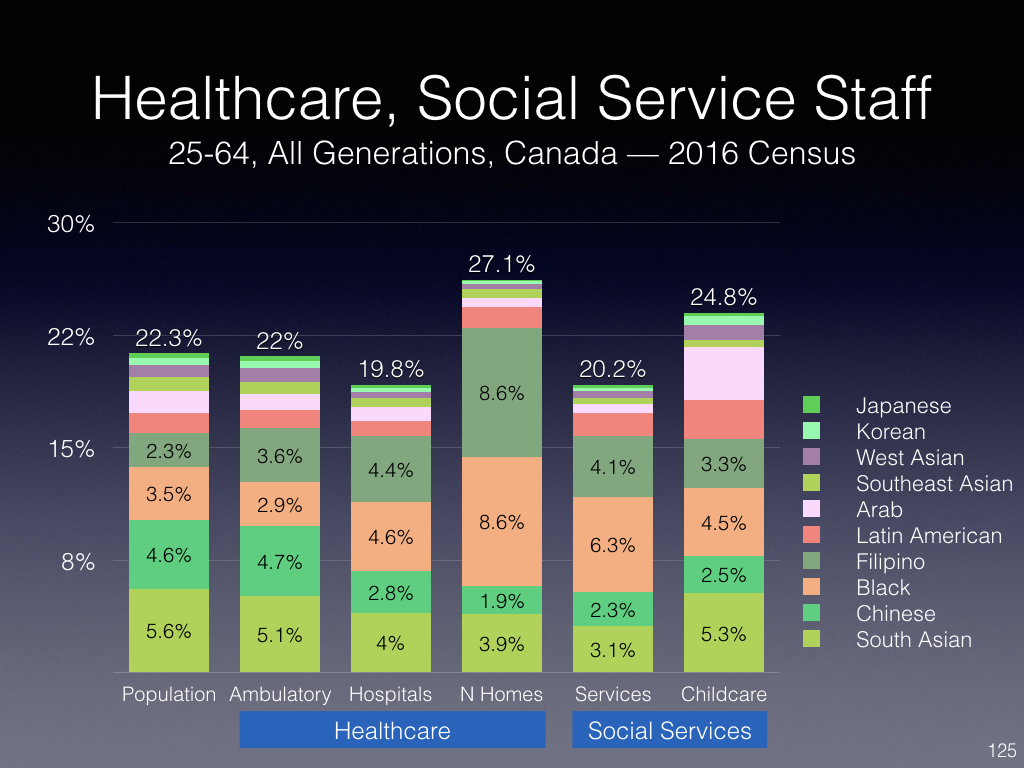
Of note. Haven’t looked at immigrant status but visible minorities provides a similar picture (mix of immigrants and subsequent generations). Some visible minority groups such as Latin American and Blacks are more concentrated in support positions than other groups:

Six million immigrant workers are at the frontlines of keeping U.S. residents healthy and fed during the COVID-19 pandemic. While the foreign born represented 17 percent of the 156 million civilians working in 2018, they account for larger shares in coronavirus-response frontline occupations: 29 percent of all physicians and 38 percent of home health aides, for example. They also represent significant shares of workers cleaning hospital rooms, staffing grocery stores, and producing food.

The foreign born also are over-represented in sectors most immediately devastated by mass layoffs: Restaurants and hotels, office cleaning services, and in-home child care, among them. All told, another 6 million immigrants work in industries that MPI has identified as some of the hardest hit, meaning that collectively 12 million immigrant workers are at the leading edge of the response to and impacts from the pandemic.

As dramatic economic contraction brings hardship to tens of millions in the coming months, the difficulties will be exacerbated for many immigrant workers because of limited access to safety-net systems and to federal relief, both for those who are unauthorized and some who are legally present. The estimated $2 trillion pandemic aid package makes many immigrants eligible for cash relief payments; others, such as most U.S.-citizen or legal immigrant spouses who file taxes jointly with unauthorized immigrants, will not be eligible.

Noncitizens also face restricted access to existing safety-net programs. While green-card holders, those on a temporary work visa, and individuals with Temporary Protected Status or Deferred Action for Childhood Arrivals can access unemployment insurance, most noncitizens cannot turn to the federal, means-tested benefits, including food stamps, that other workers tap in times of need. And immigrant workers face additional vulnerabilities, including smaller incomes and lower rates of health insurance coverage.

Cohen: Why Canada’s response to COVID-19 is so different from that of the U.S.

Another piece on differences:

Comparing the character of nations is risky and imprecise. In the Age of Contagion, though, it offers a window into how the peoples of the world are coping.

Japan, South Korea, Taiwan and Singapore have handled the crisis relatively well. We expect that of people we see as highly disciplined, motivated and organized. Italy is reeling from the contagion. Gregarious, unruly, passionate, creative, independent – this is how we see Italians. It suggests why they were slow to respond.

In Washington, Congress struggles to forge an economic response. The president is erratic and unempathetic. He is widely disbelieved, skeptical of expertise and reluctant to accept responsibility.The media send mixed messages. Fox News, with the highest audience, once denied the pandemic, calling it “a hoax.” One host – before she was fired – claimed the coronavirus was a plot by the Democrats to re-impeach Donald Trump.

The danger is that the medical system will be overwhelmed. On the tenth anniversary of Obamacare, universal health care remains contentious in the United States – undermined by the Republicans, who have tried repeatedly to abolish it, and repeatedly challenged in the courts.

In Canada, a country of 37 million, there were some 2,100 cases and 24 deaths as of early Tuesday. The system is holding, for now. Hospitals have enough masks and respirators, for now. The prime minister appears in public every day, alone, outside his residence. He speaks sensibly, with authority, without hyperbole. This has been his finest hour.Canadians trust him. They may not have voted for him – only about one-third did – but that doesn’t matter now. Nor do we question the competence of his ministers who are the other faces of the crisis – Chrystia Freeland, Marc Garneau, Patty Hajdu, Bill Blair. All are calm, competent and professional. This is what we want.

The provincial premiers, most of whom are not Liberals, have lost their congenital instinct to attack Ottawa. Doug Ford, no admirer of Justin Trudeau, now praises his leadership.All provinces have declared states of emergency, and will not object if the national government does, too. If it must, it will – and we won’t complain.

Opposition parties are not posturing. Andrew Scheer, who called Trudeau “a fraud” last autumn, says this is no time for politics. He is right. His fellow Conservatives, vying to succeed him, have put away their popguns. Some want the leadership vote scheduled for August delayed.

Unlike in America, there is consensus in Canada. No one is saying that the aid package is inadequate, that the government is slow, that money unduly favours corporations. Jason Kenney is not talking about western alienation and the Bloc Québécois is not talking sovereignty. Canadians want only freedom from fear.Mercifully, we have no Fox News. Whatever the CBC’s flaws as national broadcaster, its reporting has been thorough and honest, under trying circumstances. Same with CTV and Radio Canada, and the country’s newspapers and websites.

Why is our response different? It may be a case of identity. Americans celebrate independence, individualism, personal liberty. Many distrust government, resent politicians, court conspiracy and dismiss science. This wasn’t always so – the New Deal and the Great Society expanded the state – but it is now.

Canadians accept big government, which is how we built the social welfare state. Two-thirds of us voted for progressives last year. We defer to authority.Yes, we’ve made real mistakes in the crisis. We didn’t secure airports fast enough or test early and widely enough. Too many are treating physical distancing as a snow day. If we ultimately do better in all this – it’s too early to know or crow – it’s not because we are morally superior. It is because we are smaller, organized, well-led, more united, more measured, more of a community.

It’s a question of character.

Source: Cohen: Why Canada’s response to COVID-19 is so different from that of the U.S.

Minimizing the Risk of Exposure to COVID-19 in Canada Order (Prohibition of Entry into Canada from the United States)

Latest version for those interested.

PC Number: 2020-0184

Date: 2020-03-26


Whereas the Governor in Council is of the opinion that

(a) based on the declaration of a pandemic by the World Health Organization, there is an outbreak of a communicable disease, namely coronavirus disease 2019 (COVID-19), in the majority of foreign countries;

(b) the introduction or spread of the disease would pose an imminent and severe risk to public health in Canada;

(c) the entry of persons into Canada who have recently been in a foreign country may introduce or contribute to the spread of the disease in Canada; and

(d) no reasonable alternatives to prevent the introduction or spread of the disease are available;

Therefore, Her Excellency the Governor General in Council, on the recommendation of the Minister of Health, pursuant to section 58 of the Quarantine Act, makes the annexed Minimizing the Risk of Exposure to COVID-19 in Canada Order (Prohibition of Entry into Canada from any Country other than the United States).

Minimizing the Risk of Exposure to COVID-19 in Canada Order (Prohibition of Entry into Canada from any Country other than the United States)

Definition of immediate family member  

1 In this Order, immediate family member, in respect of a person means

(a) the spouse or common-law partner of the person;

(b) a dependent child, as defined in section 2 of the Immigration and Refugee Protection Regulations, of the person or of the person’s spouse or common-law partner;

(c) a dependent child, as defined in section 2 of the Immigration and Refugee Protection Regulations, of a dependent child referred to in paragraph (b);

(d) the parent or step-parent of the person or of the person’s spouse or common-law partner; or

(e) the guardian or tutor of the person.

Prohibition

2 Any foreign national, as defined in subsection 2‍(1) of the Immigration and Refugee Protection Act, is prohibited from entering Canada if they arrive from a foreign country other than the United States.

Non-application

3(1) Section 2 does not apply to

(a) an immediate family member of a Canadian citizen or of a permanent resident as defined in subsection 2‍(1) of the Immigration and Refugee Protection Act;

(b) a person who is authorized, in writing, by an officer designated under subsection 6‍(1) of the Immigration and Refugee Protection Act or by a consular officer of the Government of Canada, to enter Canada for the purpose of reuniting immediate family members;

(c) a crew member as defined in subsection 101.01‍(1) of the Canadian Aviation Regulations or a person who seeks to enter Canada only to become such a crew member;

(d) a member of a crew as defined in subsection 3‍(1) of the Immigration and Refugee Protection Regulations or a person who seeks to enter Canada only to become such a member of a crew;

(e) a person who is exempt from the requirement to obtain a temporary resident visa under paragraph 190‍(2)‍(a) of the Immigration and Refugee Protection Regulations and the immediate family members of that person;

(f) a person who seeks to enter Canada at the invitation of the Minister of Health for the purpose of assisting in the COVID-19 response;

(g) a person who arrives by any means of a conveyance operated by the Canadian Forces or the Department of National Defence;

(h) a member of the Canadian Forces or a visiting force, as defined in section 2 of the Visiting Forces Act, and the immediate family members of that member;

(i) a French citizen who resides in Saint-Pierre-et-Miquelon and has been only in Saint-Pierre-et-Miquelon, the United States or Canada during the period of 14 days before the day on which they arrived in Canada;

(j) a person or any person in a class of persons who, in the opinion of the Chief Public Health Officer appointed under subsection 6‍(1) of the Public Health Agency of Canada Act

(i) does not pose a risk of significant harm to public health, or

(ii) will provide an essential service while in Canada;

(k) a person whose presence in Canada, in the opinion of the Minister of Foreign Affairs, the Minister of Citizenship and Immigration or the Minister of Public Safety and Emergency Preparedness, is in the national interest;

(l) a person who arrives by means of a vessel as defined in section 2 of the Canada Shipping Act, 2001, if the vessel departed before 00:00:01 am Eastern Daylight Time on March 21, 2020 and had a scheduled destination of Canada upon its departure;

(m) the holder of a valid work permit or a study permit as defined in section 2 of the Immigration and Refugee Protection Regulations;

(n) a person whose application for a work permit referred to in paragraph (m) was approved under the Immigration and Refugee Protection Act and who has received written notice of the approval, but who has not yet been issued the permit;

(o) a person whose application for a study permit referred to in paragraph (m) was approved under the Immigration and Refugee Protection Act, and who received written notice of the approval before noon, Eastern Daylight Time on March 18, 2020, but who has not yet been issued the permit;

(p) a person permitted to work in Canada as a student in a health field under paragraph 186‍(p) of the Immigration and Refugee Protection Regulations;

(q) a person permitted to work in Canada as a provider of emergency services under paragraph 186‍(t) of the Immigration and Refugee Protection Regulations.

(r) a licensed health care professional with proof of employment in Canada;

(s) a person who seeks to enter Canada for the purpose of delivering, maintaining, or repairing medically-necessary equipment or devices;

(t) a person who seeks to enter Canada for the purpose of making medical deliveries of cells, blood and blood products, tissues, organs or other body parts, that are required for patient care in Canada during or within a reasonable period of time after the expiry of the Order;

(u) a person whose application for permanent residence was approved under the Immigration and Refugee Protection Act, and who received written notice of the approval before noon, Eastern Daylight Time on March 18, 2020, but who has not yet become a permanent resident under that Act; or

(v) a worker in the marine transportation sector who is essential for the movement of goods by vessel, as defined in section 2 of the Canada Shipping Act, 2001, and who seeks to enter Canada for the purpose of performing their duties in that sector.

Exception — signs and symptoms

(2) Despite subsection (1), a foreign national is prohibited from entering Canada from a foreign country other than the United States if they exhibit the following signs and symptoms:

(a) a fever and cough, or

(b) a fever and breathing difficulties.

Exception — optional or discretionary purpose

(3) Despite subsection (1), a person who seeks to enter Canada for an optional or discretionary purpose, such as tourism, recreation or entertainment, is prohibited from entering Canada from a foreign country other than the United States.

Non-application — order

4 This Order does not apply to

(a) a person registered as an Indian under the Indian Act; or

(b) a protected person within the meaning of subsection 95‍(2) of the Immigration and Refugee Protection Act.

Powers and obligations

5 For greater certainty, this Order does not affect any of the powers and obligations set out in the Quarantine Act.

Repeal of P.C. 2020-0162

6 The Minimizing the Risk of Exposure to COVID-19 Coronavirus Disease in Canada Order (Prohibition of Entry into Canada from any country other than the United States) is repealed.

Effective period

7 This Order has effect for the period beginning on the day on which it is made and ending on June 30, 2020.

Source: https://orders-in-council.canada.ca/attachment.php?attach=38958&lang=en

Crisis within a Crisis: Immigration in the United States in a Time of COVID-19

Good overview by Muzaffar Chishti and Sarah Pierce of MPI on the cumulative impact of US immigration restrictions and related policies on COVID-19 (conclusion):

Relief for Some, But Not All

Once the severity of the health and economic crisis precipitated by the pandemic became evident, Congress passed—and the president signed—two emergency aid packages offering economic and other assistance. A far larger, “Phase 3” estimated $2 trillion-dollar package has been approved by the Senate, awaiting House action. It would provide important medical coverage for Americans who are uninsured and an economic cushion in the form of cash payments, extended unemployment insurance benefits, and other income supports for many impacted by the sharp economic decline and rising joblessness. But the aid package excludes a large section of the noncitizen population. For the medical benefits, the bill excludes even a substantial-share of green-card holders—those who have held legal permanent residence for less than five years. And the economic relief and tax rebate provisions exclude more than 4 million immigrant workers, typically unauthorized, who pay income taxes but use Individual Taxpayer Identification Numbers (ITINs) instead of Social Security numbers to file their tax returns. Advocates had been able to get these provisions included in a House draft that ultimately was not considered; they undoubtedly will plan to push for these to be addressed in future coronavirus-relief legislation.

Immigrant advocates note that foreign-born workers, legal and unauthorized alike, not only constitute a sizeable number of those in critical occupations on the frontlines of fighting the pandemic, they also work disproportionately in non-salaried, nonpermanent jobs, living close to the margin. At the other end of the debate, some conservatives have argued in favor of reserving taxpayer funds for the U.S. born, and in particular object to including unauthorized immigrants. Yet excluding workers who are among the most vulnerable in society from critical safety-net benefits would compromise the effectiveness of the entire aid package and recovery from a virus that makes no distinction based on national origin, immigration status, or income level, experts have noted.

There are no parallels to the multidimensional challenges that the COVID-19 pandemic has presented the United States and the world in this globalized and economically interdependent era in which we live. The vast public health crisis and resulting economic freefall require a global response, and certainly a unified and robust national response where all institutions and individuals are responding to their fullest potential. A set of policies that intentionally or inadvertently discourages a subset of the population from fully participating—without fear or repercussion—in this war against the invisible enemy compromises the wellbeing and lives of all of us.

Source: new article

Neo-Nazis from U.S. and Europe build far-right links at concerts in Germany

Of note. As if we don’t have enough to worry about these days…

As the deafeningly loud, rapid-fire music known as “hate rock” blasted out, hundreds of white nationalists, skinheads and neo-Nazis nodded their heads and swigged their drinks.

Among them was Keith, 46, a welder from Las Vegas, who for the second year in a row had traveled from Nevada to Germany to attend several far-right events.

“We must secure the existence of our people and a future for white children,” Keith told NBC News in June.

However, he was not there just to enjoy the music. He said he was also hoping to share ideas and strategies with like-minded people — a small part of what Jonathan Greenblatt, CEO of the Anti-Defamation League, said was becoming an increasingly interconnected international movement with “clear links” between Europe and the U.S.

“You can’t just sit at home and eat cheeseburgers anymore. It’s time to mobilize,” said Keith, who did not wish to have his last name published, for fear of reprisals back in the U.S.

Events like the one in Themar, a small town in central Germany, are reluctantly tolerated and strictly controlled by the authorities. Both federal and local police could be seen monitoring the gathering, and riot squads with water cannons were braced for trouble nearby.

Keith changed his clothes before venturing to the event. At a privately run hotel before the event, he had been dressed from head to toe in clothing full of white power symbolism, and he wore a necklace showing Odin’s wolves and Thor’s hammer.

His big steel-capped boots, with 14 lace holes representing a popular white supremacist slogan, were scuffed from “brawling,” he boasted.

He said he was prevented from wearing them outside because German police considered them a weapon.

The country’s laws also ban the display of Nazi imagery and any action that could be deemed an incitement of hatred. To avoid arrest, many attendees walked around with Band-Aids on to hide their swastika tattoos.

“You’ll notice there’s a whole lot of people with scratches or bruises around here,” Keith said, adding that while he had given Nazi salutes many times, he would not do so in Germany because he would likely be arrested

Like other events of its type, it was held just outside the town, cordoned off to keep it separate from the local community. Keith and his fellow attendees then faced a gauntlet of searches and Breathalyzer tests from the authorities and jeering from a handful of anti-fascist protesters.

Separated by police and metal barriers, one of the demonstrators blew bubbles at them, while another taunted them with a beer can on a fishing rod.

As they have at many events of this type, police had banned the sale of alcohol, citing violence at similar events in the past. In March 2019, journalists and police officers were attacked at a far-right rock concert in Saxony.

Once inside the event in Themar, attendees, including a number of Americans like Keith, were greeted by Patrick Schroeder, who runs a weekly internet TV show espousing far-right views. He handed them free red baseball caps emblazoned with “MGHA,” shortform for “Make Germany Hate Again.” They mimick the “Make America Great Again” hats used to promote Donald Trump’s 2016 presidential campaign.

“We make it look like the Donald Trump party when he was elected,” said Schroeder, who has been dubbed a “nipster,” or “Nazi-hipster,” by the German media.

While the German government does not regularly publish the number of far-right events and concerts, the Interior Ministry has provided them when asked by members of Parliament. The last time they were made public, the figures showed that there had been 132 events of this type from January to September 2019.

There was a “major increase” in the number of violent crimes linked to the far right in Germany in 2017, according to the latest report from the Interior Ministry. The rise in right-wing extremist offenses motivated by anti-Semitism during the reporting year was also “noticeable,” it said, without providing figures.

In the U.S. meanwhile, the FBI recorded 7,036 hate crimes in 2018 — the latest figures available — of which 59.6 percent were racially motivated. That was a 17 percent spike in hate crimes overall, and there was a 37 percent increase in anti-Jewish incidents — the most common kind.

While it is unclear how many Americans attend events like the one in Themar, “there’s a great deal of cross-pollination” between the far right in Europe and the U.S., said Greenblatt.

“There are clear links between white supremacists in the United States and their ideological fellow travelers in Europe,” Greenblatt said in an interview, adding that the alt-right in the U.S. and Europe’s far-right Identitarian movement were both young and sophisticated and used the internet and social media to spread their messages.

“Both these movements have a lot in common,” he added. “They are anti-globalization, they are anti-democratic, they are anti-Semitic to the core, and they are highly opposed to multiculturalism and diversity of any sort.”

European white supremacists were marching in 2017 at the “Unite the Right” rally in Charlottesville, Virginia, where counterdemonstrator Heather Heyer was killed when a car was deliberately driven into a crowd, he said.

A few months later, American white supremacists marched at the Independence Day rally in Poland, he added.

Greenblatt said there was a “through line” between a series of atrocities linked to attackers inspired by far-right thinking, including Anders Breivik, now 40, who killed 77 people in Norway’s worst terrorist attack in July 2011.

Breivik told a court that he wanted to promote his manifesto, a mixture of his thinking, far-right theories and other people’s writing. This included sections from a manifesto produced by Theodore Kaczynski, the Unabomber, who over a number of years sent letter bombs to several universities and airlines, killing three people and wounding 23 others.

American white supremacist Dylann Roof, now 25, who killed nine people at a historic black church in Charleston, South Carolina, in a bid to promote a “race war” in June 2015, cited Breivik as an influence, as did white nationalist Alexandre Bissonnette, now 21, who shot six people dead at a mosque in Quebec City in 2017. Bissonnette also praised Roof.

After 11 people were gunned down at the Tree of Life synagogue in Pittsburgh in October 2018, the suspect, Robert Gregory Bowers, was found to have repeatedly threatened Jews in online forums. British lawmaker Jo Cox was killed in the street in 2016 by a man inspired by far-right beliefs.

In March 2019, a man walked into two mosques in Christchurch, New Zealand, killing 59 people as he livestreamed the attack on Facebook. He referred to Breivik, Roof and Bissonnette in his writings.

“We are no longer talking about one-off events, but a loosely coordinated chain of far-right attacks across the world, where members of these networks inspire — and challenge — each other to beat each other’s body counts,” said Peter Neumann, a professor of security studies at King’s College London.

These killers want to “launch a race war,” he said, adding: “The aim is to carry out attacks, claim responsibility, explain your actions and inspire others to follow.”

Describing himself as “a white internationalist because I’m international at this point and I’m participating in political activities on more than one continent,” Keith said he did not approve of violence.

But he said he thought the far-right attacks were a “direct result of the terrorist attacks that have happened against Christians and white people throughout the world.”

Keith said he did not believe that Trump was a white nationalist, although he said the U.S. president was “definitely white” and “definitely a nationalist.”

However, he added: “To put the two together is suggesting that he has some kind of desire to be associated with people like myself, and I don’t believe he does.”

Nevertheless, he said it is “great” having a national leader who “makes common-sense decisions in line” with his own beliefs.

Greenblatt said he found it “deeply disturbing” to see neo-Nazis “taking cues from our commander in chief.”

Trump has been criticized on a number of occasions for his use of language and his failure to condemn racist behavior from his supporters.

After Heyer was killed, Trump declared that there were “very fine people on both sides,” although in a later White House briefing he said the “egregious display of “hatred, bigotry and violence” had “no place in America.

Similarly, as the president stood by, the crowd at a Trump rally last year in Greenville, North Carolina, chanted “send her back” about the Rep. Ilhan Omar, D-Minn., Rep. Alexandria Ocasio-Cortez, D-N.Y., Rep. Ayanna Pressley, D-Mass and Rep. Rashida Tlaib, D-Mich, collectively known as “the squad.”

Trump later disavowed those chants, telling reporters: “i was not happy with it. I disagree with it.”

Asked about whether white supremacists were taking their cues from Trump, a White House spokesperson told NBC News the the president had consistently and repeatedly rejected racism, racial discrimination, and anti-Semitism in all its forms.”

That should be a real cause for concern, Greenblatt said. “The racists feel like they have someone who is in their corner, and that is a total break from the role of the presidency.”

Source: Neo-Nazis from U.S. and Europe build far-right links at concerts in Germany

#FATCA Accidental Americans ask US to cut fees for renouncing citizenship

More on FATCA and renunciation fees:

The Accidental Americans Association (AAA) has written a letter to the US Secretary of State, asking the country to reduce the costs of renouncing American citizenship.

Many accidental Americans would like to give up their US citizenship to avoid having tax obligations to a country most have never even lived in. However, the waiver procedure alone costs $2,350 and the final sum could run to thousands of dollars since they also need to pay the Internal Revenue Service any tax obligations from the previous five years.

“$2,350 is an exorbitant sum and does not correspond at all to the real cost of the procedure,” Fabien Lehagre, president of the Accidental Americans Association wrote in the letter addressed to Mike Pompeo.

$2,350 is an exorbitant sum and does not correspond at all to the real cost of the procedure”

According to a recent report by the Office of Information and Regulatory Affairs of the Executive Office of the President, State Department calculations show the cost of the procedure is just $20.25 per person.

“Therefore, on behalf of the accidental Americans I have been representing around the world for the past five years, I would ask you to kindly instruct your administration to reduce the costs associated with the renunciation procedure drastically, so that accidental Americans can get rid of their unwanted [American] nationality if they so wish,” Lehagre added.

The EU has urged the US to cut the $2,350 (£1,785) bill for renouncing American citizenship, and to simplify tax filing requirements.

The US is the only country aside from Eritrea that taxes non-resident citizens on their global income.

Accidental Americans is the name given to individuals who are citizens of countries other than the United States, but who are deemed also to be a US citizen, by virtue of the fact that they were born there to non-American parents, but typically only discovered this fact recently, as FATCA came into force.

FATCA was passed in 2010 and forces banks wanting to operate in the US to report any assets held by American citizens overseas. While the measure is aimed at tax avoidance, it has created problems for many American expats and dual nationals who have been rejected by retail banks seeking to avoid hassle and risk.

Dutch banks have started freezing the accounts of dozens of ‘accidental’ Americans in the Netherlands because they have failed to provide them with their US tax information numbers (TINs), a requirement under FATCA.

French Finance minister Bruno Le Maire has said that failure to comply with the FATCA TIN requirement is not cause for banks operating in the country to immediately close the accounts of French-American taxpayers. However banks are nervous about what to do.

It is estimated that over 9 million Americans live overseas, not including accidental Americans.

Source: Accidental Americans ask US to cut fees for renouncing citizenship

Immigration Grinds To A Halt As President Trump Shuts Borders

More on recent US developments, including ICE detention facilities where social distancing is not possible:

President Trump plans to seal off the U.S-Mexico border to migrants under a law intended to protect the country from communicable disease — a move that comes as the U.S. immigration system grinds to a halt in response to the growing coronavirus pandemic.

At a press conference Wednesday, Trump said the southern border would not close completely. But the move would allow the administration to quickly deport asylum-seekers and other migrants who cross the U.S.-Mexico border illegally without due process.

Meanwhile, the U.S. and Canada have agreed to close their mutual border to all “non-essential” traffic, following earlier restrictions imposed by the Trump administration on travel from Europe and China.

The dramatic developments on the northern and southern borders come as immigration is being curtailed in other ways, too.

U.S. Immigration and Citizenship Services, the agency in charge of processing green card and citizenship applications as well as conducting asylum interviews, is closing its field offices to the public. Immigrants fighting deportation are having their cases postponed as some immigration courts are limiting dockets and others are closing. Refugee resettlement is temporarily suspended as well, according to the United Nations, because of the Coronavirus pandemic.

There are about 100 confirmed cases of COVID-19 in Mexico, and about 600 in Canada, compared to nearly 8,000 cases in the United States.

Immigrant advocates accuse the Trump administration of exploiting the pandemic to advance its crackdown on asylum-seekers, and the partial closure of the southern border where thousands have amassed in Mexico is sure to draw legal challenges.

“President Trump has been falsely scapegoating immigrant communities in the name of public safety since he came into office,” said Michelle Brané at the Women’s Refugee Commission. “This rule would unquestionably violate both domestic and international law and is an abdication of our moral responsibility to protect vulnerable people.”

In addition, immigrant advocates and physicians who study detention facilities are calling on U.S. authorities to release detained immigrants who pose no threat to public safety — starting with detainees who have medical conditions that put them at high risk for severe complications from COVID-19.

In immigration detention, there’s no such thing as social distancing. Detainees often live together, in large rooms with rows of cots. Immigrant advocates say that makes detention centers ideal breeding grounds for the virus.

“It is a disaster that is waiting to happen,” said Eunice Cho, a lawyer with the American Civil Liberties Union, which filed a lawsuit this week seeking the release of immigrants with a range of medical problems who are detained by Immigration and Customs Enforcement in Tacoma, Wash.

“Medical conditions in ICE detention facilities are inadequate in normal times,” Cho said. “These are not normal times, and ICE needs to take stock of that.”

ICE is currently holding more than 37,000 immigrants in its detention centers. Nearly half have been accused of no crime other than civil immigration violations, and many probably would not have been held under previous administrations.

ICE is scaling back its enforcement activities. In a statement, the agency says it will stop making arrests except in “mission critical” criminal cases. The agency says it will focus on individuals who pose a public safety risk and delay other enforcement actions.

Court cases involving ICE detainees will continue, despite calls to suspend all hearingsfrom the union representing immigration judges, prosecutors and immigration attorneys. Hearings for immigrants who are not in detention have been postponed until April. Immigration courts in New York, Atlanta, Houston and elsewhere will close.

In a statement, ICE says it is taking precautions to protect detainees. The agency has temporarily suspended social visits at all of its detention centers. As of Tuesday, ICE says, there were no confirmed cases of COVID-19 in its detention facilities.

But in New Jersey, one staffer at the Elizabeth Detention Center has voluntarily self-quarantined after feeling ill, and has been tested for the COVID-19.

“It would seem to be only a matter of time before the virus makes its way into these particular settings,” said Anwen Hughes, an attorney with the nonprofit Human Rights First who represents immigrants being held in Elizabeth.

“There’s the opposite of social distancing” at the facility, Hughes said. “It’s like social piling on.”

It’s not just immigrant advocates who want to see ICE detainees released.

“A lot of people think that, well, these are, you know, controlled locked facilities and you just lock them up and seal them off and the virus isn’t going to get in. Well, it’s not that simple,” said Dr. Josiah Rich, an epidemiologist at Brown University who studies infectious disease in correctional facilities.

It’s not just the detainees who are at risk if there’s an outbreak, Rich says, because an influx of sick detainees could overwhelm local medical facilities.

“So you’ll have a whole group of people that are going to be infected because of rapid spread in that correctional and detention facility,” he said. “And then all of sudden, those people will get sick all at once.”

Source: Immigration Grinds To A Halt As President Trump Shuts Borders

The Coronavirus Is Hindering One Of The Trump Administration’s Ways To Deport Asylum-Seekers

Ironic:

The Guatemalan government has suspended accepting flights carrying asylum-seekerstrying to enter the US — rebuffing one of the Trump administration’s key methods of deporting would-be immigrants — as a way to prevent the spread of the coronavirus within its borders.

The controversial policy, which has been in place since late last year, sends people from Honduras and El Salvador who try to seek asylum in the US to Guatemala to seek protection there instead.

Guatemala’s Ministry of Foreign Affairs announced the change on Tuesday. Department of Homeland Security officials did not respond to a request for comment.

The policy — officially labeled as an Asylum Cooperative Agreement and colloquially called a “safe third country” agreement — is a key element in its strategy to deter immigration at the border and restrict asylum-seekers from entering the US. Advocates and asylum officers previously told BuzzFeed News that the unprecedented agreement lacks legality and organization and will lead to immigrants being placed in dangerous circumstances.

Guatemala’s Ministry of Foreign Affairs said it had also suspended flights of Guatemalan deportees from the US while it established health protocols to ensure a deportee doesn’t take the virus back to their community. Officials said plans include three medical checks in the US, as well as one before getting on a plane for Guatemala and another inspection when they land.

There is no timeline for when that would happen.

Senior administration officials have said the policy of sending asylum-seekers from El Salvador and Honduras to Guatemala is an opportunity for individuals from the countries to seek protection closer to their home countries.

“We are building protections that will be available to the region’s vulnerable populations closer to home — eliminating the need to make the dangerous journey north and lining the pockets of transnational criminal organizations,” acting Homeland Security Secretary Chad Wolf said in December.

The coronavirus pandemic has been spreading within US communities for weeks. This has led to cancellations of large conferences, concerts, and other events; widespread closures of schools; and other containment measures.

Guatemala recently reported the first death of an individual from COVID-19, the disease caused by the novel coronavirus, within its country on Sunday.

On Tuesday afternoon, US Citizenship and Immigration Services asylum officers had yet to receive guidance on the reported suspension of flights to Guatemala. The officers oversee key aspects of the program to send asylum-seekers from El Salvador and Honduras to Guatemala.

Source: The Coronavirus Is Hindering One Of The Trump Administration’s Ways To Deport Asylum-Seekers