The same characteristics apply to Canada in terms of the limited impact of immigration on addressing an aging demographic. However, given Canada’s prioritizing skilled immigration, the fiscal drain arguments don’t apply (previous studies by Grubel that argued thus were flawed):
The idea that immigration is the solution to the aging of American society has become an article of faith among those arguing for ever-higher levels of new arrivals. They assert that, in societies such as the United States, where fertility rates are low relative to historic patterns, the native population will not supply enough workers to maintain a robust economy and pay for government services, particularly retirement programs. If native-born Americans aren’t going to have enough children to balance the longer-lived elderly population, the argument goes, then our only option is to increase immigration levels.
It’s not a crazy argument; it just happens to be incorrect. In reality, a significant body of research shows that the impact of immigration on population aging is small. While immigration can certainly make our population larger, it does not make us dramatically younger.
And yet, commentators have been making such arguments for years. The late Washington Post columnist Charles Krauthammer asserted in 1998 that America has been “saved by immigrants” from the kind of aging taking place in other first-world countries. Former Florida governor Jeb Bush famously said that America needed higher levels of immigration to “rebuild the demographic pyramid.” At the data-journalism site FiveThirtyEight, Ben Casselman has argued that immigration is the “only thing” preventing the country from facing a “demographic cliff.”
The release of the 2020 census showing the U.S. population grew by only 22.7 million since 2010, coupled with preliminary data indicating a sharp drop in fertility during the Covid-19 pandemic, have prompted a new round of articles asserting that immigration is the solution to population aging. The title of a recent Vox piece by Nicole Narea summed up this view: “The Census Shows the US Needs to Increase Immigration — By a Lot.” Similarly, George Mason University’s Justin Gest has called for doubling immigration to make the United States “younger, more productive and richer.”
But demographers have known for a long time that, absent truly gargantuan and ever-increasing rates of immigration, it isn’t actually possible for immigrants to undo or dramatically slow the overall aging of society. As Oxford demographer David Coleman observes, “it is already well known that [immigration] can only prevent population ageing at unprecedented, unsustainable and increasing levels of inflow.”
Those who argue that immigration is the key to dealing with an aging society are right about one thing: Both the share of the population that is of working age (16 to 64) and the ratio of workers to retirees are declining as Americans live longer and have fewer children. It is also true that, primarily due to post-1965 immigration, immigrants and first-generation Americans represent a growing share of the U.S. population and workforce. But this does not mean that immigration can dramatically slow or halt the aging of American society to nearly the degree that many seem to believe.
There are four broad reasons why the demography doesn’t support the political credo. First, not all immigrants arrive young — in fact, a growing share are arriving at or near retirement age. Second, immigrants age just like everyone else, adding to the elderly population over time. Third, immigrant fertility rates tend to converge with those of the native born. Fourth, to the extent that immigrants do have higher fertility rates than the native born, their children add to the dependent population — those too young or old to work. All of this means that immigration has only a modest impact on the working-age share of the population and the ratio of workers to retirees.
Immigration and Population
Studying the impact of immigration on population aging is nothing new for demographers. In a 1992 article in Demography — the top journal in the field — economist Carl Schmertmann explained that mathematically, “[c]onstant inflows of immigrants, even at relatively young ages, do not necessarily rejuvenate low-fertility populations. In fact, immigration may even contribute to population aging.” In 1994, Thomas Espenshade, the former chairman of Princeton’s sociology department and director of its graduate program in population studies, concluded the same. “Immigration,” he observed, “is a clumsy and unrealistic policy alternative to offset a shortage of domestic labor or to correct a perceived imbalance in the pensioner/worker ratio in the United States.” Likewise, as part of its population projections in 2000, the U.S. Census Bureau stated that immigration is a “highly inefficient” means for increasing the working-age share in the long run.
More recent studies only confirm these conclusions. A paper I co-authored for the 2012 annual meeting of the Population Association of America, for instance, shows that future levels of immigration have a modest impact on population aging. A 2019 version of that paper, which is based on the most recent Census Bureau population projections, demonstrates the point yet again.
According to those projections, the total U.S. population will reach 404 million in 2060. This figure assumes current trends in net migration — the difference between the number of people arriving and those leaving — will continue, at an average rate of about 1.1 million each year. To determine the effect this level of immigration will have on the U.S. population, we can compare the bureau’s 2060 projection to the projected population under a scenario where net migration is zero (which is unlikely in the extreme, of course, but useful for our analysis). In this scenario, the U.S. population would decline slightly, to 329 million. The 75-million difference between the two figures represents the impact that immigration will have on the total population over the next 39 years.
The Census Bureau also estimates that, in 2060, 59 percent of the population will be of working age. Again, this is based on the assumption that net migration will amount to an average of 1.1 million each year. Under a zero-immigration scenario, just under 57 percent of the population would be of working age. In other words, while immigration is projected to add 75 million people to the American population by 2060, it will only increase the working-age share of the population by about two percentage points. Even if annual net immigration were expanded by 50 percent above what the Census Bureau projects, so that it averaged about 1.65 million a year, it would still only increase the working-age share of the population by three percentage points.
Part of the reason immigration has such a small effect on the working-age share of the population is that while it certainly adds new workers, it also adds to the number of retirees over time, as well as to the number of children. To be sure, these children eventually grow up and become workers. But by the time this happens, many of their immigrant parents will have reached retirement age. These two developments tend to cancel each other out over time. As a result, immigration does not have much of an impact on the share of the population that is of working age in the long run.

This fact is key to understanding why immigration has such a modest impact on overall population aging. Looking at the average age of immigrants over time, as opposed to projecting into the future, shows how this works. In 2000, the average age of all immigrants — not just new arrivals — was 39.2 years. By 2019, it was 46 — a seven-year increase. Over the same period, the average age of native-born Americans increased only slightly, from 35.4 years to 38 years. Part of the reason for the disparity is that all children born to immigrants are considered natives, so they add only to the native-born population. Nonetheless, the relatively high and increasing average age of all immigrants is a good reminder that they grow old like everyone else, even if they do arrive when relatively young.
Most people recognize why a larger senior population increases government expenditures, but fewer acknowledge that a larger population of children does so as well. Government spending on children makes up a sizeable portion of federal, state, and local budgets: The United States spent $726 billion on public schools during the 2017-2018 school year alone. Federal and state governments also spend more than $1 trillion per year on means-tested programs, a large share of which goes to families with children. Indeed all societies, including ours, devote enormous resources to providing for children, and for good reason. But a larger population of children means the state must spend more to provide for them.
Even if we were to exclude children from the analysis and focus solely on the ratio of working-age people to retirees (those 65 and over), the impact of immigration would still be modest. Under the Census Bureau’s current projections, there will be 2.5 working-age people per retiree in 2060. If the projected immigration rate were cut in half, there would be 2.3 workers per retiree. Commenting on our findings at a panel discussion, American Enterprise Institute scholar Nicholas Eberstadt summarized the upshot succinctly: “[I]mmigration cannot possibly over the long run maintain a youthful population structure.”
Of course, as Espenshade and Coleman suggest, it is theoretically possible to use immigration to preserve the current working-age share of the population, as well as the ratio of workers to retirees. But doing so would require levels of immigration that have no precedent in American history. Our analysis shows that, to roughly maintain the working-age share of the population, immigration rates would have to increase five-fold over what the bureau currently foresees. This would create a total population of 706 million in 2060 — more than double the current population. Under such a scenario, by 2060, most U.S. residents would be post-2019 immigrants or their offspring. This level of immigration would be transformative in the extreme; few aspects of society would remain untouched by adding so quickly and so dramatically to the U.S. population.
Immigration and Aging
Population projections provide a reasonable picture of what is likely to happen demographically in the future, but they also rely on assumptions about trends that are always changing. As a result, the newest Census Bureau projections do not fully reflect the significant increase in the age at which immigrants are now coming to America.
Although newcomers were slightly younger in 2019 than they were in 2018, the average age of new immigrants, including illegal immigrants, is still much higher than it was in the past — increasing from 26 in 2000 to 31 in 2019. Perhaps even more surprising, the share of newly arrived immigrants who are 55 and older more than doubled, from 5 percent in 2000 to 11 percent in 2019. This means that one in nine new immigrants is arriving old enough to move directly into a retirement community.

Why are immigrants arriving at older ages? One reason is that, as the United Nations has reported, fertility is declining and life expectancy is increasing worldwide. Rapidly aging populations in countries that send immigrants to the United States almost certainly translate into immigrants arriving at older ages, at least to some extent.
Even more importantly, U.S. citizens can sponsor their parents for permanent residence without numerical limits. Parents typically immigrate to the United States after age 50, meaning they tend to be at or near retirement age as soon as they arrive. As the number of naturalized citizens living in the United States has nearly doubled since 2000, it should come as no surprise that the number of immigrants arriving each year in the parents category has increased in turn.
It is fair to criticize this category of permanent immigration — at least for a society facing an entitlement-funding crisis, such as ours. But it would be politically difficult to end the program. Press accounts in recent years indicate that the Trump administration considered offering parents a continually renewable temporary visa instead of permanent residence, but no such policy was formally proposed. The Biden administration is unlikely to advance such an idea. And in any case, the approach would still have meant the arrival of perhaps 150,000 or more parents each year, who would have added to overall population aging.
The understandable desire of many immigrants to bring their parents to the United States means that any immigration reform that emerges from Congress will almost certainly allow a substantial number of older immigrants to enter the country on both permanent and long-term temporary visas. Once these individuals arrive, it is hard to imagine the government refusing to provide some level of assistance for them — after all, many elderly immigrants who did not work long enough to qualify for Social Security or Medicare often end up receiving Supplemental Security Income and Medicaid. Like our devotion to providing for children, our commitment to assisting the elderly is not without merit. But we should also be cognizant of how immigration policy affects our ability to make good on this commitment as our society ages.
Immigration and Fertility
A key reason for the aging of America’s population is the declining fertility rate among the native born. Many commentators assume that immigration can help reverse this trend, as they believe immigrant women tend to have many more children than do American-born women.
Yet as mentioned above, declining fertility rates are a near-universal trend. Several of the top countries that contribute to America’s immigrant population — including Cuba, Vietnam, China, and South Korea — have fertility rates near as low as, or even lower than, that of the United States. More importantly, immigrants living in the United States are increasingly reflecting these trends: Despite a 9 percent increase in the total number of immigrant women of childbearing age between 2008 and 2019, there were 158,000 fewer births to immigrant women in 2019 than there were in 2008.
As the graph below indicates, the total fertility rate (TFR) — the number of children a woman is expected to have in her lifetime — for immigrant women has fallen steadily. In 2008, immigrant women had a TFR of 2.75. By 2019, the rate had fallen to 2.02. A TFR of 2.1 is widely considered necessary to maintain the existing population. Thus, for what is almost certainly the first time in American history, the immigrant fertility rate was below replacement level.
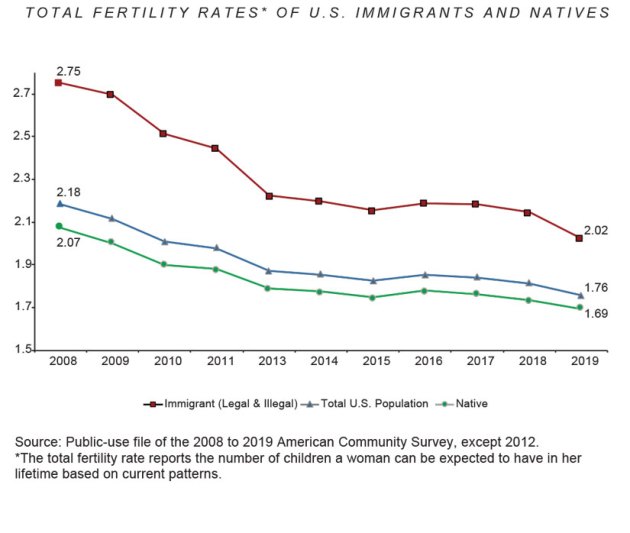
As the graph above indicates, the TFR for native-born women also declined over the same period. But it did so by roughly half as much as it has among immigrants. To be sure, the overall immigrant TFR of 2.02 is still higher than the 1.69 TFR of natives. But the presence of immigrants only pulls up the overall TFR in the United States to 1.76 — an increase of just 4 percent.
The steep decline in immigrant fertility has not received much media coverage, even while the fall-off in births nationwide has received a good deal of press. In fact, many people remain unaware that it has occurred. The Census Bureau is aware of the development, but again, the trends it relies on are always changing, and it takes time to incorporate changes of this kind into its population projections. As a result, the bureau’s most recent projections do not fully capture this trend, instead assuming a 2019 TFR for immigrants of 2.5 — well above the actual rate of 2.02. Because immigrant fertility is much lower than projected, the small, positive impact of immigration on population aging shown in the bureau’s projections is even smaller. What’s more, although the fertility numbers for 2020 are preliminary, we do know that fertility was down significantly in the country during the pandemic. There is no reason to believe immigrants bucked this trend.
Among native-born Americans, Hispanics have seen the steepest drop in fertility in recent years. American-born Hispanic women had a TFR of just 1.77 in 2019. The TFR was 1.42 for American-born Asian women that same year — both well below replacement level. The rate for native-born whites and blacks was 1.69 and 1.68, respectively. In short, among native-born whites, blacks, and Hispanics, there is now no meaningful difference in fertility rates, while the native-born Asian fertility rate is a good deal lower than the rest. Thus, in a very real sense, immigrants and their children are assimilating to American norms when it comes to family size. This means immigration is no game changer when it comes to the nation’s birth rate.
Intriguingly, some research indicates that immigration may actually lower the fertility rate of the native born, most likely by driving up housing costs, which discourages couples from starting or expanding their families. Kelvin Seah of the National University of Singapore has found that the Mariel Boatlift to Miami — during which about 125,000 Cuban immigrants arrived in the city during a five-month period in 1980 — caused a significant decline in native fertility. In an analysis completed this year, Karen Zeigler and I show that in large metropolitan areas, a higher share of immigrants in the population correlates with lower fertility among the native born, even after controlling for each city’s demographic characteristics. If this finding is confirmed, it could erase, and perhaps even reverse, the small positive impact of immigration on the nation’s overall fertility.
The Fiscal Picture
One of the central concerns about population aging is the ability of an older society to pay for government. With immigration, the hope is that young immigrants will help pay for entitlement programs. Of course, this depends on their actual tax payments relative to the fiscal costs they create. While many immigrants are young, are highly skilled, and have high incomes, immigrants on average have less education and lower incomes than do native-born Americans. This makes it difficult for them to generate the kind of fiscal surplus that would be necessary to help them pay for entitlement programs.
In 2017, the National Academies of Sciences, Engineering, and Medicine (NASEM) estimated the current net fiscal impact of all immigrants and their dependents using eight budgetary scenarios. In all eight of these scenarios, immigrants and their dependents were found to be a net fiscal drain, paying less in total taxes than the costs they created. Though they were found to be a surplus in four of the scenarios at the federal level, their fiscal drain at the state level offset the federal surplus.
Even if immigrants were able to shift the ratio of workers to retirees dramatically, it would not help fill public coffers if they are a net fiscal drain on government funds before they reach retirement age. The best evidence indicates that this is in fact the case, at least at present. One might think this fiscal drain is due to the immigrant population consisting of mostly newcomers who are still trying to find their way in America, but this is not so. In 2017, the average immigrant had lived in the United States for 21 years.
NASEM also ran long-term fiscal projections (out 75 years) for immigrants and their descendants, which showed a fiscal deficit in four of the scenarios and a surplus in the four others. Projections of this kind are quite speculative, involving not just predicting births, deaths, and migration in the way that population projections do, but also predictions about future tax rates, spending, economic growth, and the progress of immigrants over several generations. The upshot of the fiscal analysis is that the current situation is clearly negative, while the long-term impact is uncertain.
To be clear, immigrants are not a fiscal drain because they are lazy or because they came to America for welfare. In fact, working-age immigrants are slightly more likely to hold a job than are working-age natives. This is especially true of the least-educated immigrants, who are much more likely to work than are the least-educated natives. The main reason for the current fiscal drain is straightforward: Immigrants are less educated on average than are native-born Americans, and as a result, they have lower average incomes, lower average tax payments, and a higher use of means-tested programs than natives do.
One way to change the fiscal picture, at least for future immigrants, would be to move away from the current system, which admits people primarily because they have a family member here, and toward a system that selects more highly educated immigrants who are likely to earn high incomes. But given political realities, it’s hard to imagine that the admission of family members will not remain a significant component of U.S. immigration policy.
The bottom line is that it’s simply not reasonable to expect a family-based immigration system to create an inflow of highly educated, high-income immigrants who are likely to help solve our fiscal problems, no matter what it does to the age structure. This is especially true because, as a society, we have been unwilling to tax ourselves enough to pay for government — hence our enormous federal debt, even before the pandemic, and heavy borrowing at the state and local levels. As a result, the average American, whether immigrant or native born, is in fiscal deficit. Our unwillingness to pay for the programs we desire is, of course, not the fault of immigrants. But given current circumstances, admitting higher numbers of immigrants, even if they were average taxpayers, would worsen our fiscal situation.
Beyond Projections
Population projections, with their inherent uncertainty about future trends, are not the only way to think about the impact of immigration on the nation’s age structure; it’s also possible to estimate the impact of immigration based on what has happened in the recent past. The Census Bureau collects detailed data on immigrants (including most illegal immigrants) in the American Community Survey and the Current Population Survey, making such retrospective analysis relatively straightforward. Since this method frees analysts from having to make any of the assumptions that would otherwise be necessary for developing a population projection, it is useful to our purposes here.
Zeigler and I have taken Census Bureau data from 2017 and found that, since 1990, immigrants — including the original immigrants, their children, and their grandchildren — have added 43 million people to the country. This total exceeds the combined population of 22 states and represents one in eight U.S. residents. Looking at this large and relatively young population offers a good test of the argument that immigration can solve the problem of an aging society.
Our analysis shows that these post-1990 immigrants and their progeny increased the overall working-age population percentage from 63.9 percent of Americans to 64.4 percent. The impact is small because, as already discussed, immigration added to both the number of workers and the number of people too young or too old to work. Even if the number of post-1990 immigrants and their offspring had been double the actual number, the working-age share would have increased to 64.8 percent — just 0.9 percentage points higher than if there had been no immigration at all.
As for the ratio of working-age people to those of retirement age, post-1990 immigrants raised it from 3.7 workers per retiree in 1990 to 4.1 potential workers per retiree in 2017. While not a trivial impact, this increase was still quite modest. The post-1990 immigrants did add a significant number of workers, but they also added over 2 million people aged 65 and older, as well as 2.7 million people nearing retirement (ages 55 to 64).
The overall conclusion from this retrospective analysis is that immigration had little effect on the working-age share of the population and a larger, but still modest, impact on the ratio of workers to retirees. This largely confirms the projection-based conclusions discussed above.
Alternative Strategies
If immigration is unlikely to dramatically transform the age demographics of our society, how can low-fertility, high-life-expectancy countries like the United States deal with population aging?
The most obvious solution is to raise the retirement age. One of the main reasons for the entitlement crisis as it relates to providing for the elderly is the increase in life expectancy. Pushing back the age of retirement — or at least the age when people can receive publicly funded old-age entitlements — would align policy with demographic reality.
The retirement age is not set in stone, as even today, programs like 401(k) accounts, private pensions, and government pensions can all be accessed at different ages. At present, the retirement age for full Social Security benefits is set to rise from 66 to 67 by 2027, while Medicare eligibility remains fixed at 65. Meanwhile, remaining in the workforce has become more common among the elderly, particularly among the so-called “young old” — those ages 65 to 69. In 2000, about a quarter of the people in this age group worked. By 2019, the portion had increased to one-third.
People who reach age 66 today can expect to live substantially longer than their counterparts in the 1930s did, when Social Security was created. If the retirement age for Social Security were increased to 70, it would still allow the average recipient to receive benefits for longer than retirees did in the 1930s while nearly preserving the working-age share of the population through 2060. As Eberstadt put it during the panel mentioned above, “raising the age of retirement has a bigger bang” when it comes to the share of the population who are workers than does immigration.
Our retrospective analysis confirms this conclusion. Raising the retirement age by just one year in 2017, assuming no post-1990 immigration, would have increased the ratio of workers to retirees by as much as the 43 million post-1990 immigrants and their offspring did. Increasing the retirement age by two years would have improved the worker-to-retiree ratio in 2017 more than did all 43 million post-1990 immigrants and their descendants combined.
Besides raising the retirement age, another effective option for addressing population aging is to increase the number of Americans in the labor force. By historical standards, the number and share of working-age people outside the labor force was quite high in 2020, even before the pandemic hit. At the start of 2020, about 71 percent of working-age non-institutionalized people — those not incarcerated or in long-term care facilities — were employed; the rest were either unemployed and looking for work or had left the labor force entirely. By then, labor-force participation rates across every major demographic subgroup had been declining among people without a bachelor’s degree for decades.
In our population projections, we found that if we assume the working age remains at 16 to 64, but the share of those working were raised to 75 percent from the pre-pandemic level of 71 percent, it would increase the worker share of the population by as much as would adding 75 million people to the population through immigration over the next four decades.
Returning discouraged workers to the labor force may not be easy given all the social problems many, especially the least educated among us, face. That said, as recently as 2000, 74 percent of working-age people were employed. Moving a larger share of working-age Americans back into the labor force is thus hardly unimaginable. Doing so would directly improve the ratio of workers to retirees and, as non-work is associated with significant social ills, would have some desirable non-economic effects on society to boot.
What Immigration Can’t Do
Every analytical approach to the question of aging demonstrates that, unless the level of immigration is truly enormous and ever-increasing, it will not solve or even significantly alleviate the challenges associated with an aging population.
The reason behind this truth is simple: Immigrants are human beings, not just the idealized workers or child-bearers that some commentators imagine. As humans, they immigrate at all ages, grow old over time, and are choosing to have smaller families. As a result, they add to the population across the age distribution and do not fundamentally change the nation’s age structure.
One can advocate for immigration for any number of reasons, including the fact that immigrants themselves benefit greatly by coming here. But it is simply dishonest, and therefore irresponsible, to claim that immigration will address the fiscal and other challenges of an aging society that maintains an enormous welfare state for the elderly.
Given this reality, we will need to think about other means of addressing our fiscal troubles, including changing the structure of our entitlement programs and coaxing more native-born Americans into the workforce. If we are serious about addressing the challenges associated with an aging society, we cannot depend on immigrants to save us.


 Multicultural Meanderings