Anderson: U.S. Immigration Critics Ignore Canada’s Welcome Mat For Immigrants

How USA immigration advocates use or abuse Canada as an immigration example. Good analysis of why point systems unlikely to fly in the USA given the inherent politicization and legislative rigidity:

When Sen. Tom Cotton (R-AR) proposed reducing U.S. legal immigration levels by half, he highlighted Canada, a country that admits four times as many immigrants as a percentage of its population as the United States. Canada has announced it will boost its annual immigration level to 500,000 by 2025, illustrating that a high level of immigration compared to other nations is a central feature of Canada’s immigration system.

“Last year Canada welcomed over 405,000 newcomers—the most we’ve ever welcomed in a single year,” said Sean Fraser, Minister of Immigration, Refugees and Citizenship, in a press statement. “The Government is continuing that ambition by setting targets in the new levels plan of 465,000 permanent residents in 2023, 485,000 in 2024 and 500,000 in 2025. . . . This plan helps cement Canada’s place among the world’s top destinations for talent, creating a strong foundation for continued economic growth, while also reuniting family members with their loved ones and fulfilling Canada’s humanitarian commitments.

”https://embedly.forbes.com/widgets/media.html?src=https%3A%2F%2Fdatawrapper.dwcdn.net%2FMgOjO%2F1%2F&display_name=Datawrapper&url=https%3A%2F%2Fdatawrapper.dwcdn.net%2FMgOjO%2F1%2F&image=https%3A%2F%2Fdatawrapper.dwcdn.net%2FMgOjO%2Fplain-s.png%3Fv%3D1&key=3ce26dc7e3454db5820ba084d28b4935&type=text%2Fhtml&schema=dwcdn

The most significant statistic in Canada’s latest report highlights how critical immigration is to the country’s labor force growth: “Immigration accounts for almost 100% of Canada’s labor force growth, and, by 2032, it’s projected to account for 100% of Canada’s population growth,” according to Immigration, Refugees and Citizenship.

In the United States, opponents of immigration have promoted the “lump of labor fallacy,” the notion discredited by economists that there is a fixed quantity of labor needed in an economy. As a result, the focus of immigration restrictionists has been to reduce labor force growth under the mistaken belief that it would help the U.S. economy. Economists note that labor force growth is an essential element of economic growth, which is needed to elevate the standard of living in a country.

As in Canada, immigration is crucial to labor force growth in the United States. Economists note that by reducing immigration—such as when the Trump administration enacted restrictive administrative changes—government officials harm the U.S. economy.

By 2025, Canada will admit 12.5 immigrants per 1,000 residents, compared to the United States welcoming 3.0 immigrants per 1,000 residents in 2025, based on a National Foundation for American Policy projection. In other words, Canada will admit approximately four times as many immigrants as the United States on a per capita basis. If the United States adopted all elements of the Canadian system, the U.S. would admit more than 4 million immigrants a year instead of the approximately 1 million permanent residents admitted in FY 2019, the last year before the Covid-19 pandemic.

By 2025, Canada will admit twice as many family immigrants as the United States as a percentage of population and several times more refugees and humanitarian admissions per capita.

The RAISE Act

In August 2017, Sen. Tom Cotton and Sen. David Purdue (R-GA) cited the Canadian immigration system in arguing for their new bill the RAISE Act. “The RAISE Act would replace the current permanent employment-visa system with a skills-based points system, akin to the systems used by Canada and Australia,” according to a Cotton-Perdue press release.

Analysis shows Sen. Cotton and others have proposed a point system not to help employers or make the United States more competitive, but to eliminate family immigration categories and reduce immigration. In addition to admitting many fewer immigrants, the RAISE Act would have eliminated approximately 4 million people from family and employment-based immigration backlogs who had waited in line for years.

Cotton and Purdue made what economists would consider a contradictory argument for their bill. The senators argued their legislation would “spur economic growth” while “reducing overall immigration by half.” However, reducing immigration would lead to lower economic growth, not “spur” it. Joel Prakken, senior managing director and co-founder of Macroeconomic Advisers, estimated a 50% reduction in legal immigration would lead U.S. economic growth to decline by 12.5% from its projected levels.

Analysts note that the RAISE Act or similar proposals, by instituting a points-based system and eliminating nearly all family immigration categories, would deprive Americans and business owners of the freedom to sponsor close family members or coveted workers. During a Fox News candidate forum in Ohio, J.D. Vance endorsed the RAISE Act, which would worsen labor shortages by reducing immigration, in response to an Ohio business owner who said he could not find enough workers due to widespread labor shortages.

On February 15, 2018, the U.S. Senate rejected a measure to eliminate most family immigration categories, voting it down on a “cloture motion” 60-39. A Trump presidential proclamationcontained a similar “suspension” of immigrants entering the United States in those categories.

Canadian and Australian Point Systems Unlikely To Work In America

report from the National Foundation for American Policy and National Immigration Forum explains why a Canadian or Australian-style point system would likely be a poor fit for the United States. (I wrote the report.)

First, after examining the Canadian and Australian immigration systems, the primary conclusion from the report was that a point system wouldn’t work in the United States, except perhaps as a separate add-on that retains the current family and employer-sponsored immigration system. “Evidence indicates that America’s separation of executive and legislative powers makes it unlikely that a point system could operate effectively or in a manner similar to those in Canada or Australia, which have parliamentary systems of government and agencies with the authority to make rapid and unilateral changes to a point system when problems arise,” according to the report.

“That would not be possible under our laws and structure. Moreover, under a point system, as envisioned, U.S. employers would no longer decide which employees are most valued. Instead, admissions would be subject to government-designed criteria.” The report noted awarding points based on highest level of education would ignore the need for workers across the skill spectrum, such as in construction and hospitality or caregivers for seniors.

While Canada’s structure allows for relatively quick adjustments in point criteria, that is unlikely to happen in the United States. Instead, Congress would pass a law and set qualifications that might not change for decades. Ceding greater authority to an immigration bureaucracy would be unlikely to work, since it can take many years for a federal agency to enact a regulation and enact changes.

There is another risk to further empowering an immigration agency, the report and other analyses noted. White House adviser Stephen Miller showed how it was possible for the executive branch to use administrative means to prevent the admission of legal immigrants. After that experience, many would ask if it was wise to hand over even more authority to the executive branch to administer the U.S. immigration system.

Second, in Australia, the point system is largely irrelevant to employers, which has an employment-based immigration system similar to current U.S. law. “The point system is not at all important for corporate immigration in Australia,” said Tim Denney, formerly an attorney with Berry Appleman & Leiden in Sydney, Australia. “The points system comes into play when an individual seeks to migrate to Australia and does not have a business operating in Australia willing to sponsor him or her upfront for either a temporary work visa or permanent residence.”

In Canada, (permanent) immigrants for employers often first work for Canadian employers on temporary visas, similar to the U.S. transition from H-1B status to an employment-based green card. The difference is that Canada awards points for age, language, schooling and work experience in Canada and grants permanent residence each year to those who achieve sufficient points. The system has evolved and been adjusted so that employers can retain highly skilled employees. Another key feature: Canada allows provinces to select immigrants based on unique regional needs, something U.S. point system advocates generally have not favored.

Finally, if members of Congress wanted to admit more immigrants with advanced degrees, they could have supported several proposals in 2021 and 2022 to boost the number of employment-based green cards and eliminate the per-country limit on such green cards to prevent decades-long delays for Indian immigrants.

Neither Tom Cotton nor any other Republican senator intervened before the CHIPS Act passed in 2022 to stop Sen. Charles Grassley (R-IA) from blocking measures to create an exemption to annual green card limits for foreign nationals with a Ph.D. in STEM [science, technology, engineering and math] fields and those with a master’s degree “in a critical industry.”

“The U.S. already has ‘merit-based’ immigration, in the form of a preference system for employment-based visas,” said Lynn Shotwell, an immigration expert and president/CEO of Worldwide ERC. “While current H-1B and green card numbers aren’t sufficient, employers don’t want a system that removes or limits their ability to hire or sponsor a specific individual, across the skill spectrum, or have the federal government set up a point criteria that may not be relevant to employer needs or keep up with changes in the economy.”

Sen. Cotton has argued that eliminating most family categories via the RAISE Act would raise worker wages. Economists would find this implausible. Giovanni Peri, economics chair at the University of California, Davis, concluded, “Decades of research have provided little support for the claim that immigrants depress wages by competing with native workers.”

Only about 25,000 or fewer people of working age with less than a high school degree immigrate annually in the categories critics have sought to eliminate (i.e., the siblings and unmarried and married adult children of U.S. citizens). Even if the consensus of economists was incorrect about immigrants’ lack of impact on native wages, it is not plausible that stopping 0.01% (25,000) of the 165 million U.S. labor force from entering the country—and living in different parts of the country—would have any impact on U.S. workers’ wages.

A higher annual level of immigration—four times higher than the United States as a percentage of its population—is a central feature of Canada’s immigration system. Analysts would find it unlikely that Sen. Cotton and other U.S. advocates of a Canadian-style point system will support admitting four times as many immigrants each year to the United States.

Source: U.S. Immigration Critics Ignore Canada’s Welcome Mat For Immigrants

USA: Religious groups with immigrant members grew fastest over past decade

Similar as in Canada as Douglas Todd has reported on:

A decennial study of U.S. religious life shows what many demographers and others have long known: Participation in congregational services has not kept up with overall population growth. However, religious groups drawing large numbers of immigrants have seen steady growth.

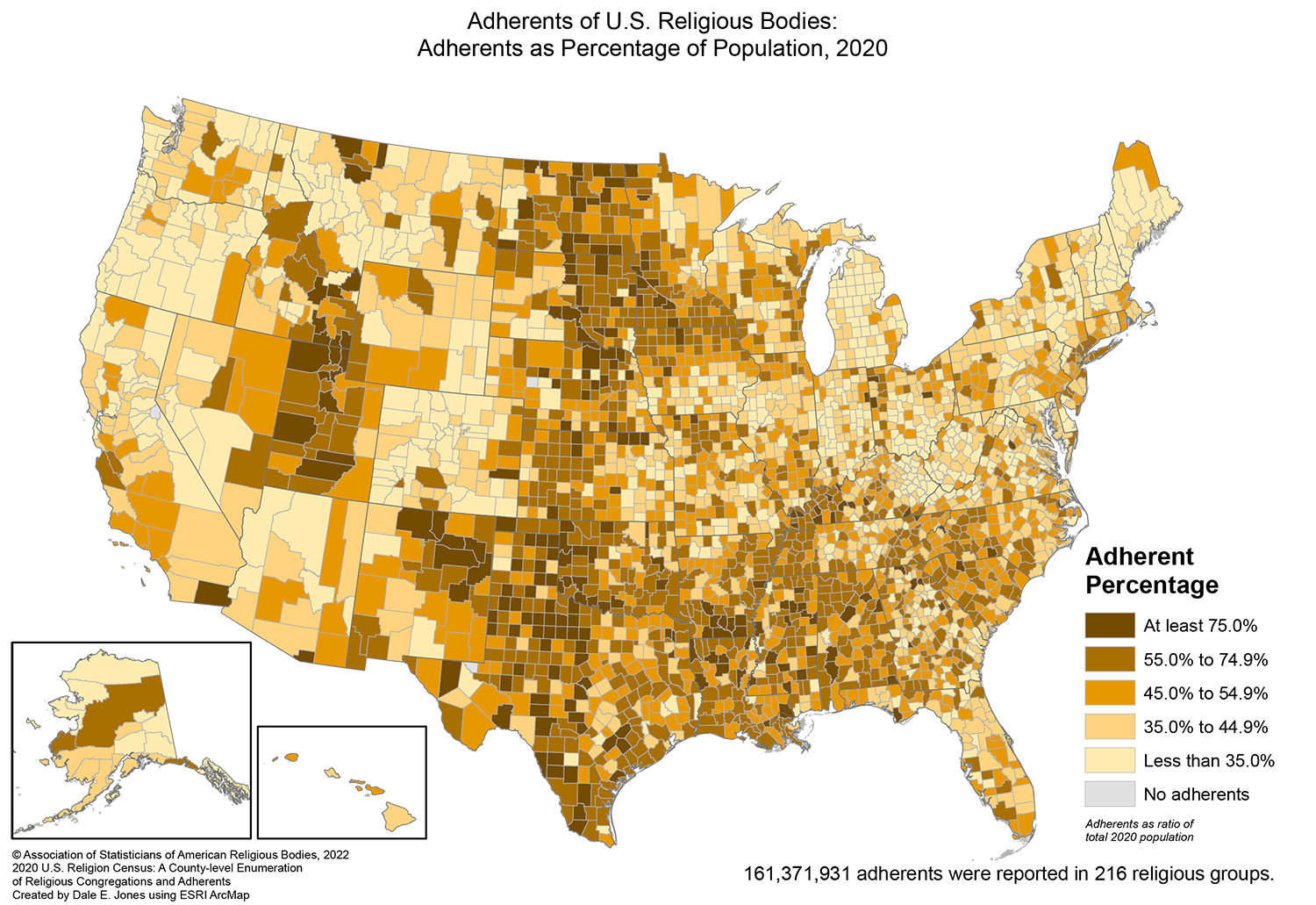
The U.S. Religion Census, conducted every 10 years by the Association of Statisticians of American Religious Bodies, concluded there were 356,739 religious congregations across the nation, and 161 million adherents, including children, in 2020. (Adherents is the formula researchers used to count those with an affiliation to a congregation, including children and people who attend but may not belong.)

Unlike polling, which asks questions from a small sample of the population and extrapolates to the general population, the religion census gathers information from denominations and other religious bodies and maps out the number of congregations and adherents on a county-wide basis. In the 2020 study, researchers collected data from 372 religious bodies, mostly denominations, but also 44,000 independent nondenominational churches. The count included synagogues, mosques and temples of Jewish, Muslim, Buddhist, Hindu, Sikh and Jain traditions

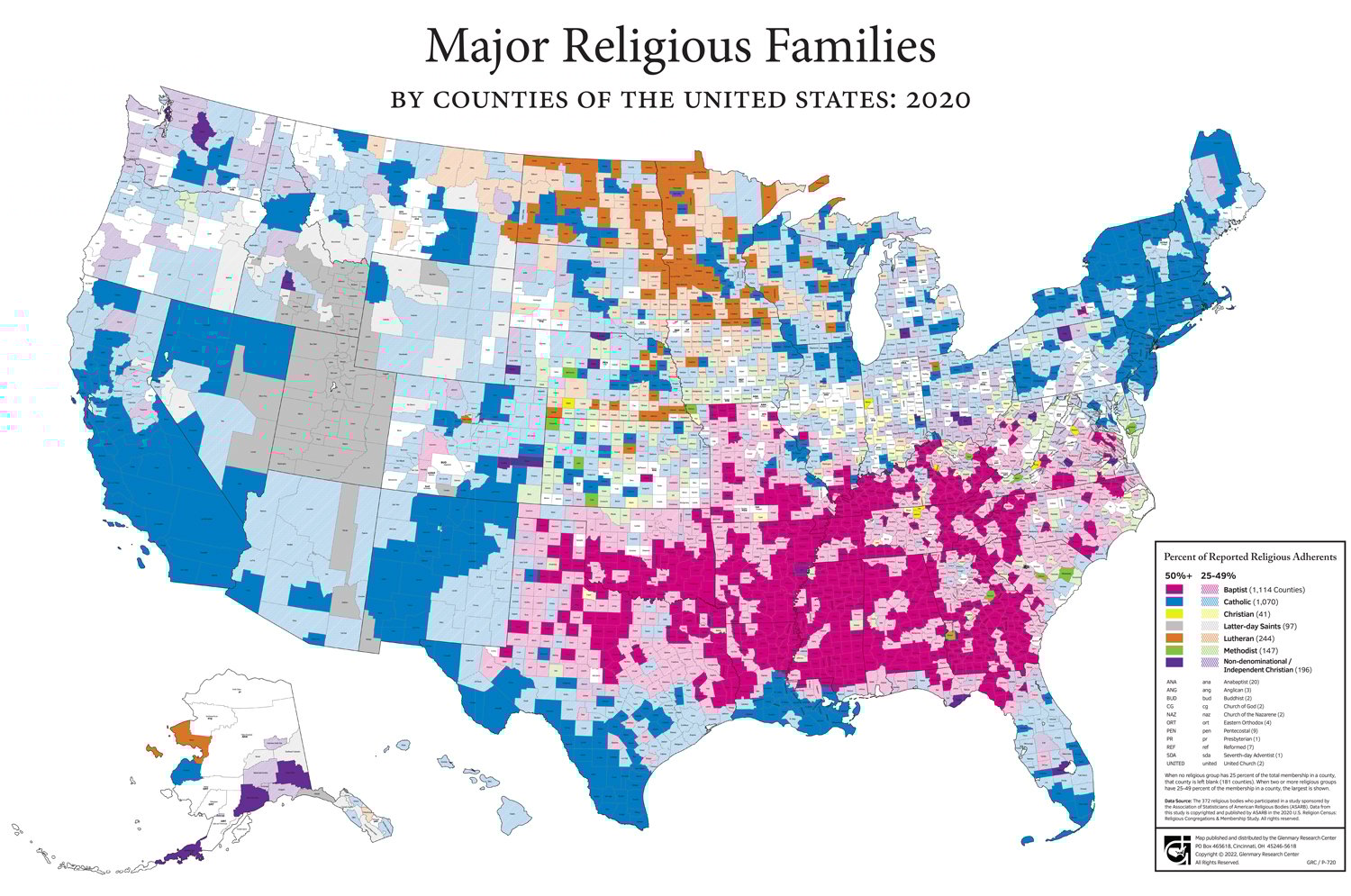
Courtesy Chart

Courtesy Chart

The study finds that the Catholic Church in the U.S. is the largest religious body, with 61 million adherents in more than 19,000 churches, comprising close to 19% of the U.S. population. That’s a modest growth of 2 million adherents from 2010, when the church had nearly 59 million adherents.

Sociologist who worked on the census said growth is almost entirely made up of Hispanic immigrants.

“If you took away the Hispanic population in the Catholic Church, it would look as bad as mainline denominations,” said Scott Thumma, director of the Hartford Institute for Religion Research, who counted independent churches for the census. (Mainline denominations, such as Episcopalian, Lutheran and Presbyterian, have been declining for more than 50 years.)

Perhaps the most striking growth was among Muslims. The number of Muslims who participate in mosque prayer increased from 2.6 million in 2010 to 4.5 million in 2020, a 75% increase. (Pew Research estimates there were 3.85 million Muslims in the U.S. in 2020, but those numbers do not include children.)

That growth is due mainly to immigration, said Ihsan Bagby, associate professor of Islamic Studies at the University of Kentucky, who collected the data for Muslims. Higher birth rates may be a secondary reason.

Bagby estimated the number of U.S. mosques at 2,771, a jump of 871 mosques in just a decade.

He suggested Muslims may be in a kind of golden age in the U.S. They are younger than the American population overall, and the Boomers among them are financially well off and able to contribute to the construction of new mosques. (First-generation mosques were often in retrofitted churches or warehouses.)

Mosques, Bagby said, “have mellowed and matured and become more moderate in their understanding of Islam and that has also been an attraction,” he said. “Many Muslims who had kept away feel more comfortable coming.”

Courtesy Chart

Courtesy Chart

U.S. mosques, like those overseas, do not typically keep memberships. Bagby said he arrived at his estimates by asking for information on weekly Jumah prayers as well as holiday or Eid prayers. (Muslims make up about 2.8% of all religious adherents and about 1.3% of the total population, the study estimates.)

Much of the value of the census is its county-level aggregation, which corresponds to how researchers in other fields, such as population studies and public health, collect and analyze data, said Rich Houseal, secretary-treasurer of the sociological group that conducted the study.

Houseal said the data is also useful to businesses, too. Walmart, he said, has contacted him to help determine what books to stock in their stores based on the dominant religious group in a county.

Among other interesting data points in the study:

  • Southern Baptists have the most churches of any religious group: 51,379.

  • There are some 44,319 nondenominational churches, a jump of nearly 9,000 over 10 years ago, and about 9 million adherents. Still, overall, they account for only 13% of the total number of religious adherents in the U.S.
  • Southern Baptists and United Methodists each lost 2 million members from 2010 to 2020.

“Denominational brands have weakened, and divisions have increased over issues such as female clergy or sexual orientation, Thumma said. “This likely led some adherents to seek or even start new nondenominational churches.”

Source: Religious groups with immigrant members grew fastest over past decade

U.S. removes Trump-era barriers to citizenship-test waivers for disabled immigrants

Of note:

U.S. Citizenship and Immigration Services has rolled out several changes to make the naturalization process more accessible for applicants with disabilities.

After months of public feedback, the federal agency has shortened and simplified its disability waiver, which is used to exempt immigrants with physical, mental or learning disabilities from the English and civics test requirements.

The revisions largely undo efforts by the former Trump administration to expand requirements for disabled applicants seeking to naturalize.

“The recent policy change is a big step in the right direction and a major improvement over the old policy,” Laura Burdick, who works on disability waiver policies with the Catholic Legal Immigration Network, told NPR.

“It takes a much more humane approach,” she added.

In a statement last week, USCIS Director Ur Jaddo said the revisions were part of President Biden’s executive order to restore faith in the U.S. immigration system.

Among the steps to become voting citizens, immigrants are tested on how well they read, write and understand English and how much they grasp U.S. history and government. Since 1994, the federal government has allowed immigrants with disabilities to receive waivers for such requirements.

In 2020, the Trump administration nearly doubled the length of the disability waiver and added unnecessary complexity, Burdick said. USCIS itself has described some parts of the application as “redundant” and has said they “no longer have practical utility.”

Questions such as how the applicant’s disability affects their daily life, a description of the severity of the disability and how frequently they are treated by medical professionals have since been eliminated.

Another policy change gives applicants who did not properly complete their waiver the option to simply resubmit their form with updated information, rather than fill out entirely new paperwork.

Burdick said these policy improvements will remove barriers and create a more efficient pathway to citizenship for people with disabilities.

But there’s more work to do, she added. Among her organization’s concerns are the limited types of medical professionals allowed to certify accommodations.

“Many of the immigrants that we serve receive their primary care from a nurse practitioner, since they are often more accessible than medical doctors, especially in low-income communities,” she said.

In the three quarters from October 2021 through June 2022, about 45,000 immigrants had applied for a disability waiver.

Source: U.S. removes Trump-era barriers to citizenship-test waivers for disabled immigrants

ICYMI: US Supreme Court declines to consider challenge to racist citizenship laws [America Samoa]

Of note:

The Supreme Court on Monday refused to reconsider the so-called “Insular Cases,” a series of cases decided in the early 1900s that are infamous today for their racist foundation.

The court’s action dashes hopes of American Samoans who were seeking birthright citizenship. It also leaves intact a Tenth Circuit decision that has been seen as “breathing new life” into constitutional distinctions between U.S. states and territories — which former Acting Solicitor General Neal Katyal said establish “a second-class of unequal Americans.”

Attorney Neil Weare, president of the organization representing the plaintiffs in this case, echoed the sentiment: “The Supreme Court’s refusal to reconsider the Insular Cases today … reflect[s] that ‘Equal Justice Under Law’ does not mean the same thing for the 3.6 million residents of U.S. territories as it does for everyone else.”

Who is a citizen?

At issue in this case was the way that people born in various U.S. territories are treated under law when it comes to U.S. citizenship. The Constitution says that anyone “born or naturalized in the United States” is a citizen of the country. But for U.S. territories, eligibility for birthright citizenship in the territories is controlled only by Congress – it is not constitutionally guaranteed.

Residents of Puerto Rico, Guam, the U.S. Virgin Islands, and the Northern Marianas Islands are deemed U.S. citizens under the Immigration and Nationality Act. But American Samoans are not. Congress has not granted birthright citizenship to residents of American Samoa or Swains Island, both of which are classified only as “outlying possessions.”

It is this disparate treatment that was before the court, after three American Samoans living in Utah brought a challenge to the Immigration and Nationality Act, contending that the statutory denial of citizenship is unconstitutional under the Fourteenth Amendment’s Citizenship Clause.

The Citizenship Clause was adopted after the Civil War primarily to protect the birthright citizenship of Black Americans, which was rejected by the Supreme Court prior to the Civil War. However, the meaning of the clause for residents of the territories has historically been contested — as has the force of constitutional protections in the territories altogether. In this case, Fitisemanu v. U.S., the American Samoans contend that the residents of all the territories should be considered “in the United States” for the purpose of citizenship.

While American Samoans who live in the States may apply for citizenship, before they successfully do so they are denied many of the rights attached to citizenship, such as the right to vote, run for office, or serve on juries. The plaintiffs in this case say their career opportunities have been curtailed and that, as non-citizens, they are unable to sponsor immigration visas for their families. Applying for citizenship itself is onerous, can take several years, and is not guaranteed.

A brief history of the Insular Cases

But this case was not just about the reach of the Citizenship Clause. The Constitution’s underlying disparity in treatment between the 50 states and the U.S. territories was enshrined in the Insular Cases, a series of cases decided in the early 1900s after the Spanish-American War. These cases — so called because of their “insular” (island-related) focus — held that full constitutional rights apply only to “incorporated” territories destined for statehood, such as Hawaii, but not to “unincorporated” territories, which then included Puerto Rico, Guam, and the Philippines. Infamously, the distinction between incorporated and unincorporated territories rested on explicitly racist stereotypes about individuals from those territories. Opposing Filipino statehood, for example, one senator called Filipinos “unruly and disobedient.” Another called them “mongrels.”

Under the Insular Cases, which were primarily about tariffs and jury trials in the territories, the Supreme Court upheld this suspect “incorporated vs. unincorporated” framework of rights. The Court’s language and reasoning was hardly any better than that of Congress. One case emphasized that “differences of race, habits, laws and customs” in the territories might require action on the part of Congress that wouldn’t be required if the territory were “inhabited only by people of the same race.” Another referred to “savage tribes” which may be “[in]capable of self-government.”

It is this insidious foundation of the Insular Cases that has drawn the condemnation of both liberal and conservative justices. In Vaello-Madero, a case from last term about Puerto Ricans’ eligibility for disability benefits, Justice Neil Gorsuch wrote a 10-page concurrence calling for the Insular Casesto be overruled — something that is now unlikely to happen any time soon.

Gorsuch did not note any dissent from Monday’s action.

Monday’s action is a victory for both the Biden administration and the American Samoan government itself, though neither party defends the offensive language in the Insular Cases. Nor does the United States affirmatively oppose American Samoan citizenship. The United States rests its argument instead on the text of the Citizenship Clause, which it contends intentionally excludes the territories from birthright citizenship conferred by the Constitution. The U.S. argues that American Samoans have the legislative route to birthright citizenship available to them, and that if there is a consensus in favor of birthright citizenship, they should pursue that through their representative in Congress. Otherwise, however, the United States says it does not want to tread on the self-governance of American Samoans.

To that end, the American Samoan government intervened in the case to argue that U.S. birthright citizenship for American Samoans would undermine the island’s ability to self-govern and maintain cultural autonomy.

Source: Supreme Court declines to consider challenge to racist citizenship laws

After raising hope, Biden still lacks climate migration plan

Of note (not sure any country does):

Shortly after taking office, President Joe Biden issued what was widely hailed as a landmark executive order calling for the U.S. government to study and plan for the impact of climate change on migration. And less than a year later, his administration released the first U.S. government assessment of the vast rippling effects of a warming Earth on international security and displacement of people.

Advocates praised both moves as bold steps toward the world finally recognizing the need to offer refuge to people fleeing not just wars and persecution but also climate calamities such as drought and rising seas.

Since then, however, the Biden administration has done little more than study the idea, advocates say.

The government has been slow to implement recommendations made a year ago by its own agencies, including the National Security Council, on how to address climate migration.

Key to progress on the issue was creation of an interagency working group to coordinate government response to both domestic and international climate migration.

But the group, which was supposed to oversee policies, strategies and budgets to help climate-displaced people, still has not been established, according to a person with knowledge of the administration’s efforts who was not authorized to speak publicly. The person said the group is expected to hold its first meeting later this fall. The administration declined to identify which agencies will participate in the working group.

Meanwhile, Biden’s report to Congress about his plans for refugee admissions to the U.S. in the 2023 budget year made scant mention of climate change.

Advocates once energized by the administration’s promises to embrace climate-displaced people say they have grown disillusioned.

“It’s been really disappointing,” said Ama Francis, climate migration expert at the International Refugee Assistance Project, a New York-based advocacy group. “We want to see real action. There are needs right now. But all we see is the administration move more slowly and staying in an exploratory phase, rather than doing something.”

That’s despite the government’s reports by the departments of Defense and Homeland Security, National Security Council and Director of National Intelligence that highlighted “the urgency of expanding current protections and creating new legal pathways to safety for climate-displaced people,” Francis pointed out.

Each year, natural disasters force an average of 21.5 million people from their homes around the world, according to the United Nations High Commissioner for Refugees. And scientists predict migration will grow as the planet gets hotter. Over the next 30 years, 143 million people are likely to be uprooted by rising seas, drought, searing temperatures and other climate catastrophes, the U.N.’s Intergovernmental Panel on Climate Change reported this year.

National security officials also recommended increasing U.S. aid to countries regularly pummeled by extreme weather and strengthening support for U.S. climate scientists and others to track these events.

To that end, the government recently released plans to work with Congress to provide billions of dollars annually to help countries adapt and manage impacts of climate change, especially to those vulnerable to the worst effects.

At the U.S.-Pacific Islands Summit, Biden announced $22 million in funding for climate forecasting and research, and setting up early warning systems in places like Africa, where 60% of nations lack such systems. The administration said it plans to announce more such funding to close that gap at the global COP27 climate summit in Egypt in November.

Environmental disasters now displace more people than conflict within their own countries, though no nation in the world offers asylum to climate migrants.

The White House’s 37-page Report on the Impact of Climate Change on Migration was the first time the U.S. government outlined the inextricable links between climate change and migration.

Released in October 2021 as Biden headed to the U.N. climate conference in Glasgow, Scotland, the report recommended steps, such as monitoring the flows of people forced to leave their homes because of natural disasters and working with Congress on a groundbreaking plan that would add droughts, floods, wildfires and other climate-related reasons in considering refugee status.

The report came a year after the U.N. High Commissioner for Refugees published legal guidance that opened the door for offering protection to people displaced by the effects of global warming.

The guidance said climate change should be taken into consideration in certain scenarios when it intersects with violence, though the document stopped short of redefining the 1951 Refugee Convention, which provides legal protection only to people fleeing persecution due to their race, religion, nationality, political opinion or social group.

The U.N. refugee agency acknowledged that temporary protection may be insufficient if a country becomes uninhabitable because of drought or rising seas, and suggested certain climate-displaced people could be eligible for resettlement.

Last month, more than a dozen humanitarian organizations sent a letter to the White House urging the government to give priority to refugee populations currently affected by climate change. The people include: South Sudanese and Ethiopians in Sudan where recurring drought and floods exacerbated by climate change threaten refugee camps. And Rohingya in Bangladesh where refugee camps are also at risk due to flooding.

But the Biden administration has not responded to the request, the organizations said.

“It was a positive step that the administration recognized that they should work on this issue, which is a first, so now they should make good on … that promise,” said Kayly Ober of Refugees International.

Migration is part of humanity’s adaptation to climate change and will become one of many tools for survival, so governments need now to plan accordingly, advocates say.

Humanitarian organizations provided the administration with reports on how to train immigration officers to do a better job at taking climate change into account when interviewing people for asylum or refugee status. They also offered analysis of possible legal pathways, such as expanding temporary protective status and humanitarian parole, which have allowed people fleeing natural disasters and conflicts in a limited list of countries to live and work in the United States for a few years.

The U.S. should establish a resettlement category for migrants who do not meet the refugee definition but who are unable to return safely to their homelands due to environmental risks, according to experts.

Worsening weather conditions are exacerbating poverty, crime and political instability, fueling tensions over dwindling resources from Africa to Latin America. But often climate change is overlooked as a contributing factor for people fleeing their homelands. According to the U.N. refugee agency, 90% of refugees under its mandate are from countries “on the front lines of the climate emergency.”

But so far there has been slow progress in the U.S. adopting policies recognizing them.

“Where we have some movement unfortunately is only in the uptick of people forcibly displaced in the world,” said Amali Tower, founder of the advocacy group Climate Refugees.

Source: After raising hope, Biden still lacks climate migration plan

Native Americans recall torture, hatred at boarding schools

As in Canada:

After her mother died when Rosalie Whirlwind Soldier was just four years old, she was put into a Native American boarding school in South Dakota and told her native Lakota language was “devil’s speak.”

She recalls being locked in a basement at St. Francis Indian Mission School for weeks as punishment for breaking the school’s strict rules. Her long braids were shorn in a deliberate effort to stamp out her cultural identify. And when she broke her leg in an accident, Whirlwind Soldier said she received shoddy care leaving her with pain and a limp that still hobbles her decades later.

“I thought there was no God, just torture and hatred,” Whirlwind Soldier testified during a Saturday event on the Rosebud Sioux Reservation led by U.S. Interior Secretary Deb Haaland, as the agency confronts the bitter legacy of a boarding school system that operated in the U.S. for more than a century.

Now 78 and still living on the reservation, Whirlwind Soldier said she was airing her horrific experiences in hopes of finally getting past them.

“The only thing they didn’t do was put us in (an oven) and gas us,” she said, comparing the treatment of Native Americans in the U.S. in the 19th and 20th centuries to the Jewish Holocaust during World War II.

“But I let it go,” she later added. “I’m going to make it.”

Saturday’s event was the third in Haaland’s yearlong “Road to Healing” initiative for victims of abuse at government-backed boarding schools, after previous stops in Oklahoma and Michigan.

Starting with the Indian Civilization Act of 1819, the U.S. enacted laws and policies to establish and support the schools. The stated goal was to “civilize” Native Americans, Alaska Natives and Native Hawaiians, but that was often carried out through abusive practices. Religious and private institutions that ran many of the schools received federal funding and were willing partners.

Most closed their doors long ago and none still exist to strip students of their identities. But some, including St. Francis, still function as schools — albeit with drastically different missions that celebrate the cultural backgrounds of their Native students.

Former St. Francis student Ruby Left Hand Bull Sanchez traveled hundreds of miles from Denver to attend Saturday’s meeting. She cried as she recalled almost being killed as a child when a nun stuffed lye soap down her throat in response to Sanchez praying in her native language.

“I want the world to know,” she said.

Accompanying Haaland was Wizipan Garriott, a Rosebud Sioux member and principal deputy assistant secretary for Indian affairs. Garriott described how boarding schools were part of a long history of injustices against his people that began with the widespread extermination of their main food source — bison, also known as buffalo.

“First they took our buffalo. Then our land was taken, then our children, and then our traditional form of religion, spiritual practices,” he said. “It’s important to remember that we Lakota and other Indigenous people are still here. We can go through anything.”

The first volume of an investigative report released by the Interior Department in May identified more than boarding 400 schools that the federal government supported beginning in the late 19th century and continuing well into the 1960s. It also found at least 500 children died at some of the schools, though that number is expected to increase dramatically as research continues.

The National Native American Boarding School Healing Coalition says it’s tallied about 100 more schools not on the government list that were run by groups such as churches.

“They all had the same missions, the same goals: ‘Kill the Indian, save the man,’” said Lacey Kinnart, who works for the Minnesota-based coalition. For Native American children, Kinnart said the intention was “to assimilate them and steal everything Indian out of them except their blood, make them despise who they are, their culture, and forget their language.”

South Dakota had 31 of the schools including two on the Rosebud Sioux Reservation — St. Francis and the Rosebud Agency Boarding and Day School.

The Rosebud Agency school, in Mission, operated through at least 1951 on a site now home to Sinte Gleska University, where Saturday’s meeting happened.

All that remains of the boarding school is a gutted-out building that used to house the dining hall, according to tribal members. When the building caught fire about five years ago, former student Patti Romero, 73, said she and others were on hand to cheer its destruction.

“No more worms in the chili,” said Romero, who attended the school from ages 6 to 15 and said the food was sometimes infested.

A second report is pending in the investigation into the schools launched by Haaland, herself a Laguna Pueblo from New Mexico and the first Native American cabinet secretary. It will cover burial sites, the schools’ impact on Indigenous communities and also try to account for federal funds spent on the troubled program.

Congress is considering a bill to create a boarding school “truth and healing commission,” similar to one established in Canada in 2008. It would have a broader scope than the Interior Department’s investigation into federally run boarding schools and subpoena power, if passed.

Source: Native Americans recall torture, hatred at boarding schools

U.S. Immigration Flaws Cause Ripple Effect in Canada

Of note:

While the U.S. grapples with questions of immigration reform, border security, and an ever-increasing visa backlog, neighboring Canada is experiencing immigration-related changes of its own.

Unlike the U.S., where population growth has steadily declined for decades, Canada is seeing the fastest population growth since 1957 — a demographic shift driven entirely by immigration. A significant percentage of this growth in recent years can be attributed to an increase in asylum claimants entering the country along the U.S.-Canada border. According to official government data, the number of asylum seekers crossing into Canada at informal entries along the country’s U.S. border reached the highest level since 2017.

Royal Canadian Mounted Police (RCMP) statistics show 23,358 asylum seekers have crossed into Canada at unofficial border points since the beginning of the year. While asylum seekers who enter Canada at official land border crossings are typically sent back to the U.S. for processing, migrants who cross elsewhere along the 5,500-mile border may remain in the country and file asylum claims with the Canadian government instead. These types of unauthorized crossings shot up during the Trump administration and have not slowed since President Biden took office.

Unofficial entries have become a common way for migrants to seek refuge in Canada and avoid being returned to the U.S. based on a decades-old agreement between the two countries. Ratified in 2004, the Safe Third Country Agreement (STCA) was designed as a way to manage U.S.-Canada land border crossings. Under the STCA, asylum seekers must request protection in the country where they first arrive, so migrants who enter Canada at official entry points are sent back to the U.S. — and vice versa. The idea underpinning the agreement is that both Canada and the U.S. are equally “safe” for refugees and offer access to fair asylum systems.

The pact has drawn widespread criticism from rights groups in recent years, with its future now being considered by Canada’s Supreme Court. Many in Canada argue that the U.S. is no longer a safe country for refugees, and therefore the U.S. government is unable to uphold its end of the agreement. Immigration advocates claim the policy forces asylum seekers to take increasingly dangerous journeys in order to cross the border, and migrants that do manage to cross are put at risk of immigration detention or deportation upon return to the U.S.

Canada’s asylum system and border policies are not the only areas to be impacted by grim immigration realities in the U.S. The sentiment that Canada may be a safer country for immigrants has rippled into other facets of the Canadian immigration system, namely the study and work permit sectors.

International student enrollment at Canadian colleges and universities doubled between 2016 and 2020 based on new analysis from the National Foundation for American Policy (NFAP). By comparison, Boundless’ data report on international students found that U.S. schools experienced a 72% decrease in international student enrollment in 2020 compared to the previous year. NFAP’s analysis cited Canada’s friendlier immigration policies as a possible explanation, as the lack of reliable paths to a green card in the U.S. could also make Canada a seemingly safer immigration choicefor prospective international students. International graduates in Canada jump through far fewer hoops to obtain temporary work visas and permanent residence than their counterparts in the U.S.

In addition to losing international students, many highly skilled foreign nationals are choosing employment opportunities in Canada over the U.S. In 2021, House Immigration Chair Rep. Zoe Lofgren warned that the U.S. is losing immigrant talent to Canada because of “outdated and restrictive U.S. immigration policies.”

There is no numerical limit on how many work visas can be issued under Canadian immigration law. In contrast, it has become increasingly more difficult to get an H-1B work visa, which is typically the only practical option for immigrants to work in the U.S. long-term. The H-1B system itself is plagued with complex requirements and yearly caps that applicants and sponsoring employers must navigate. For example, in March 2021, sponsoring employers filed around 308,000 H-1B applications and over 72% of petitions were rejected.

Unlike the U.S., Canada also does not have a per-country limit on permanent residence, and immigrant workers are generally able to declare immigrant intent after working in temporary status for one year, regardless of country of origin. Meanwhile, the employment-based green card backlog stood at around 1.4 million in 2021, with applicants from certain countries like India estimated to wait several years to a decade before becoming eligible for a green card.

The trend of individuals selecting Canada over the U.S. for future immigration plans, regardless of which visa category they may fall under, is likely to continue with increased incentives from the Canadian government. Prime Minister Trudeau’s government announced plans to roll out new policies and programs to better recruit immigrant workers in industries suffering the most from labor shortages. Trudeau also set an ambitious target to bring in a record number of new permanent residents (more than 1.3 million) over the course of the next three years.

Source: U.S. Immigration Flaws Cause Ripple Effect in Canada

Inequality in higher education: the American Dream is over

Of interest:

Can College Level the Playing Field: Higher education in an unequal society’ by Sandy Baum and Michael McPherson is published by Princeton University Press. ISBN: 978-0691-171-807

No doubt, Sandy Baum and Michael McPherson, authors of Can College Level the Playing Field: Higher education in an unequal society, were pleased by United States President Joe Biden’s recent announcement that the US government was forgiving US$10,000 of student debt held by people earning less than US$125,000 and US$20,000 of debt held by those who received Pell Grants, which are made to the nation’s poorest students – and by the plan to increase Pell Grants from by over US$2,000 to US$8,670. 

Likewise, New Mexico’s recent decision to make the first two years of higher education free to its residents fits well within their recommendations. 

Their scepticism about online education, especially for less prepared students, has become a leitmotif in the news because the impact of online education during the many COVID-19-caused shutdowns of universities, colleges and schools becomes clear.

For readers outside the United States, however, the strength of this book is not so much in its common sense recommendations but, rather, in its devastating portrait of inequality – in education, achievement and incomes – in America today. 

The Gini coefficient, a figure used by political scientists to show inequality, is 0.390 in the United States. The closer a country is to 1.0, the more its economy is inequitable; accordingly South Africa’s number, 0.623, indicates it is 62% more inequitable than is the US. By contrast, Canada’s number is 0.300 while Norway’s is 0.264.

“The correlation between socioeconomic background and educational attainment has more serious implications in the United States than in many other nations because not earning a four-year college degree has more significant implications for lifetime earnings than it does elsewhere,” write Baum and McPherson. 

Baum is a non-resident senior fellow at the Center on Education Data at the Washington DC-based Urban Institute and emeritus professor of economics at Skidmore College (Saratoga Springs, New York), and McPherson is a non-resident fellow at the Urban Institute, former economics professor and former president of Macalester College (St Paul, Minnesota).

Among the other studies Baum and McPherson use to show that the “American Dream”, which holds that the next generation will climb higher on the socio-economic ladder, has become a nightmare, is the aptly named “Gatsby Curve”. 

At its top is the United States (closely followed by Britain and Italy). This visual representation is deceiving, for the higher the country is on the Gatsby Curve the less intergenerational improvement there is. At the top of the league table, so to speak, are Finland, Norway and Denmark, countries not normally associated with dynamic social change.

The higher education premium

Readers of this publication are used to seeing figures showing the premium higher education provides. The median income for a high school graduate in the United States is US$37,000 a year, or US$18 dollars an hour, a dollar over the minimum wage in New York. For someone with a bachelor degree it is US$62,000 and for those with advanced degrees it is US$82,000. 

However, as Baum and McPherson show, the benefits of higher education accrue to a minority of Americans. This fact, incidentally, is one of the reasons the Republicans oppose Biden’s plan to forgive student debt. 

95% of whites and 89% of blacks complete high school. However, only 40% of white people and 26% of black people hold bachelor degrees. Accordingly, the pay received by 60% of white people and 75% of black people are in jobs where they earn around the minimum wage.  

In fact, in reality, the income of black people is even worse than it appears. For the “median earnings of black 35- to 44-year-old bachelor degree recipients are about $14,000 less than the median for whites”. Instead of earning US$62,000, therefore, blacks with bachelor degrees earn US$48,000 a year, or US$23 per hour.

More than half of white students whose parents hold bachelor degrees go on to graduate from a four-year college or university. The figure is even more striking for children of doctorate holders: 70% of them go on to earn a doctorate. Only 5% of those whose parents graduated from a two-year community college go on to earn a doctorate. 

A meritocratic class

While perhaps predictable, what these figures show is that within families education builds on education, creating a meritocratic class quite separate from the majority of Americans.

Like the “sorting hat” that assigns students to their house at Hogwarts (Harry Potter), a number of America’s high school graduates are sifted by family income and race. 53% of students with very high scores on the Scholastic Aptitude Test (SAT) are admitted to highly selective schools like Harvard or University of Chicago. 

These are the same students who, Baum and McPherson show, tend to come from families in which the parents hold degrees. 

They are also the students who come from families with the financial means to have sent them to private school – or to live in wealthy areas where public schools are well-funded – and to provide extras such as travel, a bookish home environment and SAT preparatory courses. Not surprisingly, only 31% of students with middling scores are admitted to highly selective schools. 

When looked at through the prism of race, Baum and McPherson show the figures are even more striking. Of the admissions to highly selective schools, 89% are Asian, 78% are white, 38% are Latinx and 25% are black. The order, it is worth noting, is the same as it is on charts they show indicating the income of each group.

Growing inequality

One of the most interesting parts of Can College Level the Playing Field is the graph Baum and McPherson use in their discussion of growing inequality, a topic which has been much discussed in the media in recent years.

Since 1969 the bottom 20% of American households (by earnings) saw the percent of their income, relative to the national income, drop from 6% to 4%. The next fifth dropped from 12% to 9%. The third fifth also dropped three percentage points to 15%. The fourth fifth remained at 24%. The highest fifth saw the percentage of their income rise from 41% to 48%; the top five percent, who are part of the highest fifth, saw their incomes rise from 16% to 20%.

At first glance, the drop in income for the poorest Americans from 6% to 4% does not seem that much. It is, however, a 33% decline. While large, when set against the fact that between 1969 and 2019 the US economy grew almost five-fold, from US$4.9 trillion to US$19.4 trillion, it might seem as though this lowest quintile is still doing fairly well economically. 

However, the cumulative inflation rate over the six decades beginning in 1969 is eight-fold: what cost US$100 in 1969 would have cost US$800 in 2019. Accordingly, the poorest Americans have absorbed approximately a 50% decrease in their buying power.

Lowering admission requirements

In the chapter titled, “What Can Colleges and Universities do?” Baum and McPherson make several suggestions. The first is for the elite schools to enroll more poor students. They urge elite schools to lower the SAT expectations from 1,600 to 1,250 for poor students. 

To those who would howl that the schools would be selling out to lower expectations, Baum and McPherson point out that elite schools routinely make such arrangements for star athletes – the ones who will fill these schools’ expensive stadia. Further, they note, such arrangements are routinely made for what’s known as “legacy applicants”, many whose parents just so happen to have made large donations to the alma mater their son or daughter is applying to.

Baum and McPherson urge other state universities to adopt a programme similar to the Texas Top Ten Percent rule. In the “Lonestar State”, the top 10% of high school graduates – even from poor areas where the high schools are lower on the league tables – are guaranteed admission to the state’s public universities, including the state’s flagship institution, the University of Texas at Austin. 

“Outcomes were no worse for the students they replaced, who attended less selective institutions but did not have lower enrollment rates, graduation rates, or earnings than they would have otherwise had,” they write.

For several decades, the United States Supreme Court has whittled away at the affirmative action efforts colleges and universities have used to address the racial imbalance on America’s campuses. In simplified terms, the court has said that quotas cannot be used to address historic or present discrimination – because doing so discriminates against the plaintiff. 

Baum and McPherson propose an interesting way around the court’s rulings. Instead of affirmative action based on race, colleges and universities can create affirmative action programmes based on economic class. 

These would “not [be] vulnerable to a legal challenge based on the Fourteenth Amendment” and, since black people and Latinx Americans make up a disproportionate share of poor people, programmes aimed at the economic class would benefit a large number of them.

Academic support

Their recommendation for mid-tier universities, which educate the vast majority of America’s higher education students, includes increasing state grants that will keep tuition as low as possible. 

Larger state grants will also allow these colleges and universities to provide academic support services that are needed by a disproportionate number of poorer students (because the schools they went to were themselves poorly funded).

Absent from Biden’s announcement about changes to Pell Grants was something Baum and McPherson consider important : however necessary for student success, remediation classes use up Pell Grant room and do not count towards graduation. 

In other words, if students need 64 classes to graduate, but have taken four remediation classes, they will have to take a total of 68 classes to graduate because the remediation classes do not count towards graduation. 

The effect of this is that many poor students have to remain an extra semester to graduate, with the attendant economic costs and no further Pell assistance.

Source: Inequality in higher education: the American Dream is over

The Super-Rich Are Already Plotting Their Escape From Trumpism – Mother Jones

Numbers are very small but an interesting increase nevertheless:

This is not a time of optimism in America. People are reeling from inflation, gun violence, partisan rancor, race-baiting, a ruthlessly divisive Supreme Court decision, the long tail of a pandemic, and the very real prospect of political violence. A significant majority of the public, polls suggest, thinks the nation is headed in a bad direction. Nearly three-quarters of the people NBC News polled in August said as much, and more than a thirdpredicted that things would get worse over the next five years.

Our societal dysfunction has progressed to the point where many well-heeled Americans are looking for an escape hatch. And David Lesperance’s phone is ringing off the hook.

Lesperance, whom I profiled for Mother Jones in 2017, is a Canada-born lawyer who has specialized in arranging foreign citizenships for extraordinarily wealthy people, from athletes and celebrities to founders, investors, and corporate bigwigs with assets ranging from about $25 million to $20 billion. He calls them “golden geese” because they pay an awful lot in taxes. (They manage to avoid an awful lot, too.)

Over the years, Lesperance—who now lives in Gdynia, Poland—has helped hundreds of ultra-high-net-worth Americans relinquish their US citizenship, usually in order to escape the long arm of the IRS. (The United States is the only country besides Somalia that imposes taxes based on citizenship, not residency.) Other US clients just want a contingency plan—a legal “go bag” containing an extra passport or two—that a family might deploy if the taxman ever gets too aggressive.

But the Trump years were pretty good for America’s richest,and expatriation is expensive. The government charges a steep exit tax: a one-time capital-gains levy of 23.8 percent on the combined net value of a person’s assets. If that’s $1 billion, you’ll have a $238 million tax bill, plus legal fees.

Lesperance and his frequent collaborator, Massachusetts-based attorney Melvin Warshaw, saw interest in their IRS-avoidance services surge in November 2020, after Joe Biden, who pledged to make America’s wealthiest families “finally pay their fair share,” defeated Donald Trump. They saw another spike in January 2021, when Democrats took the Senate, and again in March 2021, when Elizabeth Warren rolled out her Ultra-Millionaire Tax Act.

Also good for their business was Biden’s Build Back Better plan, which aimed to boost taxes on capital gains and corporate income, end the carried interest tax loophole, and kill GRATs—sneaky legal entities that half of America’s richest families now rely upon to pass huge tax-free fortunes to their heirs. That failed Democratic effort was followed by Sen. Ron Wyden’s (similarly doomed) billionaire tax plan and Biden’s short-lived encore—both nixed by Sen. Joe Manchin. Mega-wealth crisis averted!

But the two lawyers more recently began seeing a new trend, Lesperance says. Namely, “clients engaging us not for tax reasons, but rather to have an alternative should the US turn into MAGA America.”

Unlike their tax-obsessed clients, Warshaw explains, the new crowd isn’t looking for a permanent exit: “They’re saying, ‘I want options. I don’t mind paying high income tax, it’s just things are getting real hot in the kitchen and I want the ability to bug out—to go somewhere else for a while, because I don’t know what’s going to happen in the 2022 election. And I have little kids. I want a safe place for them.’”

Recent developments, particularly the Supreme Court’s reversal of Roe v. Wade, have fueled demand for dual citizenship even among the non-wealthy. But securing one is pricey if you don’t have a relative who is a citizen elsewhere. Lesperance’s new “client zero,” he says, dates to early this year, when the Atlantic ran an essay titled, “Trump’s Next Coup Has Already Begun.

Technically, the next attempt to overthrow a national election may not qualify as a coup,” staff writer Barton Gellman began, ominously:

“It will rely on subversion more than violence, although each will have its place. If the plot succeeds, the ballots cast by American voters will not decide the presidency in 2024. Thousands of votes will be thrown away, or millions, to produce the required effect. The winner will be declared the loser. The loser will be certified president-elect.

The prospect of this democratic collapse is not remote. People with the motive to make it happen are manufacturing the means. Given the opportunity, they will act. They are acting already.”

Gellman hit a nerve. Three would-be clients cited the essay in a span of two days, Lesperance says: “There’s a significant fear there. They look at the daily news, they see, ‘Okay, [Supreme Court Justice Samuel] Alito said this [Dobbs decision] only deals with abortion, and [Clarence] Thomas goes on in his dissent to say, no, we’re winding up for this, we’re throwing it back to the states.’ And then they see politicians talking about a nationwide ban on abortion. They see a very legal search done on Mar-a-Lago,” and all of a sudden people are talking about civil war.

When Warshaw returned to work from vacation the week after a draft of the Dobbs decision leaked, nine new inquiries awaited him—one or two per week was the previous norm—from clients sufficiently alarmed to drop $500 on an initial telephone consultation. “That at least showed me that they were ready to put some money on the line,” he says.

“I did three of them today. And two yesterday,” Lesperance adds. For every client interested in expatriating for tax purposes, he estimates, “we now see 10 looking for a bug-out.” Securing a dual citizenship is an unfamiliar experience for most Americans, “so there’s a very big learning curve. The last call I had, the guy kind of panicked and had laid out money for like five different things—of which he only needed one.”

Since June 24, the date of the official Dobbs ruling, he and Warshaw have signed on 23 new clients—of whom only a handful were tax-motivated. Another 36 have completed consultations and received engagement letters, and 14 more are awaiting their consultations. In addition to super-rich clients, the new crop includes some professionals in the $5 million to $10 million range.

They are concerned, roughly in this order, Lesperance says, about the state of American democracy (voter suppression, rejection of election outcomes, MAGA subversion), the outlawing of abortion and what the court may do next, and the specter of domestic terrorism and mass shooting events.They aren’t necessarily liberal. One client, a billionaire hedge-funder who would call himself a Reagan Republican, Lesperance says, just didn’t want his little kids to have to deal with the trauma of active shooter drills at school. He knew they probably wouldn’t ever be victims of a mass shooting, “but he knows that they’re going to be thinking about it every time they go to soccer practice or McDonald’s or SpongeBob’s new movie.” So he’s arranging for his wife and kids to live in a less trigger-happy country, and he’ll fly back and forth to be with them.

The new clients also include “a bunch” of former high-level government officials who served under Presidents Barack Obama and George W. Bush—“remember, to a MAGA you’re a RINO if you served for W,” Lesperance says. They “really got freaked out, not only by Dobbs but also by Trump’s announcement that he’s gonna get rid of the civil service and replace it with loyal flunkies.”

One would hope people who believe in good governance might stay around and fight the good fight. It’s not as though they are giving up, Lesperance says. “They’re sitting there saying, ‘I have a giant target on my back. So, yes, I’m gonna vote. Yes, I’m gonna join organizations and fund organizations to get voter registration. I’ll call that fire prevention,’” he says. “‘But I’m also gonna get fire insurance. And you know, depending on the outcome in the midterms, and what outcome comes in the general, I want to be able to bug out, and I want to take my family.’”

Source: The Super-Rich Are Already Plotting Their Escape From Trumpism – Mother Jones

Lederman: Ken Burns has a lesson for Ron DeSantis

Great column and reminder:

I can think of a few things that could benefit anyone involved in orchestrating last week’s shameful stunt of sending planeloads of desperate, unsuspecting migrants from Florida to Martha’s Vineyard in Massachusetts. For instance: sitting them down for six hours and 38 minutes to watch Ken Burns’ The U.S. and the Holocaust, which aired on PBS this week.

I’m unsure anyone who hatched this cruel plan has ever watched a minute of PBS, seen a Ken Burns documentary – or seen a documentary, period – but this three-part series should be required viewing for them. (For anyone, really.)

The central point of the documentary (co-made with Lynn Novick and Sarah Botstein) is that while Americans might see their country as a haven for immigrants, and a saviour during the Second World War, the U.S. in fact closed its doors pretty tightly during that critical period – to Jews, in particular. The State Department, lobby groups such as one called America First (sound familiar?), and average Americans didn’t want Jews entering the country. When asked two weeks after Kristallnacht whether the U.S. should allow more Jews into the country, 70 per cent of respondents said no.

“The exclusion of people and shutting them out has been as American as apple pie” says historian Peter Hayes, in episode one.

(Canada is not the focus of this project, but we do earn a mention in our turning away of the MS St. Louis, filled with hundreds of Jewish refugees, who were then sent back to Europe.)

Episode two opens with a scene from a Nazi rally, before the war, but after Hitler had made his thoughts about the Jews clear.

“You will make a statement as to whether you consider my work to be right, whether you believe that I have been diligent, that I have spent my time decently, in the service of my people, and thus entitle me to say that what I am declaring here and now is what Germany desires, what the German people desire.”

A roar of approval fills the packed house, as the crowds stand, arms outstretched.

It was particularly chilling to watch that scene shortly after photos emerged of an Ohio Trump rally where some attendees stood in a similar pose. Even if their outstretched arms included a pointed finger, associated with Trump’s “America First” rallying cry, it was a stomach-turning image. It happened last Saturday.

The Burns documentary is about history, but it is also a warning about what is happening now. Not just the references to Charlottesvilles Unite the Right rally (“Jews will not replace us!”) and the January 6 insurrection, including the guy in the “Camp Auschwitz” sweatshirt, but about increasingly alarming attitudes toward immigrants.

The parallels are striking. Sickening.

During the Second World War, Americans were concerned about the influx of Jews; that they were being “replaced” – the narrator emphasizes this word, surely a nod to the Great Replacement Theory that certain far-right, white nationalist elements have adopted.

In 1941, U.S. senator Robert Reynolds stated: “If I had my way, I would today build a wall about the United States so high and so secure that not a single alien or foreign refugee from any country upon the face of this Earth could possibly scale or ascend it.”

It was a humanitarian crisis, yet there was great reluctance to help. There were open calls for the status quo – a “white, gentile-ruled United States.” There was suspicion about German-Jewish refugees entering the U.S.

“Something curious is happening to us in this country and I think it is time we stopped and took stock of ourselves,” wrote first lady Eleanor Roosevelt. “Are we going to be swept away from our traditional attitude toward civil liberty by hysteria?”

Something is happening – again, still – in the U.S. There is probably a better word for it than “curious.”

It should be shocking to every American, to every human being, that officials paid by tax dollars – that anyone, in fact – devised this nasty scheme for these migrants. That others agreed to it, carried it out. That human beings approached these vulnerable people, lied to them, loaded them onto planes and dumped them not where they were told they were going.

And these prankster perpetrators maybe even laughed, amongst friends, about it. And in the case of Donald Trump, claimed that Florida Governor Ron DeSantis had stolen the idea from him. Mr. Trump wanted the credit.

This is the country that put children in cages, children who want to live in America. Well, who sends a child out alone to try to cross a border, some people tut-tut.

I’ll tell you who: Desperate parents willing to do the unthinkable for a shot at safety for their children, a good life. It happened during what we now call the Holocaust. And it’s happening now.

Historian Deborah Lipstadt says in the film, “The time to stop a genocide is before it happens.”

The time to stop anti-immigrant madness is before it happens. The next best time is now.

Source: Ken Burns has a lesson for Ron DeSantis