How the U.S. Census Penalizes Arab Americans

Interesting history to the lack of a Middle Eastern and North Africa (MENA) category (in Canada, Arab and West Asian) and the reasons why needed:

The exact number of Middle Eastern residents in the United States is unclear, with estimates ranging from 1.8 to 3.7 million people. The uncertainty is not primarily due to undocumented immigration, poor data maintenance, or limited survey reach, but how the U.S. Census Bureau classifies individuals of Middle Eastern descent. While federal demographic databases typically include five categories (Hispanic, non-Hispanic White, African American/Black, Asian/Pacific Islander, and American Indian or Alaska Native), those of Middle Eastern ancestry do not fit neatly into any of these groups. The federal government and the U.S. Census Bureau address this concern by classifying white as “a person having origins in any of the original peoples of Europe, the Middle East, or North Africa.”

This categorization originated from the 19th-century wave of Arab immigration when being classified as white in the United States provided clear advantages such as access to citizenship, legislative programs, and governmental employment. Arab immigrants campaigned to avoid being categorized as Asian, and arguments were made based on Social Darwinism and Christian superiority, as the majority of the initial immigrants were Christian Arabs. They argued that if Jesus, who was from the same region, was the son of God and at the top of the social pyramid alongside Anglo-Saxons, then Lebanese and Syrian immigrants were also white.

This theory faced legal challenges in 1909 when George Shishim, a Lebanese American police officer in L.A. County, arrested the son of a prominent lawyer. The lawyer and his son argued that Shishim, due to his Asian race, was not a U.S. citizen and had no right to arrest U.S. citizens. At the time, Shishim argued, “If I am Mongolian, then so was Jesus, because we came from the same land.” Arab American community leaders rallied around Shishim and hired attorney Byron C. Hanna. In response to the argument, Judge Hutton of the Superior Court of Los Angeles ruled that Shishim was eligible for citizenship and that Lebanese and Syrians belonged to the “white race.” This classification gradually extended to all individuals of Middle Eastern and North African descent across the United States.

While this classification initially benefited Arab Americans, it presented challenges in policy formulation as the United States embraced multiculturalism. Arab individuals are not commonly viewed as white and often have different socio-cultural backgrounds. These differences have significant policy implications. For example, if policymakers or researchers wanted to study alcohol consumption prevalence among Arab residents in California, public health data would not provide specific categories for Arab and European respondents. This lack of differentiation makes crafting effective policy increasingly difficult. Sociology professor Kristine J. Ajrouch, who studies Alzheimer’s disease among Arab Americans, faces this difficulty in her research. “[The current classifications] make it very difficult to identify Middle Eastern and North African individuals or those of Arab ancestry.”

The current categorization prevents Arab Americans from accessing policy programs designed for minority groups. Minority-owned businesses often receive specific advantages in government contracts through local, state, and federal programs. Despite being a minority group, Arab-owned businesses do not benefit from these programs. Legislative actions, such as Executive Order 13769, labeled the “Muslim travel ban” by critics 0f the former Trump administration, which disproportionately impacted travel from many Arab countries, have targeted Arab communities, raising the question of whether Arab Americans are viewed and treated as white. Samer Khalaf, President of the American Arab Anti-Discrimination Committee, believes otherwise, arguing, “We’re counted as ‘white,’ but we’re not treated as ‘white.’ We have the ‘no-fly’ lists, and we’re subjected to heightened security wherever we go.”

However, there is a possibility of change in the 2030 Census, as it might include a “Middle Eastern or North African” option. During preparations for the 2020 Census, researchers concluded that a MENA category “helps respondents to more accurately report their MENA identities.” However, a lack of approval from the Office of Management and Budget (OMB) during the Trump administration prevented the implementation of this plan. In 2021, the Biden administration confirmed that it had reviewed the proposal. If the OMB approves a MENA classification before the finalization of the 2030 Census, it could appear on the nationwide survey for the first time in U.S. history.

Racial categorization is an ever-evolving concept in the United States, and the classification of white has often been contentious. However, beyond symbolic portrayals of group identity, this categorization has significant legislative implications. Not tracking the unique cultural, linguistic, and social patterns found in Arab communities hinders the creation of effective policy. Cities and states across the United States must act and include a Middle Eastern and North African racial option on official surveys in order to pursue effective legislation.

Source: How the U.S. Census Penalizes Arab Americans

With new “talent visas,” other countries lure workers trained at U.S. universities

Of note and good overview:

When Cansu (pronounced “Johnsu”) Deniz Bayrak was deciding where to emigrate from her native Turkey, she first considered San Francisco.

Only in her 20s, she had already co-created an e-commerce website that rose to the top of its category in her home country, gotten snatched up by a tech company, then been poached by another tech firm. But she saw more opportunity in the United States, where there is a projected demand for more than 160,000 new software developers and related specialists per year, and where tech companies said in a survey that recruiting them is their biggest business challenge.

Bayrak quickly learned, however, that to come to the United States, she’d need an employer sponsor. Even then, she’d have to enter a lottery for an H-1B visa, with only one-in-four odds of being approved. If she was laid off, she’d have 60 days to find a new job, or she’d likely have to leave.

Source: Highly skilled workers thwarted by the U.S. immigration system find …

Shielding Israel from criticism is not part of US strategy for combating anti-Semitism

Of note (on the IHRA and other definitions):

Supporters of Israel advocating for the controversial International Holocaust Remembrance Alliance (IHRA) definition of anti-Semitism have suffered a major blow in their ongoing effort to shield the apartheid state from criticism, following the release of a strategy document by the White House detailing its plan to combat the rise of anti-Jewish racism. Since at least 2016, anti-Palestinian groups have been clamouring to place the IHRA at the heart and centre of regulatory frameworks, which critics say is designed to police free speech on Israel and Palestine.

Yesterday, the US President Joe Biden had his say on the issue and the outcome is far from what advocates of the IHRA had been calling for. Instead of adopting the IHRA as the only definition of anti-Semitism, which hundreds of pro-Israel groups had been advocating for during consultation, its status has been demoted as one of the definitions of anti-Jewish racism alongside others that “serve as valuable tools to raise awareness and increase understanding of anti-Semitism.”

The White House’s strategy for combatting anti-Semitism refers to IHRA as “most prominent” but also “non-legally binding working definition” alongside other definitions it “welcomes and appreciates”. The US Administration also cites the non-controversial “Nexus Document” as a valid definition of anti-Semitism. Unlike the IHRA, the Nexus Document does not conflate criticism of Israel with anti-Semitism. Interestingly, the IHRA is only mentioned once in the report, alongside other less controversial definitions of anti-Semitism, that do not mention Israel.

Noticeably, the White House did offer its own definition of anti-Semitism: “Anti-Semitism is a stereotypical and negative perception of Jews, which may be expressed as hatred of Jews” said the strategy document, without mentioning Israel once. “It is prejudice, bias, hostility, discrimination or violence against Jews for being Jews or Jewish institutions or property for being Jewish or perceived as Jewish. Anti-Semitism can manifest as a form of racial, religious, national origin, and/or ethnic discrimination, bias, or hatred; or, a combination thereof. However, anti-Semitism is not simply a form of prejudice or hate. It is also a pernicious conspiracy theory that often features myths about Jewish power and control.”

To the disappointed of pro-Israel groups, the White House’s definition does not mention the apartheid state once. Seven of the eleven examples of anti-Semitism in the IHRA conflate criticism of Israel with ant-Jewish racism. Because of this fact, opponents of the IHRA have warned that instead of focusing on how to keep Jews safe, the so called “working definition” is fixated on shielding Israel from accountability. The Biden administration seems to be implicitly sympathetic to this view. With no mention of Israel in the White House’s own definition of anti-Semitism, there is no other way to interpret the position of the Biden administration other than to view it as a snub to advocates of the IHRA. Having campaigned hard and long to make sure that the IHRA was at the heart and centre of the White House’s strategy to combat anti-Semitism, it was mentioned once and only in passing.

The Biden administration’s strategy represents “the most comprehensive and ambitious US government effort to counter anti-Semitism in American history”. To develop this strategy, the White House held listening sessions with more than 1,000 diverse stakeholders across the Jewish community and beyond. These sessions have included Jews from diverse backgrounds and all denominations. The White House also met with Special Envoys who combat anti-Semitism around the globe to learn from their best practices. Bipartisan leaders in Congress and from across civil society, the private sector, technology companies, civil rights leaders, Muslim, Christian and other faith groups, students and educators and countless others were engaged during “listening sessions”.

A bitter row had ensued during the consultation period over the status of the IHRA. Though there is said to have existed a broad consensus that anti-Semitism in America is a crucial problem and must be addressed, some Jewish organisations tried to undermine this effort, according to Hadar Susskind, the President and CEO of Americans for Peace Now. By insisting on the prioritisation of the IHRA above all other issues, Susskind claimed that a number of American Jewish organisations had prioritised shielding Israel from criticism over combatting anti-Semitism.

“Rather than support this far-reaching  plan to truly combat anti-Semitism, there are those in our community who, instead, insist that this plan should be about the IHRA definition, and only the IHRA definition,” said Susskind on twitter, while revealing details of the polarisation in the Jewish community over the IHRA. “Why are some insisting that the IHRA definition is so unique that it alone is worthy of inclusion in this effort?” Susskind asked. “Why do those same people insist that the Nexus definition and the Jerusalem Declaration on Anti-Semitism are so unacceptable as tools to combat anti-Semitism?”

Explaining the difference, Susskind said that “the IHRA definition and only the IHRA definition has been weaponised by the Israeli government and those who defend its worst policies and actions”. He mentioned how the IHRA definition has been used repeatedly to define anti-Zionism as anti-Semitism and “honed into a weapon to shut down criticism of Israeli policy and discourse on Israel-Palestine.”

J Street, another liberal pro-Israel advocacy group, which had urged the Biden administration not to incorporate the IHRA in its strategy, also welcomed the report. “Importantly, the strategy avoids exclusively codifying any one specific, sweeping definition of anti-Semitism as the sole standard for use in enforcing domestic law and policy, recognising that such an approach could do more harm than good” said J Street. “While some voices have pushed the White House to give the full force of US law to the IHRA Working Definition of Anti-Semitism and its accompanying examples, the Biden Administration rightly cites this definition as just one of a range of illustrative and useful tools in understanding and combating anti-Semitism.”

J Street went on to add that it was supported by many other advocates in the Jewish community – including the definition’s original author, Kenneth Stern – in warning that the IHRA and examples of anti-Jewish racism cited in the definition have been used to focus attention disproportionately on criticism of Israel and advocacy of Palestinian rights.

In refusing to endorse the IHRA as the only definition of anti-Semitism, President Biden has shown that a genuine effort to combat the rise of anti-Jewish racism cannot have a document shielding Israel from accountability at the heart and centre of its strategy.

Source: Shielding Israel from criticism is not part of US strategy for combating anti-Semitism

Here’s why the U.S. is pushing Ottawa to require visas from Mexicans

Good explainer:

When Canada lifted the visa requirements on Mexicans in late 2016, one of the first things Selene Mateos did was book a vacation to visit Vancouver with her girlfriend.

Drawn by Canada’s reputation as an “open and friendly” country, the couple jumped on the travel opportunity without the hassles of having to put together an application package and line up in queues —and without the prospect of cancelling their trip if a visa didn’t come through.

“If I’d needed a visa, I would’ve had to think about it three or four times more, even though I had all the proofs, of a job, income and ties to Mexico,” says the 35-year-old environmental engineer. “This makes travel easier and faster.”

Mateos was surprised when she learned from media reports this week that Washington has requested that Ottawa reimpose visas on Mexico after a surge of Mexican irregular migrants trying to cross into the U.S. through the northern border via Canada.

“I don’t think that’s fair, to be honest,” said Mateos, who now works in hospitality in Toronto on a work permit. “Even the U.S., Canada and Mexico are trade partners, we are the poor partner. We are not equal.”

That inequality is at the centre of concerns some have over the potential move — one critics say would severely restrict asylum seekers and punish residents of Mexico, a country that is a significant trading partner, but lacks the clout to resist whenever the U.S. wants to change the rules of the relationship.

The situation at the border

Mexicans are increasingly crossing the land border into the U.S. from Canada. The number caught crossing illegally has risen from a total of 1,169 in 2016 to some 300 a month since October, according to U.S. Customs and Border Protection data.

Mexican refugees made up 7,483 of Canada’s 60,158 asylum claimants in 2022. During that year, more than 400,000 Mexicans came to visit. (That number of claims was up significantly from 250 in 2016, which was before Ottawa lifted its visa requirements on Mexico.)

In March, in response to the irregular migration at the northern border, Washington and Ottawa expanded the Safe Third Country Agreement across the entire land border, not just at official ports of entry, so asylum seekers crossing anywhere are turned back.

Still, compared to the U.S. southern border, where more than 2.5 million irregular migrants were stopped last year, the U.S.-Canada frontier is peanuts, says Laura Macdonald, a political science professor at Carleton University.

So why the increased amount of attention?

“There is some pressure being exerted by Republicans in Congress, Republicans from the northern states. Some of the northern states who want to make an issue out of this partly because they’re trying to convey the message that the Biden administration is weak on border control policies and weak on migration control,” said Macdonald, who studies North American relations and Latin American politics.

“I don’t think it’s a huge issue for the Biden administration. They have many other issues to deal with. But you could see how politicians in the border states could get caught up in that kind of dynamic. So he’s telling Canada they have to fall into line about policies that the U.S. government wants to enact.”

An unequal relationship

The U.S. has always required visas from Mexicans in order to screen out those who come to seek asylum or likely overstay their visits, while Canada has changed its policy back and forth under different governments.

In 2009, Stephen Harper’s Conservative government slapped Mexico with a visa rule in response to an influx of Mexican refugees who fled gang violence and drug cartels. The requirement was lifted in 2016, after Justin Trudeau’s Liberals came to power.

For Washington and Ottawa, visa decisions are tied to border control and economic interests, said Macdonald, but Mexico can never afford to put up travel barriers against its northern neighbours.

“Tourism is such a huge interest. So that goes back to the power asymmetries in the region. The U.S. and Canada could contemplate having such a visa and Mexico will never, ever retaliate in that form,” she said.

The reasons for crossing from Canada into the U.S.

Ramiro Arteaga, founder of a Mexican Canadian Facebook group, says there’s been a lot of discussions within the diaspora about the Biden administration’s visa proposition to Ottawa, with many worrying about further stigmatization of the community.

Arteaga says he’s against visa requirements which would restrict Mexicans’ families and friends from visiting them in Canada, and he doesn’t believe such measures would stop irregular migrants determined to cross into the U.S. at all costs.

He said it has always been easier for Mexicans to get to Canada than to the U.S., even when both countries required visas. And some of his compatriots have always had their eyes set on the U.S., for a variety of reasons.

“The language is not a barrier down there. You can go to Los Angeles, Chicago, New York, anywhere you go, you can find someone who speaks Spanish. You can find your own church, your own community, your own places to gather,” said Arteaga, 48, whose Facebook group has 250,000 members, mostly in Canada.

“It’s more likely to have a family member or someone from the same town back home living in the U.S. You can get jobs easily there. It’s more difficult if you are coming here and you don’t know the language and you don’t know anyone.”

The fallout of imposing visas

Efrat Arbel, an immigration law professor at University of British Columbia, said a visa requirement is a blunt instrument imposed by western countries to stem asylum flow from so-called refugee-producing countries.

“ If an asylum seeker is fleeing for their lives, then they don’t have the time, the ability or the capacity in most situations to apply for a visa in order to set foot on Canadian soil,” she said.

“The effect is that those individuals are prohibited from travel, are prohibited from making access of lawful routes of entry in order to seek refuge from persecution. It works contrary to the basic commitments of refugee protection that underpin our asylum regime.”

The visa requirement is among many tools Canada has implemented over the years to restrict people from certain regions and countries from coming, she said.

Even valid visa holders can be kept off a Canada-bound flight by air carriers that fear sanctions for bringing in “improperly documented persons,” or by border liaison officers stationed abroad, who flag travellers at their discretion.

“All of these mechanisms operate in tandem and Canada is systematically closing its borders to refugees,” said Arbel.

How will a decision be made?

In assessing whether to impose or abolish visa requirements, Canada’s immigration department said officials look at the socio-economic profile of the country, immigration issues, travel documents, security concerns, border management, human rights and bilateral relations.

“Canada values its strong ties with Mexico. The visa lift (ending the requirement in 2016) underscores the commitment Canada made to further enhance and expand its relationship with Mexico,” said department spokesperson Stuart Isherwood.

“The visa lift has generated positive results for Canadians and Canadian business. It has deepened our bilateral relations and expanded trade, investment, and tourism between both countries.”

Since the visa requirement was removed against Mexico, Isherwood said, Canada has welcomed more than two million Mexican visitors and they’ve spent more than $2.4 billion in Canadian hotels, restaurants and other businesses.

Mexican officials said leaders of the three countries met in a summit in Mexico City in January where they reaffirmed their commitment to collaborate on regional migration issues.

“Mexico is working closely with the United States and Canada to achieve safe, orderly and humane migration in the region through a holistic approach that includes addressing its root causes,” the Mexican Embassy in Ottawa said in a statement. 

Mateos is well aware that the political wind can shift at any moment. She just hopes any visa change won’t come before her wedding this August; 20 guests, including her family, are expected from Mexico.

“It’s going to be devastating for me not having my family and friends on my side on this very important day of my life,” she said.

Source: Here’s why the U.S. is pushing Ottawa to require visas from Mexicans

U.S. asks Canada to reimpose visa requirements for Mexico to stem surge of crossings at northern border

Request was bound to happen:

The Biden administration has been asking Ottawa to consider reimposing visa requirements for Mexican nationals visiting Canada, CBC News has learned.

At issue is the sharp increase in illegal crossings from Canada into the United States: Mexicans don’t need a visa to travel to Canada, while the U.S. requires a visa for Mexicans to enter. American border officials say some Mexican nationals are using Canada’s visa-free rule to fly into the country and then cross south illegally into America.

The Conservative government under Stephen Harper created a visa requirement in 2009 for Mexicans to stem the flow of asylum claims from Mexico. The Trudeau government relaxed it in 2016.

Source: U.S. asks Canada to reimpose visa requirements for Mexico to stem surge of crossings at northern border

Changing how U.S. forms ask about race and ethnicity is complicated. Here’s why

Good explainer. Canada’s visible minority categories provide much richer detail:

The first changes in more than a quarter-century to how the U.S. government can ask about your race and ethnicity may be coming to census forms and federal surveys.

And the Biden administration’s revival of this long-awaited review of federal standards on racial and ethnic data has resurfaced a thorny conversation about how to categorize people’s identities and the ever-shifting sociopolitical constructs that are race and ethnicity.

While this policy discussion is largely under the radar, the stakes of it touch the lives of every person in the United States.

Any changes to those standards by the White House’s Office of Management and Budget could affect the data used to redraw maps of voting districts and enforce civil rights protections, plus guide policymaking and research. They could also influence how state and local governments, as well as private institutions, generate statistics.

Here are a few things to know about this complicated effort that could change OMB’s Statistical Policy Directive No. 15:

Asking about race and ethnicity in a combined question could shrink a mysterious “Some other race” category

The current standards require federal forms that ask participants their identities to inquire about race and ethnicity through two separate questions. That’s why on census forms, for example, before you see the race question, there’s a question about Hispanic or Latino identity, which the U.S. government considers to be an ethnicity that can be of any race.

But for the 2020 census, close to 44% of Latinos either did not answer the race question at all or checked off only the box for the mysterious catchall category “Some other race,” according to data the Census Bureau released last month.

“They provide really important insights to what we’ve seen in our research over the decade — that Hispanics continued to find great difficulty with answering the separate questions on ethnicity and on race,” Nicholas Jones, director of race and ethnic research and outreach in the bureau’s Population Division, says about the data, the release of which the bureau moved up to help inform discussions about OMB’s standards.

The rise of “Some other race” — which is legally required on the census by Congress and is now the second-largest racial category in the U.S. after white — helped drive earlier research by the bureau into alternative ways of asking about race and ethnicity.

Combining those two topics into one question, while allowing people to check as many boxes as they want, is likely to reduce confusion and the share of Latinos who mark “Some other race,” bureau research from 2015 suggests.

And that has led an OMB working group to propose making a single combined question the new required way of collecting self-reported racial and ethnic data.

How would a combined question likely change how many people identify as Asian, Black or Pacific Islander?

The bureau’s research involved comparing how people could respond to a combined question vs. separate questions.

Its testing in 2015 – along with similar testing in 2010 and 2016 – found no statistically significant differences in the shares of participants who reported identifying as Asian, Black or Pacific Islander. (There are conflicting findings about the potential impact on the percentage of people reporting as American Indian or Alaska Native.)

But Howard Hogan, a former chief demographer at the bureau who retired from the agency in 2018, contends that research is inconclusive on the potential effects a combined question could have on those groups, particularly on the Black population.

“We don’t know for sure. It’s possible that it would have no effect or even increase. But it’s also equally possible, and I believe slightly more likely, that it would reduce,” Hogan says about a combined question’s impact on the share of people identifying as Black, adding that not all of the bureau’s experiments were designed to test how people may respond to a combined question when it’s asked by a census worker in person, which is how many people of color have participated in the count rather than filling out a form on their own.

The bureau was able to do a month of in-person interviewing for its testing in 2016, and it found no statistically meaningful differences in the shares of people identifying as Asian, Black or Pacific Islander.

Despite the limitations of the agency’s research, the bureau’s officials continue to stand behind their recommendation that a combined question would be the “optimal” way of asking about a person’s race and ethnicity.

“We’re confident in the sampling methodology as well as the consistent results that we’ve seen across three, large national tests,” says Sarah Konya, chief of the bureau’s census testing and implementation branch.

There are concerns about how a combined question could affect racial data about Latinos

Major civil rights organizations focused on census and data issues have also voiced their support for a combined question.

But a campaign called “Latino Is Not A Race,” which is led by a group of researchers who are part of the afrolatin@ forum, has raised concerns that a combined question would allow some Latinos to answer the question by only checking a box for “Hispanic or Latino.”

“The idea that there are some Latinos who are just Latino is contributing to the myth that Latinos are exempt from racialization. That’s not true. Our history has never been that. If you go back to any country in Latin America, you will see a racial hierarchy where whites were on top, brown-skinned people were somewhere in the middle, and Black people and people racialized as Indigenous have been on the bottom,” says Nancy López, a sociology professor who directs the University of New Mexico’s Institute for the Study of “Race” and Social Justice and is calling for research into an additional racial category that could be meaningful to Latinos who are racialized as “Brown.”

The OMB working group has said it’s looking into doing more testing of the combined question’s effects by this August, and outside advisers to the bureau on its Census Scientific Advisory Committee have recommended additional tests and focus groups on specifically how Latinos would respond to this race-ethnicity question format.

Any follow-up research is running up against a summer 2024 deadline that OMB has set for its review of the standards in order to enact changes before the end of President Biden’s first term and in time for them to be incorporated into 2030 census preparations, which are already underway.

In the meantime, both López and the National Association of Latino Elected and Appointed Officials Educational Fund are calling for the standards to clearly define the difference between the concepts of race and ethnicity, which the OMB working group acknowledges many people understand to be similar or the same.

If there’s no combined question, there may be no new “Middle Eastern or North African” checkbox

Entangled within the discussion about the combined-question proposal is the possibility of a new checkbox for “Middle Eastern or North African” — a category that the OMB working group has proposed to no longer classify as white under the federal standards.

Many people in the U.S. with origins in Lebanon, Iran, Egypt and other countries in the Middle East or North Africa do not identify as white people, and advocates for Arab Americans and other MENA groups have spent decades pushing for a checkbox of their own on the census and other forms.

Including a “Middle Eastern or North African” checkbox would likely reduce the share of participants who mark “White” or “Some other race,” while increasing the shares marking “Black” or “Hispanic or Latino,” the Census Bureau’s 2015 research suggests.

But if OMB does not change the standards to allow for a combined question about race and ethnicity, it’s not clear whether a new checkbox for “Middle Eastern or North African” would be approved. The bureau’s research has not specifically tested treating that category on forms as an ethnicity, which has long been the preference for the Arab American Institute and other advocates for a MENA category.

Source: Changing how U.S. forms ask about race and ethnicity is complicated. Here’s why

Biden Opens a New Back Door on Immigration

Of note, one of the few areas of movement but only through executive action and the humanitarian parole program and TPS:

Amid a protracted stalemate in Congress over immigration, President Biden has opened a back door to allow hundreds of thousands of new immigrants into the country, significantly expanding the use of humanitarian parole programs for people escaping war and political turmoil around the world.

The measures, introduced over the past year to offer refuge to people fleeing Ukraine, Haiti and Latin America, offer immigrants the opportunity to fly to the United States and quickly secure work authorization, provided they have a private sponsor to take responsibility for them.

As of mid-April, some 300,000 Ukrainians had arrived in the United States under various programs — a number greater than all the people from around the world admitted through the official U.S. refugee program in the last five years.

By the end of 2023, about 360,000 Venezuelans, Cubans, Nicaraguans and Haitians are expected to gain admission through a similar private sponsorship initiative introduced in January to stem unauthorized crossings at the southern border — more people than were issued immigrant visas from these countries in the last 15 years combined.

The Biden administration has also greatly expanded the number of people who are in the United States with what is known as temporary protected status, a program former President Donald J. Trump had sought to terminate. About 670,000 people from 16 countries have had their protections extended or become newly eligible since Mr. Biden took office, according to a new report from the Pew Research Center.

All told, these temporary humanitarian programs could become the largest expansion of legal immigration in decades.

“The longer Congress goes without legislating anything on immigration, the more the executive branch will do what it can within its own power based on the president’s principles,” said Theresa Cardinal Brown, senior adviser at the Bipartisan Policy Center in Washington.

The main challenge, she noted, is that “the courts can come in and say it’s outside the president’s authority, or an abuse of discretion, and take it all away.”

Already, critics have complained that the administration is using unfettered discretionary power that runs afoul of the laws Congress passed to regulate legal immigration, a system based primarily on family ties and, to a lesser extent, employment.

With Mr. Biden expected to kick off his re-election campaign this week, Republicans are likely to focus on what they call his overly permissive immigration policies.

Twenty Republican-led states, including Texas, Florida, Tennessee and Arkansas, have sued in federal court to suspend the parole program for residents of Cuba, Haiti, Nicaragua and Venezuela, arguing that it will admit 360,000 new immigrants a year from those countries and burden states with additional costs for health care, education and law enforcement.

Alabama, one of the plaintiffs, cited estimates that even before these programs, up to 73,000 undocumented immigrants were already living in that state, about 68 percent of them with no medical insurance and 34 percent with incomes below the poverty line, an influx the state said was costing taxpayers about $324.9 million a year.

“This constitutes yet another episode in which the administration has abused its executive authority in furtherance of its apparent objective for immigration policy: open borders and amnesty for all,” Ken Paxton, the Texas attorney general who is leading the states’ lawsuit, said when it was filed.

In adopting the programs for Latin Americans, the Biden administration was responding to widespread criticism over the chaotic situation on the southern border, which last year saw 1.5 million unauthorized crossings. It bypassed years of failed attempts in Congress to legalize undocumented workers already in the country or to make more visas available to employers who wish to bring in temporary workers.

The new parole programs are temporary — most expire after two years, unless they are renewed — but they already are changing the nature of immigrant arrivals. The migrants who were admitted to the country after flooding the border from many of the same conflict-ridden countries last year have not been allowed to work for at least six months, after opening an asylum case.

As a result, many have wound up in shelters in cities like New York, which has struggled to accommodate them.

The humanitarian parole program, in contrast, requires immigrants to first have a sponsor in the United States who will take financial responsibility for settling them in, and expeditiously offers a work permit for those approved. Employers with worker shortages are welcoming the arrivals as an important new labor pool.

The administration’s goal was to discourage the hundreds of thousands of migrants who were arriving at the border by allowing people to apply in a more orderly fashion from their home countries. After the programs began, overall Border Patrol apprehensions at the border reached their lowest levels in two years, led by a precipitous decline in Cubans, Haitians, Nicaraguans and Venezuelans. Average weekly apprehensions declined to 46 in late February from 1,231 in early January, when some of the parole measures were announced.

“The successful use of these parole processes and the significant decrease in illegal crossing attempts demonstrate clearly that noncitizens prefer to utilize a safe, lawful and orderly pathway to the United States if one is available, rather than putting their lives and livelihoods in the hands of ruthless smugglers,” the Department of Homeland Security said in a statement.

Overall border crossings from all nationalities, however, remain near historic highs, even with the new programs.

The programs have divided leaders of Republican states. Some, including those suing, contend that with the new programs, Mr. Biden has effectively kept the country’s doors wide open, although instead of masses of people crossing without authorization, he has invited them in legally.

But the programs have attracted broad support in the business community in some conservative states, like North Dakota, where there is deep concern over worker shortages.

report last week from FWD.us, a bipartisan pro-immigration group, estimated that about 450,000 immigrants who entered the United States on parole programs from Afghanistan, Ukraine and Latin American countries were filling jobs in industries facing critical labor shortages, including construction, food services, health care and manufacturing.

In North Dakota, where the oil industry has been struggling to hire roustabouts to operate rigs in the region’s notoriously punishing weather, the state Petroleum Council is recruiting people across the western prairie to act as sponsors for new Ukrainian immigrants who can be put to work.

The first 25 Ukrainian families are expected to arrive by July, with hopes that hundreds more will follow soon after.

“The Ukrainians need us, and we need them,” said Ron Ness, president of the council. “We have been working seriously to develop a very big project on a very large scale to attract them.”

In Utah, already home to a thriving Venezuelan community but where unemployment is 2.4 percent, Gov. Spencer Cox has called for states to be allowed to sponsor immigrants to meet their work force needs. Derek Miller, president of the Salt Lake Chamber, said that Utah was “very supportive” of the parole program given the inability of Congress to open new pathways for legal immigration.

“We have 100,000 jobs going unfilled,” Mr. Miller said. “We embrace a process for those who want to contribute to be able to come.”

Employers in Illinois are also gearing up for new arrivals. “This is a breath of fresh air, when we are seeing such a labor shortage,” said Sam Toia, president of the Illinois Restaurant Association in Chicago, who said businesses there were attracting many Ukrainians on parole because of the state’s historical ties to Ukraine.

Many of the new immigrants already have found work. Anastasiia Derezenko of Ukraine crossed the southern border with her husband and two children last year, and the family received the temporary protected status Mr. Biden approved for Ukrainians. She found a job as a certified nurse assistant in Washington State.

“We have decided we don’t want to go back; we want to build our life here,” she said.

Humanitarian parole has been used in the past. The authority granted by Congress to the executive branch in 1952 in fact has evolved into a key tool for expeditiously admitting people who do not qualify under established immigration categories, though rarely to the degree seen lately under the Biden administration.

President Eisenhower used parole authority to allow 15,000 refugees to enter the United States after the Hungarian revolution in 1956. Before the enactment of the Refugee Act of 1980, parole was used to swiftly admit 690,000 Cubans and 360,000 refugees from Southeast Asia after the fall of Saigon.

Over the last several administrations, some of the most consequential immigration policies have resulted from presidents exercising discretion, including former President Barack Obama’s executive action to create the Deferred Action for Childhood Arrivals program, or DACA, which gave young undocumented immigrants work permits and a reprieve from deportation. Mr. Trump used his authority to ban travel into the United States from a list of targeted countries.

But following the earlier moves to parole Cubans and Southeast Asians, Congress quickly granted the ability for them to obtain permanent U.S. residency.

The Biden administration paroled into the United States some 75,000 Afghans evacuees amid the hectic U.S. military withdrawal, but a divided Congress does not appear likely to pass the Afghan Adjustment Act, a bill that would put them on the path to green cards. If it fails to pass, the administration would have to extend their temporary status before it expires in August.

“The challenge today is, we are much less likely to get legislation from Congress that regularizes people who have come,” said Adam Cox, an expert on immigration and constitutional law at New York University.

Muzaffar Chishti, senior fellow at the Migration Policy Institute, cautioned that unless the parolees applied for asylum, or their parole was extended when it expires after two years, many recipients could join the mass of 10.6 million undocumented people already in the country

The United States historically has extended humanitarian exemptions repeatedly, enabling many participants to remain in the United States for decades. Nicaraguans, whose nation was battered by a hurricane, for example, have been allowed to stay since 1998.

The Ukrainian immigrants in western North Dakota are joining a community of Ukrainians that sprang up there in the late 1800s. State officials said that welcoming the newcomers would both achieve a humanitarian goal and help address a shortfall of about 10,000 workers in the oil industry.

Glenn Baranko, who owns a large company that builds pads for drilling rigs and is the great-grandson of Ukrainian settlers, said that his family and friends have already agreed to sponsor 10 people he plans to employ.

“I want them here, and I will help them get their first apartment and make sure their fridge is full until the paychecks start to come in,” he said.

Brent Sanford, a former lieutenant governor who is leading the state’s project to tap into the humanitarian parole program, said the state’s oil industry was keen to sponsor people from additional countries, such as Venezuela, which has a robust petroleum sector, and whose nationals are also eligible for humanitarian parole.

“We are hearing some who come might want to continue and stay in the United States, which is great,” he said.
Source: Biden Opens a New Back Door on Immigration

USA: One reason the push for diversity in medicine is lagging

Of interest:

Sabina Spigner says she’s always known she wanted to be a doctor. But, as a premed student at the University of Pennsylvania, she found herself struggling to balance a heavy class load while also working as much as 20 hours a week.

“I was always working, because I didn’t have money and I was a work-study student,” says Spigner.

Her grades suffered as a result. In her junior year, she turned to her pre-med adviser for help. “She was like, well, you know, you’re just not going to get into med school with that GPA. so I think you should consider something else. And she didn’t really present me with many resources or options other than just giving up,” Spigner says.

That conversation happened nearly eight years ago. Spigner — who is Black and Southeast Asian-American — says when she recalled the experience on Twitter last month, “unfortunately, a lot of people shared similar stories.”

“You know, this is something that’s happening across the country and it’s very, very common, especially for students of color, to experience discouragement,” she says.

For decades, leading medical organizations have been trying to diversify the ranks of physicians, where Black and Hispanic doctors remain vastly underrepresented relative to their proportion of the U.S. population. That matters, because research has shown that people from underrepresented racial and ethnic groups can have better health outcomes when their doctors look like them.

But a recent study in the journal JAMA Health Forum highlights the factors, including financial pressures and discrimination, that can keep determined students of color from actually making it to medical school.

The study looked at responses from more than 81,000 students who took the Medical College Admission Test. The standardized exam is grueling: People study for it for months, if not years, says the study’s first author, Dr. Jessica Faiz of the University of California Los Angeles.

“You paid for the test. You took all that time to study. You are definitely quite committed to applying” to med school, says Faiz, an emergency physician and fellow with the National Clinician Scholars Program at UCLA.

Even so, Faiz and her colleagues found that Black and Hispanic test takers were significantly less likely to go on to apply and enroll in med school than white test takers. Not only that, but Black, Hispanic and Native American students were more likely to say they faced financial barriers, such as difficulty affording test prep materials and already having large student loans.

“Even further, they’re more likely to face discouragement from advisors when applying to medical school compared to their white counterparts,” says study co-author Dr. Utibe Essien, an assistant professor of medicine and health equity researcher at UCLA.

Another key finding: Black, Hispanic and Native American students were more likely to have parents without a college degree and more likely to go to a low-resourced college, which the researchers defined as a college with a less-selective admissions process and a majority of students living off campus.

Those factors “really trickle down to your social networks that are really integral in succeeding as a medical student,” Faiz says. For instance, the study found that students of color were less likely to have shadowed a physician – an experience that can burnish a med school application. Faiz says that likely reflects a lack of the kinds of connections that make it easier to set up that kind of experience.

Essien notes that decades of research have found that patients of color can benefit from having a doctor of their own racial or ethnic background. For example, studies have found they were more likely to have received preventative care in the prior year and more likely to be satisfied with the health care they receive.

For minorities, says Essien, “Having a doctor who looks like you makes you more likely to accept flu vaccination, to have a colonoscopy, to consider having a more invasive heart procedure.”

There’s even striking new evidence that Black people live longer if they reside in counties with more Black physicians. But that new study came with a sobering discovery: A little over half of U.S. counties were excluded from the national analysis because they didn’t have a single Black primary care physician. Faiz says that finding, which was published on the same day as the study she led, underscores why it’s so critical to better understand the factors that keep students of color from med school.

Adds Essien: “We’re not just advocating diversity out of the goodness of our hearts. It really, literally is saving lives.”

Dr. Jaya Aysola is executive director of Penn Medicine’s Center for Health Equity Advancement. She wrote a commentary that accompanied the study in JAMA Health Forum. Aysola says the study sheds much-needed light on the financial barriers and unconscious biases that can block the path to med school for students of color.

“From who advises you to submit an application to who then eventually helps select your application, to those who interview you, there’s bias all along those processes,” Aysola says.

As for Sabina Spigner? She didn’t let her premed adviser’s discouragement stop her from pursuing her med school dreams. She decided to pursue graduate school first. She ended up with two master’s degrees — in science and public health — before heading to the University of Pittsburgh School of Medicine. When she graduates next month, she’ll officially be Dr. Spigner at last.

She says she lives by the philosophy that “only you can tell you if you can succeed or not. It’s not somebody else’s job to say that.”

I’m proof that there’s a way,” she adds.

She’ll start her OB/GYN residency at Northwestern University in June.

Source: One reason the push for diversity in medicine is lagging

A new look at immigrants’ outsize contribution to innovation in the US

Yet another study:

The United States has long touted itself as a nation built by immigrants. Yet there has never been a precise measure of immigrants’ contribution to the country’s economic and technological progress. Around the time that President Donald Trump was moving to curb employment visas for skilled foreigners, economist Rebecca Diamond and a team of researchers set out to examine this unresolved question.

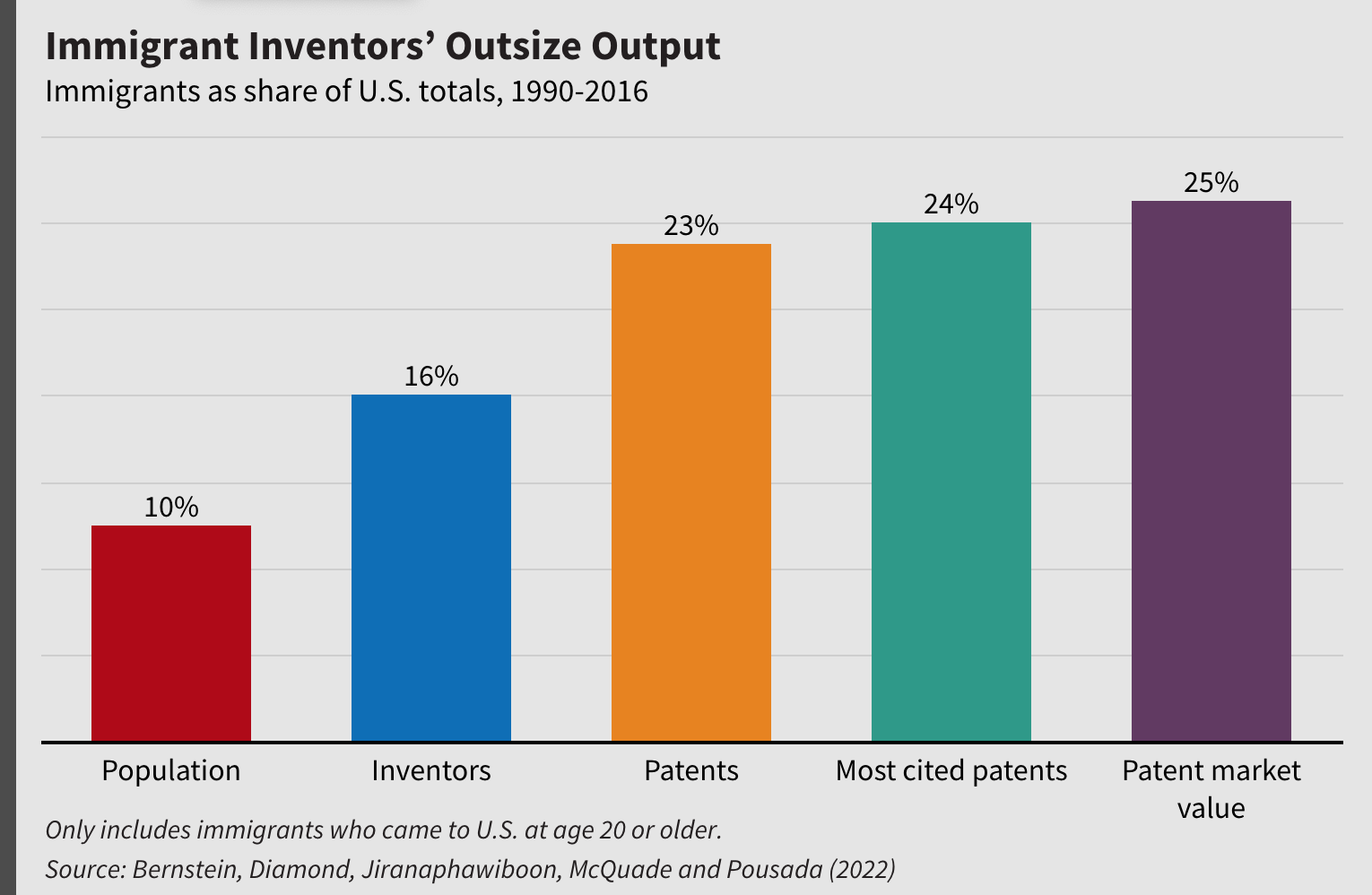
To find the answer, the researchers looked at the output of nearly 880,000 Americans who patented inventions between 1990 and 2016. They found that immigrants made an outsize contribution to innovation in the U.S. While they comprised 16 percent of inventors, immigrants were behind 23 percent of the patents issued over these years.

It wasn’t just a matter of quantity: The share of patents immigrants produced was slightly higher when weighted by the number of citations each patent received over the next three years, a key measure of their quality and utility. Moreover, immigrants were responsible for a quarter of the total economic value of patents granted in that period, as measured by the stock market’s reaction to new patents.

“The high-skilled immigrants we have in the U.S. are incredibly productive and innovative, and they’re disproportionately contributing to innovation in our society,” says Diamond, a professor of economics at Stanford Graduate School of Business and senior fellow at the Stanford Institute for Economic Policy Research (SIEPR).

Past research has indirectly pointed to the sizable role immigrants play in American innovation. Studies have shown that immigrants represent nearly a quarter of the U.S. workforce in science, technology, engineering, and mathematics and more than a quarter of the nation’s Nobel Prize winners. But this study, described in a recent working paper, is the first time economists have used patents to directly measure the output of foreign-born innovators living in the U.S.

The data was clear: “The average immigrant is substantially more productive than the average U.S.-born inventor,” write Diamond and her colleagues, Shai Bernstein of Harvard Business School; Timothy McQuade of UC Berkeley’s Haas School of Business; Abhisit Jiranaphawiboon, a former predoctoral fellow at SIEPR and now a Stanford PhD student; and Beatriz Pousada, a PhD student at Stanford and SIEPR Dissertation Fellowship recipient in 2022-23.

The researchers took a unique approach to their work. They started with a database of 300 million adults who had lived in the country between 1990 and 2016 and then used Social Security numbers to identify those who had immigrated after age 19. (The first five digits of a Social Security number encode the date it was issued; U.S.-born citizens typically receive their numbers at birth or in childhood.) Using names and address history, they matched individuals in the database to those listed as inventors with the United States Patent and Trademark Office. (When patents had multiple authors, each got credit for a proportional share.)

The researchers found that immigrants generate patents across a broad swath of sectors, including computers, electronics, chemicals, and medicine. They also discovered that, while all inventors reach peak productivity in their late 30s and early 40s, immigrants decline from that peak at a slower rate than U.S.-born inventors over the rest of their careers, a disparity that remains unexplained.

The immigrant innovation gap

Diamond believes there are several potential reasons for the innovation gap between immigrant and native-born inventors. One is brain drain: “There’s likely a pretty strong positive selection in terms of the types of people from every country that end up as high-skilled professionals with U.S. visas,” she says.

Another factor is cross-border collaboration: The researchers observed that foreign-born inventors are more likely to work with inventors based in other countries and cite foreign technologies in their patents. “Different pools of knowledge get imported by immigration, and diversity in background is good for innovation,” Diamond says.

Diamond and her team also found evidence that immigrant inventors are more likely to live in innovation hubs, such as Silicon Valley or Boston, and to work on patents in cutting-edge technology sectors. Still, the researchers estimate that these two factors explain just 30 percent of the gap in patent output.

Immigrant inventors’ contributions go beyond their own work — they also make their native-born collaborators more productive, the researchers discovered. To arrive at this finding, Diamond and her team identified inventors who died before they turned 60 and examined the output of people who had co-authored a patent with that individual before their early death. Compared to a control group of inventors that did not lose a collaborator, surviving inventors produced 10 percent fewer patents after the death of their co-author. The effect was larger for inventors whose deceased co-author was an immigrant — their productivity declined by 17 percent. This gap persisted even after the researchers controlled for a number of factors, such as the productivity of the deceased inventors.

“At the end of the day, we weren’t really able to explain the gap,” Diamond says. “It seems there’s something special about being an immigrant. Their knowledge has these huge external effects on who they work with, and what they know impacts what their collaborators can produce in the future.”

Diamond believes these findings have direct implications for policymakers who want to maintain the nation’s role as a technological trailblazer. “Understanding the forces that make the U.S. one of the most innovative and productive countries in the world is important,” she says. “The U.S. has done an amazing job of attracting the best and the brightest immigrants. Any policy that would revamp the visa process might want to consider how big a deal immigrants are in our innovation output.”

Source: A new look at immigrants’ outsize contribution to innovation in the US

Minority status biases evaluation of both women and men professors

Of interest:

Both men and women professors in the United States may receive lower course evaluation scores in departments where the majority of professors are of the other gender. However, because women are more often in the minority, they receive a disproportionate share of lower scores.

Further, since course evaluation scores are a significant factor in promotion and tenure decisions, this disparity negatively affects women professors’ career trajectories, hampering efforts to achieve equity and gender parity in the upper levels of the professoriate, says a new study published in the journal PNAS – Proceedings of the National Academy of Sciences.

“Our key finding is that regardless of which gender is in the minority, that gender receives lower course evaluation scores than does the dominant gender. We saw the same effects for men working in female-dominated departments and women working in male-dominated departments,” says Professor Oriana R Aragón, who teaches in the department of marketing at the Carl H Lindner College of Business of the University of Cincinnati.

She is lead author of the study published in PNAS earlier this year and titled “Gender bias in teaching evaluations: the causal role of department gender composition”.

“These findings are consistent with role congruity theory, which, in the context of academe, says that when a department is majority male or female, members of the opposite gender who teach in it are not deemed to be ‘authentic’ or as not being a bona fide expert.

“Students have a sense of, ‘It’s not quite right. I didn’t get the teacher that I should have had.’ This leads them to rate the professor lower, especially in upper-level courses; this negatively affects women professors because they are more often in the minority.”

The study and some findings

There are two parts to the study conducted by Aragón; Evava S Pietri, professor of psychology and neuroscience at the University of Colorado Boulder; and Brian A Powell, Fjeld professor in nuclear environmental engineering and science at Clemson University in South Carolina.

The first part utilised course evaluations from courses in which 115,647 students were enrolled in all of Clemson University’s 51 departments. These evaluations covered 1,885 educators who taught 4,700 courses during the 2018-19 academic year.

The evaluations utilised a Likert-type scale ranging from one (strongly disagree) to five (strongly agree). Since introductory courses have much larger enrolments, more than 72% of the courses were upper level, that is, years three and four.

These archived evaluations revealed that in departments with gender parity, students rated male and female educators almost equally in both the lower- and upper-level courses.

By contrast, in those departments that were majority male, female educators teaching lower-level courses were rated almost 0.1 point higher than were male teachers: 4.24 to 4.15. In upper-level courses, the relative position of the genders flipped, with women scoring 4.28 and men just under 4.37.

In the lower-level courses, in departments in which women made up the majority of the instructors, female educators actually scored 0.1 points lower than do males: 4.33 to 4.43. In upper-level courses in which the teaching staff is majority female, female educators are rated 4.48 while male teachers were rated more than a tenth of a point lower (4.36), a significant difference in scores.

Interpreting some findings

Central to understanding the results found in the evaluations from 2018-19, Aragón explained, is role congruity theory.

Female professors are rated more highly by both male and female students in lower-level courses, she says, partially because students value the interpersonal nurturing role that female instructors either provide or are seen to provide at that level of the university.

“Role congruity theory tells us that women are seen as more communal. Women are seen as caretakers of the home and of the sick, for example. In male dominated departments, at least at the lower level, it’s consistent with stereotypes to see women in these roles and that translates into rating them more highly on evaluations.”

The lower course evaluation scores that male instructors receive when they teach lower-level courses in male dominated departments can be understood as the flipside of why male professors are rated so much higher than are female professors in the upper-level courses in these same departments.

The expectation, according to role congruity theory, is that upper-level courses will be taught by experts in their fields. Since 72.6% (or 37) of Clemson University’s programmes have majority male staff, simple maths dictates that the cadre teaching the upper-level courses will be majority male.

Male educators in the lower-level courses pay a price of approximately 2/10ths of a point on their course evaluation scores because, Aragón and her co-authors aver, they are seen as fulfilling supporting (that is, stereotypically female) and not essential or agentic roles in their department’s educational and research ecosphere.

Women teachers in upper-level courses in female dominated departments are rated more highly than are those who teach lower-level courses (4.28 to 4.49). They also received higher course evaluation scores than men teachers who teach in departments in which female instructors dominate, such as nursing.

“Because upper-level courses signal high status and require expertise, broader gender stereotypes [that is, those beyond the university itself] would imply that men should teach upper-level courses,” Aragón et alwrite.

“However,” Aragón further explained to University World News, “the broader stereotype is overridden in female dominated departments, such as nursing or education where women may be considered bona fide members in those fields. And, so follows too, women’s higher evaluation scores, relative to men, when teaching these upper-level courses in female-dominated departments.”

The course evaluation scores for male teachers who teach lower-level courses in majority female departments is not only approximately 0.2 points higher than their male colleagues who teach in majority male departments, it is more than a point higher than the course evaluation scores of women professors who teach in male dominated departments.

Aragón and her co-authors explain why we see these biases against those in the gender minority in upper-level courses but not in lower-level courses by pointing to a societal paradox identified by role congruity theory.

“In the female-dominated domain of the family caregiver, men are evaluated negatively for filling the essential care-giver role of stay-at-home fathers or for taking extended family leave, which signals a primary caretaking position,” they write.

“Yet, men are viewed more positively than are women when they fill supportive roles in female domains, such as reducing work hours to help with the family’s needs or taking shorter leaves from work for supportive or interim caretaking. It seems that those in the gender minority are not penalised for entering gender incongruent domains when they are simply facilitating the more supposedly genuine measures of that domain.”

Shifting gender-based expectations

The second part of the “Gender bias” article reports on an experiment Aragón et al used to see if they could shift students’ gender-based expectations about professors and their ‘fit’.

In the research, 803 students were randomly assigned to departments, the descriptions of which were vague enough so that the students could not make stereotypical assumptions about whether the department was male- or female-dominated.

The students were then shown ‘faculty’ webpages that were manipulated to show male- or female-dominated departments and asked to evaluate the professors.

In the absence of classroom experience with professors the course evaluation scores were more stratified by gender. For example, female teachers in majority male departments who teach lower-level courses received course evaluation scores 0.17 higher than male teachers in the experimental group, while in the archived group the difference was 0.08.

“Our manipulation via a few moments with a faculty webpage,” writes Aragón, “was most likely not powerful enough to override broader gender stereotypes, particularly because the fields of study were not specified. Thus, the gender stereotypes appeared to play a larger part in shaping biases in the experimental than in the archival study” and significantly disadvantaged women.

Some conclusions

Aragón and her co-authors conclude the “Gender bias” article with two arguments.

The first addresses the question of whether, as departments become more balanced in terms of gender, existing stereotypes go by the wayside. While they answer yes, their example, computer programming, points to the paucity of examples of fields where the achievement of gender parity has improved the perception of women.

In the 1960s, computer programming, which involved preparing computer punch cards and, thus, was not seen as being far removed from bookkeeping or secretarial work, was a majority female job classification and was seen as a being supportive role. “Once the field became male dominated” – in the mid-1970s – they write, “the characterisation of the field changed to one of cerebral analysis”.

Secondly, the authors indicate strategies that departments and universities can use until various fields reach gender parity, so that women professors are not systematically disadvantaged by the bias in course evaluation scores.

Among these strategies is one they dub “fake it until you make it”, which would de-emphasise course evaluation scores and emphasise the achievements of both men and women in their departments. To try to neutralise gender expectations and course levels, they propose that “both male and female educators should teach lower- and upper-level courses”.

Finally, they call on tenure and promotion committees to make themselves aware of the bias inherent in course evaluation scores which, their study shows, have more to do with students’ sense of ‘fit’ than with performance in the classroom.

“Promotion and tenure decisions are made,” Aragón told University World News, “on very small differences. If the department average for a certain item on the questionnaire is 4.6 and you have a 4.55, you better believe I have gotten letters from the tenure promotion review committee that say, ‘You really need to get that score up a little bit’.

“That little fraction of a point can make a huge difference. It can decide who gets promoted, who gets tenure and who doesn’t. At present, the bias in these numbers disproportionately negatively affects the trajectory of women educators in colleges and universities.”

Source: Minority status biases evaluation of both women and men professors