China slams Olympic boycott call, ‘politicization of sports’

The Special Committee on Canada-China Relations should stop making virtue signalling calls for the Olympics to be moved (won’t happen) and join the British parliamentary committee in calling for a boycott:

China on Thursday criticized what it called the “politicization of sports” after British lawmakers urged a boycott of the 2022 Beijing Winter Olympics unless China allows an investigation of complaints of human rights abuses in its northwest.

A boycott “will not succeed,” Foreign Ministry spokesperson Wang Wenbin said.

The British Parliament’s Foreign Affairs Committee called for the government to urge British companies to boycott the Beijing Games, scheduled for February. The appeal adds to pressure on China’s ruling Communist Party over reports of mass detentions and other abuses of mostly Muslim ethnic minorities in the northwestern region of Xinjiang.

“China firmly opposes the politicization of sports and the interference in other countries’ internal affairs by using human rights issues as a pretext,” Wang said. “Attempts to disrupt, obstruct and sabotage the preparation and convening of the Beijing Winter Olympic Games out of political motivation have been met with strong opposition from all sectors of the international community.”

China, which rejects the accusations of abuses in Xinjiang, has denied the United Nations unfettered access to the region to investigate the claims.

Source: https://abcnews.go.com/Sports/wireStory/china-slams-olympic-boycott-call-politicization-sports-78731310

British Jews’ fear and defiance amid record monthly anti-Semitism reports

Of note:

A monthly record number of reports of anti-Semitic incidents were recorded following the 11-day conflict between Israel and the Palestinians in May, a charity says. So how does it feel to be Jewish in the UK?

Rabbi Nicky Liss had been preparing to give a midnight talk at a north London synagogue last month, when he began to feel nervous.

A rabbi of 13 years, he was used to giving speeches. This one, to mark the start of the Jewish festival of Shavuot on 16 May, should not, on the face of it, have been any different.

But that afternoon, events built to what he describes as a “crescendo”.

He’d learned that his good friend and fellow rabbi, Rafi Goodwin, had been attacked outside his synagogue in Chigwell, in Essex – allegedly struck over the head with a brick.

Two men have denied causing grievous bodily harm, robbery and religiously aggravated criminal damage and are due to appear at Chelmsford Crown Court for trial in November.

In a separate incident that afternoon, a man was filmed apparently using a megaphone to shout anti-Semitic abuse from a convoy of cars with Palestinian flags that travelled through St John’s Wood in north-west London – an area that is home to a Jewish community. Four men were arrested and remain on bail until mid-July.

Over the next few hours, worried phone calls and messages buzzed through Mr Liss’s community. Some feared the situation in north London could become “very threatening” by the evening.

Orthodox Jews do not use cars on religious holidays or the Sabbath, so Mr Liss had planned to walk the 25 minutes from his home on-site at Highgate synagogue to the synagogue in Hampstead Garden Suburb.

But the day’s events left Mr Liss with an agonising dilemma over whether he should go ahead with his talk – and what, as chair of United Synagogue’s rabbinical council, he should advise concerned colleagues to do.

Advice was sought from the Community Security Trust (CST), a Jewish charity that provides security support and monitors reports of anti-Semitic incidents.

Mr Liss says the advice was to go ahead with the events – but with increased vigilance and precautions, including local patrols being stepped up.

“This is the first time I’ve felt physically threatened,” he tells the BBC.

“I can’t believe that in 2021, I was thinking, was it safe for me to go on the street and walk to another synagogue to give a talk. It was incredibly worrying.”

A record number of anti-Semitic incidents have been recorded in the UK since the start of last month’s violence between Israel and the Palestinians, the CST says.

From 8 May to 7 June, 460 incidents were reported to the charity – the highest monthly total since records began in 1984 – with 316 happening offline and 144 online.

The previous record was 317 in July 2014 – coinciding with the last major eruption of violence between Israel and the Palestinians as part of a decades-long conflict.

In the month before 8 May, 119 anti-Semitic incidents were reported to the CST.

On 17 May, Communities Secretary Robert Jenrick told the House of Commons that there had been a “deeply disturbing” upsurge in anti-Semitism in recent years, particularly on social media.

Police forces in London, Greater Manchester and Hertfordshire did not have readily available data on the number of anti-Semitic incidents reported to them in May.

Last month, Greater Manchester Police’s Det Ch Insp Paul Coburn said that “following recent tensions in the Middle East”, officers had seen a “rise in hate crime directed towards members of specific communities” – which he told the BBC has since “stabilised” since the force launched a dedicated response, Operation Wildflower.

Dave Rich, CST’s head of policy, says 416 of the 460 incidents “used language or some other evidence” related to Israel. He adds that generally, most incidents involve verbal abuse, with a “relatively small” number involving violence.

“Every time Israel is at war… 2014, 2009, 2006 being the main ones, we’ve seen record totals each year, each time, [that are] always higher than the last,” he tells the BBC.

Mr Rich says the current trends that have “stood out” are the car convoys that have driven through areas where Jewish people live – as well as the “disproportionate impact” on school pupils, teachers, and university students – with 30% of all reports recorded linked to the educational sector.


The conflict between Israel and the Palestinians is not the only global event to spark a backlash against minority groups in the UK.

Whether it is the targeting of East Asian and South East Asian people at the start of the Covid-19 pandemic; or Islamophobic attacks following terrorist incidents, major news events have real-life consequences for ordinary people.

Tell Mama UK, which monitors anti-Muslim hate incidents, says it received a “rise in reports both online and offline” after last month’s violence between Israel and the Palestinians.

From 8 May to 31 May, it says it recorded 131 incidents – up from 59 in April. Of the 131, Tell Mama says 93 were directly linked to the conflict.

Iman Atta, the organisation’s director, says the majority of cases involved “abusive behaviour” – with some including threatening behaviour, and others mentioning assault.

“Although the political conflict in the region can stir up a lot of emotions, there is absolutely no room for anti-Muslim or anti-Semitic rhetoric,” she says.

“We fear that such behaviour threatens to harm social cohesions between Muslim and Jewish communities here in the UK.”

From 8 May to 15 June, around 50 anti-Semitic incidents were reported that were related to university campuses, according to the Union of Jewish Students.

Rebecca Lyons, vice-president of the UCL Jewish Society, says “threats of death and physical violence” have been sent to the social media accounts of the Jewish and Israel societies.

In one private message, an Instagram user told the student-run Jewish society: “See you on campus. We’ll be waiting to say hello to you, Arab style.”

Rebecca, 21, says initially she feared the online threats and comments “might be actualised,” adding that the abuse had left her feeling a “loss of identity” as a British Jew.

“I was born and raised in London, I worked hard to achieve highly in a British academic curriculum and yet I’ve been made startlingly aware of how clearly unwelcome I am in my own university space.”

She says the “memory of how intense and bloodthirsty” those weeks were was “embedded” in her mind – and has added to her uncertainty over her future in London.

Despite the abuse, Rebecca adds that “we as a Jewish student community remain very much Jewish and proud… and no amount of harassment will deter that”.

Jonny Eintracht, a 26-year-old PhD student from London, says there are always going to be pockets of anti-Semitism – and the best way to tackle them is by staying true to your own values.

“As long as I can behave in a way that… if people looked at me, or my friends and family, and think ‘my experience of observant Jews, or Jews is general, is different to what I thought,’ or ‘that’s someone that I would like to emulate one day’ – I think that’s the best way to combat anti-Semitism.

“It’s a kind of responsibility that I feel. We stay proud, and we stay true to what we believe in and we continue to contribute to the world however we can.”

Jonny, who wears a kippah, the head covering traditionally worn by male Jews, says since moving to London from Australia three years ago he has never felt unsafe or that he needs to change his behaviour – even after facing recent verbal anti-Semitic abuse in the street.

He says when events have become more volatile, he has felt a “large sense of unity” as Jewish people around the world come together – adding that he’s also had support from people who aren’t Jewish.

“I’ve had non-Jewish colleagues ask me if I’m OK or if I want to talk about the situation… I think when you’re able to sit down and talk about it in a calm way, and out of concern for one another, then that’s the first step to having any sort of constructive way forward.

“It gives me hope for the future.”

Jenny Tamari, a mother-of-three from north-west London, says she is reconsidering her family’s future in the UK, as she feels it has become “open season on the British Jews”.

The former marketing consultant says she has “been feeling anti-Semitism for a while” in Britain, but with every “flare-up” of tensions in the Middle East, “people always see how far they can go… to let out their hatred for the Jews”.

After watching the widely-circulated video of the car convoy that travelled through north London, Jenny thought of her six-year-old daughter.

“At the time, I heard cars beeping and I didn’t actually know what was happening. But then I saw the video and went to my kitchen away from my kids and just cried.”

Jenny, 40, admits recent events have left her increasingly scared for her family’s safety.

She says she even took off her son’s kippah as they walked to a friend’s house for a recent Sabbath lunch.

“I told my son he had to take his kippah off. And he said, ‘why Mummy, I don’t want to’, and I got really frustrated and said, ‘you can’t wear it in the streets’. I got really scared and he felt that, as a four-and-a-half-year-old child, and just said ‘It’s OK Mummy, I’ll take it off’.

“I just feel so disappointed in myself, so sad for him, so sad for my grandfather who came from Vienna and escaped the Holocaust, so that he could be actively, outwardly Jewish in Britain – the country that took him in.”

Jenny has recently started a podcast called Jewish in the City, which despite being “born out of” anti-Semitism, is designed to “uplift, inspire and encourage” Jews; and to highlight their “positive contributions” to communities.


In Essex, Lindsay Shure, the chair of the Chigwell and Hainault synagogue, is “determined that something good” will follow the attack on their own Rabbi Goodwin.

Lindsay, 70, says the Jewish community and the residents of Chigwell’s Limes Farm estate – where the synagogue sits – had never had “terribly much to do with each other”, but the support from non-Jewish people has been “incredible”.

He says people have left flowers and cards outside the synagogue and others have left kind messages on social media, including one which said: “Your community is our community”.

For him, the outpouring of support “emphasises that it’s the people on the extremes who show the hatred… generally, people are very supportive and treat each person on their merits”.

He says he is meeting the local residents’ committee soon to discuss how they and the Jewish community can work together on future social projects. They are hoping to do some work in a care home later this year.

“If we get closer, we get a better understanding of people as human beings… I hope this will lay the foundations for something even more important and longer-lasting.”
Source: British Jews’ fear and defiance amid record monthly anti-Semitism reports

Ethnic makeup of Buckingham Palace workforce not ‘what we would like,’ says senior source

Smaller gap than I would have guessed but perhaps London would be a better benchmark than the UK as a whole (40 percent ethnic minorities):

Buckingham Palace has for the first time released figures on the ethnic makeup of its staff, following the Duke and Duchess of Sussex’s allegations of racism in the Royal Family.

The Royal Household said Thursday that 8.5 per cent of its staff come from ethnic minorities, compared with a target of 10 per cent by next year. The latest census data shows that ethnic minorities account for about 13 per cent of the U.K. population. The staffing figures were released as part of an annual report on royal finances.

A senior palace source said publishing the figures was an effort to ensure greater accountability because there would be “no place to hide” if diversity goals aren’t met. The source acknowledged that much more needed to be done.

Source: Ethnic makeup of Buckingham Palace workforce not ‘what we would like,’ says senior source

David Olusoga on race and reality: ‘My job is to be a historian. It’s not to make people feel good’

Thoughtful interview:

History’s purpose isn’t to comfort us, says David Olusoga, although many in the UK seem to think it is. “History doesn’t exist to make us feel good, special, exceptional or magical. History is just history. It is not there as a place of greater safety.”

As a historian and broadcaster, Olusoga has been battling this misconception for almost two decades, as the producer or presenter of TV series including Civilisations, The World’s War, A House Through Time and the Bafta-winning Britain’s Forgotten Slave Owners. His scholarship has been widely recognised: in 2019, he was awarded an OBE and made a professor at the University of Manchester. (He is also on the board of the Scott Trust, which owns Guardian Media Group.) Yet apologists for empire, in particular, like to dismiss him as a “woke historian” in an attempt to politicise his work or flatly deny the realities that he points out.

Now he can expect more flak, thanks to the new edition of his book Black and British: A Forgotten History.

First published in 2016, and made into a TV series the same year, the book charts black British history from the first meeting between the people of Britain and the people of Africa during the Roman period, to the racism Olusoga encountered during his own childhood, via Britain’s role in the slave trade and the scramble for Africa. It is a story that some of Olusoga’s critics would prefer was forgotten.

Hostility to his work has grown since the Brexit vote, shooting up “profoundly since last summer”, he says, speaking over Zoom from his office in Bristol. “It has now got to the point where some of the statements being made are so easily refutable, so verifiably and unquestionably false, that you have to presume that the people writing them know that. And that must lead you to another assumption, which is that they know that this is not true, but they have decided that these national myths are so important to them and their political projects, or their sense of who they are, that they don’t really care about the historical truths behind them.

“They have been able to convince people that their own history, being explored by their own historians and being investigated by their own children and grandchildren, is a threat to them.”

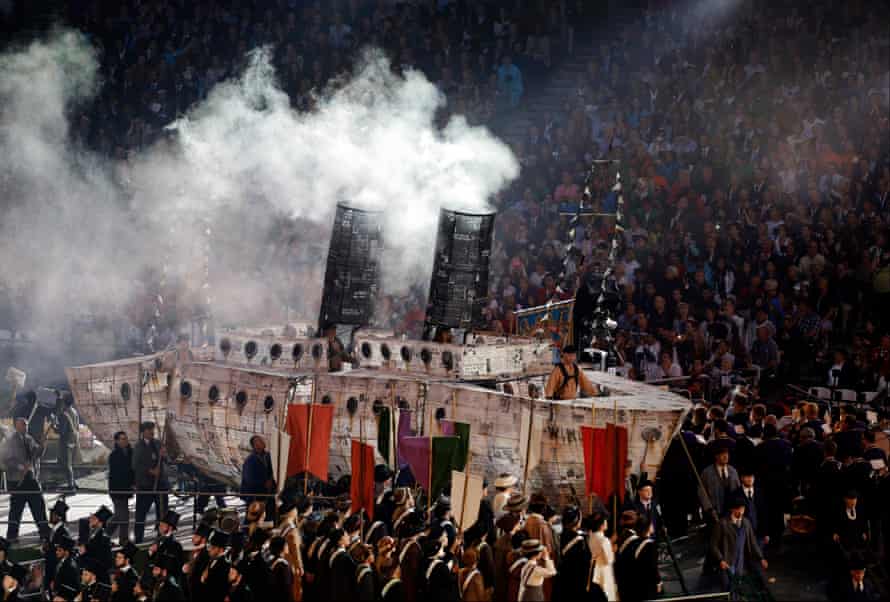
A recreation of the Empire Windrush at the opening ceremony of the London Olympics in 2012
‘You have to have a real tenure in the country to play your ancestors’ … a recreation of the Empire Windrush at the opening ceremony of the London Olympics in 2012. Photograph: Lee Jin-man/AP

For Olusoga, 51, this hostility can in part be explained by ignorance. “If you were taught a history that the first black person to put his foot on English soil was stepping off the Windrush in 1948, then this can seem like a conspiracy,” he says.

But there is a deeper issue at play. “If you have been told a version of your history and that is part of your identity, it’s very difficult when people like me come along and say: ‘There are these chapters [that you need to know about].’ People feel – wrongly in my view – that their history is being undermined by my history. But my history isn’t a threat to your history. My history is part of your history.”

When the book was published in 2016, it ended on a hopeful note. Olusoga was writing just a few years after the London Olympics, in which a tantalising view of Britain emerged – a country at ease with its multiculturalism, nodding with pride to the arrival of the Windrush generation in 1948. Black Londoners dressed up as their ancestors for the opening ceremony, “with long, baggy suits, holding their suitcases”, says Olusoga. “You have to have a real tenure in the country to play your ancestors.” That moment, he says, was profoundly beautiful.

But that upbeat note has begun to feel inaccurate – an artefact of a more optimistic time. In the new edition of Black and British, which includes a chapter on the Windrush scandal and last year’s Black Lives Matter protests, Olusoga describes that moment in 2012 as a mirage. The summer afterwards, vans bearing the message “Go home or face arrest” were driven around London as part of Theresa May’s notorious “hostile environment” strategy, aiming to make the UK inhospitable for undocumented migrants. Thousands of people who had lived legally in the UK for decades, often people who had arrived from the Caribbean as children, were suddenly targeted for deportation.

In 2020, protesters in more than 260 British towns and cities took part in BLM protests, thought to be the most widespread anti-racist movement since the abolition of the slave trade. A statue of the slave trader Edward Colston was toppled in Bristol; a Guardian analysis suggests about 70 monuments to slavers and colonialists have been removed, or are in the process of being removed, across the UK.

But this movement for racial justice has been met with a severe backlash. In January, Robert Jenrick, the secretary of state for housing, communities and local government, said he would introduce laws to protect statues from what he called “baying mobs”. The government’s recent review on racial equality concluded controversially that there was no institutional racism in areas including policing, health and education, despite all the evidence to the contrary.

“I’m really frightened about the future of this country, and frightened about people using forces of race and racism for electoral reasons and not being cognisant about how difficult it is to control those forces after elections have been counted,” says Olusoga. “I’m really frightened about the extent to which people are able to entirely dehumanise people who they deem to be their enemies in this culture war.”


Olusoga was born in Lagos in 1970, to a white British mother and a Nigerian father, moving to his mother’s home town, Gateshead, at an early age. As one of a handful of mixed-race families on the council estate where they lived, they were regularly terrorised by the far right. The violence culminated in a brick being thrown into the family’s home, wrapped in a note demanding they be sent “back”. He was 14. Eventually, the family had to be rehoused.

His early experience of education was also distressing. “I experienced racism from teachers in ways that are shocking if I tell them to young people at school now,” says Olusoga. He was dyslexic, but the school refused to get him tested until he did his GCSEs: “It was the easier story to believe that this kid was stupid because all black kids are stupid.” When he finally got his diagnosis and support – thanks in large part to his mother’s fierce determination – Olusoga went to study history at the University of Liverpool, followed by a master’s degree at Leicester.

Olusoga was confident about having two identities, despite the prejudice he had encountered. He was proud of being a black Nigerian of Yoruba heritage and was perfectly happy being part of his mother’s white working-class geordie tradition. But he has always had a third identity.

“I’m also black British – and that had no history, no recognition. It was presented as impossible – a dualism that couldn’t exist, because whiteness and Britishness were the same thing when I was growing up. So, to discover that there was a history of being black and British, independent from being half white working-class and being half black Nigerian, that was what was critically important to me,” he says. His book does its best to uncover that history, exploring the considerable presence of black people in Britain in the age of slavery, as well as the part played by black Britons in both world wars.

He says that some of the aggression shown towards black historians who write honestly about Britain’s past comes from people who think “this history is important because it gives black people the right to be here”. They hold on to the belief that the UK was a “white country” until the past few decades and refuse to accept evidence that shows the presence of black people goes back centuries. But this is to fundamentally misunderstand what drives him and also why this history is important for black people.

“I don’t feel challenged in my right to be proud to be British,” he says. “I’m perfectly comfortable in my identity. I’ve looked at this history because it’s just exciting to be part of a long story. This comes out of wanting to enrich life, not seeking some sort of needy validation of who I am.”

He found it refreshing to see the UK’s history of empire and colonialism acknowledged in last summer’s anti-racist placards, with one popular slogan stating “The UK is not innocent”. “A generation has emerged that doesn’t need history to perform that role of comfort that its parents and grandparents did,” he says.

As for black people’s experiences in Britain, he says, there is a “hysterical” level of anger if you point out that many have lived in some form of slavery or unfreedom. Recently, historians have uncovered notices of runaway enslaved people or advertisements for their sale. This adds to the evidence that thousands of black people were brought to Britain, enslaved as well as free.

“It brings slavery to Britain and therefore undermines the idea that it doesn’t really matter because it happened ‘over there’,” says Olusoga. “It short-circuits an idea of British exceptionalism. And there are a lot of people for whom that idea of exceptionalism is a part of how they see themselves. I’m really sorry that the stuff I do and that other people do is a challenge to that, but my job is to be a historian. It’s not to make people feel good.”

Olusoga is often accused of pursuing a political agenda. He is asked, for instance, why he doesn’t speak about the Barbary slave trade of the 16th to 18th centuries, in which Europeans were captured and traded by north African pirates. He has a simple response: that he has been trying to get a programme made about it for his entire career and it is finally happening.

He gives another example: “I have been accused literally hundreds of times of ignoring the slavery suppression squadron that the Royal Navy created after 1807.” Its task was to suppress the Atlantic slave trade by patrolling the coast of west Africa. “I think the chapter in Black and British about that is 30,000 words, which is as long as some books.”

What his more extreme critics fail to understand, he adds, is that he is loyal to history and not a political agent. He remains committed to one goal: to uncover the stories of those who have long been deemed unimportant. When he wrote his first book on the 1904-08 Namibian genocide, he went to mass graves where he saw bones sticking out of the ground. “We promised the victims of that genocide that we would be their voice, we would fight for them and we would tell their story – and we use every skill we have to do that.

“I care deeply about people who were mistreated in the past. I care about the names on slave ledgers, I care about the bones of people in Africa, in mass graves in the first world war and in riverbeds in Namibia. I care about them. I think about them when I read the letters, when I look at their photographs and their faces. No one gave a damn about them. That’s my job – to care about them. And I will be ruthless in fighting for them.”

Source: David Olusoga on race and reality: ‘My job is to be a historian. It’s not to make people feel good’

How imperial hopes for the Commonwealth led to British citizenship being redefined along racial lines

Interesting history of the policies and policy objectives:

It’s just over a year since the government released the Windrush Lessons Learned Review, an attempt to come to terms with the Windrush scandal. Recommendation six of the Review states among other things that Home Office staff should ‘learn about the history of the UK and its relationship with the rest of the world’. Meanwhile, recommendation eleven states that the Home Office should make sure its staff ‘understand the history of immigration legislation’. Policy reviews don’t usually redirect to history in such a definite way, and we should pay attention to the fact that this one does.

As it turns out, the connections and correlations between immigration laws and Britain’s relationship with the rest of the world in the post-war era are many and strong. The legal architecture (a mix of immigration law and nationality law) at stake in the Windrush scandal did not begin with the 2014 and 2016 Immigration Acts. Nor did it begin with Theresa May’s tenure as home secretary. The story is much bigger and more intrinsic to Britain’s gambit in the post-war world. This story began in 1948 and was largely complete by 1971 (a year mentioned 35 times in the Review). Fifty years ago this year, the 1971 Immigration Act was the legislative culmination of Britain’s struggle against its own nationality law, and began Britain’s modern immigration system.

The 1948 British Nationality Act set the tone for post-war Britain. It was greeted by a New York Times headline that declared ‘British empire gets new nationality act’. In other words, the act might have been named the British Imperial Citizenship Act. The 1948 act created a single, non-national citizenship around the territories of the British Isles and the crown colonies. It was momentous because it gave rights of entry and residence in Britain to millions of non-white people around the world on the basis of their connection to existing crown colonies or independent Commonwealth states. These citizenship rights were given to  ‘citizens of the United Kingdom and Colonies’ – the forerunner to what is now called British citizenship – and to ‘Commonwealth citizens’.

The true motivations behind the 1948 Act were squarely imperial – namely, keeping the colonies and Commonwealth unified at the level of nationality, and keeping a soon-to-be-republican India in the Commonwealth. Yet, despite the fact that Britain’s formal empire was all but over by 1965, successive governments refused to dismantle these imperial structures of British nationality and citizenship, instead passing immigration laws as so many bandages on nativist wounds as the imperial heartland became home to more and more non-white migrants.

There was something strange going on here: immigration laws were targeting citizenship rights provided in British nationality law. Bizarrely, it was the post-war immigration laws (in 1962, 1968, 1971), not British nationality law itself, that dictated who ‘belonged’ in Britain, both politically and legally. At the level of British nationality and citizenship, decolonisation did not begin in Britain until 1981 and the British Nationality Act of that year. In other words, British nationality and citizenship remained imperial throughout the age of decolonisation.

These confusions intensified in the late 1960s. Worried about South Asian British citizens in East Africa migrating to Britain, a Commonwealth Office official wrote to his colleagues in 1967 that ‘we had obviously made a big mistake’ in passing the 1948 Act, which was equivalent to ‘handing out British citizenship to large numbers… Having made this mistake, we have somehow now got to pay for it’. Most of the South Asians in Kenya facing majoritarian policies in the late 1960s held an identical citizenship to Labour prime minister Harold Wilson himself and an unrestricted legal right of entry to Britain. The 1968 Commonwealth Immigrants Act was designed to block their entry and left them with ‘the husk of citizenship’, as the home secretary put it in a key Cabinet meeting. This was the first time that an immigration law had been levelled at British citizens per se, and left them stateless in reality, despite their still being described as British citizens in law.

Three years later, the 1971 Immigration Act was an attempt to bring order to Britain’s immigration system. By placing the administrative burden of proof on individuals themselves, it also laid the foundation for the Windrush scandal. The 1971 Act created a peculiar new concept – a ‘patrial’, a term that referred primarily to a person’s birth in or ancestral connection to the territories of the British Isles. The home secretary himself admitted that he was not quite sure how to pronounce the archaic word. It was the patrial who now commanded the right of entry (now called ‘right of abode’) in Britain. Because patriality now served to grant rights of citizenship (entry and residence), this effectively detached citizenship rights from both citizenship of the UK and Colonies and Commonwealth citizenship. Being a patrial meant that you ‘belonged’ in Britain. As Violet Bonham Carter, daughter of Henry Asquith and grandmother of Helena Bonham Carter, put it in a House of Lords debate during this period, ‘a belonger usually has a white face’. The Economist, meanwhile, described the word patrial as ‘a nasty piece of tribal jargon’.

This was indirectly a tiering of British citizenship (citizenship of the UK and Colonies) and Commonwealth citizenship along racial lines, allowing in practice white settlers to ‘return’ to Britain but keeping out non-white migrants. Tanzania’s prime minister, Julius Nyerere described British immigration policies as ‘decadent racism’. Swaran Singh, India’s minister of external affairs, lambasted the ‘racial overtones’ of the proposed 1971 Act in the Rajya Sabha, the upper house of the Indian parliament, adding that it ‘introduces the concept of “patrials” as a privileged category’. In Port of Spain, the prime minister of Trinidad and Tobago, Eric Williams, subsequently condemned Britain’s ‘open unadulterated and ambiguous racialisms’. But the most devastating criticism came from the veteran Indian diplomat, Apa Pant, then the Indian high commissioner to the UK. Pant intervened with home secretary Reginald Maudling, telling him that the ‘concept of “patrials”’ was ‘unmistakably racialist’ and ‘breaks up the Commonwealth into white and non-white’. Its provisions on police registration would make ‘the already tense police-immigrant relation more tense and intolerable’, while those on employment turned the working migrant into ‘virtually a “brown/black” slave labourer’. This was to say nothing of the executive powers of deportation attendant on the 1971 Act.

Britain suffered a significant reputational cost at the hands of its exclusivist immigration laws, including at the European Court of Human Rights in 1973. Why did Britain create such laws without dismantling the imperial structures of the 1948 British Nationality Act? The answer is that the 1948 Act was a constitutional pillar of what various officials, diplomats, and politicians hoped would be a British-led imperial Commonwealth – a vehicle by which to contend in the making of the post-war world. To dismantle the 1948 Act was to give up on the imperial promise of the post-war Commonwealth.

‘There is in the Commonwealth a complex of links, not only political, but economic, educational, administrative and professional’, wrote Commonwealth Office officials in 1967. The Commonwealth was ‘a special asset which could give Britain a position of central importance in the world in, say, the last two decades of this century, out of proportion to her comparative economic and military strength’. Britain wanted to have it both ways: a grand Commonwealth based on a perceived ‘Anglocentricity’ abroad and exclusivist immigration laws at home.

Source: How imperial hopes for the Commonwealth led to British citizenship being redefined along racial lines

Home Office handling of Windrush citizenship claims ruled ‘irrational’

More on Windrush:

The Home Office’s handling of some Windrush citizenship applications has been irrational and unlawful, the high court has ruled in a judgment that will prevent the department from refusing citizenship to Windrush-generation applicants due to minor, historical convictions.

The court was ruling on the case of Hubert Howard, who was repeatedly denied British citizenship over the course of a decade, despite having lived in the UK since he arrived from Jamaica at the age of three in 1960.

The Home Office sought to deny him citizenship, despite the 59 years he had spent continuously in the UK, because of a number of minor convictions, most of them committed in the 1970s and 1980s – none were serious enough to trigger a jail sentence. He was still fighting for naturalisation from his intensive care bed as he was dying in hospital in October 2019.

Source: Home Office handling of Windrush citizenship claims ruled ‘irrational’

A new Windrush is in the making. Its victims are the most vulnerable of young people

Of note:

Three years on, the individual tales of Windrush injustice still have the power to catch my breath. Men and women who moved to Britain as children decades ago, who found themselves banished from the UK for the remainder of their life after a holiday abroad, wrongfully arrested, detained and threatened with deportation, and denied life-saving care on the NHS. So many stories of the British state ruining black lives, but one stands out for its exquisite cruelty: that of Jay, the son of a Windrush immigrant.

Jay was born in the UK and taken into care as a baby. When he applied for a passport as a teenager he was told he did not have enough information about the status of his estranged mother. After his third unsuccessful application, the Home Office threatened to deport him to Jamaica and forced him to declare himself stateless. He was only able to secure a passport years later, after the Windrush scandal broke and his case received significant media attention.

Source: A new Windrush is in the making. Its victims are the most vulnerable of young people

UK Home Office: new deportation law may discriminate against ethnic minorities

Of note:

The Home Office has admitted that a new immigration rule to criminalise and deport migrant rough sleepers may discriminate against ethnic minorities, including Asian women who have survived domestic violence.

An internal document outlines the department’s analysis of how the new power – which prompted widespread outrage when it came into force four months ago – would also indirectly affect at-risk groups, including people with disabilities.

The eight-page equality impact assessment, obtained by Liberty Investigates, accepts the potential of the rule to indirectly discriminate on the grounds of race, since some factors leading to homelessness disproportionately affect people from particular ethnicities. “The main reason Asian women give for being homeless is because of domestic violence,” the assessment states.

Source: Home Office: new deportation law may discriminate against ethnic minorities

UK: Ten previous inquiries expose the real problem with the Race Commission’s findings

As all too often happens with inquiries:

Amid Black Lives Matter protests following the death of George Floyd, Boris Johnson promised a Commission on Race and Ethnic Disparities. Announced in a Telegraph column(where else?) about Winston Churchill (who else?), it was clear even then that this was a weak response to a widespread problem.

The Commission’s remit was vague (with its sights on “inequality across the UK, not just that affecting the BAME community”), and those eventually charged with it had previously expressed reservations about the existence of institutional racism.

Yet the main problem was that previous inquiries, many set up by past governments using official data, had already exposed the racial disparities in the areas under the Commission’s remit: education, work, policing and health.

The information is already out there, but the recommendations from those reports have not been taken up. Last June, when the Commission was announced, I counted 375 recommendations to the government in ten different inquiries – from the 1999 Macpherson Report following the racist murder of Stephen Lawrence, to 2020’s Lessons Learned review into the Windrush scandal – which are yet to be implemented.

As my colleague Ailbhe Rea points out, the latest Commission’s findings were carefully briefed ahead of publication to achieve headlines suggesting institutional racism is “no longer” a problem in Britain.

The pre-publication stories focused on celebrations of Britain as a “beacon” of successful multiculturalism to Europe and the rest of the world, scepticism of the use of “institutional racism”, and success stories among certain ethnic minority pupils in educational attainment.

While there are clearly nuggets for the “war on woke” brigade to get their teeth into – the description of slavery as “not only being about profit and suffering” springs to mind – there are also recommendations that echo findings of aforementioned reviews.

For example, the 2017 Lammy Review into discrimination in the criminal justice systemanalysed disproportionate use of stop and search on black people, citing Northamptonshire Police Force’s enhanced scrutiny of the practice as a favourable case study. The Race Commission recommends greater scrutiny of the practice through body-worn video footage, with officers who have their cameras off providing a written reason to the individual who was stopped as well as their supervising officer (and “misconduct procedures” for serious instances of misuse).

Many of the Race Commission’s recommendations contradict its own headlines and implicitly accept the existence of systemic racism: the application of the Equality Act to potentially discriminatory “algorithmic decision-making” is just one example.

There are also proposals that run against the “war on woke” narrative. For example, the development of a pilot to divert offences of low-level Class B drug possession – which disproportionately affect ethnic minority young people – into public health solutions.

Yet the evidence-heavy, action-light history of reviews into British racism suggests these may be patchily enacted or left to exist only on paper – forever buried beneath headline-hungry right-wing virtue signalling.

Anoosh Chakelian is the New Statesman’s Britain editor.

Source: Ten previous inquiries expose the real problem with the Race Commission’s findings

British Government’s ‘Gaslighting’ Report on Racism Says Slavery Had Some Upsides

Not a great headline if a government wants to demonstrate awareness and sensitivity to racism. More denial of systemic barriers and bias, including how the report was released:

Last summer, after George Floyd’s killing sparked mass anti-racism demonstrations around the globe, British Prime Minister Boris Johnsonasked a dedicated team to investigate and report back on racism in the U.K.. On Wednesday, they came back with their findings—that institutional racism no longer exists, and that the slave trade had some upsides.

The report, published by the British government’s Commission on Race and Ethnic Disparities, has been branded as “gaslighting” and “an insult” by anti-racism activists. While the study went as far as admitting that Britain is not yet a “post-racial country,” it lauds the country’s race relations as “a model for other white-majority countries.”

“Put simply, we no longer see a Britain where the system is deliberately rigged against ethnic minorities,” it says. “The impediments and disparities do exist, they are varied, and ironically very few of them are directly to do with racism. Too often ‘racism’ is the catch-all explanation, and can be simply implicitly accepted rather than explicitly examined.”

The report went on to say that other factors—such as geography, socio-economic background, culture, family influence, and religion—had “more significant impact on life chances than the existence of racism.”

Appearing on BBC Radio 4’s Today show on Wednesday, the chairman of the commission, Dr Tony Sewell, explained his questionable findings further, saying: “No-one denies and no-one is saying racism doesn’t exist… We found anecdotal evidence of this. However, evidence of actual institutional racism? No, that wasn’t there, we didn’t find that.”

Perhaps the low point of the report is when it appears to find some benefits of the African slave trade—an atrocity in which Britain very much led the way. The government report chirpily states: “There is a new story about the Caribbean experience which speaks to the slave period not only being about profit and suffering but how culturally African people transformed themselves into a re-modelled African/Britain.”

The report also criticized anti-racism campaigners, dismissing Black Lives Matter and related demonstrations as the “idealism” of “well-intentioned young people” that risks “alienating the decent centre ground” of British politics. The commission condemned what it described as an “increasingly strident form of anti-racism thinking that seeks to explain all minority disadvantage through the prism of white discrimination.”

The report has, predictably, received an extremely bad reaction from anti-racism advocates. Rehana Azam, the national secretary of the GMB trade union, said: “Only this government could produce a report on race in the 21st century that actually gaslights Black, Asian, Minority and Ethnic people and communities. This feels like a deeply cynical report that not only ignores Black and ethnic minority workers’ worries, but is part of an election strategy to divide working class people and voters.”

David Lammy, a lawmaker for the opposition Labour Party and shadow Justice Secretary, described the report as “an insult to anybody and everybody across this country who experiences institutional racism.” He added: “Boris Johnson has just slammed the door in their faces by telling them that they’re idealists, they are wasting their time. He has let an entire generation of young white and Black British people down.”

Prof Kehinde Andrews, a professor of Black Studies at Birmingham City University, said: “It’s complete nonsense. It goes in the face of all the actual existing evidence. This is not a genuine effort to understand racism in Britain. This is a PR move to pretend the problem doesn’t exist.”

To make matters worse, HuffPost reported that selected journalists were not briefed about the report in advance—including Britain’s only race correspondent, The Independent’s Nadine White. White was sent an emailshowing that the commission asked for briefings on their report on racial disparities be sent to a “tight list of journos” only.

Institutional racism in Britain has been under the spotlight in recent weeks after Prince Harry and Meghan Markle’s allegation that the royal family expressed concerns about how dark their baby’s skin would be. Harry said racism in the British media was a “large part” of why he left the country, adding: “Unfortunately, if the source of information is inherently corrupt or racist or biased, then that filters out to the rest of society.”

Source: British Government’s ‘Gaslighting’ Report on Racism Says Slavery Had Some Upsides