UK immigration latest: EU net migration falls over past year as Brexit uncertainty continues | The Independent

Not surprising:

EU net migration is falling as more European citizens leave the UK and fewer arrive in the wake of the vote for Brexit, new statistics show.

The Office for National Statistics (ONS) said overall net migration in the year to September was 244,000 – a similar level to early 2014 and down on record levels in the next two years.

The number of European citizens arriving has plummeted since the EU referendum, while the number of people from outside the bloc has increased.

“EU net migration has fallen as fewer EU citizens are arriving, especially those coming to look for work in the UK, and the number leaving has risen – it has now returned to the level seen in 2012,” said Nicola White, head of international migration statistics at the ONS.

“The figures also show that non-EU net migration is now larger than EU net migration, mainly due to the large decrease in EU net migration over the last year. However, migration of both non-EU and EU citizens are still adding to the UK population.

“Brexit could well be a factor in people’s decision to move to or from the UK, but people’s decision to migrate is complicated and can be influenced by lots of different reasons.”

The number of EU citizens coming to the UK plummeted by 47,000 in the year and the number leaving – 130,000 – is the highest recorded level since the 2008 financial crisis.

Almost a quarter of a million people arrived in the UK to work in the period 2017, with the number of EU citizens falling by 58,000.

Most of the Europeans arriving had a definite job lined up, while a smaller proportion were looking for work.

The biggest nationality starting work in the year to September, according to National Insurance number registration data, was Romanian, followed by Polish, Italian, Bulgarian, Spanish and Indian – who accounted for over half of all skilled work visas granted.

The ONS said that the overall employment rate for EU nationals was 81.2 per cent, followed by Brits at 75.6 per cent and non-EU nationals on 63.2 per cent.

George Koureas, a partner at immigration law firm Fragomen, said: “The UK has become a significantly less attractive place for European citizens to work since Brexit, so it’s no surprise that more EU workers are leaving the country.

“Although the Government may see this as good news, it presents a significant threat to UK businesses, already struggling to hire the skilled workers they need to thrive.”

He said there could be a further impact from the Government’s plan to double the Immigration Health Surcharge, which is paid by migrants to use the NHS, and caps on visas for skilled workers.

via UK immigration latest: EU net migration falls over past year as Brexit uncertainty continues | The Independent

Businesses are floundering while Whitehall dithers on immigration

Interesting commentary from Adam Marshall, director general of the British Chambers of Commerce:

You might not know it, but a crisis is looming on the business parks, industrial estates, construction projects and farms of Britain. As the Brexit process dominates politics – and diverts Westminster’s energy away from virtually every other issue – businesses are struggling to fill vacancies and to find the people they need in order to grow.

In some sectors firms report that labour shortages have reached critical levels. A combination of record employment levels for UK-born people, significant falls in immigration following the devaluation of sterling in 2016, and the total absence of job candidates in some areas is biting hard. British Chambers of Commerce surveys show nearly three-quarters of firms trying to recruit are experiencing difficulties – this is at or near the highest levels since our records began more than 25 years ago.

Pragmatic solutions are needed to this acute and immediate problem. Job vacancies at all levels in the workforce are being left unfilled, damaging not only individual businesses and their growth prospects but also supply chains and the wider economy. While many firms report they are investing long term in the training and development of their workforce, this will take years to have the desired impact, particularly for very highly skilled roles. We cannot afford any gap in the supply of skills and labour. Businesses that have not planned ahead for their future needs will be wishing they had.

Yet, with few exceptions, businesses tell us that breezy Whitehall assumptions about artificial intelligence and automation remain years away from fruition. While some jobs may change or disappear in future, businesses will always need people because they are more flexible and adaptable than robots to the fast pace of change in the workplace. There’s no doubt, in the here and now, that UK firms require continuing access to labour, from Europe and farther afield, to plug the gaps.

Amid all the uncertainty our businesses and communities face, the UK government must act swiftly to define an open and responsive immigration policy. Businesses accept that, in future, there will be some form of registration for European workers, but they are equally clear that they must be able to access skills and talent from the European mainland with minimal costs, barriers and delay after Brexit – irrespective of the final settlement between the UK and the EU.

Taking back control of immigration should not mean pulling up the drawbridge. It means knowing who’s coming in and out, and ensuring that only those who are entitled to work in the UK can do so. Tighter enforcement of the law, with individuals and with rogue employers, alike, is much more important to addressing legitimate public concerns over immigration levels than an expensive, draconian and damaging visa or work permit regime. At the same time, firms across the country must demonstrate, day in and day out, real civic commitment to train and invest in staff here at home. We in business must hold up our side of the deal, too.

Civic-minded businesses aren’t making the case for immigration because they’re seeking cheap labour from abroad. Despite the oft-repeated myths, our research clearly shows that a tiny percentage of businesses consciously recruit outside the UK for reasons of cost. Businesses in the communities I represent are far more likely to try to address skills shortages locally, by investing in their workforce or seeking new employees through word-of-mouth advertising or UK recruitment agencies. Firms in a small number of areas, such as agriculture and personal care, do advertise overseas – but only because they fail to recruit local workers to do the jobs on offer.

These skills gaps won’t disappear after Brexit, but many firms’ production targets will be scaled back, and expansion plans shelved, if the loathed and expensive system used for non-EU recruiting is expanded across the board. The current rationing of non-EU work permits is already a clear and present threat to investment in our business communities, and extending that cumbersome system to European workers would make a difficult situation even worse.

A brave government would either unilaterally keep a preferential approach, or adopt a level playing field that radically reduces costs and administrative burdens across the board, rather than put them up.

In recent months, the Home Office under Amber Rudd has made welcome efforts to open up after years of defensiveness, and talk more to businesses about the UK’s future immigration rules. The migration advisory committee is also taking a clear-eyed look around the country at different communities’ future workforce needs. This enhanced engagement, rather than dictation, is a major step forward. Ministers must now avoid an unwelcome and untimely step backwards to an expensive and bureaucratic immigration system – and make a bold commitment to meet the needs of the economy.

The simple fact is that many businesses can’t afford to wait much longer for a clear UK immigration policy to emerge. This makes it all the more troubling that the planned immigration white paper, meant to cover the short to medium term, is now delayed. As the prime minister herself has repeatedly noted, workers of all skill levels from Europe play a huge role in the success of British businesses and communities. Now it is up to the cabinet as a whole – including Theresa May – to send a clear and swift signal that businesses can access the people and skills needed to remain competitive in a global market.

A failure to act swiftly would hamstring UK firms’ competitiveness, and even send some to the wall. It’s not just about “the best and the brightest” coming to work in the City, our universities and the creative industries. If ministers wish to avoid the sight of unfinished urban buildings, fruit rotting in Herefordshire fields, and care homes and hotels from Bournemouth to Inverness shutting their doors, as well as manufacturers investing in their overseas operations instead of here at home, the time to act is now.

Source: Businesses are floundering while Whitehall dithers on immigration

Anne Applebaum: In Britain, anti-Semitism is back | Pittsburgh Post-Gazette

Applebaum on the mainstreaming of antisemitism and some of the possible reasons:

Anti-Semitism is back. Not just as a nasty little fringe sentiment, and not just in the Breitbart comment sections. Not just in social media either, although anyone who posts or tweets and has a Jewish-sounding surname (and even many who don’t) has had to get used to the fact that social media is a perfect conduit for language that would once have been too filthy to use.

The best antidote is not to care; that is what the “block” button on Twitter is for. But when the sentiments begin to creep into mainstream institutions in European countries, then some deeper analysis is required. Here, I am going to bypass the would-be authoritarians of central Europe — some of whom have lately fallen all over themselves trying to live up to old stereotypes. I am instead going to write about reasonable, pragmatic Britain, where both major political parties have lately been incubating distinctly un-British forms of conspiracy thinking and paranoia.

Weird forms of anti-Semitism on the far left of the British political spectrum have been around for some time. The former mayor of London, Ken Livingstone, is famous for, among other things, having compared a Jewish journalist to a Nazi. He also accused the Jews of collaborating with Hitler, a statement that got him suspended from the Labour Party last year. Once an outlier, Mr. Livingstone is now mainstream. Over the past couple of years, as the party has moved left, internal party squabbles have broken out over a Holocaust denier being invited to speak at a fringe event during a party conference, over a local council candidate who posted anti-Semitic comments, over a member of the Labour Muslim Network accused of the same and so on.

Some of the lines of paranoia seem to stretch back to the “rootless cosmopolitanism” propaganda of the old Eastern Bloc. Remember that Jeremy Corbyn, the Labour leader, is a former writer for the Morning Star, a pro-Soviet British publication that furtive-eyed young people used to hand out on street corners. Some of it seems to be coming from the Muslim community. There are constant calls to do something more about it — to stamp it out, to protest, none of which ever quite seems to solve the problem.

But the other side of the British political spectrum is catching up. Here, the sources of the conspiracy theories are different: the international alt-right and the authoritarian states of Eastern Europe. Nigel Farage — the pro-Brexit, anti-European friend of President Donald Trump and Steve Bannon — has mused aloud about the vast power of the “Jewish lobby.” The Daily Telegraph, once the reliably conservative newspaper of the English shires, has picked up that theme, too.

On Feb. 8, the paper ran an extraordinary front-page headline splash about George Soros, the Jewish financier, and his “secret plot to thwart Brexit.” The same story — also reported in more ordinary language in other British papers — in fact concerned a non-secret donation that is by no means unique. There are several anti-Brexit groups in Britain with private funding from wealthy people, just as there are several pro-Brexit groups with private funding from wealthy people.

The headline — in a newspaper owned by two genuinely secretive billionaires who live in what is considered an offshore tax haven — was accompanied by an article that repeated some of the slander about Mr. Soros that has been peddled for years, starting in Russia and then spreading west, including the fact that his foundation, which supports democracy and free speech in that part of the world, was chased out of Russia and Uzbekistan — as if that were a mark against it. The following day, the Daily Mail — a newspaper owned by a billionaire — and the Sun — a newspaper owned by Rupert Murdoch, a nonresident billionaire — picked up the same story with the same imagery. The latter referred to Mr. Soros as a “puppeteer.”

The most charitable explanation is that the Telegraph, in conjuring the age-old specter of a secretive Jew manipulating politics behind the scenes, did not know what it was doing. The less charitable explanation is that it was dog-whistling on purpose. The Sun and the Mail almost certainly could care less.

Still, this is new, even by the low standards of British tabloids. Why is it happening now? My best explanation is that the British, having unmoored themselves from Europe, are experiencing an unfamiliar sense of powerlessness. The campaign to leave the European Union told them they would “take back control.” Instead, negotiations with the EU have forced a humiliating series of concessions. Although the deadline is only a year away, the most important questions are still unresolved, because the ruling Conservative Party is too badly divided to resolve them. Hard choices on trade deals and the status of Northern Ireland have not been made because they will make too many people angry. The Labour Party, meanwhile, maintains strategic ambiguity and says  little.

As centrists and pragmatists retreat, wounded, from political life, new fantasies and fantasists blossom in the vacuum. Surely it can’t be the case that a directionless Britain is floundering; surely someone else must be to blame for all of this chaos and ill will. Some seek scapegoats, others uncover conspiracies. Maybe it’s unsurprising, then, that the oldest scapegoats and the most familiar tropes are among them.

via Anne Applebaum: In Britain, anti-Semitism is back | Pittsburgh Post-Gazette

UK: Home Office citizenship fees ‘scandalous’

Not just cost recovery. as in the case of expensive US and Canadian fees, posing a barrier to integration:

The Home Office has been criticised for making more than £800m from nationality services over the past six years.

Young people who have citizenship rights – including thousands born in the UK – have to pay up to £1,000 to register formally as citizens.

Campaigners claim the fees, which they say many youngsters cannot afford, are a “terrible injustice” and “nothing short of a scandal”.

The Home Office says the fees are fair and fund the wider immigration system.

What is registration?

Nationality services include naturalisation fees, registration fees, and other nationality-related payments. Naturalisation is the process of applying to become a British citizen.

Registration is the process where someone who has an existing right to British citizenship – for example, through residency, parentage, or birth – but does not currently hold citizenship, applies to obtain it.

If a young person does not register, and does not otherwise gain settled status, they could risk being subject to immigration controls, despite having grown up British.

Fees have risen since 2011, and the cost of registering two children has more than tripled due to fee increases and the abolition of second child discounts.

Another freedom of information response showed registrations cost the Home Office £264 to complete, despite applicants being charged £936 in the 2016-17 financial year.

Samson Adeola, 18, from Walthamstow, had to borrow money to pay his fees last year and said he was angry the Home Office was making so much money.

Mr Adeola, who was born in Nigeria, moved to London with his family when he was five and although had rights to citizenship, did not hold it.

He said without it, if he was going on to university, he would be forced to pay significantly higher tuition fees as an international student.

He also said he had missed out on the chance to perform in the opening ceremony of the London 2012 Olympics because he did not have citizenship at the time.

“It was very difficult for my mum, going around finding the money [for the Home Office fees],” he said, adding the family borrowed a “substantial amount” from their local church.

Chart showing the changes in fees for nationalist services

He said the family still had not repaid all the money, and he had taken a job as a pizza delivery boy to contribute.

“Balancing it with schoolwork is difficult – last night I got back really late,” he said.

“It’s really tiring and draining and it can take your mind off your studies.”

He said it was “really upsetting” the fees were so high, “especially for people who can’t scrimp and save the money together, and can’t put forward an application because of the cost”.

The family will also have to pay for each of Mr Adeola’s siblings, aged 10 and 15, to register if they want British citizenship, despite the fact the ten-year-old was born in the UK.

Solange Valdez-Symonds, director of the Project for the Registration of Children as British Citizens said: “For the Home Office to be exploiting this to make vast sums of money to spend on its immigration responsibilities is nothing short of a scandal and an especially terrible injustice to those children who cannot afford the Home Office’s fees.”

A Home Office spokesperson said: “When setting fees, we also consider the benefits that a successful applicant is likely to gain and believe that it is right that those who use and benefit directly from the system make an appropriate contribution towards meeting associated costs.

“British nationality applications are not mandatory and many individuals decide not to apply.”

Source: Home Office citizenship fees ‘scandalous’

Antisemitic incidents in UK at all-time high

Latest UK data – not police-reported but CST plays a similar role as B’nai Brith does here:

Antisemitic hate incidents have reached a record level in the UK, with the Jewish community targeted at a rate of nearly four times a day last year, figures indicate.

There were 1,382 antisemitic incidents recorded nationwide in 2017 by the Community Security Trust.

This was the highest tally that the trust, a charity that monitors antisemitism, has registered for a calendar year since it began gathering such data in 1984. The figure rose by 3%, compared with a total, in 2016, of 1,346 incidents – a tally that itself was a record annual total.

There was no obvious single cause behind the trend, the trust said. “Often increases in antisemitic incidents have been attributable to reactions to specific trigger events that cause identifiable, short-term, spikes in incident levels. However, this was not the case in 2017. Instead, it appears that the factors that led to a general, sustained, high level of antisemitic incidents in 2016 continued throughout much of 2017.”

The report pointed to a rise in all forms of hate crime following the EU referendum as well as publicity surrounding alleged antisemitism in the Labour party. These factors may have caused higher levels of incidents as well as encouraged more reporting of antisemitic incidents from victims and witnesses in the Jewish community, the trust said.

The trust’s figures showed a 34% increase in the number of violent antisemitic assaults, from 108 in 2016 to 145 in 2017. The most common single type of incident in 2017 involved verbal abuse randomly directed at Jewish people in public.

There was a fall in the number of incidents that involved social media, from 289 in 2016 to 247 last year. Three-quarters of all the antisemitic incidents were recorded in Greater London and Greater Manchester, home to the two largest Jewish communities in the UK.

The trust’s chief executive, David Delew, said: “Hatred is rising and Jewish people are suffering as a result. This should concern everybody because it shows anger and division that threaten all of society. We have the support of government and police, but prosecutions need to be more visible and more frequent.”

The home secretary, Amber Rudd, said antisemitism was a “despicable form of abuse” which had “absolutely no place in British society”.

She said: “I welcome this report’s findings that the rise in reported incidents partly reflects the improving response to these horrendous attacks and better information sharing between the CST and police forces around the UK. But even one incident is one too many, and any rise in incidents is clearly concerning, which is why this government will continue its work protecting the Jewish community and other groups from antisemitism and hate crime.”

The shadow communities secretary, Andrew Gwynne, said the findings were extremely concerning and emphasised “just how important it is that we all make a conscious effort to call out and confront antisemitism”.

A spokesperson for advocacy group Hope Not Hate said the levels of antisemitism remained unacceptably high and it was concerning to see that incidents had not declined.

Stephen Silverman, director of investigations and enforcement at the Campaign Against Antisemitism, said the trust figures were indicative of official 2017 police statistics. “Antisemitic crime has been rising dramatically since 2014 and that rise is not explained by an increase in reporting, and we have seen no noticeable impact from Brexit,” he said.

Silverman added: “We believe that Jews are being singled out disproportionately and with increasing violence due to the spread of antisemitic conspiracy myths originating from Islamists, the far-left and far-right, which society is failing to address, as evidenced by the ongoing disgraceful situation in the Labour party, and because the Crown Prosecution Service declines to prosecute so often that antisemites no longer fear any consequences to their actions.”

Until the criminal justice system and political parties stopped “paying lip service to antisemitism,” he said, “the threat to the security of British Jews was at risk of reaching crisis point”.New data this week revealed that hundreds of hate crimes have been committed at or near schools and colleges in the last two years, most linked to race and ethnicity.

Source: Antisemitic incidents in UK at all-time high

Extremists use schools to pervert education, says Ofsted head Amanda Spielman | The Times

Increasing muscular language by Ofsted. It would be helpful if she could cite some examples of other religions rather just highlighting legitimate concerns with some Muslim schools:

Religious extremists are “perverting” education by using schools to narrow children’s horizons and cut them off from wider society, the head of Ofsted is warning.

Parents and community leaders see schools as vehicles to “indoctrinate impressionable minds with extremist ideology” in the worst cases, Amanda Spielman says. In a speech today, she will call on head teachers to “tackle those who actively undermine fundamental British values”, facing them down using “muscular liberalism” rather than being afraid of causing offence.

Ms Spielman will also throw her weight behind Neena Lall, the head of St Stephen’s primary school in east London, who has tried to stop girls under eight from wearing the hijab in class and to prevent younger pupils taking part in Ramadan fasting during school hours.

Ms Lall was compared to Adolf Hitler in a video circulated by a group of parents and community leaders. Councillors also protested, accusing the head teacher of undermining the freedom to practise faith and insisting that it was up to parents to decide how to dress and bring up their children. The school, a secular state primary in a largely Pakistani and Bangladeshi community, was forced to reverse the decision.

In an unusual move, Ofsted inspectors arrived at the school yesterday to check on the welfare of staff and pupils and to show solidarity with the head. In a speech to be made today at a Church of England schools conference, Ms Spielman attacks those who opposed the stance taken by St Stephen’s, saying it is a matter of “deep regret” that the school, considered one of the best in the country, has been subjected to “a campaign of abuse by some elements within the community”.

Head teachers must have the right to set uniform policies as they see fit to promote cohesion, Ms Spielman says. “Rather than adopting a passive liberalism, that says ‘anything goes’ for fear of causing offence, school leaders should be promoting a muscular liberalism,” she says. “It means not assuming that the most conservative voices in a particular faith speak for everyone — imagine if people thought the Christian Institute were the sole voice of Anglicanism. And it means schools must not be afraid to call out practices, whatever their justification, that limit young people’s experiences and learning.”

Since starting the job as Ofsted’s chief inspector a year ago, Ms Spielman, 56, has made tackling religious extremism one of her main goals. Her speech is her most outspoken attack yet on religious communities who seek to limit the education and opportunities of youngsters in the name of faith.

“Ofsted inspectors are increasingly brought into contact with those who want to actively pervert the purpose of education. Under the pretext of religious belief, they use education institutions, legal and illegal, to narrow young people’s horizons, to isolate and segregate, and in the worst cases to indoctrinate impressionable minds with extremist ideology. Freedom of belief in the private sphere is paramount, but in our schools it is our responsibility to tackle those who actively undermine fundamental British values or equalities law.”

Ms Spielman has confronted unregistered faith schools when she believes they are not serving communities well. She also took legal action against Al-Hijrah, a state-funded faith school in Birmingham, to stop it segregating girls and boys on religious grounds. Another 25 mixed-faith schools will have to follow suit as a result of the ruling by judges in the Court of Appeal.

The Ofsted chief has challenged primaries that allow girls to wear a hijab or similar headscarf, saying that it could be seen as sexualising those as young as five or six. The practice of head covering is usually associated with modesty only after the onset of puberty. She said that inspectors would question girls seen wearing headscarves in primary schools to establish why they did so. As a result of her stance, she and other inspectors have received threats. Last year she told The Times that security measures had been put in place for herself and some Ofsted staff.

Ofsted says that zealous parents and community leaders dictating school policies is not widespread but happens “enough to be a cause of concern”. Its inspectors have identified at least 170 unregistered faith schools, attended by up to 3,000 children.

via Extremists use schools to pervert education, says Ofsted head Amanda Spielman | News | The Times & The Sunday Times

The lessons Canada should learn from Britain’s anti-immigrant politics: Julia Rampen

IMO, Rampen’s piece shows a limited understanding of Canada and Canadian federal politics. Given the large number of ridings in which immigrants form a significant number of voters, all major parties are essentially pro-immigration as I have argued elsewhere (The growing diversity within federal ridings), which essentially explains why Canada does not have an equivalent to UKIP in terms of popular support.

And she conflates anti-EU origin migration with immigration in general and overstates the importance of Rebel Media given the electoral realities (Sun Media is more representative of those with immigration-related concerns).

And while there are significant number of Canadians with concerns about number of immigrants (about one third), this group is not monolithic, ranging from those who are xenophobic to those who have legitimate concerns:

Nigel Farage, then the leader of the United Kingdom Independence Party (UKIP), poses for photographers holding a British passport at the launch of the party’s open-top bus that will be touring the UK for the campaign to leave the European Union, ahead of the referendum, in London on May 20, 2016. (Justin Tallis/AFP/Getty Images)

On Jan. 29, 2017, the newly inaugurated U.S. President Donald Trump got to work and announced a ban on travel and migration from a number of Muslim-majority countries—and in the world’s airports, chaos ensued. Passengers who boarded planes confident of their U.S. itinerary found themselves blocked on landing. Protesters and human-rights lawyers gathered outside airports. Security officials, surprised as everyone else, floundered.

Justin Trudeau, though, was quick to respond. “To those fleeing persecution, terror & war, Canadians will welcome you, regardless of your faith,” he tweeted. “Diversity is our strength #WelcomeToCanada.” To date, the tweet has been shared nearly 418,000 times.

It’s the kind of message that has helped Canada become a byword in the international community for a sensible, progressive attitude to immigration. In Britain, too—where 3.7 million European Union citizens spent 2017 waiting to hear whether they could continue to live in the country they had made their home, and where, after a rancorous Brexit vote that many saw as hinging on the issue of immigration, British Prime Minister Theresa May declared that “if you believe you’re a citizen of the world, you’re a citizen of nowhere”—the message was received.

Yet not so long ago, Britain also celebrated diversity, and a U.S. president depicted his Kenyan father and Indonesian childhood as a modern version of the American Dream. Trudeau might declare, as he did in June, that “our differences make us strong,” but there are signs that not everyone agrees—signs that we missed in Britain, until the morning of Jun. 24, 2016, when the cost of missing them became impossible to ignore.

Multiculturalism, Trudeau said in that June statement, “is at the heart of Canada’s heritage and identity.” This may be true, but when it comes to views on immigration, Canada is almost indistinguishable from a European country. A 2017 study by University of Toronto political scientist Michael Donnelly found that seven in ten Canadians would only accept “a few” or “some” poor immigrants, a view most similar to public opinion in France. Most people were willing to be generous to refugees, but only to the extent that British people were. While Canadians were generally positive about the impact of immigrants on the economy—and here, it’s worth noting Canada did not have as bad a financial crisis as many European countries—one in five would support stopping all immigration to the country.

So far, it has been possible for Canada’s political establishment to ignore this awkward squad on immigration. But this may say more about their opponents’ organizational skills than Canadian exceptionalism. “Both countries have large blocs of people who are genuinely upset about immigration alongside many who are quite comfortable with it,” Donnelly said in an interview with Maclean’s, when asked about the U.K. and Canada. “Perhaps the anti-immigrant group is a bit larger in the U.K. than in Canada, but I’d say the major difference is the lack of a British National Party, or the UK Independence Party, to attract and, to an extent, legitimize the fringe right, which is present in both countries.”

The British National Party—a far-right group that, at its high point in the mid-2000s, managed to elect some local councillors—is unlikely to keep Canadian liberals up at night. UKIP, however, is a different story. Under the leadership of the beer-swilling, hat-doffing Nigel Farage, the party charmed its way into TV studios and foxtrotted a fine line between respectable, if anti-European Union, political rhetoric, and far-right xenophobic dog whistles. By 2015, Farage had still not managed to get elected to the Westminster Parliament, but two Conservative MPs had defected to UKIP, immigration was a dirty word, and a rattled David Cameron, then the Conservative prime minister, promised a referendum on EU membership.

Defenders of Britain’s anti-immigration turn will point out that there is one stark difference to Canada: the free movement rules which allowed up to 190,000 EU citizens a year to come to the U.K. and indeed, admiration for Canada’s immigration system is shared by some British Eurosceptics, who say they are in favour of control rather than ending immigration per se. Still, immigration was an issue that united voters across party lines, and against their own party leadership. The Lincolnshire town of Boston—christened Britain’s “most Brexit town” because of the high Eurosceptic vote—experienced a 460-per-cent rise in immigration between 2004 and 2014.

British liberals who reject anti-immigration sentiment, yet accept that after Brexit it has to be taken seriously, often argue that this is because immigration has become a proxy for economic concerns. It is true that in the years between the financial crisis and Brexit, Britain’s Conservative-led government inflicted a series of cuts on public services. Between 2007 and 2015, the U.K. was the only advanced country to see wages shrink while the overall economy grew. For older residents of post-industrial provincial towns, far from the cosmopolitan splendours of London, it would not take a great leap of imagination to believe that there were too many people in the country willing to work for too little. Although at first glance Canada is not plagued with these problems, liberals might want to take note of the fact that in 2014, the country was ranked third worst for regional economic disparity among countries in the OECD. 

Yet there is another bulwark against anti-immigration sentiment in Canada, and this one is far easier to overcome. While the majority of British MPs were in favour of remaining in the EU, the two biggest-selling newspapers in the U.K., The Sun and The Daily Mail, backed Leave. This was no surprise, not least given the same papers had already successfully been blurring the lines between immigrants, refugees and criminals for years. In the spring of 2015, after roughly 1,600 people had died trying to cross the Mediterranean in at the beginning of what would later be called “Europe’s refugee crisis,” Sun columnist Katie Hopkins wrote a piece entitled “Rescue boats? I’d use gunships to stop migrants.” The Daily Mail published a front page declaring: “MIGRANTS: HOW MANY MORE CAN WE TAKE?”

Hopkins, who also compared refugees to cockroaches, ultimately proved too much for mainstream British audiences after she called for a “final solution” in the wake of a domestic terror attack. But she quickly found a new job—with the Canadian-based Rebel Media, where she hosts her own website, Hopkins World. (Her discussion of “shithole countries” has already prompted one Canadian reader to lament the “Clown Prince” of the liberals, “Justin Mohammed Trudeau.”)

According to Ryan Scrivens, an academic at Concordia University who has spent six years studying far-right extremism, some Canadians are receptive to a “traditional” racist skinhead message. More common, though, is the trend of being drawn to the alt-right, which inhabits the same, ambiguous area as UKIP and columnists like Hopkins. “The alt-right is watered-down hate,” said Scrivens. “It’s the more mainstream, palatable, and acceptable form of hatred, which seems to resonate with more people.”

While Scrivens echoes Donnelly’s view that the far right struggles to co-operate in Canada, he does identify one issue they can unite behind: immigration. Here, the concerns resemble those in Europe, with the focus on refugees from Muslim countries. “With that comes a (mis)perception that, with an increase in Muslim immigrants, Sharia law will be imposed on Canadians and terrorists will sneak into the country and cause harm.”

One year on from his tweet, Trudeau does not face an obvious ideological opponent on immigration, at least so long as Andrew Scheer, focussed on a message of inclusion, leads the Conservatives; Kellie Leitch, who brought anti-immigration ideas to the Tories’ leadership campaign, now faces a nomination challenge for her seat from within her own party in 2019. But the lesson from Europe and the U.S. is that anti-immigration movements do not come from within the establishment. Sites like Rebel Media have seized on the implications of Trudeau’s “Welcome to Canada” message, calling the movement of people from U.S. to Canada since Trump took power a “border invasion.” Leitch and movements like Canada First continue to depict welcoming refugees and Canadian values as incompatible, and despite her loss, a poll during the Conservative leadership campaign found that a majority of Canadians supported some form of values test.

With his personal popularity ratings slipping, and the influence of online media growing, Trudeau needs to beware an insurrection from below. Otherwise, he may be surprised about how quickly a country’s reputation can change.

Source: The lessons Canada should learn from Britain’s anti-immigrant politics

UK’s Falling Immigration Is a Boon for May, But Not for Business

Not surprising given Brexit and the related uncertainty:

Net immigration to the U.K. is likely to fall to 180,000 in 2018, the closest the government has come to meeting its longstanding target of a reduction to the “tens of thousands.”

That’s the forecast on Tuesday from the Institute of Directors. The decline by at least 50,000 is good news, on the face of it, for Prime Minister Theresa May, who failed to get anywhere close to the goal during her six years in charge of immigration policy as home secretary and, latterly, 18 months as premier.

But business doesn’t see it the same way.

Small and medium-sized ones in particular, “will find it more difficult to recruit the people they need for our economy to prosper, resulting in a labor market tightening,” the institute said. “Some firms will feel pressure to raise wages but others will struggle to cope and will consequently stagnate or downsize.”

That’s hardly the picture of a vibrant economy that May’s seeking to project as Britain negotiates its departure from the European Union. But for May, meeting the target — which dates back to 2010 — is one of the keys to delivering on the verdict of the Brexit referendum in 2016.

Her Conservatives have stuck doggedly to their immigration target even as net migration soared as high as 336,000 in the year through the end of June 2016. Since the referendum, quantities have been falling, a combination of EU workers feeling less welcome and less secure, and net immigration for the year through June 2017 was 230,000.

Private faith schools are resisting British values, says Ofsted chief | The Guardian

Significant report and issue:

Private faith schools run by religious conservatives are “deliberately resisting” British values and equalities law, according to the chief inspector of schools in England, who appealed for school inspectors to be given new powers to seize evidence during visits.

Source: Ofsted

Amanda Spielman, the head of Ofsted, listed a string of disturbing policies and literature used by private faith schools, detailed in the school inspectorate’s annual report published on Wednesday.

“We have found texts that encourage domestic violence and the subjugation of women. We have found schools in which there is a flat refusal to acknowledge the existence of people who are different, so for example lesbian, gay and bisexual people.

“We also find well-meaning school leaders and governors who naively turn to religious institutions of a particularly conservative bent for advice about religious practice, not realising when this advice does not reflect mainstream thinking,” Spielman said at the report’s launch.

The chief inspector – who took over running the watchdog from Sir Michael Wilshaw at the start of the year – said the discoveries made for uncomfortable reading, denying it amounted to criticism of faith schools in general.

“When I see books in schools entitled Women Who Deserve to Go to Hell; children being educated in dank, squalid, conditions; children being taught solely religious texts at the expense of learning basic English and mathematics, I cannot let it be ignored,” said Spielman, who argued that inspectors should be able to remove such texts from school libraries.

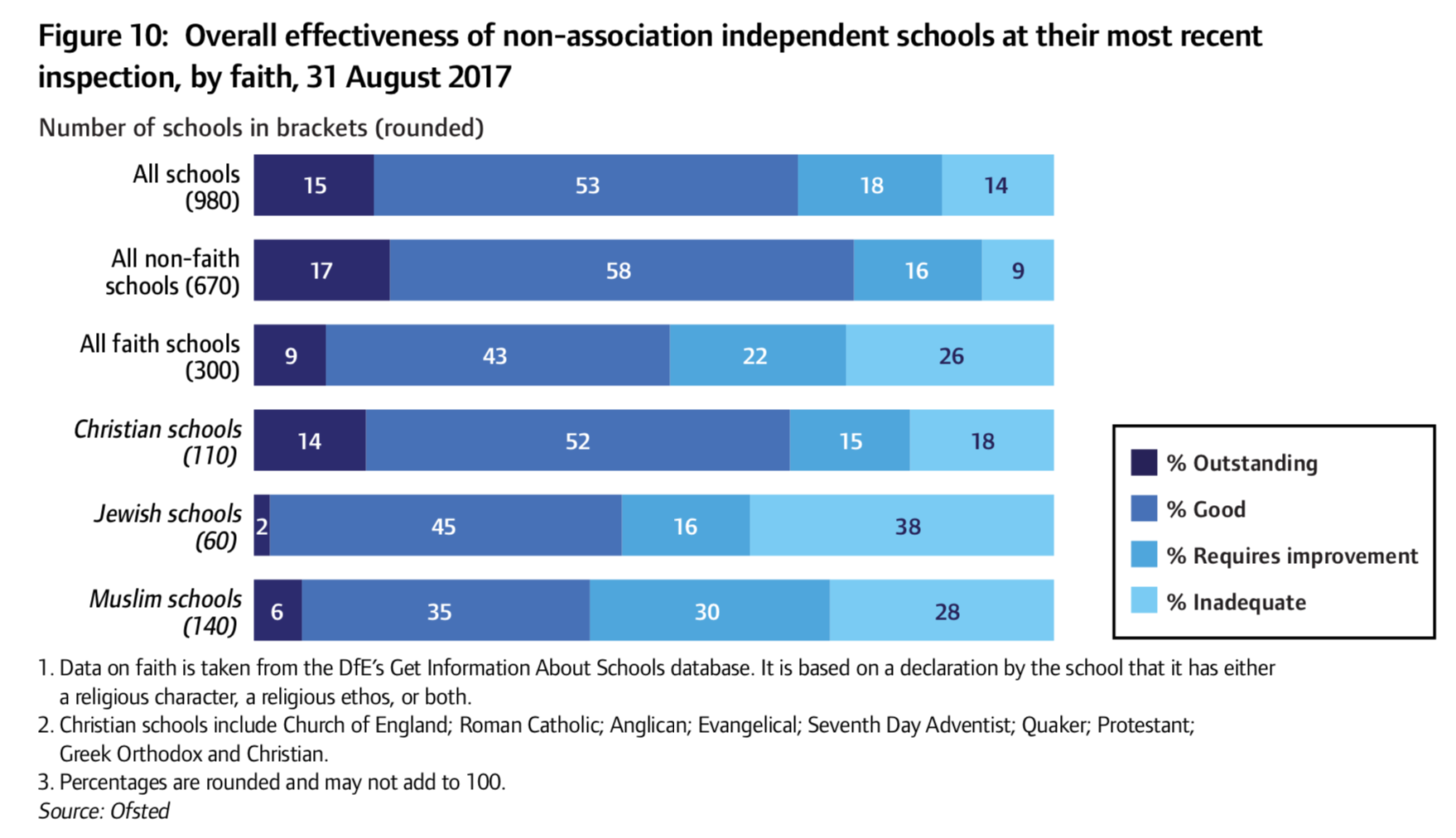
The Ofsted report detailed its recent inspections of private faith schools, with 26% rated inadequate and 22% as requiring improvement – Ofsted’s two lowest categories.

Of the 140 small Muslim private schools inspected by Ofsted in the year, 28% were graded as inadequate, along with 38% of Jewish private schools and 18% of Christian schools.

Spielman had praise for the bulk of state schools, noting that 90% of primaries and nearly 80% of secondaries were rated as good or outstanding.

“If this speech generates any headlines, I doubt they will be ‘English education is good’,” Spielman said.

But the report also focused on a group of schools that Spielman said remained “intractable” to improvement, including a group of nearly 130 that had failed to achieve a good rating in inspections this year or at any time since 2005.

via Private faith schools are resisting British values, says Ofsted chief | Education | The Guardian

Cost of British citizenship for children is now 22 times more expensive than Germany | The Independent

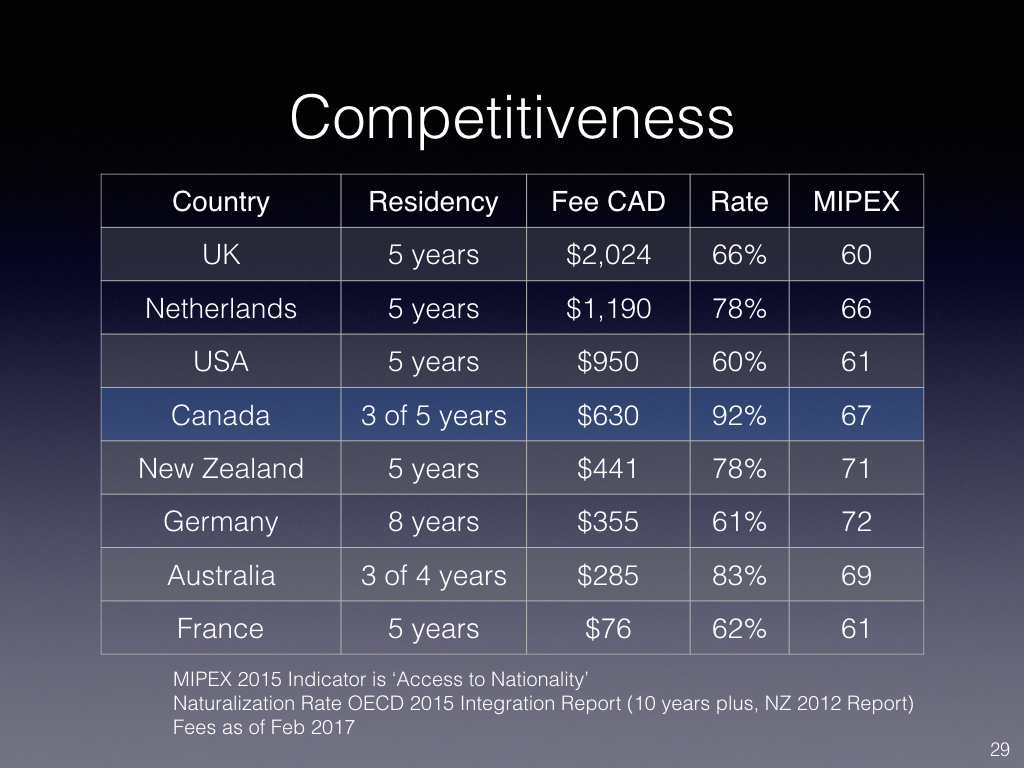
I had not done the comparison of fees for children so the data in this article is revealing. The last time I checked, UK was also the most expensive for adults:

The Government is under pressure over the “astronomical” rise in the cost of British citizenship for children, which is now 22 times more expensive than in Germany.

Costs to register a child’s citizenship application have soared by 153 per cent in the last seven years, from £386 in 2010 to £973 today.

Scores of youngsters descended on Westminster on Wednesday morning with Citizens UK in protest against the fee, which sees many children unable to become British citizens despite having a legal right.

The fee is considerably higher than in other European countries, with the figure standing at 80 euros in Belgium, 55 euros in France and just 51 euros in Germany.

Each application costs the Home Office £386, meaning the department makes a £586 profit per child registered. With 40,537 applications made in the year to September 2017, the Home Office is expected to make almost £24m this year from children registering for citizenship.

The soaring costs mean a family with three children who have come from abroad and settled in the UK for 10 years, accessing citizenship for all members, including those born here, would have paid out more than £15,000 to be “naturalised” as British citizens, taking into account all migration fees.

Many of these families suffer in-work poverty due to their low wages, so are unable to afford the cost of citizenship, which can prevent children from fully participating in the life of their community, experts warn.

There are an estimated 120,000 “undocumented” children across the UK, more than half of whom are legally entitled to a UK passport. Many are unaware of their status until they apply to university, try to open a bank account or need a passport for foreign travel, according to Citizens UK.

Anne-Marie Canning, director of social mobility and student success at King’s College London, said this can lead to problems when youngsters wish to go into higher education, with many facing difficulties due to not having the correct documents to access student loans.

“There are a large number of students in Greater London who are unable to access university because they are locked out of the student loans system due to paperwork,” she said.

Revd Mother Ellen Eames and school children singing carols outside the Home Office. Hundreds delivered Christmas cards to Secretary of State Amber Rudd asking her to cut the cost of British Citizenship (James Asfa @ Citizens UK)
“We’ve heard stories of parents having to pick which of their children’s paperwork they process so they can access student finance, as they cannot afford to do it for all of their children. We and other universities in London and across the UK are concerned about this issue and have made scholarships available for these learners.

“If the Home Office reduced their fees it would enable more children and talented young people to secure their papers and access higher education like other students.”

Citizens UK leader Fiona Carrick Davis said: “Over the past few years Citizenship fees have risen astronomically and far exceed those of other European countries.

“Many of these children were born in the UK or have spent much of their lives in the UK and have a legal right to citizenship. This is their home, they are British in all respects except they don’t have Citizenship.

via Cost of British citizenship for children is now 22 times more expensive than Germany | The Independent