USA: “Islands” That Separate Education Haves From Have-Nots : NPR
2016/07/21 Leave a comment
Fortunately, Canadian school system funding (at least in Ontario) is funded at the provincial level, ensuring relatively equal funding levels between schools (although parental fundraising etc means some differences):
The school district of Freehold Borough, N.J., has a 32 percent poverty rate. It is fully surrounded by another school district, Freehold Township, which has a 5 percent poverty rate.
Freehold Borough is what a new report calls an “island district” — and it’s not alone. The report, from a nonprofit called EdBuild, maps 180 of these islands around the country: Districts that, by historical accident or for political reasons, lie completely inside other systems with a disparate poverty rate and often different funding levels.
And that can correlate with very different outcomes for students — something educators in Freehold Borough have long struggled with.
“Surrounding communities are able to provide a better education than we are,” says Rocco Tomazic, superintendent of the K-8 district. “It’s not supposed to be that way per the state constitution.”
As we noted in our School Money project, around half of school funding in the U.S., on average, comes from local property taxes. That means districts with high poverty often struggle with limited resources, a one-two punch.
“We have a mismatch between the way we’re funding schools and what we’re expecting schools to deliver,” says Rebecca Sibilia, the founder and CEO of EdBuild, which focuses on school finance.
Though they are rare, Sibilia argues that these island districts serve as vivid examples of a larger pattern that holds true in many places throughout the country: The resources available to your local public school may depend on your zip code, or sometimes even your specific address at birth.
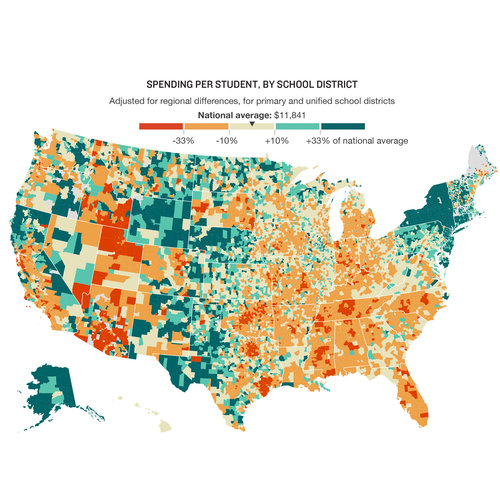
Source: “Islands” That Separate Education Haves From Have-Nots : NPR Ed : NPR

 Multicultural Meanderings