On Saudi arms deal, the new boss in Ottawa is just like the old boss: Neil MacDonald

As someone in the past who has written comparable memos, I can only congratulate the various writers and editors of the memo on the Saudi LAV to FM Dion. Macdonald captures it perfectly:

Well. If further proof was needed that the sunny new regime in Ottawa is perfectly capable of behaving just like the un-sunny previous regime, we now have it, in a memo that was stamped “Secret,” then rather inconveniently laid bare in the Federal Court of Canada.

The document, signed by Foreign Affairs Minister Stéphane Dion, is a gem of hair-splitting, parsing, wilful blindness and justification for selling billions worth of fighting vehicles and weaponry to Saudi Arabia, one of the most oppressive regimes on Earth.

Source: On Saudi arms deal, the new boss in Ottawa is just like the old boss – Politics – CBC News

Obama to Turnbull on Indonesia, Islam and the Saudis: ‘It’s complicated’

Always interesting to have a more inside account of these discussions, highlighting awareness in this case:

A revealing series of interviews with US President Barack Obama has given insight into a private discussion he had with Australian Prime Minister Malcolm Turnbull.

The 20,000-word feature published in The Atlantic magazine also relies on interviews with Mr Obama’s former Secretary of State Hillary Clinton, her successor John Kerry, Israeli Prime Minister Benjamin Netanyahu, other world leaders and key White House insiders.

It details part of a meeting between Mr Obama and Mr Turnbull during November’s APEC summit in Manila.

The president, according to The Atlantic, described to Mr Turnbull how he had watched Indonesia gradually move from a relaxed, multi-faceted Islam to a more fundamentalist, unforgiving interpretation with large numbers of Indonesian women adopting the hijab Muslim head covering.

“Why, Turnbull asked, was this happening?” the author of the feature, Jeffrey Goldberg, wrote.

Mr Obama told the prime minister the Saudis and other Gulf Arabs have funnelled money and large numbers of imams and teachers into Indonesia and in the 1990s the Saudis heavily funded Wahhabist madrassas, seminaries that teach the fundamentalist version of Islam favoured by the Saudi ruling family, according to The Atlantic.

Mr Obama also told Mr Turnbull Islam in Indonesia was much more Arab in orientation than it was when he lived there.

“Aren’t the Saudis your friends?,” Mr Turnbull reportedly asked Mr Obama.

Mr Obama smiled and said: “It’s complicated”.

Source: Obama to Turnbull on Indonesia, Islam and the Saudis: ‘It’s complicated’

Men-only Ontario college campuses in Saudi Arabia unacceptable: Wynne

Not exactly news that Saudi Arabia has gender-segregated campuses, workplaces etc so why waking up now? While I have no sympathy with the Saudi regime, I think focusing only on Ontario colleges is shallow and parochial.

The dynamics at play were and are complex. Universal education in Saudi Arabia, if memory serves me correctly, dates from the 1970s, and the regime took some chances in ensuring that this applied to both boys and girls:

Premier Kathleen Wynne says it is unacceptable to her that two Ontario colleges are operating campuses in Saudi Arabia that don’t admit women students.

Niagara College and Ottawa-based Algonquin College have been operating men-only campuses for a couple of years in two cities in Saudi Arabia, where Sharia law forbids the education of women and men in the same classes.

Colleges and Universities Minister Reza Moridi, who had earlier said it was up to colleges to determine the student makeup on their campuses, said Thursday he was concerned that women were excluded from the Ontario-run campuses.

Wynne says she told Moridi to meet with the two colleges as soon as she found out about the situation, which she says has “got to change.”

Progressive Conservative critic John Yakabuski calls it a “stretch” for Wynne not to have known Ontario colleges are excluding women from their Saudi campuses, and says she’s only expressing concern because the media picked up the story.

Ontario provides $1.44 billion in funding to its 24 community colleges, with Algonquin getting $103 million for the current fiscal year, while Niagara College received $45 million.

Source: Men-only Ontario college campuses in Saudi Arabia unacceptable: Wynne

Egan: Algonquin’s money-losing Saudi campus raises ethical questions

Valid questions:

Why does the world go nuts when the University of Ottawa student federation cancels a yoga class – for lack of cultural sensitivity – but no one bats an eye when Algonquin College opens a men-only campus in Saudi Arabia, only to lose $1 million in public money in one year?

Algonquin, the city’s leading college with 20,000 students, has a mission statement that details its core values. One of them is “integrity,” described thusly: “We believe in trust, honestly and fairness in all relationships and transactions.”

Another is “respect,” put this way: “We value the dignity and uniqueness of the individual. We value the equity and diversity in our community.”

How you square those values in a country with a human rights record like Saudi Arabia is a mystery. It has been said — and written — that Ontario Premier Kathleen Wynne would not only be barred from attending Algonquin’s campus in Jazan, she could well be arrested for being open about her sexuality. If she tried driving a car to class, Lord knows what would happen.

(This is not histrionics: public floggings and beheadings are common in a country with so-called religious police. It hardly helps when you visit the Human Rights Watch website and the first story on Saudi Arabia is: “Poet Sentenced to Death for Apostasy.”)

Nonetheless, a couple of the Wynne ministries were only too eager to announce this great adventure in international education in 2013.

The optics are terrible, frankly, gender inequality being one of many sore points.

The college said this planned “revenue generator” was important at a time of reduced funding, presumably from the Ontario treasury. At capacity, annual revenue in Jazan was to peak at more than $25 million.

Well, does this not have a “sell-your-soul” feel to it? It’s OK if it makes money? Setting aside that whopper, the bottom-line predictions turned out to be wrong.

The campus lost $983,000 in 2014/15 and the estimate for the current year is a modest profit of $232,000, followed by projected profits of $2 million and $3.6 million. Well, we shall see. It might be the moment to point out Algonquin’s operating deficit for 2016/17 is projected to be near the $5-million mark.

This can probably be parsed eight ways to Sunday, but the bottom line is easy to find. This is a public institution. It is not a for-profit corporation. It needs to think pretty hard about gambling with the public’s money, with an eye on profit, to provide a service to citizens in one of the world’s wealthiest countries.

The people of Ontario — is it not so — are subsidizing oil sheiks?

The arguments are not lost on the school. It produced a strategic plan in 2014 that discussed the human rights records in countries where Algonquin does or might collaborate.

“Algonquin believes that education is a powerful, effective force for positive change in any country,” it reads.

“For these reasons, while some feel Algonquin should not partner with countries that do not offer the same human rights protections as Canada, the College is convinced that working with those genuinely invested in change can yield beneficial outcomes. Saudi Arabia and China, for example, are investing heavily in education and have explicit policies encouraging their educational institutions to partner with those in the west.”

It is also worth asking whether the Saudi deal could have been structured so that Ontario taxpayers were protected. Instead, the college is paid on a performance-based model that takes into account things like attendance and graduation rates.

Wonderful if students stay in school. Not so good if they drop out, or flunk, which they did in alarming numbers in 2013-14: of the 600 students in the English foundation program, only 20 per cent completed the year.

Things are improving, however. This year, the school has 800 students, including 200 in actual diploma programs. So, perhaps, financially, the corner has been turned.

This hardly solves the conflict in values. Institutions of higher learning should be places where ideas — even crazy ones about yoga — can be expressed without fear of reprisal. Hard to imagine this is the case at Algonquin’s Saudi campus, where students are learning how to be accountants and “truck and coach technicians.”
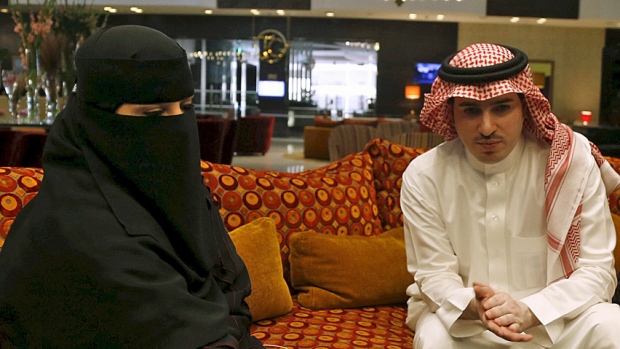
Source: Egan: Algonquin’s money-losing Saudi campus raises ethical questions | Ottawa Citizen

Why aren’t we looking into the Saudi role in San Bernardino attack?

Neil MacDonald, on Saudi Arabia and the uncomfortable parallel with ISIS:

Usually, executions — more than 150 so far this year — are performed with a “godly” sword. In public, of course, for the entertainment of a self-righteous crowd. But there are also crucifixions and mutilations.

SAUDI-ELECTION/

Saudi woman Fawzia al-Harbi, a candidate for local municipal council elections, sits next to one of her chaperones at a shopping mall in Riyadh last month. Saudi Arabian women are running for election and voting for the first time on Dec. 12, but their enfranchisement marks only a pigeon step towards democracy and gender equality in the Islamic kingdom. (Reuters)

Saudi women are treated better than immigrants, but are still severely oppressed, and treated like chattels of the male population.

If that all sounds like the modus operandi of ISIS, which the Saudis have been accused of having funded and armed before becoming a stout ally in the U.S. bombing campaign, well, the shoe does fit.

The Saudis have actually threatened to sue anyone who makes the ISIS comparison, but objectively, it’s not unreasonable.

The main difference is that the Saudis are extremists who managed to create a nation and have it recognized. And of course their king doesn’t claim to lead a new caliphate.

It’s almost a cliché to say this is all about oil, and the Saudi willingness to sell it, and sell it cheaply in unlimited quantities, to the West.

Because it is about oil. It’s also about the Saudis’ willingness to spend billions of that petro-revenue back in the West, signing contracts for military materiel that our governments are ecstatic to arrange.

If you’re inclined to think otherwise, try this mental exercise: imagine if Cuba, or Russia, or Venezuela (or even Canada) had produced 15 of the 19 9/11 hijackers, and had remained a consistent leader in exporting murderous ideology, and radicals like Tashfeen Malik.

Source: Why aren’t we looking into the Saudi role in San Bernardino attack? – World – CBC News

Foreign funds promoting ‘extreme Islamic jihadist’ views in Canada, Evolving terror threat justifies need for Bill C-51, national security advisor says

Always uncomfortable, given that some of our current allies in the fight against ISIS such as Saudi Arabia are a source of funding of fundamentalists and extremists:

Richard Fadden said the money often goes through religious institutions, which helps to shield it from further scrutiny.

“Without commenting on a particular country of origin, there are monies coming into this country which are advocating this kind of approach to life,” Mr. Fadden said on Monday before the Senate Committee on National Security and Defence. “Finding out where it all goes in the end, and for what purpose, is in fact quite difficult. A lot of these funds are directed through religious institutions, quasi-religious institutions, and it’s very difficult in this country to start poking about religious institutions, because of the respect that we have for freedom of religion.”

Mr. Fadden was answering a question from Conservative Senator Daniel Lang, who asked about the government’s response to funding from countries such as Saudi Arabia that promotes an “extreme jihadist” interpretation of the Koran.

Mr. Fadden said the federal government is aware of the problem, but noted that his discussions with allies have shown that “nobody has found a systemic solution.”

“The difficulty in most cases is that the monies are not coming from governments, they are coming from fairly wealthy institutions and individuals, which makes it doubly difficult to track,” he said.

In his appearance, Mr. Fadden argued that the evolving terror threat helps to justify the need for Bill C-51, the proposed anti-terrorism legislation.

“Our enemies have continued to refine their methods and adapt; so must we.”

Mr. Fadden said the Canadian Security Intelligence Service (CSIS) needs new powers to disrupt potential terrorist activities, in addition to collecting intelligence on the threats facing Canada.

He said the goal of the new disruption measures is to allow CSIS to take action before criminal activities take place, arguing that the RCMP should not be called in these events.

“The police cannot get involved, by the nature of their work, if they cannot see something concrete in terms of criminal activity,” Mr. Fadden said. “Otherwise, we are living in a police state.”

The new disruption powers would allow CSIS to advise family members that someone is being radicalized to violence or take actions to neutralize a terrorist plot.

Mr. Fadden added the public and the media’s concerns over Bill C-51 are exaggerated, referring specifically to the notion that non-governmental organizations will become the target of counterterrorism agencies.

“A number of people in the media and elsewhere have been reported as saying, ‘The Girl Guides will be hit next.’ Well there has to be an actual threat to national security,” he said.

Too bad no question regarding Fadden’s views on the need for oversight (although he would not be in a position to speak other than the government line). His comments “otherwise we are living in a police state” are ironic given his silence on the oversight issue.

Evolving terror threat justifies need for Bill C-51, security adviser says – The Globe and Mail.

Treating Saudi Arabian Jihadists With Art Therapy

Saudi Arabia’s deradicalization program using art therapy, with reasonably good results (only 20 percent failure rate). Kind of interesting to be using art in a place where it is generally frowned upon:

“They’re not so tough,” says Dr. Awad Al-Yami, a counselor here. “These are our kids, and anyway, they are members of our society, and they are hurting us. We feel obligated to help them.”

Al-Yami trained as an art therapist at the University of Pennsylvania. He pioneered an innovative program that’s unusual in Saudi’s ultra-conservative culture, where some clerics say that drawing is forbidden.

“I had a hard time convincing my people with art, let alone art therapy for jihadists,” he says.

But the program has delivered results.

“Actually, art creates balance for your psyche,” he says.

It is also a window on the psyche, he says. Drawing is a way for inmates to express emotions, anger and depression, when they first arrive at the center.

He keeps a gallery of paintings, which he analyzes like a detective. The black and white landscapes, which depict scenes from Afghanistan, mean an inmate is still living in the past.

After a few months of counseling, the paintings show more promise. Inmates use color and depict scenes from family life in Riyadh. Al-Yami says this is a sign that the inmate is coming to terms with coming home.

There is a striking number of inmates who draw pictures of castles with high walls. Those send a distinct message, according to Al-Yami.

“I’m not going to give you any information,” he says. “I’m behind the wall and you can’t get through. If I give you information, I am weak.”

He takes the failures hard. Some 20 percent of the inmates here go back to the fight. One spectacular failure went on to become an al-Qaida leader in Yemen.

Now, Al-Yami is preparing for a new wave of inmates: the ISIS generation. He knows they are more extreme than al-Qaida.

“We’ve got some in prison, waiting for their sentences to be over and they will be here,” he says.

Treating Saudi Arabian Jihadists With Art Therapy : Parallels : NPR.

‘Behind Sweden’s tirade is a hidden Western agenda to tarnish Islam’ | Arab News

A reminder of some of the beliefs of those allied in the fight against ISIS and their denial of universal human rights:

Sweden and other Western countries have adopted double standards while dealing with human rights as they ignore the killing of thousands in Iraq, Syria and Palestine, and highlight the flogging of an individual in Saudi Arabia as a big issue, said Dr. Mohammed Badahdah, assistant secretary general of the World Assembly of Muslim Youth (WAMY).

Speaking to Arab News, he emphasized that Saudi Arabia’s rules and regulations as well as its judicial system are based on the Qur’an and Sunnah or Shariah. “Shariah laws are not made by Parliament or people’s representatives. They are divine laws given by the Almighty for the welfare and security of the whole humanity,” he explained.

“It’s the duty of all countries and societies to respect religious faiths, beliefs and cultures of different communities in order to promote peace and stability in the world,” Badahdah said while denouncing Swedish Foreign Minister Margot Wallstrom’s anti-Saudi tirade.

“We are not imposing Shariah on others. Why do then Sweden and other Western countries criticize the Kingdom when we are implementing Shariah in accordance with our faith? This is clear interference in our internal affairs and Saudi Arabia will not tolerate such attacks,” he said.

‘Behind Sweden’s tirade is a hidden Western agenda to tarnish Islam’ | Arab News.

‘This is what Islam tells us to do’: A rare glimpse inside a Saudi Arabian prison – where Isis terrorists are showered with perks and privileges

The Saudi approach to de-radicalization:

“If you lose these inmates when they are in prison, they will come out of prison more radical,” Turki said, adding that supporting their families also helps make sure they, too, don’t “fall into the hands of the terrorists.”

Turki said that about 20 percent of those who have gone through the rehabilitation program have returned to terrorism-related activities. Many rights activists think the failure rate is higher than Saudi officials admit.

Critics often argue that Saudi Arabia, or at least many rich Saudis, supports violent Islamist radicals, and that the government’s emphasis on rehabilitation reflects a certain sympathy with terrorists.

But Saudi officials argue that no country, except for Syria and Iraq, is more directly threatened by Isis. They say their approach to convicted terrorists is more pragmatic and effective than simply throwing thousands of them in prison for decades and hoping that their friends and family don’t become radicalized.

“I don’t think we should be reflexively opposed to these programs,” said Bruce Hoffman, director of the Center for Security Studies at Georgetown University. “The hard-core, wild-eyed fanatics we are never going to rehabilitate, but a solution that says they are all the same and we should lock them away forever isn’t effective, either.”

Hoffman said a 20 percent recidivism rate is far better than the 70 to 75 percent recidivism rate for violent criminals in the United States. He said prisons without rehabilitation programs can become “terrorist universities” that turn minor offenders into hardened militants. He also said that inmates who are coaxed away from radical thinking can also provide valuable intelligence about terror groups.

“Programs like this can be enormously effective,” he said.

‘This is what Islam tells us to do’: A rare glimpse inside a Saudi Arabian prison – where Isis terrorists are showered with perks and privileges – Middle East – World – The Independent.

The state and Islam: Converting the preachers | The Economist

Good article in The Economist regarding state control of mosques and Imams to reduce radicalization:

In fact, the Saudi effort to tone down its clerics is mild, hesitant and belated compared to what some Muslim states do. Uzbekistan, Kazakhstan and Tajikistan already routinely use cameras. Kuwait has long installed tape-recorders to monitor Friday sermons. Preachers in the neighbouring United Arab Emirates need not write their own sermons. Except for a few trusted senior clerics, they read instead from a text delivered weekly by the government department for religious affairs that also pays all their salaries. “Protecting Youth from Destructive Ideas” and “Our National Flag, Symbol of Affiliation and Loyalty” provided two stimulating recent topics. Similarly, Turkey has for decades enforced a monopoly of Islamic discourse via a religious bureaucracy, known as Diyanet, that wields 121,000 employees and a budget of $2.3 billion.

Other governments aspire to such dominance. Tunisia’s government has in recent months restored strict state control of mosques that had slipped following its revolution of January 2011, leading to a brief flowering of Wahhabist-style jihad promotion. Morocco, whose king has traditionally posed as Commander of the Faithful, delivering televised Ramadan sermons, has steeply boosted state promotion of a relatively tolerant version of the faith. Its budget for training imams, including a growing number of foreign students, has swollen tenfold in the past three years. The unspoken aim is to counter the spread of extreme Salafist ideas in places such as Mali and northern Nigeria.

…Egypt’s government has of late clamped unprecedented controls. In January it decreed that all Friday sermons must adhere to a weekly theme set by the religious-affairs ministry, establishing a hotline to allow worshippers to denounce preachers daring to voice political dissent. Further decrees required all preachers to be government-licensed, imposed a code of ethics forbidding discussion of politics in mosques, and banned smaller prayer halls from holding Friday prayers. The ministry fired 12,000 preachers and now allows only those trained in government-approved institutes to deliver sermons.

…As a foil to the powerful Brotherhood, the [Egyptian] state had long allowed followers of quietist forms of Salafism to run some 7,000 mosques. But the ministry in September decreed it would take over their mosques too, after reports of a sermon forbidding the faithful from buying interest-bearing government bonds.

Amr Ezzat, an Egyptian researcher, sees the effort to impose state-ordained orthodoxy as misguided and possibly dangerous. Religious institutions will lose legitimacy with time, pushing more Muslims towards radical margins. And by acting in effect as the imam, the state takes upon itself a duty to enforce morality. It is perhaps as a sop to religious conservatives, for instance, that Egyptian authorities have mounted an increasingly lurid campaign against homosexuality, most recently by staging a midnight raid on a Cairo bathhouse on national television, dragging a score of naked men to prison.

The state and Islam: Converting the preachers | The Economist.