The Great Gulf Citizenship Competition

Overview of some of the changes (significant but restrictive in scope):

For years, expats from around the world who flocked to the Gulf could only dream of Saudi or Emirati citizenship, although they made up as much as 33% of the population in Saudi Arabia and approximately 85% in the United Arab Emirates. Neither the construction workers from Egypt nor the maids from the Philippines, the engineers from Iraq nor doctors from India or the UK could get citizenship, even if they lived in the Gulf countries for decades and built their homes there.

Nowadays, when the global and local demand for talent is high, the Gulf petrostates are changing their attitudes and fiercely competing with each other.

This week, Saudi Arabia announced that it will grant citizenship to a group of “outstanding” expatriates including doctors, clerics and academics, becoming the second Gulf Arab state to introduce a formal naturalization program for foreigners with exceptional skills this year.

Back in January, the UAE decided to grant citizenship to “talented” foreign residents that will “add value to the country.”

Currently the opportunity is very limited. According to Saudi media, there is no open application process; citizenship may be awarded by the state to individuals who “meet the criteria.” In the UAE, professionals can only be nominated by Emirati royals or officials as well.

Experts say that for now only a few foreign professionals will be able to take advantage of the offer. However, it’s quite certain that the need for foreign talents will keep growing and the citizenship card will serve as an extraordinary perk for job seekers.

Both the UAE and the Saudi Arabia also encourage “emiratization” and “saudisation” of the labor market in their respective countries in order to combat unemployment and to develop home-grown talents.

“These Gulf states are aiming at the technologies of tomorrow. They worry about the US pullout from the region, about Iran’s attempts to spread its hegemony, and they know that they need the super advanced technological edge,” Prof. Uzi Rabi, the director of the Moshe Dayan Center for Middle Eastern Studies at Tel Aviv University, told The Media Line.

“The Emiratis were ahead so far, and now Saudi Arabia is stepping ahead as well. They are buying entire systems of knowledge along with the people who operate them, and there are many opportunities for the professionals in Jeddah, Riyadh and other places. Speedy technological development is highly prioritized by the leaders – MbZ  and MbS,” Rabi said, referring to, respectively, Abu Dhabi Crown Prince Mohammed bin Zayed and Saudi Crown Prince Mohammed bin Salman.

The Saudis see the UAE success and aspire to develop a similar strategy that will also be compatible with the conservative character of the state. Its leadership understands that they will have to open up, but at the same time there is a fear of losing control.

In fact, Kuwait can be considered the pioneer that opened up to foreigners in the 70s and 80s, but during the last three decades it has undone much of its previous success in attracting talent from abroad. Currently, if a Kuwaiti woman is married to a foreigner, even their children are not entitled to Kuwaiti citizenship.

Notably, there is a clear aspect of competition in many areas between the two Gulf states – for tallest buildings, extravagant projects and talented individuals, for example. The UAE began offering citizenship to talented expats in January, and garnered a great deal of media attention, while Saudi Arabia only followed suit in November. Earlier this year Saudi Arabia told international companies to move their regional headquarters to Riyadh or lose out on government contracts. For now, 44 international companies have moved their offices – mostly from glamorous Dubai – and more companies are expected to join them soon.

Source: The Great Gulf Citizenship Competition

Soccer stars, technocrats among those granted Saudi citizenship

Apart from the propagandist language (“wise leadership”) interesting to note Saudi priorities and how they define “exceptional:”

Three leading Saudi football players as well as a number of technocrats and eminent academics are among those who were granted Saudi citizenship following a royal order issued by Custodian of the Two Holy Mosques King Salman on Thursday, Saudi Gazette has learned from well informed sources. This was in recognition of their outstanding contributions and distinguished services to Saudi Arabia in their respective fields.

Saudi Arabia has decided to grant citizenship to a selected number of expatriates with distinguished talents, unique expertise and specialized skills in a number of key professions such as medicine, industry, energy, agriculture, geology, space, aviation and artificial intelligence. The initiative emanates from the wise leadership’s ambitious drive to attract top world-class professionals to these vital sectors.

Saudi Arabia needs such top standard professions to supervise the Kingdom’s development march in those vital areas where it wants to achieve and consolidate its leadership and expertise par excellence. This will facilitate these professionals to contribute vigorously to the nation’s development march and initiatives to diversify its sources of income and spurring its robust economic growth.

The great initiative is aimed at supporting to achieve the Kingdom’s Vision 2030 goal to create an environment that enables attracting, investing in and retaining professionals with exceptional creativity and talent.

The following are the prominent professionals who were granted citizenship. They include three football stars, who all were born in the Kingdom and represented the national team several times.

It is noteworthy that the decision to grant citizenship to those who made outstanding contributions in sports to benefit from the country’s children who grew up on its land and imbibed its culture, after many of them left and started serving countries of their origin.

The list of distinguished persons who were granted citizenship also included some top professionals in the fields of technology and various branches of science.

Abdulfattah Adam

Abdulfattah Adam is a professional footballer who plays as a striker for Al-Nasr Club in the Saudi League, and represented Saudi Arabia’s national team in many matches. Born on Jan. 1, 1995, in Saudi Arabia, he is a famous Association Football Player. Abdulfattah is also listed among famous people born on Jan. 1, and one of the richest celebrities born in Saudi Arabia.

Mukhtar Ali

Mukhtar Ali is a professional footballer who plays as midfielder for Al-Nasr and the Saudi Arabian national football team. He was born in Saudi Arabia, and was a professional in the English Premier League at Chelsea, and contributed to Saudi Olympic team’s qualification to the Tokyo 2020 Olympics. In 2008, Ali joined Chelsea and was part of the Chelsea youth side, which recorded back to back triumphs in the FA Youth Cup in 2015 and 2016. Later in 2017, Ali joined the Dutch club Vitesse and later became part of Al-Nasr team.

Haroune Camara

Haroune Moussa Camara is a professional football player who plays as striker for Al-Ittihad in the Saudi Professional League. Born on Jan. 1, 1998 in Saudi Arabia, he represented the Saudi national team at the youth and Olympic level, and was selected more than once for the camp of Saudi national team.

Dr. Manahel Thabet

Dr. Manahel Abdulrahman Thabet is an internationally-acclaimed mathematics and finance expert. She is the youngest and only Arab with a PhD in Financial Engineering. She writes research papers on quantum mathematics. Her work to revolutionize understanding of math and physics is poised to earn her a second PhD at the age of 32.

She is one of the rare Arab women to have entered the field of Quantum Mathematics, and currently her research has been adopted by several American universities for development purposes. In the year 2000 she attained the “Excellence of Global International Environmental and Humanitarian Award.”

She was also recognized as “The Woman of the Year 2000” by “Woman Federation for World Peace.” In December 2010, Dr. Thabet was awarded L’Officiel Women Of the Year, Inspiration Women Of the year award.

Dr. Thabet is the vice president of the World Intelligence Network, and supervisor of the Arabian Intelligence Network. She is an active member of MENSA, Young Arab Leaders, and the International Association of Financial Engineers.

This is all in addition to her day job as President of SmartTips Consultants, a company offering management consultancy, feasibility studies, strategic planning advice and crisis management to the business community. She is also a columnist and an economic researcher in many leading financial publications.

Omar Mounes Yaghi

Omar Mounes Yaghi is in the field of advanced research as a chemist currently working at the famous Lawrence Berkeley Research Center and a chemistry professor at the University of California Berkeley.

Born in Jordan to a Palestinian family, Yaghi pioneered a new field known as reticular chemistry. He is the founding director of the Berkeley International Institute for Science, which offers educational programs to people who would otherwise not have access to them. Yaghi has established several laboratories in different universities.

He has been awarded numerous accolades including the Newcomb Cleveland Prize, the Albert Einstein World Award of Science, and Saudi Arabia’s King Faisal International Prize. He received the US Department of Energy’s Hydrogen Program Award.

Ihab Khalil

Ihab Khalil is an expert in corporate finance and investment strategies and his experience in financial consultancy spans 20 years. He had his higher education at the American University of Beirut. He has experience in closed-end stocks, corporate finance, investment strategies and evaluating and structuring investments. Khalil has been a managing director and partner of management consultant giant Boston Consulting Firm for the last five years.

Asif Sajid

Asif Sajid has held many leadership positions in consulting and financial services companies. His work in the field contributed to the digital strategies of several Saudi ministries and government agencies, including ministries of justice, human resources, and commerce. An expert in digital technologies, Sajid has contributed to the formation of strategic programs for a number of government agencies. He served as the head of the public sector and financial services for the consulting company KPMG. He is currently the CEO of Raz Group in Riyadh

Source: Soccer stars, technocrats among those granted Saudi citizenship

Saudi Arabia Gives Citizenship to ‘Outstanding’ Expats in Shift

Will be interesting to see who qualifies:

Saudi Arabia granted citizenship to an unspecified number of foreigners whose expertise could help the country as it diversifies away from oil, a major shift that follows a similar decision by the neighboring UAE earlier this year.

The program targets people with “outstanding capabilities” and backgrounds in “rare specialties,” the official Saudi Press Agency reported. The kingdom will focus on naturalizing foreigners in fields including Shariah, medicine, science, culture, sports and technology, “in order to strengthen the pace of development” and boost its attractiveness for investment and human capital, the agency said.

Saudi Arabia becomes the second Gulf country to formalize a process aimed at giving expatriates a bigger stake in the economy after the UAE announced its own naturalization program for exceptional foreigners in January.

It also underlines the kingdom’s growing competition with its neighbors for business and talent as Crown Prince Mohammed bin Salman tries to expand non-oil sectors such as tourism and manufacturing.

Immigrants make up a third of the population in Saudi Arabia, but with extremely limited mechanisms for granting permanent residency or nationality, they have little long-term stability.

Even as officials work to attract more highly-educated foreigners, the government has been reserving for Saudis many jobs once occupied by lower-income immigrants from other Arab, Asian and African countries — part of an effort to tackle citizen unemployment of over 11%.

Source: Saudi Arabia Gives Citizenship to ‘Outstanding’ Expats in Shift

How the world’s biggest Islamic organization drives religious reform in Indonesia – and seeks to influence the Muslim world

Of interest:

After its return to power in Afghanistan, the Taliban are again imposing their religious ideology, with restrictions on women’s rights and other repressive measures. They are presenting to the world an image of Islam that is intolerant and at odds with social changes.

Islam, however, has multiple interpretations. A humanitarian interpretation, focusing on “rahmah,” loosely translated as love and compassion, has been emphasized by a group I have studied – Nahdlatul Ulama, which literally means “Reawakening of the Islamic Scholars.”

Nahdlatul Ulama, or NU, was founded in 1926 in reaction to the Saudi conquest of Mecca and Medina with their rigid understanding of Islam. It follows mainstream Sunni Islam, while embracing Islamic spirituality and accepting Indonesia’s cultural traditions.

Functioning in Indonesia, the country with the largest Muslim population, Nahdlatul Ulama is the world’s biggest Islamic organization with about 90 million members and followers. In terms of membership, the organization hugely outstrips that of the Taliban – yet this face of Islam has not been sufficiently recognized on the international stage.

In 2014, NU responded to the rise of the Islamic State group and its radical ideology by initiating an Islamic reform. Since then, it has elaborated on this reform that it calls “Humanitarian Islam.”

Humanitarian Islam

During the past seven years, NU’s general secretary, Yahya Cholil Staquf, has organized several meetings of the organization’s Islamic scholars with a reformist agenda. They made public declarations for reforming Islamic thought on controversial issues, including political leadership, equal citizenship and relations with non-Muslims.

The Nahdlatul Ulama declarations include crucial decisions that differentiate “Humanitarian Islam” from other interpretations. First of all, they reject the notion of a global caliphate, or a political leadership that would unite all Muslims. The concept of a caliphate has been accepted by both mainstream Islamic scholars, such as those in Al-Azhar – Egypt’s world-renowned Islamic institution – and radical groups, such as the Islamic State group and al-Qaeda.

Moreover, the NU declarations emphasize the legitimacy of modern states’ constitutional and legal systems, and thus reject the idea that it is a religious obligation to establish a state based on Islamic law.

Additionally, these declarations stress the importance of equal citizenship by refusing to make a distinction between Muslims and non-Muslims as legal categories.

They call for a deeper cooperation among Muslims, Christians and followers of other religions to promote world peace.

Nahdlatul Ulama has taken practical steps for realizing these aims. For example, it has established a working relationship with the World Evangelical Alliance, which claims to represent 600 million Protestants, to promote intercultural solidarity and respect.

These NU declarations may sound insufficient from a Western liberal point of view, since they do not touch upon some issues such as LGBTQ rights. To better understand the importance of NU’s perspective and its limits requires an examination of the Indonesian context.

Indonesia’s tolerant Islam

My research on 50 Muslim-majority countries finds that Indonesia is notable because it is one of the few democracies among them.

Indonesia’s foundational credo, Pancasila, means “five principles” and basically refers to the belief in God, humanitarianism, Indonesia’s national unity, democracy and social justice.

About 88% of Indonesia’s population of 270 million are Muslim. Both Nahdlatul Ulama and Muhammadiyah, the country’s second-biggest Islamic organization, have been respectful of these principles. Like NU, Muhammadiyah also has tens of millions of followers, and these two organizations often cooperate against radical Islamist groups.

Robert Hefner, a leading expert on Indonesia, documents in his 2000 book “Civil Islam” how NU and Muhammadiyah made important contributions to the country’s democratization in the late 1990s. During this process, the leader of NU, Abdurrahman Wahid, became Indonesia’s first democratically elected president in 1999.

Wahid, who died in 2009, left a religious legacy, too. During my conversations, senior NU members repeatedly referred to Wahid’s reformist ideas as the main source of inspiration for Humanitarian Islam.

Indonesia’s intolerant Islam

Not all Islamic theories and practices in Indonesia are tolerant toward diversity. The country’s Aceh province has enforced certain rules of Islamic criminal law, including the punishment of caning for those who sell or drink alcohol.

Another example of religious and political intolerance is the country’s blasphemy law, which resulted in the 20-month imprisonment of the capital city Jakarta’s Chinese Christian governor, Basuki Purnama in 2017-2018, for a statement about a verse in the Quran.

In January 2021, the story of a Christian female student being pressured by the school principal to wear a Muslim headscarf went viral on Facebook. In two weeks, the Indonesian government responded with a decree that banned public schools from making any religious attire compulsory.

In short, there is a tug-of-war between tolerant and intolerant interpretations of Islam in Indonesia. Even within NU, there exist disagreements between conservatives and reformists.

Nonetheless, Nahdlatul Ulama reformists are becoming more influential. One example is the current minister of religious affairs, Yaqut Cholil Qoumas, a leading NU member and the younger brother of NU’s reformist general secretary. He was one of the three ministers who signed the joint decree banning the imposition of headscarves on students in February.

NU’s Humanitarian Islam movement might be crucial to promote tolerance among Indonesia’s Islamic majority. But can it have an effect beyond Indonesia?

This reform movement’s reception in the Middle East, the historical center of Islam, is important if it is to have a global impact. Humanitarian Islam has been mostly ignored by scholars and governments of Middle Eastern countries, who generally see it as a competitor of their own attempts to influence the Muslim world. As a nongovernmental initiative, Humanitarian Islam is different from Middle Eastern efforts to shape the Muslim world, which are mostly government-led schemes.

With its reformist emphasis, Humanitarian Islam may appeal to some young Middle Eastern Muslims who are discontent with their countries’ political and conservative interpretations of Islam.

In order to reach a Middle Eastern audience, the Humanitarian Islam movement is launching an Arabic-language version of its English website. Whether this Indonesian initiative can have an impact in the Middle East and become a truly global movement for Islamic reform remains to be seen.

Source: How the world’s biggest Islamic organization drives religious reform in Indonesia – and seeks to influence the Muslim world

Saudi seeks religious reset as clerical power wanes

Of note (change from when I lived there in mid 80s):

Muezzins issuing high-decibel calls to prayer have long been part of Saudi identity, but a crackdown on mosque loudspeakers is among contentious reforms seeking to shake off the Muslim kingdom’s austere image.

Saudi Arabia, home to the holiest Muslim sites, has long been associated with a rigid strain of Islam known as Wahhabism that inspired generations of global extremists and left the oil-rich kingdom steeped in conservatism.

But the role of religion faces the biggest reset in modern times as Crown Prince Mohammed bin Salman, spurred by the need to diversify the oil-reliant economy, pursues a liberalisation drive in parallel with a vigorous crackdown on dissent.

Chipping away at a key pillar of its Islamic identity, the government last month ordered that mosque loudspeakers limit their volume to one-third of their maximum capacity and not broadcast full sermons, citing concerns over noise pollution.

In a country home to tens of thousands of mosques, the move triggered an online backlash with the hashtag “We demand the return of mosque speakers” gaining traction.

It also sparked calls to ban loud music in restaurants, once taboo in the kingdom but now common amid liberalisation efforts, and to fill mosques in such large numbers that authorities are forced to permit loudspeakers for those gathering outside.

But authorities are unlikely to budge, as economic reforms for a post-oil era take precedence over religion, observers say.

“The country is re-establishing its foundations,” Aziz Alghashian, a politics lecturer at the University of Essex, told AFP.

“It’s becoming an economically driven country that is investing substantial effort in trying to appear more appealing — or less intimidating — to investors and tourists.”

– ‘Post-Wahhabi era’ –

In the most significant change that began even before the rise of Prince Mohammed, Saudi Arabia neutered its once-feared religious police, who once chased people out of malls to go and pray and berated anyone seen mingling with the opposite sex.

In what was once unthinkable, some shops and restaurants now remain open during the five daily Muslim prayers.

As clerical power wanes, preachers are endorsing government decisions they once vehemently opposed — including allowing women to drive, the reopening of cinemas and an outreach to Jews.

Saudi Arabia is revising school textbooks to scrub well-known references denigrating non-Muslims as “swines” and “apes”.

The practice of non-Muslim religions remains banned in the kingdom, but government advisor Ali Shihabi recently told US media outlet Insider that allowing a church was on “the to-do list of the leadership”.

Authorities have publicly ruled out lifting an absolute ban on alcohol, forbidden in Islam. But multiple sources including a Gulf-based diplomat quoted Saudi officials as saying in closed-door meetings that “it will gradually happen”.

“It’s not an exaggeration to say that Saudi Arabia has entered a post-Wahhabi era, though the exact religious contours of the state are still in flux,” Kristin Diwan, of the Arab Gulf States Institute in Washington, told AFP.

“Religion no longer has veto power over the economy, social life and foreign policy.”

– ‘Eliminated rivals’ –

In another shift, observers say Saudi Arabia appears to be turning its back on global issues affecting fellow Muslims, in what could weaken its image as the leader of the Islamic world.

“In the past its foreign policy was driven by the Islamic doctrine that Muslims are like one body — when one limb suffers the whole body responds to it,” another Gulf-based diplomat told AFP.

“Now it is based on mutual non-interference: ‘We (Saudi) won’t talk about Kashmir or the Uyghurs, you don’t talk about Khashoggi’.”

Prince Mohammed, popularly known as MBS, has sought to position himself as a champion of “moderate” Islam, even as his international reputation took a hit from the 2018 murder of Saudi journalist Jamal Khashoggi in Istanbul.

He has vowed to crack down on radical clerics, but observers say many of the victims have been advocates for moderate Islam, critics and supporters of his rivals.

One such cleric is Suleiman al-Dweish, linked to former crown prince Mohammed bin Nayef, MBS’s key rival.

Dweish has not been seen since his detention in the holy city of Mecca in 2016 after he tweeted a parable about a child spoiled by his father, according to London-based rights groups ALQST and a source close to his family.

It was seen as a veiled insult to MBS and his father King Salman.

Another is Salman al-Awdah, a moderate cleric detained in 2017 after he urged reconciliation with rival Qatar in a tweet. He remains in detention even after Saudi Arabia ended its rift with Qatar earlier this year.

“Politically, MBS has eliminated all his rivals, including those who shared many of the same goals of religious reform,” said Diwan.

Source: Saudi seeks religious reset as clerical power wanes

Would Canadian citizenship be a lifeline to this jailed Saudi blogger? Ottawa ‘not convinced’

Raises some broader citizenship policy issues (e.g., likely sets a precedent for other detained prisoners) and likelihood of impact on Saudi government incarceration of Badawi likely to me minimal at best, counter-productive at worst. That being said, yet another reminder of the false veneer of MBS’s modernization initiatives:

The federal government appears reluctant to grant Canadian citizenship to a jailed blogger in Saudi Arabia whose wife and children live in this country.

Weeks after the House of Commons passed a unanimous motion to ask the immigration minister to bestow citizenship on Saudi dissident Raif Badawi, a source told the Star on Wednesday that the federal government is “not convinced” such an act would help — and fears that a show of public support might in fact worsen his treatment.

As a result, the federal government prefers, for now, to stick with diplomatic “back channels” to advocate for his release, said the source, on the condition of anonymity as they were not authorized to speak publicly on the matter.

The case appears to be the latest to spotlight the fine line the Canadian government is trying to walk when it comes to using public pressure versus quiet diplomacy on the international stage.

Badawi, who has championed support for religious pluralism and respect for minorities, was arrested in 2012 and accused of using the internet to “infringe on religious values” in violation of a Saudi Arabian law against cybercrime, according to his international legal team. He was later found guilty of the charges and sentenced to 10 years in prison, 1,000 lashes and a steep fine.

“This new investigation is likely an act of intimidation, intended to silence Raif and his family as the Kingdom faces growing backlash for its human rights abuses,” said Brandon Silver, an international human rights lawyer and the centre’s director of policy and projects.

The centre says Badawi’s ongoing imprisonment is unjust and it has urged Saudi authorities to include Badawi among the list of prisoners who, as part of an annual tradition, will be granted royal pardons during Ramadan this year.

“Nine years have been long enough. My kids are growing up without their father, and we all miss him terribly,” Haidar said in a recent statement.

A written appeal previously sent to Saudi authorities by Irwin Cotler, Canada’s former justice minister and the centre’s founding chair, argued that Badawi’s “moderate and reasonable voice” did not defame Islam or personally attack authority figures, posed no threat to national security and reflected a “deep patriotism.”

The clemency appeal noted that Saudi Arabia’s “reputational crisis” following the 2018 murder of Washington Post columnist Jamal Khashoggi in the Saudi consulate in Turkey, as well as other events, could intensify if the kingdom doesn’t send a “clear signal” to the world it is committed to reforming.

A motion in late January calling on Immigration Minister Marco Mendicino to use his discretion under a section of the Citizenship Act, which allows granting of Canadian citizenship to a person facing “special and unusual hardship,” was put forward by Bloc Québécois leader Yves-François Blanchet and approved unanimously in the House. 

Thomas Juneau, an associate professor of international affairs at the University of Ottawa, said he sees both sides of the argument when it comes to conferring citizenship upon Badawi.

On the one hand, granting citizenship is the morally right thing to do and helps bring attention to the case. On the other hand, there’s a powerful counterargument that granting citizenship could make the Saudi government feel like it’s been backed into a corner and there’s a risk it could dig its heels in because it does not want to be seen as bending to outside pressure.

“It’s not a democracy, but it still has its own domestic considerations,” Juneau said. “It might be reluctant to be seen as responding to external pressure.”

Juneau says this sort of dilemma over whether Canada should exert public pressure on another country or use more discreet back-channel talks to get its way can be seen in this country’s handling of the ongoing detention of Canadians Michael Kovrig and Michael Spavor in China and terrorist kidnapping cases abroad.

“Is it better when these terrorist kidnappings are managed with as low profile as possible or when there’s attention brought to the case? We don’t know the answer to that. There’s still a very serious debate,” he said.

Juneau adds that going the quieter route can invite speculation whether the government is seeking to avoid political embarrassment.

Silver told the Star conferring Canadian citizenship upon Badawi would “give Canada greater standing in its interventions on Mr. Badawi’s behalf, including in requests for clemency and consular visits.”

“As well, (Badawi) is subject to a 10-year travel ban following the completion of his sentence, and Canadian citizenship may also help secure him a passport and safe passage to Canada despite the ban.”

There is precedent for this, Silver added, citing the federal government’s efforts under Pierre Elliott Trudeau to secure the release of Soviet dissident and human-rights advocate Anatoly Sharansky, who was sentenced to 13 years in prison in the late 1970s on espionage charges. According to a 1978 Canadian Press story, Trudeau told Soviet authorities “We would take him off their hands” and that the House had earlier given unanimous approval to grant Sharansky landed-immigrant status. (Sharansky was eventually released in 1986 and flew to Israel).

Asked Wednesday if the government planned to act on the motion regarding Badawi, Alexander Cohen, the minister’s press secretary said in a statement, “We continue to raise (Badawi’s) case at the highest levels and we have repeatedly called for clemency to be granted. We remain in contact with Ms. Haidar and we want to see Mr. Badawi reunited with his family. The recent motion demonstrates the concern of Parliament with regard to Mr. Badawi’s detention.”

Syrine Khoury, press secretary to Foreign Affairs Minister Marc Garneau, would not elaborate, saying, “We will continue to raise our concerns regarding (Badawi’s) situation in Riyadh and Ottawa.”

However the government source said Ottawa was “treading carefully” on the question of granting citizenship to Badawi.

“The idea it could confer benefits is tenuous,” the source said.

For one, the Saudis don’t recognize dual citizenship, so giving Badawi Canadian citizenship would basically amount to a symbolic gesture.

Secondly, the source said, there is concern the Saudis could perceive the act of granting citizenship as Canada unnecessarily “meddling” in their internal affairs and potentially hurt Badawi’s clemency bid and result in a deterioration of his conditions. (Badawi is allowed brief phone calls with his wife but is not allowed visitors, according to his international legal team).

Informed Wednesday of the government’s lukewarm position on granting citizenship to Badawi, Silver said public advocacy and private diplomacy are equally important and proved to be an effective combination in getting the recent release from detention of Loujain Alhathloul, the Saudi women’s rights activist and former UBC graduate.

The granting of citizenship to Badawi, Silver added, would give “great hope” to Badawi and to his family and potentially protect him from future reprisals.

“I don’t think symbolism is something that should be so quickly papered over.”

Source: https://www.thestar.com/news/canada/2021/03/03/would-canadian-citizenship-be-a-lifeline-to-this-jailed-saudi-blogger-ottawa-not-convinced.html

Saudi Arabia: Further Textbook Reforms Needed

Progress, but unfinished, particularly with respect to Shia and Sufi Muslim minorities. During my time in Saudi Arabia in the 1980s, I sometimes heard Shia being referred to as “unclean”:

Saudi Arabia has taken important steps to purge its school religion textbooks of hateful and intolerant language, but the current texts maintain language that disparages practices associated with religious minorities, Human Rights Watch said today.

A comprehensive Human Rights Watch review of Education Ministry-produced textbooks for the 2019-2020 and 2020-2021 school years found that some practices associated with the Shia and Sufi Islamic traditions remain stigmatized as un-Islamic and prohibited. The curriculum, entitled Monotheism (Tawhid), is a mandatory subject for the primary, middle, and secondary education levels. Human Rights Watch did not review additional religion texts dealing with Islamic law, Islamic culture, Islamic commentary, or Qur’an recitation.

“Saudi Arabia’s glacial progress on textbook reform appears to have finally picked up steam in recent years,” said Michael Page, deputy Middle East director at Human Rights Watch. “But as long as the texts continue to disparage religious beliefs and practices of minority groups, including those of fellow Saudi citizens, it will contribute to the culture of discrimination that these groups face.”

In 2017, Human Rights Watch conducted a comprehensive review of the religious curriculum and found numerous harsh critiques of practices associated with Shia and Sufi Islam, as well as intolerant and degrading language about Christianity and Judaism. Human Rights Watch found that the curriculum does not make direct reference to Shia Islam or use derogatory terms. Instead, the texts harshly criticize practices and traditions closely associated with Shia Islam in broad terms, in many cases labeling them evidence of polytheism (shirk) that will result in removal from Islam and eternal damnation for those who practice them.

Saudi activists and experts Human Rights Watch consulted said that Saudi students would immediately understand the targets of the criticism in these texts as Shia beliefs and practices even though the texts do not use the word Shia, though some of the criticisms would apply equally to Sufi religious practices.

Human Rights Watch was unable to access the online versions of the textbooks available through the Saudi Education Ministry’s website. Instead, the curriculum was found on Saudi websites that host copies of the official texts. These textbooks were cross-checked between the different websites to ensure their authenticity. Only the first semester of the 2020-2021curriculum was available online at the time of the review. The 2019-2020 curriculum was used in reviewing the second semester textbooks.

Between 2017 and 2020, the Education Ministry made numerous changes to the texts in response to years of criticism by US authorities, including a draft law circulated in the US Congress that would require the secretary of state to report annually to Congress about whether Saudi Arabia had removed “intolerant” content from its textbooks.

These changes, however, have been mostly limited to how other religions or groups are presented in the textbooks, including eliminating hateful reference to Christians, Jews, and LGBT people, as well as removing violent and anti-Semitic language. IMPACT-se, an Israeli organization monitors cultural tolerance in schools globally, also reviewed the newest available editions of the texts and noted that even though some problematic references remain, the removal of many examples is “a significant improvement and an encouraging development, understood as representing a step toward moderation.”

More explicit references that targeted Shia Islam have been minimized, but much of the implicit language remains. For example, the textbooks continue to label some practices and traditions associated with Shia and Sufi Islam as evidence of polytheism (shirk), which is penalized by cancellation of a person’s good deeds, God’s rejection of their repentance, and eternal damnation, the fourth-grade (age 9) second semester book says. The new textbooks now refer to those who perform these practices explicitly as polytheists (mushreekin), instead of the former label of unbelievers (kuffar). That term is now used explicitly in the textbooks for non-believers.

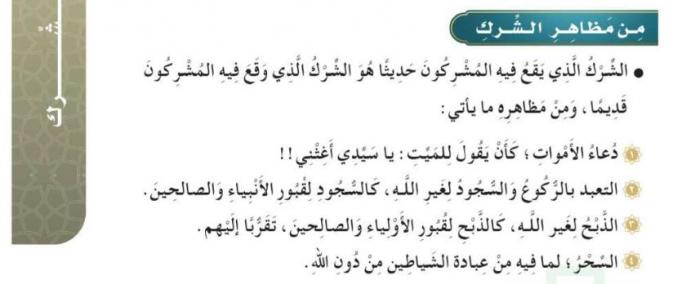
Practices that qualify as polytheism (shirk) include visiting graves of prominent religious figures, and the act of intercession (tawassul), by which Shia and Sufis supplicate to God via intermediaries. The text condemns “supplication,” a thinly veiled reference to the Shia practice of intercession (tawassul), including supplication to “the righteous,” “the dead,” or at “graves” and “shrines.” For example, the fourth grade second semester book cites several examples of polytheism (shirk), the first of which is supplication to the dead (see figure below).

Fourth-Grade (Age 9), Second Semester Textbook, pg 31.

Fourth-Grade (Age 9), Second Semester Textbook, pg 31.

Photos of sacred Shia shrines and graves were also removed from the texts reviewed, as well as several mentions of Hussein, the prophet’s grandson, and a sacred figure for Shia. The second semester of the fourth-grade textbook forbids swearing by anyone other than God and lists Hussein as an example, though.

The first semester fourth-grade textbook defines four core corners of monotheism; not seeking help from anyone other than God, not seeking refuge from anyone other than God, not to perform a pilgrimage to anyone other than God, and not kneeling to anyone other than God.

The textbooks label certain practices as “illicit innovations” (bida’), which the authors consider a form of polytheism (shirk). These include performing a pilgrimage or kneeling to anyone other than God, and building mosques and shrines on top of graves clear examples of Shia/Sufi practices. The second semester of the seventh-grade (age 12) textbook includes an entire lesson on why visiting graves is considered polytheism (shirk) and says that a curse will fall upon those who treat graves like mosques (see graphic below).

Seventh-Grade, Second Semester Textbook, pg 25.

The practice of wailing over the dead is labelled in the textbooks as a form of blasphemy in the first semester sixth-grade textbook. Wailing is closely associated with Shia flagellation and mourning rituals around the commemoration of the martyrdom of Hussein known as Ashoura during the first month of the Islamic calendar.

The religion textbooks also continue to identify themselves with Sunni Islam (Ahl al-Sunna wa al-Jam’a). In 2017, Human Rights Watch noted a reference in the first textbook of the secondary level curriculum (age 15) that contended that Sunni Islam has received the “best” of that afforded to the nation of the prophet Mohammad, because “they represent the true Islam, both in theory and practice.” This statement is still included in the latest reviewed version of the texts (see figure below).

Secondary Program, Level One (Age 15), pg 33.

Secondary Program, Level One (Age 15), pg 33.

Moreover, the texts warn against the “exaggeration” (al-ghulu fi) with regards to members of the prophet’s family, which would be considered a form of polytheism (shirk). This is a direct reference to the Shia belief that the prophet’s cousin and son-in-law, Ali, and his grandsons Hassan and Hussein are sacred. The seventh-grade second semester textbook warns that praying to any member of the prophet’s family or asking for their help during difficult times, is a form of “exaggeration with regard to the family of the prophet or raising them over their [rightful] place that God gave them is one of the causes of polytheism [shirk]”. (see figure below).

Seventh-Grade, Second Semester Textbook, pg 18.

Seventh-Grade, Second Semester Textbook, pg 18.

A Saudi lawyer from the Shia-majority Eastern Province told Human Rights Watch that all Muslims in Saudi Arabia, regardless of their denomination, are required to use this curriculum even if they find it personally offensive. Any signs of protest lead to a reduction of the student’s grades. Additionally, the lawyer said that the propagation of the idea that Shia and Sufi Muslims are polytheists (mushreekin) could make them vulnerable to harassment or even violence.

With few exceptions Saudi Arabia does not tolerate public worship by adherents of religions other than Islam and systematically discriminates against Muslim religious minorities, notably Twelver Shia and Ismailis, including in public education, the justice system, religious freedom, and employment. On April 23, 2019, Saudi Arabia carried out a mass execution of 37 men in various parts of the country. At least 33 of those executed were from the country’s minority Shia community. They had been convicted following unfair trials for various alleged crimes, including protest-related offenses, espionage, and terrorism.

“Saudi Arabia has made progress but it is not time to declare victory on textbook reform”, Page said. “As long as disparaging references to religious minorities remain in the text it will continue to stoke controversy and condemnation.”

Source: Saudi Arabia: Further Textbook Reforms Needed

In the crosshairs of a crown prince? Canadian hit-squad claim just latest allegation against controversial Saudi royal

Why am I not surprised…:

The two Saudi emissaries who visited Omar Abdulaziz wanted him home.

It was the spring of 2018 and Abdulaziz, a high-profile Saudi dissident and activist living in exile in Montreal, was developing a huge following on social media. While studying at McGill University, he had started a satirical news show on YouTube that took aim at Saudi Arabia’s human rights record. It was getting millions of views.

The two emissaries — one a lawyer, the other a TV host — suggested he could have his own show and become the “voice of the youth” back in Saudi Arabia, he recalls.

But the conversation had clear overtones. One of the men told Abdulaziz, who secretly recorded their conversations, there were two options: Either return home or he “goes to jail.”

Why not at least go to the embassy to get your passport renewed, they implored.

He never went.

Looking back, he says he’s haunted by the thought of what might have happened next. It was only a few months later that Jamal Khashoggi, the Saudi dissident and Washington Post columnist, was killed and dismembered inside the Saudi consulate in Istanbul, Turkey.

“I don’t know what was the plan — killing me, kidnapping me, taking me away from Canada? I don’t know,” he told the Star.

In recent months, the world has been captivated by the story of Saad Aljabri, the former high-ranking Saudi intelligence official exiled in Toronto who has made stunning allegations in a lawsuit that Crown Prince Mohammed bin Salman and his agents have repeatedly tried to lure him out of hiding and even sent a team of hit men to try to kill him in Canada. Lawyers for Aljabri — once a top aide to a key rival to bin Salman in a bid for the throne — allege he was targeted because of his close ties to Western security officials and the confidential information Aljabri holds about the crown prince.

But Aljabri is far from the only person in the world claiming to be a target of the Saudi regime. High-profile dissidents, activists and former royal insiders, from Montreal to Oslo, Norway, to Düsseldorf, Germany, say their outspokenness has put their safety — and that of their loved ones back home — in jeopardy.

Bin Salman was elevated to crown prince in June 2017, making him de facto ruler. Even as he has introduced social reforms, such as lifting the ban on female drivers, and pushed to diversify the economy away from a reliance on oil, he has also engaged in an intense effort to suppress government critics through mass arrests, according to human rights watchers.

This push to consolidate power and sideline those deemed as foes has occurred not only at home but abroad, security observers say.

“It’s foreign interference,” said Alan Treddenick, who spent 32 years with the RCMP and CSIS that included a posting at the Canadian embassy in Riyadh.

“That shouldn’t be happening. That’s why we should be outraged with this sort of thing.”

The crown prince has previously denied personal involvement in the killing of Khashoggi. In response to Aljabri’s lawsuit, bin Salman’s lawyers have said Aljabri’s claims are without merit and an attempt to divert attention from “massive theft” of state funds.

Saudi embassies in Ottawa and Washington, D.C., did not respond to the Star’s requests for comment for this story.

Abdulaziz, who claimed asylum in Canada in 2013 after the Saudis revoked a scholarship to study here and was later granted permanent resident status, had built a close friendship with Khashoggi, whose killing would make headlines around the world.

Abdulaziz had been working with Khashoggi in the months prior to his death on a project to build an army of volunteers to counteract pro-Saudi propaganda online.

In the recently released and critically acclaimed documentary, The Dissident, about the assassination of Khashoggi, Abdulaziz says it was around this time that he was approached out of the blue by two Saudi emissaries.

In a March 2018 phone recording featured in the documentary, one of the men tells Abdulaziz they have a message from the crown prince, who is referred to by his initials.

“Omar,” the man says. “MBS said, ‘First of all, this is Omar’s country, and nobody can stop him from entering his country. Omar is under my protection. Tell him: You are under bin Salman’s protection.’”

When the pair of emissaries travel to Montreal, Khashoggi tells Abdulaziz to make sure their meetings are in public places, such as restaurants or cafes.

During one of the recorded meetups, the emissaries continue to push Abdulaziz to return home.

“There are two scenarios,” one of them says. “A scenario where Omar returns home, and Omar benefits. Now the country has benefited a lot because Omar is working in its media outlets and platforms. The second scenario — Omar goes to jail.”

Abdulaziz stayed put, a decision that resulted, he alleges, in the detention of two brothers and many friends back home.

“They’re blackmailing me. Just to silence me,” Abdulaziz, who boasts more than half a million followers on Twitter, told the Star.

In a lawsuit filed this month in New York Supreme Court, Abdulaziz alleges that a PowerPoint presentation prepared by consulting firm McKinsey & Company in 2016 and shared to bin Salman or his agents identified him and two other men as being the three most influential dissidents using Twitter to criticize bin Salman and his policies.

As a result, Abdulaziz continues to face pressure from Saudi agents to stop his political activities, fears for his life and, at one point, was even “forced into hiding and had to move from hotel to hotel for four months to avoid being kidnapped or harmed,” the lawsuit contends.

In a statement, the company said the claims were meritless and denied it was commissioned by the Saudi government to produce the report. It said there was no evidence the document was misused and that Abdulaziz “was recognized as an influential voice years before the internal McKinsey document was produced.”

Abdulaziz claimed in a separate lawsuit that his phone was hacked in June 2018, exposing his mobile communications to Saudi authorities.

“The spying that was directed against (Abdulaziz) and the disclosure of the content of the conversations and messages between him and Khashoggi through the system contributed significantly to the decision to assassinate Mr. Khashoggi,” the lawsuit states.

The lawsuit was filed in Tel Aviv after members of the Citizen Lab, a digital watchdog group based at the University of Toronto’s Munk School of Global Affairs & Public Policy, published a report in October 2018 outlining how Abdulaziz’s phone came to be infected with spyware sold by an Israeli vendor with links to Saudi Arabia.

That Israeli surveillance company, NSO Group, called the allegations “completely unfounded.”

Meanwhile, the threats to Abdulaziz’s life have persisted, he said.

“I’ve been in touch with the Canadian authorities, the RCMP. They warned me a couple of times about illegal threat, that I might be a potential target,” he said, declining to elaborate.

“We live in a time where some dictators, such as Mohammed bin Salman, they don’t want anyone to criticize them. … So if we’re not going to remain silent, if we’re not going to shut down our work or our projects, that means we put our lives in danger.”

During the filming of the documentary, while walking through a subway station, Abdulaziz scrolls through a text message on his phone.

“I just received this, you know, while we were walking,” he tells the camera. “Just three minutes ago. It’s anonymous and he’s saying that, ‘Just be careful. Move from city to another one. Do not use your phone, try to change your phone number, and there’s a team that’s going to kill you soon.’ It’s from Canada. It’s not from outside the country.”

It is not clear in the film whether this was intended as a threat or a warning from a friendly party.


Five-thousand kilometres away in Oslo, similar concerns have dogged Iyad el-Baghdadi.

The Palestinian human rights activist, blogger and vocal critic of bin Salman has said authorities have warned him of possible threats against him from Saudi Arabia.

In May 2019, Reuters reported that Norwegian security services had whisked him to a secure location the previous month.

“Once I was there and settled down, they told me that … they have received a tip from a partner intelligence agency indicating that I’ve been the target of a threat,” he told the news agency.

The Guardian reported the tip came from the CIA.

This past December, the Norwegian news outlet Dagbladet reported that in the summer of 2018, the Norwegian government received an “unusual” request: The Saudi government wanted to send 10 security guards to work at the embassy in Norway and asked they be registered as diplomats, which would give them immunity status.

This request, Dagbladet reported, coincided with a meeting in Oslo between el-Baghdadi and his friend Khashoggi.

“If they sent a team, I would assume it was to find out what was going on between me and Khashoggi,” el-Baghdadi was quoted as saying. “We talked about meeting again and doing projects together.”

Ultimately, the Norwegian government granted only one of the 10 guards diplomatic status.

In a statement at the time, the Saudi embassy denied any knowledge of el-Baghdadi and said the addition of the guards was in response to threats Saudi embassies in several countries had received.

Martin Bernsen, a spokesperson for the Norwegian Police Security Service, told the Star in an email he could not discuss operational matters but did acknowledge the existence, generally speaking, of foreign targeting of residents in the country.

“In general, the activity that Dagbladet describes is something that is associated with what we call refugee espionage,” he said. “The aim of such activity is to undermine, neutralize or eliminate political opposition.”

Asked if he had learned further details about the security team sent to Norway, el-Baghdadi told the Star in an email he could not discuss his personal security. But he encouraged Canadian citizens to “open their eyes as to the depth of depravity and evil” represented by the crown prince.

“To the ‘layperson,’ the idea that the Saudi government can lure a U.S.-resident journalist to their embassy in Turkey, kill him, dismember his body and burn his remains in a tandoori oven in the nearby ambassador’s residence seems too fantastical even for a movie, but that’s exactly and factually what happened,” he wrote.

“Canada is a kind country and a mature democracy. To those who have only experienced life under a democracy, the actions and incentives of dictatorships may seem rather hard to understand. The sad fact is that like bullies, dictators cannot be appeased, they take silence as permission. If there is no stern response, they will keep doing what they’ve been doing until someone stops them.

“MBS will not stop unless he is stopped.”

That sentiment was echoed in a Vanity Fair investigation published in 2019 that documented how the Saudi regime sent operatives to foreign countries to “silence or neutralize” perceived foes.

In that story, Prince Khaled bin Farhan al-Saud, a rogue royal in exile in Düsseldorf who has publicly called for a constitutional monarchy back home, shared how, in June 2018, the Saudi embassy in Cairo, where his mother lives, contacted her to say that the kingdom was willing to offer him $5.5 million in an effort to mend relations. But the offer had a catch: He needed to come to a Saudi embassy or consulate to collect.

He did not accept.


Back in Canada, Aljabri says threats against him and his family members persist.

In an amended complaint recently filed in U.S. District Court in Washington, D.C., Aljabri alleges that in 2018, an attempt was made to lure his daughter to the same Saudi consulate in Istanbul where, just days later, Khashoggi was killed. She did not go to the consulate.

The amended complaint also alleges that following one botched attempt to send a group of would-be assassins — a “Tiger Squad” — to Canada to kill Aljabri in October 2018, the crown prince convened a meeting in May 2020 with his agents to pursue another mission to kill Aljabri — this time by travelling to the United States and then entering Canada by land.

Two months later, because of a “credible and imminent threat to his life,” RCMP stationed an emergency response team outside Aljabri’s home, the lawsuit says.

RCMP spokesperson Robin Percival said in an email the agency does not generally comment on operations, allegations or investigations.

“Canada has a robust national security regime in place. The RCMP takes seriously and investigates criminal threats to Canada’s national security and works with federal and international partners to keep Canadians safe.”

Experts say Aljabri’s allegations are troubling.

“Of course it’s plausible. The world’s a nasty place, man,” said Daniel Hoffman, who formerly headed the CIA’s Middle East division.

“The way things work in the kingdom of Saudi Arabia is a lot different than other places,” he added, noting that two of Aljabri’s adult children were detained last year and held incommunicado in an apparent bid to lure him out of hiding.

Treddenick agrees that Aljabri and his family have a “legitimate fear” for their safety.

“If foreign governments are coming in and threatening Canadian citizens or residents, shouldn’t we be concerned about that?”

Treddenick says he got to know Aljabri professionally and personally when Aljabri was a top official within the Saudi interior ministry.

“He was very serious, very committed to assisting the West in countering terrorist threats. It was a great relationship. It paid dividends for Canada, the U.S. and the UK.”

Treddenick said he questions the timing of a lawsuit filed last month by a group of Saudi state companies that alleges Aljabri embezzled billions of dollars in state funds and secreted that money in offshore locations — claims that Aljabri has denied.

“What I don’t like is an abuse of the Canadian court system and that’s what, to me, this looks like — abuse by a foreign government,” he said.

With such perceived threats, does Abdulaziz ever get tempted just to quit his activism?

His answer is unequivocal.

“Not at all. Everyday I’m encouraged by what’s happening and I think what we’re doing is something important not only for us, not only for our loved ones, not only for my arrested friends and brothers, but it’s also for thousands of prisoners back there in Saudi,” he said.

“I cannot remain silent. That would betray them. … Thousands of people — our philosophers, scholars, activists, human rights defenders — are jailed in Saudi Arabia. If I’m going to say it’s not my (problem) anymore, this is a betrayal.”

Source: In the crosshairs of a crown prince? Canadian hit-squad claim just latest allegation against controversial Saudi royal
Saudi Arabia Is Scrubbing Hate Speech from School Books. Why That’s a Win for the Trump Administration

Reality a bit more nuanced but yes, reflects progress:

Students in Saudi Arabia, like so many around the world, have traded in-person classrooms for logging onto an app during the COVID-19 pandemic. But they’re also experiencing other major shifts in Saudi Arabia’s official, country-wide curriculum, with new reforms stripping out lessons of hatred toward the “other” – whether Christian, Jewish, or gay – and dictats to defend the Islamic faith through violence.

The Kingdom’s latest batch of textbooks has for the first time removed sections calling for non-believers to be punished by death, and predicting an apocalyptic final battle in which Muslims will kill all Jews, according to a report released Tuesday by a Jerusalem-based think tank that analyzes global curricula for extremist and intolerant views.

The “trend line is cause for optimism,” says Marcus Sheff, CEO of the nonprofit Institute for Monitoring Peace and Cultural Tolerance in School Education, or IMPACT SE. “We do see a significant change…a real institutional effort … at the highest levels to make a change to modernize the curriculum to remove offense.”

That said, the books, which are used in the public K-12 curriculum and made freely available throughout the Arab world, still characterize Jews and Christians as “enemies of Islam.” They say that infidels “do not have any good deeds” and will spend eternity in hell, according to the report, made available exclusively to TIME prior to its publication. “No question about it, there is still a way to go,” says Sheff.

It’s a potentially critical change in a country that has been widely criticized for teaching and exporting its strict interpretation of Sunni Islam across the Muslim world. Roughly two-thirds of the Saudi population is under 30, but an old guard of Saudi royals, religious scholars and long-serving government officials remains both powerful and deeply conservative. The curriculum is taught at Saudi Arabia’s some 30,000 schools inside the country, available to all its citizens, as well as at Saudi schools overseas, according to the Saudi embassy in Washington’s website. The free textbooks are also downloaded by teachers throughout the Sunni Muslim world, reaching potentially millions of students every year.

Trump Administration officials say the changes are proof that Saudi Arabia is turning a corner on extremism, thanks in part to their quiet lobbying to put textbook reform near the top of Saudi Crown Prince Mohammed Bin Salman’s Vision 2030 plan to modernize the Kingdom. A former senior State Department official says President Donald Trump helped facilitate MBS’s reform drive by paying attention to the Kingdom’s fears of Iran’s regional ambitions. “By countering Iran, and engaging privately with them on human rights issues, we have expanded the space for MBS to modernize the Kingdom, and continue the reforms that he has wanted to make,” the former official says.

A State Department official tells TIME that the Trump Administration is “encouraged by the report that finds positive changes in influential textbooks used throughout Saudi Arabia,” adding that the Administration supports “textbooks free of intolerance and violence” and is also backing the development of a pilot Saudi teacher training program. Both officials spoke anonymously in order to describe sensitive and private conversations with the Saudis.

A Saudi official, asked to comment on the broad outlines of the IMPACT-SE report, tells TIME that “education reform is an ongoing process that will continue into the foreseeable future,” as part of Vision 2030, with the “development of more effective teachers and students … as one of its primary goals.” The official spoke on condition of anonymity to discuss the controversial subject.

Fahad Nazer, spokesman for the Saudi embassy in Washington, told a virtual audience in November that Saudi education officials have found “some material that was deemed objectionable … offensive” in the Kingdom’s textbooks, and made “a very concerted effort to remove all of it from the entire curriculum,” and replace “this offensive material with lessons that promote moderation, toleration and peaceful coexistence.” The IMPACT-SE report did not find new material had been added for the deleted sections in the latest revisions, however.

This is the second major revision of the nation’s textbooks during the Trump Administration. Last year’s version dropped many of the worst racist and anti-Semitic references but was still “suffused with extremism,” Sheff says, spreading the kind of hateful ideology that has fueled attacks on westerners from 9/11 to the 2019 shooting of U.S. personnel at Naval Air Station Pensacola by Saudi Second Lt. Mohammed Saeed Alshamrani, an officer of the Royal Saudi Air Force, who killed three Navy Airmen. Alshamrani, who was 21 when he carried out the attacks, would have studied the earlier, more extreme, unaltered version of the texts, in which Sheff says “the West was blamed for for every conceivable evil.”

One of the report’s peer reviewers, David Weinberg, Washington Director for International Affairs at the Anti-Defamation League, says “some of the most intolerant parts of the curriculum have now been removed, which is truly remarkable,” including the removal of passages calling for the death penalty for adultery, acts of homosexuality and perceived acts of magic. But he agrees problematic passages remain, including references to Jews who commit wrongdoing being turned into “real monkeys,” and passages that “encourage enmity and demonization toward infidels and polytheists,” a blanket term used for Jews, Christians, Shi’ite Muslims and other perceived nonbelievers, Weinberg says. “They’re not there yet.”

Ali Shihabi, a Saudi author and political analyst based in New York and Europe, says curricula reform in Saudi Arabia has been underway since 9/11, and “accelerated” under MBS, but that the effort has been “resisted by a ‘conservative deep state’” in the Saudi education ministry. “The process has been one of two steps forward, and one back, but forward nonetheless,” he says.

MBS has made landmark social reforms since taking power in 2017, advancing women’s rights in particular by allowing them to drive, get a passport and travel abroad without the permission of a male guardian. But for watchdog groups like Human Rights Watch, those reforms don’t offset acatalog of human rights abuses, including the military campaign against Houthis in Yemen that has killed scores of civilians, the jailing of women’s rights activists, and the killing of Washington Post journalist Jamal Khashoggi, who was dismembered and disappeared by Saudi officials at their consulate in Istanbul.

MBS had initially been feted as an agent of change, named one of TIME’s most influential people in April 2018. But Khashoggi’s brutal killing in October of that year drew widespread international condemnation and raised fundamental questions over the young Crown Prince’s commitment to basic human rights. MBS has denied knowledge of the plot, and in September, the Kingdom sentenced eight people to long prison terms for taking part in the brutal extrajudicial killing.

President-elect Joe Biden has vowed to “reassess” the U.S. relationship with Saudi Arabia, giving priority to “democratic values and human rights.” In a statement on the two-year anniversary of Khashoggi’s death, Biden said, “Saudi operatives, reportedly acting at the direction of Saudi Crown Prince Mohammed bin Salman, murdered and dismembered” him, adding that the Saudi journalist and his loved ones still “deserve accountability.”

‘Words and deeds have to match.’

The MBS-blessed reforms to the 2020 textbooks include removing most references to Jihad, broadly defined as the fight against enemies of Islam and interpreted differently across the Muslim world. The previous version included an example that declared violent Jihad as the pinnacle of Islamic teaching. Just a decade ago, Sheff says, the curriculum centered around preparing students for Jihad and martyrdom.

The texts no longer include the anti-Semitic trope that “Zionist Forces” run the world and are plotting to expand Israel’s territory from the Nile to the Euphrates, according to the IMPACT-SE report. And for the first time, a key Saudi religious teaching has been deleted that describes an end-of-days battle between Muslims and Jews in which all the Jews would be killed.

Ali Al-Ahmed, a critic of the Saudi government from the Washington, D.C.-based Institute for Gulf Studies, confirms the latest textbook editions no longer include references to this final battle, also called the fifth sign of Armageddon – which he said included the Jews being “annihilated” – nor the sections saying that apostasy, adultery and homosexuality are punishable by death. A chapter concerning Jihad was also removed, says Al-Ahmed, who has done his own independent review of Saudi textbooks. “The fact that the Trump Administration is in power made it easier, because they have a stronger relationship,” Al-Ahmed says. “I give them credit for it.”

But, he and others caution, simply removing the references is not enough. “If you don’t talk about Jihad, you leave it for others to interpret. You need to talk about it the right way,” and replace the hateful material with “more proactive instructions on how to deal with other faiths.” He points out that Saudi scholar Dr. Hassan Farhan al-Maliki is still jailed in Saudi Arabia and facing a possible death sentence for allegedly confessing to the crime of “calling for freedom of belief” and criticizing some of the more extreme practices of Saudi Salafi Wahhabism, the strict sect of Islam upon which Saudi Arabia was founded.

Farah Pandith, author of How We Win on how to defeat extremism, agrees the Kingdom’s “words and deeds have to match.” Pandith was part of efforts to encourage Saudi education reform during the Bush Administration and as the Obama Administration’s first Special Representative to Muslim Communities, after the attacks of 9/11, in which most of the hijackers were Saudi. Pandith says while the latest textbooks have removed “some horrifying things about homosexuality and sorcery” and altered language that called for violence against nonbelievers, the changes need to be matched by steps to counteract the “billions” the Kingdom has spent to export textbooks and clerics steeped in the uncompromising Wahhabi sect’s interpretation of Islam.

“You’ve got to be able to say it is okay for different countries…to have Muslims practice Islam the way they would like to,” Pandith says. The Saudis haven’t added anything to teach “respect for the diversity of Islam,” she says. “By omitting that, they’re already saying their way is the only way.”

Source: Saudi Arabia Is Scrubbing Hate Speech from School Books. Why That’s a Win for the Trump Administration

Blood money from Saudi Arabia arms deals casts Canada as an international sellout

Good commentary by Rita Trichur:

What’s the price of human dignity?

That’s the question that Prime Minister Justin Trudeau must ask himself as his government maintains a twisted economic relationship with Saudi Arabia, which boasts one of the world’s worst human-rights records.

As the Trudeau government pledges a feminist economic recovery from the COVID-19 crisis and vows to fight systemic discrimination, Canadian arms sales to Saudi Arabia are inflaming the war in Yemen, according to a recent report published by the UN Human Rights Council. That five-year conflict, which is effectively a proxy war between Saudi Arabia and Iran, is systematically brutalizing women and children.

Marked by widespread child starvation and endemic sexual violence, the humanitarian crisis in Yemen has become so gruesome that the independent experts who penned that UN report are urging the UN Security Council to refer the matter to the International Criminal Court for possible war crimes prosecutions.

Yet, for unfathomable reasons, Canada continues to do billions of dollars worth of military business with Saudi Arabia’s repressive regime. That blood money is casting Canada as an international sellout on human rights and emboldening Crown Prince Mohammed bin Salman (MBS), the kingdom’s de facto ruler.

MBS’s repressive behaviour inside and outside the kingdom has plumbed new depths since the assassination of Washington Post journalist Jamal Khashoggi at the Saudi consulate in Istanbul two years ago. So, why is Ottawa maintaining such tainted financial ties?

Although Canada imposed a temporary ban on new military export permits after Mr. Khashoggi’s murder, that moratorium was lifted this past April.

“That sends absolutely the wrong message,” said Stephen McInerney, executive director of the Project on Middle East Democracy (POMED), a Washington-based non-partisan, non-profit organization that supports democratic reform in the Middle East.

“There has been no progress on any human rights issues in Saudi Arabia since the killing of Jamal Khashoggi … Unfortunately, the human rights abuses in Saudi Arabia have only proceeded to get worse.”

Much of the controversy over Canada’s military exports to Saudi Arabia have centred on Ottawa’s decision to honour a $14-billion contract to sell light armoured vehicles (LAVs) built in London, Ont., by a subsidiary of U.S. defence contractor General Dynamics Corp.

When lifting the permit moratorium in April, Canadian officials claimed their military export review had produced no evidence the Saudis were using Canadian-made machinery to commit human-rights violations.

Perhaps they weren’t looking hard enough.

Even before the recent UN Human Rights Council report named and shamed Canada for fuelling the war in Yemen with arms exports to Saudi Arabia, there were already videos of Canadian-made military vehicles being used in that conflict.

Separately, the Crown corporation that brokered the LAV deal was slammed by the Auditor-General’s office in July for failing to scrutinize export contracts for human-rights risks.

Human-rights groups are putting pressure on Canada to cancel the LAV deal, but Ottawa is reticent. Government officials have previously warned of hefty financial penalties and the loss of Canadian jobs.

In an effort to assuage Canadians last April, Foreign Affairs Minister François-Philippe Champagne said the terms of the LAV contract had been amended. Ottawa’s financial risk would be eliminated in cases “where future export permits are delayed or denied” should it be proved the kingdom is using the LAVs for non-defensive purposes.

Clearly, our federal officials need remedial lessons on mastering the art of the deal.

Make no mistake, Canada is already paying a steep price for being willfully blind to Saudi Arabia’s transgressions. As Ottawa bends over backward to fulfill the ill-conceived LAV contract, MBS is making a mockery of Canadian sovereignty.

Not only did he allegedly send a hit squad to Canada in a foiled attempt to assassinate former Saudi intelligence officer Saad Aljabri about two years ago, Mr. Aljabri is facing a new murder threat by MBS’s agents, The Globe and Mail reported in August. The very idea a Khashoggi-type killing could potentially transpire on Canadian soil is horrific.

To make matters worse, Canada is shoring up the kingdom’s flagging financial fortunes by importing billions of dollars in Saudi oil – more than $3-billion worth last year alone – even though the kingdom’s crude oil price war with Russia earlier this year made collateral damage of our energy industry.

In order to preserve what’s left of Canada’s credibility, Ottawa needs to slap a tariff on Saudi oil imports and ban military exports to the kingdom until it substantially improves its human-rights record.

Canada should also boycott next month’s virtual Group of 20 leaders summit, which will be chaired by MBS’s father, King Salman bin Abdulaziz Al Saud. Under no circumstances should Canada give Saudi Arabia cover at that international gathering.

Doing business with a repressive regime is no doubt profitable for Canada, but that quid pro quo comes at a cost: the loss of human life. The world expects better of us.

“Up until now Canada has had a reputation of being a country that does adhere to its principles and values and does respect human rights,” Mr. McInerney said. “These kinds of moves do legitimately threaten and erode that positive reputation.”

Source: https://www.theglobeandmail.com/business/commentary/article-blood-money-from-saudi-arabia-arms-deals-casts-canada-as-an/