East Asians have Toronto’s lowest coronavirus infection rate. But other Asian groups are suffering badly

Good article and analysis of the Toronto race-based COVID-19 data

  • Toronto’s ethnic Chinese are weathering the epidemic well – yet it’s a much different story for Filipinos, South Asians and all other non-whites

  • Wide disparities are also reflected according to income, with experts suggesting socio-economic factors like racism and poverty are likely at play, not genetics

North American Covid-19 statistics that group Asian communities together have suggested they are experiencing relatively low infection rates – but new data out of Toronto indicates sharp differences among Chinese, Filipino and other Asian groups in the city.

Toronto’s large East Asian population, which overwhelmingly consists of ethnic Chinese, has the lowest rate of infection among all ethnicities.

But all other Asian groups have been hit hard. Southeast Asians, consisting mostly of ethnic Filipinos, have an infection rate more than eight times higher than that of East Asians; the rate for South Asian Torontonians is more than five times East Asians’.

In fact, all other non-white groups have infection rates that exceed the East Asian rate by huge margins.
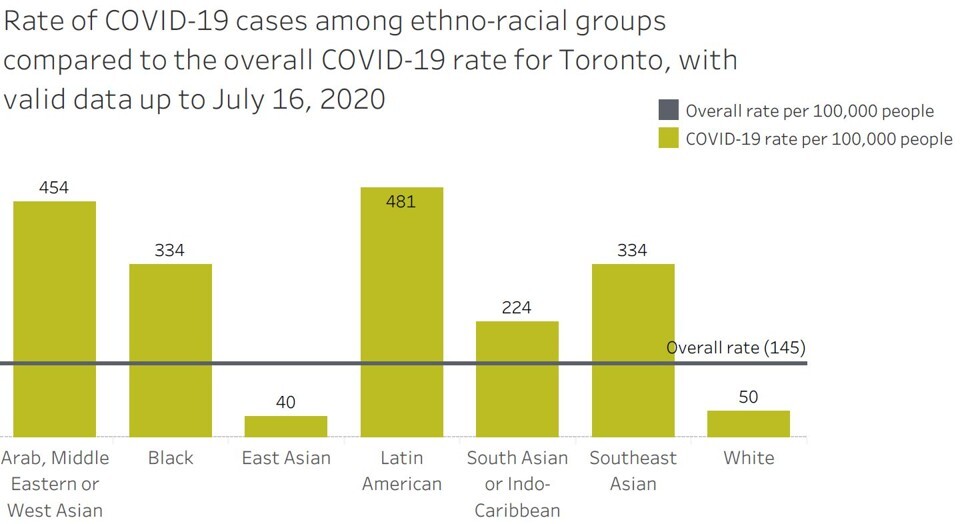
This chart shows the wide disparities in Covid-19 infection rates in Toronto, according to ethnicity, with East Asians experiencing the lowest rate and Latin Americans the highest. Graphic: Toronto Public Health

White Torontonians, meanwhile, have an infection rate that is a more modest 25 per cent higher than East Asians’ – still much lower than the rate for the whole of this diverse city.

Experts suspect that a combination of racism, behaviour and circumstance explains the stark differences among various ethnicities. The fact that wide disparities are also reflected in income-based infection rates suggests that socio-economic reasons are at play, not genetics, they say.

Widespread and early mask usage among East Asians could be a factor, said Dr Jason Kindrachuk, a University of Manitoba virologist who is studying Covid-19.
Covid-19 rate in Canada’s most Chinese city isn’t what racists might expect

But teasing apart causality would take time. “Is it as straightforward as income? Could this relate back to earlier community acceptance of things like masks or social distancing?” he asked.

Either way, the data is crucial to identifying communities that bear the greatest burden in the pandemic, said Kindrachuk.

“In Canada we talk about being a multi-ethnicity community, but we’re starting to identify just how different our communities are, how different the vulnerabilities are … so we need to think about how we provide services to those most in need.”

The Toronto data likely reflected the higher risks of certain jobs, those that relied heavily on non-white employees and were ill-suited to social distancing, Kindrachuk said.

Canada’s care industry has high numbers of Filipino workers, for example, while its meat processing and seasonal agricultural sectors employ many foreign workers from Mexico.

As well as suggesting communities most at risk, the ethnic data also stood in sharp contrast to what Kindrachuk called “shocking” racist rhetoric about “the ‘China virus’ [and the] implicit targeting of the East Asian, the Chinese communities, as being to blame for the virus”.

Poverty, racism and risk in Toronto

Previous data from New York and Los Angeles suggested that Asian residents of those cities had the lowest infection rates among various racial groups. But those US statistics lumped all Asians together, disguising any disparities within the group.

The Toronto data, presented by the city’s Medical Officer of Health Dr Eileen de Villa last Thursday and current to July 16, split up East Asians, Southeast Asians and South Asians. West Asians were grouped with Arab and Middle East people.

Separate census figures show that Toronto’s East Asian population is 84 per cent Chinese; ethnic Filipinos similarly dominate the Southeast Asian category, representing 79 per cent of the grouping.

East Asians had a Covid-19 rate of 40 infections per 100,000, far below the citywide rate of 145. They make up 13 per cent of the City of Toronto’s population of about 2.7 million – but less than 4 per cent of all infections.
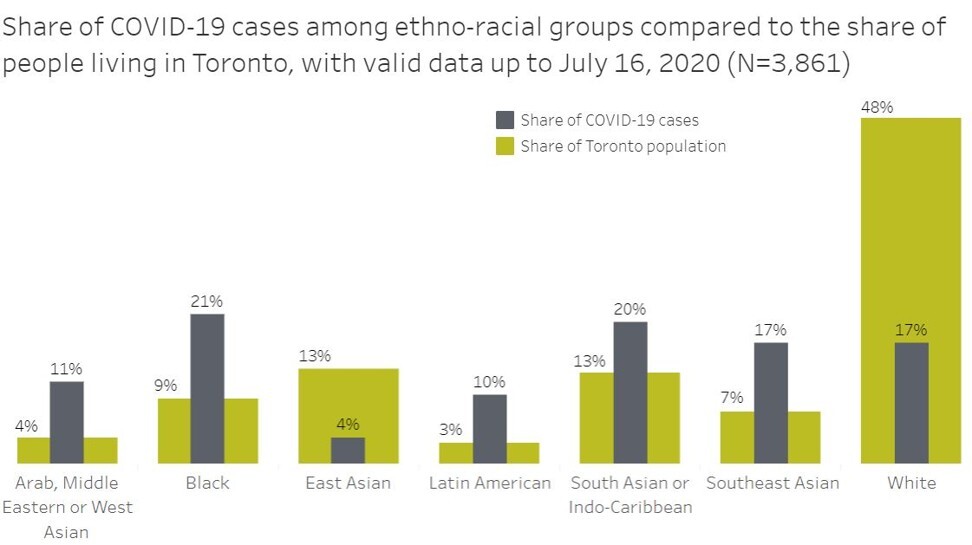
This chart shows the wide disparities in Covid-19 infection rates in Toronto according to ethnicity, illustrated as percentages of total population and total infections. Graphic: Toronto Public Health

The second-lowest infection rate (50 per 100,000) was among whites, who make up 48 per cent of the city’s population, and 17 per cent of infections.

Every other ethnic group has fared much worse.

The highest rates are among Latin Americans (481 per 100,000) and Arab/Middle Eastern/West Asians (454 per 100,000). Those communities are relatively small, at less than 3 and 4 per cent of the city respectively – but they suffered 10 per cent and 11 per cent of all Covid cases.

The larger populations of black Torontonians and Southeast Asians had identical infection rates of 334 per 100,000 people. Blacks make up about 9 per cent of the city, and Southeast Asians about 7 per cent, but experienced 21 and 17 per cent of all infections respectively.

South Asians (grouped with Indo-Caribbeans), had an infection rate of about 224 per 100,000. They make up about 13 per cent of Toronto, but have suffered 20 per cent of infections.

Canada has not been releasing race-based Covid-19 data on a national level, something critics call a blind spot.

But the Toronto data echoes previous geographical data from British Columbia, where the rate of Covid-19 infection in Richmond – the most ethnically Chinese city in the world outside Asia – has been the lowest in the metro Vancouver region.

In her presentation last week, Dr de Villa said there was “growing evidence … that racialised people and people living in lower-income households are more likely to be affected by COVID-19“.

“While the exact reasons for this have yet to be fully understood, we believe it is related to both poverty and racism,” she said.

She noted that 83 per cent of reported COVID-19 cases in Toronto involved a patient who identified as a member of a racialised group, compared to 52 per cent among the general population.

The race-based data from Toronto showed that “risk distribution was very unequal”, said Dr David Fisman, a professor of epidemiology at the University of Toronto. But this could be an overlapping function of wealth and income, he said.

There were dramatic differences between infection rates depending on income, with the rate steeply declining as incomes rose. The infection rate among residents of households earning C$150,000 (US$113,000) or more was 24 per 100,000 – less than one-sixth the rate suffered by the lowest earners, on less than C$30,000 per year, at 160 infections per 100,000.
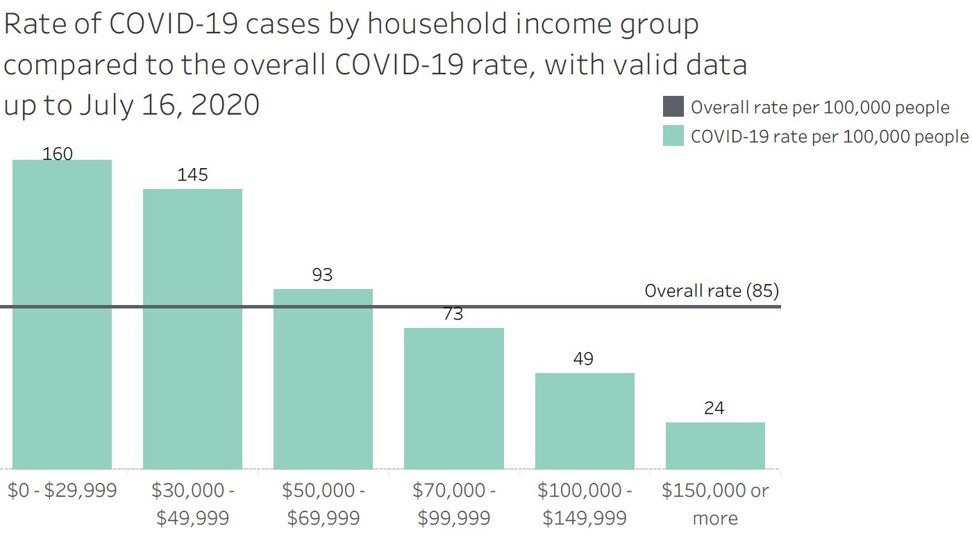
The risk of Covid-19 in Toronto declines steeply as income increases, this chart shows. Graphic: Toronto Public Health

“We were seeing this anecdotally in hospitals; the lockdown extinguished spread [of Covid-19] in higher-income areas, as a lot of professionals with service jobs got to go online,” he said.

“Lower-income folks are more likely to be people of colour and more likely to be in essential in-person work,” such as jobs in factories, food processing or care facilities, Fisman said.

“We can see that the epidemic split off in Toronto into two epidemics: one for wealthier Torontonians, and another, more prolonged, epidemic for those of lesser economic means.”

Kindrachuk agreed – the income divide was “eye-opening”, he said. “If you have a high income, you likely are going to be able to weather the storm … there is a complete disparity between how the burden of this disease looks between high and low income brackets.”

As for genetics, Kindrachuk said he doubted that it explained the stark disparities among ethnicities. “I haven’t seen evidence that there is a difference” on a genetic basis, he said.

ICYMI: Toronto’s marginalized communities disproportionately affected by coronavirus, data suggest

Better data on what we have seen worldwide:

COVID-19 has infected racialized and low-income people in Toronto at far higher rates than the general population outside of long-term care homes, data released by the city suggest.

Doctors, community organizations and public-health workers have long suspected that racialized people – especially those who are Black – have been disproportionately affected by COVID-19. The findings released Thursday by Toronto Public Health showed that despite making up 52 per cent of the population, racialized people accounted for 83 per cent of COVID-19 cases between mid-May and mid-July.

The data reveal health inequities that existed long before the pandemic and will continue to if governments don’t look to address the upstream causes, experts say.

“Racism essentially sets up whether you’re able to have a life in which you can protect yourself from risk for any disease, including COVID, or whether you are forced into exposing yourself to risk,” said Arjumand Siddiqi, the Canada Research Chair in population health equity.

According to the data, Black people had the highest share of COVID-19 cases (21 per cent), followed by South Asian or Indo-Caribbean (20 per cent), Southeast Asian (17 per cent), white (17 per cent), Arab, Middle Eastern or West Asian (11 per cent), Latin American (10 per cent) and East Asian (4 per cent). All groups except white and East Asian were overrepresented based on the size of their overall population. Black people had six times the rate of COVID-19 cases compared with white people, while Latin American as well as Arab, Middle Eastern or West Asian populations had nine times the rate.

https://s3.amazonaws.com/chartprod/HuLhs5wv7Pvi3ckkP/thumbnail.png

The data from Toronto Public Health do not include long-term care and retirement home residents, as these people are not asked about their race or their income. The data also did not include Indigenous identities. The data were collected by public-health officials between May 20 and July 16 and provided voluntarily.

Eileen de Villa, Toronto’s medical officer of health, said targeted testing, improved communication and access to social supports – such as voluntary isolation sites for those infected with or exposed to COVID-19 – could address these stark inequities in the short term. But she emphasized the city must work to address the root causes.

“We need to focus on the social determinants of health, like affordable housing opportunities, access to employment and income supports and educational opportunities. And yes, we need to address systemic racism,” Dr. de Villa said.

Mayor John Tory said community organizations will be a key partner in identifying solutions.

“This includes engaging with local community groups to better understand risks and the concerns that residents in these areas have, so that we can work together with them to address those concerns,” Mr. Tory said.

Floydeen Charles-Fridal, the executive director of Caribbean African Canadian Social Services, said her organization, based in the northwest part of the city that’s home to one of its largest Black populations, does the sort of front-line work that has been chronically underfunded for years.

CAFCAN usually spends about $10,000 to $15,000 annually on food-related programming but instead spent nearly $40,000 in the first month of the pandemic on hot meals, food hampers and staff to prepare and deliver them. Food insecurity was already an issue in the neighbourhood but grew worse after lockdown-related job losses, Ms. Charles-Fridal said. A University of Toronto study published last fall found Black Canadians experience food insecurity at nearly twice the rate of white Canadians, even after adjusting for factors such as education, income and home ownership.

“It took COVID-19 and the murder of Black folks here and across the border for people to really understand how anti-Black racism is working,” Ms. Charles-Fridal said.

Studies have repeatedly shown that South Asians and Black people have much higher rates of diabetes and high blood pressure than the general population. For people with one of these underlying conditions who become infected with COVID-19, there is an elevated risk for more severe outcomes, including death.

Michelle Westin, a senior analyst at Black Creek Community Health Centre, which serves neighbourhoods with some of the highest rates of poverty, said she was not at all surprised by the data.

“We know that we have community members that are living in crowded apartment buildings, people who are working in the service and factory industries, people who are underemployed so they don’t have paid sick days,” Ms. Westin said. “So they’re working in positions that are putting them at greater risk for catching COVID.”

In a report published after the Black Experiences in Healthcare Symposium held earlier this year in Toronto, organizers noted there were “disparities and inequities in health care access and delivery for racialized Canadians.”

Tracey Thompson, 52, experienced this first-hand. Ms. Thompson, who is Black, contracted COVID-19 in mid-March and still lives with serious long-term effects from the virus. She said she was turned away from the emergency room twice, and has not been able to see a doctor to get medication to relieve her symptoms, which are still present.

“I just haven’t been able to access health care in a reasonable fashion,” Ms. Thompson said. “I think that being Black and being a woman didn’t do me any favours in that.”

Toronto Public Health also reported Thursday that having a low income and living in crowded spaces were major risk factors for COVID-19: 27 per cent of cases were among those living in households of five or more, and 51 per cent of cases were among those living in low-income households.

The two are closely connected, Ms. Charles-Fridal said. “When people have low income what that also suggests is they may very well be in [public] housing and living in places where they cannot practice physical distancing.”

Earlier this month, a group of homeless people and activist organizations filed an application with the Superior Court calling a bylaw that bans tents and camping in city parks unconstitutional. Evicting people from parks, they said, would then push them into crowded communal spaces where they faced an elevated risk of contracting COVID-19.

ICYMI: Black Children Are More Likely to Die After Surgery Than White Peers, Study Shows

Yet another study showing racial disparities in healthcare:

Black children are more than three times as likely to die within a month of surgery as white children, according to a study published in the journal Pediatrics on Monday.

Disparities in surgical outcomes between Black and white patients have been well established, with researchers attributing some of the difference to higher rates of chronic conditions among Black people. But this study, which looked at data on 172,549 children, highlights the racial disparities in health outcomes even when comparing healthy children.

Researchers found that Black children were 3.4 times as likely to die within a month after surgery and were 1.2 times as likely to develop postoperative complications. The authors performed a retrospective study based on data on children who underwent surgery from 2012 through 2017.

Olubukola Nafiu, the lead author of the study and a pediatric anesthesiologist at Nationwide Children’s Hospital in Columbus, Ohio, said the authors were not surprised to find that healthy children, across the board, had extremely low rates of mortality and rates of complications after surgery. But what surprised them was the magnitude of the difference in mortality and complication rates by race.

“The hypothesis we had when we started was that if you studied a relatively healthy cohort of patients, there shouldn’t be any difference in outcomes,” Dr. Nafiu said.

The authors, in their paper, acknowledged limitations of the study: They did not explore the site of care where patients received their treatments or the insurance status of patients, which can be used as a proxy for socioeconomic status. This meant they could not account for differences in the quality of care that patients received or the economic backgrounds of the patients.

Another limitation was that because mortality and postoperative complications are so uncommon among healthy children, it is possible that most of the cases came from a few hospitals, Dr. Nafiu said.

But while Black people are more likely to receive care in low-performing hospitals, that may not be the main factor driving the gap this study found, Dr. Nafiu said. The hospitals examined in the study were all part of the National Surgical Quality Improvement Program, a voluntary program, meaning they had the resources to be part of the program and the belief that quality improvement is important.

Adil Haider, dean of the medical college at Aga Khan University, who was not involved with the study, said that it told a key piece of the story about racial disparities in surgical outcomes, but that there were still many questions about what drives disparities.

Dark skinned patients left out of COVID-19 studies, as minorities some of the hardest bit by the virus

Of note, another example of systemic bias and discrimination:

Clinical images of patients with hives, swollen lips, chickenpox-like rashes, and red or purple lesions on the feet known as “covid toes,” have been published in medical studies since the start of the pandemic, demonstrating how the virus can affect the skin.

These images can help doctors diagnose patients who are otherwise asymptomatic – if they have light skin.

But images of darker-skinned patients have largely not been included in medical studies showing how COVID-19 can present on the skin, even as the disease has disproportionately affected people of colour in Canada and the United States. Symptoms can appear very differently on dark skin tones, underscoring the need for inclusion in clinical studies.

“Black folks in Canada, specifically Toronto, are overrepresented in terms of the burden of COVID-19,” said Bolu Ogunyemi, a dermatologist and clinical assistant professor of medicine at Memorial University in Newfoundland.

“So it’s unfortunate that we’re actually underrepresented in records of the manifestation from skin for this disease.”

The COVID-19 studies reflect a pattern in which darker skinned patients are largely missing from medical literature, part of an issue of racism within the medical system.

A literature review in The British Journal of Dermatology found that out of 36 studies showing images of COVID-19 presentations on skin published between December, 2019, to May, 2020, there were zero images of dark skin tones.

Researchers evaluated each clinical image using the six-point Fitzpatrick scale, which categorizes skin tones from lightest to darkest, and found that 92 per cent of the 130 images were of skin in the first three categories, which range from the lightest coloured skin to a medium tone. There were zero images of skin in the two darkest Fitzpatrick categories.

While it is not yet clear how significant these skin lesions can be in diagnosing COVID-19, understanding what they look like could lead to earlier testing. Some provinces, such as Nova Scotia, have added symptoms of red or purple fingers or toes to a list of symptoms that indicate a person should get tested.

“We’re still trying to figure out what these manifestations actually mean,” said the main author of the study, Jenna Lester, who is an assistant professor of dermatology at the University of California, San Francisco.

“But if there is a rash that patients can identify themselves when they were perhaps asymptomatic and can use it as a way to know they need to get tested but we’re not showing it in dark skin – it is a huge disservice to patients.”

Including examples of what diseases can look like on dark skin is important because indicators such as redness may be difficult to spot on dark skin, said Lynn McKinley-Grant, associate professor of Dermatology at Howard University College of Medicine and president of the U.S.-based Skin of Color Society.

Redness on light skin can appear as a different shade on darker skin, she said, or not appear at all. Doctors may have to employ different diagnostic methods to determine the issue, such as using touch to see whether the skin is warm. Sometimes, darker skin can also react very differently.

“In the textbooks it’ll describe a rash as flat and not itchy, but in darker skin types, it’ll be raised and itchy, but still be in the same pattern,” Dr. McKinley-Grant said.

The Skin of Color Society has shared images on social media of darker skin showing symptoms that are similar in appearance to COVID-19 symptoms.

While most health care units in Canada do not yet collect race-based data on COVID-19 patients, statistics show that the most diverse geographic areas also have some of the highest rates COVID-19. In early June, after health care professionals across the country raised concerns about the lack of data on how COVID-19 has affected racialized populations, Ontario had granted some health units permission to begin collecting race-based data.

In the U.S., where race-based data are available, studies show that African-Americans are almost three times as likely to test positive for the virus than white people.

Some doctors in Canada have linked the lack of representation in COVID-19 studies to larger issues of representation in medical studies and textbooks, across all disciplines.

Edgar Akuffo-Addo, a first-year medical student at the University of Toronto, says he has experienced this first hand.

In a first-aid training course he recently completed, Mr. Akuffo-Addo said participants were instructed to check for signs of shock by pressing down on a patient’s fingernails and waiting to see how long it took to turn red again.

“I tried to do the test on myself, and I couldn’t see it on my own skin,” he said. In addition, he said all the patients featured in the video training materials were white.

Mr. Akuffo-Addo describes the lack of representation as “troubling and worrying” and has embarked on his own review of clinical images of skin conditions related to COVID-19, and has so far examined 1,000 images in studies from Spain, France, Italy, the U.S. and Canada. Mr. Akuffo-Addo said that he confirmed with the authors of those studies that all patients were white.

Dr. Ogunyemi said the study of dermatology has been historically white.

When the field was first developing in Britain, the U.S. and Canada, he said, there was a smaller proportion of people of colour, so the criteria for the diagnosis of skin issues was centred around people with lighter skin. But these criteria have not changed significantly since that time.

“The problem is our population in these countries is changing – but the definition of skin disease is not keeping up with the pace.”

Studies also show that a mistrust of the medical system is a major reason why people of colour may choose not to participate in medical studies, stemming from a history of mistreatment as well as discrimination within the medical system.

Dr. Ogunyemi said that because the information on treating dark skin may not be readily available, Canadian doctors may have to take additional steps to ensure they are comfortable and able to treat people with dark skin.

“I think like a lot of things, you have to take a conscious effort, you have to go out of your way.”

Study shows virus hit African immigrants hardest in France

As is the case everywhere, those at the lower economic scale, living in worse areas, and with more precarious yet essential work:

Death rates among immigrants from sub-Saharan Africa doubled in France and tripled in the Paris region at the height of France’s coronavirus outbreak, according to a study from the French government’s statistics agency released Tuesday.

The INSEE agency’s findings are the closest France has come yet to acknowledging with numbers the virus’s punishing and disproportionate impact on the country’s Black immigrants and the members of other systemically overlooked minority groups.

The study was the first in France to cross-reference deaths that occurred in March and April, when intensive care units were swamped with COVID-19 patients, with the regions of origin of the people who died. By highlighting dramatic increases in deaths among immigrants born in Africa and Asia, the research helps fill some of the gaps in France’s understanding of its minority communities.

The topic has become an increasingly hot-button issue for French administrators in the wake of Black Lives Matter protests sparked by the death of George Floyd. French researchers hailed the study as an important step but also said it only begins to scratch the surface of how the pandemic is impacting France’s minorities, who often live in crowded, underprivileged neighborhoods.

French Black rights activists have long pushed for more and better ethnic-specific data. Officially, the French republic is colorblind, refusing to categorize or count people by race or ethnicity. For critics, that guiding philosophy has made the state oblivious to discrimination and put minorities at additional risk during the pandemic.

“I’m delighted, and I know colleagues are delighted, because we have been waiting for this data,” Solene Brun, a sociologist specializing in issues of race and inequality, said. “But our enthusiasm is tempered by the fact that this concerns only countries of origin. It’s not looking at Black populations or North African and Asian populations in their entirety.”

Most glaringly, the study shed no light on how the French-born children of immigrants are faring in the pandemic. Still, its findings pointing to high death rates among their foreign-born parents suggest that minorities, especially Black people from Africa, may have disproportionately borne much of the brunt in France.

“They have very clearly been hard hit. That is undeniable,” said Sylvie le Minez, who heads INSEE’s department of demographic studies.

Mounting evidence from the United States and Britain pointing to greater COVID-19 mortality risks for Black residents than whites has increased pressure for French studies. Researchers bemoaned that their hands were tied by French taboos against identifying people by race or ethnicity and by legislation that regulates the scope of research and data collection.

“France doesn’t do ethnic-racial statistics, but we have the country of birth,” Le Minez said. “That is already very, very illuminating.”

INSEE researchers drilled down into data gleaned from France’s civil registry of births, deaths and marriages to look at the birth countries of people who died during the March-April peak of the country’s outbreak. France has reported about 30,000 virus-related deaths in all since the pandemic started.

The research findings were particularly alarming for the Paris region, especially in the densely populated and underprivileged northern reaches of the French capital. Compared to March-April of 2019, Paris-region deaths during the same two months this year shot up by 134% among North African immigrants and by 219% for people born elsewhere in Africa.

The region’s increased March-April mortality in 2020 was less marked among people born in France: 78%.

Skewed death rates were even more pronounced in Seine-Saint-Denis, the northern outskirt of Paris long troubled by poverty and overcrowding. There, deaths increased by 95% among the French-born but by 191% among people born in North Africa and by 368% among those from sub-Saharan Africa.

The study suggested that African immigrants were more exposed to infection because they live in more crowded conditions, make greater use of public transportation to commute to work and are more likely to have been among the key workers who continued at their posts when white-collar workers stayed home during France’s two-month lockdown.

Sociologist Brun said the study, by exposing limits in France’s knowledge about minorities, offered compelling arguments for broader research.

“Once you wedge a foot in the door, it becomes easier to open it,” she said. “What’s precious about this data is that, roughly put, it gives us a glimpse of what we could learn if we agreed to really look at racial inequalities in health. So not just immigrants, but also their descendants and even perhaps their grandkids, that’s to say all those people who are racialized as non-white in France and live with discrimination because of that.”

Source: Study shows virus hit African immigrants hardest in France

To Be Useful, Health Data Must Go Deeper Than ‘Black’ and ‘White’

Apart from the somewhat polemic introduction, a good discussion of the limits of aggregated visible minority groups and the need for more desegregated data by country of ethnic ancestry (rather than nationality, given need to include second and subsequent generations).

However, starting with the basic visible minority data, which could then be matched with census socio-economic data, is a needed start to further needed disaggregation:

All over the world, the COVID-19 pandemic has disproportionately affected patients based on a variety of identifiable factors, from age to sex to occupation. Data such as these are crucial to public-health officials and researchers tasked with improving care for all citizens. But in some cases, the quest for data seems driven as much by political factors as by the need to protect public health.

In Canada, where I work as a resident physician in the field of head and neck surgery, the federal government has proposed that racial data be tracked as part of our national response to the COVID-19 pandemic, as is already the case in the United States. On the surface, there would seem to be an obvious parallel with the need to collect race-based policing data, especially in the wake of George Floyd’s death and the worldwide protests that followed.

Collecting such data makes sense in the context of policing, since race corresponds to a visible marker that can prompt radically different responses from police officers. But the situation is different when it comes to public health. And using race as a proxy for socioeconomic and environmental explanations of disease—by broadly categorizing patients as White, Black, Asian, Indigenous, and so on, according to melanin-influenced phenotype—is a dangerous leap. Obtaining more detailed data, including nationality-based information, would be a more fruitful endeavor.

Consider the use of broad racial typologies in the field of education. York University professors Carl James and Tana Turner combed through Toronto District School Board data to go beyond the officially recognized categories of “Black” and “White.” In so doing, they discovered that recent immigrants from Africa and the Caribbean tend to perform better than those with generational ties to Canada. This disparity is not evident within the aggregated statistics, wherein both of these groups are simply classified as Black. In a country with a rich recent history of immigration, such as Canada, finer distinctions are particularly important.

Similar examples arise when it comes to race-based health data. Sickle cell anemia, a blood disease with a challenging clinical trajectory, is most commonly found in sub-Saharan Africa, whose population undeniably may be placed within the “Black” designation. But examining sub-populations within this category yields surprising trends. Sickle cell anemia is about 100 times more common in Nigeria than in Somalia. Making matters more confusing, the prevalence of the disease is higher in Greece, whose majority population we may safely place in the “White” category, than in either Somalia or Jamaica. Terms such as “Black” and “White” simply become useless when talking about many areas of health-related statistics.

In some rare instances, there may be a direct causal association between skin melanin content and disease. Skin cancers fall into this category. Here, we may confidently assert that racial characteristics are relevant to the biological explanation for the disease. Medicine has long recognized this, and has adapted to it—including through the so-called Fitzpatrick scale as a tool to help evaluate risk based on skin tone.

In the case of COVID-19, we know that diabetes, hypertension, and obesity all are significant comorbidities. Does skin melanin content have an effect on incidence rates and mortality? We can’t confidently come to a conclusion one way or another. But any clinician will tell you that such a link is improbable. Yes, there are outcome disparities that align with race. But such disparities among racialized Canadian communities seem largely related to unequal access to care, and to socioeconomic factors related to a historical narrative of inequality. Those inequalities should be addressed regardless of whether they manifest themselves in COVID-19 data.

Broad categorizations fall apart when it comes to Indigenous groups as well. It is no secret that Indigenous Canadians face unacceptable health disparities when compared to non-Indigenous Canadians. By many accounts, the state of Indigenous health in Canada is a shameful stain on an otherwise successful universal healthcare enterprise. But just as with Somali-Canadians and Greek-Canadians, each Indigenous community faces unique challenges related to their disease burden. While arthritis and rheumatism are more common amongst Indigenous groups as a whole, the prevalence of these conditions is significantly higher for First Nations as compared to Inuit communities in the northern part of the country. Surely this is important when determining priorities in a cash-strapped healthcare delivery environment.

Similarly, a sub-group analysis reveals that northern Inuit communities in Nunavut and the Northwest Territories face significantly greater challenges related to access to care as compared to First Nations people in the provinces, who are more likely to live closer to large hospitals and specialist medical clinics. These disparities are a matter of geography, amongst other things. Yet important patterns are masked if the data is simply grouped under broad categories such as “Indigenous” and “Non-Indigenous.”

These examples underscore the need for granularity in data collection. More detailed information encompassing nationality and background, in combination with other important socio-economic factors, allow for a more complete picture of the health problems that must be addressed. There are numerous health-outcome disparities between “Black” and “White” Canadians that many politicians and policy makers, with good intentions, seek to cast as evidence of systemic racism. Putting aside how that term should be defined, such an approach would apply a misguided oversimplification to the practice of medical data collection.

The goal should be to help all Canadians—especially those who truly need it. Statements such as “Canadian females of Filipino descent have higher incidence rates of thyroid cancer when compared to the general population” are much more useful than “Asian-Canadian females have higher rates of thyroid cancer.” That is why Public Health Ontario and organizations such as the ICES research institute already use large data sets to fine-tune clinical practices and improve the livelihood of all citizens.

Thanks to advances in machine learning, we have the tools to collect, store, and analyze data on an even larger scale. But our efforts will be successful only if we apply a typology that is based on categories useful to doctors and patients, not politicians and activists.

Source: To Be Useful, Health Data Must Go Deeper Than ‘Black’ and ‘White’

The Fullest Look Yet at the Racial Inequity of Coronavirus

Good in-depth analysis (for charts, see the article):

Teresa and Marvin Bradley can’t say for sure how they got the coronavirus. Maybe Ms. Bradley, a Michigan nurse, brought it from her hospital. Maybe it came from a visiting relative. Maybe it was something else entirely.

What is certain — according to new federal data that provides the most comprehensive look to date on nearly 1.5 million coronavirus patients in America — is that the Bradleys are not outliers.

Racial disparities in who contracts the virus have played out in big cities like Milwaukee and New York, but also in smaller metropolitan areas like Grand Rapids, Mich., where the Bradleys live. Those inequities became painfully apparent when Ms. Bradley, who is Black, was wheeled through the emergency room.

“Everybody in there was African-American,” she said. “Everybody was.”

Early numbers had shown that Black and Latino people were being harmed by the virus at higher rates. But the new federal data — made available after The New York Times sued the Centers for Disease Control and Prevention — reveals a clearer and more complete picture: Black and Latino people have been disproportionately affected by the coronavirus in a widespread manner that spans the country, throughout hundreds of counties in urban, suburban and rural areas, and across all age groups.

Latino and African-American residents of the United States have been three times as likely to become infected as their white neighbors, according to the new data, which provides detailed characteristics of 640,000 infections detected in nearly 1,000 U.S. counties. And Black and Latino people have been nearly twice as likely to die from the virus as white people, the data shows.

The disparities persist across state lines and regions. They exist in rural towns on the Great Plains, in suburban counties, like Fairfax County, Va., and in many of the country’s biggest cities.

“Systemic racism doesn’t just evidence itself in the criminal justice system,” said Quinton Lucas, who is the third Black mayor of Kansas City, Mo., which is in a state where 40 percent of those infected are Black or Latino even though those groups make up just 16 percent of the state’s population. “It’s something that we’re seeing taking lives in not just urban America, but rural America, and all types of parts where, frankly, people deserve an equal opportunity to live — to get health care, to get testing, to get tracing.”

The data also showed several pockets of disparity involving Native American people. In much of Arizona and in several other counties, they were far more likely to become infected than white people. For people who are Asian, the disparities were generally not as large, though they were 1.3 times as likely as their white neighbors to become infected.

The new federal data, which is a major component of the agency’s disease surveillance efforts, is far from complete. Not only is race and ethnicity information missing from more than half the cases, but so are other epidemiologically important clues — such as how the person might have become infected.

And because it includes only cases through the end of May, it doesn’t reflect the recent surge in infections that has gripped parts of the nation.

Still, the data is more comprehensive than anything the agency has released to date, and The Times was able to analyze the racial disparity in infection rates across 974 counties representing more than half the U.S. population, a far more extensive survey than was previously possible.

Disparities in the suburbs

For the Bradleys, both in their early 60s, the symptoms didn’t seem like much at first. A tickle at the back of the throat.

But soon came fevers and trouble breathing, and when the pair went to the hospital, they were separated. Ms. Bradley was admitted while Mr. Bradley was sent home. He said he felt too sick to leave, but that he had no choice. When he got home, he felt alone and uncertain about how to treat the illness.

It took weeks, but eventually they both recovered. When Mr. Bradley returned to work in the engineering department of a factory several weeks later, a white co-worker told Mr. Bradley that he was the only person he knew who contracted the virus.

By contrast, Mr. Bradley said he knew quite a few people who had gotten sick. A few of them have died.

“We’re most vulnerable to this thing,” Mr. Bradley said.

In Kent County, which includes Grand Rapids and its suburbs, Black and Latino residents account for 63 percent of infections, though they make up just 20 percent of the county’s population. Public health officials and elected leaders in Michigan said there was no clear reason Black and Latino people in Kent County were even more adversely affected than in other parts of the country.

Among the 249 counties with at least 5,000 Black residents for which The Times obtained detailed data, the infection rate for African-American residents is higher than the rate for white residents in all but 14 of those counties. Similarly, for the 206 counties with at least 5,000 Latino residents analyzed by The Times, 178 have higher infection rates for Latino residents than for white residents.

“As an African-American woman, it’s just such an emotional toll,” said Teresa Branson, the deputy administrative health officer in Kent County, whose agency has coordinated with Black pastors and ramped up testing in hard-hit neighborhoods.

Experts point to circumstances that have made Black and Latino people more likely than white people to be exposed to the virus: Many of them have front-line jobs that keep them from working at home; rely on public transportation; or live in cramped apartments or multigenerational homes.

“You literally can’t isolate with one bathroom,” said Lt. Gov. Garlin Gilchrist II, who leads Michigan’s task force on coronavirus racial disparities.

‘We just have to keep working’

Latino people have also been infected at a jarringly disparate rate compared with white people. One of the most alarming hot spots is also one of the wealthiest: Fairfax County, just outside of Washington, D.C.

Three times as many white people live there as Latinos. Yet through the end of May, four times as many Latino residents had tested positive for the virus, according to the C.D.C. data.

With the median household income in Fairfax twice the national average of about $60,000, housing is expensive, leaving those with modest incomes piling into apartments, where social distancing is an impossibility. In 2017, it took an annual income of almost $64,000 to afford a typical one-bedroom apartment, according to county data. And many have had to keep commuting to jobs.

Diana, who is 26 and did not want her last name used out of fear for her husband’s job, said her husband got sick at a construction site in April. She and her brother, who also works construction, soon fell ill, too. With three children between them, the six family members live in a two-bedroom apartment.

Diana, who was born in the United States but moved to Guatemala with her parents as a small child before returning to this country five years ago, is still battling symptoms. “We have to go out to work,” she said. “We have to pay our rent. We have to pay our utilities. We just have to keep working.”

At Culmore Clinic, an interfaith free clinic serving low-income adults in Fairfax, about half of the 79 Latino patients who tested for the virus have been positive.

“This is a very wealthy county, but their needs are invisible,” said Terry O’Hara Lavoie, a co-founder of the clinic. The risk of getting sick from tight living quarters, she added, is compounded by the pressure to keep working or quickly return to work, even in risky settings.

The risks are borne out by demographic data. Across the country, 43 percent of Black and Latino workers are employed in service or production jobs that for the most part cannot be done remotely, census data from 2018 shows. Only about one in four white workers held such jobs.

Also, Latino people are twice as likely to reside in a crowded dwelling — less than 500 square feet per person — as white people, according to the American Housing Survey.

The national figures for infections and deaths from the virus understate the disparity to a certain extent, since the virus is far more prevalent among older Americans, who are disproportionately white compared with younger Americans. When comparing infections and deaths just within groups who are around the same ages, the disparities are even more extreme.

Latino people between the ages of 40 and 59 have been infected at five times the rate of white people in the same age group, the new C.D.C. data shows. The differences are even more stark when it comes to deaths: Of Latino people who died, more than a quarter were younger than 60. Among white people who died, only 6 percent were that young.

Jarvis Chen, a researcher and lecturer at the Harvard T. H. Chan School of Public Health, said that the wide racial and ethnic disparities found in suburban and exurban areas as revealed in the new C.D.C data should not come as a surprise. The discrepancies in how people of different races, ethnicities and socioeconomic statuses live and work may be even more pronounced outside of urban centers than they are in big cities, Dr. Chen said.

“As the epidemic moves into suburban areas, there are good reasons to think that the disparities will grow larger,” he said.

The shortfalls of the government’s data

The Times obtained the C.D.C. data after filing a Freedom of Information Act lawsuit to force the agency to release the information.

To date, the agency has released nearly 1.5 million case records. The Times asked for information about the race, ethnicity and county of residence of every person who tested positive, but that data was missing for hundreds of thousands of cases.

C.D.C. officials said the gaps in their data are because of the nature of the national surveillance system, which depends on local agencies. They said that the C.D.C. has asked state and local health agencies to collect detailed information about every person who tests positive, but that it cannot force local officials to do so. Many state and local authorities have been overwhelmed by the volume of cases and lack the resources to investigate the characteristics of every individual who falls ill, C.D.C. officials said.

Even with the missing information, agency scientists said, they can still find important patterns in the data, especially when combining the records about individual cases with aggregated data from local agencies.

Still, some say the initial lack of transparency and the gaps in information highlight a key weakness in the U.S. disease surveillance system.

“You need all this information so that public health officials can make adequate decisions,” said Andre M. Perry, a fellow in the Metropolitan Policy Program at The Brookings Institution. “If they’re not getting this information, then municipalities and neighborhoods and families are essentially operating in the dark.”

Higher cases, higher deaths

The higher rate in deaths from the virus among Black and Latino people has been explained, in part, by a higher prevalence of underlying health problems, including diabetes and obesity. But the new C.D.C. data reveals a significant imbalance in the number of virus cases, not just deaths — a fact that scientists say underscores inequities unrelated to other health issues.

The focus on comorbidities “makes me angry, because this really is about who still has to leave their home to work, who has to leave a crowded apartment, get on crowded transport, and go to a crowded workplace, and we just haven’t acknowledged that those of us who have the privilege of continuing to work from our homes aren’t facing those risks,” said Dr. Mary Bassett, the Director of the FXB Center for Health and Human Rights at Harvard University.

Dr. Bassett, a former New York City health commissioner, said there is no question that underlying health problems — often caused by factors that people cannot control, such as lack of access to healthy food options and health care — play a major role in Covid-19 deaths.

But she also said a big determinant of who dies is who gets sick in the first place, and that infections have been far more prevalent among people who can’t work from home. “Many of us also have problems with obesity and diabetes, but we’re not getting exposed, so we’re not getting sick,” she said.

The differences in infection case rates are striking, said Jennifer Nuzzo, an epidemiologist and professor at the Johns Hopkins Bloomberg School of Public Health.

“Some people have kind of waved away the disparities by saying, ‘Oh, that’s just underlying health conditions,’” Dr. Nuzzo said. “That’s much harder to do with the case data.”

In June, C.D.C. officials estimated that the true tally of virus cases was 10 times the number of reported cases. They said they could not determine whether these unreported cases had racial and ethnic disparities similar to those seen in the reported infections.

But they said that more-severe infections — which are more often associated with underlying health conditions, and with people seeking medical care — are more likely to be recorded as cases.

That difference in the reporting of cases might explain some portion of the race and ethnicity disparities in the number of documented infections, C.D.C. officials said. But they said that it was also clear that there have been significant disparities in the number of both deaths and cases.

Ontario is starting to collect race-based COVID-19 data. Some worry it could do more harm than good

Sigh. Yes, groups should be consulted, yes, the data should be made public, but hard to see that minorities will be worse off with data than without.

Having better data facilitates discussion of current realities and possible policy options to address disparities:

With Ontario’s race-based COVID-19 data collection beginning “imminently,” health experts say crucial unresolved questions will determine whether those efforts help alleviate the pandemic’s brutal disparities, or cause more harm.

Regulatory changes came into effect last Friday that mandate the collection of information on race for all newly reported COVID-19 cases province-wide, along with data on income, household size and languages spoken. Data collection is beginning once training for public health units and changes to data entry systems are complete, according to a health ministry spokesperson.

Community organizations, researchers, doctors and public health experts have called for the collection of this data, pointing to the disproportionate burden of COVID-19 in areas with more racialized, low-income and newly immigrated residents.

But health researchers said the question of how this data is managed and used is even more important than whether it is collected.

“The collection of race-based data is not the outcome,” said Camille Orridge, a senior fellow at the Wellesley Institute and longtime advocate for health equity data collection. “The outcome is to have the information and use the information to reduce disparities. That’s the goal.

“We need to be clear with people who are collecting the data — government, etc. — that there are a number of things that must be answered before we come to the table to give up the data,” she said.

Orridge cited a list of questions, including whether the data will stay in Canada, whether it will be sold in any form to the private sector, how artificial intelligence will be used with the resulting databases. And most importantly, for her: whether the racialized communities most affected will have oversight and input on whether the data is being used to answer questions and create policies that counter the pandemic’s unequal toll.

She cited a phrase often used in the world of Indigenous policy: “Nothing about us, without us.”

Alexandra Hilkene, the health ministry spokesperson, said “We’re currently in the process of finalizing the terms of reference for the working group that will report to the ministry and help ensure we interpret the data accurately. The group will include policy experts from racialized communities.”

In Toronto, some of the neighbourhoods most affected by COVID-19 have case rates 14 times higher than the least affected neighbourhoods. Those hard-hit neighbourhoods are all clustered in the northwest of the city, an area that has been historically underserviced and has higher rates of poverty, inadequate housing, and other symptoms of systemic disadvantage.

The city’s most affected areas also have significantly higher percentages of Black residents than the least-affected areas, and higher percentages of Southeast Asian and other racialized groups. But health experts say these area-based analyses, which rely on matching the postal codes of known cases to census data, are less revealing than collecting the data directly from individuals.

Toronto, Peel Region and some other health units have already begun collecting this data, but officials argued that it should be mandated province-wide to provide a complete picture. After weeks of urging, the province made regulatory changes to the Health Protection and Promotion Act to mandate the collection of race and sociodemographic information for COVID-19.

But now that the government is about to begin collecting that data, it shouldn’t be exclusively available to them, said Arjumand Siddiqi.

“I would worry that if the data stays in the domain of the government, or if they handpick a small group of people to use it and no one else sees it, we have to rely on what those people tell us,” said Siddiqi, Canada Research Chair in population health equity and a professor at the University of Toronto’s Dalla Lana School of Public Health.

Making the data available more broadly ensures that independent researchers can check the work of others, rebut flawed analyses and conclusions, and ask different kinds of questions.

But Orridge said it’s also important to ensure that the researchers who do get access to race-based COVID-19 data have real relationships in and accountability to the communities that are most affected.

“We have researchers who have no connection to the communities having access to the data, and making their careers on the use of that data,” said Orridge.

“We’ve got to make sure that the data, when it’s being used and published, always has a context, so that we don’t further stigmatize communities.”

LLana James, a doctoral candidate at the University of Toronto Faculty of Medicine who researches race-ethnicity, health data, privacy, AI and the law, noted that Ontario and Canada collect health data in a legal framework that has failed to catch up to the massive technological changes that have occurred, especially in the last decade with the rise of machine learning.

“We have one of the lowest thresholds for legal use of data in the developed world,” said James, noting that technology companies see Ontario as an attractive market for lucrative health-care data, and contrasting Canada’s poor data privacy protections with Europe’s robust framework.

James provided critical comments on the province’s proposed regulatory changes to begin collected race-based COVID-19 data, and believes the current, government-driven data efforts will not help Black, Indigenous and other racialized communities.

Race-based data assumes that “we need to know the race of the person, not how racism is functioning. Those are two completely different scientific questions,” James said.

“We have 400 years of data about what happens to Black people during pandemics,” said James. “We have hundreds of years of race-based data, and it’s changed very little. It’s the will to act (that’s missing), not the will to collect more stuff.”

Like Orridge, however, she believes that any data collection that avoids harm must be centred in and directed by communities. James is the co-lead of REDE4BlackLives, a research and data collection protocol that provides a framework for the ethical engagement of Black communities in Canada.

“Black communities, like Indigenous communities, know exactly what they need,” says James. “They know who advocates for them. They know who shows up for them. And they know who to trust, because they see it with their own eyes.”

US: Trying to Correct Banking’s Racial Imbalance

Of note. Anyone have comparable Canadian data?

Wole Coaxum was a managing director at JPMorgan Chase in business banking when a police officer fatally shot the unarmed Michael Brown in Ferguson, Mo., in 2014.

The killing caused Mr. Coaxum to rethink his career goals.

“Everyone needs the opportunity to effectively participate fully in the economy, and I wanted to be part of the conversation,” he said. “The issues, including the lack of access to banking and financial tools, were hiding in plain sight. But for a community to have a social justice plan without an economic plan is like one hand clapping.”

Within the year Mr. Coaxum left JPMorgan to create Mobility Capital Finance, known as MoCaFi, a start-up focused on providing free or less expensive financial services to those with low-to-moderate incomes, “people like home health care workers, bus drivers and municipal employees,” he said, who frequently were underserved, discriminated against or shut out from traditional banks.

Now, the deaths of George Floyd, Rayshard Brooks and Breonna Taylor, coupled with the racial disparity in Covid-19 outcomes, have magnified the deep fault lines nationwide. Additionally, black-owned businesses have been more affected by the economic fallout from the pandemic. The confluence of these crises have laid bare another underlying issue: income inequality and a resulting loss of access to the financial system among communities of color.

At the time Mr. Coaxum left traditional banking to become an entrepreneur, close to 30 percent of households in the United States had no bank accounts or, even if they had them, still resorted to significantly more expensive alternative systems like check cashing centers or payday loan businesses.

While those numbers have improved incrementally since then — as of 2017, roughly 25 percent of U.S. households had limited or no access to the traditional financial system, a racial divide remains. Most of those who are the so-called un-or-under-banked live either in communities of color or rural areas. Close to 17 percent of black households and 14 percent of Hispanic families lack basic financial services, compared with 3 percent of white households in 2017, the last year for which statistics are available from the F.D.I.C.

The loss of access means that “black and Hispanic people are spending 50 to 100 percent more per month for basic banking services, which, over a lifetime, can cost $40,000 in fees,” Mr. Coaxum said.

While the technology sector has been criticized for its lack of diversity, Mr. Coaxum and a handful of other founders are hoping that fintech — the frequently used term for financial technology — can lead to successful business models that can help correct the imbalance in the financial system.

Marla Blow had worked in start-ups and financial institutions after graduating from the Stanford Graduate School of Business. But it was through her experiences at the Treasury Department and the Consumer Financial Protection Bureau that she thought about focusing on those without access to banks and credit cards.

“Financial services companies have a long history of redlining and declining to serve communities of color,” she said.

While the economy recovered from the financial crisis, she said, the subprime market — often the only credit available to households with low-to-moderate income — lagged behind.

As a result, she started FS Card, a company that provided the Build credit card with a $500 spending limit, offering a lower-cost alternative to a payday loan. To get this done, FS partnered with Republic Bank to gain access to the credit-card system. She had traction: At the time she sold the company to Continental Financein late 2018, FS Card had issued more than 100,000 cards and extended $50 million in credit, she said.

Ms. Blow joined Mastercard as the senior vice president for social impact, North America, at the company’s Center for Inclusive Growth last October, where she focuses on closing economic disparities.

Mr. Coaxum and Ms. Blow were also aware of another problem facing people with low-to-moderate income: the inability to get personal or small business loans. Traditionally, banks use three credit rating bureaus — Equifax, Experian and TransUnion, which rely on indicators like checking-account performance and mortgage payments, among others, to compute the important FICO scores.

But that often leads to a dilemma for those who have had overdrafts or pay rent. These people may have very low scores, or sometimes none at all. About 20 percent of consumers have insufficient credit history to secure loans from traditional means.

James Gutierrez, the chief executive and co-founder of Aura Financial and the grandson of immigrants, was driven by this imbalance, which, he said, left “customers with only two options — payday loans or auto title loans.” His first company, Progreso Financiero, opened in 2005 before smartphones became widespread.

It offered loans through supermarkets and storefronts. Both companies, Mr. Gutierrez said, took a risk on people who were “sometimes invisible but make the economy go round. And they paid us back.”

After he left in 2012, he began Aura, which offered loans to people often unbanked and underbanked, but this time through smartphones and in locations like supermarkets. To determine credit risk — and the interest rate for the loans — Aura “uses proprietary data, in addition to credit bureau data, that include income and expenses, bank account information” and whether the borrower gives money to relatives in other countries, he said.

Progreso was renamed Oportun after Mr. Gutierrez left. Under the current chief executive, Raul Vazquez, Oportun has an “omnichannel approach” of mobile, branded storefronts and grocery store availability and is now publicly traded on Nasdaq. Mr. Vazquez, the son of Mexican immigrants, said Oportun was not only providing financing, but was also trying to provide “relationship banking services” to customers who often worked multiple jobs with little time to spare.

All the founders emphasize that while they focus on low-to-moderate-income households, they are for-profit companies that can succeed as they scale.

MoCaFi, for example, which offers Mastercard debit cards, relies on the fees merchants pay credit-card processors for revenue. MoCaFi recently announced that it would expand significantly this summer by offering free deposit accounts at 55,000 A.T.M.s in five countries, 40,000 of which will be in the United States, in stores like CVS and Rite Aid, Mr. Coaxum said.At those A.T.M.s, customers can deposit checks or cash into their accounts and, as a result, avoid checking-cashing businesses.

For companies like Oportun and Aura that focus on lending, the revenue source is from the interest rates on loans that often hover around 36 percent (when including origination fees, the annual percentage rate, or APR, can exceed 50 percent). While that seems high when compared to bank loans or even credit-card financing, it is far lower than the effective rates for small payday loans — those that offer money to be repaid with the next paycheck — which can exceed 400 percent.

Mr. Vazquez said that the higher rates applied to first-time loans from borrowers with no credit history; he estimated that half of Oportun’s customers lacked credit scores. If they repay on time, a second loan might be offered at a lower rate, and ultimately, the borrower could establish a credit rating that would enable even better rates.

Leonard Chanin, the deputy to the chairman of the F.D.I.C., said that those short-term rates should be viewed as just that. An annual interest rate of 36 percent on a $100 loan could amount to about $3 if repaid in a month, he said, while in comparison a bank could charge a flat fee of $30 for an overdrawn $100 check.

He said that if online lenders and banks were prohibited from charging those interest rates, then lending could dry up, leaving some borrowers with no recourse apart from payday or auto-title loans.

While these companies are expanding, there is room for more, said Linda Lacewell, superintendent of New York State Department of Financial Services.

“Many are not participating in the financial system the way middle class and rich understand,” she said. “We want to help generate the opportunity to participate in a way that is efficient, but not discriminatory.”

Source: Trying to Correct Banking’s Racial ImbalanceEntrepreneurs are working on new business models to address income inequality and a resulting lack of access to the financial system for communities of color.By Ellen Rosen

Race Is Used in Many Medical Decision-Making Tools

Good example of systemic but unintentional racism:

Unbeknown to most patients, their race is incorporated into numerous medical decision-making tools and formulas that doctors consult to decide treatment for a range of conditions and services, including heart disease, cancer and maternity care, according to a new paper published Wednesday in the New England Journal of Medicine.

The unintended result, the paper concludes, has been to direct medical resources away from black patients and to deny some black patients treatment options available to white patients.

The tools are often digital calculators on websites of medical organizations or — in the case of assessing kidney function — actually built into the tools commercial labs use to calculate normal values of blood tests. They assess risk and potential outcomes based on formulas derived from population studies and modeling that looked for variables associated with different outcomes.

“These tests are woven into the fabric of medicine,” said Dr. David Jones, the paper’s senior author, a Harvard historian who also teaches ethics to medical students.

“Despite mounting evidence that race is not a reliable proxy for genetic difference, the belief that it is has become embedded, sometimes insidiously, within medical practice,” he wrote.

The paper is being published at a tense moment in American society as black communities, disproportionately affected by the coronavirus, protest unequal treatment in other areas of their lives.

Dr. Jones said he believed the developers of the tools, who often are academic researchers, are motivated by empiricism, not racism. But the results, his analysis found, have often led to black patients being steered away from treatments or procedures that white patients received.

The paper included a chart listing nine areas of medicine where there are race-based tests, and it analyzed the consequences. For example, it reported, labs routinely use a kidney function calculator that adjusts filtration rates for black patients. With the adjustment, black patients end up with slightly better rates than whites, which can be enough to make those with borderline rates ineligible to be on a kidney transplant list.

An online osteoporosis risk calculator endorsed by the National Osteoporosis Foundation, among others, calculates chances of a fracture differently for black and white women. Black women end up having a score that makes them less likely to be prescribed osteoporosis medication than white women who are similar in other respects.