How A Minneapolis Clinic Is Narrowing Racial Gaps In Health

Of interest:

North Minneapolis, one of the most racially diverse neighborhoods in Minnesota, was already dealing with high coronavirus infection and death rates when George Floyd was killed by police outside a corner store just 3 miles away.

His death on May 25 sparked deeper conversations all across the U.S. about the ways racial inequality plays out, including when it comes to health. Nationally, Black people are at least twice as likely to die from heart disease, from COVID-19 or in childbirth, compared with white people, and north Minneapolis mirrors those trends. Nearly two-thirds of Latinos in the area who get tested for the coronavirus test positive — that’s a rate nearly 10 times higher than the state’s rate overall.

“We were not surprised, because we serve a community that has health disparities,” says Stella Whitney-West, CEO of NorthPoint Health & Wellness Center, a community health and dental clinic and social services agency located in the heart of north Minneapolis.

Stella Whitney-West has been CEO of NorthPoint Health & Wellness Center for the last 16 years. “Our staff is reflective of our community that we serve,” she says.

But NorthPoint also has a five-decade history of addressing public health through the lens of race. It was founded with a mission to increase access to health care and social services in a community that today is 90% Black, Latino or Asian.

Central to its approach is tackling the social problems that contribute to illness — in order to better prevent and treat disease. Over the years, the center has made strides in public health: increasing the rates for child vaccinations and screenings for things like cancer, depression and dental care needs.

Of course the coronavirus pandemic has also added weight to many existing social burdens that contribute to poor health: loss of employment and insurance, poverty and food scarcity, stress and anxiety. Whitney-West says the racial strife layered on top of that also feels like a step backward.

“It’s been hard — not only for the community but patients, clients and our staff,” says Whitney-West. “Our staff is reflective of our community that we serve. Civil unrest — the riots in the aftermath of George Floyd’s death — brings us back to the history of how NorthPoint was started.”

The NorthPoint center began during a time eerily reminiscent of today.

NorthPoint is located at a corner of Plymouth Avenue that burned down during protests and rioting in 1967, when long-standing grievances in the Black community over lack of access to adequate housing, education and health care turned violent.

“I was 10 years old at the time, but it was very traumatizing to see all these Black people getting beat up by police and the fires right on our block,” says Gary Cunningham, who lived on Plymouth Avenue and watched it burn that night.

Inadequate access to medical care was a major issue that shaped life for Cunningham and his neighbors.

“There was an issue with ambulance service,” Cunningham says. “The ambulance wouldn’t serve the Black community there,” so he and his mother would take the bus across town when they needed care. “Most Blacks went to Dr. Brown — his office would be like 200 people in the waiting room because he was one of the few Black physicians.”

The federal government tried to increase access to health care for minorities. Among other efforts, President Lyndon B. Johnson’s War on Poverty established pilot programs in 14 cities to offer health and social services.

North Minneapolis got one of those programs. Months after the 1967 riots, Pilot City — which later became NorthPoint — opened in an old synagogue on Plymouth Avenue.

“I just remember it being a place where community gathered. The health center and social service center at that time were one place,” Cunningham recalls.

Nearly four decades later, Cunningham took over as the clinic’s CEO.

By then, Pilot City had fallen into disarray — its public image was that of an impoverished clinic of last resort. By 2002, when Cunningham took over, he says, it was running a $2 million annual deficit, and few patients were getting regular vaccinations or mammogram screenings.

So Cunningham refocused on Pilot City’s original mission: to increase access to health care by also identifying and enhancing social services to support that goal.

Cunningham’s team developed some innovative solutions to bring more patients in, including providing bus tokens to patients who couldn’t otherwise afford transportation. NorthPoint’s new approach reached a growing Somali and Hmong population in the area through hosting lunch events with religious leaders and featuring food from those communities. Over the last 15 years, vaccination and health screening rates more than doubled, to close to 80%.

That has meant more prevention of disease and lower costs for treatment and care.

Diabetes, lead poisoning and depression are also big problems in the community. So NorthPoint lobbied local agencies to get lead paint safely removed from homes. The center stocks a free-food shelf with healthy, culturally relevant food. All patients — regardless of what health problem they come in for — are now automatically screened for depression and dental care needs and are told to bring their family members in as well.

Enlarge this image

NorthPoint’s founding mission was to increase access to health care and social services. Over the years, this approach helped the clinic increase the neighborhood’s rates of child vaccinations and screenings for things like cancer, depression and dental care needs.

These measures have increased NorthPoint’s reach into a diverse community — something many other medical centers facing similar dynamics are struggling with today.

Rashida Jackson first came to NorthPoint as a patient in childhood, and is now community board member. The clinic, she says, is a beloved part of the community.

As a child, Rashida Jackson, 52, came to NorthPoint for health care, and now her mother, children and all her grandchildren see their doctors there.

Jackson is now on NorthPoint’s board of directors, which draws a majority of its seats from patients like her, who are members of the community.

“This is one of those powerful institutions that developed out of a lot of civil unrest and pain,” says Jackson, “and it’s a thing of pride to see this small community health clinic explode and grow. Whatever social service support you need, they have.”

That’s why the center is so beloved by the community, she says: “We own it, it’s family — it’s almost a living, walking, breathing thing.”

And today, NorthPoint is once again being held up as a model.

This past summer, in the wake of George Floyd’s death, Minneapolis and the Hennepin County Board of Commissioners declared racism a public health crisis.

Irene Fernando, one of the co-authors of the county’s declaration, says just as NorthPoint has done in the health realm, the county wants other government agencies to rethink policy — by looking at how race affects outcomes in education, employment and criminal justice.

“NorthPoint listens to the community,” says Fernando, who also serves on NorthPoint’s board. “Earlier than other entities, NorthPoint was reporting on race; earlier than other entities, NorthPoint was willing to do free testing for COVID.” So thinking about improving access to health care “is in how NorthPoint operates,” she says.

One reason its approach differs from those of other health centers is that it is a community health clinic, not a hospital, says Ed Ehlinger, former Minnesota health commissioner, who has written about racism in health.

That means, he says, its mandate is to improve public health in the community; it’s not under the same commercial pressures many private hospitals are up against.

Ehlinger compares NorthPoint to medical centers in countries that have universal public health care. “They focus on community-oriented primary care and have much better outcomes and lower health care costs,” he says. “So even though there aren’t as many of those neighborhood health centers left, I see them as the model that we should look to replicate, in moving forward.”

At a time when few patients trust their health care providers, NorthPoint has bucked that trend.

LaVonne Moore, a midwife and lactation consultant with the center, says that’s in part because NorthPoint recruits its leaders and doctors from the community it serves.

Moore, who lives nearby, says that interconnection between residents and staff fosters enduring, trusted relationships with patients and a level of care that is highly unusual today.

“I’m a provider,” she says. “I have dropped medicines for COVID-19 patients at their door: I just leave it at the door, go back in the car, make sure they know what’s out there, and they come to the door and pick it up.”

That trust is critical, especially given the gravity of problems that north Minneapolis faces these days: Nearly two-thirds of Latino patients who test for the coronavirus at NorthPoint are testing positive. While that’s an alarmingly high rate, CEO Whitney-West says it’s also a positive sign. A significant number of those patients are undocumented immigrants, she notes, and the findings suggest they trust NorthPoint enough to get tested at the center.

And from a public health standpoint, that’s a win, she says, because you need to know where the virus is in order to stop its spread.

Source: How A Minneapolis Clinic Is Narrowing Racial Gaps In Health
The startling impact of COVID-19 on immigrant women in the workforce

Good detailed analysis of disparities:

While the mantra for the COVID-19 crisis has been “let’s build back better,” it will be impossible to do so without acknowledging that this pandemic has hit demographic groups unequally. Immigrant women faced many challenges in the workforce before COVID, but this pandemic has had a way of further exacerbating existing social and economic inequities. To ensure we come out of this crisis with a more resilient economy and better institutions, it is essential that we understand the differentiated impact of the pandemic on our diverse communities and bring forth policy ingenuity to make sure workers and their families are not left behind.

The impact of the pandemic on the labour market has been profound, particularly for women. The overall gender differences in the impact of COVID-19 are partly due to school and daycare shutdowns and the crisis in our long-term care centres. Gendered norms still designate women as the ones to step up and tend to our homefront, which has compounded the daily care responsibilities of many women during the pandemic. But the closure of economic activity has also directly induced larger drops in the employment of immigrant women.

Undoubtedly, the pandemic has had devastating effects on new entrants to the labour market, young adults and recently arrived immigrants. Yet among workers with more secure jobs – those aged 25 to 54 and immigrants arriving more than 10 years ago – the differentiated impact on immigrant women is startling. Employment rates for these immigrant women dropped by 12.2 percentage points between May 2019 and May 2020, according to our calculations using Statistics Canada’s Labour Force Survey. This compared to drops of 7 percentage points for Canadian-born men and women and of 8 points for immigrant men.

Employment rates offer one view of the labour market. A falling number indicates that workers have quit or lost their jobs. Unemployment rates, on the other hand, measure the fraction of individuals who do not currently have jobs but are actively looking for work.

In the year between May 2019 and May 2020, the unemployment rate of these immigrant women dramatically increased, by around 7 percentage points. During that time, the unemployment rate of Canadian-born men and women and of immigrant men rose significantly less, approximately by 4.5 points. It is worth noting that increases in unemployment rates were even higher among recent immigrant women (9.6-point increase) but not recent immigrant men (4.3-point increase). Even more troubling is the fact that immigrant women with high levels of education were particularly disadvantaged. University-educated immigrant women experienced the largest unemployment rates, 12.6 percent in May 2020, 7.3 percentage points higher than in May 2019. In contrast, university-educated Canadian-born women experienced unemployment rates of 5 percent, only 2.7 percentage points higher than last year.

We know that workers in the service sector were more negatively impacted than in other industries. Clearly, we are travelling less, eating out less, and we shifted our purchases to online shopping instead of visiting bricks and mortar retailers. However, even within the service sector, shutdowns affected immigrant women workers differently.

To illustrate, the bars in Figure 1 show the year’s growth in unemployment (May 2019 to May 2020) across service industries for immigrant women and Canadian-born women. Unemployment rates are most pronounced in retail trade and information, culture and recreation sectors, and are quite significant in finance and insurance. In the retail sector, unemployment rates of immigrant women increased by 9 percentage points, whereas that of Canadian-born women rose only by 2.3 percentage points. To get a rough sense of the severity of the shutdown across industries, the blue dots in Figure 1 show the increase in the number of women from these sectors who report that they are unemployed. The hospitality and retail trade industries have seen the largest of such increases with 142,000 and 132,000 more women being unemployed, respectively, this year over last.

As well as realizing the differential impact of the pandemic, it is important to understand the differences in the recovery process so far. Even if preliminary, the most recent Labour Force Survey data indicates that immigrant women are still further below pre-pandemic employment levels than men and other Canadian women.

Figure 2 shows the difference in employment rates between August and February 2020 for different groups. Larger bars indicate that employment rates are still far from those seen in February, before the pandemic, with immigrant women showing the largest differentials.

The differentiated labour market impact of the pandemic on immigrant women compared to other groups, including the differences within sectors, is more likely to be related to the precariousness of their work. They tend to work in hourly jobs rather than salaried jobs and have weaker protections in their labour contracts. Many immigrant women are underemployed, working in low-skill, part-time, and high-risk occupations. This has been decades in the making.

It is particularly worrisome that education does so little to mitigate the adverse effect of the pandemic for immigrant women.

Among the longstanding challenges immigrant women face in the workforce, the lack of recognition of their foreign credentials, their lack of Canadian work experience, and their limited access to social capital and professional networks are some of the most important. Since many immigrant women are also racialized, these constraints feed into systemic biases in hiring and advancement that affect immigrant women’s careers. It is particularly worrisome that education does so little to mitigate the adverse effect of the pandemic for immigrant women. In the retail and accommodation service sector, for instance, settled immigrant women are more than twice as likely to hold bachelor and postgraduate degrees than Canadian-born workers in the sector, but during this crisis their higher levels of education did not insulate them from being more likely to lose their jobs. These trends in the recovery are worrying and require policy action to course-correct.

As much of the Canadian federal government funding to businesses and workers is winding down, we need to ask what other policy instruments can help us get out of our economic predicament, particularly with increased recognition that some of the economic activity, and the jobs associated with it, will never return. So where do we go from here?

Undoubtedly, business trends point to an acceleration of the digital economy, increased automation of tasks, rise of artificial intelligence, reshoring production in response to supply chain disruptions and increased reliance on gig workers. These plausible trends will challenge policy-makers in charting an economic recovery path and finding the right policy instruments to ensure equality of opportunities for all workers. Looking to emerging economic sectors might be part of the answer. The green economy remains under invested in and society’s normative turn in favour of climate action and sustainability means that green jobs will be needed.

The time is ripe, then, to invest in workers to take advantage of the new economy. The opportunity to direct these investments in ways that address the diversity of our communities should not be passed over. Government should increase support for projects of social value – shovel-worthy over shovel-ready projects – that make use of diversity talent and promote fairer access to employment for immigrant women and those who are racialized, whose talents are currently underutilized. Further, investment in upskilling and retraining displaced workers – those hardest hit by the pandemic – will be needed across the country. Given the large portion of immigrant and racialized women who fall into this unemployed group, training needs to be designed, tailored, and delivered to improve their employment outcome.

Canada’s social and economic well-being cannot afford to let marginalized groups repeatedly fall through the cracks. We need to find innovate ways for immigrant women, particularly those who are racialized and newcomers, to not be left behind in the post-COVID economic recovery. Otherwise, building back better will be for some and not for all.

Source: The startling impact of COVID-19 on immigrant women in the workforce

Germany: Coronavirus an extra burden for immigrants

Common pattern in most countries:

The German federal government commissioner for integration, Annette Widmann-Mauz, highlighted the plight of asylum seekers and people with immigration backgrounds during the coronavirus pandemic and the related economic crisis in a statement on Sunday.

“They often work in industries which are particularly affected by the economic consequences of the pandemic, such as retail, logistics or the hospitality sector,” she said, on the eve of the 12th integration summit which shines a light on the effects of the pandemic on immigrants.

At the same time as work conditions are becoming more difficult, the number of opportunities for integration are also shrinking.

The national integration action plan took on a digital offensive offering online integration courses, language teaching and consultations over social networks. The focus is on supporting women to enter and integrate into the job market.

“We mustn’t lose any time on integration, in spite of coronavirus,” Widmann-Mauz said.

A joint effort on integration policy

The integration summit, which began in 2006, will see around 130 representatives from immigrant organizations, religious communities, the economy, politics and sports come together over video conference to discuss the current topics regarding integration policy.

The government’s vice-spokeswoman, Martina Fietz, announced in advance of the summit, that those taking part “will discuss answers to the important question of how we can also strengthen integration in times of coronavirus, as many people with an immigration background are particularly hard hit.”

German Chancellor Angela Merkel will lead the discussion which will also look at the possibility of recognizing foreign professional and educational qualifications, as well as the promotion of early childhood education.

The first summit took place 14 years ago following a national debate about violence in schools. Teachers from a school in Berlin triggered the founding of the summit through a protest letter they wrote.

Source: Germany: Coronavirus an extra burden for immigrants

High anxiety: In Toronto’s immigrant-rich apartment towers, elevators and density keep many students at home

Yet another example of inequalities at work:

When the final bell rings at Thorncliffe Park Public School, Canada’s largest elementary school, dozens of children burst through the doors onto the schoolyard, immediately pulling their colourful masks below their mouths with the same relief that comes from undoing one’s top button after a big meal. In the apartments housed inside a cluster of highrises, the rest of the school population marks the end of the day more quietly, logging out of their online classrooms.

Most of those students live within a five-minute walk of the school, but their families, many of whom were deterred by the vertical commute, opted for remote learning this school year. In a survey conducted by community organizers in September, 75 per cent of parents in Thorncliffe and neighbouring highrise community Flemingdon Park – both COVID-19 hot spots – expressed worries about waiting for elevators and physical distancing on them.

Even before COVID-19 this was a struggle, and families, community leaders and teachers feared the crowding and wait might worsen without the ability to pack a dozen or more people in an elevator like they had in the past.

The school eliminated its late policy and parents were encouraged to pack lunches the night before for their children, but that still wasn’t enough to assuage fears. “I worried so much about the elevator. I couldn’t imagine them being at school on time,” said Saara Khota, who shares her two-bedroom 16th-floor apartment with her husband and four children.

She had big plans for the fall: For the first time in 13 years, she was going to go back to school to continue her education in computer science with hopes of finding work. Instead, over concerns about the elevators and her children’s abilities to wear masks properly, she signed three of her kids up for remote learning.Zoom/Pan

When school started, just 62 per cent of students returned to class at Thorncliffe Park Public School, which has a student body of 1,350. Later, even more made the switch and, this week, only about 56 per cent are registered to be in class, according to the Toronto District School Board.

It’s part of a larger trend of approximately 7,500 students across the board moving online in the weeks since school started as COVID-19 case counts have exponentially risen.

For decades, this neighbourhood has been a magnet for newcomers. Eight out of 10 residents are racialized (the majority are immigrants from South Asian countries) and the median household income is $46,595, about 30 per cent less than the city as a whole.

Toronto Public Health data show the coronavirus has disproportionately infected racialized and low-income people, who have also felt the virus’s secondary effects more acutely, logging higher rates of job losses, poverty and food-bank reliance.

School board data show families in areas with the highest COVID-19 case rates were more likely to select remote learning.

Keeping her children at home didn’t feel like a viable option for Sana Khan, a mother of two and a Pakistani immigrant.

Her children are in junior kindergarten and Grade 5 and she doesn’t feel equipped to parent and assist with their learning at home, so, with reservations, she sent them back to school.

“I’m always worried for the kids,” she said in the lobby of her building on a recent morning after school drop-off. “You don’t know who they’re coming across, who might make them sick.”

That afternoon after the pickup, she detoured to the nearby plaza after school – she needed to get groceries, but this is a common tactic neighbourhood parents use to avoid afternoon rush hour at the highrises.

A queue snaked out the door of Ms. Khan’s building until about 4:15 p.m. as one staffer played usher, managing the crowd and ensuring not too many crowded onto the elevators, while another deposited a squirt of hand sanitizer in every resident’s palm before they entered the lobby.

All the parents The Globe and Mail spoke to said they were pleasantly surprised by how smoothly things have gone with the elevators – they’ve made adjustments, as have the schools, but most importantly, far fewer students are actually leaving their buildings each day to get to school. The crowds have been so light that Ms. Khota decided to send her second eldest, who is in Grade 5, back to class this week.

Mehreen Ubaid, one of Ms. Khan’s neighbours, lives on the second floor of the building, but the elevator is still a part of her daily routine because she has a one-year-old who is usually transported by stroller. The risk of one of her three school-going children becoming infected with the coronavirus already felt high before school started: Her husband is a taxi driver.

Having arrived here from Pakistan in July, 2019, she is still learning English (she spoke to The Globe in Urdu through an interpreter), so assisting her children with anything they struggled with this school year would’ve been an impossibility.

Since the first day of school, a WhatsApp group for Thorncliffe parents who chose remote learning for their young children has lit up several times with inquiries about whether any neighbourhood teens might be available to tutor since the language barrier has left parents unable to assist their children with even simple assignments – 57.8 per cent of residents have a home language that isn’t English.

Shakhlo Sharipova, a member of that group, said the remote learners experienced a host of other problems as well. On the morning she assumed would be her daughter Khadija’s much-postponed first day of kindergarten at Fraser Mustard Early Learning Academy, which is beside Thorncliffe Park Public School, she couldn’t log into the online learning platform and learned she wasn’t the only one. Each morning for weeks she was greeted with a flurry of messages in the WhatsApp group: “Were you able to get into Brightspace?” “Has class started?” “Does your child have a teacher yet?”

Certain her daughter would not be able to wear a mask on the elevator ride for the journey from her apartment down to the lobby (let alone in class all day), Ms. Sharipova thought remote learning was the best option. But once classes finally began, Khadija was distracted and disengaged, especially as her teacher navigated WiFi issues, at one point clumsily reading a book to her virtual class while holding her cellphone out so they could see the pictures.

Ms. Sharipova found herself responsible for multiple hours of teaching each day, which she knew she couldn’t keep up after accepting a job at a local pop-up COVID-19 testing site. So she decided after a few days to send her daughter back to class – risks and all (about 3,000 other students have registered to do the same within the board). She says it’s a shame so many in her community don’t feel they have a true choice when it comes to how their children will be educated. “It’s disappointing and kind of unfair, you know?” she said.

Source: https://www.theglobeandmail.com/canada/article-high-anxiety-in-torontos-immigrant-rich-apartment-towers-elevators/

How The Pandemic Is Widening The Racial Wealth Gap

Good data-based analysis:

Joeller Stanton used to be an assistant teacher at a private school in Baltimore and made about $30,000 a year. In mid-March, when the pandemic was just starting, her school closed for what was supposed to be two weeks. “Up to that point, we were under the impression that it wasn’t that serious, that everything was going to be OK,” Stanton recalls.

But as schools in Maryland switched to virtual learning indefinitely, Stanton was let go from her job. She received her last paycheck in March. “I had about $300 savings that was basically gone by the end of March,” she says.

She says she applied for unemployment but was denied initially. And by April, she had no money to pay for rent and utilities, and was struggling to put food on the table for her two children.

Stanton, who is Black, is caught up in a huge wave of economic stress hitting Americans, especially people of color.

Sixty percent of Black households are facing serious financial problems since the pandemic began, according to a national poll released this week by NPR, the Robert Wood Johnson Foundation and the Harvard T.H. Chan School of Public Health. That includes 41% who say they’ve used up most or all their savings, while an additional 10% had no savings before the outbreak.

Latinos and Native Americans are also disproportionately affected by the pandemic’s economic impact. Seventy-two percent of Latino and 55% of Native American respondents say their households are facing serious financial problems, compared with 36% of whites.

“The thing that immediately struck me was how large the gap was by race for the people who said they were facing serious problems,” says Valerie Wilson, director of the Program on Race, Ethnicity and the Economy at the Economic Policy Institute.

The pandemic’s disproportionate financial impact on communities of color reflects — and is worsening — existing racial disparities in wealth, she adds.

Struggles with income, housing, food

“The three groups that are being just ravaged by this epidemic are reporting unbelievable problems of just trying to cope with their day-to-day lives,” says Robert Blendon, professor emeritus of health policy and political analysis at the Harvard T.H. Chan School of Public Health, who oversaw the poll.

Thirty-two percent of Latino and 28% of Black respondents say they’re having problems paying rent or mortgages. About a third of respondents in both groups were struggling to pay credit cards or other loans. And 26% of Latino and Native American respondents say they struggle to afford food, while 22% of Black respondents do.

Among households that reported they lost income, survival is even more of a challenge. For Black respondents, 40% say they’re struggling to pay rent or mortgage, and 43% say they’re having trouble paying utilities. For Latino households that lost income, 46% say they’re struggling to pay mortgage or rent. About a third of both Black and Latino respondents who lost household income said they’re struggling to pay for food.

The fact that many minority groups are also experiencing higher rates of coronavirus infections makes it even harder for them to cope financially, Blendon adds.

“You have people who don’t have savings, they can’t pay bills,” he says. “And then you’re going to tell them, ‘Well, somebody in the household tested positive, nobody can go work.’ How are they going to keep their lives going?”

Stanton’s sister, who works for the city government, got COVID-19 earlier this year and had to isolate in her basement. “She had a cough, and she couldn’t eat because her taste buds were completely gone,” Stanton says. “I would cook meals, and I would take it to the basement, put it down on the floor for her.”

Luckily, she says, no one else in the family — including her 82-year-old mother and her 7-year-old son, who has asthma — got infected.

But Stanton says she has lost a sister-in-law to the disease and had a friend in coma for six weeks on a ventilator. She knows of many others in her community who have died.

And most of her co-workers and friends are out of work.

Worsening existing disparities

Even during the economic recovery of recent years, minority groups were lagging behind, says Wilson of the Economic Policy Institute. “There were significant racial disparities in wages, significant racial disparities in unemployment, significant racial disparities in the kinds of jobs people held.”

Black, Latino and Native American workers were more likely to have jobs that were lost during the pandemic, Wilson says. A Harvard University analysis of the U.S. Census Bureau’s Pulse Survey, released in July, found that 58% of Latino and 53% of Black households experienced loss in earnings early in the pandemic. Wilson’s own research has shown that Latino workers have been particularly affected by job losses during the pandemic.

Wilson adds that people in these groups are also more likely to have jobs that didn’t allow them to work from the safety of their homes, therefore putting them more at risk of getting infected. And they’re also less likely to have substantial savings. As a result, it makes it harder for them to weather times of economic downturn, she says.

Wilson says she worries that the pandemic is worsening racial disparities.

“We’re going to see coming out of this pandemic an expansion of the racial wealth gap,” she says. “We saw the same kind of thing in the Great Recession in 2007-2008 — in particular then with the extensive foreclosures in communities of color and the loss of housing wealth.”

“You just pray”

The pandemic forced Stanton to give up her rental home back in April. But she says she was fortunate not to end up homeless, thanks to her sister.

“My sister helped me get a storage unit,” Stanton says. “I moved my furniture into a storage unit. And I moved in with my sister, me and my two kids — my 11-year-old daughter and my 7-year-old son.”

She is grateful to have a roof over her head, but money, she says, is still tight.

She now gets $280 a week from the state of Maryland as unemployment, but it doesn’t go far.

“The first thing I buy is any personal hygiene items me or my kids need,” she says. She buys food, above what food stamps get her; she pays her phone bill and covers her sister’s utility bills. “That’s my only way of telling her, ‘Thank you,’ to show her that I appreciate what she’s doing.”

What little she has left, she buys a treat or two for her children, who have mostly been stuck indoors since the pandemic began: “Just trying to keep them happy,” she says.

But she’s far from happy herself. She hasn’t been able to find a new job because of the nature of remote learning. “They don’t need an assistant right now because the kids are not physically in the building,” she says.

And even if she did find a job, she worries she’d have to use pay to cover child care. Her kids are now also learning virtually from home and need constant supervision.

Stanton says the only way she copes with her daily struggles is through faith. “A lot of prayer and a lot of patience,” she says. “I try not to let things bother me because I don’t want to become depressed. So, you know, you just pray. I hope this is all over soon.”

Source: How The Pandemic Is Widening The Racial Wealth Gap

COVID-19 disproportionately impacted immigrants and refugees in Ontario, new report finds

Better data confirming what we know:

The spread of COVID-19 has disproportionately affected immigrants, refugees and those who live in low-income neighbourhoods in Ontario, a new report has found.

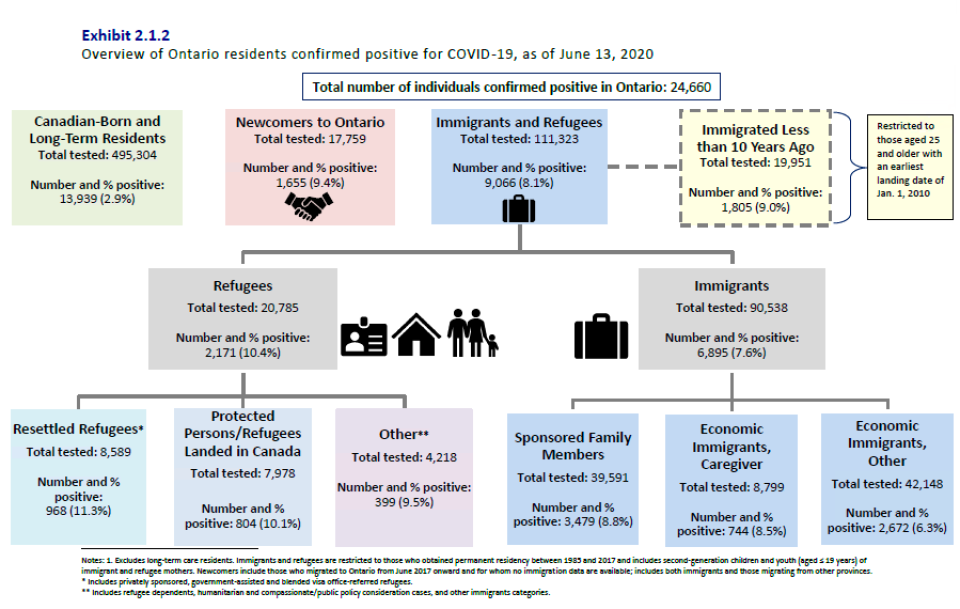
The report released Wednesday by ICES, a not-for-profit research institute focusing on health-related data in Ontario, found that while immigrants and refugees in the province accounted for only about a quarter of those tested for COVID-19 between January and June, they represented 43.5 per cent of all positive cases.

“We document disproportionately higher rates of infection among those who landed in Ontario as economic caregivers, refugees, those with lower levels of education and language fluency, those who currently live in lower income neighbourhoods and with more crowded housing,” Dr. Astrid Guttmann, Chief Science Officer at ICES and lead author on the report, said in a statement.

“Apart from addressing many of (the) root causes of higher risk of infections, very high test positivity in certain groups of immigrants also suggests that there may be important barriers to testing that will be important to address if there is a second wave in Ontario this fall.”

The data was pulled from test results conducted between January 15 and June 13. According to the report, rates of testing were lower for most immigrants and refugees compared with Canadian-born and long-term residents—with an exception for economic caregivers who tend to work in health-care and were prioritized for testing.

The data found that of the 4.4 per cent of Canadian-born and long-term residents tested for COVID-19 in Ontario, 2.9 per cent tested positive.

Of the 3.4 per cent of people who identify as immigrants or refugees who were tested for COVID-19, 8.1 per cent received a positive diagnosis.

Refugees alone had the highest positivity rate within that time period at 10.4 per cent.

Chart

The report also found that while testing positivity peaked at the beginning of April among Canada-born and long-term residents, there were two “pronounced peaks of positivity” for immigrants, refugees and newcomers in April and May respectfully.

“The pandemic has sharpened the focus on structural and societal inequalities that have long existed,” the report reads. “These inequities put many racialized and immigrant populations at higher risk of both contracting the infection and suffering poor outcomes.”

The highest rates of positivity in Canada were found in racialized immigrants and refugees from Central, Western and East Africa, South America, the Caribbean, Southeast Asia and South Asia, the report found. The rates were also higher for those living in low-income neighbourhoods.

Public health units with larger immigrant populations such as Toronto, Peel Region, Durham Region, Waterloo, Windsor and York also reported a high number of COVID-19 positive patients among that demographic.

In Toronto specifically, 4,027 immigrants and refugees have tested positive for COVID-19 (9.8 per cent of those tested) compared to 3,788 Canadian-born patients (4.9 per cent of those tested).

What data was available and what was missing?

The general findings presented in the report are not necessarily new. Advocacy groups have been calling on all levels of government to support the gathering of race and socio-economic data for months, arguing that marginalized communities are disproportionately contracting or dying from COVID-19.

As a result of these calls, the City of Toronto began collecting race-based data in May.

Toronto Public Health said that of the data collected between May 20 and July 16, 83 per cent of known COVID-19 cases involve members of racialized communities.

It also found that patients with a household income level of $50,000 or less represents more than 50 per cent of reported infections in the city, despite the fact that the 2016 census revealed only 30 per cent of Toronto’s population reported being in that income bracket.

The data released by city officials are based on voluntary questions collected by a local public health unit.

Provincially, officials and politicians have all said they support the collection of race and income-based data, but they have yet to provide any information about the trends they are seeing.

In mid-June, the government proposed regulatory changes that would allow those who test positive for COVID-19 to be asked about their race, income, languages spoken and household size.

The questions are optional and the government said personal privacy would be protected. Since then, not much has been said about the data collection.

The ICES report said they were limited in the creation of the report by incomplete immigration data and could only include information on immigrants or refugees who landed in Ontario from January 1985 to May 2017 and who became permanent residents. They also included second-generation immigrant children under the age of 19 who were born in Ontario to permanent residents.

A “newcomer,” a status defined separately from an immigrant or refugee, is described as an individual who became eligible for OHIP after May 31, 2017

The authors also noted that ICES lacked data on “important risk factors for testing and positivity” such as occupation and living conditions.

“We currently do not have comprehensive data on important outcomes such as hospitalization and death,” the report says. “We have data on demographic and some census-based characteristics but not on the critical structural factors that play an important role in shaping inequities.”

ICES was able to access information on the health-care sector. The report found that employment as a health-care worker, especially among women, accounted for a disproportionate number of COVID-19 cases among immigrants and refugees. Among the 36 per cent of women employed as health-care workers and who tested positive in Ontario, 45 per cent were within that demographic.

Inequities ‘are complex’ and often rooted in racism

The report suggests that the “causes of these inequities are complex and often rooted in social and structural inequities, including systemic racism.”

It notes that a large proportion of immigrants, refugees and newcomers to Canada hold temporary or minimum-wage jobs at facilities where physical distancing is difficult. These positions may also not have paid sick leave or other health benefits.

ICES says that employment in any of these sectors— such as occupations in retail, factories or transportation– “is considered precarious” and could impact testing and quarantine.

Other factors such as language barriers, education and accessibility to quality healthcare could impact whether a person gets a COVID-19 test.

The not-for-profit is calling for more accessible testing options ahead of a possible second-wave in the fall as well as better training and enforcement of safety measures for those at risk of COVID-19 exposure in the workplace.

“A continued focus is needed on securing funding to house those who cannot safely quarantine in their homes or are homeless, as well as for income supplements for workers must quarantine who do not have employer-sponsored sick leave,” the report says.

The report also noted that the findings should be interpreted in the context of Ontario’s testing strategy. Initially, local public health units were only testing those in essential workplaces, those who had recently travelled and for those with acute medical conditions. Later that strategy evolved to include long-term care homes, hospitalized patients, and the general population, including asymptomatic patients.

“This means that some groups are over-represented in the testing numbers and that positive cases include those who were symptomatic at the time of testing, as well as those who were asymptomatic,” the report says.

“This may distort some associations of characteristics with both testing rates and potential to test positive. It also means that there is an unknown number of untested infected individuals in the general population.

Source: https://toronto.ctvnews.ca/covid-19-disproportionately-impacted-immigrants-and-refugees-in-ontario-new-report-finds-1.5097363

Why the Coronavirus More Often Strikes Children of Color

Mainly linked to lower socio-economic status:

One of the notable features of the new coronavirus, evident early in the pandemic, was that it largely spared children. Some become severely ill, but deaths have been few, compared to adults.

But people of color have been disproportionately affected by Covid-19, the illness caused by the coronavirus, and recent studies have renewed concern about the susceptibility of children in these communities.

They are infected at higher rates than white children, and hospitalized at rates five to eight times that of white children. Children of color make up the overwhelming majority of those who develop a life-threatening complication called multisystem inflammatory syndrome, or MIS-C.

Of more than 180,000 Americans who have died of Covid-19, fewer than 100 are children, according to the Centers for Disease Control and Prevention. But children of color comprise the majority of those who have died of Covid-19.

The deaths include 41 Hispanic children, 24 Black children, 19 white children, three Asian-American children, three American Indian/Alaska Native children, and two multiracial children.

The unique vulnerabilities of these youngsters are coming to light even as the number of infections in children is rising and schools and parents around the country are grappling with nettlesome decisions about reopening safely.

The susceptibility of minority children to the disease is not unique to the United States. Black children hospitalized in the United Kingdom were more likely than whites to be transferred to critical care and to develop MIS-C, according to a study published last week in the journal BMJ.

“Children don’t exist in a vacuum,” said Dr. Monika K. Goyal, a pediatric emergency medicine specialist at Children’s National Hospital in Washington.

Among 1,000 children tested for Covid-19 at a site in Washington in March and April, nearly half of the Hispanic children and nearly one-third of the Black children were positive for the coronavirus, Dr. Goyal found in a recent study.

‘Racial Inequality May Be As Deadly As COVID-19,’ Analysis Finds

Yet another study, highlighting racial disparities in health:

Even during the COVID-19 pandemic, mortality rates and life expectancy are far better for white Americans than they are for Black people during normal, non-pandemic years, according to an analysis published this weekin the Proceedings of the National Academy of Sciences.

The analysis, which looked at U.S. mortality statistics back to 1900, finds an additional 1 million white Americans would have to die this year in order for their life expectancy to fall to the best-ever levels recorded for Black Americans — back in 2014. That year, the average life expectancy for African Americans was 75.3 years — similar to the average life expectancy for white Americans back in 1989, says study author Elizabeth Wrigley-Field.

“It’s as though Blacks have just missed out on the last three decades of [life expectancy] progress,” says Wrigley-Field, a demographer and infectious disease historian at the Minnesota Population Center at the University of Minnesota.

The findings underscore the pandemic scale of the racial inequalities in mortality in the U.S., she says.

“We don’t know what the ultimate scale of COVID-19 deaths is going to be,” Wrigley-Field says. “But what we can say is that white deaths to COVID would have to increase from what they are right now by a factor of [more than] five to make white death rates this year look like the best that Black death rates have ever been.”

She notes that 2014 was also the year when Black Americans had their lowest age-adjusted death rates on record — 1,061 deaths per 100,000. By comparison, for whites, the age-adjusted mortality rate was 899 per 100,000 in 2017 (the last year with available data). To match the lowestmortality rates on record for Black Americans, more than an additional 400,000 white Americans would have to die this year, her analysis found.

Thus far, COVID-19 has taken a disproportionate toll on Black people and other communities of color. Black Americans have experienced the highest death rates from the pandemic — about 88.4 deaths per 100,000, compared to 40.4 per 100,000 for white Americans, according to data compiled by the APM Research Lab.

But there are also longstanding systemic reasons behind these racial health disparities, notes Dr. Utibe Essien, a health equity researcher with the University of Pittsburgh — factors that include Black Americans’ well-documented disparities in access to quality health care.

African Americans have higher rates of underlying medical conditions, including diabetes, heart disease and lung disease, that are linked to more severe cases of COVID-19. Black people in the U.S. also bear the burden of historic discrimination policies, Essien says, such as redlining policies in housing that limited African Americans’ ability to accumulate wealth through property ownership. And wealth is a significant driver of health, Essien notes.

“I think it’s important to … appreciate that the pandemic didn’t start something new, but that these disparities really, unfortunately, have been seen for decades, if not centuries,” he says.

Indeed, Wrigley-Field says she was inspired to carry out the current analysis after conducting an earlier study on regional mortality rates from infectious disease during the early 20th century. “The thing that we found that stunned us was that white deaths in 1918 during the flu pandemic” — which killed more than a half-million Americans — “were less than what Black deaths had been in every prior year.” A century later, she writes in her paper, “the basic fact endures that Black disadvantage is on the scale of the worst pandemics in modern U.S. history.”

Wrigley-Field says she hopes her analysis will help reframe the discussion in the U.S. about the kinds of policy changes that society can realistically embrace to address health disparities stemming from systemic racism.

“To me, this really changes the question about how we think about, ‘What are we willing to do to stop these deaths?’ ” she says. “Because we know what we’re willing to do to stop deaths from COVID. We’re basically willing to change every aspect of how we live, how we work, how we do our family lives, whether we travel, whether schools are in session. Absolutely everything is on the table. And all of that is controversial, but it’s actually all pretty popular, too. ”

“Meanwhile,” she says, “we have this similar or probably larger scale of deaths happening every year, just to Blacks. But proposals that would try to address that in some way are often very controversial. Most people do not support, for example, reparations. Most people do not support defunding the police, although the opinions about that are changing pretty quickly. … To me, these results, more than anything, just kind of reframe that question about what’s realistic.

“So what are the things that we think are unimaginable that would address racism that we have to similarly say, we have no choice but to do this because the scale of death that’s resulting is unacceptable?”

Source: ‘Racial Inequality May Be As Deadly As COVID-19,’ Analysis Finds

B.C. survey shows racialized people most likely to suffer from effects of COVID-19 pandemic

Confirming patterns elsewhere:

An official survey shows the tumult created in B.C. by the novel coronavirus has hurt racialized people the most, with more than one in five Latin American, West Asian and Black respondents reporting job losses due to the pandemic.

Provincial Health Officer Bonnie Henry said at Thursday’s daily COVID-19 briefing that the results of a recent online survey of 394,000 people confirmed a trend seen in many other places: The virus and the measures taken to slow its growth have disproportionately affected non-white people. The results did not touch on who has been infected, but charted how people of different ethnicities have fared with regards to unemployment, financial stress, and access to health care and food.

“The challenge has not been shared equally,” she said as she revealed the results of the survey done by the BC Centre for Disease Control, a government agency.

The information comes as British Columbia logs an additional 78 confirmed cases of the virus. The numbers have been creeping up all summer, leading to a recent spike that Dr. Henry says is driven by younger people socializing.

The provincial average for losing a job due to the pandemic was 15.5 per cent, according to the survey. Only white respondents reported recent unemployment at below that rate, 14 per cent. People of every other ethnicity reported rates above the provincial average, with the highest affecting Latin American people at 22.6 per cent, West Asian or Arabic people (21.5 per cent), and Black people (21.1 per cent).

That same inequality was seen when respondents were asked about whether they had more money troubles. The provincial average was 32 per cent of respondents saying they had increased financial problems, with 29 per cent of white people reporting these issues.

Neither Dr. Henry nor the provincial health ministry explained why Indigenous respondents were not represented in the survey results released on Thursday.

Japanese, multi-ethnic and Korean respondents were the most likely to report difficulty accessing health care. On the other hand, Latin American, Southeast Asian and Black respondents were the most likely to report feeling more connected to family since the province began its state of emergency in March.

The survey also showed people at the income level of less than $60,000 reported having a harder time meeting their financial needs and putting enough food on the table, and that they were more likely to be out of work.

Among respondents with school-aged children, lower-income households reported more stress on their kids, more barriers to learning and a decreased connection to their friends.

At Thursday’s briefing, Health Minister Adrian Dix and Dr. Henry spent most of their time addressing the increase in cases. Mr. Dix warned anyone ignoring physical distancing at parties this weekend that public-health inspectors will be out enforcing rules at bars and banquet halls.

Since early July, people in their 20s have made up the highest proportion of new cases, according to the Public Health Agency of Canada. From July 29 to Aug. 4, more than 40 per cent of cases nationally for which data were available were reported in people 29 or younger.

In B.C., this group accounts for about 32 per cent of cases since July 1, while people in their 30s make up about 22 per cent. In Alberta, people in their 20s make up the largest proportion of active cases, at 22 per cent, while people in their 30s followed with 19 per cent.

Source: https://www.theglobeandmail.com/canada/british-columbia/article-bc-survey-shows-racialized-people-most-likely-to-suffer-from-effects/

Children Can Get Severe COVID-19, CDC Says — Especially Black And Hispanic Children

Another example of racial disparities. While the study did not include socioeconomic factors, these likely explain part of the differences:

While most children who catch the coronavirus have either no symptoms or mild ones, they are still at risk of developing “severe” symptoms requiring admission to an intensive care unit, the Centers for Disease Control and Prevention said in a new report released Friday.

Hispanic and Black children in particular were much more likely to require hospitalization for COVID-19, with Hispanic children about eight times as likely as white children to be hospitalized, while Black children were five times as likely.

Despite persistent rumors that children are “almost immune” from the virus, the analysis of 576 children hospitalized for the virus across 14 states found that one out of three was admitted to the ICU — similar to the rate among adults. Almost 1 in 5 of those were infants younger than 3 months. The most common symptoms included fever and chills, inability to eat, nausea and vomiting.

The findings come as school districts across the country are figuring out how to educate the nation’s children while still protecting kids, teachers and family members from the ravages of the virus. The American Federation of Teachers has said it considers in-person schooling to be safe only when fewer than 5% of coronavirus tests in an area are positive.

Researchers don’t fully understand why some racial groups are hospitalized at higher rates than others. But the CDC’s findings are consistent with other studies, the authors of the report said, citing a recent analysis from the Baltimore-District of Columbia region that found that Hispanics had more COVID-19 infections than other groups.

“It has been hypothesized that Hispanic adults might be at increased risk for SARS-CoV-2 infection because they are overrepresented in frontline (e.g., essential and direct-service) occupations with decreased opportunities for social distancing, which might also affect children living in those households,” the CDC researchers wrote.

Underlying medical conditions might have contributed to the children’s hospitalization, researchers wrote, noting that Hispanic and Black children are more likely to suffer from conditions like obesity.

If there’s any good news, it’s that even among children hospitalized with severe COVID-19 complications, the fatality rate remains low, researchers said.

A separate study in the journal Pediatrics also found racial and socioeconomic disparities in children and young adults tested for COVID-19 in Washington, D.C. Hispanic children were more than six times as likely as white children to test positive for the virus; Black children were over four times as likely.

Ultimately, the CDC concluded, it’s crucial to continue prevention efforts wherever children gather, specifically citing schools and child care centers.

Source: Children Can Get Severe COVID-19, CDC Says — Especially Black And Hispanic Children