Ottawa planning processing centre for asylum seekers in Quebec near U.S. border

Of note:

Canadian authorities are planning to open a processing centre for asylum seekers near the United States border in Quebec in case there is a sharp rise in the number of would-be refugees entering Canada.

Earlier this week, the federal government published a notice seeking office space it could lease to accommodate reception and meal distribution areas as well as a waiting room for up to 200 people at a time.

In an e-mail, the Canada Border Services Agency says the planned processing centre is part of its contingency plans “in the event of an influx of asylum seekers.”

The notice from Public Services and Procurement Canada says the building must be located within a 15-kilometre radius of the official border crossing area in St-Bernard-de-Lacolle, Que., south of Montreal.

The notice follows Ottawa’s $1.3-billion announcement in December to beef up border security in response to U.S. President Donald Trump’s threats to impose steep tariffs unless Canada reduces the flow of migrants and drugs across the border….

Source: Ottawa planning processing centre for asylum seekers in Quebec near U.S. border

Canada’s immigration department cutting 3,300 jobs, prompting concerns over backlogs and processing times

The federal immigration department will reduce its workforce by more than 20 per cent, sparking concerns over further backlogs and longer processing times for applications.

On Monday, immigration staff were told that 3,300 jobs are going to be eliminated and details would follow in mid-February, according to the Canada Employment and Immigration Union, which represents 35,000 employees at Immigration, Service Canada, Employment and Social Development Canada (ESDC) and the refugee board.

“Immigration processing wait times continued to reach record-breaking backlog levels, and these cuts will only worsen an already dire situation,” Rubina Boucher, the union’s national president, said in a statement.

“Families longing to reunite, businesses grappling with critical labour shortages and a health-care system desperate for skilled workers will all suffer the consequences of this reckless decision.”

The news of the layoffs followed the Liberal government’s plan to reduce the number of new permanent and temporary residents admitted to Canada in the coming three years in its attempt to slow down the country’s population growth amid the affordability crisis.

It also came in the wake of the department’s recent decisions to significantly cut funding to organizations that assist newcomers with settlement and integration through employment-related services, language training and community support.

Between 2020 and 2023, the Immigration Department’s workforce grew from 9,207 to 13,685 — about 30 per cent of whom were contract, “casual” and students — to beef up its operational capacity to deal with backlogs created during the pandemic and meet the federal government’s then targets to raise immigration levels.

As of late November, the department had 2,267,700 permanent and temporary immigration applications in the system; more than one million of them had exceeded its own targeted processing times. Overall, 38 per cent of permanent residence applications and 54 per cent of temporary residence applications in the queue were considered backlogged.

While it’s too early to know if this would simply mean a diversion of staff to other areas of government operations such as the asylum system, Toronto immigration lawyer Rick Lamanna of the Fragomen law firm said immigration applicants to Canada should expect some processing delays moving forward. 

Source: Canada’s immigration department cutting 3,300 jobs, prompting concerns over backlogs and processing times


Thousands of caregivers’ status at risk as immigration programs stall 

Another example of poor management:

Thousands of caregivers from overseas may need to leave the country or risk staying here illegally as Ottawa delays the rollout of a new pathway to permanent residency for nannies and home support workers.

Since 2019, the Home Child Care Provider and the Home Support Worker pilot programs have brought caregivers and support workers to Canada from overseas on temporary work permits, allowing them the ability to apply for permanent residency.

But those programs ended in June, when the federal government announced it would introduce new pilot programs that have yet to be launched.

In a statement to The Globe and Mail, Immigration, Refugees and Citizenship Canada said the department needed time to reduce the number of existing permanent residence applications through the old pilot programs before launching the new ones. The statement from early December also said that full eligibility criteria and details on how to apply for the programs will be available in the “coming months.”…

Source: Thousands of caregivers’ status at risk as immigration programs stall 


Biden-Harris Administration Approving Citizenship Applications at Fastest Rate in a Decade

Legitimate priority to ensure more timely processing of citizenship applications beyond the politics of doing so. In Canada, both liberal and conservative governments have done the same. Should be viewed positively in terms of government service delivery:

According to the Los Angeles Times, once in office, the Biden-Harris Administration immediately took steps to prioritize naturalization applications. U.S. Citizenship and Immigration Services (USCIS) hired more staff for processing applications, made it easier for immigrants to apply for free, and expanded its public relations efforts surrounding the naturalization process to reduce the flood of applications around election years.

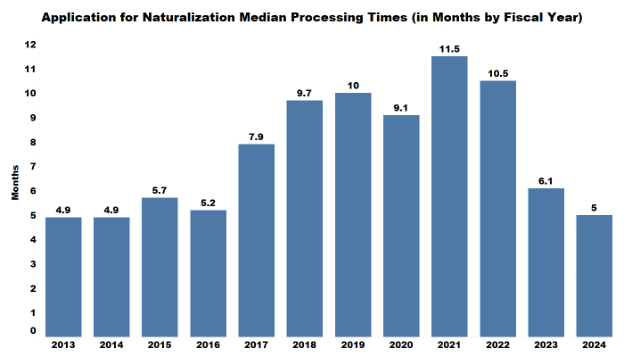
These efforts reduced the time it takes to process naturalization applications to an average of 5 months in FY 2024—half the processing time in FY 2021, its fastest rate in a decade. Processing times increased during the Trump Administration due to a surge in citizenship applications and slowed even more during the Covid-19 pandemic. With the changes made by the Biden-Harris Administration, however, processing times have returned to their lowest level in a decade.

The Biden-Harris Administration denies that the rush to approve citizenship applications is politically motivated. When asked about the rapid approvals of citizenship applications, a spokesman for the Department of Homeland Security said, the Department “does not take actions based on electoral politics or upcoming elections. Period.”

However, a recent poll of new citizens conducted by a coalition of open-borders groups showed that new citizens disproportionately identify as Democrats (43.3. percent) rather than Republicans (30.4 percent). The same poll found that a greater share of newly naturalized citizens would vote for Vice President Kamala Harris (53.6 percent) over former President Donald Trump (38.3 percent). The remaining 8 percent said they would vote for another candidate or not vote at all.

Indeed, 3.5 million new voters have the potential to change the outcome in elections, especially if they live in swing states. In 2020, President Biden won Arizona by about 10,457 votes and Georgia by 12,670 votes. He won Wisconsin by 20,682 votes and Nevada by 33,596 votes. In 2016, former President Trump won Michigan by 10,704 votes and Wisconsin by 22,748 votes. Trump won Pennsylvania by 44,280 votes and Arizona by 91,234 votes.

Last year (FY 2023) USCIS data show that a large number of naturalizations took place in California, New York, Texas, Florida, and New York. But naturalizations occur across the country on a regular basis, and USCIS is now approving citizenship applications at about the rate of 2,500 per day. It seems Americans will just have to wait until November 6 to see what impact this wave of new citizens has had on the election.

Source: Biden-Harris Administration Approving Citizenship Applications at Fastest Rate in a Decade

These international students are still waiting for study permits from Canada with just two weeks before classes begin

Not great:

…Following changes announced by the federal government in January to rein in the number of international students, there has been an overall increase in student visa backlogs and processing times due to the confusion over how study permit quotas would be allocated and the lack of infrastructure for provinces to issue the newly required attestation letter for applicants. 

The wait times to get a decision for international applicants shot up from nine weeks in January to a peak of 15 weeks in May; processing times for those applying from inside Canada went from four weeks to 14 weeks in June and now 11 weeks, according to data from ApplyBoard, an online marketplace for learning institutions and international students.

The Immigration Department has stopped publishing the overall outside Canada wait times in favour of providing the information based on the country where an application is processed. Currently, the estimated processing time for China is eight weeks….

Source: These international students are still waiting for study permits from Canada with just two weeks before classes begin

U.S. speeding up asylum claim processing along the Canadian border

Of note, an area that Canada has to improve upon:

The U.S. government is moving to speed up asylum claim processing at its northern border in an attempt to deter migrants from illegally crossing over from Canada.

Washington is making two changes that fall under the Safe Third Country Agreement (STCA), which calls for asylum seekers to apply for refugee status in the first of two countries they enter.

First, migrants looking to prove that they’re exempt from the STCA will have to provide their documents to U.S. border officials at the time of their screening. Migrants previously were allowed to postpone screenings to gather necessary documentation.

Second, migrants will only have four hours — down from 24 hours — to consult a lawyer prior to their screening.

CBS News first reported on the changes. The U.S. Department of Homeland Security (DHS) confirmed the changes to CBC News.

“DHS carefully reviewed its implementation of the Safe Third Country Agreement with Canada and concluded that it could streamline that process at the border without impacting noncitizens’ ability to have access to a full and fair procedure for determining a claim to asylum or equivalent temporary protection,” the department said in a media statement.

The U.S. has seen a sharp increase in illegal crossings into the country from Canada in the past few years.

Border agents have taken 12,612 migrants who crossed the U.S.-Canada border illegally into custody in the first six months of 2024, according to U.S. Customs and Border Protection. That’s up from 12,218 in all of 2023 and is more than the number that were taken into custody in 2021 and 2022 combined.

Earlier this year, Ottawa reimposed some visa requirements on Mexican nationals visiting Canada, in part to answer a request from Washington to help stem illegal border crossings into the U.S. The number of Mexican migrants attempting to cross into the U.S. from Canada has since dropped.

In 2023, Prime Minister Justin Trudeau and U.S. President Joe Biden announced that they were making changes to the STCA by expanding its application to the entire Canada-United States border, rather than just official points of entry.

Source: U.S. speeding up asylum claim processing along the Canadian border

Immigrants Are Becoming U.S. Citizens at Fastest Clips in Years

Not surprising, post Trump administration and prior to the 2024 elections. 5 month average processing time is impressive. While I don’t have the average number of months for Canadian citizenship, 71 percent of all applications in 2023 were processed in one year (below the target of 80 percent):

The federal government is processing citizenship requests at the fastest clip in a decade, moving rapidly through a backlog that built up during the Trump administration and the coronavirus pandemic.

At ceremonies in courthouses, convention centers and sports arenas across the country, thousands of immigrants are becoming new Americans every week — and becoming eligible to vote in time for the presidential election this fall.

It’s unclear how many of the new voters live in battleground states, but a number of the states where Kamala Harris or Donald Trump must win have large and growing numbers of voting-age naturalized citizens, including Georgia, Arizona, Nevada and Pennsylvania.

In Savannah, Ga., people from 19 countries streamed into a federal courthouse recently to take the oath of allegiance.

“My case was done in less than six months,” said Gladis Brown, who is married to an American and emigrated from Honduras in 2018.

Generally, lawful permanent residents, known as green-card holders, are eligible to become naturalized citizens if they have had that status for at least five years, or have been married to a U.S. citizen for at least three years.

Green-card holders have many of the same rights as citizens. But voting in federal elections is a right accorded only to citizens. And that can be a powerful motivation to pursue citizenship, especially when big national elections are on the horizon.

“I’m so glad that the process moved quickly,” said Ms. Brown, who was one of the 31 immigrants being sworn in. “People like me want to vote in the election.”

After the ceremony, Ms. Brown celebrated with cake and punch from a local women’s volunteer group — and by completing a voter-registration form provided by a representative of the League of Women Voters.

Naturalization applications typically spike upward in the approach to an election.

“The surge in naturalization efficiency isn’t just about clearing backlogs; it’s potentially reshaping the electorate, merely months before a pivotal election,” said Xiao Wang, chief executive of Boundless, a company that uses government data to analyze immigration trends and that offers services to immigrants who seek professional help in navigating the application process.

“Every citizenship application could be a vote that decides Senate seats or even the presidency,” Mr. Wang said.

At under five months, application processing speed is now on a par with 2013 and 2014. About 3.3 million immigrants have become citizens during President Biden’s time in office, with less than two months to go before the close of the 2024 fiscal year.

The U.S. Citizenship and Immigration Services took 4.9 months, on average, to process naturalization applications in the first nine months of the current fiscal year, compared with 11.5 months in fiscal 2021.

After taking office in 2021, Mr. Biden issued an executive order that sought to dial back his predecessor’s hard-line immigration agenda and “restore faith” in the legal immigration system. Among other steps, the order called for action to “substantially reduce current naturalization processing times” with the goal of strengthening integration of new Americans.

Unlike many federal agencies, the citizenship agency is funded mainly by fees paid by applicants, rather than by congressional appropriations, giving the administration latitude to define its priorities and the allocation of resources.

The Biden administration began deploying new technology and additional staff in 2022 to reduce the pending caseload of citizenship applications, which had ballooned because of heightened scrutiny by the Trump administration and protracted pandemic-related delays in conducting the swearing-in ceremonies.

The Biden administration also shortened the naturalization application to 14 pages from 20. It raised the application fee in April to $710 from $640, but made it easier for low-income people to qualify for a discount.

While there has long been partisan disagreement over how to tackle illegal immigration and overhaul the nation’s immigration laws, naturalizing lawful residents had broad bipartisan support. As president, George W. Bush signed an executive order in 2002 expediting naturalization for noncitizens serving in the military. Since he left office, he has hosted oath ceremonies at his institute in Dallas.

But citizenship has become more politicized in recent years.

Intent on curbing legal immigration, the Trump administration conducted lengthier reviews of naturalization applications. The processing time roughly doubled to about 10 months during Mr. Trump’s tenure.

The bottleneck prevented some 300,000 prospective citizens from naturalizing in time to vote in the 2020 election, according to estimates by Boundless.

It is a crime for noncitizens, including legal permanent residents, to attempt to vote in federal elections. Some Republicans, including former President Trump and Representative Marjorie Taylor Greene of Georgia, have spread unfounded narratives about undocumented immigrants being encouraged to vote by Democrats….

Source: Immigrants Are Becoming U.S. Citizens at Fastest Clips in Years

Canada to stop processing study permits for colleges, universities that fail to track international students

The federal government having to take on a role the provinces should be doing given in their jurisdiction :

The federal government plans to suspend processing of study permits from post-secondary students if the schools fail to keep track of international students’ enrolment. 

The proposed regulations would compel colleges and universities to report to the federal Immigration Department whether a student is attending school and complying with all study permit requirements.

The move is part of recent attempts to restore confidence in Canada’s international student program.

Under the plan unveiled in the Canada Gazette, students must also apply for a new study permit whenever they want to switch schools, and before the start date of the new study program.

In flexing its muscle to ensure compliance, the federal government is treading a fine line, as governance of the education system falls under provincial jurisdiction.

The Immigration Department is responsible for the entry of international students, establishing the conditions that study permit holders must meet while in Canada, and deciding whether a study permit should be issued.

Although Ottawa only grants study permits to “designated learning institutions,” it’s the provinces that designate if a college or university is authorized to admit international students.

As a result, federal officials have had a tough time monitoring what goes on after a student enters Canada. They don’t know if a student is enrolled in the school named in their study permits or if they are actually studying until they need to extend a permit or apply for postgraduation work permits….

Source: Canada to stop processing study permits for colleges, universities that fail to track international students

La bouée de sauvetage des travailleurs temporaires coule

Of note, regarding open work permits for Temporary Foreign Workers:

De Vancouver à Gaspé, des personnes immigrantes attendent durant des mois la réponse à leur demande de permis ouvert pour travailleurs vulnérables afin de fuir les abus qu’elles subissent. Un programme d’urgence censé offrir cette protection rapidement est bloqué, selon cinq organisations qui accompagnent les travailleurs dans de telles démarches.

Une forme de soupape pour remédier aux risques du permis lié à un seul employeur, appelé « permis fermé », le programme a été lancé en 2019 avec la promesse de traiter les demandes en cinq jours. Ce délai est d’autant plus problématique que les responsables politiques l’utilisent pour se défendre des critiques, notamment formulées par le rapporteur spécial des Nations unies sur les formes contemporaines d’esclavage.

Mais cette manière « rapide » de « régler la situation des employés vulnérables », comme l’a décrite le ministre de l’Immigration, Marc Miller, en commission parlementaire, est en panne. Sur la soixantaine de demandes que ces organisations ont soumises depuis janvier dernier, seulement cinq ont été traitées, ont-elles confirmé au Devoir. 

Sur les 1349 demandes reçues pour les trois premiers mois de l’année 2024, Réfugiés et Citoyenneté Canada (IRCC) n’a délivré que 201 permis jusqu’à maintenant, soit nettement sous la moyenne de l’an dernier. Une trentaine de permis seulement ont été octroyés en mars. La page Web du programme a été modifiée en catimini depuis novembre 2023.

Ces réponses qui arrivent au compte-gouttes créent une « situation intenable » et « énormément de pression » sur les immigrants, dit Noémie Beauvais, organisatrice communautaire au Centre des travailleuses et travailleurs immigrants (CTI).

« Quelqu’un m’appelle en détresse quasiment chaque jour », illustre Florian Freuchet, organisateur communautaire au CTI du Bas-Saint-Laurent…

Source: La bouée de sauvetage des travailleurs temporaires coule

New Zealand: Despite automation, citizenship applications taking longer

Canada not the only country to have processing and service standards challenges, along with effective implementation of automation:

The average time it takes to become a citizen is continuing to rise.

But Internal Affairs (DIA) said it had brought down a backlog of applications by 10,000, with 26,483 applications on hand this week, compared to 36,417 at the same time last year.

Average wait times for residents applying to become citizens have risen to 188 days, up from 27 days in 2017.

Decisions are quicker for applications where many decisions can be made via automated checks, DIA said in a statement.

“Our teams have been working hard to reduce the decision timeframes on citizenship applications,” said DIA general manager of services and access Julia Wootton.

“During 2022, we completely caught up on pending decisions for applications which could be assessed with the maximum number of automated checks. These types of applications are now being decided on within one to three months.

“The remaining applications we are working through require more intervention, but we are working to increase the number of these applications that can be processed with automated checks.”

The longest applications now take more than two years, compared to almost four years in 2016, when people had to make an appointment to see a citizenship officer. Some took longer because of automated checks failing or information being sourced from overseas, she said.

“Reducing the decision timeframes on citizenship applications continues to be a priority for us, and we’ve been able to do that by establishing automatic checks when possible. We are taking several other measures to further reduce decision timeframes, including more training, investing in technology changes to speed things up, and recruiting more staff.

“Based on current trends and the additional measures detailed above, we expect to continue to reduce average wait times and the number of applications awaiting allocation.”

Source: Despite automation, citizenship applications taking longer