With civil service shakeup, Trudeau brings youth, diversity to top jobs

Election 2015 and Beyond- Implementation Diversity and Inclusion.001Simon Doyle on changes to Deputy ranks but more anecdotal than evidence-based.

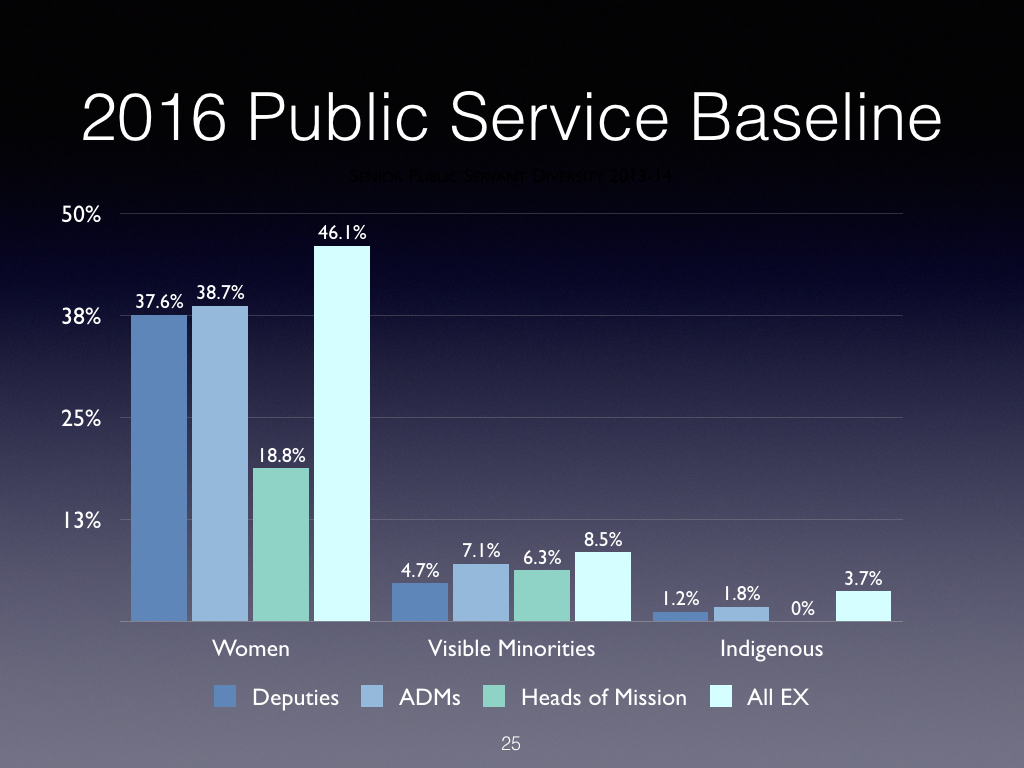
My count of the 19 Deputy appointments to date by PM Trudeau: 10 men, 9 women, 1 visible minority, no Indigenous people. Gender parity but weak visible minority and Indigenous peoples representation, reflecting in part weaknesses in ADM diversity as shown in the above chart:

Retirements of Ottawa’s highest-ranked bureaucrats have accelerated under the Justin Trudeau government as the Liberals shuffle the leadership of the public service after years of management under Stephen Harper.

The government has made a series of moves with its highest-ranked bureaucrats since coming into office last fall, most recently promoting senior officials who had worked on the Environment and Foreign Affairs portfolios.

…..David Zussman, a former senior government official and a professor of public-sector management at the University of Ottawa, said the number of appointments are high, with more than 20 changes in the senior ranks of the public service since late December, including retirements.

“I’m sure word would have gone out that: ‘We’re in a process of renewal, and any of you guys thinking of leaving, do me a favour and tell me now,’ ” Dr. Zussman said.

“A lot of them are really long-standing public servants who I think hung around for the election to help out [former clerk] Janice Charette, and now, six months into it, they decided to trigger their retirements. They’ve all got their 35 years,” he said, indicating they can collect pensions.

…“Some ministers may want a new deputy, and it’s their prerogative to say they would like someone new. The clerk may decide that he feels someone should move, or sometimes deputies will go and say they would like to move,” said C. Scott Clark, former deputy minister of finance and a senior adviser to the prime minister under the Jean Chrétien government.

“It takes time for a minister and a deputy to form what I would call a good relationship, a professional, working relationship. Sometimes they do, sometimes they don’t,” Mr. Clark said.

…The new deputies also reflect efforts by Mr. Trudeau and the clerk to renew the public service and, as with the makeup of the Prime Minister’s cabinet, introduce some youth and diversity into the government’s leadership.

“He’s been very clear about the importance he attaches to having a professional, non-partisan, responsive, agile, creative public service,” Mr. Wernick told The Globe and Mail in an interview earlier this year. “It’s the only way he’s going to accomplish the goals he put in front of Canadians.”

One senior government official said Mr. Trudeau, in late January, made a rare appearance at the Deputy Ministers’ Breakfast, a gathering of all the public service’s most senior mandarins who meet in Langevin Block. Prime ministers typically address the breakfast once or twice per year.

While it’s unclear what was said, the PM has been emphasizing with senior officials a program for getting results and revitalizing the public service. Mr. Trudeau attended the meeting shortly after he appointed Mr. Wernick as Clerk.

….Mr. Scott expects more changes in the fall after the government takes the summer to regroup. “I would expect there will probably be more moves coming,” he said. As Mr. Wernick said in a recent letter to the PM: “It is clear to me that we are entering a period of dramatic generational change in the Public Service.”

Source: With civil service shakeup, Trudeau brings youth, diversity to top jobs – The Globe and Mail

Komagatu Maru Apology

This has been a long-standing issue for many in the Indo-Canadian community, particularly Sikh Canadians. Reading the announcement, reminded me of the previous attempt by former Prime Minister Harper to do so at an Indo-Canadian community picnic on 3 August 2008.

It was a “drive-by” apology, to use my irreverent words, given that the PM and his party had to beat a hasty retreat after one activist seizing the mike and denouncing the fact that it was not delivered in Parliament. See Harper apologizes in B.C. for 1914 Komagata Maru incident, CBC, 3 August 2008.

My takeaway from that incident (I was present) was that any apology, if made, should be done in the House of Commons (as was the case for Japanese wartime internment, the Chinese head tax and residential school abuse). Any other approach made the community being apologized to feel second-rate, as was the case with Italian Canadian wartime restrictions (former PM Mulroney delivered an apology at a dinner) or the above case of the Komagata Maru).

So while there will be predictable debate about whether an apology is warranted, the House is the appropriate forum.

An Indo-Canadian friend of mine reminded me that neither the Government of India or Britain have ever apologized for opening fire on the ship and killing passengers.

Will be interesting to see if Italian Canadians continue to press for a formal House apology.

Text of the PM press release:

The Prime Minister, Justin Trudeau, today announced that on May 18, 2016, he will make a formal apology in the House of Commons for the Komagata Maru incident.

This year will mark the 102nd anniversary of the Komagata Maru incident, where 376 passengers of mostly Sikh descent arrived in Vancouver and were refused entry into Canada due to the discriminatory laws of the time.

The Prime Minister made the announcement at Vaisakhi on the Hill concluding a three day religious ceremony, where Sikh scriptures were read continuously to commemorate Vaisakhi.

Quotes

“As a nation, we should never forget the prejudice suffered by the Sikh community at the hands of the Canadian government of the day.  We should not – and we will not.”
– Rt. Hon. Justin Trudeau, Prime Minister of Canada

“An apology made in the House of Commons will not erase the pain and suffering of those who lived through that shameful experience.  But an apology is not only the appropriate action to take, it’s the right action to take, and the House is the appropriate place for it to happen.”
– Rt. Hon. Justin Trudeau, Prime Minister of Canada

And the full remarks of the PM at the Vaisakhi ceremony on the Hill:

This year will mark the 102nd anniversary of the Komagata Maru incident where 376 passengers of mostly Sikh descent arrived in Vancouver and were refused entry to Canada due to the discriminatory laws of the time. The passengers of the Komagata Maru like millions of immigrants to Canada since were seeking refuge and better lives for their families. With so much to contribute to their new home, they chose Canada and we failed them utterly. As a nation, we should never forget the prejudice suffered by the Sikh community at the hands of the Canadian government of the day. We should not and we will not. That is why next month, on May 18, I will stand in the House of Commons and offer a full apology for the Komagata Maru incident.

An apology made in the House of Commons will not erase the pain and suffering of those who lives through that shameful experience, but an apology is not only the appropriate action to take, it’s the right action to take and the House is the appropriate place for it to happen. It was in the House of Commons that the laws that prevented the passengers from disembarking were first passed and so it’s fitting that the government should apologize there on behalf of all Canadians. It’s what the victims of the Komagata Maru incident deserve and we owe them nothing less.

Just as we look back and acknowledge where we’re failed, so too do we need to celebrate the remarkable success of the Sikh community here in Canada and Vaisakhi is the perfect opportunity to do just that. April is a special month, not only for Sikhs but for all Canadians. It marks the anniversary of the adoption of the Charter of rights and freedoms which ensures that no Canadian needs to make the choice between their religion and activities in their day-to-day lives. The charter ensures that the five Ks are protected. As Canadian Sikhs gather with their loved ones to mark the creation of the Khalsa, it’s a chance to reflect on shared values and celebrate the successes of the past year.

What Justin Trudeau said today about the Komagata Maru incident

Wells: Justin Trudeau takes Ottawa’s debates to Washington

Interesting snippet from Paul Wells’ account of Trudeau in Washington:

The other striking moment came when Trudeau raised, by himself, his decision to repeal the provisions in the Conservatives’ “Strengthening Canadian Citizenship Act,” C-24, that stripped some convicted terrorists of their Canadian citizenships.

“One of the things the right-wing had done was put forward a bill that took away the citizenship of convicted terrorists,” he said. “A number of countries have done that around the world. It seems like a fairly obvious thing to try and do. If someone’s gonna commit an act of war, an act of terrorism against the country, they probably shouldn’t deserve to keep Canadian citizenship if they’re doing that.”

This is indeed a decent paraphrase of the arguments Conservatives made in support of C-24. Trudeau said his opponents “felt they were on very, very safe ground” with their policy.

“The problem is, as you scratch into that a little deeper, you realize it only really applies to citizens who have, or could have, a dual nationality. So a kid who was born in Canada, and only has a Canadian citizenship — but whose parents were born, for example, in Pakistan — could lose his citizenship if he committed an act of terror, [whereas] a kid who was tenth-generation Canadian home-grown terrorist could never lose his citizenship. And suddenly we’d made citizenship conditional on good behaviour. Or on non-heinous behaviour, which comes down to the same thing. And that devalues the citizenship — made two classes of citizen.”

Trudeau’s tone suggested he knew this was not, on the face of it, a winning issue for him. “And it came to the point where, in one of our largest debates, I was standing on stage against the former prime minister. And he was telling people that I was willing to stand up and restore the citizenship of the one Canadian who, under this law, had had his citizenship taken away.

“He knew he had me on that one. I’m actually standing there defending the right of a Canadian — stripped of his citizenship for terrorism — to become, once again, a Canadian citizen. And I stood there, and I defended that principle, that you should not be able to take away citizenship from anyone. And our government would be, because we’d reverse that law, restoring the citizenship of someone who was convicted of terrorism in Canada.

“And that’s a perfect narrative for the politics of fear and aggression. And yet it’s me sitting here as Prime Minister of Canada, not Stephen Harper.”

Source: Macleans

Trudeau on Trump: Not ‘smug’, Mr. Kenney — just sensibly alarmed: Kheiriddin

Tasha Kheiriddin on Trudeau’s comments and Jason Kenney’s reaction:

Some criticized Trudeau’s remarks as ungracious. “Regrettably smug comment by PM Trudeau,” sniffed Jason Kenney on Twitter, “re our American friends, who help to defend Canada & our interests globally.” The American Spectator’s Aaron Goldstein called Justin Trudeau “smug and condescending just like Obama.”

But Trudeau wasn’t being smug. He was speaking truth to power, or power-in-waiting — at a time when many in the U.S. would do well to listen. Like his father, Trudeau pointed out something about Americans that Americans are seldom going to notice themselves — that they are all too often oblivious of the interests and experiences of the people with whom they share the planet. The elephant won’t crush the mouse out of malice — but he might do it out of ignorance.

In Trump’s case, the ignorance is wilful — even celebrated by those who profess it. Anti-elitism has combined with racism to fuel Trump’s rise. Malicious verbal — or physical — attacks are visited on those who disagree with him. The ends aren’t justifying the means this time, because the ends have nothing to do with protecting American values or interests. They’re all about Donald Trump — what he wants, the lies he’s willing to tell to get what he wants.

Trump’s campaign carries all the hallmarks of tyranny — towards other nations, towards the American people themselves. And it won’t help Americans defend themselves … or us.

Trudeau on Trump: Not ‘smug’, Mr. Kenney — just sensibly alarmed

Justin Trudeau says next GG will ‘reflect the diversity of Canada’

Clear message and consistent with record so far:

In a Friday announcement in Toronto, Prime Minister Justin Trudeau hinted at the nature of the coming change-up in the governor general’s office.

Trudeau said the next appointment would express Canada’s diversity and referenced the answer he gave last November when he was asked why he created a cabinet with equal number of men and women.

“I suspect I might be saying ‘because it’s 2017’ when the time for that decision [on the Governor General] comes around to be explained,” he said.

“I can reassure you, I will take into account the nature of Canada and the desire of Canadians to see institutions and appointments across the government that reflect the diversity of Canada,” said Trudeau.

“We appoint people who look like Canada, who understand the extraordinary diversity of Canada and highlight the amazing fact that Canada is one of the few (places) in the world that is made stronger because of its differences.”

Trudeau commended current Gov. Gen. David Johnston on the work he’s done to represent Canada, push innovation and work on youth issues.

“He’s doing an exceptional job and I’m proud to have him as our Governor General,” said Trudeau, noting that he’ll have big shoes to fill when the time comes.

Source: Justin Trudeau says next GG will ‘reflect the diversity of Canada’ – Politics – CBC News

Canadians ask Trudeau the tough questions – and some answers don’t come easy

Greater transparency and honesty in responses than we have come to expect:

But if this government is about openness and transparency it must continue to demonstrate that by taking risks like this one. And that sometimes means being confronted by the harsh reality that answers aren’t always possible and that solutions to problems will be difficult and sometimes take an awfully long time.

The prime minister sat face to face with a woman named Nikki, who wanted assurances her indigenous daughter would be safe growing up and that her life was valued. She was emotional. Trudeau spoke bluntly: “Indigenous lives matter. That you even have to say that is, you know, frustrating to me. And then you demonstrate it.”

It’s the demonstrating part that Trudeau acknowledged will be the most challenging. Some of what his government has promised for indigenous peoples, he said, will take “years and even decades.”

That is not surprising, but it is risky to admit this truth so publicly — that “real change” on many issues likely won’t happen as quickly as most people would like or even need.

Some change must happen more immediately for strict economic reasons.

At least, that’s what Danny, the oilsands worker from Alberta, demonstrated. He wanted to know the government’s plan to save the oil fields and keep everyone working.

There again, the prime minister admitted not everyone would still have a job at the end of the day — or, at least, not a particularly high-paying one.

Danny asked Trudeau what he should do and the prime minister told him to keep working hard. And he hinted later that measures will be in the budget to help people like Danny and other regions struggling with the low price of oil.

By the end of the exercise, a town hall with a twist, Trudeau seemed to have won over many of the chosen Canadians, who he admitted had been “tough” and “challenging” with him.

He shook their hands, and you could hear them off mic thanking him and wishing him luck.

It is a large part of this government’s gamble: not just the openness, but the listening. The bet that by hearing people out, you can also convince them to come along with you, or stick with you, or have faith in you.

But as Jenna, the first to get 10 minutes with Trudeau, told him so honestly, “Forgive me if we’re a little bit skeptical …”

Source: Canadians ask Trudeau the tough questions – and some answers don’t come easy – Politics – CBC News

And of particular interest:

Prime Minister Justin Trudeau says a change in culture is needed within Canadian police forces to ensure indigenous people are treated the same as everyone else.

Trudeau told a CBC forum Sunday night that a “pervasive culture” in police forces, governments and religious communities has led to indigenous people being less valued.

He said that culture must be changed and he predicted the push for change will come from the Canadian people.

Canada, the country that nationalism side-swiped: Salutin | Toronto Star

Salutin on the perverse, counter-intuitive nature of Canadian nationalism:

Here’s where it starts to get paradoxical. Stephen Harper, during his reign, tried to become the voice of Canadian nationalism in the traditional, exclusivist sense. He promoted militarism, including symbols like the Highway of Heroes, and shopworn imperial imagery like the Royal Family. He promoted undercurrents of xenophobia, nativism and racism in his policies toward immigrants and especially refugees, who were despicably treated. These became overcurrents during the election, with his attacks on Muslim headgear, the “barbaric cultural practices” snitch line and revocable citizenship.

What’s fascinating is that Justin Trudeau didn’t oppose him by declaring he was anti-nationalist, as you’d have to in, say, Serbia or Hungary. He fought back as a Canadian nationalist, defining it in terms of tolerance or even, the glory of diversity — a sharp rebuttal to most contemporary nationalism. It also had weird echoes. Justin’s dad, Pierre, rejected Quebec nationalism as parochial but embraced Canadian nationalism as a way to fight it. When he ran against Tory leader Joe Clark in 1979, Trudeau père scorned Clark’s notion that Canada was just a “community of communities,” for being wishy-washy and contentless.

Yet that’s essentially what his son endorsed. Now picture Harper: beaten not only by the son of his most reviled Canadian predecessor; but by the son’s embrace of the vision of Harper’s most loathed Conservative antecedent, Joe Clark. It’s beyond Shakespearean. Who says we don’t have a colourful history?

If we’d been more successful in creating a robust, conventional Canadian nationalism, who knows — the country mightn’t have as handily beaten back the nasty nativism cultivated by Harper. It could have provided unintended grist for his mill. So the real strength of Canadian nationalism might turn out to be its relative weakness. We’re the land that nationalism side-swiped. Lucky us.

In his book, Benedict Anderson quoted Walter Benjamin’s passage on the angel of history — based on a Paul Klee print. The angel stands looking backward sadly as history’s failures and disasters pile up at his feet. So, as history’s wind blows him into the future, he can’t see, behind him, the progress that may be about to arrive. You could call it, back to the future, in a literal sense.

Justin Trudeau Urged By Advisers To Be Innovative In Era Of Big Change

Not easy challenges:

Justin Trudeau’s advisers are warning that the federal government needs to do a better job of connecting with Canadians — especially online — in order to keep pace with ever-evolving public expectations.

The new landscape is being shaped by policy complexity, rapid technological change, limited finances and increasing demands for citizen involvement, say internal briefing memos prepared for the prime minister.

More and more, people expect the government to include them early and often in the design of policy and programming choices that affect them, say the notes, obtained by The Canadian Press under the Access to Information Act.
“There is a gap in Canada between how citizens communicate with each other and with private sector service providers (e.g. banks) and their experience with the federal government,” says one memo.

In order to remain relevant to Canadians, the government needs to focus on delivering high-quality, factual digital content.

However, government is often bogged down by red tape, the need for signoffs from various layers of management and barriers to effectively spending money and assigning people to tasks, the notes say.

The memos point out other problems and hurdles:

  • the access-to-information system that allows people to make formal requests for government files is “time-consuming and expensive to administer”;
  • Canadians are “broadly concerned and uncertain” of how the government uses their personal information, whether it be for law enforcement, national security or other purposes;
  • the government is grappling with cyberthreats to its information holdings from so-called ‘hacktivists,’ criminals and others.

The notes suggest updating the outmoded 2006 federal communications policy to reflect the “voracious demand” from Canadians for online information and the rising use of mobile devices.

Information published on the prime minister’s website and social media accounts must be factually accurate and non-partisan — tenets that should be enshrined in a new communications policy, the advisers say.

Government advertising is seen to be “partisan in nature” at times, another shortcoming that must be addressed in the revised policy, the notes stress.

The Conservative government was pilloried by critics for lavish multimillion-dollar ad campaigns that seemed to convey little useful information.

The Privy Council Office is already working with Treasury Board officials to ensure potential amendments to the policy include “clear accountabilities for non-partisanship” when it comes to ads.

Source: Justin Trudeau Urged By Advisers To Be Innovative In Era Of Big Change

Improving public access to information will make government better, Trudeau says

Something to watch:

During the election campaign, the Liberals said government data and information should be open by default, in formats that are modern and easy to use.

Trudeau has asked Treasury Board President Scott Brison to work with Justice Minister Jody Wilson-Raybould on a review of the access law to ensure the information commissioner is empowered to order government files to be released — something she cannot do now.

He also wants Canadians to have easier access to their own personal information and says the law should be extended to ministerial offices — including his own — as well as to the administrative institutions that support Parliament and the courts.

In addition, Trudeau has directed Brison to accelerate and expand open-data initiatives and make government data available digitally.

In the interview, the prime minister made it clear he was not wedded to those changes alone.

“Access to information is about better governance, and it’s about ensuring that the decisions we take are thoroughly justifiable on a broad level,” he said. “And that’s not always easy, but it is certainly what’s going to lead to better outcomes.”

In a broad sense, the federal government must dispense with the notion that secrecy is necessary for decision-making behind the doors of cabinet, caucus and the bureaucracy, said Sean Holman, an assistant professor of journalism at Mount Royal University in Calgary.

“That’s really the test of openness for any kind of access-to-information reform in this country.”

Certain classes of records, such as audits and ministerial calendars, should be released as a matter of course so “we get used to the idea that government should be operating in the sunlight, not in these darkened, private spaces,” he said.

Legault tabled a report earlier this year recommending dozens of changes to the access law — the latest in a long line of calls for reform. She welcomes the prospect of a federal review, but hopes it happens “in a timely manner.”

Holman said history suggests the Trudeau government’s planned study will lead nowhere.

“The fact that this isn’t something the government appears to be doing immediately is concerning in and of itself,” he said.

“The longer governments stay in power the more seductive secrecy becomes.”

Source: Improving public access to information will make government better, Trudeau says

First large group of Syrian refugees on government plane arrive in Canada: Diversity and Inclusion language

Consistent welcoming and inclusive language:

The first large group of Syrian refugees coming to Canada by government aircraft arrived in Toronto late Thursday night, with Prime Minister Justin Trudeau on hand to welcome them at a temporary processing centre at Pearson International Airport.

Trudeau was joined by the ministers of immigration, health and defence, as well as Ontario Premier Kathleen Wynne, local mayors and opposition immigration critics.

“They step off the plane as refugees, but they walk out of this terminal as permanent residents of Canada with social insurance numbers, with health cards and with an opportunity to become full Canadians,” Trudeau said.

“This is something that we are able to do in this country because we define a Canadian not by a skin colour or a language or a religion or a background, but by a shared set of values, aspirations, hopes and dreams that not just Canadians but people around the world share.”

All of the Syrians on board are sponsored by private groups, many of whom had filed the necessary paperwork months ago in order to bring in some of the estimated 4.3 million Syrians displaced by the ongoing civil war in that country.

More than 400 refugees have already arrived on commercial flights since the Liberals took office on Nov. 4.

Just before the aircraft arrived, the prime minister thanked the staff and volunteers helping to process and welcome the 163 refugees.

“How you will receive these people tonight will be something they will remember for the rest of their lives, but also I know something that you will remember for the rest of your lives,” Trudeau said.

“So I thank you deeply for being a part of this because this matters. Tonight matters, not just for Canada but for the world.”

Source: First large group of Syrian refugees on government plane arrive in Canada – Macleans.ca