Judge shortage causing unnecessary legal trauma: MacKay

While MacKay is right to criticize the government for its delay in appointing judges, his assertion that under the Conservative government ‘s, “We appointed a judiciary that represented “the face of Canada,” a diverse bench predicated and built on inclusion of all races, creeds, and genders in the legal community across Canada” is false as shown in my 2016 analysis: Diversity among federal and provincial judges – Policy Options).
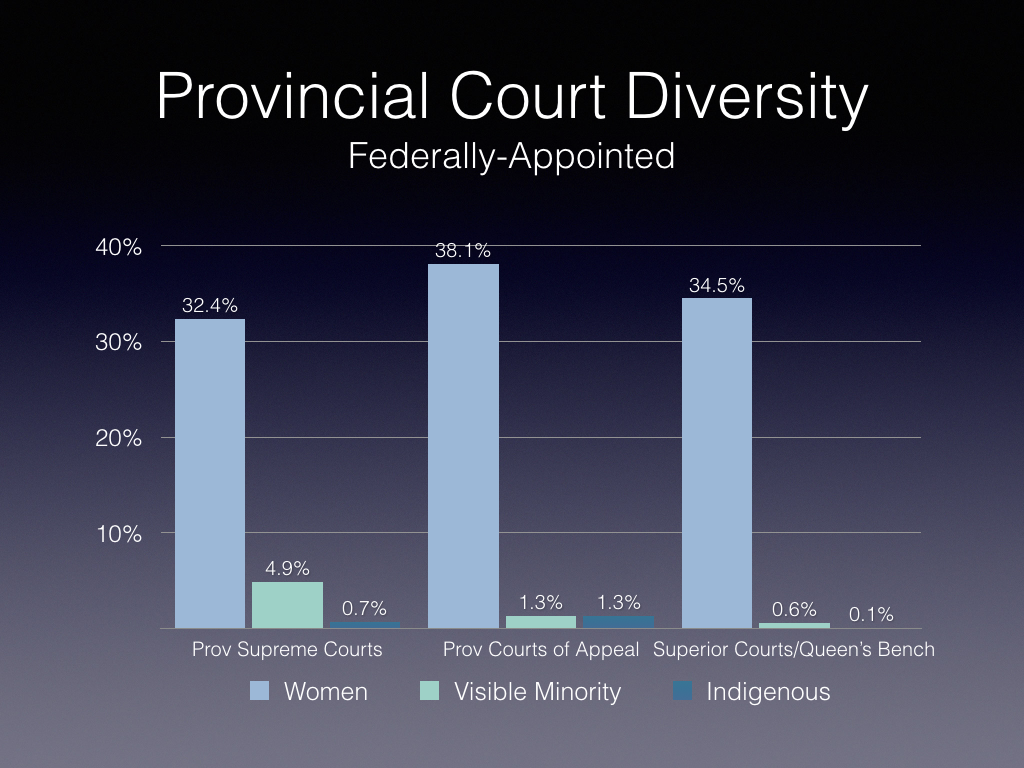
In contrast, appointments to date of the current government show a marked increase: 57.4 percent women, 6.4 percent for each of visible minorities and Indigenous peoples.

The federal government has a fundamental responsibility to appoint a sufficient complement of judges such that our courts can function properly. Its failure in that regard creates a constitutional crisis that goes to the very rule of law that underpins our justice system.

A lack of judicial appointments in the context of increasing pressure to conduct timely trials equals a systemic miscarriage of justice. With caseloads where they are, the system is at its breaking point.

Add to this difficult dynamic the recent Supreme Court of Canada ruling in the R v Jordan decision, which mandates criminal trials must be heard within 18 months for the so-called lower courts, and 30 months for the Superior ones. Absent compelling circumstances, “delinquent” prosecution equals administrative dismissal.

Due to this artificial prescription dozens of cases have been tossed, including murder and sex assault cases. No trial. No verdict. Worse still, the victims and their families are left without recourse or remediation and no one is accountable. Not fully appreciated as yet, this jarring situation stands to worsen due to the arbitrary deadline, which provides no consideration for the seriousness of the offence.

Against this backdrop we note inertia from the federal government on the appointment of judges to hear these languishing cases. Canadians face an alarming scenario of serious violent charges being vacated due to the acute shortage of judges. “Justice delayed is justice denied” is a maxim never more appropriately invoked than now.

As minister of justice (2013-15) I oversaw the appointment of more than 230 judges; prior to that my government prioritized hundreds more. We appointed a judiciary that represented “the face of Canada,” a diverse bench predicated and built on inclusion of all races, creeds, and genders in the legal community across Canada.

Vacancies on the federally appointed bench is at an all-time high. Sixty-two empty seats of the 840 federally appointed judges, against 14 (the lowest in decades) when my government left office. In June 2015, we appointed a record 22 women: over 60 per cent of the judges appointed on that occasion. We appointed more judges on one day (43) than the current government has in 16 months in office.

Source: Judge shortage causing unnecessary legal trauma: MacKay | Toronto Star

Peter MacKay suggests anti-terror laws don’t need major overhaul – Politics – CBC News

As the Government continues to consider what further changes, if any, are required to current legislation, some mixed signals:

… former public safety minister Stockwell Day warned hes hearing the government may try to eliminate the requirement that a judge sign off on such orders, giving discretion solely to the minister of public safety.

“One of the provisions Im hearing about, I don’t know if its accurate yet, is there may be a provision for a minister like myself to sign for [preventive] arrest, and not having it countersigned by a judge,” he said in an interview on CBC Radio’s The Current.

“I’ r always appreciated the balance [of both judge and minister signing] for preventive arrest and wiretaps … I would take a close look at that if a judge’s [signature] is no longer required,” Day added.

Without getting into specifics, MacKay seemed to dismiss that idea, “We’re not going to upset that balance that requires police to make that very important evidentiary determination.”

“I always would come down on the side of judicial oversight before you would make any interventions,” MacKay added.

MacKay also said the government is looking for ways to crack down on those who encourage terrorist acts online. “There’s no question that the type of material that is used often to recruit, to incite, and the word I don’t particularly like … but, glorification,” he said, adding he’s looking closely at legislation in the United Kingdom on this topic.

Day believes the legislation will “talk about things like, those who support calls on terrorists to attack Canadians or to kill Canadians, those who support groups who are calling for attacks on Canadians.’”

Peter MacKay suggests anti-terror laws dont need major overhaul – Politics – CBC News.

And the information and privacy czars pick up on the point that any increased powers should be matched by increased review and oversight.

If you step up police powers to fight terrorism, make watchdogs more powerful, privacy czar tells Tories

Similarly, a note of caution not to rush things from former judges, Frank Iacobucci, John Major and Dennis O’Connor:

Panel of judges urges caution in passing new anti-terror laws

Adam Chapnick has a thoughtful piece on the challenge of managing our reactions to terror:

As a professor of defence studies, I know all too well that it’s impossible to stop every ‘lone wolf’ with a gun or a bomb. No measure enacted by any government can guarantee our safety.

It follows that the national conversation led by our parliamentarians over the next few weeks cannot be about terrorism. It must be about managing the terror that Canadians feel.

We need calm reassurance, not more calls to be fearful. We need to see unity of effort and purpose among all of our MPs — not the divisive, fearmongering partisanship to which we have grown far too accustomed.

The debate must last as long as is necessary to enable all interested Canadians — not just supporters of the government — to understand what new measures are being exacted, and why.

It must shape a degree of consensus over the extent to which we are willing to surrender the freedoms we hold so dear in order to feel more comfortable on our streets and in our homes.

Terrorism is a state-level problem — but terror itself is personal. Let us hope that our elected representatives understand the difference as we move forward.

The real problem isn’t terrorism. It’s terror (pay wall)