Indigenous, Black youth spend more time in Ontario court system, according to report

Yet more evidence of system bias in our court system:

Young people charged with crimes in Ontario are waiting longer for their cases to be resolved, prolonging their time behind bars or extending onerous bail conditions – a situation that disproportionately affects Black and Indigenous youth.

The finding is part of a comprehensive report on youth bail by the John Howard Society of Ontario that is set for release on Tuesday. The research draws on provincial justice data and interviews with people who’ve endured the youth criminal-justice system.

The report, titled Unequal Justice, portrays a system that made huge advances after the passage of the Youth Criminal Justice Act in 2003, but has slipped of late in its treatment of a vulnerable subsection of the population.

Last year, The Globe and Mail found that racial bias pervades the adult correctional system as well. An investigation revealed that risk-assessment scores used to determine parole decisions, treatment plans and security classifications in adult federal prisons discriminated against Black and Indigenous inmates.

“Looking at young people, there’s an opportunity here, early on, to stop a lifetime of involvement with the justice system,” said Safiyah Husein, senior policy analyst with the John Howard Society of Ontario. “So if we are able to connect these children with the resources and supports they need early, then we can prevent them from cycling in and out of the justice system for the remainder of their lives.”

The Youth Criminal Justice Act, which applies to people between 12 and 17 years of age, has largely succeeded in doing just that. In 2000, Canada’s rate of youth incarceration was among the highest in the Western world, at 17.64 per 10,000. Today, it’s 3.79.

But those gains have come with huge racial disparities. The proportion of whites among youth in secure detention, the most restrictive form of youth custody, declined to 28 per cent from 39 per cent between 2006 and 2016. Over the same period, the rate remained flat for Indigenous prisoners, at about 10 per cent, and increased to 21 per cent from 19 per cent for Black inmates.

“The rate of youth detention has decreased overall since the implementation of the Youth Criminal Justice Act, but the question is, are those positive impacts being felt by all? They’re not,” said Fareeda Adam, staff lawyer at the Black Legal Action Centre. “And specifically Black and Indigenous youth are not seeing these benefits.”

John Howard researchers found some heartening news in the court data. For instance, they determined that around 59 per cent of youth cases in 2017 recorded a bail decision at the initial court appearance. However, the number of young people who have to appear before a court five or more times before receiving bail is on the rise, to 9 per cent of cases in 2017 from 5 per cent of cases in 2009.

And those appearances are becoming more spaced out. While five appearances equated to roughly 2½ weeks in custody as of 2006, it stretched out to three weeks by 2017.

While such a stint might seem short from the outside, just a few days in detention can shift a young person’s mindset permanently.

“Whether it’s group care or jail, the system teaches you to run away from people who do anything negative toward you, or physically fight them,” said Liam Smith, a 22-year-old Belleville-based youth peer mentor.

Mr. Smith helps teens navigate the criminal-justice system. He says many of them are encumbered with impossible bail conditions.

“They get these silly conditions like ‘keep a curfew’ and ‘keep peace and good behaviour,’ ” Mr. Smith said. “What happens if the court tells a kid he has to be somewhere at 9 o’clock but due to circumstances he can’t control, he doesn’t have a bed and has to sleep on the streets? That’s a bail breach. He can get arrested for that.”

Those bail breaches come with administration-of-justice charges that can further entrench a young person in the justice system, the report states.

The report calls for an end to such “boilerplate” bail conditions, an increase in funding for programs that divert youth from jail, a renewed focused on expediting release for detained youth and the adoption of a strategy to address the overrepresentation of Black and Indigenous youth in the justice system.

“Once we have a robust system of community-based alternatives to jail, we can fully realize the goals of the Youth Criminal Justice Act,” said Ms. Husein, the John Howard analyst.
Source: https://www.theglobeandmail.com/canada/article-indigenous-black-youth-spend-more-time-in-ontario-court-system/

Ford government says it’s changing judicial appointments to promote diversity. Racialized lawyers accuse it of ‘power grab’

Of note. The annual reports by the Ontario Judicial Appointments Advisory Committee allow for assessment of these changes:

Organizations representing racialized lawyers have all come out against the Ontario government’s proposed changes to judicial appointments, which the attorney general says are partly needed to improve diversity on the bench. 

Major organizations representing Black, Asian, South Asian and Muslim lawyers told the Star they didn’t ask for these changes. They argue the new system will lead to the perception that the appointments of provincial court judges in Ontario is no longer an independent and impartial process and could allow for provincial governments to make patronage appointments. 

“We see this as a power grab dressed up in the very thin veneer of purported diversity,” said Nader Hasan, a member of the legal advocacy committee of the Canadian Muslim Lawyers Association. 

“Our view is that diversity and excellence are best preserved by maintaining the independence and integrity of the current process.” 

Added Raphael Tachie, president of the Canadian Association of Black Lawyers, “It’s challenging to read something that says, ‘We’re doing this to increase the diversity of the judiciary,’ when the equity-seeking groups didn’t ask for it.”

In an omnibus justice bill tabled at Queen’s Park last month, Attorney General Doug Downey proposed several changes to the way provincial court judges are appointed. 

It includes significant changes to Ontario’s Judicial Appointments Advisory Committee (JAAC), the independent panel of judges, lawyers and members of the public that vets judicial applicants and submits a ranked short list of at least two candidates to the attorney general. 

Under the proposed amendments, that shortlist would grow to at least six candidates. “It allows for a bigger look at what’s out there in terms of creating some diversity and creating more choice,” Downey told the Star when he tabled the bill. 

The attorney general could also reject the six-person shortlist and ask to see the names of the next six candidates, as he is currently permitted to do with the two-person shortlist. Downey says he has already asked the committee to provide shortlists with more than two names, and that this change merely formalizes that practice. 

Janani Shanmuganathan, a board member of the South Asian Bar Association, argues that allowing the attorney general more choice in who to appoint to the bench leaves room “for a partisan or patronage appointment — some sort of appointment based not on the selection criteria or on who is best fit for the job, but for other reasons.”

A spokesperson for Downey maintained that the proposed changes reflect feedback received from lawyers and “justice-sector partners” and will ensure the appointments process remains non-partisan. 

“We believe it is responsible to update the system to help Ontario’s bench better reflect the evolving diversity of the province’s communities,” Nicko Vavassis said in an email. 

Another proposed change would mean the three legal organizations with representatives on the committee — the Law Society of Ontario, the Ontario Bar Association and the Federation of Ontario Law Associations — would no longer pick their own representatives, but would submit a shortlist of candidates for the attorney general to choose from.

“That will allow us to manage balance and diversity on the committee itself as well,” Downey told the Star last month. 

The attorney general already picks the seven community members on the 13-person committee.

Legal groups representing racialized lawyers say improving diversity on the bench is a laudable goal, but say they struggle to see how the government’s more significant changes would accomplish that. 

“Is there a problem with diversity on the JAAC itself? I don’t think there is. No one has complained there is an issue,” said Emily Lam, chair of the advocacy and policy committee and board member at the Federation of Asian Canadian Lawyers. 

“The irony is Mr. Downey himself has described JAAC as the gold standard, so why does he need these changes?” Lam said. 

“The concern is that this is actually for partisan purposes, and I think that transparency and fairness call for a discussion to be had by Mr. Downey with stakeholders and the public before taking any further steps.” 

The Federation of Ontario Law Associations said it did not receive much of an explanation from Downey for the proposed change to selection of committee members. 

“It has been suggested that it might be to achieve some greater diversity; however, given that the (attorney general) appoints the majority of the committee and the fact that our bench is quite diverse, it does not appear that we have an issue in this regard,” federation chair Bill Woodward said in an email. 

“This change gives the appearance of allowing the (attorney general) to have even greater control over the composition of the JAAC.” 

The Law Society of Ontario and the Ontario Bar Association have not objected to the proposed changes, and told the Star that they support a system that produces diverse judges. 

Source: https://www.thestar.com/politics/provincial/2021/03/02/ford-government-says-its-changing-judicial-appointments-to-promote-diversity-racialized-lawyers-accuse-it-of-power-grab.html

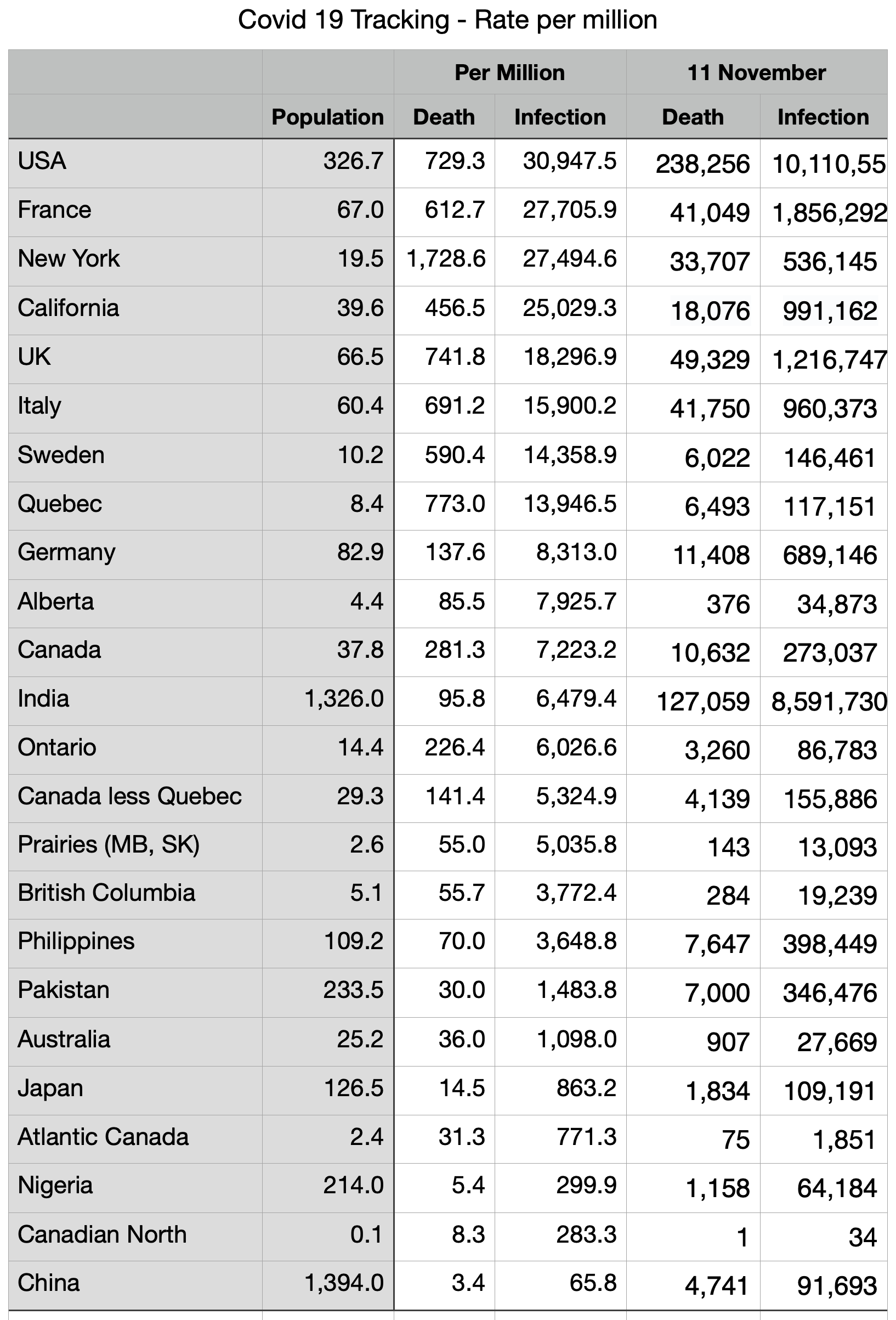
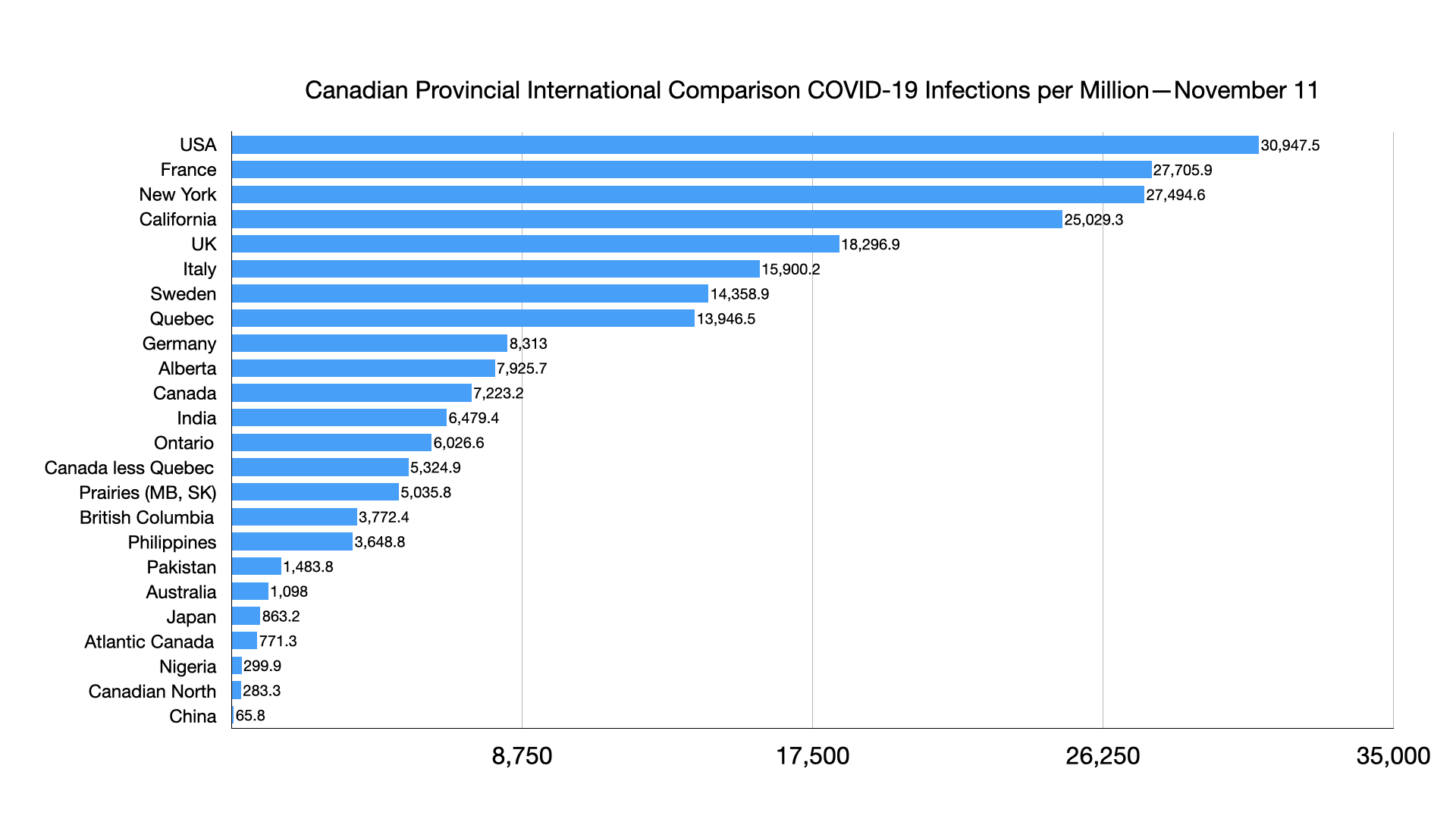
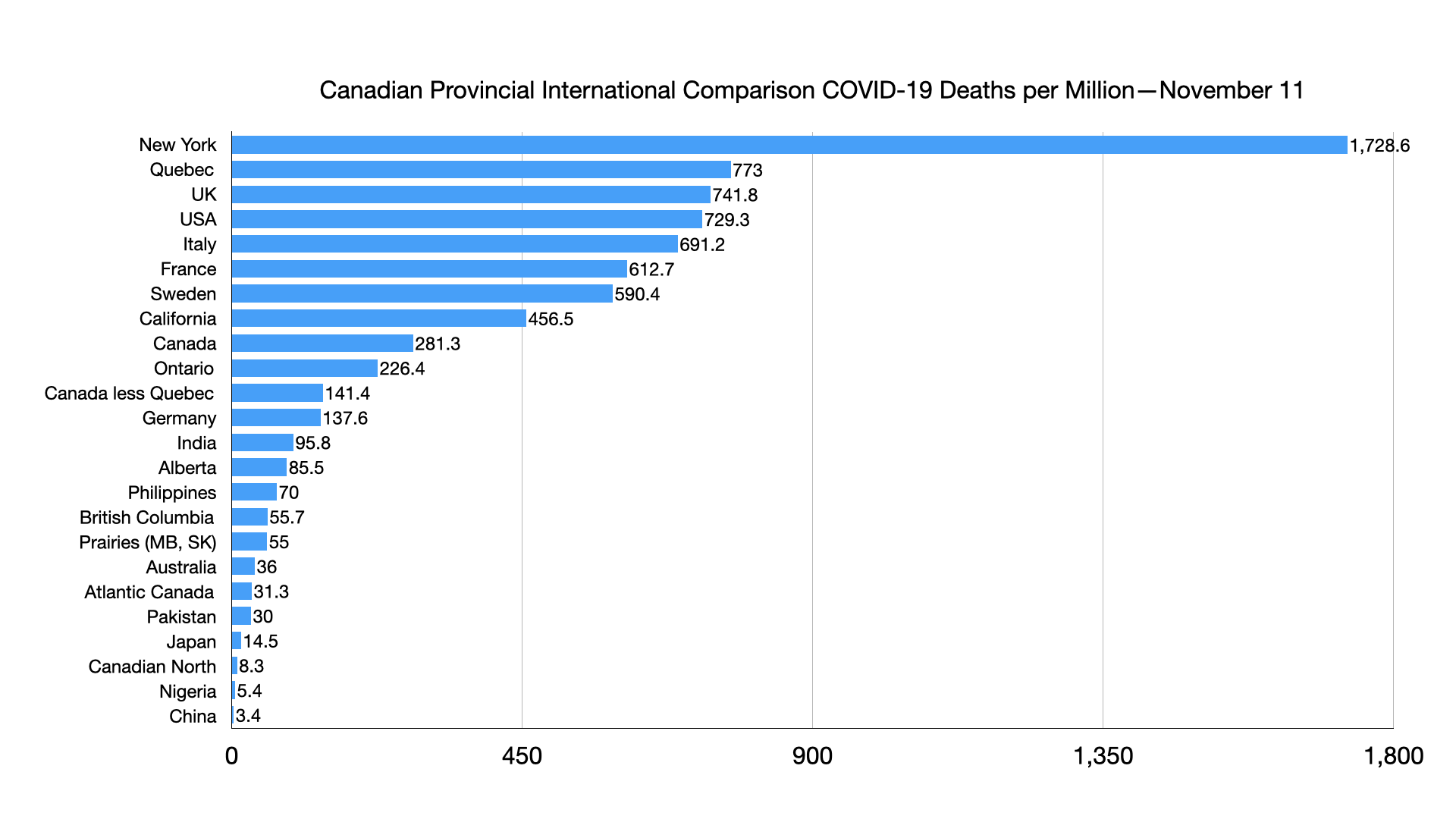
#COVID-19: Comparing provinces with other countries 11 November Update

Main news continues to be with respect to rapid increase in infections in most countries and provinces:
 
Weekly:
 
Infections per million: France ahead of New York, Italy and Sweden ahead of Quebec, British Columbia ahead of Philippines
 
Deaths per millionUK ahead of USA, France ahead of Sweden, Canadian North ahead of Nigeria


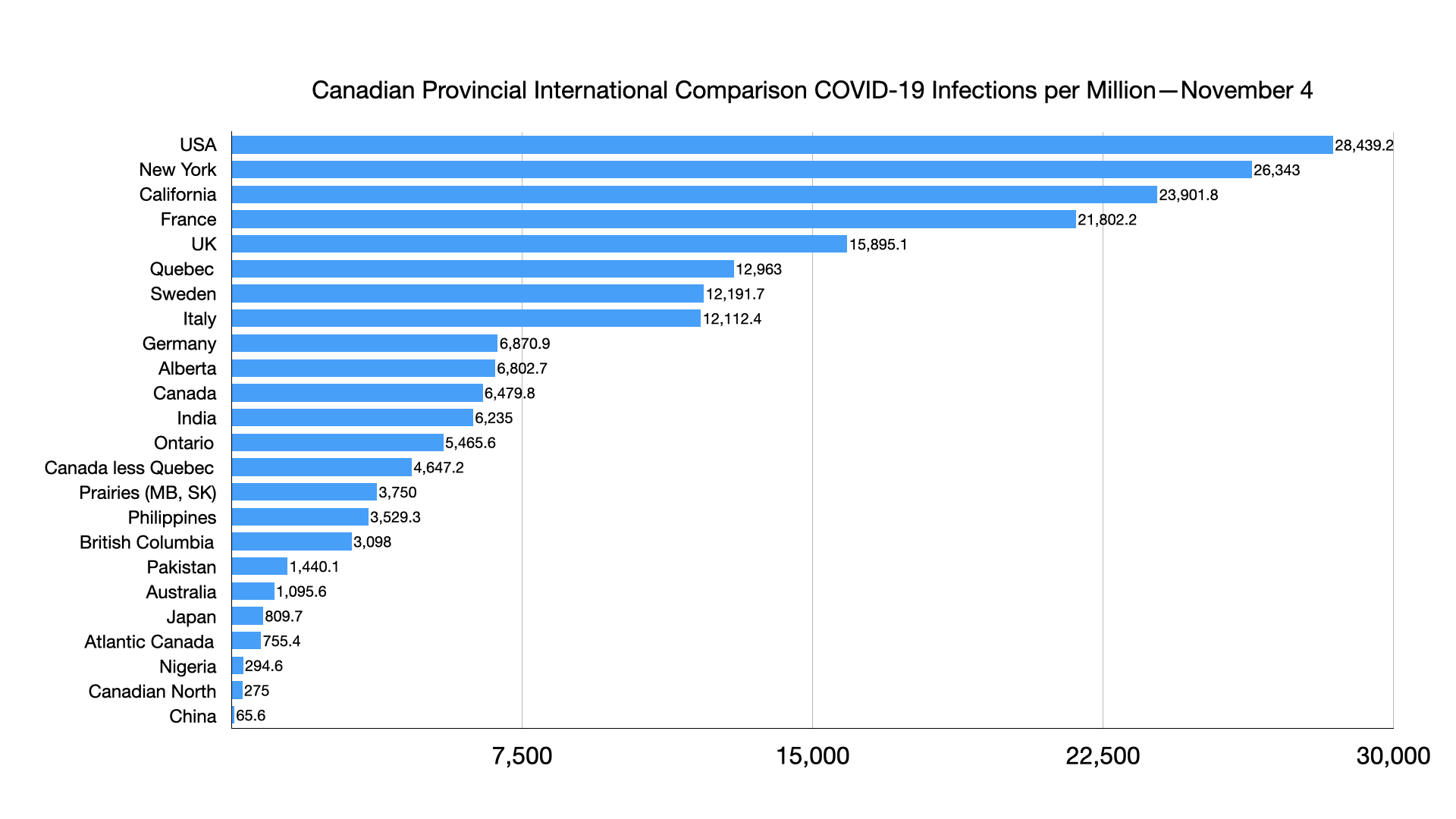
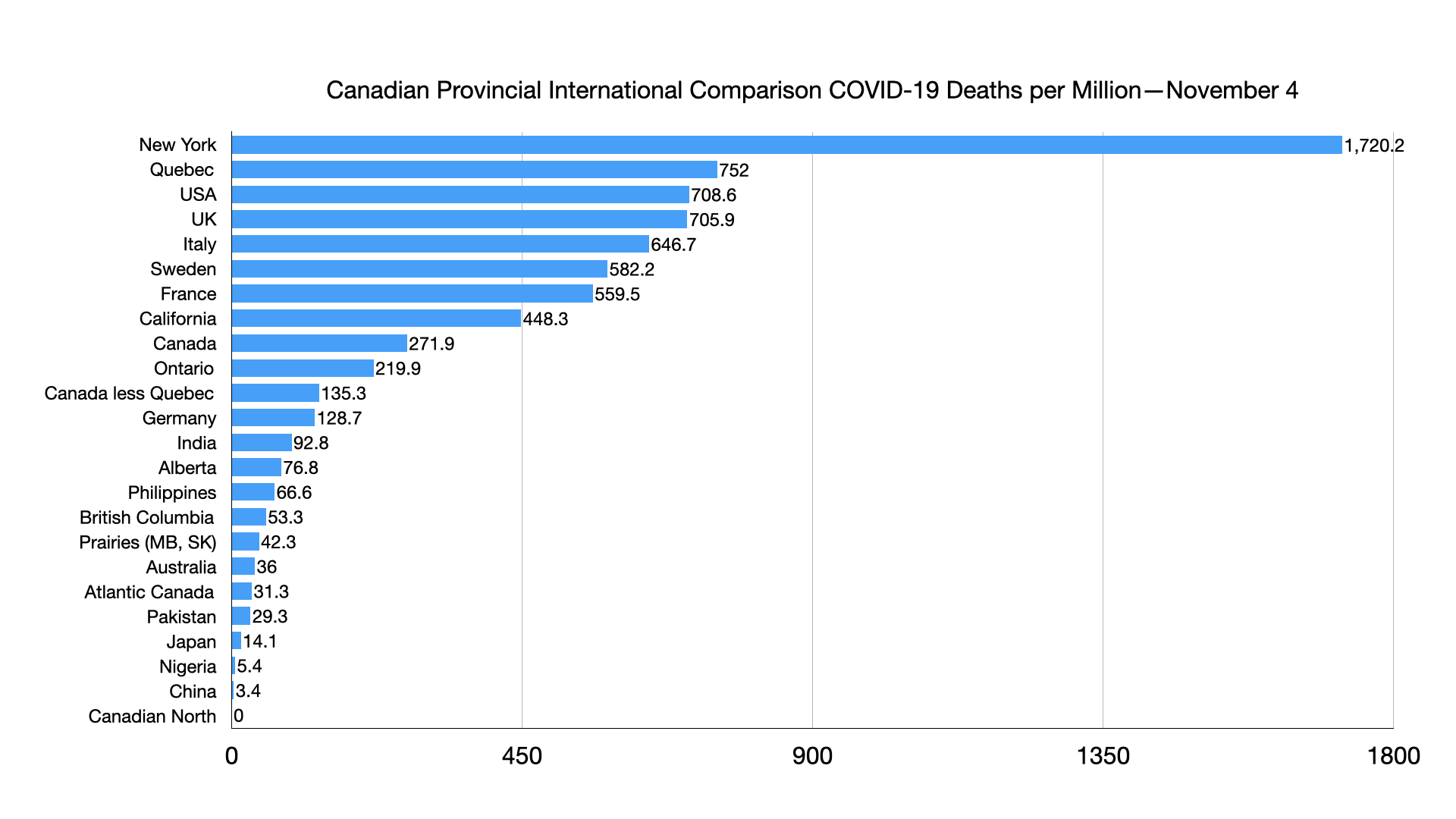
#COVID-19: Comparing provinces with other countries 4 November Update

Main news continues to be with respect to infections and relative increase of COVID cases and deaths in Prairie provinces:
 
Weekly:
 
Infections per million: Germany now ahead of Alberta, Canada, India, Prairies now ahead of Philippines
 
Deaths per million:nPrairies now ahead of Australia


After Ottawa monument is vandalized, Ontario adopts International Holocaust Remembrance Alliance’s ‘working definition of anti-Semitism’

Of note despite some of the valid concerns that the definition may be interpreted too broadly with respect to legitimate criticism of Israeli government policies:

The Ontario cabinet has adopted the International Holocaust Remembrance Alliance’s “working definition of anti-Semitism” after recent vandalism at the Tomb of the Unknown Soldier in Ottawa.

Government House Leader Paul Calandra said Premier Doug Ford’s ministers “took swift and decisive action” Monday to recognize the definition even before the passage of legislation currently before the house.

“After a heinous act of anti-Semitism at the Tomb of the Unknown Soldier in Ottawa … it is crucial that all governments be clear and united in fighting anti-Semitism and our adoption of the working definition has done just that,” Calandra said Tuesday.

“The government of Ontario is proud to adopt and recognize the working definition of anti-Semitism. We stand with Ontario’s Jewish community in defence of their rights and fundamental freedoms as we always have and always will,” he said.

Four years ago, the IHRA, an intergovernmental organization with 34 member nations, including Canada, adopted the definition that reads: “anti-Semitism is a certain perception of Jews, which may be expressed as hatred toward Jews.”

“Rhetorical and physical manifestations of anti-Semitism are directed toward Jewish or non-Jewish individuals and/or their property, toward Jewish community institutions and religious facilities,” the definition continues.

While MPPs are currently reviewing Bill 168, the proposed Combating anti-Semitism Act, Calandra said the cabinet wanted to move more quickly with a largely symbolic gesture.

Ontario is the first province in Canada to use the working definition.

In a statement, Michael Levitt, president and CEO of the Friends of Simon Wiesenthal Center for Holocaust Studies, said “we applaud the government of Ontario for joining the dozens of other governments around the world in adopting the IHRA definition of anti-Semitism, a vital tool in the ongoing fight against hatred and discrimination targeting the Jewish community in Ontario.”

“Jews continue to be subjected to vile rhetoric and propaganda and still remain the minority group most targeted by hate crime, which is nothing less than an affront to our basic democratic values as Ontarians,” said Levitt, a former Liberal MP.

Not everyone was happy with the move.

While the New Democrats supported Bill 168, they expressed concern that the “government secretly adopted the definition, behind closed doors and passed it by Ford edict instead of by democratic vote.”

“Anti-Semitism and anti-Semitic acts of hate are growing in Ontario, and we need to take concrete actions as a province to stomp out this growing, racist movement,” said NDP MPP Gurratan Singh (Brampton East).

Source: After Ottawa monument is vandalized, Ontario adopts International Holocaust Remembrance Alliance’s ‘working definition of anti-Semitism’

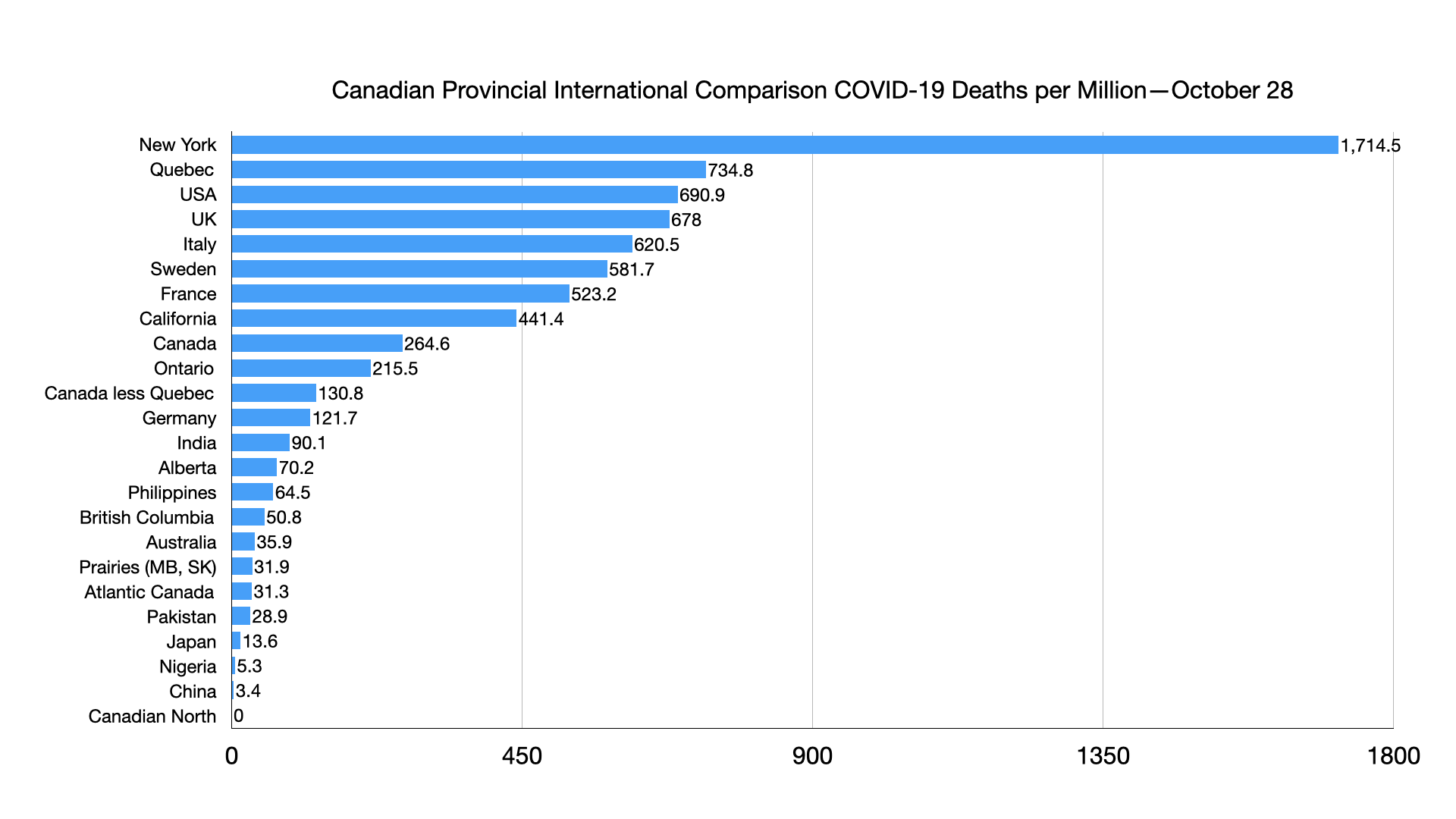
#COVID-19: Comparing provinces with other countries 28 October Update

Main news continues to be with respect to infections:
 
Weekly:
 
Infections per million: UK higher than Quebec, Alberta higher than Canada, Germany higher than Ontario, Prairies higher than British Columbia 
 
Deaths per million: Prairies higher than Atlantic Canada, both higher than Pakistan
 
October 7-28 increase:
 
Infections per million: Prairies (Manitoba, Saskatchewan) join European countries in highest percentage increase
 
Deaths per million: Highest increase in Prairies, particularly Manitoba and Saskatchewan 


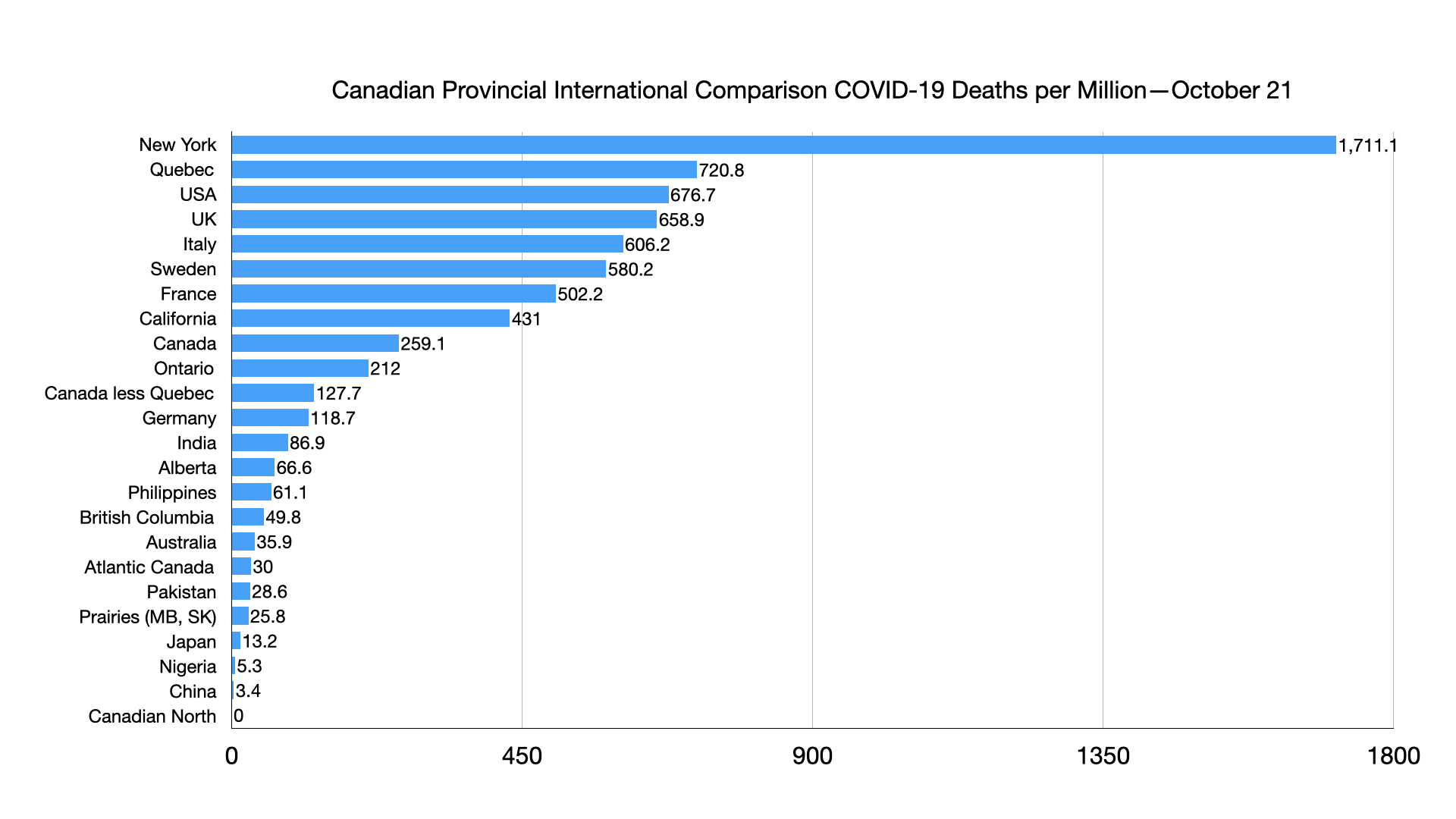
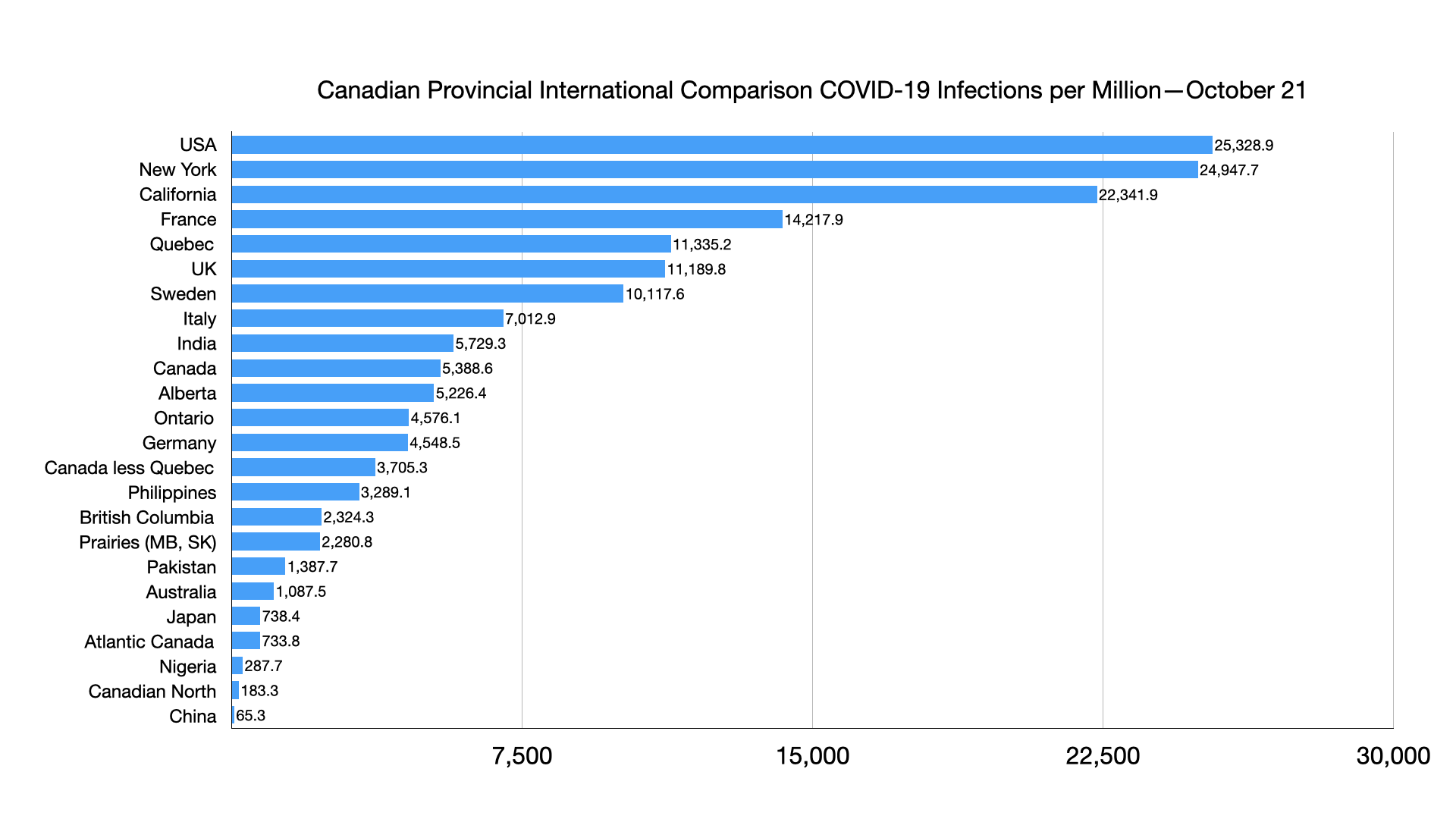
#COVID-19: Comparing provinces with other countries 21 October Update

Apart from overall large increases in infections in most jurisdictions, and corresponding increases in death rates in some, overall country and jurisdiction ranking largely unchanged.

Deaths per million: no change
 
Infections per million: Sweden now higher than UK (so much for herd immunity), Japan ahead of Atlantic Canada
 
Weekly:


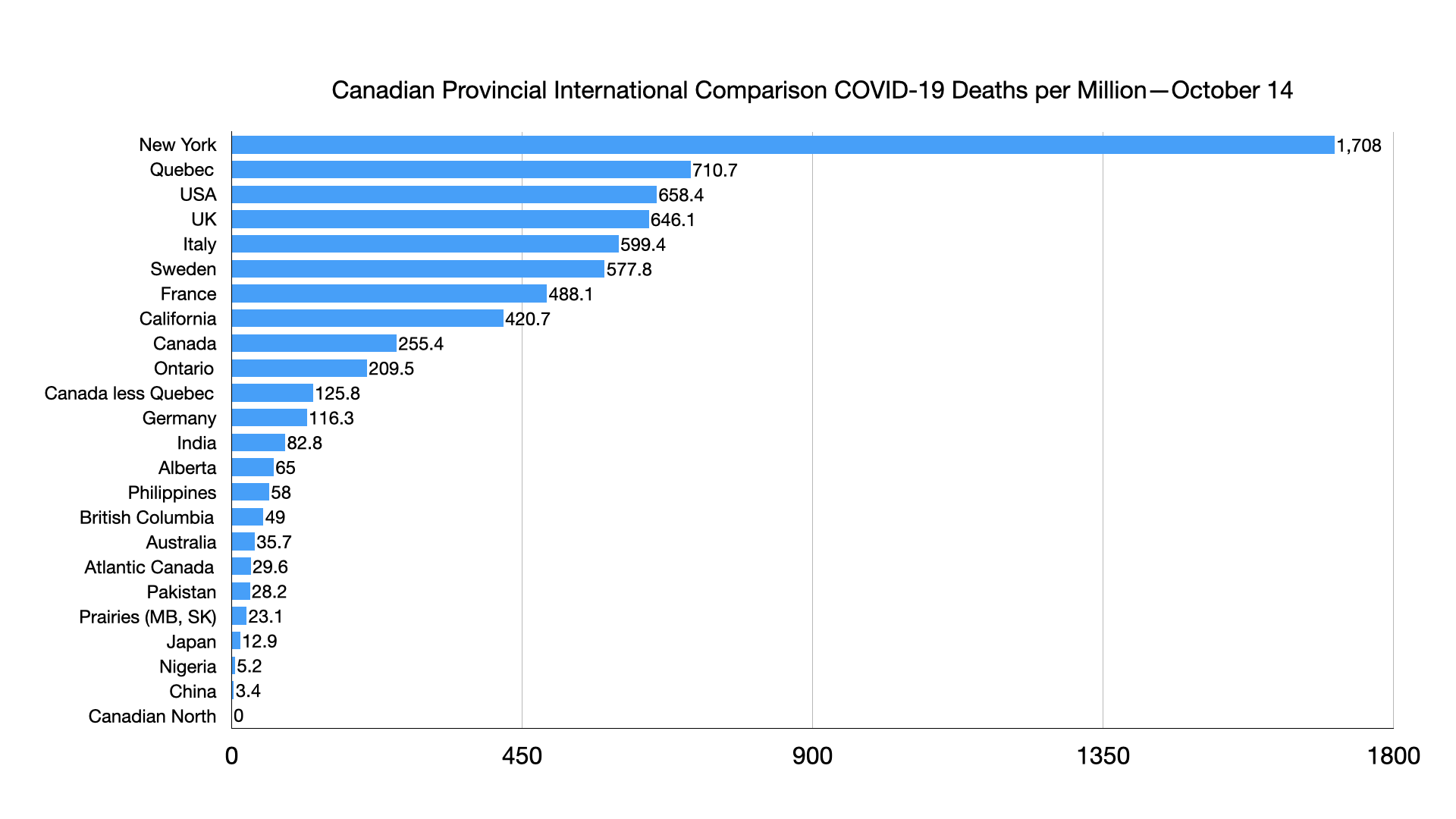
#COVID-19: Comparing provinces with other countries 14 October Update

No changes in relative ranking as overall rate of infections climbs in most jurisdictions:

Weekly:


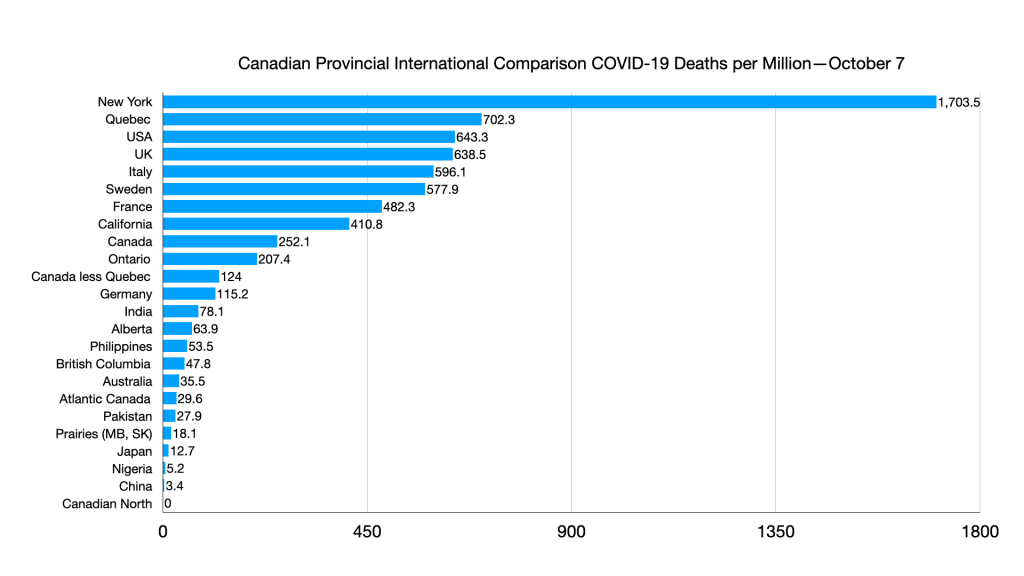
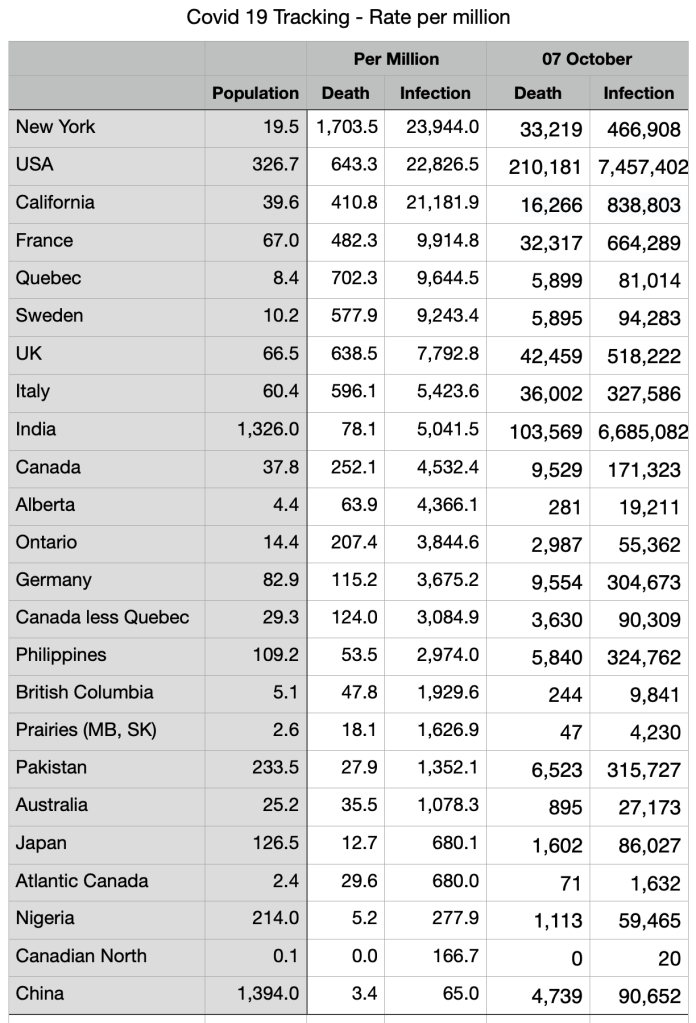
#COVID-19: Comparing provinces with other countries 7 October Update

Highlights:

Deaths per million: USA now ahead of UK

Infections per million: France and Quebec ahead of Sweden, Japan ahead of Atlantic Canada

Weekly:


When white Canadians think of racism, they think of America. These Black MPPs know better

Good conversation and discussion:

“Five Black politicians have changed the face of Ontario politics.

They’ve formed the first Black Caucus in the history of Canada’s most diverse province — which still has a mostly white legislature.

In the worst of times, their timing couldn’t be better. In the wake of the 2018 election that vaulted them to the provincial legislature, in advance of the violence-plagued summer of 2020 that sparked public protests, five New Democrats came together to speak out.

Now, they are being put to the test. We all are.

When white folks confront racism, their first thought is usually slavery or strife in America — with Canada as an afterthought. For the Black Caucus, the reality of racism is closer to home, here and now.

“When I as a Black person am thinking about racism, I don’t actually see a difference between the U.S. and Canada in the same way that a lot of white community members seem to believe is true,” Black Caucus chair Laura Mae Lindo told a Ryerson Democracy Forum I hosted Thursday on the NDP Black Caucus — why it matters.

“What I see is a similarity about how quickly we stop talking about racism in the U.S. and Canada — how quickly we accept people’s apologies for racist comments or denial of my history or denial of my humanity.”

Lindo, who spent much of her career before politics educating people on diversity — as a researcher and university administrator — has a keen eye for Canadian blind spots. And an ear for classic Canadian excuses.

“There’s a subtlety and a politeness in which Canadians perpetuate their anti-Blackness,” she muses. “And much of that is linked to their ability to just say, ‘I’m sorry,’ when somebody calls them on it.’”

Lindo came face to face with that in her Kitchener riding when she asked a gathering of Black students from the school district if the N-word was thrown around by white folks in their presence. Every single hand went up.

Not in America, not decades ago, here and now.

“I cried — I’ll be honest — because it’s shocking,” Lindo recalled. “It was overwhelming.”

And a life lesson for the mostly-white teachers in the classroom. Racism isn’t just accidental or incidental in Canada, it’s ingrained — even if sometimes invisible.

To cope with deadly serious racism, Lindo has resorted to humour as a teaching tool. Studying for her PhD in education, she focused on standup African American comedians for her doctoral thesis.

Diversity training for white folks too often tried to “guilt them and shame them into doing better.” She wanted to get their attention by harnessing humour, after realizing that “the people who were doing that best were the standup comedians.”

She coined the academic term “race-comics” to analyze their ability to “keep people in that room.” Laughing can make listen and learn the lessons of racism.

“I need to laugh…. We can’t do that if we’re angry all the time. Racism makes me rage-y, right?”

Fellow MPP Faisal Hassan recounted his own life story as an immigrant, experiencing homelessness, hardship and harassment on his way from the Horn of Africa to his Toronto riding of York South—Weston: As a Black male, he was carded a half-dozen times by local police.

But he described his journey in surprisingly resilient terms.

“My story is a happy story — I am an immigrant, I came here, and I have been welcomed,” Hassan told the students, many of whom wanted to know not just how he got to Canada, but how he got where he is today — in the legislature.

“Nobody’s going to give you anything,” he replied to student Stephen Mensah. “You have to be competitive, you have to be working hard with others, you have to show that you are going to be the voice of your community.”

Ontario needs more Black, Brown and Indigenous politicians so that people feel reflected in their institutions, added Jill Andrew, who represents St. Paul’s and proudly describes herself as the first Queer and Black elected representative in any provincial legislature.

“There’s a subtlety and a politeness in which Canadians perpetuate their anti-Blackness,” she muses. “And much of that is linked to their ability to just say, ‘I’m sorry,’ when somebody calls them on it.’”

Lindo came face to face with that in her Kitchener riding when she asked a gathering of Black students from the school district if the N-word was thrown around by white folks in their presence. Every single hand went up.

Not in America, not decades ago, here and now.

“I cried — I’ll be honest — because it’s shocking,” Lindo recalled. “It was overwhelming.”

And a life lesson for the mostly-white teachers in the classroom. Racism isn’t just accidental or incidental in Canada, it’s ingrained — even if sometimes invisible.

To cope with deadly serious racism, Lindo has resorted to humour as a teaching tool. Studying for her PhD in education, she focused on standup African American comedians for her doctoral thesis.

Diversity training for white folks too often tried to “guilt them and shame them into doing better.” She wanted to get their attention by harnessing humour, after realizing that “the people who were doing that best were the standup comedians.”

She coined the academic term “race-comics” to analyze their ability to “keep people in that room.” Laughing can make listen and learn the lessons of racism.

“I need to laugh…. We can’t do that if we’re angry all the time. Racism makes me rage-y, right?”

Fellow MPP Faisal Hassan recounted his own life story as an immigrant, experiencing homelessness, hardship and harassment on his way from the Horn of Africa to his Toronto riding of York South—Weston: As a Black male, he was carded a half-dozen times by local police.

But he described his journey in surprisingly resilient terms.

“My story is a happy story — I am an immigrant, I came here, and I have been welcomed,” Hassan told the students, many of whom wanted to know not just how he got to Canada, but how he got where he is today — in the legislature.

“Nobody’s going to give you anything,” he replied to student Stephen Mensah. “You have to be competitive, you have to be working hard with others, you have to show that you are going to be the voice of your community.”

Ontario needs more Black, Brown and Indigenous politicians so that people feel reflected in their institutions, added Jill Andrew, who represents St. Paul’s and proudly describes herself as the first Queer and Black elected representative in any provincial legislature.

She noted the impetus for creating Black Caucus — its two other members are Kevin Yarde (Brampton North) and Rima Berns-McGown (Beaches—East York) — came from members of the Black community who pointed out that the Official Opposition NDP now had enough MPPs to make it happen (two Black MPPs in the Liberal caucus, Mitzie Hunter and Michael Coteau, have not been invited to join the New Democrats).

Now the challenge is to get more outsiders inside the halls of power — and inside voting booths. Getting engaged, and getting elected, can be doubly hard for Blacks and Indigenous peoples, Lindo added.

“When you have been subject to the realities of a political system that has never seen you, kept you invisible, ignored your needs, used you — it’s very difficult to trust that the politician knocking on your door, asking for your vote, or putting her name forward is going to be any different,” the caucus chair told students.

“The formation of the Black Caucus at this point in history has pushed us to really look deep into our souls, too, and decide: ‘Are we going to push?’””

Source: https://www.thestar.com/politics/political-opinion/2020/10/04/a-black-caucus-at-queens-park-is-an-idea-whose-time-has-come.html