Anderson: U.S. Immigration Critics Ignore Canada’s Welcome Mat For Immigrants

How USA immigration advocates use or abuse Canada as an immigration example. Good analysis of why point systems unlikely to fly in the USA given the inherent politicization and legislative rigidity:

When Sen. Tom Cotton (R-AR) proposed reducing U.S. legal immigration levels by half, he highlighted Canada, a country that admits four times as many immigrants as a percentage of its population as the United States. Canada has announced it will boost its annual immigration level to 500,000 by 2025, illustrating that a high level of immigration compared to other nations is a central feature of Canada’s immigration system.

“Last year Canada welcomed over 405,000 newcomers—the most we’ve ever welcomed in a single year,” said Sean Fraser, Minister of Immigration, Refugees and Citizenship, in a press statement. “The Government is continuing that ambition by setting targets in the new levels plan of 465,000 permanent residents in 2023, 485,000 in 2024 and 500,000 in 2025. . . . This plan helps cement Canada’s place among the world’s top destinations for talent, creating a strong foundation for continued economic growth, while also reuniting family members with their loved ones and fulfilling Canada’s humanitarian commitments.

”https://embedly.forbes.com/widgets/media.html?src=https%3A%2F%2Fdatawrapper.dwcdn.net%2FMgOjO%2F1%2F&display_name=Datawrapper&url=https%3A%2F%2Fdatawrapper.dwcdn.net%2FMgOjO%2F1%2F&image=https%3A%2F%2Fdatawrapper.dwcdn.net%2FMgOjO%2Fplain-s.png%3Fv%3D1&key=3ce26dc7e3454db5820ba084d28b4935&type=text%2Fhtml&schema=dwcdn

The most significant statistic in Canada’s latest report highlights how critical immigration is to the country’s labor force growth: “Immigration accounts for almost 100% of Canada’s labor force growth, and, by 2032, it’s projected to account for 100% of Canada’s population growth,” according to Immigration, Refugees and Citizenship.

In the United States, opponents of immigration have promoted the “lump of labor fallacy,” the notion discredited by economists that there is a fixed quantity of labor needed in an economy. As a result, the focus of immigration restrictionists has been to reduce labor force growth under the mistaken belief that it would help the U.S. economy. Economists note that labor force growth is an essential element of economic growth, which is needed to elevate the standard of living in a country.

As in Canada, immigration is crucial to labor force growth in the United States. Economists note that by reducing immigration—such as when the Trump administration enacted restrictive administrative changes—government officials harm the U.S. economy.

By 2025, Canada will admit 12.5 immigrants per 1,000 residents, compared to the United States welcoming 3.0 immigrants per 1,000 residents in 2025, based on a National Foundation for American Policy projection. In other words, Canada will admit approximately four times as many immigrants as the United States on a per capita basis. If the United States adopted all elements of the Canadian system, the U.S. would admit more than 4 million immigrants a year instead of the approximately 1 million permanent residents admitted in FY 2019, the last year before the Covid-19 pandemic.

By 2025, Canada will admit twice as many family immigrants as the United States as a percentage of population and several times more refugees and humanitarian admissions per capita.

The RAISE Act

In August 2017, Sen. Tom Cotton and Sen. David Purdue (R-GA) cited the Canadian immigration system in arguing for their new bill the RAISE Act. “The RAISE Act would replace the current permanent employment-visa system with a skills-based points system, akin to the systems used by Canada and Australia,” according to a Cotton-Perdue press release.

Analysis shows Sen. Cotton and others have proposed a point system not to help employers or make the United States more competitive, but to eliminate family immigration categories and reduce immigration. In addition to admitting many fewer immigrants, the RAISE Act would have eliminated approximately 4 million people from family and employment-based immigration backlogs who had waited in line for years.

Cotton and Purdue made what economists would consider a contradictory argument for their bill. The senators argued their legislation would “spur economic growth” while “reducing overall immigration by half.” However, reducing immigration would lead to lower economic growth, not “spur” it. Joel Prakken, senior managing director and co-founder of Macroeconomic Advisers, estimated a 50% reduction in legal immigration would lead U.S. economic growth to decline by 12.5% from its projected levels.

Analysts note that the RAISE Act or similar proposals, by instituting a points-based system and eliminating nearly all family immigration categories, would deprive Americans and business owners of the freedom to sponsor close family members or coveted workers. During a Fox News candidate forum in Ohio, J.D. Vance endorsed the RAISE Act, which would worsen labor shortages by reducing immigration, in response to an Ohio business owner who said he could not find enough workers due to widespread labor shortages.

On February 15, 2018, the U.S. Senate rejected a measure to eliminate most family immigration categories, voting it down on a “cloture motion” 60-39. A Trump presidential proclamationcontained a similar “suspension” of immigrants entering the United States in those categories.

Canadian and Australian Point Systems Unlikely To Work In America

report from the National Foundation for American Policy and National Immigration Forum explains why a Canadian or Australian-style point system would likely be a poor fit for the United States. (I wrote the report.)

First, after examining the Canadian and Australian immigration systems, the primary conclusion from the report was that a point system wouldn’t work in the United States, except perhaps as a separate add-on that retains the current family and employer-sponsored immigration system. “Evidence indicates that America’s separation of executive and legislative powers makes it unlikely that a point system could operate effectively or in a manner similar to those in Canada or Australia, which have parliamentary systems of government and agencies with the authority to make rapid and unilateral changes to a point system when problems arise,” according to the report.

“That would not be possible under our laws and structure. Moreover, under a point system, as envisioned, U.S. employers would no longer decide which employees are most valued. Instead, admissions would be subject to government-designed criteria.” The report noted awarding points based on highest level of education would ignore the need for workers across the skill spectrum, such as in construction and hospitality or caregivers for seniors.

While Canada’s structure allows for relatively quick adjustments in point criteria, that is unlikely to happen in the United States. Instead, Congress would pass a law and set qualifications that might not change for decades. Ceding greater authority to an immigration bureaucracy would be unlikely to work, since it can take many years for a federal agency to enact a regulation and enact changes.

There is another risk to further empowering an immigration agency, the report and other analyses noted. White House adviser Stephen Miller showed how it was possible for the executive branch to use administrative means to prevent the admission of legal immigrants. After that experience, many would ask if it was wise to hand over even more authority to the executive branch to administer the U.S. immigration system.

Second, in Australia, the point system is largely irrelevant to employers, which has an employment-based immigration system similar to current U.S. law. “The point system is not at all important for corporate immigration in Australia,” said Tim Denney, formerly an attorney with Berry Appleman & Leiden in Sydney, Australia. “The points system comes into play when an individual seeks to migrate to Australia and does not have a business operating in Australia willing to sponsor him or her upfront for either a temporary work visa or permanent residence.”

In Canada, (permanent) immigrants for employers often first work for Canadian employers on temporary visas, similar to the U.S. transition from H-1B status to an employment-based green card. The difference is that Canada awards points for age, language, schooling and work experience in Canada and grants permanent residence each year to those who achieve sufficient points. The system has evolved and been adjusted so that employers can retain highly skilled employees. Another key feature: Canada allows provinces to select immigrants based on unique regional needs, something U.S. point system advocates generally have not favored.

Finally, if members of Congress wanted to admit more immigrants with advanced degrees, they could have supported several proposals in 2021 and 2022 to boost the number of employment-based green cards and eliminate the per-country limit on such green cards to prevent decades-long delays for Indian immigrants.

Neither Tom Cotton nor any other Republican senator intervened before the CHIPS Act passed in 2022 to stop Sen. Charles Grassley (R-IA) from blocking measures to create an exemption to annual green card limits for foreign nationals with a Ph.D. in STEM [science, technology, engineering and math] fields and those with a master’s degree “in a critical industry.”

“The U.S. already has ‘merit-based’ immigration, in the form of a preference system for employment-based visas,” said Lynn Shotwell, an immigration expert and president/CEO of Worldwide ERC. “While current H-1B and green card numbers aren’t sufficient, employers don’t want a system that removes or limits their ability to hire or sponsor a specific individual, across the skill spectrum, or have the federal government set up a point criteria that may not be relevant to employer needs or keep up with changes in the economy.”

Sen. Cotton has argued that eliminating most family categories via the RAISE Act would raise worker wages. Economists would find this implausible. Giovanni Peri, economics chair at the University of California, Davis, concluded, “Decades of research have provided little support for the claim that immigrants depress wages by competing with native workers.”

Only about 25,000 or fewer people of working age with less than a high school degree immigrate annually in the categories critics have sought to eliminate (i.e., the siblings and unmarried and married adult children of U.S. citizens). Even if the consensus of economists was incorrect about immigrants’ lack of impact on native wages, it is not plausible that stopping 0.01% (25,000) of the 165 million U.S. labor force from entering the country—and living in different parts of the country—would have any impact on U.S. workers’ wages.

A higher annual level of immigration—four times higher than the United States as a percentage of its population—is a central feature of Canada’s immigration system. Analysts would find it unlikely that Sen. Cotton and other U.S. advocates of a Canadian-style point system will support admitting four times as many immigrants each year to the United States.

Source: U.S. Immigration Critics Ignore Canada’s Welcome Mat For Immigrants

H-1B Visa Rule About To Die For Good

Of note. May reduce the relative attractiveness of Canada:

An H-1B visa regulation that would make it less likely international students can work in the United States appears ready to die for good. Critics asked why the Biden administration was defending an immigration rule championed by Trump adviser Stephen Miller. The answer is the Biden administration is no longer defending the rule.

“Our plaintiffs are thrilled with the government’s apparent, yet belated, decision to no longer defend the H-1B Lottery Rule,” said Jesse Bless, director of litigation at the American Immigration Lawyers Association (AILA), in an interview. “While we wish that the government had not waited until we had completed briefing on cross-motions for summary judgment, we are fully committed to settlement negotiations, which will hopefully ensure that our plaintiffs receive all the relief to which they are entitled.” 

The case is Humane Society of NY, et al. v. Alejandro Mayorkas, et al. “Following the completion of briefing in this case, the parties entered into settlement negotiations,” according to an unopposed motion filed in the case on December 6, 2021. “There is now a good-faith reason to believe that the parties will reach an agreement in the near future that will fully resolve this matter. However, the parties need additional time to confer and fully resolve the issues presented. In light of the current state of play, plaintiffs hereby move for a sixty-day extension of time to file the Joint Appendix of the Administrative Record which is due on December 6, 2021. Plaintiffs conferred with opposing counsel and they expressed support for the requested extension. The parties anticipate that sixty days will allow the parties to exhaust the possibility of resolving this case without further involvement of the court and move for a dismissal of this matter.”

Plaintiffs’ attorneys in the Humane Society case, in addition to Bless, are Greg Siskind (Siskind Susser), Jeff D. Joseph (Joseph & Hall) and Charles H. Kuck (Kuck Baxter Immigration).

Background: On January 8, 2021, the Trump administration published a regulation as “final” to end the H-1B visa lottery and replace it with a system that awards H-1B petitions by highest to lowest salary. U.S. Citizenship and Immigration Services (USCIS) uses the lottery when companies file more H-1B applications than the annual limit of 85,000 (65,000 plus a 20,000-exemption for advance degree holders from U.S. universities). In 2021, USCIS received more than 300,000 H-1B registrations for FY 2022.MORE FROMFORBES ADVISORBest Travel Insurance CompaniesByAmy DaniseEditorBest Covid-19 Travel Insurance PlansByAmy DaniseEditor

H-1B petitions are essential because they typically represent the only practical way foreign nationals, including international students, can work long-term in the United States.

The H-1B rule would be bad news for international students. “The National Foundation for American Policy (NFAP) found that an international student may be 54% more likely to get an H-1B petition under the current H-1B lottery system than under the Trump administration’s regulation that would end the H-1B lottery,” according to an NFAP analysis of cases of recent international students and filings for H-1B petitions. “The data demonstrate the new regulation would have a significant negative effect on the ability of international students to gain an H-1B petition.”

In its September 20, 2021, motion for summary judgment in Humane Society of NY, et al. v. Alejandro Mayorkas, et al., plaintiffs cited NFAP research on the primary reason why the rule would prevent most international students from gaining H-1B status: “Initial registrations for these freshly graduated H-1B workers are generally assigned a Level I wage.” 

In other words, employers would naturally offer individuals with less experience in the U.S. labor market lower salaries (Level 1 under the Department of Labor wage level system) than more experienced professionals. Adopting the rule would lead the United States to establish a system—unlike any of its competitors for talent in other countries—that favors the most senior foreign nationals over young, promising talent, particularly recent graduates of U.S. universities.

Difficulty in gaining H-1B status and permanent residence contributed to an increase in Indian students at Canadian universities from 76,075 to over 172,000 between 2016 and 2018. At the same time, at U.S. universities, Indian graduate students in engineering and computer science fell 25%. The evidence indicates America is losing talent because it is much easier to work after graduation and gain permanent residence in Canada and other countries—and the Trump administration’s H-1B regulation would exacerbate this problem. 

In its complaint (May 17, 2021) and motion for summary judgment, plaintiffs argued the regulation is illegal because Chad Wolf was not properly serving as acting secretary of Homeland Security when the rule was issued. Also, according to the plaintiffs, “This final rule unlawfully makes the H-1B nonimmigrant visa selection process dependent on wage level and unlawfully gives priority for lottery selection to those H-1B applicants who are paid the highest wages.”

In a defendants’ reply in further support of their cross-motion for summary judgment, filed on November 22, 2021, the Biden administration argued, “The final rule was promulgated by an authorized official, the final rule comports with the INA [Immigration and Nationality Act]” and “DHS [Department of Homeland Security] responded sufficiently to the public comments.”

The U.S. Chamber of Commerce Lawsuit: Earlier in the year, the Biden administration lost a different lawsuit over the H-1B rule. In his order on September 15, 2021, issued in Chamber of Commerce v. DHS, Judge Jeffrey S. White agreed with a critical legal argument made by the plaintiffs. 

“Plaintiffs argue the Final Rule must be set aside because Mr. Wolf was not lawfully appointed as Acting Secretary at the time DHS promulgated the rule,” Judge White wrote. “In ILRC, the Court concluded the plaintiffs were likely to succeed on the merits of their claim that Mr. Wolf’s appointment was not lawful. At that time, two other district courts had considered and rejected DHS’s arguments, as had the Government Accountability Office (“GAO”). . . . Since then, a number of other courts also have determined that Mr. McAleenan and Mr. Wolf not acting with lawful authority. . . . Because he was not lawfully appointed, Mr. McAleenan’s subsequent attempts to amend the order of succession and to elevate Mr. Wolf to Acting Secretary also were not valid.”

Judge White ruled against the regulation solely on the DHS appointment issue and did not address other arguments raised by plaintiffs. Paul Hughes of McDermott Will & Emery, representing the plaintiffs (the Chamber of Commerce and others), argued the H-1B rule also violated current law. “First, the Lottery Rule is flatly inconsistent with the text of the Immigration and Nationality Act,” according to the plaintiffs. “The statute provides unambiguously that H-1B visas ‘shall be issued . . . in the order in which petitions are filed for such visas.’ Yet the Rule instead unabashedly institutes ‘ranking and selection based on wage levels,’ such that the relatively highest-paid noncitizens are issued visas first, likely leaving none for those at lower wage levels. Agencies are powerless to thus ‘rewrite clear statutory terms.’”

Department of Justice lawyers representing the Department of Homeland Security filed an unopposed motion for dismissal in the Chamber of Commerce case on November 30, 2021. That action foreshadowed the Biden administration’s willingness to bring the Humane Society case to a close as well.

Now that the litigation on the H-1B rule appears to be finished, one question remains: Will the Biden administration allow the regulation to stay dead, or will it issue a new regulation that critics believe embraces Stephen Miller’s vision of business immigration?

An H-1B visa regulation that would make it less likely international students can work in the United States appears ready to die for good. Critics asked why the Biden administration was defending an immigration rule championed by Trump adviser Stephen Miller. The answer is the Biden administration is no longer defending the rule.

“Our plaintiffs are thrilled with the government’s apparent, yet belated, decision to no longer defend the H-1B Lottery Rule,” said Jesse Bless, director of litigation at the American Immigration Lawyers Association (AILA), in an interview. “While we wish that the government had not waited until we had completed briefing on cross-motions for summary judgment, we are fully committed to settlement negotiations, which will hopefully ensure that our plaintiffs receive all the relief to which they are entitled.” 

The case is Humane Society of NY, et al. v. Alejandro Mayorkas, et al. “Following the completion of briefing in this case, the parties entered into settlement negotiations,” according to an unopposed motion filed in the case on December 6, 2021. “There is now a good-faith reason to believe that the parties will reach an agreement in the near future that will fully resolve this matter. However, the parties need additional time to confer and fully resolve the issues presented. In light of the current state of play, plaintiffs hereby move for a sixty-day extension of time to file the Joint Appendix of the Administrative Record which is due on December 6, 2021. Plaintiffs conferred with opposing counsel and they expressed support for the requested extension. The parties anticipate that sixty days will allow the parties to exhaust the possibility of resolving this case without further involvement of the court and move for a dismissal of this matter.”

Background: On January 8, 2021, the Trump administration published a regulation as “final” to end the H-1B visa lottery and replace it with a system that awards H-1B petitions by highest to lowest salary. U.S. Citizenship and Immigration Services (USCIS) uses the lottery when companies file more H-1B applications than the annual limit of 85,000 (65,000 plus a 20,000-exemption for advance degree holders from U.S. universities). In 2021, USCIS received more than 300,000 H-1B registrations for FY 2022.MORE FROMFORBES ADVISORBest Travel Insurance CompaniesByAmy DaniseEditorBest Covid-19 Travel Insurance PlansByAmy DaniseEditor

H-1B petitions are essential because they typically represent the only practical way foreign nationals, including international students, can work long-term in the United States.

The H-1B rule would be bad news for international students. “The National Foundation for American Policy (NFAP) found that an international student may be 54% more likely to get an H-1B petition under the current H-1B lottery system than under the Trump administration’s regulation that would end the H-1B lottery,” according to an NFAP analysis of cases of recent international students and filings for H-1B petitions. “The data demonstrate the new regulation would have a significant negative effect on the ability of international students to gain an H-1B petition.”

In its September 20, 2021, motion for summary judgment in Humane Society of NY, et al. v. Alejandro Mayorkas, et al., plaintiffs cited NFAP research on the primary reason why the rule would prevent most international students from gaining H-1B status: “Initial registrations for these freshly graduated H-1B workers are generally assigned a Level I wage.” 

In other words, employers would naturally offer individuals with less experience in the U.S. labor market lower salaries (Level 1 under the Department of Labor wage level system) than more experienced professionals. Adopting the rule would lead the United States to establish a system—unlike any of its competitors for talent in other countries—that favors the most senior foreign nationals over young, promising talent, particularly recent graduates of U.S. universities.

Difficulty in gaining H-1B status and permanent residence contributed to an increase in Indian students at Canadian universities from 76,075 to over 172,000 between 2016 and 2018. At the same time, at U.S. universities, Indian graduate students in engineering and computer science fell 25%. The evidence indicates America is losing talent because it is much easier to work after graduation and gain permanent residence in Canada and other countries—and the Trump administration’s H-1B regulation would exacerbate this problem. 

In its complaint (May 17, 2021) and motion for summary judgment, plaintiffs argued the regulation is illegal because Chad Wolf was not properly serving as acting secretary of Homeland Security when the rule was issued. Also, according to the plaintiffs, “This final rule unlawfully makes the H-1B nonimmigrant visa selection process dependent on wage level and unlawfully gives priority for lottery selection to those H-1B applicants who are paid the highest wages.”

In a defendants’ reply in further support of their cross-motion for summary judgment, filed on November 22, 2021, the Biden administration argued, “The final rule was promulgated by an authorized official, the final rule comports with the INA [Immigration and Nationality Act]” and “DHS [Department of Homeland Security] responded sufficiently to the public comments.”

The U.S. Chamber of Commerce Lawsuit: Earlier in the year, the Biden administration lost a different lawsuit over the H-1B rule. In his order on September 15, 2021, issued in Chamber of Commerce v. DHS, Judge Jeffrey S. White agreed with a critical legal argument made by the plaintiffs. 

“Plaintiffs argue the Final Rule must be set aside because Mr. Wolf was not lawfully appointed as Acting Secretary at the time DHS promulgated the rule,” Judge White wrote. “In ILRC, the Court concluded the plaintiffs were likely to succeed on the merits of their claim that Mr. Wolf’s appointment was not lawful. At that time, two other district courts had considered and rejected DHS’s arguments, as had the Government Accountability Office (“GAO”). . . . Since then, a number of other courts also have determined that Mr. McAleenan and Mr. Wolf not acting with lawful authority. . . . Because he was not lawfully appointed, Mr. McAleenan’s subsequent attempts to amend the order of succession and to elevate Mr. Wolf to Acting Secretary also were not valid.”

Judge White ruled against the regulation solely on the DHS appointment issue and did not address other arguments raised by plaintiffs. Paul Hughes of McDermott Will & Emery, representing the plaintiffs (the Chamber of Commerce and others), argued the H-1B rule also violated current law. “First, the Lottery Rule is flatly inconsistent with the text of the Immigration and Nationality Act,” according to the plaintiffs. “The statute provides unambiguously that H-1B visas ‘shall be issued . . . in the order in which petitions are filed for such visas.’ Yet the Rule instead unabashedly institutes ‘ranking and selection based on wage levels,’ such that the relatively highest-paid noncitizens are issued visas first, likely leaving none for those at lower wage levels. Agencies are powerless to thus ‘rewrite clear statutory terms.’”

Department of Justice lawyers representing the Department of Homeland Security filed an unopposed motion for dismissal in the Chamber of Commerce case on November 30, 2021. That action foreshadowed the Biden administration’s willingness to bring the Humane Society case to a close as well.

Now that the litigation on the H-1B rule appears to be finished, one question remains: Will the Biden administration allow the regulation to stay dead, or will it issue a new regulation that critics believe embraces Stephen Miller’s vision of business immigration?

Source: https://e.email.forbes.com/c2/869:5df3a796a806e2781760c8d7:rm202112111300:5e4bc7f55b099ce02faa6b40:1/56c3e6d7?jwtH=eyJ0eXAiOiJKV1QiLCJhbGciOiJIUzI1NiJ9&jwtP=eyJpYXQiOjE2MzkyMjc5MzksImNkIjoiLmVtYWlsLmZvcmJlcy5jb20iLCJjZSI6ODY0MDAsInRrIjoiZm9yYmVzLWxpdmUiLCJtdGxJRCI6IjYxYjRhMTg4NWVlMTdiM2UxMDJlODExYiIsImxpbmtVcmwiOiJodHRwczpcL1wvd3d3LmZvcmJlcy5jb21cL3NpdGVzXC9zdHVhcnRhbmRlcnNvblwvMjAyMVwvMTJcLzA5XC9oLTFiLXZpc2EtcnVsZS1hYm91dC10by1kaWUtZm9yLWdvb2RcLz91dG1fc291cmNlPW5ld3NsZXR0ZXImdXRtX21lZGl1bT1lbWFpbCZ1dG1fY2FtcGFpZ249Zm9sbG93JmNkbGNpZD01ZTRiYzdmNTViMDk5Y2UwMmZhYTZiNDAmdXRtX3NvdXJjZT1uZXdzbGV0dGVyJnV0bV9tZWRpdW09ZW1haWwmdXRtX2NhbXBhaWduPWZvbGxvdyZjZGxjaWQ9NWU0YmM3ZjU1YjA5OWNlMDJmYWE2YjQwIn0&jwtS=Q41VLkxtpbyTDTU7aGedDln-Agp94UQVb-c0_tBKuh0

As Donald Trump tightens immigration rules, Indian tech students ditch the American Dream for Canada

Yet another article of the shift with some interesting data:

Indian students are slowly getting over their fascination with the US.

The number of Indians enrolled in graduate-level computer science and engineering courses at American universities declined by more than 25% between 2016-’17 and 2018-’19, according to an analysis of government data by the National Foundation for American Policy.

The key factors for this decline are “more restrictive immigrationand international student policies under the [Donald] Trump administration and the difficulty of obtaining green cards in the United States,” the think tank focused on public policy research on trade and immigration said in a report published on June 8.

Data: National Foundation for American Policy, US Department of Homeland Security, US Immigration and Customs Enforcement, special tabulations (2018) of the Student and Exchange Visitor Information System (SEVIS) database via Quartz

This decline is a massive hit to the entire international tech student population in the US, as Indians form an outsized proportion of the group.

Data: National Foundation for American Policy, US Department of Homeland Security, US Immigration and Customs Enforcement, special tabulations (2018) of the Student and Exchange Visitor Information System (SEVIS) database via Quartz

America’s loss

In a letter dated June 2, 21 members of the US Congress highlighted that international students and their families contributed approximately $41 billion to the US economy in 2018-’19 alone, despite making up just 5.5% of overall US college enrollments. This cohort subsidises tuition for many domestic students.

Moreover, “as a source of research assistants, graduate students help professors conduct research and retain top faculty,” the National Foundation for American Policy report said. “Without the ability to perform high-level research, many leading professors would move on to other careers, which would weaken American universities as a global centre for science.”

While the US is losing out on Indian talent, its neighbour is making strides.

Canada’s gain

National Foundation for American Policy’s research shows that the share of Indian students in Canada more than doubled between the academic years 2016-’17 and 2018-’19.

Data: Canadian Bureau for International Education, National Foundation for American Policy via Quartz

Unlike America’s hardline approach, Canada’s policies have been incentivising students. In June 2018, Immigration, Refugees and Citizenship Canada announced the Student Direct Stream for China, India, Vietnam, and the Philippines. Students from these four countries enrolled in any of the 1,400-plus designated learning institutes in Canada can fast-track their applications, as long as they pass English-language tests and prove they are financially stable.

While the US has suspended immigration due to coronavirus outbreak and is reconsidering the post-graduate work programme Optional Practical Training, Canada isn’t letting Covid-19 get in its way.

As of May 14, international students with valid study permits in Canada from before March 18 have been exempted from the travel restrictions contingent on passing health checks and following isolation protocols.

Not just students but even Indian working professionals have been flocking to Canada as Trump’s anti-immigration rhetoric builds up. Several Indian techies have been swapping Silicon Valley for the more immigrant-friendly neighbour.

“Canada is benefiting from a diversion of young Indian tech workers from US destinations, largely because of the challenges of obtaining and renewing H-1B visas and finding a reliable route to US permanent residence,” said Peter Rekai, founder of the Toronto-based immigration law firm Rekai LLP. The country even offers express entry for skilled immigrants.

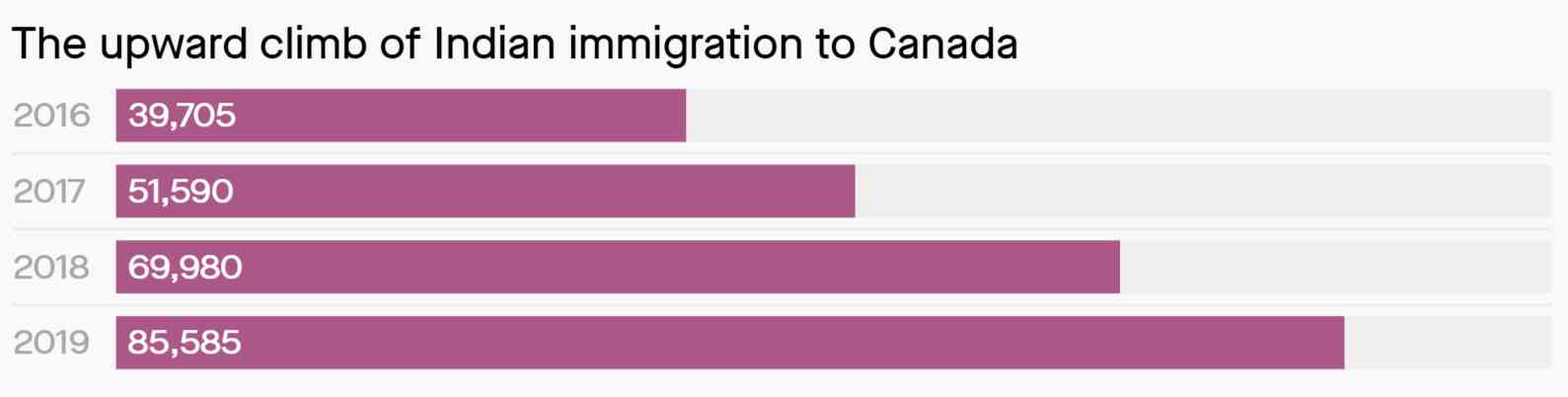
Moreover, Canada allows permanent residents to apply for citizenship after six years. Indian permanent residents admitted into the country jumped up over 117% between fiscal years 2016 and 2019, National Foundation for American Policy found.

Source: As Donald Trump tightens immigration rules, Indian tech students ditch the American Dream for Canada