Has the activist left decided #antisemitism doesn’t exist?: Neil Macdonald

Another good piece by Neil Macdonald:

The conflation of all supporters of BDS with Jew-hating is as scattershot and sweeping as the conflation of all Jews with Israel.

It ignores the inconvenient truth that some pro-Israeli Jews are embarrassed by that country’s current government, as well as the fact that some of the strongest proponents of BDS are Jewish.

But it is all of a piece with the scorched-earth nature of modern political discourse.

There is us, and them, and no-man’s land in between. Detail and nuance and history are just annoyances, to be marched past, or over.

Source: Has the activist left decided anti-Semitism doesn’t exist?: Neil Macdonald – Politics – CBC News

On Saudi arms deal, the new boss in Ottawa is just like the old boss: Neil MacDonald

As someone in the past who has written comparable memos, I can only congratulate the various writers and editors of the memo on the Saudi LAV to FM Dion. Macdonald captures it perfectly:

Well. If further proof was needed that the sunny new regime in Ottawa is perfectly capable of behaving just like the un-sunny previous regime, we now have it, in a memo that was stamped “Secret,” then rather inconveniently laid bare in the Federal Court of Canada.

The document, signed by Foreign Affairs Minister Stéphane Dion, is a gem of hair-splitting, parsing, wilful blindness and justification for selling billions worth of fighting vehicles and weaponry to Saudi Arabia, one of the most oppressive regimes on Earth.

Source: On Saudi arms deal, the new boss in Ottawa is just like the old boss – Politics – CBC News

The problem with newspapers today: the Marty Baron perspective

For those concerned about the future of media and journalism, and who liked the film Spotlight, good piece by Neil Macdonald on the assessment by Marty Baron, the former editor of the Boston Globe featured in the film:

Baron, now executive editor of the Washington Post, acknowledged the economic forces ripping the business to shreds.

Like most media managers, he has an app that shows how many readers are on any story on the paper’s website at any moment, and how long they keep reading. Those metrics are now indices of survival.

But, said Baron, news institutions must place principle ahead of metrics, or our core withers, and we become clickbait hustlers for corporate paymasters who would rather see stories about a Kardashian. (He didn’t quite put it that way, but you get the idea.)

Over dinner, I asked him how media managers in such a shaky financial environment can possibly be expected to operate without fear or favour.

Baron, who actually is as serious in person as the character played by Schreiber, put down his fork and recited a segment from a speech he regularly gives.

It is so on target that I’m going to quote its most salient passage:

“The greatest danger to a vigorous press today,” he begins, “comes from ourselves.

“The press is routinely belittled, badgered, harassed, disparaged, demonized, and subjected to acts of intimidation from all corners — including boycotts, threats of cancellations (or defunding, in the case of public broadcasting) …

“Our independence — simply posing legitimate questions — is seen as an obstacle to what our critics consider a righteous moral, ideological, political, or business agenda.

“In this environment, too many news organizations are holding back, out of fear — fear that we will be saddled with an uncomfortable political label, fear that we will be accused of bias, fear that we will be portrayed as negative, fear that we will lose customers, fear that advertisers will run from us, fear that we will be assailed as anti-this or anti-that, fear that we will offend someone, anyone.

“Fear, in short, that our weakened financial condition will be made weaker because we did something strong and right, because we simply told the truth and told it straight.”

Amen, Brother Baron.

Any reporter who has, for example, ever been based in the Middle East, or has tried to bring some sensible context to a domestic audience whipped into fear about terror, terror, terror, has often seen the mettle of his or her managers tested to the limit.

When Baron’s Washington Post, along with The Guardian, revealed U.S. government lying and law-breaking, courtesy of whistleblower Edward Snowden, public outrage was mostly directed against the newspapers and Snowden himself.

Baron made one other key point. He’s not the first one to make it, but it’s a gleam of optimistic logic in these tumultuous times: Anybody can Google anything, he said. Everyone does.

But the original information, before it is aggregated and re-aggregated a thousand times, has to come from someone with the experience, brains and training to uncover it in the first place.

That is usually the work of credentialed journalism. It’s what Baron did in Boston. The alternative is usually just spin and corporatist fantasy, and let us all hope the latter does not overwhelm the former.

Although, I have my doubts.

Source: The problem with newspapers today: the Marty Baron perspective – Politics – CBC News

Can America’s political discourse get any cruder? Neil Macdonald

Interesting if uncomfortable parallel Neil Macdonald makes between the religious extremists in the Iranian revolution and the US evangelicals:

In fact, Palin’s speech reminded me of another one I attended, years ago, in Tehran during my time as CBC’s Middle East correspondent.

Mohammed Khatami, the reformer, had been elected president of Iran, and you could taste the craving for change in the city’s mountain air.

On a whim, I decided to attend a Friday sermon by Ayatollah Taghi Mesbah Yazdi, probably the most hardline cleric in the theocracy.

He scorned the reformers and called down divine judgment on them, and exhorted the crowd to go and impose the will of the people.

It was a speech filled with hatred and religious bigotry and nativism, and the crowd absorbed it with the same sort of ecstasy U.S. conservatives evidently experience at Republican rallies nowadays.

I spoke to several people as they exited the sermon; most were rural, uneducated, and were bused in for the event. In cosmopolitan Tehran, Yazdi wouldn’t likely have been able to fill a big classroom, let alone pack in thousands of panting zealots.

‘You’re fired’

Sarah Palin, likewise, feels most comfortable outside America’s big cities, talking to the white evangelical Christians she calls “real Americans,” as opposed to the ethnic stew of the more permissive, homosexual-tolerating, non-God-fearing souls who populate the coastal population centres.

…Watching Palin and Trump, it was impossible not to wonder, once again, how America, a country that has achieved such excellence, and has so often shown the world a better way, descended into a political discourse that demonizes enlightened thought and glamorizes mean-spirited, lowbrow crudeness.

And something else occurred, a notion I’ve always shied away from because I find jingoism distasteful: None of this stuff would go anywhere in Canada. It would draw snickers and derision, not cheers.

The only reason I can cite for this difference in national attitudes is religion. Not the quiet, old-line religiosity whose adherents believe worship is a private matter, best practised in church.

I’m referring to the messianic, aggressive religion of certain evangelical Christian sects, which believe that even other streams of Christianity, never mind other faiths, are false, and that their job is not just to spread the word of God but to impose it, and that the best way to do that is to run the government.

That sort of religion happily ignores inconvenient facts and contradictions, and has always been ripe for the con job pulled by the Republican elite: promise to end atheistic permissiveness, then get into office and implement an economic agenda most friendly to Manhattan billionaires like Trump and multi-millionaires like Palin. (She recently put her 8,000 square-foot Arizona compound up for sale for $2.5 million.)

To be fair, this loopy form of religio-political fantasy is particular to the Republicans, and lots of religious Americans find it offensive to rational thought.

But it should not be dismissed, as clownish as its heroes can seem.

Think about Iran: Yazdi and his fellow hardliners triumphed. The reformers were shut down and jailed. The urban elites were cowed. It can happen.

Source: Can America’s political discourse get any cruder? – World – CBC News

Why aren’t we looking into the Saudi role in San Bernardino attack?

Neil MacDonald, on Saudi Arabia and the uncomfortable parallel with ISIS:

Usually, executions — more than 150 so far this year — are performed with a “godly” sword. In public, of course, for the entertainment of a self-righteous crowd. But there are also crucifixions and mutilations.

SAUDI-ELECTION/

Saudi woman Fawzia al-Harbi, a candidate for local municipal council elections, sits next to one of her chaperones at a shopping mall in Riyadh last month. Saudi Arabian women are running for election and voting for the first time on Dec. 12, but their enfranchisement marks only a pigeon step towards democracy and gender equality in the Islamic kingdom. (Reuters)

Saudi women are treated better than immigrants, but are still severely oppressed, and treated like chattels of the male population.

If that all sounds like the modus operandi of ISIS, which the Saudis have been accused of having funded and armed before becoming a stout ally in the U.S. bombing campaign, well, the shoe does fit.

The Saudis have actually threatened to sue anyone who makes the ISIS comparison, but objectively, it’s not unreasonable.

The main difference is that the Saudis are extremists who managed to create a nation and have it recognized. And of course their king doesn’t claim to lead a new caliphate.

It’s almost a cliché to say this is all about oil, and the Saudi willingness to sell it, and sell it cheaply in unlimited quantities, to the West.

Because it is about oil. It’s also about the Saudis’ willingness to spend billions of that petro-revenue back in the West, signing contracts for military materiel that our governments are ecstatic to arrange.

If you’re inclined to think otherwise, try this mental exercise: imagine if Cuba, or Russia, or Venezuela (or even Canada) had produced 15 of the 19 9/11 hijackers, and had remained a consistent leader in exporting murderous ideology, and radicals like Tashfeen Malik.

Source: Why aren’t we looking into the Saudi role in San Bernardino attack? – World – CBC News

Here’s a thought, what if governments weren’t so secret? MacDonald

Relevant article by Neil MacDonald given the comments by Alex Himelfarb, former Clerk of the Privy Council and Head of the Public Service:

He [Himefarb] says secrecy is essential and, at the same time, greatly overused.

Ministers and officials, he says, need to be able to speak frankly.

HARPER-SWEARING-IN TOPIX

Former Clerk of the Privy Council Alex Himelfarb, right, administers the oath of office to new Prime Minister Stephen Harper in 2006 as then governor general Michaelle Jean looks on. (Tom Hanson/Canadian Press)

Around the cabinet table, he says, it may be that somebody wants to talk back to the prime minister.

“It may be that somebody there wants to say ‘I hate what you’re doing. This is terribly, terribly wrong.’ You want people to be free to say to the PM ‘that’s a pile of garbage’ and know that the opinion will not be leaked and used against the government later,” he says.

“It is important to have zones in which courageous advice can be given freely.”

That said, he acknowledges “we have inappropriately expanded the need for legitimate zones to a massive extent. They now include message control and avoidance of personal responsibility.”

No one actually owns up to that, he says. It’s a deeper, unacknowledged reality, down in the marrow of the culture.

Moreover, he says, the holders of the deepest secrets often become “absolutely convinced that they are not only working for the people, but that they are the best people to judge whether something should be secret.”

Generational shift?

Perhaps surprisingly, though, Himelfarb believes all of that is changing, and government must accommodate and manage what’s coming, or be overwhelmed.

WikiLeaks, social media, the advent of bloggers and citizen journalists determined to root out information, and a relentless 24-hour mass media are now arrayed against the old forces of mutton-chopped secrecy.

Bureaucracies at first react by shifting defences; they respond to WikiLeaks and access-to-information laws by ensuring less is written down, or by becoming even more controlling.

But Himelfarb, for one, believes we are in the midst of a generational attitude shift. Younger people expect — demand, in fact — to be included in the process of government between elections.

Many of Trudeau’s new ministers may well be inclined to grant that, given that so many are unschooled in governing. Their lack of experience is also a lack of baggage.

Some have worked outside government, Himelfarb observes, and may have even been victimized by government.

But ultimately, it’s the prime minister who gets to decide what those oaths taken at Rideau Hall will mean in reality.

If bureaucrats sense that loosening the flow of information to the public is not just OK but actually career enhancing, and that government’s boss of bosses wants more open government, open government will be more likely.

The trick, says Himelfarb, is to ensure that only those secrets that must truly remain secret for the proper functioning of government are shielded.

Perhaps. But again, the journalist’s view: Information is power. Politics is the exercise of power. Secrecy allows information, and therefore power, to be hoarded and preserved.

Source: Here’s a thought, what if governments weren’t so secret? – Politics – CBC News

Neil Macdonald: Government sensitivity over you hearing about ‘sensitive’ information

While MacDonald is unfair to CIC DM Anita Biguzs (she had no option but to investigate the leak), his broader points are valid:

But to Biguzs and her fellow mandarins at Citizenship and Immigration, the public should never have been told any of these things in the first place, and the fact that it was constituted a grave crime.

Interestingly, Biguzs’s memo does not call the information leaked “classified.” She calls it “sensitive.” There’s a big difference.

Classified information is an official secret, determined by security professionals to be potentially injurious to national security. (Or at least that’s supposed to be how it works.)

Disclosing an official secret is a crime.

“Sensitive information,” on the other hand, is anything the government doesn’t want the public to know, and, as noted, the government that Biguzs has served for a decade doesn’t want the public to know much.

Prosecuting embarrassment

Using Biguzs’s logic, federal scientists who decide the public should know about a scientific finding about the quality of the air we breathe or water we drink are unethical underminers of democracy, too, unless they seek permission to speak, which is rather difficult to obtain nowadays in Ottawa.

Of course, when a government does want reporters to know something, the information is suddenly not sensitive at all anymore, and democracy is well-served by its disclosure, sometimes even — and I speak here with some experience — when it’s an official secret.

In the case of the immigration and passport stories, apparently, the government was embarrassed, so the RCMP are now stalking the department’s hallways, further intimidating an already scared group of bureaucrats.

Politicians, including Harper’s Conservatives, love to talk about the supreme importance of accountability. It is a word that has been milked, flogged and ridden practically to death.

So Biguzs and her political masters might want to ponder this: If the information about the refugee review and the faulty passports had been divulged in a timely fashion, as a matter of public accountability, democracy would not only have been served, there’d be no need to call the police.

Source: Neil Macdonald: Government sensitivity over you hearing about ‘sensitive’ information – Politics – CBC News

The barbaric cultural practice of election pronouncements: Neil MacDonald

Another good summary of the play on identity politics:

Instead of economic issues and the timeless election slogan of jobs, jobs, jobs, the drumbeat today seems to be Muslims, Muslims, Muslims.

It’s not quite that explicit, of course. Using that sort of language wouldn’t be “politically correct,” to borrow a Conservative attack phrase.

Rather, the language is more suggestive.

Just last week, we were reminded by the immigration minister, standing beside the minister responsible for the status of women, that Canada now has something called the Zero Tolerance for Barbaric Cultural Practices Act, and that if re-elected, the government would establish an RCMP task force, and a “tip line” for Canadians who wish to call the Mounties to denounce someone, a neighbour, it was suggested, for engaging in a barbaric cultural practice.

This fearsomely titled law is actually just a few amendments to the Immigration Act and Criminal code that outlaw a few things that are mostly already against the law in Canada — polygamy, forcing children into arranged marriages, and so-called honour killings, otherwise known as murder.

But the phrase “barbaric cultural practices” invokes so much more, especially as “barbaric” is not a legal descriptor, it’s an emotive.

The mind of the beholder

Barbarism, of course, is in the mind of the beholder.

To some people, it is barbaric to pierce a baby’s ears or slice off the skin on the end of an infant’s penis, or even what the Christian ritual of communion symbolizes.

Almost certainly, though, the title of this new law was designed to invoke other, more foreign horrors: female genital mutilation, or all the stoning, flogging, amputating and executing contained in the ferociously harsh interpretations of religious law now associated in the public mind with Islam.

What’s more, at the same time as the government was reminding Canadians of its new barbarity law, it was also stripping citizenship from people convicted of extremism. All, so far, have been Muslims.

The government says stripping of citizenship will be restricted to “terrorists and traitors.” But then both those words are just as pliable as “barbaric.”

There have been no reports that the government is considering stripping citizenship from the Sikh bomb-maker convicted in the 1985 Air India bombing — the worst act of political violence in Canadian history — or any of the surviving FLQ members convicted after the October Crisis.

None of the above is a Muslim.

Even when the government has responded to public pressure to allow in more of the miserable wretches streaming out of Syria, Stephen Harper has repeatedly emphasized that they are coming from a “terrorist war zone,” and that Canada must select “the most vulnerable” refugees, which has widely been taken as code for “Christians.”

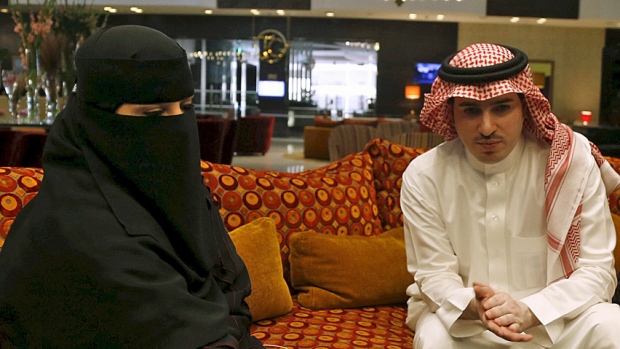
Then of course there are the two Muslim women who, alone in all of modern Canadian history, insisted on taking a citizenship oath while wearing a niqab (a word most Canadians had probably never heard of before this election).

The Federal Court of Appeals says they were within their rights. And yet, in the nativist ether of this particular election, Canadians are effectively being asked to decide if they are a threat to our way of life.

Muslim, Muslim, Muslim …

‘Canadian values’

A corollary to all this is the suggestion that there are two sorts of Canadians: those who stand consistently and unswervingly with Israel, and those who stand against the Jewish state, most probably with its (Muslim) enemies.

Harper has suggested that criticism of Israel is a mask for anti-Semitism.

And just last week, a Conservative candidate in Winnipeg, Joyce Bateman, chose to answer a question on the economy by listing Liberal candidates whose support for Israel she deemed insufficient.

She ticked off names, arriving finally at Andew Leslie, a decorated former Canadian lieutenant-general who commanded the fight against the Taliban in Afghanistan

She was booed, but remained unapologetic for rhyming off her party’s talking points.

“It is a choice between standing up for Canadian values in a dangerous world, or returning to the days of going along to get along,” she said.

Political journalists, working under the stricter dictates of moral equivalence imposed during election campaigns, refer to this kind of talk as “identity politics.”

Being under the same strictures myself, I can’t really go much further. But it does sound an awful lot like the Barack-Obama-is-a-Muslim-who-hates-Israel stuff I heard so much when I covered American campaigns.

Just out of curiosity, I called the RCMP’s media relations department to ask about this new task force and what sort of barbaric cultural practices would merit a call to the Mounties.

The officer who answered said that if, say, an honour killing is taking place next door, it’d be best to dial 911 and tell the local police.

Otherwise, the force said in an email about 20 minutes later: “It would be inappropriate for the RCMP to comment on a political announcement.”

“A political announcement.” What a dry, refreshing description.
Source: The barbaric cultural practice of election pronouncements – Politics – CBC News

The niqab debate, let’s not forget, is about individual rights: Neil MacDonald

A further reminder, no matter how much we may dislike the niqab and how much we feel that wearing it is inappropriate (at a citizenship ceremony or elsewhere):

In too many instances, the niqab is clearly an instrument of inequality; using it to indoctrinate young girls is, on the face of it, probably a human rights issue.

But then, indoctrinating children is how religions ensure their continuity. Society has accepted that religious parents have the right to impose religious practices on their children. The children have little say in the matter.

And the decision of a grown woman, like Zunera Ishaq, to cover her face at a public ceremony is, well, the decision of a grown woman.

Sure, Stephen Harper, and a lot of other people, think the niqab is rooted in an anti-woman culture, but where does that argument end once the heavy hand of government becomes involved?

Harper’s own immigration minister, Chris Alexander, has already conflated the niqab and the burqa, which cover a woman almost entirely, with the hijab, which can simply be a headscarf, and which millions of Muslim women wear.

And if a government can base public policy on a belief that one monotheistic religion has misogynistic doctrine, might not some future government turn its attention to the treatment of women by orthodox streams of the two other monotheistic religions?

A niqab can appear sinister to someone who hasn’t lived in the Middle East. It has clearly become a distillation of Canadians’ unease about fundamentalist Islam.

But there is no law against wearing it, and any eventual law will need to scale the impassive walls of the Supreme Court and the Charter of Rights.

Former Liberal prime minister Jean Chretien, in his awkward fashion, nailed it last week.

“It’s not am I comfortable or not” with women covering their faces, he said. “Makes no difference at all. It’s a question of rights and it will be for the court to decide.”

Makes no difference at all. Precisely.

Source: The niqab debate, let’s not forget, is about individual rights – Politics – CBC News

Baltimore shows police killings America’s real state of emergency

Neil MacDonald on police killings in the US and the relative risk of being killed in the US by the police is much greater than being killed by terrorists. Of course, as all the numbers show, the likelihood is much greater for Blacks:

Today, though, even the conservative voices that have for so long defended law enforcement are wavering.

Take some time and browse the libertarian Cato Institute’s online National Police Misconduct Reporting Project.

It’s a scholarly work, and evidence gathered is weighed carefully; in fact, the last full year for which they have issued a definitive report is 2010.

That report identified 4,861 formal incidents of police misconduct involving 6,613 law enforcement officers and 247 civilian fatalities for that year alone.

If just a fraction of those fatalities were criminal, then the inescapable conclusion is that more people have been murdered by police in America in the last 10 years than by terrorists.

Of course, we are told, we don’t know how many terrorists have been thwarted by vigilant behind-the-scenes enforcement.

Well, true. But given the minuscule number of prosecutions, let alone convictions, neither do we know how many of the people who are supposed to be guarding us have gotten away with murder.

Baltimore shows police killings America’s real state of emergency – World – CBC News.