May: Building a culture of public service on hybrid work, Speer: It’s time for public servants to return to the office

Some good comments by those interviewed:

….Spicer, who teaches values and ethics, expects the government will face clashes between “individual values and organizational values.”

“There hasn’t been a lot of weight put behind ethics … and we now have a lot of younger folks coming in who don’t have the same kind of understanding of what it means to be a public servant, what it means to act purely within the public interest,” he says.

Spicer says many have a weaker connection to the notion of public service. Some still have the “spark” and see it as a calling. Others, however, see it as little more than a secure and steady job with benefits. Then there are advocates who want to advance a cause, such as climate change or sustainability.

The last group is more likely to quit if they don’t see progress, if their advice isn’t taken or if a change in government takes policy in a different direction or undoes policies, Spicer says.

New recruits are also more culturally diverse. Many have experience in the private sector, other levels of government or are transitioning between sectors. They tend to be professionals, bring expertise from their respective fields and often identify more closely with their profession’s code of conduct than with traditional public service norms.

The era of social media and gig employment

Spicer says they grew up on social media and juggling different jobs. Many see no reason why they can’t voice their opinions on social media or pursue a side hustle while working in government – both of which were traditionally frowned upon and are still controversial.

Public servants claim to be more productive since they began working from home, but a consensus that government needs fixing has emerged. It is too big, slow and risk-averse to deliver its basic services, let alone get ready for the world’s crises. On top of that, trust in government is dropping.

Turnbull says the political timeline “is already so much faster than the public service timeline” and working from home slows that down. The “values-transmission question” is urgent, especially with so many new public servants, she argues.

Fox says the government is committed to a hybrid work model, but departments must be more deliberate about creating a workplace culture that reflects “who we are.”

“We’ve got to have more emphasis on our environment and our learning within so people feel that they’re part of something larger and they understand the responsibilities that come with that.”

Linda Duxbury, a professor of management at Carleton University and expert on work-life balance and remote work, counters that both the unions and the government are misguided in the battle over hybrid work.

She argues there is no one-size-fits-all solution and that people need to be where the jobs can be done. A meat inspector must go to a processing plant and a customs officer must go to the border, but many other public service jobs can be done from anywhere.

However, she added that public servants’ complaints about time and money spent commuting and on lunches and child care are not the employer’s problem. These gripes also don’t fly with Canadians.

“Your job is to serve the public. So, are you serving them? Are you serving yourself?” she asks.

Duxbury says both the government and unions need to “stop with the stupid rhetoric” and start designing jobs to get the best work done. “There is not a simple solution here, so stop talking as if there is.”

Source: Building a culture of public service on hybrid work

And from Sean Speer on the politics and perceptions:

It’s time for Canada’s public servants to return to the office

On last week’s Roundtable podcast, Rudyard Griffiths and I were critical of the public sector unions’ over-the-top reaction to the federal government’s new policy that public servants must be in the office three days per week beginning in September. 

Our weekly exchange generated a bigger reaction than normal. Most of the response was positive. But some were critical of our comments, including those who support remote work in general and those who believed we were wrong to single out public sector workers in particular. 

I thought it might be useful to elaborate on our objections to the union reaction to Ottawa’s back-to-work plan. 

Although we generally think that the negative effects of remote work are underestimated and that all things being equal, workers benefit, individually and collectively, from being in physical proximity with their colleagues, we believe that it’s reasonable to have asymmetric expectations of public sector workers. 

That is to say, while our personal belief is that people should generally be back in the office, we recognize that in the private sector those decisions will be made by employers based on their understanding of the interests of their respective companies. 

Government workers, by contrast, should, in our view, be thought about differently. As taxpayers, we have a collective interest in their workplace arrangements.

There are three chief reasons why we think public servants should be back in the office.

First, we’ve discovered through the We Charity scandal, the ArriveCan scandal, and the details of public servants earning millions of dollars as third-party contractors that there’s a “crisis of culture” in the federal government. One proof-point: The federal public service has grown by more than 40 percent since the Trudeau government took office and yet its service standards and state capacity seem to have deteriorated. Getting back into the office is a crucial step to restoring a more performance-driven culture.

Second, the unionization rate is almost five times higher in the public sector which means that there are inherent limits on the employer’s ability to terminate unproductive or underperforming staff. This is important because we know that public-sector productivity is already generally lower than the private sector’s. Working-from-home can enable public sector workers to lower their productivity even further and yet the government has little to no recourse to address it. Getting back into the office should be understood as a key mechanism for accountability in an employer-employee environment in which traditional forms of accountability are weak or essentially non-existent.

Third, as we discussed on the podcast, there’s something inherently unfair about public sector workers who already benefit, on average, from higher wages, more benefits, and greater job security relative to their private sector peers to also have more flexible workplace arrangements. But there’s also a risk that, in an era of labour scarcity, an asymmetry between the public and private sectors could create perverse incentives for where people want to work. A growing concentration of scarce talent in the public sector due its long list of advantages could come at the expense of Canada’s long-run dynamism and productivity. 

That’s because, whatever the strengths of the public sector, it’s not generally viewed as a source of productivity. Many in fact would argue that Ottawa is actually a drag on productivity—which is to say, the deadweight loss of financing and staffing the government typically subtracts from the more productive deployment of these resources in the broader economy. Therefore, as we face a combination of slowing labour growth and ongoing weak productivity, we cannot afford for the government’s workplace arrangements to distort the labour market. 

The upshot: Federal public servants—it’s time to return to the office. 

Source: https://thehub.ca/2024-05-18/the-weekly-wrap-being-young-doesnt-make-right/

May: Office Blues (government back to office)

Unlikely to garner much sympathy (public servants rarely do!) but out of step with overall trend of office workers returning to the office. Not sure how many will actually “demote out” of being an executive. But appreciate the adjustment challenge:

The more than 9,000 executives who normally keep their heads down publicly are raising alarms.

APEX is getting lots of reaction from its members. Executives are now required back in the office four days a week. Some accept the shift as part of the job, but most are disappointed and surprised at the lack of consultation.

Some say they are thinking of leaving executive roles and “demoting out.” There is also a concern that the four-day requirement will discourage people from applying for promotions.

Many feel they don’t have the tools and support to smoothly manage the transition – like they don’t have the space, desks or the office configurations for their teams to be productive.

They also question this decision when the government is committed to reducing half of its office space portfolio over the decade.

Executives feel they have faced many challenges managing teams at a distance while scrambling to deliver programs during the pandemic. This is seen as another one piled onto an already taxing workload. The “straw that broke the camel’s back,” said one.

APEX says stress is high among executives, mental-health claims are rising, and this decision won’t help.

“These issues are real and concerning,” said APEX CEO Carl Trottier. “APEX has started consulting the executive community to better understand their concerns and will advocate tirelessly on their behalf to support them as they are faced with implementation.”

Source: May: Office Blues (government back to office)

Black public servants locked in three-year legal battle with Ottawa with no end in sight [and related equity issues]

Good overview. One issue I have is the lack of comparison with other minority groups. Citing the numbers for Black public servants without the other groups provides an incomplete picture, as the table below shows, highlighting that other groups have more significant under-representation than Blacks, both at the all public service and EX levels. Disaggregated data for the last six years shows similar differences (https://multiculturalmeanderings.com/wp-content/uploads/2023/05/ee-analysis-of-disaggregated-data-by-group-and-gender-2022-submission-1.pdf):

Jasminka Kalajdzic, director of the Class Action Clinic at the University of Windsor, says the mere pursuit of the lawsuit has already led to more changes than what a public servant could ever achieve with a grievance.

For example, Treasury Board is working on a more accurate self-identification process and centralizing employment equity data collection and reporting. As well, many departments have created anti-racism secretariats.

The government committed to a Black justice strategy and set aside $46 million in funding for a Black mental-health plan, although efforts to get that up and running have been mired in controversy.

The government recently announced a new panel to develop a “restorative engagement” program to address discrimination.

There has also been a flurry of promotions. In August 2022, Caroline Xavier became the first Black deputy minister when she was appointed president of Communications Security Establishment – 33 years after Ontario appointed its first Black deputy minister.

The Black Executives Network, established in July 2020, delivered its first report in June 2023, which noted “tremendous progress” in building a Black executive community over the past three years. The number of Black executives in the federal public service has grown to 168 today from 68 in 2016, with four deputy ministers and 15 assistant deputy ministers and a few dozen directors-general.

That’s still only about 2.3 per cent of the executives in the core public service, while Black people account for about 4.2 per cent of all public-service employees.

“This (issue) is so much bigger than the Black class action,” says Courtney Betty, the plaintiffs’ lead lawyer. “This is reflection of Canadian society. This is who we are. And for many Black individuals, that’s what they feel. It’s not a reality for any other Canadian. But for Black Canadians, it is a reality.”

Source: Black public servants locked in three-year legal battle with Ottawa with no end in sight

Articles of interest: Government and politics

More of a grab bag:

Wernick: The pay-as-you-go proposal on cutting federal spending not as simple as advocates say

Michael continues to provide interesting commentary based up his experience in government:

There are two interpretations of what pay-go legislation could mean in Canada. One is that the proponents know it is just for show – a form of fiscal virtue signalling – and they have no intention of applying it with any rigour. The future would be full of exemptions, waivers and extensions. It makes the base happy and looks like decisiveness. But it isn’t serious.

The other possibility is that it is serious and would at regular intervals create a hot mess for future governments and for future fiscal choices. It isn’t going to deliver more effective government to let an algorithm stack the deck, distort the options, create unnecessary and artificial crises, and stealthily erode those parts of government that don’t have political and media champions.

So, which is it – empty virtue signalling or a hot mess of fiscal distortion? We can do better, either way.

Any political party that wants to take real action on restraining spending should do it in a serious way: Let Canadians know before the election what it considers cuttable and what it considers a priority. Once in office set up a deliberative process. The 1990s program review would be my starting point for designing the next one.

What is essential and what is discretionary in government spending is a political judgment informed by ideologies and values – a judgment that must be responsive over time to new facts and realities.

There are many better ways for democratically elected politicians to approach spending restraint and to achieve it. Pay-go legislation isn’t a good one and should be discarded before the platforms for the next election are written – after which it will be difficult to turn back.

Source: The pay-as-you-go proposal on cutting federal spending not as simple as advocates say

Buruma: Geert Wilders may have shock value, but he harbours an ‘outsider’ rage we’ve seen before

Of note:

Mr. Wilders may not be a fascist, but his obsession with sovereignty, national belonging, and cultural and religious purity has a long lineage among outsiders. Ultra-nationalists often emerge from the periphery – Napoleon from Corsica, Joseph Stalin from Georgia, Hitler from Austria. Those who long to be insiders frequently become implacable enemies of people who are farther away from the centre than they are.

Source: Geert Wilders may have shock value, but he harbours an ‘outsider’ rage we’ve seen before

Kurl: Pierre Poilievre needs to choose his words much more carefully

Yes, the risks are there:

The last six weeks have brought out the worst in us. Bomb threats and shootings at Jewish schools. Calls for doxxing, censure and harassment of students and faculty who sympathize with Palestinians and ceasefire calls. In Toronto alone, police are reporting 17 incidents of Islamophobic or anti-Palestinian hate crimes since Oct. 7 (compared to just one in the same period in 2022). Antisemitic hate crimes numbered 38 (last year it was 13 in the same period) and now comprise half of all hate crimes reported to Toronto police since Oct. 7.

At such a fraught time, leadership from Poilievre would see his words about these highly sensitive issues focused on appealing to Canadians’ better natures, not further driving them into suspicion and division.

But will the opposition leader and his strategists do this? We are not so far removed from the failed Conservative campaign of 2015, notorious for its “barbaric cultural practices” tip line. The director of that disastrous campaign is reportedly tipped to direct the upcoming one.

Poilievre and the Conservatives for now, anyway, have the support of a plurality of Canadians. They need to start acting like it means something to them.

Shachi Kurl is President of the Angus Reid Institute, a national, not-for-profit, non-partisan public opinion research foundation.

Source: Kurl: Pierre Poilievre needs to choose his words much more carefully

May: Chief information officer Catherine Luelo resigns from job revamping federal tech

Doesn’t bode well:

Private sector executives, unfamiliar with the culture and complexity of operations, have historically had rough time making the adjustment, said Michael Wernick, a former clerk of the privy council and now the Jarislowsky chair of public sector management at the University of Ottawa.

He said the government has never resolved how technology should be managed. Is it a single service with common standards, interoperability and cybersecurity? Or is it a loose federation of 300 departments and agencies where deputy heads and managers have autonomy? It now operates with both philosophies, depending on the agency.

Source: Chief information officer Catherine Luelo resigns from job revamping federal tech

Clerk of the Privy Council John Hannaford relaunches ethics and values discussion in the public service

Count me among the sceptics despite the need and I share the concerns and questions raised by others. The Tait report was written by one deputy working full time on the report rather than having a committee of deputies, likely accounting in part for its clarity and sense of purpose:

Canada’s top bureaucrat is making values and ethics a top priority, striking a task force of deputy ministers to lead a “broad conversation” on reaffirming the core values of a non-partisan public service in a changing world where crises never stop.

John Hannaford, named clerk of the Privy Council Office three months ago, put together the five-member task force with marching orders to “bring our collective values and ethics to life within a dynamic and increasingly complex environment.” He sent notice of the new task force to all departments last week and outlined the plan in a keynote speech at recent conference that was closed to the media.

“As head of the public service, fostering a renewed conversation on values and ethics will serve as one of my priority areas of focus over the next year and will support the effective management and renewal of our public service,” he wrote in a letter to public servants.

Hannaford said the task force will spend the next several months conducting outreach with public servants, networks and communities — both inside and outside the public service. He expects a “milestone report” by the end of the year.

Meanwhile, he wants every department, branch and division to come up with activities and ways to discuss public service values and ethics and what they mean in today’s world.

The task force will be chaired by Catherine Blewett, a former top bureaucrat in Nova Scotia who is now deputy minister of Economic Development and president of the Atlantic Canada Opportunities Agency.

Other members include: Stephen Lucas, deputy minister at Health Canada, Christiane Fox at Immigration, Refugees and Citizenship Canada, and Caroline Xavier, the chief of the electronic spy agency Communications Security Establishment (CSE). Donnalyn McClymont, PCO deputy secretary for senior personnel and public-service renewal, will support the task force as an ex-officio member.

A first in 30 years

This marks the first major values and ethics review since the groundbreaking report A Strong Foundation, by former deputy minister John Tait nearly 30 years ago.

That report was also built on a conversation with public servants. It laid the groundwork for values-and-ethics code that came into effect in 2003 to govern how public servants work, behave and their relationship with Parliament, ministers and Canadians.

Tait’s report also grew out of a task force of deputy ministers appointed by then-PCO clerk Jocelyne Bourgon at a time of huge flux. She created nine task forces to study the big challenges for public servants in the aftermath of the  Chrétien government’s historic program review. That review completely rethought the role of government and wiped out more than 50,000 federal jobs to beat a crushing deficit.

Times have changed, but Hannaford said the core values outlined in Tait’s report — respect for democracy, respect for people, integrity, stewardship and excellence — are enduring and are still the compass to guide public servants’ behaviour.

“Our world is increasingly dynamic, complex, and ever-changing,” Hannaford wrote in a letter to departments.

“As public servants, we play an important role in the Canadian democratic system. We continue to rise to the occasion to serve Canada and Canadians. Our public-service values and ethics serve as an important compass to guide our actions and behaviours, particularly as we adapt and evolve in times of change.”

He said the task force’s work will complement other ongoing priorities to improve workplace wellness, accessibility, anti-racism, equity and inclusion and reconciliation. 

Public servants work in much different circumstances today, but like 30 years ago they face challenging questions about what they do and how they do it.

Public servants feel besieged these days by everything from workload to hyper-partisan politics. Federal executives report high levels of stress and burnout with rising levels of cynicism and mental-health problems. A Top of Mind report found public servants at all levels of government worry they can’t speak truth to power and have to toe the party line in giving advice

They’ve come through a pandemic, the convoy protest, service-delivery fiascos, the biggest strike in 30 years, working remotely and are now in the throes of a $15.4-billion spending review. The public service, at 350,000 people, has never been so big, so diverse, and millennials now dominate the workforce with very different attitudes than their baby-boomer predecessors.

Then there’s climate and geopolitical crises after crises. There is war and floods and fires, soaring inflation and housing shortages compounded by the day-to-day distractions of social media, hyper-partisan politics, and the 24-hour news cycle.

Questioning “moral fibre”

Stephen Van Dine, who led the Top of Mind study, asks why the clerk is focusing on values and ethics when public servants are worried about basics like giving fearless advice, eroding policy capacity and the impact on governance. He said this is sure to raise alarms among public servants who will be asking, “What did we do wrong?”

“Why in heaven’s name would you start with values and ethics unless you believe the root problem is the moral fibre of the public service at this stage,” he said. “Why not examine what public-service leadership looks like in the 21st century?”

Senior officials say Hannaford isn’t re-opening the code or picking between new and traditional values. Hannaford also isn’t sounding the alarm about the public servants’ integrity. They say it is about adaptability: he wants public servants to better understand how to apply long-held  values in a rapidly changing world.

Alasdair Roberts, a professor of public policy at the University of Massachusetts Amherst and former visiting scholar at the Canada School of Public Service, studies how countries can adapt and thrive in this turbulent century.

Roberts point to a number of threats to Canada’s adaptability, but the health of the public service and its ability to execute quickly is a key one.

The mountain of controls, rules and new parliamentary watchdogs built up over the decades – all in the name of accountability – stifles innovation and makes publics servants risk averse, he said. On top of that, they face a new layer of political control – which he calls the “political service” of ministerial staffers.

And then there’s the shift to remote work, which raises big questions for leaders on how to build common purpose and values when people are rarely working together in-person.

Although Hannaford is tying the exercise to a renewal of the public service, the preliminary plan falls short of the kind of major reform critics have called for over the years.

Donald Savoie, considered the éminence grise of public administration in Canada, argues the public service has so lost its way that only an independent body like a royal commission could fix it.

Roberts, who supports the call for a royal commission, called Hannaford’s task force worthwhile and well-timed, but five busy deputy ministers, under-the-gun in their day-jobs, will be constrained in what they can do.

They can’t really tackle legislative barriers, the morass of controls, rules and structures and outdated processes that need to be fixed. They also can’t grapple with the vexing question about the role of the public service, especially its strained relationship with ministers, Parliament and political staff.

Many argue the clerk simply doesn’t have time for the kind of review needed. With an election two years away, if not sooner, he has to be deep in transition planning. And if polls hold out, a Conservative government could come to power with a very different view of the public service and the role of the state.

Others, like Alasdair Roberts, question whether values and ethics can be discussed without sorting out the role of the public service: “I don’t want to diminish the significance of doing this, but it can’t be a substitute for a broader, bigger and independent review about the role and structure of the public service.”

Source: Clerk of the Privy Council John Hannaford relaunches ethics and values discussion in the public service

The public service is ailing. Janice Charette says organizational health is the next big challenge

Perennial challenge, diagnostic easier than solutions given size, complexity and diversity of government programs along with the political-public service interface:

Janice Charette left the job as Canada’s top bureaucrat stressing that the public service must turn its attention to “organizational health” so it can manage in a world seemingly gone haywire with one crisis on top of another.

Charette, who retired last week as clerk of the Privy Council Office, called organizational health the “new frontier” in renewing the public service, which emerged from a once-in-a-century pandemic with its management performance – the good and the bad – fully exposed.

Every part of society, every family, every employer is dealing with significant changes to the way we live, socialize and interact because of the pandemic, she said in an interview.

“But the conversation we need now is around organizational wellness. How are organizations dealing with one crisis after another, with workload pressures 24/7 and in the complicated and somewhat conflictual operating environments governments are functioning in?”

That conversation is a tall order. Critics and observers say there’s so much that needs fixing in the way human resources, technology and finances are managed. They were built for another time and are out sync with the speed and expectations of the digital age.

The public service, with 350,000 employees, is also as big as it has ever been, and the social and economic problems it tackles more complex.

Organizational health is one of those corporate buzzwords that boils down to how effectively an organization manages and adapts to change.

“An enterprise focus on organizational health is exactly what this government needs because the need to be adaptable, resilient, and engaged is not going away,” said Stephen Harrington, Deloitte’s workforce strategy advisory leader.

He likens it to training for a marathon. You have to prepare, eat, train, and sleep right.

Charette and her predecessors have spent years working on ways to support health and wellbeing of their employees – with varying degrees of success. They’ve made mental health, accessibility for persons with disabilities, reducing anti-Black racism and increasing diversity and inclusion top management priorities. They’re all linked and part of recruiting a public service that reflects the country.

The shift in emphasis must come as workloads are increasing, stress is high and disability claims are climbing. Workplace issues have a disproportionate impact on the mental health of Indigenous, Black and racialized workers, those with disabilities, and those from religious minorities and the 2SLGBTQIA+ community.

Charette said examining organizational health means analyzing how structures, controls, rules, processes and oversight is contributing to work overload, long hours, and stress, as well as turning off the skilled workers it needs to keep and attract.

Charette recently told a mental-health conference that Canada’s largest employer needs a reset.

“You can’t boil an ocean”

“Leaders need to think about how we pivot now to support organizational wellness. COVID also gave us some not-so-great work practices – workers were at home and available to work 24/7. That is wonderful and essential in a crisis.  But it is not sustainable.”

She argues a key part of the next renewal is figuring out what issues to focus on because “you can’t boil an ocean.” Charette, however, steers clear of prioritizing what should be tackled first, leaving that up to her successor, John Hannaford, who takes over this week.

“How do you make sure that public service is fit for purpose in a very different world going forward? That is a timely question, and that’s going to be a question for my successor,” she said.

“I’m going to leave to John to define what his priorities are going to be and how to approach them.”

Clearly, the big issue is workload.

The Liberals have an ambitious agenda with big plans for climate change, transition to a clean-energy economy, and reconciliation – not to mention cabinet ministers loaded up with hundreds of must-dos in their mandate letters. Then there’s the impact of crises erupting around the world and all those day-to-day issues that crop up.

And she’s lived it. As she says, whatever issues landed on the prime minister’s desk landed on hers.

As clerk, she stickhandled the emergence from the pandemic, a shift to hybrid work, service delivery cockups with passport and immigration backlogs and the biggest public-service strike in 30 years. There is the war in Ukraine, a trucker protest, the invoking of the Emergencies Act and the machinery-of-government crisis over foreign interference. Don’t forget floods, fires, soaring inflation, housing shortages and all the day-to-day distractions of social media, partisan attacks and 24-hour news cycle.

Everyone talks about the world being in  “polycrisis,” the term popularized by historian Adam Tooze to describe the coming together of multiple crises at once with the ensuing damage greater than the sum of each part.

“I’m a believer that the polycrisis is here to stay. I think that is a feature of public administration,” Charette says.

The government has enduring priorities, she says, that include addressing inequality, fixing climate change, Canada’s economic growth, prosperity and role in the world.

“All those (priorities) don’t change. It’s the layer of stuff that’s sitting on top of it, and then the crises,” she says.

“The questions for renewal going forward are whether we are affectively organized for that world. Are we trying to do that and everything else at the same time?”

And Charette worries the public service is not ready.

She said it’s as if everyone thought that once the pandemic was over, we would get back to the way things were. She likens it to waiting for “regular programming to resume after this special broadcast.”

“You know what?” she said. “There is always going to be a new special broadcast. I think the world of ongoing special broadcasts in a world of regular programming is here to stay.”

A more permeable public service

During Charette’s final days as clerk, senior bureaucrats, academics and politicians were blocks away in an Ottawa hotel at a conference talking about governments’ institutional resilience during COVID-19. They talked about lessons learned by governing in a crisis and how to adapt for the next one.

They rhymed off examples of governments pulling off feats unimagined pre-pandemic – and in record time. But there’s a lot that needs fixing for public servants to do their jobs better: procurement rules, an outdated job classification system and staffing rules. It can take nearly a year to hire someone. Unions are stuck in an industrial labour regime. There’s too much reliance on contracting. Old legacy IT systems had to be tricked to get out COVID-19 benefits.

A key piece of a reset should be driven by skills, Harrington of Deloitte argues. The government needs to “upskill and reskill” because the skills the government needs will change rapidly. Generative AI alone is going to replace tasks, eliminate jobs and even create new ones.

Charette acknowledged it may also be time to re-think a career public service and make it more “permeable.” Rather than spending 35 years in the public service, people could work there for a few years, move to the private and nonprofit sectors, and perhaps return to the federal government.

Alasdair Roberts, a professor of public policy at the University of Massachusetts, just finished a stint as the Jocelyne Bourgon Visiting Scholar at the Canada School of Public Service, where he studied adaptability as key to countries’ survival in this turbulent century.

He argues one of the big threats to Canada’s adaptability is the health of the public service. Public servants’ risk aversion stems from a 50-year build-up of controls with new oversight watchdogs to improve accountability, he maintains. On top of that, bureaucrats face a new layer of political control, the growing arm of ministerial staffers he calls the “political service.”

“A country cannot be adaptable if its public service is incapable of taking new ideas and translating them into action efficiently,” he said.

Charette cautions a big challenge in sorting out the obstacles is “how we put a bias on agility and responsiveness without losing the due diligence we need as stewards of public resources and the public interest.”

Roberts joins Donald Savoie, Canada’s pre-eminent scholar on public administration, in calling for a royal commission on reforming the public service.

“We can’t expect public-service managers to have the kind of oversight bodies we have now looking over their shoulders every single day,” said Savoie.

The clerk’s role comes with the power and influence to lead a major reform, but Hannaford won’t have the time to do it, Savoie argues.

“It’s not that the incoming clerk is not up to it, but he is too busy. Too many crises thrown at him. Too many issues. Ministers bouncing around to keep under control. So many issues. I think what you needed is a parallel process, call it what you want, to look at these fundamental issues.”

Source: The public service is ailing. Janice Charette says organizational health is the next big challenge

May: The time and place for consultants

Good discussion and commentary on the issues which reflect some longstanding management failures at both political and bureaucratic levels as well as the overall complexity of government and accountabilities:

Canada’s budget watchdog says it’s time for a “deep dive” into the workings of the public service to unravel why departments are spending billions of dollars on consultants while also hiring a record number of employees.

Parliamentary Budget Officer (PBO) Yves Giroux said the recent spotlight on the government’s growing dependency on contracting for professional services — for everything from policy advice to running programs — raises fundamental questions about the role of the public service.

“Do we have the public service that we need right now?” he said in an interview. “Is it well equipped to deal with the challenges and the expectations that Canadians have of the public service — especially in light of its growth in recent years and the extensive use of outside advice and services?

“I think it’s time to do a real deep dive.”

Giroux is joining a growing chorus of experts who argue it’s time to fix the public service. Former clerks of the Privy Council Office, senior bureaucrats and academics are weighing in with views on what’s wrong and possible ways to fix it.

Giroux’s call comes with the release of his latest report on the government’s spending plans. They showed the cost of outsourcing will hit a record $21.4 billion this year. Spending on contracting has increased by more than a third since 2017-18.

He said the growth of consultants during the COVID-19 crisis was expected, but it hasn’t stopped. Rather than slow down to pre-pandemic levels, contracting which shot up 20 per cent in 2021-22, is still growing at a rate of more than 10 per cent this year.

The bigger question is why departments are adding thousands of employees to the federal payroll at the same time. The number of new hires has grown in lockstep with more consultants.

“If you increase the size of the public service, it’s because you feel there are needs that need to be met. That should reduce the use of consultants, but it’s not happening. They’re both growing in line,” said Giroux.

Personnel costs are the biggest single operating cost in government. The PBO estimates the seven-year hiring boom under the Trudeau government is expected to push the size of the workforce to about 409,000 jobs within five years. 

The PBO said spending on personnel grew an average of 6.7 per cent a year – from $39.6 billion to $60.7 billion since 2015. That’s about a four-per-cent increase in compensation for each full-time employee.

Giroux said it might make sense if services were improving, but the bureaucracy is taking a beating for backlogs and delays in passports, immigration, access to information and privacy (ATIP) requests, veteran services and employment insurance.

It also doesn’t add up because the government and unions claim public servants are as productive, if not more, since the pandemic and the recent shift to hybrid work.

“Services are not improving significantly. In fact, some would say they are improving not at all… So, I wonder what’s going on? It’s a real mystery,” said Giroux.

The House of Commons government operations committee is juggling three separate probes into federal contracting. The most politically charged is the $116 million the Trudeau government spent on scandal-plagued consultants McKinsey & Company. Canada’s auditor general Karen Hogan announced she will conduct a review into the McKinsey contracts.

The committee is also widening its study to contracts of other big consulting firms — Deloitte, PricewaterhouseCoopers (PwC), KPMG, Ernst and Young (EY) and Accenture.

Many worry the committee hearings are so focused on the political blowback of tarnished McKinsey and its possible ties to the Liberals, that getting at what’s behind the growth of consultants and employees is getting lost.

Consultants, who are hired for their expertise and new ideas, never seem to leave. Once in, they get a lock on work and prevent the public service from developing its own in-house expertise.

There are no hard-and-fast rules for departments to follow on what work is best done by public servants or contractors. Many expect such guidance will be one of the recommendations out of these studies.

Treasury Board argues both are growing simply because there is so much more work. An activist government, the Liberals have fingers in many pies and ministers have mandate letters with long to-do lists. Treasury Board President Mona Fortier has saidthe cost of professional services as a percentage of federal spending has largely remained the same since 2011.

Dominic Barton, McKinsey’s former global managing director, told MPs that McKinsey doesn’t provide policy advice. Rather, it “executes” what government wants to do, be it streamlining its pay or passport processes or digitization, moving paper-based operations to electronic.

But Barton also said the public service operates in the “stone age” and the government needs to up its game with more training and new technology.

“There’s a technology transformation that’s needed in this government and in all governments. I don’t want to be harsh about it, but we’re in the Stone Age. We have to spend the money. That will need a lot to be able to do it, but it will enable the organization to do more if we do it.”

The government is heavily reliant on IT consulting. Thirty per cent of its IT jobs are vacant and the experts they need are often not interested in becoming public servants. All this scrutiny will make public servants skittish about using them which could be a problem because “government can’t run without them,” said one senior bureaucrat.

The government contracts for all kinds of services. For cleaning, security, building maintenance, translation, temporary help and IT services. A Carleton University research team studying federal contracts took a run at breaking down the kind of services consultants offered departments.

Management consulting, which is typically for advice, is a small portion of government’s contracting bill for professional services. It has grown the most since in recent years and hit about $800 million in 2021-22.

But it’s the public service’s job is to provide frank and “fearless” advice to government – advice that puts the public interest first.

The growth in consulting raises questions whether public servants have lost its capacity to provide policy advice or their advice isn’t sought or trusted. Maybe they lack inhouse expertise or savvy to be good shoppers and buyers? Or are risk-averse public servants so cowed by years of bashing and criticism they opt for the safer course of running ideas by consultants or hiring those who provide the answer they think their political masters want to hear?

A common concern among those calling for reform of the public service is the centralization of power in the prime minister’s office and the frayed trust between politicians and bureaucrats. That relationship underpins Canada’s Westminster-style democracy.

Giroux, a long-time public servant before becoming an agent of Parliament, believes the public service has the capacity to provide advice if there’s an appetite for it.

“Is it because ministers don’t trust the advice they’re getting from the public service, which would be a big issue,” he said. “I think it leads to the need for a deep dive a thorough look at the state of the public service. Is it still the public service that politicians the executive, parliamentarians and Canadians expect.”

Giroux said the public service needs a top-to-bottom review of how the public service is structured, organized and equipped to deliver the kind of services Canadians expect today. In a 24/7 world, the public service has to rethink how it works, hires, pays, manage its workers, including where they work and hours of work.

Michael Wernick, a former clerk and Jarislowsky chair at the University of Ottawa agrees structural issues are key. He says the “core software” of government – its mountain of rules, job classifications, human resources regime and technology, are outdated.

“There’s very little attention to how it works. Its internal governance and processes and structures – basically the software on which it runs is like Windows 95,” he said

Donald Savoie, one of Canada’s leading experts on public administration, has argued for a royal commission. He said the “alarm bells about the public service have been ringing for a long time” and it’s time for a debate. Savoie says he was an “academic in the wilderness” when he warned about eroding trust and the concentration of power in the 1999 book, Governing form the Centre. Now, it’s a premise that’s widely accepted.

But Savoie said any efforts to reform the public service won’t get off the ground without the support of the prime minister.

Giroux said the state of the public service has been on his mind for a while. The pandemic dramatically changed the nature and how public servants work so the timing is ideal.

He recently mused at a Senate’s committee about a nonchalance pervading the public service, a ‘broken system” and the need to “crack the whip” in some departments. He lamented the lack of a “challenge function” for public servants. They set their own targets for the programs they run, often setting the bar “not too high so that it doesn’t look too easy but neither too low.”

“There are pockets of excellence, but there are also pockets of, I would say, nonchalance in the public service. They’re overwhelmed or something is not right. Not being inside the public service, unfortunately, I cannot pinpoint what is in need of fixing,” he said.

Source: The time and place for consultants

May/Savoie: Canada needs a royal commission to fix problems with the federal public service

There are so many issues where a royal commission would be useful and provide deeper insights and solutions to some of the weaknesses of Canadian government policies and programs:

Canada’s public service needs to be fixed. It’s growing like gangbusters, faces relentless attack, is losing the confidence of politicians, and struggles to keep up in a changing world because it is using decades-old policies and processes, says a leading expert.

Donald Savoie, Canada’s pre-eminent scholar and expert on public administration, is calling for a royal commission into the role of the public service, the first in more than 45 years, to fix its deteriorating relationship with ministers, Parliament and Canadians.

Savoie has written exhaustively about what’s wrong with the public service. But he now believes the non-partisan institution has so irreparably come off its moorings that only an independent royal commission can fix it.

“I reluctantly came around to a royal commission because I see no better option. I’m not a big fan of them. They’re costly and once launched can go off on tangents… But what else can we do?”

He says the time is right because the public service is under “sustained criticism with bureaucrat bashing taking hold everywhere.”

The work and expectations of the public service has changed dramatically over the past 45 years while the rules under which they operate stayed the same. Ministers of all political stripes have hired large staffs for policy advice, whereas they used to rely on getting that from public servants.

All of that is taking its toll on the morale of the public service, frustrating those who work there and discouraging those who may be interested in working in government.

The most worrisome problem is the lack of trust.

Forty years ago, a minister ‘s office had three or four assistants and the main policy adviser was the department’s deputy minister. Today, ministers have several dozen staff headed by chiefs of staff ­— equivalent to assistant deputy ministers — and have their own policy advisers.

“Why is it that 40 years ago there was no such thing as a policy adviser to a minister? It used to be a deputy minister, but now every minister’s office has four or five,” says Savoie. “That tells me ministers are saying: ‘we don’t accept the policy advice that comes from our deputy minister.’ That’s a pretty fundamental question.”

Public servants basked in accolades in the early days of the pandemic for responding quickly and getting benefits out to Canadians. That all turned as the pandemic eased and public servants were lambasted for moving too fast and making mistakes.

Service debacles such as passport and immigration delays fed Canadians’ growing discontent with government, while populist leaders such as Pierre Poilievre and anti-institution protest groups are tapping into that mistrust.

Savoie says it’s now increasingly popular to deride the public service as too big, overpaid, underworked and pampered with pensions and benefits few Canadians enjoy.

“I hear it, I understand it,” he says. “But where does all that bashing take you? We better have a sober second thought. This is a vitally important institution and all we’re doing is belittling it.”

Then, the rapid growth in the size of the public service, which went into overdrive during the pandemic, grabbed the spotlight.

The public service is growing faster than the private sector as the economy recovers from the pandemic. It’s bigger than ever and the Parliamentary Budget Office expects it will hit 409,000 employees within five years – and maybe more.

On top of that, outsourcing work to contractors – the so-called shadow public service – is also soaring. But all that growth isn’t paying off with better services.

Savoie laments that fixing the situation isn’t on anyone’s radar. The public service can’t do it. The prime minister, ministers and even the clerk of the Privy Council, the head of the public service, already have too much on their plate. On top of that, he argues, “nobody knows what to do about it. “

“The public service is an institution that’s been buffeted about for so long…but it can’t speak out,” says Savoie. “They can’t voice what they think is wrong.

“So how do we get to the bottom of these issues? I think we can only do that with a detached body, that’s neither reporting to the public service nor politicians, and can look coldly at how it has evolved and what needs to be done to fix it.”

Reforming the public service has been an enduring challenge for more than 50 years. There’s been debate over the years about who’s best to lead the way on reform – public servants, the government or Parliament.

A royal commission is an independent investigation into matters of national importance. It comes with broad powers to hold public hearings, call witnesses under oath and compel evidence. They make recommendations to the government on what should change.

There have been at least four such royal commissions into the public service over the years. The last ones are the Glassco Commission in the 1960s and the Lambert Commission in the 1970s.

The Glassco commission focused on government organization. Its recommendations can be summed up as “let the managers manage.” The Lambert Commission delved into financial management and accountability. Its work can be summed up as “make the managers manage.”

But Savoie says both commissions, led by businessmen, never considered how management reforms related to Parliament or ministers.

They were followed by a series of reform initiatives led by the public service – Public Service 2000; the 1990s Chretien government Program Review; La Relève of 1998; the Task Force on the Human Resources Services Modernization Initiative of 2015-16, through to Blueprint 2020, which has been updated with Beyond 2020.

Savoie holds the Canada Research Chair in Public Administration and Governance at the Université de Moncton. His research and achievements are prodigious, and have influenced policy and public management. He has won too many awards to count ­— including being named a Companion of the Order of Canada in 2022 — and has published 52 books and is always working on another.

Savoie has warned about eroding trust, the concentration of power and “politicization” of the public service in articles and books ever since he wrote the 1999 book, Governing from the Centre, a must-read in Ottawa circles that made him persona non-grata with then-prime minister Jean Chrétien.

Back in 2003, Savoie wrote Breaking the Bargain, about the unravelling of the traditional bargain underpinning the relationship between politicians and public servants.

Public servants are still nominally bound by that bargain. They are still expected to be anonymous and non-partisan and when meeting with parliamentarians, “have no distinct personality from their ministers” – like bureaucrats 45 years ago, says Savoie.

A recent report, Top of Mind, by two think tanks – the Ottawa-based Institute on Governance and the Brian Mulroney Institute of Government at St. Francis Xavier University – also threw the spotlight on the increasingly troubled relationship after probing public service executives at all levels of government about their biggest challenges.

Stephen Van Dine, who led the project, argues reform is overdue and supports the idea of independent review by a royal commission.

“Recent events have shown a fundamental decline in understanding between the roles of elected and unelected public officials resulting in poor decisions, absence of foresight and planning to anticipate policy needs,” he says. “It means policy options to address climate change, health care reform, and cost of living are likely less robust.”

The Top-of-Mind report found that today’s executives worry about falling public trust in government; the decline in senior bureaucrats giving “fearless advice” to ministers; a hollowing-out of policy capacity; a post-pandemic economic reckoning; conflicts among levels of government; and the need for public service reform.

There is a growing appetite to reform the public service. Politicians, public servants and Canadians don’t feel it is working like it should, but it’s not a groundswell and won’t be a vote-winner for the campaign trail.

The Trudeau government was elected in 2015 as saviours of the public service, with promises of a new “golden age,” but some argue an all-powerful PMO and mistrust has made things worse.

The big worry for those like Savoie who believe the “strength of Canada depends on the strength of the public service” is that with the rise of populism and its push for smaller and less intrusive government it will be fixed by sweeping cuts, downsizing and privatization.

“There has to be a rational way to do this,” said Savoie.

Source: Canada needs a royal commission to fix problems with the federal public service

May: The black hole of public service contract spending

Of note:

A parliamentary committee is trying to unpack the $15-billion back hole of spending federal departments spend on contracting.

Not sure how much progress MPs will make with four hearings.

A big question for MPs on the government operations and estimates committee: why is the public service growing in leaps and bounds while outsourcing is exploding right alongside that growth in the bureaucracy? MPs want to know if taxpayers are getting value for money using all these contractors. They have become a “shadow” or ghost public service that can dodge the staffing rules bureaucrats have to follow.

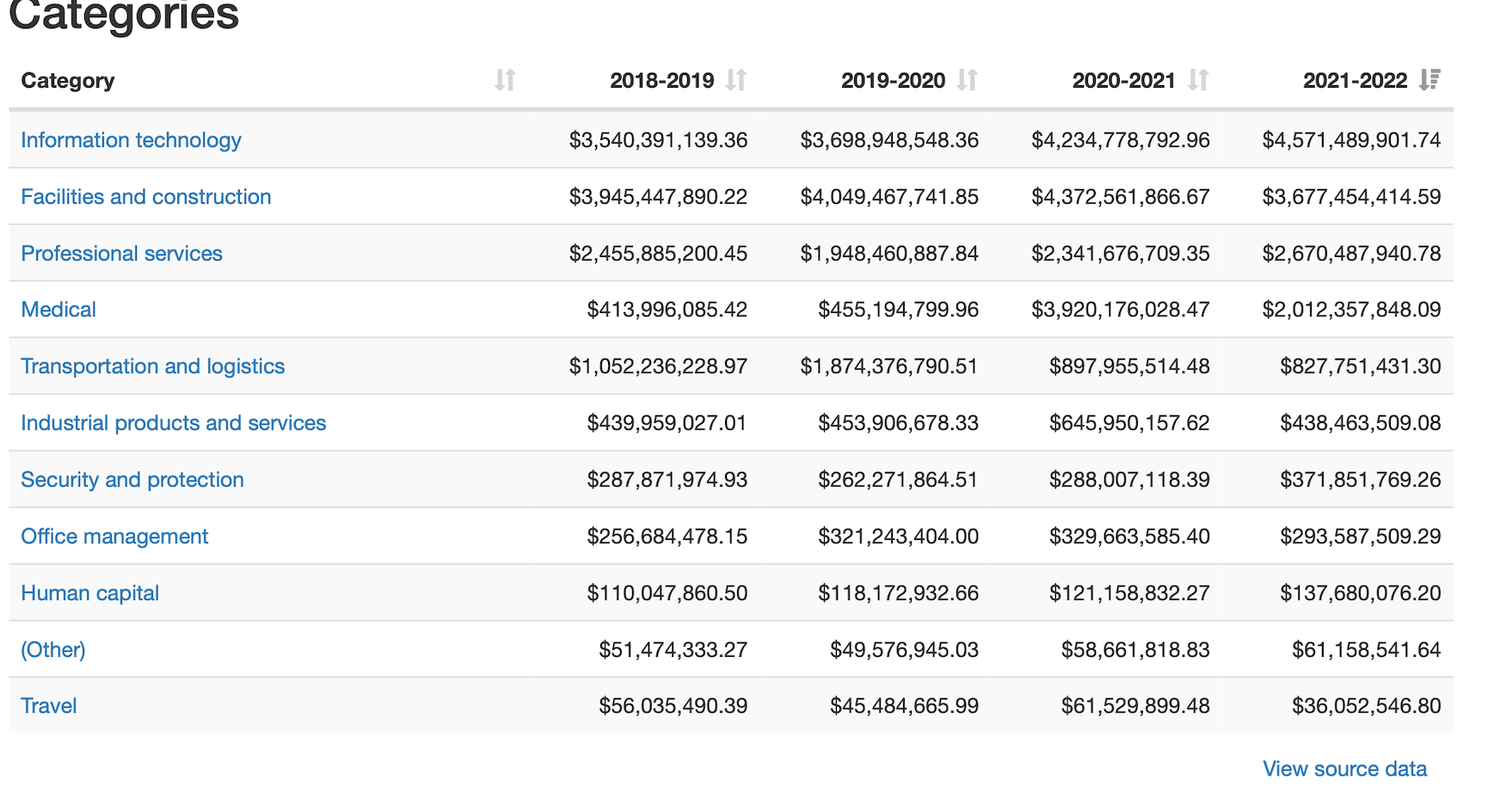
How big is big? A Carleton University research team has been digging into contracts to get a handle on how many billions are spent and on what. Last year, it estimated the government spent $15 billion, and $4.7 billion was on IT contracts.

A big part is amendments. About 272,075 contracts have been active since 2017-18. About 16 per cent of them have been amended at least once. These amendments added $25.6 billion to the original cost.

On average: Contract duration is about 10 months and is worth $423,000 (for contracts over $10,000).

Longest: 34.8 years (June 2015 to March 2050 for the consortium to replace the Champlain Bridge in Montreal).

Biggest: $5.7 billion to Brookfield Global Integrated Solutions for office building management.

ArriveCAN: The committee’s probe comes at the same time as a head-scratching revelation that the cost of the much-reviled ArriveCAN app is on track to hit $54 million. Stunned, app developers say it could have been done for about $1 million. Even public servants are aghast. There is a shortage of app developers in government. One long-time official, who is not authorized to speak about the subject, argued the app’s development should have been contracted out to the experts. Trying to build inhouse, where there’s a shortage of the right skills, means bringing in an army of consultants.

Some MPs on the committee want to have a separate probe into why developing the ArriveCAN app cost so much.

Here’s a look at some of the $15 billion in contracting costs across the government of Canada, according to a Carleton University research project:

Source: Carleton SPPS Research Project.

CONTRACTING 101
Why does it matter? Why do it?

The Professional Institute of Public Service of Canada (PIPSC) has long been consumed by outsourcing – especially for IT – and has done a number of reports. It concludes outsourcing means higher costs and lower quality services for Canadians. It erodes transparency, accountability and the institutional knowledge of the public service.

The fact is departments will always need to outsource for expertise they don’t have, especially for IT and digital talent to modernize government and services for Canadians.

The I-need-it-now pace of the public service picked up during the pandemic. Now a global talent shortage meets the public service’s turtle-slow hiring process. Departments can’t wait. They contract.

Why does it matter?

  • About $15 billion a year is spent on contracts in the core public service. (The Liberals also promised when elected to reduce spending on consultants to 2005-06 levels.)
  • It strikes at the heart of the kind of work the public service should be doing and what should it contract out, says Conservative MP Kelly McCauley. “A lot of lot these (consultant) reports should be done by our ever-expanding public service. So, what does this say…. about size of our public service if we have to source out so many contracts to the Deloittes of the world?”
  • Accountability. It raises questions about influence and who has the government’s ear in making policy and decisions.
  • Then there is question of value for money when both contracting and hiring is increasing but services don’t seem to be getting any better. We saw a summer of delays for passports, immigration applications and at airports. NDP MP Gord Johns has asked: “What steps are being taken to ensure that the quality of the service to the public and to other government departments is the first order of business?”

These questions will become even more important when the inevitable spending reviews and cuts come.

Main reasons departments contract:

  • They need special expertise and have no in-house skills to do the work.
  • Talent shortage, major recruitment and retention issues for the full gamut of IT work.
  • The time to hire staff, often months, is too long to meet the ever-shortening deadlines of the work.
  • Surges in workload.
  • No funding of public servant positions so departments use operating budgets for contracts.

IT contracts will become even more important as all governments push to modernize services. Digital expertise, hiring and contracting them, is central to Canada’s Digital Ambition, to modernize. In a speech, Treasury Board President Mona Fortier outlined her IT priorities: “escaping the trap” of decades-old legacy systems, establishing digital credentials so that Canadians can securely access all government services online, and pursuing a strategy to recruit, keep and develop in-house digital talent.

Where’s Treasury Board? Treasury Board is the employer and rules-maker, but the actual authority for contracting and human resources has been turned over to deputy ministers to manage their departments.

“Does Treasury Board have any role apart from setting a general framework,” asked McCauley. “Does Treasury Board as a guardian of the public purse ever follow up on any of these contracts that are sent out?”

Last week, MPs were all over the map during the first hearing, questioning contracts from big IT projects to cleaning services and everything in between. They grilled bureaucrats to get a handle on what is outsourced and why.

Finally, Conservative MP Kelly McCauley threw up his hands (watch here, at 12:28:30) and asked:

“I just want a quick question to the three departments here. Just a real quick yes or no if you believe taxpayers are getting fair value for the money, the billions being spent on outside or outside contracts. Just a quick yes or no?”

No takers. Crickets.

Source: The black hole of public service contract spending

The public service’s biggest disruption in decades : hybrid work

Happy I’m retired. That being said, I tried to work from home one day every week or two weeks to prepare presentations or thought pieces, away from the transactional files (but of course remaining available as need be).

In some cases, such as coordination with regions, being virtual placed NHQ on the same footing and improved engagement compared to the tedious phone conference calls, according to some colleagues and friends who worked during the pandemic.

But understand employee preference as well as political and management concerns regarding appearances, after all, those who can work from home are privileged compared to those in front-line service, whether public or private sector:

The return-to-work pushback of Canada’s public servants could lay the groundwork for the most radical change in the federal government’s relationship with its employees in a century.

The resistance reveals a grassroots shift taking place in the public service that’s all about power and control.

The public service is one of the most hierarchical employers in the country. It has operated the same way for decades. Management decides everything about staffing; how and where people work. Employees have little choice but to toe the line.

The pandemic that sent public servants home to work challenged that hierarchy by giving federal employees a taste of controlling their time and job location – factors that had been largely out of their hands.

After more than two years of working remotely, public servants like it and resent the idea of giving up the newfound control of time. They feel more productive, enjoy better work-life balance, have more child-care options. It’s also cheaper: no commuting, no parking, no restaurant or takeout lunches.

And for the first time, they had control of their space. No more cubicles. Hundreds took jobs without having to move to Ottawa and many others picked up and moved around the country.

But that flexibility has come with a price, and no city has felt the pinch like Ottawa, the nation’s capital and home to most departmental headquarters. The Ottawa Board of Trade estimates one-quarter of the city’s workforce worked downtown pre-pandemic and 55 per cent of those downtown workers were public servants sent home, leaving ghost offices behind. (A CBC radio broadcast on Aug. 25 talked about the topic.)

It also forced the biggest rethink of the future of work and the government’s relationship with employees as it officially shifted to a hybrid workforce this fall.

It will not be an easy ride.

Lori Turnbull, director of the school of public administration at Dalhousie University, called the shift to a hybrid workforce the most disruptive change in decades.

The public service has had its share of disruptions over the years – unionization and collective bargaining in the 1960s, massive downsizings and restructuring in the 1990s, the Y2K bug, 9/11, even the disastrous Phoenix pay system. This, however, could be as seismic a shift for the employer-employee relationship as when patronage was abolished a century ago and replaced with the merit system for the hiring and promotions of public servants.

“As far as disruptions go, this is the biggest one in decades, if not ever, because it’s a completely different ballgame when it comes to relationships, and how people manage their lives,” Turnbull said.

Turnbull said remote work gave workers flexibility and the value of that newfound freedom flowed more to their personal lives than their work lives. The government can’t expect to “put that genie back in the bottle,” without a fight, she said.

“Now, people, even the lowest rungs of the organization and seen as the least powerful, were given the sense of autonomy about their time and space and that is having fundamental repercussions on how the organization and management works,” said Turnbull.

The big question is whether the return-to-office will end this flexibility or will it spark worker rebellion? Before the pandemic, the thought of working only two days at the office was beyond the wildest of dreams. Today, it’s not flexible enough.

Public servants are openly voicing their displeasure about returning to the office. A growing number are mobilizing internally, speaking out on social media, signing petitions and writing letters to MPs. Some are resorting to access to information requests to get to the bottom of the decision to send them back.

Employees who want to work remotely feel the return-to-work guidelines are arbitrary and imposed top-down from management with no rationale. They feel unheard and that there is no evidence supporting why employees have to spend specified days in the office unless to satisfy political pressures, said one union official who is not authorized to speak publicly.

“If there’s a need to have public servants in the office, what is it?” the official said. “What we’re seeing right now is people being called back for the sake of being called back for political reasons.”

It will be a top issue at the bargaining table. Unions are hoping to enshrine remote work provisions into the collective agreement to give employees more say in determining where they work. Just as important is inflation, and unions, which are emboldened by a global talent shortage, are asking for big raises.

The unions’ long game is that employees will permanently have the option to work remotely. That’s a big and controversial change, however, which would mean rewriting rules, policies and collective agreements. Not to mention that Treasury Board President Mona Fortier has already said working at home is a privilege, not a right. She insists Treasury Board won’t give up its power to organize the workplace, including where employees work.

Unions hope to find some negotiating room around where public servants work. They also want less arbitrary decisions about who can work from home and what they can do remotely. That could mean explanations in writing beyond the blanket “operational requirements” that workers are hearing.

Turnbull warns a workforce feeling management exercises too much control over their time can breed mistrust and resentment that undermines productivity.

But flexibility is unknown territory for the government. More than any other employer, it has little experience with flexible work models. A study by Jeffrey Roy showed that the senior echelons are most comfortable with the traditional in-person office model – from ministers’ offices to deputy ministers and central agencies.

Flexibility on where people work opens a pandora’s box of issues. What happens to the value of work? How does it affect the 7.5-hour work day, overtime and pay? How are employees accountable when they no longer report to the office? How to track productivity, performance or deal with discipline when working from home.

Meredith Thatcher, cofounder and workplace strategist at Agile Work Evolutions, said the unfolding workplace evolution will depend on the “maturity and skills of the individual managers and whether they have the trust of their employees.”

“It is a societal earthquake that has happened, and the fallout will be years to come,” she said. “Assuming everyone will just fall in line and return to the office either full-time or mandated time is naive. The world of the office has shifted on its axis and many executives have not figured that out yet.”

But Donald Savoie, a leading public administration expert at University of Moncton, argues there is a lot more at stake than flexibility. Back in 2003, Savoie wrote Breaking the Bargain, about the unravelling of the traditional bargain underpinning the relationship between politicians and public servants.

He says public servants also have a bargain undergirding their relationship with Canadians. The public is losing confidence in the public service and its ability to deliver services – crystalized by a summer of chaotic delays at airports and passport offices.

He said Canadians are discontent with government, and populist leaders like Pierre Poilievre and anti-institution protest groups are tapping into that mistrust. He said a public service griping about going back to the office is ripe for attack.

Many see public servants asking for the freedom of an independent contractor or entrepreneur to work when and where they want while keeping the job security, pay and benefits few other Canadians enjoy.

“My advice to federal public servants: think about the institution. Think of the public service, not just your self-interest. There’s something bigger at play here. It’s called protecting the institution that you’re being asked to serve. I think too many federal public servants have lost sight of that.”

And Turnbull said Privy Council Clerk Janice Charette, a head of the public service, bears a big responsibility for the institution. She’s out in front urging departments to get employees back to the office.

“The clerk has to worry about the reputation of the public service and the sense that they have been given too much flexibility and now we see services crumbling. Even if there’s no truth to that the perception, it’s something she has to worry about,” said Turnbull.

Source: The public service’s biggest disruption in decades : hybrid work