Jamie Sarkonak: Liberal diversity mandates must end if we’re to solve the judge shortage

Not sure if there is real evidence for the assertion “focus on diversity necessarily comes at the expense of excellence” and citing one example rather than a broader sample does not cut it. The shortages assertion may or may not be true, as the government has a record in many areas of not meeting targets and levels:

…This tends to involve standard-bending because the pool of bench-eligible senior lawyers is going to be more white and more male than the country as a whole. The senior tiers of any profession reflect the demographics of students in professional schools 40 years ago, not today. While excellent candidates can be found from all walks of life, the Liberal focus on diversity necessarily comes at the expense of excellence. And because the Liberals are obsessed with maintaining an acceptable ratio of white male to “diverse” appointees, we can infer that they’d rather leave some seats empty until a correct number of diverse judges can be put forward at the same time. Shortages ensue….

Source: Jamie Sarkonak: Liberal diversity mandates must end if we’re to solve the judge shortage

Surge of new judges on top courts cut vacancies to lowest level after years of alarm

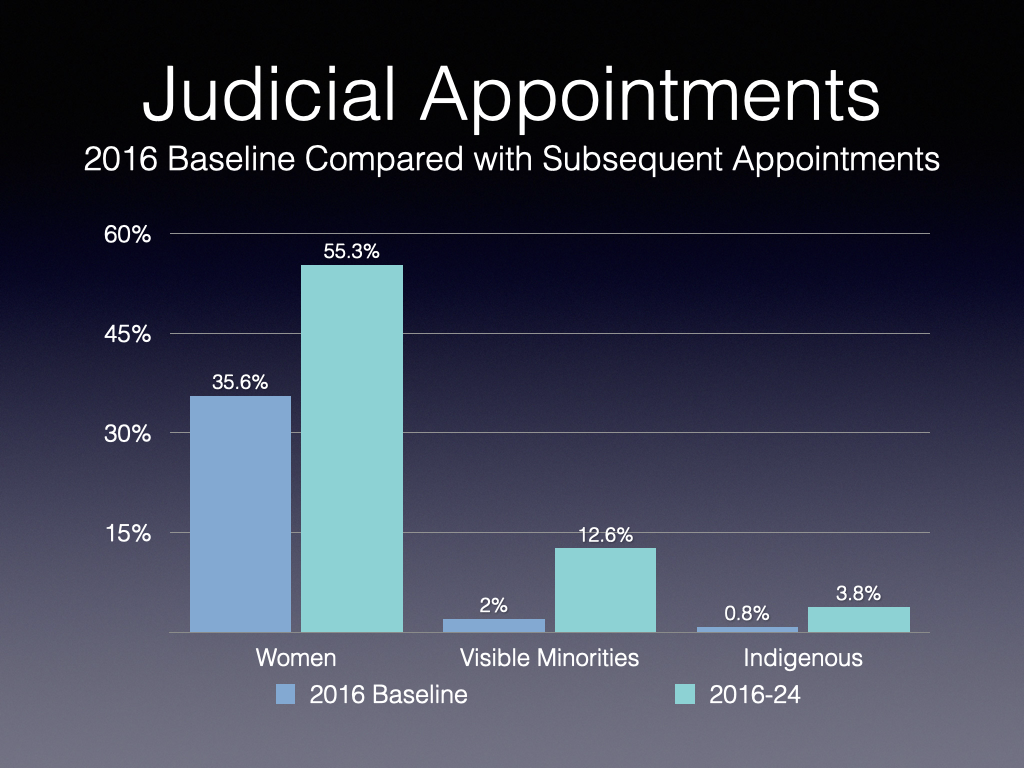
Of note. The most recent stats on diversity can be found at: https://www.fja.gc.ca/appointments-nominations/StatisticsCandidate-StatistiquesCandidat-2024-eng.html. My summary, comparing the Harper government baseline and subsequent appointments is below:

The federal Liberals have cut judicial vacancies on top courts across the country to their lowest level on record, new data show, after allowing the problem to get out of control for several years.

A flurry of 31 appointments in recent weeks leaves only 13 vacancies, as of mid-March, among the 1,000 full-time positions for judges on federally appointed benches, according to government data.

The previous low in vacancies was 14 in mid-2015, based on a review of data going back to 2003.

The latest appointments, made as a federal election is expected soon, further address unusually sharp and public criticism in recent years about unfilled positions on federally appointed benches. Those include the Supreme Court of Canada, provincial appeal and superior courts, and the Federal and Tax courts….

Source: Surge of new judges on top courts cut vacancies to lowest level after years of alarm

Biden Made the Judiciary More Diverse—but Not More Liberal

Interesting analysis. Would be useful to have a similar systematic analysis of Canadian judicial appointments under Trudeau (may have missed one:

President Biden left his mark on the federal judiciary by installing a large number of appointees from diverse backgrounds, but he made few inroads on changing the ideological balance of courts that Donald Trump made more conservative during his first term.

Now, Trump’s return to office could ensure that the federal courts lean solidly in a conservative direction for years to come.

In terms of raw confirmation numbers, Biden edged Trump’s first term by a nose, appointing 235 judges to Trump’s 234. But the Democrat had the opportunity to appoint just one Supreme Court justice, Ketanji Brown Jackson, and he installed nine fewer judges than Trump to the powerful U.S. courts of appeals, which sit one level below the high court. 

Many of Biden’s appointees to those courts succeeded other like-minded judges, meaning that the overall ideological dynamics didn’t change much.

Where Biden made a lasting impact, however, was in appointing judges that represent a broader swath of America. About 60% of the judges he installed were people of color, according to the Leadership Conference on Civil and Human Rights. And more than 60% were women. 

Biden noted in December that he appointed more Black women to the courts of appeals than all other previous administrations combined. He also appointed the first openly LGBTQ woman to the appeals courts, as well as the first Muslim-American to a life-tenured judicial post.

Another Biden priority was selecting nominees with a broader array of professional experience, including by appointing former federal public defenders to a judiciary that has been disproportionately represented by former prosecutors. 

That focus resulted in a new batch of judges who are distinctly different “in terms of the types of clients they’ve represented and the cases they have been exposed to,” said retired federal judge Jeremy Fogel, who now directs the Berkeley Judicial Institute, a center at the UC Berkeley School of Law….

Source: Biden Made the Judiciary More Diverse—but Not More Liberal

ICYMI: Biden outpacing Trump, Obama with diverse judicial nominees

Of note.

In Canada, the Trudeau appointments 2016-22 are (2016 baseline in parentheses): 56 percent women (36 percent), 10 percent visible minorities (2 percent), and 3 percent Indigenous peoples (1 percent):

For the Biden White House, a quartet of four female judges in Colorado encapsulates its mission when it comes to the federal judiciary.

One of the judges, Charlotte Sweeney, is an openly gay woman with a background in workers’ rights. Nina Wang, an immigrant from Taiwan, is the first magistrate judge in the state to be elevated to a federal district seat. Regina Rodriguez, who is Latina and Asian American, served in a U.S. attorney’s office.

Veronica Rossman, who came from the former Soviet Union with her family as refugees, is the first former federal public defender to be a judge on the 10th U.S. Circuit Court of Appeals.

With these four women, who were confirmed during the first two years of President Joe Biden’s term, there is a breadth of personal and professional diversity that the White House and Democratic senators have promoted in their push to transform the judiciary.

“The nominations send a powerful message to the legal community that this kind of public service is open to a lot of people it wasn’t open to before,” Ron Klain, the White House chief of staff, told The Associated Press. “What it says to the public at large is that if you wind up in federal court for whatever reason, you’re much more likely to have a judge who understands where you came from, who you are, and what you’ve been through.”

The White House and Democratic senators are closing out the first two years of Biden’s presidency having installed more federal judges than Biden’s two immediate predecessors. The rapid clip reflects a zeal to offset Donald Trump’s legacy of stacking the judiciary with young conservatives who often lacked in racial diversity.

So far, 97 lifetime federal judges have been confirmed under Biden, a figure that outpaces both Trump (85) and Barack Obama (62) at this point in their presidencies, according to the White House and the office of Senate Majority Leader Chuck Schumer, D-N.Y. Among them: Supreme Court Justice Ketanji Brown Jackson, that court’s first Black woman, 28 circuit court judges and 68 district court judges.

Three out of every four judges tapped by Biden and confirmed by the Senate in the past two years were women. About two-thirds were people of color. The Biden list includes 11 Black women to the powerful circuit courts, more than those installed under all previous presidents combined.

“It’s a story of writing a new chapter for the federal judiciary,” said Paige Herwig, a senior White House counsel.

The White House prioritized judicial nominations from the start and Democratic leaders in the Senate moved quickly on them. Particular focus was placed on nominees for the appellate courts, where the vast majority of federal cases end, and those coming from states with two Democratic senators, who could find easier consensus in a process where there’s still significant deference given to home-state officials.

Democrats hope to speed up confirmations next year, a goal more easily accomplished by a 51-49 Senate that will give them a slim majority on committees. In the past two years, votes on some of Biden’s more contested judicial nominees would deadlock in committee votes.

Schumer said he also hopes to install more judges in appeals courts that shifted rightward under Trump, an effort that the majority leader described as rebalancing those courts.

“Trump loaded up the bench with hard right ‘MAGA’ type judges who are not only out of step with the American people, they were even out of step with the Republican Party,” Schumer said in an interview, using shorthand for Trump’s 2016 campaign slogan, “Make America Great Again.”

Despite their limited power to derail Biden’s judicial picks, some Republicans have fought ferociously against many of them, arguing that their views were out of the legal mainstream. The precarious 50-50 Senate meant several Biden nominees languished for months and were never confirmed before the Senate wrapped up its work this year.

Democrats also say certain judicial nominees, particularly women of color, were unfairly made into lightning rods by their GOP critics.

“The Republicans have just got a problem with this,” Sen. Dick Durbin, D-Ill., chairman of the Judiciary Committee, told the AP. “Not all of them, some do.”

Sen. Josh Hawley, R-Mo., a committee member, said Biden’s picks were “very, very left, but unapologetically so” and that his colleague’s assertions about Republicans were “absurd.”

Despite the strengthened Democratic majority. the White House could nonetheless struggle to seat some judges over the next two years.

For instance, Biden has made barely a dent in the number of vacancies for district court judges in states that have two Republican senators, confirming just one such person: Stephen Locher, now a judge in the Southern District of Iowa. Home-state senators still get virtual veto power over district picks. Advocates want Democrats to discard that tradition, arguing it only allows for Republican obstructionism.

Durbin has said he would reconsider the practice if he sees systematic abuse of it. But such roadblocks have been rare, he said, and influential Republicans give some deference to Biden on judges.

One matter Biden has not been willing to address: the structure of the Supreme Court.

Any push to reshape the high court has found little footing at the White House despite its the court’s tilt farther right under Trump.

In June, the 6-3 conservative majority overturned the landmark decision Roe v. Wade, eliminating the constitutional protections for abortion that had existed for nearly 50 years. In the same term, it also weakened gun control and curbed the U.S. Environmental Protection Agency’s ability to manage climate change.

Biden has argued the court is more of an “advocacy group these days.” But he has not embraced calls to expand the court, impose term limits or mandatory retirement, or subject justices to a code of conduct that binds other federal judges.

“I wouldn’t, in any way minimize the progress and the importance of what President Biden is doing on the lower courts,” said Chris Kang of Demand Justice, an advocacy group leading the push to expand the court. But “we need to look at the core problem, which is the Supreme Court.”

Source: Biden outpacing Trump, Obama with diverse judicial nominees
Biden seeking professional diversity in his judicial picks

Significant. In contrast, my analysis of judicial appointments under the Liberal government (close to 500 appointments, 55.7 percent women, 8.5 percent visible minorities, 3.1 percent Indigenous):

President Joe Biden spent a recent flight aboard Air Force One reminiscing with lawmakers and aides about his start as a young lawyer in Delaware working as a public defender in the late 1960s.

The flight from New York to Washington was short, and there wasn’t much time to explore the president’s brief time in the job during the civil rights era. But as Biden considers his first Supreme Court nominee, this lesser-known period in his biography could offer insight into the personal experience he brings to the decision. The account was relayed by a person familiar with the trip who insisted on anonymity to discuss it.

Biden has already made history by nominating more public defenders, civil rights attorneys and nonprofit lawyers to the federal bench during his first year in office than any other president, increasing not just the racial and gender diversity of the federal judiciary but also the range of professional expertise. And it’s possible that theme will continue as he looks to make more history by nominating the first Black woman to the nation’s highest court.

While three of the current justices have experience as prosecutors, none was a criminal defense attorney. The last justice with serious experience in defense was Thurgood Marshall, a civil rights attorney nominated about 55 years ago. He was the first Black person on the court and retired in 1991.

Some of the women on Biden’s list of potential nominees have deep public defense or civil rights backgrounds: Ketanji Brown Jackson, 51, for example, worked as a public defender and served on the U.S. Sentencing Commission before she was nominated to the bench by President Barack Obama. Eunice Lee, 51, whom Biden named to the U.S. Court of Appeals for the 2nd Circuit in August, is the first former federal defender to serve on that court.

Biden’s judicial appointments thus far make clear his interest in professional diversity.

Nearly 30% of Biden’s nominees to the federal bench have been public defenders, 24% have been civil rights lawyers and 8% labor attorneys. By the end of his first year, Biden had won confirmation of 40 judges, the most since President Ronald Reagan. Of those, 80% are women and 53% are people of color, according to the White House.

“It’s so important to have a diversity of perspectives and having the judiciary really reflect the diversity of lived experiences and perspectives of the folks who are coming before them,” said Lisa Cylar Barrett, director of policy at the NAACP Legal Defense & Educational Fund.

The Supreme Court hears only a fraction of federal cases filed each year. Federal judges are hearing most of the cases, with roughly 400,000 cases filed in federal trial courts a year. The high court hears only about 150 of the more than 7,000 cases it is asked to review annually.

Most of the judges appointed to the federal bench have worked as prosecutors, corporate attorneys or both. A survey three years ago found more than 73% of sitting federal judges were men, and more than 80% were white, according to the Center for American Progress.

A diversity of professional expertise makes for a more fair and just bench, advocates say. Judges draw on their personal histories to help them weigh arguments and decide cases, and they also learn from each other. Public defenders often represent the indigent and the marginalized, those who often can’t afford their own attorneys.

“They represent the 80% percent of people in the criminal legal system too low-income to afford a lawyer,” said Emily Galvin-Almanza, a former public defender who founded the nonprofit Partners for Justice. “So when you put a public defender on the bench, you’re putting a person on who listens with a very different ear. You have a person on the bench with an experience of the realities of very, very disempowered people.”

Biden’s brief time as a public defender isn’t widely discussed, and it isn’t listed in his official biography on the White House website. He’s more prone to talk about his 36 years as a senator and his time as head of the Judiciary Committee, where he oversaw six Supreme Court nominations.

But the president has spoken at times about his brief time as a public defender before he became a U.S. senator at the age of 29. It’s informed some of his decisions in office, like directing federal grant money for public defense and expanding other federal efforts on public defense.

“Civil rights, the Vietnam War and President Nixon’s rampant abuse of power were the reasons I entered public life to begin with,” Biden said in a 2019 speech in South Carolina during the presidential campaign. “That’s why I had chosen at that time to leave a prestigious law firm that I had been hired by and become a public defender — because those people who needed the most help couldn’t afford to be defended in those days.”

In a 2007 memoir, he called the job “God’s work.”

The president promised during his campaign for president that he’d nominate a Black woman to the bench, and he spent his first year in office broadening his potential applicant pool through judicial appointments. Most Supreme Court justices have come from federal appeals courts, but it’s not a requirement. Among the current justices, only Justice Elena Kagan wasn’t a federal appeals court judge before joining.

Federal judges are often chosen from state courts, which also lack in diversity. But Biden’s very public push to diversify federal judges could have an impact on how judges in the states look, too.

“Neither state courts nor federal courts reflect the diversity of the communities they serve, or the diversity of the legal profession. Courts across the country are falling short,” said Alicia Bannon, the director of the Judiciary Program at the Brennan Center for Justice at NYU School of Law. “But we’re hoping that is slowly changing.”

Biden has promised a rigorous selection process for his Supreme Court nominee. His team, led by former Democratic Sen. Doug Jones, is reviewing past writings, public remarks and decisions, learning the life stories of the candidates and interviewing them and people who know them. Background checks will be updated and candidates may be asked about their health. After all, it’s a lifetime appointment.

The goal is to provide the president with the utmost confidence in the eventual pick’s judicial philosophy, fitness for the court and preparation for the high-stakes confirmation fight. Interviewing potential candidates comes later, but Biden has already spoken to some of the women who may be under consideration back when they were being appointed to other courts.

Biden will also continue to seek the advice of lawmakers. He was to host Senate Judiciary Committee Democrats on Thursday, a White House official said.

Source: Biden seeking professional diversity in his judicial picks

Lawyer who called for elimination of citizenship tests named to bench

I thought the right-wing press might notice Avvy Go’s appointment. Will be interesting to see how she manages the transition from a very public activist to being a more discrete judge:

A Toronto legal activist who questioned the need for immigrants to take immigration citizenship tests and said the COVID-19 pandemic has created an increase in racism in Canada, has been appointed a federal judge.

Blacklock’s Reporter said Avvy Yao-Yao Go has also lamented the “shameful history” of Canada’s first Prime Minister, John A. Macdonald.

Go had been director of a Toronto law clinic that criticized Canadians for “anti-China sentiment and white supremacy.”

Go described herself in a 2020 commentary in the Globe & Mail as a lawyer “fighting for social justice” and cohesion.

“The past several years of turmoil both in the United States and Canada have taught us our democracy is fragile and that structured racism, if left unchecked, poses a serious risk to social cohesion,” wrote Go.

Attorney General David Lametti appointed Go to the bench on Friday saying he was confident she will “serve Canadians well.”

Go was director of the Chinese and Southeast Asian Legal Clinic of Toronto. The federally-funded group in a June 1, 2020 submission to the United Nations Office of the High Commissioner for Human Rights complained of widespread racism in Canada.

“In contrast to the image of Canada as multicultural and welcoming, many Canadians have been emboldened to use the pandemic as a license to exhibit hate and racism,” said the submission to the UN.

“Moreover, since the outbreak of the pandemic, anti-Asian hate speech has proliferated on social media platforms fueled by right-wing extremists who are using the pandemic as an opportunity to stir up racist ideologies.

“The collision of conspiracy theories, anti-China sentiment and white supremacy has rendered dangerous results, including the movement of racist theories and messaging from the fringe to the mainstream.”

The group earlier received a $301,904 grant from the Canadian Heritage department.

“While the Prime Minister has remarked that ‘hate, violence and discrimination have no place in Canada’ and his government stands with ‘Asian-Canadians across the country,’ his government has failed to take any concrete steps to address the surge of hateful violence and messaging that has arisen during the pandemic,” said the report.

Meanwhile, Go in numerous commentaries and letters to editors criticized Canadians’ treatment of racial issues and proposed abolishing the citizenship test as a “hollow screening” of immigrants.

“The moment I became a true Canadian was the very moment when I began to challenge the Canadian system,” the Hong Kong-born Go wrote in 1998.

In a 2014 commentary in the Toronto Star, Go lamented the “shameful history” of Macdonald, “architect of racist law” that saw Canadians “forced to live in nightmarish conditions while Macdonald pursued his dream to unite Canada.”

“Given the stark human rights record under his belt, why should Canadians celebrate John A. Macdonald’s birthday?” wrote Go.

In a 2013 letter to the Globe, the judge wrote: “The term ‘visible minority’ is fraught with issues, the key one being it uses ‘white’ as a standard against which everyone else is measured.”

“As we prepare to mark Canada Day, Ottawa must admit past wrongs particularly against Chinese-Canadians,” she wrote Toronto Star editors in 2003.

Go was one of thirteen new federal appointees named to the bench Friday.

Source: Lawyer who called for elimination of citizenship tests named to bench

Selley: Justin Trudeau’s symbolic agenda collides with itself at the Supreme Court

Can’t satisfy all groups on a nine-member court (more latitude with respect to all judicial appointments where government, as per the contrast between the 2016 baseline and subsequent appointments highlights. And while symbolism is important, the harder work lies with reducing inequalities and long-standing issues:

A few headlines from the past week: “Justice Mahmud Jamal is first person of colour nominated to the Supreme Court of Canada” (CBCthe Toronto Star, and The Guardian). “ ‘Taunted and harassed’ as a youth, judge Mahmud Jamal receives historic Supreme Court nomination” (CTV and the National Post, quoting Jamal’s application statement). “Judge Mahmud Jamal, who finished high school in Edmonton, nominated to Supreme Court of Canada” (the Edmonton Journal, scoring the all-important local angle).

The first sentence in The Globe and Mail’s story mentions that Jamal is a “frequently cited author on the Charter of Rights and Freedoms.” We learn later on about his copious qualifications and impressive record as a jurist. But the second sentence explains a conflict: Prime Minister Justin Trudeau was “under pressure from minority and Indigenous organizations to make the Supreme Court more diverse.” And so “the Indigenous Bar Association is disappointed.”

The Supreme Court has some pretty spicy meatballs on its plate, not least the future of certain religious practices in certain parts of Quebec’s public service, and will have more spicy meatballs in the future. The retiring Rosalie Abella is no ordinary Supreme Court justice, but rather the standard-bearer for a very activist and flexible brand of judge. We might hear more about Jamal’s approach when he meets with parliamentary committees. But surely it’s odd how much more we seem to care about who he is than about how he thinks or how he might rule.

Justin Trudeau isn’t the first prime minister to be concerned with the symbolism of his appointments, and nor have the Canadian media only recently acquired an interest. Globe and Mail headline writers greeted Bertha Wilson’s appointment in 1982 with “First woman is appointed to Canada’s top court” (March 5). (This was followed by “Woman judge still avoiding press” (March 9) and finally “Woman justice to take oath” (March 26).) Abella’s and Louise Charron’s appointments in 2004 were hailed for approaching near-gender-parity on the top bench.

This is all for the good, to a large extent. In a jury trial, we are ostensibly judged by our peers. We shouldn’t want judges to be members of an exalted class. Ideally, the jurisprudence they create would reflect the full scope of Canadian experiences — of class, race, ethnicity, faith and so on.

But it’s not a stretch to say that Trudeau — Mr. “Because it’s 2015″ — is more obsessed with symbolism than is typical. And sometimes it makes his life far more difficult than it needs to be. On the Supreme Court, his wish to appoint an Indigenous justice runs smack into his pledge never to appoint a justice who can’t manage a hearing in both official languages — which is to say, his wish to placate Quebec nationalists at every possible turn.

“A fully bilingual Indigenous candidate who also meets regional requirements and conventions” is a very tough order to fill, as many articles in the press have explained. Fewer articles have noted how far offside this requirement is with Trudeau’s reconciliation agenda. Trudeau’s new rule for judges doesn’t just discount Indigenous languages entirely; it also demands Indigenous lawyers learn not just one settler tongue fluently, but both! In a recent interview with APTN, Harry LaForme, Canada’s first Indigenous appellate court judge, likened the policy to the assimilation of children at residential schools. It would be very awkward, if only more people noticed.

You see a somewhat different problem when it comes to the unfilled vacancy at Rideau Hall, which is seeing similar demands for a minority or Indigenous appointment. Either would be fine, obviously, just so long as they’re not on a mission to do anything other than be the Queen’s representative on Canadian soil. You can just imagine Trudeau and his advisers struggling with the concept, even after Julie Payette’s flameout and Paul Martin’s near-miss with obvious-separatist Michaëlle Jean. This is a chance to make a splash, to send a message!

But the returns diminish. Real people who need real improvements in their lives cannot be impressed by symbolism. And weakness for symbolism makes us overlook things. It’s a distraction. Many of Trudeau’s detractors, especially to his left, would suggest it has distracted him from actually making significant progress on issues central to his brand, and to which these symbolic appointments are meant to nod.

A pledge to eliminate boil-water advisories on reserves is worthless without eliminating boil-water advisories. Adopting or not adopting the UN declaration on Indigenous rights is worthless without implementing what’s in it. At some point after accepting the findings of the Truth and Reconciliation Commission, which had a whole section on unmarked and forgotten children’s gravesites, someone was going to have to pony up the money to look for those gravesites. It took until now.

I often argue there are maddeningly few fundamental differences between Liberal governance and Conservative governance in Canada — certainly not nearly enough to justify the intensity of the battles between them. Privileging action and disdaining empty symbolism is one principle Canadian conservatives should guard jealously, even if they don’t always apply it consistently themselves. It’s the only way to help real people with real problems.

Source: https://ottawacitizen.com/opinion/chris-selley-justin-trudeaus-symbolic-agenda-collides-with-itself-at-the-supreme-court/wcm/cad4b3f1-d2c4-48a2-93f0-976678296276

Ford government says it’s changing judicial appointments to promote diversity. Racialized lawyers accuse it of ‘power grab’

Of note. The annual reports by the Ontario Judicial Appointments Advisory Committee allow for assessment of these changes:

Organizations representing racialized lawyers have all come out against the Ontario government’s proposed changes to judicial appointments, which the attorney general says are partly needed to improve diversity on the bench. 

Major organizations representing Black, Asian, South Asian and Muslim lawyers told the Star they didn’t ask for these changes. They argue the new system will lead to the perception that the appointments of provincial court judges in Ontario is no longer an independent and impartial process and could allow for provincial governments to make patronage appointments. 

“We see this as a power grab dressed up in the very thin veneer of purported diversity,” said Nader Hasan, a member of the legal advocacy committee of the Canadian Muslim Lawyers Association. 

“Our view is that diversity and excellence are best preserved by maintaining the independence and integrity of the current process.” 

Added Raphael Tachie, president of the Canadian Association of Black Lawyers, “It’s challenging to read something that says, ‘We’re doing this to increase the diversity of the judiciary,’ when the equity-seeking groups didn’t ask for it.”

In an omnibus justice bill tabled at Queen’s Park last month, Attorney General Doug Downey proposed several changes to the way provincial court judges are appointed. 

It includes significant changes to Ontario’s Judicial Appointments Advisory Committee (JAAC), the independent panel of judges, lawyers and members of the public that vets judicial applicants and submits a ranked short list of at least two candidates to the attorney general. 

Under the proposed amendments, that shortlist would grow to at least six candidates. “It allows for a bigger look at what’s out there in terms of creating some diversity and creating more choice,” Downey told the Star when he tabled the bill. 

The attorney general could also reject the six-person shortlist and ask to see the names of the next six candidates, as he is currently permitted to do with the two-person shortlist. Downey says he has already asked the committee to provide shortlists with more than two names, and that this change merely formalizes that practice. 

Janani Shanmuganathan, a board member of the South Asian Bar Association, argues that allowing the attorney general more choice in who to appoint to the bench leaves room “for a partisan or patronage appointment — some sort of appointment based not on the selection criteria or on who is best fit for the job, but for other reasons.”

A spokesperson for Downey maintained that the proposed changes reflect feedback received from lawyers and “justice-sector partners” and will ensure the appointments process remains non-partisan. 

“We believe it is responsible to update the system to help Ontario’s bench better reflect the evolving diversity of the province’s communities,” Nicko Vavassis said in an email. 

Another proposed change would mean the three legal organizations with representatives on the committee — the Law Society of Ontario, the Ontario Bar Association and the Federation of Ontario Law Associations — would no longer pick their own representatives, but would submit a shortlist of candidates for the attorney general to choose from.

“That will allow us to manage balance and diversity on the committee itself as well,” Downey told the Star last month. 

The attorney general already picks the seven community members on the 13-person committee.

Legal groups representing racialized lawyers say improving diversity on the bench is a laudable goal, but say they struggle to see how the government’s more significant changes would accomplish that. 

“Is there a problem with diversity on the JAAC itself? I don’t think there is. No one has complained there is an issue,” said Emily Lam, chair of the advocacy and policy committee and board member at the Federation of Asian Canadian Lawyers. 

“The irony is Mr. Downey himself has described JAAC as the gold standard, so why does he need these changes?” Lam said. 

“The concern is that this is actually for partisan purposes, and I think that transparency and fairness call for a discussion to be had by Mr. Downey with stakeholders and the public before taking any further steps.” 

The Federation of Ontario Law Associations said it did not receive much of an explanation from Downey for the proposed change to selection of committee members. 

“It has been suggested that it might be to achieve some greater diversity; however, given that the (attorney general) appoints the majority of the committee and the fact that our bench is quite diverse, it does not appear that we have an issue in this regard,” federation chair Bill Woodward said in an email. 

“This change gives the appearance of allowing the (attorney general) to have even greater control over the composition of the JAAC.” 

The Law Society of Ontario and the Ontario Bar Association have not objected to the proposed changes, and told the Star that they support a system that produces diverse judges. 

Source: https://www.thestar.com/politics/provincial/2021/03/02/ford-government-says-its-changing-judicial-appointments-to-promote-diversity-racialized-lawyers-accuse-it-of-power-grab.html

British Columbia Appeal Court ‘sorely lacking’ in people of colour: top judge

Of note:

Since the Liberal’s re-election in 2019, nearly 59 per cent of the judges federally appointed or elevated have been women, 16 per cent identify as a visible minority and a further three per cent identify as Indigenous, said the department. (last para highlights increased diversity in appointments since 2016:

B.C.’s top judge admits that the B.C. Court of Appeal is “sorely lacking” in diversity among its judges.

In 2016, the Trudeau government introduced policies aimed at increasing diversity for federally appointed judges, including those on B.C.’s highest court and the B.C. Supreme Court.

But while the gender balance on the Appeal Court has been improved, with 11 of the 24 current full-time and part-time judges being women, there are no judges who are Black, Indigenous or people of colour.

But while the gender balance on the Appeal Court has been improved, with 11 of the 24 current full-time and part-time judges being women, there are no judges who are Black, Indigenous or people of colour.

Chief Justice Robert Bauman of the B.C. Court of Appeal said that it was important to the administration of justice that public institutions reflect society.

He said the judiciary and law are enriched by judges bringing a wide range of experiences and perspectives to their work.

“For many years, the B.C. Court of Appeal has achieved gender balance, or near-balance, between male and female judges,” Bauman said in a statement. “However, the Court is sorely lacking in other forms of diversity, especially judges who identify as Indigenous, Black or people of colour.”

Bauman noted that Appeal Court judges are appointed almost exclusively from the pool of judges who make up the B.C. Supreme Court, which he said has had an increasing number of diverse appointments in the past several years.

“That being so, I expect that the Appeal Court will begin to receive appointments in the coming years that will enhance the Court’s diversity, and I look forward to that positive development.”

In September, the Canadian Bar Association urged the federal government to put its stated commitment to diversity in the courts into action, noting that the judiciary in Canada remains overwhelmingly white with judges lacking first-hand knowledge and experience of the racism and systemic challenges faced by people of colour.

Raphael Tachie, the president of the Canadian Association of Black Lawyers, also believes the government is not moving fast enough.

“Good rhetoric is appreciated. To be taken seriously, you need to take concrete steps. If you look at the B.C. Court of Appeal, it’s not a reflection of concrete steps.”

Tachie said he moved from B.C., where he practised law for 11 years, to Ontario in part because he believes his career prospects as a Black lawyer in the eastern province are better.

He said he does not accept the argument made by some in the judiciary and in law schools and corporate law firms that the lower courts need to be stocked with more qualified candidates before the higher courts can become more diversified.

Rupinder Gosal, president of the South Asian Bar Association of B.C., said it’s definitely a goal of her organization to increase diversity among judges but added she understands why there aren’t many diverse Court of Appeal judges because up until recently there weren’t as many appointments of diverse judges at lower levels.

“I think it’s unfortunately a step-by-step process and it’s unfortunately a process that will take some time.”

But Gosal said there were concerns about what she called systemic barriers to judicial applicants, including requirements to provide judicial references, as well as a need to encourage more candidates to step forward and apply.

In 1985, Wally Oppal was the first person of colour appointed to the B.C. Supreme Court. He was elevated to the B.C. Court of Appeal in 2003 where he served for two years before being elected to the provincial legislature and serving as attorney general for four years.

He said that getting more diverse judges on the bench was a “challenging” issue but added that he had never met anyone in positions of power in the justice system, whether judges or justice ministers, who don’t agree that there’s a greater need for diversity.

“The multicultural aspect of the justice system has only started to change within the last 20 years or so, 25 years. So I think there’s a certain amount of catch up that has to take place.”

In a statement, the federal Justice Department said that the face of Canada’s judiciary has changed considerably since the Liberals took office.

“We are committed to having a judiciary that looks more like Canada — one in which all Canadians can see themselves reflected,” said the statement.

“We are proud of the transparent and accountable appointment process we put into place to identify outstanding judicial candidates who reflect Canada’s diversity.”

Since the Liberal’s re-election in 2019, nearly 59 per cent of the judges federally appointed or elevated have been women, 16 per cent identify as a visible minority and a further three per cent identify as Indigenous, said the department.

Source: Appeal Court ‘sorely lacking’ in people of colour: top judge

In support of a process based on merit

One of the better and more nuanced discussions regarding merit in the judicial appointment process and the involvement of the political levels:

The president of the Canadian Bar Association has written to party leaders in Parliament and justice critics to clarify his comments on judicial appointments, which he says have been mischaracterized in the House of Commons and in news reports. CBA president Brad Regehr states that he has not accused the government of interfering in the appointment process, nor has he suggested that the process has resulted in the appointment of unworthy candidates.

The president of the Canadian Bar Association has written to every party leader in Parliament to clarify his comments on judicial appointments, which he says have been mischaracterized by several of those leaders and in news reports. CBA president Brad Regehr states that he has not accused the government of interfering in the appointment process, nor has he suggested that the process has resulted in the appointment of unworthy candidates.

Regehr also points to leaks about applicants to the media as demeaning the selection process, unfairly tainting those who are appointed, and discouraging worthy candidates from applying.

“One of the things that really concerns me is the naming people who submitted their names in the belief that it was a confidential process, and all of a sudden their names are appearing in the media,” Regehr told the CBA National. “It really bothers me that this happened. The potential impact on those individuals – their relationships with their clients, with their co-workers, with their firm – it was highly inappropriate.”

In recent weeks, news stories based on those leaks have fuelled speculation that the government is appointing friends and donors of the party. Members of the Prime Minister’s Office vet candidates who have been recommended to the Justice Minister by the Judicial Appointments Committees (JACs). They also consult with caucus members to learn if they have heard anything about those candidates that could potentially embarrass the government.

Justice Minister David Lametti stated in Question Period that the PMO has not directed any appointments, nor has it declined any of his recommendations.

According to Regehr, the current appointment process has improved compared to what it once was. His concern is that the process remains free of political interference.

“I understand that government … may do some additional vetting – I’m not unrealistic,” says Regehr. “If there is an indication that a person’s enrollment in a particular party or their financial support to a political party becomes a governing factor, that’s of concern, because the idea should be that these judges are being appointed on merit, and that they are reflective of Canadian society.”

Regehr reiterated that political involvement is an indicator of someone who is devoted to public service.

“It would be best if there could be some further affirmation that this is not the governing factor in the appointment of judges,” says Regehr. “I will take those accusations in the House and allegations in the media with a grain of salt. I have a good relationship with Minister Lametti, and I have had a talk with him about this, and he has assured me that this is not the case.”

In an emailed statement to CBA National Magazine, Lametti said he was pleased to read Regehr’s letter.

“I share his concerns about the confidentiality of the process,” Lametti stated. “Those who have chosen to leak the names of individuals who are seeking a judicial appointment are violating the privacy rights of those individuals as well as undermining public confidence in the appointments process. They may also be discouraging qualified applicants from applying.”

Addressing Regehr’s stated concerns about delays in filling vacancies on the JACs, which in turn delay filling vacancies on the bench, Lametti said the government has worked to reconstitute the JACs in jurisdictions where terms have expired. It has also reduced the number of vacancies nationally, he said.

“It is my responsibility to make recommendations to Cabinet for judicial appointments,” said Lametti. “It is one of the most important tasks I have as Minister. I make my recommendations to Cabinet on the basis of merit and the needs of the particular court. I also believe that an effective bench is one which reflects the diversity of the country it serves, and I am proud of the progress we are making in appointing diverse candidates. More needs to be done, but we are on the right path.”

Asked about the vetting by the PMO as a function of the appointment process, University of Waterloo political science professor Emmett Macfarlane says that our political system has rested on a set of executive prerogatives of appointments that provide a direct line of accountability for the appointment itself.

“Modernization of a lot of these processes have included establishing a bit of an independent filter, usually through these Judicial Advisory Committees, that have been set up for a lot of the Section 96 courts, and are probably a reasonable step to the extent that historically there was a lot of patronage in these appointments,” says Macfarlane. “A degree of professionalization of the appointments process was reasonable.”

Macfarlane says he is concerned by some of what has transpired over the past week. People have taken to the idea that an independent filter means the government and the prime minister should be cut out of the equation entirely.

“That’s a bit of a naïve view about the nature of courts and the role of the judiciary in our system, in that we obviously want a judiciary staffed with people who can do their best to recognize their biases, but there’s no such thing as an apolitical court,” says Macfarlane. “In fact, the higher up the ladder you go, the more political the nature of the court’s work gets.”

Macfarlane says that having an elected official who must maintain Parliament’s confidence and is responsible for selecting people appointed to our courts provides some measure of democratic accountability to the third branch of government.

“This is important – the quality of people appointed obviously matters, but the political nature of the role matters too,” says Macfarlane. “That’s not to say we slide off the opposite slope in that we should be talking about electing judges – very few people, rightly, in Canada want to go that route, but the reason that we should want that degree of political accountability is reflected in the nature of judicial decision-making, particularly in areas like constitutional and administrative law.”

Source: In support of a process based on merit