Diversity among federal and provincial judges

This article appeared originally in IRPP’s Perspectives:

With the federal government’s general commitment to increased diversity in appointments, and Justice Minister Jody Wilson-Raybould’s current review of the judicial appointment process, there needs to be a baseline of information about the current diversity situation in order to measure implementation of these commitments.

Overall, women, visible minorities and Indigenous people are under-represented among the over 1,000 federally appointed judges (65 are in federal courts, the balance are in provincial courts). There is a similar but less pronounced pattern of under-representation among the over 700 provincially appointed judges.

Does this matter given that judges by are expected to be objective, impartial and neutral? Their legal education, training and experience prepare them for this end. However, judges are human and, like all of us, they are influenced by their past experiences, influences and backgrounds. We know from Daniel Kahneman (author of Thinking, Fast and Slow) and others that no one is completely neutral and bias-free, even if the judicial process does represent “slow” or deliberative thinking, and thus greater objectivity, rather than “fast” or automatic thinking. Diversity of background and experience is another way to improve neutrality in decision-making.

Moreover, given the over-representation of some groups who are tried in the courts, such as Black people and Indigenous people, a judiciary in which these groups are significantly under-represented risks being viewed as illegitimate to those communities. The current debate over murdered and missing Indigenous women and police carding practices exemplify this risk.
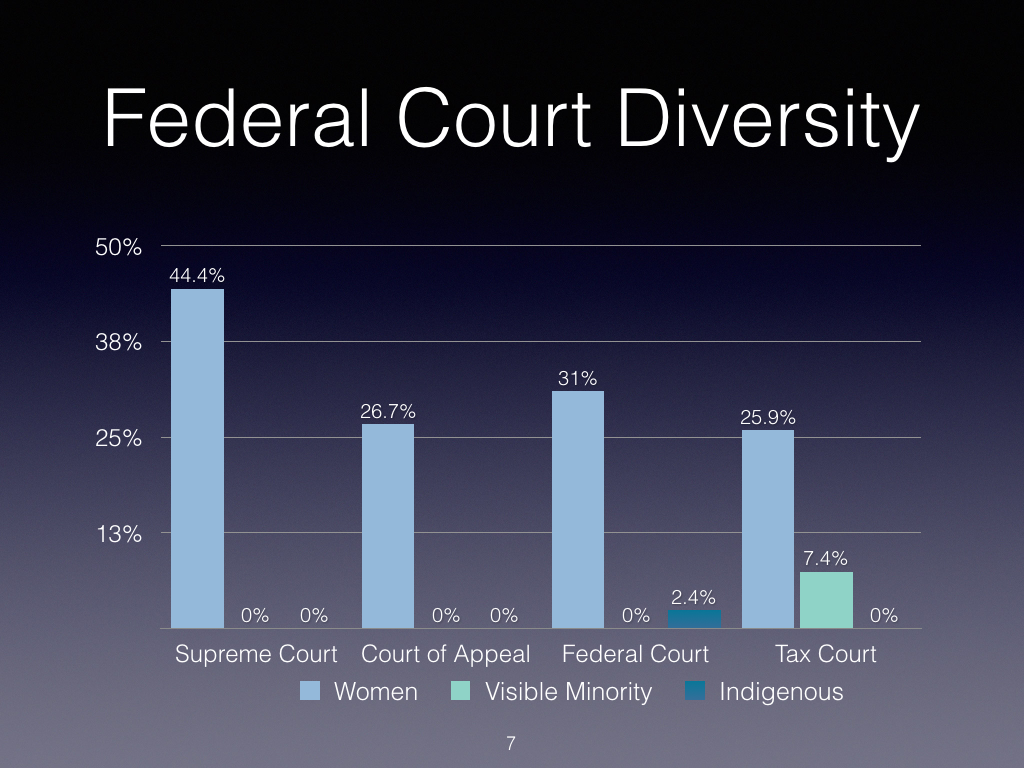
Figure 1 highlights the extent of this under-representation: there are no visible minority or Indigenous judges in the Supreme Court and Court of Appeal, no visible minority judges in the Federal Court and no Indigenous judges in the Tax Court. In all the courts except for the Supreme Court, women are significantly under-represented.

Judicial Diversity 2016 - DRAFT.009Figure 1

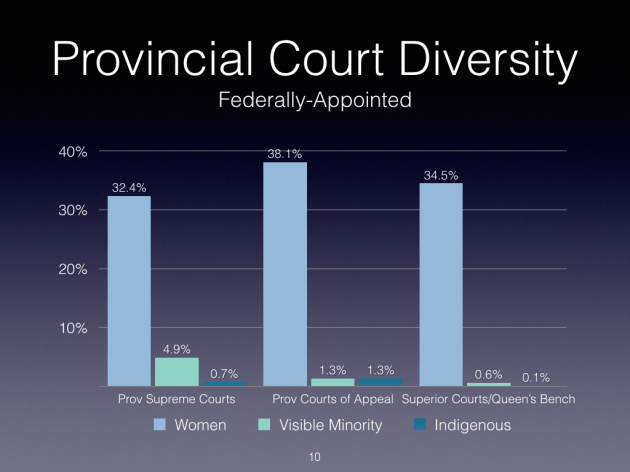
If we look at federally appointed judges to provincial courts (figure 2), the picture is slightly better in terms of both visible minority and Indigenous judges, but in both cases the representation is significantly lower than these groups’ population shares. In the superior courts/Queen’s Bench women are particularly under-represented, but they are better represented when the representation is compared with that of the federal courts.
Judicial Diversity 2016 - DRAFT.010Figure 2

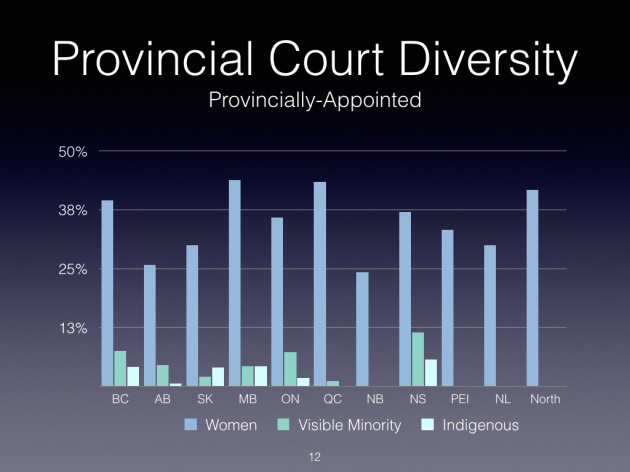
The picture for provincially nominated judges to provincial and territorial courts (figure 3) varies by province, but overall the provinces resemble each other in their under-representation of these groups. The Atlantic provinces, with the exception of Nova Scotia, have no visible minority or Indigenous judges. In the North, despite the large Indigenous population, there are no Indigenous judges. Quebec has relatively few visible minority judges and no Indigenous judges. Saskatchewan and Manitoba, despite their large Indigenous populations, have relatively few Indigenous judges.
Judicial Diversity 2016 - DRAFT.012Figure 3

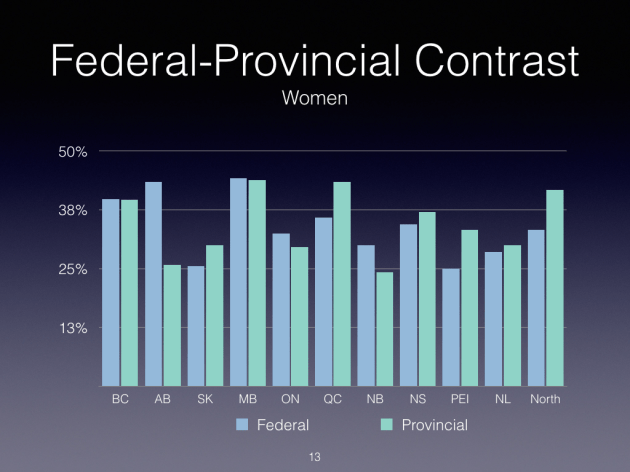
In the next series of charts federally and provincially appointed judges are compared for each under-represented group, by province, starting with women (figure 4). Here there is no overall trend: the federal and provincial appointment of women is similar in British Columbia, Manitoba, Nova Scotia, and Newfoundland and Labrador; in Saskatchewan, Quebec, Prince Edward Island and the North, provincial appointment of women is higher; and in Alberta the appointment of women is significantly lower, given the relatively large share of part-time and supernumerary appointments that are men (about a third of full-time judges are women).
Judicial Diversity 2016 - DRAFT.013Figure 4

Looking at visible minorities (figure 5), when we compare federal and provincial appointments by province, we see a trend in all provinces except Saskatchewan: provincial judicial appointments are more representative of their populations than federal nominations, although visible minorities are still significantly under-represented.

Judicial Diversity 2016 - DRAFT.014Figure 5

Lastly, with respect to Indigenous appointments (figure 6), we see the same pattern: provincial appointments are more representative of provincial populations than federal appointments in all provinces and territories, except, surprisingly, in the North, where there are no Indigenous territorial judges.

Judicial Diversity 2016 - DRAFT.015Figure 6

Looking at senior judges (chief and associate-chief justices), there are no federally appointed visible minority or Indigenous judges, and there are only a handful number of provincially appointed senior judges (figure 7).

Judicial Diversity 2016 - DRAFT.011Figure 7

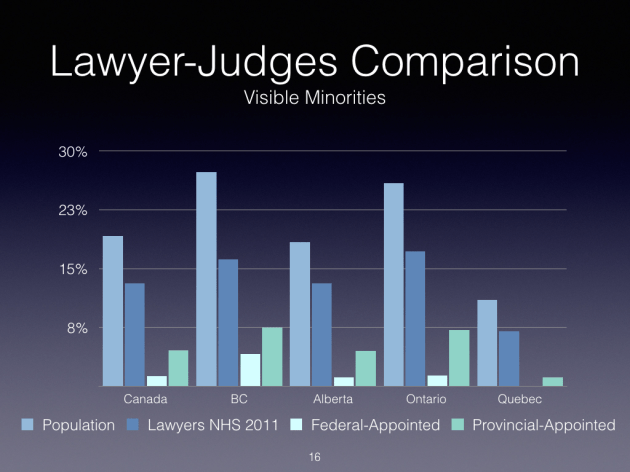
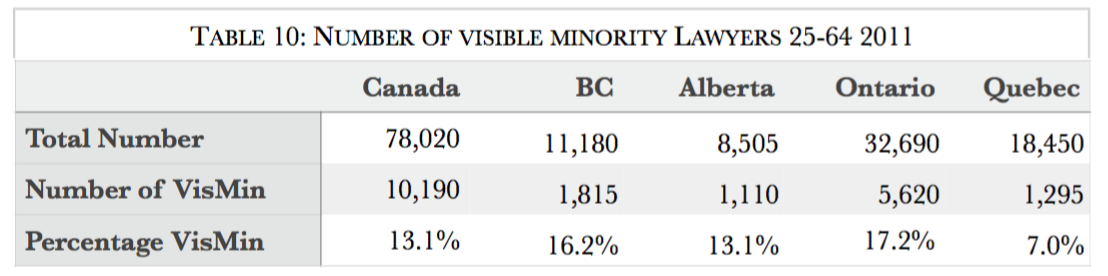
While judicial diversity is low, particularly for visible minorities and Indigenous people, the number of visible minority lawyers continues to increase. Figure 8 presents the proportions of visible minority lawyers aged 25-64 Canada-wide and in the largest provinces, which gives an idea of the size of the pool that can be drawn from. Given that visible minorities are, in general, younger than the general population, visible minority lawyers are also likely to be younger and, therefore, the percentage who would be aged 45 years old or older, the usual age people are considered for these positions, would be lower.
Judicial Diversity 2016 - DRAFT.016.pngFigure 8

As part of its review of the judicial appointment process, the Office of the Commissioner for Federal Judicial Affairs should expand the existing information on the gender of judges and include visible minorities and Indigenous people. With this information, the government could be held to account for its diversity and inclusion commitments, and it would be easier to track its progress over time.

The provinces and territories that do not already do this should do so, and they should use Ontario’s annual reports on appointments as a model, ensuring that the annual reports cover the overall diversity of the entire bench.

*A few notes on methodology. The federal government publishes statistics on gender but not on visible minority or Indigenous appointments. All provinces except Alberta and Saskatchewan indicate gender through the use of “Mr.” or “Madam” justice (the departments of justice provided the number of women judges). Gender information is thus complete.

To identify visible minority and Indigenous origin name checks, appointment announcements and, when available, photos and biographies were used. All provincial judicial councils or departments of justice were approached (only Ontario reports publicly but Saskatchewan, Quebec and Nova Scotia provided the breakdowns used). The Canadian Bar Association, national and regional branches, and law societies were approached and a number of individual lawyers also helped improve the quality of the data collected. I believe this provides a reasonable assessment of current diversity.
Federally appointed courts grow restive as Ottawa slow to fill vacancies

Judicial Diversity 2016 - DRAFT.001Good piece by Sean Fine of the Globe on the questions around new processes of judicial appointments.

I am currently in the process of analyzing the diversity of current federally and provincially appointed judges (preliminary federal court numbers in above chart) and hope that as part of the process review, the Government will commit to diversity statistics for visible minorities and Indigenous Canadians (some provinces already do this with respect to provincial court judges):

Ms. Wilson-Raybould would not commit to a starting date for appointments when she spoke to the judicial council, said an Alberta lawyer with knowledge of the meeting. “The government is considering the full scope of the appointments process, including the composition and operations of the Judicial Advisory Committees,” a spokeswoman for the minister said in an e-mail to The Globe.

“Any potential changes will be examined in light of the government’s objectives to achieve transparency, accountability and diversity in the appointments process and they will be carefully considering how best to achieve this goal, taking into account views of key stakeholders and interested Canadians in this regard.”

The appointments process is not up and running yet. And Ms. Wilson-Raybould has made little progress toward putting a new process in place – having not even begun consultations with the legal community and leaving a critical position unfilled.

At the system’s foundation are 17 judicial advisory committees – eight-member groups that screen candidates for federally appointed courts such as provincial appeal and superior courts, the Federal Court and the Tax Court. Several of these committees have no members at all – two of Ontario’s three committees, both of Quebec’s, plus all four committees in Atlantic Canada.

The Alberta committee, however, has all eight of its members, and met as recently as mid-March to recommend candidates for the bench, Chief Justice Wittmann said.

“Nobody is against reform if it betters the system,” he said, “but you can’t change locomotives and stop the train; the train’s got to keep running while you’re doing it.”

Criminal and civil trials that need more than five days are being scheduled for “well into 2017,” Chief Justice Wittmann said. “If the public through their elected representatives say that’s fine, well, I guess it’s fine. But there seems to be an expectation that it’s not fine.”

For the court’s judges, “it increases their stress and their sense of helplessness, because they can’t handle everything they’re asked to do. The public thinks they’re not getting the access they’ve come to expect. We cannot sacrifice quality to increase the quantity of cases that we process. It just can’t work that way.”

Ms. Wilson-Raybould has yet to discuss the system’s pressing questions with the legal community: what to do about the changes to the process that the former Conservative government put in place, whether to commit to gender parity in judicial appointments, and whether to begin tracking the numbers of visible minority and aboriginal applicants.

Source: Federally appointed courts grow restive as Ottawa slow to fill vacancies – The Globe and Mail

Time to name an Aboriginal justice to the Supreme Court: Hassan and Siddiqui

 Visible Minority LawyersNader Hassan and Fahad Siddiqui make the argument (the number of visible minority lawyers is higher than their article, based upon NHS data that I used in my book, Multiculturalism in Canada: Evidence and Anecdote):

These criteria narrow the field considerably [member of provincial superior court, bilingual, Maritime], and risk obscuring another important fact: our high court does not look like the rest of Canada. No Aboriginal or visible minority has ever been appointed to the Supreme Court. Regional representation — which convention so assiduously protects — is important, but in an increasingly ethnically and religiously diverse country, it is only one of many indicia of diversity.

Since the Abella Equality in Employment Royal Commission Report in 1984, a consensus has emerged among judges, lawyers and academics that judicial diversity matters. A diverse judiciary results in a broader range of perspectives, which is crucial to judicial decision-making. And greater judicial diversity fosters public confidence in the administration of justice.

Little progress has been made so far. Professor Rosemary Cairns Way of the University of Ottawa reports that Aboriginal and visible minority members account for roughly 23 per cent of the population, and yet from 2009 to 2014, only 1.04 per cent of appointees to the provincial superior courts were Aboriginal, and only 0.5 per cent were members of a visible minority group.

The same appears to be true of the senior reaches of the legal profession. The body that regulates lawyers in Ontario, the Law Society of Upper Canada, does not regularly collect comprehensive demographic data. But a Society report, released in 2010, shows that only 5 per cent of lawyers in Ontario between the ages of 45 and 64 are Aboriginals or visible minorities even though those two groups make up more than a fifth of that segment of the population.

It is sometimes argued that as Canada’s population diversifies, the legal profession will too. Problem solved — some years or decades down the line.

The statistics we have don’t bear out that claim though. Even among younger generations, Aboriginals and visible minorities are under-represented at the bar. And those who have managed to gain a foothold in the profession face unique challenges. The society reports that a majority of Aboriginal and visible minority lawyers believe that having a different cultural background has disadvantaged their careers. In that sense, the legal profession reflects trends in the broader job market. According to a recently released study led by University of Toronto researchers, black job applicants are 25.5 per cent more likely to land a job interview when they scrub their resumé of clues of their race.

The time has come for change. And this change requires leadership from the top. We need out-of-the box thinking, such as Trudeau’s laudable decision to name women to half his cabinet positions — including Canada’s first Aboriginal justice minister. The prime minister will have to take a similarly bold approach to fill the high court vacancy. An Aboriginal candidate should take priority. It’s an absolute shame that Canada’s highest court has never had representation from among our First Nations.

Why don’t we have more female judges? – Macleans.ca

Irwin Cotler’s efforts to get more information on judicial appointments (see earlier Tories chastised for lack of racial diversity in judicial appointmentsRacial Diversity Gap in the CourtroomForget MacKay, a woman’s place is on the bench):

The justice minister’s office explains that in the case of Cotler’s most recent question, there simply wasn’t enough time to do what would have had to have been done to answer Cotler’s questions.

In the order-paper question that Mr. Cotler tabled last December, Q-836, he was asking the department to go back through 21 years of information, a great deal of which would require a manual search of the paper records. The department only has 45 days to answer order-paper questions and there was just not enough time.

It does seem like a rather large project.

Cotler and Liberal MP Sean Casey today released a statement calling for greater diversity on the bench and the questions raised by last year’s controversy—whatever Peter MacKay said or didn’t say—still seem worthwhile. While Ontario publishes information on applicants for judicial publications, we have no such data for federal appointments. At what rate are women applying to be federal judges? How has that rate changed over time? And how has the rate of appointment of women changed over time? Those don’t seem like questions for which it would be unreasonable to expect answers to be somehow procured.

I don’t think this is true.

When I compiled a list of women and visible minorities in provincial legislatures, it only took me a week or so to go through names and photos of provincial legislature members. Going through judicial appointments should not be that time consuming (only an average 69 per year between 2006-12).

Why don’t we have more female judges? – Macleans.ca.

Direct link to the table for 2006-12 appointments:

breakdown (pdf)

Forget MacKay, a woman’s place is on the bench

One of the better rebuttals to MacKay’s arguments on lack of diversity:

Mr. MacKay essentially suggests that female lawyers have no judicial ambition. But where is his proof? The federal government’s Office of Federal Judicial Affairs refuses to publish statistics about the number or breakdown of applicants. It can and it should. Consider Ontario, which does publish such statistics. Between 2006 the year the Harper government came to power and 2012, 299 women applied out of a general pool of 636; in other words, 47 per cent. And Ontario appointed 32 of those women to bench out of a total of 72, or 44 per cent.

Can Mr. MacKay plausibly explain why this pattern would be markedly different at the federal level? We doubt it.

Mr. MacKay’s comments perpetuate tired tropes about women, motherhood and professional ambition. Forget the fact that most women applying for or considering judicial office will be well past the stage where they are balancing a toddler on each hip. Forget that the reference to “riding circuit” dates back to times when judges traveled by horse and buggy some Canadian superior court judges do travel, but none who sit on provincial courts of appeal or the Supreme Court of Canada. Even more troubling is that suggestion that women define themselves by motherhood. Not only is the claim sexist and unsupported by evidence, but it locates the fault for any disparity among women themselves.

Equally disturbing is the government’s apparent lack of interest in other aspects of judicial diversity. Statistics from a 2012 Globe and Mail study combined with Ms. Cairns Way’s recent findings suggest that the appointment rate of aboriginal judges hovers at 1 per cent, while the appointment of members of visible minority communities is an abysmal .5 per cent. Clearly, ensuring that the judiciary reflects the community it serves is not a priority for this government.

Make no mistake – the failure to appoint women to the bench is not “a women’s issue”. It affects us all. It is not the fault of women, either. It is a pattern by a government hostile to the judicial role and apparently indifferent to pervasive patterns of under-representation in our judiciary.

Forget MacKay, a woman’s place is on the bench – The Globe and Mail.

Peter MacKay tries to explain lack of diversity on federal courts

More tone deafness on the Government’s judicial appointments. Only three non-white judges out of 200 appointments (Tories chastised for lack of racial diversity in judicial appointments – The Globe and Mail):

According to people in attendance last Friday, MacKay said that as a new father he understands women’s reluctance to leave their children because, while he didn’t want to downplay the role that fathers play, women have a special bond with their children.

Several of the men and women at the meeting of the Ontario Bar Association’s council described the remarks to the Star variously as “disappointing,” “bizarre,” “frustrating” or “offensive.”

In the first instance, they said the answer failed to address the issue of diversity. Secondly, they suggested it was presumptuous if not insensitive, and thirdly it betrayed a lack of understanding of, or commitment to, the goal of making the judiciary more representative, they said.

Today in a scrum he seemed to dig himself in deeper, to the discomfort of some of the women in the Conservative caucus. But surprising that gender diversity has been the main focus, when ethnic diversity is lacking as well.

Peter MacKay tries to explain lack of diversity on federal courts | Toronto Star.