Justice minister announces 24 new judges in effort to end national shortage

Finally, the announcement of the new process for selecting federally-appointed judges. No real surprise given the ministerial mandates letters. Still nothing (yet) and regular reporting:

The Liberal government has announced a new judicial appointment process that emphasizes gender and racial diversity.

One of the key changes unveiled on Thursday specifies that governments and independent legal groups that pick the members of the committees that screen candidates “will be asked to take into account the need to ensure [the committees] are representative of the diversity of Canada,” according to a justice department backgrounder. All members of the screening committees will get training on diversity, unconscious bias and assessment of merit, the backgrounder says. A federal agency will keep track of the demographic makeup of applicants. Until now, applications have been tabulated only by gender, not race.

As part of the process, applicants will have to fill out more detailed application forms than they do now. In these forms, applicants will detail their abilities in Canada’s two official languages, and they may be tested on their proficiency.

Another set of modifications will undo changes the Harper government made to the process. The Conservatives had put a police representative on the judicial advisory committees that screen judges for federally appointed courts (such as provincial superior courts, the Federal Court and Tax Court). They had also taken away the vote of a judge on those committees, which had given the federal appointees a voting majority. And the Conservatives had taken away the judicial advisory committees’ ability to “highly recommend” applicants; they could only recommend (or not). The government will remove the police representative, return the vote to the judge and re-establish the “highly recommended” category.

Applicants who applied under the previous process will have to re-apply, but on Thursday, the government announced the appointments of 24 judges under the existing process.

The Liberals have come under fire from the legal community because they appointed just 15 judges in their first year in power, during which judicial vacancies reached 61. That’s more than at any time during Stephen Harper’s decade in power, records show. When Mr. Harper stopped appointing judges in the summer of 2015, before the federal election, there were a little more than a dozen vacancies.

Backlogs in criminal, civil and family cases have risen in some provinces, especially in Alberta and Nova Scotia.

Source: http://www.theglobeandmail.com/news/national/liberals-to-unveil-new-judicial-appointment-process-undo-changes-made-by-harper/article32454733/

And the announcement of 24 judicial appointments:

After months of criticism for not acting fast enough to appoint much-needed judges across the country, Justice Minister Jody Wilson-Raybould announced 24 judicial appointments Thursday.

“We have moved to fill urgent judicial vacancies by drawing on existing lists of recommended candidates,” the minister said in a statement. “The government is confident in the outstanding quality of these appointees and their dedication to delivering just outcomes for Canadians.”

Justice system can’t wait for judicial appointments review, say judges

Trudeau government has backlog of more than 300 appointments

Of the 24 new appointees, 14 are women and two are Indigenous. (No visible minorities are mentioned but need to doublecheck).

Source: Justice minister announces 24 new judges in effort to end national shortage

And for the list (I will be doing an analysis later as am travelling):

Source: http://news.gc.ca/web/article-en.do?nid=1140619 (separate links by Federal Court and Provincial Courts)

How Trudeau can bring diversity to Supreme Court: Ranjan Agarwal

Some good practical suggestions. The ones I favour include publishing the demographics of applicants and focussing efforts on improving the diversity of other judicial level appointments, where the potential pool is larger.

The easing of the official languages requirement is a non-starter, so those with judicial ambitions should make knowledge of both official languages part of their education.

Needless to say – but I keep saying it – the Office of the Commissioner for Federal Judicial Affairs Canada should include in its reporting, the number of visible minority and Indigenous judges, not just women:

So, can this missed opportunity be salvaged? Yes, if the prime minister takes four steps.

First, he should make clear that Justice Rowe was appointed because he was the best Canadian for the job, not the best Atlantic Canadian. In doing so, he would affirm that his next appointment in September 2018 does not have to be from British Columbia (since Chief Justice Beverly McLachlin, who will retire then, notionally holds that seat on the Court), leaving open the possibility of appointing an aboriginal or minority judge from outside B.C.

In particular, the current convention does not allow for the appointment of a Northern Canadian, even though the courts in the territories are some of the most diverse in Canada.

Second, the prime minister should publish demographic statistics of the applicants for this appointment. How many women applied? Self-identified minorities? Aboriginals? Non-Atlantic Canadians? How many judges? How many lawyers? The problem with promising diverse appointments is that the talent pool at the senior levels of the bar or on the trial and appeal benches may simply not be there. Demographic statistics allow the government and the legal profession to consider where more work must be done to create a pool of good, diverse candidates.

Third, the prime minister should revisit (though not necessarily reconsider) the “functional bilingualism” requirement. Potential applicants have two years to immerse themselves in French-language training. But the government should test whether the bilingualism requirement had a disproportionate impact on aboriginal and immigrant communities, where French-language education may not have been a priority for their parents.

Finally, the prime minister should disproportionally fill the 60 other judicial vacancies with qualified women, aboriginal and minority judges. A more diverse Supreme Court is, in many ways, symbolic. The real work of the justice system happens in our trial courts — that may be the only interaction many Canadians have with a judge.

After every hearing, the Court’s justices gather over lunch to discuss their views on the appeal. The appointment of Bertha Wilson in 1982 surely changed the discussion around that table about many issues, including perhaps most importantly abortion, gender rights and spousal abuse.

The appointment of an aboriginal or minority judge will have the same impact, providing a much needed perspective on novel issues facing an increasingly diverse Canada and in an age of truth and reconciliation. Our justice system is the finest the world has ever known. But, sometimes, not only must justice be done, it must also be seen to be done.

Source: How Trudeau can bring diversity to Supreme Court | Toronto Star

Advocates for minority Supreme Court judge disappointed by Trudeau’s pick

Understandable reactions but equally understandable that the government chose to give priority to regional representation and bilingualism.

However, it will be more important to assess the diversity of future appointments to the lower courts, which I expect will include visible minorities and Indigenous peoples (as did with the initial 15 appointments).

And nice to see my IRPP article, Diversity among federal and provincial judges – Policy Options,  continues to provide useful background data:

The Liberal government may have made history by nominating a Newfoundlander to Canada’s top court — but disappointed advocates say a more critical opportunity has been missed to add racial diversity to Canada’s predominantly white judiciary.

“It’s another white male . . . It’s the exact thing we’ve been doing for years,” said Koren Lightening-Earle, president of the Indigenous Bar Association, adding she would have been “borderline happy with any person of colour.”

Prime Minister Justin Trudeau announced Monday that Justice Malcolm Rowe from Newfoundland and Labrador has been nominated for the Supreme Court of Canada. If formally named to the court, it will be a historic first for the province.

However, scholars and aboriginal jurists had hoped Trudeau’s new selection process might set aside the constitutional convention of regionally based appointments, and focus on putting an aboriginal or black judge into the job.

Lightening-Earle said while Newfoundlanders and Labradorians have waited a number of decades for a representative on the court, aboriginal Canadians have deeper historic claims to a place in the judiciary.

“They (Newfoundland and Labrador residents) have been waiting a long time, but we’ve been waiting a little bit longer,” she said.

Lightening-Earle said in a telephone interview a rare opportunity has been missed, and indigenous lawyers are wondering why they bothered applying to the government’s advisory board for the position.

A report in Policy Options magazine estimated earlier this year that just one per cent of Canada’s 2,160 judges in the provincial superior and lower courts are aboriginal, while 3 per cent are racial minorities — prompting a Dalhousie University law professor to describe the Canadian bench as a “judiciary of whiteness.”

Robert Wright, a black social worker who has served on a Nova Scotia board that recommends judicial appointments, said the announcement is a disappointment given the Trudeau government’s earlier signals it might adjust the system.

“There are an increasing number of Canadians who . . . are not caught up in what I call the historical regional nature of the various Canadian identities we used to focus on,” he said in a telephone interview from Halifax.

Wright argues the principle of diversity that lies beneath appointing people from different regions needed to be shifted to recognize the increasing number of Canadians from diverse ethnic and racial backgrounds.

He said as a black Nova Scotian he would have been content to see a black person from any part of the country elevated to the bench, and he also would have been very pleased if an aboriginal judge was appointed.

Wright and Lightening-Earle say the country is losing out on the opportunity to gain from indigenous perspectives on everything from constitutional issues to sentencing to the factors that lead to crime.

Jeffery Hewitt, a legal scholar at the University of Windsor, said he doesn’t accept arguments that there may be a lack of qualified candidates.

“Tell us who applied. Give us the list. Talk to us about . . . whether there were any indigenous people in there?” said Hewitt, a Cree who has provided legal advice to First Nations.

A spokeswoman for the federal Justice Department said the independent advisory board that recommends candidates to the prime minister’s office “will be reporting on this information one month from (an) appointment.”

Hewitt said he’s hopeful that going forward, the Liberals will make more appointments to the superior courts in the provinces.

In Quebec, the Policy Options study noted three visible minority judges out of more than 500, despite bar society figures showing more than 1,800 of its roughly 25,000 lawyers identify themselves as being from visible minority groups. The province said it doesn’t keep figures.

In Ontario, one of the few provinces where the judicial advisory body keeps figures on the lower court appointments, there were 24 visible minority judges out of 334 judges, even though one quarter of the province’s overall population identifies as a visible minority.

There are no visible minorities on the bench in Newfoundland and Labrador, which by constitutional convention was the likeliest province to be tapped for the next Supreme Court of Canada appointment.

Source: Advocates for minority Supreme Court judge disappointed by Trudeau’s pick | Toronto Star

‘There seems to be a paralysis’: Trudeau government has backlog of more than 300 appointments

Almost a year in, one would expect more vacancies to have been filled, given the overall policy – greater diversity – is clear. But I can also see the wish to ensure that the details of the policy and its implementation are addressed first.

One of the key things to look for is the degree of transparency in political appointments, with comparable employment equity reporting to the public service and federally-regulated sectors (telecoms, banking, transport). Currently for judges, only gender is tracked. For other GiC appointments, while gender has been tracked comprehensively for 25 years (as has official languages), there has been little systemic tracking of the other groups (visible minorities, Indigenous peoples, persons with disabilities).

And in some cases, there has been backsliding: the GiC appointment index (top view) has less information than previously, requiring more looking at the individual organizations than before.

For my baseline study, see my short ebook, “Because it’s 2015 …” Implementing Diversity and Inclusion, available either in an iPad/Mac version (iBooks) or Windows (pdf) Version.

Prime Minister Justin Trudeau and his cabinet have accumulated a backlog of more than 300 appointments that are due to be filled, a CBC News investigation has found.

Almost 20 per cent of governor in council (GIC) appointments, which include roles with Crown corporations, port authorities, agencies and tribunals, are currently vacant or occupied by a Conservative appointee whose term is past its expiry date.

Overall, 170 GIC positions are listed as vacant. Another 116 are past their appointment’s expiry date but the incumbent has been allowed to remain in the role until he or she is either replaced or renewed.

Currently, 61 federally appointed judge positions are vacant, including one seat on the Supreme Court of Canada.

In the Senate, 20 per cent of the 105 seats are empty. The government has pledged to fill the 21 spots “by the end of the year.” Three more senators are due to retire in January.

Taking a toll

In some cases, incumbents have been temporarily renewed only a day or two before their appointments were set to expire because the government had not yet launched the process to find a replacement.

For example, Graham Fraser’s appointment as commissioner of official languages, which was set to expire Sunday, was extended Thursday for two months. The government has yet to issue a job posting to find his successor.

The backlog has taken a toll on the operations of some boards and government bodies.

The CRTC hasn’t been able to hold a planned hearing on French music since November because it doesn’t have the necessary three French-speaking commissioners.

The parole board, where 21 per cent of positions are currently vacant, says it’s being stretched, with its remaining part-time board members putting in additional hours to ensure the work is done.

Alberta judges warned a Senate committee in late September that the 61 vacant judge positions could affect court proceedings, saying the province’s justice system is so backlogged they are now setting trial dates for 2018. Last week, an Edmonton judge stayed a murder charge against Lance Matthew Regan, citing delays in bringing the case to trial caused in part by the backlog in Alberta’s justice system.

‘Overwhelmed’

Liberal government insiders privately point to the Prime Minister’s Office and the Privy Council Office as the source of the problem, saying “the centre” has been “overwhelmed.”

The government is confident the problem will be resolved soon. It says the backlog was caused in part by the decision to overhaul the appointments process and bring in a more open, balanced, merit-based system. The new system is now up and running and vacancies are being filled, officials say.

Source: ‘There seems to be a paralysis’: Trudeau government has backlog of more than 300 appointments – Politics – CBC News

Sean Fine of the Globe focusses on the impact on the court system:

While Prime Minister Justin Trudeau is considering his first appointment to the Supreme Court of Canada – a vacancy became available on Sept. 1 – the shortage of lower-court judges may make it difficult for some jurisdictions to meet constitutional guarantees of timely criminal trials.

In July, the Supreme Court of Canada set a deadline of 30 months in superior courts (such as the Court of Queen’s Bench) from the time a charge is laid until the trial is completed. In Calgary, the wait is now just short of 15 months – 63 weeks – to schedule a trial of five days or more. (It can take months from the time a charge is laid until a trial is scheduled.) The situation is about the same in Nova Scotia, where the Supreme Court is now booking criminal trials of five days or more for next fall.

Civil trials, too, face long delays, which Chief Justice Wittmann said is especially hard on families seeking resolutions to legal problems. The lead time to schedule a civil or family trial of five days or more in the Court of Queen’s Bench in Calgary is now 138 weeks – bookings are being accepted for April, 2019. The Court of Queen’s Bench is Alberta’s top trial court, and it has seven vacancies and 59 full-time judges in office, according to the Office of the Commissioner for Federal Judicial Affairs. The province’s Court of Appeal has two vacancies and 12 full-time judges in office.

In Nova Scotia, the Supreme Court (the top trial court) has five vacancies and 31 full-time judges in office. The Court of Appeal has one vacancy and seven judges in office.

“On rare occasions in the past we’ve had to cancel matters. However, this is the first time we’ve had to send out multiple letters the month before suggesting that trial dates be rescheduled due to the shortage of judges,” Jennifer Stairs, the communications director for the Nova Scotia judiciary, told The Globe in an e-mail.

“That’s very difficult on the lawyers and on the litigants who are anxious to have their matters heard.”

B.C. has eight vacancies and 82 judges in office on its Supreme Court, and three open spots and 12 judges in office on its appeal court. Five-day criminal trials are available in January, 2017, while five-day civil trials, other than motor-vehicle actions, can be booked from August, 2017, onward. Dates for five-day motor-vehicle action trials are fully booked for the next 18 months, according to Superior Courts communications officer Bruce Cohen.

The Canadian Bar Association, representing the country’s legal profession, is also upset at the delays in appointing judges.

“We are very concerned. Ongoing judicial vacancies have created significant delays in the court system. These delays have a serious impact on separating families and their children, on criminal justice, on business in Canada,” CBA president René Basque said in an e-mail.

Canadian courts languish as vacancies on bench remain unfilled

More indigenous judges needed in lower courts to develop skills for Supreme Court: Beverley Mclachlan interview

Valid points and hence the focus should be more on the yet to be formalized new process to appoint federally-appointed judges that better reflect Canada’s diversity, and the actual implementation by the government (for those who missed my analysis of the current baseline, see my Diversity among federal and provincial judges – Policy Options):

Canada’s top judge says the best way to one day see an aboriginal person named to the Supreme Court of Canada is for governments to appoint more indigenous judges to lower courts.

In an exclusive interview with the Star, Chief Justice Beverley McLachlin said the country’s highest court requires high-level judging and “considerable” judicial experience, and while she welcomes ethnic diversity and more aboriginal judges in the system, she suggested they must work their way up.

She said the challenge for aboriginal aspirants to the high court is the same that women faced three or four decades ago when there were “virtually no women on the bench. And so how did the government go about changing that to the point now where we’re four women on the Supreme Court of Canada? They started appointing people at the trial level.

“But the difficulty we have with racial minorities, indigenous people is that we’re just beginning this process of getting the judges in place on the trial benches and so on.”

The federal government has launched a new judicial selection process, striking an independent advisory board to recommend candidates to fill the top court vacancy announced in March by retiring Justice Thomas Cromwell, of Nova Scotia, who steps down at the end of August.

Trudeau wants the seven-member advisory board to recommend jurists “of the highest calibre” who must be functionally bilingual and “representative of the diversity” of Canada.

The new process has again shone a light on the lack of diversity in Canada’s judicial ranks.

McLachlin was consulted by the government as it devised the new selection process. She will also be consulted by the advisory board as it canvasses for Cromwell’s replacement. She was careful not to express an opinion on the government’s changes, saying reforms to judicial selection for greater transparency have been an ongoing project, and it is up to the government to set its criteria, including the bilingualism requirement. “I’m not about to comment on that because it’s not my business.”

 However, she did endorse the functional bilingualism prerequisite as “desirable” even though she herself was not fully, functionally bilingual when first appointed in 1989 to the Supreme Court of Canada by then-Prime Minister Brian Mulroney. That came after she actually started working in the law in French, she said.

Most of the judges at the top court are “completely bilingual now and those who might lack something are working very hard to improve their skill and the court works very well this way,” she said.

“Let me put it this way. It’s possible for the court to function without everyone being bilingual. We’ve done it in the past and I think we’ve done our job well. However, I believe that functional bilingualism is very helpful and desirable.”

But the question of diversity on the court is more complicated.

McLachlin pointed to her own experience. She was first appointed to the County Court of Vancouver “where I thought maybe that’s where I’d spend the rest of my days. And then I worked my way up through the trial court and through the court of appeal, and finally to the Supreme Court of Canada.”

Now women make up about 35 per cent of Canadian judges, she said. “We’ve been able to achieve a significant measure of diversity on the gender front and,” she stressed, “have judges who are reflective of this high calibre of judicial experience, intellectual experience and judgment and familiarity with the law and judging. So we’ve been able to have it all.”

McLachlin is encouraged by “a host of very accomplished indigenous lawyers and professors” who she said are the result of proactive programs in law schools and universities and better educational standards. However, she did not suggest any of those are in a position to be vaulted onto the top bench from the bar, as has been the case with some Supreme Court judges in the past: Suzanne Côté, Ian Binnie, John Sopinka.

Asked if there are any current sitting aboriginal judges that could sit on the high court, McLachlin dodged.

“I can’t say; I haven’t done a survey. We’ll see who applies, and what comes of it.”

Source: More indigenous judges needed in lower courts to develop skills for Supreme Court: Beverley McLachlin | Toronto Star

Ottawa overhauls process for selecting Supreme Court justices

By my count, of the seven members, four women, one indigenous person, no visible minorities. Will be interesting to see how this process works and the results it generates:

Members of the new advisory board nominated by the legal community include: Susan Ursel, a senior partner with a Toronto law firm who has been recognized for her support of the lesbian, gay, bisexual, transgendered and two-spirited (LGBTT) communities in Canada; Jeff Hirsch, president of the Federation of Law Societies of Canada and partner with a Winnpeg law firm; Richard Jamieson Scott, a former chief justice of the Manitoba Court of Appeal and counsel, arbitrator and mediator at a Winnipeg law firm, and Camille Cameron, dean of the Schulich School of Law at Dalhousie University and Chair of the Canadian Council of Law Deans.

The Prime Minister said opening up the process helps reassure Canadians “that all members of the Supreme Court are both fully qualified and fully accountable to those they serve” across the country.

“The appointment of a Supreme Court justice is one of the most important decisions a Prime Minister makes. It is time we made that decision together.”

All candidates must be functionally bilingual, the government says.

The three members of the advisory board appointed by the Trudeau government include: Ms. Campbell, who served as prime minister in 1993 when she led the Progressive Conservative Party, former Northwest Territories premier Stephen Kakfwi and Lili-Anna Peresa, president of Centraide of Greater Montreal. Centraide is the Quebec presence of United Way Canada.

The government will mandate the advisory board to support the goal of a gender-balanced Supreme Court that also reflects Canada’s diverse society. With Justice Cromwell’s departure, the bench is equally split between men and woman and so a new ninth judge will tilt the balance one way or another.

“A diverse bench brings different and valuable perspectives to the decision-making process, whether informed by gender, ethnicity, personal history, or the myriad other things that make us who we are,” Mr. Trudeau wrote.

Source: Ottawa overhauls process for selecting Supreme Court justices – The Globe and Mail

Allan Richarz: A more diverse bench isn’t the answer

Nice to see that my analysis (Diversity among federal and provincial judges – Policy Options) is provoking some discussion and debate.

But I think for most advocates of greater diversity on the bench and public and private institutions more generally, the fundamental purpose is to encourage a greater diversity of life experiences and views to inform and improve decision-making.

We all have our implicit biases and assumptions. Judges are no exception, even if their training and decision-making (“slow thinking” to use Kahneman’s phrase) are designed to help them be more mindful of these biases.

It is not simply assuming that female, visible minority and indigenous judges will necessarily make different decisions than male, non-visible minority or non-indigenous judges, but that their different backgrounds may provide a different perspective to interpreting the law.

Moreover, the legitimacy of public institutions requires a reasonable correlation between the population and their representation in these institutions.

How would Richarz feel if the numbers were reversed with only 2.1 percent of federal judges being white?


So while I fully agree with Richarz that improved judicial diversity is not a panacea for over-representation in prison or other similar issues, this does not undermine the overall case for diversity:

A recent report by Policy Options magazine reveals that indigenous and minority representation on Canada’s judiciary registers in the low single digits. This has led to the predictable hue and cry over a “judiciary of whiteness” from assorted legal analysts cum race-baiters. The real problem, however, is not with a lack of minority representation on the bench, but with the patronizing and divisive assumption that having more minority judges will serve as a sort of panacea for certain racial groups’ over-representation in prison. The clamour for more minority appointments to the bench is simply a smokescreen for pushing broader political ends that will ultimately do nothing for the communities it purports to help.

There are a number of troubling assumptions underlying the contention that greater minority representation on the bench will result in more positive outcomes for minority defendants. The first seems to take as a given that, say, an African-Canadian judge will cut a black defendant slack based not on the law, nor on the facts of the case, nor on the judge’s legal experience, but on nothing more than a sense of racial solidarity. This would be unacceptable in any other contexts. A male judge acquitting a male defendant of sexual assault based on a wink-wink, nudge-nudge “you know how it is” would raise immeasurable howls of protest.

Such an approach also unfairly reduces minority judges to just that, a minority judge. Becoming a judge is no easy task. Never mind the long hours at law school, passing the bar exams, spending a decade or more as a practising lawyer and earning the recommendation of one’s peers; all that is thrown out the window when one is simply reduced to “the Asian judge” or “the black female judge.” Perhaps for activist lawyers who have built careers on sowing racial divisions such labels do not matter, but for minority lawyers simply wanting to work and be treated no differently from their white colleagues, being reduced to a mere token is undoubtedly patronizing and unfair.

Adding to this is the unfair denigration of the thousands of judges serving  across Canada. While it is certainly fair to note that the judiciary is somewhat “male, pale and stale,” it is quite another to conclude based on that that the judiciary is riddled with closet racists, homophobes and misogynists as a result.

None of this matters, of course, to activists who would simply reduce the legal profession and judiciary to its constituent elements of race and sex. Their end game, however, is not about greater equality or fairness or whatever other trendy legal cause célèbre arises; it is about their own power, self-aggrandizement and profit. The squeaky wheel gets the grease, but also the TV face time and lucrative government contracts.

Judges are not the victims in this instance. For better or for worse, they have largely insulated themselves from the slings and arrows of the rabble-rousers and society generally. Who suffers most is the communities activists purport to help. Underlying causes of criminal overrepresentation in black and indigenous communities are overlooked in favour of sexier, more profitable Band-Aid solutions.

It is an unfortunate trend among progressive organizations in which political opportunism trumps all. In the United States, the leading cause of death among African-Americans aged 15-34 is homicide, according to the Centre for Disease Control. Among all African-American homicide victims, 90 per cent are killed by other blacks. Last weekend, 11 people in Chicago — all black — were shot and killed, yet Black Lives Matters was elsewhere, disrupting yuppie food festivals and clambering for airtime on CNN. This is a crisis, and people are dying. The solutions will be complex and never complete, but surely a more diverse bench isn’t the first place the hard work should start.

Ultimately, if activists want to help their communities, they must focus less on cheap agitation and political stunts, and more on actually supporting those in need. There is no doubt room to improve our judicial system, but tokenizing those serving in it is not the way to do it. Promoting and sponsoring education, work training opportunities and self-respect, rather than treating communities as hapless minorities in need of a Svengali-like saviour, are key. Perhaps it means less screen time on the TV talk shops, but activists’ political opportunism must take a back seat to actually serving their communities.

Source: Allan Richarz: A more diverse bench isn’t the answer

Trudeau faces diversity challenge in Supreme Court judge selection

Interesting comment about the small ‘pipeline’ of potential visible minority and Indigenous judges bequeathed by the previous government (for my analysis of judicial and other diversity, see my free download in iPad/Mac version (iBooks) and Windows (pdf) Version)::

In Prime Minister Justin Trudeau’s first chance to name a judge to the Supreme Court of Canada, the search for diversity is bumping up against the reality of limited choices – raising the odds that a government that chose just three white males in its first 15 judicial appointments will pick one for the country’s most powerful court.

Mr. Trudeau has an opportunity to make a historic mark. If he names a woman for the job that comes open in September, he would give the court the first female majority in its 141-year history. If he names a member of a visible minority or an indigenous judge, that, too, would be a first for the court.

His Liberal government has left little doubt that it would like to find a well-qualified candidate from one of those groups.

“If it’s possible, they’re going to give it to a female, bilingual, visible minority – if they can find that person,” a Liberal party insider said.

But the search is proving to be a challenge. The opening comes with the upcoming retirement of Justice Thomas Cromwell of Nova Scotia and convention dictates that his successor must come from Atlantic Canada. The Prime Minister’s insistence that new appointees to the country’s highest court be functionally bilingual limits his choices further.

And there are no obvious bilingual stars among women on the region’s appeal courts (the most frequent source of Supreme Court judges) and in its law firms, more than a dozen legal observers in Atlantic Canada said in interviews. As for visible minority or indigenous judges, the pipeline was left largely empty by the former Conservative government.

And so Mr. Trudeau’s attention may yet turn to white males. Among the leading candidates in that category are Justice Marc Richard of the New Brunswick Court of Appeal and Chief Justice Michael MacDonald of the Nova Scotia Court of Appeal.

Source: Trudeau faces diversity challenge in Supreme Court judge selection – The Globe and Mail

Advocates call for minority judges as figures show ‘judiciary of whiteness’

Source: Advocates call for minority judges as figures show ‘judiciary of whiteness’ – Winnipeg Free Press

Justice system can’t wait for judicial appointments review, say judges

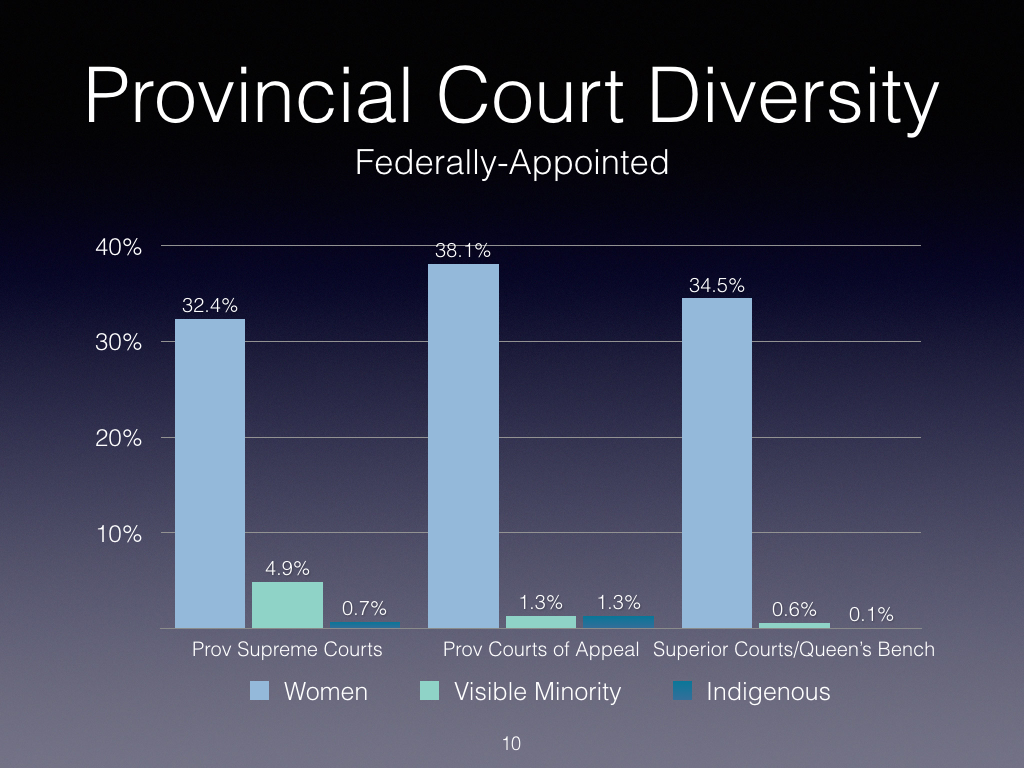
Judicial Diversity 2016 - DRAFT.010The fine balance of doing a review – generally a good idea to ensure comfort with the process and alignment with governmental priorities – and the operational requirements of filling positions (see my analysis of current judicial diversity Diversity among federal and provincial judges):

Since being appointed justice minister and attorney general six months ago, Jody Wilson-Raybould has not appointed a single judge. There are at least 46 vacant seats on the bench of federally-appointed superior courts, with British Columbia and Alberta each short 10 judges.

In addition, every judicial advisory committee from Toronto to Newfoundland and Labrador was disbanded last fall when their terms expired. Judicial advisory committees assess the qualifications and merits of those who apply to be a judge and recommend applicants to the minister.

“It would be much better to continue those committees until they’re replaced. That would be a fairly simple situation to an unacceptable hiatus,” Wittmann told CBC News.

Appointments to JACs and the bench are made by the minister in close collaboration and consultation with his or her judicial affairs adviser — a crucial role that has also not yet been filled.

“The minister is working to staff this position as soon as possible,” said Michael Davis, director of communications for Wilson-Raybould, in response to several inquiries by CBC News.

Lorne Sossin, dean of law at York University’s Osgoode Hall, calls that surprising and concerning.

“It’s not an emergency in the way a forest fire or a flood is, but it is building to that point that it’s creating really negative consequences on the ground,” said Sossin. “If you have those vacancies for so long a period of time, it’s again putting extra stress and strain on those who are in the system. It creates backlogs and access-to-justice concerns.”

Wilson-Raybould is, without a doubt, among the busiest cabinet ministers. Prime Minister Justin Trudeau gave her a lead role on several important and pressing files, such as legislation to permit physician-assisted dying, a federal inquiry into murdered and missing indigenous women and legalizing marijuana.

“So, there’s lots of different priorities but I don’t think those are any excuses to not have a timely set of benchmarks being met on something as critical as judicial appointments,” said Sossin.

Judicial appointments process under review

According to the minister’s office, the hold up is an overall review of the judicial appointments process.

“A review of the entire judicial appointments process is ongoing, based on principles of openness, transparency, merit, and diversity. The minister is committed to achieving a greater degree of diversity within the Canadian judiciary, so that it will come to truly reflect the face of Canada,” her office said in a statement.

Judicial advisory committees are also subject to that review. CBC News asked her office whether Wilson-Raybould is interested in tinkering with the makeup of the councils, as the previous government changed the rules to require each committee to have a representative with a background in policing.

“(The minister is) aware of the need to get the Judicial Advisory Committees up and running in a timely manner. However, it is important to ensure that this is done in a considered way, given the important role these committees play,” her office said.

‘What should happen is some appointments ought to be made by the executive branch of government. That’s their job.’-Alberta Court of Queen’s Bench Chief Justice Neil Wittmann

“I regret there is nothing we can add as processes are under review at the moment,” Davis added later, when asked for an update on the process so far, including the mandate, scope and timeline for completion.

But Chief Justice Wittmann isn’t so sure.

“I’m not aware of a review actually occurring. I’m aware of the minister’s position that she wants a review to occur,” he said.

Source: Justice system can’t wait for judicial appointments review, say judges – Politics – CBC News