Will Hollywood Finally Learn From the Success of ‘Hidden Figures’? – The Atlantic

One of the films on my list to see (our daughter saw it and highly recommended it):

… it wouldn’t be hard for major studios to increase the number of films written by women: The ratio in 2015 was 69 percent male to 31 percent female, but by commissioning just five new scripts by women per year, things would be equal by 2018. But the supposed “surprise” of Hidden Figures’s success feels especially galling because it repeats a similar conversation from a year ago. Films like Creed and Straight Outta Compton were smash hits, clearly refuting the discriminatory maxim that films about people of color are more of a box-office risk for studios. A year later, Hidden Figures is “disproving” that trend yet again—even though that kind of backwards thinking about diversity should feel entirely irrelevant by now.

In its first weekend of wide release, Hidden Figures defied tracking numbers that saw it grossing less than the fourth weekend of Rogue One; it made $22 million, also beating out that week’s new blockbuster, Underworld: Brood Wars. For the subsequent four-day Martin Luther King, Jr. holiday weekendHidden Figuresactually increased its gross, making $26 million and staying at number one, holding off the expansion of La La Land, the horror film The Bye Bye Man, and Paramount’s broad-skewing children’s adventure Monster Trucks.

That last film provides a particularly interesting lesson in Hollywood economics. The industry, in general, has focused in recent years on films that have the potential to be launching pads for major franchises. As the movie business becomes more globally focused and tries to compete with TVs that can offer a near-theater-quality viewing experience at home, splashy big-budget extravaganzas have become a routine matter of course. This is frequently put forward as an explanation for why Hollywood seems loath to cast actors of color in leading roles, because they supposedly have less market pull worldwide (an argument soundly disproven by hits like the Fast & Furious franchise or Star Wars: The Force Awakens, as well as many smaller-scale films).

And yet Monster Trucks is a patently silly piece of kids entertainment about a young man who finds a squid-like monster living in his truck. It stars Lucas Till, hardly an A-lister (though he had a small role in the recent X-Men movies), and cost $125 million to make—$100 million more than Hidden Figures. Devoting such a large budget to a film with little brand recognition that was basically guaranteed to get terrible reviews was quickly regarded as a disastrous decision. Viacom, the company that owns the Monster Trucks studio Paramount Pictures, took a $115 million write-down in earnings last September in anticipation of its failure (it opened to a lackluster $15 million last weekend).

This is what Hollywood’s emphasis on big-budget films with “broad appeal” inevitably leads to: hundreds of millions of dollars being spent on toy-focused action films with no real audience. For the cost of Monster Trucks, Paramount could have made five Hidden Figures—smaller films, focused on telling grounded stories to fill a market gap that studios continue to ignore. That Hidden Figures’s success has to serve as a lesson to Hollywood in 2017 is ridiculous, but the lesson is nonetheless there to be learned. Audiences are hungry for films that look beyond the movie industry’s narrow worldview. It’s time to start delivering them.
Source: Will Hollywood Finally Learn From the Success of ‘Hidden Figures’? – The Atlantic

ICYMI: After #OscarsSoWhite, film academy invites diverse new membership

Getting the message:

Months after the #OscarsSoWhite backlash, the film academy behind the Oscars has invited a diverse blend of 683 filmmakers, movie artists and executives to join its ranks.

“We’re proud to welcome these new members to the academy, and know they view this as an opportunity and not just an invitation, a mission and not just a membership,” Academy of Motion Picture Arts and Sciences president Cheryl Boone Isaacs said in a statement Wednesday.

New members range from recent Oscar-winners such as Brie Larson, Alicia Vikander and Mark Rylance to famous names from a variety of backgrounds, including Idris Elba, America Ferrera, Vivica A. Fox, Carla Gugino, O’Shea (Ice Cube) Jackson, Daniel Dae Kim, Michael B. Jordan, Eva Mendes, Freida Pinto, Mary J. Blige and Will.i.am.

The list also features a host of Canadians, including Adam Beach, Bruce Greenwood, Rachel McAdams, Xavier Dolan, Mary Harron, Deepa Mehta, Patricia Rozema and Emma Donoghue.

Should all the invited members accept, the academy says its new class would boost the diversity of the overall membership to 27 per cent female (46 per cent of the invited members are women) and 11 per cent minority (41 per cent of the invited new members are people of colour).

Currently, the academy’s membership is 25 per cent female and eight per cent people of colour.

The youngest new member is 24, while the oldest is 91.

“This class continues our long-term commitment to welcoming extraordinary talent reflective of those working in film today,” Isaacs said.

“We encourage the larger creative community to open its doors wider, and create opportunities for anyone interested in working in this incredible and storied industry.”

Source: After #OscarsSoWhite, film academy invites diverse new membership – Arts & Entertainment – CBC News

Memo to the Oscars from the Tonys — this is what diversity looks like

Stark contrast with Hollywood:

This is not to say that Broadway has solved racism. In fact many of this year’s most-lauded actors say there’s more work to be done. Speaking with the Hollywood Reporter, Leslie Odom Jr., who won for his role as Aaron Burr in Hamilton, has said the lack of complex roles for black actors is so acute he plans on focusing on his music career following Hamilton. Looking into 2017, few expect the range of plays and musicals for the year ahead to rival this season. The real question is what comes out of the seeds that Hamilton is sowing — perhaps a new generation of actors and writers inspired to tell their own stories.

645679121JN00223_2016_Tony_

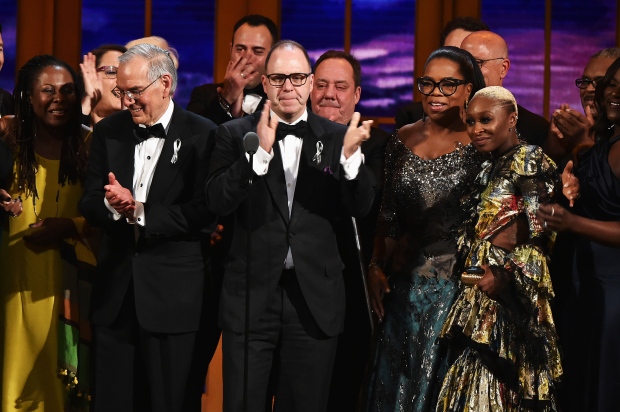
The cast of The Colour Purple accepts the award for Best Revival of a Musical onstage. (Getty Images for Tony Awards Productions)

Meanwhile, when it comes to diversity, the hip-hop history lesson is just the beginning. From Spring Awakening, where actors perform American Sign Language, to the Latin rhythms of the Gloria Estefan-inspired On Your Feet, Broadway is breaking boundaries and wooing new audiences. While Hollywood is busy arguing about who should direct the inevitable Hamilton movie, executives should be taking notes. Instead of playing it safe with familiar faces and bland remakes, shake things up. As Kevin Costner once said: “Build it and they will come.”

Source: Memo to the Oscars from the Tonys — this is what diversity looks like – Arts & Entertainment – CBC News

Hollywood Studios Targeted by Feds in Gender Bias Investigation – The Daily Beast

Interesting to see how it turns out:

As much as powerful female voices in Hollywood like Patricia Arquette have helped bring national awareness to the industry’s alleged gender bias, Maria Giese, one of the women directors interviewed by the EOCC [Equal Employment Opportunity Commission], deserves credit for helping to spearhead the investigation.

Giese began working on the issue at the end of 2011, when she met with the Directors Guild of America.

“The DGA fought me so ferociously and were so hostile to the activist efforts I was making inside the guild to increase hiring of women directors,” she told The Daily Beast. “I realized there was a huge conflict of interest—here was a union run by a vast majority of male members pretending to have an interest in hiring mandates of women when they own the lion’s share of the pie.”

She first met with the ACLU in February 2013, and again in April and May, and explained why the issue was so significant and how they could possibly mitigate it, either by coming up with solutions to take legal actions themselves or by getting the EEOC involved.

She had previously met with the EEOC and said that they were more interested in a single woman filing a lawsuit with smoking gun evidence against a studio than in getting involved themselves. She now believes that government involvement is the only way to affect real change.

Very few women directors have been as vociferously critical of the industry as Giese, who admits she has essentially sacrificed her career in doing so.

“I knew I would risk getting blacklisted in an industry that is run on personal relationships,” she said. “But I hadn’t been able to get any work for a very long time and I felt I had nothing left to lose.”

 There are only a handful of women directors who have achieved enormous success in Hollywood, most notably Kathryn Bigelow. Giese said that roughly 4 percent of studio features are directed by women, and nearly 100 percent of those women are movie stars, pop stars, or relatives of movie moguls (Angelina Jolie, Drew Barrymore, Sofia Coppola, and Jodie Foster, to name a few).

“There’s no guarantees that this investigation will amount to any change, and that puts women directors and allies of women directors in a precarious position if they choose to speak out right now,” said another female director who asked to remain anonymous.

If the EEOC found evidence of widespread discrimination in Hollywood, they could potentially sue studios or seek to negotiate a solution that would increase their hiring of women in various roles.

Source: Hollywood Studios Targeted by Feds in Gender Bias Investigation – The Daily Beast

Diversity of Marvel comics not reflected in movies

More on the lack of diversity in Hollywood:

Powered by a cast of comic-book characters generations have grown up with, Captain America: Civil War appears set for another record-breaking weekend.

But while the familiar faces are part of the allure, drop by your local comic shop (it is free comic book day after all) and you’ll see many of your old favourites undergoing radical makeovers.

….But the recent controversy over the new trailer for Doctor Strange suggested there’s still hesitation when it comes to displaying diverse characters. In the upcoming Marvel movie Tilda Swinton portrays the Ancient One, a character who was originally Tibetan.

Actor and activist George Takei was among those who blasted Marvel’s move.

“They cast Tilda because they believe white audiences want to see white faces,” he wrote on Facebook. “Audiences, too, should be aware of how dumb and out of touch the studios think we are.”

Considering a top-selling comic title reaches an audience of only about 200,000 readers in North America, it’s amazing the industry has any impact at all.

Yet the movies and the comics books are tied together in other ways. De Landro points out that many of the TV and film producers working for Marvel started in the publishing division. They understand the characters and the desire for change.

“There’s that hunger, that real need to see these characters out there and for people to see themselves represented. I think that’s going to translate,” he said.

And while publishers spin out new stories every month, multi-million dollar blockbusters have much longer gestational period. Considering the fact both Warner Brothers and Disney both have committed to film schedules stretching into 2020, the movies will be playing catch-up for many more years to come.

Source: Diversity of Marvel comics not reflected in movies – Arts & Entertainment – CBC News

The Largest Ever Analysis of Film Dialogue by Gender: 2,000 scripts, 25,000 actors, 4 million lines

The_Largest_Ever_Analysis_of_Film_Dialogue_by_Gender__2_000_scripts__25_000_actors__4_million_linesA really good example of the kind of detailed analysis that provides a more rigorous evidence base for trends, preferences, and biases. Check out the interactive graphics, which are particularly well-designed, informative and effective:

This project was born out of the less-than-stellar response to our analysis of films that fail the Bechdel Test. Commenters were quick to point out that the Bechdel Test is flawed and there are justifiable reasons for films to fail (e.g., they are historic). By measuring dialogue, we have much more objective view of gender in film.

Many of the findings are anecdotally obvious to women in the film industry. But nobody wanted to do the grunt work of gathering the data. We spent weeks just matching scripts to IMDB pages. It’s still not perfect, but we’re now in a much better place than “you know…women are never love-interests when they’re older than 40. ¯\_(ツ)_/¯”

All of our sources are available in this Google Doc and as much data as we can share (without getting sued) is available here on Github. Or if you don’t know how to code, here’s an easy way to comb through every film, genre, and year.

Source: The Largest Ever Analysis of Film Dialogue by Gender: 2,000 scripts, 25,000 actors, 4 million lines

Hollywood’s Diversity Problem at ‘Epidemic’ Levels, Study Finds | TIME

Sobering statistics from a thorough study:

In one of the most exhaustive and damning reports on diversity in Hollywood, a new study finds that the films and television produced by major media companies are “whitewashed,” and that an “epidemic of invisibility” runs top to bottom through the industry for women, minorities and LGBT people.

A study to be released Monday by the Media, Diversity and Social Change Initiative at the University of Southern California’s Annenberg School for Communication and Journalism offers one of the most wide-ranging examinations of the film and television industries, including a pointed “inclusivity index” of 10 major media companies — from Disney to Netflix — that gives a failing grade to every movie studio and most TV makers.

Coming just days before an Academy Awards where a second straight year of all-white acting nominees has enflamed an industry-wide crisis, the report offers a new barrage of sobering statistics that further evidence a deep discrepancy between Hollywood and the American population it entertains, in gender, race and ethnicity.

“The prequel to OscarsSoWhite is HollywoodSoWhite,” said Stacy L. Smith, a USC professor and one of the study’s authors, in an interview. “We don’t have a diversity problem. We have an inclusion crisis.”

The study, titled the Comprehensive Annenberg Report on Diversity, examined the 109 films released by major studios (including art-house divisions) in 2014 and 305 scripted, first-run TV and digital series across 31 networks and streaming services that aired from September 2014 to August 2015. More than 11,000 speaking characters were analyzed for gender, racial and ethnic representation and LGBT status. Some 10,000 directors, writers and show creators were examined, as was the gender of more than 1,500 executives.

The portrait is one of pervasive underrepresentation, no matter the media platform, from CEOs to minor characters. “Overall, the landscape of media content is still largely whitewashed,” the study concludes.

In the 414 studied films and series, only a third of speaking characters were female, and only 28.3 percent were from minority groups — about 10 percent less than the makeup of the U.S. population. Characters 40 years or older skew heavily male across film and TV: 74.3 percent male to 25.7 percent female.

Just 2 percent of speaking characters were LGBT-identified. Among the 11,306 speaking characters studied, only seven were transgendered (and four were from the same series).

“When we start to step back to see this larger ecology, I think we see a picture of exclusion,” said Smith. “And it doesn’t match the norms of the population of the United States.”

Behind the camera, the discrepancy is even greater. Directors overall were 87 percent white. Broadcast TV directors (90.4 percent white) were the least diverse.

Just 15.2 percent of directors, 28.9 percent of writers and 22.6 percent of series creators were female. In film, the gender gap is greatest: Only 3.4 percent of the films studied were directed by women, and only two directors out of the 109 were black women: Ava DuVernay (“Selma”) and Amma Asante (“Belle”).

USC’s study, which the school has been publishing in various forms for the last 10 years, also seeks to add a new metric in the conversation. The “inclusivity index” is a report card for the performances of 21st Century Fox, CBS, NBC Universal, Sony, the Walt Disney Co., Time Warner, Viacom, Amazon, Hulu and Netflix. Those companies encompass all the broadcast networks, most major cable channels, all of the major movie studios and three of the dominant streaming services.

Each was rated by their percentage of female, minority and LGBT characters; and of female writers and directors. None of the six major studios rated better than 20 percent overall; Time Warner fared poorest of all with a score of zero. The report concludes that the film industry “still functions as a straight, white, boy’s club.”

Disney, Sony, Paramount, Fox, Universal and Warner Bros. didn’t immediate comment Sunday night.

Some of the same companies, however, scored better when their TV and digital offerings were evaluated. Disney, the CW, Amazon and Hulu all scored 65 percent and above.

“When we turn to see where the problem is better or worse, the apex to this whole endeavor is: Everyone in film is failing, all of the companies investigated,” said Smith. “They’re impervious to change. But there are pockets of promise in television. There is a focus that change is possible. The very companies that are inclusive — Disney, CW, Hulu, Amazon to some degree — those companies, if they’re producing and distributing motion pictures, can do this. We now have evidence that they can, and they can thrive.”

Source: Hollywood’s Diversity Problem at ‘Epidemic’ Levels, Study Finds | TIME

Meryl Streep’s ‘We’re All Africans’ Flub at the Berlin Festival Makes It Clear: It’s Time to Retire Talk of ‘Humanism’ – The Atlantic

Good deconstruction of the use/misuse/abuse of the term humanism:

“Humanism,” used as an anti-ism, is a lexical version of all those people who claim, as if they are unique in the sentiment: “I think all lives matter.”

If transcendence is your aim—if you happen to prefer the soaring over the searing in your rhetoric and in your life—then “humanism” is an ideal term. It is soft and smooth and inviting and historically inflected and, above all, conveniently unfalsifiable. Who doesn’t believe in the value and the potential of collective humanity? Who wouldn’t be excited by all that might be achieved by, as Sarah Jessica Parker put it, “a humanist movement”? Humanism is the stuff of the Taj Mahal and Leonardo da Vinci and “one giant leap for mankind.” It is also, today, the stuff of cultural utopianism. Who wouldn’t love a world in which the seams of our great human tapestry are rendered effectively invisible?

In that sense, “humanism” makes for a self-contained tautology. But it also makes, as a piece of rhetoric, for a sentiment that is extremely glib: It is concern trolling, essentially, in the guise of inclusivity. Used as an alternative to feminism or any other civil-rights movement—used, broadly, as a justification for convening an all-white film-festival jury in the year 2016—it suggests that those movements are somehow petty or point-missing. That they ignore the beautiful human forest for its trees. That they insist on strife and manufacture drama and, all in all, have no chill. I am for nice, easy balance.

In all that, the deployment of “humanism” effectively forestalls conversation about gender or race or power or privilege or any of the other things that, especially right now, desperately need talking about. What do you say to someone who refuses to acknowledge divisions? To someone who seems to see social movements that fight systemic injustices as awkwardly thirsty? To someone who ignores the ongoing nature of the civil-rights movement, and the battles women have fought for equality? Streep’s recent film, Suffragette, features a character willingly martyring herself so that her fellow women might one day win the vote. “Humanism” treats that sacrifice as, effectively, a little bit awkward.

Which is all to say: To confess that one sees oneself, all social strife aside, as a “humanist” is not to confess a partisanship with our better angels. It is to willfully ignore history. 

It is also to ignore, by the way, the history of the concept of “humanism” itself. “Humanism,” on the surfacesuggests the Renaissance, and the flowering of human potential, and the ending of the Dark Ages, and education, and art. It whiffs of both Enlightenment and enlightenment. Humanism, certainly, embodied all that as a historical movement. But that was centuries ago. Today, most commonly, the term functions as an abbreviation of “secular humanism,” or the espousal of cultural values that have been disentangled from belief in the supernatural. It suggests the primacy of social norms over religious ones. “Humanism” suggests, essentially, “atheism that isn’t jerky about it.” 

… Regardless, there are many ironies here. One of them is that humanism, in all its incarnations, has historically involved a rejection of regressive thinking in favor of something more “enlightened,” more forward-thinking, more optimistic about what humans can achieve when they strive for something together. The celebrities’ brand of humanism, on the surface, promises to the do the same. “Why classify people?” Charlotte Rampling asked in her now-infamous questioning of the validity of #OscarsSoWhite.

But in a time of legitimate division and strife—in a time that equates progress with the recognition of social divisions rather than the rejection of them—it’s Rampling’s question that’s regressive. It’s humanism that is, counter to all logic, on the wrong side of history. That’s the real tautology here: We classify people because, well, we classify people. It might not be the world we want, but it is the world we have. Loftiness is lovely, but humans—from our African origins to the present day—were made, in the end, to walk on the ground.

Source: Meryl Streep’s ‘We’re All Africans’ Flub at the Berlin Festival Makes It Clear: It’s Time to Retire Talk of ‘Humanism’ – The Atlantic

The Coen Brothers: ‘The Oscars Are Not That Important’ and Comments on Diversity – The Daily Beast

The Coen brothers (I like many of their films) on diversity and storytelling:

I asked the Coens to respond to criticisms that there aren’t more minority characters in the film. In other words, why is #HailCaesarSoWhite?

“Why would there be?” countered Joel Coen. “I don’t understand the question. No—I understand that you’re asking the question, I don’t understand where the question comes from.”

“Not why people want more diversity—why they would single out a particular movie and say, ‘Why aren’t there black or Chinese or Martians in this movie? What’s going on?’ That’s the question I don’t understand. The person who asks that question has to come in the room and explain it to me.”

As filmmakers, is it important or not important to consciously factor in concerns like diversity, I asked.

“Not in the least!” Ethan answered. “It’s important to tell the story you’re telling in the right way, which might involve black people or people of whatever heritage or ethnicity—or it might not.”

“It’s an absolute, absurd misunderstanding of how things get made to single out any particular story and say, ‘Why aren’t there this, that, or the other thing?’” added Joel. “It’s a fundamental misunderstanding of how stories are written. So you have to start there and say, ‘You don’t know what you’re talking about.’”

He continued: “You don’t sit down and write a story and say, ‘I’m going to write a story that involves four black people, three Jews, and a dog,’—right? That’s not how stories get written. If you don’t understand that, you don’t understand anything about how stories get written and you don’t realize that the question you’re asking is idiotic.”

“It’s not an illegitimate thing to say there should be more diversity in an industry,” concluded Joel. “But that’s not what that question is about. That question is about something else.”

Source: The Coen Brothers: ‘The Oscars Are Not That Important’ – The Daily Beast

#OscarsSoWhite: How a Lack of Diversity Historically Dooms Oscars Ratings – The Daily Beast

Interesting correlation how greater diversity of Oscar nominees is reflected in greater viewership. While other factors may also be at play as noted in the article, the business argument appears persuasive:

Using ratings data provided by Nielsen that broke Oscars viewership down by race, stretching back to the 2004 telecast, we found that the largest percentage of black viewers and non-white viewers tuned in to the Academy Awards in years when the most nominees of color and films featuring protagonists of color were in contention.

The reverse is also true: Generally, the years with the least diversity were the least-watched among people of color.

Not only that, but the years that had the highest percentages of black and non-white viewers also happened to be the highest rated Oscars telecasts overall. That means that people of color have been a major force in driving the biggest Oscars ratings.

Simply put, a more diverse slate of nominees leads to better ratings. Assuming that the Academy needs big ratings numbers to make money and stay relevant, #OscarsSoWhite—or, at the very least, a resistance to diversity—is bad for business.

For example, 2005 was the year with the highest ratings among black viewers, with 5.3 million tuning in, amounting to 12.5 percent of that year’s total viewers. It was also among the highest rated Oscars ceremony in the years that we surveyed, topping out at 42 million viewers.

That year, six nominees were actors of color: Don Cheadle and Sophie Okonedo (Hotel Rwanda), Morgan Freeman (Million Dollar Baby), Catalina Sandino Moreno (Maria Full of Grace), and Jamie Foxx, who won for Ray and was nominated for Collateral.

Plus Ray was a Best Picture nominee, one of only nine Best Picture nominees in the 12 years we surveyed featuring a protagonist of color. (The others: CrashBabel, Precious, The Help, Django Unchained, 12 Years a Slave, and Selma. And we will concede that several of the films on that list are dubious inclusions.)

Over the course of the 12 years we looked into, viewership among black and non-white viewers, which includes Hispanic and Asian viewers, reliably spiked in years with the most nominees of color.

In 2007, there were a remarkable eight nominees of various non-white races contending for acting trophies: Forest Whitaker (Last King of Scotland), Will Smith (The Pursuit of Happyness), Penelope Cruz (Volver), Djimon Hounsou (Blood Diamond), Eddie Murphy and Jennifer Hudson (Dreamgirls), and Adriana Barraza and Rinko Kinkuchi (Babel).

That year 12.15 percent of the total viewership was black, the second-highest in that period. Just more than 20 percent of the viewership was non-white as a whole—the highest of any year. And it was the year with the second-biggest ratings overall, with 40.2 million viewers tuning in, signaling again that people of color help to drive viewership in the biggest Oscars years.

Babel was also a Best Picture nominee that year. Though it didn’t get a Best Picture nod, Dreamgirls was the most nominated film of the year. Beyoncé and Jennifer Hudson were among the performers at the ceremony, and Hudson and Forest Whitaker were presumed victors long before the ceremony aired.

There’s no factual correlation between an Oscar telecast that spotlights black performers and higher ratings, but there certainly is an anecdotal case to be made suggesting that.

And while the numbers indicate that total viewership surges when black viewership surges—2010’s telecast, in which Precious was nominated, scored a stellar 42 million viewers and was third-ranked among black viewers and nominees of color—there is also a correlation between a lack of diversity and ratings.

Up until last year’s first #OscarsSoWhite telecast, during which Selma was nominated for Best Picture, the least watched Oscars telecasts among black and non-white viewers were, perhaps expectedly, the years featuring only two nominees of color or less, and no Best Picture nominees featuring diverse protagonists.

The lowest percentage of black viewers tuned in for the 2004, 2008, and 2011 telecasts. In 2004, only Djimon Hounsou (In America) and Ken Watanabe (The Last Samurai) were nominated. In 2008, only Javier Bardem (No Country for Old Men) and Ruby Dee (American Gangster) got nods. In 2011, it was only Bardem, for Biutiful.

And with the exception of 2004’s ceremony, which aired during an era when the Oscars ratings didn’t fluctuate as wildly as they tend to now and were almost always guaranteed blockbuster numbers, total viewership over the years we surveyed was reliably lowest when the films in contention were woefully, well, “white.”

The ratings for last year’s #OscarsSoWhite fiasco were the worst since 2009, a fact that you can’t help contrast with the numbers for the year before. The ceremony in 2014—when 12 Years a Slave won Best Picture, Lupita Nyong’o won Best Supporting Actress, and Chiwetel Ejiofor and Barkhad Abdi were also nominees—was the highest rated ceremony of the 12 years we surveyed.

Oh, and the lowest ratings? That was for 2008’s ceremony, a year that was almost laughably white: No Country for Old Men defeated There Will Be Blood, Juno, Atonement, and Michael Clayton for Best Picture.

Admittedly, this isn’t a perfect argument.

There are many reasons why ratings for the Oscars surge or plummet. A theory that is often floated correlates high ratings to the box office totals of the nominees. The year of Titanic remains the most-watched Oscars ever. In our surveyed range, Lord of the Rings: Return of the King help stoke big ratings in 2004, while the year that Avatar competed (but lost) also put up big numbers.

Still, there is a compelling case to be made by looking at the data that diversity in nominees and the films in contention also plays a major part in driving viewership; it should also be noted that the year Avatar competed was also one of the most diverse years in terms of nominees.

Plus, years featuring the largest percentages of black and non-white voters also had the highest Oscars ratings, suggesting that people of color play a large part in fueling bigger viewership numbers. And that happens when there are diverse nominees.

So what does all of this mean for this year, a year when the lack of diversity among the nominees isn’t just fodder for thinkpieces and social media handwringing—but actual calls for action?

This is an unprecedented situation—two consecutive years with no acting nominees of color and, this year, no Best Picture nominees either—and therefore an unprecedented case study.

Despite our argument that a lack of diversity hurts Oscars ratings, there’s a valid rebuttal that the zeitgeist-seizing controversy surrounding #OscarsSoWhite could actually lead to bigger numbers. A lot of people are desperate to know how the Academy and especially Chris Rock will address the situation, if at all, and what repercussions there will be from the grassroots Oscars boycott—again, if any.

Read more of this post