Statistics Canada: Patterns and Determinants of Immigrants’ Sense of Belonging to Canada and Their Source Country

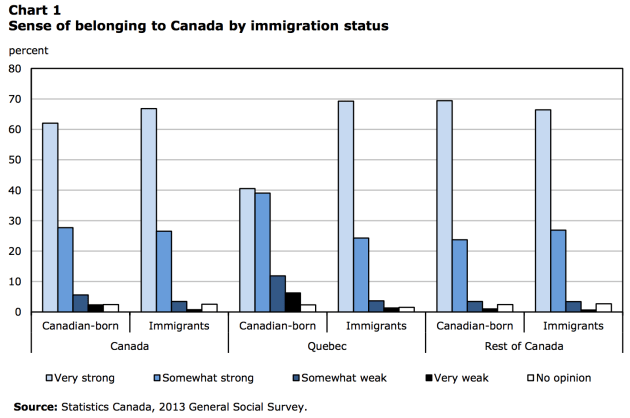
statscan-gss-belongingImportant study by Statistics Canada and John Berry from the General Social Survey confirming high levels of belonging to Canada:

The results show that 93% of immigrants had a very strong or a strong sense of belonging to Canada. Furthermore, a strong sense of belonging to the receiving country is not necessarily incompatible with a sense of belonging to the source country. About 69% of all immigrants had strong sense of belonging to both Canada and their source country (the integrated belonging profile). Another 24% of immigrants had a strong sense of belonging to Canada and a weak sense of belonging to their source country (the national belonging profile). In comparison, very few (3%) had a strong sense of belonging to their source country but a weak sense of belonging to Canada (the source-country belonging profile); and very few (4%) had a weak sense of belonging to both Canada and their source country (the weak belonging profile).

Compared with immigrants in the integrated belonging profile, those in the national belonging profile were characterized by lower levels of civil liberty and life satisfaction in their source countries and by more exposure to Canadian society. Younger age at immigration, more years of residence in Canada, and speaking English or French at home are all significant predictors of the national belonging profile.

The source-country belonging profile was characterized by a high average level of life satisfaction in the source country, older age at immigration, shorter stay in Canada, and perceived discrimination. The weak belonging profile was relatively more prevalent among spouses and dependants of economic principal applicants, or immigrants who came to join their relatives in Canada, and among those who were unemployed, never married, or had very low income.

Overall, this study finds that the overwhelming majority of immigrants had a strong sense of belonging to Canada, with or without a strong sense of belonging to their source country. Source-country attributes were as important as immigration entry status and post-migration experience in affecting immigrants’ sense of belonging to Canada and their source country.

Source: Analytical Studies Branch Research Paper Series: Patterns and Determinants of Immigrants’ Sense of Belonging to Canada and Their Source Country

Immigrants more likely to consider Canadian symbols important to national identity

SC - GSS Immigrant Native Comparisons.001

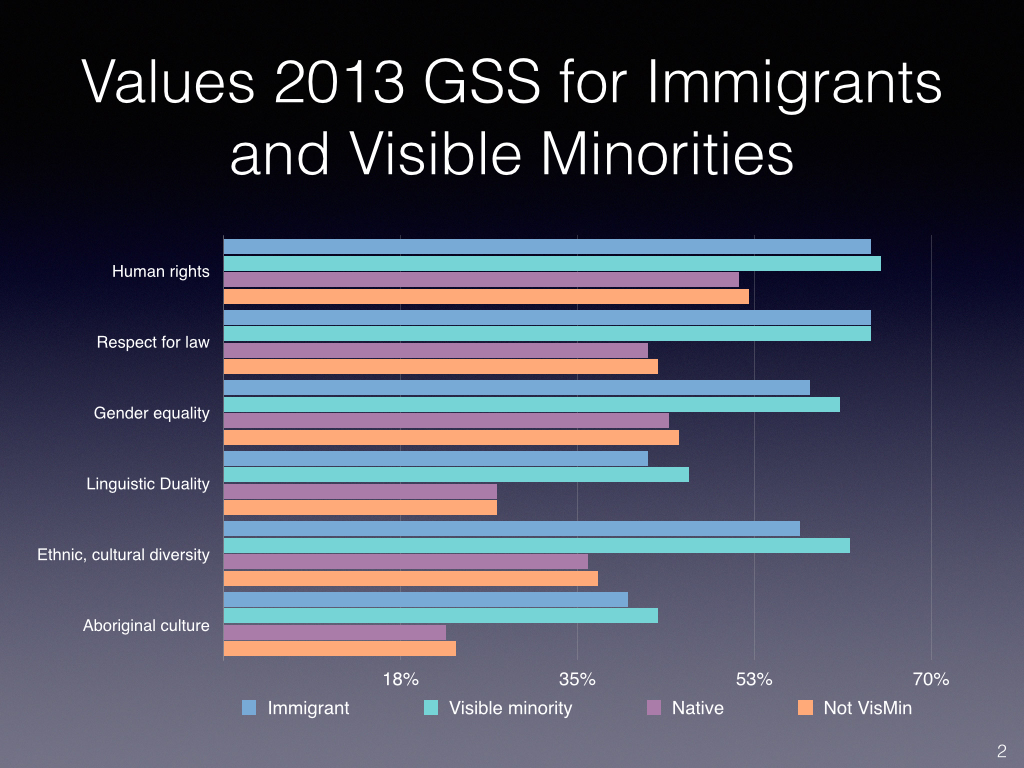
SC - GSS Immigrant Native Comparisons.002Interesting findings from the General Social Survey. For the charts, I have focussed on the contrast between immigrants (first generation) and the native-born and visible minorities (multiple generations but the vast majority first generation) and non-visible minorities.

The key takeaway, and no significant change from earlier surveys, is that for the most part, visible minorities and immigrants have higher level of attachment to Canada than the native-born (in early briefings to Minister Kenney, this type of evidence was cited to indicate that there was no need for major changes to the citizenship program:

The vast majority of Canadians think symbols like the flag and the national anthem are important to Canada’s identity, an expansive survey of opinions by Canada’s national data agency suggests.

More than nine in 10 Canadians surveyed by Statistics Canada said symbols like the Charter of Rights and Freedoms and the flag were important symbols of national identity. Other iconic notions such as the national anthem, the Mounties and hockey were also cited by more than three-quarters of Canadians polled in the agency’s General Social Survey, which asked 27,695 Canadians from all provinces and territories for their views on Canada’s national identity in 2013.

The vast majority of respondents said they believed that Canadians shared specific values. Exactly what those values are, however, is a subject of some debate.

Human rights a major factor

The thing most often cited by those who think Canadians share specific values was the value of human rights, at 92 per cent of respondents. Respect for aboriginal culture (68 per cent) and linguistic duality (73 per cent) also came up a lot.

By and large, immigrants and minority groups were more likely to believe national symbols are very important to Canada’s national identity.

This picture sent out last year by a B.C. RCMP detachment was deemed to be one of the most iconically Canadian images in recent memory. (Royal Canadian Mounted Police)

That gap was especially pronounced when it comes to valuing the importance of the national anthem. When asked about the importance of O Canada, 75 per cent of immigrants viewed it as very important, compared to 61 per cent of non-immigrants.

And all national symbols were viewed as more important by visible minorities than by Canadians at large. The gap was largest in terms of the significance of the charter (82 per cent versus 68 per cent), while the smallest differences were evident for the RCMP (59 per cent versus 54 per cent) and hockey (52 per cent and 45 per cent).

The great frozen game

On the subject of hockey, there’s a gap in how important our national sport is perceived to be between men and women. Half of all men said hockey was important to Canada’s national identity. Only 42 per cent of women said the same.

There was also a gender gap with regards to the belief of whether Canadians even share specific values — never mind what those values may be.

Some 41 per cent of women believed to a great extent that Canadians valued equality between men and women, compared to 53 per cent of men. That gap existed across all age groups, although it was most pronounced among people under 25, where 46 per cent of women said so, but 63 per cent of men did.

Among those over the age of 75, 31 per cent of women said so, compared with 46 per cent of men.

National pride

By and large, Canadians are on the whole proud of Canada’s national identity. That statement is especially true of immigrants, as they “reported a greater feeling of pride in being Canadian and in Canadian achievements,” the data agency said.

There were some geographic differences, however, with people from Quebec feeling generally less proud of Canada’s national identity. Within Quebec, residents of Saguenay had the lowest level of pride in the province, with 52 per cent saying they were either proud or very proud to be Canadian, while residents of Gatineau had the highest levels of pride in Quebec at 76 per cent.

Source: Immigrants more likely to consider Canadian symbols important to national identity – Business – CBC News