Teaching The Holocaust: New Approaches For A New Generation

One of the many approaches to Holocaust education and awareness, building on comparisons and parallels for a more universalist message:

In a conference room recently at the main library at Duke University, middle and high school teachers, many from North and South Carolina, watched a video exploring the parallels between Nazi Germany’s anti-Semitic Nuremberg codes and the racist Jim Crow laws in the American south.

“July 1938: Aryan and non-Aryan children cannot play together.”

“In Alabama, all passenger stations shall have separate waiting rooms,” intones the video, “Cause and Effect.” It was created by Centropa with teachers from the U.S. and Europe.

“1938: Jewish children are no longer allowed to attend public schools.”

“In Georgia it shall be unlawful for a white person to marry anyone but another white person.”

The teachers were not suggesting a moral equivalency between dehumanizing and repressive Jim Crow laws and genocide. But they were looking at how the two racist codes might become teaching tools, to explore what dialogue might be sparked with students.

The teachers trade ideas on reaching kids in their world and through their news feeds.

“That’s awesome. I’ve never thought about it that way. It’s like ‘tweet’ is the new telegram,” one teacher says. “That could be the title of the lesson: Tweets Are Telegrams.”

The teachers gathered at Duke were part of a recent seminar run by Centropa, which is dedicated to preserving stories of Jewish life in 20th century Eastern and Central Europe.

Several prominent Holocaust remembrance and education groups have long used survivor interviews and other first-person accounts and pictures to educate about the genocide of European Jewry. The USC Shoah Foundation and its online visual history archive has taken the lead, along with the United Holocaust Memorial Museum, and other organizations in the U.S. and abroad.

Centropa takes a slightly different approach, centering its work on the wider personal family stories, pictures and memories of a lost era, not just the unbelievable darkness of the Nazi years.

“We’re about searching for human values in the darkest times. It is about showing teenagers there is always a true north,” says Director and founder Edward Serotta.

Teaching The Holocaust: New Approaches For A New Generation : NPR Ed : NPR.

Immigrants With PhDs: Difficult Transitions, Marginal Advantages – New Canadian Media – NCM

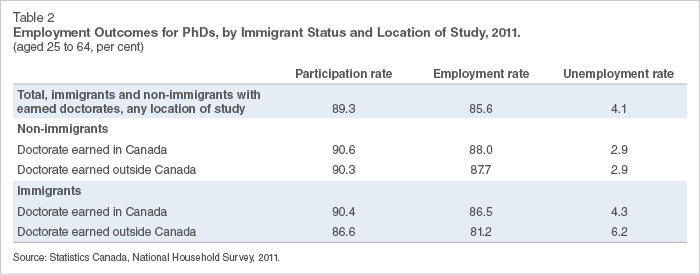
PhDs and EmploymentInteresting comparison on outcomes for immigrants and non-immigrants with PhDs, including country where PhD granted. Nice evidence-based approach to analysis:

Immigrants are less likely than non-immigrants to have studied in a country whose credentials are easily recognized and trusted by Canadian employers. While immigrants who earned their doctorates in the United States had an unemployment rate of only 3 per cent—in line with the unemployment rate of non-immigrants with doctorates—less than a quarter earned their doctorates from the United States. Immigrants who earned their doctorates in countries other than the U.S. or U.K. experience much higher rates of unemployment.

But location of study explains only part of the difference. Regardless of where they earn their PhDs, immigrants face a range of employment barriers, including less-developed employment networks, language barriers, and racism. Immigrants with PhDs fare much better than immigrants without PhDs, but they face difficult transitions, achieve only a slim advantage over non-immigrants with lower education, and continue to lag well behind their non-immigrant peers with PhDs.

Understanding and addressing the many barriers to immigrant PhDs is critical to ensuring that both they and Canada’s economy and society as a whole can benefit from the advanced education and skills they have obtained. The ongoing work of The Conference Board of Canada’s Centre for Skills and Post-Secondary Education and National Immigration Centre explores various dimensions of the challenges facing immigrants—those with and without PhDs. It will shed light on changes that might be required as to how immigrant PhDs are educated and trained in Canada, as well as how immigrants are selected and integrated into the Canadian economy and society more generally. Watch for future commentaries and reports from both centres in 2015.

Immigrants With PhDs:  Transitions, Marginal Advantages – New Canadian Media – NCM.

How closing the ‘word gap’ could give poorer kids an equal chance at success

Interesting and positive initiative:

That realization [that children in richer households were exposed to a whopping 30 million more words by age 3 than their low-income counterparts] inspired two projects recently launched by Eriks-Brophy, now an associate professor at the University of Toronto’s Department of Speech Pathology, and PhD candidate Hillary Ganek.

Like the Providence initiative, the researchers are making use of LENA technology. But they’re aiming to recruit Toronto-based families of varied backgrounds, to expand the scope of the discussion beyond just income level.

They also want to look at the influence of culture in how parents talk to their kids. It will be the first time LENA has been used to explore the topic.

While both acknowledge income level plays a role in children’s development, Eriks-Brophy and Ganek say framing the issue as a “gap” might be the wrong approach.

Ultimately, they hope their research will help speech pathologists and schools be more responsive to cultural variations in language learning, which Eriks-Brophy argues often gives minority children their own unique set of skills.

“It’s not necessarily the case that it’s a (word) deficit or there’s a problem. It’s a difference. And that has to be acknowledged as well.”

WHEN DR. RIPUDAMAN S. MINHAS treats families in the city’s low-income Regent Park neighbourhood, he asks some unusual questions.

In addition to inquiring about kids’ allergies and immunizations, he wants to know how many books parents have at home. He wants to know if they have a library card, and how much they sing to their children.

“The idea of this 30-million-word gap really rings true,” he says. “Because it’s something that we see every day.”

Minhas’s medical interest in words is an approach endorsed by the country’s top children’s health body. Although there is no specifically Canadian research on the effects of the “word gap,” the Canadian Paediatric Society calls low literacy a “severe and pervasive” national problem.

New programs, such as St. Michael’s Hospital’s Reach Out and Read initiative are taking this to heart. Minhas, a developmental pediatrician affiliated with the hospital, is now also embarking on research into how inner-city families can be supported in creating “linguistically rich” homes.

How closing the ‘word gap’ could give poorer kids an equal chance at success | Toronto Star.

Immigration rules so unclear applicant can be given high-pass or a fail on same paperwork, court says

Interesting. While the Court upheld the particular decision, does look like more clarity needed:

A financial analyst from Pakistan applying last year for permanent residence status in Canada as a federal skilled worker was given a score of five points, out of a potential 25, in the education category of her assessment.

It was argued in court that different assessments of the same credentials could have scored her 19 or even 23 points.

Federal Court Justice Cecily Strickland found all three scores could have been seen as correct or “reasonable.”

“Having reached the conclusion that the [visa] officer’s decision was reasonable, I would also note that the alternate interpretation suggested by the applicant was also a possible outcome,” Judge Strickland wrote in a recent decision released this week.

The process is “less than a model of clarity,” she wrote.

“It’s a little bit absurd,” said Matthew Jeffery, a Toronto lawyer acting for the applicant, Minaa Ijaz, in an interview.

“All of these rules are quite new and the regulations for assessing how many points are awarded for qualification have been rewritten recently by the Conservatives.

“This case was the first to challenge them and it will take some back-and-forth in the courts to assess how the rules are written and interpreted.”

Immigration rules so unclear applicant can be given high-pass or a fail on same paperwork, court says

Myth-busting: Immigrants Drive Down School Rankings – New Canadian Media – NCM

Charles Ungerleider on educational outcomes and immigrants.

Surprising that no mention made of the OECD PISA studies, which show the Canadian education system does relatively well in educational outcomes for immigrant kids:

While it is true that immigrant students have lower levels of print literacy upon entering school, the differences between them and their non-immigrant peers is reduced over time with good instruction and exposure to positive English language role models. However, immigrant students often perform as well or better in mathematics and science than their Canadian-born peers. If school rankings take into account performance in a variety of subjects, the performance of immigrant students should not diminish the overall ranking of the school.

It is interesting that the reverse is not true. More advantaged children do not suffer from being in a school where most of the children are poor. This is likely a consequence of the very strong influence that having advantaged parents confers as well as living in communities that are relatively more advantaged. In other words, affluence appears to be a protective factor for advantaged learners.

Socio-economic segregation is another story.  A concentration of low-income students will have a negative effect on a school’s rankings just as the concentration of high income students will have a beneficial effect. As you have probably inferred, I do not have much interest in or regard for school rankings.  But I have a very strong interest in encouraging school boards to ensure that school boundaries do not separate groups on socio-economic lines.

Myth-busting: Immigrants Drive Down School Rankings – New Canadian Media – NCM.

Taking the Plunge: Immersion Programs Help Children Learn Other Languages

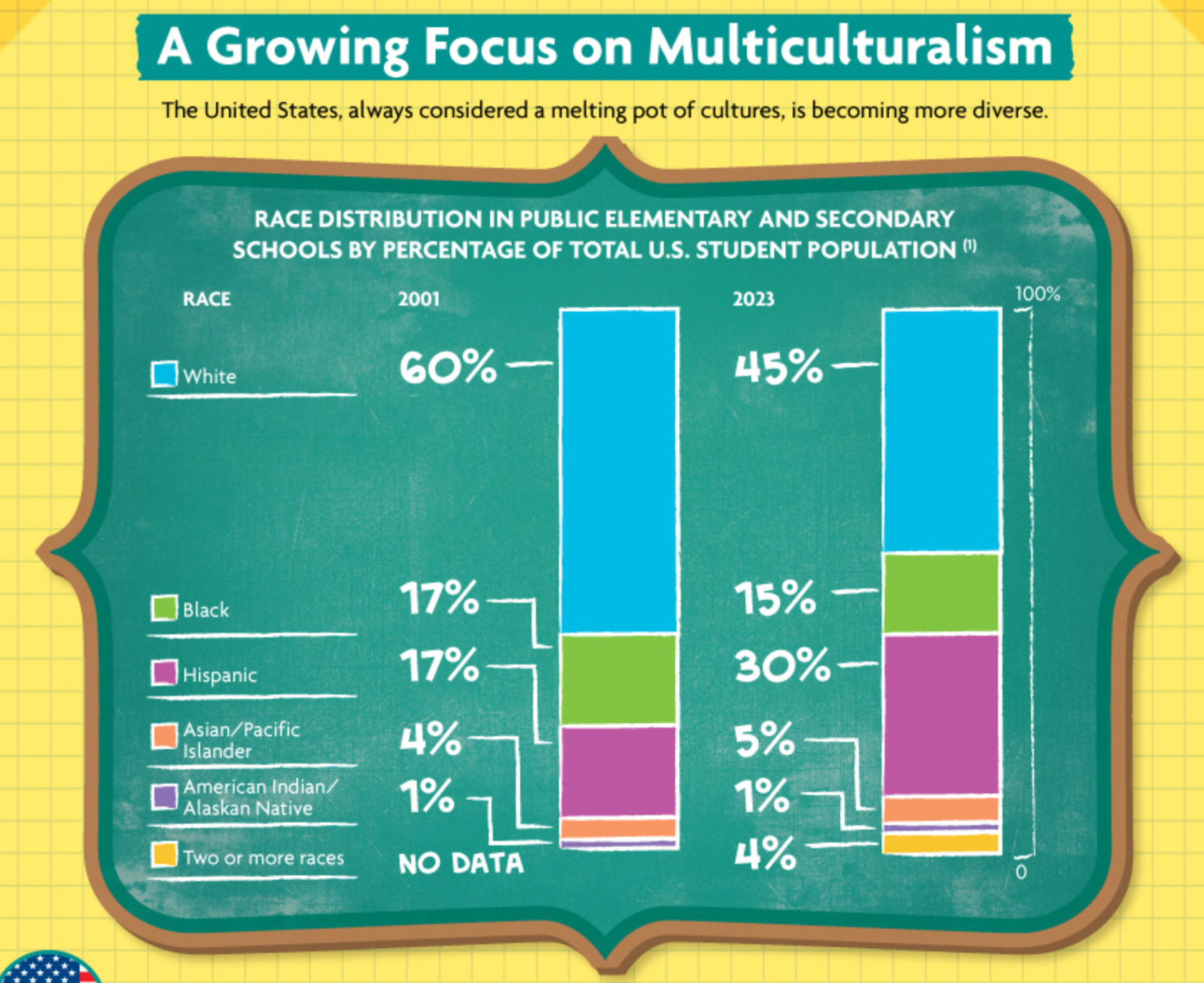
Taking_the_Plunge__Immersion_Programs_Help_Children_Learn_Other_LanguagesNice infographic on US multiculturalism and immersion education (link below has full infographic).

Taking the Plunge: Immersion Programs Help Children Learn Other Languages.

Toronto school fundraising raises questions about equity in public-education system

Given that one of Canada’s strength in education, as measured by the OECD’s PISA studies, is with respect to equity in education, the funding disparity suggests that this may diminish over time:

Schools in Toronto’s most affluent neighbourhoods are fundraising 300 times more money per student than needier schools, using the cash for field trips and playground renovations and raising questions about equity in the public-education system.

Fundraising figures for elementary schools provided by the Toronto District School Board and analyzed by The Globe and Mail found that children in those affluent neighbourhoods are getting almost as much as $900 each in educational extras, from new playgrounds to Scientists in Schools. The money is raised through events such as fun fairs and pizza lunches. Some schools in lower-income neighbourhoods raise as little as $3 a student.

Canada’s largest school board provides special grants to schools in high-needs communities to help compensate for the vast differences.

But it still cannot catch up to the hundreds of thousands of dollars schools in the city’s richest neighbourhoods raise. Blythwood Junior Public School, situated around Mount Pleasant Road and Lawrence Avenue East, a wealthy neighbourhood, raised almost $700 a student in the 2012-13 academic year. Thorncliffe Park Public School, located in an area that serves as a landing pad for recent immigrants, raised about $45.

The board can’t afford to fully make up the differences, according to Carla Kisko, associate director of the TDSB. “It’s a serious concern because there are significant differences between communities,” she said.

Certainly nothing like the US system, where much of school funding is by neighbourhood in contrast to the block funding in Canada, but still something to watch.

Toronto school fundraising raises questions about equity in public-education system – The Globe and Mail.

Toronto school board sets higher improvement targets for students based on race, sexual orientation

The value of data to inform educators and support communities and groups that are not doing as well as most:

Cecil Roach is the York board’s superintendent of equity and engagement and a strong champion of collecting data.

“The things that are important are the things we measure, and you need to know who your students are. You cannot fully talk about supporting students unless you’re able to peel back the onion in order to see the inequities.

“You have some folks who say, ‘I don’t want to segregate kids by social identity,’ but that’s ridiculous,” said Roach. “We already know gay kids are more prone to suicide, but a lot of our knowledge is anecdotal. We need to know who our students are.”

York University education professor Carl James is such a believer in the value of gathering student data he has created a network of school board officials from Toronto, Peel, York Region and Ottawa to study the issue.

He would like to see Premier Kathleen Wynne call for a “learning gap strategy” like the one she requested this week to close the wage gap between men and women, and for this, surveys would be key.

“Such data would yield very rich information for the province,” said James, “and I would argue it would be of tremendous social and economic benefit.”

A spokesperson for Education Minister Liz Sandals said Friday her government is committed to have school boards “regularly use high-quality data and ongoing research to measure progress and guide programming,” especially after the scrapping of Ottawa’s long-form census, but “it is too early to tell what that will look like.”

But detailed surveys won’t be easy. A fierce split erupted this spring among Toronto’s Somali parents when the TDSB survey showed Somali students have a 25 per cent dropout rate, 10 points higher than the board average. While some Somali parents welcomed the information and joined a task force to examine solutions, others called it unfair labelling.

“These numbers can lead to uncomfortable conversations, especially about race and also sexual orientation,” admitted Spyropoulos, “but they’re conversations we need to have.”

As I go through the NHS data on educational outcomes, some clear and uncomfortable gaps in outcomes for some communities. Again, the conversations may be uncomfortable but silence and ignorance won’t help improve outcomes.

Toronto school board sets higher improvement targets for students based on race, sexual orientation | Toronto Star.

When it comes to recruiting foreign students, Canada earns F for effort

On the lack of an effective international education strategy. Removal of credit for pre-permanent residency time in the new Citizenship Act is another disincentive compared to other countries (believe UK, Australia and other countries provide):

“Canada seems to think of education as a really crude export industry and we look at it in a really mercantilist fashion, where we want more people to come in and we don’t really care if people go out or not,” says Alex Usher, president of Higher Education Strategy Associates based in Toronto.

Jennifer Jeffs, president of the Canadian International Council, says international education should be part of Canada’s foreign policy strategy. As a tool of “soft diplomacy,” encouraging students to go abroad, where they form meaningful relationships, would improve foreign relations and Canada’s reputation.

While Canada may not have the highest standard of education and research or the most competitive fees, it still has an unmatched reputation as a tolerant, multicultural and safe society, which it should capitalize on.

“The overriding concern is that Canada is not getting as much as it deserves from international education,” says Simon. “All the building blocks are there to make Canada a real powerhouse in international education, and yet it hasn’t happened.”

When it comes to recruiting foreign students, Canada earns F for effort.

U.K. to teach students ‘British values’ after ‘Trojan horse’ scandal reveals Islamists taking over schools

More on the Birmingham schools issue and debates in the UK:

Inspectors said members of governing boards had promoted a “narrow faith-based ideology” at some schools, whose students were overwhelmingly from Muslim backgrounds. One school attempted to ban mixed-sex swimming lessons; at another, music lessons were dropped because they were considered un-Islamic, and at a third, board members vetted the script for a nativity play and told staff they could not use a doll to represent the baby Jesus.

“Staff and some head teachers variously described feeling ‘intimidated,’ ‘undermined’ or ‘bullied’ by governors, and sometimes by senior staff, into making changes they did not support,” Mr. Wilshaw said.

Park View Educational Trust, which runs three of the criticized schools, rejected the inspectors’ verdict and said it would launch a legal challenge. Vice chairman David Hughes said the inspectors “came to our schools looking for extremism” but had not found any.

The Muslim Council of Britain said it was concerned that the inspectors were conflating religious belief and extremism.

It said in a statement that “extremism will not be confronted if Muslims and their religious practices are considered as, at best, contrary to the values of this country, and at worst, seen as ‘the swamp’ that feeds extremism.”

U.K. to teach students ‘British values’ after ‘Trojan horse’ scandal reveals Islamists taking over schools