Douglas Todd: Three million people snap up Canada’s 10-year visas

A further update on the 10 year visa (Douglas Todd: New 10-year visas stoke housing booms in Vancouver …):

The global appetite for Canada’s new 10-year visas appears insatiable, especially in China.

More than three million people from countries with which Canada has long had travel restrictions have obtained the 10-year, multiple-entry visas since the program began in 2014.

With almost half the 10-year visas being handed out in Mainland China, where Prime Minister Justin Trudeau’s government this year opened seven new visa offices, the province of B.C., more than anywhere in Canada, has experienced a surge of visitors.

Immigration specialists say the 10-year visas are having multiple effects on Canada.

They’ve markedly boosted tourism. And they’ve helped re-connect globally far-flung families for extended periods.

But they have also been vulnerable to abuse by rich trans-nationals with families in Canada who seek to avoid paying Canadian income taxes on their global income.

More than 1.4 million Mainland Chinese have gone through the vetting process to obtain Canada’s 10-year visa, which allows visits of up to six months at a time.

More than 716,000 people from India have also obtained multiple-entry visas, followed by 273,000 from Brazil and 140,000 from the Philippines.

The federal government says Mainland China visitors now spend $1 billion a year in Canada. Travel from that country has soared and China has become Canada’s third largest source of visitors after the U.S. and the U.K.
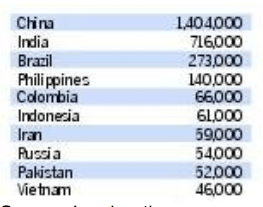
Countries in which Canada’s 10-year visas have proved most popular

George Lee, a Burnaby immigration lawyer who was born in China, says Metro Vancouver hotels, retailers and restaurants are responding to the swelling stream of Chinese visitors by hiring more Mandarin-speaking employees and even making sure their staff “serve Coca-Cola warm,” the custom in China.

In addition, Lee said wealthy Mainland Chinese visitors are increasingly buying hotels, resorts and residential real estate in B.C., particularly in Metro Vancouver and on Vancouver Island.

“Vancouver has become a global village,” Lee said. “When we encounter a new trend … some, if not most, dislike it. They feel challenged and intimidated. But eventually people will get used to it.”

Immigration lawyer Sam Hyman believes the 10-year visas not only help boost tourism from China, India, Brazil and elsewhere; they also help far-flung relatives reunite for extended periods of time in Canada — without having to go through the process of applying for permanent resident status.

For instance, Hyman has worked with many Latin American families who immigrated to Canada in the past couple of decades. Their offshore parents and other relatives, he said, have been applying for 10-year visas to come to Canada as “seasonal visitors,” staying for months at a time.

Would-be visitors from countries that have reciprocal visa arrangements with Canada obtain the multiple-entry visas through a detailed application and vetting process (unlike visitors from visa-exempt countries such as the U.K., the U.S., France, Australia and Mexico, who have more open access to Canada).

Each foreign national who obtains a 10-year visa must prove to Immigration Department officials they have closer ties with their home country than with Canada, a declaration that reduces the chances they would ever apply for refugee status.

Canadian statistics on international border arrivals indicate the exceedingly popular 10-year visas have contributed to a sharp upturn in travellers from key countries.

The number of Mainland Chinese visitors to Canada swelled by 23 per cent in 2016 alone — with 312,000 choosing to come to B.C. out of a nationwide total of 610,000.

More Indian visitors, 71,000, also came to B.C in 2016, out of a national sum of 215,000.

However, Brazilian visitors tended to opt for other parts of the country, with just 17,000 stopping in B.C. out of a Canada-wide total of 214,000.

While Hyman applauds the positive effects of the 10-year visas, he also points to a downside: “People who really abuse the system.”

Because of loopholes in Canadian tax law, Hyman said, it is possible for rich foreign nationals to take advantage of the 10-year visa to avoid paying Canadian taxes on their global income.

Because of loopholes in Canadian tax law, Sam Hyman said, it is possible for rich foreign nationals to take advantage of the 10-year visa to avoid paying Canadian taxes on their global income.

Hyman said the popularity of the 10-year visas has come at the same time tens of thousands of foreign nationals, many of whom were the principal applicants for their family’s permanent resident status, are relinquishing the status for themselves.

This would normally mean they give up the chance to become Canadian citizens.

But Hyman and other immigration specialists say several Canadian tax loopholes allow trans-nationals “to transfer unlimited wealth” to spouses, children and other family members in Canada.

And in many cases, said Hyman, those family members use the breadwinner’s money to invest in real estate, particularly in Metro Vancouver.

Meanwhile, the breadwinner, typically the father, can earn money in his homeland or another country while spending up to six months at a time in Canada on a multiple-entry visa.

Since the breadwinner can therefore claim he is not a “resident of Canada for tax purposes,” he is not expected to declare his worldwide income to the Canada Revenue Agency.

At the same time, Hyman said, the breadwinner’s family members receive access to taxpayer-subsidized Canadian educations, health care and social services, without any member of their family paying significant, or any, taxes to the Canada Revenue Agency.

Hyman urges the federal Liberals to close the loophole that allows foreign nationals to relinquish their permanent residents status — but, years later, apply for it again; sponsored by their spouses or children who had become citizens of Canada.

Source: Vancouver Sun

Douglas Todd: Immigrants prosper in Canada’s small towns

Interesting commentary as always by Todd. After correctly rejecting a “sticks” approach (unenforceable given Charter mobility rights), he discusses possible “carrots.”

Not convinced that the “carrots” will necessarily make a major change to settlement patterns:

  • Awarding extra points to immigrants who settle in rural areas, whether through Express Entry or Provincial Nominee Programs,  doesn’t guarantee they will remain;
  • The StatsCan study mentioned that immigrants settling in smaller centres do better may reflect that they had a job offer attracting them to that community, and a smaller immigrant pool. For example, visible minorities in Newfoundland and Labrador have higher median incomes than elsewhere, likely reflecting the small immigrant labour pool concentrated in the professions.

There may be some lessons to be learned from previous efforts, whether with respect to Atlantic immigration (where retention has been an issue) or efforts to encourage Francophone immigrants to settle in official language minority communities in English Canada:

It’s been done before. From the 1870s to 1930s Ottawa offered free land to immigrants and refugees, much of it on the Prairies or in B.C.

The raw land was given to newcomers after they proved over several years they were developing it for homesteading, farming or logging.

A carrot approach is being tried in parts of Scandinavia. Sweden, for instance, has experimented with offering more generous social housing and welfare rates to immigrants and refugees who move to its smaller towns.

It wouldn’t be complicated to offer some carrots in Canada, especially to the one million people living here as permanent residents.

What about fine-tuning Canada’s immigrant point system — which favours those with high educational and skill levels — to grant extra points to newcomers who settle in Canada’s hinterlands?

That’s a suggestion from Vancouver immigration lawyer Richard Kurland, who frequently advises the federal government.

A points system that favours permanent residents who have shown (in part through their income-tax statements) they are committed to making a life in Quesnel, Timmins or St. John’s could do a lot for those cities. The small cities’ schools would fill and their housing and retail markets would strengthen.

Rather than Metro Vancouver and Toronto experiencing unaffordable property and rent ­costs —­ in large part because of high in-migration ­and offshore real-estate speculation — smaller cities and rural areas could enjoy modest boosts from the foreign-born.

Pressure would also ease on Metro Vancouver’s and Toronto’s over-stretched transit systems, as suggested by a StatsCan study that shows immigrants and foreign students rely on taxpayer subsidized transit at double the rate of Canadian-born residents.

A hinterland-related immigration points system is not far-fetched, even in Canada.

Kurland says it’s already virtually in place, in various ways, in B.C.’s provincial nominee program, which oversees a portion of the province’s skilled and educated immigrants.

Citizenship court judges dealing with people who are applying to be accepted as immigrants on compassionate grounds, Kurland adds, have also been known to treat favourably migrants who live in small towns.

The carrot approach would not only breathe new life into the hinterlands, it would give a leg up to immigrants themselves.

A little-known Statistics Canada study by Andre Bernard found that most immigrants who settle in Canada’s small towns do better financially than the majority who choose Canada’s 13 largest cities.

His report, “Immigrants in the Hinterland,” found newcomers who move to small towns and rural areas not only more quickly learn an official language, they soon earn more than other immigrants and those born in Canada.

That not only benefits the immigrants and their children, it does the same for our increasingly struggling small towns.

Source: Douglas Todd: Immigrants prosper in Canada’s small towns | Vancouver Sun

Douglas Todd: Chinese languages gain ground in Metro Vancouver

Further to the StatsCan release (see An increasingly diverse linguistic profile: Corrected data from the 2016 Census Text), Todd delves more deeply into Vancouver data and issues (the Canadian approach has been based upon integration, rather than assimilation, enunciated as early as 1959 – maintaining mother tongues, while knowing one of the official languages, reflects that approach):

Chinese languages are becoming more predominant in Metro Vancouver and across Canada, according to newly released 2016 census figures.

The proportion of Metro Vancouver residents who speak Chinese dialects continues to rise and is now more than double those who speak Punjabi.

With almost one third of new arrivals to Metro Vancouver since 2011 speaking a Chinese language, the total number of residents who have Mandarin or Cantonese as their mother tongue has swelled to 373,000.

That dwarfs the 163,000 residents whose mother tongue is Punjabi, which Statistics Canada says is the second largest “immigrant language” in Metro Vancouver.

An analysis of data released last week from the 2016 Canadian census shows the country’s major cities are developing different characters based on languages spoken — Arabic is the leading immigrant language in Montreal, Tagalog (Filipino) leads in Calgary, and Chinese leads in Toronto and Metro Vancouver.

Of Canada’s major cities, Metro Vancouver has the biggest proportion of residents — 25 per cent — who speak neither English nor French in their homes, with the largest group of them speaking a Chinese “immigrant language,” a term that Statistics Canada uses to distinguishes them from English or French, the languages of the early settlers who established Canada’s public institutions.

Across Canada more than 1.2 million people have either Mandarin or Cantonese as their mother tongue (an increase of 18 per cent in five years), while 543,000 have Punjabi, 510,000 have Tagalog, 495,000 have Spanish and 486,000 have Arabic.

The 13 per cent overall increase in the use of immigrant languages across Canada — to the point where 7.7 million people (22 per cent) speak a language other than English or French in their homes — illustrates how public officials are moving away from expecting immigrants to “assimilate,” says Vancouver statistician Jens Von Bergmann.

“Parents are being encouraged to pass on their mother tongue to their children. Generally, it’s considered great to have a language other than English or French,” said Von Bergmann, who speaks to his young child in his native tongue of German, while his wife talks with their son in her native Mandarin.

Von Bergmann, who has created interactive online maps based on census language data, says that immigrants are more likely to hold onto their mother tongues if they live in places such as Vancouver or Toronto, where large numbers of people speak the same language.

The 2016 census data shows that 1.1 million out of Metro Vancouver’s population of 2.44 million (44 per cent) have a mother tongue other than English or French, though most are able to communicate in English.

However, Metro Vancouver also has the highest proportion of residents who acknowledge they cannot carry on a conversation in either English or French (5.6 per cent of the region’s population, or 138,000 people).

The proportion who can’t speak English or French rises to 11.2 per cent in the City of Richmond, which is the highest ratio of any municipality in the country.

Richmond has for years been the centre of controversy over the expansion of Chinese-language signs, as well as over Chinese-language condo meetings.

While University of B.C. linguist Bonny Norton says Canadians value multilingualism, she cautions that people who do not learn one of Canada’s two official languages are unable to take part in important public “conversations.”

In addition, studies by Canada’s immigration department found that newcomers who cannot speak English or French struggle, with one-third lower earnings than other Canadians.

A Statistics Canada study by Edward Ng also discovered that immigrants with poor skills in English or French are three times more likely to report poor health.

Source: Douglas Todd: Chinese languages gain ground in Metro Vancouver | Vancouver Sun

BC college faculty feel pressure to ‘pass’ students with poor English | Vancouver Sun

Conflict between universities and colleges as a business versus maintaining standards?

Veteran college English instructors are routinely receiving passionate, imploring pleas for passing grades from the international students who increasingly fill their classes.

The foreign students’ emotion-filled emails and in-office appeals, often issued in jumbled English, invariably aim to cajole faculty at Langara College and other institutions into giving them a break, so they will be able to move on from their mandatory courses in English literature.

The foreign students often maintain their entire future depends on passing the English course.

Langara College has experienced a five-fold rise in foreign students since 2014, but two English literature and composition instructors say the college’s over-reliance on international fees is not working for many high-stressed foreign students, their anxious offshore parents or for shortchanged domestic students.

Langara College English instructors Peter Babiak and Anne Moriarty are among a small number of Canadian higher education officials who are ending their silence to raise concerns about the expanding business of international education, which now brings 130,000 foreign students to B.C., mostly Metro Vancouver.

“I do feel sorry for the (international) students, of course, but that’s not really the point. When I assign grades, presumably I need to be objective and not let emotions get in the way,” says Babiak, who has been teaching at Langara since 2002.

Like many faculty at universities and colleges, Babiak and Moriarty feel pressure to wave through the full-fee-paying foreign students, especially in mandatory first-year English literature courses, even if they lack fluency in English.

“There is a booming industry dedicated to helping students jump through English-language hoops, which teachers like me everywhere work hard to defend. Being part of this is weighing heavily on my conscience,” said Moriarty.

Langara Provost Ian Humphreys, however, said Tuesday “there is no pressure on faculty to pass students who are not yet achieving learning outcomes.”

Humphreys said he is proud that Langara “is an open access institution that serves a diverse student population – both domestic and international – that has a high proportion of English language learners.” He says the college’s grads have a strong success rate when they transfer to other institutions or the job market.

Moriarty, however, said that even though many of the foreign students work hard in their technical, business and computer courses, many also leave their mandatory English literature course to the end of their multi-year programs, knowing their English is weak.

Both Babiak and Moriarty also agonize over how classroom discussions in English literature courses are often severely restricted because of language barriers. It means, he said, students who seriously want to study novels, linguistics and composition don’t get as much high-level interaction as they could.

Source: BC college faculty feel pressure to ‘pass’ students with poor English | Vancouver Sun

Douglas Todd: Canada struggling to ‘absorb’ immigrants, report says

Good account by Douglas Todd on one of the more thoughtful CIC policy decks  (possibly part of pre-2015 election transition planning given the date of June 2014). Lexbase was kind enough to provide me with a copy.

While some of the issues identified – housing, healthcare, public transit – affect both immigrants and non-immigrants, the deck provides a good overview of the main issues, identifies data gaps particularly at the local and municipal level and proposes an absorptive capacity index to help inform future levels planning (unclear whether this is being pursued):

Immigration, Refugees and Citizenship Canada officials are digesting a significant report that defines absorptive capacity as “a two-way process that encourages adjustment on the part of both the newcomer and the receiving society.”

Indeed, the internal report, obtained under an access to information request, shows that immigration analysts are worried that the “absorptive capacity” of Canada is going down.

“Declining outcomes of recent immigrants have shown that integration is not automatic,” says the report, which surveys emerging problems with immigration flows and the pressure it’s putting on Canadian sectors.

While some Canadians behave as if it’s xenophobic to question immigration policy, immigration rates and their results, the sweeping in-house government report, titled Evidence-Based Levels and Mix: Absorptive Capacity, does exactly that.

The report, obtained by Vancouver lawyer Richard Kurland, shows integration of immigrants into Canada, despite relative success here compared to most countries, is faltering ­– in regards to housing, jobs, health care, education, religious tensions, ethnic enclaves and transit.

With Canada now accepting 300,000 immigrants a year, in addition to accommodating 700,000 international students and temporary foreign workers, the 2014 report, which has no listed author, recognizes real problems. It wants policy makers to adapt.

Assimilation has been largely superseded by the word “integration” [always has been integration].And now Canadian government immigration officials are talking about a new concept: “absorptive capacity.”

Some pivotal points:

Immigrants are struggling with housing
Like millions of Canadian-born residents, immigrants are battling to afford adequate housing, especially in major cities. They face particular barriers because of their larger household sizes.

Many immigrants, however, do well in housing after a decade, though with risk.

Immigrant “home ownership rates rise significantly with time spent in Canada and surpass that of the native-born after 10 years in Canada, (but) newcomers tend to risk more capital and spend more of their income on housing costs, making them more vulnerable to market fluctuations.”

Language gaps are expanding

Despite language requirements for immigrants and the availability of free language classes in Canada, many may not be learning English or French nor passing it onto their young children.

The study found that in one large school district in Metro Toronto [Peel], three out of 10 children needing ESL training were born in Canada.

Language limitations also create obstacles in Canadian workplaces. “Skilled immigrants face labor market integration challenges such as limited language proficiency.”

Immigrants have difficulties getting health care

“Waiting for care is the number one barrier to access, although this problem is not specific to the immigrant community, as Canadians also mention long wait times as a critical problem,” says the report.

Immigrants are not dispersing across the country

Two out of three immigrants move to Toronto, Montreal or Vancouver.

That means immigrants are almost 2.5 times more concentrated in Canada’s three largest cities than is the total population (only 27 per cent of whom live in these cities).

Despite a phrase often heard in discussion of immigration — “Canada is a large country” — the study makes clear “absorptive capacity” is being tested almost entirely in our large cities. And virtually no city-by-city data exists on how that’s working out.

Ethnic enclaves are expanding

There is a strong tendency for newcomers to settle with members of their own ethnicity in the core of cities and, more recently, their suburbs.

“Residential concentrations of newcomers is a growing concern,” the report says, suggesting self-chosen ethnic isolation can create further barriers to full integration. [Todd somewhat overstates the deck’s observations as the analysis is more nuanced.]

Tensions exist over religious differences

Religious and cultural accommodation continues to be an issue regarding practices that are deemed in conflict with Canada’s institutions,” the report says, naming “forced marriages” and “family violence issues.” [may reflect the then Conservative government focus as these are not accommodation but criminal issues – more common ones being related to religious accommodation such as worship space, food requirements etc].

Transit hassles abound for immigrants

With Metro Vancouver residents debating whether to build a bridge or tunnel on the south arm of the Fraser River, the report shows public transit is a much bigger worry for Canada’s urban and suburban immigrants.

Although transit hassles are significant for all residents of cities such as Metro Vancouver, they’re worse in the suburbs, where many immigrants are moving.

“Recent immigrants are twice as likely to use public transit as their Canadian-born counterparts.”

What’s the way forward?

Despite trying to be frank about Canada’s immigration difficulties, the report notes the country is recognized as “a world leader in creating an environment than enables newcomers to settle and become active, productive and connected citizens.”

Canada is ranked third out of the 31 countries that welcome immigrants. The Migration Integration Policy Index rates only Sweden and Portugal as doing better at absorbing newcomers.

For obvious reasons, the index doesn’t bother comparing Canada to the majority of the world’s countries, like most of those in Africa and Asia, which either deny entry to any immigrants or allow in a trivial number.

Despite Canada’s strong ranking, the Immigration department’s report notes another disturbing finding, which could have long-term repercussions.

Second-generation visible minority immigrants, compared to first-generation immigrants, are more likely to “perceive” they’ve been subject to discrimination.

Poll results suggesting 43 per cent of Canada’s second-generation visible minority citizens are convinced they’re being treated unfairly may point to an expanding crack in the dream of cultural integration.

As for coming up with better policies, the report makes it clear Immigration officials are often in a fog about the overall effects of large-scale immigration on Canada, not to mention the impact of international students and temporary foreign workers.

There is “no comprehensive stock-taking on how Canadian institutions and cities are adapting” to immigrants and other foreign nationals, says the report. The knowledge vacuum exists across housing, health care, the regional job market, transit and more.

Source: Douglas Todd: Canada struggling to ‘absorb’ immigrants, report says | Vancouver Sun

Douglas Todd: Why Canadians need to debate immigration economics

A more nuanced critique of immigration levels and policies than most, raising some valid concerns regarding increased housing and congestion issues in our major cities, and the possible impact on per capita income:

Simon Fraser University political scientist Sanjay Jeram is bravely going where few Canadian scholars — and virtually no politicians — dare to go.

In the face of an unspoken taboo against seriously debating immigration policy in Canada, Jeram says the time has come for Canadians to start openly discussing the migration issues they’ve been avoiding.

Housing, employment, urban congestion, the welfare state and training are all affected by Canada’s immigration policies, says Jeram, who has a PhD from the University of Toronto, the city in which he was born and raised.

Instead of Canadians and the media getting worked up about race-related migration issues that Jeram thinks are largely irrelevant — such as the short-lived “barbaric cultural practices” hotline — he astutely urges discussion of the influence of immigration on economics.

‘’The hidden consensus in Canada is we don’t talk critically about immigration. The taboo against discussing it is very real,” said Jeram, who understandably believes Canadians are almost alone in this regard.

“(Prime Minister Justin) Trudeau campaigned on openness to immigrationwithout limits. I have never heard him talk about the potential consequences that immigration has for overcrowding, housing, opportunities for domestic workers or the welfare state.”

Housing is on the top of Jeram’s immigration-issues list, since Metro Vancouver, Toronto and other cities are experiencing an affordability crisis.

The rental and housing markets in Canada’s cities are increasingly shaped, he said, by federal immigration policies, which have tended to bring to Canada two financially opposite groups of newcomers: the wealthy and those with low incomes.

Strong offshore in-migration into Metro Vancouver, including an influx of international students, Jeram said, has “created competition for low-end rental spaces in the city,” which is struggling with a shortage and exorbitant fees.

“There is also pressure on the higher end of the housing market” because of the arrival of many well-off immigrants and foreign investors, he said. “Money from the outside has turned middle-income properties into high-end properties.”

As a result, said Jeram, most of Metro’s millennial generation is being required to financially “stretch beyond the breaking point.” Most do not have pockets deep enough to buy detached homes or even condominiums.

“As a country, we don’t want to discourage foreign investment, but foreign investment in housing is not going to be productive or benefit us in the long run.”

He recommended new housing policies that restrict the “amount of foreign income, which is not produced in Canada, that can be used to purchase properties” in the country.

Since more than four out of five immigrants to Canada move to its major cities, added pressure is not only on housing, but on infrastructure, traffic and transit.

It contravenes human rights law to restrict the mobility rights of anyone in Canada, so Jeram thinks politicians should follow the lead of European nations and create incentives for immigrants and others to settle outside the Toronto and Vancouver metropolitan areas.

The job market is also being affected by immigration, said Jeram, 35, who admires the work of noted Oxford migration economist Paul Collier, a leader in migration, refugee and developing world studies.

Even though a majority of Canadians tell pollsters “immigration is good for the economy,” Jeram said some don’t realize their per capita financial well-being may be shrinking as corporations bring in immigrants to make up for skill shortages.

“Instead of offering internship programs or on-the-job training, they just import new workers from elsewhere. That leads to a smaller piece of the economic pie for host-society workers.”

It should be no surprise, he said, that corporations advocate more immigrants and temporary foreign workers.

“They have no skin in the game in regards to income levels at the low end of the scale. High immigration has no negative impact on them. Only positive.”

Canada’s federal politicians have to be forced to think more carefully, he added, about whether immigration policies are reducing public support for the country’s social safety net.

“The welfare state requires we all pay into it. And some will be worse off to sustain it. There may come a time when the Canadian consensus to support a high-tax society will fray.”

Most Canadians tell pollsters that bringing in more young and middle-aged immigrants who pay taxes will advance the welfare state.

“But it just doesn’t add up, because a working immigrant comes with dependants. And with rising immigration rates, that can become expensive and unsustainable. It’s nothing to do with race. It’s just economics.”

Contrary to conventional North American wisdom, Jeram said, “bigger is not necessarily better” for creating equitable financial well-being. “Most wealthy societies are very small.”

Will Canadians ever again be able to have a fair debate about immigration policy?

“That’s the million-dollar question,” Jeram says. “Politically it’s become too much of a hot potato.”

Canada is unusual in the way every major federal political party treads cautiously on immigration, Jeram said. All go out of their way to “placate” immigrant voters that dominate in many electoral ridings in major cities like Vancouver, Toronto and Montreal.

But if Canadians don’t soon start having rational discussions about the economics of immigration, Jeram said, working-class nativist movements bent on opposing globalization and reducing immigrant flows could quickly rise to the surface, as they have in Europe and the U.S.

Source: Douglas Todd: Why Canadians need to debate immigration economics | Vancouver Sun

Douglas Todd: Forgotten struggle for Canadian ‘unity’ leads to ‘silos’

The language-related tensions in Richmond have been simmering for some time, whether over Chinese-language signage only or this disturbing example of condo board proceedings (even if private bodies are not required to use English or French).

In terms of how widespread these kinds of issues are, Dan Hiebert’s various studies indicate Canada’s ethnic enclaves more diverse than you think, study finds. And overall, I don’t find the government’s message only being about diversity given the common values language that it also uses.

This may be more of an issue in Richmond (that should be taken seriously) than widespread, which is, accordingly to the 2011 NHS, 53 percent of East and Southeast Asian origin:

Andreas Kargut moved out of Richmond forever on the weekend that Canada marked its 150th anniversary.

The effort that Kargut, his immigrant wife and others put into fighting for the right to have their strata council meetings conducted in English, not Mandarin, had caused too much grief.

Kargut and six others filed a complaint last year with the B.C. Human Rights Tribunal because they couldn’t participate in the Mandarin-only meetings in their 54-unit complex.

Former B.C. premier Ujjal Dosanjh lamented how the strata council’s discrimination against Kargut illustrated the rise of ethnic and language “silos” in Canada. But Kargut said local politicians ignored their plight.

The language battle in Richmond, where half of residents are ethnic Chinese, is one of many challenges to Prime Minister Justin Trudeau and many small-l liberals who proclaim that diversity can only be celebrated.

While creativity definitely can emerge within the many manifestations of diversity, liberal platitudes censor questions about the real tensions that can also be provoked by diversity, a word that means difference.

Trudeau is among those heading into dangerous territory because he is not following the example of his prime minister father, Pierre, in standing up for English and French — and for the ideal of unity.

“When my parents immigrated from Germany, they knew there was an expectation for them to learn English so they could join the workforce and earn a living to provide for their family,” Kargut said in a posting on a Facebook page called Richmond’s Changing Neighbourhoods.

“Why is it then if a person immigrates from China they don’t need to learn English and can discriminate against English-speaking Canadians to the point of causing financial hardship?”

Many Canadians are asking similar questions. The Pew Foundation discovered only 21 per cent of Canadians believe place of birth is important to whether one is an authentic citizen (one of the lowest rates in the world).

But Canadians do care about English and French. Three in five Canadians agreed “being able to speak our national language(s) is very important for being truly Canadian.”

The dispute over language barriers is not only worrying whites. Longtime resident Ken Tin Lok Wong told Richmond News many of the city’s controversial Chinese-only signs are in a dialect known mainly to newcomers from the People’s Republic of China, which Wong says signals many are not willing to integrate.

Yet it’s Kargus’s departure from Metro Vancouver that is one of the more stark illustrations of self-segregation in this city, in Toronto and in Montreal, which are becoming increasingly defined by ethnic and language enclaves, whether South Asian, Chinese or European.

The kind of frustration felt by Kargut is something liberals in the U.S. are finally starting to note — as they try to come to terms with why the diversity-celebrating Democrats are constantly losing election campaigns.

Atlantic magazine has two articles in this month’s edition exploring why Hillary Clinton alienated former supporters among the white suburban and working classes, while methodically wooing Hispanic and black voters.

In “How the Democrats’ Lost Their Way on Immigration,” Peter Beinart notes one of Clinton’s prominent campaign images showed her surrounded by Spanish-language signs.

“Americans know that liberals celebrate diversity. They’re less sure that liberals celebrate unity,” says Peter Beinart, who credits Barack Obama with the ability to do both. Justin Trudeau doesn’t perform the balancing act, but his father stood up for ‘national unity.”

Barack Obama would not have done that, Beinart says. The former president once said he felt frustration when he’s “forced to use a translator to communicate with the guy fixing my car.”

With the National Academies of Sciences recently reporting new immigrants to the U.S. are learning English more slowly than their predecessors, Beinart maintains Democrats should put teaching immigrants English at the centre of their immigration agenda.

“Americans know that liberals celebrate diversity. They’re less sure that liberals celebrate unity. And Obama’s ability to effectively do the latter probably contributed to the fact he — a black man with a Muslim-sounding name — twice won a higher percentage of the white vote than did Hillary Clinton.”

Source: Douglas Todd: Forgotten struggle for Canadian ‘unity’ leads to ‘silos’ | Vancouver Sun

Douglas Todd: Fake jobs fast-track permanent residency for migrants

Hard to know full extent of problem compared to overall numbers of Permanent Residents but number of anecdotes and some high profile convictions indicate is an issue:

Canadian employers are creating fake jobs so would-be immigrants can quickly get citizenship.

Immigration “consultants” often arrange the illicit deals, which frequently result in Canadian business owners being paid to fabricate non-existent jobs.

Other times, the immigrants perform actual work, while themselves handing cash to the employer under the table to top up their own salary.

The employers, for their part, devise fraudulent pay stubs so the foreign nationals can “prove” to immigration officials they have needed skills to go to the front of the queue to become a permanent resident of Canada.

“It’s very widespread. I have met a lot of clients who tell me how this is being done underground,” says George Lee, a veteran Burnaby-based lawyer who specializes in immigration law.

Immigration department officials, lawyers, employers, prosecutors and migrants are increasingly providing accounts of how immigration consultants and companies fabricate bogus records so foreign nationals can obtain permanent resident status.

Migrants are handing company owners anywhere from $15,000 to more than $150,000 to create the counterfeit jobs, with immigration consultants pocketing large fees in the bargain.

One immigrant department report said fraud is “commonly associated” with such jobs, called “arranged employment offers.”

“There are lots of cases like this and they’ve been going on for a long time,” said Lee. “In most cases, jobs are needed to become a permanent resident, yet in many cases they are just jobs on paper.”

Both Lee and Vancouver immigration lawyer Richard Kurland have been informed by clients, who range from young international students to professionals with degrees, about different deals would-be immigrants strike with employers.

In one standard example, Lee said, a foreign student who received paycheques worth $30,000 a year for part-time work was paid $15,000 by the employer, but also secretly handed over another $15,000 in cash to his boss to prop up his declared salary.

It’s a violation of the law, say Lee and Kurland, to offer cash in exchange for a job.

CBC TV in Saskatchewan last month secretly recorded Bill Sui, of the Vancouver-based immigrant consulting company Vstar International, offering cash to a Prairie retail employer to create jobs for his clients from Mainland China.

Since the news story came out about how Vstar International promised the owner of a Fabricland outlet $15,000 to produce a false job, plus enough to pay the migrant’s salary, people in three other Saskatchewan communities have come forward with similar accounts.

Kurland provided documents in which people complain to the Immigration department about such practices.

In one redacted letter obtained under an access to information request, a Canadian provided details about how her colleague was “getting her cheques and returning cash money to her employer just to show fake employment.”

Kurland, who publishes the newsletter Lexbase, said: “My research uncovers allegations of fake jobs, examples of fake jobs, and complaints by visa officers about fake jobs. It shows that some people who can’t qualify under our rules will pay big money to get their visa illicitly.”

An Iranian-Canadian businessman in Metro Vancouver told Postmedia that each month offshore professionals offer to pay him large sums to cook up artificial jobs in Canada.

“I get this on a regular basis. I’m offered fees from $10,000 to $50,000, plus they will pay their own salaries. So I could bring employees here and have them work for free,” said the businessman, who asked to not be identified.

In a related case, he cited how three years ago an Iranian couple ago went public about paying a B.C. film company $15,000 to come to Canada for jobs that turned out to be non-existent.

The businessman, who said he does not engage in such practices, said any Canadian company with more than six employees can offer a job to a foreign national.

Many job descriptions, which are either bogus or exaggerated to make them seem more “skilled,” are facilitated through immigration consultants, some of whom are not registered, even though registration is supposed to be a requirement in Canada.

Richmond immigration consultant Xun (Sunny) Wang hauled in $10 millionover eight years by producing phoney paycheques and other documents for up to 1,200 clients in arguably the largest immigration fraud case in Canadian history.

Wang’s employees counterfeited thousands of employment documents for clients, most of whom had no real jobs in Canada.

In 2015 Wang, who was not registered as a consultant, was sentenced to seven years in jail.

Source: Douglas Todd: Fake jobs fast-track citizenship for migrants | Vancouver Sun

International students in B.C. could be in fake marriage schemes: Douglas Todd

The ingenuity of persons wanting to come to Canada knows no bounds. No hard numbers but widespread anecdotes indicate that there is an issue (India sends the second largest number of students to Canada after China: 77,000 in 2016):

The newspaper ads in India are the visible tip of a booming underground industry in fake marriages involving would-be international students.

The prize for the “spouse” whose family buys an instant marriage with a foreign student is back-door access to a full-time job in Canada and a fast-track to citizenship.

The matrimonial ads normally promise that the foreign students’ sham marriage, plus all travel and study expenses, will be paid for by the Indian families who are determined to have their son or daughter emigrate.

The type of Indian student the ads seek is usually a teenage girl, who must have passed an English-language test and therefore be in line to be accepted as an international student.

Media outlets in India, such as the Hindustan Times, report there is a “booming matrimony market for ‘brides’ who can earn the ‘groom’” coveted status as a migrant to a Western country.

Canada is among the most sought-after destinations for Indian foreign students, say migration specialists, because it is the most generous toward foreign students and their spouses. Australia has also been popular, but recently tightened its rules.

Here is a typical recent ad from one Punjabi-language newspaper in India, Ajit:

“Jatt Sikh, boy, 24 years old, 5 feet 10 inches, needs girl with IELTS band 7. Marriage real or fake. Boy’s side will pay all expenses.”

The ad is listed by a high-caste “Jatt” Sikh male, or more likely his parents. It seeks a contractual marriage with a young woman who has scored well (“band 7”) on an international exam called “IELTS,” the International English Language Testing System. Almost three million IELTS exams are conducted each year.

Here is another ad, from the newspaper Jagbani:

“Barbar Sikh, 24, 5 feet 8 inches. Finished Grade 12. Looking for BSc or IELTS pass girl. Boy’s side will pay all expenses to go to Canada.”

In this ad the family of a lower-caste “Barbar Sikh” is seeking to have their son marry an Indian female with a bachelors of science degree, or a passing mark on the IELTS test, so their son can be allowed into Canada as her spouse.

As these kinds of ads illustrate, the parents of the male “spouse” typically offer to cover all expenses for the international student, who often end up attending one of the scores of private colleges in Canada with low to non-existent standards.

B.C. is home to 130,000 international students, the vast majority of whom are in Metro Vancouver, which has the highest concentration of foreign students in Canada.

In exchange for financing the foreign student, the phony spouse gets to live in Canada and legally work up to 40 hours a week, plus receive medical coverage and other benefits. That puts them in a strong position to become permanent residents of Canada.

The foreign-student marriage rackets are gaining attention in newspapers in India.

Indian media are reporting angry fallout when students financed by other families either fail to get into a Western college or university, or try to break up with their spouses of convenience.

Kwantlen Polytechnic University political scientist Shinder Purewal, a former Canadian citizenship court judge, says Punjabi- and Hindi-language newspapers in India run dozens of such ads each week.

“Families are looking for matches to get their sons or daughters abroad. And the most successful route to Canada is through international-student channels. It’s an easy way to get immigration,” said Purewal.

Source: International students in B.C. could be in fake marriage schemes | Vancouver Sun

Almost 7 in 10 Metro residents will be non-white in two decades: Todd

From the Statistics Canada 2036 projections:

Canada is experiencing the fastest rate of ethnic change of any country in the Western world, say international demographers.

Almost seven of 10 Metro Vancouver residents will be visible minorities, or non-whites, in less than two decades, says Eric Kaufmann, a professor at University of London, Birkbeck, citing Statistics Canada projections.

In addition, Kaufmann said, University of Laval professor Patrice Dion has worked with Statistics Canada officials to develop projections that suggest Canada as a whole, at the current rate of immigration, will be almost 80 per cent non-white in less than a century.

While the rapid pace of change likely will not  hurt Canada’s economy, Kaufmann said, it will continue to have great effect on the ethnic make-up of cities such as Greater Toronto and Metro Vancouver.

These two Canadian cities and others will, in just a few years, become “majority minority,” a term describing places in which one or more ethnic minority (relative to the country’s population) make up a majority of the local population.

 A 2017 Statistics Canada report, titled Immigration and Diversity: Population Projections, forecasts the number of Canadians with visible minority status will “increase more rapidly than the rest of the population” and “could more than double by 2036 to between 12.8 million and 16.3 million.”

The cities that will have the highest levels of visible minorities by 2036 will be Greater Toronto, Metro Vancouver, Calgary, Abbotsford-Mission, Edmonton and Winnipeg.

Non-whites already make up almost half the residents of Greater Toronto and Metro Vancouver.

…Meanwhile, Canada is undergoing “the fastest rate of ethnic change of any country in the Western world,” Kaufmann said, describing how 300,000 immigrants are arriving each year in a country of 35 million people, with four in five of those immigrants being visible minorities.

“The United States’ per capita immigration rate is only one-third to one-half as fast as Canada’s. … At the same time (U.S. President Donald) Trump has promised to reduce America’s inflows by half,” Kaufmann said.

“Europe is also generally tightening inflows and only 300,000 non-Europeans enter the European Union, population 510 million, each year. Most immigrant-receiving Western European states will be at least three-quarters European origin in 2050.”

In Canada, whites currently make up about 80 per cent of the population.

Kaufmann, however, drew attention to a study led by the University of Laval’s Patrice Dion and Statistics Canada official Eric Caron-Malenfant that projects that by 2106, the vast majority of Canada’s population will be descendants of immigrants who arrived after 2006.

Assuming that four in five immigrants during that time period will continue to be non-white, Kaufmann projected that by 2106 whites will account for between 12 to 38 per cent of the population.

“I think a reasonable middle conclusion is that Canada will be 20 per cent white, 65 per cent non-white and 15 per cent mixed race by 2106,” he said.

“Canada will probably become a ‘majority-minority’ country around 2060.”

Source: Almost 7 in 10 Metro residents will be non-white in two decades | Vancouver Sun

StatCan report: Immigration and Diversity: Population Projections for Canada and its Regions, 2011 to 2036 (91-551-X2017001)