Want a more diverse work force? Move beyond inclusion to belonging

A private sector view from Jaqui Parchment, CEO of Mercer Canada and a director of the BlackNorth Initiative:

In recent weeks, individuals and organizations across North America and beyond have engaged in important conversations about systemic racism and how it is embedded in our institutions, workplaces and daily lives. It’s been heartening to hear from people from diverse backgrounds expressing a desire to learn, to reflect and to consider the roles they can play in addressing these issues. These conversations, while difficult and stemming from recent instances of horrific violence, are necessary if we want to create lasting change.

In order to do so, however, we need to think beyond short-term solutions. Instead, from a business perspective, we need to focus on improving the employee experience for a more diverse Canadian work force. We need to shift our thinking to move from a focus on diversity and inclusion alone, and start cultivating a more deeply-rooted sense of belonging in our workplaces.

This requires a fundamental shift in the way we do business. Leaders must encourage open communication and really listening to their staff, be willing to make the necessary changes, conduct themselves with compassion and put their people first. It’s not just the right thing to do; it’s also the smart thing to do: A workplace where employees can bring their full selves is one where they will be engaged, productive and want to stay.

The focus on belonging at work is deeply personal to me. As one of the few Black chief executives in Canada, and as a woman in the corporate world, I came up through the ranks at a time when diversity was neither prized nor a focus. I sat in meetings, attended networking events and activities and started to notice and think about the thousand seemingly small things that happen at work every day that might make an employee feel like they don’t belong. This could be the food that’s served, the music that plays at an event, the kind of networking activities that are hosted, and who is represented at conferences, speaking engagements, town halls, as co-authors of research, and in a company’s branding.

In addition to ensuring a diverse group of voices are heard, there is also tremendous power in people feeling seen, represented, reflected and promoted at work, both within the organization and externally. These things might seem small or innocuous individually, but in aggregate they send important messages, showing employees of colour what is possible for them to accomplish and letting them know that they are seen and valued by their companies. These actions signal to employees and clients who belongs, and who does not, who the corporate world is designed for, and who is excluded from consideration.

I carried these ideas with me as I advanced to my current position as CEO of Mercer Canada, where I now have the opportunity to build a workplace where everyone feels like they belong. With colleagues whose families come from more than 78 different countries in our Toronto office alone, we recognize that we need to ensure we reflect this diversity whenever possible. We started in our Toronto office by reviewing our client entertainment practices. Where hockey games and golf tournaments were previously the biggest client events, we’ve now looked for more representative ways of engaging all our clients and finding opportunities for all our colleagues. Instead of hosting events with food, music and images representing little to no racial diversity, we’ll serve food and play music from various cultures, and ensure our images are representative of a diverse work force.

In terms of charitable efforts, we have chosen to support local initiatives in our community that better reflect the needs of a diverse society, recognizing that people are more likely to feel they belong if their companies are prepared to align with the social justice issues and philanthropy initiatives relevant to their communities.

It’s time for the difficult and necessary work of looking inward and making fundamental changes to our workplaces. This work can and must begin right now if we are going to capitalize on a time when, finally, real change seems possible.

Source: Want a more diverse work force? Move beyond inclusion to belonging

New Wharton Business Dean Says Lack Of Diversity Stems From A Lack Of Prioritizing

Of note:

One of the country’s leading business schools — the Wharton School of the University of Pennsylvania — has never had a woman or a person of color as its dean since it was founded nearly 140 years ago.

Until now.

Erika James was named as Wharton’s 15th dean in February and officially started the job earlier this month.

The business world has been slow to reflect the gender and racial makeup of America today, but James says that’s not due to a lack of ability to make it happen.

“I think if we can create social media platforms, if we can put people on the moon and if we can have self-driving cars, there’s very little that we can’t do,” James said during an interview on All Things Considered. “So the fact that we have not yet created a more diverse work environment means that we simply haven’t prioritized it.”

In these excerpts from her interview, she discusses obstacles that women and people of color face in climbing the executive ladder and a future in which “inclusivity is just the order of the day.”

Clearly there are structures in place that make it difficult for women and people of color to have exposure to opportunities within the organization. Folks of color generally have less access to mentors. Sponsoring relationships are important, but folks of color generally aren’t sponsored in the same way.

What I personally have also found was the need for me to take responsibility for my own success and progress within an organization. And for me, what that has meant was I needed to imagine that I had everything it took to be successful in a job or an assignment that might have been a stretch assignment, and take the risk that we see oftentimes so many men take, even if they don’t have all the right experiences. And I think oftentimes women are more reluctant to take on new roles unless all the Is are dotted and Ts are crossed.

What’s your message to incoming students at Wharton about their responsibilities to not just build successful companies but to build inclusive ones?

I don’t know how much more of a message that we need to deliver, because as I see it, each generation is becoming more and more, not even cognizant or aware, but the expectation that they have is that inclusivity is just the order of the day. And they are looking and demanding of their current workforce or school to be inclusive. And that is happening from white students, from students of color, from women, from men. I just see they’re a growing force, where the expectation is that the organization they enter will be diverse and inclusive.

Source: New Wharton Business Dean Says Lack Of Diversity Stems From A Lack Of Prioritizing

Why are there still so few Black lawyers on Bay Street?

Good detailed analysis in the Globe (see article for graphics):

Just about every Black lawyer on Bay Street has a tale to tell about the racism – whether overt or covert – they’ve experienced throughout their career: drawing scathing rebukes for minor errors that white colleagues don’t seem to face; being mistaken for an assistant rather than a litigator; enduring comments about their hair and clothing, or blatant accusations of tokenism; being ignored in a circle of white colleagues, and left out of after-work drinks and client meetings.

For years, the country’s biggest law firms have been proudly posting messages of diversity and inclusion on their websites. Yet, with organizations on both sides of the border now at an inflection point when it comes to race, Bay Street is still overwhelmingly white.

According to the Law Society of Ontario (LSO) – the largest self-governing legal body in the country, with more than 55,000 lawyers and 9,000 paralegals as members – 19.3 per cent of the province’s lawyers in 2016 identified as racialized, a full 10 points lower than the population at large. A mere 3.2 per cent were Black, compared with 4.7 per cent of Ontario’s population.

As for the situation at the country’s largest law firms, comprehensive data either doesn’t exist or hasn’t been made public. To help fill in the gaps, The Globe and Mail sent questions about racial diversity to 20 of them (including Bay Street’s hallowed Seven Sisters: Blakes, Davies, Goodmans, McCarthy Tétrault, Osler, Stikeman Elliott and Torys).

While more than half provided information on racial diversity within their ranks, only five firms broke out data on Black lawyers in particular; two others confirmed the number of Black partners. (Many respondents cited the need to protect privacy and data collection policies that prohibit the disclosure of numbers so small the people behind them could be identifiable.)

Six firms – Osler, Bennett Jones, Davies, McMillan, Blaney McMurtry and Fogler Rubinoff – said they either didn’t collect the information or would not share it publicly; WeirFoulds declined to answer any questions for this story.

The Globe also conducted a visual analysis of photos and biographies posted on the websites of 16 of Toronto’s largest firms to estimate the number of Black partners represented. The result: roughly 35 out of around 4,000 partners. This is an imperfect estimate, of course, because it can’t account for how people self-identify. Still, many law students and junior lawyers perform a similar exercise, scanning through the photos on firm websites in search of others who look like themselves.

McCarthy Tétrault was one of the five firms that was most candid in its responses (along with Fasken, Goodmans, Dentons and Aird & Berlis), admitting that just 2 per cent of roughly 700 lawyers, including partners, and articling students at the firm are Black. (Dentons reported a similar figure.)

McCarthy’s CEO, Dave Leonard, says he’s not proud of its diversity numbers, but decided to share relatively detailed information anyway. “Transparency,” he says, “is part of how we’re going to solve this.”

“I stand up often and talk to our people about my white privilege and that too much of our partnership looks like me,” Mr. Leonard adds.And I do recognize that I’m here because of hard work and intelligence and all the rest of it. But I’m also here because of my role and my place in society, and where I grew up and how I grew up and the colour of my skin and my gender.”

Hadiya Roderique chronicled five years of microaggressions in her essay “Black on Bay Street,” published in The Globe in November, 2017. Ms. Roderique had been hired as an employment lawyer at Fasken straight out of law school, where interviewers were wowed by her top grades and litany of extracurriculars. But she ultimately struggled to fit into the “upper-class white world” that dominates the corporate realm. “Big law could not accommodate the person and the colour I was,” wrote Ms. Roderique, who went on to do her PhD in organizational behaviour at the Rotman School of Management.

Ms. Roderique’s essay went off like a bomb inside the country’s biggest law firms. Linc Rogers, a partner at Blakes who is Black, remembers feeling there was a new kind of willingness to talk about how Bay Street could accommodate people from different backgrounds.

“Her thesis was there is a narrow corporate culture on Bay Street, and to succeed, you have to mold yourself to it,” he says. “She said out loud what a lot of people were saying in quiet conversations, and she said it with thunder. Everybody read it. Everybody talks about it.”

For this story, The Globe spoke with dozens of Black lawyers and those from other diverse backgrounds about their experiences at Bay Street firms. Some commented on the record; others asked to remain anonymous, concerned that even mildly critical remarks could impede their careers in what is still a relatively small community dominated by a handful of powerful players.

“I think systemic discrimination is unfortunately baked into the system,” says Vivene Salmon, president of the Canadian Bar Association. “I think you have to fight pretty hard to defy the odds.”

DIVERSITY SURVEY

The Globe asked the 20 largest law firms in Toronto (most of which have offices around the country as well) questions about the diversity of their Canadian workforce. The following firms responded and most provided data from their most recent internal survey based on employee self-identification.

The world of Bay Street law is small. All together, according to trade publication Lexpert, the 20 largest corporate firms in Toronto collectively employ about 8,500 lawyers across the country, almost half of them in Toronto itself. For two decades, these organizations have been promoting the idea of diversity and inclusion, but their efforts have focused primarily on gender, often with the goal of reaching partnerships comprised of at least 30 per cent women.

While progress has come slowly on that front, Bay Street has generally not put the same emphasis on recruiting, retaining and promoting lawyers who are Black, Indigenous and people of colour (BIPOC) – or, for that matter, those with disabilities or members of the LGBTQ+ community. Even without published information on Black leaders at Canadian law firms, it’s evident the numbers are miniscule.

“We don’t collect data on this stuff, but if you poke around the firm websites, it becomes pretty clear the representation of Black people on Bay Street isn’t anywhere near what Toronto actually looks like,” says Marlon Hylton, who was a partner at Cassels before recently starting his own data, information and innovation law firm and affiliated tech company, INNOV-8 Data Counsel.

In 2010, the Canadian Association of Black Lawyers held an event to honour 17 Black partners known to work at major Bay Street firms. A decade later, that figure appears to have roughly doubled – but still represents less than 1 per cent of partners at top firms.

Beyond Bay Street, there were just 63 Black lawyers in Ontario who were partners at law firms of all sizes in 2016, according to the LSO. That’s just 6 per cent of Black lawyers overall; meanwhile, 18 per cent of white lawyers (about 4,800) were partners.

Black lawyers also tend to work as sole practitioners at a far higher rate than their white counterparts. In 2016, the LSO lists 31 per cent of Black lawyers in the province as sole practitioners, compared with 19 per cent of white ones. That suggests at least some don’t find a career path for themselves in Big Law and opt instead to set up shop on their own.

Data on the number of Black law students is also uneven – only a handful of Canada’s 20-plus law schools share demographic information. What information is available shows members of the Black community account for about 1 per cent of law students at both the University of Toronto and Queen’s University; York University’s Osgoode Hall is more representative, at about 8 per cent. Part of the problem is cost: Law students graduate with an average debt load of $83,000 in Ontario – particularly damaging for low-income and BIPOC students without the benefit of generational wealth.

Marie Kiluu-Ngila was one of just five Black students in her law class at U of T, spurring her to co-found Black Future Lawyers, a program to support and encourage Black students going into law. When CBC interviewed Ms. Kiluu-Ngila about the initiative in January, the firm where she was articling, Cassels, featured the clip on its website. In late spring, however, she learned she was one of two students out of 15 who wouldn’t be hired back. Despite several requests, she says she never received a clear answer why.

“It was very confusing – to hear that you’re so great, you have stellar performance reviews, to be told you’re an excellent student,” says Ms. Kiluu-Ngila, who is now looking for work in consulting, or with a government or financial institution. “It didn’t really add up.”

The hiring process is just the first hurdle Black law grads face, where a foreign-sounding name might scuttle your chances of getting an interview in the first place and an ineffable quality called “fit” dictates who gets hired and who doesn’t.

Since most students’ résumés look roughly the same, who gets an interview is based largely on grades. But even top marks might not be enough to overcome bias in favour of white-sounding names. One Black lawyer who now works in Ottawa told The Globe he applied widely to large Toronto firms with employment and labour practices. He had straight A’s in all the relevant courses, but never even got an interview – leading him to suspect it was related to his African last name. In fact, a 2016 study by Sonia Kang at the University of Toronto showed Black students who “whiten” their résumés get callbacks at a rate 2.5 times higher than ones who don’t.

Once past the résumé-screening process, further barriers include looking the part during speed-dating-style interviews and navigating awkward cocktail parties with talk about international travel, cottages and ski clubs.

Shaneka Shaw Taylor, now a partner at Boghosian + Allen, recalls the high anxiety she felt during in-firm interviews. “At various interviews, I felt excluded or not understood, in the sense that I just couldn’t resonate with some of the conversations, some of the questions, some of the experiences. And it wasn’t coming from a place of the interviewer meaning to do anything wrong – sometimes you can only speak to what you’ve experienced.”

Several lawyers who spoke with The Globe expressed concern that nepotism is also still common, with children, nieces and nephews of partners (or friends of partners at other firms) often flagged for interviews.

“One of the things that helps people get Bay Street jobs is connections and legacy,” says Hermie Abraham, who articled at Cassels before starting her own employment law practice. “If you do see Black students landing jobs at those firms, you know they’re outstanding.”

Even once you’re in, it can be a struggle to stick around and to attain the same level of pay as your peers (for in-house counsel, for instance, white lawyers make an average of $12,000 more than their BIPOC counterparts). “I’m not going to tell any Black lawyer at a major firm that being Black doesn’t matter,” says Raphael Tachie, a senior in-house lawyer at TD Bank. “I think it does.”

Mr. Tachie joined Blakes as a summer student in 2008 in part because there were five Black lawyers at the firm – “the most I’d ever seen.” But although Blakes made a concerted effort to recruit Black students, he later found many of them didn’t stay. (He left after articling because he was only offered a non-permanent position.) He now passes on the same advice to Black law students that a mentor once gave him: “Go into job interviews as if being Black doesn’t matter, but leave the room knowing it does.” That means turning on the charm to get the job, he says, then working harder than anyone else to keep it.

But even getting the chance to do that can be difficult. To climb the ranks, lawyers need to build a book of business, which means getting good work on important files, along with crucial client face-time. All that is doled out by partners, who for decades have tended to mentor and assign work to people they like – people who remind them of themselves.

“It might not be anything particularly malevolent on someone’s part, but it’s just that you’ve made a connection with the person in the next office,” says Blakes’ Mr. Rogers. “Maybe they went to the same school, vacation at the same spot, like the same sport. You have a connection, and you give them work. Those attributes are often tied to race and gender.”

When the CBA’s Ms. Salmon was a junior lawyer on Bay Street, she recalls working weekends and long hours on legal research, and then having to beg the partners to let her attend client meetings. “If you were a white guy, you wouldn’t have to beg,” she says. “The senior partner on the file would say, ‘Oh it would be good for your learning – why don’t you come along?’ ”

The culture is changing, some lawyers say, but invitation-only meals and tickets to major-league events remain a big part of business development and career advancement, and Black lawyers are often left out. Black women face a double bind because of their race and gender, says Jenelle Ambrose, in-house counsel with Grant Thornton and secretary of the Black Female Lawyers Network.

“There’s a discomfort in interrogating not just the things that you are doing, but the things that you aren’t,” Ms. Ambrose says. “Like not including people – why is it that someone isn’t really a fit? Why is it that someone is invited to golf or after-work drinks, and someone else isn’t?”

Then there are the consistent microaggressions that leave many BIPOC lawyers confused and thinking, “I’m pretty sure that’s racism,” says Mr. Hylton, who worked at McCarthy Tétrault before he was a partner at Cassels. Many of the lawyers who talked to The Globe had stories of being praised for being articulate – as though it were completely unexpected – or being told by a colleague, “I don’t see race.” Both women and men spoke of receiving comments on their hair, and one man wondered if letting his curls grow in might affect his job prospects.

“You walk around with this sense of a question about whether or not they think you belong,” Mr. Hylton says. “You know you’re just as smart, you do good work, but you still have that feeling of needing to do that much more than everyone else.”

On one occasion, Ms. Salmon attended a meeting with a group of white men when a lawyer on the opposite side of the file told her to serve coffee. “I essentially wasn’t invited to sit at the table, but I was told to get coffee for everybody else. That just shows you the effect of race and gender. It shows you you’re not considered equal.”

Lori Anne Thomas, president of the Canadian Association of Black Lawyers, has been in plenty of similar situations throughout her 12 years of legal practice. “These things come about in your day-to-day experiences, and you’re faced with a decision tree of how do you act, how do you respond? Am I the educator today, or am I the stern corrector? Or do I ignore it? And then, how do I do my job?” Ms. Thomas says. She owns her own criminal defence firm, which she says gives her the freedom to wear her hair dyed blonde and cropped short. But she often hears from CABL members about the pressures they face to look a certain way at corporate law firms: “What do I wear today? How do I minimize my Blackness to assimilate and accommodate? Do I wear the colourful tie that brings out my African heritage, or will that be perceived as ‘too Black?’ ”

In the wake of the police killing of George Floyd in Minneapolis, many Bay Street firms began to reevaluate their efforts on diversity and inclusion. At Stikeman Elliott, chairman Marc Barbeau sent a firm-wide email, acknowledging, “We’re by no means perfect.” Although it didn’t share overall numbers, the firm says it has made progress on hiring junior lawyers from diverse backgrounds, but admits it hasn’t done as well on retention and promotion. Stikeman’s leaders have been going through an “uncomfortable process,” says Mr. Barbeau, as they question why they came up short, “despite all our good intentions, our desire to be fair, to be equitable and to advance these things.”

Over at Gowlings, chief executive Peter Lukasiewicz says that when it comes to ensuring lawyers from diverse backgrounds make it to partner, “honestly, until recently, firms simply weren’t addressing that. … We know what some of the issues are and are addressing them.”

Last week, Norton Rose, Stikeman Elliott, Bennett Jones and corporate finance firm Wildeboer Dellelce signed on to a pledge associated with the BlackNorth Initiative, a new program to improve Black representation in boardrooms. The firms have committed to attaining seven goals, including hiring at least 5 per cent of their student work force from the Black community and employing Black or visible-minority leaders in 3.5 per cent of senior roles by 2025.

Yet, recent events have shown many in powerful positions have yet to confront the widespread and insidious barriers facing lawyers from diverse backgrounds. Stockwell Day resigned his position as a strategic adviser to McMillan in June after questioning the existence of systemic racism during a TV appearance. Both the firm and the business community overall were quick to censure Mr. Day for his remarks, which he made at the height of protests over Mr. Floyd’s death.

Mr. Day’s opinions were hardly unique in the world of Big Law, however. Months earlier, a co-ordinated group of benchers was elected to the board of the Law Society of Ontario after campaigning on a promise to overturn a statement of principles (SOP) that would have had lawyers and paralegals pledge to promote equality, diversity and inclusion. The SOP was scrapped in September, leaving many BIPOC lawyers feeling betrayed.

“It’s disheartening,” says Atrisha Lewis, a litigation lawyer at McCarthy Tétrault who was also elected as a bencher last year. “On the one hand, you see now a greater kind of attention and rhetoric focused on race. But at the same time, with all of this happening, you have this slate who very much campaigned on denying that systemic racism exists.”

In interviews with leaders from six firms – Stikeman Elliott , McCarthy, Cassels, McMillan, Gowlings and Blaney McMurtry – as well as lengthy written responses from others, Canada’s biggest law firms generally express a commitment to do better on representation and regret over their failures to date.

“We are aware that all of the large Canadian firms are dedicated to anti-racism and diversity in the legal profession, and are taking steps to address inclusion and retention of Black lawyers and partners,” Angie Andich, director of communications at Dentons, said in an e-mail last week. “We have been in touch with each other, nearly weekly, to address this issue.”

The research is clear on how to improve outcomes for lawyers from diverse backgrounds, says Ms. Roderique, who is now an equity, diversity and inclusion researcher and consultant. For starters, she’d like to see firms eliminate the “mystery” of the interview process and end subjective elements like cocktail parties and dinners, since they can penalize BIPOC candidates, some of whom may have never attended such an event. Firms should also take steps to make recruiting and retention more objective, she says, by removing names from résumés, using standardized interview questions and controlling the distribution of work. “It’s not rocket science,” she says. “They just have to actually follow through and do these things.”

To address the pipeline issue, many firms are involved with diverse student groups (14 of the firms surveyed sponsor the Black Law Students’ Association of Canada, for example), and several donate money to scholarships aimed at BIPOC students. McCarthy Tétrault said it plans to run a pilot project offering summer jobs to first-year law students, with an emphasis on recruiting from equity-seeking groups.

Most firms have also conducted at least some training around unconscious bias – usually for firm leaders and those involved in hiring – and some have rolled it out firm-wide or plan to (including Cassels, McCarthy, Gowlings and Davies). On the hiring front, McMillan, Gowlings and Fasken have begun using standardized interview questions. Lenczner Slaght, a litigation-focused boutique, was the first Canadian firm to implement anonymized résumé review, in 2018. Shara Roy, a partner and co-head of the firm’s student program, says the evidence so far is anecdotal, but in the first year, they hired 11 students, nine of whom were women and six of whom self-identified as racialized. Last year, the firm hired eight female students, three of whom were racialized. So far, none of the largest Bay Street firms said they have taken steps to make résumé review anonymous.

When it comes to advancement, almost all firms have some sort of formalized mentorship program, but many lawyers also spoke about the importance of getting good work. Most firms have controls in place to distribute work to junior lawyers, but some – including Blakes, McCarthy Tétrault, Osler and Fasken – have gone further, formalizing work-allocation processes in large practice groups or across the firm, taking subjective assigning decisions out of partners’ hands. Other firms say they’re considering similar initiatives.

Banks, pension funds and other big corporate clients are also ramping up demands on external legal providers to field diverse teams. American companies have been more aggressive on this front, says Kristin Taylor, deputy managing partner at Cassels, adding that large Canadian companies have started to require more detailed data from law firms on the issue. “Relying on clients to force us to do it is obviously a wrong-headed approach,” she says, “but with the support of clients for what we’re doing, it’s an easier sell within law firms to get out of their comfort zone and really focus on this.”

Committing to diversity and inclusion can help woo the next generation, as well as boost the bottom line, says Nikki Gershbain, chief inclusion officer at McCarthy Tétrault (a unique role among Canadian firms – she reports directly to the CEO and is a member of the management team). “All the research shows that organizations that are inclusive are more productive, innovative and profitable, and the people who work for such organizations have higher morale, they’re more productive, and they’re more likely to stay with the organization.”

Sandra Aigbinode Lange worked as a Crown lawyer before joining McCarthy’s Calgary office in 2017, a move she credits in part to its inclusion programs. She says the firm’s formal work allocation program has led to some some high-profile assignments, including the chance to argue a case at the Supreme Court of Canada. Although Ms. Lange notes she sees no Black judges in Calgary and only a tiny handful of Black partners at large firms, she still sees the possibility of partnership in her future.

“I carry this weight of my Blackness, and specifically my Nigerian heritage, on my shoulders, because so many people have invested in me, and so many believe in me,” Ms. Lange says. And although she sees no examples to follow, “I just feel I’ve got to do it. To show this province, this country, this world that a Black woman like me is smart, capable and just as right for the job.”

US Military: Esper order aims to expand diversity, skirts major decisions

While avoiding the political questions, some practical initiatives (the US military has played a significant role in integration of African Americans):

Secretary Mark Esper took steps Wednesday to expand diversity within the military and reduce prejudice, but he skirted several major decisions, including whether to ban the Confederate flag at installations.

In a four-page memo, Esper ordered all military services to stop providing service members’ photos for promotion boards, directed a review of hairstyle and grooming policies, and called for improved training and data collection on diversity. Absent from the memo was any mention of the issues that have roiled the nation — efforts to ban the Confederate flag and a growing movement to remove Confederate statutes and rename military bases Confederate leaders.

Confederate flags, monuments and military base names have become a national flashpoint in the weeks since the death of George Floyd. Protesters decrying racism have targeted Confederate monuments in multiple cities. Some state officials are considering taking them down, but they face vehement opposition in some areas.

A draft policy circulated by Pentagon leaders more than a week ago would have banned the display of the Confederate flag in Department workplaces or public areas by service members and civilian personnel. It said a ban would preserve “the morale of our personnel, good order and discipline within the military ranks and unit cohesion.” That policy was never finalized or signed, and instead officials say it is now being revised.

President Donald Trump has flatly rejected any notion of changing base names, and has defended the flying of the Confederate flag, saying it’s a freedom of speech issue. Esper spent last Friday with Trump in Florida, but it’s unclear if they talked about the flag ban.

The Marine Corps and U.S. commands in Korea and Japan have already banned display of the Confederate flag, saying it can inflame division and weaken unit cohesion. The Navy, Air Force and Army were all ready to do the same, but their progress was halted when Esper made it known he wanted to develop one consistent policy.

Some of the orders in Esper’s memo released Wednesday are already in effect by the military services, but his directive is a move to also make those policies more consistent.

For example, he ordered the military to no longer include photos of service members when they are being considered by a promotion board. This would mark a change for the Navy and Marine Corps. But, the Air Force removed photos from promotion boards more than a decade ago, and Army Secretary Ryan McCarthy announced last month that beginning in August his service would no longer include them.

The Navy eliminated the photos in 2016, then added them back in 2018 after members of promotion boards complained. They said the photos aided their ability to assess a service member’s “ability to perform the duties of the next higher grade,” according to the 2018 memo. The Marines have always included photos.

Army officials last month said they were eliminating the photos because a study showed they could make a difference in some promotion boards. The study suggested that when the photo is not included, it took board members less time to vote, their scores were more closely aligned and “the outcomes for minorities and women improved.”

Esper’s memo, however, left other promotion board issues unresolved and subject to further review, including whether the services should redact the box on the form that identifies a person’s race or whether a person’s name — which in some cases could indicate race or gender — should also be removed.

He also ordered a review of hairstyle and grooming policies, which all the military services have done multiple times in recent years. They have all loosened restrictions, particularly on women’s hair, to allow for more ethnic hairstyles, including various braids and larger buns.

Esper also has asked that every time he receives a promotion list from one of the services, it includes a review that shows the racial make-up of the pool of candidates and also of the group getting promoted.

The services have historically compiled that data, and it is always provided to the secretary with promotion results for higher ranks — one star and above. For years, it was also provided for lower ranks, but in 2009, the department switched to an annual report, and stopped providing it to the chief for each promotion list.

A senior official said giving the secretary the review for every list is meant to identify any potential problems or lack of diversity and wasn’t expected to affect the promotion results. The official spoke on condition of anonymity to describe a personnel issue.

Esper also met Wednesday with his newly formed Board on Diversity and Inclusion, which is expected to identify potential policy changes over the coming months. It will deliver a final report in December, and then be replaced by a permanent commission.

Source: Esper order aims to expand diversity, skirts major decisions

Senator Omidvar: No longer business as usual [diversity and governance]

Good arguments by Senator Omidvar:

Over the last month Canadians have taken to the streets to protest against racism, calling for justice, truth and an appropriate reflection of diversity in all aspects of Canadian life, in particular in places of power and influence.

In this context, those who are appointed or elected to the nation’s public and private boards as directors deserve special attention.  They include the directors of publicly listed corporations, public agencies, boards and commissions at the federal, provincial and local levels, as well as those who govern Canada’s private foundations and charities.

For the most part, these corridors of power are a reflection of the old Canada and the privileges accrued to one demographic: mainly white and mainly male. There has been almost no real movement for visible minorities (including Black Canadians), Indigenous Peoples and the disabled as they stand on the bottom rungs of governance, even though their share of the population is 27.2 per cent for Indigenous and visible minorities and 22 per cent for the disabled.

If we are serious about going beyond mouthing platitudes on diversity, then we must become more intentional about it — first by grounding change based on evidence and next by charting a way forward.

Typically, change comes in one of two ways: either we are legislated by our governments to behave a certain way or we choose to do so willingly. Both can be propelled by events. The events and the mood of the day call for a combination of both, but with an underlining imperative of urgency.

Just as the corporate sector has been intentional about bringing more women on to their boards, they can and must turn their eyes now to both men and women who are Black and Indigenous. Business understands this. The Canadian technology sector has come together to launch a new effort to eliminate racism and bring diversity into its fold. Earlier, through the leadership of Wes Hall, and Bay Street influencers like Victor Dodig, Prem Watsa and Rola Dagher announced the launch of the Canadian Council of Business Leaders against Anti-Black Racism. If they are successful and demonstrate results, they will transform not just how they do business, but who they are.

In turn, the federal government should rethink its approach to corporate reporting on diversity. A few years ago, the government passed Bill C-25 which requires federally listed corporations to develop diversity plans, and to either “comply or explain” their progress on an annual basis. The first such reports are trickling in and if there is progress, it is in terms of gender.  The opposite is true of racial and ethnic minorities, the disabled and Indigenous peoples.

With the hindsight and wisdom of today, the government needs to make every effort to go beyond “diversity planning” to “governance equity.”  They should amend the law to include employment equity definitions (EE) since EE laws have changed the face of the workforce in this country. A similar approach is needed in governance.

Further, the search for truth should take us into the hazy world of public agencies, boards, commissions and crown corporations. These include big nation-building institutions at the federal level, like the CBC but also hundreds of provincial and municipal agencies boards and commissions. Data at the federal level is scarce, and what exists isn’t fulsome, aggregated amongst groups, nor is it regularly disclosed. This is a missed opportunity because as we know, what gets measured, gets reported and gets actioned. Statistics Canada should be given the mandate to gather and report this data on an annual basis.

The search for truth also includes Canada’s 175,000 charities, foundations and not for profits. They hold our country together —whether in small towns, or large urban centres. They touch every aspect of our society, from sport to religion, from seniors to youth. Philosophically, they are more likely to embrace values and principles of inclusion and voluntarily begin to gather data on governance through their large and powerful industry associations.  They should begin to do at the earliest possible opportunity, thus leading the way for other sectors to follow.

This voluntary resolve must be further strengthened by government action.  The CRA should amend the T3010 and the T1044 forms that charities and not for profits file annually to include a simple question on diversity representation on boards of directors based on existing EE guidelines.   In this way the country’s vast network of charities and not for profits may well be the first sector to have a fulsome picture of governance, inclusion and diversity.

It is easy to be aspirational, but it is imperative to move from aspiration to concrete action.   Gathering the evidence on governance in a thoughtful and sustained way will lead us from symbolic discussions about diversity to the real expression of inclusion.

The only option not on the governance table is simply governance as usual.

Source: ipolitics.ca/2020/07/15/no-…

Sidelined: How diversity in Canada’s sports leadership falls short

Good investigative reporting and data analysis:

For 14 years Clayton Pottinger had tremendous success as a basketball coach, his teams winning nearly 80 per cent of their games.

But an opportunity to coach at the next level never came.

As a Black head coach, he often wondered why.

“I don’t know a 100 per cent the reasons behind it. I don’t know that it was race related but I don’t discount that,” Pottinger told CBC Sports. “I was interviewed for three positions but overlooked — not even granted an interview dozens of times. It got to the point where I didn’t think it was going to happen.”

Pottinger’s story may sound like a tale often told south of the border, but his is a Canadian story.

Last March, he finally broke through and landed his first job at the Canadian university level when UBC-Okanagan named him head coach of its men’s basketball team.

Pottinger, 49, joined a small group of Black coaches who have reached the highest leadership positions in Canadian university sports.

For decades, North American professional sports leagues have been castigated for the dearth of Black and people of colour employed in key leadership and coaching positions.

An investigation by CBC Sports reveals that the issue is prevalent across Canadian sports.

A visual audit conducted by CBC Sports examined hundreds of key positions at all 56 Canadian universities that compete under the umbrella of national governing body U Sports, including the school’s athletic director and head coach of football, men’s and women’s basketball, hockey and soccer, and track.

Of the nearly 400 positions examined, only about 10 per cent were held by Black, Indigenous or persons of colour (BIPOC). Only one of the 56 schools has a non-white athletic director.

“You could go to any website at any university and you’d see one of the five principles or objectives is diversity and inclusion, yet you see the numbers in our studies, you see the [CBC’s] numbers,” said Dr. Richard Lapchick, founder and director of the Institute For Diversity and Ethics and Sport. The institute, based at the University of Central Florida, was the first to begin compiling racial breakdowns of hiring practices in the United States.

Lapchick said filling athletic leadership positions on North American college campuses is not always a result of overt racism, but rather a persistent old boys’ network.

“If you have a white athletic director and a white [university] president and they’re making the key hires in your athletic department, the people they know are more than likely to be white,” Lapchick said. “So they’re going to turn to them in that selection process as opposed to who [else] might be out there.”

The recent killing of George Floyd by police in Minneapolis in May has refocused the lens on racial inequality in everyday North American life. Hundreds of thousands of people have filled city streets demanding an end to systemic racism.

Many companies and organizations, including the CBC, have been forced to acknowledge both a lack of diversity among senior leadership, while addressing systemic racism in the way they conduct business both internally and externally.

The world of sports has not escaped this scrutiny.

Leagues condemn racism

In wake of Floyd’s death, professional leagues across North America issued statements condemning racism and promised to do better. Players demanded change. Leagues like the NFL, where 70 per cent of the players are Black or persons of colour, promised more would be done to reflect that in its coaching staffs and leadership. And after years discouraging outward signs of protest, like kneeling during the U.S. national anthem, NFL commissioner Roger Goodell came full circle and encouraged players to express themselves.

In Canada, the recently hired Pottinger says there is still a long way to go. UBC-Okanagan is one of only three universities in Canada to employ both a Black men’s and women’s head coach. He points to an undercurrent of bias when it comes to how leadership positions are filled.

“People of colour aren’t necessarily looked at as people with those abilities. We can shoot hoops, we can make baskets, we can make defensive plays,” Pottinger said. “But if you ask us to lead a team, then I think there’s always some question marks around whether or not you can do it.”

CBC Sports presented its findings to officials at U Sports and the four conferences that govern Canada’s university sports system.

None of the groups rejected or disputed the findings. But at the same time, it appears little has been done to formally track who is being hired and why.

The NCAA, governing body of college sports in the U.S., does maintain a database that tracks demographics for student-athletes, coaches and administrators. U Sports does not.

Most of the responses pointed to strides made in the area of gender equity but acknowledged little has been done to promote and encourage more BIPOC candidates and hirings.

Everyone involved in the upper reaches of Canadian university sport acknowledged there’s work to do when it comes to diversity in leadership positions.

At the same time, U Sports officials contend that, for the most part, they are powerless to change things.

“One of our key principles is institutional freedom and as such hiring is based on member universities’ human resource policies in compliance with provincial labour laws,” the organization said in its statement.

Balancing act

Atlantic University Sport (AUS) executive director Phil Currie called it a balancing act.

“The hiring of athletics directors or sport coaches/assistant coaches is done under the policies and practices of our member institutions and as such the AUS has no direct control of that process,” said Currie, who oversees athletics in the Atlantic provinces.

“CBC’s summary on the number of BIPOC head coaches demonstrates that, and we acknowledge that those numbers are not where they need to be,” he said.

The lack of diversity in leadership is equally stark among Canada’s key Olympic institutions. CBC Sports looked at the board of directors at the Canadian Olympic Committee and seven among the country’s largest national sport organizations: swimming, athletics, hockey, skating, basketball, volleyball and soccer.

Across them, around 100 board members are tasked with representing thousands of athletes. Only seven of these key positions are held by BIPOC. For example, the COC’s 17-member board is composed of 16 white directors and only one BIPOC.

“Our reflection following the events of the past month has reinforced that while we have made important strides in diversity and inclusion, we need to do more,” the COC said in a statement to CBC Sports.

“Though our board of directors reflects diversity in a number of important measures, including gender, LGBTQ+, language, etc., there’s no denying that we have considerable work to do in addressing BIPOC diversity on our board.”

The COC vowed to change the makeup of its board by instituting a number of measures, including no longer simply relying on a public call for board nominations.

Across the board, national sports organizations contacted by CBC Sports acknowledge major shortcomings in the racial makeup of their key leadership positions.

Athletics Canada said it’s “probably the most inclusive sport in Canada in terms of racialized participation,” but said its board must “better represent what the sport looks like on the field of play.”

Basketball Canada also acknowledged a large gap between players and decision makers.

“Our Canadian national basketball teams are some of the most ethnically diverse in our country. However, we acknowledge that, off the court, our organization still has some work to do at a leadership level,” it said in a statement.

For some, change has been elusive. Hockey Canada said it’s been “working at various stages over the past few years to address areas of diversity,” but its 11-member board was comprised of 11 white males as of July 1.

CBC Sports also looked into 500 leadership positions across professional ranks and found that for the most part, they mirror the above findings.

CBC Sports compiled data that included team ownership, team president, general manager and head coach across seven major leagues: NFL, MLB, NHL, NBA, CFL, WNBA and the NWSL.

Only the NBA, where more than 80 per cent of players are BIPOC, according to research by the Institute for Diversity and Ethics in Sports, approached close to 25 per cent of leadership positions filled by people who look like the majority of its athletes.

In MLB, where 41 per cent of players are BIPOC, only seven of 100 leadership positions looked at are filled by people of colour.

In the CFL, only about 10 per cent of the league’s key leadership positions are filled by people who aren’t white, a sharp departure from the league’s on-field racial makeup.

One of the league’s two Black head coaches is former quarterback Khari Jones, who has been head coach in Montreal since June 2019.

After a stellar career in the CFL, he worked as assistant coach for a decade in Hamilton, B.C and Saskatchewan.

Jones said he doubted whether he would ever be a head coach.

“You see so many African-American people play the game but not having the chance to coach and have lead roles,” he told CBC Sports. “It’s never deterred me. It’s just a sad thing, even when I knew I wanted to get into coaching and I knew my goal was to be a head coach.”

Jones says until more BIPOC people own teams or fill leadership roles with authority to hire, change will be difficult.

“All the owners are white, so you tend to go that route when hiring,” Jones said.

“It becomes really disheartening when you don’t think you have a real chance, or you don’t have an opportunity to get a job that other people seem to be getting.”

Source: Sidelined: How diversity in Canada’s sports leadership falls short

Disaggregated data key to ensuring representative workplaces, say experts, as PMO skirts Black staff statistic

Partial data on political staffer diversity, with a very low response rate:

A recent Hill Times survey seeking to understand the demographics of staff on Parliament Hill found that, among a small pool of respondent MP offices, 42 per cent of staff identified as a visible minority, while 5.3 per cent identified as Black, but a comparison to cabinet offices, including the Prime Minister’s Office, isn’t possible after a separate survey was circulated by the PMO that excluded a specific category on staffers who identified as Black.  

Instead, results from the PMO, which are said to include responses from a little more than 560 staffers across all cabinet offices and Prime Minister Justin Trudeau’s (Papineau, Que.), offered an aggregated percentage of staff who identified as “racialized/visible minority/a person of colour.”

But truly addressing gaps in diversity and representation requires being willing to talk about the numbers and breaking them down, “particularly along racial lines,” said York University professor Lorne Foster, as barriers to inclusion—and their solutions—are unique to different groups.

“In education for instance … a large number of the visible minority category are doing quite well in school, but when you disaggregate the data you find that South Asians do well, but Blacks don’t do well,” said Prof. Foster, who is director of York’s Institute for Social Research. 

Moreover, ensuring a truly representative workforce means going beyond just “diversity by the numbers” to look at occupational mobility, who holds senior positions of power, how diversity is being harnessed and empowered, and how diverse perspectives are being integrated into organizational frameworks, he said.

“If you don’t have that disaggregated data, you really don’t know where the gaps are and you really cannot get to any problems or vulnerability, or even develop constructive workplace policies. You know, there’s an old saying, it’s been said a million times but it’s worth noting again: what gets measured gets done,” said Prof. Foster, noting “consistent” calls from the Black community, and others, for disaggregated data across various issues and sectors. “It’s the only way to comprehensively deal with problems that have been with us for centuries.”

“By staying away from those numbers, putting their head in a hole, then they’re actually preserving their own interests, but it really doesn’t do anything for an inclusive and empowering society and the representative society that we all want and we all talk about,” he said.

Recent widespread anti-Black racism and police brutality protests have put a spotlight on diversity and representation among Canada’s public institutions.

Last fall, The Hill Times collaborated with The Samara Centre for Democracy and researchers Jerome Black and Andrew Griffith to analyze more than 1,700 candidates running for the Liberals, Conservatives, NDP, Greens, and the People’s Party in 2019. Compiled through candidate biographies, media articles, social media and the like, it found 16.5 per cent of candidates were from a visible minority group, with 2.8 per cent identified as Black, and 3.7 per cent as Indigenous.

Of the 338 MPs elected, roughly 15.1 per cent belong to a visible minority group—within that, five MPs, or 1.5 per cent, are Black—and almost three per cent (10 MPs) are Indigenous. Within Mr. Trudeau’s 36-member cabinet, seven ministers (19.4 per cent) are a visible minority, just one of whom is Black, and one is Indigenous. 

Mr. Griffith similarly spoke to the need for disaggregated data, noting that, through his research, when it comes to political representation, often “South Asians tend to be overrepresented in relation to their share of the population, whereas Blacks are underrepresented and Filipinos are underrepresented.”

While there may be seen to be “less everyday racism in the street” in Canada as compared to the U.S., the story is reversed when it comes to institutional racism and systemic discrimination, said Prof. Foster, with far more instances of Black people in positions of power, as elected officials and otherwise, south of the border.

“It’s really quite remarkable and distinctive in terms of its difference with the Canadian scene,” he said, noting that within Canada’s federal public service, the highest-level Black public servant is the assistant deputy minister for Immigration, Refugees, and Citizenship Canada, Caroline Xavier, who was appointed in February and stands alone at her level. 

Just as important as elected officials are the staff who support them—the people at the table or behind the keyboard when laws are being drafted, debated, amended, and passed.

Low response rate, aggregated categories cloud survey findings 

To conduct its survey, The Hill Times reached out to a total of 386 offices on Parliament Hill, including all 338 MPs, all opposition leader offices, House leaders, Whips, research bureaus, 36 ministers’ offices, and the PMO. In reaching out, it was indicated responses would be reported on in aggregate with other like offices. 

The survey was voluntary, and based entirely on self-identification by staff. Offices were asked for a total count of full-time staff (both on the Hill and in riding offices), a gender breakdown (male, female, or non-binary), and how many staff identify as a visible minority, Black, or Indigenous. Offices were also asked about their hiring practices, namely: what they’ve done to ensure diversity in hiring and whether approaches were being reconsidered. For ministers’ offices and the PMO, an extra question was included regarding how many EX-level staff—a Treasury Board Secretariat designation that refers to the senior-most level of ministerial staff, like directors and chiefs of staff—identify as Black or Indigenous.

Questions were sent to offices by email on June 16 and 17, with a deadline of June 29 to respond.

It’s important to note that, along with being based on self-identification, the survey did not capture part-time staff, students, or interns—a decision contested by at least one office, noting an increased level of part-time staff due to efforts to provide flexible work arrangements. 

In the end, excluding cabinet and the PMO, The Hill Times received 38 responses from 36 MP offices, the Liberal research bureau, and the Liberal Whip’s office. Among MPs, 26 of the 36 respondents were Liberal, six were Conservative, three were NDP, and one Bloc Québécois, for a total response rate of about 10 per cent.

Based on Elections Canada’s riding assessments, of those MPs who responded, 27 represent urban ridings, five represent urban/rural ridings, and four represent rural/urban ridings. 

One MP office that responded declined to provide a gender breakdown, and another declined to provide a breakdown of Black or Indigenous staff. In turn, percentages for those categories were calculated using modified total staff counts. 

In all, these 38 offices reported a total of 212 full-time staff, of whom 119 identified as women (57.2 per cent), 88 as men (42.3 per cent), and one as non-binary (0.5 per cent), and 89 identified as a visible minority (42 per cent). Eleven staff identified as Black (5.3 per cent of the adjusted total), while five identified as Indigenous (2.4 per cent).

Graph created with Infogram

Reacting to The Hill Times’ findings from MPs, Mr. Griffith said he was “surprised” at the “very high percentage of visible minority staffers,” but stressed it’s hard to draw conclusions as the results don’t reflect “the total universe of MPs and their staff” due to the small sample size and self-identifying nature of the survey. Mr. Griffith also hypothesized that MPs from more diverse ridings—namely, urban ridings, which 75 per cent of MP respondents were—may be more likely to have diverse offices. 

The results are different when it comes to cabinet and the PMO.

Though The Hill Times reached out to these offices individually with a similar set of survey questions, only one minister’s office responded directly, and in doing so, declined to provide a specific breakdown of Black or Indigenous staff.

Instead, The Hill Times understands the PMO circulated a different, voluntary survey among ministers’ offices, with responses collected and aggregated by the PMO before being emailed on the evening of July 3. 

While these findings in ways present more data than was sought—providing insights into language, disability, and LGBTQ2 diversity among political staff—they also lack one of the two key aspects The Hill Timessought to understand, specifically: how many political staff identify as Black. Instead, numbers were provided for staff who identify as “racialized/visible minority/a person of colour” as one combined category. 

“As many of the offices you surveyed have a smaller number of staff, information shared detailing individual’s race and gender by each office could very much identify individual staff. So to ensure the privacy of individuals is maintained, we asked Minister’s Offices to share information in a manner that was both anonymous and voluntary,” said PMO press secretary Alex Wellstead in an email. 

“With that in mind, we sent a confidential survey to staff to help collect information on the diversity of our team.”

Graph created with Infogram

In all, the PMO reported a response rate of 82 per cent to its survey, with a little more than 560 respondents from all ministers’ offices, including the PMO. The Hill Times was only provided the aggregated, total percentages for each category.

Of the total, 24.7 per cent of staff identified as racialized/visible minority/a person of colour and 3.4 per cent identified as Indigenous; 51.2 per cent identified as male and 48 per cent as female; 2.3 per cent identified as a person with a disability; 15.8 per cent identified as LGBTQ2; 68.5 per cent identified English as their first language, while 23.8 per cent said it was French, and 6.2 per cent identified another language as their first.

Graph created with Infogram

Among senior staff in the PMO and ministers’ offices (directors, senior advisers, chiefs of staff) who responded, 19.1 per cent identified as racialized/visible minority/a person of colour and 1.9 per cent identified as Indigenous; 57.4 per cent identified as male and 42.6 per cent as female; 3.1 per cent identified as a person with a disability; 11.7 per cent identified as LGBTQ2; 71.6 per cent identified English as their first language, while 24.1 per cent said French, and 2.5 per cent identified another language. 

Graph created with Infogram

Picking out the PMO specifically, the office reports that 29.9 per cent of its staff self-identified as racialized/visible minority/a person of colour and 1.1 per cent as Indigenous; 52.9 per cent identified as male and 47.1 per cent as female; 3.4 per cent identified as a person with a disability; 12.6 per cent as LGBTQ2; and 69 per cent identified English as their first language, while 25.3 said French, and 4.6 said another language.

“As all our offices are always striving to provide a safe and healthy workplace, and one where employees feel valued and be treated with dignity and respect, this information will also help us continue our work toward a more diverse and inclusive workplace,” said Mr. Wellstead.

“We are committed to creating a workplace that truly reflects the full diversity of our great country and we will continue to recruit, retain, and train diverse staff from across Canada. The current conversations around systemic racism and discrimination in our society have made it even clearer that we need to continue this work,” said Mr. Wellstead. 

“We will be offering opportunities for staff to participate in future confidential and voluntary surveys to better understand our team later this summer. Topics on this survey will include greater granularity on demographics, mental health in the workplace, the impacts of COVID-19, systemic inequalities, education and training, and more,” he said, noting the upcoming survey would use Statistics Canada’s list of visible minority groups. That list includes “Black” as a distinct group.

The Hill Times reached out to Diversity, Inclusion, and Youth Minister Bardish Chagger’s (Waterloo, Ont.) to speak with the minister about diversity on Parliament Hill but was told she was not available by filing deadline.

Source: Disaggregated data key to ensuring representative workplaces, say experts, as PMO skirts Black staff statistic

Open Letter to Directors, Executive Senator Omidvar: Directors, and CEOs of Canadian Charities and Non-Profits

A pointed reminder that charities and non-profits have work to do to improve their board diversity by Senator Omidvar, starting with better data and voluntary disclosure. Any initiative by the big players should report on the four employment equity groups and ideally be synchronized on a fiscal or calendar year basis to facilitate comparisons:

Dear colleagues,

First, let me thank you for the work that you, your staff, and volunteers have done to keep Canadians safe during the pandemic.  Your heroic efforts have not gone unnoticed or unappreciated. I also know that Canadians will rely on you to help them stride slowly, yet confidently, into the recovery stage of this crisis.

But our country also needs to wake up to another crisis. The scourge of racism holds back prospects for security, safety, and opportunity for all its victims. But it has a particularly malignant effect on Black Canadians and Indigenous Peoples in Canada. Canadians recognize this; they have taken to the streets with vociferous demands to address it. Governments, corporations, the media, and other institutions are all taking a hard look at themselves to ask the question: what have we done to recognize and address all kinds of racism?

But what about charities and non-profits?

In June 2019, the Senate Charities Committee tabled its final report. Buried in the 42 recommendations is one that deserves re-examination given the context of the day. In the report we took note of the size, scope, and influence of the sector. We noted that it touches all aspects of our lives, from religion to sports, from seniors to young people. It also wields sizeable heft in other aspects: it contributes 8% to the GDP and employs close to two million Canadians. But what about its diversity?

Sadly, the absence of data gets in the way of answering these questions with any real reliability.  An e-consultation conducted in connection to the Senate study, although not statistically significant, found that more than half of the organizations which responded to the survey did not collect data on diversity of employees or directors.

Further, studies by academic institutions like the Diversity Institute at Ryerson University paint a picture of a sector that may talk the talk but appears to be unwilling to walk the walk. The evidence that is available is not encouraging. Racialized minorities made up 54% of the Greater Toronto Area’s total population in 2017. However, their representation in leadership roles in the voluntary sector falls short. Only 38% of boards analyzed had at least 20% racialized minority leaders, and 19% had none. Equally notable, 38% of senior management teams had at least 20% racialized minority representation, while 52% had none.

The Senate recommended a reasonable start to get data on diversity in the charitable sector. It recommended that the CRA include questions on both the T1044 and the T3010 forms on diversity representation on boards of directors as per the existing employment equity definitions.

In this way, the data could be aggregated to present a picture of diversity in the sector on an annual basis. Based on clear evidence, the country and the sector could see if progress is being made, how and where.

Since the Senate tabled the report, events have overtaken it. Parliament has not met on a regular basis and the Senate Charities report has not yet been debated or approved. However, the need to ensure that leaders reflect the diversity of our country’s population has heightened. The sector does not have the time to wait for the report’s recommendations to be implemented. It must take action now. That action is now in the hands of its leaders.

Each charity or non-profit can undertake such a review voluntarily on an annual basis. More importantly, large sector membership-based organizations, like Imagine Canada, Community Foundations of Canada, the Ontario Nonprofit Network, and the Philanthropic Foundations of Canada can request that their members disclose this data on a voluntary basis. Given that the membership of these organizations is large, it would create a significant evidence base from which to draw conclusions. Collected annually, it would give impetus to provide a national picture of diversity in the sector. Because the sector would be in the driver’s seat, it could choose to disaggregate the data to further understand issues of race and intersectionality. Most importantly, evidence could lead to action: the opportunity to compare successes and challenges and share best practices. All without legislation.

The sector could go one step further. It could make disclosure of such information a criterion for all members, thus making it mandatory within their associations. This would send a powerful signal of leadership to the rest of Canada.

Charities and non-profits are often frustrated and hamstrung by the federal government in their efforts to achieve their missions. The sector has urged the government to take it more seriously, as it should. Yet, here is an opportunity to state exactly how serious the charitable sector is on a matter of national urgency. It is time for the sector to lead, to show the way for others, so that others may follow.

I am calling on the sector to take up this call and be a leader and a champion for diversity and inclusion. In the fight against racism, this is not the only step. But it is the first that will bring evidence-based reflections and changes.

I have often been asked if the sector is ready for this change. My observations to date are summed up as follows: the sector’s spirit is willing, but its flesh is weak.

I sincerely hope that you will prove me wrong.

Sincerely,

The Honourable Ratna Omidvar, C.M., O.Ont.

Independent Senator for Ontario

Senate of Canada

Source: https://thephilanthropist.ca/2020/06/open-letter-to-directors-executive-directors-and-ceos-of-canadian-charities-and-non-profits/

How diverse is your police force? After anti-racism protests, we analyze the makeup of B.C.’s policing

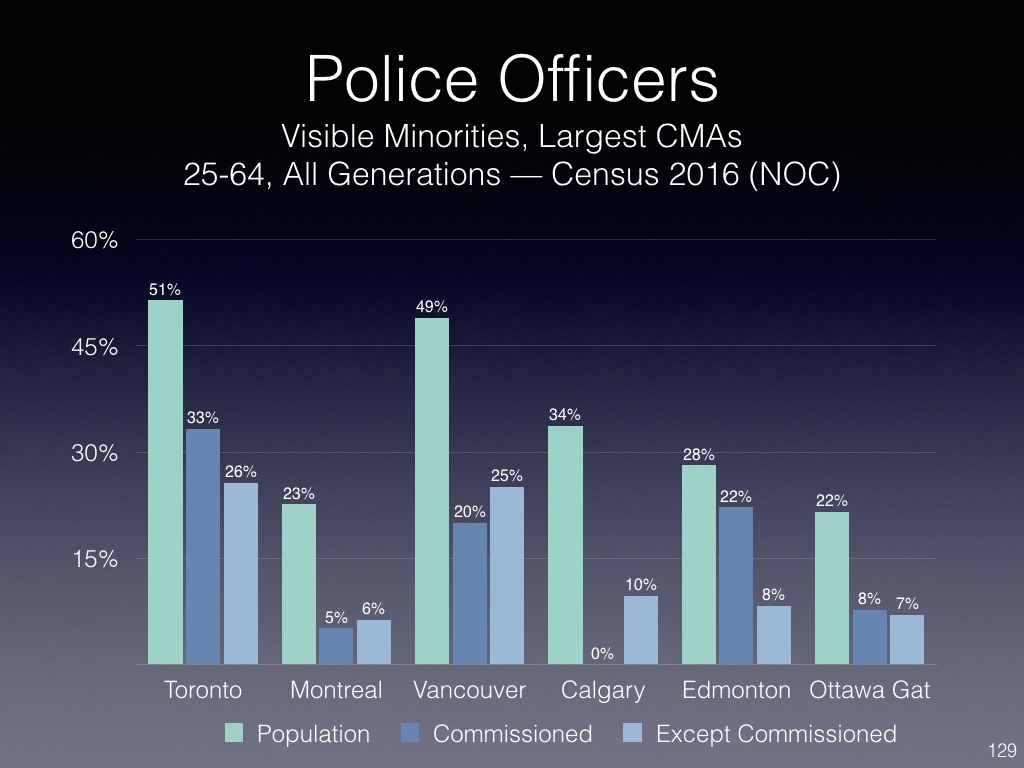
Above chart shows diversity data based upon the 2016 Census.

Good look at the diversity of British Columbia police forces:

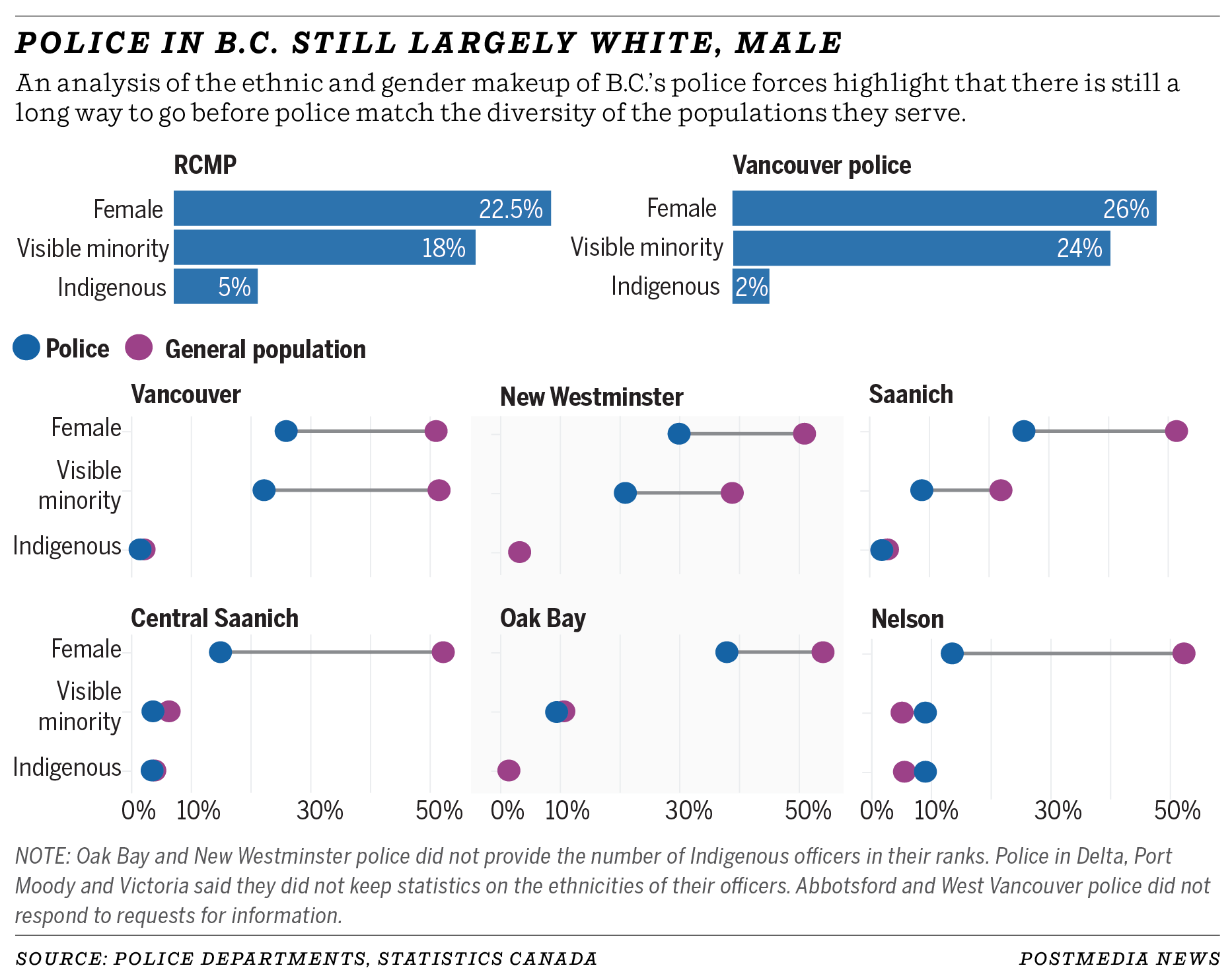
As a growing number of protests in the U.S. and Canada call for reimagining how police are funded and structured, we wondered how closely B.C.’s various departments reflect the demographics of the people they serve.

We asked B.C.’s 12 municipal police agencies and the RCMP, which has jurisdiction in the rest of the province, how many of their officers identify as visible minorities and how many are women.

The significance of these numbers varies widely depending on who you ask.“Overall, I’d say it’s good to have these kinds of statistics. However, even if we made a lot of progress in terms of having RCMP and local city forces more reflective of the general population in B.C. in terms of proportions of visible minorities, I’m not sure how much actual change we could expect,” said Samir Gandesha, director of the institute for humanities at Simon Fraser University.

There needs to be a cultural shift within law enforcement, Gandesha argued, that addresses “deep-seated” inequities around racism and sexism. “Talking about the demographics, I think, is a great place to start, but there are some much harder questions.”

Protesters demanding a different type of policing have marched on local streets since the May 25 death of George Floyd in Minneapolis, after a white officer knelt on the Black man’s neck for nearly nine minutes. Many local activists want the police to be “defunded,” a concept that would allocate some — or all — of hefty law-enforcement budgets to social workers or psychologists better equipped to respond to mental health calls.

For Sgt.-Maj. Sebastien Lavoie, a Black Mountie based in Surrey, the statistics mean the RCMP needs to find new, innovative ways to hire qualified officers from varied backgrounds, especially from communities in which recruitment has been challenging. The video of Floyd’s agonizing death was sickening to Lavoie, but he believes the vast majority of police officers are good people, and says sensitivity and cultural training of new recruits is “a million light years” ahead of when he went through the process 20 years ago.

“We do want to represent the society as best we can in terms of demographics,” said Lavoie, whose job is to advise rank-and-file members about decisions made by management, while also bringing officers’ concerns to the higher-ups.“So the challenge is how do we get the good candidates from those demographics coming to us? We want to get the quality and the equality. … For me the biggest focus has to be to reach out to the communities and bridge the gap and actually have people interested in policing in those communities.”

‘Not an overnight fix’

The RCMP polices large areas of the province, including parts of Metro Vancouver and most of rural B.C. It employs nearly three-quarters of B.C.’s 9,500 police. The RCMP says 18 per cent of its officers are visible minorities and another five per cent are Indigenous persons.

Those statistics come close to reflecting the demographics of a rural city like Prince George, where 24 per cent of the population identifies as one of those two groups, the census says, or in Kelowna, where the two groups comprise just 16 per cent of the population. But the statistics are out of whack for diverse cities such as Richmond, where visible minorities and Indigenous peoples represent 77 per cent of residents, or in Surrey, where they represent 61 per cent.
The Vancouver Police Department employs the second largest number of officers in B.C., and says 26 per cent of its 1,340 officers are visible minorities or Indigenous, which is one of the highest percentages in the province. However, the 2016 Census found twice that amount — 54 per cent — of Vancouver’s population identified as one of those two groups.

Vancouver police Chief Adam Palmer agreed it is important for his department to reflect the community, and suggested it is “on the path” towards that, but cautioned “it’s not an overnight fix.” He said each recruiting class today is far more diverse than the officers who are retiring, that his officers speak a combined 50 languages, and that a quarter of the force is female.“I think a lot of people would think that, ‘Oh, policing in Vancouver, it’s a bunch of six-foot-tall, 200-pound white guys running around,’ when that’s not the case,” Palmer said.

He added, though, that hiring cannot be focused on demographics alone. “Diversity is important, but it’s also important to get the right person, the right temperament and background and just the right personality and mindset to be a police officer.”

Palmer, who is also president of the Canadian Association of Chiefs of Police, denied this week there is systematic racing in Canadian policing. His department, though, is falling under increasing scrutiny.Vancouver Mayor Kennedy Stewart asked the province for a “comprehensive review” of policing in B.C., including investigating the “systemic racism and disproportionate violence” faced by Black and Indigenous peoples. Stewart, who chairs the police board, has also said he wants Vancouver police to end the practice of street checks, when people are randomly stopped and their identification often recorded, because the checks have disproportionately targeted Indigenous and Black people in his city.

On Thursday, the B.C. Civil Liberties Association, the B.C. Union of Indian Chiefs and the Hogan’s Alley Society echoed calls for street checks to end, after alleging racist and other inappropriate behaviour by two Vancouver police officers.And Vancouver Coun. Pete Fry has introduced a motion asking council to support a “community-based crisis management strategy” that would send mental-health experts, rather than police, to help people in crisis.

Also this week, trustees with the Vancouver and Victoria school boards voted unanimously to review the use of police liaison officers, who often work with at-risk youth and sometimes coach sports teams.

‘Change in a radical way’

Meenakshi Mannoe, criminalization and policing campaigner with Pivot Legal Society, co-wrote a letter last week to B.C.’s attorney general and the RCMP’s B.C. commander, calling for immediate action to address issues such as the disproportionate policing of some groups and low-income communities.

Mannoe does not, though, believe the answer is hiring more Indigenous or visible-minority officers, but rather a defunding of law-enforcement budgets, with the money routed to areas that can “prevent a crisis,” such as housing, medical care, a safe drug supply, peer counselling and cultural programs.

“We are in a moment where people are really talking about change within the police in a radical way,” said Mannoe, a trained social worker.“If we address inequalities at their core, we wouldn’t need to over-police communities like the Downtown Eastside or communities with people who experience homelessness or use drugs.”

She rejects the argument that policing in B.C. is not as racist as south of the border and therefore doesn’t need a major rethink, pointing to several local police incidents involving visible minorities. In 2014, Tony Du, a schizophrenic man waving a piece of wood, was shot dead in a Vancouver intersection. And last December, police handcuffed an Indigenous man, Maxwell Johnson, and his 12-year-old granddaughter outside a Vancouver bank after tellers questioned the pair’s identification.

These high-profile incidents are not just happening in Vancouver, of course. This week, University of B.C. Okanagan nursing student Mona Wang sued the RCMP, alleging a Kelowna officer dragged her out of her apartment, kicked her in the stomach and shouted phrases like “stupid idiot” during a wellness check.

B.C.’s policing rules outdated: Minister

The province has not yet responded to Mannoe’s letter. But earlier this month, Public Safety Minister Mike Farnworth promised to set up an all-party committee to modernize B.C.’s 45-year-old Police Act, “with a specific focus on systemic racism.” He added the “outdated” act is “out of step with our government’s approach” on issues including harm reduction and mental health.

Policing in B.C. is a patchwork quilt, with the RCMP taking up most of the fabric. Eleven municipal departments oversee 12 cities and communities, while the Transit Police patrols the SkyTrain, bus routes, the SeaBus and the West Coast Express.

After the two largest agencies, the RCMP and Vancouver, here is how the rest of the departments report on the combined percentage of visible minority and Indigenous officers they employ, based on statistics they supplied to Postmedia:

Transit Police: 31 per cent of officers are visible minorities or Indigenous, the highest percentage in B.C. It provided the most detailed breakdown of its officers’ ethnicities, which included three Indigenous and two Black officers.

New Westminster: 21 per cent of officers in a city where 42 per cent of the population identifies as visible minority or Indigenous. The agency is trying to recruit more diverse applicants through social media, community liaison officers, and lower application expenses for underprivileged people, said Sgt. Jeff Scott.Saanich: 11 per cent of officers compared to 25 per cent of the general population that is a visible minority or Indigenous. It provided detailed five-year data, which showed a slight improvement over 2016, when nine per cent of officers belonged to those two groups.

Central Saanich: It has one visible minority and one Indigenous officer, representing seven per cent of its 27-member department, numbers that have stayed roughly the same for a decade in a small community where 10 per cent of the population identifies as one of those two groups. “We are consulting with the Greater Victoria diversity committee to identify ways to reach a greater, more diverse audience” when the department is ready to hire new officers, said Sgt. Paul Brailey.

Nelson: It has two Indigenous officers but no visible-minority officers, representing nine per cent of its 22-officer department. Chief Paul Burkart noted his community is unique in B.C., because the census says its overall population of visible minorities and Indigenous people is only 11 per cent of the total.

Oak Bay: Like Nelson, nine per cent (two) of its 22 officers identify as visible minorities, compared to 12 per cent of the general population. It is seeking ways to find more diverse officers, but only hires from other departments, which limits its pool of potential candidates, said spokesperson Lindsay Anderson.

Victoria, the second largest department after Vancouver, and smaller Port Moody do not keep ethnicity statistics and did not explain why they don’t. Neither does Delta, but it “believes there may be value in collecting this data,” so in 2018 started asking recruits to volunteer this information. Since then, half of its new employees have identified as visible minorities, said Delta spokesperson Cris Leykauf.Abbotsford did not respond to requests for the data, and West Vancouver did not provide it by deadline.

To find more ethnically diverse officers, the VPD held information sessions for LGBTQ2S+ candidates, and attended events like Hoobiyee, National Indigenous People’s Day, the Chinese New Year Parade and Vaisakhi, said Simi Heer, public affairs director. The RCMP attends career fairs and cultural events, and has also launched a pilot program to help Inuit people navigate the recruitment process, said Staff Sgt. Janelle Shoihet.

‘This is the worst I’ve ever seen it’

The fallout from Floyd’s “heartbreaking” death and the public’s animosity toward police hit local Mounties harder than any other similar case that has been in the news, said the RCMP’s Lavoie.

“This is the worst I’ve ever seen it. We have seen family members turn on each other, spouses turn on their spouse,” he said. “This is one of the most emotional topics that I’ve seen in my 20 years. It’s been really bad.”

He believes the RCMP does good work and is trying to make up for past errors with modern-day efforts to change. For example, before officers respond to a major situation involving Indigenous people, such as the Wet’suwet’en pipeline protests, Lavoie says he reminds them of the Mounties’ role in seizing children to force them into residential schools and that officers need to be sensitive about this history.

“We need to own exactly what we have done, and I think we are doing a much better job of this than ever before. And that is critical,” he said.Lavoie added he has not felt racism directed at him by anyone in the RCMP, noting he was promoted while on the emergency response team and into his position today with no consideration of the colour of his skin.

Gandesha, the SFU prof, argued that hiring more racialized, or ethnically diverse, people or even having them in positions of power is not a quick fix on its own, unless everyone in the organization believes in change. For example, Minneapolis has a Black police chief, but that didn’t stop a white officer from kneeling on Floyd’s neck until he died.

He notes police budgets have risen as crime has fallen in Canada, and believes there should be a rebalance that results in more investment in social services. Then when someone is in distress, as happened west of Toronto on the weekend when Ejaz Choudry, who had schizophrenia, was shot dead by Peel police, social workers or psychologists would ideally respond to the call, not armed officers, Gandesha said.

‘It raises an eyebrow’

Another statistic we requested from B.C.’s police departments was the number of female officers they employed. That ranged widely, including 30 per cent in New Westminster, 26 per cent in the VPD, 23 per cent within the RCMP, and 15 per cent in Port Moody.

“It raises an eyebrow” that, in 2020, women are not closer to representing half of the police officers in the province, said Genevieve Fuji Johnson, an SFU political science professor who just published a study on the “whiteness” of the upper echelons of Canadian universities.She wonders about the retention rate of women in policing careers, if they perhaps leave prematurely if they don’t feel valued. Earlier this year, for example, an estimated 2,000 former female employees of the RCMP won final court approval to proceed with a multimillion-dollar class-action lawsuit against the force over gender-based abuse and discrimination.

Another question to ask these departments, she said, is whether women and visible minorities have a proportional number of high-ranking jobs or if they mainly fill the lower ranks.“Our police departments, and the RCMP, you want them to look, to the extent that’s possible, like the people they are serving. So you want that representation for a whole range of reasons,” said Fuji Johnson, who is not sure that substantive change will happen soon.

“Right now there are tons of demonstrations going on and people are making noise and I think that is super important. But is anything going to change? I don’t know.”

In a letter posted on the Stl’atl’imx website this month to the people of the St’at’imc Nation, near Lillooet, Doss-Cody wrote that many police agencies have promised to check past behaviour and build a better relationship with the people they serve.

“I wish them all of the best, but like you, I can only believe that this change can come about if there is a serious effort to deal with the systemic racism that has existed that has led to much strife with our people, including our interaction with police,” the police chief wrote.

Source: How diverse is your police force? After anti-racism protests, we analyze the makeup of B.C.’s policing

RCMP failing to diversify its workforce, new statistics show


Nothing new here as the RCMP (along with the Canadian Forces) has long struggled to improve representation of visible minorities and women (need to update above chart but doubt that overall picture has changed much):

A drive to make the RCMP’s workforce more diverse stalled last year as the Mounties struggled to become fully representative of the communities they police, newly available statistics show.

The national police force’s report on employment equity for 2018-19 says the diversity of the RCMP’s overall workforce had “not changed by any significant measure” from the previous year.

The proportion of women, visible minorities and people with disabilities also remained lower than the rates found in the general Canadian workforce, while the proportion of Indigenous employees was a notable exception.

“Diversity has traditionally been a challenge for police forces in Canada, and the RCMP is no exception,” says the report, recently tabled in Parliament.

The killing of George Floyd, a Black man, by police in Minnesota has set off a global wave of calls for law-enforcement agencies to fundamentally address entrenched racism and the oppression of minorities.

RCMP Commissioner Brenda Lucki has acknowledged her police force can improve. But she initially stopped short of endorsing Prime Minister Justin Trudeau’s assessment that the force, like all Canadian institutions, exhibits systemic racism.

On Friday, Lucki expressed regret for not doing so.

“During some recent interviews, I shared that I struggled with the definition of systemic racism, while trying to highlight the great work done by the overwhelming majority of our employees,” she said in a statement.

“I did acknowledge that we, like others, have racism in our organization, but I did not say definitively that systemic racism exists in the RCMP. I should have.

“As many have said, I do know that systemic racism is part of every institution, the RCMP included. Throughout our history and today, we have not always treated racialized and Indigenous people fairly.”

Trudeau said Friday that Lucki had already made strides within the RCMP but added that more needs to be done quickly across the country to ensure police officers, including Mounties, can better serve Canadians.

“There are some deep changes we need to make in our institutions, and we need to work with people who want to make those changes, who want to be part of the solution — and I know Commissioner Lucki is one of those,” Trudeau said.

The report says that on April 1, 2019, representation rates among regular RCMP members, as opposed to civilian employees, were 21.8 per cent for women, 11.5 per cent for visible minorities, 7.5 per cent for Indigenous people and 1.6 per cent for people with disabilities.

The numbers are fairly consistent with 2018 data for all police forces in Canada, the report notes.

“These results are not reflective of modern trends being observed in the Canadian population, and signal that a ‘one size fits all’ approach to attracting, selecting, developing and retaining diverse employees is not the most effective way of achieving diversity in the workforce,” the report says.

“The RCMP must continue to strive to increase the diversity of its workforce by removing barriers which inhibit attracting new employees who will bring a greater diversity of identities, backgrounds, experiences and expertise.”

Asked for comment on the report, the RCMP said that while year-over-year changes in diversity statistics will vary, the proportion of visible minorities among police officers has been increasing steadily for decades.

The RCMP’s modernization plan, spearheaded by Lucki, has identified a more representative employee base as critical to the force’s future.

“Delivering culturally relevant community policing solutions requires an in-depth understanding of the challenges people experience while accessing justice,” the equity report says.

“Making progress in this area requires meaningful dialogue with community leaders, enabled by a diverse workforce able to overcome differences and capable of building lasting relationships.”

The RCMP has tried to address employment-equity shortcomings through initiatives including an internal advisory council, fostering a better understanding of Indigenous traditions, and making the force’s uniform and grooming requirements more sensitive to the needs of different faith groups.

The force says it is also trying to attract candidates from different backgrounds through career fairs and a review of its application process to remove possible barriers. It has also developed a strategy to increase diversity at the executive levels in response to a recent audit.

Understanding common barriers such as privilege, bias, harassment and the glass ceiling is not difficult, the report says.

“Oftentimes, the real challenge is acknowledging that equity and inclusion-related issues must be addressed. This may mean accepting different approaches to conducting operations, which can lead to short- and long-term success.”

The report recommends a focus on identifying the “success factors” that contribute to a Mountie’s advancement to the highest officer ranks.

Reaching the executive level requires access to the right opportunities, networks and training, endorsement from other senior leaders, language skills and a balance between personal obligations and the increased demands of executive leadership, it says.

However, members of the underrepresented groups “are likely to face additional challenges” in this respect.

These factors point to a need to identify leadership potential early, so the organization is well-positioned to help promising members advance, the report says.

Source:  RCMP failing to diversify its workforce, new statistics show