Dave Snow: As the U.S. abandons DEI, Canada doubles down 

On some of the excesses. Likely that a future conservative government would eliminate granting council requirements among other programs:

While the U.S. government, corporations, and universities begin to abandon Diversity, Equity, and Inclusion (DEI) policies, Canada has instead doubled down, continuing to make them an integral part of both government and academia.

This trend has become increasingly apparent in federal granting agencies, the main source of Canada’s research funding, whose combined budget is nearly $4 billion.

In my new Macdonald-Laurier Institute report—“Promoting Excellence—Or Activism? Equity, Diversity, and Inclusion at Canada’s Federal Granting Agencies”—I find DEI has now become fully infused into all three of Canada’s granting agencies: the National Sciences and Engineering Research Council (NSERC), the Canadian Institutes of Health Research (CIHR), and the Social Sciences and Humanities Research Council (SSHRC).1

Their DEI initiatives range from specialized race, gender, and diversity grants to revised definitions of “research excellence” to mandatory bias training for most peer reviewers. As a result, a growing proportion of grants are awarded to projects with explicitly activist subject matter. All this adds to the idea that Canada’s research funding process has become politicized, further undermining the public’s faith in universities.

The colours of the DEI rainbow

My report identifies three categories of DEI (or “EDI,” as typically fashioned by the federal government) at Canada’s granting agencies.

Mild DEI uses the language of DEI in vague, unobjectionable terms to push for greater institutional diversity.

Moderate DEI uses DEI as a substitute for affirmative action. Under the guise of “equity targets” or “equalization” of grants through preferential awarding processes, Moderate DEI seeks to increase the number of awards given to those who identify as Indigenous, women, visible minorities, LGBTQ+, and persons with disabilities.

Finally, Activist DEI uses the language of DEI to advance the goals of critical social justice activism. This category is broadly consistent with what many call “wokeness.” Activist DEI views society, in the words of University of Buckingham professor of politics Eric Kaufmann, “as structured by power hierarchies of white supremacy, patriarchy, and cis-heteronormativity.” It aims to “overthrow systems of structural racism, sexism, homophobia, and transphobia.” Activist DEI is utterly incompatible with the creation of objective, falsifiable academic research—yet it is increasingly creeping into granting agencies’ guidelines, definitions, and reports. CIHR has even embedded Activist DEI into how it evaluates success, updating its Research Excellence Framework to say, “Research is excellent when it is inclusive, equitable, diverse, anti-racist, anti-ableist, and anti-colonial in approach and impact.”

The ambiguous meaning of DEI enables scholars and institutions to hide behind Mild DEI language while advancing Activist DEI research agendas. Canada’s granting agencies claim that equity merely means the “removal of systemic barriers.” But in practice, SSHRC-administered Canada Research Chair positions often exclude applicants who are white and male.

The agencies claim diversity is only “about the variety of unique dimensions, identities, qualities and characteristics individuals possess.” But SSHRC’s Guide to Including Diversity Considerations includes eleven sources about intersectionality.

The agencies insist that inclusion merely ensures “all individuals are valued and respected for their contributions and are supported equitably in a culturally safe environment.” Meanwhile, CIHR funds and promotes a workshop whose participants envision a day where “Public health is no longer run by nauseating Whiteness [sic].”

The result is a confusing mélange of DEI terminology that inevitably nudges students and scholars towards activism in their grant and scholarship applications. Unsurprisingly, many prestigious grants are ultimately awarded to Activist DEI projects. Building directly off preliminary research I completed for The Hub, my new report assessed more than 2,600 individual SSHRC awards between 2022 and 2024. As expected, Activist DEI language was present in as many as 63 percent of project titles for the federal government’s specialized identity-focused “Future Challenge” grants.

More troublingly, Activist DEI language was present in many of the titles of SSHRC’s prestigious Insight Grants (10 percent) and Insight Development Grants (14 percent). These grants are supposed to promote research excellence; instead, they are funding projects with titles such as “Just Kids: Children and White Supremacy” and “Reclaiming the Outdoors: Structures of Resistance to Historical Marginalization in Outdoor Culture,” with the latter costing taxpayers more than $250,000.

Seeking solutions

What can be done to fix this? My report makes several recommendations for reform. Amend the granting agencies’ legislation to enshrine a commitment to political and ideological neutrality. Remove all references to DEI from agency guidelines. Eliminate DEI-themed grants. End the practice of “equity targets” and preferential awards.

But also, avoid the instinct to “ban” DEI-driven research from award consideration. Such bans are antithetical to academic freedom. Instead, let Activist DEI scholars make the case that their research deserves scarce taxpayer resources—resources that will be awarded on objectively meritorious criteria related to research excellence and knowledge production, rather than adherence to fashionable political activism.

Canadian universities are in need of substantial reform, and removing DEI considerations from federal granting agencies will not be a catch-all fix to the problems of ideological diversity, intolerance, and bloated bureaucracies that plague our higher education. But it would be a good start. The granting agencies remain committed (in principle) to research excellence and objective knowledge creation, which is more than can be said of much of the Canadian academy. They continue to fund indispensable research in health, hard sciences, and social sciences. Thankfully, the proportion of prestigious grants given to Activist DEI research remains small. But, while a DEI fixation has not yet caused irreparable harm to the agencies, it runs the risk of permanently damaging their reputations.

The first step in fixing higher education in Canada should come from the top. It is time for the federal government to depoliticize grant agency funding and remove DEI from the agencies’ domain.

Source: Dave Snow: As the U.S. abandons DEI, Canada doubles down
Dave Snow: The Canadian Human Rights Tribunal will not be able to handle the deluge of cases from the Online Harms Act 

Interesting analysis of their workload and decisions:

…Exploring Human Rights Tribunal decisions

To determine how this new Bill could affect the federal human rights framework, I sought to understand how the existing framework works in practice. I conducted a content analysis of every Canadian Human Rights Tribunal decision over the last five-and-a-half years, from January 1, 2019, to June 30, 2024.

Surprisingly, I discovered that the Canadian Human Rights Tribunal issues very few decisions. Between 2019 and 2024, the tribunal only issued 63 actual decisions, along with 260 procedural “rulings” about ongoing hearings—typically involving brief motions to admit evidence, anonymize participants, or amend statements.

Moreover, nine of the 63 decisions were merely procedural in nature (mostly dismissing “abandoned” complainants) and one evaluated compliance with an ongoing settlement agreement between First Nations and the government of Canada.

This means that since 2019, the Canadian Human Rights Tribunal has only actually issued 53 decisions that involved an evaluation of a complaint alleging discrimination or harassment—fewer than 10 per year–from a low of six in 2022 to a high of 14 in 2019. By way of comparison, in 2023 alone, human rights tribunals in AlbertaB.C., and Ontario issued 126, 248, and 1,829 decisions respectively. The COVID-19 pandemic did not appear to have a serious impact on delaying tribunal decisions.

In human rights tribunals, complainants allege discrimination or harassment based on one or more “grounds.” They can claim to have faced discrimination on multiple grounds simultaneously. Across the 53 decisions, there were an average of 2.1 grounds claimed per decision.

The most frequently claimed ground was disability (in 58 percent of decisions), followed by national or ethnic origin (34 percent), race (32 percent), family status (21 percent), age (19 percent), and sex (19 percent). Interestingly, there were only two decisions where complainants alleged discrimination based on religion, only two on sexual orientation, and only one on gender identity.

For each decision, I examined whether the claimant was successful (a “win”) or unsuccessful (a “loss”). I characterized partially successful claimants as a win, as these decisions still involved a remedy that typically included some form of financial compensation.

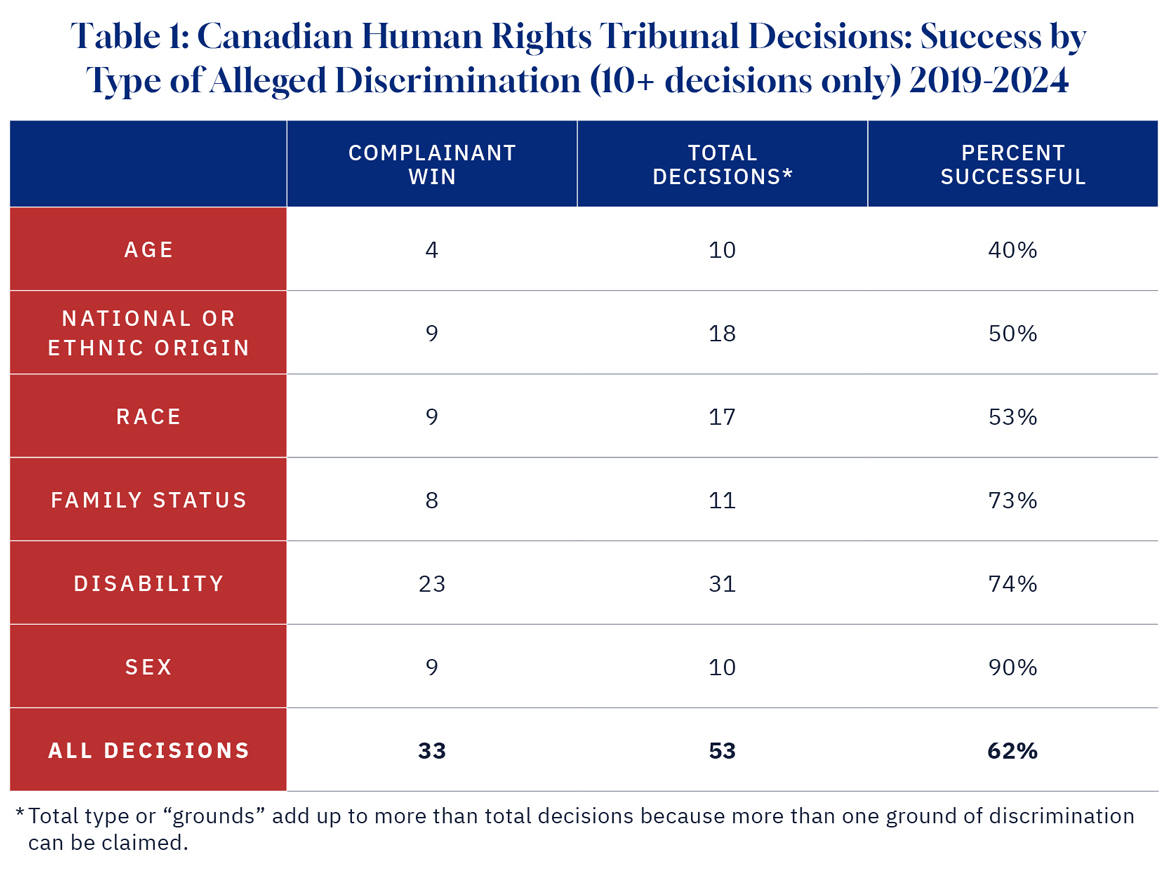
Table 1 shows an overall success rate of 62 percent. It also shows the win rate for each type or “ground” of discrimination that appeared in at least ten decisions.

Graphic credit: Janice Nelson. 

I found that complaints alleging age-based discrimination—all but one of which were based on old age —were least likely to be successful (40 percent win rate). Complaints involving discrimination based on race (53 percent) and national or ethnic origin (50 percent) also had a lower-than-average success rate.

By contrast, complainants alleging sex-based discrimination or harassment were the most successful (90 percent). Nine of the 10 complainants alleging sex-based discrimination and or harassment were women. Eight of those nine were successful.

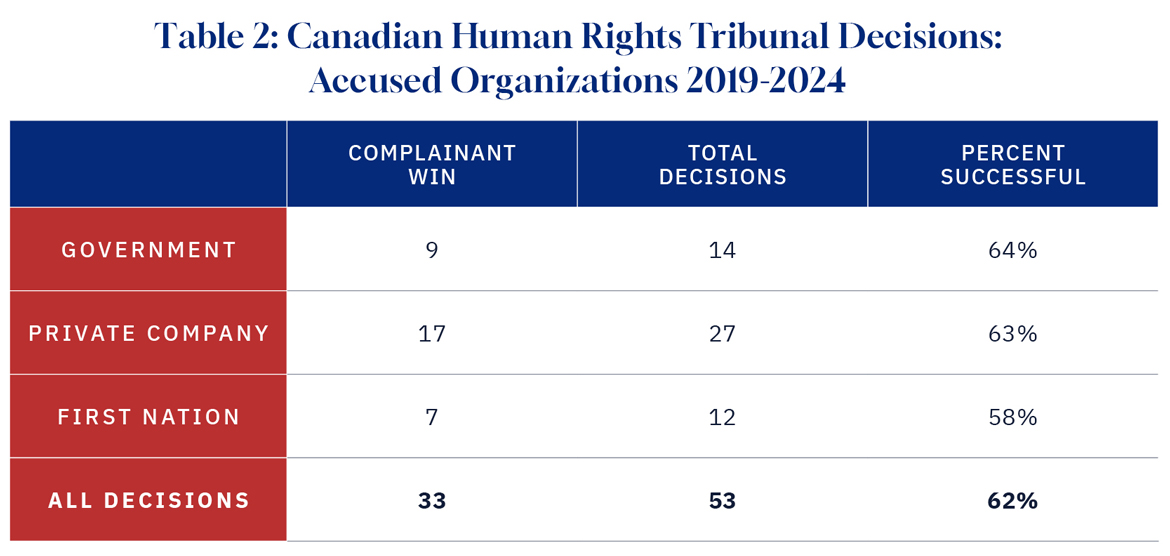
Table 2 organizes the 53 decisions according to the three types of “respondents,” or the organizations accused of harassment or discrimination: federal government entities (including federal departments, Crown corporations, the RCMP, and the City of Ottawa); private companies in federally-regulated industries (transportation, aviation, marine, rail, banking, and telecoms); and First Nations. There was minimal variation in success rates by the type of respondent, with complainants slightly less successful against First Nations (58 percent win rate) than against governments (64 percent) and private companies (63 percent).

Graphic credit: Janice Nelson. 

Given the controversy over the incoming chief of the Canadian Human Rights Commission, I also sought to explore decisions in which Jewish complainants alleged antisemitic discrimination, whether on the grounds of religion or national or ethnic origin.

What I found was that there were no such decisions. The words “Jew,” “Zion,” “Zionist,” and “antisemitic” do not appear in any of the tribunal’s 63 decisions from 2019-2024. The word “Jewish” only occurs in four procedural rulings. Three were from an identically-worded sentence in procedural rulings describing an ongoing case involving an inmate who “self-identifies as an Indigenous, Jewish, Two-Spirit transfeminine woman”. The fourth was found in an interim ruling for a Muslim inmate. He had complained that Correctional Service Canada “provided a religious diet for Jewish inmates, but not a diet for [him] that would accommodate his Muslim beliefs and his health issues.”

It is worth noting how infrequent claims of religious discrimination are. Only two of 53 decisions involved religious discrimination, and in both cases the complainants also alleged discrimination on other grounds. Both complainants were successful.

Conclusions

Federal human rights institutions are under the political microscope, and for good reason. The Canadian Human Rights Commission claims“We must all call out antisemitism” but its incoming leader (expected to take up his post this week) once posted that “Palestinians are Warsaw Ghetto Prisoners of today.” Its website proudly displays a section on “Anti-racism work” yet it has been publicly admonished for its own alleged anti-black racism.

Meanwhile, as I have demonstrated through my investigation, the Canadian Human Rights Tribunal appears unprepared to deal with the influx of complaints about online hate speech for which it will be responsible if the Online Harms Act passes.

Based on my research, I draw three main conclusions. First, the tribunal simply does not issue many decisions. It only issued 63 decisions over the last five-and-a-half years, 10 of which did not involve a formal evaluation of discrimination or harassment. The fact that the tribunal also issued 260 procedural rulings during the same period further suggests its existing hearings are often slowed down by procedural issues.

Second, the few decisions the tribunal does render are fundamentally different than what it would decide under the Online Harms Act. More than one in five decisions (12 of 53) involved truck drivers or trucking companies. The same number(12 of 53) involved allegations of discriminatory conduct by First Nations, such as when a non-Indigenous woman alleged discrimination for being fired from a First Nation-owned bowling alley (she lost). Cases of discrimination involving religion, gender identity, and sexual orientation are virtually nonexistent. The term “hate speech” occurred precisely once in a single decision over the last five-plus years. Not a single decision involved a Jewish complainant and only one involved a Muslim. This is not an organization prepared to adjudicate hateful content over the entire internet.

Third, it appears the Online Harms Act is yet another example of the Trudeau government asserting federal authority where provinces are likely better suited to govern. Because they deal with most forms of employment discrimination, provincial human rights commissions and tribunals have a far wider scope of jurisdiction than the federal tribunal does. Provincial human rights codes already deal with discriminatory speech, and the B.C. Human Rights Commission has even recently argued that the B.C. tribunal has jurisdiction over online speech as well. There is no inherent reason that the responsibility for determining online hate should be done by an entirely new and costlylayer of federal bureaucracy, particularly given the existing institutional capacity at provincial commissions and tribunals.

To be clear, I am not suggesting that provincial human rights tribunals ought to be given the sweeping powers contemplated by the Online Harms ActOthers have convincingly shown that the bill likely violatesCharter rights, and will chill “legitimate expression by the mere spectre of a complaint.” I am simply arguing that there are additional procedural reasons to be concerned about the institutional venues through which that chilling will occur.

Adjudicating online hate speech under the Online Harms Act will require deft sensitivity to competing rights claims and societal interests, a tall order for any organization. Instead, the federal government is placing its hopes in the hands of institutions that lack both the moral authority and institutional capacity to do the job.

Source: Exploring Human Rights Tribunal decisions

Dave Snow: The groundbreaking Cass Review on transgender care is shifting the debate abroad. Yet it was barely reported by Canadian media  

While I don’t follow this issue closely, this analysis is nevertheless revealing on how the review and related issues are portrayed, particularly by the CBC:

Few Canadian policy issues are as polarizing as youth gender transition. Yet according to my analysis below, most Canadian media spent last month paying little to no attention to one of the most consequential reports on the topic…

Canadian media coverage of the Cass Review

As a major medical report on an issue where there is considerable Canadian political debate, one would have expected the Cass Review to garner considerable Canadian media attention.

To determine how the issue was covered in Canada, I conducted a content analysis of online articles from five mainstream media outlets (The Globe and MailNational PostToronto Star, CBC, and CTV) from the three-week period following the Cass Review’s publication (April 10 – April 30, 2024). These five outlets published a total of 15 stories that mentioned the Cass Review. Given that three stories (all from the National Post) only briefly mentioned it in passing, and one Associated Press story was published in two outlets, this meant a total of 11 unique stories in which the Cass Review featured prominently.

Coverage was dominated by the National Post, which featured seven articles on the Cass Review over an 11-day period between April 10 and April 20. By contrast, there were only two stories featuring the Cass Review in the Toronto Star, and only one each in CBC, CTV, and the Globe. Apart from the one AP story, every article applied the Cass Review to the Canadian context, with six mentioning Alberta’s proposed gender policies. The stories were split between hard news (six) and opinion pieces (five).

Given the National Post’s longstanding focus on youth gender transition, it is not surprising that it gave the Cass Review the most coverage. The other four outlets did not give it as much attention. The only hard news piece in the Toronto Star was a wire story written by the U.S.-based Associated Press. CTV’s one mention of Cass appeared in a piece about Alberta’s proposed gender policies and was only the result of Premier Smith raising it during an interview with the outlet. Meanwhile, the lone CBC article on the review was more of a condemnation than a news report (see below). The Globe and Maildid not feature Cass in a single hard news article, though the report was mentioned in an investigative opinion piece about gender transition in Canada written 16 days after the review was published. In total, only three of the six hard news pieces quoted from the Cass Review extensively, including two lengthy pieces from National Post reporter Sharon Kirkey and one Associated Press piece (published in both the Star and Post).

While there were only five opinion pieces published about the Cass Review, they shared several notable characteristics. All five opinion pieces—three from the National Post and one each in the Toronto Star and The Globe and Mail—portrayed the review positively, including descriptions such as “landmark” and“an exhaustive and rigorous report.” All five were broadly supportive of exercising greater caution around the use of puberty blockers and cross-sex hormones for youth. The Post’s Adam Zivo called such restrictions “a wise approach that Canada should follow,” while the Globe’s Robyn Urback cited multiple studies “exploring the potential long-term effects of puberty blockers and cross-sex hormones on bone densityfertilitysexual function, and cognitive development” (links in original). Moreover, the five opinion writers demonstrated considerable knowledge of the review itself, with Cass quoted or paraphrased a total of 1611eightfour, and three times, respectively.

By contrast, the CBC’s one news story, published five days after the Cass Review, only quoted it twice. The 1,750-word article, “What Canadian doctors say about new U.K. review questioning puberty blockers for transgender youth,” spent more time criticizing the report than describing it. The story did not quote any proponents of the Cass Review, but it did contain over a dozen quotes from three organizations and three Canadian doctors who were supportive of the gender-affirming model. Two of those doctors criticized the Cass Review directly: one wondered if it was “coming from a place of bias” and “trying to create fear around gender-affirming care,” while another called it “politically motivated.”

One sentence in particular, written by the journalist, is indicative of the CBC’s framing: “The Cass Review, while aiming to be an independent assessment, has been criticized as flawed and anti-trans by trans activists in the U.K., and was described as a product of the U.K.’s hostile environment for trans people in the International Journal of Transgender Health” (links in original). The CBC journalist did not specify the difference between an “independent assessment” and “aiming” to be independent.

However, the International Journal of Transgender Health piece cited by  the CBC journalist refers to the Cass Review as an example of “Cis-supremacy in the UK’s approach to healthcare for trans children.” It was written by a researcher who specializes in “trans inclusion and Applied Trans Studies” and currently holds a grant for “Building Lived Experience Accountability into Culturally Competent Health and Well-being Assessment for Trans Youth Social Justice.” The CBC did not address whether that piece, which was published nearly a month before the Cass Review’s final report came out, was similarly “aiming” to be independent in its assessment of Cass.

This CBC article has garnered considerable attention. It was criticized by American journalist Jesse Singal as “critically dangerous science miscommunication,” while Hub contributor Peter Menzies described it as “so bereft of balance that one could only conclude it [CBC] had abandoned any pretence of principled journalism in favour of playing the role of ally.” But, to regular observers of the CBC, this story was entirely in keeping with its ongoing approach to covering youth gender transition.

People involved in a march against the teaching of so-called “gender ideology” in schools, stand in front of the New Brunswick legislature as they yell across the street at pro-transgender rights counter-protesters in Fredericton, Wednesday, Sept. 20, 2023. Stephen MacGillivray/The Canadian Press. 

Canadian coverage of other LGBTQ topics

Given that major Canadian outlets paid limited attention to the Cass Review, apart from the National Post, observers may wonder if this simply reflected a media tendency to ignore LGBTQ issues.

To test for this, I also conducted a search of stories containing terms like “LGBTQ,” “transgender,” and “gender identity” at each of the five outlets during the same period (April 10-30). I then analyzed stories in which LGBTQ issues were the main topic.

Between April 10-30, in addition to the 11 stories about Cass described above, there were 25  stories on the topic of Canadian LGBTQ issues: 14 at the CBC, six at CTV, three at the Globe and Mail, and one each at the Toronto Starand National Post (this includes one identical Canadian Press wire story published by the Globe, Star, and CTV).

However, not one of these additional Canadian stories mentioned the Cass Review. Some of this was understandable, as most CBC and CTV articles, for example, were local stories covering topics such as a proposed LGBTQ community centre in Montreal, legal battles over New Brunswick’s pronoun policy, and a summer camp for LGBTQ children in Newfoundland and Labrador.

However, in addition to these 25 Canadian-focused LGBTQ stories, the five outlets also published  66 internationally-focused LGBTQ stories. None of these mentioned the Cass Review. All were written by foreign wire services.

Thirty stories were published by the National Post, 27 by the Toronto Star, five by CTV, four by he Globe and Mail, and none by the CBC. Nearly 80 percent (52/66) were focused on American politics, but the 14 other stories covered topics such as Swedish and German laws making changing your gender easier, the passage of an anti-LGBTQ law in Iraq, and a Hong Kong trans activistgetting a male ID card.

Canadian news outlets’ lack of attention to the Cass Review cannot be explained by a lack of interest in international news on LGBTQ issues. The Toronto Star published 28 hard news stories about international LGBTQ issues during this period, but only one mentioned the Cass review. Likewise, the Globe and Mail and CTV published four and five international news stories on LGBTQ issues respectively, none of which mentioned the Cass Review.

 Consequences for Canada

Three broad conclusions can be drawn from the Canadian media’s coverage of the Cass Review. First, apart from the National Post, hard news coverage of the groundbreaking report was limited. Moreover, this minimal coverage cannot be explained by a lack of interest in LGBTQ issues, as these outlets published many Canadian and international LGBTQ-focused stories about topics far less prominent. Perhaps it is unsurprising that a conservative outlet was more likely to report on a major study that appeared to vindicate arguments associated with conservative political positions. Yet the lack of reporting by other news outlets brings to mind a quote from American journalist Nellie Bowles about the 2020 riots around policing and African Americans in Kenosha, Wisconsin: “How the mainstream media controlled the narrative was by not covering it.”

Second, despite this minimal reporting in Canada, the Cass Review seems to have shifted the parameters of the debate over youth gender transition. The way that it has been covered in international media suggests it will now be far more difficult to paint those who favour a more cautious approach to social transition, puberty blockers, and cross-sex hormones as “transphobic.” Although Canadian hard news coverage of Cass was limited, Canadian opinion pieces demonstrate a similar shift. All five opinion pieces (including one from the Toronto Star) covered the Cass Review favourably. All raised criticisms about the prevalence of the gender-affirming model across Canada. In the recent past, the Globe and Star have not been shy about publishing opinionpieces lauding the gender-affirming model. But no such opinion pieces were published in response to the Cass Review.

Finally, as the debate around youth gender medicine shifts, the CBC appears to have dug in its heels in support of the gender-affirming model. In previous research for The Hub, I documented how the national public broadcaster chose allyship over objectivity in its coverage of youth gender transition. That trend has clearly continued. The CBC has often been criticized in general for progressive bias, but it is difficult to recall another policy issue for which the CBC’s lack of balance has been so strident and so sustained. As scientific and policy debates around youth gender transition evolve, this issue will provide a litmus test for whether CBC can provide objective coverage on contentious social and medical topics. For now, the public broadcaster is failing that test.

Source: Dave Snow: The groundbreaking Cass Review on transgender care is shifting the debate abroad. Yet it was barely reported by Canadian media

Dave Snow: The federal government is spending millions on equity, diversity, and inclusion research

Informative data-based analysis of SSHRC funding for its Race, Diversity and Gender Initiative, revealing an overtly ideological and activist social justice and equity agenda:

…A year before, SSHRC awarded $19.2 million in funding for 46 grants of up to $450,000 for its Race, Diversity, and Gender Initiative to create partnerships to study disadvantaged groups. The program description encouraged projects that seek to “achieve greater justice and equity,” and its list of “possible research topics” included questions such as “How can cisgender and straight masculinity be reinvented for a gender-equitable world?” and “Which mechanisms perpetuate White privilege and how can such privilege best be challenged?” The language used in these new grants denotes the clearest shift yet towards more activist priorities in federal research grant funding.

SSHRC data on EDI

To determine whether the “hard” EDI of social justice activism has had a real effect on the types of projects that received funding for SSHRC grants, I conducted a content analysis of the titles of 680 grants awarded under four programs between 2022-23, the latter two of which are explicitly EDI-focused: 

  1. Insight Grants announced in 2023, which “support research excellence in the social sciences and humanities,” valued between $7,000 and $400,000 over five years. (504 total)
  2. Partnership Engage Grants announced in 2023, which provide short-term support for a partnership with a “single partner organization from the public, private or not-for-profit sector,” valued between $7,000 and $25,000 for one year. (100 total)
  3. Knowledge Synthesis Grants to study “Shifting Dynamics of Privilege and Marginalization” announced in 2023, valued at $30,000 for one year. (30 total)
  4. Race, Gender, and Diversity Initiative grants announced in 2022, which support partnerships “on issues relating to systemic racism and discrimination of underrepresented and disadvantaged groups,” valued at “up to $450,000” over three years. (46 total)

First, I categorized each grant recipient according to whether their project title was clearly adopting a critical activist perspective (if there was any uncertainty, it was categorized as “no”). 

I then categorized each grant according to which EDI identity markers the projects covered—Indigenous Peoples, women/gender, LGBTQ+, race, and disability (including mental health). 

As Table 1 shows, the contrast between the two “traditional” grants and the two new EDI-focused grants was striking. Fully one-third of grants in the Race, Gender, and Diversity initiative focused on Indigenous Peoples, and 30 percent mentioned race or racism (compared with 3 percent and 1 percent of the Insight Grants). 

The disparity is especially pronounced when you compare the Race, Gender, and Diversity grants to the Insight Grants, where there was an 11-1 ratio in the proportion of grants awarded on the topic of Indigenous peoples (33 percent versus 3 percent). There was also a 30-1 ratio in the proportion of grants awarded on the topic of race (30 percent versus 1 percent).

Graphic credit: Janice Nelson

It might seem obvious that the two EDI-focused grants produced so many recipients with explicitly activist titles (63 percent compared with 9 percent of traditional grants). Yet it didn’t need to be this way. Examples of non-activist titles of Race, Gender, and Diversity Initiative recipients included “Understanding Race and Racism in Immigration Detention” and “Open-Access Education Resources in Deaf Education Electronic Books as Pedagogy and Curriculum.” One can study marginalized communities without engaging in social justice activism. 

However, most of the EDI-focused grants awarded left no doubt as to the type of research that would be undertaken. Choice titles included:

  • “‘So what do we do now?’: Moving intersectionality from academic theory to recreation-based praxis” ($450,000 grant awarded)
  • “Queering Leadership, Indigenizing Governance: Building Intersectional Pathways for Two Spirit, Trans, and Queer Communities to Lead Social and Institutional Change” ($446,000 grant awarded)
  • “Carceral Intersections of Gender Identity, Sexual Orientation and Trans Experience in Confronting Anti-Black Racism and Structural Violence in the Prisoner Reentry Industrial Complex” ($400,075 grant awarded)

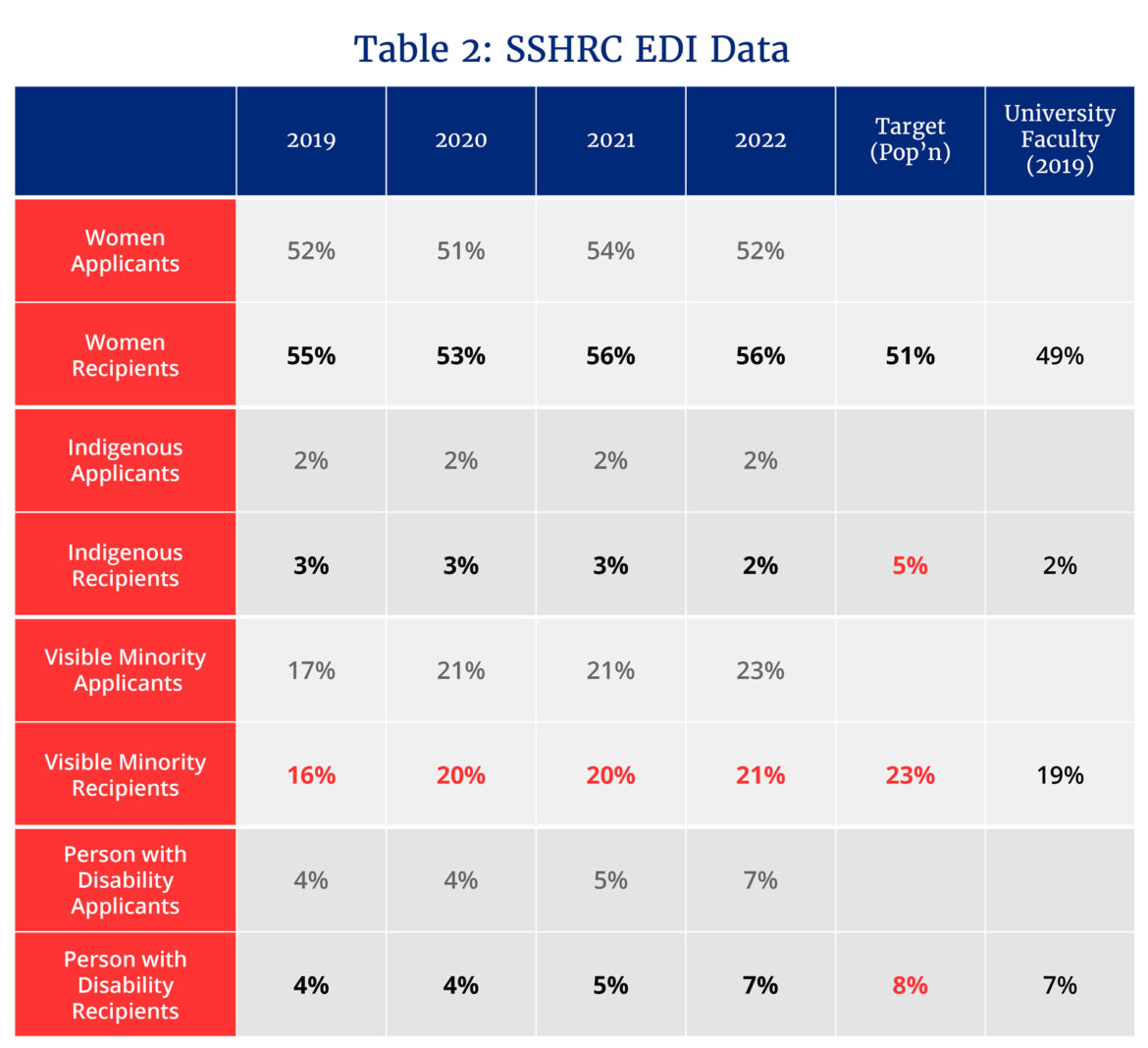
In addition to grant titles, I also examined SSHRC’s diversity data on grant recipients from “underrepresented groups” for all major grants in SSHRC’s own EDI dashboard. This included Insight Grants, Insight Development Grants, Partnership Grants, and Connection Grants contained in SSHRCs (diversity data for the two new EDI-focused grants described above were not available). 

Table 2 provides these numbers alongside SSHRC’s equity targets for 2024/2025 and the groups’ proportion of Canadian university faculty as of 2019. Numbers in red show “under-performance” in the applicant-recipient ratio and SSHRC’s own targets.

Graphic credit: Janice Nelson

Four things are notable. First, only one of SSHRC’s four target groups (visible minority applicants) has been underrepresented in terms of the applicant-recipient ratio. Second, while women are the only group who have exceeded SSHRC’s equity target, the percentage of recipients has been growing rapidly for visible minority applicants and persons with a disability. Third, no target group is underrepresented relative to its proportion of university faculty members, with women (56 percent of recipients) especially outperforming their faculty proportion (49 percent). Finally, Indigenous grant recipients (2 percent) are underrepresented relative to their proportion of the overall population (5 percent), but not relative to their proportion of university faculty members.

Damaging the pursuit of truth

The above analysis leads me to three broad conclusions. First, while the language of EDI has permeated SSHRC, the federal agency oscillates between the “soft” EDI of affirmative action and the “hard” EDI of critical social justice activism. Most of the time, SSHRC focuses on achieving “equity targets” and frames EDI as complementary to research excellence. However, SSHRC’s new EDI-themed grants explicitly adopt activist language, and it is little wonder that those awards have been dominated by activist projects.  

Second, when it comes to the “soft” EDI of affirmative action, SSHRC’s policies are clearly having their intended effect for all groups except Indigenous Peoples. The number of grants awarded to women, visible minority applicants, and persons with a disability is rising. Grants are being awarded to members of these three groups at a proportion equal to or greater than their share of university faculty, and in the case of women, well above their share of the overall population. At this rate, it will soon be inaccurate for SSHRC to refer to “underrepresented groups” when it comes to prestigious national grants.

Finally, the “hard” EDI of critical social justice activism poses the biggest threat to SSHRC’s commitment to research excellence. While there are important critiques of the effects of “soft” EDI of affirmative action, it does not necessarily pose the same existential threat to research excellence. But the “hard” EDI of critical social justice activism is utterly incompatible with the objective pursuit of truth. One need only skim the titles of grants awarded under SSHRC’s two new EDI-focused initiatives to see how far they have strayed from the objective, empirical knowledge creation that we expect our national granting agencies to fund. Ironically, the more an award is pitched in terms of “diversity,” the less intellectually diverse the recipients seem to be. Thankfully, such activist research remains primarily confined to the new (and for now temporary) EDI-focused grants. 

If the federal government wants universities to keep the public’s trust, it should avoid any future activist-themed grants and ensure that granting agencies eschew social justice priorities. Federal granting agencies using taxpayer dollars should be explicit that their primary commitment is to promote excellence via the creation and dissemination of objective, falsifiable research knowledge. The university is supposed to function as a system of knowledge production. Policies that openly tie research to activist political ends threaten to undermine that very system.

Source: Dave Snow: The federal government is spending millions on equity, diversity, and inclusion research

Dave Snow: When political scientists get political

Believe not unique to political science and his conclusions based on extensive article analysis.

Some of my academic friends, in broad agreement with Snow’s depiction of the shift, point out however that most academics prefer to publish in higher profile international journals given greater weight in tenure and related decisions:

…. I draw three main conclusions. First, Canadian political science scholarship is clearly shifting in important ways. For better or worse, papers published in the Canadian Journal of Political Science reflect the discipline itself. While the discipline has not undergone a wholesale change (as seems to be the case in history), a sizeable proportion of Canada’s flagship political science journal is composed of papers using critical approaches and methodologies that place a greater emphasis on narratives of historical marginalization, particularly with respect to Indigenous Peoples and decolonization. 

Second, the journal’s openness to critical methodologies and identity diversity has been accompanied by a narrowing of its ideological diversity. While authors’ policy recommendations are by no means ideologically homogenous, they generally range from centre-left to far-left. This tilt is most obvious in papers that focus on decolonization, but it is present throughout the entire journal. Of 227 papers published over the last five years, I did not find a single one that provided anything approximating a conservative policy recommendation. By contrast, even the journal’s most empirically rigorous quantitative papers often contain recommendations such as “political parties should recruit and promote more women candidates” and “Policy tools specifically designed to problematize, target and alleviate racial economic inequality also seem needed.” Conservative scholars used to publish mildly conservative policy recommendations in the journal. Those days are now long gone.

Third, the journal editors’ statement is sadly reflective of similar statements made in Canadian higher education regarding equity, diversity, and inclusion, insofar as it refuses to acknowledge any previous progressive change. The Canadian Journal of Political Science had already clearly opened itself up to diverse perspectives and methodologies in recent years. Several papers in a 2017 special issue had already identified some of these changes. Yet this did not stop its new editors from claiming that the discipline was still engaged in “gatekeeping” on behalf of “white androcentric paradigms.” Thankfully, political scientists are well-equipped to use data to test the truth of such speculative arguments.

In spite of the challenges facing our universities, Canadians continue to profess high levels of trust in academics, including those in the social sciences and humanities. To retain such trust, we must demonstrate a commitment to the core purposes of the university: intellectual curiosity and the pursuit of truth. We do ourselves no favours when we abandon these goals in favour of political projects. 

Dave Snow is an Associate Professor in Political Science at the University of Guelph.

Source: Dave Snow: When political scientists get political