Some U.S. religious leaders flout COVID-19 restrictions

Unfortunately, not that surprising among some evangelical groups:

School buses delivered hundreds of church-goers to Life Tabernacle Church in Baton Rouge, Louisiana, on Sunday, defying physical-distancing guidelines and the state governor’s direct order banning gatherings of more than 10 people.

Religious service, steeped as it is in community, is one area where people are finding it hard to avoid gathering amid the COVID-19 pandemic. And while some churches in the U.S. are finding innovative ways to continue services, such as conducting them virtually, a few are still gathering in person, potentially exposing many people to the novel coronavirus.

South Korea has experience with the danger of public worship services: More than half of the country’s coronavirus cases were linked to the branch of the Shincheonji Church of Jesus in Daegu.

But Life Tabernacle is flouting officials’ pleas in a state where, as of Monday afternoon, more than 4,000 have been infected and 185 have died, according to an ongoing tally by Johns Hopkins University.Gov. John Bel Edwards, a Democrat, on March 22 ordered a lockdown of all but essential services, which did not include religious worship services, and prohibited gatherings of more than 10 people.The father of Life Tabernacle’s pastor Tony Spell says the church is an essential service.

“The church is not a non-essential. The church is the most essential thing in all the world,” Timothy Spell told NBC News outside the church Sunday.

“No one is telling anybody you got to come to church. We tell people not to come if you have a fever, if you have any symptoms, if you’re aged, if you’re elderly, don’t come.”

Florida pastor arrested

That’s got local residents like Ryan Tregre fuming.

“If they really worried about just spreading the [spiritual] word, they would go on Facebook Live or YouTube or some kind of way to spread the word where they would not have to go and meet in places and spread this virus that’s killing people every day,” he told NBC.Life Tabernacle wasn’t the only church to defy public orders and open their doors to parishioners on Sunday.A video posted to the Facebook page of the River at Tampa Bay Pentecostal church in Florida on Sunday shows hundreds of parishioners standing side by side.

Rev. Rodney Howard-Browne has said he would close services only for the Rapture and that shutdowns were for “pansies.” He reportedly held two services Sunday, flying in the face of physical-distancing guidelines and attracting the attention of the local sheriff’s department.

Florida has not ordered a statewide shutdown of non-essential businesses, but on Monday the Hillsborough County Sheriff charged him with unlawful assembly and a violation of health emergency rules.

Canadian clergy urge compliance

It’s a different story in Canada.

A statement released by religious leaders across Canada on Monday urged people to follow public health officials’ guidelines.David Guretzki, vice-president of the Evangelical Fellowship of Canada said there were no evangelical services that he knew of this past weekend and noted his group has signed on to statement.Still, members of all faiths are grappling with how to continue practicing.

Some mosques in the Toronto have stayed open after Ontario Premier Doug Ford declared a province-wide state of emergency March 17.

In Montreal, police were called to a synagogue after receiving a report that someone saw Hasidic men going inside, CTV reported.

Social distancing measures like working from home, school closures and cancelling sporting events could lead to a drop of new infections of coronavirus. 1:54

“Some wonder if this is too much, too fast, but in general the approach has been that, no, the best approach is just to shut down,” said Daniel Cere, an associate professor of Religion, Law and Public Policy at McGill University in Montreal.

“My impression is that on the whole, in Canada, the religious communities have fallen in line with the government on this.”

‘God will take care of your body’

One religious scholar in the U.S. attributes the defiance to a particular type of Christian teaching.

“There is this strand in modern American Christianity that has rejected the norms of science and medicine and that thinks health can be achieved through discourse with the divine, holy spirit,” said Bradley Storin, director of religious studies at Louisiana State University in Baton Rouge.

The philosophy is, he says: “If you are a good and true believer then God will take care of your body.”

He’s noted the church busing people in for services and passing out “anointed” handkerchiefs to people for protection.

“What we see pastor Spell doing is giving way to this ancient tradition of linking faith in God with healing in the body,” said Storin.

“It feels a little violative of the social compact that we have right now,” said Storin.

Source: Some U.S. religious leaders flout COVID-19 restrictions

And meanwhile, in Egypt:

For 55-year-old Coptic housewife Magda Mounir, knowing she can no longer pray at her local church is worse than all the precautions she has had to endure to prevent the spread of the novel coronavirus in Egypt.

“The church is our haven; it is where we go to find moral support,” Mounir told Al-Monitor a few days after Egypt closed all places of worship, including mosques and churches.

The Ministry of Religious Endowments, more often referred to as the Awqaf Ministry, and Egypt’s Orthodox Christian Church both released statements March 21 announcing they would temporarily halt communal prayers.

Egypt’s Coptic Orthodox Church, to which the majority of Egypt’s Christians belong, said it would lock down churches and suspend masses for at least two weeks.

In multicultural and multifaith Egypt, Christians make up roughly 10% of the country’s 100 million-plus population, with the vast majority of Christians in Egypt belonging to the Coptic Orthodox Church.

“The holy week is coming, and we used to spend these days in the church. It seems this year we will not be able to do so for the first time in our lives,” Mounir said tearfully, referring to the Easter holiday on April 19.

Sandy Emad, a 27-year-old engineer, supports the ministry’s decision. “I support the decision [to close places of worship], and I can’t understand the anger of some people,” she told Al-Monitor. “We can’t kill ourselves and our families and say God will rescue us. God gave us brains to use and protect ourselves from any harm. This is what he ordered us to do,” Emad said.

“This decision is considered the most difficult decision the church has made in decades,” admitted Bishop Boules Boutros of St. Michael Church in the district of Heliopolis in Cairo. “However, it is necessary for slowing down the rapid spread of the coronavirus. God does not only exist in churches; we all have him in our hearts and can pray to him to heal the whole world,” Boutros said.

Boutros said he was not sure just how long the churches would remain closed, but it was unlikely they would be opened in time for Easter mass.

Egypt’s Awqaf Ministry decided to suspend congressional Friday prayers in all mosques nationwide until further notice. The suspension came after controversy erupted over Muslim worshippers insisting on flocking to mosques for Friday’s noon prayers despite a religious edict allowing people to pray at home due to the coronavirus pandemic.

“If it was necessary to shut mosques because of the crowd, why not close down the underground, which carries thousands every day?” Mohamed Abdel Monem, a 45-year-old Arabic teacher, said to Al-Monitor. “Now is the time most people need to resort to God and pray. Praying to God is our only way out of this ordeal,” he added.

But not everyone shares his views. Hassan Khaled, a 28-year-old graphic designer, agreed with the decision to shutter holy places. “Given that people insisted on going to the mosques despite the call to stay home, it is a wise decision to close down mosques,” he said. “If only one person is carrying the virus, thousands will be infected, and then they go home to infect their families,” Khaled added.

Khaled said while it is difficult to be deprived of places of worship during times like these, he also understands it is necessary for public health. “I imagine people will resort to praying in open areas if [prayers in mosques] continue to be banned,” he said.

Religion plays a major role in Egyptian society, so statements by religious authorities carry major weight on keeping people at home. Dar al-Ifta, Egypt’s body responsible for issuing religious edicts, issued March 24 a brief statement warning that “any call for people to gather in the streets in any pretext or under a slogan” would be sinful as it would jeopardize public health.

The statement stressed it is a “duty” under Sharia law to comply with official decisions to “protect people from epidemics and diseases.”

The Awqaf Ministry also modified the adhan — the Muslim call to prayer — to include warnings to stay at home and take precautions on preventing the spread of the coronavirus. The new adhan, broadcast on radio and television a day after religious sites were closed, urges believers to take “the utmost caution in adhering to preventive and precautionary” measures.

Islamic scholars say the special adhan was previously used during natural disasters and pandemics as well as in earlier times in Islam’s history when people were instructed to perform prayers at home.

Meanwhile, Minister of Endowments Muhammad Mukhtar Juma suspended on March 22 an imam and a preacher in Beni Suef governorate, south of Cairo, for violating the ministry’s order to close mosques. The two men were banned from giving sermons from the pulpit for a period of three months.

“Preserving life is a main aspect of Islam, and the faithful should comply with preventive measures taken by the government,” Sheikh Mohammed Mehana of Al-Azhar University told Al-Monitor.

“The images of empty mosques would break any Muslim’s heart, but the priority now is to save people’s lives. This is what Allah asked us to do, and the rest is his will,” said Mehana, adding he hoped the crisis would end before the Islamic holy month of Ramadan, which starts on April 24 and goes until May 23, and that everybody would reunite for Taraweeh, the additional prayers carried out at night during Ramadan.

The Ministry of Health has reported some 609 cases of coronavirus and 40 deaths in Egypt so far.

A 7 p.m. to 6 a.m. curfew has been imposed countrywide as part of strict measures to limit the spread of the coronavirus, Prime Minister Mustafa Madbouly said March 23.

All masses as well as public and private transport are suspended during the curfew.

Source: Egypt Egyptians feel demoralized by empty churches, mosques
Chris Selley: Official nonsense on masks, travel bans is killing Ottawa’s COVID-19 credibility

From armchair generals to armchair public health officials. Given recent Ekos and Angus Reid polls, most Canadians appear overall pleased with the their federal and provincial government responses despite the delayed in response and the changing risk assessments and thus evolving measures.

As always, hindsight is 2020. And one of the benchmarks is with respect to how other countries have handled the pandemic where Canada lags of course South Korea but it ahead or in tandem with many European countries.

But I do think that Trudeau could be more open about acknowledging delays in hindsight, for both substantive and communications reasons:

On Saturday, the federal government announced passengers with COVID-19 symptoms would be barred from domestic air and train travel, effective noon on Monday. “It will be important for operators of airlines and trains to ensure that people who are exhibiting symptoms do not board,” Prime Minister Justin Trudeau told reporters.

Does that make sense? It’s a question Canadians seem to be asking more and more about this country’s coronavirus response. And for governments and public health officials, it’s a dangerous one. All too often, the answer is “no.”

“What about buses?” many asked on social media of Saturday’s announcement. Buses are provincial jurisdiction, the feds noted. “What about ferries?” asked the Canadian Ferry Association. Good question. Ferries are Transport Canada’s business. No answer yet. Mind you, transport operators don’t yet have any guidance on how exactly they’re supposed to “ensure” symptomatic people don’t travel. It doesn’t make much sense.

Furthermore, we have been told over and over again that any measures carriers might implement — temperature sensors, for example — simply don’t work. “The positive predictive value of screening is essentially zero,” the authors of a widely cited 2005 study reported, based on Canadian airports’ experience with thermal scanners during the 2003 SARS outbreak.

One of the authors of that study was Theresa Tam, who is now Canada’s Chief Public Health Officer. She’s the one doling out all the science that Trudeau insists underpins every single decision he and his ministers make: “Our focus every step of the way is doing what (is) necessary at every moment based on the recommendations of experts, based on science and doing what we can to keep Canadians safe,” the prime minister said Monday.

It’s more than a bit awkward — but not as awkward as federal Health Minister Patty Hajdu’s immortal March 13th dismissal of travel restrictions: “Canadians think we can stop this at the border, but what we see is a global pandemic, meaning that border measures actually are highly ineffective and in some cases can create harm.” Five days later, the border slammed shut.

We are to believe all of the positions above were supported by the same scientific experts. That doesn’t make sense. Clearly the experts supported the more lenient measures, and then politics intervened.

Clearly the experts supported the more lenient measures, and then politics intervened

Appearing before the Health Committee on January 29, Tam strongly dismissed the notion even of having all travellers from COVID-19 hot zones self-isolate for 14 days. She warned against “stigmatizing” communities. She very nearly suggested we couldn’t implement travel restrictions even if we wanted to. “Right now… (the World Health Organization) does not recommend travel bans,” she warned the committee. “We are a signatory to the International Health Regulations and we’ll be called to account if we do anything different.”

The WHO still recommends against travel restrictions, even to and from especially affected countries. No one seems to be “calling us to account.”

It could well be that by the time Canadians started calling for travel restrictions, it was already too late to implement useful ones. That’s what research generally concludes. But research also acknowledges the political inevitability of travel crackdowns. They just make too much sense to too many people. Federal ministers and public health officials recklessly undermined themselves by so forcefully rejecting measures that made so much sense to so many people.

“Security theatre can be dangerous — but the absence of security theatre can be dangerous too,” Martha Pillinger, an associate at the O’Neill Institute for National and Global Health Law at Georgetown University, wrote in Foreign Policy last month. “Apparent inaction (or insufficient action) erodes trust in public health authorities, which undermines response efforts.”

Indeed, Tam is asking a lot of Canadians to set aside a lot of common sense right now. There is ample evidence that face masks — even homemade ones— can provide significant protection to the uninfected. But Tam warns only of the potential pitfalls: Masks can provide “a false sense of security,” lead to more face-touching or make us forget to wash our hands. “Putting a mask on an asymptomatic person is not beneficial,” she said at her Monday press conference.

That makes sense to a lot of medical professionals. A lot of regular people, however, are pretty sure they know how to wash their hands and not touch their faces. When officials say “masks don’t work,” a lot of regular people hear “we have an inexcusable shortage of masks for frontline healthcare workers so please give us your masks.” When officials say “you don’t need to be tested,” they are likely to hear “we have inexcusably few tests available and not enough lab capacity to process the ones we have.”

Officials recklessly undermined themselves by so forcefully rejecting measures that made so much sense to so many people

On Sunday, Tam sternly advised Canadians against retreating to any “rural properties” they might own. “These places have less capacity to manage COVID-19,” she told reporters in Ottawa. That makes sense, as do concerns about straining off-season supply chains. But let’s say you’ve been extremely careful. You’re symptom free. You pack up a week’s worth of groceries, drive 90 minutes or two hours non-stop to your cottage, camp, farm or chalet, and don’t interact with a single other human being. How dangerous, how irresponsible could that really be? If the cottage is good enough for Sophie Grégoire Trudeau and the kids, who beetled off to Harrington Lake on Sunday, some people might conclude it’s good enough for them.

Public health officials want to prevent people from asking such questions, from making excuses for themselves, in hopes the maximum number of people will take the maximum precautions. They need smart people to forsake relatively low-risk things in order to counterbalance all the dumb people who do high-risk things no matter what they’re told. None of the measures will ever make perfect sense in every single situation. They are calls to collective sacrifice for the greater good. But they can’t keep changing on the fly, with no explanation other than “the experts got more worried overnight,” and remain credible.

On Monday, Trudeau declined even to say he regretted not moving quicker on measures he now insists are essential.

Does that make sense? No, that doesn’t make sense.

Source: Chris Selley: Official nonsense on masks, travel bans is killing Ottawa’s COVID-19 credibility

China’s COVID-19 disinformation push, aided by Canadian group, raises concerns about next pandemic

More on Chinese government disinformation efforts:

It’s safe to say China’s foreign ministry does not often pay much attention to obscure Canadian research organizations run by conspiracy theorists.

But earlier this month the ministry’s spokesman tweeted in English not once but three times about two surprising articles from the Montreal-based Centre for Research on Globalisation.

“This is so astonishing that it changed many things I used to believe in,” Lijian Zhao wrote to 500,000 followers on a social-media platform his fellow Chinese are banned from using. “Please retweet to let more people know about it.”

The “astonishing” piece suggested that COVID-19 did not originate in Wuhan, China, as Chinese and other scientists have reported, but was brought to Wuhan by American soldiers last November.

This is so astonishing

Despite the dubious source, Zhao tweeted about another article on the institute’s website — a hotbed of 911-deniers and champions of Vladimir Putin’s worldview — and then tweeted “it might be US army who brought the epidemic to Wuhan. Be transparent!”.

Beijing and its media outlets did not stop there. They’ve also suggested recently the virus might have originated in Italy, and that a Wuhan doctor arrested after raising the alarm about the new virus — only to later die from it — was a Communist Party hero, not an inconvenient whistleblower silenced by the state.

Only a couple of months ago, China was pilloried for initially covering up and then underplaying the newly emerging coronavirus.

But as it emerges from a strict lockdown and claims to have snuffed out local transmission of COVID-19, the regime is casting the pandemic in a dramatically new light. It’s one that reflects brightly on the government of President Xi Jinping — and raises worrisome questions about the likelihood of China making changes that might prevent the next pandemic.

“The Chinese Communist Party sees itself as engaged in a global competition over the narrative surrounding COVID-19, its origins and government responses,” says Julian Gewirtz, Harvard-affiliated author of Unlikely Partners: Chinese Reformers, Western Economists and the Making of Global China.

“The disinformation, the conspiracy theory peddling and the wild and unsubstantiated accusations are prime examples.”

China’s role in the beginnings of the pandemic has, of course, become political fodder in the United States, where President Donald Trump insists on ignoring the medical name of the new disease, calling it the “Chinese virus” instead.

Increased reports of anti-Asian racism and xenophobia in the U.S. have followed. China is a convenient scapegoat now that the U.S. actually has more COVID-19 cases, a soaring death toll and overwhelmed hospitals in some places.

Meanwhile, China has received widespread praise for its eventual, aggressive response to the new virus, imposing a massive quarantine around the epicenter in Wuhan that helped at least slow the virus’s spread elsewhere. Chinese scientists have also been key in isolating the pathogen and mapping out its unique qualities.

The origins of the pandemic are a complex question best left to scientists, said China’s embassy to Canada in an email response to National Post questions.

“People of the world have all witnessed that it is under the leadership of the CPC (Communist Party of China) that the Chinese people achieved independence, freedom and liberation and made enormous progress in national development,” said the mission’s statement. “It is also under the leadership of the CPC that the Chinese nation united as one and speedily fought against COVID-19, buying precious time for the global response.”

The Chinese Communist Party sees itself as engaged in a global competition over the narrative surrounding COVID-19, its origins and government responses

But beyond name-calling by the U.S. and chest-thumping by China, there are clear reasons to look toward Beijing and its part in the expanding crisis, reasons that could determine if the world faces a similar calamity in the near future.

While the precise genesis of the disease is still something of a question mark, the current consensus reflects the conclusions of a group of 34 Chinese researchers, and one Australian, in the journal Lancet late last month.

The coronavirus, like others of its type, seems to have originated in bats, then jumped to live animals sold at a market in Wuhan, the specific culprit likely being an odd beast called a pangolin, and from there to humans, their paper concluded. Microbiologist David Kelvin of Dalhousie University, who has had a longstanding collaboration with researchers in Shantou, China, agrees.

It’s not totally implausible that it might have been circulating in humans earlier somewhere else — like Italy, he said. A “sero-prevalance” study that tested banked blood samples from well before the start of the pandemic might determine if there’s anything to the theory.

But, he said, “the data right now suggest that the origins are Chinese.”

In that regard, COVID-19 has obvious parallels.

The 2003 SARS virus, to which the new virus is closely related, is thought to have originated in bats, then leapt to animals sold at live markets in China’s Guangdong province — probably the civet cat — and on to people.

The H7N9 influenza virus, which has caused a string of relatively small but deadly epidemics in China, likewise moved from bats to wild fowl and then domestic poultry bought live by consumers, Kelvin said.

Wild animal sales were ordered stopped after SARS, then re-emerged. Beijing has now banned trade in live wild animals like the pangolin for food, though apparently not for use in traditional medicine.

Live wild game sales in China and other countries must be ended completely, otherwise “we predict with confidence that COVID-19 will not be the last viral pandemic,” virologist Nathan Wolf and “Guns, Germs and Steel” author Jared Diamond wrote in a recent op-ed article.

Some want a crackdown to go further. Wet markets, generally, even if just selling domestic animals, should be closed, says Kelvin.

Meanwhile, another human factor also seemed key to the spread of COVID-19. As doctors in Wuhan first became aware in December of patients suffering a mystery pneumonia — and infecting health-care workers — some put out the word to colleagues. But then eight of them, including ophthalmologist Li Wenliang, were brought in by police and accused of spreading false rumours. Li died from COVID-19 in February.

When officials publicly acknowledged the emergence of a novel pathogen, they at first played down its seriousness, questioning whether it could be transmitted between humans. A holiday banquet of 40,000 people went ahead in Wuhan on Jan. 13.

The Citizen Lab, a University of Toronto Internet watchdog, later reported that a Chinese live-streaming platform started blocking key words related to the outbreak in late December, with broader censorship following that.

Wuhan was eventually sealed off from the world on Jan. 23, inside a cordon sanitaire of unprecedented scale. Amid the initial suppression, virus carriers had already left the transportation hub in droves. The first Canadian case, a traveller who had visited the city, surfaced Jan. 26.

The emergence of COVID-19 was at first a public-relations disaster for China, an emerging superpower keen to bolster its international influence and prestige.

Then it began trying to change the conversation, and the pandemic’s core facts.

Among the first, startling examples was Foreign Ministry spokesman Zhao’s posts earlier this month.

One of the Montreal centre’s articles he tweeted about suggested that American soldiers who visited the World Military Games in Wuhan in December might have brought over the virus. Another suggested they caught the bug from a shuttered U.S. disease lab.

The centre’s website, globalresearch.ca, is replete with such conspiracy theories, including claims that Al Qaeda and the 911 attacks were an American invention, that the U.S. manipulates the weather as a potential weapon of mass destruction and vaccines are “genetic poisons.”

The website earlier came to the attention of the Latvia-based Strategic Communications Centre (StratCom), a NATO-affiliated thinktank, because of its consistent dissemination of articles reflecting Kremlin propaganda. A recent piece suggested NATO was preparing to attack Russia.

Those articles tend to reflect disinformation that was originally spread by Russian operatives. Then, to bolster the legitimacy of the dubious reports in a sort of “information laundering,” the Canadian items are quoted back by Kremlin-controlled media, Janis Sarts, StratCom’s director, said in an interview Friday.

“When Russia needs to refer to a Western source, this is typically the site that is quoted,” he said.

In a similar vein, the site’s articles on COVID-19 quote extensively from the Chinese Communist party’s Global Times, only to be later cited by a Beijing official.

For those not convinced the pandemic originated in the U.S., state-controlled media like the Global Times and CGTN have proffered another suggestion: that it began last November in Italy.

We have not seen the last Li Wenliang

But when Italian newspaper Il Foglio reached the supposed Italian source for one such report, the pharmacology professor told the outlet “it’s propaganda. The virus is from Wuhan. Science has no doubt about that.”

Then there is the reinvention of Li Wenliang’s tragic story. His death triggered an outpouring of public grief and anger at authorities “unlike anything else I can remember,” said Gerwitz.

That was before the regime claimed him as one of its own. Local police were punished for unfairly persecuting him and official organs described him as a loyal party member.

So how does all this bode for the future? If another new virus emerges within its borders, will China be more transparent, allowing public health to quickly and definitively stop the germ before it spreads? Will traditional food commerce be changed for good?

Gerwitz says all countries, and particularly his own, need to be held accountable for how they handled the pandemic, which has killed over 1,000 Americans under a president who also once downplayed its gravity.

As for China, though, he’s not overly optimistic.

Rather than make the necessary changes, Beijing may see the crisis as a reason to intensify even further its surveillance and control of the population.

“We have not seen the last Li Wenliang,” Gerwitz said of the doctor whistleblower. “The question his case raises is whether the next Li Wenliang will even have the opportunity to send that first message.”

Source: China’s COVID-19 disinformation push, aided by Canadian group, raises concerns about next pandemic

New Site Collects Reports Of Racism Against Asian Americans Amid Coronavirus Pandemic

Of note. Similar instances in Canada:

As the coronavirus spreads and disrupts life across the country, Chinese Americans and other Asian Americans are facing a secondary threat: racism.

The virus was first detected in Wuhan, China, and some now blame the country for its global spread. In recent weeks, blame has escalated into reports of harassment and even assault in places with large communities of Asian Americans.

Last week Russell Jeung, a professor of Asian American Studies at San Francisco State University, started tracking these attacks on a new website he helped launch called Stop AAPI Hate. In the site’s first eight days, it received more than 650 reports of discrimination — largely against the Asian American community.

Jeung spoke with NPR’s Steve Inskeep about this spike in reports. Here is some of what he had to say:

On the need for the site

We recognized early on that people were experiencing a lot of bullying, a lot of shunning, a lot of avoiding when the coronavirus outbreak occurred. And we didn’t have any hard data to document what was going on, so the first thing we did was we looked at news trends, and we counted news stories that had coronavirus and discrimination or xenophobia in it.

We found hundreds of articles about policies that people thought were xenophobic, economic boycotts of Asian businesses and then later on about interactions that Asian Americans were having where people were bullying, taunting, harassing and now attacking.

We had hundreds of accounts to go to the state legislature and say, “This is happening. We need to get it documented. We need to proactively address these trends.” And since the government didn’t have the capacity in California, we started our own website as a reporting center, and it just was launched last week and we’ve been getting over 100 reports every day.

What types of reports the site is receiving

Name-calling and verbal harassment — microaggressions are the most common. It moves up to people having bottles and cans thrown at them, their homes being vandalized, and then … maybe three times a day, we have people actually being physically attacked, assaulted, being hit or punched, pushed on subways.

Are there things that have made it worse?

After [Sept. 11] people were attacking Muslim Americans and President Bush came out and said we have to not discriminate or mistreat Muslim Americans. What President Trump did was he insisted on calling it the “Chinese virus” and labeling coronavirus as a racial disease. And by othering Asians — and it’s not just Chinese, anybody who looks Chinese — it just gave people license to attack us, to blame us for the disease, to say we’re the source of it. And it’s not the people who are the source of the disease, it’s just, you know, a virus that doesn’t discriminate.

On whether President Trump helped this week when he tweeted that the virus is not the fault of the Asian American community

Yeah, we appreciate that. I think that was due to the pressure that we exerted and the complaining. But I think it’s a little too little, too late. He’s already opened the door to this racism. It was already starting even before he made the China virus remarks, and he just sort of exacerbated the situation. He still uses this us vs. them binary that argues that, “Oh, we’re really working with them” and that “We’re protecting them,” that we’re still outsiders and foreigners and not part of the American fabric.

Hear the full interview on Morning Edition here.

Source: New Site Collects Reports Of Racism Against Asian Americans Amid Coronavirus Pandemic

‘White-Collar Quarantine’ Over Virus Spotlights Class Divide

Not unique to the USA but gaps wider:

For about $80,000, an individual can purchase a six-month plan with Private Health Management, which helps people with serious medical issues navigate the health care system.

Such a plan proved to be a literal lifesaver as the coronavirus pandemic descended. The firm has helped clients arrange tests in Los Angeles for the coronavirus and obtained oxygen concentrators for high-risk patients.

“We know the top lab people and the doctors and nurses and can make the process efficient,” said Leslie Michelson, the firm’s executive chairman.

In some respects, the pandemic is an equalizer: It can afflict princes and paupers alike, and no one who hopes to stay healthy is exempt from the strictures of social distancing. But the American response to the virus is laying bare class divides that are often camouflaged — in access to health care, child care, education, living space, even internet bandwidth.

In New York, well-off city dwellers have abandoned cramped apartments for spacious second homes. In Texas, the rich are shelling out hundreds of thousands of dollars to build safe rooms and bunkers.

And across the country, there is a creeping consciousness that despite talk of national unity, not everyone is equal in times of emergency.

“This is a white-collar quarantine,” said Howard Barbanel, a Miami-based entrepreneur who owns a wine company. “Average working people are bagging and delivering goods, driving trucks, working for local government.”

Some of those catering to the well-off stress that they are trying to be good citizens. Mr. Michelson emphasized that he had obtained coronavirus tests only for patients who met guidelines issued by the Centers for Disease Control and Prevention, rather than the so-called worried well.

Still, a kind of pandemic caste system is rapidly developing: the rich holed up in vacation properties; the middle class marooned at home with restless children; the working class on the front lines of the economy, stretched to the limit by the demands of work and parenting, if there is even work to be had.

“I do get that there are haves and have-nots,” said Carolyn Richmond, a Manhattan employment lawyer who is advising restaurant industry clients from her second home, on Long Island, as they engineer layoffs. “Do I feel guilty? No. But I do know that I am very lucky. I understand there’s a big difference between me and the people I work with every day.”

Long before the new coronavirus, another kind of equalizer was being promoted: the internet. For decades, tech evangelists cited the democratizing power of the World Wide Web, which they said would bring high-quality services to strata of society that had previously gone without them.

Some of those predictions have come to pass. In recent days, time spent on the site of the Khan Academy, a well-regarded online curriculum that is free, is up about two and a half times from this time last year.

In March, the federal government broadened its coverage of so-called telemedicine services through Medicare, giving many more people access to a doctor over the web.

Still, the technology that makes these services accessible remains out of reach for many Americans. While data on internet access is inexact, the most recent Federal Communications Commission figures, from 2017, showed that 30 percent of households did not have even a slow broadband connection.

Jessica Rosenworcel, a Democratic member of the commission, said millions of Americans had only phones, often with strict caps on data usage. “Imagine using a mobile device to look up your class work, type out a paper,” she said. “No parent would choose that as the primary tool for their child’s learning.”

Like many districts around the country, the Brownsville Independent School District in Texas sought to transfer much of its curriculum online when it closed its doors this week. Schools encouraged students to use digital platforms like Google Classroom, Apple Teacher and Seesaw to keep up with their studies.

But unlike wealthier areas, Brownsville has notoriously spotty internet access. Nearly half of households there lacked broadband in 2018, putting it at the top of a list of worst-connected citiescompiled by the National Digital Inclusion Alliance, an advocacy group. “We’re limited when it comes to online services in our community,” said the district’s superintendent, René Gutiérrez. “It’s not where it needs to be.”

The situation has sent many families scrambling. Anahi Rubio, 11, and her mother just moved into an apartment that lacks an internet connection. Anahi has struggled with balky access while using a laptop at her aunt’s house, where she couldn’t get the videoconferencing app Zoom to work.

“They’re always telling you to use YouTube to learn multiplication, or to look something up on Google,” said her mother, Betsy Rubio. “Online, everybody gets to be on the same page. But if not everyone has good internet, like my daughter, you don’t. I’m concerned about her falling behind.”

And internet access is far from the only challenge confronting the less affluent. Marc Perrone, the president of the United Food and Commercial Workers, which represents over one million workers in industries like groceries and meatpacking, said child care was a top concern when the union held a telephone town hall this week with about 5,000 supermarket workers in New York State.

“In some cases, if they’re old enough, they’re latching them — becoming latchkey kids,” Mr. Perrone said, alluding to the option of leaving a child home alone.

Until a few weeks ago, Darlyne Dagrin would drop her 22-month-old son off at a day care facility on her way to work at a nursing home in Cedar Grove, N.J. But the center has closed temporarily amid the pandemic, leaving her with no choice but to skip work when she can’t find a friend or relative to care for him.

“This week I called out twice,” Ms. Dagrin said Wednesday. “They called me and said: ‘We won’t accept no more callouts. If you call out again you’re out of a job.’” She said she didn’t know what she was going to do for the rest of the week.

Unlike Ms. Dagrin, Maggie Russell-Ciardi doesn’t have to choose between going to work and providing child care for her young child. A nonprofit consultant in New York City and part-time yoga teacher, Ms. Russell-Ciardi can slot work around her 3-year-old son’s sleep and play schedule — even if it sometimes requires waking up in the wee hours — and simply makes do when he’s awake and active.

“It’s better for me to do my own practice when he’s sleeping,” she said of the yoga classes she now teaches online. “But it’s nice to have him growing up feeling like he’s part of the yoga community even if it’s now a virtual one. It’s an important teaching for him.”

The ability of the middle class to quickly shift life online has been striking. The Brooklyn Conservatory of Music, where roughly 100 faculty members on site teach several hundred students each week, has shifted its entire music instruction to videoconferencing. Over 95 percent of the students enrolled in private lessons have resumed their classes since the school reopened online last Friday.

By contrast, said Dorothy Savitch, an administrator, the school operates a music education program in 25 local public schools, with large numbers of children below the poverty level. Ms. Savitch said about one-third of those children might take part when the program resumes online next week, though she hopes to reach 60 percent of them eventually.

But the middle class is not free of anxiety in this pandemic moment. Otherwise-privileged people have become acutely aware of the options they lack. “For the first time in my life, I feel the difference between myself and my more affluent friends,” said Deb Huberman, a freelance television producer living on the Upper East Side of Manhattan. “I desperately want to get out of the city but I can’t afford to rent something.”

Ms. Huberman estimates that half the neighbors in her building have fled to second homes. Many have joined other wealthy New Yorkers in the less densely populated East End of Long Island.

“I feel guilty about friends and colleagues who don’t have the ability to leave,” said Joe Bilman, who moved with his family from Park Slope in Brooklyn to his vacation house in East Hampton. “We knew it would be easier for us to isolate and be part of the quarantine. We have a backyard and the kids can go for bike rides.”

Hamptonites have often managed to recreate the amenities of home, except with more space and beachfront views. Many children enrolled in Manhattan prep schools continue to be taught by teachers in conventional classroom formats, albeit over the internet, while public schools have frequently substituted individual study with materials supplied online.

MyTennisLessons.com advertises that “coaches are continuing to give 1-on-1 lessons” and lists a few pros available in Hamptons ZIP codes. Zabar’s, the Upper West Side food emporium, will deliver an assortment of noshes for a $300 to $400, depending on the distance.

“I don’t even take a markup — it’s whatever the messenger service charges me,” said Scott Goldshine, the general manager. “Obviously, for most of the people out there getting these types of delivery, money is not an issue.”

At some summer retreats, like Martha’s Vineyard and the Jersey Shore, local officials have taken to discouraging second-home owners and renters for fear of overtaxing local infrastructure.

In other cases, the rich aren’t going east or west, but down. Gary Lynch, general manager of Rising S, a Texas maker of safe rooms and bunkers that range in price from $40,000 to several million dollars, said he had added a second shift of 15 workers to handle the flood of new orders, mostly for underground bunkers.

“I’ve never seen interest like there is now,” said Mr. Lynch, who has taken to turning his phone off at night so he can get some sleep. “It has not let up.”

‘They see my blue eyes then jump back’ – China sees a new wave of xenophobia

Of note:

Over the past few weeks, as Chinese health officials reported new “imported” coronavirus cases almost every day, foreigners living in the country have noticed a change. They have been turned away from restaurants, shops, gyms and hotels, subjected to further screening, yelled at by locals and avoided in public spaces.

“I’m walking past someone, then they see my blue eyes and jump a foot back,” said Andrew Hoban, 33, who is originally from Ireland and lives in Shanghai.

Experiences range from socially awkward to xenophobic. An American walking with a group of foreigners in a park in Beijing saw a woman grab her child and run the other way. Others have described being called “foreign trash”. A recent online article, under an image of ship stacked with refuse being pushed away from China’s coast, was headlined: “Beware of a second outbreak started by foreign garbage.”

Medical Expert Who Corrects Trump Is Now a Target of the Far Right

Sigh but predictable. A few but appear to be exceptional worrying signs in Canada in questioning expertise (e.g., Conrad Black on COVID-19: The world succumbed to a pandemic of hysteria, more than a virus, MALCOLM: It’s time to double check the experts’ COVID-19 work):

At a White House briefing on the coronavirus on March 20, President Trump called the State Department the “Deep State Department.” Behind him, Dr. Anthony S. Fauci, the director of the National Institute of Allergy and Infectious Diseases, dropped his head and rubbed his forehead.

Some thought Dr. Fauci was slighting the president, leading to a vitriolic online reaction. On Twitter and Facebook, a post that falsely claimed he was part of a secret cabal who opposed Mr. Trump was soon shared thousands of times, reaching roughly 1.5 million people.

A week later, Dr. Fauci — the administration’s most outspoken advocate of emergency measures to fight the coronavirus outbreak — has become the target of an online conspiracy theory that he is mobilizing to undermine the president.

That fanciful claim has spread across social media, fanned by a right-wing chorus of Mr. Trump’s supporters, even as Dr. Fauci has won a public following for his willingness to contradict the president and correct falsehoods and overly rosy pronouncements about containing the virus.

An analysis by The New York Times found over 70 accounts on Twitter that have promoted the hashtag #FauciFraud, with some tweeting as frequently as 795 times a day. The anti-Fauci sentiment is being reinforced by posts from Tom Fitton, the president of Judicial Watch, a conservative group; Bill Mitchell, host of the far-right online talk show “YourVoice America”; and other outspoken Trump supporters such as Shiva Ayyadurai, who has falsely claimed to be the inventor of email.

Many of the anti-Fauci posts, some of which pointed to a seven-year-old email that Dr. Fauci had sent praising Hillary Clinton when she was secretary of State, have been retweeted thousands of times. On YouTube, conspiracy-theory videos about Dr. Fauci have racked up hundreds of thousands of views in the past week. In private Facebook groups, posts disparaging him have also been shared hundreds of times and liked by thousands of people, according to the Times analysis.

One anti-Fauci tweet on Tuesday said, “Sorry liberals but we don’t trust Dr. Anthony Fauci.”

The torrent of falsehoods aimed at discrediting Dr. Fauci is another example of the hyperpartisan information flow that has driven a wedge into the way Americans think. For the past few years, far-right supporters of President Trump have regularly vilified those whom they see as opposing him. Even so, the campaign against Dr. Fauci stands out because he is one of the world’s leading infectious disease experts and a member of Mr. Trump’s virus task force, and it is unfolding as the government battles a pathogen that is rapidly spreading in the United States.

It is the latest twist in the ebb and flow of right-wing punditry that for weeks echoed Mr. Trump in minimizing the threat posed by the coronavirus and arguably undercut efforts to alert the public of its dangers. When the president took a more assertive posture against the outbreak, conservative outlets shifted, too — but now accuse Democrats and journalists of trying to use the pandemic to damage Mr. Trump politically.

“There seems to be a concerted effort on the part of Trump supporters to spread misinformation about the virus aggressively,” said Carl Bergstrom, a professor of biology at the University of Washington who has studied misinformation.

Adding that Dr. Fauci is bearing the brunt of the attacks, Mr. Bergstrom said: “There is this sense that experts are untrustworthy, and have agendas that aren’t aligned with the people. It’s very concerning because the experts in this are being discounted out of hand.”

The Trump administration has previously shown a distaste for relying on scientific expertise, such as when dealing with climate change. But misinformation campaigns during a pandemic carry a unique danger because they may sow distrust in public health officials when accurate information and advice are crucial, said Whitney Phillips, an assistant professor at Syracuse University who teaches digital ethics.

“What this case will show is that conspiracy theories can kill,” she said.

The National Institute of Allergy and Infectious Diseases did not respond to a request for comment on the misinformation being directed at Dr. Fauci, who has said he plans to keep working to contain the coronavirus.

“When you’re dealing with the White House, sometimes you have to say things one, two, three, four times, and then it happens,” Dr. Fauci said in an interview with Science magazine this past week. “So, I’m going to keep pushing.”

The online campaign is an abrupt shift for Dr. Fauci, an immunologist who has led the institute since 1984. He has long been seen as credible by a large section of the public and journalists, advising every president since Ronald Reagan and encouraging action against the AIDS epidemic in the 1980s.

In recent weeks, much of the online discussion of Dr. Fauci was benign or positive. Zignal Labs, a media analysis company, studied 1.7 million mentions of Dr. Fauci across the web and TV broadcasts from Feb. 27 to Friday and found that through mid-March, he was mainly praised and his comments were straightforwardly reported. Right-wing figures quoted Dr. Fauci approvingly or lauded him for his comments on shutting down travel to and from China, Zignal Labs said.

In the White House briefings on the coronavirus, he often spoke plainly of the severity of the situation, becoming something of a folk hero to some on the left. Then Dr. Fauci, who had been a steady presence at Mr. Trump’s side during the briefings, did not appear at the one on March 18.

A hashtag asking “Where is Dr. Fauci?” began trending on Twitter. Several Facebook fan groups dedicated to praising his medical record called for his return. The first accounts tweeting #FauciFraud also appeared, though their volume of posts was small, according to the Times analysis.

Two days later, Dr. Fauci put his head in his hand at the White House briefing after Mr. Trump’s remark on the “Deep State Department.” His gesture — some called it a face palm — caught the attention of Mr. Trump’s supporters online, who saw it as an insult to the president.

Anti-Fauci posts spiked, according to Zignal Labs. Much of the increase was prompted by a March 21 article in The American Thinker, a conservative blog, which published the seven-year-old email that Dr. Fauci had written to an aide of Mrs. Clinton.

In the email, Dr. Fauci praised Mrs. Clinton for her stamina during the 2013 Benghazi hearings. The American Thinker falsely claimed that the email was evidence that he was part of a secret group who opposed Mr. Trump.

That same day, Mr. Fitton of Judicial Watch posted a tweet linking to a different blog post that showed Dr. Fauci’s email on Mrs. Clinton. In the tweet, Mr. Fitton included a video of himself crossing his arms and saying, “Isn’t that interesting.” It was retweeted more than 1,500 times.

In an interview, Mr. Fitton said, “Dr. Fauci is doing a great job.” He added that Dr. Fauci “wrote very political statements to Hillary Clinton that were odd for an appointee of his nature to send.”

The conspiracy theory was soon shared thousands of times across Facebook and Twitter. It was also taken up by messaging groups on WhatsApp and Facebook run by QAnon, the anonymous group that claims to be privy to government secrets. On YouTube, far-right personalities began spouting that Dr. Fauci was a fraud.

By Tuesday, the online and television mentions of Dr. Fauci had declined but had become consistently negative, Zignal Labs said.

One anti-Fauci tweet last Sunday read: “Dr. Fauci is in love w/ crooked @HillaryClinton. More reasons not to trust him.”

Facebook said it proactively removed misinformation related to the coronavirus. YouTube said that it did not recommend the conspiracy-theory videos on Dr. Fauci to viewers and that it promotes credible virus information. Twitter said it remained “focused on taking down content that can lead to harm.”

Ms. Phillips, the Syracuse assistant professor, said the campaign was part of a long-term conspiracy theory propagated by Mr. Trump’s followers.

“Fauci has just been particularly prominent,” she said. “But any public health official who gets cast in a conspiratorial narrative is going to be subject to those same kinds of suspicions, the same kinds of doubt.”

That has not stopped Dr. Fauci from appearing on the internet. On Thursday, he joined a 30-minute Instagram Live discussion about the coronavirus hosted by the National Basketball Association star Stephen Curry.

In the session, Dr. Fauci, with a miniature basketball hoop behind him, conveyed the same message that he had said for weeks about the outbreak.

“This is serious business,” he said. “We are not overreacting.”

Immigrant Workers: Vital to the U.S. COVID-19 Response, Disproportionately Vulnerable

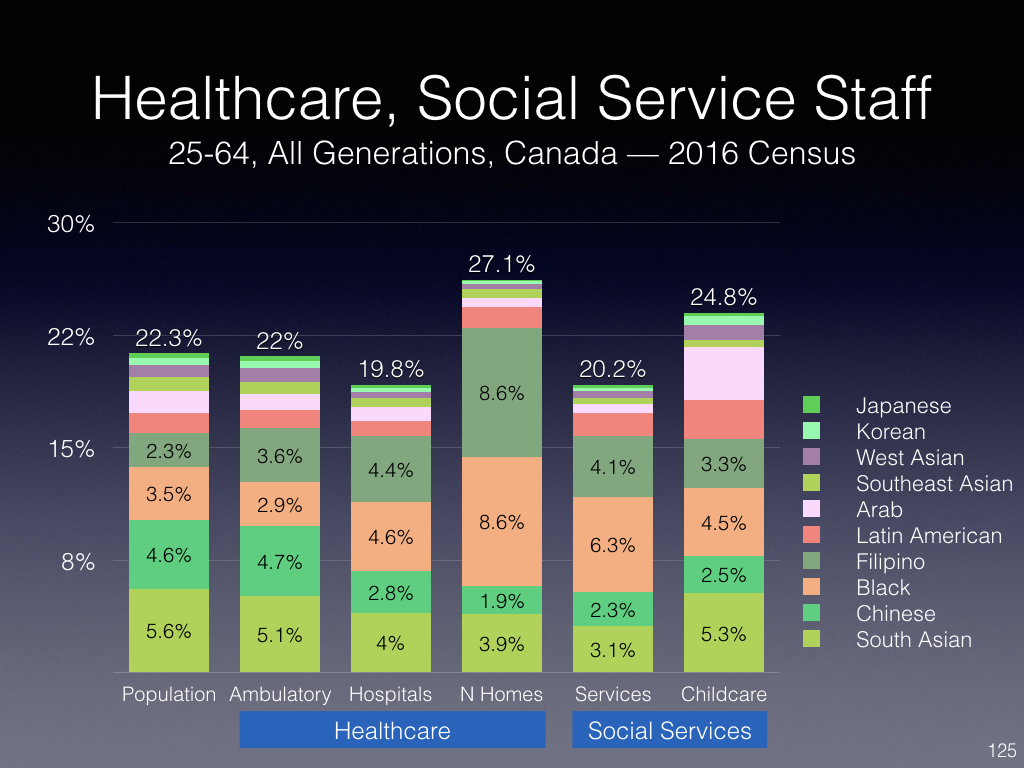
Of note. Haven’t looked at immigrant status but visible minorities provides a similar picture (mix of immigrants and subsequent generations). Some visible minority groups such as Latin American and Blacks are more concentrated in support positions than other groups:

Six million immigrant workers are at the frontlines of keeping U.S. residents healthy and fed during the COVID-19 pandemic. While the foreign born represented 17 percent of the 156 million civilians working in 2018, they account for larger shares in coronavirus-response frontline occupations: 29 percent of all physicians and 38 percent of home health aides, for example. They also represent significant shares of workers cleaning hospital rooms, staffing grocery stores, and producing food.

The foreign born also are over-represented in sectors most immediately devastated by mass layoffs: Restaurants and hotels, office cleaning services, and in-home child care, among them. All told, another 6 million immigrants work in industries that MPI has identified as some of the hardest hit, meaning that collectively 12 million immigrant workers are at the leading edge of the response to and impacts from the pandemic.

As dramatic economic contraction brings hardship to tens of millions in the coming months, the difficulties will be exacerbated for many immigrant workers because of limited access to safety-net systems and to federal relief, both for those who are unauthorized and some who are legally present. The estimated $2 trillion pandemic aid package makes many immigrants eligible for cash relief payments; others, such as most U.S.-citizen or legal immigrant spouses who file taxes jointly with unauthorized immigrants, will not be eligible.

Noncitizens also face restricted access to existing safety-net programs. While green-card holders, those on a temporary work visa, and individuals with Temporary Protected Status or Deferred Action for Childhood Arrivals can access unemployment insurance, most noncitizens cannot turn to the federal, means-tested benefits, including food stamps, that other workers tap in times of need. And immigrant workers face additional vulnerabilities, including smaller incomes and lower rates of health insurance coverage.

Cohen: Why Canada’s response to COVID-19 is so different from that of the U.S.

Another piece on differences:

Comparing the character of nations is risky and imprecise. In the Age of Contagion, though, it offers a window into how the peoples of the world are coping.

Japan, South Korea, Taiwan and Singapore have handled the crisis relatively well. We expect that of people we see as highly disciplined, motivated and organized. Italy is reeling from the contagion. Gregarious, unruly, passionate, creative, independent – this is how we see Italians. It suggests why they were slow to respond.

In Washington, Congress struggles to forge an economic response. The president is erratic and unempathetic. He is widely disbelieved, skeptical of expertise and reluctant to accept responsibility.The media send mixed messages. Fox News, with the highest audience, once denied the pandemic, calling it “a hoax.” One host – before she was fired – claimed the coronavirus was a plot by the Democrats to re-impeach Donald Trump.

The danger is that the medical system will be overwhelmed. On the tenth anniversary of Obamacare, universal health care remains contentious in the United States – undermined by the Republicans, who have tried repeatedly to abolish it, and repeatedly challenged in the courts.

In Canada, a country of 37 million, there were some 2,100 cases and 24 deaths as of early Tuesday. The system is holding, for now. Hospitals have enough masks and respirators, for now. The prime minister appears in public every day, alone, outside his residence. He speaks sensibly, with authority, without hyperbole. This has been his finest hour.Canadians trust him. They may not have voted for him – only about one-third did – but that doesn’t matter now. Nor do we question the competence of his ministers who are the other faces of the crisis – Chrystia Freeland, Marc Garneau, Patty Hajdu, Bill Blair. All are calm, competent and professional. This is what we want.

The provincial premiers, most of whom are not Liberals, have lost their congenital instinct to attack Ottawa. Doug Ford, no admirer of Justin Trudeau, now praises his leadership.All provinces have declared states of emergency, and will not object if the national government does, too. If it must, it will – and we won’t complain.

Opposition parties are not posturing. Andrew Scheer, who called Trudeau “a fraud” last autumn, says this is no time for politics. He is right. His fellow Conservatives, vying to succeed him, have put away their popguns. Some want the leadership vote scheduled for August delayed.

Unlike in America, there is consensus in Canada. No one is saying that the aid package is inadequate, that the government is slow, that money unduly favours corporations. Jason Kenney is not talking about western alienation and the Bloc Québécois is not talking sovereignty. Canadians want only freedom from fear.Mercifully, we have no Fox News. Whatever the CBC’s flaws as national broadcaster, its reporting has been thorough and honest, under trying circumstances. Same with CTV and Radio Canada, and the country’s newspapers and websites.

Why is our response different? It may be a case of identity. Americans celebrate independence, individualism, personal liberty. Many distrust government, resent politicians, court conspiracy and dismiss science. This wasn’t always so – the New Deal and the Great Society expanded the state – but it is now.

Canadians accept big government, which is how we built the social welfare state. Two-thirds of us voted for progressives last year. We defer to authority.Yes, we’ve made real mistakes in the crisis. We didn’t secure airports fast enough or test early and widely enough. Too many are treating physical distancing as a snow day. If we ultimately do better in all this – it’s too early to know or crow – it’s not because we are morally superior. It is because we are smaller, organized, well-led, more united, more measured, more of a community.

It’s a question of character.

Source: Cohen: Why Canada’s response to COVID-19 is so different from that of the U.S.

Terry Glavin: COVID-19: Beware the wartime propaganda as we battle this plague

On the lack of checks and balances regarding Chinese government propaganda:

It’s a terribly imperfect metaphor, and it’s already something of a cliché, but fair enough, too. The global struggle with the disaster of the coronavirus that first emerged last December in the Chinese city of Wuhan is, without question, something very much like war. And almost everybody who’s saying so is relying on pretty well the same formulation.

U.S. President Donald Trump has lately fashioned himself as a ‘wartime president,” determined to defeat a “horrible, invisible enemy.” French President Emmanuel Macron: “We are at war. The enemy is invisible and it requires our general mobilization.” Greek Prime Minister Kyriakos Mitsotakis: “We are at war with an enemy that is invisible, but not invincible.” Israeli Prime Minister Benjamin Netanyahu: “This is a battle for public health … We are at war with an invisible enemy.”

So yes, fair enough. But we should be very careful that we don’t allow the confines of approved terminology and the banalities of official diction to leave us unmoored from the objective realities of the crisis we’ve all found ourselves stumbling through. Because that’s how colossally stupid public policy mistakes get made. It’s also how the powerful get away with occluding the truth and telling outright lies.

It’s how the powerful get away with occluding the truth

The official exertions dozens of nation states are taking to deal with the calamity of the virus are of the kind that are ordinarily made only in wartime. After all, in Canada’s case the statutory antecedent of the Emergencies Act, which Justin Trudeau’s cabinet is quite sensibly considering as a “last resort,” is the War Measures Act, which was invoked only once after the Second World War, during the October Crisis of 1970.

Naming the enemy precisely would help. And this is where things have already got off to a shabby and slightly sinister start.

Strictly speaking, the enemy is not COVID-19, as the disease has come to be named by the World Health Organization’s International Classification of Diseases group, “covi” being the short form of coronavirus, and ‘d” for disease, and 19 for 2019. It’s true enough that the herculean medical research efforts required to find effective treatments for the disease, and of course to develop a vaccine — an undertaking which is expected to take at least a year to complete — should put us all on a war footing. And that effort deserves the rapid marshalling of public resources and whatever measures are necessary to keep our hospitals from crashing and ensuring the safety and security of public health workers.

But the “invisible enemy” that’s showing up in the speeches of presidents and prime ministers, the thing that has forced wartime-type lockdowns and curfews and social mobilization, is the virus that causes the disease. The virus was named SARS-CoV-2 by the International Committee on the Taxonomy of Viruses. The SARS bit in the name comes from the virus’s genetic relation to the virus associated with the SARS outbreak of 2003.

It was perfectly sensible that “Wuhan virus” immediately and quite innocently emerged in the language of common speech, in China and elsewhere, But nobody wants their hometown named after a killer virus, and WHO guidelines are averse to the association of viruses with specific countries. So SARS-CoV-2 it was, and not “China virus.” For naming purposes it didn’t and shouldn’t have mattered that 99 per cent of all the eruptions from the virus at the time were occurring in China.

But then the Chinese Communist Party’s propaganda machinery kicked in. Faced with a population disaffected to a degree without precedent since the time of the nationwide pro-democracy insurrections that were crushed in the Tiananmen massacre of 1989, the CCP’s braintrust began to circulate lurid fictions to the effect that the virus didn’t originate in China at all, but was rather somehow smuggled into Wuhan by the U.S military.

The CCP’s braintrust began to circulate lurid fictions to the effect that the virus didn’t originate in China at all

The CCP was also keen on following Xi Jinping’s Feb. 3 instruction to recast China’s police-state efficiencies as the solution to the world’s hardships, and to recast Xi himself as a global medical-supply benefactor rather than the cold-blooded villain sensible people understand him to be. Because of all this, the regime’s state media and several senior propaganda ministry officials and diplomats were particularly determined to lay in an ambuscade for Trump over his use of the provocatively vulgar term “China virus.”

This all may seem trivial and petty, but it’s worth taking a moment here to notice a couple of things about the way wartime propaganda works.

The first thing is the classic strategy of exploiting divisions and anxieties in an enemy population in order to weaken public resolve and undermine the enemy’s leadership. If you don’t think the CCP sees the U.S.-led global order and the institutions of liberal democracy as the enemy, you simply haven’t been paying attention. And if you don’t think the Chinese Communist Party intends to exploit the coronavirus disaster as an opportunity to advance its interests against its enemies around the world, you’re not taking the CCP at its own word.

It’s the democratic world’s ill luck that the inflammation of domestic divisions and anxieties just happens to be both the cause and the purpose of Trumpism itself, and a significant body of American opinion will not grant Trump the time of day. Neither does it help matters that the Americans are in the bitter throes of an election year, when they all tend to give the impression of being at one another’s throats at the best of times.

The second thing is that controlling the terminology of the conflict and the subversion of vocabulary are crude wartime propaganda methodologies, and Beijing is taking matters to absurd extremes, with its ambassadors around the world instructing everyone in what we are allowed to say and how we are allowed to say it.

China’s embassy in Peru, for instance, has initiated a thuggish attack on the celebrated Peruvian novelist and Nobel laureate Mario Vargas Llosa, a former president of PEN International, owing to a March 14 essay Llosa wrote in the Spanish national newspaper El Pais. Llosa merely noted that the coronavirus originated in Wuhan, and that the Chinese authorities had suppressed early efforts to alert the public about the disease — a catastrophic error that a free society would not so readily make.

The embassy went so far as to deny that the virus even originated in China, and admonished Llosa for having the cheek to criticize the Chinese government. Immediately, Llosa’s novels started getting pulled from China’s e-book platforms.

Every reasonable person understands that Donald Trump is a buffoon, but his torrents of false claims and imbecilities are routinely fact-checked and corrected by a robust American news media, and sometimes even by Trump’s own officials. The Chinese people enjoy no such liberties and China’s brutal state-capitalist system allows no such corrections. With the world divided more or less into two camps, with Xi Jinping on one side and Donald Trump on the other, any retreat into a facile “both-sidesism” would be a mistake the democratic world can’t afford to make.

We’ve had quite enough of that already, to disastrous result, and it would be the height of folly to try to salvage the relics of a broken global order that treated China like a normal country. That world is gone. Besides, it would be a peacetime activity, and as crude as the metaphor is, the predicament we face at the moment, in this time of plague, is very much like war.

Source: Terry Glavin: COVID-19: Beware the wartime propaganda as we battle this plague