Immigration services to reopen gradually after pandemic shut down many programs

Useful overview:

Immigration officials are beginning gradually to resume in-person services after the pandemic forced many programs to shut down, frustrating immigrants whose lives were put on hold.

Immigration, Refugees and Citizenship Canada (IRCC) shut down immigration tests and citizenship ceremonies in March to protect the health and safety of staff and clients. The department started offering some virtual services over the last few months. Starting this week, it is opening in-person services by appointment only.

“This testing phase will allow us to assess our protocols and procedures and ensure the safety of our staff and our clients. The lessons learned will help us plan for reopening services more widely in the future,” says the IRCC’s website.

Limited services being offered at specific locations include citizenship, services related to permanent residence, asylum claims and biometrics.

Clients must wait for government officials to schedule appointments before visiting an IRCC site and should not call IRCC to try to arrange a date themselves, the department says.

William Ojeda and his family have waited an agonizing three years to renew their permanent residency, a time frame he said is unreasonable. They are now unable to re-enter Canada from Mexico.

“Being unable to be in Canada, and the uncertainty and anxiety of almost three years checking the IRCC website pretty much daily after the initial reasonable delay, and worrying for the well-being of my kids has been really, really hard,” he wrote in an email from Guadalajara.

Odeja, his wife and their eldest daughter were born in Mexico, while his two younger daughters were born in Canada and are citizens.

‘Three years lost’

“We have never broken a law … we live, by choice, by Canadian written and social laws and yet we feel treated as second class immigrants,” he said.

“If the decision is favourable, of course, it would be a happy ending and all the uncertainty, anxiety and fear will blur over time. If negative, it would be all for nothing, with three years lost on our life plan, which is in Canada.”Ojeda said the delay in processing his file predated the pandemic. COVID-19 has created a bigger backlog in many cases, however.

Conservative immigration critic Raquel Dancho said she’s heard from countless families affected by what she calls the “administrative ineptness” of IRCC.

“The lack of a plan throughout the pandemic has failed refugees and immigrants who wish to come to Canada,” she said.

“The Liberals have failed to ensure a fair and compassionate immigration process for the world’s most vulnerable. Frankly, it’s unacceptable and those that depend on the immigration system deserve better.”

NDP MP Jenny Kwan said MP offices have been “inundated” with immigration applicants’ desperate pleas for help. She said several of her MP colleagues have reported that immigration cases consume up to 90 per cent of their constituency casework.

“It’s apparent that there has been little to no movement on IRCC offices resuming their work up to now. The limited capacity of the restart will still mean that too many people are still just going to be stuck in the system with ongoing delays,” she said.”People are still being asked to continue to put their lives on hold. Is it a wonder that families desperate to reunite with their loved ones feel that their cries for help are just falling on deaf ears? The problems with the backlog are so deep that this limited restart will do little to reassure those stuck in the system.”

Efforts to speed up processing

Mathieu Genest, spokesperson for Immigration Minister Marco Mendicino, said the department has been adapting its systems to speed up the processing of applications while protecting the health and safety of staff, clients and Canadians. IRCC has prioritized applications from Canadians and permanent residents returning to Canada, as well as people performing essential services.

Staff now have more resources and streamlined processes for working remotely, he said.

“The expansion of the resumption of in-person services will depend on the results of and lessons learned during this pilot, as well as regional health guidelines, available capacity and virtual alternatives, among other considerations,” he said.

IRCC has introduced safety measures at its locations — including a self-assessment questionnaire that must be completed before an appointment and again before entering the premises.

All employees and clients are required to wear masks, maintain physical distance and follow signs directing the flow of foot traffic. People who appear ill will have to reschedule their appointments.

Source: Immigration services to reopen gradually after pandemic shut down many programs

How The Pandemic Is Widening The Racial Wealth Gap

Good data-based analysis:

Joeller Stanton used to be an assistant teacher at a private school in Baltimore and made about $30,000 a year. In mid-March, when the pandemic was just starting, her school closed for what was supposed to be two weeks. “Up to that point, we were under the impression that it wasn’t that serious, that everything was going to be OK,” Stanton recalls.

But as schools in Maryland switched to virtual learning indefinitely, Stanton was let go from her job. She received her last paycheck in March. “I had about $300 savings that was basically gone by the end of March,” she says.

She says she applied for unemployment but was denied initially. And by April, she had no money to pay for rent and utilities, and was struggling to put food on the table for her two children.

Stanton, who is Black, is caught up in a huge wave of economic stress hitting Americans, especially people of color.

Sixty percent of Black households are facing serious financial problems since the pandemic began, according to a national poll released this week by NPR, the Robert Wood Johnson Foundation and the Harvard T.H. Chan School of Public Health. That includes 41% who say they’ve used up most or all their savings, while an additional 10% had no savings before the outbreak.

Latinos and Native Americans are also disproportionately affected by the pandemic’s economic impact. Seventy-two percent of Latino and 55% of Native American respondents say their households are facing serious financial problems, compared with 36% of whites.

“The thing that immediately struck me was how large the gap was by race for the people who said they were facing serious problems,” says Valerie Wilson, director of the Program on Race, Ethnicity and the Economy at the Economic Policy Institute.

The pandemic’s disproportionate financial impact on communities of color reflects — and is worsening — existing racial disparities in wealth, she adds.

Struggles with income, housing, food

“The three groups that are being just ravaged by this epidemic are reporting unbelievable problems of just trying to cope with their day-to-day lives,” says Robert Blendon, professor emeritus of health policy and political analysis at the Harvard T.H. Chan School of Public Health, who oversaw the poll.

Thirty-two percent of Latino and 28% of Black respondents say they’re having problems paying rent or mortgages. About a third of respondents in both groups were struggling to pay credit cards or other loans. And 26% of Latino and Native American respondents say they struggle to afford food, while 22% of Black respondents do.

Among households that reported they lost income, survival is even more of a challenge. For Black respondents, 40% say they’re struggling to pay rent or mortgage, and 43% say they’re having trouble paying utilities. For Latino households that lost income, 46% say they’re struggling to pay mortgage or rent. About a third of both Black and Latino respondents who lost household income said they’re struggling to pay for food.

The fact that many minority groups are also experiencing higher rates of coronavirus infections makes it even harder for them to cope financially, Blendon adds.

“You have people who don’t have savings, they can’t pay bills,” he says. “And then you’re going to tell them, ‘Well, somebody in the household tested positive, nobody can go work.’ How are they going to keep their lives going?”

Stanton’s sister, who works for the city government, got COVID-19 earlier this year and had to isolate in her basement. “She had a cough, and she couldn’t eat because her taste buds were completely gone,” Stanton says. “I would cook meals, and I would take it to the basement, put it down on the floor for her.”

Luckily, she says, no one else in the family — including her 82-year-old mother and her 7-year-old son, who has asthma — got infected.

But Stanton says she has lost a sister-in-law to the disease and had a friend in coma for six weeks on a ventilator. She knows of many others in her community who have died.

And most of her co-workers and friends are out of work.

Worsening existing disparities

Even during the economic recovery of recent years, minority groups were lagging behind, says Wilson of the Economic Policy Institute. “There were significant racial disparities in wages, significant racial disparities in unemployment, significant racial disparities in the kinds of jobs people held.”

Black, Latino and Native American workers were more likely to have jobs that were lost during the pandemic, Wilson says. A Harvard University analysis of the U.S. Census Bureau’s Pulse Survey, released in July, found that 58% of Latino and 53% of Black households experienced loss in earnings early in the pandemic. Wilson’s own research has shown that Latino workers have been particularly affected by job losses during the pandemic.

Wilson adds that people in these groups are also more likely to have jobs that didn’t allow them to work from the safety of their homes, therefore putting them more at risk of getting infected. And they’re also less likely to have substantial savings. As a result, it makes it harder for them to weather times of economic downturn, she says.

Wilson says she worries that the pandemic is worsening racial disparities.

“We’re going to see coming out of this pandemic an expansion of the racial wealth gap,” she says. “We saw the same kind of thing in the Great Recession in 2007-2008 — in particular then with the extensive foreclosures in communities of color and the loss of housing wealth.”

“You just pray”

The pandemic forced Stanton to give up her rental home back in April. But she says she was fortunate not to end up homeless, thanks to her sister.

“My sister helped me get a storage unit,” Stanton says. “I moved my furniture into a storage unit. And I moved in with my sister, me and my two kids — my 11-year-old daughter and my 7-year-old son.”

She is grateful to have a roof over her head, but money, she says, is still tight.

She now gets $280 a week from the state of Maryland as unemployment, but it doesn’t go far.

“The first thing I buy is any personal hygiene items me or my kids need,” she says. She buys food, above what food stamps get her; she pays her phone bill and covers her sister’s utility bills. “That’s my only way of telling her, ‘Thank you,’ to show her that I appreciate what she’s doing.”

What little she has left, she buys a treat or two for her children, who have mostly been stuck indoors since the pandemic began: “Just trying to keep them happy,” she says.

But she’s far from happy herself. She hasn’t been able to find a new job because of the nature of remote learning. “They don’t need an assistant right now because the kids are not physically in the building,” she says.

And even if she did find a job, she worries she’d have to use pay to cover child care. Her kids are now also learning virtually from home and need constant supervision.

Stanton says the only way she copes with her daily struggles is through faith. “A lot of prayer and a lot of patience,” she says. “I try not to let things bother me because I don’t want to become depressed. So, you know, you just pray. I hope this is all over soon.”

Source: How The Pandemic Is Widening The Racial Wealth Gap

Ontario families living in more racialized neighbourhoods less likely to send children back into classroom, Globe analysis finds

Interesting possible explanations for a counter-intuitive effect, as I had thought that it would be those with higher socioeconomic status that would be best able to support remote learning:

As some of Ontario’s largest school boards scramble to accommodate a mass migration to remote learning, an analysis by The Globe and Mail shows families living in more racialized neighbourhoods are less likely to send their children back into the classroom.

The Globe analyzed the percentage of remote learners for hundreds of schools across the Greater Toronto Area, identifying patterns related to income, race, density of housing and COVID-19 cases. The data reveals regional and neighbourhood differences, suggesting the government’s back-to-school approach of offering a choice between online learning and in-class instruction could be forcing people with the fewest resources into unfamiliar learning environments.

“The numbers of parents opting for online due to concerns about the back-to-school plan is understandable to protect their child, but the potential impact on educational inequities between in-school and out-of-school learning for students is deeply concerning,” said Carol Campbell, an associate professor at the Ontario Institute for Studies in Education at the University of Toronto. She added that early evidence indicates the students with the most negative experiences of remote learning in the spring were students living in low income households, students with special education needs and those learning the English language.

The four boards analyzed by the Globe – Toronto District, Peel, York Region and Hamilton-Wentworth – represent more than a quarter of the student population in the province. Ontario’s approach is similar to Alberta’s, while the B.C. government has allowed boards to offer the remote learning option to families.

The Globe’s analysis revealed that 78 per cent of families in Toronto’s high-income neighbourhoods chose to send their children to the classroom compared with 64 per cent of families in low-income neighbourhoods. Similarly, more than 80 per cent of families in Toronto neighbourhoods with a low-racialized population opted for in-class learning, and only 60 per cent of families who live in high-racialized neighbourhoods did the same.

The Globe’s analysis divided neighbourhoods into four quarters, respectively, based on their median household income and percentage of visible minorities in the neighbourhood. The demographic and economic information was based on the 2016 census.

Kwame McKenzie, chief executive of the Wellesley Institute, a Toronto think-tank, said family decisions are often influenced by neighbours and friends.

“Complex social trends can be less complex than we think because people are connected,” Dr. McKenzie said. “Yes, there are the stats [on COVID-19] but do not underestimate the importance of social connections. We look and see what other people are doing and talk to people before we make decisions.”

At Crescent Town Elementary School in east Toronto, about half of students have opted for online learning this year. The school is in the Taylor-Massey neighbourhood, which is low-income and has a medium-to-high visible minority presence. About 77 per cent of residents live in apartment buildings that are more than five-storeys tall, which Razia Rashed, a parent who sits on Crescent Town’s school council, said is a major contributing factor. Living in a dense neighbourhood has made families nervous, she said: they’re worried about community transmission, especially if they have to ride the elevator twice daily to take their children to and from school.

Much of the neighbourhood is composed of immigrants from Bangladesh, India and Pakistan, and Ms. Rashed said many parents in the community have more closely followed news and stories from relatives in their countries of origin, rather than domestically, about the toll COVID-19 has taken (the worst outbreaks in South Asia have been in India and Bangladesh).

“How it is back home matters,” Ms. Rashed said.

In Toronto, online learners are also over-represented in low income neighbourhoods, in contrast to Brampton – a hot spot for COVID-19 and one of the country’s most diverse cities – where high income neighbourhoods have the lowest rates of in-class learning. Many parents are working from home and are opting to keep their children there as well. Brad Teeter, the principal of Eldorado Public School in Brampton, said students also live in multi-generational homes with elderly grandparents who are more vulnerable to infection.

His school, part of the Peel District School Board, is in a high-income neighbourhood with a large East Indian population and just over 40 per cent of students have opted for virtual learning.

In his conversations with families, Mr. Teeter lets them know about the health and safety measures in his school, and he knows parents are wrestling with difficult decisions. The Peel board has delayed the start of its live online school to the week of Sept. 21 after seeing enrolment jump to 64,000 students, an increase of more than 10,000 in the past week.

“We would love to see every kid in the building … [but] there’s still, I think, a lot of COVID fears that are happening and parents are making decisions in the best interests of their families and safety for the kids and each member of the family,” Mr. Teeter said.

Satinder Gill, whose three children attend school in Brampton, said the decision to have them learn online was difficult. She and her husband did not want to compromise the health of her in-laws, who live with relatives next door, or her parents living close by. In her Punjabi Indian culture, she said that the “extended family plays a very big role.”

“Our kids are exposed to many people in the family and we love that about our culture. That makes these types of decisions very difficult to make,” Ms. Gill said.

Sonia Reid, whose daughter attends Heart Lake Secondary School, also in Brampton, said the family’s plans called for her daughter to attend school in-person, but then Ms. Reid grew worried as she watched people in her area become less cautious, coupled with a rise in COVID-19 cases. She said that among her group of friends, only one has decided to send their child into the classroom.

“All those little things, and watching the numbers go up, I definitely knew that starting in September, I had to switch her to completely online,” Ms. Reid said.

Overall, a significant portion of Ontario students are not returning to the classroom. That number is most stark in Brampton, where only 56 per cent of elementary students will be in school, compared with Hamilton where 83 per cent of elementary children will learn in classrooms. In Toronto, meanwhile, preliminary data showed that 69 per cent of elementary children and 75 per cent of high school students are returning to the classroom. The Toronto and Peel boards have said this week that thousands of families have been switching to online learning in recent days amid rising COVID-19 rates.

In Ontario, families have been given a choice between in-person and virtual learning. Alberta school districts, too, have offered families an online option. The B.C. government said school districts have flexibility to provide remote learning options, but there is confusion among parents and school officials as to what that means. In Montreal, school districts did not provide a school-by-school enrolment breakdown of online and in-class learning. Online options in Quebec are only for children with medical exemptions and those forced to stay home because of illness or quarantine. The English school board said it had given about 400 medical exemptions that allow children to receive online learning among 19,600 students. The Centre de services scolaire de Montréal has 363 students online among its 77,500 students.

Ottawa appoints new management to ‘strengthen’ pandemic surveillance system

Needed given short-sightedness of PHAC-decisions regarding pandemic preparations:

The Public Health Agency of Canada has installed new management to oversee and “strengthen” the country’s pandemic surveillance system, a once-globally renowned unit whose capabilities were curtailed less than a year before the COVID-19 crisis hit.

In a statement provided to The Globe and Mail, the department said Brigitte Diogo, a senior official with 25 years of experience in government, has taken over as the vice-president of the Health Security Infrastructure Branch. The division oversees the government’s pandemic early warning and surveillance unit, known as the Global Public Health Intelligence Network, or GPHIN, among other operations, such as an emergency stockpile of medical supplies.

Sally Thornton, who previously served in that role, left the government last week, the department said. “After a long and distinguished career, Ms. Thornton is retiring from the federal public service,” Public Health spokeswoman Natalie Mohamed said in an e-mailed statement.

Ms. Thornton declined requests for an interview. Ms. Diogo was also not available for comment, the department said.

GPHIN has been at the centre of controversy since a Globe investigation in late July detailed how the intelligence-gathering capabilities of the government’s pandemic early warning system were reduced significantly in late 2018 and early 2019. That effectively shut down much of its surveillance work on international health threats less than eight months before the outbreak in China began to spread, and appears to have impacted Canada’s ability to gauge the risk of the virus.

Throughout January, February and much of March, the government judged the threat from the outbreak as “low” in its official risk assessments, even after the World Health Organization warned in late January that the risk to the world was high.

In her new role, Ms. Diogo’s mandate will include bolstering the surveillance system, although no specifics were provided.

“Ms. Diogo will lead efforts to maintain and strengthen Canada’s public health event-based surveillance system including the Global Public Health Intelligence Network,” department spokesman Eric Morrissette said in a statement.

In late 2018, believing that GPHIN was too internationally focused and could be put to better use on domestic projects, the department reassigned doctors and epidemiologists in the highly specialized unit to projects that didn’t involve pandemic preparedness. A once-prolific alert system operated by GPHIN, designed to track evolving health threats and inject urgency into government responses, was effectively shuttered when a new edict required that Ms. Thornton approve all such alerts.

With no approvals given, the alert system eventually went silent on May 24, 2019, according to 10 years’ worth of PHAC records obtained by The Globe. With it, much of the unit’s surveillance activities – designed to track early signals of an outbreak and inform government risk assessments – effectively shut down as well.

The alert system remained silent for 440 days, and was restarted only last month, less than two weeks after the Globe investigation. During the intervening months, employees inside Public Health say GPHIN’s intelligence-gathering abilities were a fraction of what they once were. Created in the 1990s, GPHIN had garnered international acclaim for its ability to detect and gather continuing intelligence on outbreaks of diseases such as H1N1, Ebola, Zika and others, helping the government formulate a response if needed.

In addition to GPHIN, Ms. Thornton also oversaw the national emergency stockpile of medical supplies, which came under heavy scrutiny this spring after it fell short of supplying the provinces and territories with badly needed personal protective equipment.

In April, Ms. Thornton testified before the House of Commons Health Committee that the stockpile held a “minimum level” of equipment, and wasn’t designed to handle the surge of a pandemic, raising questions about how it was being managed.

The Globe has made several requests since May to interview department officials connected to GPHIN, including Ms. Thornton. All of those requests were declined.

Last week, Health Minister Patty Hajdu ordered an independent federal review of the problems at GPHIN, saying she was troubled that scientists at Public Health told The Globe they were not being listened to within the department. The Auditor-General has also launched an investigation.

Scientists within Public Health told The Globe that over the past decade, the department has suffered from an influx of senior officials from other areas of the government, such as the Treasury Board, Border Services and others, who lacked sufficient grounding in Public Health. Epidemiologist Michael Garner, a former senior science adviser at the agency, said it became difficult for scientists to communicate urgent and complex messages up the chain of command, because those officials often didn’t comprehend the problems.

Ms. Diogo, who moves over from Transport Canada, has no science background, which may add to such concerns. However, Mr. Morrissette said she has extensive experience working on safety and security policy, and on program design and delivery.

“While a newcomer to the agency, Ms. Diogo understands the merit of a well-functioning, event-based surveillance system including the timely dissemination of information such as alerts, to inform decision-making in addressing public health threats,” Mr. Morrissette said.

According to information from the department, Ms. Diogo was director-general of rail safety at Transport Canada from 2015-20, and director of operations at the Security and Intelligence Secretariat in the Privy Council Office, where she oversaw matters related to national security from 2011-14. She also has a background in risk mitigation while at Immigration, Refugees and Citizenship Canada, the department said.

Source: Ottawa appoints new management to ‘strengthen’ pandemic surveillance system

Data shows an increase in anti-Asian hate incidents in Canada since onset of pandemic

Although collected through online portals with anonymity, of concern and buttressed by official police stats:

More than 600 incidents of hate targeting Asians within Canada have been reported to Chinese Canadian groups since the pandemic began, and one in three of those attacks have been assaults, say the groups.

The data, collected through online portals that have allowed victims to report hate incidents anonymously, are consistent with reports from Canadian police forces that they are also investigating an increase in anti-Asian attacks.

The data, released last week, were compiled by the Chinese Canadian National Council Toronto Chapter, Project 1907, the Vancouver Asian Film Festival and the Chinese Canadian National Council for Social Justice. All of the incidents were reported through two online platforms based in Toronto or Vancouver. The reports were received from seven provinces.

Justin Kong, executive director for the Chinese Canadian National Council Toronto Chapter, said the data again indicate Asian Canadians have been targeted through the pandemic and racism will continue to taint Canada until there are policies in place to tackle it.

“Those attacks stemmed from historical anti-Asian racism, but also because of the ways in which COVID-19 has been racialized,” he said, adding COVID-19 is seen as a Chinese disease, similar to SARS.

“We saw what happened during SARS, and I guess it became obvious that this was going to go the same way. … That’s why we started collecting the data on the racist attacks.”

Mr. Kong acknowledged they weren’t able to verify the reports, and the groups instead have been relying on “a trust system.”

The data, which have been collected since February, show that 83 per cent of the incidents were reported by East Asians, followed by 7 per cent by Southeast Asians. It says 44 per cent of the attacks were reported from B.C. – the highest in Canada – while 38 per cent of the occurrences were reported in Ontario and 7 per cent in Quebec.

Women reported 60 per cent of all incidents. In B.C., women were even more disproportionately affected, accounting for nearly 70 per cent of all reported incidents there.

The data found nearly 30 per cent of reported incidents are assault, including targeted coughing, physical attacks and violence, and that verbal harassment is the most common type of discrimination.

These groups’ findings echo those of the Vancouver Police Department, which has reported a dramatic rise in hate incidents against East Asians.

In July, Vancouver police said they have had 66 hate-motivated incidents against East Asian people reported to them so far in 2020, a huge spike from the seven during the same period last year. A VPD spokesperson said the most targeted community continues to be East Asian.

Toronto Police Service spokeswoman Connie Osborne said, in comparison to 2019, her force has seen an increase in the number of hate-motivated occurrences, including where race has been a factor.

She said many of the 2020 cases are active investigations and the motivation of the offence may change or more offences may be uncovered, so the force can’t provide specific numbers for the year so far. But she added such incidents often go unreported and the number of reports received by police are not an accurate reflection of what people have experienced.

Earlier this year, Korean Montrealer Kyungseo Min compiled testimonies from Asian Québécois of racist incidents since January. In the span of about a month and a half, Ms. Min collected more than 20.

She said some of her findings match those from the advocacy groups. For example, female Asians reported more harassment or violence than men, and the majority of the racism was verbal.

In Alberta, the Alberta Hate Crimes Committee has been running the StopHateAB.ca portal since 2017 to encourage people to report incidents and talk about what happened to them. The portal’s reports include four incidents reported this year of an East Asian Canadian being verbally assaulted in a public space in a tirade related to COVID-19.

Since it began collecting data, the portal has logged 74 incidents of hate in Edmonton, 69 in Calgary and 31 in Lethbridge. There are a handful of reports from other areas of the province. The data were last updated in July.

The groups are calling on the federal government to include an anti-racism strategy in its postpandemic recovery plan.

Mr. Kong said as the pandemic has posed more challenges to racialized communities, he hopes that the government could also come up with policies aimed at helping migrant workers and low-income immigrant workers.

The House of Commons’ standing committee on justice and human rights issued a report just more than a year ago with recommendations for battling online hate. They include recommendations for more funding for police, judges and Crown prosecutors to enable them to better respond to hate complaints as well as better data collection on hate incidents.

The report, submitted in June, 2019, noted a 50-per-cent jump in hate crimes targeting Black people in 2017 relative to the year earlier. However, the report does not refer to hate crimes against those of East Asian descent.

In a response this month, the Friends of Simon Wiesenthal Centre, a Toronto-based foundation, provided several recommendations to the Justice Minister’s office, including placing online hate crimes under federal jurisdiction and developing a more clear and comprehensive definition of illegal hate activities.

Jaime Kirzner-Roberts, the foundation’s director of policy, said it is the responsibility of the justice system to recognize hatred as the poison that it is and confront hate crimes.

“We want to see all hate crimes aggressively investigated by police, regardless of what community is being targeted and what form these crimes take, so that perpetrators are brought to justice.”

Source: https://www.theglobeandmail.com/canada/british-columbia/article-data-shows-an-increase-in-anti-asian-hate-incidents-in-canada-since/?utm_medium=email&utm_source=Morning%20Update&utm_content=2020-9-14_6&utm_term=Morning%20Update:%20Isolation%20and%20loneliness%20take%20a%20toll%20on%20mental%20health%20during%20pandemic%20&utm_campaign=newsletter&cu_id=%2BTx9qGuxCF9REU6kNldjGJtpVUGIVB3Y

COVID-19 disproportionately impacted immigrants and refugees in Ontario, new report finds

Better data confirming what we know:

The spread of COVID-19 has disproportionately affected immigrants, refugees and those who live in low-income neighbourhoods in Ontario, a new report has found.

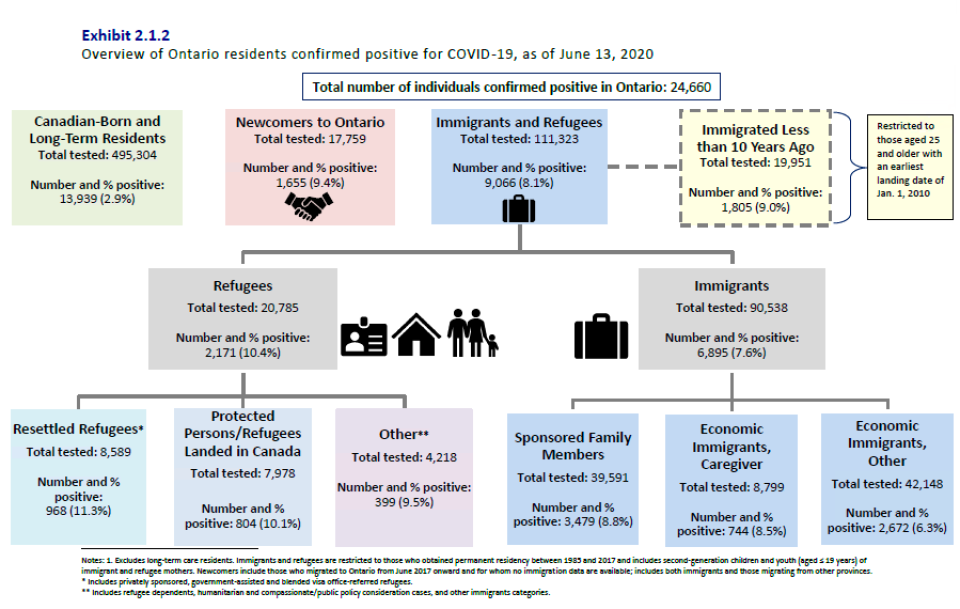
The report released Wednesday by ICES, a not-for-profit research institute focusing on health-related data in Ontario, found that while immigrants and refugees in the province accounted for only about a quarter of those tested for COVID-19 between January and June, they represented 43.5 per cent of all positive cases.

“We document disproportionately higher rates of infection among those who landed in Ontario as economic caregivers, refugees, those with lower levels of education and language fluency, those who currently live in lower income neighbourhoods and with more crowded housing,” Dr. Astrid Guttmann, Chief Science Officer at ICES and lead author on the report, said in a statement.

“Apart from addressing many of (the) root causes of higher risk of infections, very high test positivity in certain groups of immigrants also suggests that there may be important barriers to testing that will be important to address if there is a second wave in Ontario this fall.”

The data was pulled from test results conducted between January 15 and June 13. According to the report, rates of testing were lower for most immigrants and refugees compared with Canadian-born and long-term residents—with an exception for economic caregivers who tend to work in health-care and were prioritized for testing.

The data found that of the 4.4 per cent of Canadian-born and long-term residents tested for COVID-19 in Ontario, 2.9 per cent tested positive.

Of the 3.4 per cent of people who identify as immigrants or refugees who were tested for COVID-19, 8.1 per cent received a positive diagnosis.

Refugees alone had the highest positivity rate within that time period at 10.4 per cent.

Chart

The report also found that while testing positivity peaked at the beginning of April among Canada-born and long-term residents, there were two “pronounced peaks of positivity” for immigrants, refugees and newcomers in April and May respectfully.

“The pandemic has sharpened the focus on structural and societal inequalities that have long existed,” the report reads. “These inequities put many racialized and immigrant populations at higher risk of both contracting the infection and suffering poor outcomes.”

The highest rates of positivity in Canada were found in racialized immigrants and refugees from Central, Western and East Africa, South America, the Caribbean, Southeast Asia and South Asia, the report found. The rates were also higher for those living in low-income neighbourhoods.

Public health units with larger immigrant populations such as Toronto, Peel Region, Durham Region, Waterloo, Windsor and York also reported a high number of COVID-19 positive patients among that demographic.

In Toronto specifically, 4,027 immigrants and refugees have tested positive for COVID-19 (9.8 per cent of those tested) compared to 3,788 Canadian-born patients (4.9 per cent of those tested).

What data was available and what was missing?

The general findings presented in the report are not necessarily new. Advocacy groups have been calling on all levels of government to support the gathering of race and socio-economic data for months, arguing that marginalized communities are disproportionately contracting or dying from COVID-19.

As a result of these calls, the City of Toronto began collecting race-based data in May.

Toronto Public Health said that of the data collected between May 20 and July 16, 83 per cent of known COVID-19 cases involve members of racialized communities.

It also found that patients with a household income level of $50,000 or less represents more than 50 per cent of reported infections in the city, despite the fact that the 2016 census revealed only 30 per cent of Toronto’s population reported being in that income bracket.

The data released by city officials are based on voluntary questions collected by a local public health unit.

Provincially, officials and politicians have all said they support the collection of race and income-based data, but they have yet to provide any information about the trends they are seeing.

In mid-June, the government proposed regulatory changes that would allow those who test positive for COVID-19 to be asked about their race, income, languages spoken and household size.

The questions are optional and the government said personal privacy would be protected. Since then, not much has been said about the data collection.

The ICES report said they were limited in the creation of the report by incomplete immigration data and could only include information on immigrants or refugees who landed in Ontario from January 1985 to May 2017 and who became permanent residents. They also included second-generation immigrant children under the age of 19 who were born in Ontario to permanent residents.

A “newcomer,” a status defined separately from an immigrant or refugee, is described as an individual who became eligible for OHIP after May 31, 2017

The authors also noted that ICES lacked data on “important risk factors for testing and positivity” such as occupation and living conditions.

“We currently do not have comprehensive data on important outcomes such as hospitalization and death,” the report says. “We have data on demographic and some census-based characteristics but not on the critical structural factors that play an important role in shaping inequities.”

ICES was able to access information on the health-care sector. The report found that employment as a health-care worker, especially among women, accounted for a disproportionate number of COVID-19 cases among immigrants and refugees. Among the 36 per cent of women employed as health-care workers and who tested positive in Ontario, 45 per cent were within that demographic.

Inequities ‘are complex’ and often rooted in racism

The report suggests that the “causes of these inequities are complex and often rooted in social and structural inequities, including systemic racism.”

It notes that a large proportion of immigrants, refugees and newcomers to Canada hold temporary or minimum-wage jobs at facilities where physical distancing is difficult. These positions may also not have paid sick leave or other health benefits.

ICES says that employment in any of these sectors— such as occupations in retail, factories or transportation– “is considered precarious” and could impact testing and quarantine.

Other factors such as language barriers, education and accessibility to quality healthcare could impact whether a person gets a COVID-19 test.

The not-for-profit is calling for more accessible testing options ahead of a possible second-wave in the fall as well as better training and enforcement of safety measures for those at risk of COVID-19 exposure in the workplace.

“A continued focus is needed on securing funding to house those who cannot safely quarantine in their homes or are homeless, as well as for income supplements for workers must quarantine who do not have employer-sponsored sick leave,” the report says.

The report also noted that the findings should be interpreted in the context of Ontario’s testing strategy. Initially, local public health units were only testing those in essential workplaces, those who had recently travelled and for those with acute medical conditions. Later that strategy evolved to include long-term care homes, hospitalized patients, and the general population, including asymptomatic patients.

“This means that some groups are over-represented in the testing numbers and that positive cases include those who were symptomatic at the time of testing, as well as those who were asymptomatic,” the report says.

“This may distort some associations of characteristics with both testing rates and potential to test positive. It also means that there is an unknown number of untested infected individuals in the general population.

Source: https://toronto.ctvnews.ca/covid-19-disproportionately-impacted-immigrants-and-refugees-in-ontario-new-report-finds-1.5097363

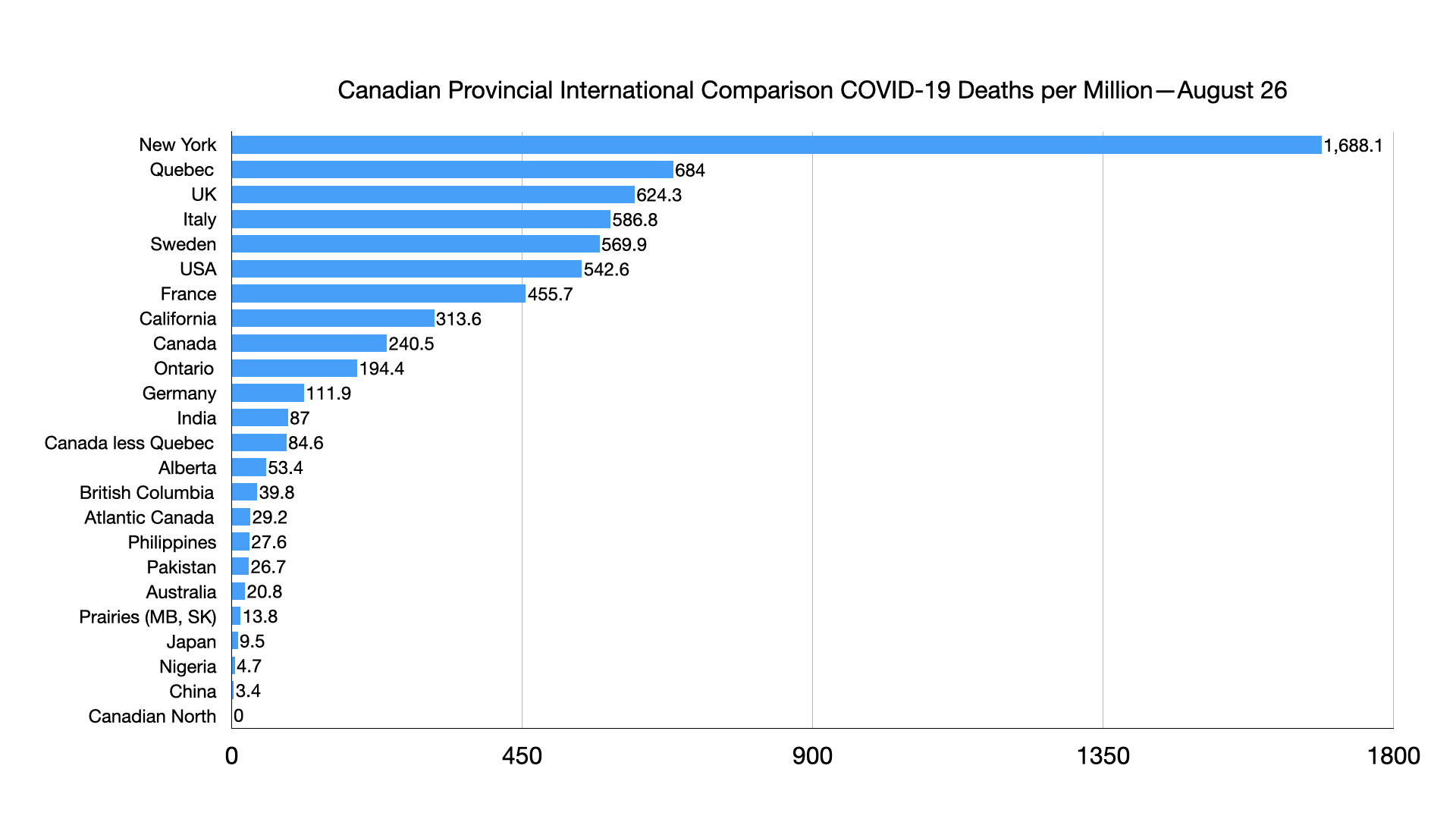
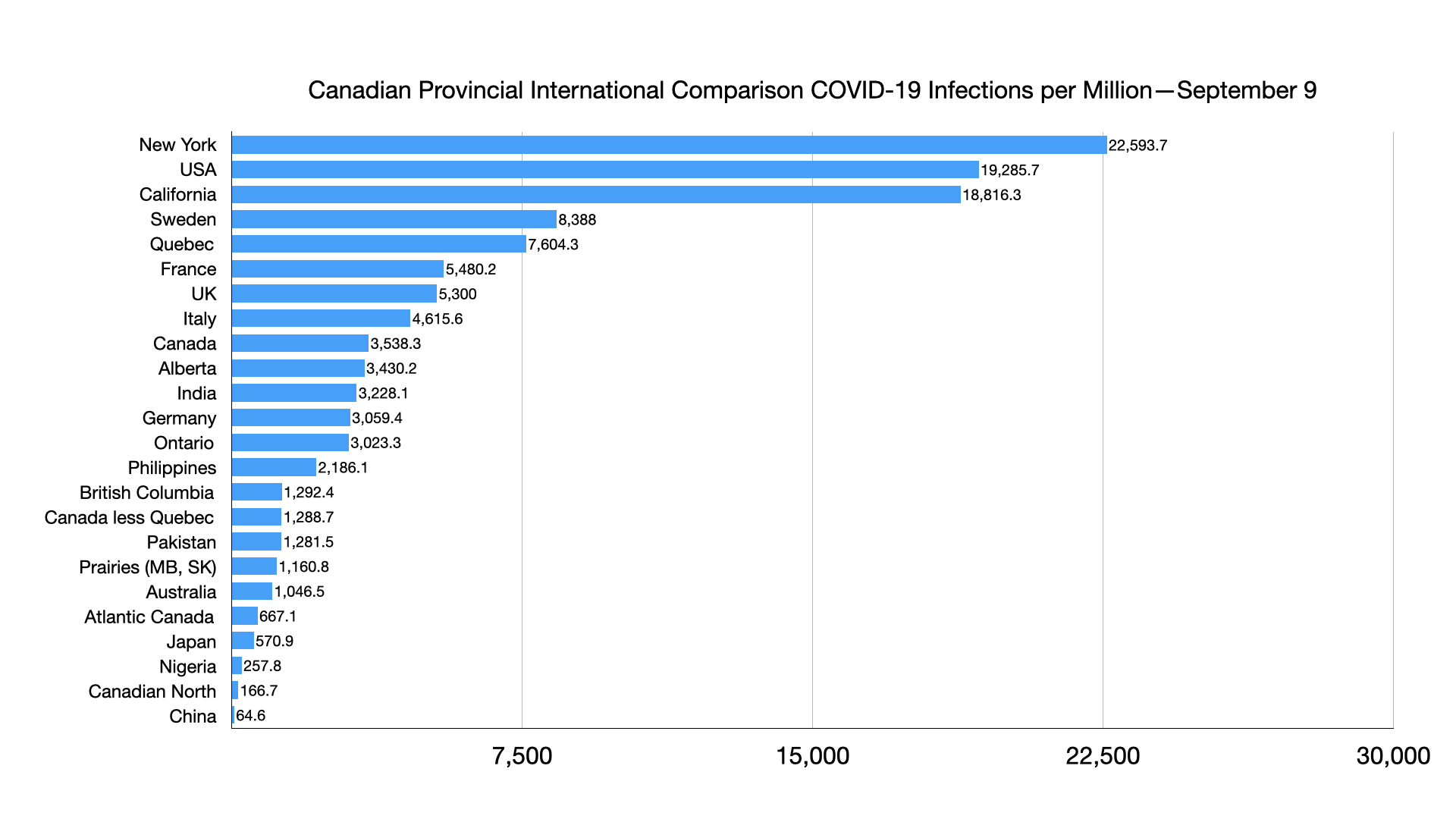
#COVID-19: Comparing provinces with other countries 9 September Update

Highlights:

Deaths per million: USA now higher than Sweden, Australia now higher than Atlantic Canada

Infections per million: France now higher than UK, India now higher than Germany and Ontario, British Columbia now higher than Canada less Quebec


When the great New Zealand immigration tap suddenly went dry

Good overview by Paul Spoonley, with some COVID similarities to Canada:

In March 2020, the immigration tap was all but turned off as New Zealand, and many other countries, closed their borders. But few countries have experienced quite the immigration arrival and net gain story that New Zealand has over the last two decades.

At this point, the drop in arrivals, apart from returning New Zealanders, is of such a magnitude it raises some fundamental questions: when will international mobility, both temporary and permanent migration, restart? And what will – or should – the new normal look like?

How did we get here?

There have been three very distinct periods of population growth and migration since 2000.

Lianne Dalziel, as minister of immigration, oversaw a significant period of immigration policy reform in the early 2000s, after the rather disastrous 1990s. What we gave points for, and what sort of work an immigrant could do after arrival, were not aligned through the prior decade. The politicisation of Asian immigration in the 1996 election did not help.

After 2000 the numbers grew but were then curtailed by the global financial crisis, when the numbers departing New Zealand increased significantly. From 2000 to 2008, the population grew by 407,200 with net migration gains contributing 45.5% to this growth.

Then the GFC years happened. Between 2008 and 2013, population growth was modest (+191,200) and net migration made up less than 5% of this growth. (Remember, there were years in this period when the net loss was nearly 16,000 per year.) But this was then followed by another period of major population growth (480,000, from 2014 to 2019) and net migration gains now made up 65% of population growth.

Fewer babies but many more immigrants

As fertility rates continued to decline, and reached sub-replacement levels in 2017, New Zealand was more than making up for it with migration numbers. The country was adding more than 60,000 people each year as a result of immigration.

The numbers did dip in 2019 but the latest figures for the year to June 2020 are quite staggering. There were 153,900 arrivals (up 8.7%), 74,500 departures (down 16.6%) with a net gain of 79,400 – and that included four months of lockdown migration rates.

The monthly arrivals for June are down 86.8% compared to June a year earlier, while departures are down 87.6%. And we still managed an all time high for the 12 months.

Our annual population growth since 2013 has been high (1.9-2.1%) and the key driver was now immigration, not natural increase. New Zealand stood out in terms of the relative size of these migration flows. Last year, New Zealand had 11.4 migrants (net) per 1000 people. Australia’s rate was 6.2, the US was 3.8 and the UK 2.4.

But there is more

This story is missing one other key ingredient : the size and role of temporary migration.

The MBIE migration data website provides a fascinating picture of the size of the temporary work and study population in New Zealand. Just before the first lockdown at the end of February, the site was showing 220,887 here on temporary work visas with another 82,857 on a study visa (remembering that these students can work up to 20 hours per week on these visas). Even by the end of July, the total number in both categories had only dropped by 23,828.

This might not be the full story. In May 2020, a statement from the then minister of immigration, Iain Lees-Galloway, suggested that there were 350,000 temporary visa holders which included a big chunk of visitors and the skilled migrant resident visa holders.

To say that these numbers are significant is an understatement.

What next?

The government has extended the current stay for the temporary worker and student visa populations under the Covid-19 Public Health response Act and with changes to the Employer Assisted Work Visa. Essentially, the visas have been extended to September 25. (Thai chefs and Japanese interpreters get their own special category of work visas provisions.) This is essentially a hold and wait approach.

In the meantime, migrant arrivals are now dominated by diaspora returnees – New Zealanders are cutting short their OE and returning home in numbers. Over the last year, 45,481 New Zealanders arrived in the country, and the net gain is 16,945. This is in sharp contrast to the major net losses during the GFC and much smaller losses from 2013 through to 2019. Over half of these returnees are coming from Australia.

The Stats NZ figures divide these returning New Zealanders in terms of whether they intend to stay or not. We will see. Covid-19 keeps changing the rules. A key influencer will be a combination of managing, or not, the virus, whether there are jobs and where is it easiest to get support from the state or family/friends. Australia is not a welcoming place for New Zealanders, as the pandemic has underscored.

One thing is certain: population growth over the next year or two will slow dramatically as migration slows. The saving grace will be returning New Zealanders but the numbers involved are still far from clear. They are exempt from meeting the labour market thresholds and the requirement to have a job offer of non-New Zealand citizen arrivals.

There is considerable pressure to open the borders – for short term workers, students or tourists, and for permanent migrants. But when? That depends on the management of Covid-19 within countries, along with a willingness to accept the risks that international arrivals bring, and international agreements about the protocols required of countries, carriers and travellers. The airline industry is suggesting that it might be 2024 before numbers are back to anything like the levels of recent years.

Demographic disruption

The dial has literally gone back to zero in terms of immigration, in sharp contrast to the previous year when the overall numbers and net gain were New Zealand’s highest ever. What is unclear is what the country’s immigration management system or migrant flows will look like as we emerge from a pandemic. Will there be a major reset or will the old normal return?

There is also the demographic future to consider. The fertility rate is in ongoing decline, aided by the delayed fertility that will result from the uncertainty associated with Covid-19. Ageing will mean that almost a quarter of all New Zealanders will be over 65 years of age by the 2030s. And we are seeing population stagnation – and decline – in many regions.

An inverted population pyramid and a smaller prime working age population are going to provide us with significant challenges. Immigration is one of the options to address these major demographic shifts. It will be interesting to see whether our politicians and policy communities see it this way and construct an appropriate immigration model for a future New Zealand.

Source: When the great New Zealand immigration tap suddenly went dry

How race, income and ‘opportunity hoarding’ will shape Canada’s back-to-school season

Good long read on how the impact of COVID-19 will likely increase inequality further:

Two weeks before vice-principal Brandon Zoras was to welcome a group of students back to the classrooms at Toronto’s Westview Centennial Secondary School, a message appeared in his LinkedIn inbox from a stranger.

“Hi Brandon, hope you are doing well! I am looking for an experienced TDSB Grade 11 chemistry tutor to coach my son online only (due to social distancing) – to start right away. Please let me know if that is something you (or someone you know) can help my son with. Best regards.”

Irritated, Mr. Zoras groaned and deleted it without replying.

Westview has one of the largest Black student populations in the country and sits in the northwest corridor of Toronto, which has become the epicentre for COVID-19 infections. Many students live in cramped housing, have parents who are essential workers and rely on public transit to get around, all things that contribute to the high infection rate – which is 10 times that of the least-infected parts of the city. The average annual income for residents in the area is $27,984 – half of what it is for Toronto as a whole.

“It makes my heart hurt for the families who can’t afford a tutor or who can’t afford all these additional things,” said Mr. Zoras, a science educator.

Since he began working as an educator 11 years ago, he has seen the way public education funding has been diminished, how families in the system have found ways to privatize parts of their children’s schooling to get what they want. Education advocates say those efforts are making things less equitable for everyone else.

Every year, parents across the country lobby to get their children into advanced-placement classes, buy houses in neighbourhoods that will give them access to coveted schools and fundraise on the school council to bring in technology and high-level arts programming.

Now, with the return to school amidst a global pandemic, those efforts to secure the best for their children, known in sociology as “opportunity hoarding,” have become more overt. The confidence many had in the public-education system has been ripped apart because of reopening plans and it seems no amount of fundraising, private meetings with principals or school council strategizing can bring about the changes many are seeking for a safe return to school.

The result is some of the most privileged public-school families are opting for distance education, hiring personal tutors and forming private learning pods – decisions that are ostensibly made in the best interests of their children, but which will likely cause major rifts across race and class. Those in lower-income communities are also choosing remote learning because they have elderly relatives living with them who are vulnerable to getting sick, they feel a heightened threat from COVID-19 because they are in areas with the highest infection rates and the buildings in which they live pose challenges to getting to school on time in a pandemic.

That families on both ends of the socio-economic spectrum are opting for remote learning exposes cracks that already existed in the system. There’s a threat the most privileged will pull out to customize their own education since they can afford to, while others who are fearful of sending their children back to school but cannot pay for private help are becoming test subjects for a new realm of online learning. As plans are pulled together haphazardly, there’s a concern the divide will deepen.

This week, school boards in Toronto, Peel Region and Halton Region released the results of parent surveys that show a sizable portion of students will not be in classes this fall: 30 per cent of elementary and 22 per cent of high school students for Toronto; 33 per cent combined for Peel; and 29 per cent elementary and 15 per cent high school for Halton. A portion of households didn’t respond and school staff will be reaching out to them directly, which could change these figures.

At Thorncliffe Park Public School, in a community that has long been a landing pad for newcomers and where the median household income is $46,595, 38 per cent of families surveyed say they’ll do remote learning this fall.

Munira Khilji, a mother of two in Thorncliffe Park, said many parents she knows chose this option because they live in high-rises and don’t want to endure waits of an hour or longer just to take the elevator while pandemic-related capacity limits are in place – and they worry about physical distancing in such a cramped space.

The issue is most apparent in Ontario, where families have been given a clear choice between in-person and remote learning, but it’s forcing a reckoning in many other parts of the country. In Alberta, 28 per cent of students in Edmonton’s public school board have chosen remote learning. In British Columbia, Education Minister Rob Fleming has said that school districts have the flexibility to provide remote learning options, but there is confusion among parents and school officials as to what that will mean and whether students will remain enrolled in their home schools.

“What COVID has done once again is expose the stark inequities in our system and the realities that families in marginalized communities have to navigate,” said Jeewan Chanicka, the former superintendent of equity, anti-racism and anti-oppression at the Toronto District School Board. “These families also know that their communities are going to be hit the hardest. They are behaving in a way where they’re trying to save their children’s lives.”

Some worry the shift out of the classroom could have devastating long-term consequences: If parents come to appreciate the increased attention their child gets from a teacher in a pod with just four other students, they might opt to continue this post-pandemic and permanently withdraw from a system whose funding is determined by head count.

“Where I worry a bit is in particular for those of privilege; if they’re pulling their children out, whether or not they will return to public education, I don’t know,” Mr. Chanicka said. “My hope is that yes, this is a blip because of the pandemic.”

COVID-19 has presented an opportunity to rethink how Canada operates homeless shelters and long-term care – will the same be true for schools, or will navigating the pandemic only further fracture the system?

Before Marty Menard even had a daughter, he and his wife had done their homework on which school they wanted her to attend. Wortley Road Public School in London, Ont., a well-regarded K-8 school known for its small student population and very involved parent community, stood out. When Mr. Menard’s wife was in her third trimester, they bought a house in Wortley Village, which the Canadian Institute of Planners dubbed the best neighbourhood in Canada in 2013, so they’d be in the catchment area for the school they determined was their first and only choice.

In his daughter’s second year there, Mr. Menard enthusiastically joined many of the various parent committees and even became co-chair of the school council, helping organize fundraisers, the breakfast program and cultural celebrations.

When schools shut down in mid-March, Mr. Menard turned to a private tutoring program to offer his daughter an hour of instruction a day and also found a few hours each week to use online resources from the Khan Academy to help boost her development. But after a few months, his daughter said she was lonely and Mr. Menard knew this couldn’t continue into September. A learning pod seemed like the best solution: The risk of his daughter being exposed to the novel coronavirus would be lower than it might be in a packed classroom, but she would still enjoy social interaction. On social media, he found a few other parents and a provincially certified teacher who will lead the pod, but is struggling to find a space that will host them without greatly increasing the costs, which he estimates will be about $500 to $750 a month.

With school already under way in some provinces and just a few weeks away in others, the scramble to clear those logistical hurdles has sent plenty of parents who have chosen the same option as Mr. Menard into a frenzy.

As August wore on, the panic among parents in the Learning Pods – Canada Facebook group was palpable. Thousands from Vancouver Island to Halifax, but mostly in Ontario, had flocked to the group to find others in their neighbourhood to pod up with, to find a teacher to hire, or to share their story about turning to this option to protect an immunocompromised member of their family.

They solicited advice on everything from costs (“Can folks share how much is a reasonable salary to offer a teacher for a pod of four?” asked one mom in Hamilton) to insurance (“My insurance company approved extended insurance for each child in my pod. They will not cover communicable disease transmission. Has anyone else figured out how to get around this? Co-op among parents to share the responsibility? Corporation to reduce risk?” wrote another in Waterloo, Ont.). Some pods will rotate between a group of households where parents share teaching duties; others will be situated in rented spaces with lots of technology and resources provided and come with a cost of up to a few thousand dollars a month.

On and offline, the conversation on learning pods often leads to bigger questions of equity: are they classist? Do they further the divide between the haves and the have nots? Shouldn’t parents with enough privilege to put their children in a learning pod harness it to lobby the government to make classrooms safe for all children?

Those debates have arisen in Mr. Menard’s own marriage. He describes himself as a “lefty” and a proponent of the public school system, which he says has been steadily defunded for years – but still, he and his wife have decided that given the pandemic and the government’s plans, this is the best option for his family.

“Nothing is going to marginalize kids more than people like me who could afford a learning pod,” he says. “The bottom line as a parent is I still have to put my kid’s interests above every other point of view or political point of view that I have.”

It’s a rationale sociologist Margaret Hagerman encountered again and again when she spent time with affluent white families in the American Midwest as part of research for her book White Kids: Growing Up with Privilege in a Racially Divided America. She observed a phenomenon she dubs “the conundrum of privilege”: Parents who identify as progressives, who care about equity, who may have taken their children to the climate strike or hung up a Black Lives Matter poster in their window, don’t think twice about what it means to give their children advantages that others don’t have access to. They want to raise their children in a just society, but they’ve used their privilege to work against that very goal.

“I think we need to reconfigure what we mean when we say we are doing the best for our child or being the best parent,” she said. “I don’t actually think that advocating for your own kid when that harms other people is the best version of anything.”

When parents talk about the gifts they want to give their children for the future, she likes to challenge them: “Don’t you want your kid to live in a society with less racial violence and with less inequality and social conflict and social problems and suffering?” she asks. “If you could do things now that would provide that different future for your child and the other children around him, it’s kind of philosophical, but I just think that that’s a compelling argument.”

While some who have opted for pods defend their choice with the argument that this will make classrooms less populous and therefore safer for students who do attend in person, the net effect isn’t the reduced class sizes parents, epidemiologists and public health experts have recommended. Rather, classes will be combined and likely grow in size because the government has not funded lower class sizes.

In Edmonton, the city’s public school board said nearly 29,000 students, or roughly 28 per cent of its entire enrolment, had opted for online learning as of Wednesday, though the board stressed that those numbers could change. To accommodate them, it has assigned 775 teachers to those online students. The board has hired an additional 100 teachers on temporary contracts, but board chair Trisha Estabrooks said the shift has meant decreased in-class enrolment hasn’t led to a decrease in class sizes.

“Even though we have 30 per cent of our students choosing to learn online, the reality is that doesn’t decrease the overall class size either, because we also need to have teachers in place to teach those online cohorts,” said Ms. Estabrooks, who acknowledged that in many classrooms, physical distancing is difficult, if not impossible.

Atiba Ralph, a single Black father, said he has heard so far that all of his daughter’s friends will return to in-person classes this fall; he hadn’t even heard of learning pods but said they sounded like “a pretty smart idea,” albeit one that was out of reach for him.

“It probably happened with the people that are in a higher tax bracket,” he said. “I have a little bit more financial problems.”

The COVID-19 threat is present every time he steps out of his apartment in Toronto: He lives in the Jane and Finch area, one of the most-infected in the city, and knows of two Black people – one a neighbour of his mother, another a friend of a friend – who died of COVID-19 earlier this year. Public health data collected by the city from mid-May to mid-July showed Black people had the highest share of COVID-19 infections.

Recognizing that some neighbourhoods have been much harder hit than others by COVID-19, the Toronto District School Board is directing extra funds and capping class sizes at abo

ut 80 schools in those areas, most of which are in the northwest corner of the city.

Alice Romo, an education advocate with the Latinx, Afro-Latin-America, Abya Yala Education Network, says she worries about the way children from low-income neighbourhoods will fall behind this year if they are educated at home: They’ll be less engaged, it will be more difficult for them to finish their homework and, crucially, many will miss out on all the non-academic parts of school that keep low-income communities afloat, such as breakfast and lunch programs.

“We’re definitely going to see this a few years down the road. There will be more of an inequality gap,” she said.

Those who withdraw from the system may think the decision only affects their household, “the more you shift the role of education towards families and away from public schools, the more inequality you’re going to have,” says Andrew Franklin-Hall, a philosophy professor at the University of Toronto who studies ethics.

For some students, school might be the only environment where they are exposed to peers from diverse ethnic and socioeconomic backgrounds; in a learning pod, just like in a private school, opportunities for that exposure are limited.

“When parents are suddenly forced to make this kind of decision, naturally they turn to the resources they have, which is their own friends, their own community,” he said. “This is not the sort of thing that people feel comfortable articulating, because they don’t want to say, ’Well, I don’t trust the people who are different than me or I don’t trust the people who aren’t as well off or have a different race.’”

Before the pandemic forced a crisis in the education system, many school boards had committed to addressing systemic racism and inequity by re-evaluating programs, such as French immersion (which attracts a higher proportion of affluent, white students) and streaming (which routinely put Black children on a path to applied courses, which limit their options after graduation), that have disadvantaged students from low-income and racialized communities. Now with educators focused on the basics of opening schools, reimagining the system seems impractical, if not impossible.

In June, Stephanie Brembridge, a Black mother in Toronto whose son attends a public Catholic school, reached out to the school principal to ask whether she could add an item to the agenda for the next parent council meeting of the year: She wanted to discuss what the predominantly white school could do to better help Black and Indigenous students succeed.

Her faith in the school had already been tested. Her son, Trusten, had been suspended several times – once for apparently saying “an inappropriate word” – though the school was never able to tell Ms. Brembridge what that word was. With the help of an advocacy group that works with Black parents, she was able to get a few of those suspensions overturned (data collected at school boards across the country show that Black students are suspended and expelled at a disproportionate rate).

When it came time for the parent council meeting, which was held over Zoom, Ms. Brembridge noticed her item was at the very end of the agenda. She grew anxious as an hour and a half flew by, while the other parents (all but one of them were white) discussed which teachers were retiring, how they might safely plan a social function in the summer and other matters Ms. Brembridge believed to be far less pressing than hers.

“Okay, I think that’s it,” someone said, ready to adjourn the meeting. Ms. Brembridge, surprised, unmuted her microphone and reminded them she still hadn’t spoken. She was told she had three minutes and could see parents starting to leave the chat. “I‘m not going speak until I can get everybody’s full attention,” she said. Her item was moved to the agenda for the next meeting – three months later, in September.

As a teacher in Toronto, Kelly Iggers has been exposed to the type of parental advocacy that’s aimed at “achieving supports that will benefit one’s own child.” When she learned Ontario’s back-to-school plan, released in late July, would not include reduced class sizes, she started a petition arguing in favour of them that netted more than 250,000 signatures across the province and evolved into a campaign with parents, educators, doctors and others discussing and planning in closed groups, including a WhatsApp chat.

“This issue of advocating for a safe and equitable return to school, it’s not about advocating for one’s own community or one’s own child,” she said. “This only works if we’re advocating for something that’s going to support everyone.”

This moment of reckoning in Ontario comes at a time when Alberta is moving toward a model that could heighten class and race disparities within the public system. For now, it’s the only province to have charter schools, which are independently run, non-profit public schools that have a greater degree of autonomy than a normal public school, allowing them to create programming that’s only for girls, or for the academically gifted.

Earlier this week, the Choice in Education Act took effect that, among other things, makes it easier to apply for and create a charter school. Now, a group wanting to establish a new charter school can bypass the local school board and apply directly to the government.

Calgary mom Dallas Hall’s son started Grade 4 last month at Connect Charter School after switching from a local public school. Ms. Hall said she likes the type of education he’s receiving, which includes experiential learning and outdoor learning. She also said the school has less bureaucracy than a traditional public school system – the same features that are making private school or learning pods an attractive option for parents elsewhere. Ms. Hall likes the idea of parents having choice in education. “They should have a voice. Their voice should be welcome,” she said.

Ms. Iggers said she didn’t want to vilify parents who are choosing private options, but says this shift out of the classroom has the potential to cause long-term damage.

“It’s prompting families with the means to do so to leave the system,” she said. And when they leave, “they [take] with them what are often the most powerful voices to advocate for a properly funded education system.”
Source: https://www.theglobeandmail.com/canada/article-how-race-income-and-opportunity-hoarding-will-shape-canadas-back/

Why the Coronavirus More Often Strikes Children of Color

Mainly linked to lower socio-economic status:

One of the notable features of the new coronavirus, evident early in the pandemic, was that it largely spared children. Some become severely ill, but deaths have been few, compared to adults.

But people of color have been disproportionately affected by Covid-19, the illness caused by the coronavirus, and recent studies have renewed concern about the susceptibility of children in these communities.

They are infected at higher rates than white children, and hospitalized at rates five to eight times that of white children. Children of color make up the overwhelming majority of those who develop a life-threatening complication called multisystem inflammatory syndrome, or MIS-C.

Of more than 180,000 Americans who have died of Covid-19, fewer than 100 are children, according to the Centers for Disease Control and Prevention. But children of color comprise the majority of those who have died of Covid-19.

The deaths include 41 Hispanic children, 24 Black children, 19 white children, three Asian-American children, three American Indian/Alaska Native children, and two multiracial children.

The unique vulnerabilities of these youngsters are coming to light even as the number of infections in children is rising and schools and parents around the country are grappling with nettlesome decisions about reopening safely.

The susceptibility of minority children to the disease is not unique to the United States. Black children hospitalized in the United Kingdom were more likely than whites to be transferred to critical care and to develop MIS-C, according to a study published last week in the journal BMJ.

“Children don’t exist in a vacuum,” said Dr. Monika K. Goyal, a pediatric emergency medicine specialist at Children’s National Hospital in Washington.

Among 1,000 children tested for Covid-19 at a site in Washington in March and April, nearly half of the Hispanic children and nearly one-third of the Black children were positive for the coronavirus, Dr. Goyal found in a recent study.