Douglas Todd: Canada’s many language schools ravaged by COVID-19

Yet another element of the immigration industry:

Downtown Vancouver might never look or feel the same, as scores of its English-language schools now sit empty with metal security gates across their doors. Many will never reopen.

B.C.’s once ultra-popular, private English-language schools, which last year enrolled 70,000 to 100,000 students, are concentrated in the city’s core. Each year language students from around the globe enlivened downtown cafes and street life, as well as rental and homestay units through the West End and Yaletown.

Most Canadians don’t give much thought to the often-overlooked English- and French-language industry, but if they did they would recognize COVID-19 has ravaged this formerly booming sector as badly as it has crippled airlines and international tourism.

The health measures brought in in March to secure borders against travellers who could carry the coronavirus into Canada caused upwards of 100 language schools in B.C. alone to close their doors to in-person classes. Some struggle just to offer low-cost online instruction to students spread through mostly Asia and Latin America.

Officials with Languages Canada, an umbrella group for more than 200 registered schools, forecast this summer that three of four of its member schools could be forced to permanently shutter. In Metro Vancouver alone, Languages Canada says their students, almost all from outside the country, were pumping more than $500 million a year into the economy.

Global Village Vancouver gone

More than 23 registered language schools across the country have already permanently packed it in, including Vancouver’s decades-old Global Village Vancouver. And that number doesn’t include the closings at many smaller private schools that are not registered with Languages Canada.

“Metro Vancouver has the most private language schools of any Canadian city. And many of them are never going to open again,” says Lorie Lee, a former language-school owner who has served on federal government trade missions and advisory panels who now works with a company called Guard.me that provides health insurance to international students.

“Not only do these schools employ many teachers and staff, the students stay with host families and rent apartments and spend money in restaurants and on car leases and trips to Whistler. That’s not to mention the schools themselves rent large amounts of space downtown.”

Language-school students often come to Canada, Lee said, with varied dreams about learning English, since it’s the common language of global business, aviation and science.

One-third of them, almost always financed by their parents, want to gain permanent resident status in Canada, Lee says. Another cohort aim to get English under their belt so they can be eligible to apply to a Canadian or American university.

Those who belong to a third group want to improve their English because it will enhance their careers in their homelands, Lee says. Many others seek adventure, learning a bit of English along with skiing, partying and hiking in a beautiful province.

There are several reasons private language schools have been hit harder by the pandemic than Canada’s public universities and colleges. The biggest problem is their rents.

High rents

Unlike public language schools, which are subsidized by taxpayers, private language businesses, especially those in Vancouver, are stuck having to pay high rents on five-year leases they normally can’t get out of. A typical monthly rent for a school downtown, Lee says, runs about $50,000 a month.

“These schools have had no students since March, so that’s eight months of no income and many are going into debt. Those schools closing will have an economic impact on other businesses, not to mention on the host families that relied on the international students to pay their mortgages.”

The second big dilemma is that language-school students are often in a different immigration category from the 642,000 people who last year were in the country on study-work visas so they could attend public institutions like the University of British Columbia, Simon Fraser University and Kwantlen Polytechnic.

Only a minority of private language-school students obtain such long-term study-work visas to be in Canada, Lee says. Most tend to be here on visitors’ visas, which last less then six months.

That means that Prime Minister Justin Trudeau’s unprecedented move to reopen the border to foreign students on Oct. 20 is of only limited help to most language schools, since the bulk of their students will not be eligible.

Gonzalo Peralta, head of Languages Canada, has said Ottawa’s policy decision extends a lifeline to some private language schools. But Lee stresses that “even with Ottawa opening the gates, there are still going to be problems.”

It’s all having a little-discussed impact on Metro Vancouver. In 1991, when Lee first shifted from teaching English at UBC to launching her own school in Vancouver, her market research showed there were only seven private language schools in the city. “But,” she says, “when I sold my school in 2011 there were approximately 200 private language schools in Vancouver.”

Even though critics have condemned the way some private language schools are shoddily run and some Canadian economists worry they contribute to bringing more low-skilled workers into an already modest-wage job market, Lee generally remains a booster.

She’s excited that language schools bring so many students from Brazil, China, India, Vietnam, Japan, Mexico and South Korea. Four of five head to Ontario or B.C. This province has more than 50 schools registered with Languages Canada, the vast majority being private, employing about 2,000 staff and teachers until COVID-19 hit.

And, as Lee clarifies, Language Canada’s registered schools are only the tip of the language-industry iceberg. There are scores more non-registered private language schools in Metro Vancouver that, until the pandemic, served tens of thousands of pupils.

Glimmers of hope

Some publicly funded language schools and the larger private ones will likely be able to hold out until the end of the health crisis, Lee says. But even they are struggling just to keep afloat by offering online courses, only charging $99 a week. “Meanwhile, think of how expensive their rents are.”

There are glimmers of hope for some schools, Lee suggests, but their survival will likely rely on further easing up of immigration policy, border restrictions and COVID-19 safety rules, which restrict how many students will be allowed in language classrooms at one time.

Even though it’s frustrating to Lee, she recognizes why most Canadians rarely think about the plight of private language schools and their impact on the country.

With understatement she says, “I think most people in Canada don’t understand how the immigration system works.”

Source: Douglas Todd: Canada’s many language schools ravaged by COVID-19

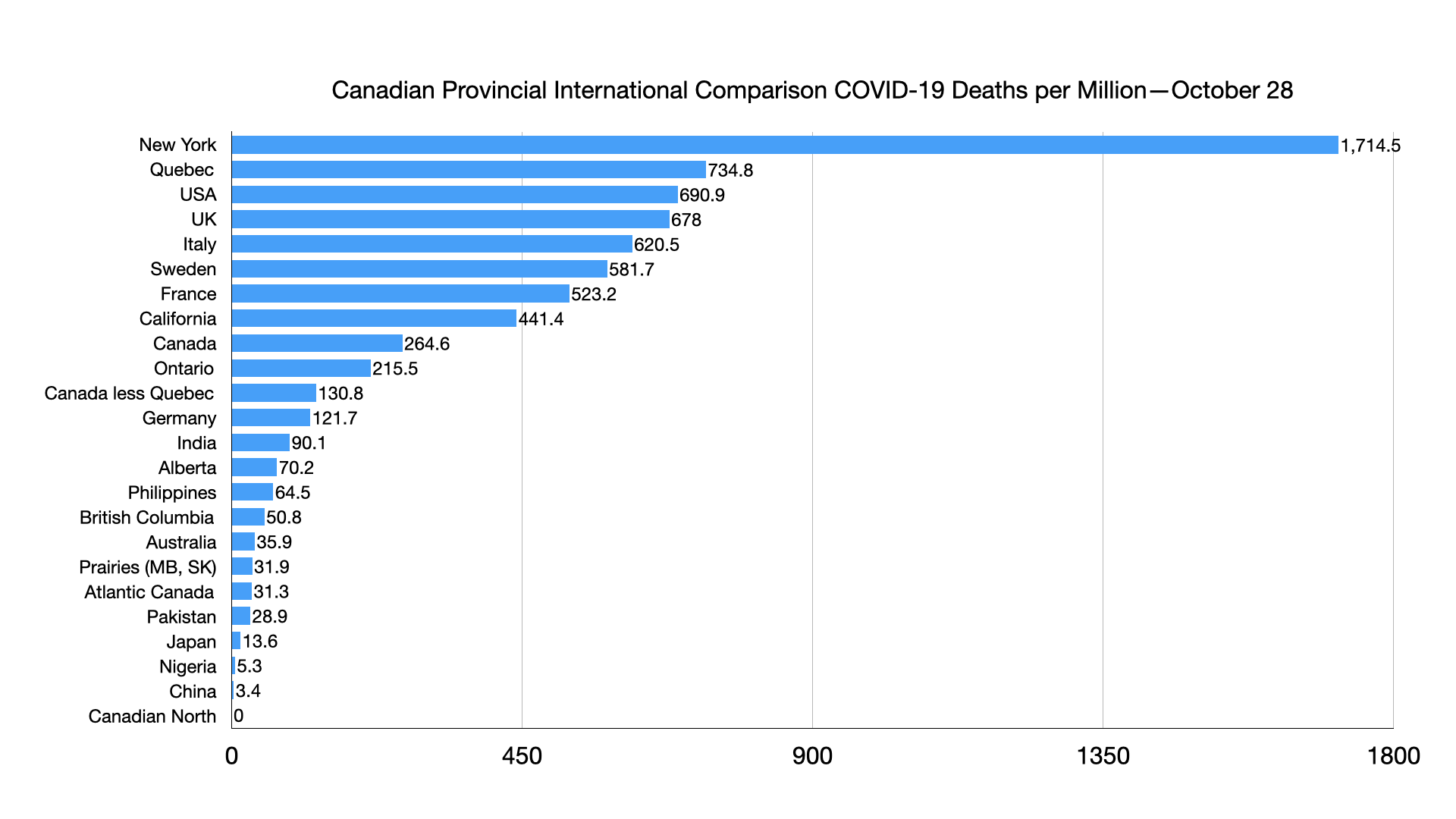
#COVID-19: Comparing provinces with other countries 28 October Update

Main news continues to be with respect to infections:
 
Weekly:
 
Infections per million: UK higher than Quebec, Alberta higher than Canada, Germany higher than Ontario, Prairies higher than British Columbia 
 
Deaths per million: Prairies higher than Atlantic Canada, both higher than Pakistan
 
October 7-28 increase:
 
Infections per million: Prairies (Manitoba, Saskatchewan) join European countries in highest percentage increase
 
Deaths per million: Highest increase in Prairies, particularly Manitoba and Saskatchewan 


The startling impact of COVID-19 on immigrant women in the workforce

Good detailed analysis of disparities:

While the mantra for the COVID-19 crisis has been “let’s build back better,” it will be impossible to do so without acknowledging that this pandemic has hit demographic groups unequally. Immigrant women faced many challenges in the workforce before COVID, but this pandemic has had a way of further exacerbating existing social and economic inequities. To ensure we come out of this crisis with a more resilient economy and better institutions, it is essential that we understand the differentiated impact of the pandemic on our diverse communities and bring forth policy ingenuity to make sure workers and their families are not left behind.

The impact of the pandemic on the labour market has been profound, particularly for women. The overall gender differences in the impact of COVID-19 are partly due to school and daycare shutdowns and the crisis in our long-term care centres. Gendered norms still designate women as the ones to step up and tend to our homefront, which has compounded the daily care responsibilities of many women during the pandemic. But the closure of economic activity has also directly induced larger drops in the employment of immigrant women.

Undoubtedly, the pandemic has had devastating effects on new entrants to the labour market, young adults and recently arrived immigrants. Yet among workers with more secure jobs – those aged 25 to 54 and immigrants arriving more than 10 years ago – the differentiated impact on immigrant women is startling. Employment rates for these immigrant women dropped by 12.2 percentage points between May 2019 and May 2020, according to our calculations using Statistics Canada’s Labour Force Survey. This compared to drops of 7 percentage points for Canadian-born men and women and of 8 points for immigrant men.

Employment rates offer one view of the labour market. A falling number indicates that workers have quit or lost their jobs. Unemployment rates, on the other hand, measure the fraction of individuals who do not currently have jobs but are actively looking for work.

In the year between May 2019 and May 2020, the unemployment rate of these immigrant women dramatically increased, by around 7 percentage points. During that time, the unemployment rate of Canadian-born men and women and of immigrant men rose significantly less, approximately by 4.5 points. It is worth noting that increases in unemployment rates were even higher among recent immigrant women (9.6-point increase) but not recent immigrant men (4.3-point increase). Even more troubling is the fact that immigrant women with high levels of education were particularly disadvantaged. University-educated immigrant women experienced the largest unemployment rates, 12.6 percent in May 2020, 7.3 percentage points higher than in May 2019. In contrast, university-educated Canadian-born women experienced unemployment rates of 5 percent, only 2.7 percentage points higher than last year.

We know that workers in the service sector were more negatively impacted than in other industries. Clearly, we are travelling less, eating out less, and we shifted our purchases to online shopping instead of visiting bricks and mortar retailers. However, even within the service sector, shutdowns affected immigrant women workers differently.

To illustrate, the bars in Figure 1 show the year’s growth in unemployment (May 2019 to May 2020) across service industries for immigrant women and Canadian-born women. Unemployment rates are most pronounced in retail trade and information, culture and recreation sectors, and are quite significant in finance and insurance. In the retail sector, unemployment rates of immigrant women increased by 9 percentage points, whereas that of Canadian-born women rose only by 2.3 percentage points. To get a rough sense of the severity of the shutdown across industries, the blue dots in Figure 1 show the increase in the number of women from these sectors who report that they are unemployed. The hospitality and retail trade industries have seen the largest of such increases with 142,000 and 132,000 more women being unemployed, respectively, this year over last.

As well as realizing the differential impact of the pandemic, it is important to understand the differences in the recovery process so far. Even if preliminary, the most recent Labour Force Survey data indicates that immigrant women are still further below pre-pandemic employment levels than men and other Canadian women.

Figure 2 shows the difference in employment rates between August and February 2020 for different groups. Larger bars indicate that employment rates are still far from those seen in February, before the pandemic, with immigrant women showing the largest differentials.

The differentiated labour market impact of the pandemic on immigrant women compared to other groups, including the differences within sectors, is more likely to be related to the precariousness of their work. They tend to work in hourly jobs rather than salaried jobs and have weaker protections in their labour contracts. Many immigrant women are underemployed, working in low-skill, part-time, and high-risk occupations. This has been decades in the making.

It is particularly worrisome that education does so little to mitigate the adverse effect of the pandemic for immigrant women.

Among the longstanding challenges immigrant women face in the workforce, the lack of recognition of their foreign credentials, their lack of Canadian work experience, and their limited access to social capital and professional networks are some of the most important. Since many immigrant women are also racialized, these constraints feed into systemic biases in hiring and advancement that affect immigrant women’s careers. It is particularly worrisome that education does so little to mitigate the adverse effect of the pandemic for immigrant women. In the retail and accommodation service sector, for instance, settled immigrant women are more than twice as likely to hold bachelor and postgraduate degrees than Canadian-born workers in the sector, but during this crisis their higher levels of education did not insulate them from being more likely to lose their jobs. These trends in the recovery are worrying and require policy action to course-correct.

As much of the Canadian federal government funding to businesses and workers is winding down, we need to ask what other policy instruments can help us get out of our economic predicament, particularly with increased recognition that some of the economic activity, and the jobs associated with it, will never return. So where do we go from here?

Undoubtedly, business trends point to an acceleration of the digital economy, increased automation of tasks, rise of artificial intelligence, reshoring production in response to supply chain disruptions and increased reliance on gig workers. These plausible trends will challenge policy-makers in charting an economic recovery path and finding the right policy instruments to ensure equality of opportunities for all workers. Looking to emerging economic sectors might be part of the answer. The green economy remains under invested in and society’s normative turn in favour of climate action and sustainability means that green jobs will be needed.

The time is ripe, then, to invest in workers to take advantage of the new economy. The opportunity to direct these investments in ways that address the diversity of our communities should not be passed over. Government should increase support for projects of social value – shovel-worthy over shovel-ready projects – that make use of diversity talent and promote fairer access to employment for immigrant women and those who are racialized, whose talents are currently underutilized. Further, investment in upskilling and retraining displaced workers – those hardest hit by the pandemic – will be needed across the country. Given the large portion of immigrant and racialized women who fall into this unemployed group, training needs to be designed, tailored, and delivered to improve their employment outcome.

Canada’s social and economic well-being cannot afford to let marginalized groups repeatedly fall through the cracks. We need to find innovate ways for immigrant women, particularly those who are racialized and newcomers, to not be left behind in the post-COVID economic recovery. Otherwise, building back better will be for some and not for all.

Source: The startling impact of COVID-19 on immigrant women in the workforce

Where are the immigrants in Canada’s policy debates?

Good commentary by Keith Banting:

COVID-19 is the great revealer. It has revealed yawning gaps in Canada’s current patchwork of social programs, which manifestly failed to cope with the crisis. Emergency measures such as the Canada Emergency Response Benefit (CERB) and wage subsidies had to be rushed into place simply to keep individuals, families and the economy afloat.

Other fatal limitations soon appeared. Lax regulation of long-term care facilities had tragic consequences for thousands of vulnerable elderly, a crisis which required the emergency deployment of military health personnel in our two largest provinces. More broadly, the pandemic shone a harsh light on inequality in Canada. Many ‘essential’ workers had to travel to work for low pay in infectious workplaces, while the professional middle class worked from the safety of their homes, with little if any hit to their incomes.

These burdens were not shared equally across Canada’s diverse society. The economic and health impacts were greatest in the case of women, recent immigrants, racialized minorities, and members of the First Nations. An analysis by Statistics Canada documents the economic hit. Poverty rates were already high among recent immigrants and racialized communities before the pandemic, but the gaps grew during the crisis, with recent immigrants and racialized communities among the hardest hit. Poverty rates increased most in the South Asian, Chinese, Black, Korean, Arab, Latin American and West Asians communities.

With emergency programs set to wind down, Canadians are engaged in an intense debate over how to ‘build back better’ by improving our social programs. The agenda is larger and more complex than at any time in recent memory.

Income security programs are front and centre. There is pressure to expand eligibility for Employment Insurance to include contingent workers and more of the self-employed. Additional options range from incremental change, such as expanding the existing Canada Workers Benefit, to radical change, such as the introduction of some form of Basic Income.

Other reformers prefer to tackle precarious work, not through income transfers, but through market-shaping policies. Too many workers are in low paying jobs that lack any guarantee of sufficient hours, job security, or sick leave. From this perspective, Canada needs tougher labour market policies, including higher minimum wages and stronger worker rights, to ensure all jobs pay a living wage that can support a dignified life.

Beyond the world of incomes and wages, the social policy agenda extends to the improvement of core services, such as an expansion of childcare and a much stronger long-term care sector. In addition, stronger protections for temporary foreign workers, especially in the agricultural sector, are clearly essential.

Income security, market protections, stronger services: This is a huge agenda.

Canada needs tougher labour market policies, including higher minimum wages and stronger worker rights

Immigrant groups, however, have an ambiguous place in this great debate. With many recent immigrants and racialized minorities working in precarious, low-wage, unsafe jobs, their interests are deeply affected by the political struggle. Many of them would benefit the options on the table. Despite this, the politics of race and immigrant integration are unlikely to play a distinctive, energizing role in the political struggle. The issues are being framed around generic or ‘universal’ workers and their needs. This is the standard way of thinking about social policy in Canada.

The 2015 election provides an earlier example. The Liberal Party promised to raise taxes on high-income earners, cut taxes for the middle class and significantly expand child benefits, which help low-income families most. Strikingly, there was virtually no mention of race and racial minorities during the election debates. Rather, the Liberals presented their package designed to help “the middle-class and those working hard to join it.” Many racial minority families with children, including newly arrived Syrian refugee families, were significant beneficiaries when the new Liberal government significantly expanded child benefits. But racial inequality was not part of the politics that drove policy expansion.

Admittedly, there may be benefits in this generic framing. In the United States and Europe, many commentators argue that ethnic and racial diversity erodes a sense of community, weakens feelings of trust in fellow citizens, and fragments coalitions that might otherwise support social programs. They fear that members of the majority public might be reluctant to support social programs that give money to ‘strangers’ who are not part of ‘us’.

So far, such corrosive politics have been muted in Canada. Nevertheless, one cannot help but wonder whether the politics of diversity might bring added energy to social policy struggles. The Black Lives Matter movement is bringing much needed pressure on the justice system. But it is not part of the social policy debate. This framing of social policy, with its limited acknowledgement of the diversity of those whose interests are at stake, is a little unsettling, a sign perhaps that Canada is not fully comfortable in its own social reality.

Source: Where are the immigrants in Canada’s policy debates?

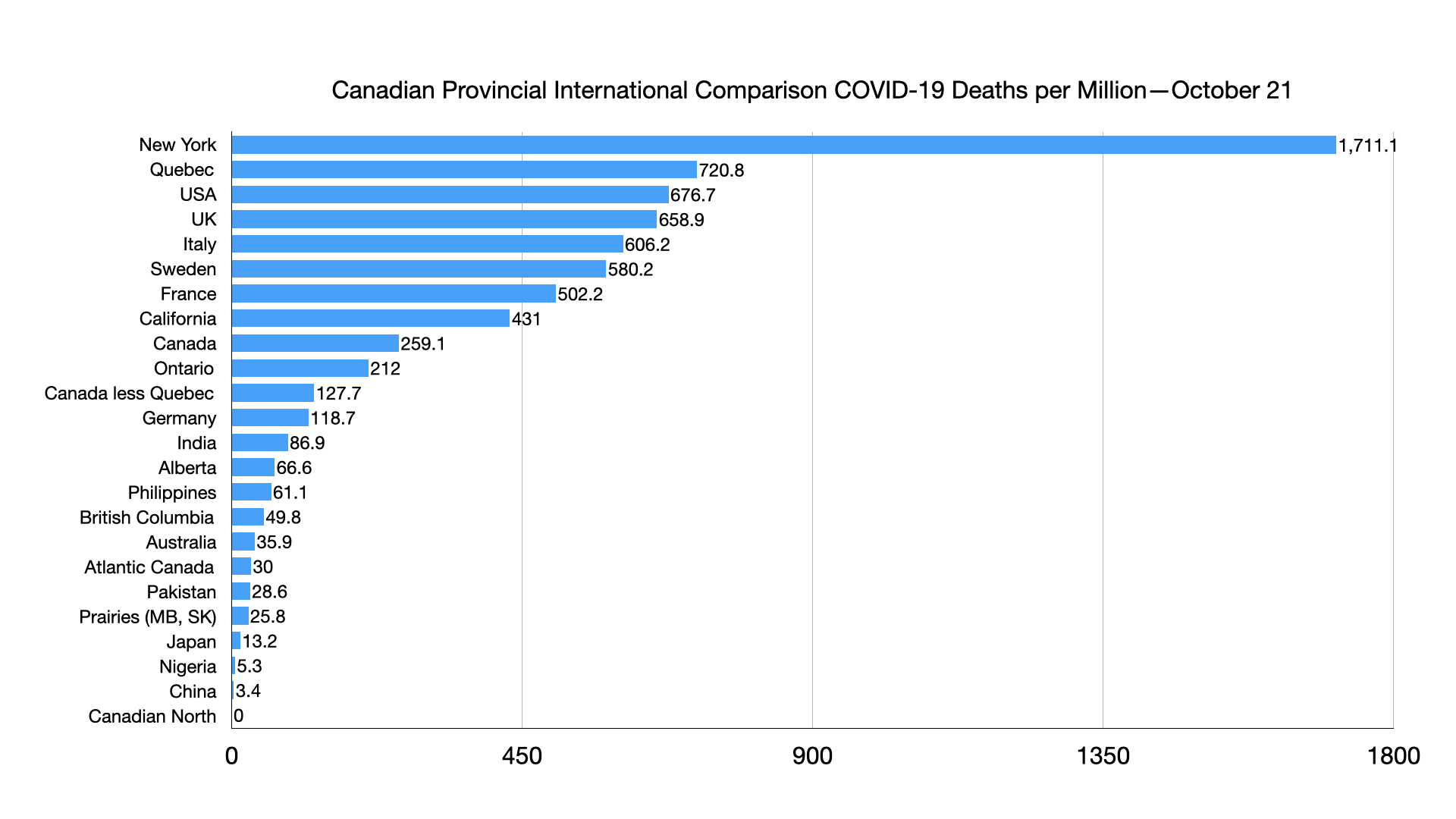
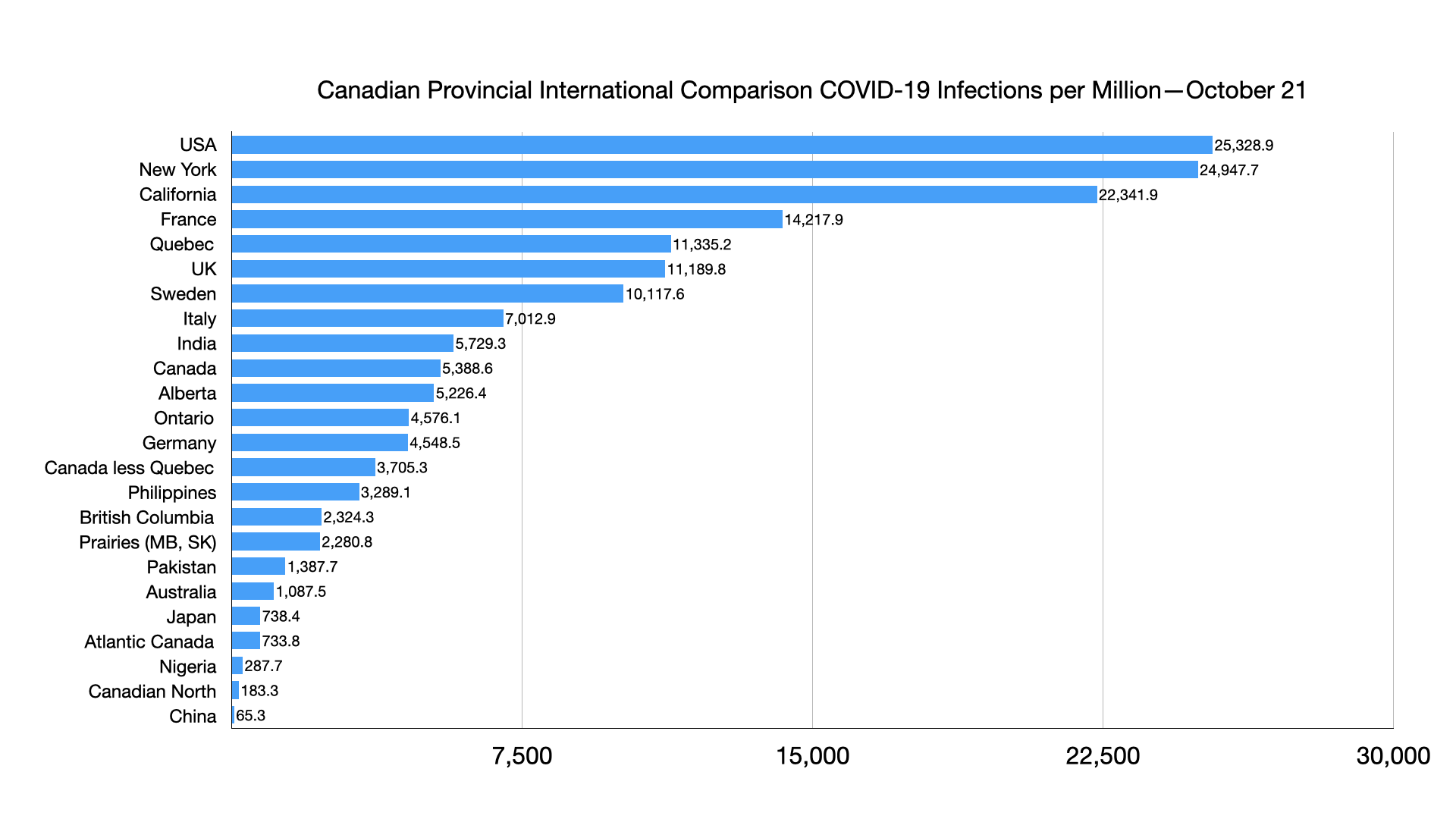
#COVID-19: Comparing provinces with other countries 21 October Update

Apart from overall large increases in infections in most jurisdictions, and corresponding increases in death rates in some, overall country and jurisdiction ranking largely unchanged.

Deaths per million: no change
 
Infections per million: Sweden now higher than UK (so much for herd immunity), Japan ahead of Atlantic Canada
 
Weekly:


After Months of Minimal COVID-19 Containment, Sweden Appears to Be Considering a New Approach


Better late than never:

Swedish authorities appear to be reconsidering their notoriously lax approach to COVID-19 containment, which has contributed to one of the world’s higher coronavirus death rates.

Starting Oct. 19, regional health authorities may direct citizens to avoid high-risk areas such as gyms, concerts, public transportation and shopping centers, the Telegraph reports. They may also encourage residents to avoid socializing with elderly or other high-risk individuals.

“It’s more of a lockdown situation—but a local lockdown,” Dr. Johan Nojd, who leads the infectious diseases department in the city of Uppsala, told theTelegraph.

In a statement provided to TIME, however, a spokesperson for the Public Health Agency of Sweden rejected that characterization.

“It is not a lockdown but some extra recommendations that could be communicated locally when a need from the regional authorities is communicated and the Public Health Agency so decides,” the spokesperson said.

A legal official from Sweden’s public health agency told the Telegraph the new policy is “something in between regulations and recommendations.” Violating the guidelines, for example, would not result in fines. Still, it’s a significant shift from Sweden’s previous handling of the coronavirus pandemic. While countries around the world implemented lockdowns once the virus began spreading, Swedish authorities largely let life continue as normal.

The Swedish government in March limited public gatherings to 50 people, but the policy left gaping loopholes—it doesn’t apply to private and corporate gatherings, nor to schools, shopping malls and plenty of other locations. Restaurants and bars never closed. Masks are not recommended in most places. There’s little to stop people from going to school or work if they come into contact with an infected person. Sweden’s testing and contact tracing capacitiesare lacking.

As of Oct. 18, Sweden’s per-capita death rate—58.6 per 100,000 people—was among the highest in the world. And from early September to early October, average daily cases nationwide rose by 173%, with particularly dramatic increases in cities such as Stockholm and Uppsala.

These hard-hit areas are the focus of Sweden’s shifting guidance, according to theTelegraph‘s report. Nojd told the outlet he is considering telling people in Uppsala not to visit the elderly and other vulnerable populations, and to avoid making unnecessary trips on public transportation. He also mentioned the possibility of imposing curfews on restaurants.

Representatives from the city of Uppsala did not immediately respond to TIME’s request for further comment.

Swedish authorities appear to be conceding that reaching herd immunity—the threshold at which enough of a population is immune to the virus for it to stop spreading widely—is unlikely to be happen without a vaccine. While officials have avoided explicitly calling herd immunity the goal of their casual containment approach, emails obtained by journalists show high-level Swedish public-health officials discussing that strategy as early as March, apparently motivated by economic concerns.

National studies, however, show that far fewer people have developed natural immunity than officials hoped—as evidenced by the ongoing spike in infections. Sweden’s state epidemiologist Anders Tegnell acknowledged that reality last week.

“I think the obvious conclusion is that the level of immunity in those cities is not at all as high as we have, as maybe some people, have believed,” Tegnell said. “I think what we are seeing is very much a consequence of the very heterogeneous spread that this disease has, which means that even if you feel like there have been a lot of cases in some big cities, there are still huge pockets of people who have not been affected yet.”

Source: After Months of Minimal COVID-19 Containment, Sweden Appears to Be Considering a New Approach

Germany: Coronavirus an extra burden for immigrants

Common pattern in most countries:

The German federal government commissioner for integration, Annette Widmann-Mauz, highlighted the plight of asylum seekers and people with immigration backgrounds during the coronavirus pandemic and the related economic crisis in a statement on Sunday.

“They often work in industries which are particularly affected by the economic consequences of the pandemic, such as retail, logistics or the hospitality sector,” she said, on the eve of the 12th integration summit which shines a light on the effects of the pandemic on immigrants.

At the same time as work conditions are becoming more difficult, the number of opportunities for integration are also shrinking.

The national integration action plan took on a digital offensive offering online integration courses, language teaching and consultations over social networks. The focus is on supporting women to enter and integrate into the job market.

“We mustn’t lose any time on integration, in spite of coronavirus,” Widmann-Mauz said.

A joint effort on integration policy

The integration summit, which began in 2006, will see around 130 representatives from immigrant organizations, religious communities, the economy, politics and sports come together over video conference to discuss the current topics regarding integration policy.

The government’s vice-spokeswoman, Martina Fietz, announced in advance of the summit, that those taking part “will discuss answers to the important question of how we can also strengthen integration in times of coronavirus, as many people with an immigration background are particularly hard hit.”

German Chancellor Angela Merkel will lead the discussion which will also look at the possibility of recognizing foreign professional and educational qualifications, as well as the promotion of early childhood education.

The first summit took place 14 years ago following a national debate about violence in schools. Teachers from a school in Berlin triggered the founding of the summit through a protest letter they wrote.

Source: Germany: Coronavirus an extra burden for immigrants

Foreign students start gradual return — along with their much-missed tuition

Will continue to watch application and admission statistics to assess the return:

Canada will begin allowing international students into the country on Tuesday, but it may take weeks before they arrive in significant numbers.

Travel restrictions are being lifted on Oct. 20, allowing foreign students to enter Canada if their post-secondary institutions’ COVID-19-readiness plans are approved by a provincial or territorial government. Universities, colleges and language schools are required to have a plan to quarantine students for 14 days.

Since March, international travel restrictions have limited entry into Canada for most non-essential travellers.

The return of foreign students is a relief for Canada’s post-secondary schools, with universities potentially losing as much as $3.4 billion this year, due mainly to the drop in international students, Statistics Canada reported earlier this month.

Tuition fees paid by foreign students have become an ever-bigger source of revenue for universities. The average tuition paid by an international student this year is $32,041, almost five times what a Canadian student pays. And the number of foreign students in Canada has tripled in 12 years to more than 640,000, generating roughly $22 billion a year in economic activity in Canada, according to federal estimates.

“This could be in the billions of dollars of loss this year alone,” said Denise Amyot, president and CEO of Colleges and Institutes Canada, which represents 135 post-secondary institutions.

Amyot said the return of international students will benefit rural colleges, in particular, where there are seldom enough domestic students to fill classes. Foreign students are also important because many decide to settle in Canada and are often trained for occupations that are short of workers, she said.

“Those are potential immigrants for our country,” Amyot said. “If they know the language, they have studied here, and they have Canadian experience, they make really well-prepared Canadians.”

With the fall semester well underway, Immigration, Refugees and Citizenship Canada (IRCC) spokesperson Shannon Ker told iPolitics that amendments to travel restrictions that kick in Tuesday “should result in a gradual movement of international students to Canada.”

Many foreign students are arranging to arrive before the winter semester starts in January, said Bryn de Chastelain, chair of the Canadian Alliance of Student Associations.

“I’m not sure if we’ll see a huge influx starting tomorrow, but I think, over the next few months, we will start to see kind of a slow trickle begin to pick up,” de Chastelain said.

Ker said it’s too hard to guess how many students will arrive in the weeks ahead, but it would depend on how many decide to study online from their home countries and the number of institutions that have their readiness plans approved. But a spokesperson for Ontario’s Ministry of Colleges and Universities says it has given 12 publicly funded schools the green light so far.

IRCC has yet to publish the list of schools — known formally as “designated learning institutions” — whose plans have been approved, although its website says it will be available by Oct. 20.

Students arriving in Canada must undergo the same screening and quarantine as any other traveller.

But the students’ arrival may be delayed because Canadian visa-application offices abroad are short-staffed due to the pandemic, Amyot said. That includes those in India, where most foreign students attending Canadians colleges and institutes come from.

International students require two stages of permits in order to study in Canada. Stage 2 includes biometrics, a medical exam, and a criminal background check that often require physically going to a visa office.

“That will become a barrier, because they need those biometrics to travel to Canada,” Amyot said.

The IRCC’s Ker said that, since March 15, more than 121,000 study permits have been issued, of which 10,000 are initial study permits and 111,000 are study permit extensions. In most cases, applicants approved for an initial study permit are abroad, whereas applicants approved for a study permit extension are already in Canada.

According to de Chastelain, foreign students have received “next-to-no financial support” from Ottawa during the pandemic. He said the federal government should help students struggling financially, and cover some expenses for digital technology as most classes move online. One idea de Chastelain proposes is reallocating unspent funds from the $9-billion student-aid package announced in April.

Despite the pandemic, most international and out-of-province students still prefer to live near the schools they’re attending, he said.

Source: Foreign students start gradual return — along with their much-missed tuition

The Long History of Blaming Immigrants in Times of Sickness

Useful reminder of history as the Smithsonian collects items from the current pandemic for future generations:

On a chilly morning in February, about a thousand Chinese immigrants, Chinese Americans and others filled the streets of San Francisco’s historic Chinatown. They marched down Grant Avenue led by a bright red banner emblazoned with the words “Fight the Virus, NOT the People,” followed by Chinese text encouraging global collaboration to fight Covid-19 and condemning discrimination. Other signs carried by the crowd read: “Time For Science, Not Rumors” and “Reject Fear and Racism.”

They were responding to incidents of bias and reported significant drops in revenue in Chinatown and other local Asian American-owned businesses, even at a time when the city had not yet experienced any Covid-19 cases. The rally banner is soon to join the collections of the Smithsonian’s National Museum of American History for the story it tells of America’s history of associating its immigrants with disease.

“There have been long-standing messages about disease being particularly something that Chinese immigrants, Chinese spaces incubate, that Chinese people spread, either because of their unsanitary living conditions or especially the weird, exotic food that Asians allegedly eat,” says Erika Lee, director of the Immigration History Research Center at the University of Minnesota.

How this phenomenon continues now during the Covid-19 pandemic was recently the subject of a curatorial colloquium called “Fear and Scapegoating during a Pandemic.” The online discussion kicked off Pandemic Perspectives: Stories Through Collections, a twice-monthly online panel discussion organized by the curators and historians at the museum. The series invites audience participation in the examination of objects and images from the collections, using them as a jumping off point for discussions on various aspects of life during the pandemic. Upcoming sessions will focus on such topics as voting, masks, comfort food, essential workers and the race for a vaccine.

“[Fear and scapegoating are] something that emerged right at the beginning of the pandemic, and it’s one of the most pervasive, stubborn kind of myths and prejudices that have emerged,” says Alexandra Lord, medical historian at the museum and the discussion’s moderator. “So we thought it was really important to start by talking about this topic in particular.”

While the virus had only just reached American shores—the day of the San Francisco rally saw America’s first Covid-19 related death in Washington—many Chinese Americans already saw how such terminology as “China virus” intensifiedan existing anti-Chinese sentiment that would bubble to the forefront of the country’s social conscience.

“We didn’t really shut down as a society until mid-March, yet we see how early Chinese Americans are feeling the impact of the virus, partly because of the history, partly because they are connected transnationally to families and communities in China, but also because the xenophobia that has risen out of Covid-19 was already global before we really experienced the pandemic ourselves,” says Lee, a panelist at the colloquium.

One object discussed was an illustration from the May 26, 1882 issue of the San Francisco Illustrated Wasp, published just weeks after the Chinese Exclusion Act passed. Depicting three ghoulish figures called malarium, smallpox and leprosy and with one holding a sash that says “Chinatown,” the artist’s intent was clear: to suggest that the places Chinese people inhabit spawn disease.

View the pre-recorded seminar: “Fear and Scapegoating During the Pandemic”

On the cover of an 1899 issue of another mainstream magazine, Judge, U.S. President William McKinley is depicted bathing a Filipino native baby in the “waters of civilization.” In the background, two figures dressing themselves in clothes made from the Puerto Rican flag have presumably just been freshly washed with the same “brush of education” that McKinley holds in his hand. Published during the Spanish-American War just after the U.S. colonized the Philippines and Puerto Rico, the illustration vividly visualizes the racist ideas of the period, according to Theodore Gonzalves, a curator at the museum who specializes in Asian American and performing arts history.

“One thing that we’re seeing in these images is this idea that it’s not just policy that shapes our ideas about immigration, but also, our concept of health, both at a policy level and in terms of medical inspections and also at a cultural level in the stories we tell about race,” said panelist Natalia Molina, a professor of American Studies and Ethnicity at the University of Southern California.

The popular narratives about race have often been tied to differences in physical health and intelligence, as Molina noted after an audience member asked about the role of eugenics in shaping these stories. Lee pointed to the Ku Klux Klan and its reliance on myths of physical and mental disparities between races as a method of enforcing racial segregation and white supremacy, to maintain an “America for Americans.”

In another context, purported differences in physical constitution encouraged agricultural and railroad construction employers to hire Mexicans. Molina explained that people in the United States believed Mexicans to be biologically different: their bodies, it was said, could withstand 110-degree Fahrenheit heat better and produce more work in the fields. But when the Great Depression rolled around, those same workers became economic scapegoats, and characterized as immigrants who were taking jobs away from native-born Americans. During this period, racist notions created the medical myth that portrayed Mexican workers as more susceptible to diseases like tuberculosis and led to charges that they would burden the nation’s healthcare system.

“It doesn’t begin with ethnic and racial minorities,” Gonzalves emphasized. “If we go back to the 1790 Naturalization Act, we have to think about how that was a law that equated citizenship with free white persons of good moral character. . . we have to think about who was really identifying and obsessed with identities. It’s clearly the founders themselves. . . . Of course it’s going to be an obsession, because [America was founded] on stolen land and everything follows from that. So we are following in the great tradition of America, which is to be obsessed with these questions of identity.”

The museum’s curators are collecting items that document the Covid-19 pandemic in the U.S., and are asking the public to help decide what objects or images will represent this time to future generations. “It’s so important to be documenting the impact of Covid especially on immigrant and refugee communities,” Lee said, noting that these populations of people are disproportionately working in occupations and industries that put them at greater health and economic risk. “As Dr. Molina pointed out, they are essential workers, but they are not treated as essential. . . . And we need to be collecting their stories.”

Source: The Long History of Blaming Immigrants in Times of Sickness

Covid-19 Immigration Effects: Key slides August 2020

Key immigration and related program trends using IRCC operational data, August data where available:

Summary:

  • August immigration numbers continued to drop for permanent residents compared to July with a slight increase in temporary workers
  • PRs: Admissions continued to decline from 13,650 in July to 11,315 in August, driven by the decline in Economic. August Year-over-year decline: Economic 70.8%, Family 48.6%, Refugees 60% 
    • Applications: Increase from  10,380 in May to  11,957 in June. June year-over-year decrease 77.2%
    • Provincial Nominee Program: Decrease from 3,050 in July to 1,969 in August. August year-over-year decrease: 77.7%
    • TR to PRs transition: Further decrease from 2,950 in July to 1,705 in August (some double counting). August year-over-year decrease of 86.9% (i.e., those already in Canada)
  • Temporary Residents:
    • TRs/IMP: Slight increase from 11,475 in July to 12,565 in August. August Year-over-year decline: Agreements 38.4%, Canadian Interests 49.8%
    • TRs/TFWP: Slight decline from 8,060 in July compared to 7,390 in August. August year-over-year decline: Caregivers 53.4%, Other LMIA 25.2%. Agriculture had a significant increase of 73.8%, perhaps reflecting a later start this year
      • Web “Get a work permit”:  From 69,931 in August to 65,397 in September (outside Canada). September Year-over-year decline: 64.5%
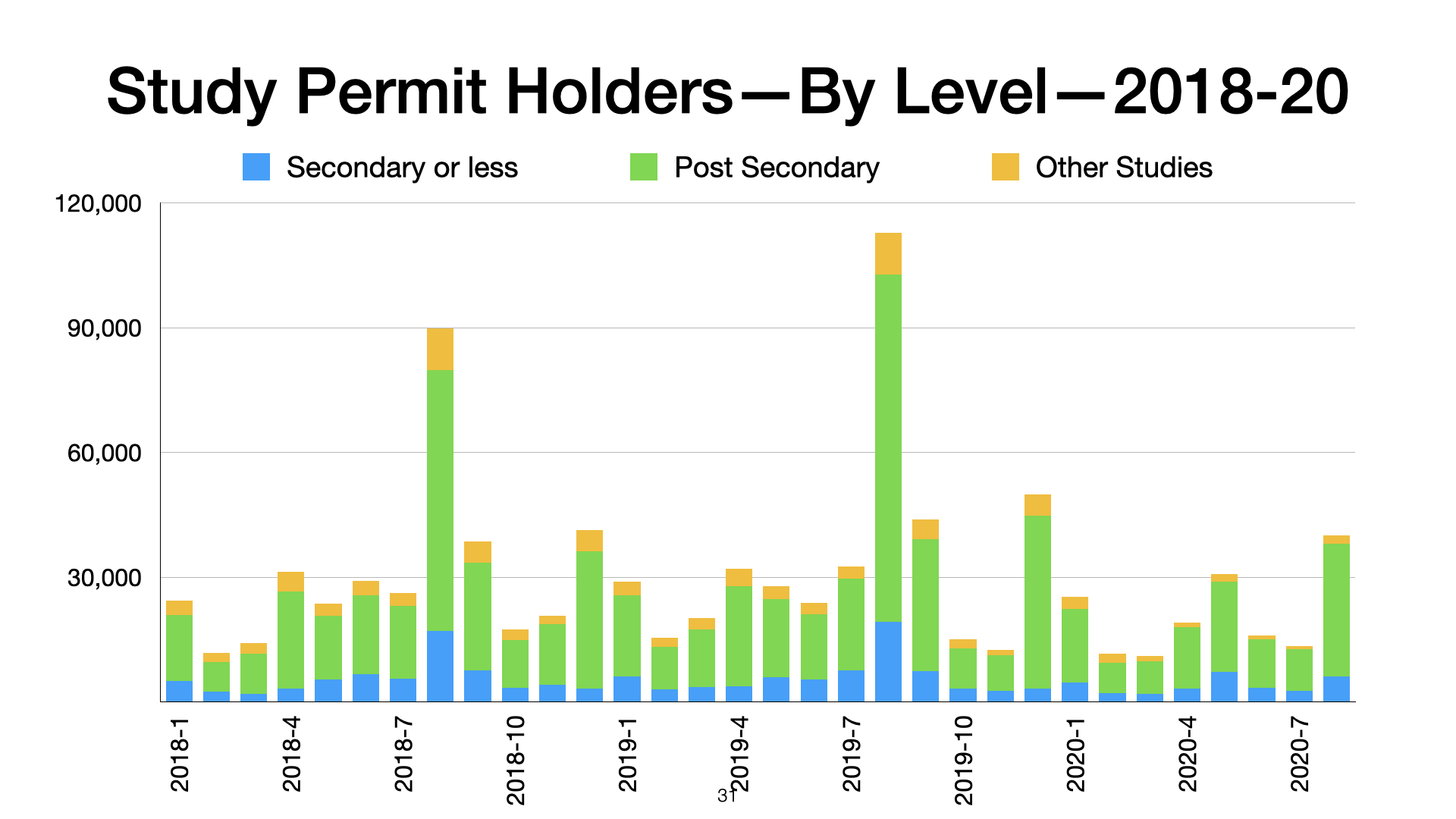
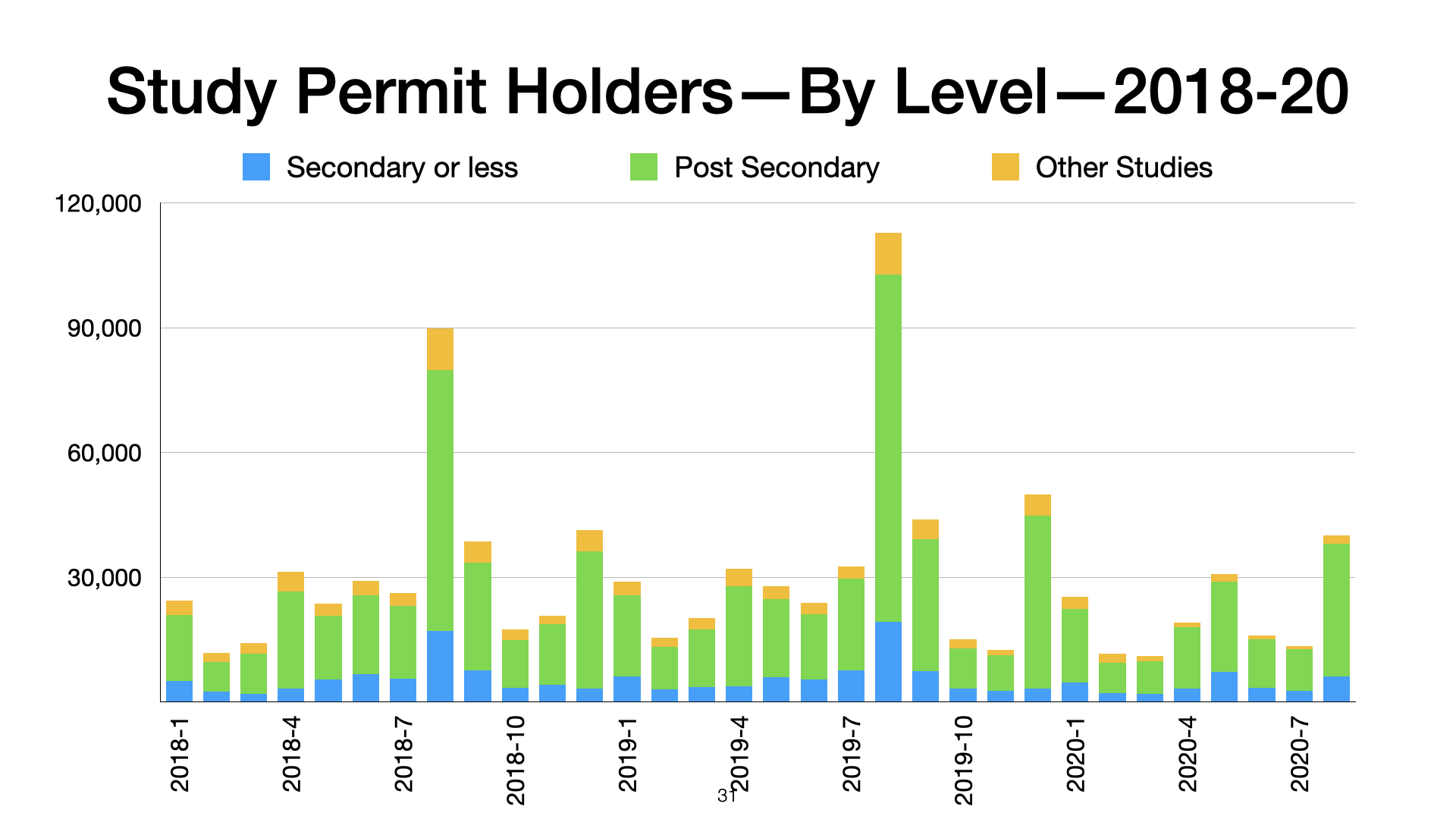
    • Students: Sharp increase from 13,455 in July to 40,130 in August (peak month). However, August year-over-year decrease: 64.5%
      • Applications:  Stable from 3,352 in May to 3,286 in June. June Year-over-year decrease: 91.6%
      • Web “Get a study permit”:  From 67,292 in August to 59,474 in September (outside Canada). September Year-over-year increase: 12.5%
  • Asylum Claimants: Increase from 885 in July to 1,030 in August (about 75% inland). August year-over-year decrease: 83.7%
  • Settlement Services:  Decline from 112,380 in April to 101,415 in May. Year-over-year decrease 9.8 percent
    • Web “Find immigrant services hear you”:  From 13,216 in August to 6,007 in September (outside Canada). September Year-over-year decrease: 57.6%
  • Citizenship: Increase from virtually none in May (53) to 1,656 in June. June Year-over-year decrease: 92.0%.(2019 monthly average was about 20,000)
    • Web “Apply for citizenship”:  From 39,479 in August to 41,263 in September (outside Canada). September 2020-2018 increase: 39.3% 
  • Visitor Visas: Complete shutdown. China authorizations declined faster and sharper