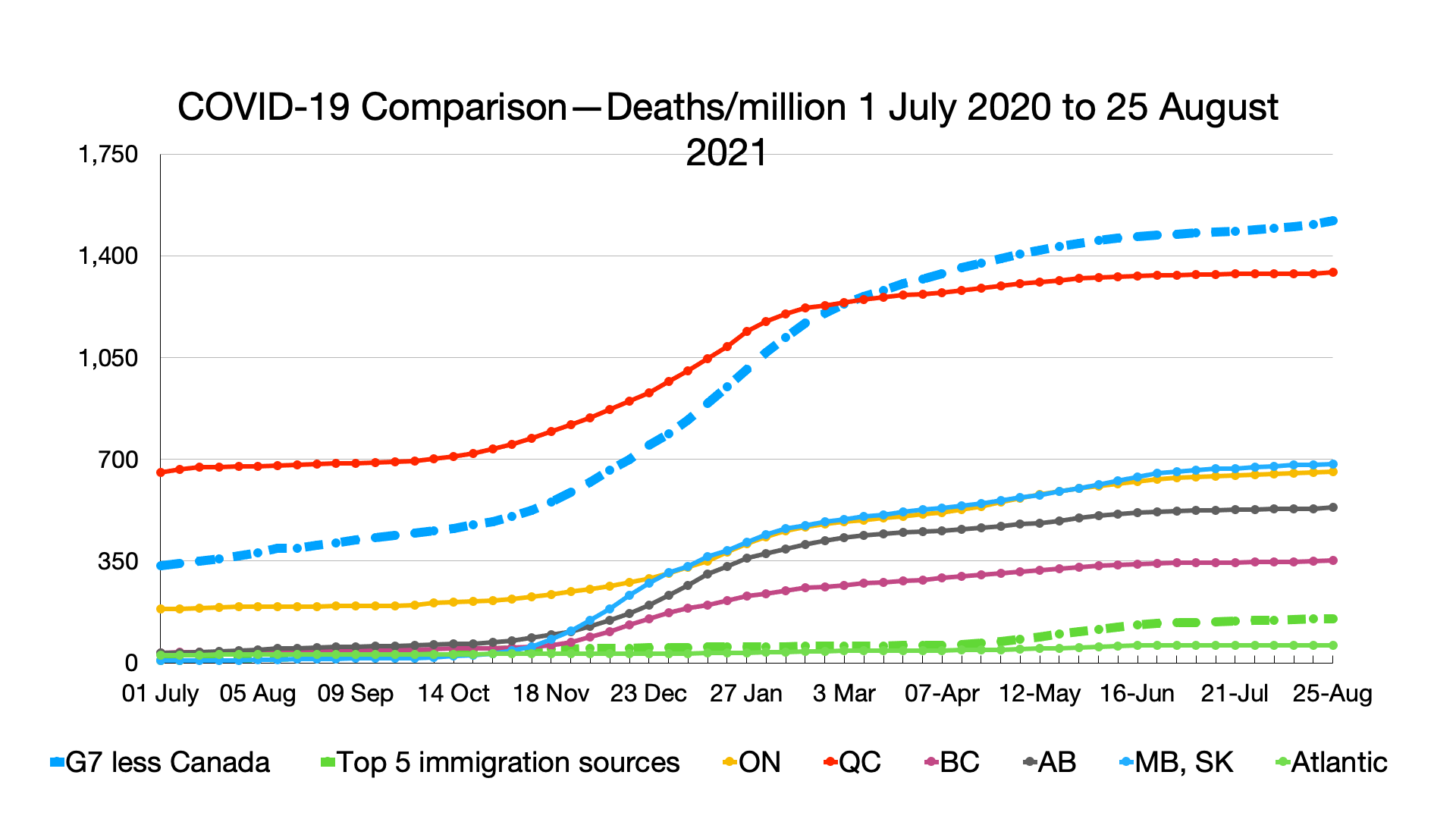
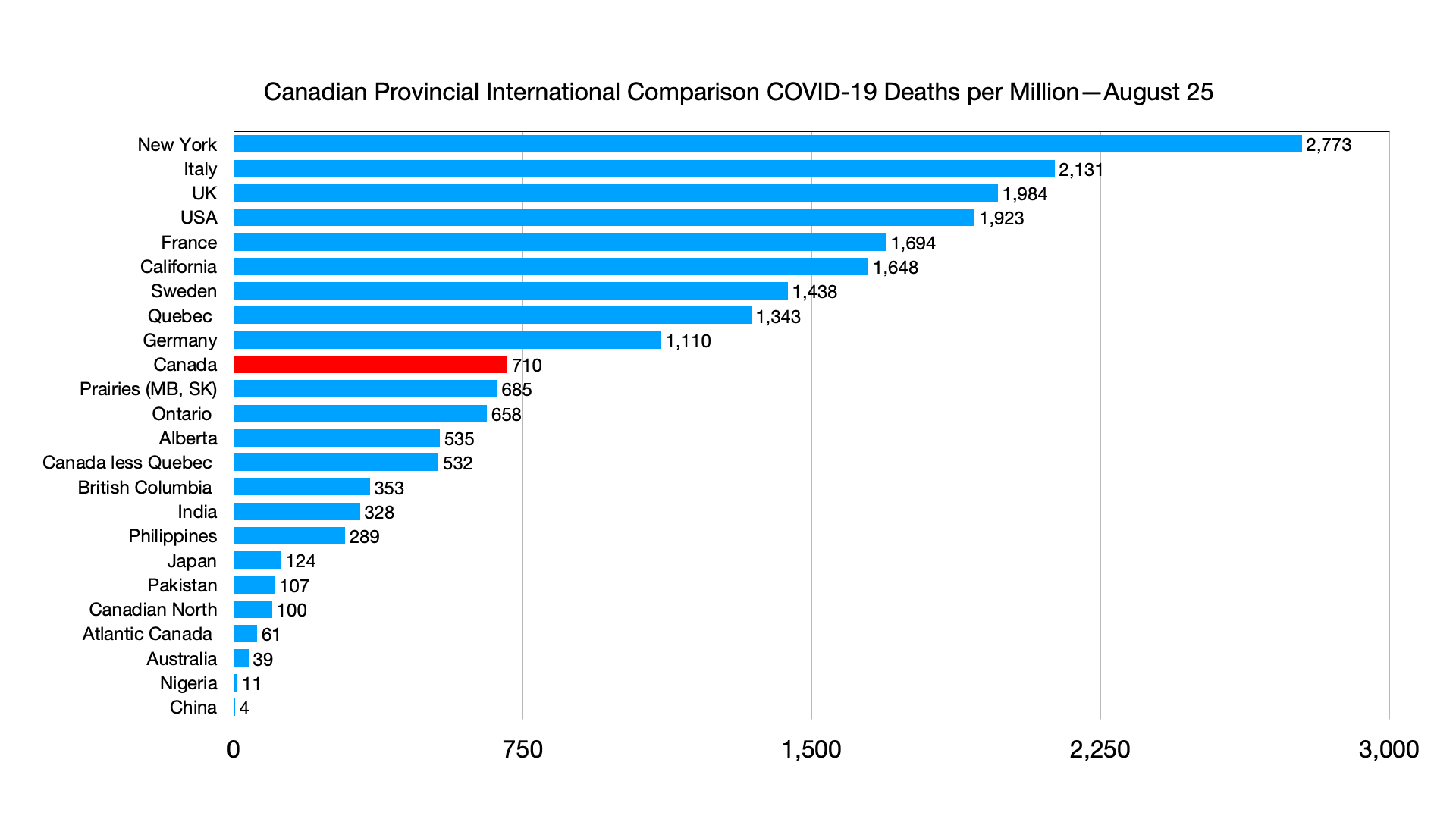
#COVID-19: Comparing provinces with other countries 25 August Update

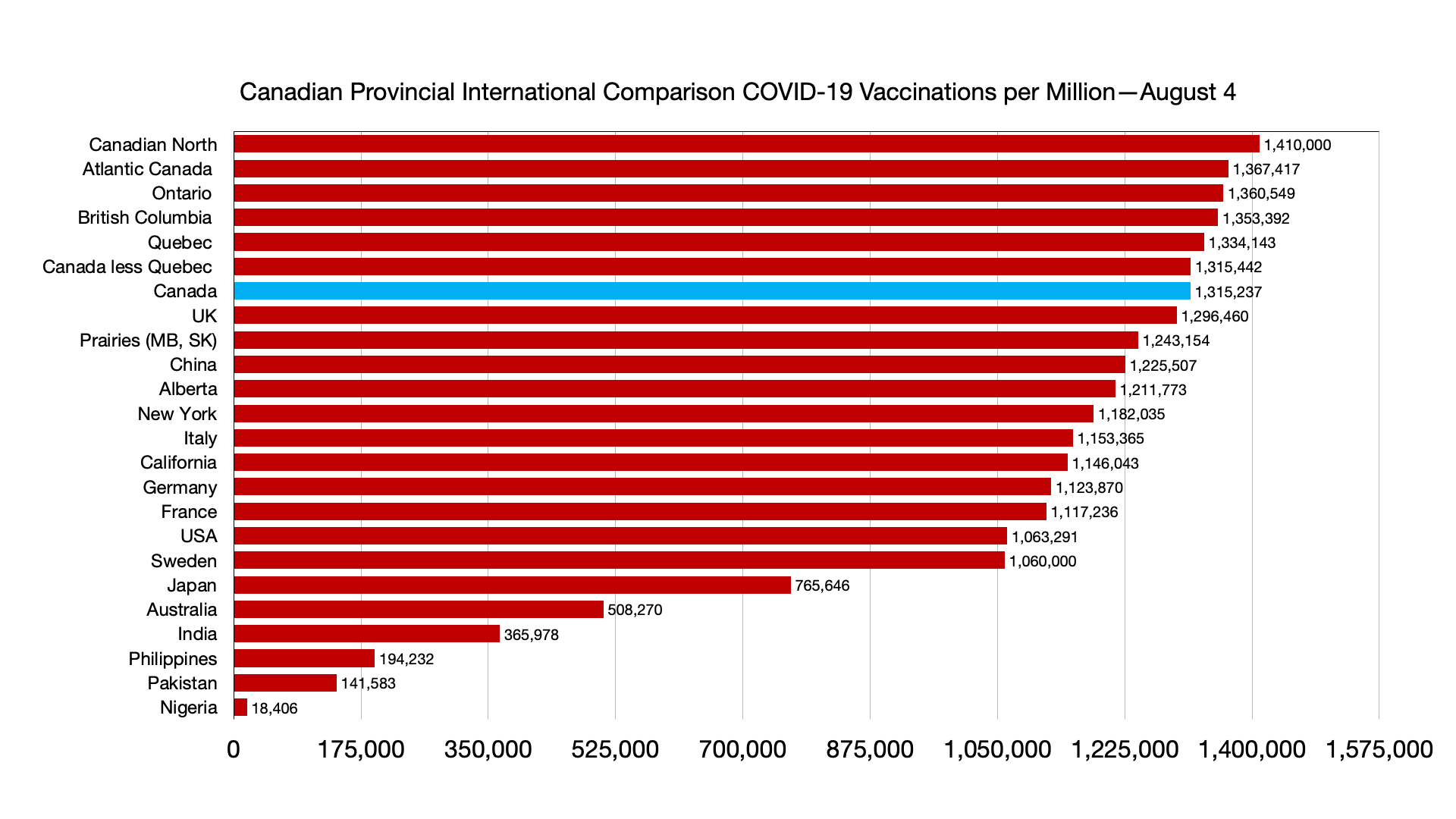
The latest charts, compiled 25 July as overall rates in Canada remain relatively stable but with slight increases due to the variant. Canadians fully vaccinated now 66.4 percent, higher than USA 52.2 percent and the UK 62.8 percent).

Vaccinations: China ahead of Canada and only slightly behind in fully vaccinated, 55.6 percent, if numbers are accurate.

Trendline charts

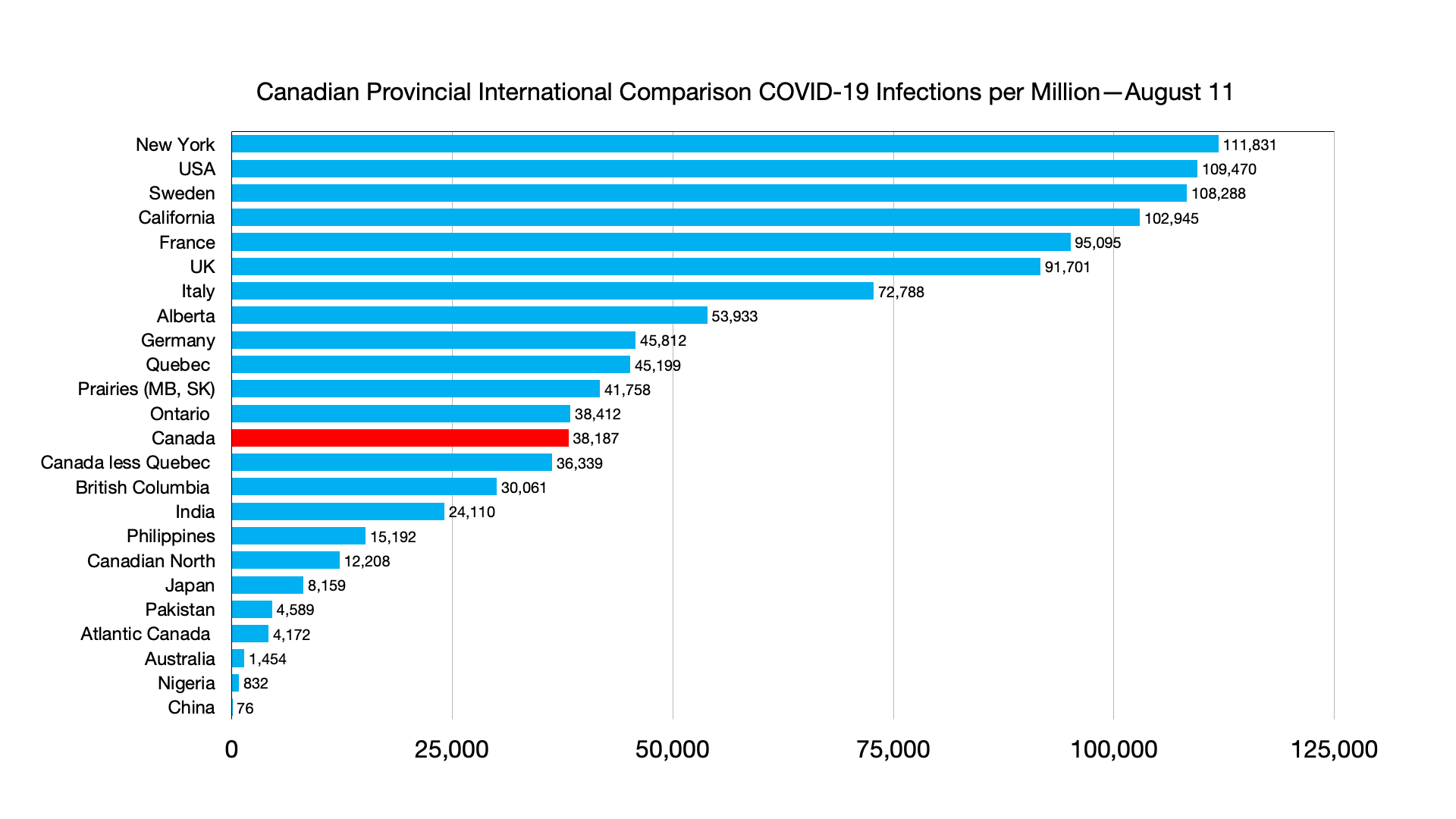
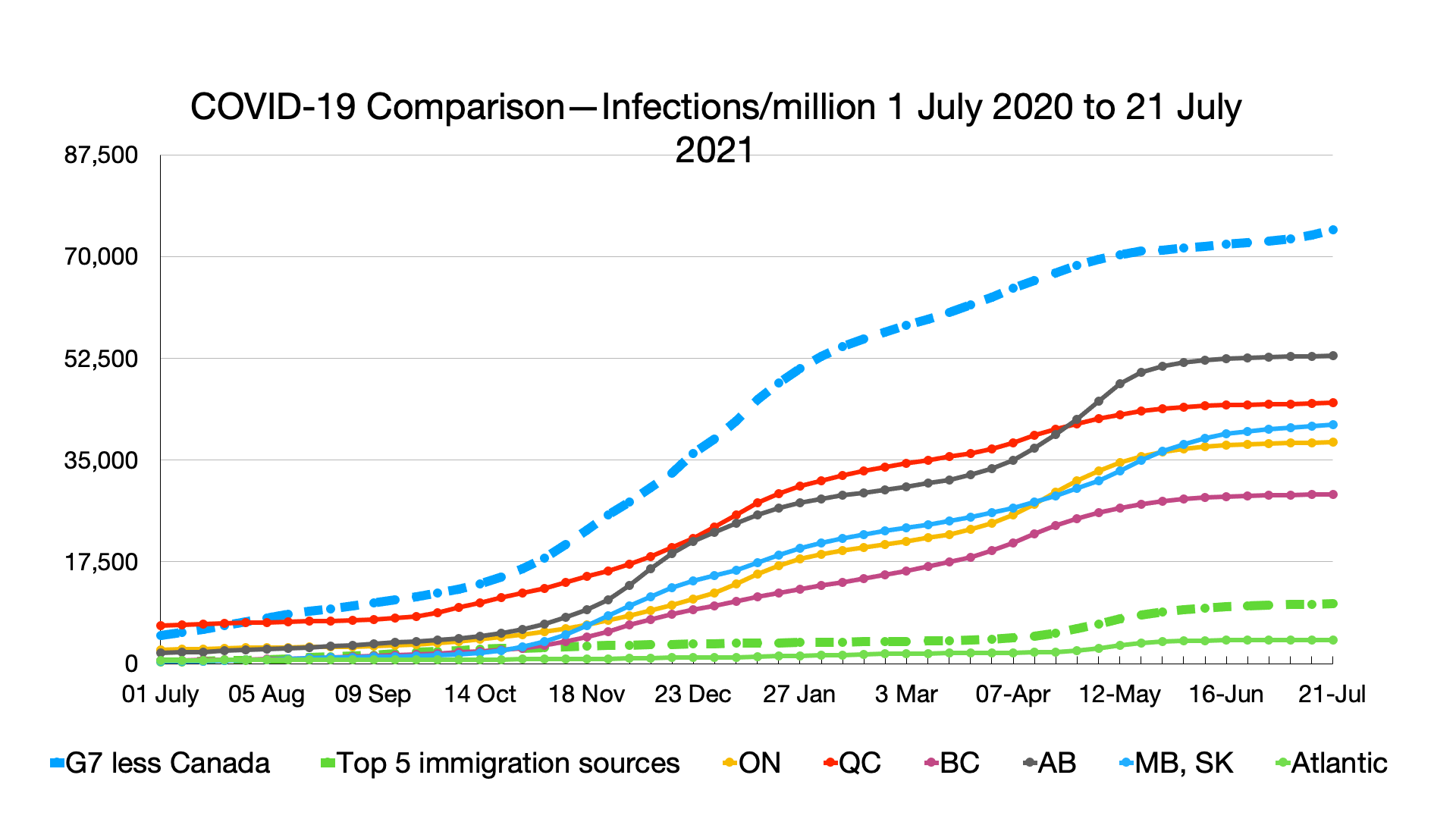
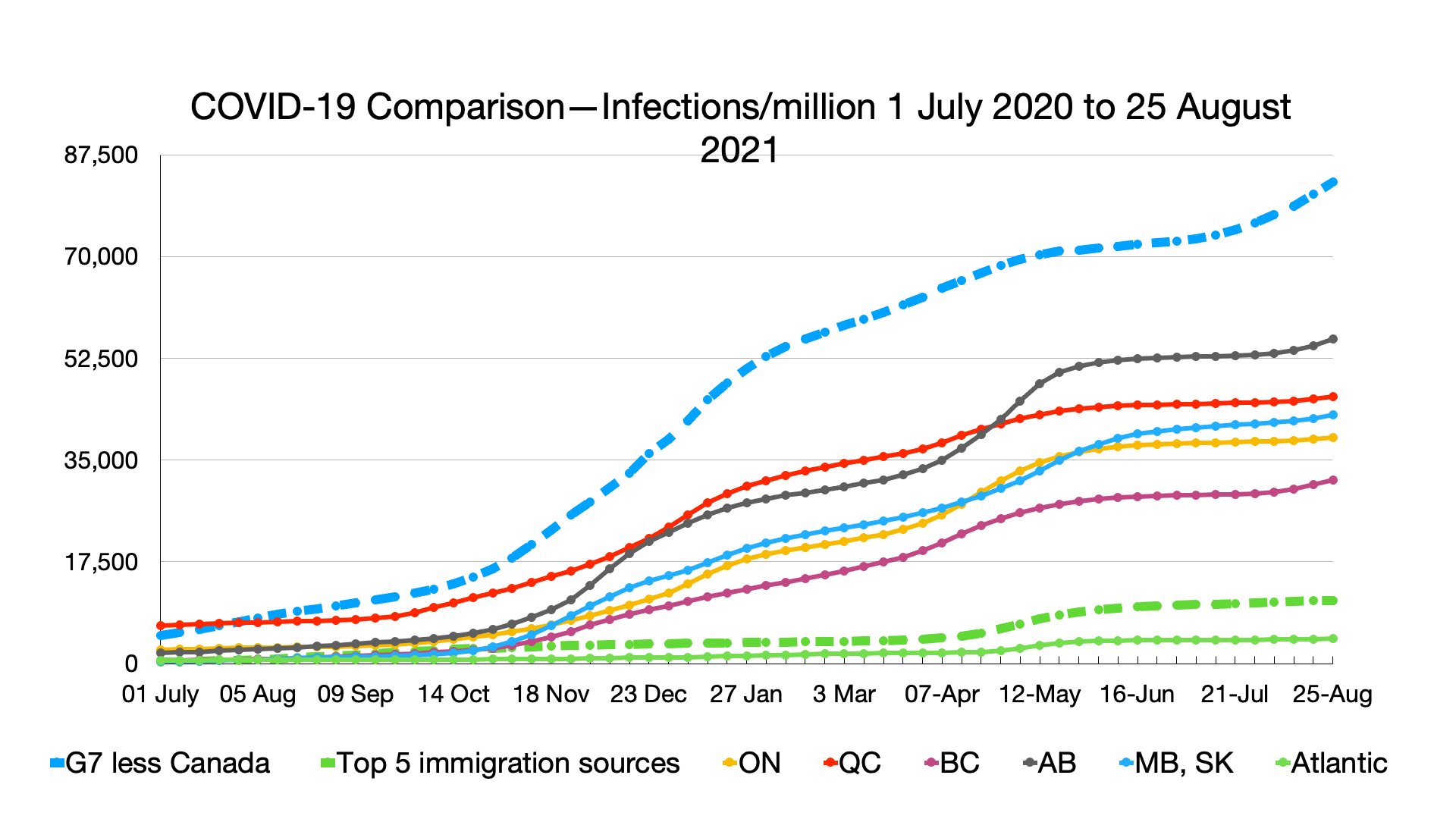
Infections: Same ongoing trend: More pronounced uptick in G7 less Canada (driven largely by USA). While all provinces showing increased infections, greater upticks in Alberta, British Columbia.

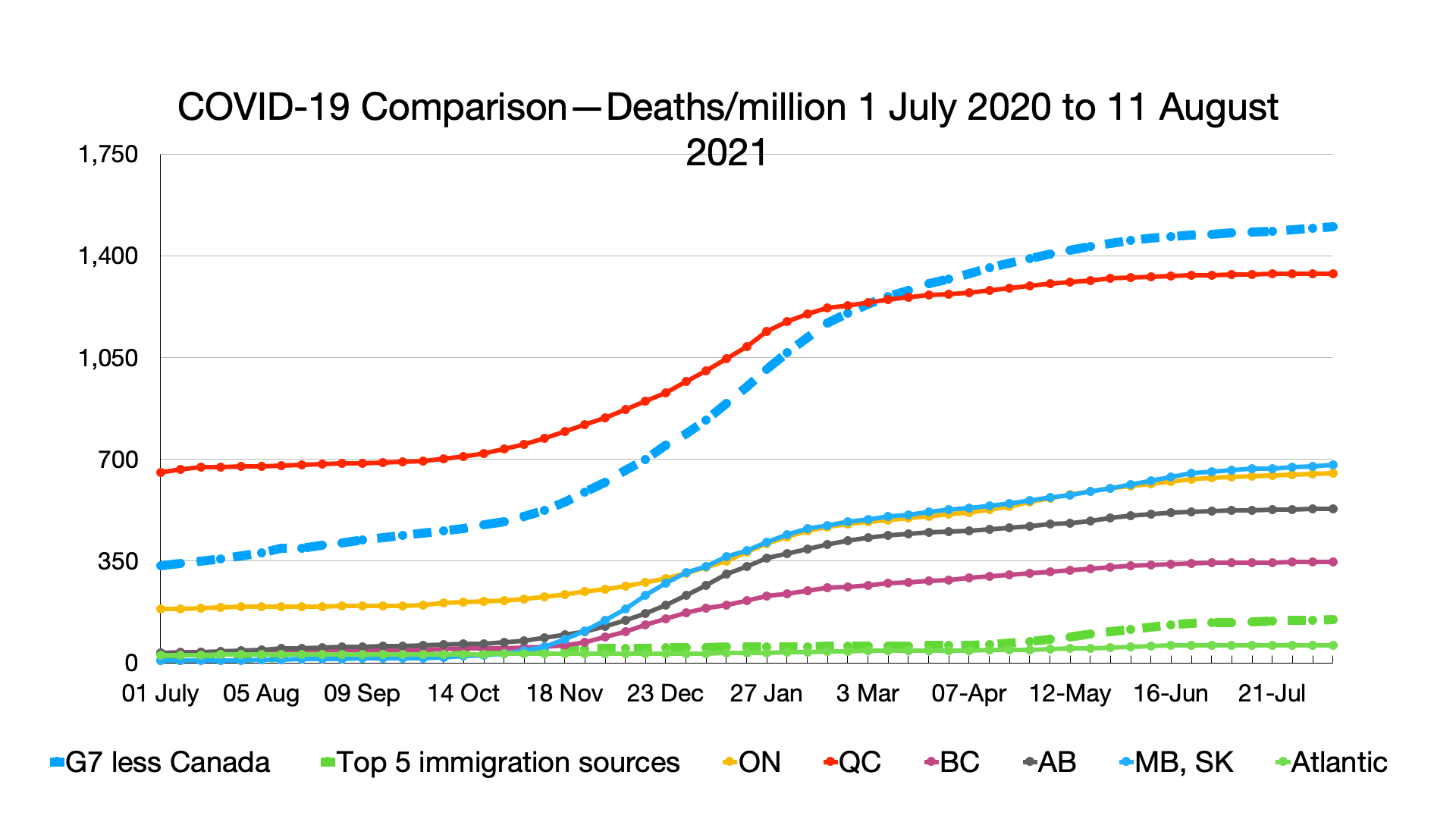
Deaths: No significant change.

Vaccinations: Ongoing steady gap between Alberta and Prairies with lower vaccination rates than elsewhere in Canada, with more pronounced flattening.

Weekly

Infections: No relative change.

Deaths per million: No significant change.

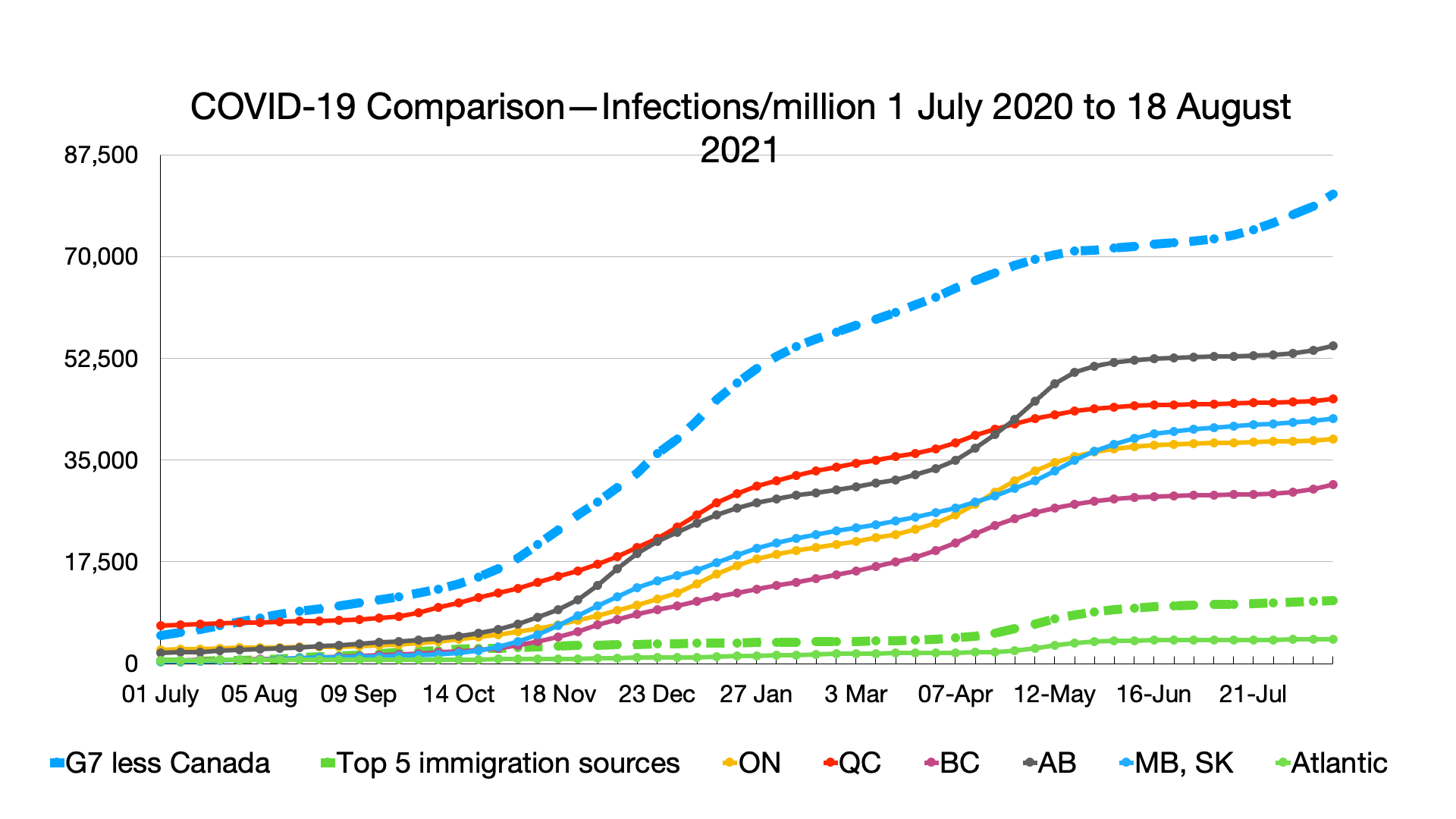
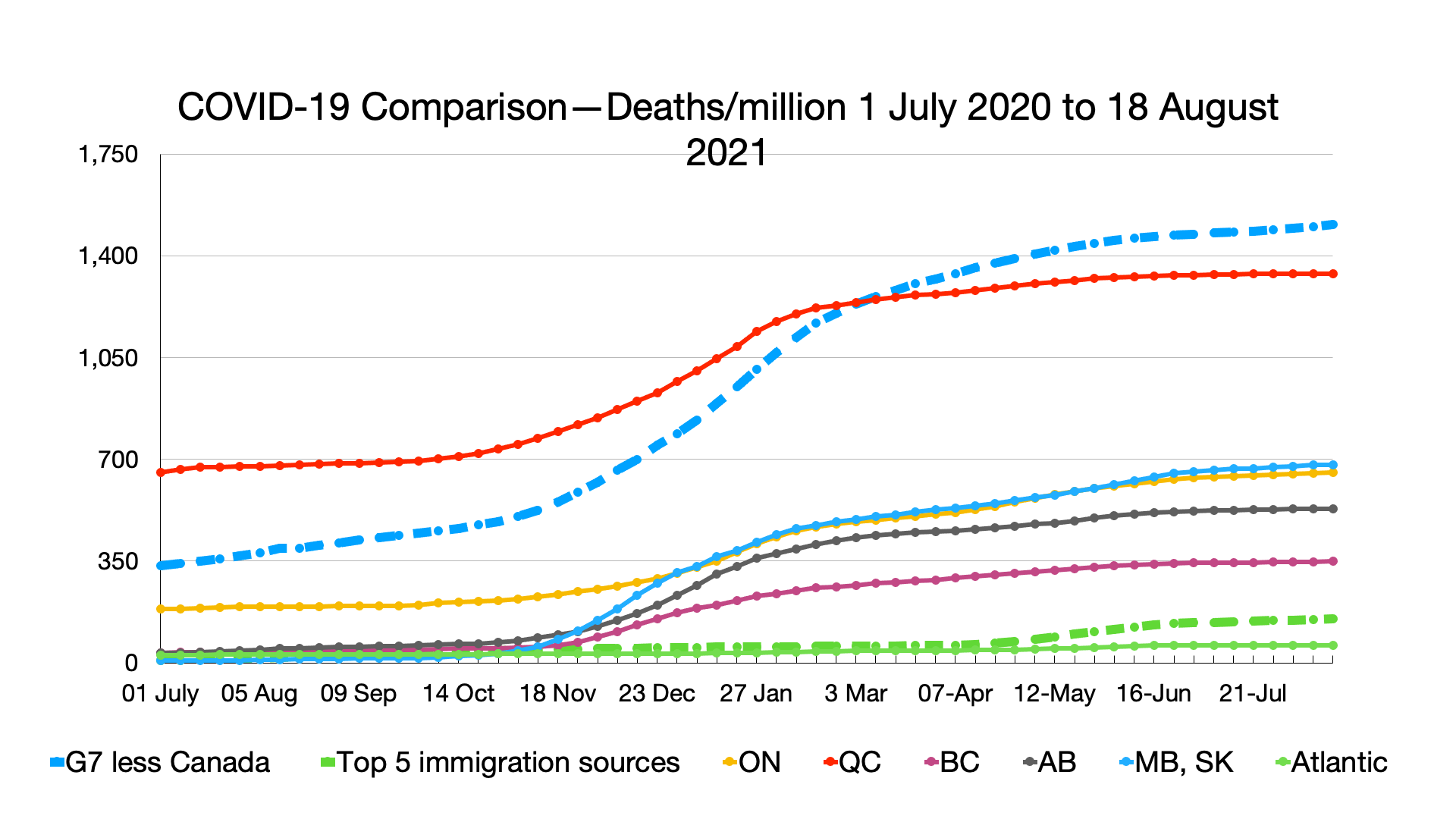
#COVID-19: Comparing provinces with other countries 18 August Update

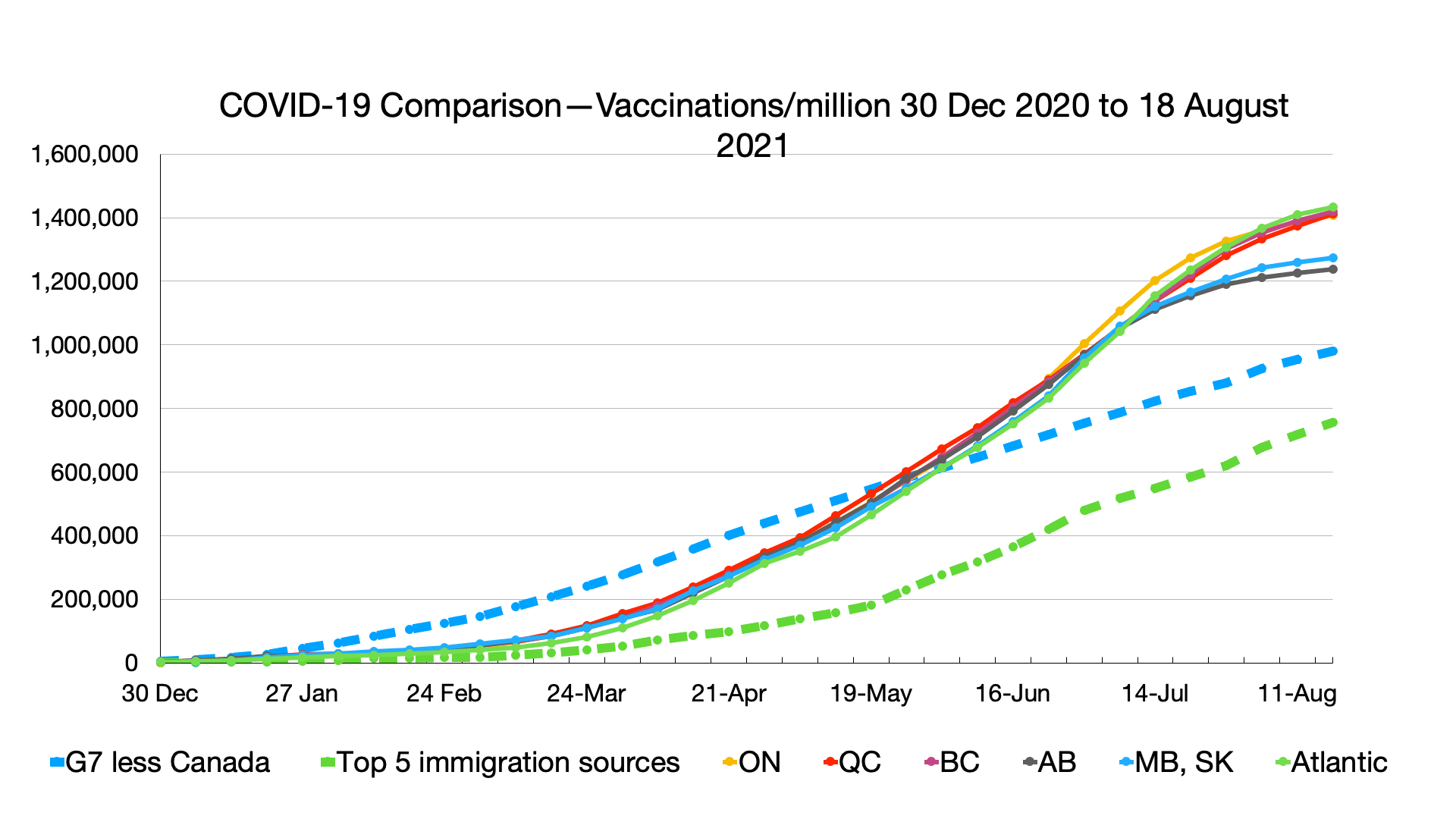
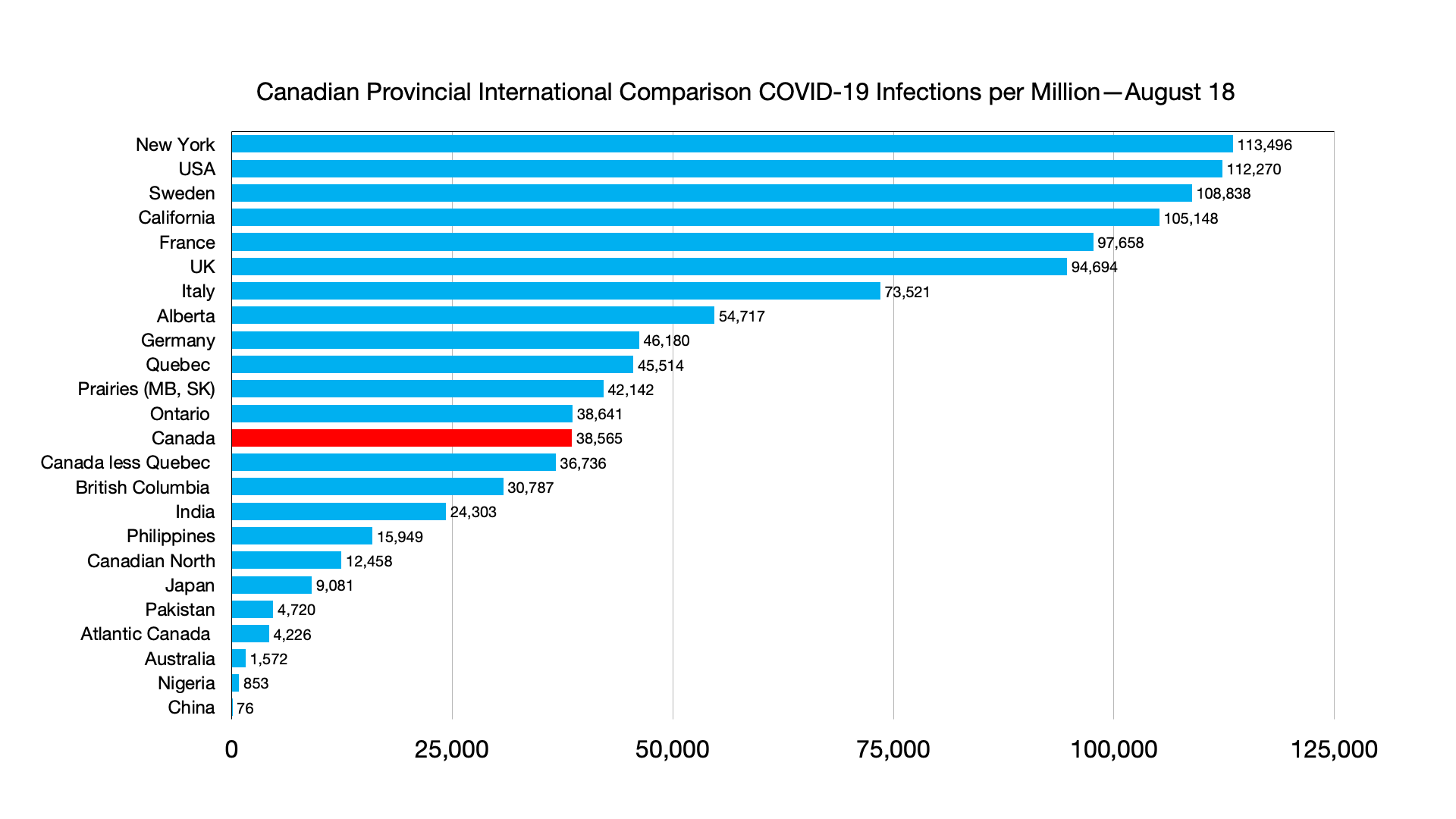
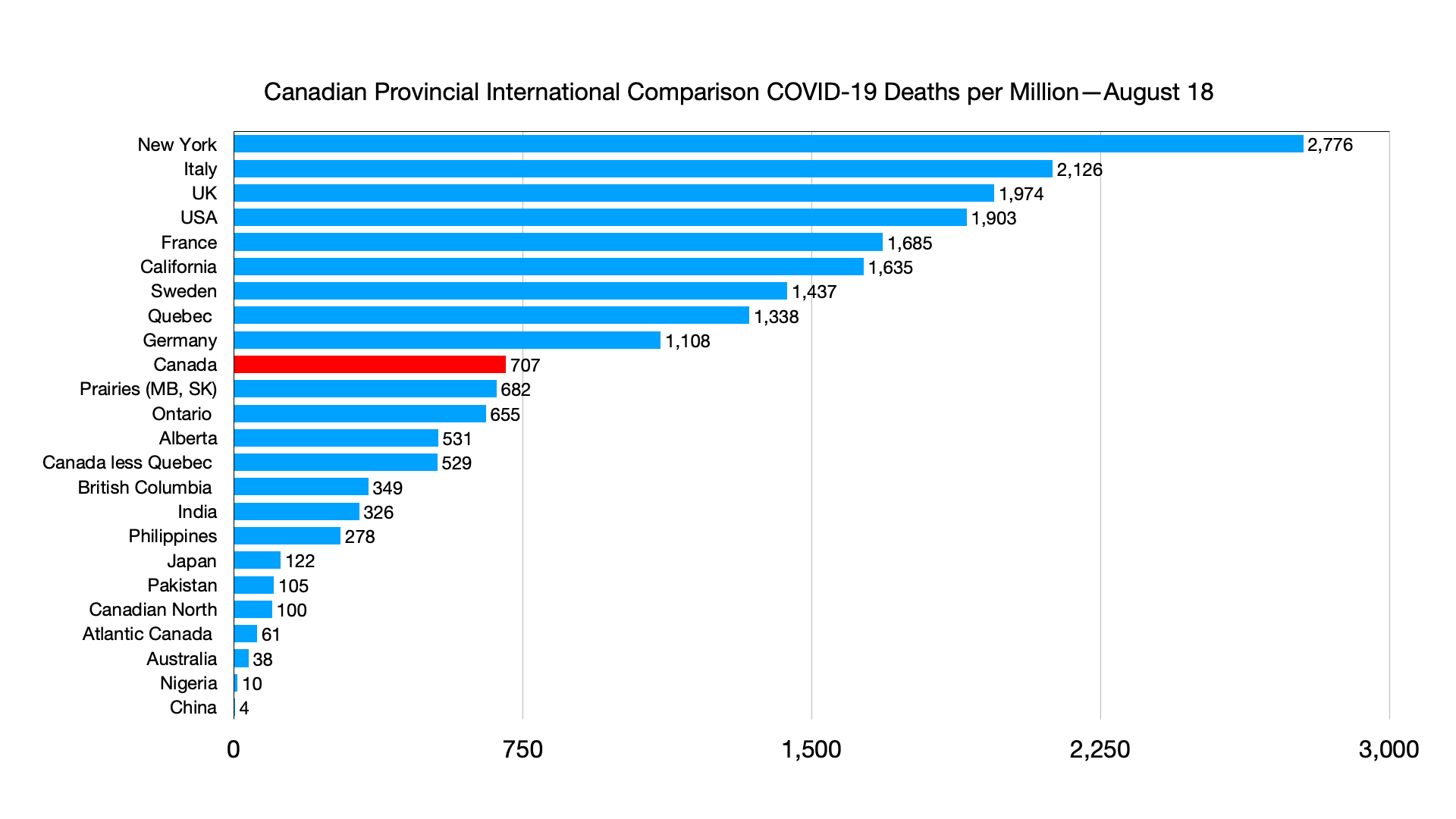
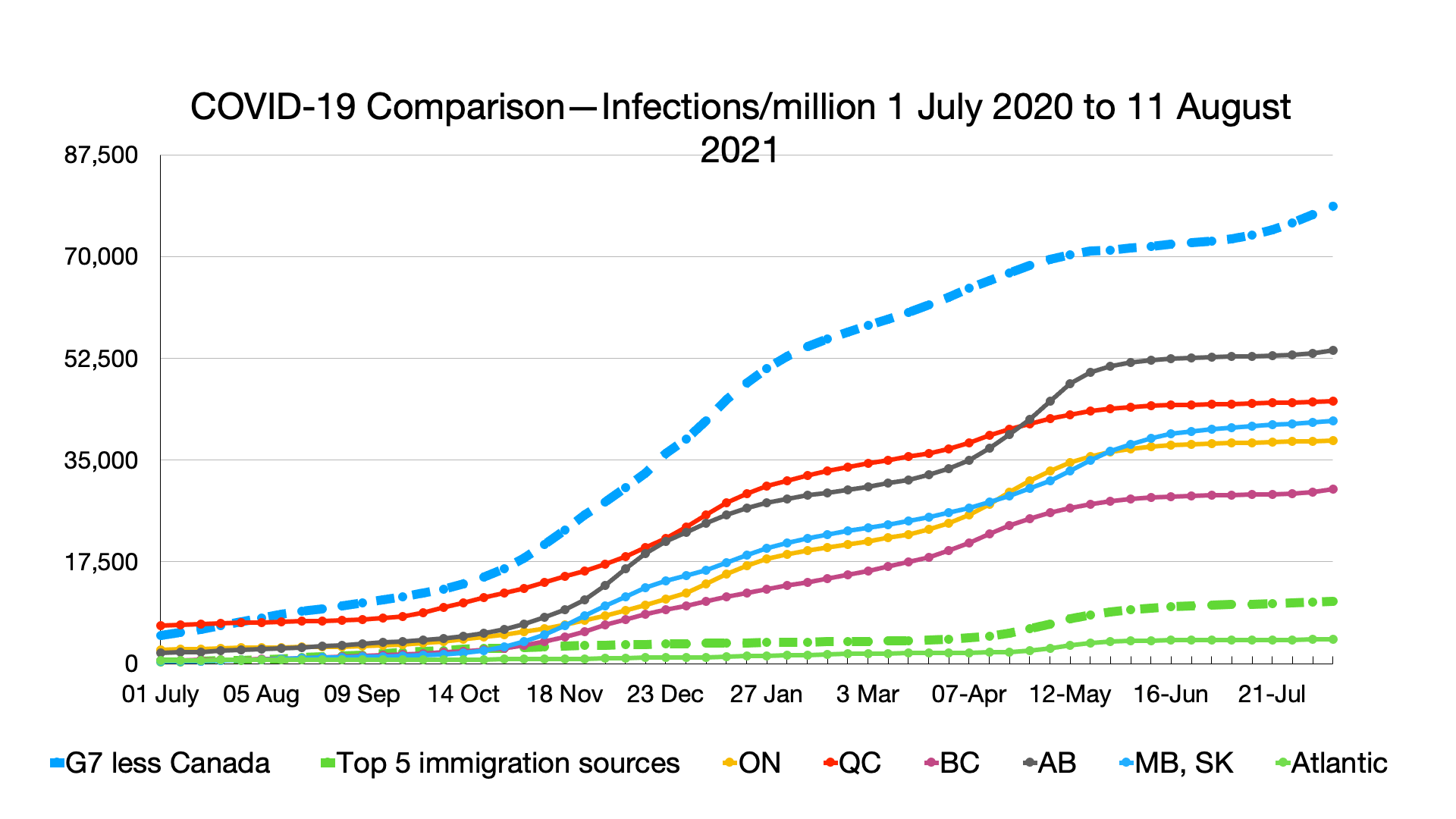
The latest charts, compiled 18 July as overall rates in Canada remain relatively stable but with slight increases due to the variant. Canadians fully vaccinated now 64.8 percent, higher than USA 51.5 percent and the UK 61.1 percent).

Vaccinations: All Canadian provinces ahead of USA and EU countries, China ahead of UK, Alberta and Prairies.

Trendline charts

Infections: Same trends as last week: More pronounced uptick in G7 less Canada (driven largely by USA). While all provinces showing increased infections, greater upticks in Alberta, British Columbia.

Deaths: No significant change.

Vaccinations: Ongoing steady gap between Canadian provinces and G7, immigration source country increase continues to be driven by China (fully vaccinated 55.6 percent, very steep rise since last week) and India (fully vaccinated 9 percent). Flattening of Canadian vaccination rates as reported elsewhere.

Weekly

Infections: No relative change.

Deaths per million: No significant change.

Picard: The troubling Nazi-fication of COVID-19 discourse

Good commentary:

If you spend any amount of time on social media engaging about COVID-19, you will know discussions tend to get personal and ugly pretty fast.

Encourage vaccination of young people, and you’re labelled a pedophile.

Support masking in indoor settings? You’re a goose-stepping fascist.

Laud vaccination as a way out of the pandemic, and you are Joseph Goebbels and should brace yourself to be on trial for crimes against humanity at the fictional Nuremberg 2 tribunal.

Acknowledge that lockdowns are sometimes necessary to control the spread of a pandemic virus, and brace yourself for the onslaught of Hitler images.

These types of responses are predictable to a certain degree.

Godwin’s law (coined by U.S. lawyer Mike Godwin in 1990) holds that as an online discussion grows longer, the probability of a comparison involving Nazis or Hitler becomes more likely.

These days, debates go from zero to Hitler in about a nanosecond.

Some may want to dismiss this kind of over-the-top rhetoric as laughable, the work of a tiny minority of extremists and their bots.

But it’s obscene, and obscenely commonplace.

The Nazi-fication of public discourse is no longer the sole purview of pathetic man-boys holed up in their basements.

Enabled by social-media giants hiding behind freedom-of-speech arguments, trolls can now spread their misogynist, racist and anti-social views readily and mercilessly.

The goal here is to muddy the waters between fact and fiction, between truth and lies, and to undermine democratic institutions.

The grunts of a few can be turned into shouts that unfortunately have a growing audience, especially among the disgruntled and disenfranchised.

Playing the victim card appeals to them.

The ragtag collection of conspiracy theorists who gather at anti-mask, anti-vaccine, anti-lockdown rallies is fascinating – a stinking potpourri of grievances, with denunciations of everything from vaccines to “fake news,” to 5G, to the so-called “deep state.”

These rallies – which are getting bigger as pandemic frustrations grow – have more than their fair share of Hitler talk and imagery. They also include people wearing the yellow Star of David, implying that being told to wear a mask or get a jab is a level of persecution comparable to Jews who were rounded up and shipped in cattle cars to death camps.

Clearly some people have lost the plot.

Yet, they are being encouraged by politicians who embrace rhetoric suggesting that a position is invalid because the same view was held by Hitler.

A case in point is odious Ontario MPP Randy Hillier, who claims that lockdowns, mask rules and vaccine mandates are forms of Nazi-like tyranny.

His perverse version of freedom holds that individual rights are absolute, and that, for example, unvaccinated people have a God-given right to do as they please up to and including infecting others with the coronavirus.

Mr. Hillier and his acolytes have made a habit of casually tossing around Nazi analogies and Hitler images.

This mainstreaming of hateful images and thinly veiled hate speech should alarm us on a number of levels.

First of all, it betrays a profound ignorance of the Holocaust.

There can be no comparisons made between the state-sponsored mass murder of six million people and the temporary shutdown of the local mall.

Those who have the unmitigated gall to wear yellow stars to anti-mask rallies offend the memory of the victims of the Shoah and their descendants.

It is worth noting that Mr. Godwin, when he fashioned his adage, actually wanted people to think harder about the Holocaust and why Nazi comparisons should not be casually tossed into conversation.

Thinking is certainly not what’s happening here.

What we’re seeing is a lot of projection, the psychological impulse to project on other people what you’re actually feeling.

Former U.S. president Donald Trump, sometimes called the “Projection President,” was the embodiment of this phenomenon.

Mr. Trump, a chronic liar who wallowed in corruption, routinely attacked his opponents as corrupt liars. He also frequently described his opponents in a derogatory fashion, a lynchpin strategy of hate-mongers, and now a mainstay of social media.

Next time you hear the claims of Nazi-like tyranny and oppression, think about what is really being said.

Those who don’t want masks under any circumstances – those who not only want to refuse vaccines but prevent others from getting them – are actually the tyrants.

Their use of Hitler images and analogies are not a caution, but an embrace, one we should call out, not dismiss casually.

Source: https://www.theglobeandmail.com/opinion/article-the-troubling-nazi-fication-of-covid-19-discourse/

COVID-19 Immigration Effects: June 2021

Regular monthly update of impact of COVID on the suite of immigration programs: Permanent Residents, Temporary Residents, Asylum Seekers, International Students, Settlement Services, Citizenship and Visitor Visas. 

The major change is with respect to Permanent Resident Admissions, which have more than doubled from 17,085 in May to 36,625 in June for all three classes. Compared to June 2019, however, only the Economic class increased. (Minister Mendicino just revealed that July admissions are close to 40,000, indicating government was well on its way to meeting this year’s questionable target of 401,000 new Permanent Residents). 

Close to three-quarters of new Permanent Residents were former Temporary Residents transitioning. 

Temporary Residents (International Mobility Program) were up significantly while Temporary Foreign Worker Program was stable. 

Study permit applications and permits also increased, both on a year-over-year basis as well as compared to 2019. 

While the number of new citizens has increased compared to May, compared to 2019 the numbers are down by over half.

#COVID-19: Comparing provinces with other countries 11 August Update

The latest charts, compiled 11 July as overall rates in Canada remain relatively stable but with slight increases due to the variant. Canadians fully vaccinated now 62.7 percent, higher than USA 50.8 percent and the UK 59.4 percent).

Vaccinations: All Canadian provinces ahead of USA and EU countries, UK and China now ahead of Alberta and Prairies.

Trendline charts

Infections: More pronounced uptick in G7 less Canada (driven largely by USA). While all provinces showing increased infections, greater upticks in Alberta, British Columbia.

Deaths: No significant change.

Vaccinations: Ongoing steady gap between Canadian provinces and G7, immigration source country increase continues to be driven by China (fully vaccinated still at 16 percent) and India (fully vaccinated 8.5 percent). Flattening of Canadian vaccination rates as reported elsewhere.

Weekly

Infections: No relative change.

Deaths per million: No significant change.

#COVID-19: Comparing provinces with other countries 4 August Update, China’s Delta variant

The latest charts, compiled 4 July as overall rates in Canada remain relatively stable but with slight increases due to the variant. Canadians fully vaccinated now 59.8 percent, higher than USA 50.3 percent and the UK 57.2 percent).

Vaccinations: All Canadian provinces ahead of USA and EU countries, all but Prairies ahead of UK.

Trendline charts

Infections: No significant change but slight uptick in G7 less Canada more apparent given increased infections in UK and USA. The outbreak of the Delta variant in China and consequent lockdowns is covered in the article following the charts.

Deaths: No significant change.

Vaccinations: Ongoing steady gap between Canadian provinces and G7, immigration source country increase continues to be driven by China (fully vaccinated 16 percent) and India (fully vaccinated 7.6 percent).

Weekly

Infections: No relative change.

Deaths per million: No significant change.

China now grappling with the Delta variant with Wuhan under lockdown:

China’s spiraling Delta variant outbreak has reached Wuhan, the original epicenter of the pandemic, prompting citywide coronavirus testing as authorities scramble to contain the city’s first reported local infections in more than a year.China is grappling with its worst outbreak in months, with more than 300 cases detected in more than two dozen cities across the country. The country now has 144 medium- and high-risk areas, the most since the initial outbreak in early 2020, the National Health Commission said Wednesday.The speed and scale of the spread has spurred mass domestic travel restrictions, with all inter-city coach, taxi and online car hailing services suspended in medium- and high-risk areas. Chinese immigration authorities have also vowed to “strictly restrict non-urgent, unnecessary cross-border travel,” including tightening the issuing of passports for Chinese citizens.
On Monday, seven infections were reported among migrant workers in Wuhan, the central Chinese city where the coronavirus was first detected in December 2019. As of Wednesday, a total of 20 local infections have been reported, including 8 asymptomatic cases, according to the Hubei provincial health commission.

The city of 11 million people was placed under the world’s first and arguably strictest coronavirus lockdown in January 2020, during the height of its devastating initial outbreak. The paralyzing 76-day lockdown came at a huge personal cost to residents, but eventually succeeded in taming the virus. Wuhan had not reported any locally transmitted cases since May last year.

Despite the initial mishandling, the Chinese government has heralded Wuhan as a success story in its fight against the pandemic. In August 2020, as much of the world grappled with Covid-19, Wuhan made international headlines when it held an electronic music festival in an open air water park, with thousands of people partying without any masks or social distancing measures in sight. 

Some fear the return of a stringent lockdown. Videos and photos shared on social media Monday show empty shelves and long lines at supermarkets, as residents rushed to stock up daily supplies.”Seeing Wuhan people panic buying at supermarkets makes me feel sad. Only those who have experienced it understand how terrible it is, (we) dread a return to the days of staying at home and not knowing where the next meal is,” said a Wuhan resident on Chinese microblogging site Weibo.During Wuhan’s initial lockdown, millions of residents were ordered to stay in their homes, relying on officials and volunteers for daily necessities — often at a higher price.As of Wednesday, no citywide lockdown has been announced for Wuhan, although residential compounds linked to detected cases have been placed under targeted lockdowns.

Spiraling outbreak

The ongoing outbreak first started in Nanjing, Jiangsu province in eastern China, where nine airport cleaners were found to be infected on July 20 during a routine test. Chinese authorities have linked the cluster to a flight from Russia, which arrived at the Nanjing Lukou International Airport on July 10. 

“It is believed that the cleaners did not strictly follow anti-epidemic guidelines after cleaning Flight CA910 and contracted the virus as a result. The infection further spread to other colleagues, who are also responsible for cleaning and transporting garbage on both international and domestic flights,” reported state news agency Xinhua.

Since then, the cluster has spread to at least 26 cities, including the tourist hot spot Zhangjiajie and the capital Beijing. In just two weeks, China has reported more than 480 locally transmitted confirmed cases, according to a CNN tally of the National Health Commission’s daily reports. Not all infections have so far been directly linked to the cluster in Nanjing.

On Monday, 63 local infections, including 50 asymptomatic cases, were reported in Zhengzhou, the provincial capital of Henan province which was ravaged by deadly floods last month. Most cases are linked to an outbreak at a hospital, where janitors, medical staff and patients are among those infected. The city launched citywide testing Sunday.

The fast spreading Delta variant has posed a major challenge to China’s hardline zero Covid strategy, which relies on mass testing, targeted lockdowns, extensive contact tracing and strict quarantine measures to quickly suppress local flare-ups.

China responded by doubling down on its containment approach, adopting stringent measures on a scale not seen in months. Several cities have been placed under effective lockdowns, ordering residents to stay in their homes and canceling flights and trains. The country has also imposed massive nationwide travel restrictions. All provincial authorities have urged citizens not to travel to medium and high-risk areas or leave the provinces where they live unless it is strictly necessary. 

The Chinese government is particularly concerned about the spread of the virus to Beijing, which is set to hold the Winter Olympics in February next year. The city has reported a handful of cases since last week — its first coronavirus resurgence in months. 

Beijing authorities have banned people from medium- or high-risk areas from entering, suspending flights, trains and buses from Covid-hit places. Since Tuesday, 23 railway stations have halted ticket sales for train rides heading to the capital, Xinhua reported.

Chinese authorities are also tightening restrictions on cross-border travel. China is still largely closed off from the outside world, and those who are allowed to enter are subject to lengthy hotel quarantine. At a press conference Wednesday, an official with the National Immigration Administration said authorities would stop issuing travel documents, such as passports, for Chinese citizens who want to leave China for “non-urgent, unnecessary” reasons. Individuals who need to travel overseas for study, work or business purposes would still be issued travel documents upon approval, he added. 

Mahjong parlors

China reported 71 locally transmitted confirmed cases On Wednesday, with nearly half of them coming from Jiangsu province, according to the National Health Commission. The city of Yangzhou, neighboring Nanjing, has become the latest hotspot, reporting 32 local infections.Authorities have blamed the outbreak in Yangzhou on a 70-year-old Nanjing resident, who traveled to Yangzhou on July 21 despite her residence in Nanjing had been placed under a lockdown, according to a statement from the Yangzhou police.The elderly woman, who stayed in Yangzhou with her sister, did not inform local officials of her travel history as required, and repeatedly visited crowded places including restaurants, markets and mahjong parlors, the statement said.The woman sought treatment at a hospital on July 27 after she started coughing and developed a fever, and tested positive for coronavirus a day later. She has been criminally detained by police and is under investigation for suspected obstruction of the prevention and control of infectious diseases, according to the statement.

Mahjong parlors, popular with older people, have played a central role in the spread of Covid in Yangzhou, according to authorities. On Wednesday, Jiangsu officials said at a press conferencethat 64% of Yangzhou’s 94 confirmed cases as of Tuesday were linked to Mahjong parlors, and 68% of confirmed cases are above 60 years old. Both Yangzhou and Nanjing have conducted several rounds of citywide testing, and suspended all domestic flights, long-distance buses, taxis and online car hailing services from arriving and departing.

Source: https://www.google.com/url?sa=t&rct=j&q=&esrc=s&source=web&cd=&cad=rja&uact=8&ved=2ahUKEwia6cWm95fyAhVNMlkFHVudBGgQFnoECAkQAw&url=https%3A%2F%2Fwww.cnn.com%2F2021%2F08%2F04%2Fchina%2Fchina-delta-outbreaks-intl-hnk%2Findex.html&usg=AOvVaw3PoVYncfFvnc5YrT6b2bw5

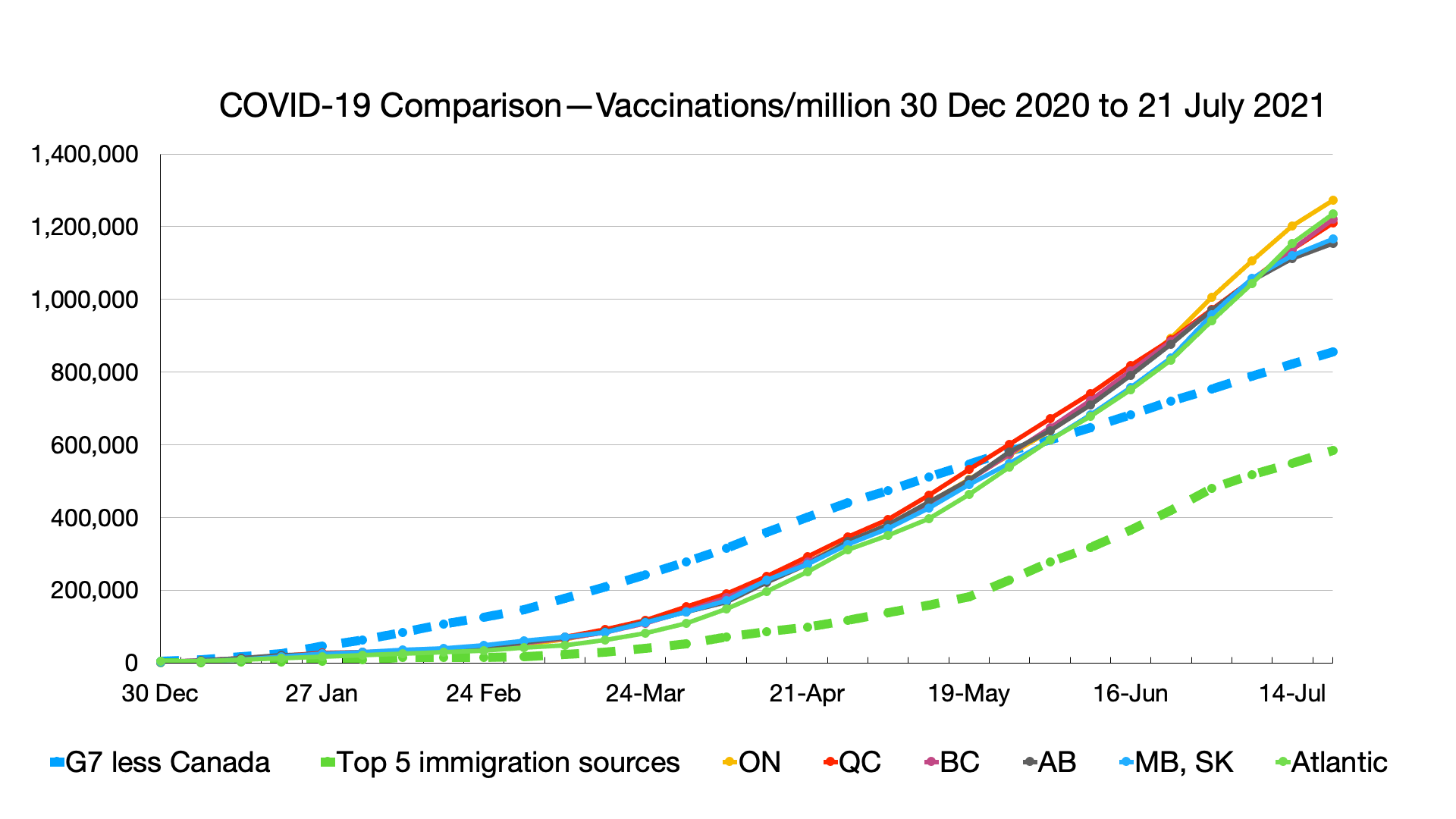
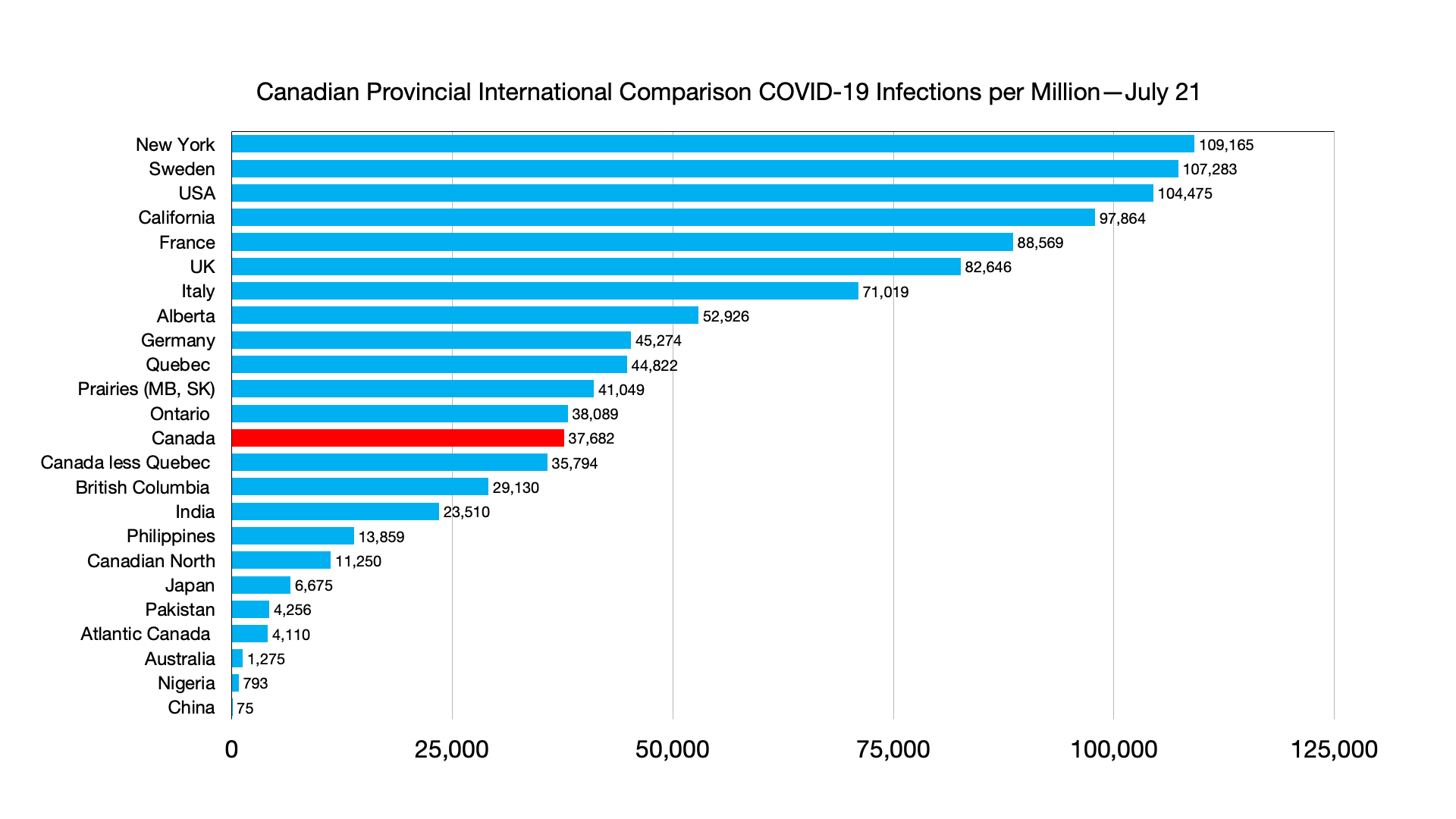
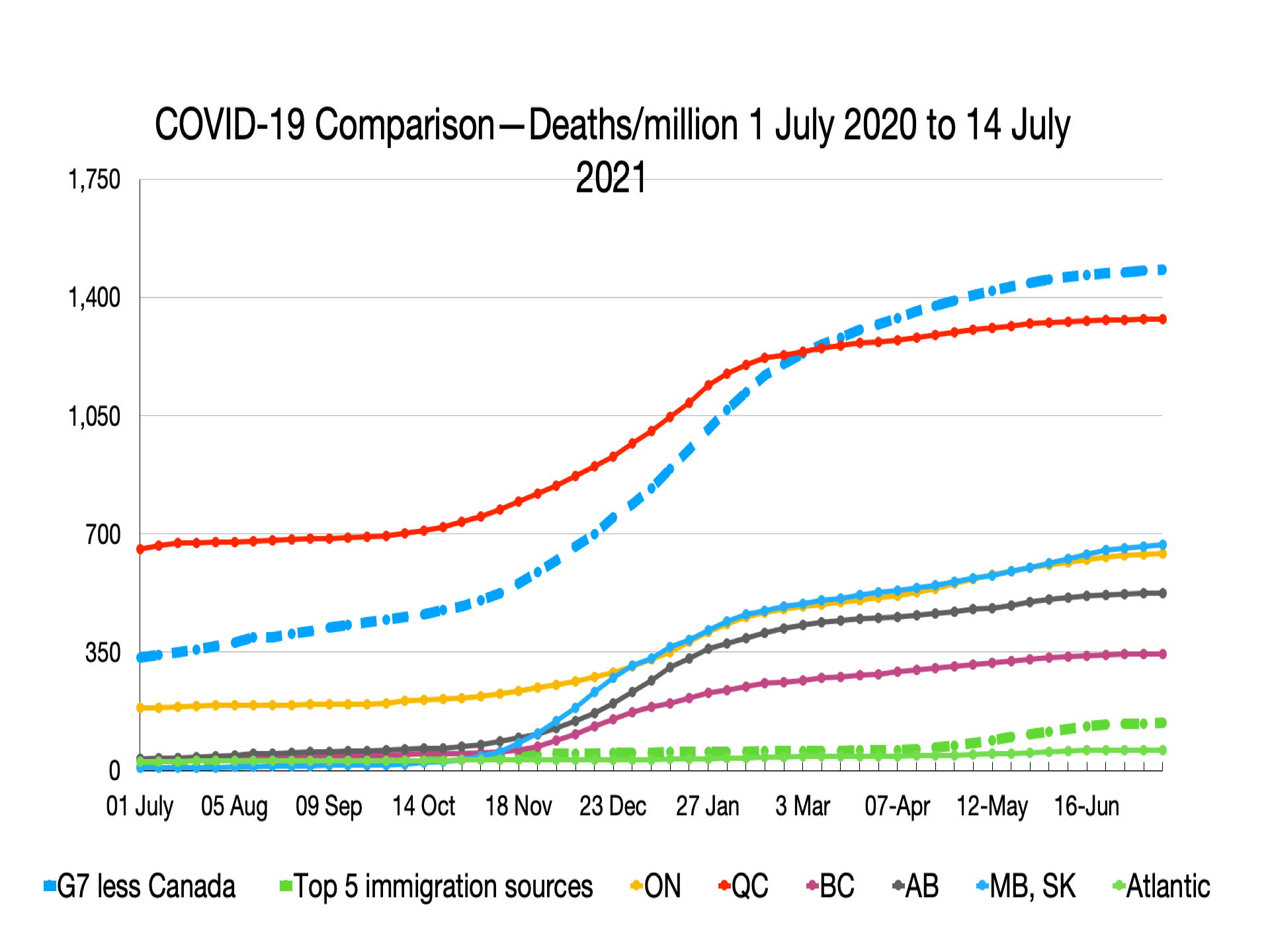
#COVID-19: Comparing provinces with other countries 21 July Update, India unreported cases

The latest charts, compiled 21 July as overall rates in Canada continue to decline along with increased vaccinations (Canadians fully vaccinated 51.7 percent, higher than USA 49.2 percent and and just behind UK 54.2 percent).

Vaccinations: All Canadian provinces ahead of USA and EU countries.

Trendline charts

Infections: No significant change but slight uptick in G7 less Canada given increased infections in UK and USA.

Deaths: No significant change.

Vaccinations: Captured above, with steady gap between Canadian provinces and G7.

Weekly

Infections: No relative change.

Deaths per million: No significant change.

Interesting and relevant analysis of India’s under-counting of COVID-19 cases:

India’s excess deaths during the pandemic could be a staggering 10 times the official COVID-19 toll, likely making it modern India’s worst human tragedy, according to the most comprehensive research yet on the ravages of the virus in the south Asian country.

Most experts believe India’s official toll of more than 414,000 dead is a vast undercount, but the government has dismissed those concerns as exaggerated and misleading.

The report released Tuesday estimated excess deaths — the gap between those recorded and those that would have been expected — to be between 3 million to 4.7 million between January 2020 and June 2021. It said an accurate figure may “prove elusive” but the true death toll “is likely to be an order of magnitude greater than the official count.”

The report, published by Arvind Subramanian, the Indian government’s former chief economic adviser, and two other researchers at the Center for Global Development and Harvard University, said the count could have missed deaths occurring in overwhelmed hospitals or while health care was delayed or disrupted, especially during the devastating peak surge earlier this year.

“True deaths are likely to be in the several millions not hundreds of thousands, making this arguably India’s worst human tragedy since Partition and independence,” the report said.

The Partition of the British-ruled Indian subcontinent into independent India and Pakistan in 1947 led to the killing of up to 1 million people as gangs of Hindus and Muslims slaughtered each other.

The report on India’s virus toll used three calculation methods: data from the civil registration system that records births and deaths across seven states, blood tests showing the prevalence of the virus in India alongside global COVID-19 fatality rates, and an economic survey of nearly 900,000 people done thrice a year.

Researchers cautioned that each method had weaknesses, such as the economic survey omitting the causes of death. 

Instead, researchers looked at deaths from all causes and compared that data to mortality in previous years — a method widely considered an accurate metric. 

Researchers also cautioned that virus prevalence and COVID-19 deaths in the seven states they studied may not translate to all of India, since the virus could have spread worse in urban versus rural states and since health care quality varies greatly around India. 

And while other nations are believed to have undercounted deaths in the pandemic, India is believed to have a greater gap due to it having the world’s second highest population of 1.4 billion and its situation is complicated because not all deaths were recorded even before the pandemic. 

Dr. Jacob John, who studies viruses at the Christian Medical College at Vellore in southern India, reviewed the report for The Associated Press and said it underscores the devastating impact COVID-19 had on the country’s under-prepared health system. 

“This analysis reiterates the observations of other fearless investigative journalists that have highlighted the massive undercounting of deaths,” Jacob said.

The report also estimated that nearly 2 million Indians died during the first surge in infections last year and said not “grasping the scale of the tragedy in real time” may have “bred collective complacency that led to the horrors” of the surge earlier this year.

Over the last few months, some Indian states have increased their COVID-19 death toll after finding thousands of previously unreported cases, raising concerns that many more fatalities were not officially recorded.

Several Indian journalists have also published higher numbers from some states using government data. Scientists say this new information is helping them better understand how COVID-19 spread in India.

Murad Banaji, who studies mathematics at Middlesex University and has been looking at India’s COVID-19 mortality figures, said the recent data has confirmed some of the suspicions about undercounting. Banaji said the new data also shows the virus wasn’t restricted to urban centers, as contemporary reports had indicated, but that India’s villages were also badly impacted.

“A question we should ask is if some of those deaths were avoidable,” he said.

Source: https://apnews.com/article/business-science-health-india-pandemics-334c326d86efa73a0631bf7cb6e3f92e?utm_source=Sailthru&utm_medium=email&utm_campaign=MorningWire_July20&utm_term=Morning%20Wire%20Subscribers

Black Canadians more likely to be hesitant about COVID-19 vaccines, survey suggests

Not just governments but governments do have a role in reducing economic barriers to vaccination (paid time off work etc). Access has become less of an issue given pop-up and other clinics, compared to earlier periods when it was more significant:

Black Canadian leaders say governments must do more to help overcome vaccine hesitancy in their communities.

Toronto orthopedic surgeon Dr. Ato Sekyi-Otu, leader of the health-care task force of the Black Opportunity Fund, says a new survey confirms unpublished public health data that hesitancy is higher among Black Canadians than among white or non-Black racialized people.

“There’s a 20-point gap with respect to the rate of vaccination in Black Canadians compared to the Canadian average,” Sekyi-Otu said in an interview. “When you look at vaccine confidence, unvaccinated Black Canadians are least likely to say that they’ll definitely get the vaccine.”

Sekyi-Otu said the Black Opportunity Fund partnered with the African Canadian Civic Engagement Council and the Innovative Research Group to try to understand why Black Canadians appeared to be getting vaccinated in lower numbers.

The survey found that as of early June, when more than 60 per cent of Canadians had received at least one dose of the COVID-19 vaccine, 45 per cent of Black Canadians surveyed said they were at least partially vaccinated, compared with 65 per cent of white Canadians and 43 per cent of non-Black visible minorities.

Sixty per cent of Black Canadians surveyed who didn’t have at least one dose expressed some level of hesitancy to get vaccinated, compared with 55 per cent of white Canadians and 44 per cent of non-Black visible minorities.

The figures are in line with vaccination data in Toronto, where the neighbourhoods with the lowest vaccination rates also have some of the largest Black populations.

Dunia Nur, president of the African Canadian Civic Engagement Counsel based in Edmonton, said addressing hesitancy in Black communities will require “a variety of policy shifts” from government that take into consideration language needs, as well as differences in education and socio-economic disparities.

“These include investing in strategies that work with Black-led and Black-focused community organizations to address COVID-19 vaccine knowledge gaps and related trust barriers,” Nur said in a statement.

Black Canadians responding to the survey were less likely to be hesitant about vaccines if they trusted their health-care providers and the vaccine makers, could take paid time off work to get vaccinated, and were confident in where and how to go about getting a shot.

“When we talk about hesitancy, we speak about the ABCs,” said Sekyi-Otu. “I’m talking about access, belief and confidence.”

He said access is affected when Black Canadians are more likely to work in jobs where taking paid time away to be vaccinated is difficult or impossible. Belief in the vaccines can be eroded if you don’t trust the people providing the information about them, and confidence that the vaccines work is harmed when people who are already less trusting of the health-care system get mixed messages about vaccine safety and effectiveness.

“It’s not surprising that if someone has a bad experience with one institution, for example, criminal justice, when he or she is 19 years old, he or she may not want to take the vaccine in 2021 when he or she is 45 years old,” he said.

Sekyi-Oto says governments need to ensure that people can take time off work to be vaccinated and take immediate steps to provide culturally sensitive and appropriate delivery and education about vaccines in Black communities.

“You have to build a system where the people who are leading the system look like the people using the system,” he said. “And so we want to create a culturally sensitive system, engage with the community so that they can come up and take the vaccine.”

The survey is being released as the Public Health Agency of Canada reports new data showing COVID-19 death rates in the first eight months of the pandemic were highest in communities with lower incomes and higher visible minority populations.

The data is the latest report from the agency that outlines the inequities surrounding COVID-19 in Canada.

Source: Black Canadians more likely to be hesitant about COVID-19 vaccines, survey suggests

#COVID19 Immigration Effects – May 2021

Updated data across all immigration programs. Given the travel restrictions and shutdowns spring 2021, some of the monthly percentage increases are exceedingly high, with comparisons to May 2019 more meaningful. 

Some of the highlights: 

  • 2021 Permanent Resident numbers to date remain below 2019 levels, 109,615 Jan-May 2021 compared to 125,850. To meet 2021 target of 401,000, over 40,000 new PRs per month needed over the next 7 months. Given the various measures taken to date, a stretch but not impossible. 
  • The decline in Permanent Resident admissions partially reflects decline in TR to PR transitions, perhaps suggesting limited existing “inventory,” with PR applications also down 
  • Temporary Residents relatively less affected with numbers fairly stable 
  • Slight decline in study permit applications and study permits 
  • Asylum claimants stable at low levels 
  • Citizenship slight recovery in numbers but still much lower than pre-pandemic 
  • Visitor visas remain largely shut down. 

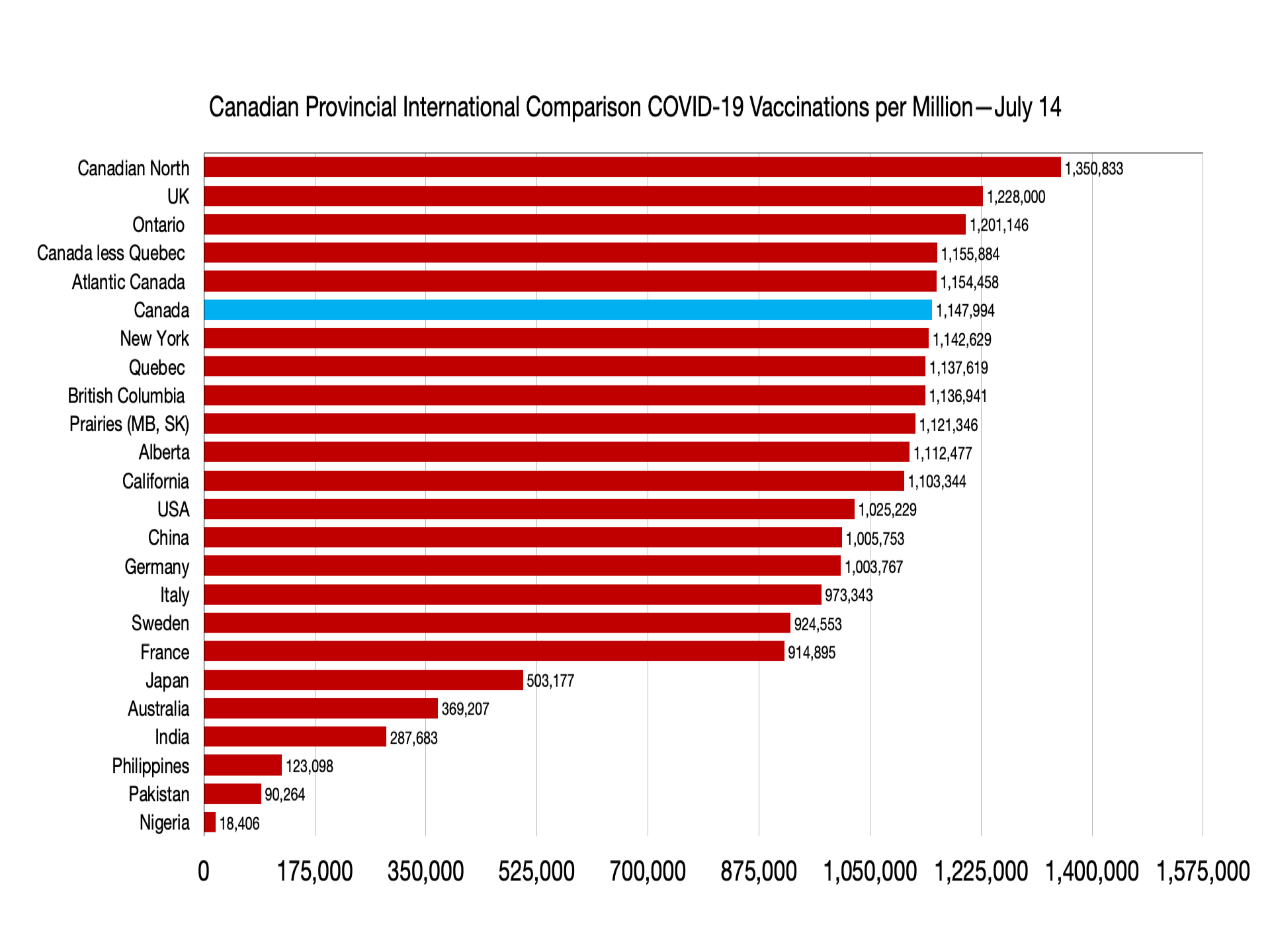
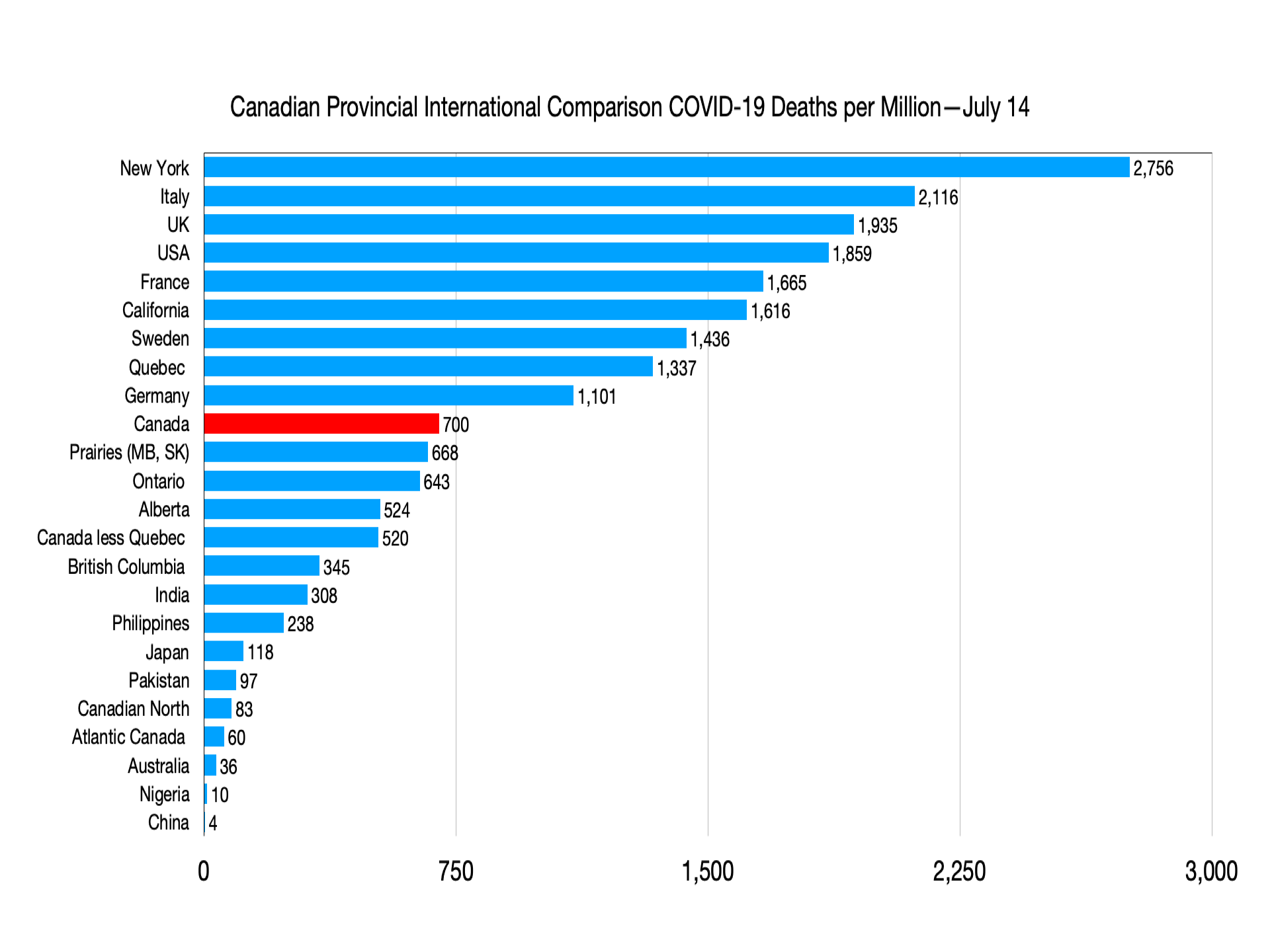
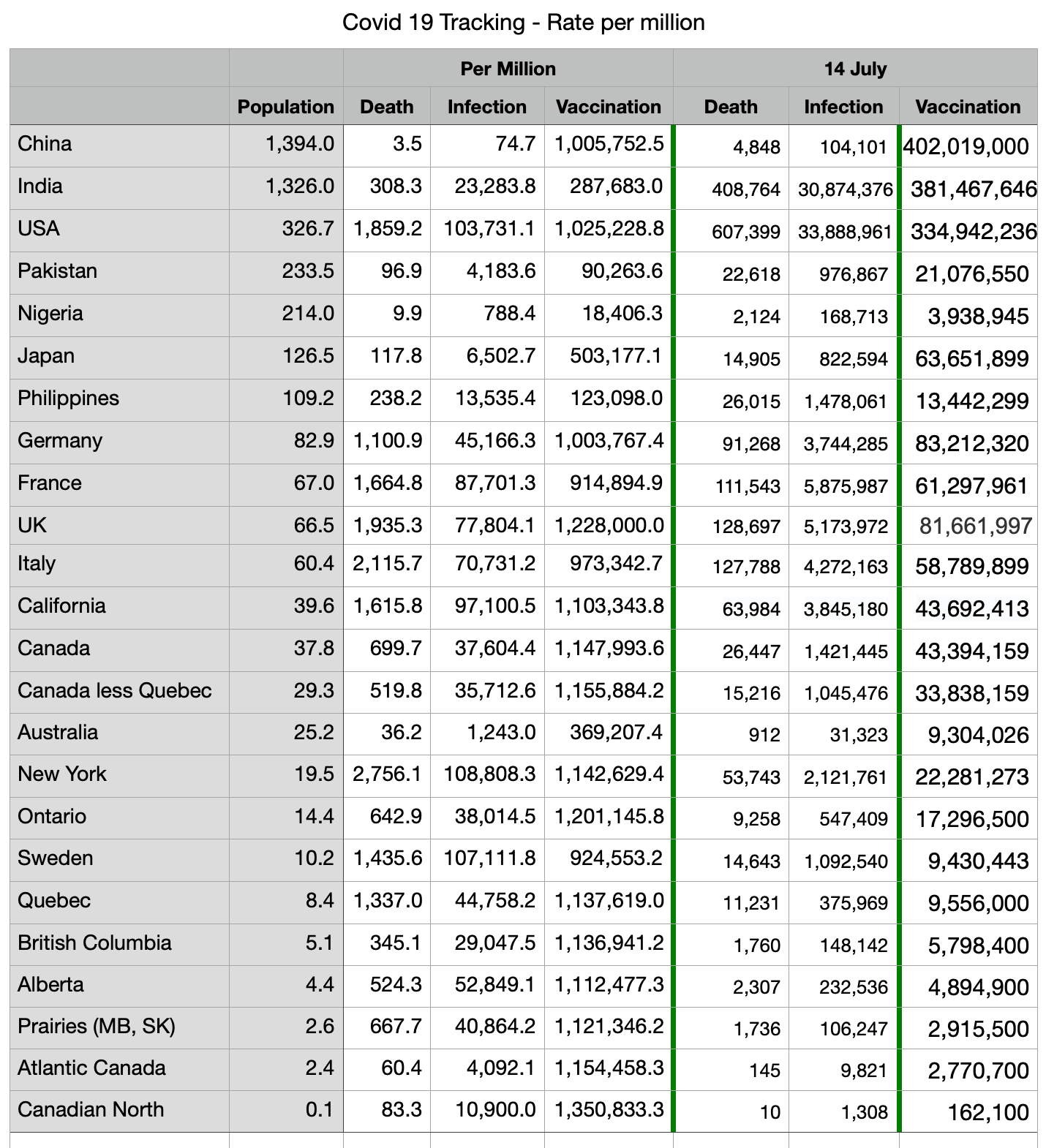
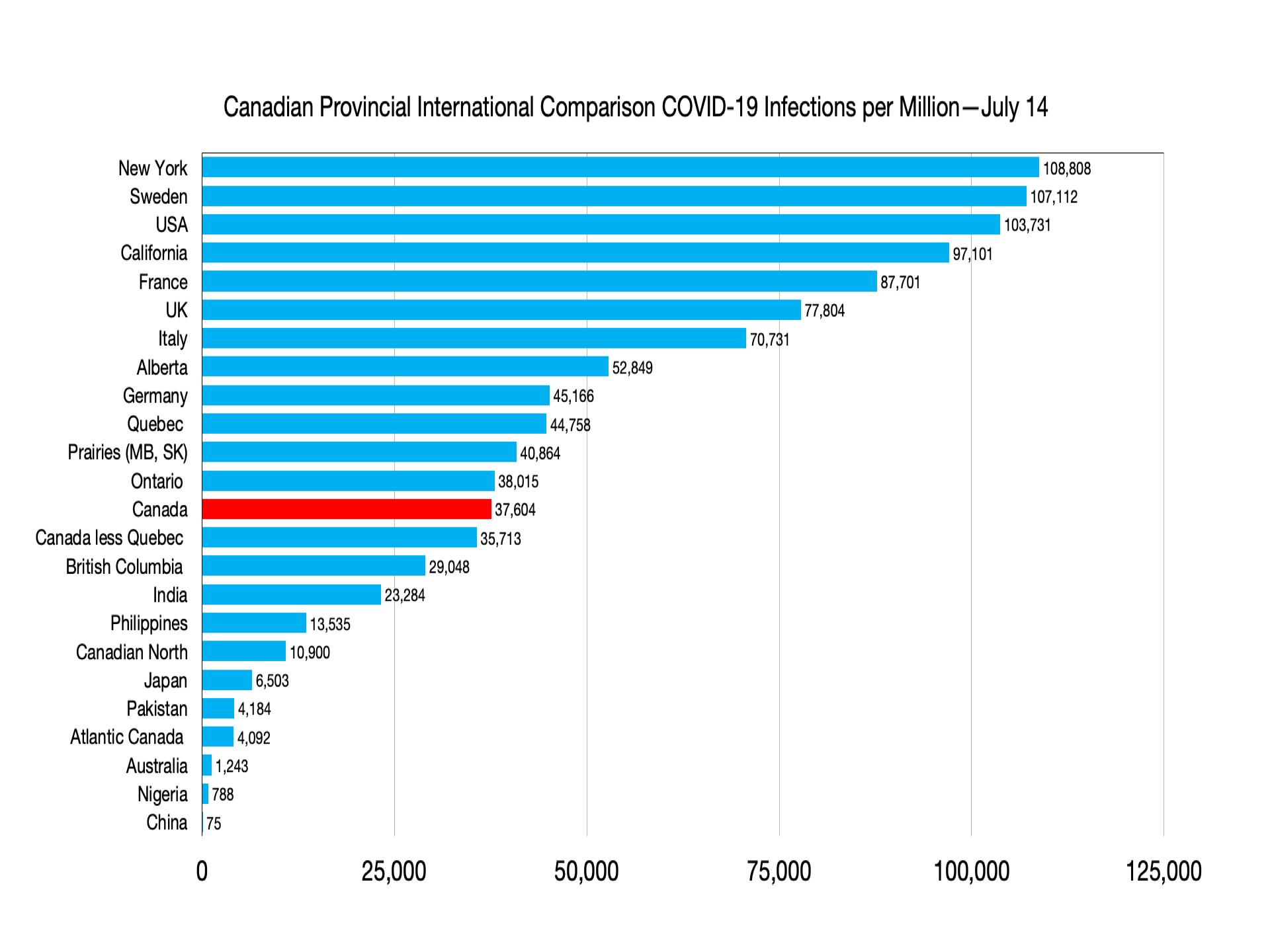
#COVID-19: Comparing provinces with other countries 14 July Update

The latest charts, compiled 14 July as overall rates in Canada continue to decline along with increased vaccinations (Canadians fully vaccinated 45.6 percent, higher than EU countries, just slightly behind USA 48.6 percent and UK 52.4 percent).

Vaccinations: All Canadian provinces ahead of USA and EU countries.

Trendline charts

Infections: No significant change

Deaths: No significant change.

Vaccinations: Captured above, with increasing gap between Canadian provinces and G7.

Weekly

Infections: No relative change.

Deaths per million: No significant change.