#COVID-19: Comparing provinces with other countries 30 June Update, Canadian excess deaths

The latest charts, compiled 30 June as overall rates in Canada continue to decline along with increased vaccinations (still largely first dose, fully vaccinated 30 percent, comparable to most EU countries).

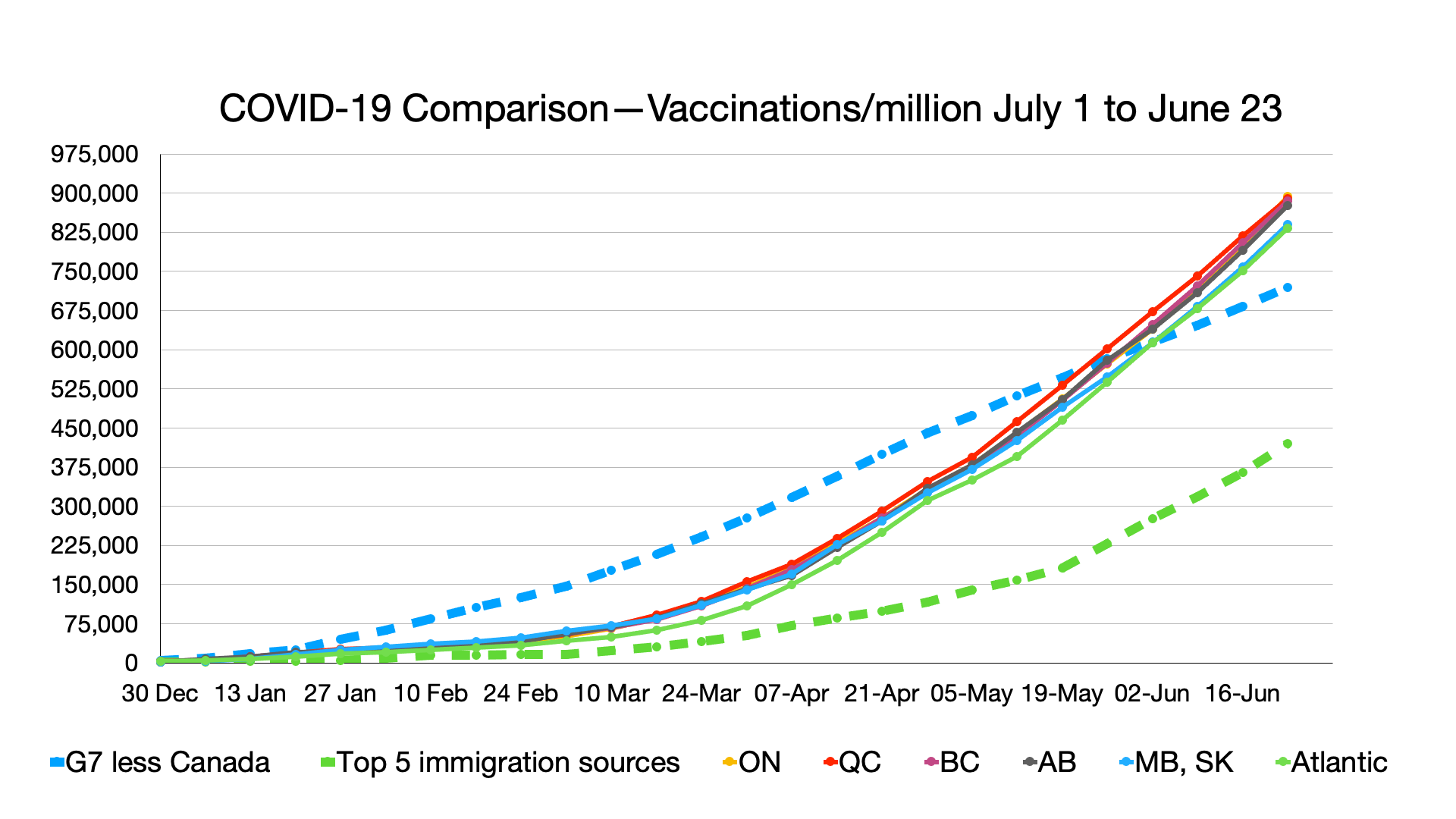
Vaccinations: Ontario ahead of USA, all provinces ahead of EU countries, China ahead of Italy in total vaccinations but lower than EU countries in terms of fully vaccinated (16 percent).

Trendline charts

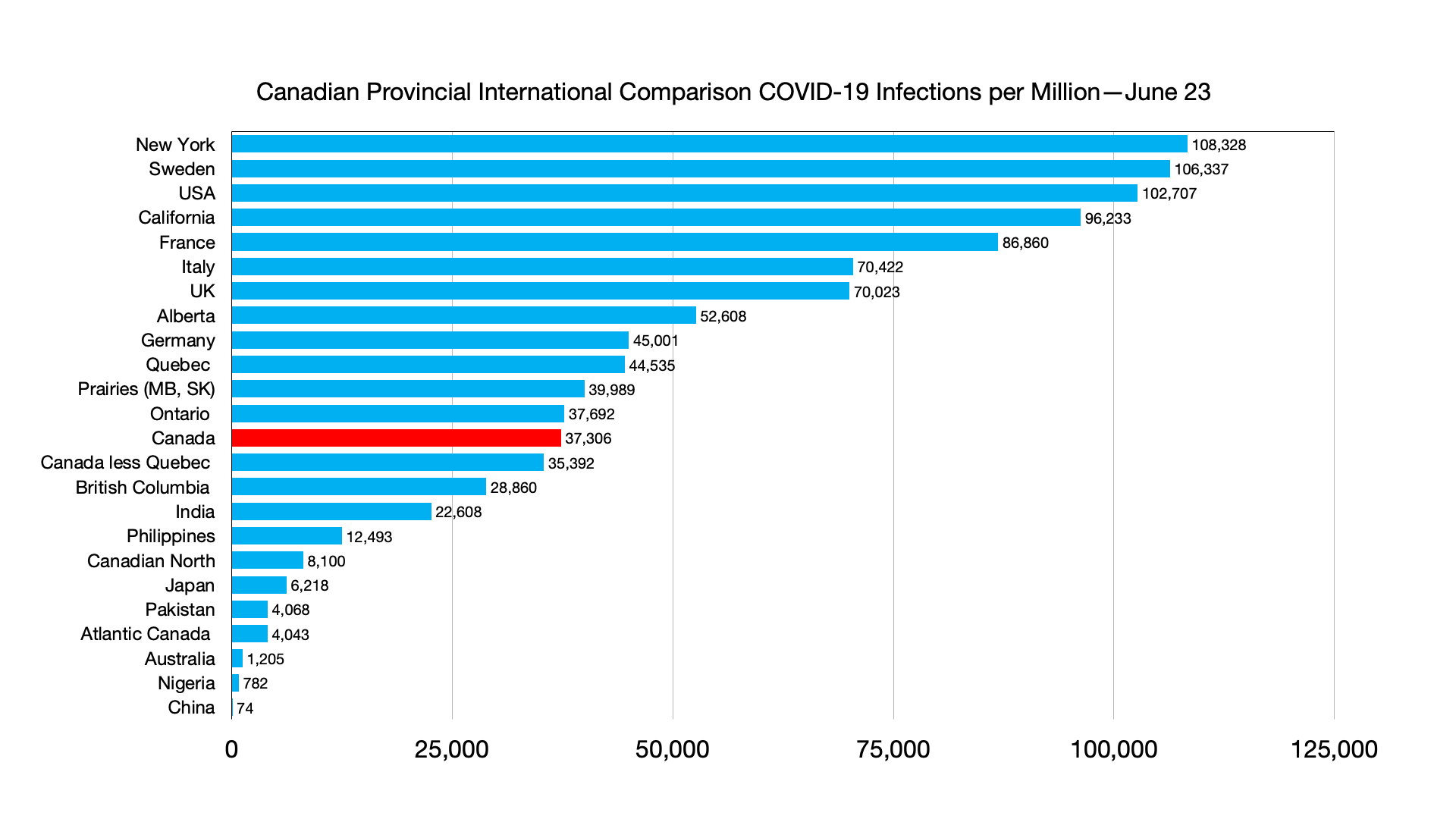
Infections per million: Surge in delta variant has resulted in UK moving ahead of Italy.
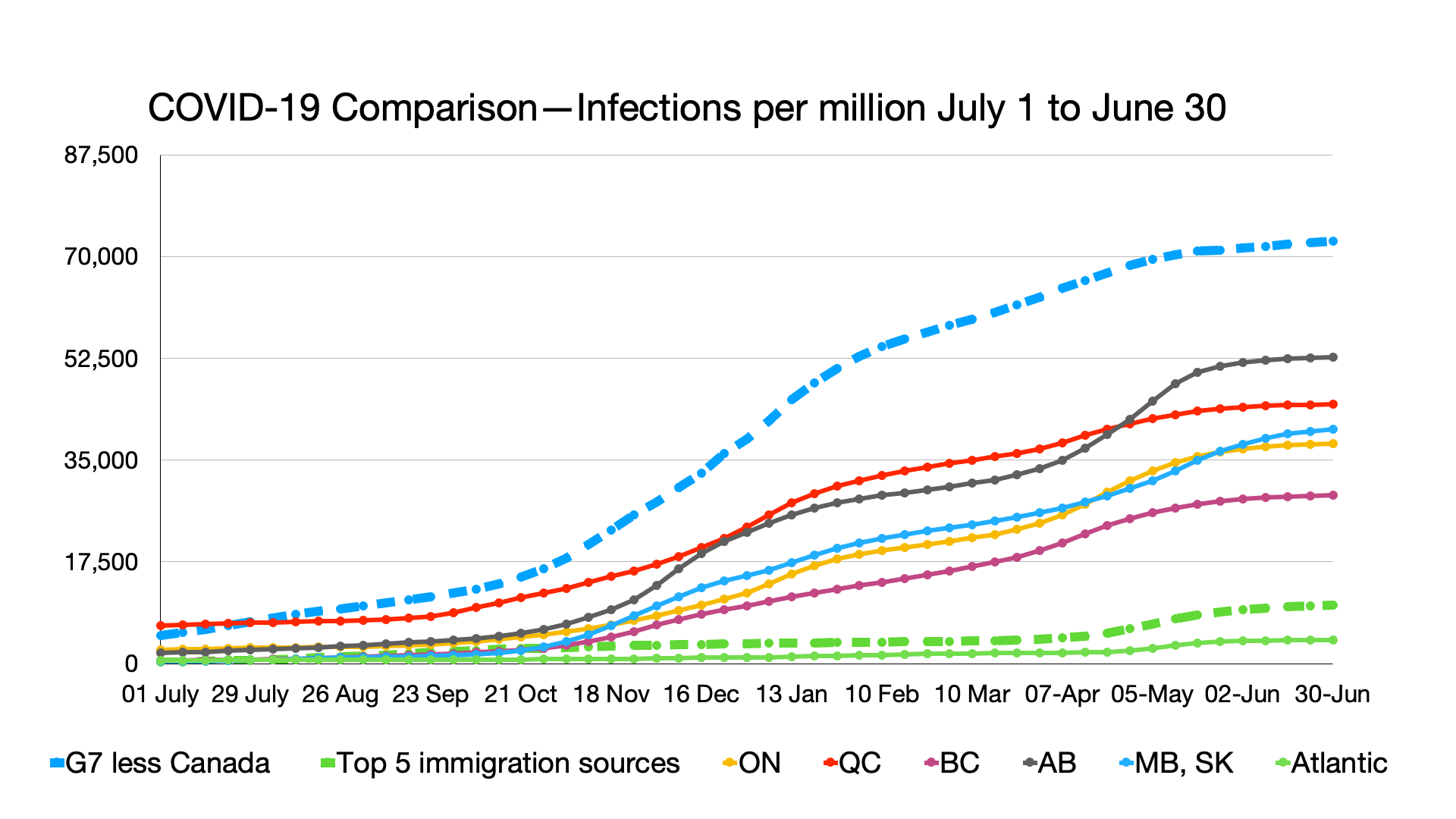
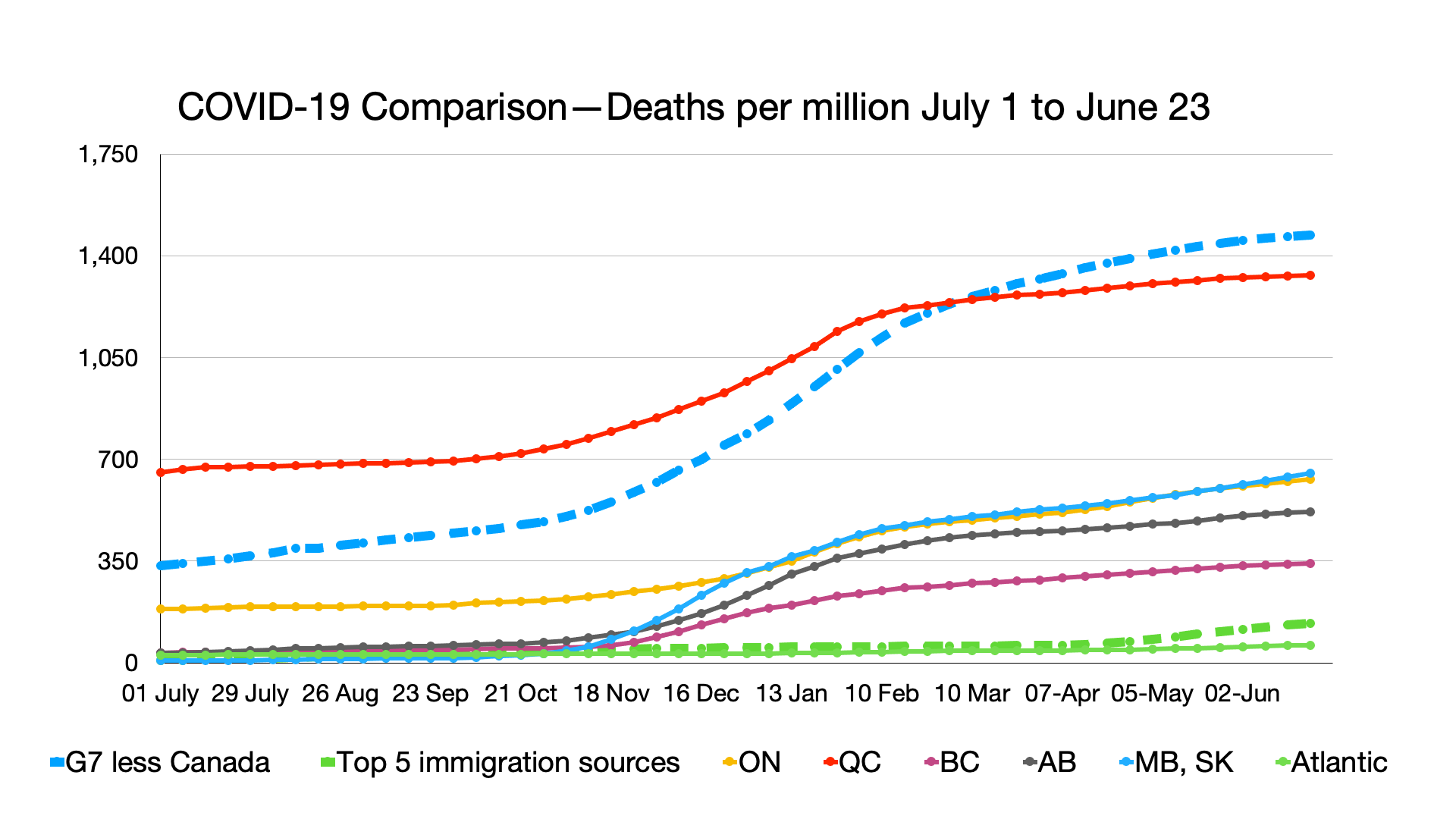
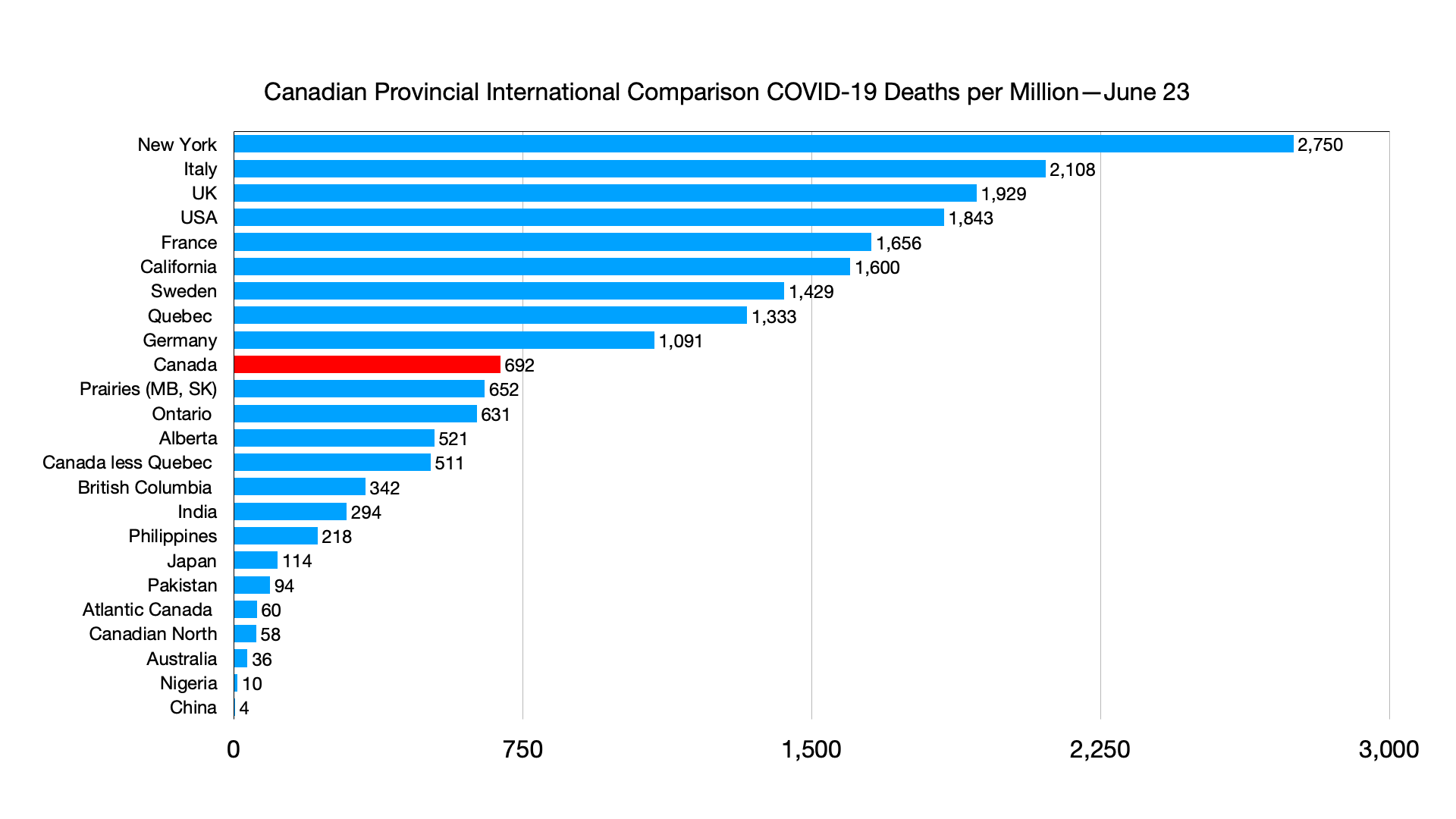
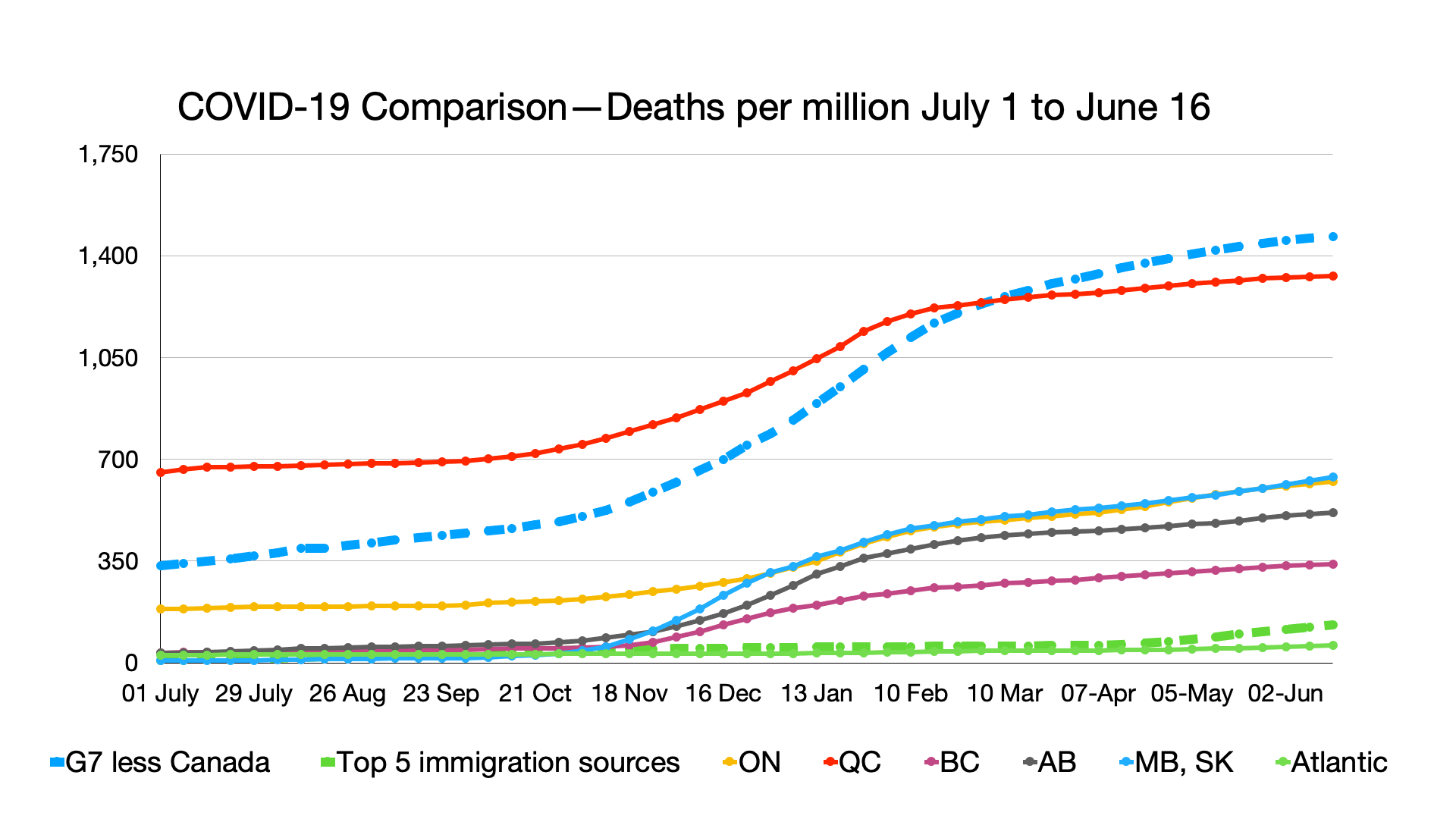
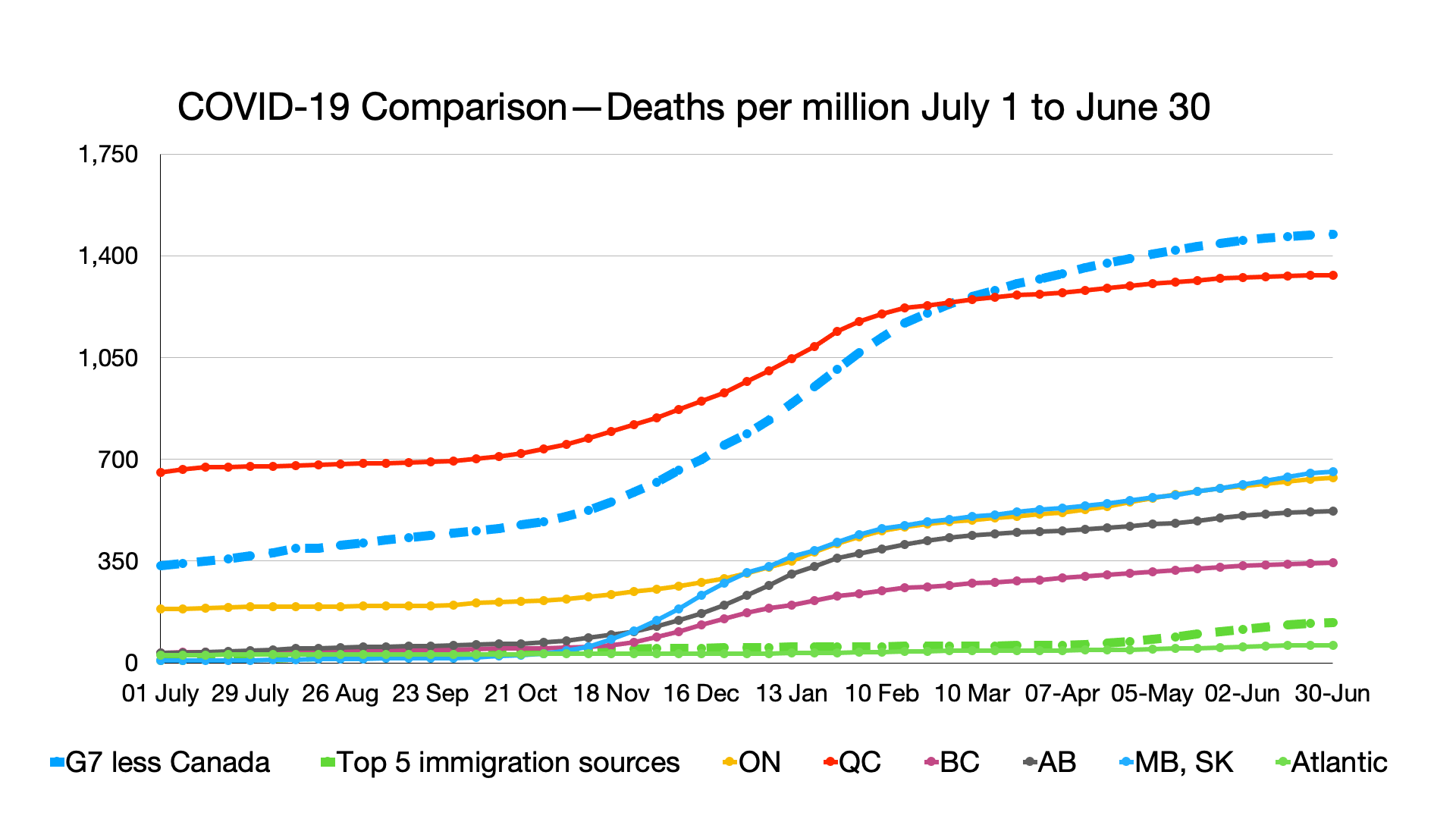
Deaths per million: Canadian North now ahead of Atlantic Canada.
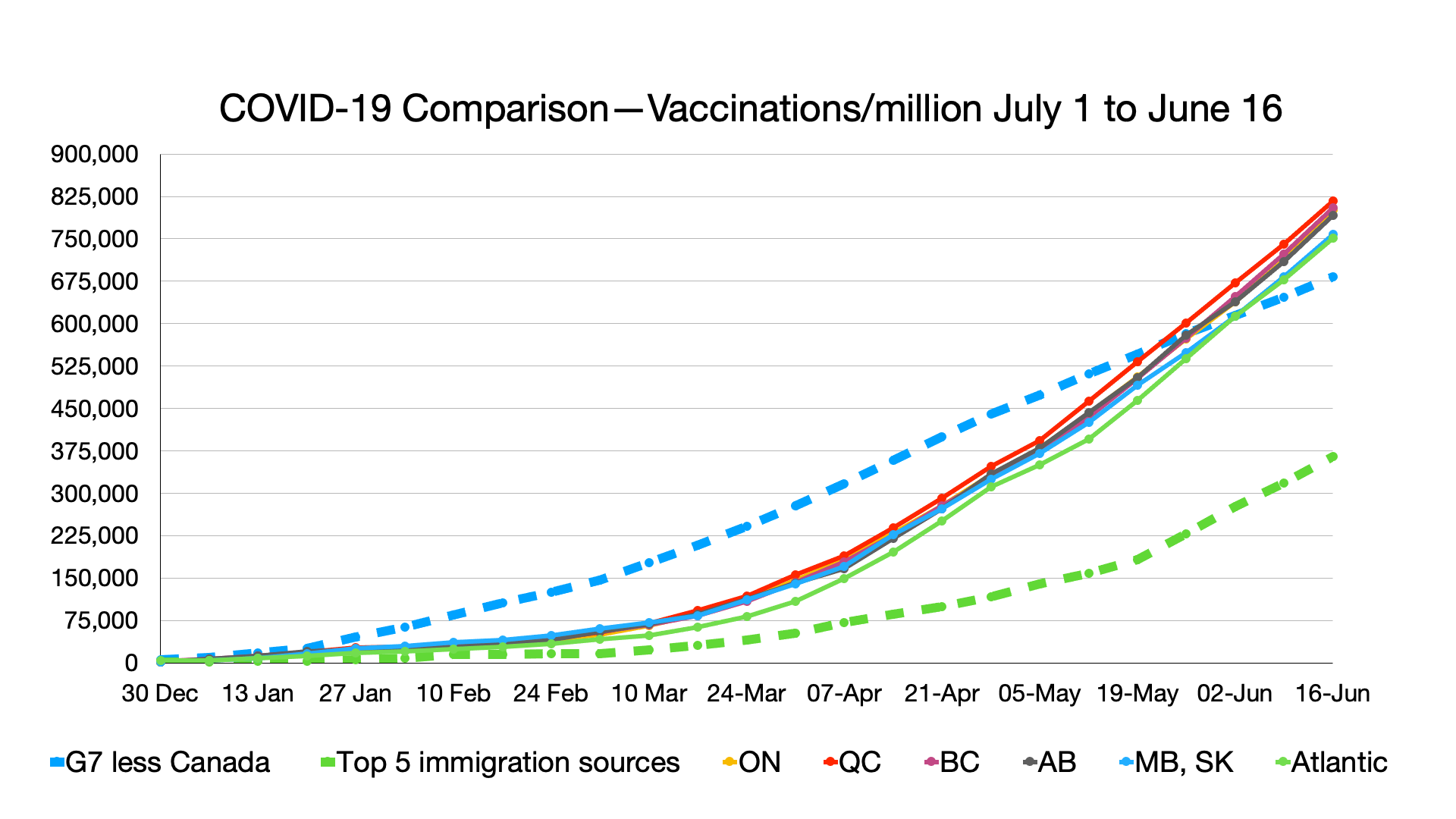
Vaccinations per million: Gap between Canada and other G7 countries continues to grow. Gap between China and India narrows (14.4% compared to 13.0%).

Weekly

Infections per million: UK ahead of Italy
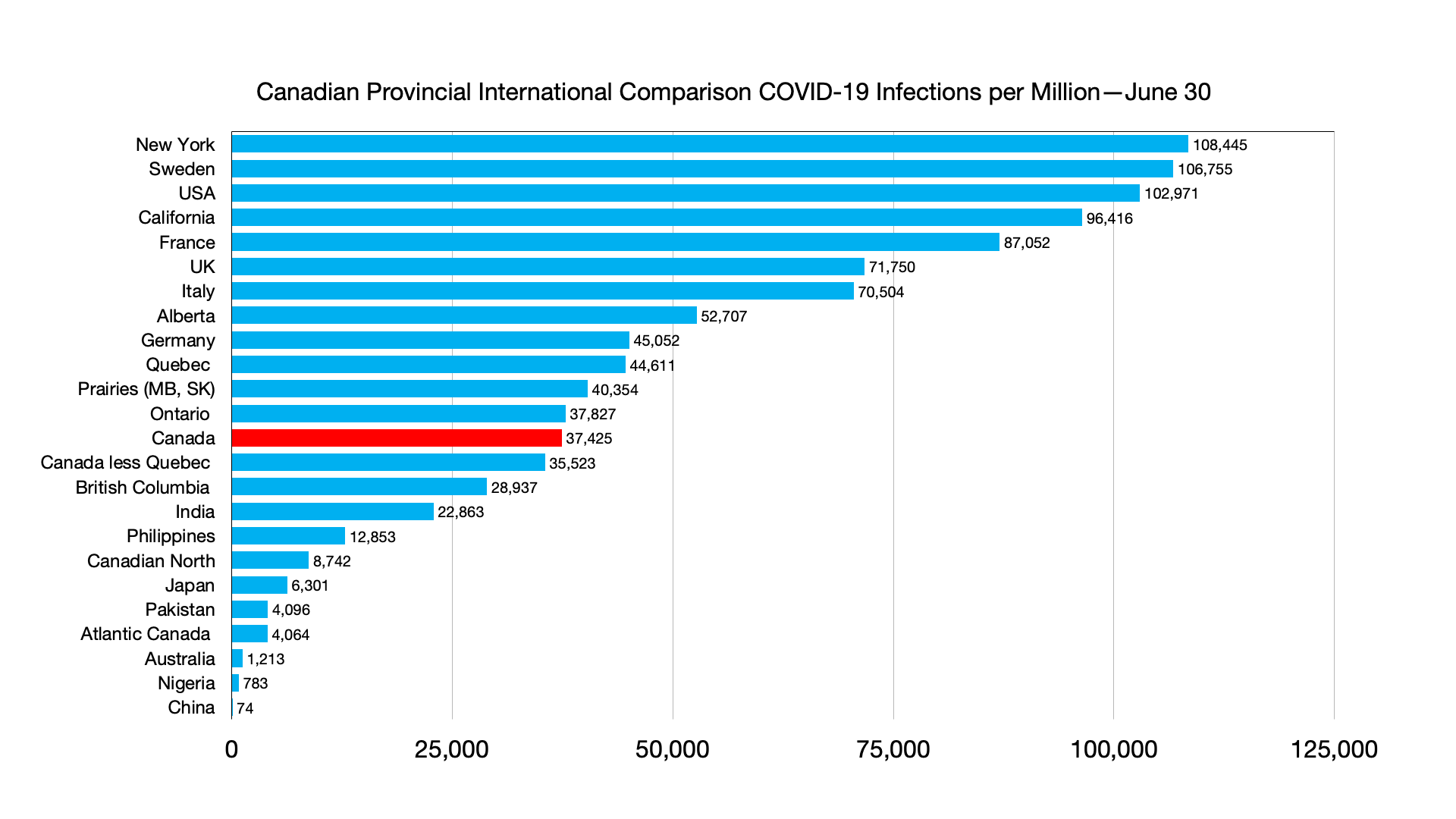
Deaths per million: Canadian North ahead of Atlantic Canada, reflecting additional death in Yukon.

And the excess deaths report, indicating that Canadian COVID mortality has been understated (not unique to Canada):

A new study suggests Canada has vastly underestimated how many people have died from COVID-19 and says the number could be two times higher than reported.

Dr. Tara Moriarty, working group lead for the study commissioned by the Royal Society of Canada, said in an interview while most accounts have put the majority of deaths in long-term care, the new data analysis suggests the toll of COVID-19 was also heavily felt outside the homes in the community.

Many of those deaths likely occurred in lower income, racialized communities and affected essential workers, new immigrants and people living in multigenerational homes, as well as clinically frail seniors living at home, the study says.

“If we’d had some sense early on of who was dying where, if we had had a sense of just how many deaths were actually occurring … maybe people would have started looking sooner or listening sooner to people in communities who were saying, ‘It’s really really bad here, people are dying,'” Moriarty said.

“It might have provided support for those claims that might have caused some kind of action that would have saved lives.”

Moriarty said seeing Canada out of step with similar high-income countries on the proportion of long-term care deaths was a red flag that inspired the analysis by the society.

The new peer-reviewed analysis casts doubt on the widely accepted assumption that 80 per cent of Canada’s deaths due to COVID-19 occurred among older adult residents of long-term care homes.

Instead, it says at least two-thirds of deaths caused by COVID-19 in communities outside of long-term care may have been missed. That would put the proportion of deaths in long-term care at around 45 per cent, much closer to the average of 40 per cent reported by peer countries in the Organization for Economic Co-operation and Development.

The conclusion is based on a review of reports of excess deaths across Canada, the pattern of COVID-19 fatalities during the pandemic and cremation data showing a significant spike in deaths at homes versus hospitals in 2020. It also relies on antibody surveillance testing that collectively unmasked the likely broad scope of undetected COVID-19 infections.

The researchers adjusted the data to account for things like increased deaths due to the drug toxicity crisis and the expected drop in deaths linked to the pandemic because of things like reduced traffic accident rates.

The extent of “likely missed” fatalities varies by province and there are major data gaps in what was available, Moriarty said.

The knowledge gap is particularly acute in British Columbia, Saskatchewan, and Manitoba where cause-of-death data is only complete into February 2020, the report says. It was less of a problem in Quebec, where the virus accounted for all excess deaths, and Ontario.

Between Feb. 1 and Nov. 28, 2020, the study found COVID-19 deaths of about 6,000 people aged 45 and older appeared to have gone undetected, unreported or unattributed to the virus.

“This suggests that if Canada has continued to miss these fatalities at the same rate since last November, the pandemic mortality burden may be two times higher than reported,” the report says.

Eemaan Kaur Thind, a public health practitioner who looked at both detected and undetected COVID-19 deaths in racialized communities, said the results weren’t a shock given previous reports linking the communities and deaths or hospitalization rates.

The study suggests it’s likely many cases in those communities were never identified, and the resulting deaths were never counted.

“We know that a high-proportion of essential workers happen to be visible minorities,” she said.

“None of that surprised me, although it never really becomes any less hard to see the official numbers when you see something like this.”

Thind said she hopes the findings push policy-makers to listen to those most affected, many of whom raised alarms about things like the role language barriers played in access to COVID-19 testing and care.

“Data is very important but I think it’s more important to also listen to people and believe them.”

About 25 per cent of likely deaths occurred in people between 45 and 64, the study said.

The researchers make several recommendations, including mandating weekly preliminary reporting of deaths due to all causes to Statistics Canada, performing COVID-19 testing on all people who die in any setting, and immediately adopting methods used by the U.S. Centers for Disease Control for estimating excess mortality during the pandemic.

The group also calls for the creation of a national COVID-19 mortality task force with the provinces and territories, and independent advisers to investigate why so many Canadian COVID-19 cases and deaths have been missed or unreported, including examining demographic and employment data for those who died.

Source: COVID-19 deaths in Canada may be two times higher than reported: Study
#COVID-19: Comparing provinces with other countries 23 June Update, China’s vaccine diplomacy

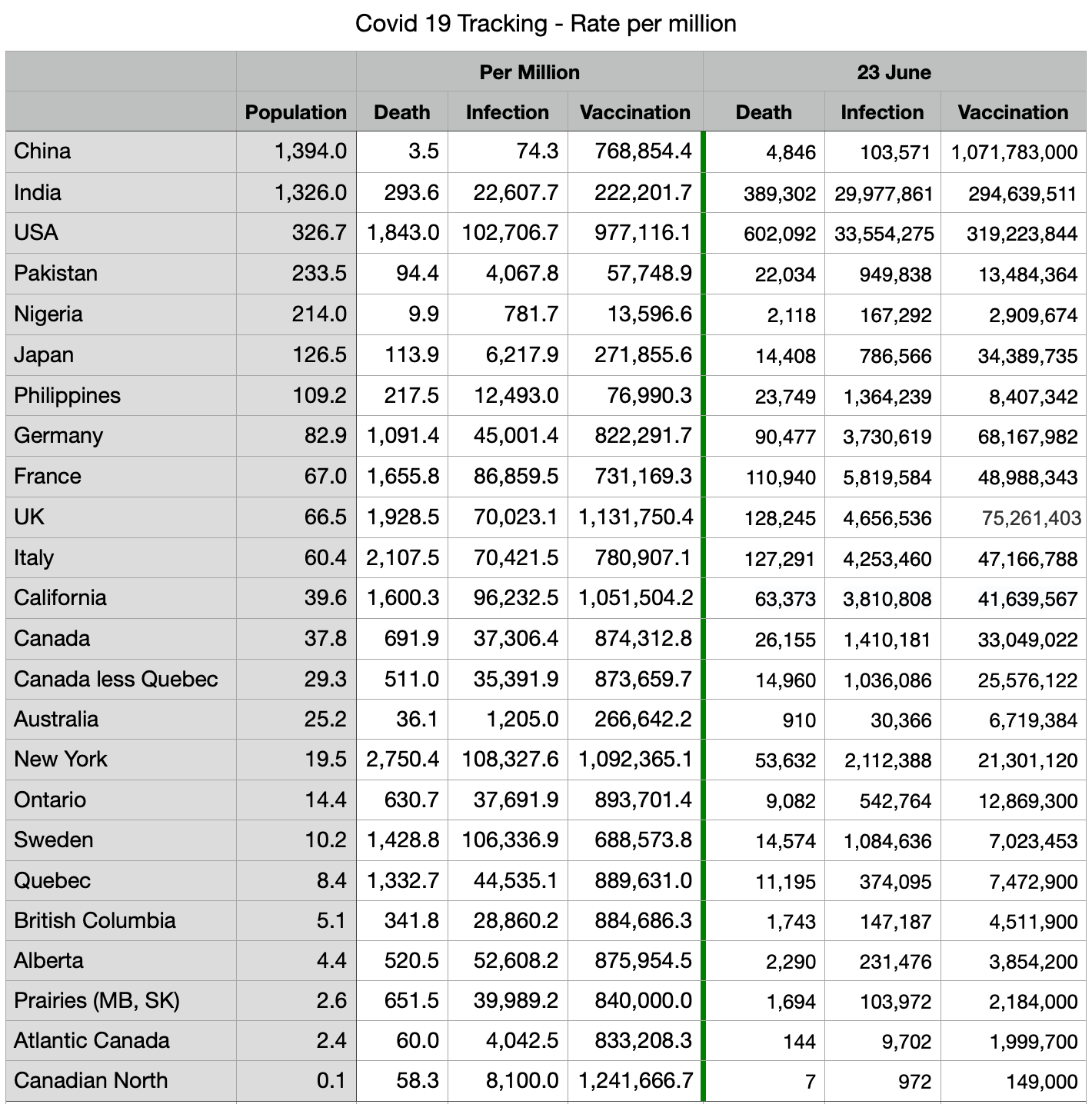
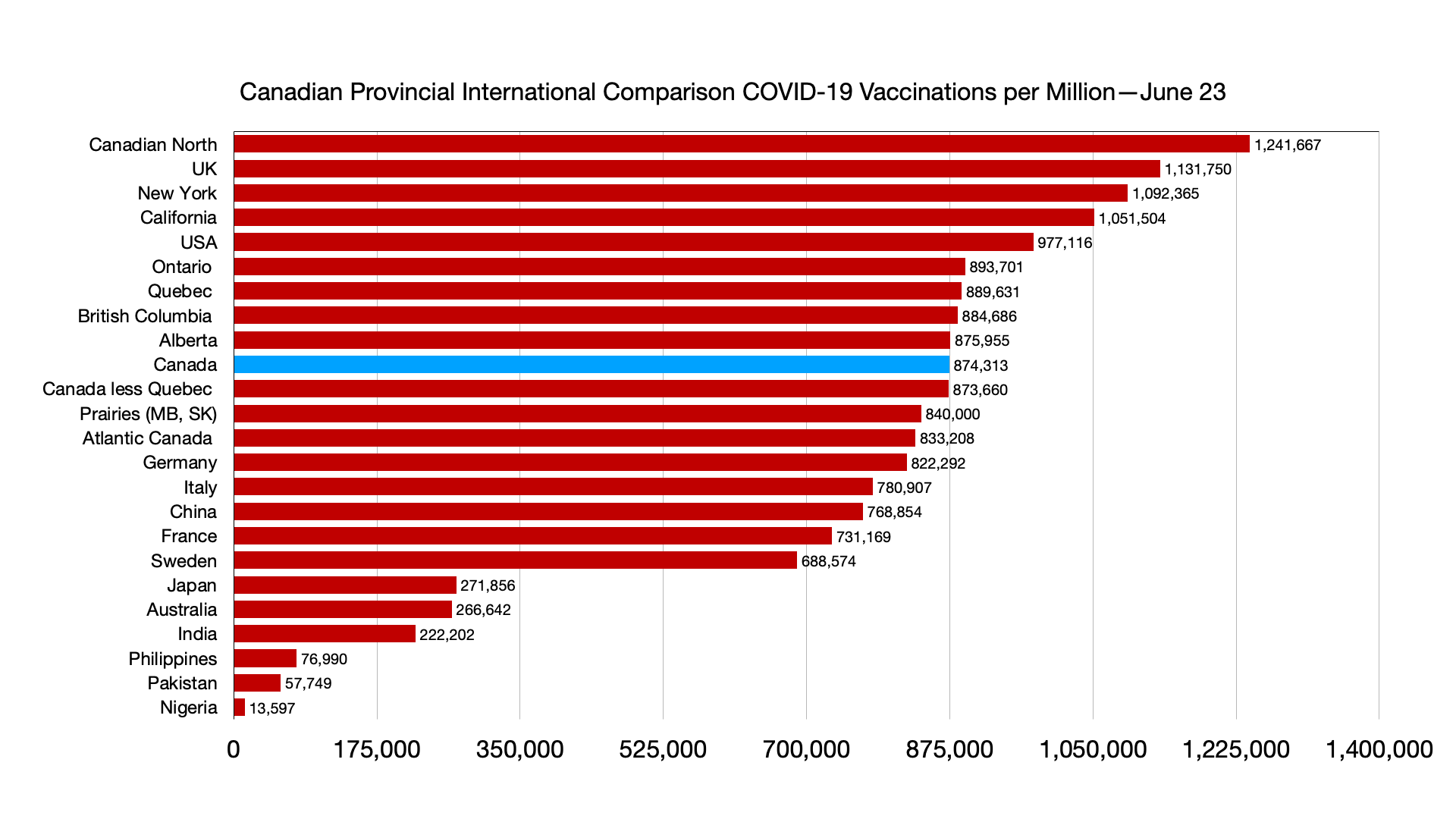
The latest charts, compiled 23 June as overall rates in Canada continue to decline along with increased vaccinations (still largely first dose, fully vaccinated 20.8 percent, most EU countries are between 25 to 35%).

Vaccinations: Minor relative changes with Ontario ahead of Quebec and British Columbia. China’s vaccination rate continues to grow dramatically (about 16% fully vaccinated. Article below charts describes lower efficacy of Chinese-made vaccines.

Trendline charts

Infections per million: No relative changes.

Deaths per million: No relative change.

Vaccinations per million: Canadian vaccination rates continue to exceed G7 less Canada. Vaccination rate increase in immigration source countries driven by China (up 16% from last week) with Indian vaccination rates up 12.5% compared to last week.

Weekly

Infections per million: No relative change.

Deaths per million: No relative changes.

They Relied on Chinese Vaccines. Now They’re Battling Outbreaks

Interesting data on the relative weakness of Chinese vaccines, likely to undermine the Chinese government’s vaccine diplomacy:

Mongolia promised its people a “Covid-free summer.” Bahrain said there would be a “return to normal life.” The tiny island nation of the Seychelles aimed to jump-start its economy.

All three put their faith, at least in part, in easily accessibleChinese-made vaccines, which would allow them to roll out ambitious inoculation programs when much of the world was going without.

But instead of freedom from the coronavirus, all three countries are now battling a surge in infections.

China kicked off its vaccine diplomacy campaign last year by pledging to provide a shot that would be safe and effective at preventing severe cases of Covid-19. Less certain at the time was how successful it and other vaccines would be at curbing transmission.

Now, examples from several countries suggest that the Chinese vaccines may not be very effective at preventing the spread of the virus, particularly the new variants. The experiences of those countries lay bare a harsh reality facing a postpandemic world: The degree of recovery may depend on which vaccines governments give to their people.

In the Seychelles, Chile, Bahrain and Mongolia, 50 to 68 percent of the populations have been fully inoculated, outpacing the United States, according to Our World in Data, a data tracking project. All four ranked among the top 10 countries with the worst Covid outbreaks as recently as last week, according to data from The New York Times. And all four are mostly using shots made by two Chinese vaccine makers, Sinopharm and Sinovac Biotech.

“If the vaccines are sufficiently good, we should not see this pattern,” said Jin Dongyan, a virologist at the University of Hong Kong. “The Chinese have a responsibility to remedy this.”

Scientists don’t know for certain why some countries with relatively high inoculation rates are suffering new outbreaks. Variants, social controls that are eased too quickly and careless behavior after only the first of a two-shot regimen are possibilities. But the breakthrough infections could have lasting consequences.

In the United States, about 45 percent of the population is fully vaccinated, mostly with doses made by Pfizer-BioNTech and Moderna. Cases have dropped 94 percent over six months.

Israel provided shots from Pfizer and has the second-highest vaccination rate in the world, after the Seychelles. The number of new daily confirmed Covid-19 cases per million in Israel is now around 4.95.

In the Seychelles, which relied mostly on Sinopharm, that number is more than 716 cases per million.

Disparities such as these could create a world in which three types of countries emerge from the pandemic — the wealthy nations that used their resources to secure Pfizer-BioNTech and Moderna shots, the poorer countries that are far away from immunizing a majority of citizens, and then those that are fully inoculated but only partly protected.

China, as well as the more than 90 nations that have received the Chinese shots, may end up in the third group, contending with rolling lockdowns, testing and limits on day-to-day life for months or years to come. Economies could remain held back. And as more citizens question the efficacy of Chinese doses, persuading unvaccinated people to line up for shots may also become more difficult.

One month after receiving his second dose of Sinopharm, Otgonjargal Baatar fell ill and tested positive for Covid-19. Mr. Otgonjargal, a 31-year-old miner, spent nine days in a hospital in Ulaanbaatar, the capital of Mongolia. He said he was now questioning the usefulness of the shot.

“People were convinced that if we were vaccinated, the summer will be free of Covid,” he said. “Now it turns out that it’s not true.”

Beijing saw its vaccine diplomacy as an opportunity to emerge from the pandemic as a more influential global power. China’s top leader, Xi Jinping, pledged to deliver a Chinese shot that could be easily stored and transported to millions of people around the world. He called it a “global public good.”

Mongolia was a beneficiary, jumping at the chance to score millions of Sinopharm shots. The small country quickly rolled out an inoculation program and eased restrictions. It has now vaccinated 52 percent of its population. But on Sunday, it recorded 2,400 new infections, a quadrupling from a month before.

In a statement, China’s Foreign Ministry said it did not see a link between the recent outbreaks and its vaccines. It cited the World Health Organization as saying that vaccination rates in certain countries had not reached sufficient levels to prevent outbreaks, and that countries needed to continue to maintain controls.

“Relevant reports and data also show that many countries that use Chinese-made vaccines have expressed that they are safe and reliable, and have played a good role in their epidemic prevention efforts,” the ministry said. China has also emphasized that its vaccines target severe disease rather than transmission.

No vaccine fully prevents transmission, and people can still fall ill after being inoculated, but the relatively low efficacy rates of Chinese shots have been identified as a possible cause of the recent outbreaks.

The Pfizer-BioNTech and Moderna vaccines have efficacy rates of more than 90 percent. A variety of other vaccines — including AstraZeneca and Johnson & Johnson — have efficacy rates of around 70 percent. The Sinopharm vaccine developed with the Beijing Institute of Biological Products has an efficacy rate of 78.1 percent; the Sinovac vaccine has an efficacy rate of 51 percent.

The Chinese companies have not released much clinical data to show how their vaccines work at preventing transmission. On Monday, Shao Yiming, an epidemiologist with the Chinese Center for Disease Control and Prevention, said China needed to fully vaccinate 80 to 85 percent of its population to achieve herd immunity, revising a previous official estimate of 70 percent.

Data on breakthrough infections has not been made available, either, though a Sinovac study out of Chile showed that the vaccine was less effective than those from Pfizer-BioNTech and Moderna at preventing infection among vaccinated individuals.
A representative from Sinopharm hung up the phone when reached for comment. Sinovac did not respond to a request for comment.

William Schaffner, medical director of the National Foundation for Infectious Diseases at Vanderbilt University, said the efficacy rates of Chinese shots could be low enough “to sustain some transmission, as well as create illness of a substantial amount in the highly vaccinated population, even though it keeps people largely out of the hospital.”

Despite the spike in cases, officials in both the Seychelles and Mongolia have defended Sinopharm, saying it is effective in preventing severe cases of the disease.

Batbayar Ochirbat, head researcher of the Scientific Advisory Group for Emergencies at Mongolia’s Ministry of Health, said Mongolia had made the right decision to go with the Chinese-made shot, in part because it had helped keep the mortality rate low in the country. Data from Mongolia showed that the Sinopharm vaccine was actually more protective than the doses developed by AstraZeneca and Sputnik, a Russian vaccine, according to the Health Ministry.

The reason for the surge in Mongolia, Mr. Batbayar said, is that the country reopened too quickly, and many people believed they were protected after only one dose.

“I think you could say Mongolians celebrated too early,” he said. “My advice is the celebrations should start after the full vaccinations, so this is the lesson learned. There was too much confidence.”

Some health officials and scientists are less confident.

Nikolai Petrovsky, a professor at the College of Medicine and Public Health at Flinders University in Australia, said that with all of the evidence, it would be reasonable to assume the Sinopharm vaccine had minimal effect on curbing transmission. A major risk with the Chinese inoculation is that vaccinated people may have few or no symptoms and still spread the virus to others, he said.

“I think that this complexity has been lost on most decision makers around the world.”

In Indonesia, where a new variant is spreading, more than 350 doctors and health care workers recently came down with Covid-19 despite being fully vaccinated with Sinovac, according to the risk mitigation team of the Indonesian Medical Association. Across the country, 61 doctors died between February and June 7. Ten of them had taken the Chinese-made vaccine, the association said.

The numbers were enough to make Kenneth Mak, Singapore’s director of medical services, question the use of Sinovac. “It’s not a problem associated with Pfizer,” Mr. Mak said at a news conferenceon Friday. “This is actually a problem associated with the Sinovac vaccine.”

Bahrain and the United Arab Emirates were the first two countries to approve the Sinopharm shot, even before late-stage clinical trial data was released. Since then, there have been extensive reports of vaccinated people falling ill in both countries. In a statement, the Bahraini government’s media office said the kingdom’s vaccine rollout had been “efficient and successful to date.”

Still, last month officials from Bahrain and the United Arab Emirates announced that they would offer a third booster shot. The choices: Pfizer or more Sinopharm.

Source: https://www.nytimes.com/2021/06/22/business/economy/china-vaccines-covid-outbreak.html?searchResultPosition=1

#COVID-19: Comparing provinces with other countries 16 June Update

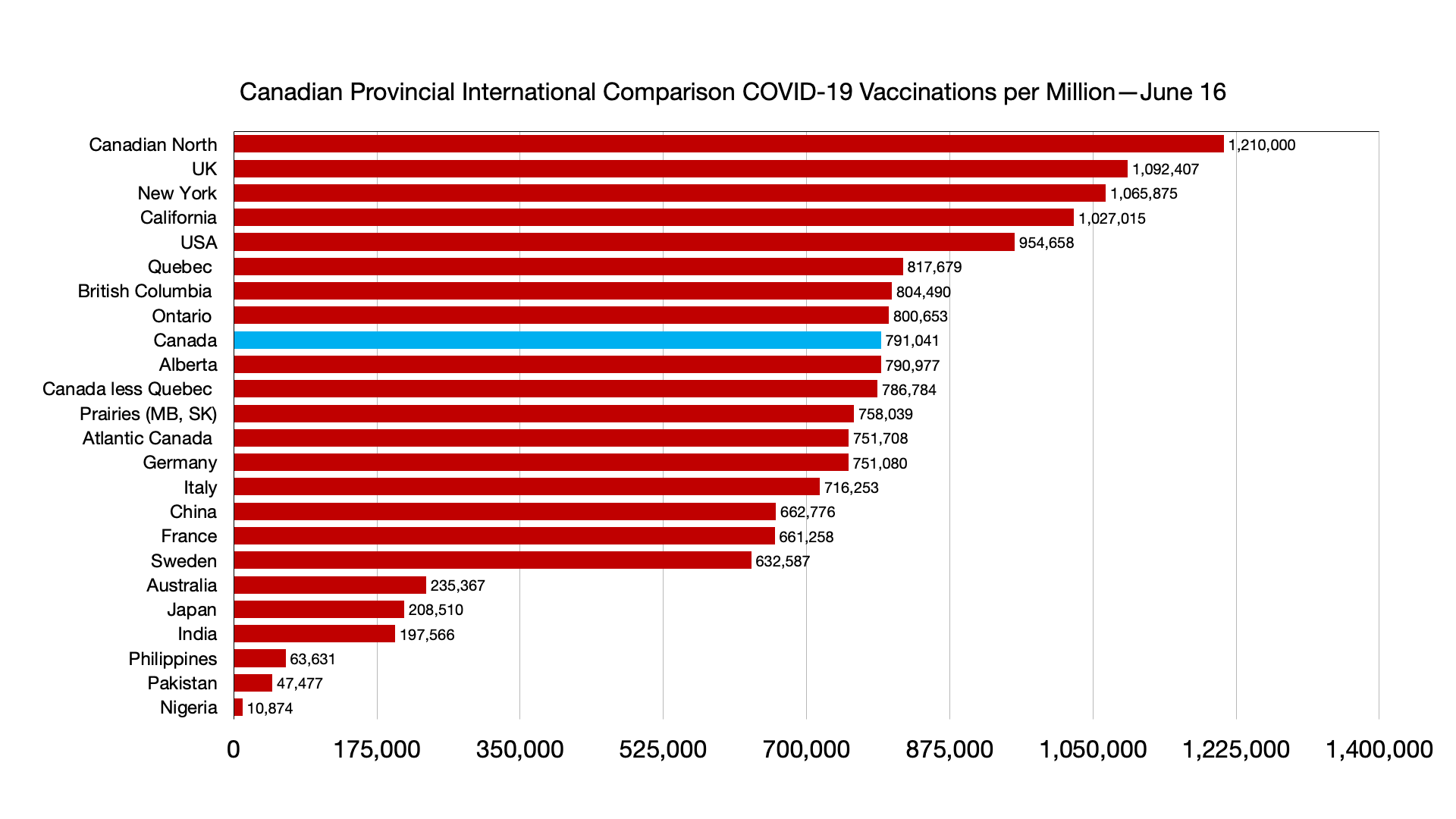
The latest charts, compiled 16 June as overall rates in Canada continue to decline along with increased vaccinations (still largely first dose, fully vaccinated just under 14 percent).

Vaccinations: Minor relative changes. Most significant is China is now ahead of France and Sweden. Also, Atlantic Canada ahead of Germany and Japan ahead of India (pre-Olympics push?)

Trendline charts

Infections per million: No relative changes and recent surges levelling off save again for the Prairies (mainly Manitoba).

Deaths per million: No relative change.

Vaccinations per million: Canadian vaccination rates continue to exceed G7 less Canada with Quebec maintaining its slight lead. Vaccination rate increase in immigration source countries driven by China (up 16% from last week) with Indian vaccination increasing more slowly (10%).

Weekly

Infections per million: No relative change.

Deaths per million: No relative changes.

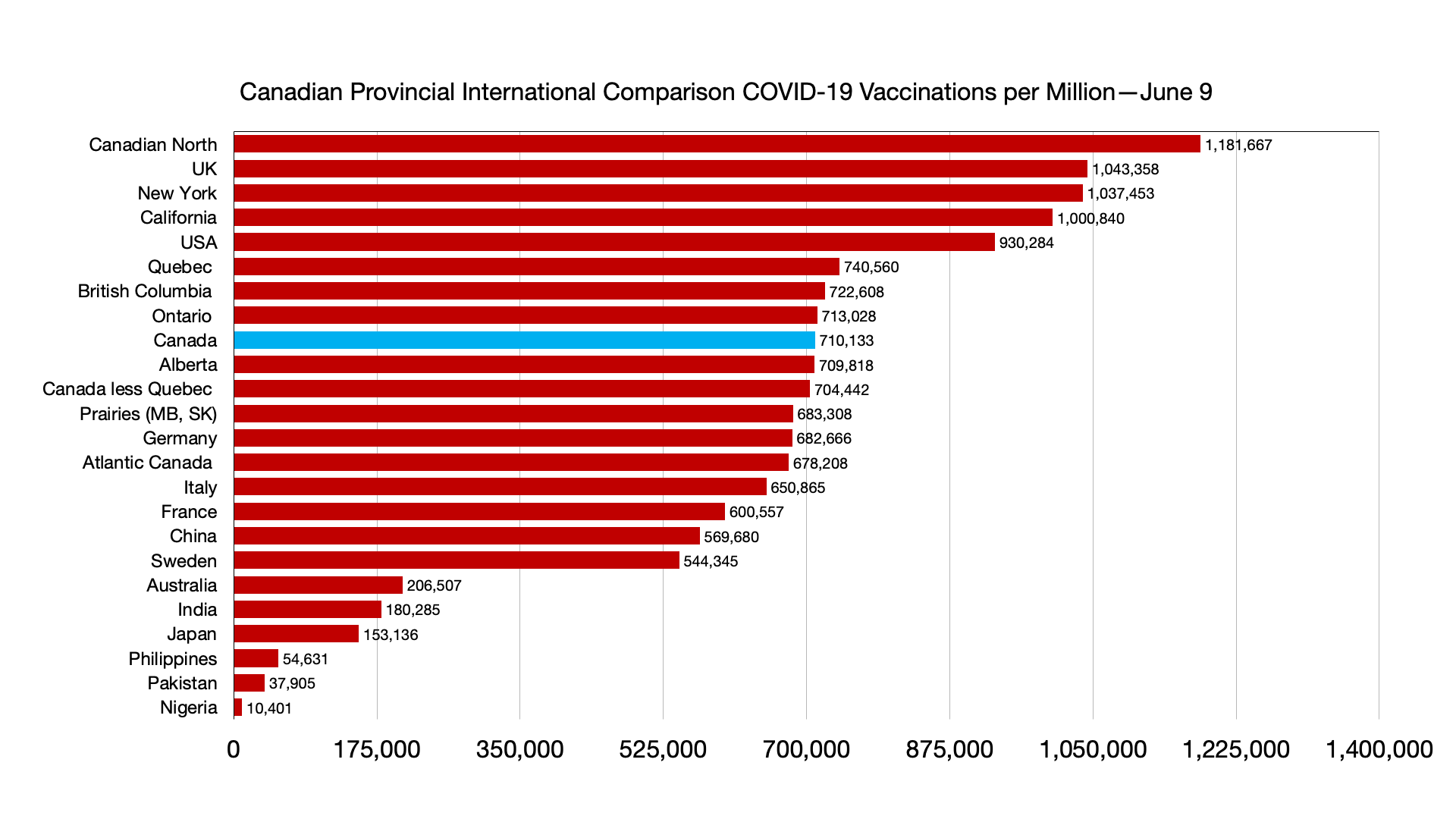
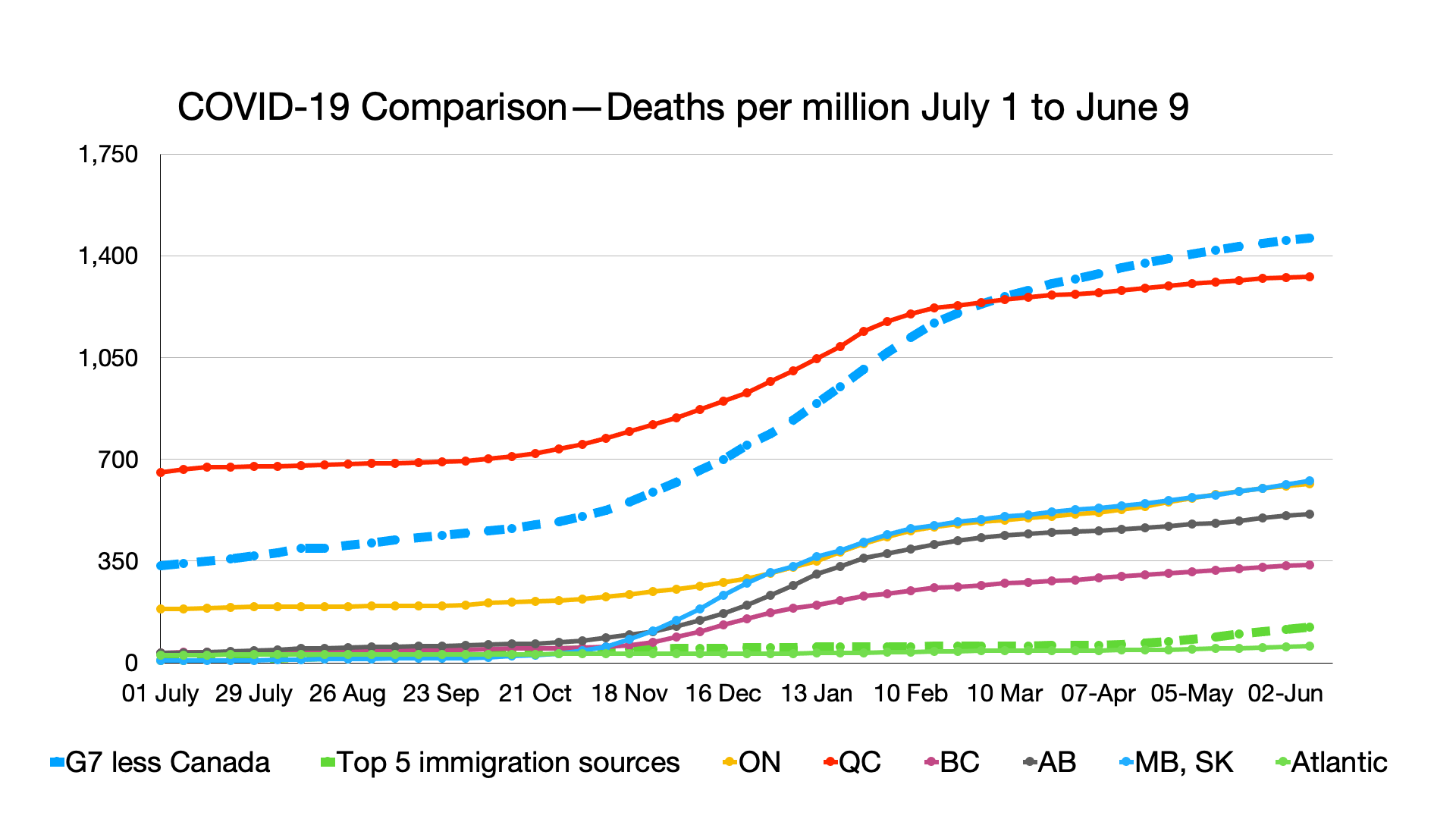
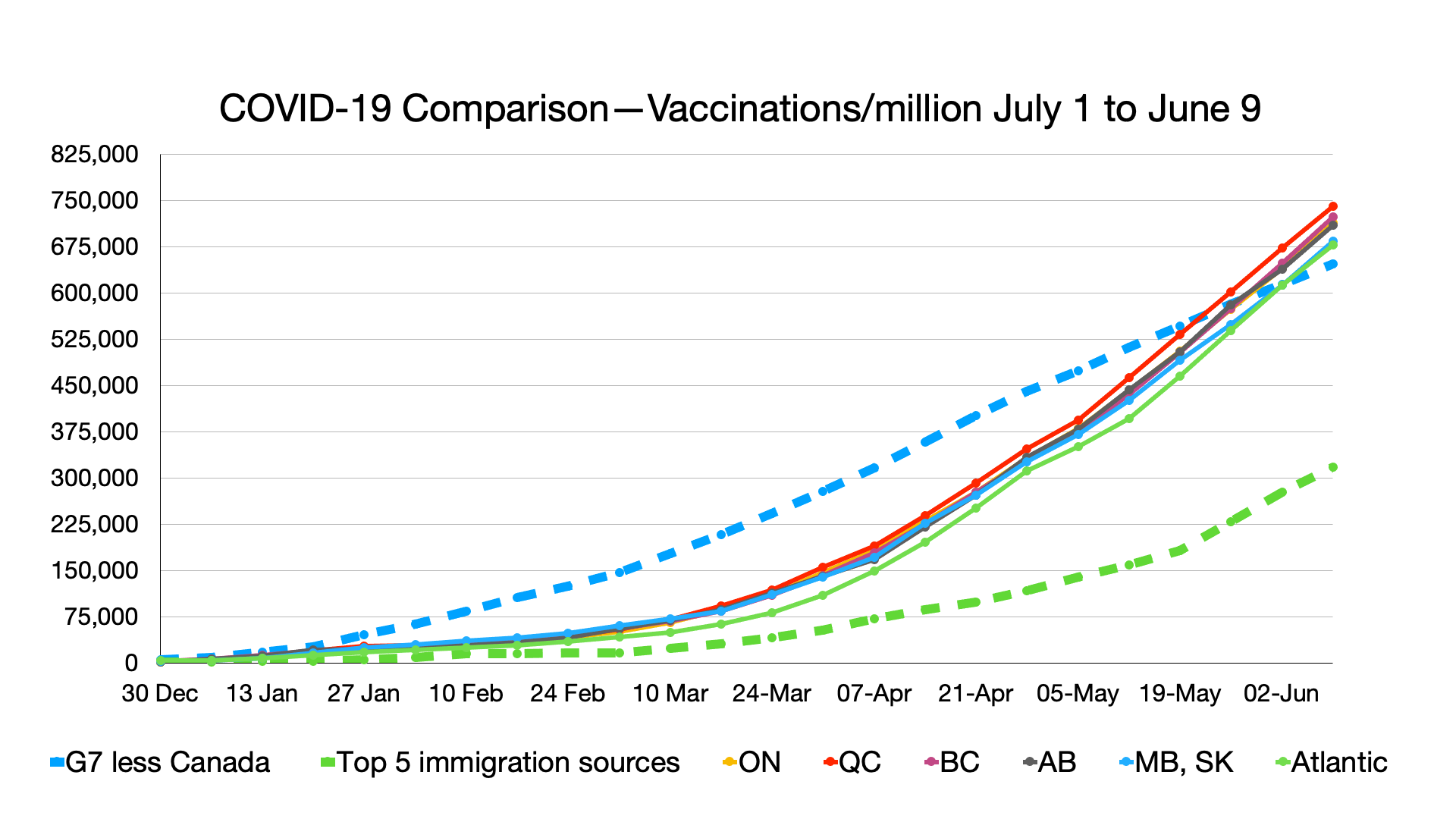
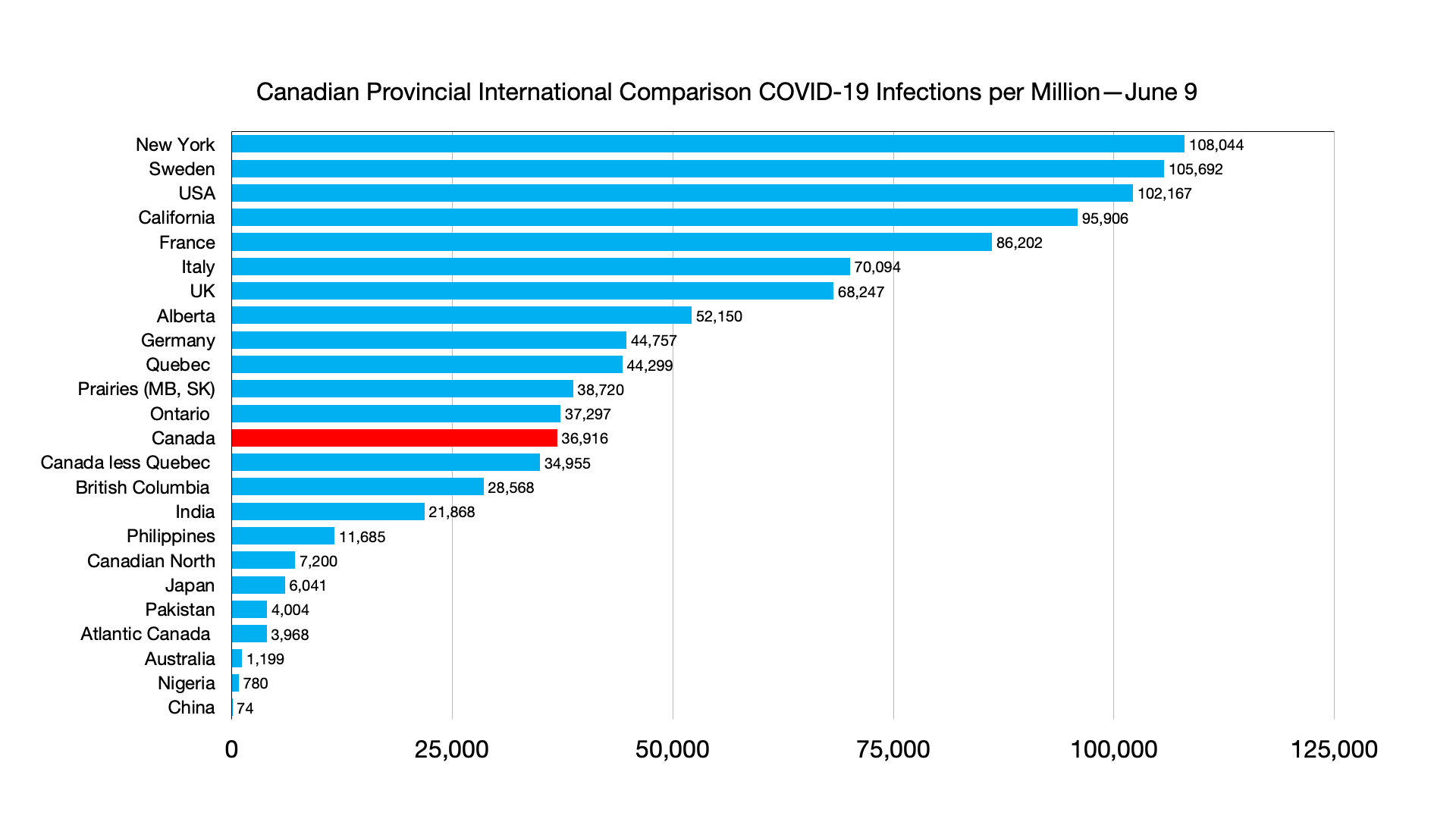
#COVID-19: Comparing provinces with other countries 9 June Update

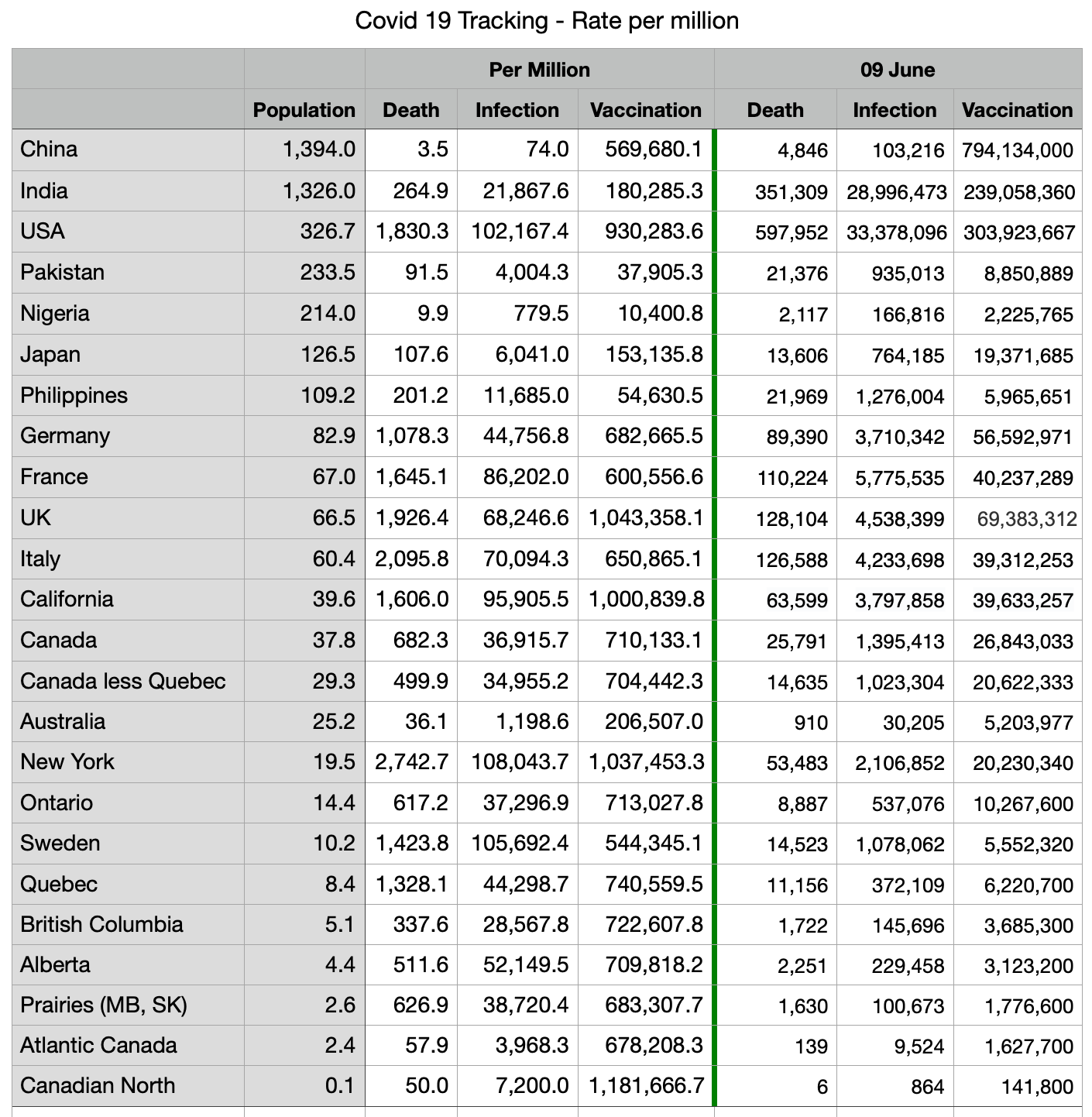
The latest charts, compiled 9 June as overall rates in Canada continue to decline along with increased vaccinations (still largely first dose, fully vaccinated less than 10 percent).

Vaccinations: Minor relative changes, Canadian provinces all ahead of EU countries save Germany.

Trendline charts

Infections per million: No major relative changes and recent surges appear to be levelling off save for the Prairies (mainly Manitoba).

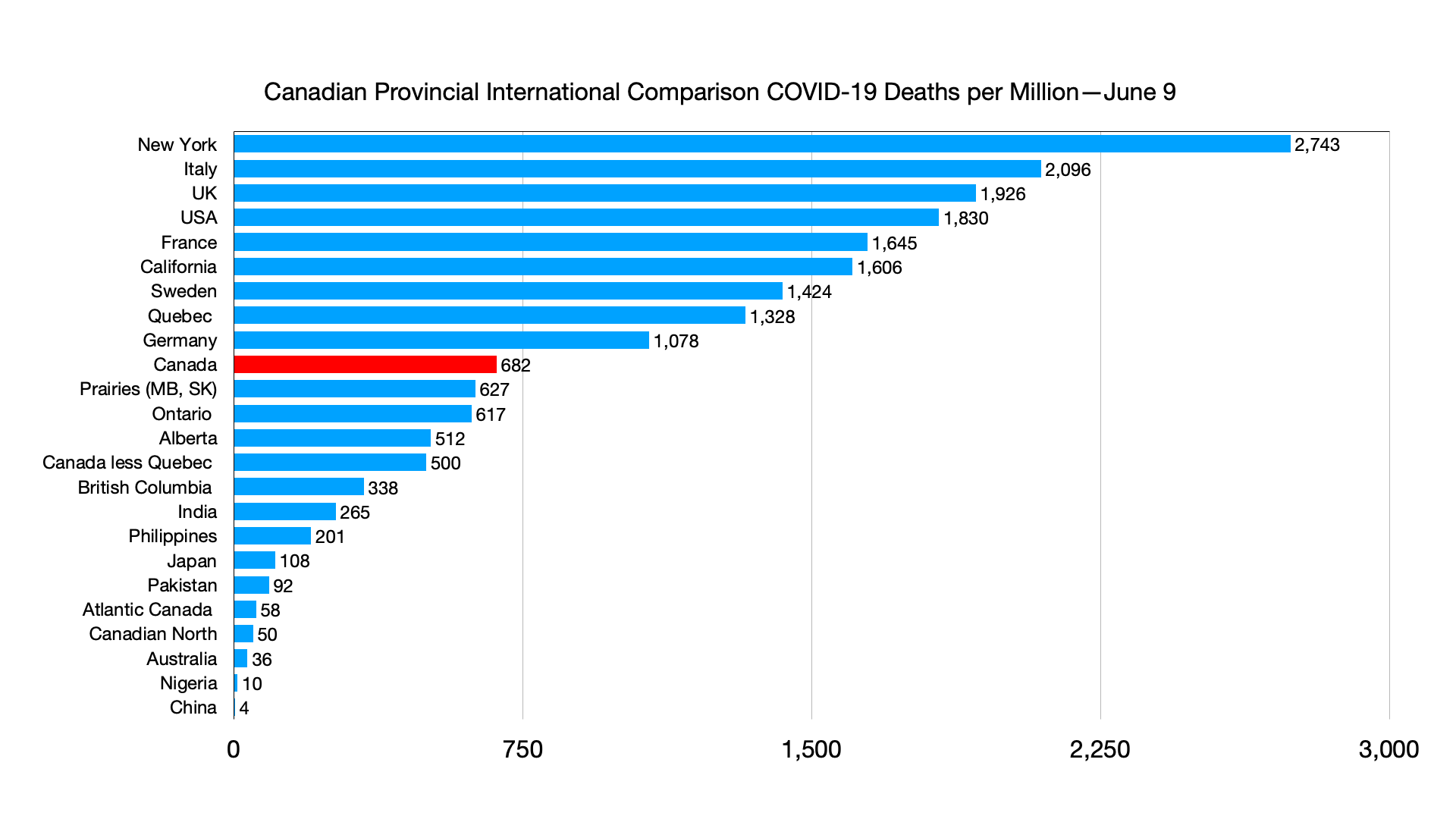
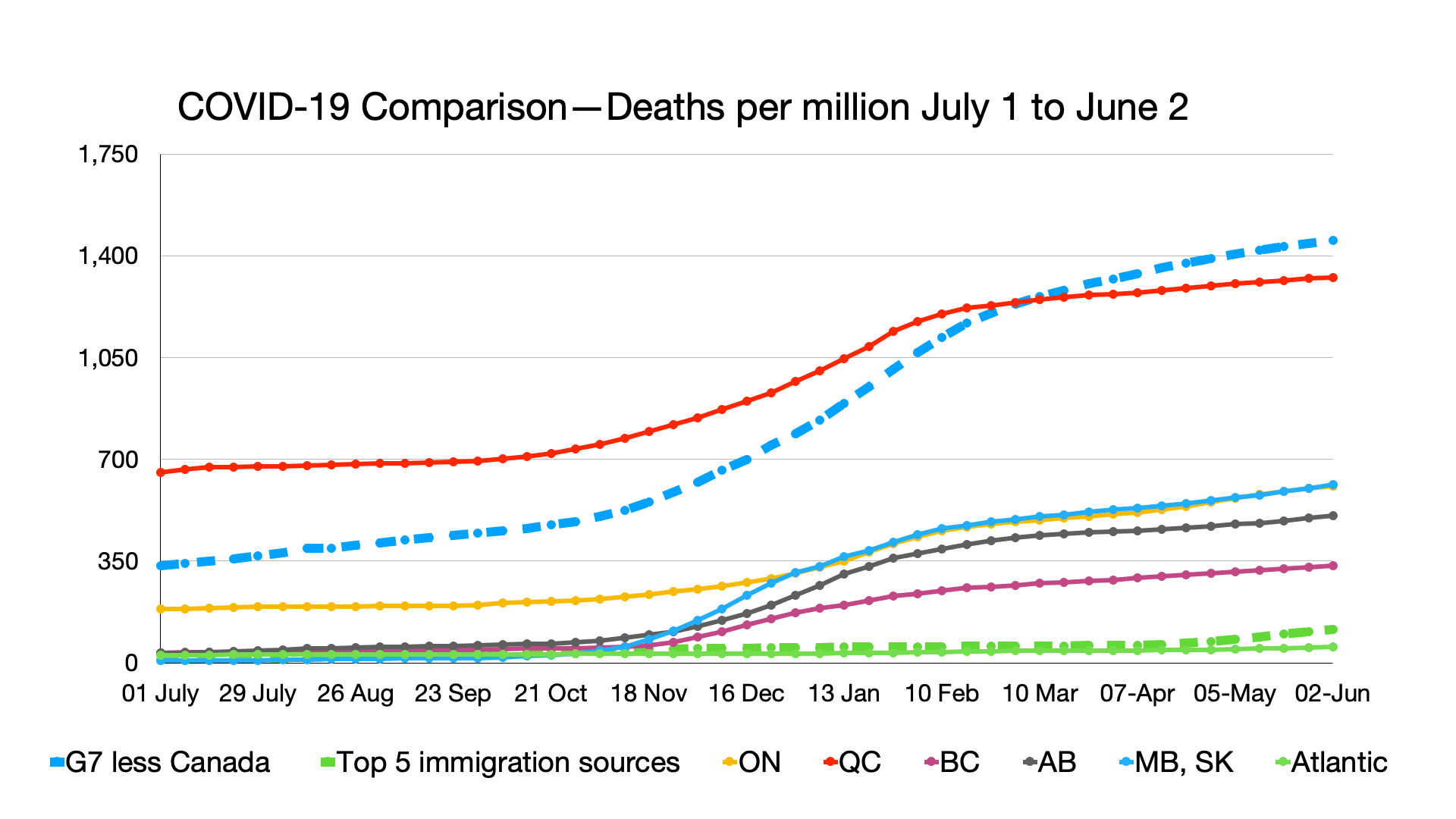
Deaths per million: No significant change, Prairies slightly ahead of Ontario.

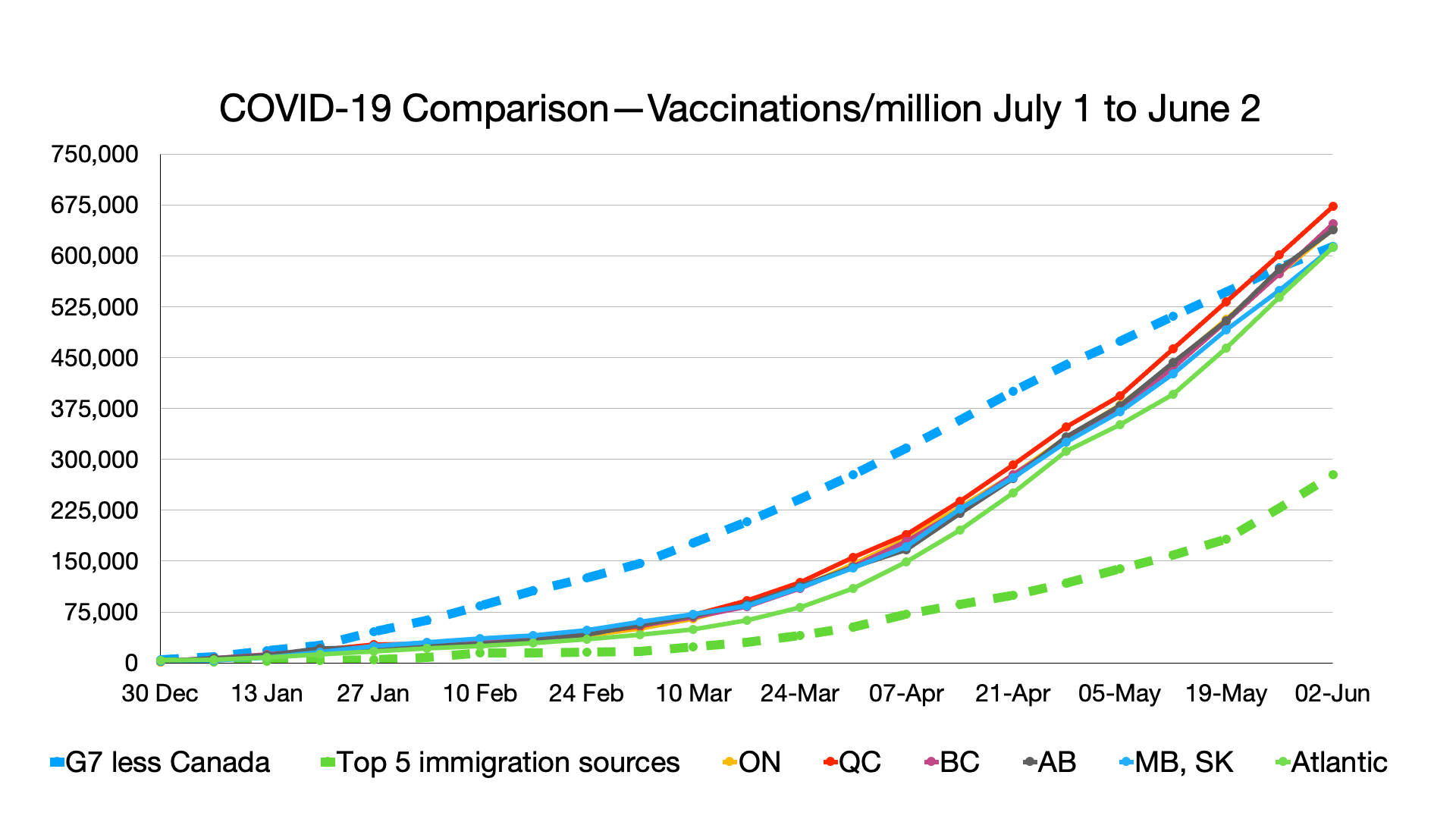
Vaccinations per million: Canadian vaccination rates now exceed G7 less Canada with Quebec. US vaccination rates continue to stall. Vaccination rate increase in immigration source countries driven mainly by China and India to a lessor extent.

Weekly

Infections per million: No relative change.

Deaths per million: Prairies ahead of Ontario, driven by Manitoba.

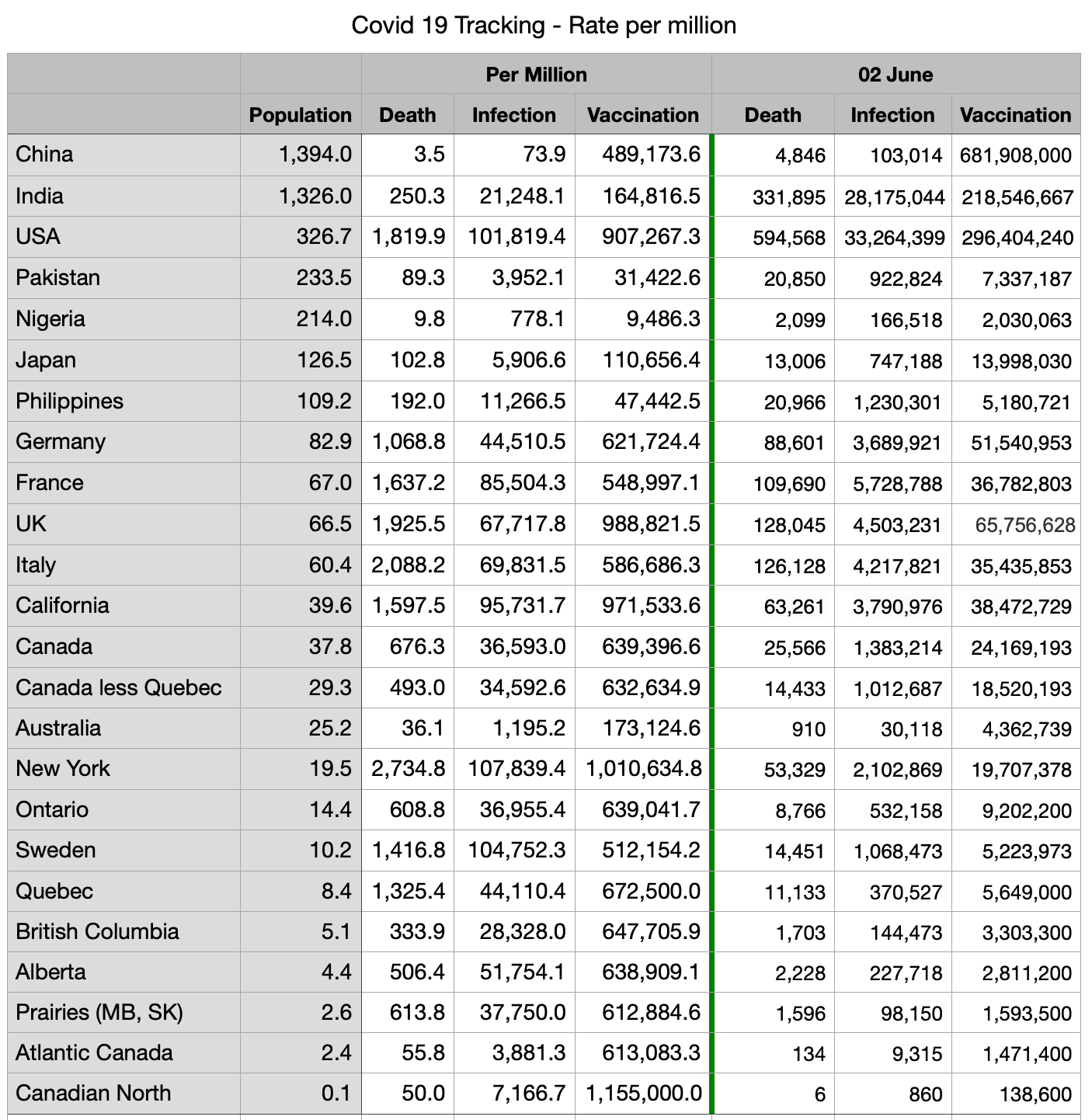
#COVID-19: Comparing provinces with other countries 2 June Update

The latest charts, compiled 2 June as overall rates in Canada continue in all provinces save Manitoba to come down along with increased vaccinations.

Vaccinations: Minor relative changes, Canadian provinces all ahead of EU countries save Germany.

Trendline charts

Infections per million: No major relative changes and recent surges appear to be levelling off save for the Prairies (mainly Manitoba).

Deaths per million: No significant change, Prairies slightly ahead of Ontario.

Vaccinations per million: Canadian vaccination rates have caught up to G7 less Canada with Quebec ahead as US vaccination rates are stalling.

Weekly

Infections per million: No relative change.

Deaths per million: Prairies ahead of Ontario, driven by Manitoba.

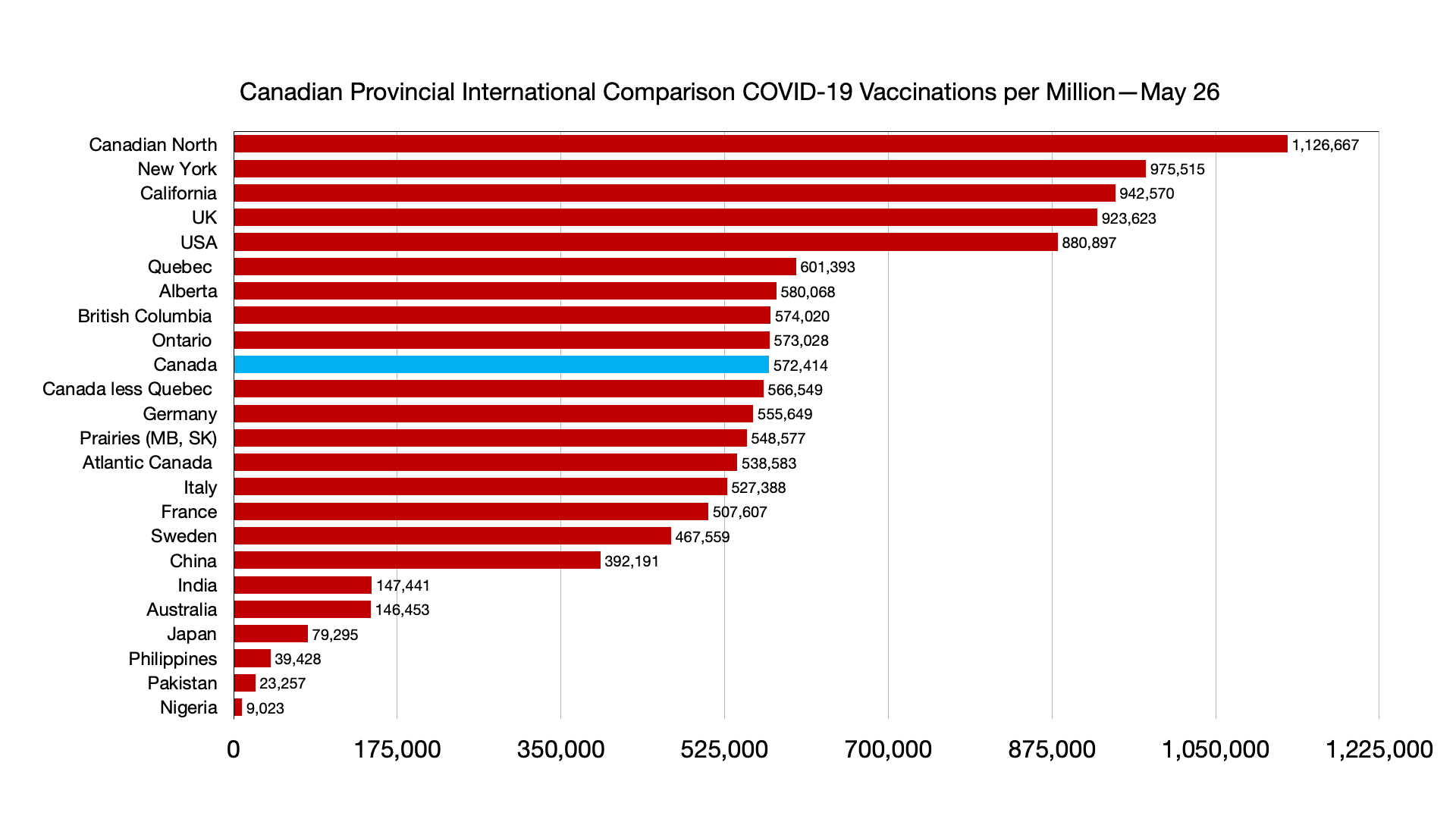
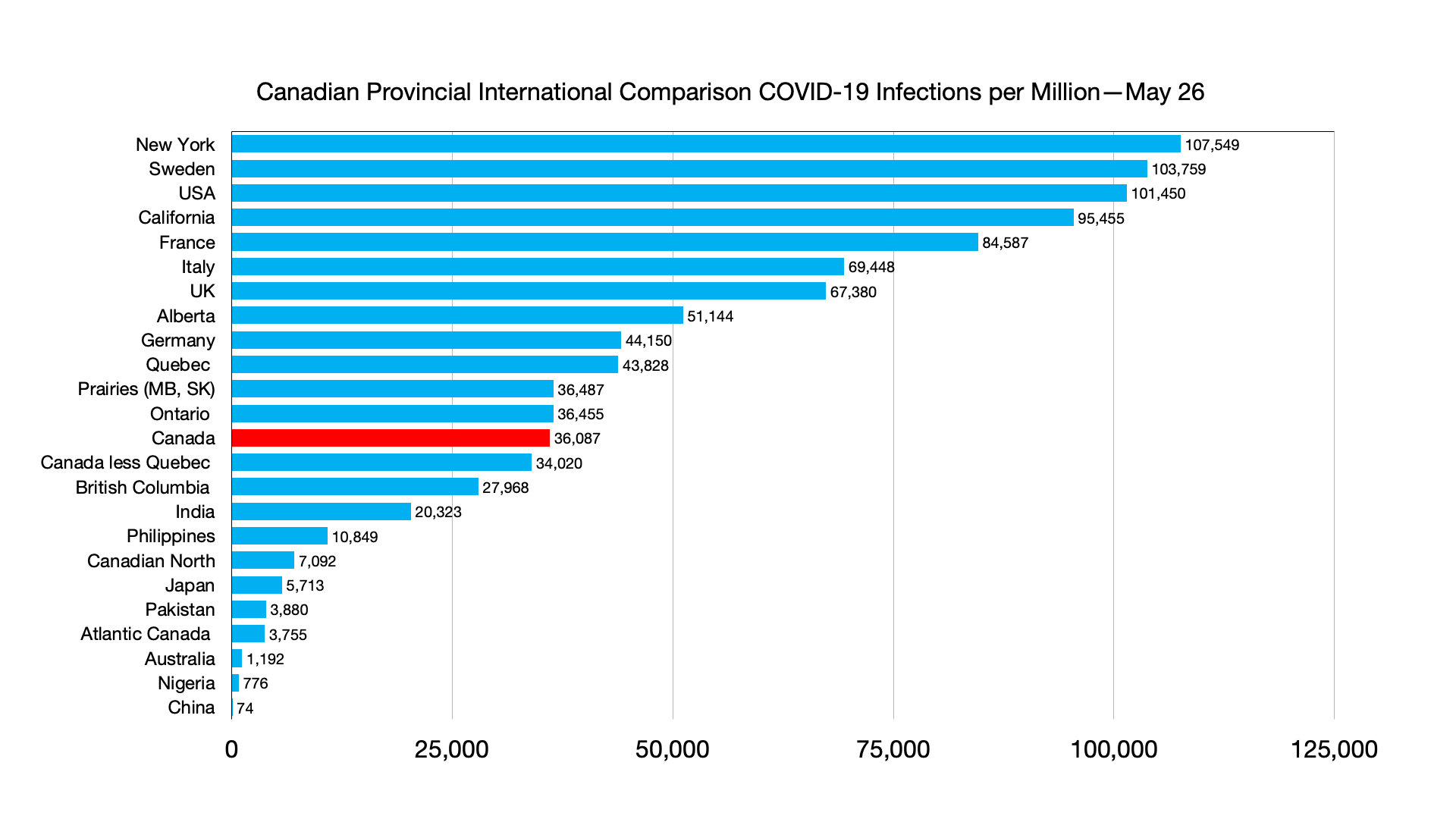
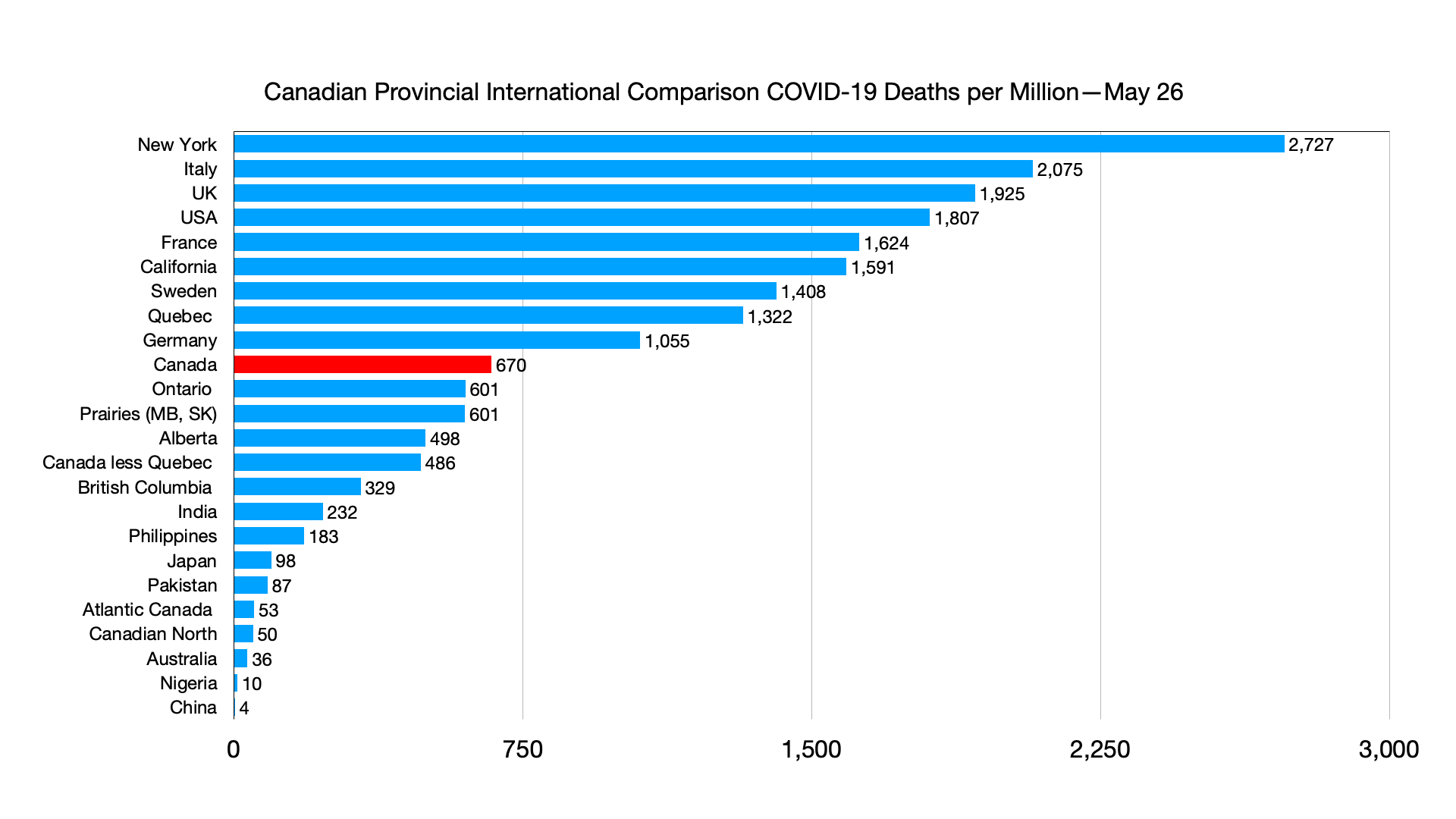
#COVID-19: Comparing provinces with other countries 26 May Update

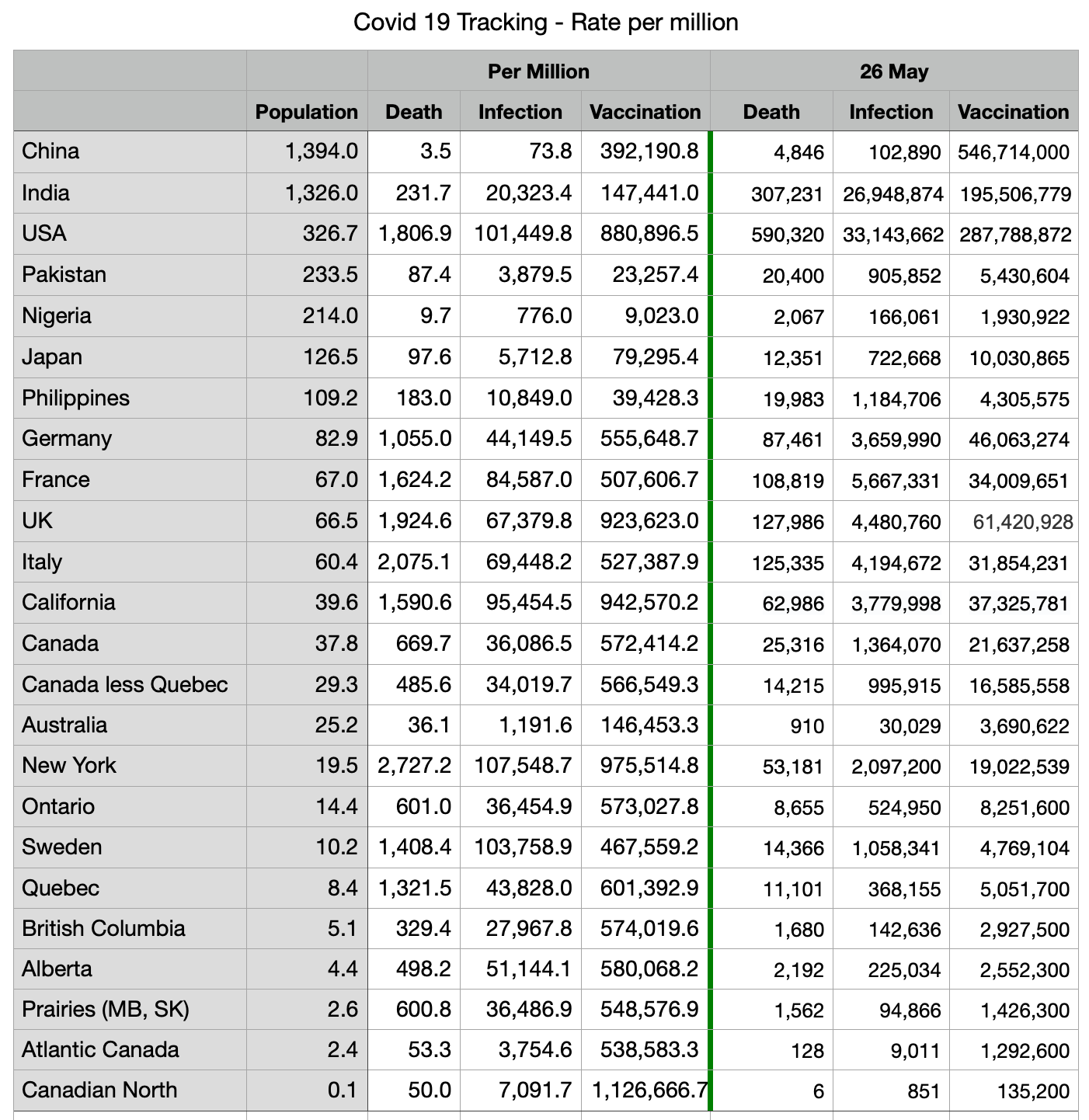
The latest charts, compiled 26 May as overall rates in Canada continue to come down along with increased vaccinations.

Vaccinations: Minor relative changes, with Alberta moving ahead of British Columbia and Ontario, Atlantic Canada ahead of Italy and France.

Trendline charts

Infections per million: Alberta levelling off and upsurge in Manitoba is resulted in Prairie rate marginally more than Ontario.

Deaths per million: No significant change.

Vaccinations per million: Canadian vaccination rates have largely caught up to G7 less Canada with Quebec ahead.

Weekly

Infections per million: Prairies ahead of Ontario, driven by Manitoba.

Deaths per million: No relative change.

India

While there is undercounting in all countries as analysis of above average deaths indicate (e.g., The Economist’s Tracking covid-19 excess deaths across countries), this article on India is of particular interest.

The official Covid-19 figures in India grossly understate the true scale of the pandemic in the country. Last week, India recorded the largest daily death toll for any country during the pandemic — a figure that is most likely still an undercount.

Even getting a clear picture of the total number of infections in India is hard because of poor record-keeping and a lack of widespread testing. Estimating the true number of deaths requires a second layer of extrapolation, depending on the share of those infected who end up dying.

In consultation with more than a dozen experts, The New York Times has analyzed case and death counts over time in India, along with the results of large-scale antibody tests, to arrive at several possible estimates for the true scale of devastation in the country.

Even in the least dire of these, estimated infections and deaths far exceed official figures. More pessimistic ones show a toll on the order of millions of deaths — the most catastrophic loss anywhere in the world.

India’s official coronavirus statistics report about 27 million cases and over 300,000 deaths as of Tuesday. The country’s response to the pandemic has been further complicated this week by a cyclone that is battering India’s eastern coast, with winds of more than 95 miles per hour.
Even in countries with robust surveillance during the pandemic, the number of infections is probably much higher than the number of confirmed cases, because many people have contracted the virus but have not been tested for it. On Friday, a report by the World Health Organization estimated that the global death toll of Covid-19 may be two or three times higher than reported.

The undercount of cases and deaths in India is most likely even more pronounced, for technical, cultural and logistical reasons. Because hospitals are overwhelmed, many Covid deaths occur at home, especially in rural areas, and are omitted from the official count, said Kayoko Shioda, an epidemiologist at Emory University. Laboratories that could confirm the cause of death are equally swamped, she said.

Additionally, other researchers have found, there are few Covid tests available. Families are often unwilling to say that their loved ones have died of Covid. And the system for keeping vital records in India is shaky at best. Even before Covid-19, about four out of five deaths in India were not medically investigated.

Source: https://www.nytimes.com/live/2021/05/26/world/covid-vaccine-coronavirus-mask

#COVID-19: Comparing provinces with other countries 19 May Update

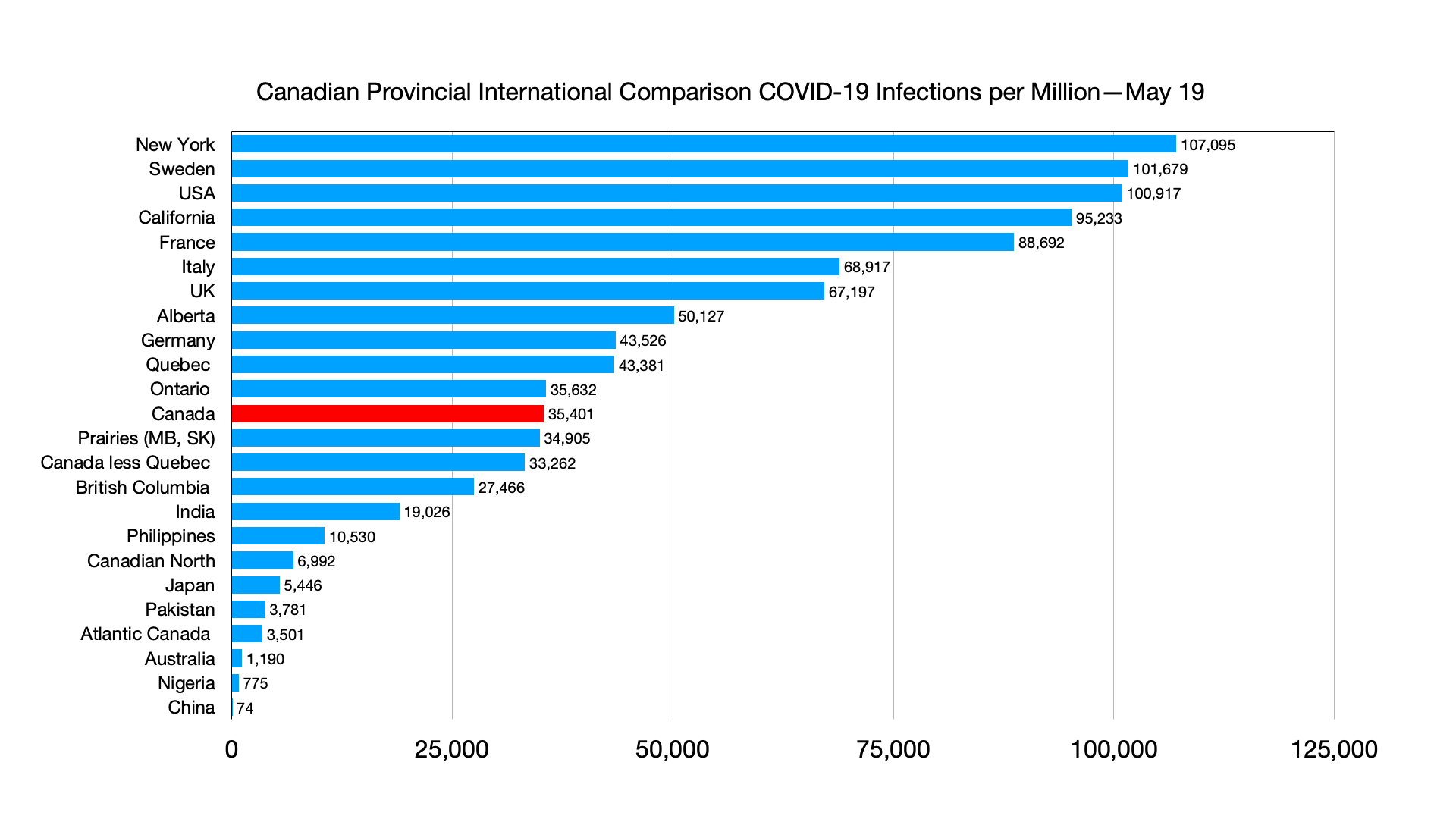
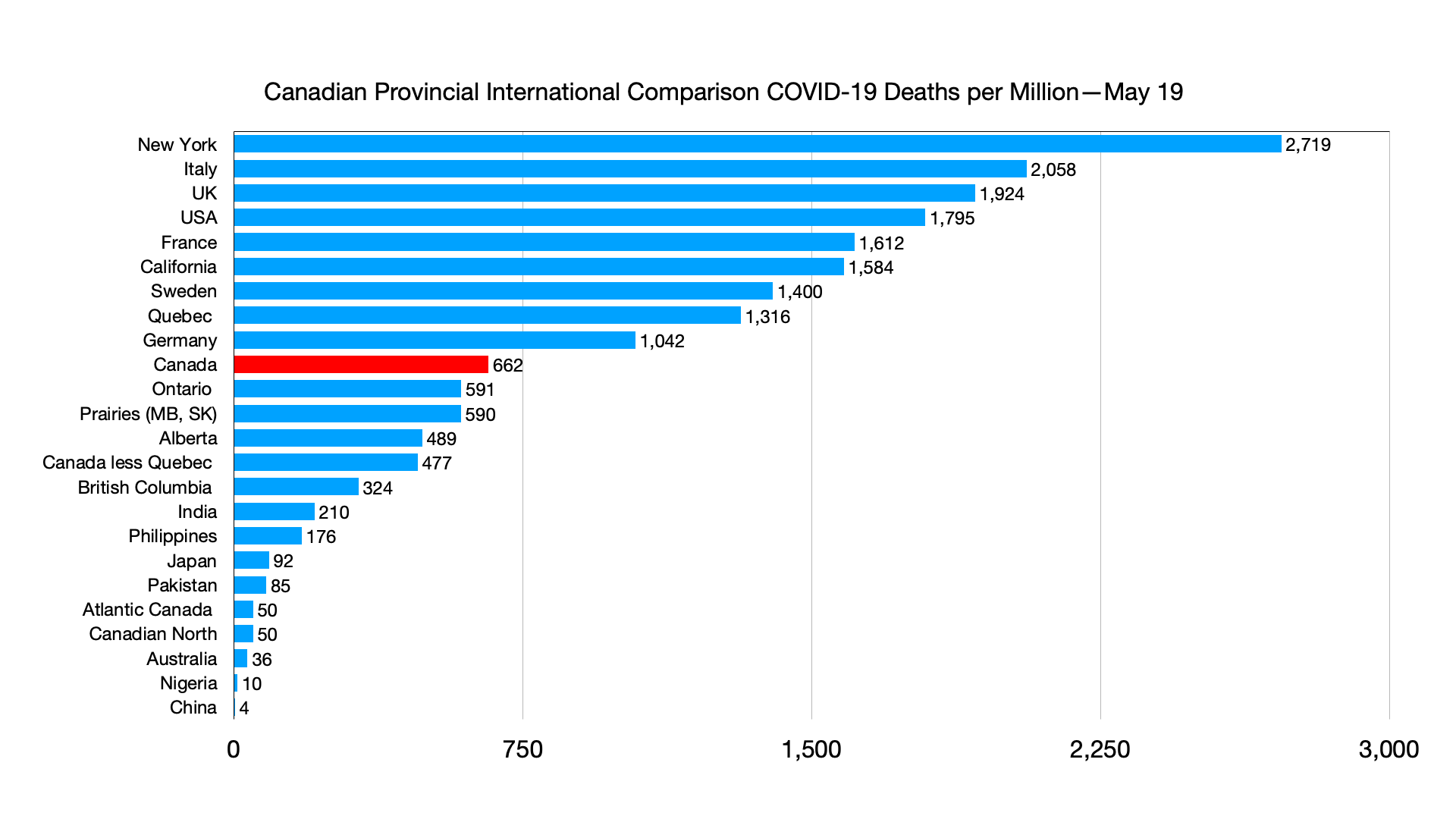
The latest charts, compiled 19 May as the third wave continues.

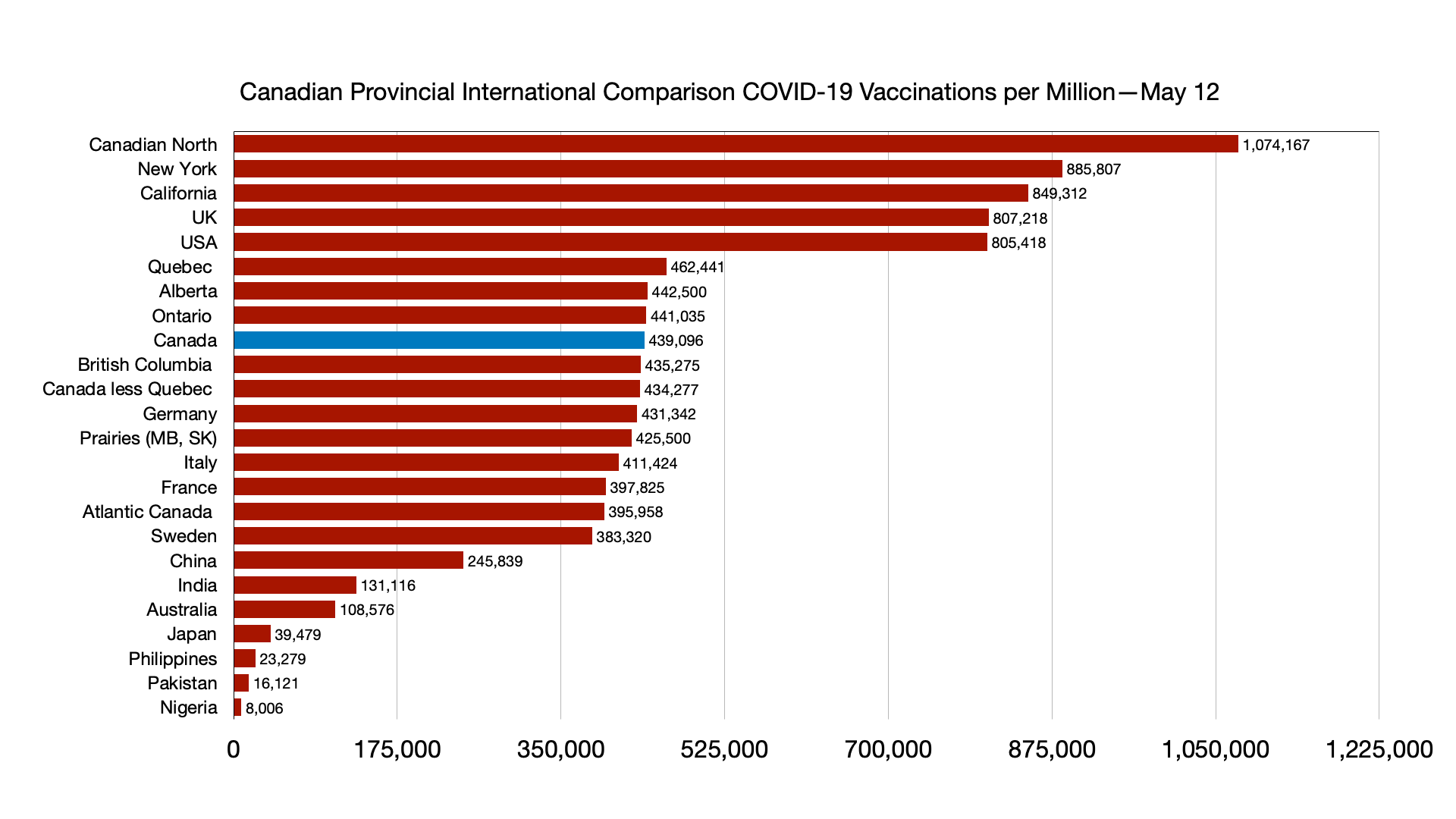
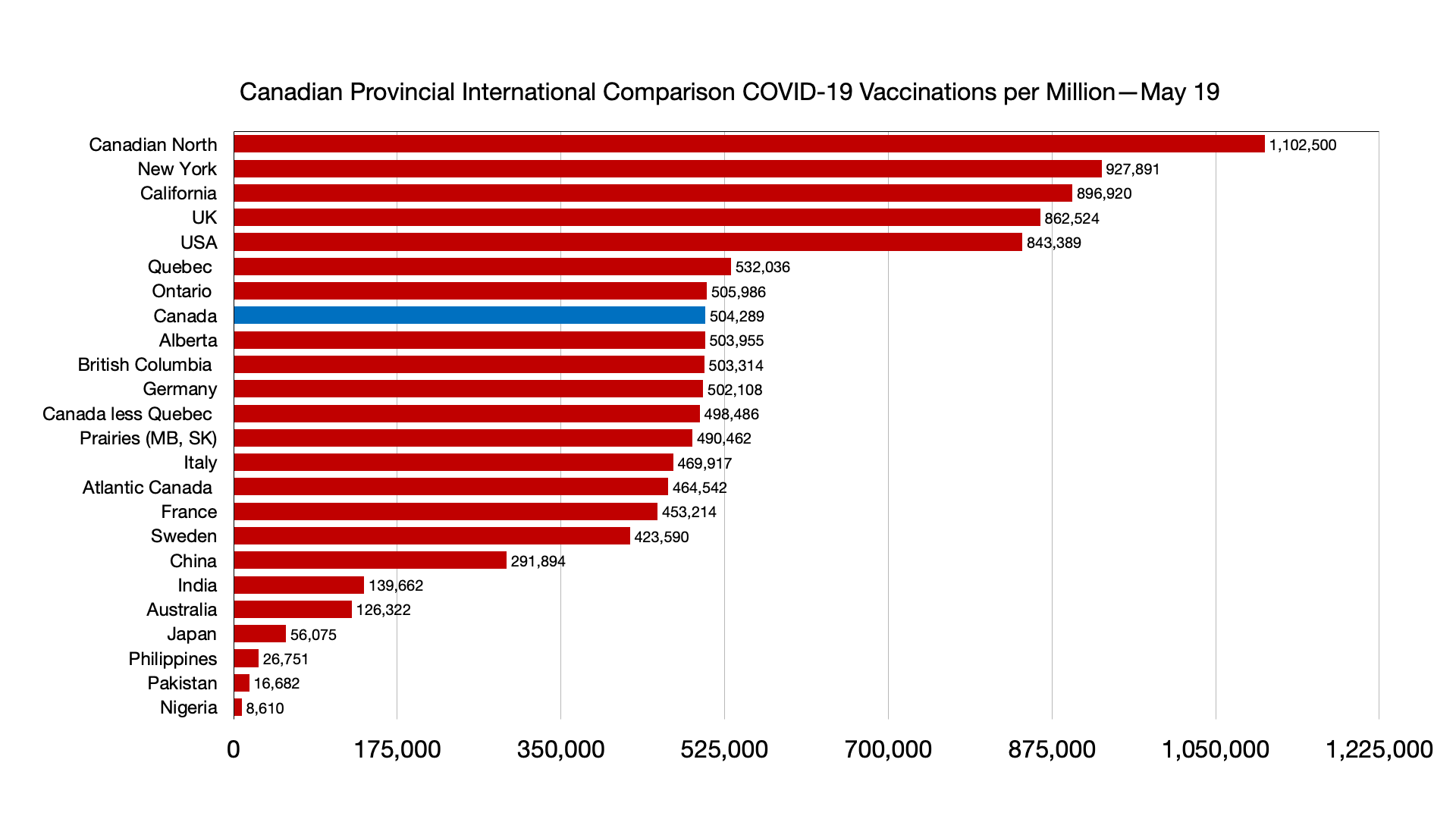
Vaccinations: No significant relative changes

Trendline charts

Infections per million: Alberta spike continues and upsurge in Manitoba is driving Prairie rates closer to Ontario.

Deaths per million: Gap between G7 and Canadian provinces continues to grow.

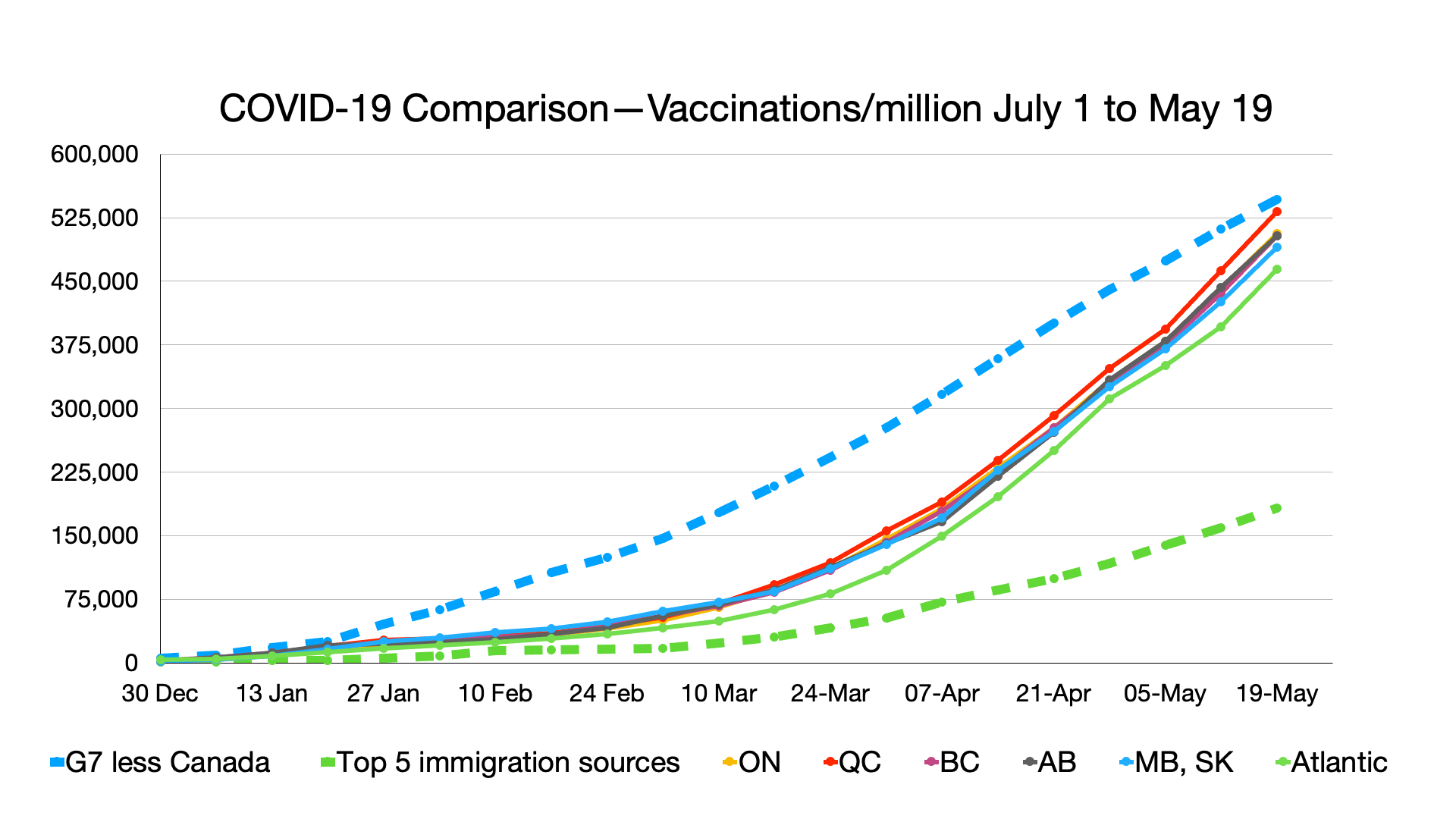
Vaccinations per million: Canadian vaccination rates continue to catch up to G7 less Canada and are likely to exceed G7 shortly (at least in some provinces).

Weekly

Infections per million: Minor shifts between some EU countries and Canadian provinces.

Deaths per million: Atlantic Canada ahead of the North.

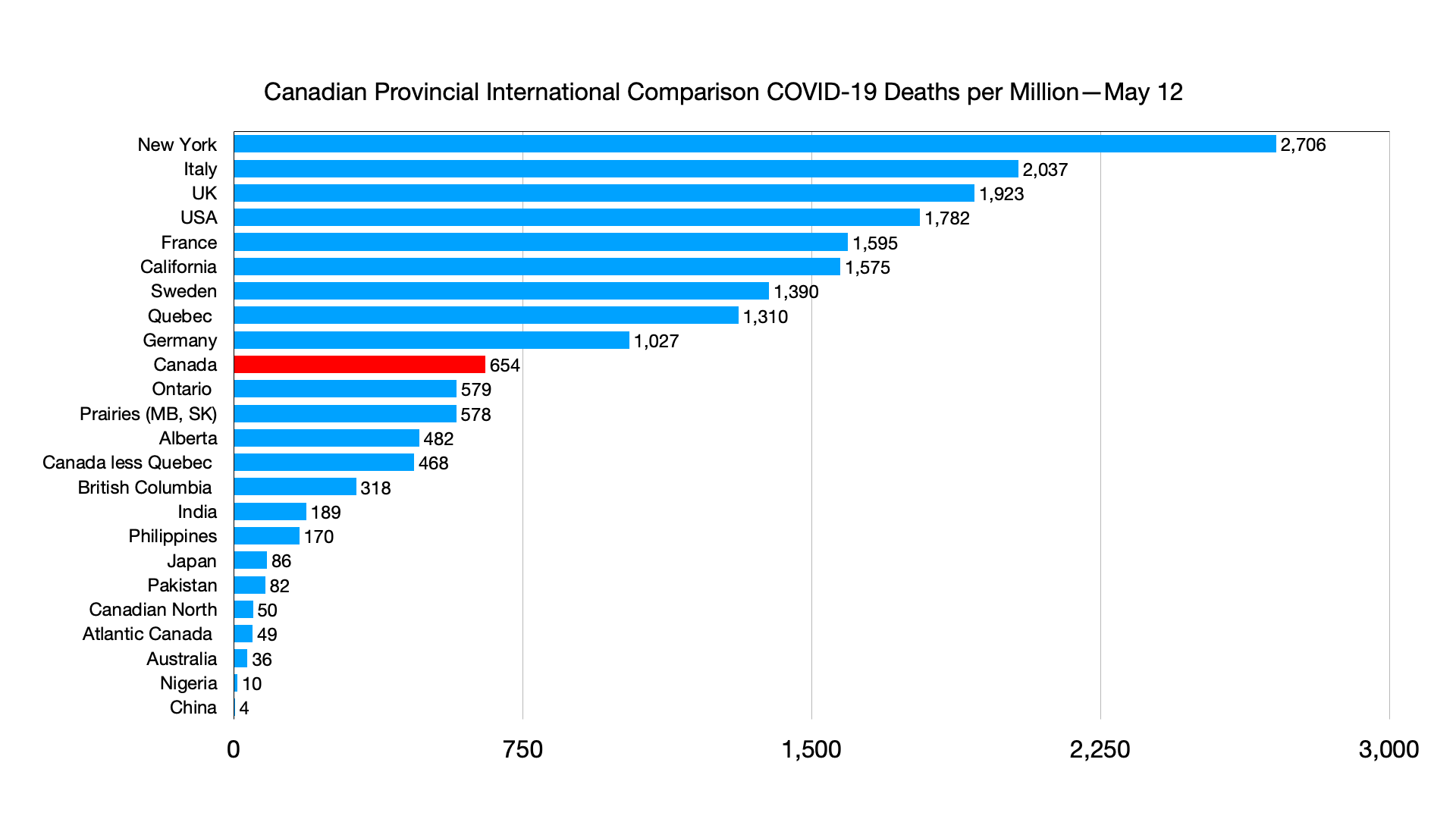
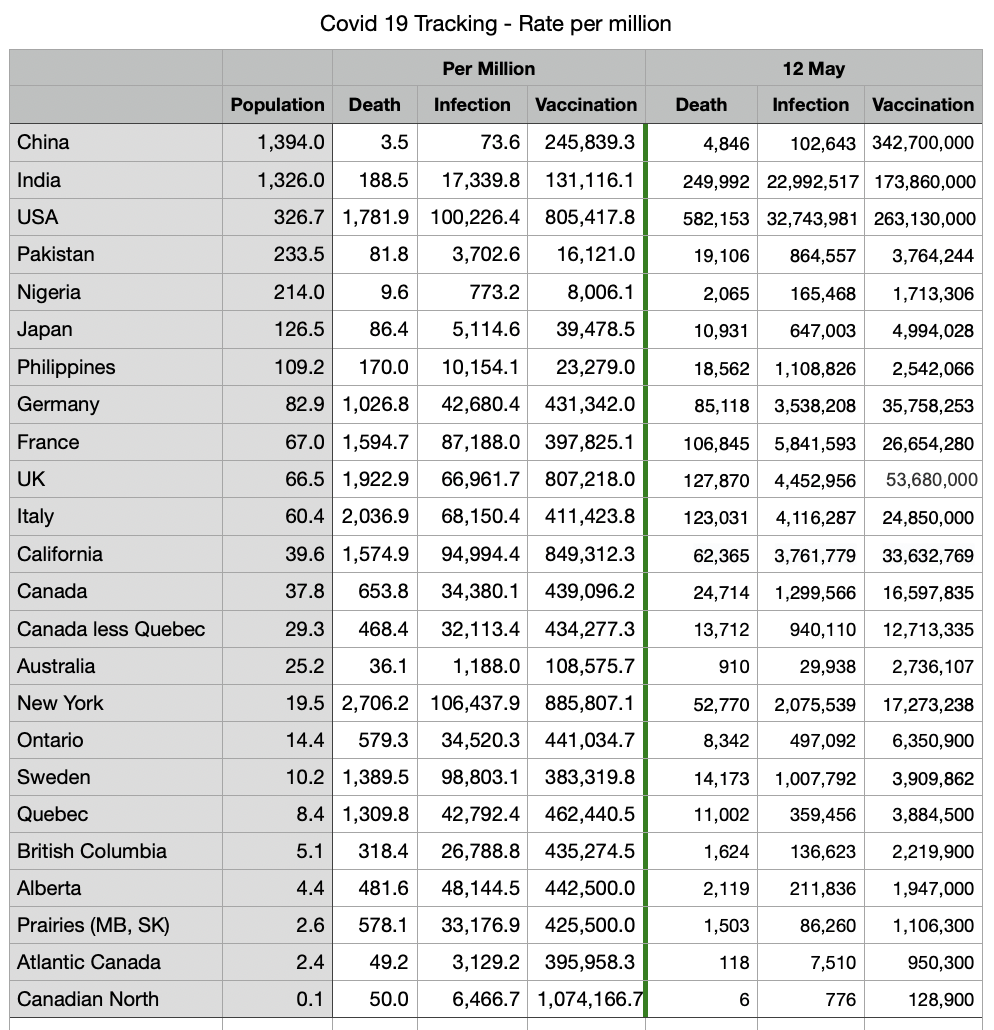
#COVID-19: Comparing provinces with other countries 12 May Update

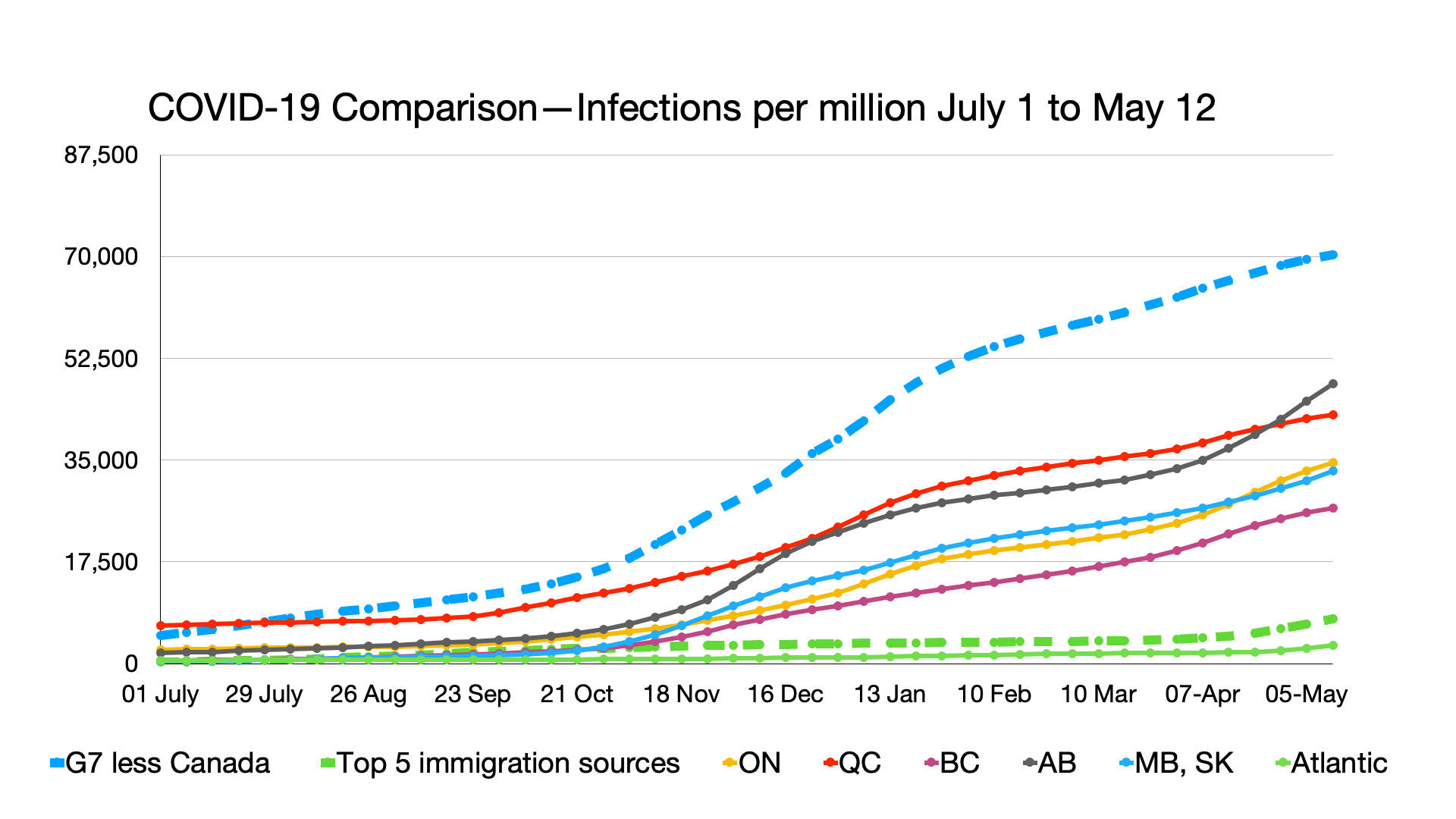
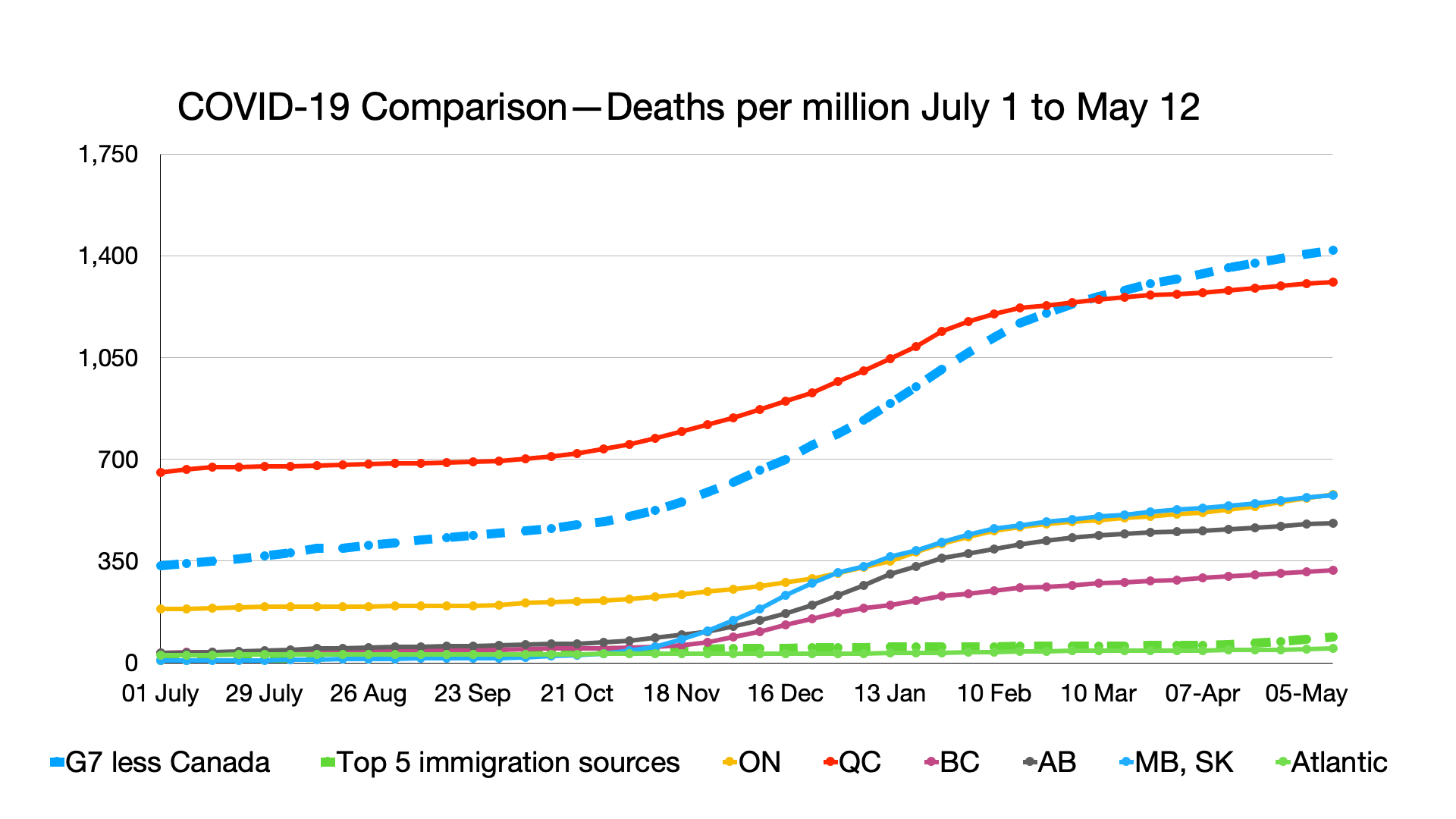
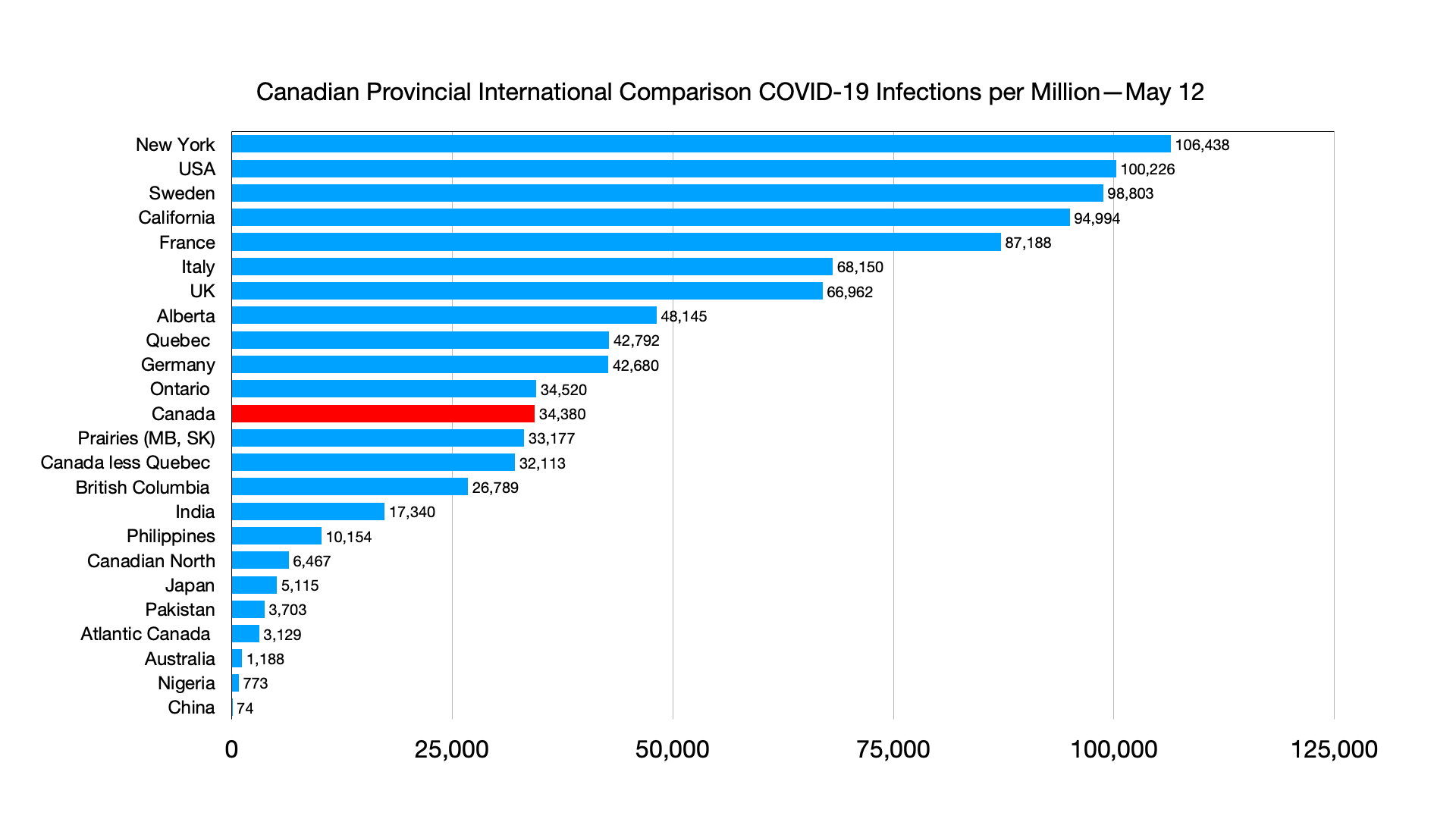
The latest charts, compiled 12 May as the third wave continues. The ongoing spike of infections and deaths in India per million still has not resulted in a change in the relative ranking given the size of India’s population.

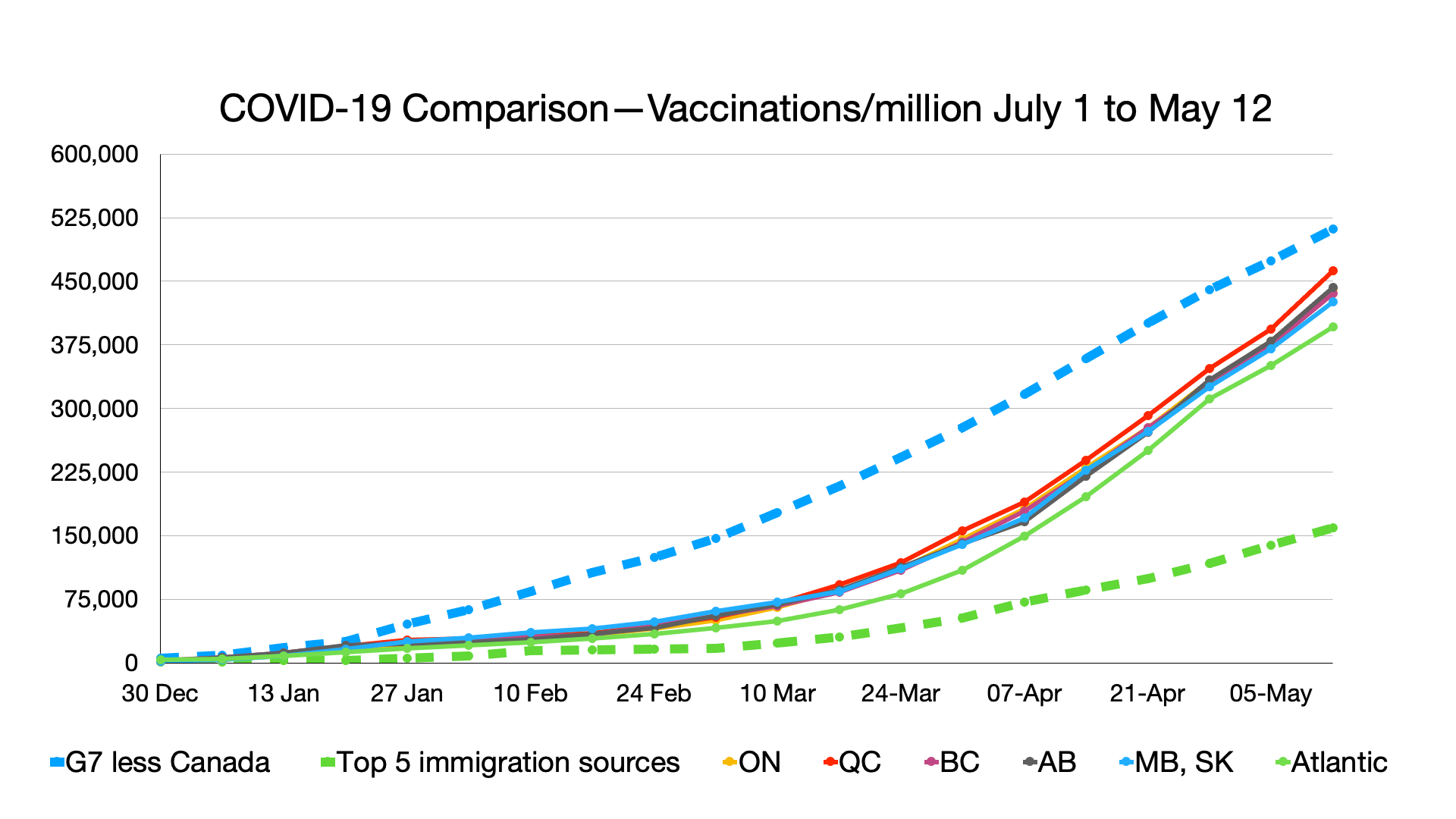
Vaccinations: Overall, vaccination rates in Canada and most provinces continue to be comparable or greater to those of EU countries.

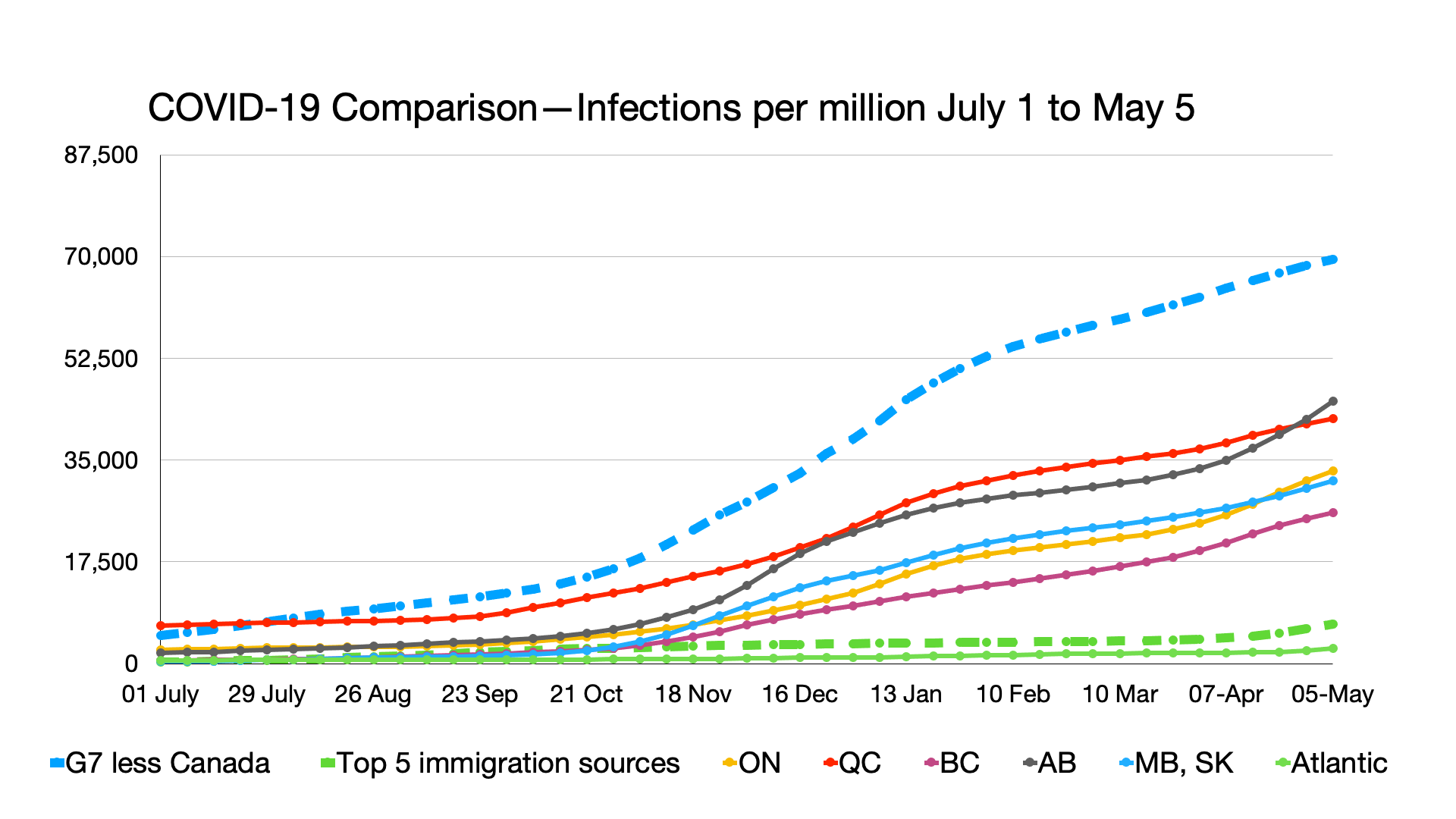
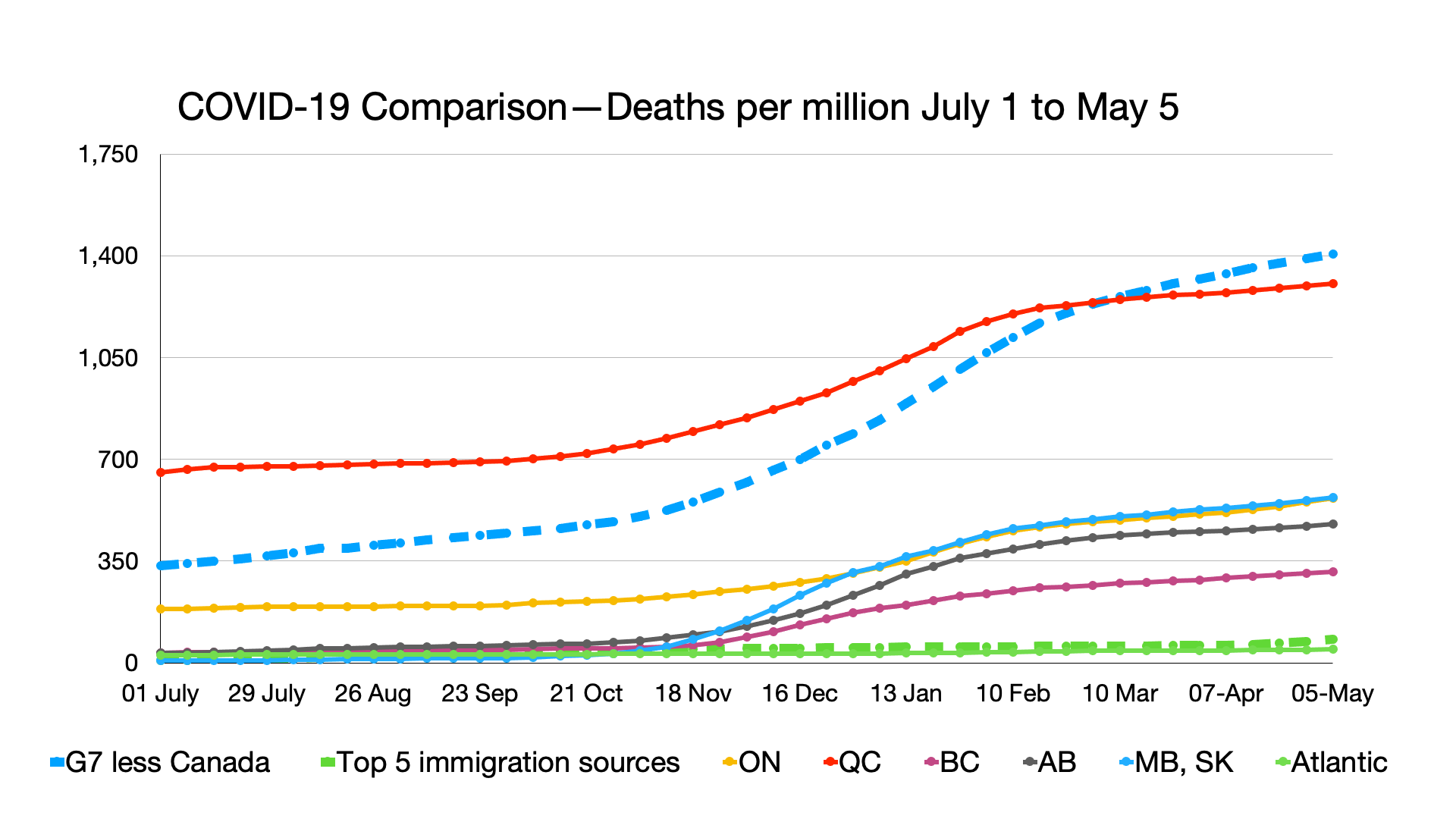
Trendline charts

Infections per million: The ongoing spikes in Alberta and Ontario continue, with Alberta showing the highest growth rate.

Deaths per million: Gap between G7 and Canadian provinces continues to grow.

Vaccinations per million: Vaccination rates in Canadian provinces continue to increase more quickly than overall G7 less Canada countries. USA has moved ahead of the UK. Canada and the largest four provinces all ahead of Germany but Atlantic Canada behind France, while Australia and Japan have moved ahead of the Philippines. The Increases among immigration source country continue to reflect China and India mass vaccination roll-out, but at lower rates of increase compared to Canadian provinces and G7.

Weekly

Infections per million: Sweden moved ahead of California, Italy ahead of UK, and Ontario ahead of all Canada.

Deaths per million: Ontario ahead of Prairies.

#COVID-19: Comparing provinces with other countries 5 May Update

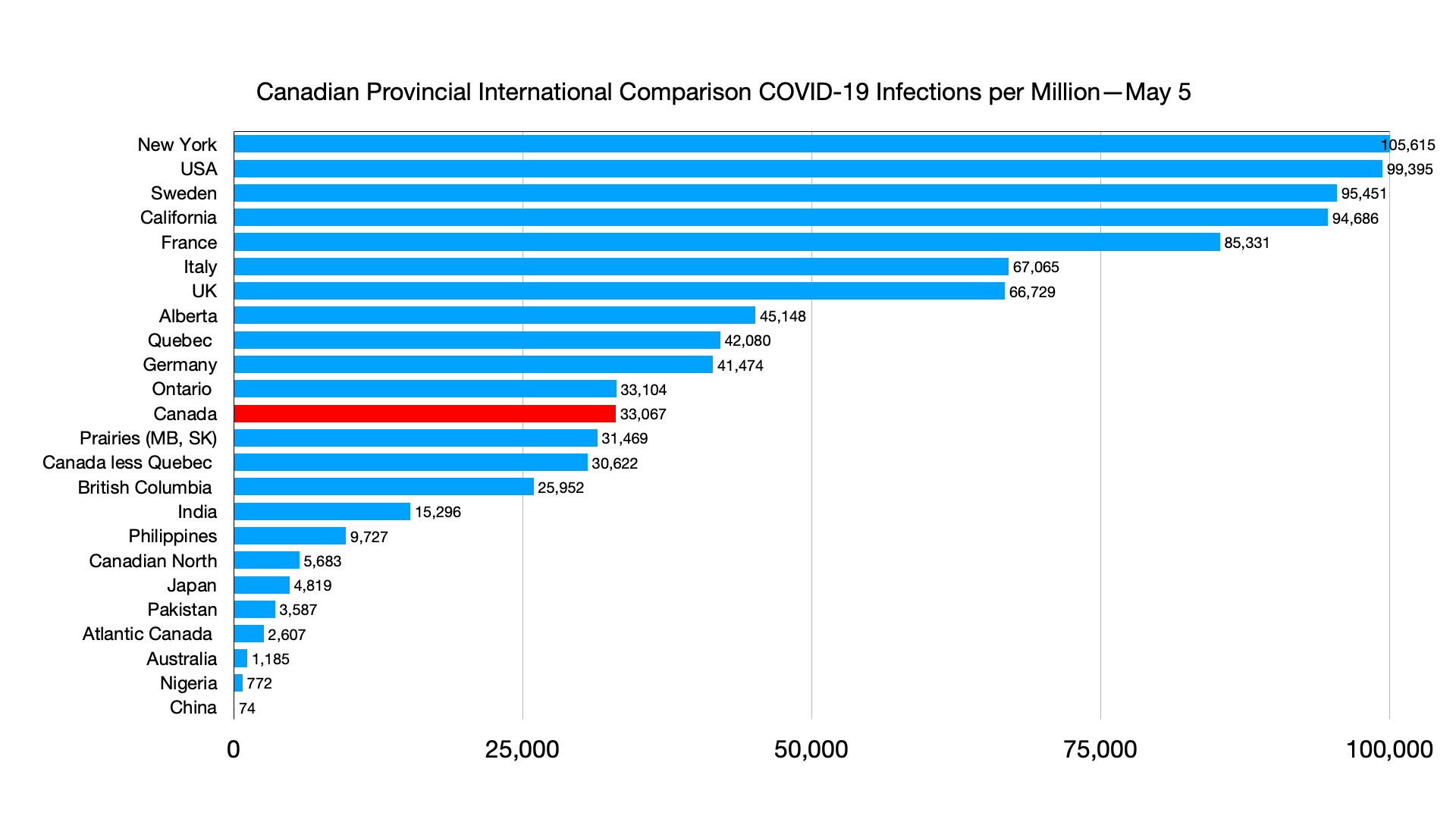
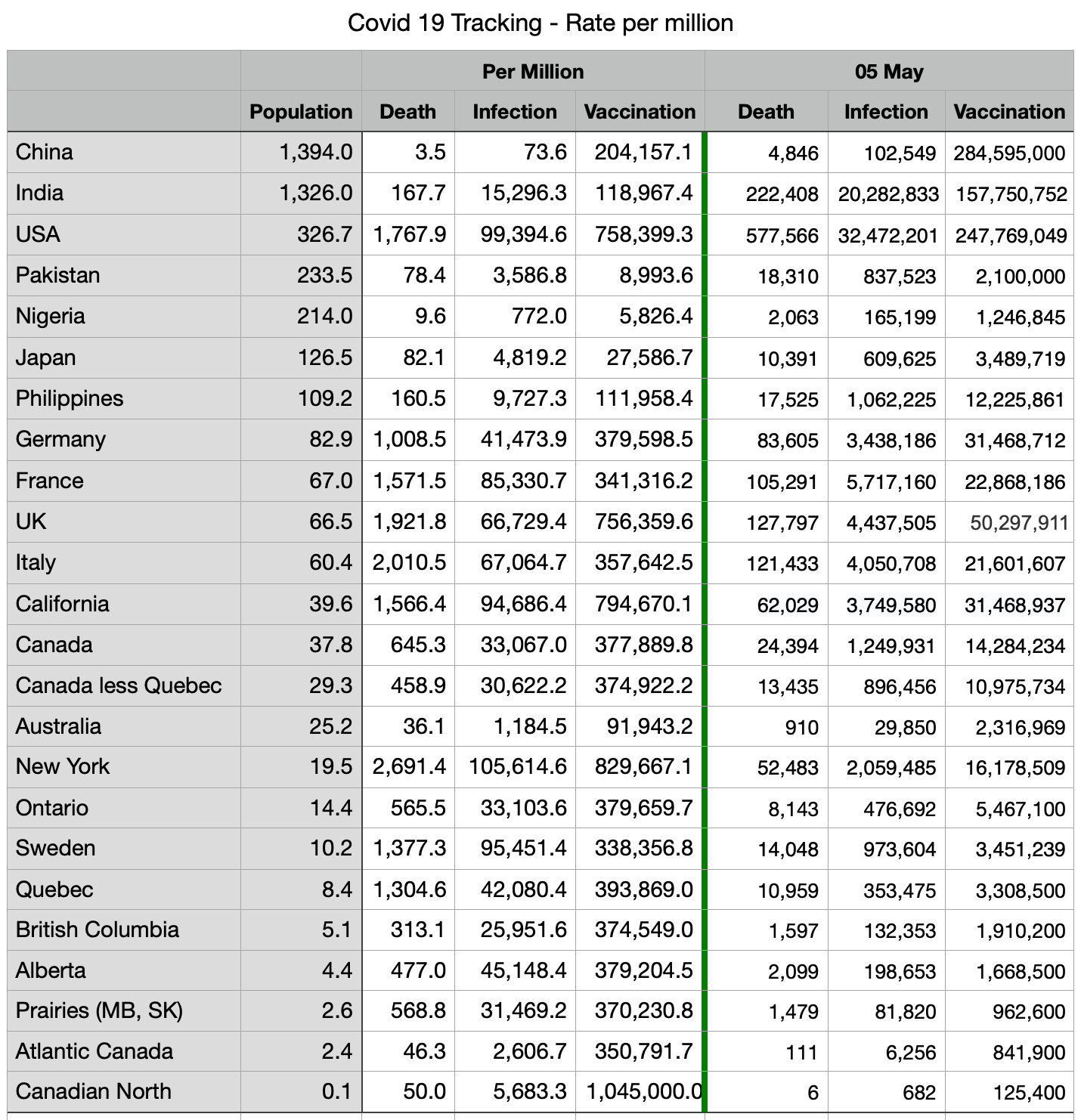
The latest charts, compiled 5 May as the third wave continues. The ongoing spike of infections and deaths in India per million still has not resulted in a change in the relative ranking given the size of India’s population.

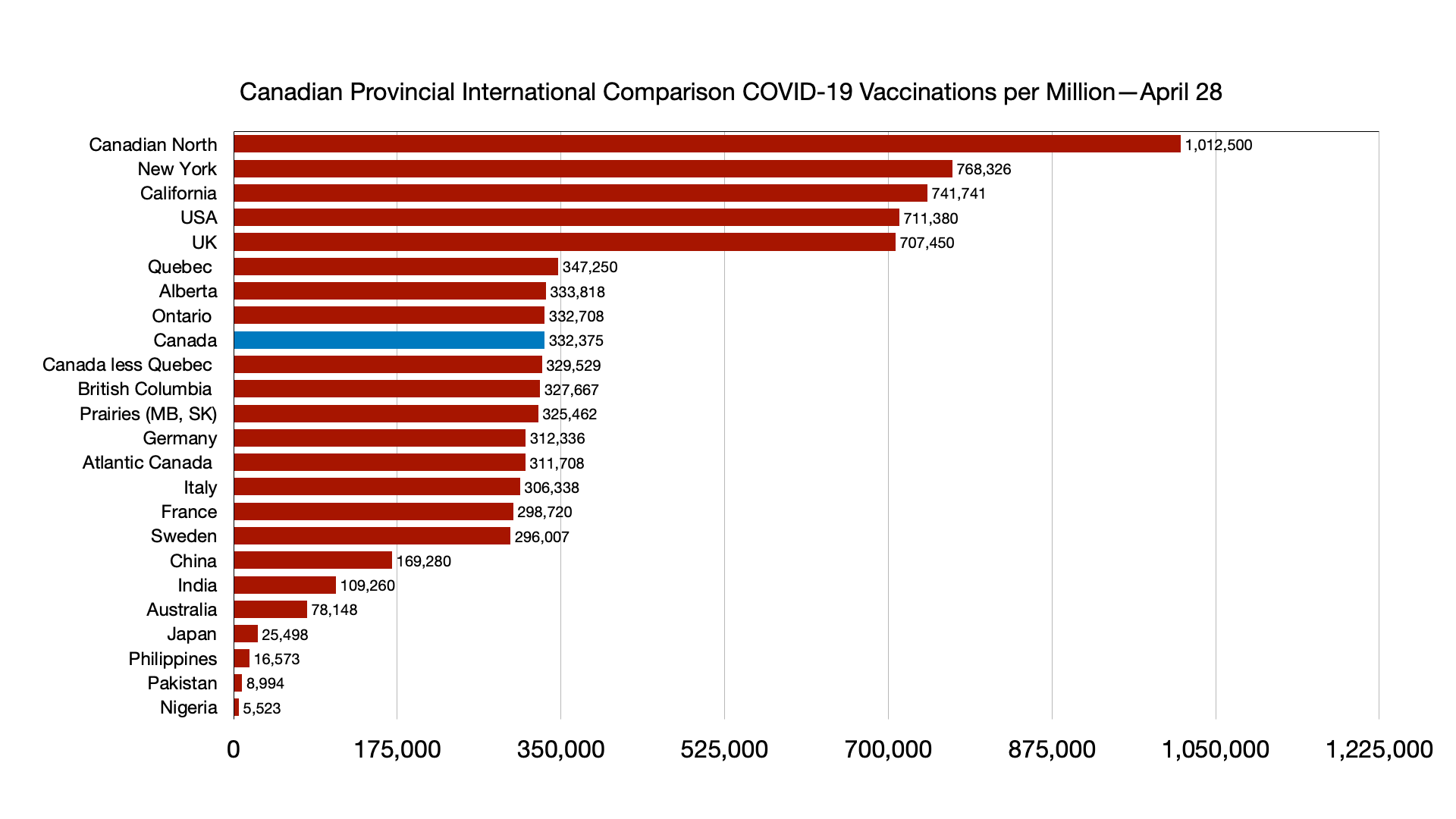
Vaccinations: Overall, Canada and most provinces continue to be comparable or greater to EU countries.

Trendline charts

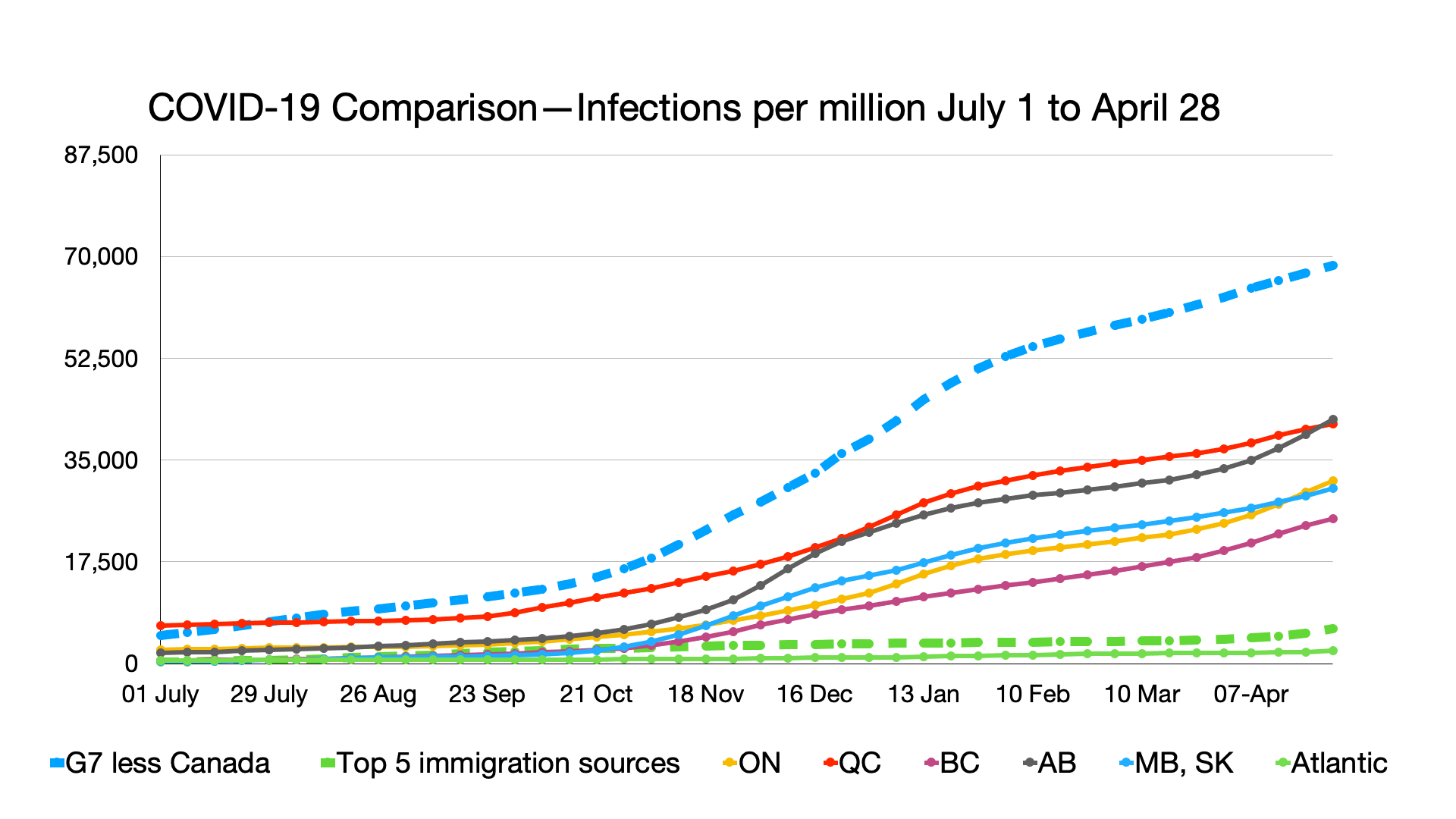
Infections per million: The ongoing spikes in Alberta and Ontario continue, with Alberta significantly ahead of Quebec, Ontario ahead of the Prairies.

Deaths per million: Gap between G7, Quebec and other provinces continues to grow.

Vaccinations per million: Vaccination rates in Canadian provinces continue to increase more quickly than overall G7 less Canada countries. Increases among immigration source country reflect China and India mass vaccination roll-out, but at lower rates of increase compared to Canadian provinces and G7.

Weekly

Infections per million: Sweden now ahead of California, Italy now ahead of UK, and Ontario ahead of Canada .

Deaths per million: France ahead of California, India ahead of Philippines

#COVID-19: Comparing provinces with other countries 28 April Update

The latest charts, compiled 28 April as the third wave has started. The spike of infections and deaths in India per million, although dramatic, has not resulted in a change in the relative ranking given the size of India’s population.

Vaccinations: Overall, Canada and most provinces continue to be comparable or greater to EU countries. On a personal note, received my vaccine last week.

Trendline charts

Infections per million: Recent spikes in Ontario and Alberta continue to be more apparent.

Deaths per million: Canadian North ahead of Atlantic Canada.

Vaccinations per million: Vaccination rates in Canadian provinces continue to increase more quickly than overall G7 less Canada countries. Increases among immigration source country reflect China and India mass vaccination roll-out.

Weekly

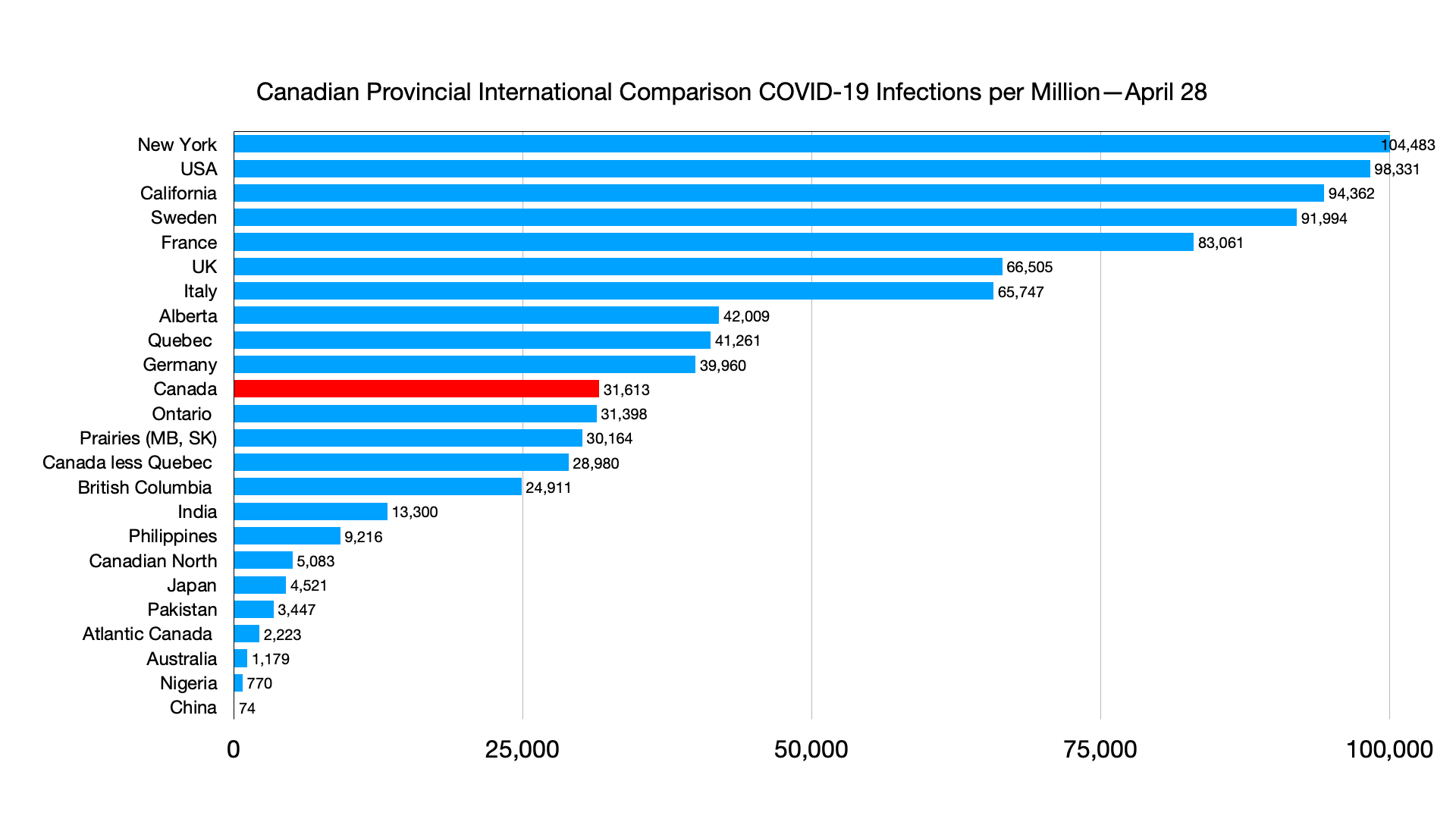
Infections per million: Surge in Ontario has not changed overall ranking but surge in Alberta has resulted in Alberta surpassing Quebec.

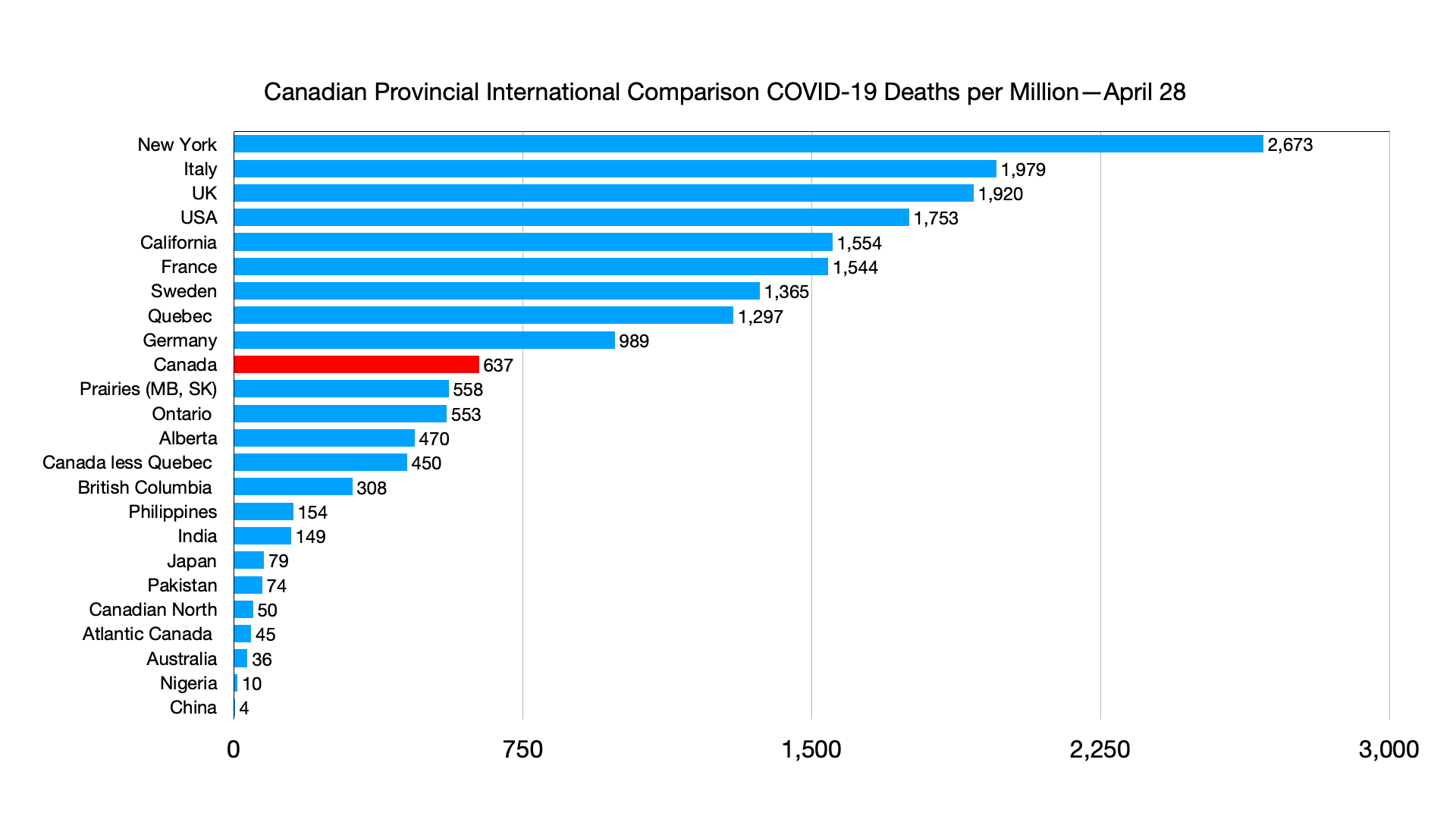
Deaths per million: As noted, Canadian North now ahead of Atlantic Canada.