Home Office separating scores of children from parents as part of immigration detention regime

The bad stories keep on coming:

The Home Office is separating scores of children from their parents as part of its immigration detention regime – in some cases forcing them into care in breach of government policy.

Schools, the NHS and social services have written letters to the department begging them to release parents from detention because of the damaging impact it is having on their children.

Bail for Immigration Detainees (Bid), a charity that supports people in detention, said they have seen 170 children separated from their parents by the Home Office in the past year – and believes there are likely to be many more.

While usually the youngsters remain in the care of their other parent, the charity has seen a number of cases where children are taken into local authority care as a result of the detention.

Case workers highlight that this is in breach of Home Office guidelines, which state that a child “must not be separated from both adults if the consequence of that decision is that the child is taken into care”.

In one case, three young children were taken into care for several days after their dad was detained earlier this year – an experience that left them traumatised and fearful that he will be “taken away” again.

Kenneth Oranyendu, 46, was detained in March while his wife was abroad for her father’s funeral. Despite the Home Office being aware of this, they kept him in detention and his four young children were forced to go into care.

The Independent has seen letters to the Home Office from public bodies in which teachers, social workers and medical workers inform officials of the detrimental impact the detention of parents is having on their children.

One letter to the Home Office from a head teacher states that the detention of the father of two of the “most delightful and brightest” pupils in the school would impact “significantly” on their emotional wellbeing.

“It is incredibly upsetting for the girls to suddenly have their father removed from their life. This distress, to what was a happy life for these girls, will no doubt impact significantly on their emotional wellbeing,” the letter states.

“It is deeply saddening that a member of our school community who is very much liked and respected by both staff and parents has been treated in this manner, and whilst he may just be a number to you he is a friend to all of us.”

Another letter to the Home Office, from a social worker in Southwark, warns that if a man in detention is not released in time for the birth of his unborn child in three weeks’ time then the baby would have to go into care.

“If [name of detainee] is not released in time for the baby’s birth, the child will be accommodated in local authority care and care proceedings will be initiated to secure the long-term care planning arrangements for the child,” it states.

“This is understandably a situation Southwark Children’s Services wish to avoid to prevent family breakdown.”

A third letter, from an NHS trust in London, urges the Home Office to release the father of a one-year-old girl who is suffering a bleed in her brain, saying: “He has accompanied [her] to all health and therapy appointments.

“He has received training and has undertaken daily therapy activities with [her] which have been key to her development. Being deported would place the immediate family in a vulnerable situation.”

Nick Beales, a legal case worker at Bid, told The Independent he had seen three cases in the past 18 months where children were placed in care because their parent was detained.

“The Home Office knew how much damage is going to be done. We get letters from schools, and social services are pleading with them to release people,” he said.

“We regularly get reports from schools of children’s behaviour deteriorating, their school work suffering. We get reports from parents of children wetting the bed, letters from social services raising concerns about children’s conduct.

“The initial decision to detain someone is usually made with very little assessment of what’s actually going on. It’s ‘detain first, ask questions later’. Any new evidence submitted falls on deaf ears. All rationality goes out of the window.”

Maddy Evans of SOAS Detainee Support, a campaign group supporting immigration detainees, told The Independent the Home Office had been “tearing parents away from their children for years”.

“These families do not know if they will be reunited or separated forever. Needless to say, this causes unbearable distress to many detainees and their families,” she said.

“This punitive and heartless policy of family separation not only has a devastating impact on parents who are separated from their children, or left to parent alone, it has lifelong ramifications for the children involved.

“It is absolutely unconscionable to put political point scoring on immigration above a child’s right to the care and love of their parents.”

The Home Office did not provide a formal comment but said it did not separate children from both adults for immigration purposes if it means the child would be taken into care, unless there are “exceptional circumstances”.

Source: Home Office separating scores of children from parents as part of immigration detention regime
Trump Administration Has No Idea Whether It Backs Family Separation at the Border

Deliberate or accidental chaos. Hard to know but the impact is real:

The United States has no policy of separating migrant families at the border. There is such a policy, but it’s all the Democrats’ fault. The policy was a “simple decision,” but one “nobody likes.” The policy is good, legal, and Jesus would approve.

The Trump administration, confronted with increasing public criticism over its immensely unpopular policy of separating migrant children from their families when they cross the U.S. border, has responded to the crisis by taking taking wildly different positions on both the policy itself and the motivation behind it.

Ranging from full-throated endorsement of the decision to separate minor children from their asylum-seeking parents to flat insistence that the decision doesn’t exist, “period,” the public-relations pileup is just a facet of the botched rollout of a policy that separated nearly 2,000 children from their families in its first six weeks.

For nearly a week, President Donald Trump has pointed to congressional Democrats as the root behind his administration’s policy. “I hate the children being taken away,” Trump told reporters on the White House lawn on Friday. “The Democrats have to change their law—that’s their law.”

The president reiterated that (incorrect) statement with a Saturday morning tweet: “Democrats can fix their forced family breakup at the Border by working with Republicans on new legislation, for a change!”

But the president’s public insistence that his hands are tied on the matter of family separation at the border isn’t just undermined by the fact that no law requiring family separation exists—it has also been undermined by the head of the government department in charge of its execution.

“We do not have a policy of separating families at the border. Period,” Secretary of Homeland Security Kirstjen Nielsen tweeted as part of a defensive thread on the matter on Sunday evening. “For those seeking asylum at ports of entry, we have continued the policy from previous Administrations and will only separate if the child is in danger, there is no custodial relationship between ‘family’ members, or if the adult has broken a law.”

The Department of Homeland Security has been treating people seeking asylum as illegal border crossers, regardless of whether they are entering a port of entry or not.

Nielsen—who reportedly has been deeply conflicted about the policy in private—clearly missed a fiery press conference held by Attorney Jeff Sessions on Monday, in which the longtime immigration hawk said that people who didn’t want to fall victim to the policy shouldn’t try to enter the country.

“If you are smuggling a child then we will prosecute you, and that child will be separated from you as required by law,” Sessions said at a law enforcement conference. “If you don’t like that, then don’t smuggle children over our border.”

Later, Sessions would point to a Bible passage once popular with the Nazis as evidence that the policy was not only good for national security, but in keeping with Christian teachings.

“I would cite you to the Apostle Paul and his clear and wise command in Romans 13, to obey the laws of the government because God has ordained them for the purpose of order,” Sessions said in a speech on Thursday. “Orderly and lawful processes are good in themselves and protect the weak and lawful.”

Sessions’ endorsement of family separation as both biblically sound and legally necessary stands in contrast to the position taken by White House counselor Kellyanne Conway on Sunday, when she told NBC’s Meet the Press that “nobody likes seeing babies ripped from their mothers’ arms” and that she found flaws with the policy as a Catholic.

“As a mother, as a Catholic, as somebody who has got a conscience,” Conway said, “I will tell you that nobody likes this policy.”

Except, of course, for its likely architect. Stephen Miller, the White House speechwriter and adviser infamous for crafting the hastily written and legally disastrous ban on travel to the United States from citizens of seven (later six) primarily Muslim nations, was reportedly the driving force behind the family separation policy and has defended it like it was his own, non-migrant child.

“No nation can have the policy that whole classes of people are immune from immigration law or enforcement,” Miller told The New York Times. “It was a simple decision by the administration to have a zero tolerance policy for illegal entry, period. The message is that no one is exempt from immigration law.”

Whatever the Trump administration’s views of the policy, the American people are in agreement on the matter. According to a new Ipsos poll conducted exclusively for The Daily Beast, only 27 percent of respondents agree that it is “appropriate to separate undocumented immigrant parents from their children when they cross the border in order to discourage others from crossing the border illegally.”

Among the 56 percent of those who disagree with the policy? First lady Melania Trump.

According to Stephanie Grisham, the first lady’s spokesperson, Trump “hates to see children separated from their families.”

via Trump Administration Has No Idea Whether It Backs Family Separation at the Border

USA: Suicide rates for black children twice that of white children, new data show

Significant study and yet another example of racial disparities:

African-American children are taking their lives at roughly twice the rate of their white counterparts, according to a new study that shows a widening gap between the two groups.

The 2001-2015 data, published Monday in the journal JAMA Pediatrics, confirm a pattern first identified several years ago when researchers at Nationwide Children’s Hospital in Ohio found that the rate of suicides for black children ages 5 to 12 exceeded that of young whites. The results were seen in both boys and girls.

Although suicide is rare among young children, the latest findings reinforce the need for better research into the racial disparities, lead author Jeffrey Bridge said Monday. Suicide is one of the leading causes of death for older children and adolescents in the United States.

“We can’t assume any longer that suicide rates are uniformly higher in white individuals than black,” said Bridge, an epidemiologist who directs the Center for Suicide Prevention and Research at the Columbus hospital. “There is this age-related disparity, and now we have to understand the underlying reasons. . . . Most of the previous research has largely concerned white suicide. So we don’t even know if the same risk and protective factors apply to black youth.”

Historically, suicide rates in the United States have been higher for whites than blacks across all age groups. That remains the case for adolescents, ages 13 to 17, according to the new study. White teens continue to have a 50 percent higher rate of suicide than black teens.

Overall between 1999 and 2015, more than 1,300 children ages 5 to 12 took their own lives in the United States, according to the Centers for Disease Control and Prevention. Those numbers translate into an average of one child 12 or younger dying by suicide every five days. The pace has actually accelerated in recent years, CDC statistics indicate.

The researchers based their latest analysis on the CDC’s Web-based Injury Statistics Query and Reporting System, which does not include geographical or socioeconomic data.

Although the study was unable to provide a cultural context for the racial difference in suicide rates, psychiatrist Samoon Ahmad thinks a number of reasons could account for the disparity.

“To me, the 5-12 range is more related to developmental issues and the possible lack of a family network, social network and cultural activities,” said Ahamad, a clinical associate professor at the NYU School of Medicine who was not involved in the research. “And with the introduction of social media, there is more isolation with children, not as much neighborhood play. Kids are more socially in their own vacuum.”

Ahmad described this age group as “probably the most vulnerable.” Yet adults tend to think the children are somehow too young to experience such depths of despair, he noted.

“No one talks about that with them. We tend to put them in silos, and don’t discuss these things because we think it’s too traumatic,” he said. “Instead, there must be a slow and steady flow of communication.”

Previous studies have looked at some of the characteristics and circumstances surrounding children’s suicides.

In 2017, research by Bridge and colleagues found that among children, ages 5 to 11, and young adolescents, ages 12 to 14, those who took their own lives were more likely to be male, African American and dealing with stressful relationships at home or with friends. Children who had a mental health problem at the time of death were more likely than young adolescents to have been diagnosed with attention-deficit disorder or attention-deficit hyperactivity disorder.

Young adolescents who killed themselves were more likely to have had relationship problems with a boyfriend or girlfriend. They also had higher rates of depression, according to last year’s study, which was published in the journal Pediatrics.

That 2017 report found more than a third of elementary school-aged suicides involved black children compared to just 11.6 percent of early adolescent suicides.

Bridge said his motivation for delving into this issue was a suicide in a town not far from Columbus. The child was not yet 10.

“We went into the original study because suicide rates were increasing among adolescents in the United States,” Bridge said. The local death “made us think if there was a change in the suicide rate of children, and that’s what made us look into it.”

Source: Suicide rates for black children twice that of white children, new data show

York U research finds children show implicit racial bias from a young age | Science News

Interesting research and study:

Do children show implicit racial preferences from an early age? According to new research from York University’s Faculty of Health, they do. In three separate studies with over 350 five to twelve-year-old White children, York University researchers found that children show an implicit pro-White bias when exposed to images of both White and Black children. But the type of bias depended on what children were asked to do.

The research was conducted by Professor Jennifer Steele in the Faculty of Health and her former PhD student, Amanda Williams now at the School of Education, University of Bristol. Steele says the goal of the research was to gain a better understanding of children’s automatic racial attitudes.

In the research published in the journal Child Development, a total of 359 White 5- to 12-year-olds completed child-friendly category-based (Implicit Association Test) and exemplar (Affective Priming Task; Affect Misattribution Procedure) implicit measures of racial attitudes.

When children were asked to sort faces by race on the category-based Implicit Association Test, both younger (5- to 8-year-olds) and older (9- to 12-year-olds) showed greater automatic positivity toward White as opposed to Black children.

“When we ask children to categorize by race, both younger and older White children show a pro-White bias. They are faster to match pictures of children who are White with positive images and pictures of children who are Black with negative images, relative to the reverse pairing” said Steele.

However, when they were not categorizing these faces by race, a different pattern of implicit preferences was found. On these exemplar measures, children were asked across many trials to quickly decide whether neutral images were pleasant or unpleasant. Just before seeing each neutral image, children briefly saw a picture of a Black or White child. On these implicit measures, children showed no evidence of automatic negativity toward images of Black children, despite demonstrating consistent pro-White versus Black bias on the category-based measure.

“On these measures, only younger White children show racial preferences. This was specifically a positive attitude towards other White children, and not a negative attitude towards Black children.”

The researchers also found that older children, aged 9 to 12, weren’t automatically positive toward other White children, which Steele says is consistent with other findings suggesting that individual characteristics, such as shared interests, become more important as children get older. Together, the results suggest that positive and negative racial attitudes can follow distinct developmental trajectories.

The findings can have important implications for programs designed to prevent or decrease prejudice in childhood. Specifically, Steele believes that interventions designed to decrease negativity towards other races might not be the best approach for younger children. Instead, interventions should encourage children to see members of other groups positively as well, although she believes that more research examining interventions is needed.

“In early childhood what we know is that children tend to be egocentric and socio-centric. They think that they’re great and that other people who are like them are great too. That’s why we recommend using interventions that don’t challenge these beliefs, but instead promote the fact that people from different backgrounds or who look different than them often have a lot in common and they can be great too.

She adds that this can be very important in the classroom.

“It is important that classroom teachers promote the benefits of diversity and expose children to positive role models from all different backgrounds. We live in an increasingly multicultural society and exposure to this diversity – even through books or media – can make children more comfortable with this diversity. Children have some awareness of race from an early age, so research suggests that taking a colour-blind approach – or pretending that race doesn’t exist – is not the best approach.”

Steele adds that classroom teachers should both create and seize opportunities to celebrate diversity and promote multiculturalism for their students.

via York U research finds children show implicit racial bias from a young age | EurekAlert! Science News

C-6: Senate bill would let children become citizens separately from parents

The Senate continues to play a larger role in legislation. In this particular case, the comparison countries used are not the usual ones (Australia, NZ, UK, USA) but rather Norway and Denmark.

Interesting, given that overall their citizenship regime is much more restrictive than in Canada, save in this instance:

Tens of thousands of children could benefit from a proposed amendment to the Citizenship Act to allow Canadian residents under the age of 18 to apply on their own for Canadian citizenship, say advocates.

Ontario Senator Victor Oh proposed legislation on Thursday that asks Canada to follow the lead of Norway and make it possible for minors to apply for citizenship separately from their parents.

The proposal would apply to a cross-section of youths in Canada — including asylum seekers, children estranged from their parents, young people with criminal convictions, and minors who don’t want to follow their parents back to nations such as India and China that don’t allow dual passports.

Canadian law currently requires permanent residents who want to apply for citizenship to be at least 18 years of age or to be included in a parent or guardian’s immigration application.

That “places some highly vulnerable minors at risk of removal once they become adults,” says a brief prepared by the senators.

A change in the citizenship law could have significant consequences for thousands of young people in Ontario and B.C., where three out of 10 residents are foreign-born.

In addition, the senators’ amendment is a response to the growing number of unaccompanied minors seeking asylum in Canada, which rose by more than 50 per cent to 3,400 in 2016.

Senator Ho’s motion, which has been supported by B.C. Senator Mobina Jaffer, echoes similar recommendations made last year to an Ottawa citizenship committee by Vancouver East NDP MP Jenny Kwan and Winnipeg Conservative MP Michelle Rempel.

“This would be the biggest push forward for children’s rights in Canada in decades,” said Vancouver immigration lawyer Richard Kurland, who helped the senators draft the proposal.

Currently, the only way that a Canadian resident under 18 can apply for citizenship on their own is on “compassionate” grounds. But that avenue is rarely used.

In contrast, Norway allows citizenship applications from youth who have been in the country for five of the previous seven years. Denmark is open to youths becoming immigrants on their own if they have gone to school in the country for four years.

The background paper accompanying the complex legislative proposal said it would make it possible for the following kinds of young people to become Canadian citizens through their own application process:

• “Unaccompanied minors,” that is young people who arrive in Canada unaccompanied by an adult. The brief argues many are at risk of exploitation and abuse by traffickers.

• Children who have gone into “protective custody” because of physical or sexual abuse by their parents or guardians.

• Children who are orphans, or who have run away from their parents or guardians.

• Children of parents who are permanent residents but who do not meet language requirements to become citizens.

• Children who as young adults become convicted of a criminal offence.

Kurland said the revised application process would also be open to minors whose parents have applied for immigration status but who have worked outside of Canada for so long that the parents fail to meet requirements for citizenship.

In addition, the immigration lawyer said new legislation would allow a youth in Canada to follow a different route from their Canadian-resident parents — who might decide against becoming citizens of Canada because they don’t want to give up the passport of their homeland.

Unlike Canada, China and India, which are two of the largest sources of immigrants to Canada, do not allow dual citizenship.

Source: Senate bill would let children become citizens separately from parents | Vancouver Sun

Eight ways to help your child deal with racial discrimination

Not a bad list:

[Samantha] Kemp-Jackson offered the following suggestions on how to prepare your children to face racial discrimination and how to teach them to be racially sensitive:

Don’t sugarcoat. “Lay the ground rules out and say, ‘It’s an ugly discussion, but it’s a real discussion. And the sooner I tell you about these facts of life, in terms of being people of colour or people who are minorities, the sooner you’ll be able to deal with it,’” she says. “I don’t know one person of colour – not just black, but South Asian, Asian, it doesn’t matter – I don’t know one minority person who has not dealt with some level of racism, whether it’s subtle or overt.”

Talk to them at their level. “You know your child best … and you know what your child can handle,” she says. “It may be very facile and very simplistic when you speak to them if they’re young. As they get older you can get more complex about it.” Young children, for instance, may express questions about differences in people’s skin colour. That can be an opportunity to talk to them about diversity.

Be upfront about your own feelings. “As a parent, you want to seem like a super-person. You don’t want to reveal to your kids that you’re vulnerable.” But, she says, when her own children saw her cry after her encounter with the store employee, “I couldn’t hide it. I had to give them an explanation.”

Give them strategies and specific tactics. “It’s not wholly a bad idea to maybe go through situations with your children, and say, ‘Okay, if somebody called you this name, what would you do? How would you respond to it?’ ” she says. It also helps to talk to your children about who they can turn to for support – for instance, teachers or principals – if an incident occurs at school.

Encourage them to have an open mind. “I always give people the benefit of the doubt. I assume that people are good unless they show me otherwise,” Kemp-Jackson says, explaining she extends this to how she talks to her children about police and other authority figures. “I’ve taught my kids that the police are there to help you,” she says. But, she notes, if her children feel they are not being treated in a fair manner, she wants them to know they have the right to stand up for themselves and to ask questions, such as, “Is there a reason why you’re asking me to do this? Or is there a reason why you’re speaking to me like that?”

Expose them to different cultures. It’s important to explicitly tell your children that every culture brings something positive from which they can learn. But, she adds, “I think it’s important to immerse them in the different cultures as much as you can.” For instance, Kemp-Jackson brings her children to various cultural fairs and neighbourhoods and introduces them to foods from around the world.

Lead by example. “We have friends of all different cultures, backgrounds, ethnicities, religious backgrounds. So when your kids see it, they will replicate it and think it’s the norm,” she says.

Address any discriminatory comments or behaviours from your children right away. “Say, ‘What did you mean by that?’ or ‘Why are you asking about that person?’ or ‘Do you think it’s strange that that person is wearing a sari? That’s not strange, that’s how people in India dress and this is why,’ ” she says. “Really confront it right when it happens and normalize the fact that people might look different and people might have different cultures but there are positive, rich and good things that can be taken from every culture.”

Source: Eight ways to help your child deal with racial discrimination – The Globe and Mail

Is ‘racial colour-blindness’ hurting our children?

The risks of colour blindness to identity (US study):

A new study by Social Psychological and Personality Science, When societal norms and social identity collide, asks this question in relation to how minority children living in western countries see both themselves and others. “Their racial background is often integral to their identity and how others perceive them,” stated the study’s authors Kristin Pauker, Evan Apfelbaum and Brian Spitzer. “Yet, talk of race is taboo.”

The study came to this conclusion after gathering 108 American-raised Latino, Asian, Black and Caucasian children between the ages of 9 and 12 and asked them to play a game similar to “Guess Who.” Each child was given 40 photos and told they had to ask as few questions as possible to figure out which card the other person was holding.

Children who come under the “visible minority” umbrella, it seems, were just as likely to avoid the topic of race.

“It is troubling that pressures to adhere to colour-blind norms override talk of race, even among racial minority children,” wrote the authors. In fact, only 40 per cent of the children asked questions like “are they Black?” or “are they White?” in order to win the game.

Afterwards, about 58 per cent said it would have been rude or offensive to ask those types of questions, while 23 per cent insisted it would be extremely racist. “Teachers are particularly important social referents for instilling norms regarding race,” noted the study.

Is ‘racial colour-blindness’ hurting our children? | Globalnews.ca

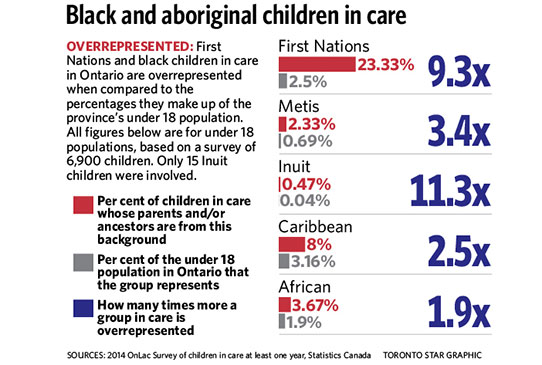
Why are so many Ontario black children in foster and group homes?

black kids in careInteresting but not surprising. Having the data allows questions and discussion:

Researchers concluded the results were influenced by the 2008 recession, which affected blacks more than whites and caused more strain on families. Poverty, it noted, is the strongest predictor of maltreatment rates.

Most children’s aid societies in Ontario don’t keep income statistics on the families they serve. The new provincial database won’t capture that information either. But local CAS officials know poverty is often a factor.

“Sometimes people don’t want to make the connection between poverty and child protection,” says David Rivard, chief executive officer for the Toronto CAS. “But there is a correlation. That’s the reality.”

A recent report on child poverty in Toronto co-authored by the agency noted that 41 per cent of children of southern and eastern African heritage are growing up poor — more than three times the rate of children with roots in the British Isles. Meantime, 26 per cent of children whose families are from the Caribbean and 25 per cent from North Africa live in poverty.

Groups serving the black community are trying to bridge the cultural divide that can land children in care. The common use of spanking to discipline children in Africa and the Caribbean, for example, can lead to astonished parents being charged with assault.

… After the Star began asking about the over representation of black youth in care, the Ministry of Children and Youth Services met with CAS officials, the provincial child advocate and Parsons’ African Canadian Legal Clinic.

Children’s aid officials and the legal clinic late last month submitted a funding proposal for a project to look into why the numbers are so high and how to reduce them.

“This cannot be just another study or training program,” Parsons insists. “What I want to see is concrete, substantive change — a reduction in those numbers.”

Parsons and other advocates say the numbers won’t go down until family counsellors from their community team up with CAS workers on every protection investigation involving a black child. That’s how Texas, for example, reduced the number of black children and youth in care.

“I’m not saying there aren’t kids in our community who should be in care,” Parsons says. “But the first approach for an African-Canadian child should not be apprehension and care. And that’s what the numbers are saying to me right now.”

Why are so many black children in foster and group homes? | Toronto Star.