High fees blamed for sharp decrease in Canadian citizenship applications | Toronto Star

Another article on the impact of the increase on citizenship fees, just before Minister Hussen testifies before the Senate committee studying the bill:

The number of immigrants applying for citizenship has plunged by a whopping 50 per cent at the same time as Ottawa has stripped a record number of Canadians of their citizenship.

According to the latest data from the Immigration Department, only 56,446 new citizenship applications were received in the first nine months of last year, a sharp decline from the 111,993 during the same period in 2015.

The number of new citizens approved also dropped by 48 per cent from 198,119 to 111,435 over the same period, said Andrew Griffith, a retired director general of the department who obtained the data.

While the tightened language proficiency and longer residency requirements have contributed to the decline, the steep increase in citizenship application fees under the former Conservative government is a key factor, Griffith said.

The processing fee was raised from $100 to $300 in February 2015 and again to $530 later that year, with an additional $100 right-of-citizenship fee required once the application is approved. Historically, citizenship applications have averaged close to 200,000 per year.

“The fee hike is a huge part. When you increase the price, you are not going to be able to afford it,” noted Griffith, a fellow at the Canadian Global Affairs Institute. “The fee is a significant barrier. If you are a professional, you can pay it with no problem. But if you are low-income, it becomes a burden.”

The federal Liberals have tabled Bill C-6 to amend the Citizenship Act, which would make citizenship less restrictive by reducing the residency requirement to three out of four years from four out of six and limiting the language and knowledge tests to applicants aged 18-54, instead of 14-64. However, there is no mention of a fee reduction in the bill.

Toronto lawyer Avvy Go, who spoke at Senate hearings into the bill, said the fees are a problem for the low-income households she serves at the Metro Toronto Chinese & Southeast Asian Legal Clinic.

The legal clinic organized a number of workshops in 2015 to urge eligible immigrants to apply for citizenship before the changes by the Tory government came into effect. Many attendees to the workshops said they were not able to afford the fees, Go told the Star.

“When you look at who the poor are, they are people from racialized communities, women and the disabled, who are bearing the consequences. You are going to further disenfranchise the vulnerable,” said Go.

“Many of my clients work long hours in restaurants and are paid minimum wages. They have to choose between putting food on the table and applying for citizenship. Many have no choice but choose to put food on the table first.”

Source: High fees blamed for sharp decrease in Canadian citizenship applications | Toronto Star
Canadian citizenship applications decline after processing fees triple

citizenship-metropolis-2017-017

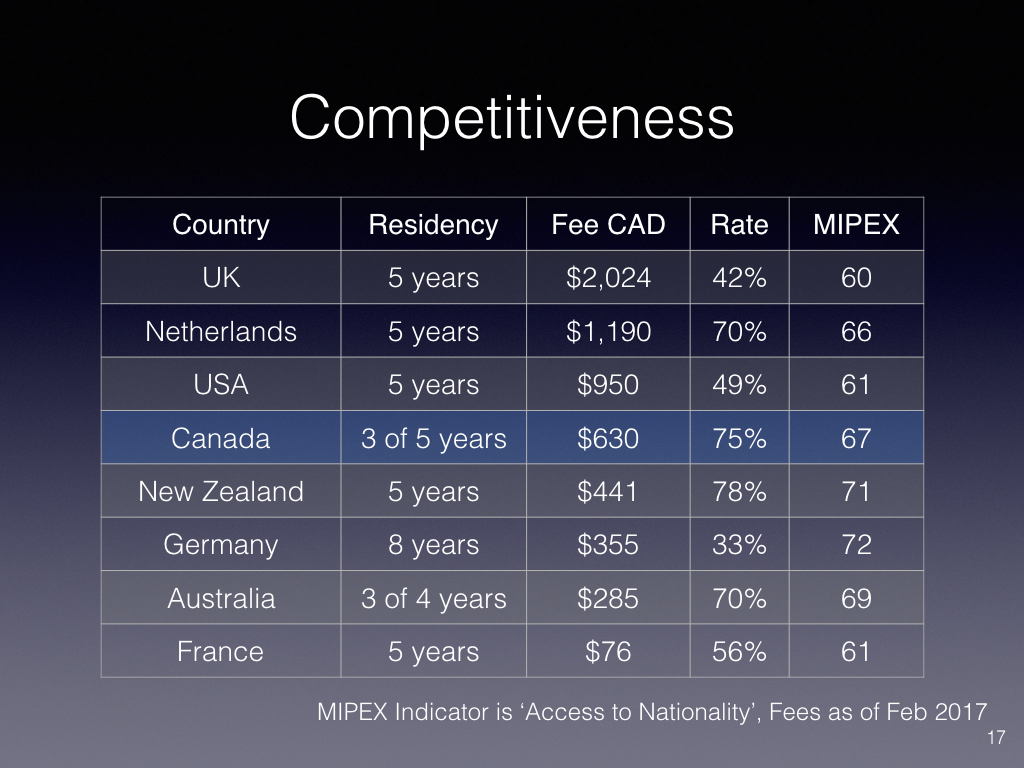
Citizenship Country Comparisons

Article based in part on my brief, C-6 Senate Hearings: Expected Impact on the Naturalization Rate.

The IRCC comment that the government has no plan to reduce fees is notable and surprising, given its diversity and inclusion agenda and expanded Immigration levels.

Equally notable that the IRCC spokesperson is incorrect on the level of Australia’s citizenship fee, our most appropriate comparator country (above comparison chart). He also cites that the increase in citizenship fees was not raised in recent consultations on immigration levels despite there being no questions in the consultation document on citizenship (IRCC Discussion guide on immigration: What about citizenship?):

A sharp fee increase has helped fuel a dramatic drop in the number of immigrants applying to become Canadian citizens, according to immigration advocates.

In the first nine months of 2016, there were 56,446 applications filed for citizenship, a decrease of nearly 50 per cent from the same period a year earlier, when 111,993 applications were submitted.

The figures are included in a briefing by former Immigration and Citizenship director general Andrew Griffith prepared for the Senate social affairs, science and technology committee, which begins hearings this week on Bill C-6, a law to amend the Citizenship Act.

Griffith, an author on immigration issues and fellow at the Canadian Global Affairs Institute, calls it an “alarming” trend that can be linked directly to a steep increase in fees.

The processing fee jumped from $100 to $530 in 2014-2015, which amounts to a tripled price tag when the additional $100 “right of citizenship” fee is added.

“If you’re a professional doing reasonably well, you may not like it, but you pay it. It’s important to you,” Griffith told CBC News. “But if you are a struggling immigrant or refugee, suddenly $630 may become prohibitive, and especially if you’re talking about a family of four or more.”

Newcomers face other costs associated with the citizenship process, including language testing, he said. He recommends cutting the processing fee to $300, abolishing the right-of-citizenship fee, and considering a waiver for refugees and low-income immigrants.

Financial and other barriers

Griffith’s brief points to a broader pattern of declining naturalization rates. He warns that a growing part of the population may not fully integrate by becoming citizens due to financial or other barriers and that could lead to marginalization.

“We’ve always prided ourselves where we have a model where we don’t just encourage immigration, but we encourage immigrants to become citizens so they be fully part of society. They can take part in political discussions, they can vote and do all the things that are part of it,” he said.

Bill C-6 reverses reforms brought in by the previous Conservative government and takes steps to streamline and strengthen the integrity of the citizenship process. Those include reducing the time permanent residents have to live in Canada to become eligible for citizenship, counting time for work or study in residency requirements, and reducing the language proficiency requirements for younger and older immigrants.

Oath

A man raises his hand while taking the Oath of Citizenship at a ceremony in Mississauga, Ont. (Jonathan Castell/CBC)

But the government does not appear prepared to reverse the fee hike brought in by the Conservatives.

Bernie Derible, a spokesman for Immigration Minister Ahmed Hussen, said citizenship fees in Canada are “significantly less” than other comparable countries such as the U.K., Australia and New Zealand. Throughout the cross-country consultations last summer, there was little discussion or concern raised about the fee, he added.

Dory Jade, CEO of the Canadian Association of Professional Immigration Consultants, said he has heard from plenty of clients who are delaying citizenship because they can’t afford the fees.

Make process ‘accessible and easy’

“If we want to bring immigrants, especially under a Liberal government which believes in nation builders, making it accessible and easy to become members of your society is a big, big issue,” he said.

Jade has met with officials from Immigration, Refugees and Citizenship Canada to propose a way to address the financial burden.

He said he was told by officials that the current fees are not cost-recovery, which means they are still financed in part by the tax base despite the increase. [Note: IRCC costing study indicated processing cost $555, about the same as the current fee of $530.] But he suggested the government could ease the cost barrier by adopting a tax-like formula based on income, developing a loan program, or capping the total fee for a family.

Stephen Green, a Toronto-based immigration lawyer, said he has not heard of the fee being a significant factor in seeking citizenship. He said many of his firm’s clients who don’t currently qualify under the existing law are anxiously awaiting C-6 to become law so they can apply for citizenship.

The Senate social affairs committee hearings will be held Wednesday and Thursday this week, with a number of immigration and refugee lawyers and academics scheduled to testify.

Various Commentary on Citizenship Act Changes

Commentary on the Liberal government’s planned changes to citizenship (Bill C-6), from those advocating a more facultative approach (including myself) and former Minister Alexander:

“We are very pleased with the government’s decision to rescind the previous government’s Bill C-24 that made it far more difficult to obtain citizenship and far easier to lose,” said Debbie Douglas of the Ontario Council for Agencies Serving Immigrants.

“We are particularly pleased that we are moving away from two-tier citizenship where dual citizens could have their citizenship revoked. We commend the Liberal government for taking this principled decision.”

The new citizenship bill also makes some new changes by extending immigration authorities’ power to seize documents suspected of fraud and barring those serving conditional sentences from seeking citizenship or counting the time toward the residency eligibility.

Andrew Griffith, a former director-general with the immigration department, said the proposed legislation surprisingly retained many of the provisions passed by the previous government to improve enforcement and integrity of the citizenship system while reducing unreasonable hurdles for would-be citizens.

“They are removing some of the worst abuses the Conservatives did, promoting its diversity and inclusive agenda, without changing the fundamental value of real and meaningful commitment to Canadian citizenship,” Griffith said.

“These proposed changes reflect, apart from revocation, relatively modest changes, in line with the Liberals’ public commitments, and that retain virtually all of the previous government’s integrity measures.”

While he is pleased with the proposed citizenship changes, veteran immigration lawyer Lorne Waldman said those who face citizenship revocation on the grounds of misrepresentation are still not entitled to a hearing – a practice that is under a legal challenge in the federal court.

“Why are we keeping this Harper legacy?” Waldman asked.

Under the Harper government, the citizenship application backlog had ballooned with processing time significantly lengthened. New resources were brought in last year to reduce the wait time.

McCallum said new citizenship applications are now being processed in 12 months and the backlog is expected to be cleared by the end of this year.

In an email to The Canadian Press ahead of the announcement, former Conservative immigration minister Chris Alexander said the changes his government made were in keeping with Canadian values.

“Terrorism, espionage and treason are serious crimes, representing gross acts of disloyalty. They are far more serious violations than covering up minor crimes from one’s past — a common form of misrepresentation,” he said.

The Conservative bill was attacked as setting a dangerous precedent and even challenged, unsuccessfully, as unconstitutional.

In the National Post, John Ivison harshly criticizes the repeal of the revocation provisions (as well as pandering to ethnic voters):

It’s true, as Immigration Minister John McCallum pointed out, that this fulfils an election pledge, made to drive a wedge between the Tories and the ethnic communities that supported them in three elections.

The Conservatives signed their own death warrant by tightening up the family reunification criteria, raising the income threshold necessary for new immigrants to bring in parents and grandparents.

The Liberals campaigned hard on easing those restrictions and on their intention to revoke the Conservative citizenship bill, exploiting fears in ethnic communities that they could be stripped of their citizenship and deported if convicted of a crime.

…. the central failing of this bill. Dual nationals can now be convicted of terrorism, high treason or spying and retain their Canadian citizenship.

You can be supportive of civility, tolerance and inclusion and still believe this move is dangerous and misguided.

Loyalty is the measure of good citizenship.

When you betray that trust, you should forfeit the rights, privileges and duties of being a member of Canadian society.

Dual nationals convicted of terrorism, high treason or spying don’t deserve to keep Canadian citizenship

I am waiting for Ivison’s colleague, Chris Selley, to weigh in given his previous strong criticism of revocation (National Post | Chris Selley: Stripping jihadis’ citizenship feels good. But what good does it do?)

Tasha Kheiriddin in iPolitics starts from the same place but ends with a more nuanced criticism, making a distinction between those who became citizens as children, which should be treated no differently from Canadian-born, and those who became citizens as adults:

But the fear of losing one’s citizenship struck a deep chord with immigrants and native-born Canadians alike. Trudeau’s impassioned defence of citizenship was widely seen as a highlight of that debate — that rare sort of knockout punch pundits and audiences yearn for. The Liberals carried that punch from the debate to the doorstep, where it — coupled with their defence of the niqab and opposition to the Conservatives’ barbaric cultural practices tip line — helped cement the Liberals’ reputation as pro-New Canadian, and the Conservatives’ image as anti-immigrant.
This week, Immigration Minister John McCallum announced that the government would be reversing Bill C-24. “Canadian citizens are equal under the law, whether they were born in Canada or were naturalized in Canada or hold dual citizenship,” McCallum said in a statement. …

The bill also will restore Canadian citizenship to anyone stripped of it under Bill C-24. As a result, Amara will have his citizenship reinstated once the Liberals’ new bill becomes law.

Opponents of the Conservative law decried the creation of two different “classes” of citizens — those born in Canada and those who have dual nationalities. But those individuals are arguably already in two different classes — in fact, more than two, depending on how they obtained their citizenships. Some did so by birth, some due to a parent’s move to Canada, and some by their own choice as an adult. And the implications of revocation for each group can be very, very different.

In Amara’s case, he came to Canada as a 13-year-old. While he arguably took his oath as a child, nothing would have prevented him from renouncing his Jordanian citizenship as an adult. Maintaining it, however, gave him certain advantages, including freedom to live, work and travel in Jordan, where he was born. Those advantages are not available to other Canadians. Should they complain that they’re second-class citizens, because they don’t have the same privileges? Should he complain that he received unequal treatment, when he himself maintains an unequal status?

In the case of dual citizens born in Canada, who hold dual citizenship by virtue of their parents, the situation is somewhat different. Saad Gaya, also one of the Toronto 18, was deemed to have Pakistani citizenship retroactively, due to his parents’ possessing Pakistani nationality. Unlike Amara, Gaya had no connection to his parents’ country, and claimed that he didn’t even have said citizenship. Furthermore, as a child born here, he did not choose Canada. Because of this, he claimed that sending him to Pakistan would constitute “cruel and unusual treatment”.

A better version of the law would be one that allows the state to cancel the Canadian citizenship of a person convicted of treason who obtained that citizenship consciously and deliberately as an adult. This would deter those seeking citizenship for no other reason than to enable them to strike back at their adopted country, or who used their ability to move freely in Canada to facilitate terrorist acts.

While there is no doubt that withdrawal of citizenship should not be subject to the whim of the state, neither should citizenship be completely taken for granted. For citizenship to have value, it must not just be a passport of convenience — or worse, a cover for crime.

Dual nationals convicted of terrorism don’t deserve to keep Canadian citizenship

Comparatively little to no coverage or commentary in Quebec media, unless I missed it.

Trudeau Cabinet takes diversity, inclusiveness to an unparalleled extent | hilltimes.com

My piece in The Hill Times:

The Liberal government has emphasized its diversity and inclusive language in speeches, in Cabinet, in Cabinet committees, and in Cabinet ministers’ mandate letters. This emphasis has been reinforced by the return of the multiculturalism program to Canadian Heritage. All together, these initiatives represent the mainstreaming of diversity, inclusiveness and multiculturalism to an unparalleled extent.

It starts with the language of Prime Minister Justin Trudeau who regularly emphasizes that: “Canadians understand that diversity is our strength. We know that Canada has succeeded—culturally, politically, economically—because of our diversity, not in spite of it.”

It continues with the creation of the Cabinet Committee on Diversity and Inclusion, with a strong inclusion mandate for indigenous and new Canadians: “Considers issues concerning the social fabric of Canada and the promotion of Canadian pluralism. Examines initiatives designed to strengthen the relationship with indigenous Canadians, improve the economic performance of immigrants, and promote Canadian diversity, multiculturalism, and linguistic duality.”

It is reflected in his choice of ministers: 50 per cent women, 17 per cent visible minority. And is further reinforced in the shared mandate letter commitments for all ministers with two strong multiculturalism-related commitments: “Canadians expect us, in our work, to reflect the values we all embrace: inclusion, honesty, hard work, fiscal prudence, and generosity of spirit. We will be a government that governs for all Canadians, and I expect you, in your work, to bring Canadians together.

“You are expected to do your part to fulfill our government’s commitment to transparent, merit-based appointments, to help ensure gender parity and that indigenous Canadians and minority groups are better reflected in positions of leadership.”

Holding all ministers to account, with PMO tracking of these and other shared commitments (in addition to minister-specific commitments), should ensure greater progress on the two objectives of multiculturalism:  recognition and equality.

It will take some time to see how well these commitments are implemented.

Equally important, the previous government’s weak record on the diversity of judicial appointments (less than two per cent visible minority) will start to be addressed.

Overall, the new government made few changes to how government is formally organized (machinery changes). This was wise given the disruption and turmoil that such changes can entail (e.g., the Martin government’s splitting apart Human Resources and Skills Development and the Department of Foreign Affairs and International Trade in 2004, reversed by the Harper government in 2006).

This makes the return of the multiculturalism program to Canadian Heritage all the more striking, after some eight years at Citizenship and Immigration (now Immigration, Refugees and Citizenship or IRCC).

The original transfer to CIC was largely driven by political reasons given then Immigration minister Jason Kenney’s political outreach role with ethnic groups. However, there was also a policy rationale. Multiculturalism deals with longer-term multi-generational issues (along with ‘mainstream’ visible minority relations) in contrast to the newcomer focus of the immigration, integration and citizenship programs, and multiculturalism could be seen as a logical extension of CIC’s mandate, and was portrayed as such in one of CIC’s strategic objectives, ‘building an integrated society.’

In practice, however, the multiculturalism program withered away at CIC.

When the program moved to CIC in 2008, it had a $13-million budget: $12-million for grants and contributions and 73 full-time positions. The last departmental performance report (2013-14) showed 29 full-time positions (a decline of 60 per cent) with a $9.8-million budget. Money for grants and contributions fell to $7.9-million.

Negotiations over the resources to be returned to Canadian Heritage will be challenging, given the impact may be felt in other program areas in IRCC that benefited from the redistribution of Multiculturalism funds. Moreover, the weakened capacity will require a major rebuilding and restaffing effort.

From a policy perspective, the return of multiculturalism to Canadian Heritage reinforces the overall government diversity and inclusion agenda, as well as the Canadian identity agenda, which fits nicely with Canadian Heritage’s overall mandate.

However, Canadian Heritage Minister Mélanie Joly’s specific mandate letter commitments make no mention of multiculturalism. This apparent oversight may just be to provide the public service time to manage the return of multiculturalism and reintegrate within Canadian Heritage. Furthermore, the lack of a junior minister may make it harder for the multiculturalism program to define its new role within Canadian Heritage and, more broadly, across government.

Joly’s public statements to date have not included any significant references to multiculturalism. Her general orientation, however, has been clear: to promote the “symbols of progressiveness. That was (sic) the soul of our platform.”

Overall, the commitment to a diversity and inclusion agenda, supported by a Cabinet committee and shared ministerial mandate letter commitments, and the rebuilding of multiculturalism back at Canadian Heritage bode well for a more effective inclusion, diversity, and multiculturalism strategy across government.

Source: Trudeau Cabinet takes diversity, inclusiveness to an unparalleled extent | hilltimes.com

New Crop of Immigrants in Parliament Is Seen as Reflection of Canada – The New York Times

New York Times coverage of Canada’s many immigrant and visible minority MPs (and always nice to be quoted!):

Many factors contributed to the sweeping victory last month by the Liberals, whose leader, Justin Trudeau, will take office as prime minister on Wednesday. But several analysts said that one of the most important factors was the immigration and refugee policies of the losing Conservative government.

In a country that generally prizes immigrants as a source of economic growth and officially encourages newcomers to maintain their ethnic identities, the Conservatives and Prime Minister Stephen Harper were widely seen as anti-Muslim, especially after they made an issue of the face coverings worn by some Muslim women.

“The Conservative government tried to use wedge politics, but in the end, it backfired,” said Andrew Griffith, a former director general of the government office that oversees citizenship matters and the author of a book about multiculturalism in Canada. “It should give any political party in Canada food for thought, food for reflection.”

The move was uncharacteristic even for the Conservatives, who assiduously courted immigrant communities even before they first won power in 2006, particularly in two areas that often decide the balance of power in Parliament: the suburbs of Toronto and Vancouver, British Columbia. The Liberals and the New Democratic Party also seek support there, but the Conservatives often found that their more traditional approach to many social issues found an eager audience.

Canadian law makes it relatively easy to move from landed immigrant to citizen, and Mr. Griffith said that many newcomers became politically active once they could vote. Because Canada’s immigration rules favor well-educated and affluent migrants, ethic communities are also an important source of donations to political parties, not least because the country’s campaign finance laws ban contributions from corporations or unions and set a relatively low ceiling for individuals.

“It’s empowering in that there are groups that can no longer be ignored,” said Arif Virani, 43, a newly elected Liberal lawmaker from Toronto who came to Canada with his parents as an Ismaili Muslim refugee from Uganda in 1972. He noted that in some constituencies, all three major parties ran minority candidates.

At times over the past decade, Jason Kenney, a Conservative cabinet minister, seemed to be appearing at just about every ethnic celebration in the country — a butter-chicken circuit that appeared to take a toll on his waistline. But Mr. Kenney’s courtship of ethnic minorities, Mr. Griffith said, was undone when the Conservative government decided to make it harder for recent immigrants to bring in relatives, when it was slow to accept Syrian refugees and when it tried to ban the niqab, or face covering, during citizenship ceremonies. Mr. Harper’s use of the phrase “old-stock Canadians” on the campaign trail made matters worse.

Mr. Griffith reckons that there are 33 electoral districts where a majority of voters belong to what are known in Canada as visible minority groups — people who are not of white European extraction. All 33 districts are in the suburbs of Toronto or Vancouver, and many were held by Conservatives until last month, when Liberals won in all but three of them.

Canada first introduced a policy of official multiculturalism, recognizing the differences in Canadians’ heritage, in 1971 under Pierre Elliott Trudeau, a Liberal prime minister and the father of Justin Trudeau. Initially, the policy provided funds for programs like language classes, but it has since evolved into a broad legal protection of religious and ethnic differences.

Though it was contentious at first, the policy is now frequently cited by Canadians as a defining characteristic of their country — though both Mr. Griffith and Mr. Virani say it has limits.

Canadians tend to think that, where the United States assimilates immigrants’ cultures in a melting pot, Canada allows all cultures to flourish. But Mr. Virani said that the contrast was “a little bit more gray than that.”

Voters appeared to reject Mr. Harper’s plan to ban face coverings during citizenship ceremonies, but Mr. Griffith said there was still widespread unease about the practice of wearing them, which many Canadians believe limits the participation of Muslim women in society.

Still, despite the tenor of the Conservatives’ last campaign, all the major Canadian political parties favor encouraging immigration. New arrivals account for two-thirds of Canada’s population growth, an important factor in a country where there are now more citizens over 65 than under 15. Geography helps form that pro-immigration consensus by making it difficult to slip into the country as an illegal immigrant or a refugee.

“You can’t walk to Canada, apart from the U.S., so we don’t have a neighbor that generates a lot of refugees or immigrants coming across,” Mr. Griffith said. “That helps the discussion.”

Source: New Crop of Immigrants in Parliament Is Seen as Reflection of Canada – The New York Times

The “Ethnic Vote”: All Over the Map – Adams and Griffith

Further to our earlier op-ed in the Globe (Why Canada’s politicians fixate on the ethnic vote), Michael and I expanded it to include more information of visible minority representation and comparisons to the US:

Remarkably, the immigrants who were elected to Canada’s parliament in 2011 had not only become citizens, gotten themselves nominated, and then won election—but they represented all five main political parties and included many visible minorities: 18 Conservatives (15 visible minorities, of 166 elected), 18 New Democrats (12 visible minorities, of 103), four Liberals (2 visible minorities, of 34), and one each in the Bloc (1 visible minority, of 4) and the Green Party (no visible minority).

The Green Party is 100 per cent foreign-born: Elizabeth May is from Hartford, CT.

Another “only in Canada” fact is that our most right-wing party, the Conservative Party of Canada, attracts a substantial contingent of candidates born abroad.

The Bloc is dedicated to dismantling the country, but managed to be inclusive of the foreign-born and visible minorities. Only in Canada!

With respect to visible minorities (defined in the U.S. as non-white races and Hispanic), the U.S. has worse representation than Canada: 20 per cent in the House of Representatives compared to their population share of 37 per cent, only six per cent in the Senate), the vast majority of these are American-born visible minorities, mainly African Americans and Hispanic/Latinos, not immigrants.

Only 16 foreign-born members sit in either of the two houses. But many of these were born abroad to American parents, the most famous being John McCain and Canada’s Ted Cruz.

But even if we include all of these legislators as foreign born, they are still less than three per cent of Congress, where demographic parity would suggest that almost 70 foreign-born “should be” in both houses (to match the 13 per cent of “legal” Americans who are foreign-born).

Another “only in Canada” fact is that our most right-wing party, the Conservative Party of Canada, attracts a substantial contingent of candidates born abroad. In most countries, right-wing parties are anti-immigrant and would be unlikely to either attract or accept foreign-born candidates.

The “Ethnic Vote”: All Over the Map – New Canadian Media.

Canada faces dramatic drop in citizenship, prompting concerns about disengaged immigrants

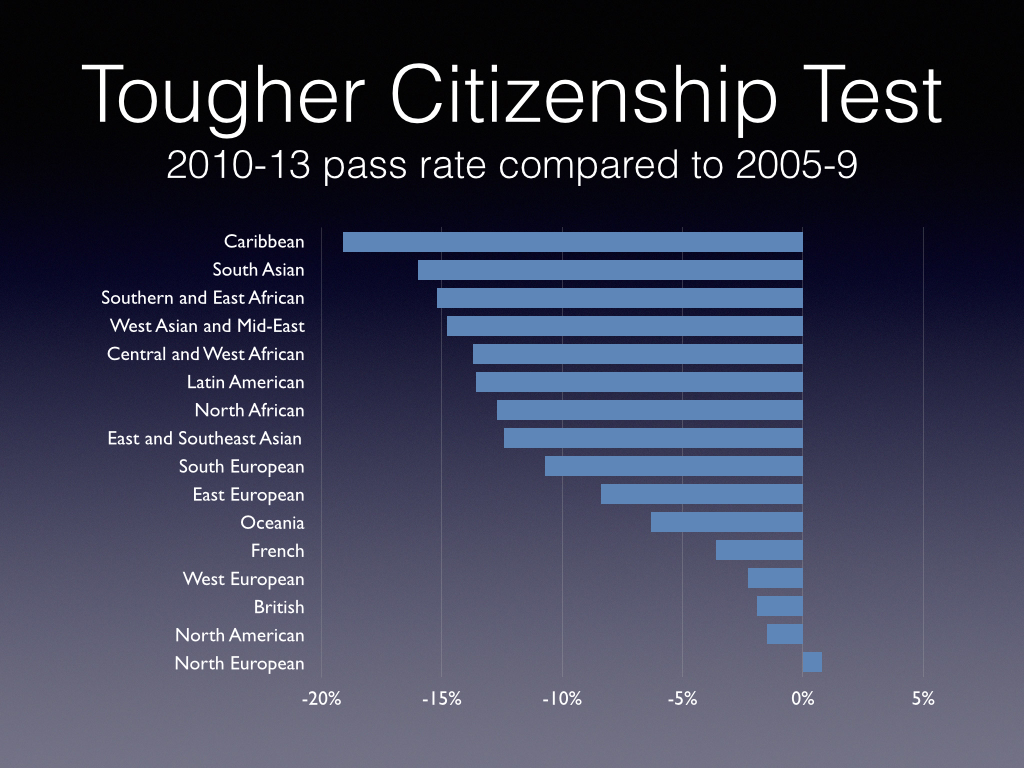
Canadian Multiculturalism: Evidence and Anecdote Deck - Images.039Further to yesterday’s post regarding my forthcoming book (Multiculturalism in Canada: Evidence and Anecdote) and the deck summarizing some of the high level results, the Toronto Star article focussing on my findings regarding citizenship take-up and the impact of the 2010 changes (the chart above shows the impact of the citizenship test changes on different ethnic groups):

“In the past, citizenship was viewed as a stepping stone to immigrant integration, and it should be done earlier on,” said Griffith, who will present Multiculturalism in Canada at a three-day national immigration and settlement conference in Vancouver that starts Thursday.

“These changes have made it harder and prohibitive for some to acquire citizenship, turning Canada into a country where an increasing percentage of immigrants are likely to remain non-citizens, without the ability to engage in the Canadian political process.”

Based on latest government data, Griffith found that the ratio of permanent residents who eventually become citizens has been in decline since 2000, and has dropped most rapidly in recent years.

Only 26 per cent of permanent residents who settled in Canada in 2008 have acquired Canadian citizenship, compared with 44 per cent for the wave of immigrants settling in 2007, and 79 per cent of those who arrived in 2000.

Griffith said the government data used in his analysis was selected to reflect the fact that it takes immigrants an average six years to acquire Canadian citizenship. The 2008 cohort best indicates the early impact of reforms implemented by the Conservative government.

The permanent-resident-to-citizen conversion rate does generally rise the longer immigrants have been in Canada. But an 18 per cent decrease between the 2008 and 2007 cohorts is alarming, Griffith said.

Citizenship and Immigration Canada spokesperson Johanne Nadeau said Canada has one of the highest naturalization rates in the world, “as 86 per cent of eligible permanent residents for Canadian citizenship decide to acquire it.”

She suggested the Griffith is misinterpreting the data because “he is not taking into account those (permanent residents) who are not yet eligible to become citizens because they haven’t met all of the requirements needed to begin the citizenship process.”

Citizens are protected by the Charter of Rights and Freedoms, can vote in elections and are entitled to Canadian passports. Not only do permanent residents not have those privileges, they are also vulnerable to revocation of their status and removals from Canada.

“I understand the rationale behind these government changes,” said Griffith, who worked for the government as the reforms were developed and rolled out, and retired in 2013.

“But I’m on the side of inclusion rather than exclusion. We need to make sure those who apply for citizenship take it seriously, but we don’t want to inadvertently create excessive barriers and shift the relationship of some of the communities with the country.”

… “When you make it more difficult for some communities to become citizens, you are going to create issues with their engagement, attachment and identity of Canada,” said Griffith.

“The question is how we balance between ensuring the rigours of the (citizenship) process and yet making it fair and reasonable.”

Canada faces dramatic drop in citizenship, prompting concerns about disengaged immigrants

Confusion reigned at CIC after Kenney kept on multiculturalism

Embassy article on how CIC had to scramble to figure out the implications of Minister Kenney retaining responsibility for the multiculturalism file, including my quotes:

The Conservative government owes its current majority in part to strong support from ethnic communities in suburban Canada, and Mr. Kenney has led the party’s efforts to appeal to immigrant diasporas.

Prime Minister Harper credited Mr. Kenney for turning “small-c conservative” immigrants into “big-C conservatives” and urged United States conservatives to learn from his party’s example during a recent sit-down interview with the Wall Street Journal in New York.

“This is a huge transformation. It’s why we’ve come to office, and have stayed in office,” Mr. Harper commented, according to a report by the Canadian Press.

Andrew Griffith, a director general for citizenship and multiculturalism at Citizenship and Immigration Canada from 2007 until 2011 and now retired, said that the decision to keep Mr. Kenney on the multiculturalism file was “a political point.”

“He engaged the communities, he developed the contacts there, he recruited candidates for the party and he played a major role in the electoral strategy of the party,” said Mr. Griffith, author of the book Policy Arrogance or Innocent Bias: Resetting Citizenship and Multiculturalism.

“It didn’t make any sense for them to switch to another minister who would have to build up the relationships. I suspect that Kenney probably didn’t want to give it up either, because it’s part of his political base.”

Even in situations where Mr. Alexander is responsible for signing off on multiculturalism decisions, Mr. Griffith said that the documents make clear that the minister for multiculturalism is responsible for the substance of those decisions.

“From a bureaucratic point of view, I don’t like it because it’s messier and I think it impacts the ability to do good policy work. But from a political point of view, I understand why the prime minister made that decision,” said Mr. Griffith.

“If I were him, I probably would have made the same decision.”

Message to current public servants: be careful what you say in emails. “Confusion reigns!” may be accurate but may also be too vivid for the public!

Confusion reigned at CIC after Kenney kept on multiculturalism | Embassy – Canadas Foreign Policy Newspaper.

Earlier blog posts and reporting:

Overstating Citizenship “Fraud” – New Canadian Media

Citizenship Fraud.037My take on citizenship fraud, with analysis of released numbers to date:

Some may argue that any fraud is unacceptable.

But the quest for perfection has to be balanced with the realities of efficient management and good service delivery.

There are more fraud issues with citizens originating in certain countries, both in terms of country of birth and likely country of application. From a risk management perspective, that is where the focus should be and likely is.

As the government addresses the backlog and implements the new Citizenship Act, we will see starting in 2016 whether it has achieved a reasonable balance between reduced fraud, efficiency, and accessibility of citizenship, meeting the Minister’s commitment of a one-year processing time.

Overstating “Fraud” – New Canadian Media – NCM.

Methodological Note: A number of readers have asked regarding the source of the numbers and analysis:

  • An ATIP request provided to me by a student listed the countries of birth for the 3,194 investigations;
  • Beyond the fact that this number was as of 31 March 2012, no details on which years were included (i.e., did all the cases of suspected misrepresentation pertain to citizenship applications in one year or, as I suspect, a number of years);
  • Other numbers were pieced together from public statements and communications material from the past few years. I integrated as best I could;
  • the percentage figures were calculated against the 5 year annual average of new citizens (2008-12);
  • I asked CIC to confirm and update these numbers. CIC declined, suggesting I file an ATIP request and sending along some communications material.


Which Country Would You Die For?

My take on dual loyalties:

We live in a globalized world. We have diverse identities, both individually and collectively. As Canada’s diversity continues to increase through immigration and intermarriage, our identities will continue to become more varied and blended.

Our ability to follow global events and to participate in political and other activities in other countries will also continue to increase.

But we do not expect interest in countries of origin to be exclusive. We expect citizens to vote in Canada. We expect citizens to participate in Canadian political, social and economic debates, and not only vote or advocate on behalf of “homeland” issues.

By and large, the government is comfortable with this approach. The only exception is with respect to citizenship revocation in cases of national security or comparable issues, where the revisions to the Citizenship Act distinguish between single and dual citizens. In other words, the existing long-standing policy that a Canadian-is-a-Canadian — whether single or dual national, whether born in Canada or naturalized — no longer applies.

As Canadians continue to navigate and develop their various identities, we expect them to find a balance between their ethnic or country of origin identity and their Canadian identity. We have few hard and fast rules, given the complexity of our lives and identities, and provide considerable scope for Canadians to express their country of origin. However, we expect this activity to be grounded in a commitment to participate in Canadian life.

Which Country Would You Die For? – New Canadian Media – NCM.