Andrew Coyne: Free speech needs to be guided by judgment and conscience, not rules

Another thoughtful column by Coyne:

It is common among some clear-thinkers to reject any allegation of speech suppression — a speaker being shouted down on campus, a boycott of an offending corporation, a Nazi getting punched — unless it involves the explicit use of the coercive power of the state. Anything else is merely the “consequences” of speech, for which one should accept “responsibility.” Suck it up, snowflake.

In a sense, of course they’re right. The obligations of the state are of a different order than private individuals or groups, because of its unique powers of coercion, and because coercion — the power, not merely to punish speech, but to actively prevent speech — is of a different order than mere disapproval, say, or shunning.

But the difference is not so absolute as all that. It is more of degree than kind. As private individuals, we may not be under the same obligations and constraints as the state, but that does not mean we are under none. We have still the obligations of judgment, of conscience, and of respect — for the spirit of free speech, if you will, rather than the legal letter.

At one extreme it is easy to see this. If a mob were to burn down the local newspaper and hang its editor, it is of no use to say, well, it wasn’t the government that did it, so no chilling of speech is involved. One should not have to factor in, among the “consequences” to be expected of speech, the chance that one might be murdered — or punched, for that matter.

Short of actual law-breaking, things get trickier. There is no violence in shouting down a speaker, you may say; neither is a university, as a private organization, obliged to provide a platform for opinions of which it, or a section of the university community, disapproves. No, indeed. But free speech exists, as a legal guarantee, in part because of the foundation of social values in which it is embedded.

The spirit of free speech, that is, is as important: the notion that none of us is in absolute possession of the truth; that the route to truth is through the exchange and conflict of ideas; that the rights we each enjoy are guaranteed only so far as they do not intrude upon another’s; and that, in particular, we do not have a right not to be offended, or to be spared any encounter with disagreeable words, images or ideas. If we do not live by these principles ourselves, we will shortly find neither will our creation, the state.

So far so good. But what of the more benign ways of expressing collective disapproval: boycotts, online campaigns, or Parliamentary motions? Are these mere consequences of speech, or constraints upon it?


Answer: It depends. Anyone who has been the subject of a Twitter mobbing can attest it can be deeply unpleasant, and quite intimidating, even without overt threats of violence. The harm to reputation, for example, of having one’s name broadly associated with sexism, racism — or “Quebec-bashing” — can be a significant deterrent to speaking freely.

Taboos, shunning and other mechanisms of social disapproval, in other words, can raise the “price” of speech to intolerable levels. On the other hand, some things are taboo for a reason. We should not feel censorious for shunning or denouncing someone who expresses hateful or noxious opinions.

Neither should we hesitate to call them what they are. A good many of the participants in the present debate seem to think their freedom to say the most virulently and prejudicially anti-Muslim things should also protect them from being accused of prejudice against Muslims — or Islamophobia — in return. Well, no. That is simply logical, as is the denunciation in the motion before Parliament.

Where do we draw the line, then? Again, it depends. It requires all of us to use our judgment. People should not be labelled bigots or hate-mongers merely for offering an unconventional view on a controversial topic. A reasoned critique of Islam’s teachings on women is not to be treated the same as, say, a blanket claim that Muslims, as a group, are “unintegrateable.” But neither should actual bigotry be excused as merely being “un-PC.”

There are no simple rules to guide us. There are only mutual obligations: not to give offence needlessly, but also not to take offence lightly; not to round up a mob every time someone’s views offend us, but neither to be intimidated by the mob when it is necessary to offend.

Source: Andrew Coyne: Free speech needs to be guided by judgment and conscience, not rules | National Post
Andrew Coyne: Hysteria from Conservatives over harmless motion on Islamophobia

Andrew Coyne calls out the Conservatives in their opposition to M-103. Again, the hypocrisy given the extent that the Conservative government singled out antisemitism.

Particular anti-racism and discrimination messaging and programming is not in conflict with general messaging and programming, as long as the link is made clear (which M-103 does). Some of the previous government’s messaging on antisemitism was less clear in that regard:

Conservatism used to have some claim to being a coherent political philosophy. Of late it has become a series of dares. The most extreme voice will lay down the most extreme position, then challenge others to endorse it.

As often as not this has nothing to do with conservatism. It is rather a kind of moral exhibitionism, populist virtue-signalling, in which the object is to say and do the most intolerant or ill-considered thing that comes to mind — anything that might attract the condemnation of bien-pensants in the media and elsewhere, whose opposition becomes proof in itself of its merits.

The willingness to court such controversy in turn becomes the test of political purity. To demur, conversely, can only be a sign of cowardice, or worse, liberalism, a heresy that would seem to have overcome much of the conservative movement, to judge by the ever-lengthening list of the excommunicated.

So we come to the latest of these blooding exercises, the “debate” over Motion 103, a private member’s motion introduced by Liberal MP Iqra Khalid. In the fevered imaginings of its online discussants, #M103 is decried as a bill that would forbid any criticism of Islam, if not the first step towards imposing Sharia law. I only wish I were exaggerating.

This hysteria campaign has been whipped up by exactly the people you’d expect, and pandered to by people of whom you might have expected better, including several Conservative leadership candidates. Pierre Lemieux has denounced it as “an attack on free speech.” Maxime Bernier asks whether “it is a first step towards restricting our right to criticize Islam.” Lisa Raitt, Andrew Scheer, and Erin O’Toole have all come out against it, while Kellie Leitch, bless her heart, has set up a petition to “Stop Motion 103,” complete with a blue-eyed model with a gag over her mouth.

The only candidate to say he will vote in favour of the motion is Michael Chong. For this he has been excoriated as a sellout; it rather confirms him as a man of judgment and conscience. There is simply no reasonable construction of the motion that can support the claims made of it. It is not a bill, for starters: it is a simple motion, an expression of opinion, of no legal force or effect. It does not call for any ban or restriction on speech of any kind.

It merely asks the government to “recognize the need to quell the increasing public climate of hate and fear,” condemns “Islamophobia and all forms of systemic racism and religious discrimination,” and instructs a committee of Parliament to study the matter. Yes, the motion is clumsily worded, and yes, it specifically mentions “Islamophobia.”

But the notion that this amounts to “singling out” one religion for “special privileges,” as some have claimed, is specious.

Yes, of course, all religious groups should be free of discrimination and hatred. But it does no disservice to the others to pay particular attention to one, at a time when that group is particularly exposed to both. After the slaughter of six Muslims at prayer in Quebec City, people of goodwill, not to say common sense, would understand why it might be timely for all of us to offer some assurance to members of that community.

It is, at the same time, understandable why there would be some nervousness around this subject. There is a certain school of Islam that would indeed place severe legal constraints on the right to criticize or ridicule the faith, just as there are lots of people, especially on the left, who would eagerly censor all sorts of “insensitive” speech.

This is what makes these issues so maddeningly elusive of resolution: it is not one thing or the other, but both at the same time. We live in a time both of much more widespread and open expressions of racism — thanks, internet — and of acute hypersensitivity to rude or even frank speech of all kinds. Each feeds off the other. But the alternative to “political correctness” is not bigotry and intolerance, and the answer to racism is not censorship. Indeed, we have too much of that already.

I’m not sure how many of those either praising Chong or denouncing him for his stand on Motion 103 are aware that he has at the same time proposed repealing Section 319 of the Criminal Code: the “hate speech” provision. But he is as correct in the latter stance as the former. Even a free society allows some exceptions to the liberties it enjoys — but a free society always insists that any such exception be, to borrow the language of our Charter, “demonstrably justified.”

The burden of proof is always on those who wish to restrict freedom to show why they must. At the very least they must show what harm it is they wish to address. In the case of “hate speech,” the harm is supposed to be the violence towards its objects that might ensue. But the Criminal Code already contains provisions against incitement to violence: that is, where the connection between the speech, and the violence that might reasonably be expected to result, is so immediate, so direct and so clear as to be “beyond a reasonable doubt.”

With the hate speech law, on the other hand, the fear is more generalized, more vague, more dubious: somebody somewhere might read this who might someday then be motivated to attack … someone. That is no basis for any kind of law, let alone one that would restrict something so vital as speech. If the other Conservative candidates want to fight censorship, let them join Chong in that cause, rather than this shameless demagoguery over a harmless motion.

Source: Andrew Coyne: Hysteria from Conservatives over harmless motion on Islamophobia | National Post

Andrew Coyne: The common threads of intolerance behind anti-Muslim atrocities | National Post

One of Andrew Coyne’s stronger columns and message for those playing identity politics – see last two paras:

It began just minutes after the first reports surfaced online. Though the killings had taken place at a Quebec City mosque, though the victims had all been Muslim, nevertheless it was asserted, with all the authority that anonymity confers, that the killers were Muslim. “Police reports” were disseminated claiming they were two Syrian refugees, just admitted the previous week. Fake news sites supplied fake names. The failure of the English-language news networks to go live with the story was attributed, not to a lack of resources or competence, but to their involvement in a cover-up.

This is how we do things now. This is the ritual we have learned, after every such outrage: not to mourn the dead or to draw, after due consideration of the facts, the appropriate lessons, but to lay the blame, in advance of the facts being known — as if it were a kind of race, in which the first to find fault wins. Both sides do it, and while the evidence this time would seem to support the alternate theory, not Islamist but Islamophobe — there are, as we have since learned, one suspect not two, the other arrestee, the one with the Arab name, proving to have been not a shooter but an engineering student who was helping the wounded — those who leapt instantly to that conclusion had no more evidence to support them on the night than their brothers-in-preconception.

In fact, we do not know what the suspect’s motive was, even now. We have rather more basis on which to draw intelligent inferences, but certainty, if ever it is given to us, must await his trial. We have even less grounds to state who or what planted that motive there, though again that has not stopped people from trying. At any rate, it is a fool’s errand. We do not need an atrocity to tell us that something has come unstuck in society of late, and we are on firmer ground, if evidence of that we seek, to look not to a single act on the part of (as I suspect we will find) a particularly disturbed individual, but rather to a more generalized wave of intolerance: to the surge in anti-Muslim hate crimes across Canada in recent months and years, to the increasingly open advocacy of anti-Muslim (and anti-Semitic, and other species of racist) sentiments, online and elsewhere. It is still no more than a small minority taking part, but it is more than it was.

I don’t know what set off Alexandre Bissonnette and neither, if you are honest, do you. But wherever we see large numbers of people acting in the same foul ways, repeating the same foul lines, we are entitled to look for common threads. That does not lessen the individual culpability of each. But people do not act in a moral vacuum. They take their cues from those around them, from what is considered acceptable in the circles in which they move, and the larger the circle in which it is considered acceptable to do and say certain things, the more likely they are to do and say the same. There are such things as cultures, which may wink at things like bribery and tax evasion — and prejudice — or, as one hopes, frown on them.

Once, not long ago, the person who harboured a certain bigotry would have had go to some lengths to find validation in others: a photocopied pamphlet, an anti-Semitic hotline, and such. Now they have merely to go on Twitter, or to visit certain websites. There they discover they are not alone, or even, as it seems, unusual. This is reinforced, in the case of anti-Muslim prejudice, by the tensions aroused after the horrifying Islamist terror attacks across the western world in recent years. The Islamophobe believes that only he is willing to see things as they are, to call things by their proper name, and that those who insist on drawing a distinction between Islamism and Islam, between Muslim terrorists and Muslims, are blinded by political correctness.

This is not in any way to suggest these views should be censored. We would not convict an accused person on a hunch; neither is the supposition, however logical, that open advocacy of prejudicial views might lead to hate crimes sufficient to warrant their suppression — not if we take free speech seriously. There are legitimate fears raised by terrorism, and legitimate debates to be had about how to fight it. Islam must be as open to criticism as any other religion or ideology.
But if we lack enough proof of cause and effect to prosecute, that does not mean we cannot draw reasonable inferences; if we would not restrict others’ speech, that does not mean we should not govern our own. We are all of us engaged every day in the construction of a moral order: by our accumulated individual examples, the words we use, the acts we condone, we can make it one that encourages decency and compassion towards others, or the reverse. This is particularly true of those in positions of leadership, political or other.

I do not think it is fair, then, to lay the murders at the Ste. Foy mosque at the feet of Kellie Leitch or Donald Trump or any other individual besides the murderer. I do think it is fair to ask them, and others, to look inside themselves, to consider what kinds of attitudes they are encouraging, what risks they are taking, and what fire they are playing with.

ICYMI – Andrew Coyne: A war that cannot necessarily be won, but must be fought all the same | National Post

Good realistic commentary by Coyne:

Alas it is not so. Whether or not we choose to be at war with ISIL they are at war with us. And there is very little we can do to change this.

We cannot simply defeat them in battle, as we might a conventional state: whatever progress we have made against ISIL in Iraq and Syria seems only to have diverted its energies into attacks overseas. Nor can we appease them, as we might a conventional terrorist group, even if we were of a mind to: for they have no demands, or none that we can possibly meet, such is the fantastic, end-times nature of their beliefs.

Nor can we just harden our defences, as if we could anticipate every possible avenue of attack. Protect the most prominent public buildings or infrastructure, and watch as restaurant diners and concert-goers are mown down. Guard against bombs and hijacked airplanes, and see AK-47s and trailer trucks used instead. Close the borders, and find yourself beset by homegrown jihadis. Focus on known terrorist profiles, and the enemy takes the form of “lone wolf” attackers, with no necessary connection to ISIL.

The threat — anonymous attackers, willing not only to kill in limitless numbers but to be killed themselves, and aided by all the latest technologies — is unlike any the world has ever faced. And among the challenges it presents is the psychological.

Because there is no satisfying narrative arc to this. We don’t get to go home when this is all over, because we are home and it may never be over. We have to accept this. We have to accept that some problems cannot be solved, but only endured; that some wars cannot necessarily be won, but must be fought all the same.

We are not helpless. We can make less likely the worst sorts of attacks, the kind that require greater planning, co-ordination and resources, and as such are more easily intercepted and disrupted. We can deprive ISIL of territory, starve it of funds, kill its leaders, and by these and other means deny it the mantle of prophecy on which it depends for new recruits.

And we can do much at home, notably to ward off the kind of deep-seated alienation within Muslim communities that so plagues Europe, on which terrorism thrives. It is crucial Muslims are not made to feel as if they are the enemy, collectively — every bit as crucial as recognizing the unique danger posed by ISIL, and the fundamentalist Islamic theology at its heart.

But there will be more attacks like those we have lately suffered, and probably they will be worse.

I don’t mean to say there is no chance of defeating ISIL, or that Islamist terrorism may not in time go the way of other threats to our way of life. I only mean that we cannot assume it will — not in the short term, and not even in the long. The roots of fanaticism have sunk too deep, over too much of the world, to be assured of that. When an idea, once unthinkable, has been first thought, and not only thought but acted upon, and spread to thousands if not millions of people, it will be a long time before it can be unthought.

So we must accustom ourselves to looking at this, as our adversaries do, as a struggle that may go on for decades, even generations, and understand that in the meantime there will be many more innocent deaths to mourn.

Cabinet is not a meritocracy. And it hasn’t been for decades.

Laura Payton provides the best rebuttal to Andrew Coyne’s blather against gender parity in Cabinet (Andrew Coyne: Trudeau cabinet should be based on merit, not gender):

Here’s the thing: Cabinet is not a meritocracy. It hasn’t been, at least as far back as 1968. It’s always been influenced by a range of factors, including where an MP is from and whether he or she is an anglophone or francophone. And while those factors are practical, other selections seem to be made based on someone’s fundraising ability or skill at obfuscating in the House of Commons.

Give me a good merit-based reason why Julian Fantino held three cabinet postsall of them disastrous. What exactly qualified Fantino to be the minister for international development? Or look at Peter MacKay, who held a range of high-profile posts, including Foreign Affairs and Justice. Any time cabinet speculation took over with the Conservatives in charge, it was assumed he would never be excluded from cabinet, simply because he was the PC leader who agreed to merge the party with the Canadian Alliance, thereby allowing Stephen Harper to lead the combined forces to victory. Never mind the bungled military procurement files or his use of a search-and-rescue helicopter to shave a couple of hours off his trip back to Ontario when his vacation was interrupted. And who can forget Chris Alexander’s deft touch with immigration matters?

Given that women are half the population, it’s downright strange that no federal government before this one has striven to put more of them into cabinet. Lots of deserving people are left out of cabinet, simply because there are too many excellent MPs from one region or another, and not all of them will make it. It’s bizarre to argue that Trudeau’s pledge to include more women in cabinet means leaving out qualified men, because the corollary is that so many women have been left out of cabinet to squeeze in men who have better fundraising networks, are better known to Ottawa-based party insiders, or know how to follow orders.

Canada’s federal parties have a long way to go to hit gender parity and to elect a representative number of visible minorities. There are 5o women in the Liberal caucus of 184 MPs, for example. While the NDP led the way with 43 per cent female candidates (rather than quotas, they asked riding associations to look for female or visible-minority candidates), the Conservatives were only able to find enough female candidates to make up 19 per cent of their total. You can’t tell me there aren’t more smart women who would want to run if they didn’t feel the hurdles were too high to clear.

Source: Cabinet is not a meritocracy. And it hasn’t been for decades.

Andrew Coyne: To uncover or not to uncover — why the niqab issue is ridiculous

Hard to argue his logic. But whether logic will carry the day against emotion and wedge politics is another matter:

Is accepting the right of others to adhere to a religious doctrine and style of dress that others find distressing or demeaning to women an example of the dreaded cultural relativism? No, it is an example of pluralism. What’s the difference? Relativism holds that truth does not exist; pluralism, that there is such a thing as truth, but that none of us is in automatic or absolute possession of it.

A liberal society is pluralist, not relativist. It allows each of us to pursue our vision of the good life, to hold and espouse our ideals of what is just, without prejudice to the notion that goodness and justice exist: indeed, precisely so that we may more nearly approach them as a society. Neither is a liberal society incompatible with the idea of cultural norms: beliefs that are commonly shared, practices that are commonly observed. It draws the line only at enforcing these norms upon the unwilling.

It would be one thing if the women who insist on their right to wear the niqab at the citizenship ceremony, to the point of going to court to defend it, were in fact being forced to wear it. But there is no evidence of this: quite the contrary. Far from meek and submissive, they give every sign of being quite obstreperously independent, rock-ribbed individualists, willing to assert their rights even in the face of a hostile majority.

We talk a lot about Canadian values in this debate. I am inclined to think that, in their own way, it is the niqabistes who best embody those values. In their ornery unwillingness to bend to others’ sensitivities, in their insistence on going their own way on a matter of principle, those women are in the finest Canadian tradition of hellraising. I think we ought to let them be.

Source: Andrew Coyne: To uncover or not to uncover — why the niqab issue is ridiculous

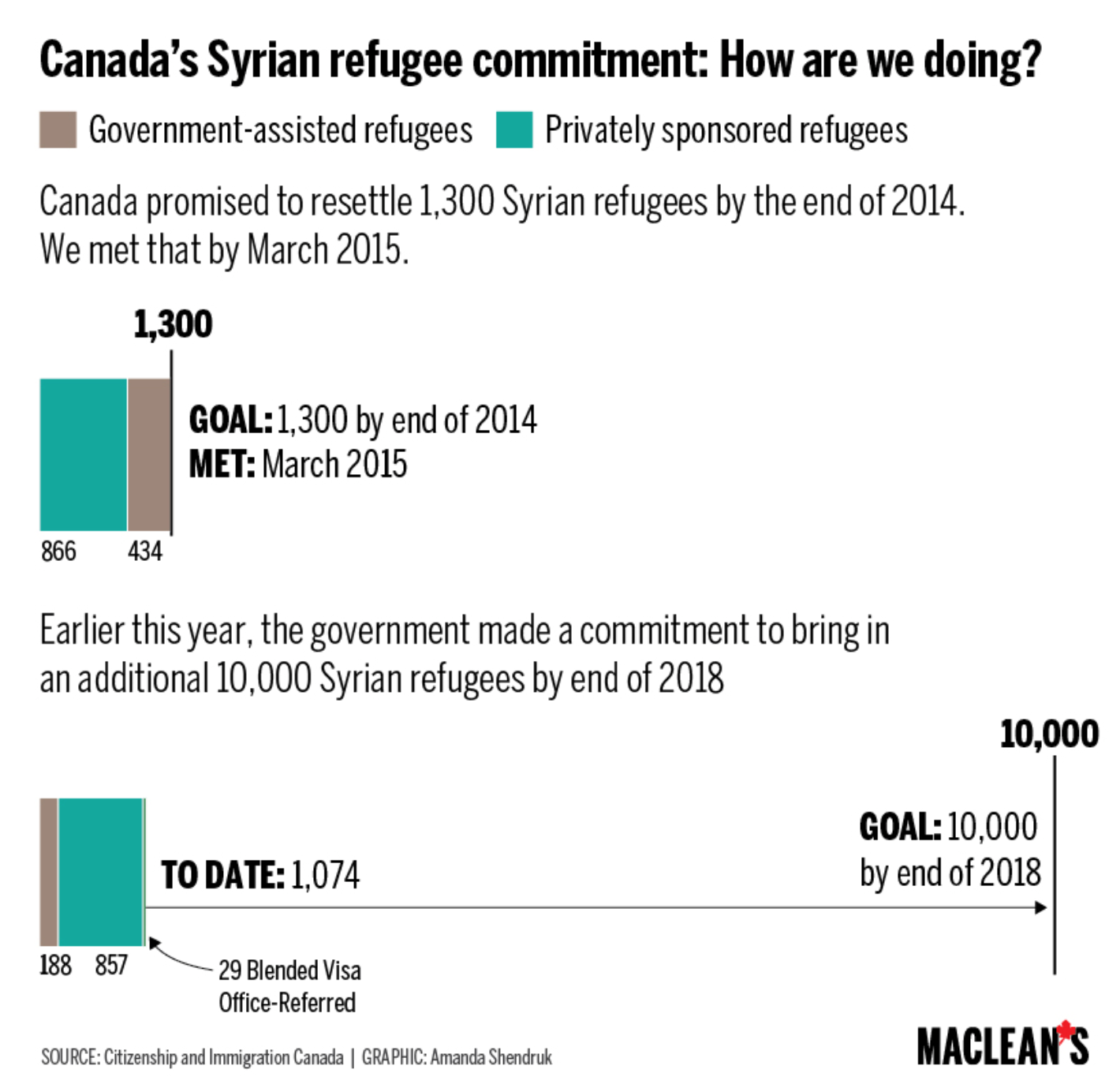
Highlights of Media Coverage of the Politics of the Syrian Refugee Crisis

Canadians_divided_along_political_lines_over_whether_to_accept_thousands_of_refugees_in_current_crisis_-_Angus_Reid_InstituteMuch of the focus has been on Minister Alexander’s handling of the crisis. Starting with Calgary Mayor Nahid Nenshi:

“Minister Alexander should have been a star. He was an incredible diplomat. By all accounts he’s a brilliant man, but he’s also the minister behind Bill C-24, which I remind you means that me — born at St. Mike’s hospital in downtown Toronto — could have my Canadian citizenship stripped,” he said.

Calgary mayor lashes out at immigration minister on refugee crisis

Both Robin Sears and Scott Reid attribute his approach to the numbing effect of the overall Conservative party approach:

As one friend put it, he must have been given a Pierre Poilievre blood replacement treatment, so thoroughly have they crushed his humanity. Since becoming minister he has spoken in a wooden, angry snarl in interview after interview. Perhaps frustrated at the nonsense he has been instructed to deliver, he repeats it in a surlier tone. Few of us are able to be smiling, convincing liars in public. It is perhaps a testament to the angst he feels about the role he has been ordered to play that he does it so woefully.
The refugee story looks as if it might now become the pivot issue of the campaign. It speaks to the deep humiliation that many Canadians have come to feel about the harsh vision of Canada the Harper government flaunts to the world. (Alexander’s TV meltdown made the BBC’s front page online.) It speaks to their ferocious defensive attack in response to any criticism from any quarter. And it underlines how far their mean-spirited response to this crisis is from the values of a majority of Canadians.

Sears: The cost of mindless, heartless message control

But it’s not the first time he’s played the part of the unthinking partisan. Watching Wednesday night’s spectacle, one had to wonder what’s gone wrong. Where did that original Chris Alexander go? Up there on the screen that might as well have been Paul Calandra or Pierre Poilievre, government spokespersons that we’ve come to associate with transparent posturing.

That’s the really troubling thing. Alexander, a knowledgeable, talented and presumably well-motivated person, someone whose history and abilities once inspired sincere hopes for great things has allowed himself to become just another one of “them.” A snapping, snarling partisan.

Not because he’s a bad person. Not because he’s taken this particular stand on this particular issue. But because that’s what politics – specifically politics as it’s currently practiced on Parliament Hill – does to people. It brings them low.

If the Conservatives lose this election, don’t underestimate how much this sort of thing contributes to their downfall. When even the likes of Chris Alexander can be so diminished people can see that something about our politics simply has to change.

Reid: Chris Alexander the latest example of how politics debases even the best of us

Both Sears and Reid’s commentary recalls an early piece by Konrad Yakabuski on the almost Faustian bargain Alexander appears to have made (Chris Alexander balances his portfolio and power).

Turning to commentary on the Government and party leaders as a whole), Andrew Coyne calls for a combined non-partisan response by the three main parties (which has been echoed by Liberal leader Trudeau):

Into the void have stepped the country’s mayors. Toronto Mayor John Tory, in particular, has been attempting to organize some sort of coordinated municipal campaign, nationwide. The emphasis, it would appear, would be on encouraging private sponsorship. “I believe we should mobilize to sponsor Syrian refugees. This is who we are as Canadians,” he said Friday. “This will not happen by itself. It will happen when Torontonians step up.” Indeed, the mayor had reportedly already personally sponsored a refugee family, even before the events of recent days.

The thought occurs: what if our national leaders were to put themselves on the line in the same way? What if they were all to get behind the same campaign? What if they were to put politics aside, even for one day, and appear together on the same stage, exhorting the whole country to “step up”? What might we do then?

Andrew Coyne : It took a photo of a dead child to capture our attention. What matters is what we do next

One of the few to defend the PM and Government (silent on Minister Alexander) was Christie Blatchford:

Harper’s view is that only a three-pronged effort has a chance in Syria: accept more refugees and do it faster; give more humanitarian aid; continue to participate in the military campaign.

As he said once, “Laureen and I had the same reaction, but it doesn’t lead to the same conclusion. Our message is (also) we need to help people who are actually there, who can’t get away, and stop the violence being directed at them. I do not know for the life of me how you can look at that picture and say ‘Yeah, I want to help that family’ and say walk away from the military coalition. … It’s incomprehensible to me to see an image like that and conclude you do more of one thing and less of another.”

It wasn’t perfect, but it was a responsible, intelligent and reasoned response to that picture, and on a day when others took an easier path, the one strewn with flowers, teddy bears, balloons and sentiment. Alan Kurdi’s story certainly should galvanize the world, not only to be stricken and weepy, but to fury.

Blatchford: Alan Kurdi’s story should galvanize the world — but Harper can’t be blamed for this tragedy

Tasha Kheiriddin explains a likely factor in the Government’s reluctance:

Harper’s words reveal the unspoken subtext of fear in the Syrian refugee crisis: this new wave of migrants and refugees come from a country where the West is not only directly involved in a war, but in a war with an organization that threatens to take the fight beyond its borders, to our own shores. The fear isn’t simply that these refugees pose a security threat because there could be terrorists among them. The fear is that they pose a social threat — by bringing with them a worldview that could be at odds with the pluralist, secular and socially-liberal societies in which they seek sanctuary.
The fear is that even though the refugees are fleeing the depredations of ISIS, they will not integrate, but seek to change the fabric of their new societies against the will of the current citizenry. It’s a fear grounded in the experiences of European nations like Great Britain, France, the Netherlands and Sweden, which have witnessed social problems ranging from demands for gender-segregated swimming pools, to Islamic “takeovers” of local public schools in Birmingham, to riots in the banlieues of Paris.
It is grounded here at home in the debate over the former PQ government’s Charter of Values in Quebec, incidents of segregation at a Toronto public school and the federal government’s opposition to the wearing of niqabs during citizenship ceremonies.
No one wants to acknowledge the elephant in the room, but if the Syrian refugees are to be saved, someone must. It would be fallacious to deny that practices such as gender segregation, the wearing of the niqab and the subordination of man-made law to that of the divine would make it difficult for any immigrant to integrate into mainstream western society. But it’s just as wrong-headed to assume that all Muslims live this way, or that other religious groups already established in our country, such as the polygamous sect members of Bountiful, B.C., don’t also hold beliefs that conflict with those of the majority.
The answer is not to turn our backs on refugees from Syria, or refugees from any Islamic country, but to impress upon them and on all immigrants that immigration is a two-way street. Newcomers have the rights to their religion, beliefs and practices — but not if those practices violate the norms of the societies to which they must adapt. Values such as equality of the sexes, equal treatment for persons of different sexual orientation, freedom of association, and separation of church and state are not up for negotiation. Any “reasonable accommodation” must be just that: reasonable.
It’s the task of a mature democracy — and compassionate leadership — to find a way forward in this and future refugee crises, and to re-establish Canada’s reputation as a haven for those who need our help.

What’s holding us back from helping the Syrians? Fear.

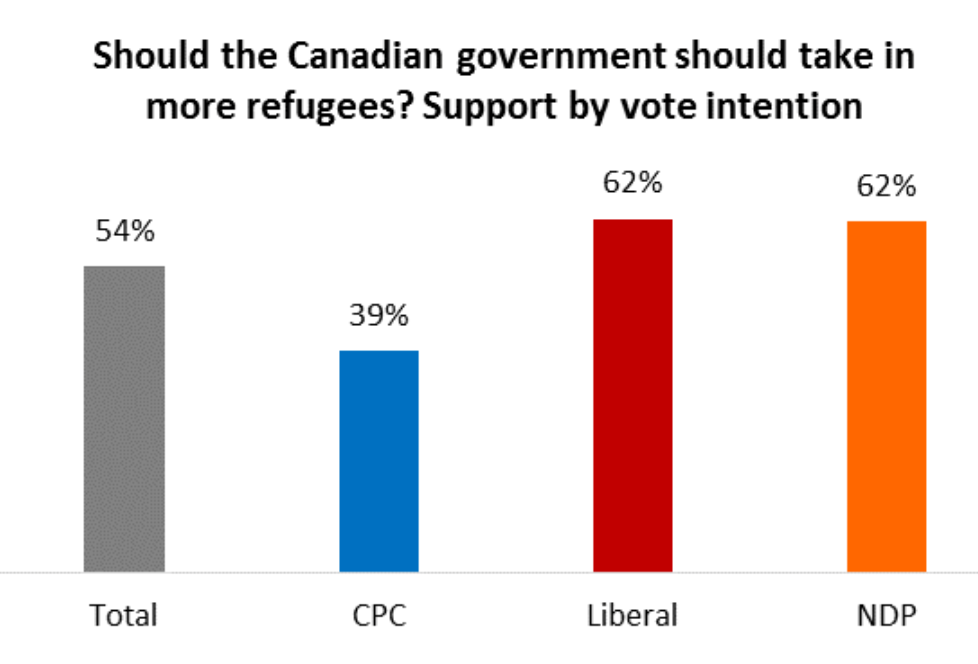
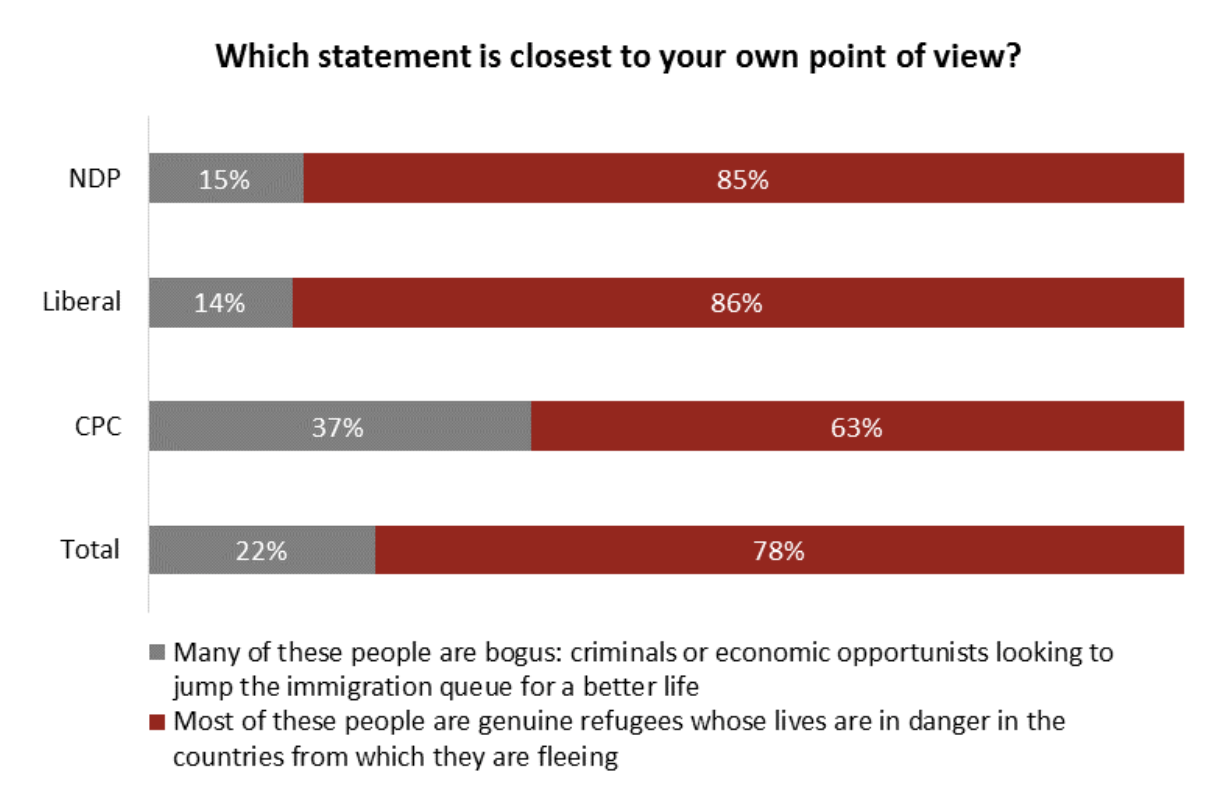
Public opinion polling helps explain the different party positions.
Bogus_refugees_or_notAngus-Reid conducted a useful poll, breaking down opinion by party affiliation, showing the Government’s position is aligned to the Conservative party base and messaging of “bogus refugees”, with the overall key findings being (all parties):

  • Overall, most Canadians (70%) say Canada has a role to play in the migrant crisis, but are divided on increasing the number of refugees the government sponsors and resettles here, and on seeing government spend more to make it happen. (54% and 51% support each, respectively)
  • A significant gender difference exists on whether the people fleeing to Europe from the Middle East are seen as “genuine”: Canadian men are twice as likely as women to say the migrants are “bogus”
  • As to what exactly this country should do, Canadians are most supportive of sending medical and armed forces professionals into the affected European countries areas to assist refugees, divided on taking more refugees and least supportive of “doing nothing”

Canadians divided along political lines over whether to accept thousands of refugees in current crisis

Niqab Politics Commentary – Various

Starting with Margaret Wente:

I loathe the niqab. I agree with Prime Minister Stephen Harper that niqabs are “not how we do things here.” A cloth that covers the face is a symbolic rebuke to Western values – especially when the covered woman is walking three steps behind her jeans-and-sneakers-clad husband.

But I also think a woman has the right to choose – even when her choice is offensive to a lot of people. I believe that religious freedom is a cornerstone of Western values. People should have wide latitude to exercise that freedom as they wish, and we shouldn’t constrain them without very good reasons.

So if Zunera Ishaq, a devout Sunni Muslim from Pakistan, wants to wear a veil while she swears the oath of citizenship, let her. Our democracy has survived greater threats than that.

…I despise niqabs. I really, really do. But I despise attacks on people’s freedom even more. There’s a difference between a woman in a veil and a jihadi sawing off a head. We need to remember that.

Why Stephen Harper is playing niqab politics – The Globe and Mail.

Stephen Maher focusses more on the politics:

The best way to counter the online recruiters who prey on those weak-minded souls is not to set up a mosque inquisition, as Mr. Legault proposed, but to build good relations with the imams who are on the front lines of anti-radicalization efforts.

We need these guys to drop a dime when they’re worried that Ahmed has gone off his meds, and they’re less likely to do that if they feel their community is under attack.

This is a good time to lower the temperature and remind Canadians of what draws us together, not constantly point to the things that divide us.

But Mr. Legault, like Mr. Harper, risks bitter defeat in the next election. So both men are playing with fire, trying to capitalize on fear, the most powerful emotion in politics.

And it is working. Recent polls show the Tories’ tough-on-terror message connecting in Ontario and, especially, Quebec, opening a ray of hope for a government that until recently looked doomed.

That’s fair play, but I’m worried that Mr. Harper will add fuel to the fire, linking terrorism to mosques — as he did when he introduced C-51 — inveighing against niqabs in fundraising emails and scaring everyone by warning about “jihadist monsters” at every opportunity.

Mr. Harper’s back is to the wall. If he loses the next election, or even fails to win it convincingly, his career is likely over.

Since oil prices collapsed, the economy is not the political winner it once was, leaving fear as his best issue.

Things could get ugly between now and the election.

  Stephen Maher: Tough talk about Muslims by Canadian politicians is unnecessary  

And Andrew Coyne issues a further warning:

On the surface, the insistence of Obama and other leaders that “this has nothing to do with Islam,” would seem as odd as that of their critics, that it has everything to do with Islam. As David Frum writes on the Atlantic website, “it seems a strange use of authority for an American president to take it upon himself to determine which interpretations of Islam are orthodox and which are heretical.” But there is a strong case for saying such things, even if you don’t believe them — especially if you don’t believe them — precisely in the service of fighting terrorism.

The one thing that could be predicted to cause more Muslims, here and abroad, to believe that violence against the West was justified would be if they were to become convinced that, indeed, there is “a clash of civilizations,” that Islam was under attack, and that they themselves, as practitioners of the religion, were objects of suspicion and hostility. The phenomenon is often observed in other social groups that, rightly or wrongly, feel themselves besieged: they will close ranks, even with those with whom they might otherwise have no sympathy.

That would be a calamitous setback to efforts, largely successful, to win the cooperation of the Muslim community in rooting out the few radicals in their midst. Which takes us to the rhetoric of the Harper government. Merely referring to “Islamic extremism” or “jihadism” would be unobjectionable in itself. But when coupled with recent, needless interventions in such volatile debates as whether the niqab may be worn at citizenship ceremonies, it suggests at best a troubling indifference to the importance of symbols and the need for those in power to go out of their way to reassure those in minority groups that they have not been targeted.

It may be good politics. But they are playing with fire.

Violent extremism or jihadism: The case for watching our language on terror

Lastly, Salim Mansur’s efforts to compare Indian religious and cultural practice restrictions doesn’t work: there is a difference between bigamy, child marriage, concubinage, FGM, which directly impact upon the rights of others or impact on the health of the person, unlike the wearing of a niqab.

The only valid comparison is that with other religious closing and headgear accommodations  (which the niqab is) and other dress code conventions (i.e., one cannot demand government services or attend a citizenship ceremony full or partially naked).

But we need to compare apples with apples, not oranges:

The same week the Federal Court ruled the niqab ban unlawful, India’s Supreme Court ruled that bigamy and polygamy is not protected under Article 25 of the Indian Constitution, which refers to freedom of conscience and religion. The justices of the Indian Supreme Court upheld a lower court ruling that the appellant, Khursheed Ahmad Khan, in taking a second wife while remaining married to his first wife, violated the civil service regulations that do not permit bigamy and polygamy as part of religious belief. The justices agreed a “bigamous marriage amongst Muslims is neither a religious practice nor a religious belief and certainly not a religious injunction or mandate.”

The relevant point here is that certain practices — such as bigamy or child marriage, concubinage, female genital mutilation, etc. — even when permitted by a religion, need to be distinguished from religious belief as customary practices. In making this appropriate distinction, the Indian courts have ruled, with the Supreme Court in agreement, that what is protected under Article 25 is religious belief, not practices that may run counter to public order, health or morality.

This ruling of the Indian Supreme Court is instructive. India shares with Canada the system of government and democratic traditions handed down from Britain. India is also the world’s third-largest Muslim country after Indonesia and Pakistan. In ruling that bigamy and polygamy are in violation of India’s laws, the courts have defended the rights of women, especially Muslim women, in terms of equality rights, and against Muslim Shariah-based laws that discriminate against them in favour of men.

Canadian courts would be well advised to make a similar and appropriate distinction between religious beliefs and customary practices, and whether any or all customs should be protected under the Charter provision of religious freedom.

Salim Mansur: Defending the niqab ban

Radicalization and the Ottawa Shooting: Weekend Commentary

Weekend news and commentary I found relevant and interesting.

Consistent messaging from a number of political figures and media commentators on the need for more than security approaches in combatting radicalization. Premiers Wynne and Couillard stress the community and societal aspects in Curbing radicalization a community issue: Wynne |  Toronto Sun.

A great deal of speculation on what measures the Government may be considering (beyond the already announced increase in CSIS powers), ranging from Online hate speech could be curtailed under new anti-terror push (ironic, given the Government’s removal of online hate speech from the Canadian Human Rights Act, and to strip the federal human rights commission’s power to investigate such complaints) to greater use of preventive detention in Tories hint at even tougher anti-terror laws. John Ivison thinks the template will be the UK in  Conservatives’ new anti-terror laws likely to mirror ‘immensely controversial’ U.K. legislation.

Stephen Maher sounds a note of caution, considering the Government’s record on privacy, oversight, and transparency, in Harper government’s intelligence agenda a cause for worry.

Interestingly, Benjamin Perrin, formerly of PMO, argues that existing laws are adequate (including the proposed additions to CSIS’ powers)in Our laws are up to the homegrown terror threat, and Ian Brodie, former chief of staff to PM Harper, advocates for an all-party non-partisan approach to improving security on Parliament Hill in Ian Brodie: There is no reason to turn Parliament Hill into an armed fortress.

And as the debate starts, Scott Reid notes that We’ve seen MPs unite, now we need them to be divided to ensure a full discussion and debate about the appropriate responses to the attacks.

Jon Kay discusses how the immediacy of video heightens fear in Did attack on Parliament really change our lives forever? even if incidents and risk are relatively low.

Doug Saunders explores the grey line between ideology and pathology in The lone wolf: Is it ideology or pathology? with both Islamic-inspired and other extremism examples. Margaret Wente dismisses arguments over blowback over intervention in What do we do about the Islamic State fanboys? without the nuance of Saunders with respect to ideology and pathology. Andrew Coyne takes a similar talk, with more nuance, and makes the valid point that We got off relatively lightly this time. We may not be so lucky the next.

Some nice commentary contrasting restrained Canadian and hyperventilated US coverage of the attacks by Dean Obeidallah in To US media Canadian shooter being Muslim ends investigation.

Douglas Todd reports on the Burnaby Mosque which essentially expelled Zahaf-Bibeau given his intolerant views in Is Burnaby mosque a victim of its own openness?

And while there have been a few incidents against Muslims (Islamophobia: the ugly side of the municipal election?), there has also been support for those Muslims or Muslim institutions (Volunteers help clean vandalism from Cold Lake mosque). And within the Muslim community, some strong messages against radicalization during Ottawa Friday prayers The Roots of Radicalizaton and the Education to Prevent It among others.

More Ottawa Shooting Commentary

Further to yesterday’s round-up of the recent shootings, more of the better commentary or more interesting commentary that has crossed my eye.

Wesley Wark: Reducing the risk of terrorism provides a sober assessment of the ongoing risks and the need neither to over or under act, but learn the lessons from any failures and gaps in security.

In the theme of let’s not get carried away, André Pratte in La réponse and Stephen Maher Time to reflect on the courage of our ancestors remind us to have balance and perspective. Doug Saunders notes how the public space around parliaments the world over has been whittled down by successive security threats in Don’t let the seat of government become a fortress.

On the other side, Journal de Montréal’s Richard Martineau is characteristically alarmist in Terrorisme: appelons les choses par leur nom.

More on the common elements to the two most recent cases of radicalization, Martin Couture-Rouleau  and Michael Zehaf-Bibeau:

Martin Couture-Rouleau et Michael Zehaf-Bibeau partagent plusieurs points en commun : ils étaient jeunes (25 ans et 32 ans), ils s’étaient récemment convertis à l’islam radical, la GRC avait confisqué leur passeport par crainte qu’ils rejoignent le groupe État islamique, et ils auraient agi tels des « loups solitaires ».

Pour les autorités policières, c’est le cauchemar. Les deux jeunes ont agi de leur propre chef, sans même avoir été initiés au combat par des groupes extrémistes à l’étranger. Ils sont difficiles à repérer et à neutraliser.

Un loup solitaire aux motivations inconnues

And further details about the troubled life of the shooter, Zehaf-Bibeau in the Globe in Drugs and religion key themes in Ottawa shooter’s troubled life and in the Post in Details of Zehaf-Bibeau’s life paint picture of a man derailed by homelessness, crime and addiction, detailing his drug addiction, quarrelsome personality and his failed efforts to use his faith to control both.

Canadian Muslims are quick to respond and express outrage in Canadian Muslims denounce recent attacks, fear backlash.

Matt Gurney challenges the military’s decision in Canadian soldiers don’t hide in their own damn country — rescind the order to not wear uniforms in public.

Barbara Kay covers a different angle in The unique anguish of a terrorist’s mother:

If it is inevitable, why feel guilty about these “bad seeds”? And yet, inevitably, parents do. Our sympathetic embrace for the real victims should therefore be wide enough to include their murderers’ collateral damage.

A great deal of favourable commentary on Parliament yesterday, how each leader struck the right tone, the hugs of support, and the deserved standing ovation for Sergeant-at-Arms Vickers starting with Jeffrey Simpson in Tribute, solidarity and back to politics (with some barbs at the difference between Government rhetoric and funding).

Jonathan Kay noted the contrast between this time and 30 years ago, when the then Sergeant-at-Arms was able to talk armed Denis Lortie into surrendering in Two Sergeants-at-Arms, two kinds of heroism.

Rick Salutin, similarly praises Kevin Vickers, but provocatively, and accurately, rubbishes the idea of Canadian innocence in We didn’t lose our innocence. We never had it.

Andrew Coyne, perceptively noted the nuances in the various positions and how that hopefully portended more serious political dialogue and debate in Politics weren’t put aside during the Ottawa hug-out, they were just made over for the occasion:

For Mr. Harper, it was “to identify and counter threats and keep Canada safe here at home,” as well as “to work with our allies” in the fight against “the terrorist organizations” abroad who hope “to bring their savagery to our shores.” For Mr. Mulcair, it was “our commitment to each other and to a peaceful world.” For Mr. Trudeau, it was “staying true to our values” of “fairness, justice and the rule of law.”

“We will not be intimidated,” Mr. Harper vowed. “That is not going to happen,” Mr. Mulcair seconded. “We will not be intimidated into changing that,” Mr. Trudeau agreed. But they meant very different things.

And the still and video images of the citizens of Ottawa paying their tribute to fallen soldier Nathan Cirillo (as well as the accounts of those who tried to save him in ‘You’re breathing — keep breathing’), as well as to democratic values, were moving.