‘We won’t forget’: How Muslims view Pierre Poilievre’s stance on Israel-Hamas war

We shall see, look forwards to any comments on my analysis of the possible impact:

….The National Council of Canadian Muslims and dozens of Muslim organizations, mosques and groups signed an open letter to MPs ahead of Ramadan, asking them to stay away from events during the holy month if they couldn’t commit to taking several stances, including support for an immediate ceasefire and condemning some of the actions of Israeli forces.

When asked about Polievre’s outreach this year, Conservative spokesman Sebastian Skamski said Poilievre has articulated a clear position that Israel has a right to defend itself and that Palestinians need humanitarian relief “as a result of the war that Hamas has started.”

Andrew Griffith, a former director of multiculturalism policy for the federal government, said while Muslims are not a monolithic group, it’s likely Poilievre’s loud pro-Israel stance will cause some people to turn from the party, including in key ridings around Toronto.

However, he said, given the current polling numbers, it would be unlikely to do much damage to Conservative fortunes when the next election rolls around.

Skamski also pointed to a speech Poilievre delivered Tuesday in Montreal to the Beth Israel Beth Aaron Jewish congregation, where he addressed the matter head-on.

“I want you to know,” Poilievre the crowd, “I say all of these things in mosques. I do go to mosques. I love meeting with the Muslim people, they are wonderful people.”

He went on to say that when the issue of Israel is raised, “I say, ‘I’m going to be honest with you — I’m a friend of the state of Israel and I will be a friend of the state of Israel everywhere I go.'”

That runs counter to the approach taken by Justin Trudeau, continued Poilievre, accusing the prime minister of muddying the government’s position.

“While it might make for good politics to have one individual MP who says the right thing in order to get a seat back and keep Justin Trudeau in power, it does not solve the problem of having Canada take a right and principled position,” he said.

Skamski said Poilievre has met with thousands of Muslim Canadians during his team as leader and has connected on their shared values of “faith, family and freedom.”

“You can’t talk to Muslim Canadians about faith, about family values, all of those things, while at the same time turning a blind eye to 30,000 dead,” Tahir said, referring to the number of people killed in Gaza since Israel began bombarding the territory in October.

Tahir said many were disappointed in Poilievre’s opposition to funding the UN aid agency UNRWA….

Source: ‘We won’t forget’: How Muslims view Pierre Poilievre’s stance on Israel-Hamas war

ICYMI: Ibbitson: Canada’s foreign policy and its domestic politics on Israel’s war against Hamas are shifting

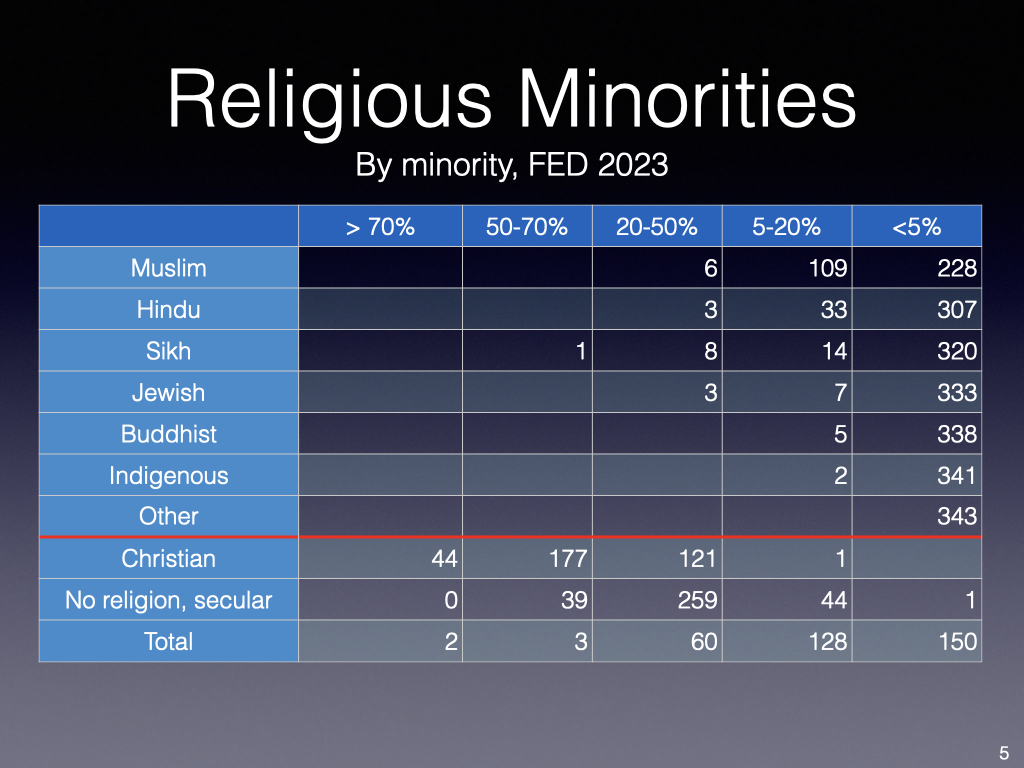
Indeed. Riding demographics highlight the relative importance of religious minorities, particularly the contrast between Canadian Jews and Canadian Muslims:

….The Liberals have tried to keep both Jewish and Muslim constituencies onside. But as last week’s vote suggests, they increasingly accord a high priority to the rights of Palestinians and to the Muslim community in Canada.

As with other religious communities, Muslims are hardly monolithic. Someone who comes to Canada from Senegal may have different values and priorities than a Canadian who comes from Syria or Pakistan or Indonesia.

And the plight of Palestinians in Gaza may not be the only issue influencing Muslims, who struggle with inflationinterest rates and housing affordability as much as other voters.

Many new Canadians come from societies that are socially conservative. Some Muslim voters may be uncomfortable with the Liberal Party’s strong support for the rights of LGBTQ Canadians.

Finally, Muslim voters for whom supporting the rights of Palestinians is the ballot question may be drawn more to the NDP than the Liberals.

Regardless, the days of Liberal/Conservative bipartisan consensus in support of Israel are over. This is the new lay of the land.

Source: Canada’s foreign policy and its domestic politics on Israel’s war against Hamas are shifting

Le Devoir Éditorial | L’immigration et les petits calculs politiciens

Malheureusement:

Si les enjeux d’immigration présentent des défis planétaires de plus en plus aigus et compliqués, ces défis gagneraient indubitablement en clarté si les gouvernements de tout acabit évitaient d’en instrumentaliser les côtés sombres à des fins politiques et électorales. Prenons seulement l’actualité récente en Grande-Bretagne, en France et aux États-Unis. Trois pays dont les gouvernements embrument le débat et cultivent les méfiances xénophobes en cédant aux sirènes du populisme.

Au premier ministre britannique, Rishi Sunak, armé d’un slogan alarmiste (« Stop the boats »), revient la palme de la déshumanisation des migrants pour son projet de transfert de demandeurs d’asile vers le Rwanda. Fondé sur un accord signé avec l’autoritaire Paul Kagame il y a près de deux ans, le projet de loi adopté le 18 janvier dernier par la majorité conservatrice aux Communes vise à décourager les migrants de traverser la Manche — ils ont été environ 30 000 à le faire en 2023, au péril de leur vie. Sunak entend procéder bien que la Cour suprême britannique ait désavoué le projet en estimant que le Rwanda peut difficilement être considéré comme un « pays sûr ». 

Outre qu’il est loin d’être acquis que les expulsions ralentiraient les arrivées par « petits bateaux », les chiffres montrent noir sur blanc que la croisade de M. Sunak, qui est largement menotté par l’aile droite du parti, tient du délire. Le fait est qu’entre juin 2022 et juin 2023, la migration a été essentiellement légale au Royaume-Uni, répondant aux besoins urgents du marché de l’emploi, particulièrement en santé. Les migrants en situation irrégulière ont représenté 7,7 % de la totalité des  682 000 entrées. Qu’à cela ne tienne : à la traîne dans les sondages face aux travaillistes, M. Sunak n’a pas seulement décidé de faire de son « projet Rwanda » le socle de sa politique contre l’immigration clandestine, il compte aussi en faire l’un des ressorts principaux de sa stratégie de campagne aux législatives de janvier 2025.

En France, des mois de controverse autour de la nouvelle loi sur l’immigration ont obéi à de semblables petits calculs, permettant in fine à Marine Le Pen, cheffe du Rassemblement national, de crier à une « grande victoire idéologique » — du moins jusqu’à ce que le Conseil constitutionnel ne censure une grande partie de la législation la semaine dernière. C’est ainsi qu’en cheval de Troie, le concept de « préférence nationale », si cher à l’extrême droite, s’est imposé de façon inédite dans un texte législatif français, avec le soutien de la droite traditionnelle (Les Républicains) et de la majorité macroniste. Résultat : les Français auront vécu une saga où Emmanuel Macron aura moins cherché à penser une politique migratoire réformée avec clairvoyance, à l’abri des dérives, qu’à enregistrer un succès législatif à n’importe quel prix, lui dont la présidence ne va nulle part à six mois du rendez-vous des élections européennes.

Aux États-Unis, Donald Trump s’emploie ces temps-ci à saboter un projet d’accord migratoire entre sénateurs démocrates et républicains pour empêcher coûte que coûte que sa conclusion ne fasse bien paraître le président Joe Biden en cette année de scrutin présidentiel. Sur le fond, le projet repose pourtant sur des mesures étroitement punitives et tout à fait au goût des républicains. Seraient sensiblement élargis, en vertu de cette entente, les pouvoirs d’expulsion manu militari dont disposent les agents frontaliers. Dans l’espoir à courte vue de raplomber sa popularité, M. Biden se trouve ainsi à jouer le jeu de la droite dure anti-immigration. Il est d’autant plus piégé par cette dynamique que le clan trumpiste au Congrès lie l’augmentation de l’aide militaire à l’Ukraine, pièce maîtresse de sa politique étrangère, à l’adoption de mesures radicales de refoulement à la frontière mexico-américaine.

En Europe comme aux États-Unis, sur fond de stagnation législative, la « pression migratoire » ne diminue pas. Ils ont été 267 000 migrants à débarquer aux frontières méridionales de l’Union européenne l’année dernière et 2800 à se noyer en Méditerranée ; ils ont été 300 000 pendant le seul mois de décembre dernier à cogner à la porte des États-Unis. Des nombres records. Des années de politiques d’endiguement et d’externalisation des contrôles n’y ont rien changé, bien au contraire, de la même manière que la fermeture du chemin Roxham — c’était écrit dans le ciel — n’a rien réglé.

À prétendre qu’il y a des réponses simples à des problèmes compliqués ; à faire l’économie des faits et à laisser prospérer les faussetés ; à trop peu investir, en amont des mouvements de migration, dans le développement des pays du Sud ; à faire depuis toujours, aux États-Unis, l’impasse sur une réforme du système d’immigration, on se trouve trop souvent à laisser la réflexion autour des enjeux de géopolitique migratoire, d’une portée pourtant capitale sur la vie des sociétés partout dans le monde, à se conclure sur des décisions politiciennes prises à la petite semaine.

Source: Éditorial | L’immigration et les petits calculs politiciens

New Electoral Map and Diversity

My analysis of the impact of the new electoral map on racialized and religious minorities and Indigenous, and how it will be further impacted by the ongoing increase in immigrants.

Source: New Electoral Map and Diversity – The Hill Times

Tasha Kheiriddin: Trudeau frittered away a good immigration policy for the sake of Liberal votes – National Post

Discounts the flawed policy rationale of the Barton commission recommendations but of course, political considerations also played a role. And, as we saw during the Kenney years, the liberals cannot take these voters for granted:

Immigrants are also grateful to the party that bring them in. Prime Minister Justin Trudeau learned this from his father. Pierre Elliott Trudeau took credit for the citizenship of millions of Canadians, even though many had come to Canada under previous governments. Why? Because they took their oath under his watch. And when it came to elections, the immigrant communities of the day — Italians, Greeks, Haitians, Vietnamese — tended to vote Liberal.

The implications of Trudeau Jr.’s replication of this policy are dire. Studies show that they are turning Canadians against immigration: even 62 per cent of current immigrants think we’re letting in too many people. They are impoverishing Canadians, both current and newcomer, according to the bank study. And they are also helping fuel Quebec separatism, as francophones look with alarm at rising immigrant populations in the Rest-Of-Canada. By the end of the century, Quebec risks becoming a bit player in Confederation, with only 15 per cent of its population.

This cannot continue. Instead of flooding the country with newcomers, the government needs to boost domestic productivity. That’s a harder fix — and one that won’t give them more votes. But then again, if Canadians can’t afford a decent life, the Liberals may not get their votes either.

Source: Tasha Kheiriddin: Trudeau frittered away a good immigration policy for the sake of Liberal votes – National Post

When ‘conservatives pounce’: The right finds its cautionary tale of subtle media bias

Always find MacDougall’s comments reasonable and balanced:

“I can think of no reporters I’ve ever dealt with who had it out for a party or a worldview. Most were trying to do the job in the fairest way possible,” said Andrew MacDougall, who was director of communications for former prime minister Stephen Harper and is now a director at Trafalgar Strategy.

“But like all biases, you’re not really aware of them until somebody points them out. If you’re university-educated and urban-living, you tend to have a worldview that is different from somebody who isn’t — and it takes a lot of effort to open your eyes up,” said MacDougall….

While MacDougall agrees that conservatives generally have to work harder to get a fair shake from the media, he also warned people on the right not to get too caught up in playing the victim. He pointed to the current controversy around Prime Minister Justin Trudeau’s recent free luxury holiday in Jamaica as proof that, above all, the media craves juicy stories.

And when conservatives govern, he said, there are times when the negative reporting targeting them is just proper reporting.

“The hardest thing in government to do is to distinguish between the fact that you’re getting heat for being in government versus for being the party that you are in government,” he said.

Source: When ‘conservatives pounce’: The right finds its cautionary tale of subtle media bias

Les femmes et minorités, encore souvent des candidatures «poteaux» au Canada

Of note (my previous analyses have focused on growth in minority candidates and MPs but this reinforces other studies showing similar overall pattern):

….Le parcours de Nathanielle Morin fait partie des données compilées dans un article rédigé par des chercheurs de l’Université d’Ottawa à paraître dans la prochaine édition de la revue Electoral Studies, et consulté par Le Devoir.

L’analyse du parcours de 3966 candidats qui se sont présentés lors des trois dernières élections générales montre que les lesbiennes, les gais, les bisexuels, les transgenres ou les queers (LGBTQ+) autodéclarés et les femmes sont nettement surreprésentés (de 17 et de 6 points de pourcentage respectivement) dans les défaites écrasantes — celles dans lesquelles ils sont arrivés plus de 15 points derrière. Les candidats autochtones ou issus des minorités visibles sont aussi désavantagés, quoique d’une moins grande ampleur.

À la surprise des chercheurs, le Parti libéral ne fait pas meilleure figure que le Parti conservateur à ce chapitre : les candidats issus de minorités sont plus souvent nommés là où les deux formations s’attendent à perdre.

« On n’a pas trouvé de grandes différences entre les libéraux et les conservateurs, même si les libéraux ont tendance à souligner qu’ils ont la parité et la question de diversité plus à coeur que le Parti conservateur », souligne Valérie Lapointe, chercheuse postdoctorale en études politiques à l’Université d’Édimbourg et coautrice de l’étude.

En fait, ces deux partis présentent surtout des hommes hétérosexuels dans les circonscriptions réputées « prenables », une tendance aggravée par le fait que les députés sortants conservent généralement leur place comme candidats. À l’issue des dernières élections fédérales, la Chambre des communes était constituée à 69,5 % d’hommes….

Source: Les femmes et minorités, encore souvent des candidatures «poteaux» au Canada

Phillips: How Muslim voters are exerting their growing political influence

Another number: Canadian Jews from more than 5 percent of the population in 13 ridings compared to Canadian Muslims forming more that 5 percent in 114 ridings:

But the Trudeau government surely didn’t need much encouragement to move in that direction, and it didn’t necessarily have to do with geopolitical calculations. You only have to look at changing demographics in this country and their far-reaching political implications.

This can be touchy territory, so let’s specify a couple of things upfront.

There’s nothing wrong with any community, including Muslims, organizing to maximize their political impact. That’s as Canadian as butter tarts. Virtually every group has done it — from the English and Irish to francophone Quebecers, Ukrainians, Italians, Sikhs, you name it.

And ethnic voting doesn’t explain everything about this or any issue. You don’t have to be Muslim to be appalled at the death toll in Gaza, no more than you have to be Jewish to be sickened by the massacre of Israeli civilians on Oct. 7.

But in this case, there’s no ignoring the increase in Muslim voters. A few numbers: the 2001 census showed there were 579,000 Muslims in this country (or 1.95 per cent of the population). The most recent census, in 2021, put that number at 1.77 million (4.9 per cent).

That’s a dramatic rise. By contrast, Muslims are only an estimated 1.1 per cent of the U.S. population, meaning their relative demographic weight in Canada is almost five times as large.

Another relevant comparison: in 2001, Canada’s Jewish population was put at 330,000. The 2021 census measured it at 335,000 — virtually the same. So while the country’s Jewish population flatlined, its Muslim population tripled….

But no party can ignore the new reality. Demographics, they say, are destiny. And right now they’re showing Muslim voters must be taken seriously.

Andrew Phillips is a Toronto-based staff columnist for the Star’s Opinion page. Reach him via email: aphillips@thestar.ca

Source: How Muslim voters are exerting their growing political influence

Sean Speer: The Left has a self-policing problem

Yep:

A key feature of a political movement’s health is its ability to self-police against ideological excesses or reactionary forms of politics. It’s not easy to do. There are powerful incentives that tilt against it, including the risk of alienating prospective supporters, harming personal relationships, and granting political ammunition to one’s opponents. There are also practical limits in a distributive democracy where there are rarely points of authority that can plausibly claim to speak for a political movement as a whole. 

Yet just because it’s hard doesn’t mean that there isn’t some onus—particularly among elite actors—to call out and, where necessary, isolate radicalism within their ranks. 

At its apogee in the second half of the twentieth century, National Reviewmagazine played this role on the American Right. Its founder, William F. Buckley Jr., famously wrote the John Birch Society out of the mainstream conservative movement that he was assiduously building. He similarly published a scathing review of Ayn Rand’s book, Atlas Shrugged, by one of the magazine’s editors, Whittaker Chambers, that signaled to the world that Rand’s objectivism didn’t have a home in it either.

In the ensuing decades, the American Right has ceased to self-police. At this point, not only are its political leaders merely trying to stay ahead of their most radical voices, but within the adjacent world of conservative ideas and thought, it can at times be hard to distinguish between the elites and the fringe. 

Canadian conservatism has generally had less of a reactionary problem. There are doubtless various factors including the Westminster model’s emphasis on top-down leadership and party discipline, the country’s more moderate political culture, and its lower racial salience. 

The Hub has nevertheless, in the two-and-a-half-years since its launch, taken seriously a sense of responsibility for calling out conservative excesses including the reactionary parts of the movement that disposed Jason Kenney as Alberta’s United Conservative Party leader, the conspiratorial impulsesbehind some of the conservative criticism of the World Economic Forum, and the growing trend of online ideas and voices radicalizing young men. 

We know that these instances have antagonized some conservatives who believe that it’s a tactical mistake to cede any ground to the Left. They’ve probably cost us some number of donors and subscribers. We also recognize that there are inherent limits to our ability to neutralize some of these excesses. No one is asking our permission before tweeting or driving their transport truck onto Parliament Hill for that matter. But we still think it’s ultimately healthy for The Hub as an institution and conservatism as a whole to speak out when we feel it’s called for. 

This notion of self-policing is something that I’ve thought a lot about in recent years. I wonder what I would have done if I had been a Republican in 2015 and 2016. I don’t know. It’s easy to look the other way or rationalize bad ideas on one’s own side. 

But the lesson of the past several years in the United States is that even if there are downsides for those who are prepared to be self-critical, there’s not a lot of upside for those who aren’t. Ask Republican congressional leaders like Kevin McCarthy or Jim Jordan. Do their choices in hindsight look better or shrewder than Liz Cheney’s? The answer is self-evidently no. 

I share this context because the reaction of the Canadian Left to Hamas’s terrorist attacks against Israel has revealed a self-policing problem. It’s become clear that the movement’s intellectual and political leaders have permitted radical ideas and voices to occupy an outsized place in today’s progressivism. The consequences have alarmingly played themselves out in recent weeks on university campuses, the streets of the country’s major cities, and even inside our mainstream politics. Put bluntly: the Left has an antisemitism problem. 

Even that however doesn’t seem to fully capture the magnitude and nature of the problem. It’s not merely the fringe expressions of outright Jew-hatred that we’ve witnessed. It’s actually something far deeper and more mainstream that may be the bigger cause for concern.

The Left’s strong attachment to radical ideas such as “decolonisation”, “oppressor versus oppressed” frameworks, and the so-called “right to resist” has created an intellectual context in which acts of terrorism and violence can find affirmation and support. 

There are different factors that have contributed to the problem. One is that progressives have so convinced themselves that the rise of the so-called “far right” represents an existential threat that they’ve been prepared to make alliances with radical political figures and organizations (“no enemies to the Left”) or opted to overlook the rise of radicalism within their movement. To the extent that they may acknowledge it, there’s been a tendency to minimize these intellectual trends as merely a form of campus politics or faculty lounge theorizing. 

Another is that the problem on the Left is essentially the opposite of the one on the Right. For conservatives, self-policing is mainly about conservative elites trying to constrain the excesses of the right-wing masses. For progressives, the excesses are among left-wing elites themselves. Radicalism finds its strongest expression among university faculty, law school students, and the panoply of non-profit organizations that comprise the modern Left. It’s not obvious therefore who’s supposed to be doing the policing. 

But it needs to happen. North American scenes of anti-Jewish rallies and full-throated defences of Hamas’s horrific terrorist attacks rooted in left-wing theories of anti-colonialism and anti-settler resistance are signs that radicalism has spilled out from university seminar rooms into the streets. 

These protests and rallies—including ones that have targeted Jewish restaurants and cultural centres—have exposed these problems for everyone to see. They’ve forced us to confront the interrelationship between these Manichean ideas about identity and power promulgated by left-wing voices and antisemitism. This should lead to a reassessment of the public good case for subsidizing various forms of critical theory education and scholarship which often seem like a thin veneer of academic rigour for what is otherwise a set of retrograde intellectual propositions about race, gender, sexuality, and society. 

But that’s probably a necessary yet insufficient response to what has played out in recent weeks. This is in large part a progressivism problem that progressives themselves must address. Progressive elites who lament the rise of the far right need to reckon with the rise of the far left and their own role in galvanizing it. Self-policing is hard—especially when it requires serious introspection—but it’s necessary. It’s time for the Left to police its own side. 

Source: Sean Speer: The Left has a self-policing problem

Kheiriddin: Pierre Poilievre’s path to victory could run through the culture wars

She may well be right given that most of these resolutions were carefully crafted and reflect issues that many may feel activists and advocates have been excessive in their demands and approaches. And her point on that voters may have different views on each of these resolutions appears likely:

The Conservative policy convention has come and gone amid a hail of plaudits, photo-ops, and favourable polls. Leader Pierre Poilievre has managed to unite the party faithful and win over Canadian voters, by tapping into their economic angst and fatigue with Prime Minister Justin Trudeau, who is increasingly seen as out of touch, and out of time.

But the convention also opened a new political fault line: the culture wars. Delegates voted that children should be prohibited from gender-related “life-altering medicinal or surgical interventions,” upheld women’s rights to single-sex spaces and sports, and rejected mandatory diversity, equity, and inclusion training and race-based hiring practices. A majority also supported allowing Canadians to refuse vaccines on the grounds of “bodily autonomy.”

Pushback was swift. A former Conservative candidate who is trans said a vote against gender-affirming care could cause some children to commit suicide. A local riding president warned against reopening the vaccine debate. But most of the criticism came from the media and analysts who say the culture wars are a distraction that will hurt the Tories at the polls, like the “barbaric practices” tip line did in the 2015 election. Poilievre has a huge lead, based mostly on economic issues: why blow it? People only care about the rent and the grocery bill; these other concerns will not inform their political choices.

For some voters, however, these issues are highly motivating. Research firm Angus Reid Institute recently asked Canadians what they think about the culture wars, and identified two groups of voters who strongly engage on them: “zealous activists” who favour “progressive” policies like pronoun use and represent 17 per cent of voters, and “defiant objectors” who reject such changes and constitute 20 per cent of the electorate. Broken down by party affiliation, a clear pattern emerges: 47 per cent of Canadians who voted Conservative in 2021 are defiant objectors, while only three per cent of Liberal and NDP voters are.

But while 44 per cent of NDP voters are zealous activists, only 22 per cent of Liberal voters are, suggesting that there is much less dogmatism in this group.

For the parties, this means picking their battles and carefully choosing their bedfellows. The culture wars are not intersectional. Parents who object to the medical transitioning of children do not necessarily support restrictions on abortion. Advocates for women’s only spaces don’t necessarily believe people should be able to refuse vaccines. They may also be uncomfortable lining up with people who do.

Angus Reid will be publishing more data in the weeks to come on specific issues, but their findings on gender identity align with the results of the Conservative convention: 43 per cent of Canadians say parents should both be informed and give consent if a child wants to change how they identify at school, while 35 per cent believe that parents should be informed but consent is not required. Those who supported the Conservative Party of Canada in the 2021 federal election are twice as likely as past Liberal voters (64 per cent to 30 per cent) and three times as likely as past NDP voters (20 per cent) to say parents’ consent is needed. At the Conservative convention, the resolution outlawing medical transition passed on the convention floor with 69 per cent.

Perhaps unsurprisingly, the three words that came up most often in the survey to describe the culture wars were divisive (60 per cent), exhausting (59 per cent), and unnecessary (40 per cent). Pundits who say they are a side issue are wrong: they have seeped into Canadians’ daily lives. Their kids go to school and are told to state their preferred pronouns on the first day of class. Their grandmother goes to an aquafit program and is uncomfortable changing alongside men in an all-gender locker room. They attend DEI sessions where they are shamed for their skin color and just “go along” so as not to get cancelled.

As pollster Nik Nanos observed, although some may see risk on the social-policy front, the reality is that the Conservatives don’t need every voter: they need about 36 per cent. “A majority could oppose their social conservative agenda and they can still win an election.” And a silent majority could guarantee it.

Source: Pierre Poilievre’s path to victory could run through the culture wars