Polgren: We’re Taught to Hate Hypocrisy. We Shouldn’t

Thoughtful and nuanced:

…I have never been especially impressed by the accusation of hypocrisy, in no small part because this is the human condition: We are a collection of aspirations and failings, from which we try to be who we think we should be but constantly fall short. But I understand the appeal of calling out what looks like hypocrisy when we see it, especially now. We live under a penumbra of impotence, even as we face wall-to-wall crises: the heating planet; wars in Ukraine, Gaza and Sudan; the migrant crisis. In place of action and solutions, which seem totally out of reach, we substitute judgment. And what is more satisfying to adjudicate than the charge of hypocrisy?

There is a temptation to police small hypocrisies to buttress our principles — lecture an environmentalist who uses plastic straws, for example. To give hypocrisy a pass, one might argue, is to slide down a slope toward having no principles at all. A better question is: How do you decide which principles you should hold with an iron grip and which you can grasp more loosely, or even ignore, when good might come of doing so? One does not need to sign up for a conspiracy of meaninglessness or embrace a binary choice between principle and expediency.

A manichean devotion to principle brings its own peril. As Ralph Waldo Emerson wrote in his best-known essay, “a foolish consistency is the hobgoblin of little minds.” But it is a less famous line from that essay, “Self-Reliance,” that has always stuck with me. It suggests that finding yourself abandoning a principle may well be a necessary precursor to changing your mind based on something new. It is, Emerson wrote, “a rule of wisdom never to rely on your memory alone, scarcely even in acts of pure memory, but to bring the past for judgment into the thousand-eyed present.”

We do ourselves no favors when we use the same language to describe our human foibles and genuine moral conflictedness to true amorality, the kind of actions that clearly illustrate that one has no principles beyond naked gain. Sure, Mitch McConnell is a hypocrite. But calling him a hypocrite is a bit like calling Al Capone a tax cheat. It is technically correct, but hardly captures the moral atrocity of his actions. In these merciless political times we should focus our minds on the true betrayals that really matter. Perhaps if we embrace our inevitable inconsistencies, we can have a more generous, less purity-focused politics of practical good aimed at actual persuasion and real change.

Source: Polgren: We’re Taught to Hate Hypocrisy. We Shouldn’t

Paul: Who You Calling Conservative?

Of note, how the left eats its own?

….But liberal people can disagree without being called traitors. Liberals can even agree with conservatives on certain issues because those positions aren’t inherently conservative. Shouldn’t the goal be to decrease polarization rather than egg it on? Shouldn’t Democrats aim for a big tent, especially at a time when registered party members are declining and the number of independents is on the rise?

Those on the Democratic side of the spectrum have traditionally been far better at nuance, complexity and compromise than Republicans. It would be to our detriment if policies on which a broad swath of Americans agree are deliberately tanked by a left wing that has moved as far to the left as Republicans have moved to the right. Those who denounce militant fealty within the Republican Party shouldn’t enforce similar purity tests in their own ranks.

Source: Who You Calling Conservative?

Paul: Confessions of an Anti-Protester

As someone who has flitted between being a joiner and not, more on the not side but others may disagree, I enjoyed this column:

…I’ve never been much of a tribalist or a joiner, and have no use for conformity of thought or dress. Unless it’s Halloween or a costume party, I don’t like playing dress-up. Nor do I want to be part of a group where people might think I accidentally left my pussy hat at home. When I see a bunch of white kids wearing kaffiyehs I can’t help wonder whatever happened to the whole anti-cultural appropriation thing.

When someone drones on about “solidarity,” all I hear is, “Get in line.” When there’s no room for dissent from the dissent, there’s no room for me.

Color me an anti-fan of performative politics, particularly if it means I’d be part of the show that features bigots posing as bleeding hearts.

Plus, all that earnestness! It brings out my ironic and impish side, inclined to correct typos on signage or foment some kind of peripheral debate. Every time someone at one of those encampments cried out “Free Palestine” I’d be tempted to yell “From Hamas!” I’d surely get kicked out of the group that wants to kick other people out. They don’t want troublemakers….

Source: Confessions of an Anti-Protester

Jen Gerson: The right to disengage from the Omnicause

Valid commentary on the nature of meaningful citizenship. Certainly, political activism is also meaningful but needs to be sustained, well-thought out, and reasonably consistent between all the various injustices in the world and society:

…Look, I’m not saying that it’s wrong to engage in political and social activism. But I suspect we risk harming young people with still-forming identities when we encourage them to hyper-fixate on problems that they have neither the emotional maturity, life experience or practical skill sets to meaningfully address. 

Further, we’ve all fallen into the habit of reducing the concept of citizenship into a narrow axiom of activism, and stripping that word of the very social context that makes it effective. The purpose of an education can’t be to churn out an army of well-intentioned activists, throwing their bodies and minds at every passing injustice. Rather, we should be trying to create well-rounded citizens; people who meaningfully contribute to their local communities through their families, employment, volunteer work, spiritual lives, and hobbies. If activism of a more radical sort is one pillar of a rich and well-grounded social life, all the better, but to reduce the concept of “civic society” to activism at the expense of all the other pillars not only risks creating unbalanced individuals, it will, paradoxically, make such individuals far less effective at creating the social changes they wish to enact. 

Hence the choir quip. Or field hockey. Or drama. Pick an extra-curricular, really. (And I would, here, encourage all education ministers to appreciate the importance of activities too often and too easily cut in the budget for being considered frivolous or expendable. They’re not.)

Obviously, I’ve been stewing over this idea since the encampments demanding various universities divest from Israel began to pop up on North American campuses. Police also appeared to move rather quickly to arrest protestors who were beginning to set up an encampment on the road in front of Parliament this week. For a moment, I want to reserve my judgment on what appears, to me, to be a clear example of a highly contagious social phenomena. That is, I don’t want to turn this column into an opinion piece about whether or not these protestors are right or wrong about Palestine and Israel. In principle, I don’t really have a problem with protestors setting up encampments to make their point, except insofar as this form of protest has a tendency to create serious safety problems over time, both for the participants, and for the surrounding communities. 

Rather, I’d confine myself to observing that these protests and encampments appear to be only the latest manifestation of a series of highly charged political movements that rapidly attract followers, engage in mass shows of support, and then fizzle out and move on to the next seemingly existential crisis. 

Coastal Gas, MeToo, Black Lives Matter, trans issues, COVID, anti-COVID, Ukraine, now Israel. Others have recently labelled it “The Omnicause.” Social activism that is ever present. Ever urgent. Ever crucial. Put the morality of any specific issue aside for just a moment, and it’s hard to ignore the bandwagoner effect. This is absolutely no different to the kind of energy that gets stirred up when a city’s sports team hits the playoffs. 

I often get the impression not of a real commitment to a cause, but rather a desperate flailing for meaning and society by people who are doped by the certainty of being on the right side of history. Righteousness is a high, man. …

You have the right to deeply interrogate your own beliefs, emotions, and motives, and from that state of introspection, to decide how you wish to spend your limited time and energy. You have a right to confine yourselves to the things that serve you. 

You don’t have to do things that serve your peer group; you don’t have to be or appear to be virtuous; you don’t need to go along to get along, nor to acquire status; and you sure as hell don’t need to let your will be hijacked by social media algorithms that profit by fuelling perpetual social movements and outrage cycles. 

And if that process of conscious examination returns a positive result — “yes, this does actually matter. I do care about it” — then know that you will be radically more effective as an activist or political actor if you can raise awareness or cash or volunteers within established and durable social networks; again, family, school, employment, social hobbies, spiritual community, and the like. It’s great to attend a protest, but real, effective and durable change most often finds itself in these quiet and unglamorous foundations of real civil society. Developing a fulfilling and healthy life isn’t an abrogation of our duty to do good in the world. Rather, I think that it’s by being healthy and engaged people that we start to become the change we wish to see in the world around us. 

Source: Jen Gerson: The right to disengage from the Omnicause

Paul: And Now, a Real World Lesson for Student Activists

Yep. Money quote: “The toughest lesson for this generation may be that while they’ve been raised to believe in their right to change the world, the rest of the world may neither share nor be ready to indulge their particular vision:”

The encampments have been cleared, campuses have emptied; protester and counterprotester alike have moved on to internships, summer gigs and in some cases, the start of their postgraduate careers.

Leaving aside what impact, if any, the protests had on global events, let’s consider the more granular effect the protests will have on the protesters’ job prospects and future careers.

Certainly, that matters, too. After all, this generation is notable for its high levels of ambition and pre-professionalism. They have tuition price tags to justify and loans to repay. A 2023 survey of Princeton seniors found that nearly 60 percent took jobs in finance, consulting, tech and engineering, up from 53 percent in 2016.

A desire to protect future professional plans no doubt factored into the protesters’ cloaking themselves in masks and kaffiyehs. According to a recent report in The Times, “The fear of long-term professional consequences has also been a theme among pro-Palestine protesters since the beginning of the war.”

Activism has played a big part of many of these young people’s lives and academic success. From the children’s books they read (“The Hate U Give,” “I Am Malala”), to the young role models that were honored, (Greta ThunbergDavid Hogg), to the social justice movements that were praised (Black Lives Matter, MeToo, climate justice), Gen Z has been told it’s on them to clean up the Boomers’ mess. Resist!

College application essays regularly ask students to describe their relationship with social justice, their leadership experience and their pet causes. “Where are you on your journey of engaging with or fighting for social justice?” asked one essay prompt Tufts offered applicants in 2022. What are you doing to ensure the planet’s future?

Across the curriculum, from the social sciences to the humanities, courses are steeped in social justice theory and calls to action. Cornell’s library publishes a study guide to a 1969 building occupation in which students armed themselves. Harvard offers asocial justice graduate certificate. “Universities spent years saying that activism is not just welcome but encouraged on their campuses,” Tyler Austin Harper noted recently in The Atlantic. “Students took them at their word.”

Imagine the surprise of one freshman who was expelled at Vanderbilt after students forced their way into an administrative building. As he told The Associated Press, protesting in high school was what helped get him into college in the first place — he wrote his admissions essay on organizing walkouts, and got a scholarship for activists and organizers.

Things could still work out well for many of these kids. Some professions — academia, politics, community organizing, nonprofit work — are well served by a résumé brimming with activism. But a lot has changed socially and economically since Boomer activists marched from the streets to the workplace, many of them building solid middle-class lives as teachers, creatives and professionals, without crushing anxiety about student debt. In a demanding and rapidly changing economy, today’s students yearn for the security of high-paying employment.

Not all employers will look kindly on an encampment stint. When a group of Harvard student organizations signed an open letter blaming Israel for Hamas’s Oct. 7 attacks, the billionaire Bill Ackman requested on X that Harvard release the names of the students involved “so as to insure (sic) that none of us inadvertently hire any of their members.” Soon after, a conservative watchdog group posted names and photos of the students on a truck circling Harvard Square.

Calling students out for their political beliefs is admittedly creepy. But Palestinian protests lacked the moral clarity of the anti-apartheid demonstrations. Along with protesters demanding that Israel stop killing civilians in Gaza, others stirred fears of antisemitism by justifying the Oct. 7 massacre, tearing down posters of kidnapped Israelis, shoving “Zionists” out of encampments and calling for “globalizing the intifada” and making Palestine “free from the river to the sea.”

In November, two dozen leading law firms wrote to top law schools implying that students who participated in what they called antisemitic activities, including calling for “the elimination of the State of Israel,” would not be hired. More than 100 firms have since signed on. One of those law firms, Davis Polk, rescinded job offersto students whose organizations had signed the letter Ackman criticized. Davis Polk said those sentiments were contrary to the firm’s values. Another major firm withdrew an offer to a student at New York University who also blamed Israel for the Oct. 7 attack. In a Wall Street Journal op-ed, a professor at the University of California at Berkeley School of Law urged employers not hirethose of his students he said were antisemitic.

Two partners at corporate law firms, who asked to speak anonymously since other partners didn’t want them to talk to the media, told me that participating in this year’s protests, especially if it involves an arrest, could easily foreclose opportunities at their firm. At one of those firms, hiring managers scan applicants’ social media histories for problems. (Well before Oct. 7, students had keyed into this possibility, scrubbing campus activism from their résumés.)

Also, employers generally want to hire people who can get along and fit into their company culture, rather than trying to agitate for change. They don’t want politics disrupting the workplace.

“There is no right answer,” Steve Cohen, a partner at the boutique litigation firm, Pollock Cohen, said when I asked if protesting might count against an applicant. “But if I sense they are not tolerant of opinions that differ from their own, it’s not going to be a good fit.” (That matches my experience with Cohen, who had worked on the Reagan presidential campaign and hired me, a die-hard liberal, as an editorial assistant back in 1994.)

Corporate America is fundamentally risk-averse. As The Wall Street Journal reported, companies are drawing “a red line on office activists.” Numerous employers, including Amazon, arecracking down on political activism in the workplace, The Journal reported. Google recently fired 28 people.

For decades, employers used elite colleges as a kind human resources proxy to vet potential candidates and make their jobs easier by doing a first cut. Given that those same elite schools were hotbeds of activism this year, that calculus may no longer prove as reliable. Forbes reported that employers are beginning to sour on the Ivy League. “The perception of what those graduates bring has changed. And I think it’s more related to what they’re actually teaching and what they walk away with,” a Kansas City-based architectural firm told Forbes.

The American university has long been seen as a refuge from the real world, a sealed community unto its own. The outsize protests this past year showed that in a social media-infused, cable-news-covered world, the barrier has become more porous. What flies on campus doesn’t necessarily pass in the real world.

The toughest lesson for this generation may be that while they’ve been raised to believe in their right to change the world, the rest of the world may neither share nor be ready to indulge their particular vision.

Source: And Now, a Real World Lesson for Student Activists

Federal panel lists 35 ‘plausible’ future threats to Canada and the world

Of interest and not necessarily encouraging. Some have noted absence of possible regional or global war (given that at least two significant ones ongoing at present):

In a new report, a think-tank within Employment and Social Development Canada cites 35 “plausible” global disruptions that could reshape Canada and the world in the near future.

The Policy Horizons Canada (PHC) panel drafted the list and then asked more than 500 stakeholders within and outside government to suggest which ones were more likely, when they might happen and how one might trigger others.

The authors of the report point out that the list is an exploration of theoretical — not guaranteed — threats. They say that even “seemingly distant or improbable” calamities can become reality and thinking about them helps governments create “robust and resilient policies.”

Leading the report’s top ten list — those threats that could have the greatest impacts and are most likely to happen — is the threat to truth.

PHC’s report says that in as little as three years, the world’s “information ecosystem” could be flooded with misinformation and disinformation created by both people and artificial intelligence (AI).

It warns that algorithms designed to engage audiences emotionally rather than factually could “increase distrust and social fragmentation,” isolating people in “separate realities shaped by their personal media …”

“Public decision making could be compromised as institutions struggle to effectively communicate key messaging on education, public health, research and government information,” the report says.

The second and third threats on the top ten list are environmental: ecosystem collapse due to loss of biodiversity and extreme weather events overwhelming our ability to respond.

In five to six years, the report says, a collapse in biodiversity “could have cascading impacts on all living things, putting basic human needs such as clean air, water and food in jeopardy.”

It says that impacts on key industries like farming, fishing and logging could lead to “major economic loss,” leaving people unable to “meet their basic needs.”

The report warns the increasing frequency of wildfires, floods and severe storms could destroy property and infrastructure, displacing millions of people and worsening the mental health crisis.

AI could run wild

In as little as four to five years, cyber attacks could disable critical infrastructure and billionaires could use their influence to run the world, the PHC warns.

The report says that cyber attacks on critical infrastructure could leave governments struggling to deliver services and compromise access to essential goods.

And in five years, the report says, the super-rich could use their influence to shape public policy and impose their values and beliefs on the world, “bypassing democratic governance principles.”

“As their power grows, billionaires could gain warfare capabilities and control over natural resources and strategic assets,” the report says. “Some might co-opt national foreign policy or take unilateral diplomatic or military action, destabilizing international relations.”…

Source: Federal panel lists 35 ‘plausible’ future threats to Canada and the world

Yakabuski: Quebec’s new history museum proposes an ethnocentric vision of the province’s past

Of note:

….Truth be told, the term “museum” is a misnomer in this case. To go by his own descriptions, what the Premier seems to have in mind is a pantheon of Québécois heroes, from hockey greats Maurice Richard and Mario Lemieux to artists such as Céline Dion and Ginette Reno – all francophone Québécois, though he did allow that Leonard Cohen might also make the list. How big of him.

Source: Quebec’s new history museum proposes an ethnocentric vision of the province’s past

Douglas Todd: Anti-stigma campaigns need a complete rethink

Social norms often change through stigma as the smoking example illustrates. For the most part, the same phenomenon with overt racism, sexism and the like but as we see south of the border, limits to its effectiveness:

…More importantly, slavish commitment to anti-stigma theory is also out of place when we realize we live in a society, if you think about it for more than a few seconds, that is quite adept at stigmatizing certain behaviours.

Like cigarette smoking.

In the past 50 years North America’s public-health community has used the power of stigma to great effect. It launched anti-smoking advertising campaigns, complete with grisly death data, that eventually rendered smoking uncommon. Something similar happened with drunk driving. And it’s widely agreed that’s been a good thing.

So there is much to learn from the professor whom Bonnie Henry hired as a consultant. In their article in The Atlantic, Caulkins and Humphreys actually highlight B.C.’s policies, because this province has gone further than just about any place in North America in making harm reduction, and anti-stigma, the centre of its drug-response strategy.

B.C. “has decriminalized drugs, offers universal health care, and provides a range of health services to drug users, including clinic-provided heroin and legal provision of powerful opioids for unsupervised use,” write Caulkins and Humphreys.

“And yet its rate of drug-overdose fatalities is nearly identical to that of South Carolina, which relies on criminal punishments to deter use, and provides little in the way of harm-reduction services.”

Caulkins and Humphreys are not trying to suggest there is no place for empathy for those in the clutches of illicit drugs. As they say, when it comes to people who are addicted, it’s worth remembering the teaching, “Love the sinner, hate the sin.” The problem is the behaviour, not the person.

And to be clear, no single strategy will end today’s scourge of drug deaths. That means there is a role for safer supply and harm reduction. And there is huge space for compassion.

But there is also a time for social deterrence, as there has been with cigarette smoking. There is a time to reinforce the message that “one pill can kill.”

To put it directly, fentanyl and its ilk should be shunned.

Source: Douglas Todd: Anti-stigma campaigns need a complete rethink

Dave Snow: The federal government is spending millions on equity, diversity, and inclusion research

Informative data-based analysis of SSHRC funding for its Race, Diversity and Gender Initiative, revealing an overtly ideological and activist social justice and equity agenda:

…A year before, SSHRC awarded $19.2 million in funding for 46 grants of up to $450,000 for its Race, Diversity, and Gender Initiative to create partnerships to study disadvantaged groups. The program description encouraged projects that seek to “achieve greater justice and equity,” and its list of “possible research topics” included questions such as “How can cisgender and straight masculinity be reinvented for a gender-equitable world?” and “Which mechanisms perpetuate White privilege and how can such privilege best be challenged?” The language used in these new grants denotes the clearest shift yet towards more activist priorities in federal research grant funding.

SSHRC data on EDI

To determine whether the “hard” EDI of social justice activism has had a real effect on the types of projects that received funding for SSHRC grants, I conducted a content analysis of the titles of 680 grants awarded under four programs between 2022-23, the latter two of which are explicitly EDI-focused: 

  1. Insight Grants announced in 2023, which “support research excellence in the social sciences and humanities,” valued between $7,000 and $400,000 over five years. (504 total)
  2. Partnership Engage Grants announced in 2023, which provide short-term support for a partnership with a “single partner organization from the public, private or not-for-profit sector,” valued between $7,000 and $25,000 for one year. (100 total)
  3. Knowledge Synthesis Grants to study “Shifting Dynamics of Privilege and Marginalization” announced in 2023, valued at $30,000 for one year. (30 total)
  4. Race, Gender, and Diversity Initiative grants announced in 2022, which support partnerships “on issues relating to systemic racism and discrimination of underrepresented and disadvantaged groups,” valued at “up to $450,000” over three years. (46 total)

First, I categorized each grant recipient according to whether their project title was clearly adopting a critical activist perspective (if there was any uncertainty, it was categorized as “no”). 

I then categorized each grant according to which EDI identity markers the projects covered—Indigenous Peoples, women/gender, LGBTQ+, race, and disability (including mental health). 

As Table 1 shows, the contrast between the two “traditional” grants and the two new EDI-focused grants was striking. Fully one-third of grants in the Race, Gender, and Diversity initiative focused on Indigenous Peoples, and 30 percent mentioned race or racism (compared with 3 percent and 1 percent of the Insight Grants). 

The disparity is especially pronounced when you compare the Race, Gender, and Diversity grants to the Insight Grants, where there was an 11-1 ratio in the proportion of grants awarded on the topic of Indigenous peoples (33 percent versus 3 percent). There was also a 30-1 ratio in the proportion of grants awarded on the topic of race (30 percent versus 1 percent).

Graphic credit: Janice Nelson

It might seem obvious that the two EDI-focused grants produced so many recipients with explicitly activist titles (63 percent compared with 9 percent of traditional grants). Yet it didn’t need to be this way. Examples of non-activist titles of Race, Gender, and Diversity Initiative recipients included “Understanding Race and Racism in Immigration Detention” and “Open-Access Education Resources in Deaf Education Electronic Books as Pedagogy and Curriculum.” One can study marginalized communities without engaging in social justice activism. 

However, most of the EDI-focused grants awarded left no doubt as to the type of research that would be undertaken. Choice titles included:

  • “‘So what do we do now?’: Moving intersectionality from academic theory to recreation-based praxis” ($450,000 grant awarded)
  • “Queering Leadership, Indigenizing Governance: Building Intersectional Pathways for Two Spirit, Trans, and Queer Communities to Lead Social and Institutional Change” ($446,000 grant awarded)
  • “Carceral Intersections of Gender Identity, Sexual Orientation and Trans Experience in Confronting Anti-Black Racism and Structural Violence in the Prisoner Reentry Industrial Complex” ($400,075 grant awarded)

In addition to grant titles, I also examined SSHRC’s diversity data on grant recipients from “underrepresented groups” for all major grants in SSHRC’s own EDI dashboard. This included Insight Grants, Insight Development Grants, Partnership Grants, and Connection Grants contained in SSHRCs (diversity data for the two new EDI-focused grants described above were not available). 

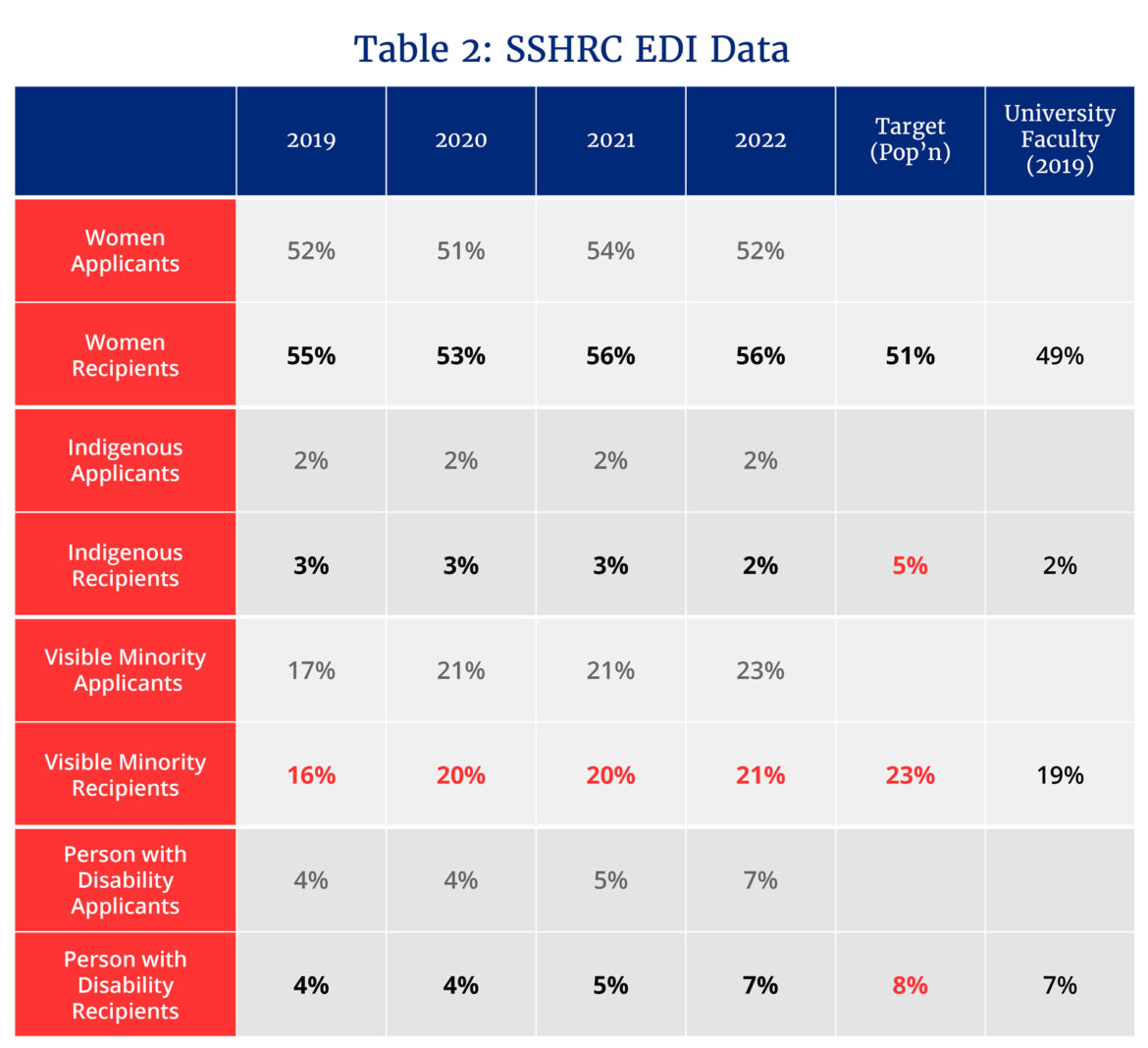
Table 2 provides these numbers alongside SSHRC’s equity targets for 2024/2025 and the groups’ proportion of Canadian university faculty as of 2019. Numbers in red show “under-performance” in the applicant-recipient ratio and SSHRC’s own targets.

Graphic credit: Janice Nelson

Four things are notable. First, only one of SSHRC’s four target groups (visible minority applicants) has been underrepresented in terms of the applicant-recipient ratio. Second, while women are the only group who have exceeded SSHRC’s equity target, the percentage of recipients has been growing rapidly for visible minority applicants and persons with a disability. Third, no target group is underrepresented relative to its proportion of university faculty members, with women (56 percent of recipients) especially outperforming their faculty proportion (49 percent). Finally, Indigenous grant recipients (2 percent) are underrepresented relative to their proportion of the overall population (5 percent), but not relative to their proportion of university faculty members.

Damaging the pursuit of truth

The above analysis leads me to three broad conclusions. First, while the language of EDI has permeated SSHRC, the federal agency oscillates between the “soft” EDI of affirmative action and the “hard” EDI of critical social justice activism. Most of the time, SSHRC focuses on achieving “equity targets” and frames EDI as complementary to research excellence. However, SSHRC’s new EDI-themed grants explicitly adopt activist language, and it is little wonder that those awards have been dominated by activist projects.  

Second, when it comes to the “soft” EDI of affirmative action, SSHRC’s policies are clearly having their intended effect for all groups except Indigenous Peoples. The number of grants awarded to women, visible minority applicants, and persons with a disability is rising. Grants are being awarded to members of these three groups at a proportion equal to or greater than their share of university faculty, and in the case of women, well above their share of the overall population. At this rate, it will soon be inaccurate for SSHRC to refer to “underrepresented groups” when it comes to prestigious national grants.

Finally, the “hard” EDI of critical social justice activism poses the biggest threat to SSHRC’s commitment to research excellence. While there are important critiques of the effects of “soft” EDI of affirmative action, it does not necessarily pose the same existential threat to research excellence. But the “hard” EDI of critical social justice activism is utterly incompatible with the objective pursuit of truth. One need only skim the titles of grants awarded under SSHRC’s two new EDI-focused initiatives to see how far they have strayed from the objective, empirical knowledge creation that we expect our national granting agencies to fund. Ironically, the more an award is pitched in terms of “diversity,” the less intellectually diverse the recipients seem to be. Thankfully, such activist research remains primarily confined to the new (and for now temporary) EDI-focused grants. 

If the federal government wants universities to keep the public’s trust, it should avoid any future activist-themed grants and ensure that granting agencies eschew social justice priorities. Federal granting agencies using taxpayer dollars should be explicit that their primary commitment is to promote excellence via the creation and dissemination of objective, falsifiable research knowledge. The university is supposed to function as a system of knowledge production. Policies that openly tie research to activist political ends threaten to undermine that very system.

Source: Dave Snow: The federal government is spending millions on equity, diversity, and inclusion research

Daniel Kahneman, Who Plumbed the Psychology of Economics, Dies at 90

Great fan of his work, and was instrumental in my framing and writing Policy Arrogance or Innocent Bias:

…Much of Professor Kahneman’s work is grounded in the notion — which he did not originate but organized and advanced — that the mind operates in two modes: fast and intuitive (mental activities that we’re more or less born with, called System One), or slow and analytical, a more complex mode involving experience and requiring effort (System Two).

Others have personified these mental modes as Econs (rational, analytical people) and Humans (emotional, impulsive and prone to exhibit unconscious mental biases and an unwise reliance on dubious rules of thumb). Professor Kahneman and Professor Tversky used the word “heuristics” to describe these rules of thumb. One is the “halo effect,” where in observing a positive attribute of another person one perceives other strengths that aren’t really there.

“Before Kahneman and Tversky, people who thought about social problems and human behavior tended to assume that we are mostly rational agents,” the Times columnist David Brooks wrote in 2011. “They assumed that people have control over the most important parts of their own thinking. They assumed that people are basically sensible utility-maximizers, and that when they depart from reason it’s because some passion like fear or love has distorted their judgment.”

But Professors Kahneman and Tversky, he went on, “yielded a different vision of human nature.”

As Mr. Brooks described it: “We are players in a game we don’t understand. Most of our own thinking is below awareness.” He added: “Our biases frequently cause us to want the wrong things. Our perceptions and memories are slippery, especially about our own mental states. Our free will is bounded. We have much less control over ourselves than we thought.”

The work of Professor Kahneman and Professor Tversky, he concluded, “will be remembered hundreds of years from now.”

Source: Daniel Kahneman, Who Plumbed the Psychology of Economics, Dies at 90