McCallum doesn’t want to let fraudsters ‘off the hook’ through moratorium on citizenship revocation

There is a distinction between fraud cases investigated by the RCMP and those investigated by IRCC. The Minister seems to be referring to only the latter. In general, if I recall correctly, the RCMP cases deal more with massive fraud (e.g., consultants submitted multiple fraudulent applications) whereas IRCC deal more with individual cases.

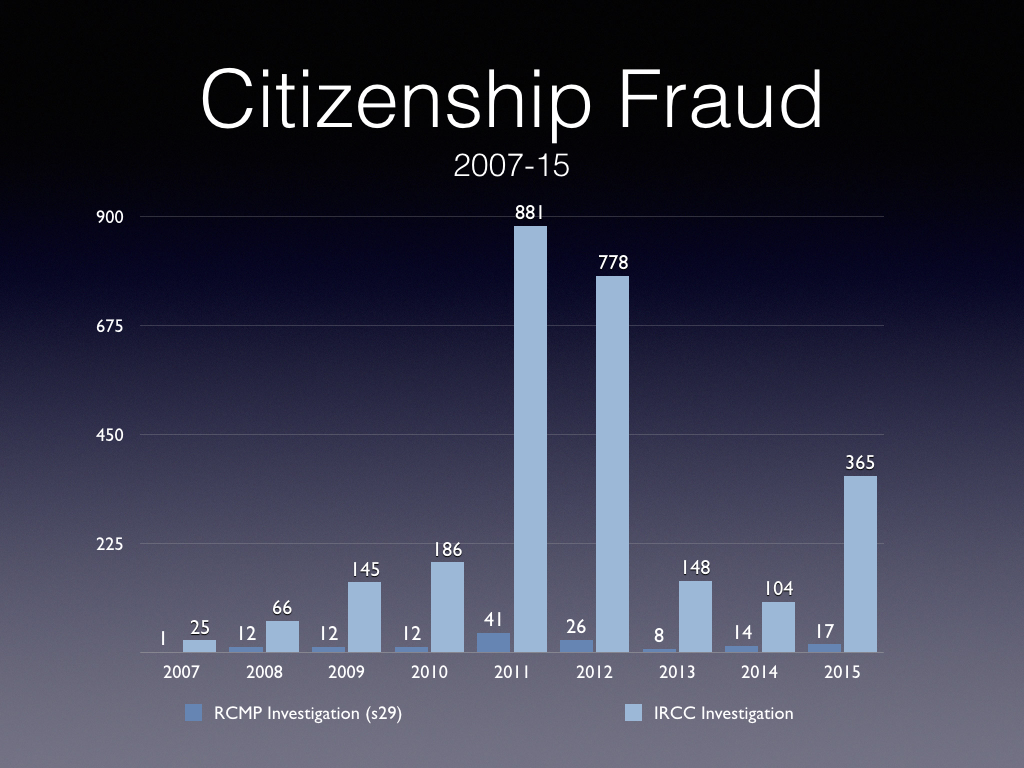
IRCC data shows the vast majority of fraud cases are a result of IRCC internal investigations, not RCMP, as the chart below indicates:

citizenship-data-slides-2015-026

The federal government is trying to revoke the citizenship of fraudsters, and that’s why it won’t agree to a moratorium on citizenship revocation, says Immigration Minister John McCallum.

“We have large numbers of a criminal element unveiled by the RCMP, and reported on by the auditor general. It was actually under the previous government that [investigations began that] we are now dealing with…and those people have really, truly abused our citizenship. So it would not be right to have a moratorium, and let them off the hook,” he said in a phone interview Thursday.

…. He [immigration lawyer Lorne Waldman] is part of a group bringing a constitutional challenge against a law brought in by the previous Conservative government, known as it was as C-24, that means a person who’s received notice of citizenship revocation doesn’t have a right to an appeal or court hearing.

 Mr. Waldman and another lawyer said they’re representing clients in similar circumstances to Ms. Monsef where their citizenship is in jeopardy because another family member is accused of misrepresentation.

Mr. McCallum (Markham-Thornhill, Ont.) acknowledged that the lack of an appeals mechanism needs to be fixed, but wouldn’t go as far as to instruct his department to stop revoking citizenships until one is set up, preferring instead to allow it to be developed through a change to a citizenship bill, C-6, currently at second reading in the Senate.

The bill aims to reverse parts of the Conservative legislation, C-24, that allowed the government to pull citizenship from dual nationals convicted of terrorism, expanded the age range of immigrants subject to language testing, and more.

Mr. McCallum told the Senate during an appearance Oct. 4 for Question Period that he would welcome a Senate amendment to C-6 to put in place an appeals process for new Canadians who had their citizenship revoked for providing false information on their citizenship application.

However, he wavered on whether he would pause revocations while C-6 went through Parliament when asked by Senate Liberal Art Eggleton, saying “no,” then saying he would “consider” it. The federal Justice Department confirmed the government would not impose such a moratorium in a letter to the Federal Court last week, the Canadian Press reported.

The government has increased the rate of citizenship revocations for fraud since the Liberals took power. That includes 104 revocations in the first eight months of this year, compared with 132 in all of last year and just 30 in the previous two years combined, the CBC reported.

‘Never entitled’ to citizenship

Mr. McCallum said the government is not trying to revoke the citizenship of the alleged fraudsters before an amended C-6 could bring in an appeals mechanism.

“Those two are not linked,” he said.

“As a result of that RCMP investigation, they are pursuing cases, which we fully support. It takes a while to pursue those cases, and some of them are just coming to the revocation point now. It wasn’t an effort for any particular reason, except that they were ready. And we are definitely supporting efforts to go after the criminal element and remove citizenship where it was clearly done for fraudulent or criminal reasons,” he said.

In a written statement provided to The Hill Times, Mr. McCallum’s office said “the recent increase in citizenship revocations is the result of large-scale fraud investigations led by our RCMP and [Canada Border Services Agency] partners that began under the former Conservative government.

“These investigations led to criminal convictions of several immigration consultants, and notices of intent to revoke citizenship were sent to their clients who had provided fraudulent documents to suggest they were living in Canada when they were living abroad, in order to gain citizenship. Others changed their identity in order to hide criminal backgrounds.

Source: McCallum doesn’t want to let fraudsters ‘off the hook’ through moratorium on citizenship revocation – The Hill Times – The Hill Times

Turnbull rebukes Labor over citizenship questions, saying ‘get on Australia’s team’ | The Guardian

Never a good idea to make this kind of accusation, reflects poorly on the accuser:

Malcolm Turnbull has attempted to shut down questions from Labor about the validity of the government’s citizenship revocation laws by borrowing a locution from the Abbott era and advising the shadow attorney general Mark Dreyfus to “get on Australia’s team”.

In question time on Monday Labor referenced a media report saying a “notorious terrorist” was set to have their citizenship revoked in the first case to be taken under the government’s citizenship revocation laws.

The report suggested the government was anticipating the move would be tested in the high court.

Dreyfus asked the prime minister whether the case referenced in the Daily Telegraph report would proceed under the same legislation where the attorney general had “incorrectly represented advice from the solicitor-general?”

The solicitor general, Justin Gleeson – courtesy of a bitter public dispute with the attorney general, George Brandis – has said very clearly he did not sign off on the final citizenship bill passed by the parliament, an account which cuts across a suggestion made by Brandis at the time that Gleeson had advised the government its citizenship revocation package had a good prospect of clearing the high court.

“What the shadow attorney general is now doing is taking his feud with the attorney general into an area where he is putting our national security at risk,” Turnbull told parliament on Monday.

The prime minister said Dreyfus needed to “get over these petty personal animosities and get on our team, get on Australia’s team, to ensure that we have the right legislation”.

Source: Turnbull rebukes Labor over citizenship questions, saying ‘get on Australia’s team’ | Australia news | The Guardian

Australian extremist with dual nationality ‘will be stripped of his citizenship’ | Daily Mail Online

Australia’s first test case of its citizenship revocation law:

The government is preparing to prosecute an Islamic State terrorist with dual-nationality to strip them of their Australian citizenship in the first case tried under new security laws, officials claim.

It is understood the government will enforce a case against a well-known unnamed terrorist under amendments to the Citizenship Act, which was passed in December 2015, The Daily Telegraph reported.

The Citizenship Loss Board was created soon after to identify jihadis with Australian citizenship and that of at least one other country. It is understood there are more than 50 people who fit the profile.

The government is reportedly keen to pursue a test case of the controversial law.

Australian Federal Police and ASIO are believed to have recently raised concerns about the burden of proof needed under the new laws.

Officials must show the suspected terrorist is also a citizen of a new country, not that they are simply entitled to dual-citizenship – which could be difficult to prove, The Daily Telegraph reported.

A new parliamentary report published in September backed the government’s controversial plan to strip citizenship from convicted terrorists of dual nationality.

Abdul Nacer Benbrika, Mohamed Ali Elomar and Mostafa Mahamed Farag are believed to be part of an initial group of six people the government plans to boot from the country once the law is passed, the newspaper claims.

Elomar was part of a group found guilty in 2009 of planning an attack in Sydney, after he was arrested in 2005. He was sentenced to 28 years in prison in 2010, and is also the uncle of killed ISIS fighter Mohamed Elomar.

Farag, also known as Abu Sulayman, is believed to be one of the most senior Australian terrorists fighting in the Middle East. Before leaving the country, he preached at a centre in the western Sydney suburb of Bankstown.

 The Australian government has been increasingly concerned about the flow of fighters to Iraq and Syria to join extremist groups such as Islamic State, with some 110 Australians reportedly fighting in the region as of last year. As many as 45 have died in the conflict.

The Attorney-General George Brandis said at the time the law passed that they will not render individuals stateless, but will apply in ‘very limited circumstances’.

They cover people who engage in terrorist acts, including training, recruitment and finance, and are convicted of a terrorist offence and sentenced to at least six years in jail.

Those who fight for a declared terrorist group also automatically lose their citizenship.

‘Dual nationals who engage in terrorism are betraying their allegiance to this country and do not deserve to be Australian citizens,’ Mr Brandis said.

Source: Australian extremist with dual nationality ‘will be stripped of his citizenship’ | Daily Mail Online

Farzana Hassan: It’s unjust to revoke the citizenship of refugees’ children

Good piece by Farzana Hassan on the streamlined revocation process, without right to a hearing or equivalent procedural protections. Welcome contrast to much of the other commentary in the Sun:

Monsef’s mother filed an application stating her children were born in Afghanistan, but it turns out the MP was born just across the border in Iran, during her mother’s several crossings to avoid persecution and harassment from the Taliban.

Did her mother lie about this? No one can be sure. Language could have been a barrier, or she may have been too distraught. After all, they were faced with the constant threat of harassment, even death.

It was the Harper government that revised the legislation to allow citizenship revocation without a hearing, but it is the Trudeau government that has been enforcing it quite aggressively, stripping people of Canadian citizenship at the rate of approximately thirteen individuals per month.

Such policing seems a little ironic considering Trudeau’s soft approach to revoking the citizenship of terrorists, people who should have professed binding loyalty to the people and soil of Canada. But they lied about their intention. The very basis of their entry into Canada was a false premise.

By contrast, should we be tolerant of the offspring of parents who may have committed errors on their application for a host of forgivable reasons? It may even be naive to expect poor and illiterate refugee status applicants trying to escape Taliban brutality to even understand the concept of citizenship. The law should show some flexibility towards such migrants, and more towards their hapless children.

Some migrants falsely filing their own application deserve to have their citizenship revoked. But by no means should their children be made to suffer.

Trudeau is silent on this controversy over a government insider. And Monsef too is hardly forthright enough. But the law is still unjust when it affects the children of refugees.

In order to rectify any past injustices and to bring some fairness to the debate, we are required to ask if mistakes of the past will be rectified. That is, once the MP’s case has brought the absurdity of the law into the limelight, will people already stripped of their citizenship and deported be allowed to have their citizenship status restored?

To quote Josh Peterson, executive director of the British Columbia Civil Liberties Association, “When we get a parking ticket, we have a right to a court hearing…and yet for citizens to lose their entitlement to membership in Canada based on allegations of something they may or may not have said 20 years ago, they have no hearing? It just doesn’t make any sense.”

Paterson is part of a group that launched a constitutional challenge to the law. Trudeau’s response to the Maryam Monsef case should have a huge bearing on this challenge. Let us hope a touch of humanity will soften this tough legislation.

Source: Farzana Hassan: It’s unjust to revoke the citizenship of refugees’ children | Ha

Trudeau government revoking citizenship at much higher rate than Conservatives

The lack of procedural protections for citizenship revocation in cases of fraud or misrepresentation, flagged as a concern in both hearings on the Harper government’s C-24 and the Trudeau government’s C-6, continues to draw attention, given both the increased number of revocations and the Monsef case (although I would argue misrepresentation of her birthplace by her mother is not material in the way that misrepresenting residency).

And while the Trudeau government continued use of this power is questionable, the higher rate reflects in part the increased number of investigations following implementation of this provision in C-24 on 28 May 2015.

IRCC data shows 24 investigations initiated before this provision came into force, and 324 in the seven months after. The number of cases in the pipeline increased, and thus normal that more revocations would result, as the government applies the law:

The Trudeau government used powers granted by the Harper government’s controversial citizenship law to make 184 revocation decisions without legal hearings between November 2015 and the end of August. About 90 per cent of the decisions resulted in a negative finding and the loss of a person’s citizenship.

The numbers show that the Trudeau government has used the law far more aggressively than the Harper government itself.

But in a Federal Court filing late Friday, the government said it would not grant a moratorium on revocation cases, and added that claims by some that the system was revoking large numbers of citizenship are speculative.

Liberal Leader Justin Trudeau made the sanctity of citizenship an issue in last year’s federal election.

“A Canadian is a Canadian is a Canadian,” Trudeau said in a leaders’ debate three weeks before storming to victory.

He used it to dress down Stephen Harper for passing Bill C-24, a law that aimed to strip dual citizens of their Canadian passports if they were convicted of crimes of terrorism, treason or espionage against Canada, or took up arms against Canada.

Immigrant communities rallied to the Liberal Party, concerned that Canadians born overseas would be reduced by C-24 to an insecure second-class status.

Once elected, one of the Liberals’ first acts was to repeal the parts of C-24 that applied to those convicted of terrorism-related crimes, ensuring that they can keep their Canadian passports.

But the Trudeau government left intact other parts of the law that allow the government to strip citizenship from other holders of Canadian passports for misrepresentation.

The 184 revocation decisions of the first 10 months of the Trudeau government nearly match the total number of decisions over a 27-year period between 1988 and the last month of the Harper government in October 2015.

Revocations increase as Trudeau takes office

Although the powers being used come from a law passed by Stephen Harper’s Conservatives, the law has been used much more aggressively under Trudeau.

In the first full month of the law’s operation, June 2015, only three revocation decisions were made. None were made in July or August, two in September and two more in October.

The Trudeau cabinet was sworn in on Nov. 4, 2015. That month saw 21 revocation decisions. The following month there were 59. The year 2016 averaged 13 decisions a month up to Aug. 31, the latest data CBC News has been able to obtain.

The monthly average under the Harper government from 2013 to 2015 was only 2.4 cases a month, some under the auspices of C-24 and some under rules that existed previously.

Citizenship revocation decisions by year (in persons)

2013 2014 2015 2016 (8 months)
January 13
February 4 7 25
March 17 7
April 5 14
May 5 16 18
June 4 1 3 7
July 10
August 10
September 4 2
October 1 2
November 4 21
December 7 59
Total 15 15 132 104

Source: Immigration, Refugees and Citizenship Canada

Liberals accused of hypocrisy

In recent days, following revelations that the birthplace of one of its own cabinet ministers was misrepresented on her passport documents, the government has said it is open to reforming the system.

But in the preceding months, it had used the revocation measures at an unprecedented rate.

“The Liberals criticized these provisions when they were in opposition,” says Laura Track of the B.C. Civil Liberties Association. “They said they were going to fix it. And yet they have been using it even more than the Conservatives did.”

The government says the revocation decisions are being taken to protect the integrity of the citizenship system and are aimed at cases of fraud.

Nancy Caron of Immigration, Refugees and Citizenship Canada said “many cases that are being processed for revocation are as a result of large-scale investigations into possible residence fraud.”

The department carried out those investigations with Canada Border Services Agency and the RCMP. Investigations led by those agencies have resulted in the conviction of immigration consultants who helped individuals obtain citizenship illegally.

“The revocation process is then undertaken to determine whether the individuals associated with these investigations, fraudulently obtained their Canadian citizenship through having intentionally misled the government of Canada about key aspects of their citizenship application such as concealing past criminal activities or submitting false documents to demonstrate residence in Canada when in fact they were not living in Canada‎. Many of the decisions to revoke citizenship that have been made since May 2015 directly result from those investigations,” Caron said in an email to CBC News.

Source: Trudeau government revoking citizenship at much higher rate than Conservatives – Politics – CBC News

Ottawa softens stand on stripping citizenship over false papers

More on revocation for fraud and misrepresentation, and the Minister’s openness to suspend revocation pending changes to the Citizenship Act that restore some measure of greater procedural protections to those accused of fraud:

Immigration Minister John McCallum says he is open to granting a moratorium on the revocation of citizenship from Canadians who misrepresented themselves in their applications, an issue that has been thrust into the spotlight by the circumstances of cabinet minister Maryam Monsef’s citizenship.

Mr. McCallum’s comments come a week after the British Columbia Civil Liberties Association and the Canadian Association of Refugee Lawyers filed a legal action with the Federal Court asking the government to put a stop to all revocations until it could fix a law that allows citizenship to be stripped without a hearing.“I will consider that moratorium. I won’t rule it out unconditionally,” Mr. McCallum told Senate Question Period on Tuesday. “What I am saying is that we would welcome a reform to the system.”

The Federal Court application made headlines when lawyers on the case said that Ms. Monsef, Democratic Institutions Minister, could have her citizenship revoked under the current law for having an incorrect birthplace listed on her citizenship papers. Ms. Monsef said she only learned that she was born in Iran, not Afghanistan as she had believed, after an inquiry from The Globe and Mail last month. She said her mother never told her and her sisters they were born in Iran because she did not think it mattered.

While Ottawa is considering the moratorium on revocations, the government says it is committed to eventually reinstating the right to a hearing for Canadians who face losing their citizenship because they misrepresented themselves in their citizenship and permanent residency applications.

Independent Senator Ratna Omidvar said she is going to propose an amendment to the government’s citizenship Bill C-6 to reverse the Conservative law that took away the long-standing right.

“I am hopeful that they will allow this amendment to be tabled,” Ms. Omidvar said. “Everybody’s hoping they’re able to do it in this bill at the Senate. But if not, I’ve been told that it will be fixed through legislation.”

MPs tried to table the amendment to Bill C-6 at the House immigration committee earlier this year, but was it declared to be out of scope by the committee chair. Ms. Omidvar noted that the Senate procedure rules are different, so the amendment still has a chance in the Red Chamber.

Source: http://www.theglobeandmail.com/news/politics/ottawa-softens-stand-on-stripping-citizenship-over-false-papers/article32254296/

Trudeau may change law to protect Monsef | Malcolm

Malcolm conveniently ignores that Minister McCallum during the spring committee hearings on C-6 committed to reviewing the revocation process in light of testimony regarding the lack of procedural protections in C-24 for those accused of fraud or misrepresentation: “less protection than for parking tickets.”

So while the Monsef case may have accelerated this review, it was already underway.

And calling C-6 “comprehensive changes” is incorrect. C-24, the 2014  changes of the Conservative government, were comprehensive; C-6 is a relatively surgical set of changes, significant to be sure, but limited in scope:

The Trudeau Liberals have spun themselves into a corner when it comes to Maryam Monsef.

It now looks as if Prime Minister Justin Trudeau is willing to change Canada’s citizenship and immigration laws to protect one of his own.

Monsef says her mother recently told her she was born in Iran, not Afghanistan, as she had previously been told.

If her immigration application, when she was a child, included false information about her birthplace, then it is possible her immigration application was fraudulent.

The penalty for providing false representation to immigration officials is steep.

In similar cases where a parent provided untrue information on behalf of a child, it has led to the stripping of citizenship and even deportation from Canada.

As I pointed out in my last column, the Trudeau government recently stripped citizenship from an Egyptian national who became a Canadian citizen at age eight.

In that case, the woman’s parents lied on her application, and therefore, as per Canadian law, she risks being deported.

But when it comes to their own star cabinet minister, Monsef, the Trudeau Liberals are scrambling to deal with the controversy.

On Tuesday, Immigration Minister John McCallum testified in front of a Senate committee discussing Bill C-6, the Trudeau government’s controversial citizenship bill.

Under pressure from Liberals in the Senate, McCallum suggested that his government would consider placing a moratorium on the practice of citizenship revocation.

How convenient.

“I will consider that moratorium. I won’t rule it out unconditionally,” McCallum told the Senate committee. “What I am saying is that we would welcome a reform to the system.”

The Trudeau government had no problem imposing this law during its first eleven months in office. None at all.

During the last session of Parliament, Trudeau and McCallum introduced comprehensive changes to Canada’s citizenship and immigration laws through Bill C-6.

On the issue of citizenship revocation, Bill C-6 halted the government’s ability to strip citizenship from convicted terrorists and those who commit treason against Canada.

As Trudeau said famously during the last election campaign, after all, “a Canadian is a Canadian is a Canadian.” Even if that Canadian is a foreign-born terrorist.

But when it came to cases of fraud and misrepresentation, no changes were made under Bill C-6.

Quite the opposite, in fact, as Trudeau said he supported citizenship revocation under these circumstances.

On the campaign trail last September, Trudeau less-famously said that, “revocation of citizenship can and should happen in situations of becoming a Canadian citizen under false pretences.”

At the time, this statement contradicted Trudeau’s own position that Canadian citizenship is an absolute and inalienable right.

Now, that contradiction is catching up on him.

Until the Monsef scandal surfaced, the Trudeau government had no problem in stripping citizenship away from those who committed fraud and those who lied on their applications.

They had no issue with the process of revocation — determined by the relevant cabinet minister and not through lengthy court proceedings.

They agreed with the law, and implemented it routinely.

But suddenly, this law threatens to damage the Trudeau government’s reputation and punish a Liberal insider.

And all of the sudden, they’re willing to change course.

The Trudeau government is now suggesting it would rather change Canada’s longstanding immigration law, ad hoc, than face the inconvenient fact that, based on the story she’s provided, Monsef’s immigration application may have been fraudulent.

Source: Trudeau may change law to protect Monsef | Malcolm | Columnists | Opinion | Toro

Senate could get rid of law threatening to strip Maryam Monsef’s citizenship

Needed: the removal of the previous procedural protections for citizenship fraud and misrepresentation without any effective replacement was over-reach:

The Senate could come to the rescue of Canadians who are being stripped of their citizenship without a hearing.

Independent Sen. Ratna Omidvar, who is sponsoring another citizenship-related bill in the upper house, says she’s hopeful the Senate will amend the bill to do away with a law that allows the government to revoke the citizenship of anyone deemed to have misrepresented themselves.

It’s a law that could potentially ensnare Democratic Institutions Minister Maryam Monsef, who revealed last week that she was born in Iran, not Afghanistan as she’d always believed.

The law, part of a citizenship bill passed by the previous Conservative government, was denounced by the Liberals when they were in opposition but lawyers say they’ve been aggressively enforcing it since forming government.

The British Columbia Civil Liberties Association and the Canadian Association of Refugee Lawyers on Monday launched a constitutional challenge of the law, which they argue violates the Charter of Rights and Freedoms.

The Liberal government chose not to deal with the issue in Bill C-6, which repeals other aspects of the Conservatives’ citizenship regime, including a provision empowering the government to revoke the citizenship of dual nationals who are convicted of high treason or terrorism.

During study of C-6 at a House of Commons committee, the NDP attempted to amend the bill to repeal the power to revoke citizenship without a hearing. But that was ruled by the committee chair to be outside the scope of the bill.

Omidvar, who moved the second reading of C-6 on Tuesday in the upper chamber, said Senate procedural rules are different and she’s hopeful the upper house will be able to do what the Commons could not.

“I would like to see this question addressed,” said Omidvar, a longtime advocate for immigrant and refugee rights.

“I think it’s a very important question because, as BCCLA has pointed out, even if you get a traffic ticket, you get a hearing or an appeal and here your citizenship is being revoked and you have no avenue for a hearing and appeal.”

Omidvar said she’s spoken about the matter with Immigration Minister John McCallum and “he’s open to an amendment” from the Senate.

“He understands that this was an oversight.”

Source: Senate could get rid of law threatening to strip Maryam Monsef’s citizenship | Toronto Star

Maryam Monsef case highlights ‘absurdity’ of Canadian law, refugee lawyers say

The Minister did commit during parliamentary committee hearings last spring to address the lack of due process for citizenship revocation in cases of fraud or misrepresentation. This court challenge likely reflects frustration that no action has been taken to date:

Maryam Monsef could be stripped of her citizenship without a hearing under a law the Liberals denounced while in opposition but which they’ve been enforcing aggressively since taking power, civil liberties and refugee lawyers say.

The democratic institutions minister revealed last week that she was born in Iran, not Afghanistan as she’d long believed. She said her mother, who fled Afghanistan with her daughters when Monsef was 11, didn’t think it mattered where the minister was born since she was still legally considered an Afghan citizen.

Monsef has said she will have to correct her birthplace information on her passport.

If Monsef’s birthplace was misrepresented on her citizenship application as well, that would be grounds for revocation of citizenship, regardless of whether it was an innocent mistake or the fault of her mother, said immigration lawyer Lorne Waldman.

Misrepresentation could lead to deportation

And if the misrepresentation was on her permanent residence and refugee applications, she could even be deported, said Waldman, part of a group that launched a constitutional challenge of the law Monday.

The Canadian Association of Refugee Lawyers and the British Columbia Civil Liberties Association argue that the law, known as Bill C-24, is procedurally unfair and a violation of the Charter of Rights and Freedoms.

Josh Paterson, the BCCLA’s executive director, said Monsef’s case demonstrates the absurdity of the law, which was passed by the previous Conservative government.

“The minister’s situation … is exactly the kind of situation that many other Canadians are facing right now because of this unjust process,” Paterson told a news conference.

“When we get a parking ticket, we have a right to a court hearing … You leave your garbage in the wrong place and you get a ticket, you have the right to a hearing and yet for citizens to lose their entitlement to membership in Canada based on allegations of something they may or may not have said 20 years ago, they have no hearing? It just doesn’t make any sense.”

Law to be enforced

When he was in opposition, John McCallum denounced the law as “dictatorial” and since becoming immigration minister, he’s promised to amend it to create an appeal process, Paterson said.

Nevertheless, repeated requests that the government stop enforcing the law until it can be changed have been ignored. As recently as two weeks ago, Paterson said Justice Department lawyers informed his group that the law would continue to be enforced.

Source: Maryam Monsef case highlights ‘absurdity’ of Canadian law, refugee lawyers say – Politics – CBC News

Germany mulls stripping citizenship in terror crackdown – France 24

To watch:

Germany’s interior minister has proposed tough new security measures including deporting foreigners and revoking citizenship after two attacks claimed by the Islamic state group.

At a press conference on Thursday Interior Minister Thomas de Maizière outlined plans to beef up federal security forces, make the promotion of terrorism a crime and strip German citizenship from dual nationals who fight for foreign militias.

After terrorist attacks on German soil this year, two of them by migrants, the minister has been under intense pressure from both the political right, who want fewer Muslim migrants, and the left, who’ve been calling for a stronger police presence.

“A lot of people … are worried about further attacks. That is understandable,” De Maizière told reporters. “No one can guarantee absolute security, but we must do what is possible.”

‘Politically reasonable’

Revoking German citizenship would go some way towards dealing with the estimated 820 Germans fighting in Syria and Iraq who may pose a threat on their return to Germany.

It’s nonetheless considered a controversial proposal with Green lawmaker Volker Beck among those condemning it as “desperate activism”.

Social Democrats (SPD) chief Sigmar Gabriel said his party — the government’s junior coalition partner — are not open to just “any populist quick fix”, but that they are “ready for discussions on anything that can contribute to reinforcing security”.

And the security package has yet to be approved by the country’s right-left coalition and German parliament.

Deportations

Beyond the issue of homegrown terrorism, the minister is proposing to make it easier to deport terror suspects and detain foreigners who have committed crimes or are a public security risk.

A tightening of German and European Union weapons laws is also on the cards.

De Maizière said he was limiting himself to policies that could be implemented quickly, and that he considered “politically reasonable”.

Source: Germany mulls stripping citizenship in terror crackdown – France 24