Australia: Matt Canavan quits cabinet over Italian dual citizenship | The Guardian

Yet another dual citizen discovered in Australia. Like the other cases, the member in question wasn’t aware of his other nationality.

It is another example of the problem with C-24’s revocation provision for dual nationals convicted of terrorism (repealed under C-6), as it would have also applied to those with no knowledge of their dual citizenship or their potential to acquire:

The resources minister Matt Canavan has quit the cabinet because he is is a dual citizen of Italy.

Canavan’s resignation on Tuesday night follows the recent resignation of two Greens senators, Larissa Waters and Scott Ludlam, because of dual citizenships – a controversy that has triggered questions about the eligibility of many other Australian parliamentarians.

Canavan told reporters on Tuesday night his mother had applied for Italian citizenship on his behalf without his knowledge or consent when he was 25 years old, in January 2007.

He said he had “no suspicion” he was in possession of a dual citizenship until last week, when his mother “raised the possibility”. The Italian embassy subsequently confirmed he was a citizen of the country.

“I was not born in Italy, I have never been to Italy and to my knoweldge I have never set foot inside the Italian consulate or embassy,” Canavan said.

“I knew my mother had become an Australian citizen, but I had no knowledge that I myself had become an Italian citizen, nor did I request to become an Italian citizen”.

The attorney general, George Brandis, said preliminary legal advice to the commonwealth suggested there had been no breach of section 44 of the constitution in Canavan’s case.

Brandis told reporters given Canavan had no knowledge about his status as a dual citizen, and the “legal uncertainty” surrounding the issue, the government would refer the issue to the high court for deliberation.

Australia’s constitution bars dual citizens from eligibility for elected office, unless they can show they have taken reasonable steps to sever foreign ties.

Canavan said he was seeking advice about whether the registration of his Italian citizenship by his mother was valid under Italian law.

He said on the basis of the government’s legal advice, he would not quit politics or the parliament before the high court’s deliberations.

Source: Matt Canavan quits cabinet over Italian dual citizenship | Australia news | The Guardian
Australian senator who denied knowing about Canadian citizenship makes suspicious, Canadian-like apology – The Beaverton

A funny, satirical take – sorry for sharing:

An Australian senator who announced her resignation after discovering her dual-citizenship has made a very suspicious, Canadian-sounding apology.

Green MP claimed that she was unaware that she was still a Canadian citizen, but issued two apologies in one statement along with some very nice compliments about the constituents she has served.

“I am deeply sorry for the impact that it will have,” said the Winnipeg-born Waters which raised many eyebrows among members of the press. “I apologise wholeheartedly to all those who have supported me and helped me to become a representative for the wonderful people of Queensland over the last six years.”

The politician known around the world for being the first woman to breastfeed in Australia’s Parliament has simultaneously renounced and reaffirmed her Canadian roots with the statement.

“If she actually didn’t know she was Canadian and didn’t intend to deceive anyone and violate section 44 of the constitution, she wouldn’t need to apologize,” explained Australian Broadcasting Corporation’s political analyst Louise Yaxley. “And saying you’re sorry for little or no reason is a very Canadian thing to do.”

In addition to her apologies, Waters continued to deny that she had any knowledge about her foreign identity despite being a strong supporter public health care, 52-week paternity leave, and asserting a smug superiority when compared to Americans.

At press time, Waters had already apologized for apologizing too much.

Source: Australian senator who denied knowing about Canadian citizenship makes suspicious, Canadian-like apology – The Beaverton

Dutch nationals taking UK citizenship ‘will lose Netherlands passports’| The Guardian

Will be interesting to see how this issue continues to play out during Brexit negotiations and in domestic political debates. EU divorce is messy.

Dual nationality generally reflects a more pragmatic view of citizenship, recognizing the mobility and economic benefits, but risks maintaining substantive connections:

Dutch nationals who take British citizenship to avoid having to leave the UK after Brexit will be stripped of their Netherlands passports due to existing limits on dual nationality, the Dutch prime minister has said.

About 100,000 Dutch nationals living in Britain face an uncertain future after March 2019. The UK and EU are yet to reconcile their differences on the citizens’ rights issue, with Brussels describing the British government’s initial offer as vague and inadequate.

Mark Rutte told Dutch citizens in the UK who have considered becoming British to avoid residency problems once Britain leaves the EU that applying for dual nationality was not an option.

“Countering dual nationality remains one of this cabinet’s policies,” the prime minister said on Monday, in response to a petition with 22,000 signatures calling for a government rethink.

“This is because having a nationality is always associated with an actual link to a certain country. If at some point there is a question of a connection to the Netherlands or if the link to another country has become stronger than that with the Netherlands, Dutch nationality will end.”

Rutte made his intervention after the launch of an information campaign to advise citizens that they would be required to renounce their original nationality should they seek to become British.

The Dutch government has told its citizens that if they “have more than one nationality, it is not always clear what your rights are”.

The Dutch security and justice ministry website says: “For instance, your country of origin may require you to do compulsory military service. The Dutch government wants to limit dual nationality as much as possible.

“If you have only one nationality, it will be clear what your rights are. That is why people who want to acquire Dutch nationality through naturalisation are, as a rule, required to give up their other nationality if possible. This is called the renunciation requirement.”

Negotiating teams led by the Brexit secretary, David Davis, and the EU’s chief Brexit negotiator, Michel Barnier, are meeting in Brussels this week to try to come to an agreement on the rights of citizens, along with issues relating to the UK’s divorce bill and the Irish border.

Source: Dutch nationals taking UK citizenship ‘will lose Netherlands passports’ | World news | The Guardian

Australian senator steps down because of dual Canadian citizenship

While a rule against dual citizenship for elected officials can be justified, this case highlights the absurdity of its formal application given that she left Canada when she was less than a year old and was caught by a Canadian rule change.

She does, of course, have the option of renouncing her Canadian citizenship but the process takes some time (don’t know how long but, if the example of Texas senator Ted Cruz is any indication, more than a few months).

Surprising, however, that she did not indicate her intent to renounce:

An Australian senator has been forced to step down because she is a dual citizen of Australia and Canada.

The Australian constitution disqualifies potential candidates from seeking election if they hold dual or plural citizenship.

Larissa Waters, who was also the deputy leader of the Green party, told a news conference Monday that was only found out about her status on Monday with “great shock and sadness.”

Waters was born to Australian parents in 1977 while they were studying and working in Winnipeg.

She left Canada as an 11-month-old baby and said she always believed she was just Australian.

Water said she also didn’t know she had to renounce the Canadian citizenship that was bestowed upon her at birth.

“I had not renounced since I was unaware that I was a dual citizen. Obviously this is something that I should have sought advice on when I first nominated for the Senate in 2007,” said Waters in a statement.

“I take full responsibility for this grave mistake and oversight. I am deeply sorry for the impact that it will have.”

Waters said she only discovered her status on Monday after seeking legal advice in the wake of fellow Green party member Scott Ludlam having to step down because he holds dual citizenship with New Zealand.

Waters said she was “devastated” to learn she was a Canadian citizen and has resigned from office “with a heavy heart.”

“I have lived my life thinking that as a baby I was naturalized to be Australian and only Australian, and my parents told me that I had until age 21 to actively seek Canadian citizenship,” said Waters.

“At 21, I chose not to seek dual citizenship, and I have never even visited Canada since leaving at 11 months old.”

Waters made international headlines earlier this year when she became the first woman to breastfeed her daughter, Alia, on the floor of the Australian Parliament.

Australian media reports say Waters was seen by some as a future leader of the Green party.

Source: Australian senator steps down because of dual Canadian citizenship – The Globe and Mail

Australian senator quits over New Zealand dual citizenship – BBC News

May explain in part relatively low levels of diversity among Australian politicians although I suspect other factors more important:

An Australian senator has resigned after realising he holds dual citizenship, meaning his nine-year parliamentary career most likely breached the nation’s constitution.

Scott Ludlam, from the minor Greens party, said he only learned of his New Zealand citizenship last week.

Under Australia’s constitution, a person cannot run for federal office if they hold dual or plural citizenship.

Mr Ludlam had been told his eligibility would be challenged in court.

The senator, who was also Greens co-deputy leader, apologised for what he called an “avoidable oversight”.

Source: Australian senator quits over New Zealand dual citizenship – BBC News

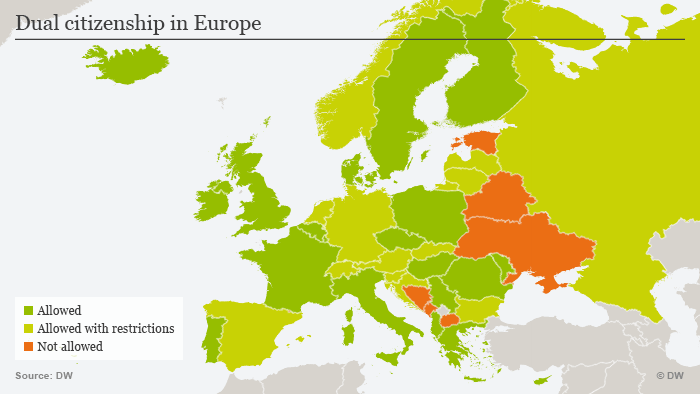
Dual citizenship in Europe: Which rules apply where?

Ongoing German dual citizenship debate, likely prompted by concerns of Turkish campaigning under Erdogan’s authoritarianism, along with a summary of the policies of other EU countries:

Chancellor Angela Merkel’s conservative Christian Democrat Union (CDU) aims to tighten citizenship laws. At the CDU conference last December, party officials launched a debate on possible restrictions on dual citizenship. The subject of the dispute is what is known as the “obligation option,” which means that children of immigrants obtain both nationalities at birth, but must choose one when they reach the age of 23. In 2014, the coalition government agreed that children born and raised in Germany would be allowed to keep both nationalities as adults.

Infografik doppelte Staatsbürgerschaft Europa ENG

German news magazine “Der Spiegel” reports that the CDU plans to campaign against dual citizenship. “We must make far-reaching changes to the policy of the exceptions,” Cemile Giousouf, the chairman of the CDU’s integration network, told the magazine. A paper that will be integrated into the CDU’s election platform suggests that grandchildren of first-generation immigrants may only have German citizenship.

Merkel rejected the demands in December. According to “Spiegel” she is now ready to back a new regulation, probably as a consequence of Recep Tayyip Erdogan’s verbal attacks on German politics and the fact that many Turks living in Germany identify with the Turkish president.

Essen CDU-Bundesparteitag Rede Merkel (picture-alliance/dpa/K. Nietfeld)‘I don’t think we are having an election over dual citizenship,’ said Merkel in December.

France

Most EU states, including France, now allow dual citizenship. French nationals have had the right to dual or multiple nationalities since 1973. In 2009, France stood against the first article of the European Council’s “Convention on the Reduction of Cases of Multiple Nationality and on Military.” The aim of the agreement was to “to reduce as far as possible the number of cases of multiple nationalities, as between member states.”

In France, “jus soli,” meaning birthright citizenship, is practiced. Anyone who is born in France is granted French citizenship regardless of the parents’ nationality.

Sweden

For a long time, Sweden, like Germany, adhered to the “avoidance of dual citizenship” principle. A law adopted in 2001, however, allows Swedish nationals to apply for a different nationality without losing their Swedish passport, provided that the laws of the country permit this. In turn, immigrants in Sweden do not necessarily have to give up their foreign citizenship when they are naturalized.

The sociologist Thomas Faist sees Sweden as a potential role model for other countries. Two passports are seen “not as a problem, but rather as a contribution to integration,” Faist told the German media agency “Integration.” Other Scandinavian countries have similar regulations. In 2014 Denmark passed a law which allows dual citizenship. In Finland, a similar law had already gone into effect in 2003. In Norway, however, dual citizenship is permitted only in exceptional cases.

Schweden Integration von Migranten Schulunterricht (Getty Images/D. Ramos)Sweden has long been a country of immigration, but it has tightened its asylum law in recent years

Central and Eastern Europe

Under the nationality law in Poland, Polish citizens cannot be recognized as citizens of other countries at the same time. The possession of a foreign passport, however, is tolerated. Polish citizens cannot avoid civic obligations by using a foreign citizenship to get out of them.

Ukraine does not recognize dual citizenship. Under current laws, newly naturalized Ukrainian citizens must give up other nationalities within two years. Some countries in Eastern and Central Europe, on the other hand, such as the Czech Republic and Romania are open to multiple nationalities. Bulgarian, Serbian and Croatian citizens are entitled to hold dual citizenship, but foreigners wishing to be naturalized must renounce their previous nationality.

Spain

In principle, Spain permits dual citizenship for immigrants from Portugal, Andorra, the Philippines, Equatorial Guinea and Latin American countries with which it has concluded dual citizenship agreements. According to the Spanish constitution, immigrants from other nations must renounce their foreign nationality if they wish to hold Spanish citizenship. Spanish citizens are entitled to dual citizenship if they inform the authorities within three years that they wish to keep their Spanish passport.

Depending on the country, laws differ throughout southern Europe. Monaco and Andorra, for example, prohibit dual nationality but in Portugal, it is permitted.

Source: Dual citizenship in Europe: Which rules apply where? | Germany | DW.COM | 28.03.2017

Angela Merkel faces party row over calls to scrap dual citizenship for children of immigrants 

Tough balancing act in overall European political context:

Angela Merkel was plunged into a new row over immigration on Wednesday when delegates at her party conference voted to end dual citizenship for the children of immigrants.

The German chancellor quickly disowned the decision by her Christian Democratic Union party (CDU), as her coalition partners said they would block it from becoming government policy.

The dispute, a day after Mrs Merkel was re-elected party leader and given an 11-minute standing ovation, threatened to mar the start of her campaign to win a historic fourth term as chancellor.

“There will be no change in the law in this parliament,” she said after the vote, in a clear rebuke to delegates. “I do not believe we should campaign on dual citizenship in the elections as we did in the past.”

In her speech to the conference on Tuesday, Mrs Merkel made a clear play for the party base who had been alienated by her “open-door” refugee policy, vowing never to repeat it and calling for a burka ban.

But the row over dual citizenship was a sign she may struggle to contain the demand for an anti-immigrant line on the party’s emboldened Right wing.

Dual citizenship is an incendiary issue in Germany, where it was not allowed until recent years, and even now is only available to citizens of other EU countries and the children of immigrants.

By a narrow majority of just over 51 per cent, CDU delegates voted to scrap laws introduced in 2014 under which the children of immigrants born in Germany are allowed to retain dual citizens as adults.

Source: Angela Merkel faces party row over calls to scrap dual citizenship for children of immigrants 

Evolving Standards of Dual Citizenship: Peter Spiro – Lawfare

Good long review of Peter Spiro’s book on dual citizenship:

In At Home in Two Countries, Peter Spiro provides a detailed account of the largely untold history of dual citizenship in the United States. The story is complex: laws, policies, and practices surrounding dual nationality have evolved inconsistently across various nations and legal systems; even today, dual citizenship is pervasive inside and outside the United States but largely hidden from careful accounting. Spiro deftly covers more than 150 years of development to the present day, interlacing legal history with political acts, court decisions, and powerful vignettes of dual citizens whose fate was often tied to more foundational understandings of citizenship well beyond their control. These biographical sketches provide the human side of a common and vital practice bereft of authoritative statistics. They resonate with some of the most shameful constitutional moments in our history, from the poor treatment of longtime U.S. residents accused of Communist Party affiliations validated by the Supreme Court in Shaughnessy v. Mezei to the internment of Japanese Americans during World War II that was ordered by President Roosevelt, ratified by Congress, and endorsed by the U.S. Supreme Court in Korematsu.

While the notion of perpetual allegiance made sense for societies in which most citizens were bound to their land, Spiro describes that sovereigns began to loosen their jealous grip on their citizens when travel became more widespread.  Yet, even after feudal understandings dissipated, states still attempted to force a choice among homelands, either by finding that naturalization in a foreign state automatically resulted in the loss of citizenship, or by mandating a choice through a process known as “election.”  Meanwhile, the dueling theories of jus soli—that any child born within a state’s territory was a subject—and jus sanguinis—citizenship by parentage—resulted in conflicting outcomes during periods of mass immigration and international travel.

…Spiro documents how other countries gradually came to embrace dual citizenship, with Britain dropping restrictions on the practice in 1948, France in 1973, Canada in 1976, and Mexico in 1998. In the late 1990s and 2000s a number of other countries with extensive immigration ties to the United States followed suit, so that 19 out of the top 20 sending countries that are sources of U.S. immigration now either accept dual citizenship or do nothing to police it. Naturalization in a new country now adds to the count of dual citizens in the majority of cases (where expatriation had once been the norm). Spiro also mentions that a number of Americans, such as the foreign ministers of Armenia and Bosnia and the chief of the Estonian army, have even retained their U.S. citizenship while serving in foreign governmental posts. These developments reflect a newfound tolerance and acceptance of dual citizenship. Emigrating citizens once had to choose one country or another; today, no such ranking of preferences is required and citizens can maintain attachments to multiple countries at once.Not only are dual citizens spared from having to choose between one nationality and another, many individuals (including Spiro) pursue multiple passports for a host of educational and professional opportunities, immigration benefits, and additional advantages. In today’s global economy, people often seek out several passports for convenience or business purposes rather than out of fierce loyalty to a state. Indeed, several countries offer a range of immigration benefits, including citizenship, to those able to pay for it.  Even some athletes who failed to qualify for the Olympics in their native lands have acquired citizenship in a second country to compete under a different flag. This new conception of citizenship is undermining traditional state-based identities.

Spiro recognizes that dual citizenship still occupies a place of ambivalence in American law. But he argues that it should be embraced as serving both the national interest and the interests of dual citizens without significant social costs. Citizenship is an important part of identity, and dual citizens deserve opportunities to accentuate and cement their connections to their heritages and homelands, as worthy of protection as any other form of association or membership. Whether nationalizing through continual presence, blood ties, or marriage, Spiro argues that dual citizens enhance deliberative democracy while transmitting American ideals and concepts back to the states from which they emigrated. And sending states have begun to see emigrant communities as economic resources that provide benefits (especially financial ones) to their native homelands.  The result is that both sending states and receiving states have seen reason to liberalize their understanding and treatment of dual citizens. And while individuals cannot simply choose to acquire a second (or third, or fourth) citizenship without foundation, Spiro contends that those who obtain multiple nationalities should not be forced to choose among them.

As the availability of dual citizenship has evolved—providing key benefits to those fortunate enough to be in a position to claim them—the wealthy and connected have found ways of making use of dual citizenship that the poor cannot.  Spiro likens these benefits to a kind of “rich kid’s problem” that pales in comparison to those in poorer countries who would benefit enormously from a second citizenship in a wealthier one. In that sense, dual nationality tends to reflect the same inequities that separate haves from have-nots more generally. Taking these concerns seriously, Spiro wonders what can be done to address them, “given the improbability of states moving to suppress the status” on grounds of inequality.  Certainly, more stringent policing of dual citizenship is not the solution. From “a global perspective, what single citizenship you are born with has been among the best predictors of economic well-being.  Citizenship has long been an instrument of exclusion and a vehicle for inequality. In other words, dual citizenship isn’t the problem, citizenship is.”

While At Home in Two Countries is largely descriptive, covering more than 150 years of legal and historical development, it endorses dual citizenship as a net positive, reinforcing important associational values and critical bonds—emotional and otherwise—between citizens and their homelands. Spiro brings welcome wit and levity to these accounts, including his personal pursuit of a second, German citizenship for himself and his children to connect with their heritage and to experience the benefits of holding an EU passport. He concludes with an optimistic outlook on a world in which dual citizenship could rise to the level of a protected right that “shouldn’t have to be sacrificed at a false altar of exclusive national attachment.”

Of course, events occurring after the publication of the book—from the United Kingdom’s withdrawal from the European Union to the election of Donald Trump—could alter the next chapter of dual citizenship in unanticipated ways. While Brexit and Trumpism raise questions about the current appetite for globalization and cosmopolitanism, it is hard to fathom a retreat to the kind of tribalism that defined an earlier age given the long historical arc that has led us to tolerate, if not fully embrace, dual citizenship today. Overall, At Home in Two Countries is full of insights to those curious about the past, present and future of dual citizenship, and Spiro’s expert path through the jagged historical terrain and surrounding legal landscape makes a lasting contribution to the field.

Conflicting loyalties? Germany debates dual citizenship 

Good report on some aspects of the debate:

Germany’s debate on dual citizenship seems to be at odds with its inclusive approach to refugees – and its economic success story. Turks, in particular, feel ostracized when German officials question their loyalty.

Dual citizenship

Earlier this week, Chancellor Angela Merkel announced that she and her government expect a “high level of loyalty” to be displayed by Germany’s largest immigrant community: the Turkish diaspora. Her divisive remarks came after mass rallies were held in support of Turkish President Recep Tayyip Erdogan following last month’s thwarted coup.

Recent security threats across the country have also prompted a re-evaluation of immigration strategy, putting the chancellor in the uncomfortable position of having to balance her welcoming approach toward refugees with the realities of Germany’s history of lacking long-term plans to integrate new residents.

Merkel questioned some Turks’ loyalty after tens of thousands rallied in support of Erdogan

Interior Minister Thomas de Maiziere also made remarks that seemed to challenge the allegiance of dual nationals, saying that allowing people to hold multiple citizenships was not a desirable long-term goal for the government.

The chairman of Germany’s TGD Turkish community association, which primarily functions as a legal network, said he welcomed the chancellor’s initiative as a way to advance the loyalty discussion, but he also criticized the idea that a series of unconnected events could call into question the allegiance of millions of people who live in Germany.

“It can’t be that a debate on loyalty is sparked purely on the basis of ethnic Turks’ participating at a rally in Cologne,” Gökay Sofuoglu told DW, adding that “milestones of social integration and participation” were suddenly being questioned – including dual citizenship.

“We have played a major role in rebuilding this country,” Sofuoglu said, referring to post-World War II reconstruction. “It is sad that the accomplishments of that first generation haven’t been honored or even acknowledged but are rather repeatedly being questioned. All these discussions only go to prove this country’s ingratitude and its total failure at its immigration policy.”

‘Mistakes were made’

Though having multiple nationalities is regarded as worldly and debonair in many cultures, Germany’s attitude is more conflicted. The subject of dual citizenship can touch a nerve as Germany tries to nail down an identity in a multicultural age; the country has become the second most popular destination for immigration after the United States, according to UN figures.

De Maiziere said facilitating dual citizenship was not in the long-term interest of the government

“Germany now has 55 years of experience of dealing with migrants,” Sofuoglu said. “We all know what mistakes were made in the past. It would be beneficial if – rather than continuing to alienate migrants and questioning their loyalties – we helped open doors and create opportunities for these people arriving in Germany now.”

The response to terror threats is a factor in the dual nationality debate, as is the potential reintroduction of compulsory military conscription. German law automatically dictates the loss of citizenship in most instances if a national joins another nation’s military, yet the armed forces are currently considering allowing citizens of other EU states to join.

A two-tiered society

The TGD’s Sofuoglu argues that threatening to revoke dual citizenship and forcing people from ethnic minorities to choose creates “second-class German nationals” who have to live in constant fear of having their privileges taken away.

Sofuoglu, a dual national, said Germany’s restrictive policy amounts to ingratitude

“No one would come up with the idea of revoking the citizenship of a native German without a migrant background who acts in an undesirable way,” Sofuoglu said. “So why do other people who were also born and raised here have to abide by a different set of standards simply because they have their roots abroad? … Because some of them chose to partake in a rally in favor of the Turkish president?”

“If loyalty to the state is such a problem, what about those right extremists protesting against Merkel and insinuating that she should be executed for allowing refugees to come to Germany?” Sofuoglu said. “Is that what they call loyalty?”

Source: Conflicting loyalties? Germany debates dual citizenship | News | DW.COM | 24.08.2016

Ottawa’s new air-travel rule catches dual citizens by surprise

While I have some sympathy for those taken by surprise if this change was not adequately communicated in advance, I have little for the substantive nature of some of the complaints mentioned in the article.

There were and are sound policy and program reasons for this requirement, linked to the eTA.

Tellingly, all those quoted come from dual citizens from the UK or Australia, although this situation would likely apply to most dual citizens from countries that Canada does not require a visa.

Dual citizens who come from developing countries, many of whom do not formally allow for dual citizenship and thus who have to travel back to their country of origin on that country’s passport, generally use their Canadian passport to return to Canada as airlines only accept passports as reliable proof of citizenship:

Canadian citizens with dual citizenships will soon be allowed to fly into the country only if they have a Canadian passport.

The policy will come into effect Sept. 30 as a final phase of Canada’s move to an electronic screening system to step up border security and boost exit control of travellers, including Canadians on government benefits.

The upcoming requirement has caught many by surprise calling the practice “discriminatory” against dual citizens and a money grab, and is expected to create havoc as travellers with dual Canadian citizenships may find out only at the last minute when trying to board on a flight.

“What is changing is that the Government of Canada is implementing a new electronic system to assist airlines in verifying that all travellers have the appropriate documents to travel to or transit through Canada by air,” Immigration, Refugees and Citizenship Canada spokesperson Lindsay Wemp told the Star.

“Air carriers are obligated by law to confirm that all persons seeking to travel to Canada carry both proof of citizenship and proof of identity. A valid Canadian passport satisfies these requirements for Canadian citizens, and is the only acceptable travel document for the purpose of air travel.”

Currently, Canadian citizens with dual citizenships can use the passport of the other country to enter Canada by air if they can provide proofs of residency in Canada, such as a driver’s licence and Canadian citizenship card.

According to the 2011 Census, at least 2.9 per cent of Canadians — 944,700 people — had multiple citizenships; the most frequently reported other citizenships were the United States, the United Kingdom, France and Poland.

Ottawa rolled out the electronic travel authorization, or eTA, system last year, requiring air passengers — including all applicants for study and work permits, as well as those from countries that currently do not require a visa to come to Canada — to submit their biographic, passport and other personal information through the immigration department website for prescreening or face being denied entry. American citizens are exempted.

 However, Canadian citizens will be ineligible for eTA of Sept. 30, because they will be expected to carry their Canadian passports which, by default, bar dual citizens from using the passport of the other country to return to Canada. What baffles several observers about the new rule is that it only applies to air passengers.

“This proposed policy change is discriminatory to dual citizens and for the life of me, I cannot see why it is necessary. It would appear to be a money grab with no benefit and huge inconvenience for any of us who live overseas,” said Craig Campbell, 60, who was born to a military family in Manitoba and is a dual Canadian-Australian citizen.

“There is time to fix this appalling discriminatory policy. I served the country of my birth as did my father, uncles, aunts and grandfather before me. This is simply a shameful way to treat one very small category of proud Canadians for no discernible benefit to the country.”

Calgary-born Carey Du Gray, 45, who has lived in the U.K. since 2009, said he only found out about the new requirement when he was trying to book travel two weeks ago to fly home in October.

“My daughters were born in the U.K., but they are Canadian citizens. They would not be able to travel to Canada using their British passports. What lunacy, eh?” asked Du Gray, a fundraising consultant based in London.

“What followed was a 48-hour scramble to get all of the documentation and photos together. The guidance on the (Canadian) website said they were taking up to 40 business days to process new passport applications on account of the flood of them that are coming in ahead of the policy change.”

Canadian expatriate Sandi Logan, who worked in the Australian immigration department, said the requirement on dual citizens’ travel just doesn’t make sense.

“It’s bad policy on so many fronts. It discriminates against dual citizens of Canada for starters. It discriminates against dual citizens of Canada flying into any Canadian port, as opposed to arriving by sea or land,” said Logan, 59, who was born and raised in Toronto before settling in Australia in 1980.

“From my vast bureaucratic experience in the public service, it has all of the hallmarks of being a simple revenue grab masked as ‘border security,’ with no discernible impact on safe and stronger borders.”

Source: Ottawa’s new air-travel rule catches dual citizens by surprise | Toronto Star