AFN: First Nations Voters can Decide the 2025 Federal Election Outcomes

Of interest. Not a bad way to encourage Indigenous peoples voting:

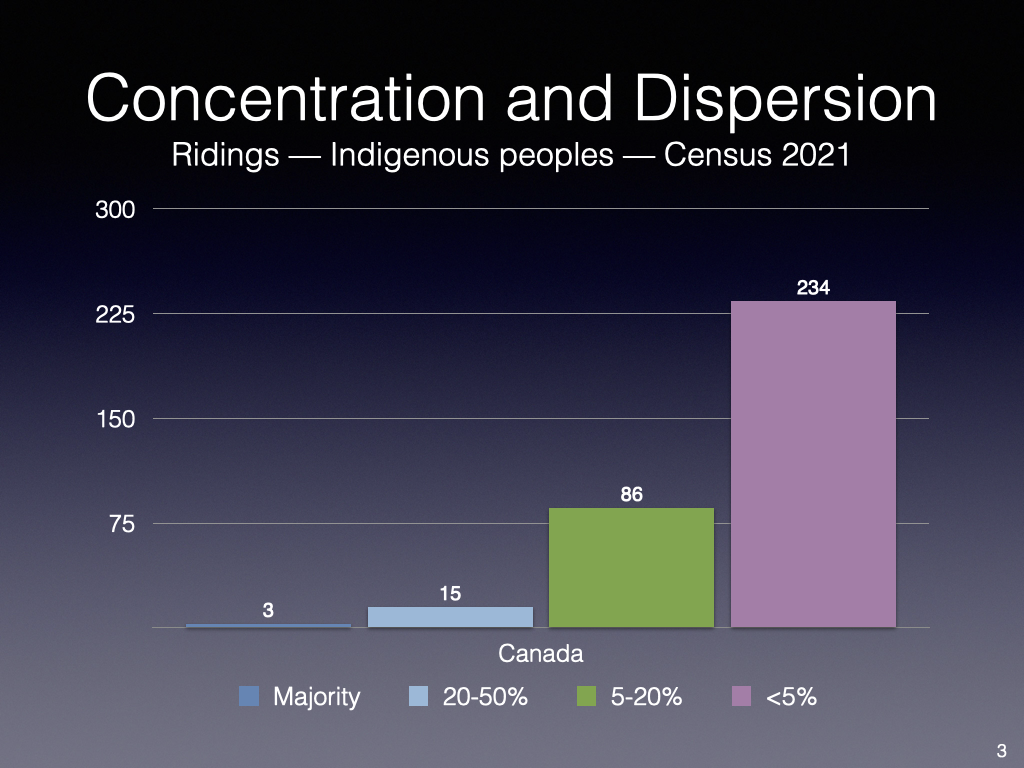
The Assembly of First Nations (AFN) has analyzed Census 2021 population data and Election
Canada’s voting results from the 2021 Canadian federal election and has highlighted 36 electoral
districts across Canada (“ridings”) where:


a. The representation of First Nations electors in a riding (%) was higher than the margin of
victory MOV for the winning candidate in 2021 1; or


b. First Nations electors represent at least 5% of electors in a riding and the difference
between the margin of victory [MOV] for the winning candidate in 2021 and the
representation of First Nations electors was less than 5%; or


c. The representation of First Nations electors in a riding is 10% or greater.


All parties should consider the role that First Nations priorities and electors will play in shaping
the outcomes of the upcoming April 2025 election. In this list, 14 seats are currently held by
Liberals, 13 by Conservatives, 7 by New Democrats, and 2 by the Bloc Quebecois

Source: First Nations Voters can Decide the 2025 Federal Election Outcomes

Savoie: The election campaign is a chance to rethink Canada’s public sector

It is, like so many issues. However, unlikely to gain traction given more pressing issues and few short-term political benefits in doing so:

…Canada’s underperforming public service is too big, too costly. It keeps growing in good and bad times at both the federal and provincial levels. Since 2020-21, the size of the federal public service, for example, has grown by 3.7 per cent annually, above the average growth rate of 1 per cent between 2007 and 2020 (the pre-COVID pandemic period). The IMF reports that the public sector in Canada accounts for 42.5 per cent of GDP. In the U.S., the figure is 36.3 per cent – and that was before Mr. Musk was let loose with his chainsaw.

Canadians know that they are not getting value for their money from the public sector, as public opinion surveys show. It’s time to finally deal with activities that have long passed their best-before date and to accept that our public sector managers have lost the ability to manage and, in particular, deal with non-performers. This is costly and saps the morale of many public sector workers who work hard in the public interest. What is often lost in the debate is that public sector managers want to perform at the top level; they don’t want to be handcuffed by overly demanding transparency requirements and the work of public sector unions.

These unions have a lot to answer for. The fact that 77 per cent of public sector workers in Canada belong to a union, compared to 15.5 per cent in the private sector, speaks to the problem. Their purpose is to promote the interest of their members, because that is what they are paid to do. They only need to push against political will, which is at times shaky, while private sector unions must push against unbending markets forces that are certain to become more difficult in the Trump era.

An election campaign provides the opportunity for a debate on the role of government and public sector unions, and to ask if the federal government still requires nearly 300 organizations. Canadians should also ask if the federal government has encroached too far in areas of provincial responsibilities because it has the spending power to do so. Time would be better spent debating these issues rather than reacting to every social media message or change of mind that comes out of the White House.

Source: The election campaign is a chance to rethink Canada’s public sector

Snyder: Twenty Lessons, read by John Lithgow

Good reminder (most of the US business, academic and other leaders failing the moment):

1. Do not obey in advance. Most of the power of authoritarianism is freely given. In times like these, individuals think ahead about what a more repressive government will want, and then offer themselves without being asked. A citizen who adapts in this way is teaching power what it can do.

2. Defend institutions. It is institutions that help us to preserve decency. They need our help as well. Do not speak of “our institutions” unless you make them yours by acting on their behalf. Institutions do not protect themselves. They fall one after the other unless each is defended from the beginning. So choose an institution you care about — a court, a newspaper, a law, a labor union — and take its side.

3. Beware the one-party state. The parties that remade states and suppressed rivals were not omnipotent from the start. They exploited a historic moment to make political life impossible for their opponents. So support the multiple-party system and defend the rules of democratic elections. Vote in local and state elections while you can. Consider running for office.

4. Take responsibility for the face of the world. The symbols of today enable the reality of tomorrow. Notice the swastikas and the other signs of hate. Do not look away, and do not get used to them. Remove them yourself and set an example for others to do so.

5. Remember professional ethics. When political leaders set a negative example, professional commitments to just practice become more important. It is hard to subvert a rule-of-law state without lawyers, or to hold show trials without judges. Authoritarians need obedient civil servants, and concentration camp directors seek businessmen interested in cheap labor.

6. Be wary of paramilitaries. When the men with guns who have always claimed to be against the system start wearing uniforms and marching with torches and pictures of a leader, the end is nigh. When the pro-leader paramilitary and the official police and military intermingle, the end has come.

7. Be reflective if you must be armed. If you carry a weapon in public service, may God bless you and keep you. But know that evils of the past involved policemen and soldiers finding themselves, one day, doing irregular things. Be ready to say no.

8. Stand out. Someone has to. It is easy to follow along. It can feel strange to do or say something different. But without that unease, there is no freedom. Remember Rosa Parks. The moment you set an example, the spell of the status quo is broken, and others will follow.

9. Be kind to our language. Avoid pronouncing the phrases everyone else does. Think up your own way of speaking, even if only to convey that thing you think everyone is saying. Make an effort to separate yourself from the internet. Read books.

10. Believe in truth. To abandon facts is to abandon freedom. If nothing is true, then no one can criticize power, because there is no basis upon which to do so. If nothing is true, then all is spectacle. The biggest wallet pays for the most blinding lights.

11. Investigate. Figure things out for yourself. Spend more time with long articles. Subsidize investigative journalism by subscribing to print media. Realize that some of what is on the internet is there to harm you. Learn about sites that investigate propaganda campaigns (some of which come from abroad). Take responsibility for what you communicate with others.

12. Make eye contact and small talk. This is not just polite. It is part of being a citizen and a responsible member of society. It is also a way to stay in touch with your surroundings, break down social barriers, and understand whom you should and should not trust. If we enter a culture of denunciation, you will want to know the psychological landscape of your daily life.

13. Practice corporeal politics. Power wants your body softening in your chair and your emotions dissipating on the screen. Get outside. Put your body in unfamiliar places with unfamiliar people. Make new friends and march with them. 

14. Establish a private life. Nastier rulers will use what they know about you to push you around. Scrub your computer of malware on a regular basis. Remember that email is skywriting. Consider using alternative forms of the internet, or simply using it less. Have personal exchanges in person. For the same reason, resolve any legal trouble. Tyrants seek the hook on which to hang you. Try not to have hooks.

15. Contribute to good causes. Be active in organizations, political or not, that express your own view of life. Pick a charity or two and set up autopay. Then you will have made a free choice that supports civil society and helps others to do good.

16. Learn from peers in other countries. Keep up your friendships abroad, or make new friends in other countries. The present difficulties in the United States are an element of a larger trend. And no country is going to find a solution by itself. Make sure you and your family have passports.

17. Listen for dangerous words. Be alert to use of the words “extremism” and “terrorism.” Be alive to the fatal notions of “emergency” and “exception.” Be angry about the treacherous use of patriotic vocabulary.

18. Be calm when the unthinkable arrives. Modern tyranny is terror management. When the terrorist attack comes, remember that authoritarians exploit such events in order to consolidate power. The sudden disaster that requires the end of checks and balances, the dissolution of opposition parties, the suspension of freedom of expression, the right to a fair trial, and so on, is the oldest trick in the Hitlerian book. Do not fall for it.

19. Be a patriot. Set a good example of what America means for the generations to come. They will need it.

20. Be as courageous as you can. If none of us is prepared to die for freedom, then all of us will die under tyranny.
Source: Snyder: Twenty Lessons, read by John Lithgow

Americans apply to revive Canadian citizenship to escape the U.S. under Trump

Still mainly anecdotal. Unfortunately, IRCC does not publish citizenship application data on open data

…Immigration consultants and lawyers say they have also had a surge in inquiries from “Lost Canadians” in the U.S. about moving to Canada.

Some “Lost Canadians” told The Globe they want to leave the country out of fear of being detained based on their race, while others said they don’t want to raise children in Mr. Trump’s America.

“In the past few weeks, we have received an increased number of inquiries from American citizens of various backgrounds asking about immigration to Canada, including Lost Canadians,” said Annie Beaudoin, an immigration consultant based in California who used to work for Ottawa’s federal Immigration Department.

Melissa Babel, founder of Babel Immigration law in Ontario, said on Thursday: “I’m getting a lot of calls from people who remember that their grandfather was Canadian – three yesterday.”…

Source: Americans apply to revive Canadian citizenship to escape the U.S. under Trump

HESA: That Was The Quarter That Was, Winter 2025 [Trump administration]

ùMore on the impact of the Trump administration’s higher education policies:

…On top of this came attacks on institutional autonomy, which for the most part consisted of threats to defund any institution which continued activities deemed to be “DEI”, a term the Administration defined in terms so vague as to make it nearly impossible to comply. In the case of Columbia University, it also threatened to defund an institution due to its failure to combat “antisemitism”, which was an odd thing to demand given how many genuine antisemites seem to orbit the Trump regime (Columbia caved). And also there was the detention and potential deportation of hundreds of international students, mainly it seems for the crime of exercising free speech and freedom of assembly in such a way as to be critical of Israel. The cumulative impact of what has happened in US in the past seventy days will take years if not decades to reverse. Careers have been destroyed. Promising lines of research – such as those involving mRNA research – have simply been dropped. If one wanted to destroy America’s future prosperity and scientific pre-eminence, one could scarcely have done more than the Trump Administration has done. This will be to the good fortune of some individual institutions in other countries, but to the world as a whole – especially North America – the faltering of science and the economic progress that depends on it will lower economic growth potential for a decade or more to come.


There are, broadly, three aspects to the whole US story. The first is one of anti-scientism, a broad disdain for the idea that anyone other than those in power are permitted to say what the truth is. This is most obvious when looking at the policies of the Department of Health and the NIH around the non-promotion of vaccines, but it permeates the administration generally. There are no other parts of the world – for the moment – where we see anything similar. But the other two aspects her – attacks on institutional autonomy and academic freedom on the one hand, and reductions in the financial capabilities of universities on the other, do have echoes elsewhere.

With respect to state controls over institutional autonomy and academic freedom, the most obvious parallel case to the United States over the past three months is Georgia, where the controversial pro-Russian government sees universities as a centre of dissent and wishes to increase supervision over them and thereby limit autonomy.  India and Pakistan have also seen flare-ups over the past few months with respect to autonomy – mainly but not exclusively relating to government use of the power to name vice-chancellors – but this is less a “new shift” than the latest incidents in a long-running battle.


The other issue, of course, is overall university funding. The United States is certainly unique in the extent to which scientific research budgets are under attack. And it is unique in the sense that it seems to be the only country where individual institutions are being singled out for specific funding reductions in the manner of Columbia University. But it is not unique in the sense that universities are feeling the need for quick retrenchment.There two closest parallels are Argentina and the Netherlands. In the former, President Milei’s inflation-busting program involves reducing government spending to well below the rate of price growth. By some accounts, real transfers to universities are now down about 30% on last year, which has led to a series of strikes. In the latter, the still new-ish coalition government, elected in 2024, is still enacting both a series of cuts to university finances and imposing restrictions on teaching programs in English, which has the effect of reducing universities’ international student fee income. This too, is leading to strike action.

Among OECD countries, universities in France, already struggling to deal with last year’s reductions in funding, got hit with a new round of compressions in the February budget, and most are looking at deficits both this year and next. The anglosphere trio of the United Kingdom, Canada and Australia are also facing continuing struggles from the loss of international students stemming from a combination of tighter visa restrictions, reduced demand and greater international competition, but unlike the other examples cited, these financial challenges in the short-term stem from a loss of market income, not government income….

Source: That Was The Quarter That Was, Winter 2025