From ‘eh’ to ‘meh’? Pride and attachment to country in Canada both endure significant declines 

Alarming decline, reflecting likely mix of housing, healthcare, post-COVID hangover, inflation, youth challenges etc, along with perhaps undue focus on criticism of Canada and its history. No easy corrective action no matter which government:


Link to the poll here: www.angusreid.org/

The years since the onset of COVID-19 have been a well-documented period of division and discord in this country, with Canadians expressing concerns about the lack of a “middle” option politically, an unwillingness from governments to work together for the people, weakening compassion and growing space between Canadians.
 
New data from the non-profit Angus Reid Institute find two broad trends underscoring these changes and signalling a challenge for national unity. In 2016, 62 per cent of Canadians said they had a deep emotional attachment to Canada. In 1991 that mark was three points higher (65%). Now in 2024 it is 13 points lower at 49 per cent.

Even more dramatic is a drop in a sense of pride among Canadians. In 1985, 78 per cent said they were “very proud” to be Canadian. This dropped to 52 per cent in 2016 and now by another 18 points to 34 per cent. The proportion who say they are either proud or very proud of their nationality has dropped precipitously from 79 per cent to 58 per cent over the past eight years.

Source: From ‘eh’ to ‘meh’? Pride and attachment to country in Canada both endure significant declines 

Brian Dijkema: American solutions won’t solve the problems fuelling Canadian populism  

Good discussion of some of the differences:

…Canadian populism ≠ American populism

Conservatives who are sympathetic to an economic vision that is focused on the working class might be forgiven for wanting to copy and paste the American vision into the Canadian context. But this would be a mistake because while many of the concerns of the Canadian working class are shared with their American counterparts (particularly their distrust of elite institutions, including universities, media, law, and cultural establishment), the economic realities that have affected the working class in Canada are markedly different in nature than they are in America.

Many of the items that Cass, Salam, and Douthat sought as policy remedies for the working class in America—family allowances or parental leave, for instance—are well established in Canada. And, frankly, if you look at significant portions of our economy, we are kind of living the dream of a realignment conservative in the U.S. You would expect populism to be a non-factor here.

But that assumes that all countries are like the United States, and they’re not. We’re not.i

Populism is a factor here for many of the same reasons in the U.S. on the cultural side.2 But on the economic side, while we have experienced job polarization, we also have many of the family and other supports that realignment conservatives in the U.S. offer as a means to provide a base for family vitality.

While Cass might be right about the imbalance in favour of the consumer in the U.S. (I’ll let him debate that within his own country), it is absolutely true that in Canada the imbalance goes the other way.

Whether it’s Volkswagen’s battery plants, or spaghetti factories in Brampton, Ont., there is nothing Canadian governments love doing more than taking care of producers in the name of creating jobs (or, more accurately, hypothetical jobs). I think it’s entirely plausible to suggest that, across a whole range of industries, the structure of our economy works against working families getting ahead. So many bills, for cell phones, the milk, butter, and cheese that we use to feed our children, chicken, flights home for Christmas, Christmas turkeys, banking costs, electricity, or housing are far higher than they need to be because the Canadian governments (both provincial and federal) have chosen the producer over the consumer.

Many Canadians, myself included, just look at their monthly bills, look at the ways in which associations and lobbyists for these groups secure protections from competition that would lower prices, and start reaching for their pitchforks. And that doesn’t include the array of other industries that aren’t directly connected with consumer goods—shipbuilding, aerospace, or infrastructure, for instance—that take our tax dollars to create jobs, but barely do that, and also fail to build us the ships and planes that we need to defend our own country. It’s tough to swallow getting dinged with tariffs because our money has gone to stuff the pockets of the Bombardiers, Irvings, and SNCs of the world while they in turn have failed to deliver the things we need to defend democratic institutions against global threats.

A realignment economic agenda in Canada will need to include measures that address these challenges, and insofar as it does so, it will not only look far different from its populist neighbours to the south, but far more like traditional free market economics than the heterodox strands that have been woven into the American populist agenda.

Politicians in Canada who hope to craft a multi-ethnic, working-class coalition will, of course, also need to address the deeply rooted sources of populism in culture, but when it comes to economics, at least in Canada, what’s old should become new again.

Source: Brian Dijkema: American solutions won’t solve the problems fuelling Canadian populism

Pro-life groups need to defend birthright citizenship

Interesting take (but then again, Catholic organizations tend to support more generous immigration and related policies, unlike Evangelicals):

President-elect Donald Trump stated he plans to end birthright citizenship, which is currently guaranteed by the 14th Amendment. The pro-life movement, which is as significant a part of the GOP base as the anti-immigrant caucus, needs to step up and oppose any attempt to end the conferral of citizenship on those born in the United States.

The foundational argument of the pro-life movement is that all life is sacred, and that once you start parsing who is, and who is not, entitled to certain rights, you are halfway down a slippery moral slope. All human beings, as human beings, should enjoy the same rights as every other human being.

The relationship of abortion policy to immigration policy might seem counterintuitive. The 14th Amendment doesn’t help the pro-life cause. It refers to “All persons born or naturalized in the United States …” Pro-choice groups argue that a human being only has a right to life once it is born, but once born, the rights that are conferred on the person are sacrosanct.

Those who drafted and enacted the 14th Amendment were not addressing the moral and legal issues surrounding abortion, and they didn’t have sonograms in 1866 when members of Congress began drafting the amendment after President Andrew Johnson vetoed the Civil Rights Act that year.

The drafters of the 14th Amendment aimed to extend the equal protection of the laws to those formerly enslaved. They knew that the framers of the original Constitution had it wrong when they decreed that slaves only counted as three-fifths of a person for purposes of representation in the Congress. They knew that the founders had been wrong about slavery entirely. They knew that this diminishment of the humanity of those who had been enslaved was an affront to our nation’s foundational claims about human freedom and legal equality.

The pro-life movement has always been constructed on this deeper moral concern, that no person should have their humanity diminished, even if the movement has failed to live up to this high ideal. The source of human rights is our civilizational belief in transcendent human dignity. Virtually every religion expresses this belief in some way. Ours expresses it in terms of the imago Dei, the belief that every person is made in the image of likeness of God. Every time the pro-life movement ignores other threats to this God-given human dignity, it weakens its credibility.

“Catholic social thought starts with the dignity of each person and the whole person,” Dylan Corbett, executive director of the Hope Border Institute which advocates for immigrants, told me. “This is the bedrock of the church’s commitment to the poor, the unborn and the vulnerable, without distinction. In the coming months, the Trump administration’s targeting of our parishioners, neighbors and the essential workers in our communities simply because of immigration status will test the credibility of our moral witness.”

Kristen Day, director of Democrats for Life of America agrees. “Pro-life principles don’t end where Donald Trump’s pet projects begin,” she told me via email. “Remaining silent on the issue of birthright citizenship would betray our movement’s highest values because there is nothing pro-life about ending it. Life begins at conception, but it doesn’t end at birth.”

To be clear, even a democracy seriously engaged in working for equality will need to draw distinctions, to discriminate, between people. We all know a precocious 16- or 17-year-old who is more mature than some 20-somethings we know, but unless you are 18, you don’t get to vote. We wouldn’t want the government devising some kind of test that decides who is worthy to vote, and who isn’t, and so we set an arbitrary cutoff. That arbitrary cutoff is applied universally.

In terms of abortion policy, conception, viability and birth are the usual cutoffs, and there is an argument to be made for any of the three. Only the first coheres with Catholic teaching, and in most pluralistic democracies, the cutoff is at some point between conception and viability.

As a culture, a society and a polity, we need to learn how to think more deeply, and less arbitrarily, about where we draw such lines.

The idea that a person is a citizen of the place where he or she is born is a bulwark against any attempt to discriminate unjustly. A good way to sniff if a particular discrimination is just or unjust is to ask whether it is universal. Birthright citizenship is universal: It applies to everyone born here.

This political linkage of immigration and abortion cuts both ways. Pro-immigrant arguments would have greater moral cogency to many Americans if they were put forward by people who are committed to protecting the lives of unborn children, or at least not indifferent to the dignity of those unborn children. Given the polarization of the country, that moral linkage is not apparent to most and will be dismissed by many. Still, moral coherence eventually wins out most of the time.

At this moment in our nation’s political history, the pro-life movement should rally around the cause of defending birthright citizenship.

Source: Pro-life groups need to defend birthright citizenship

Globe editorial: Wanted – More enforcement in immigration 

Latest in the series:

…Right now, Canada relies on a system of incentives for people to follow the law. People ordered to leave must confirm their departure with the CBSA at a port of exit or risk being put under an exclusion order that would prevent any future return to Canada.

But leaving it to people to decide what is in their best interests leads to a situation where the CBSA cannot speak with absolute certainty as to the whereabouts of 19,729 people whose claims for refugee status were denied by Canada in 2011 or earlier. They might have left and simply not informed the CBSA. Or they may still be here.

There are a range of potential solutions. First, the problem needs to stop where it starts: limiting the number of refugee cases by reducing the incentive for fatuous claims, as this space argued on Thursday. Ottawa could also explore issuing automatic exclusion orders once permits expire.

At the same time, the government needs to provide the CBSA with the tools and staffing to ensure that the people deported actually leave the country. In this new, harder world, stricter monitoring of whether people leave the country when they’re supposed to is inevitable.

Canada can no longer give people the option to fade into the woodwork.

Source: On the Brink: Wanted – More enforcement in immigration

Canadian Immigration Tracker – October 2024 Update

Year to date highlights:

  • Permanent residents admissions: Increase January-October from 404,000 in 2023 to 413,000 in 2024 or 2.3 percent.   
  • TR2PR (Those already in Canada): Increase January-October from 212,000 in 2023 to 219,000 in 2024 or 3.3 percent. 
  • TRs-IMP: Decrease January-October from 757,000 in 2023 to 648,000 in 2024 or -14.5 percent.
  • TRs-TFWP: Decrease January-October from 172,000 in 2023 to 165,000 in 2024 or -4.0 percent.
  • Students: Decrease January-October from 570,000 in 2023 to 461,000 in 2024 or -19.2 percent. Post-secondary only: Decline from 431,000 to 328,000 or 23.9 percent.
  • Asylum Claimants: Increase January-October from 117,000 in 2023 to 149,000 in 2024 or 27.3 percent.
  • Citizenship: Increase January-October from 317,000 in 2023 to 329,000 in 2024 or 3.7 percent.
  • Visitor Visas: Decrease January-October from 1,567,000 in 2023 to 1,290,000 in 2024 or -17.7 percent.

https://www.slideshare.net/slideshow/canadian-immigration-tracker-october-2024-pdf/274022459

Ling | Court fights aren’t fixing our culture wars. They might be making them worse

Good commentary:

…The fact is, Canada is in a state of particular social and political polarization. That isn’t inherently a bad thing. There was a time when having gay teachers in the classroom was a deeply polarizing concept. The courts, yes, declared that legally permissible. But having Queer people in the classroom did not become normal or accepted because the courts deemed it so. That was made possible because many good people did the difficult work of convincing skeptics that it was an actively positive thing. A recent backlash to LGBTQ issues in education should be a sign that while the law can be settled, our politics rarely are.

Community is not created by a tribunal ruling or a waving flag, but by people who actively work to build it. Litigation can absolutely dismantle systemic injustice and force conversations, but there are limits to what the adversarial battles in the courtroom can achieve. 

In recent years, many progressives have come to believe they are indisputably right and therefore have no need to debase themselves by talking to those who are wrong. In the worst cases, they have come to believe that wrong-thinkers can be cowed into silence or deplatformed entirely. These lines in the sand aren’t just polarizing, they rob us of the ability to resolve actual differences. And when polarization can’t resolve itself, it can spiral into societal breakdown.

One of the ways we can disentangle these disputes is through politics. (McQuaker didn’t have to defend his record in a campaign, he was recently re-elected by acclamation.)

But more broadly, we should take some lessons from Gilbert Baker and Queer activists of recent decades. As the Queer community’s Betsy Ross told theTimes: “We have put our whole lives into changing society, but we are just starting. This is an intergenerational process.”

This process is slow and difficult, but it is important. If we rely too much on institutions, symbols, and learning modules titled “Human Rights 101” to change society, we can forget that society is other people. And other people must be convinced, not cajoled.

Source: Opinion | Court fights aren’t fixing our culture wars. They might be making them worse

Alicia Planincic: The provinces are losing ground to federal priorities in immigration 

Useful observation and analysis. It would benefit, however, from further analysis comparing PNP and federal economic outcomes:

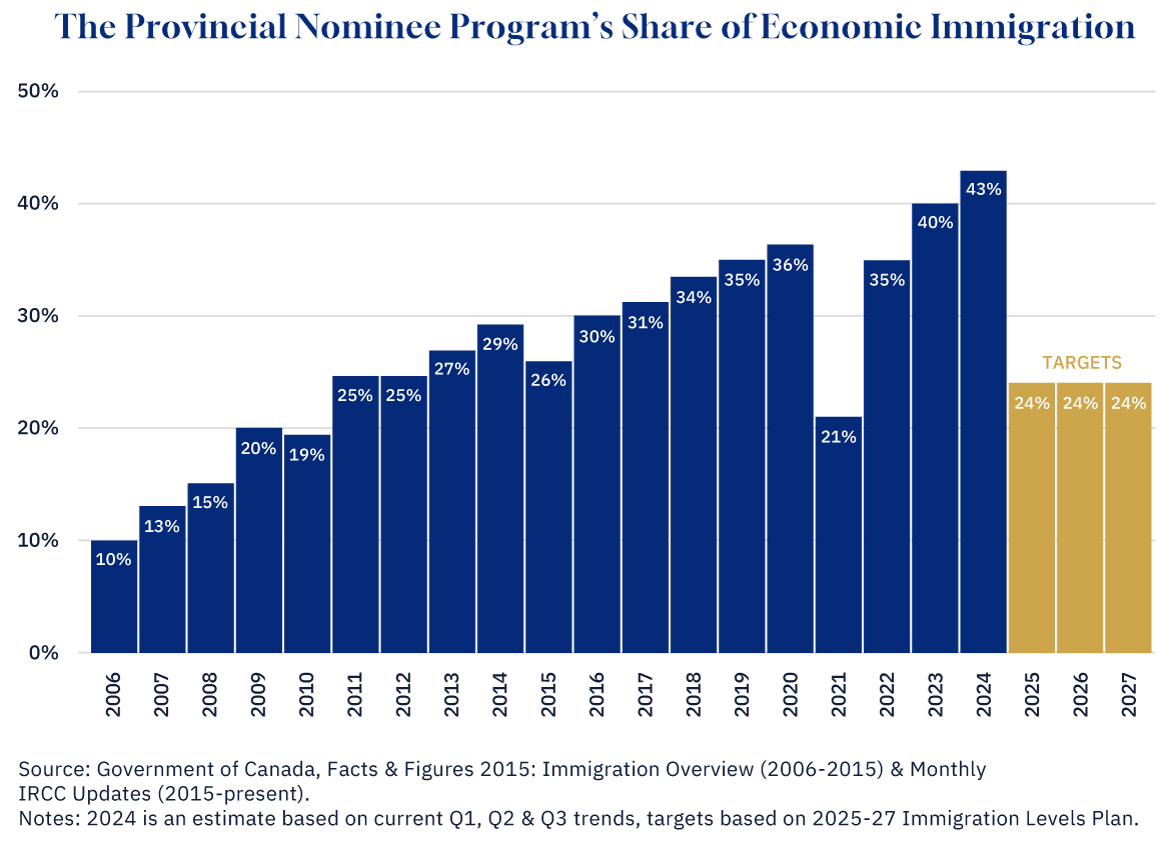
A couple of months ago, the federal government made a big announcement that they were decreasing targets for immigration pretty substantially. Though there was a lot of talk about the topline numbers and what it means for the economy, what was overlooked at that time was that cuts to immigration came primarily at the expense of a single program: the Provincial Nominee Program (the “PNP”)—what represents the provinces’ role in selecting economic immigrants.

What’s important about the PNP is that it’s designed to distribute immigrants more widely across Canada (especially beyond the country’s biggest cities) and give the provinces the ability to meet local labour market needs. And, though it’s not perfect, it’s pretty effective at both.

Just how big of a hit did the program take? Pretty big.

Graphic credit: Janice Nelson. 

While total immigration was reduced by around 100,000 new permanent residents (annually), the PNP was reduced by 65,000. To put this into perspective, the PNP is just a single program within the broader “class” of economic immigration but cuts to the PNP dwarfed cuts made to the other two main classes of immigration combined (i.e., family-related immigration and refugees).

At the same time, federally-focused economic programs did not see any major cuts. In fact, their numbers grew slightly. The result of all this is that the province’s role in economic immigration, which had been steadily growing for years, is set to collapse from over 40 percent of total economic immigration down to just 24 percent.

It’s worth noting that the PNP is also losing ground to another federal priority: French-speaking immigration outside of Quebec. In fact, French language proficiency has become a key factor in selecting economic immigrants federally. Though the target for French-speaking immigration was cut marginally this year, numbers have nearly doubled over the last couple of years, with the latest target at 30,000 (compared to 55,000 for the PNP).

In other words, the current plan to decrease immigration is not just an across-the-board cut that will hit all parts of Canada equally. It comes with regional consequences, as provincial priorities lose out to federal ones.

Source: Alicia Planincic: The provinces are losing ground to federal priorities in immigration 


Thousands of pro-Assad Syrians flee to Lebanon to escape reprisals as interim government takes shape 

Suggesting need for strong vetting for any new Syrian origin asylum seekers to ensure that few, if any, former senior officials and others complicit with the regime are rejected:

…Lebanon is watching one set of Syrian refugees head home only to see another set arrive within its borders in the aftermath of the toppling on Sunday of Syria’s autocratic president Bashar al-Assad.

Since then, thousands of Syrians, most of them believed to be Alawites – members of the same Islamic sect that included the Assad family – have crossed into Lebanon illegally to avoid retribution from the Islamic rebel alliance, led by Hayat Tahrir al-Sham, that has set up a transitional government.

Michel Constantin, the regional director for Lebanon, Syria and Egypt for the Catholic Near East Welfare Association, a papal charity established almost a century ago, said that some 50,000 Syrians have entered Lebanon since the fall of the Assad regime.

“Villages in the north Bekaa Valley are full of families coming from Syria,” he told The Globe and Mail, referring to the 120-kilometre valley in eastern Lebanon that runs roughly parallel to the Syrian frontier. “If they continue to come, it could turn into a crisis for Lebanon.”

The arrivals figure was difficult to verify, though a France 24 news channel report from the Syrian-Lebanese border said there were many more cars lined up to leave Syria than to enter it.

Marc Saad, a spokesperson for the Lebanese Forces, a Christian party that is the largest in the country’s parliament, said, “There is an influx of Syrians fleeing into Lebanon. We cannot bear any more arrivals here.”

Source: Thousands of pro-Assad Syrians flee to Lebanon to escape reprisals as interim government takes shape

Globe editorial: The refugee crisis needs a new approach, not just more money 

Nice shout out to Rob Vineberg and his recommendation:

….Part of that new thinking must be abandoning the rigid rule that cases are heard in the order in which they are filed. That first-in-first-out approach combined with the soaring volumes creates the incentive for false claims. Much better, then, to hear new claims first and reduce that incentive.

Similarly, the conceit that the IRB must hear all refugee claims needs to end. Claims cannot be ignored, of course. But Robert Vineberg, a former director general of Citizenship and Immigration Canada, has made the eminently sensible suggestion that the Department of Immigration, Refugees and Citizenship should first examine cases, approving those claims that are clearly genuine. Only those that were borderline or headed for rejection would proceed on to the IRB.

That would fulfill the obligations laid down in the Singh judgment, since any rejected claimant would have the benefit of an oral hearing. And no claimant would protest about an expedited approval.

Ottawa must act to reduce the claims backlog before today’s crisis becomes tomorrow’s collapse. Otherwise, a future government may find its only option is the even more radical step of using the notwithstanding clause to suspend the effects of the Singh ruling. That would be a stunning epitaph for the Liberals’ mismanagement of the immigration system.

Source: On the Brink: The refugee crisis needs a new approach, not just more money

Committee’s endorsement of ‘anti-Palestinian racism’ report splits Liberal caucus

No surprise. Ongoing tension. Agree no need for new category for racism. Anti-Arab more than sufficient for ethnic origin, anti-Muslim or Islamophobia for Palestinian Muslims:

Tensions were apparent in the Liberal caucus Wednesday after a committee chaired by Liberal MP Lena Metlege Diab released a report endorsing the disputed concept of anti-Palestinian racism.

Attorney General Arif Virani said he was “alive to concerns” about the notion of anti-Palestinian racism, but stressed the need to confront the rise in hatred since the Oct. 7, 2023, attacks in southern Israel.

“I think what’s really important is that Canadians understand we’re trying to address the divisions and the hatred that we’re seeing in society,” Virani told reporters on his way to the Liberals’ weekly caucus meeting. “And we’re seeing a lot that’s related to geopolitical conflicts on the other side of the world.”

“That’s why it’s critical to address antisemitism, but it’s also critical to address reprisals and backlash that we’ve seen against people that are Arab or Palestinian, including looking in more detail at the definition of anti-Palestinian racism.”

Anthony Housefather, the Liberal MP for Mount Royal, said he wasn’t convinced Palestinians need special protections.

“We’d have to understand why … you would have this nationality and not other nationalities,” said Housefather.

“If you’re going to adopt anti-Palestinian racism, are you going to have anti Israeli-racism? Are you going to have anti other country racism?”

Housefather, who is Jewish, was a vocal backer of the Trudeau government’s adoption of the International Holocaust Remembrance Alliance definition of antisemitism in 2019.

The committee report, titled Islamophobia on the Rise, uses the term “anti-Palestinian racism” more than a dozen times. It also recommends that the federal government, joined by the provinces, direct educational institutions to appoint “special advisors” on anti-Palestinian racism.

The report stops short of recommending that anti-Palestinian racism be added to Canada’s anti-racism strategy, as some activists have pushed for.

The report also sidesteps the question of formally defining anti-Palestinian racism, but refers to a definition put forward by the Arab Canadian Lawyers Association in 2022, which is commonly used.

In this definition, anti-Palestinian racism is “a form of anti-Arab racism that silences, excludes, erases, stereotypes, defames, or dehumanizes Palestinians or their narratives.”…

Source: Committee’s endorsement of ‘anti-Palestinian racism’ report splits Liberal caucus, Report: ISLAMOPHOBIA ON THE RISE: TAKING ACTION, CONFRONTING HATE AND PROTECTING CIVIL LIBERTIES TOGETHER