Shree Paradkar: A four-year study has mapped out ‘The Canadian Islamophobia Industry’

Of note. Zine’s creation of a voting guide for Muslim voters in 2019 generated considerable controversy:

What connects a book titled “How Baby Boomers, Immigrants and Islam Screwed My Generation”, a tweet with two women wearing sweatshirts labelled “Deus Vult”, a meme of a Trojan horse labelled “Infiltrating From Within” and public warnings about the “Great Replacement”?

It’s not merely that a thread of Islamophobia weaves through them all. It’s that the thread is supported by a well-funded and orchestrated matrix, as uncovered by a new report titled “The Canadian Islamophobia Industry: Mapping Islamophobia’s ecosystem in the Great White North.”

Wilfrid Laurier professor Jasmin Zine likens the four years she and a group of graduates spent investigating the networks of hate and bigotry that purvey Islamophobia to playing whack-a-mole.

“We went down hundreds of rabbit holes investigating so many different Islamophobic groups and organizations and individuals, and one led to another,” she said this week at a discussion of her report at the Centre on Hate, Bias and Extremism.

Islamophobia has had an insidious and deadly impact in Canada, leading, in just one example, to the murder of Muslims in Quebec City in 2017 and in London, Ont., in 2021.

Zine is an expert on the topic; the author of a recent book titled “Under Siege: Islamophobia and the 9/11 Generation” and a consultant on the subject for international human rights agencies such as The Council of Europe and the UNESCO.

Her recently released 240-page report based on a four-year study unveils an ecosystem that comprises media outlets and Islamophobia influencers, white nationalist groups, fringe-right pro-Israel groups, self-professed “Muslim dissidents,” think-tanks and their designated security experts, and the donors who fund their campaigns.

While studies such as “Hijacked by Hate” or “Fear Inc.: The Roots of the Islamophobia Network in America” and the book “The Islamophobia Industry” have shown the co-ordinated and monetized nature of Islamophobia in the United States, Zine’s report is the first to show the links between various actors in Canada that target and vilify Islam and Muslims here. It adds urgency to act on the recommendations of the Summit on Islamophobia last July.

“The report highlights, first of all, the breadth and depth of the problem,” Barbara Perry, a leading Canadian expert on white extremism, told the Star. “Beyond that, however, it uncovers the ways in which the white supremacist/Islamophobic networks draw from both the fringe and the mainstream.”

Perry, who was not involved in the development of the report, called it “an incredibly important piece of work,” coming at a time when the public’s attention is diverted from Islamophobia due to the surge in anti-authority activism, such as that seen in the so-called Freedom Convoy.

Discussions about Islam often surface in the aftermath of violence — whether by those in the name of Islam or by those in the name of Christianity and whiteness.

But hate simmers in the background the rest of the time, gaining steam among the 300 or so hate groups that have blossomed across the country like poisonous mushrooms. Propagations of an us-versus-them rhetoric show up in memes, in anti-Trudeau conspiracy theories and in connection to Muslim women wearing hijabs, niqabs and burqas.

Crusader imagery is a popular symbol for these groups. A photo of Canadian Islamophobia influencers Faith Goldy and Lauren Southern wearing hoodies with the term “Deus vult,” Latin for “God willing” is one example. Deus vult was a rallying cry against Muslims during the First Crusade. “Reviving the tropes of this centuries-old battle, they invoke moral panic about Muslims and ignite Islamophobic fears and fantasies,” Zine writes.

Repeatedly circulating the idea of Islam as an existential threat primes people to accept blatantly anti-Muslim policies, including heightened surveillance of Muslims in the name of “counter terrorism.” And a law to ban head coverings by Muslim women, as Quebec did, under the guise of banning all items of overt religiosity.

In 2017, Southern went to the Mediterranean Sea to support the racist, xenophobic Defend Europe campaign and procured a 250-foot boat to stop NGOs such as Doctors Without Borders from conducting search-and-rescue missions to aid migrants in distress. While she and the motley crew ultimately failed to stop migrant ships, they earned credibility in racist movements that included a thumbs up from a former grand wizard of the Ku Klux Klan, David Duke.

This is but one example of the transnational reach of an ideology where tropes about deceptive and dangerous “Muslim invaders” and an oncoming “jihad” against the Western world intersect with xenophobia about migrants and fears of “white replacement”. The replacement theory views policies that welcome immigrants of non-European backgrounds as being part of a plot to push out the political power and culture of white people.

Three years prior, anti-Muslim blogger Kevin Johnston called Mississauga “ground zero for the entire Islamic invasion of the country” as he ran a failed campaign for mayor of the city. It was on a YouTube video since taken down for violating hate-speech guidelines.

To this matrix of bad faith players, Zine adds the category of “Muslim dissidents” and “ex-Muslims” — who she can occupy a central role in the Islamophobia industry and sometimes publish pieces in mainstream Canadian media.

While debates within communities are normal and common, some of these individuals are not mere enablers. “Bolstered by their ‘insider’ status, they act as instigators and propagators of anti-Islamic narratives as well as validating and authorizing the circulation of these tropes,” Zine writes.

As the Iranian-American author Hamid Dabashi once wrote, “There is no longer any need for ‘expert knowledge’ when you can hear the facts from the horse’s mouth.”

Zine points out the writer Raheel Raza. Days after a Canadian-born Muslim man shot dead Cpl. Nathan Cirillo at the Ottawa war memorial in 2014, Raza wrote a blog saying “Canada is under attack” in which she recommended Canada “close all mosques for three months to have intense scrutiny on the Imams and their sermons in the past 3 months” and put “a moratorium on immigration from Muslim countries for a set period till matters here settle down.”

The writer Salim Mansur is another example Zine points to among the seven profiles of dissidents and ex-Muslims in the report. Mansur, a columnist at Rebel Media and the Toronto Sun, once wrote “Muslims, in general, are a ‘third-world’ people whose understanding and practice of Islam remain fixed in their pre-modern cultures.”

These “voices of dissent” claim Islam needs reforming.

But Islamophobia keeps Muslims on the defensive, steals their ability to challenge hierarchies or to have frank internal critiques that the dissidents say are needed.

Zine draws connections between dissidents and their roles at anti-Muslim think-tanks.

For instance, American reports such as Hijacked by Hate or Countering the Islamophobia Industry by The Carter Centre found the Gatestone Institute is one of the biggest funders of the Islamophobia industry in the U.S. It was founded by Nina Rosenwald, who is heiress to the Sears Roebuck fortune and has been dubbed the “sugar mama” of Anti-Muslim hate there.

“We can’t actually track the money trail in Canada in the way that they can in the United States by using tax records,” Zine says.

Certain connections still become visible. Raza and Mansur were distinguished fellows with the Gatestone Institute, the report says.

Writes Zine: “The Muslim community and its allies must work to engender social movements and to enact dedicated advocacy and powerful lobbies to combat the formidable and lucrative business of Islamophobia.”

Source: Shree Paradkar: A four-year study has mapped out ‘The Canadian Islamophobia Industry’

Adams and Parkin: Surveys show Canadian are less polarized and angry than Americans

Of note:

We are living in an era of populism and polarization. Our politics is divided and angry. And if anything is changing, it is changing for the worse. Or so we are often told.

As usual, the U.S. sets the tone. Our recent surveys — run on both sides of the border — bring this into focus. Compared to 1986, in the midst of Reagan era, Americans today are much less likely to be satisfied both with opportunities to get ahead in their country, and with their system of government. Republicans, in particular, are losing faith in the American dream and in their democracy.

Perhaps surprisingly, over the same period of time, there has been no noticeable change of opinion in Canada. Not everyone here is satisfied with opportunities to advance, or with our system of government. But, on average, Canadians are no more dissatisfied than they were in the mid-1980s. Certainly Conservative party supporters are more dissatisfied now that the Liberals are in power. But this is offset by growing satisfaction among Liberals.

A big shift has occurred in Canada, however, when it comes to social programs. In the mid-1980s, Canadians were almost twice as likely as Americans to be satisfied with social services for the poor and the elderly in their country. Today, there is no difference — while satisfaction in the U.S. has remained low, satisfaction in Canada has fallen sharply. And it has fallen among partisans on both the left and the right of the political spectrum.

This hardly fits the narrative of the rise of populism. Yes, there is evidence of growing dissatisfaction in Canada, but the focus of this dissatisfaction is our failure to better protect the most vulnerable in our society. 

If this seems too rosy, consider opinions on two other questions. In 1986, about 3-in-4 people in both Canada and the United States agreed that government should reduce the income gap between the rich and the poor, and that government should do much more to make sure racial minorities are treated fairly. Since then, agreement on both questions has declined in the U.S. In Canada, there has been no change.

True, there are signs of polarization in both countries, as the gap in agreement between the those on the left and right has widened. But the gap today between Republicans and Democrats in the U.S. is about twice as wide as that in Canada between Conservatives and Liberals. On these questions, the opinions of Canadian Conservatives resemble those of American independents much more that those of their Republican “cousins.”

Then there is the notable absence of division in Canada between the views of racialized and non-racialized citizens. Predictably, in the U.S., African-Americans are much more likely than whites to call on government to act to promote both economic and racial equality; the gap emerges because white Americans are much less likely to favour these actions. 

Not so here, where equally large majorities of white and racialized Canadians call for government to act to reduce inequalities. 

Canadians must avoid looking upon these findings with smugness. Public opinion aside, we struggle to confront racism in our society. If Canadians have grown less satisfied with social services, it is a sign not only of social solidary, but also of the failure of our governments to deliver.

Pointing out that we are less polarized or angry than our American neighbours may be reassuring, but it does little to solve the problems we face. However, we at least can tackle these problems with an awareness that our history, society, culture and institutions are our own, with plenty of weaknesses, but also with undeniable strengths.

Source: Surveys show Canadian are less polarized and angry than Americans

Is birth tourism about to return now that travel restrictions have been lifted?

My annual update:

COVID-19 continues to provide the perfect natural experiment to assess the extent of “birth tourism” – when women visit Canada for the purpose of giving birth here and thus obtaining Canadian citizenship for their child. Two years in, the data shows a decrease of almost eight per cent, compared to 2020-21 and almost 52 per cent compared to the pre-pandemic 2016-20 average, in the number of “non-resident self-pay” births in Canada.

As Figure 1 indicates, there was a steady increase of non-resident births prior to the pandemic. But after COVID-related travel restrictions were implemented in 2020, there was a sharp drop, with no recovery in 2021. This provides a very good indication of the extent of birth tourism in Canada. Now that the restrictions are loosening and travel is once again opening up, it’s time for the federal government to revisit its policy on non-resident births and Canadian citizenship.

https://e.infogram.com/1bffaa89-7b27-4768-acdd-860d46ab420b?parent_url=https%3A%2F%2Fpolicyoptions.irpp.org%2Fmagazines%2Fdecember-2022%2Fbirth-tourism-may-rise-again%2F%3Futm_source%3DPolicy%2BOptions%2BNewsletter%26utm_campaign%3D87f90b7127-EMAIL_CAMPAIGN_2022_02_14_05_26_COPY_01%26utm_medium%3Demail%26utm_term%3D0_26f66e24ce-87f90b7127-104024581%26mc_cid%3D87f90b7127%26mc_eid%3D86cabdc518&src=embed#async_embed

The decline to 2,245 in 2021 from 2,433 in 2020 occurred in all provinces save Quebec, which remained relatively stable (Table 1). The decline was particularly notable in British Columbia, where most birth tourists pre-pandemic were from China – a country most affected by travel restrictions. The drop is in stark contrast to steady increases over the previous five-year period.

https://e.infogram.com/c85b1f61-f842-4a62-adbb-c69b1c8964af?parent_url=https%3A%2F%2Fpolicyoptions.irpp.org%2Fmagazines%2Fdecember-2022%2Fbirth-tourism-may-rise-again%2F%3Futm_source%3DPolicy%2BOptions%2BNewsletter%26utm_campaign%3D87f90b7127-EMAIL_CAMPAIGN_2022_02_14_05_26_COPY_01%26utm_medium%3Demail%26utm_term%3D0_26f66e24ce-87f90b7127-104024581%26mc_cid%3D87f90b7127%26mc_eid%3D86cabdc518&src=embed#async_embed

A similar decline in visitor visas and birth tourists has been noted in the United States.

The percentage of non-resident births in Canada fell from slightly less than two per cent of total births in 2019 to 0.7 per cent in 2020 and has remained at that level. Given increased immigration, the percentage of non-resident births also fell during the same period.

As noted in previous articles, the non-resident self-pay code that is the basis for the analysis is broader than that of women who arrive on visitor visas. It includes international students, about half of whom are covered by provincial health plans, and other temporary residents. Visitor visas recovered to only 57 per cent of pre-pandemic levels in 2021-22 while visas for temporary workers have more than recovered from pre-pandemic levels. Visitor visas for Chinese nationals, one of the major groups, have recovered to only 21 per cent of former levels compared to 57 per cent of previous levels for all visitor visas. Chinese government travel-related restrictions are likely a significant factor in the reduced number.

Table 2 provides a hospital-level view of the impact of COVID, contrasting pre- and post-pandemic years in terms of non-resident and total births for the 10 hospitals with the largest percentage of non-resident births. Non-resident births continued to decline in most hospitals. British Columbia’s Richmond Hospital – the epicentre of birth tourism with its supportive “cottage industry” of “birth hotels” – has been the hardest hit. There was a decrease of 95.6 per cent compared to pre-pandemic levels.

https://e.infogram.com/d4121dd0-70ad-48bc-ba08-1b02f02ecbe6?parent_url=https%3A%2F%2Fpolicyoptions.irpp.org%2Fmagazines%2Fdecember-2022%2Fbirth-tourism-may-rise-again%2F%3Futm_source%3DPolicy%2BOptions%2BNewsletter%26utm_campaign%3D87f90b7127-EMAIL_CAMPAIGN_2022_02_14_05_26_COPY_01%26utm_medium%3Demail%26utm_term%3D0_26f66e24ce-87f90b7127-104024581%26mc_cid%3D87f90b7127%26mc_eid%3D86cabdc518&src=embed#async_embed

This suggests that my initial estimate from 2018 that about 50 per cent of non-resident births were due to birth tourism was conservative, and that the percentage of “tourism births” is about one per cent of all births (or about 0.4 per cent of current immigration levels).

Three federal immigration ministers later, the government has not have followed up on its 2018 commitment to “better understand the extent of this practice as well as its impacts” following the first release of the Canadian Institute for Health Information numbers and related media attention. The 2021-22 decline understandably reduces political interest and pressure in addressing the issue, particularly at a time of government and stakeholder support of increased immigration, as the proportion on “non-resident” self-pay is only about 0.5 per cent of permanent resident admissions, having fallen from 1.7 per cent pre-pandemic.

Given the current focus on increased immigration, it is highly unlikely that the government will take action. The numbers are very small compared to the planned level of 500,000 immigrants to Canada in 2025 and Immigration, Refugees and Citizenship Canada’s current policy and operational challenges. However, given that visitor visas have largely reverted to pre-pandemic levels in 2022, growth in birth tourism can be expected in future years.

The government should address the policy deficit in this area. There appears to be public support for some action. A 2019 Angus Reid survey indicated that the vast majority of Canadians would support removing birthright citizenship for children born to women on visitor visas.

The use of CIHI data to quantify the extent of birth tourism, albeit approximately, highlights the potential in greater linkages between immigration and health data. With respect to birth tourism, the ability to distinguish between non-resident births for visitors, international students and temporary workers would provide greater precision on the extent of the practice.

It would also allow for more informed analysis and understanding of the health outcomes of immigrants and would identify opportunities for improvement.

The policy and operational questions remain as to whether the extent of birth tourism warrants an amendment to the Citizenship Act, visa restrictions on women intending to give birth in Canada, or other administrative and regulatory measures to curtail the practice. Because visa restrictions would be difficult to administer, and because regional administrative and regulatory measures may well encourage hospital and jurisdiction “shopping,” the “cleanest” approach would be an amendment to the Citizenship Act that would make Canadian citizenship dependent on one parent being a citizen or permanent resident, comparable to the situation in Australia.

A note on methodology 

The data is from the CIHIs Discharge Abstract Database, more specifically the responsible for funding program (RRFP) non-resident self-pay” category, as well as totals for hospital deliveries. The RRFP data include temporary residents on visitor visas, international students, foreign workers and visiting Canadian citizens, and permanent residents. While Quebec has a slightly different coding system, CIHI ensures its data is comparable. 

Health coverage for international students varies by provinces, but most are covered by provincial health plans. This is not the case in Manitoba and Ontario, and for some students in Quebec whose country of origin does not have a social security agreement with Quebec. The pre-pandemic baseline is the five-year average 2016-20.

Mackenzie Health’s Woman and Child program moved from Mackenzie Richmond Hill Hospital to Cortellucci Vaughan Hospital when it opened to the community in June 2021.

Source: Is birth tourism about to return now that travel restrictions have been lifted?

ChatGPT: Remarkably good on immigration and citizenship

With all the coverage on ChatGPT and its ability to answer normal language questions, I tried out some questions.

Remarkable comprehensive and balanced responses, suggesting that the programmers and others behind it have minimized biases and distortions in the software.

While currently cannot search the internet (may be a blessing!), I am thinking it may supplant Wikipedia for many requests:

—–

What is multiculturalism?

Multiculturalism is the idea that different cultures and ethnic groups can coexist within a single society. It is based on the belief that diversity is a positive aspect of society and that different cultures can enrich one another. In a multicultural society, different cultural groups are allowed to maintain their own customs and traditions, and there is a general tolerance and acceptance of cultural differences. Multiculturalism is often seen as a way to promote harmony and understanding between different groups within a society.

What are the problems with multiculturalism?

There are several potential problems with multiculturalism. One is that it can lead to the segregation of different cultural groups within a society, with each group living in its own separate community. This can make it difficult for people from different backgrounds to interact and understand one another, and it can create social tensions.

Another problem is that some people argue that multiculturalism can undermine national unity and a sense of shared identity. Critics argue that when different cultural groups are allowed to maintain their own customs and traditions, it can create a fragmented society where people are more loyal to their own cultural group than to the nation as a whole.

Additionally, some people argue that the emphasis on cultural diversity can lead to a lack of recognition of the values and traditions that are common to all members of a society. This can make it difficult to build a sense of shared identity and unity among people from different cultural backgrounds.

Which countries have been most successful in implementing multiculturalism? Which countries have been the least successful?

I’m sorry, but I do not have the information needed to answer that question. As a large language model trained by OpenAI, my knowledge is limited to the text that I have been trained on, which includes a wide range of general knowledge but does not include specific, up-to-date information on current events or recent changes in the policies of different countries. Additionally, I am not able to browse the internet, so I do not have access to the most recent data and statistics on the success of different countries’ multiculturalism policies.

What are the benefits of immigration?

There are many potential benefits of immigration. One is that it can help to fill labor shortages and support economic growth. Immigrants often have different skills and experiences than the native population, and they can bring new ideas and perspectives to a country. This can help to drive innovation and support the growth of new industries.

Immigration can also help to promote cultural diversity and understanding. When people from different backgrounds and cultures come together in a new country, they can learn from one another and gain a deeper understanding of different perspectives and ways of life. This can help to create a more vibrant and dynamic society.

Additionally, immigration can help to address demographic challenges, such as an aging population. In countries with low birth rates and an aging population, immigration can help to maintain a healthy balance between the number of workers and the number of people who are retired or unable to work. This can help to ensure that there are enough workers to support social programs and maintain a strong economy.

What are the disadvantages of immigration?

There are also potential disadvantages of immigration. One is that it can put pressure on a country’s public services and infrastructure, such as schools, hospitals, and public transportation. When a large number of people move to a new country, it can be challenging for the government to provide the necessary resources to support them. This can lead to overcrowding and reduced access to public services for everyone.

Another potential disadvantage is that immigration can lead to job competition and wage stagnation for the native population. When there is a large influx of immigrants into a labor market, it can create competition for jobs, which can lead to lower wages for some workers. This can be particularly challenging for workers with lower levels of education and skills, who may have difficulty competing with immigrants for jobs.

Additionally, immigration can create social tensions and conflict, particularly if there is a perception that immigrants are taking jobs away from the native population or are not assimilating into the country’s culture. This can lead to resentment and hostility between different cultural groups within a society, which can be difficult to address.

What are the advantages of immigrants becoming citizens?

There are several advantages to immigrants becoming citizens. One is that it gives them the right to vote and participate in the political process, which allows them to have a say in the decisions that affect their lives and their communities. Citizenship also gives immigrants the right to hold public office, which can help to ensure that their voices and perspectives are represented in government.

Another advantage of citizenship is that it provides immigrants with greater security and stability. As citizens, they are less likely to be deported or separated from their families, and they have the right to live and work in the country without the threat of losing their legal status. This can give them the freedom to pursue their goals and build their lives without the constant fear of being forced to leave.

Additionally, citizenship can give immigrants access to certain benefits and protections that are not available to non-citizens. For example, in many countries, citizens have the right to access public education and healthcare, and they may be eligible for certain government programs and services. Citizenship can also make it easier for immigrants to travel internationally and to sponsor their family members to join them in the country. Overall, becoming a citizen can provide immigrants with greater opportunities and a sense of belonging in their new country.

Write an article on becoming a Canadian citizen

Becoming a Canadian citizen is a rewarding and exciting experience, but it can also be a complex and challenging process. In this article, we will provide an overview of the steps involved in becoming a Canadian citizen, as well as some tips and advice to help you navigate the process successfully.

The first step in becoming a Canadian citizen is to determine if you are eligible. To be eligible, you must be a permanent resident of Canada, have lived in Canada for at least three out of the last five years, and have a good knowledge of English or French. You must also have good moral character and be willing to swear allegiance to the Queen and to the values of Canada.

If you meet these requirements, the next step is to gather the necessary documentation. This includes proof of your permanent resident status, evidence of your time spent in Canada, and proof of your language skills. You will also need to fill out an application form and pay the required fees.

Once you have submitted your application, it will be reviewed by Immigration, Refugees and Citizenship Canada (IRCC). If your application is approved, you will be invited to attend a citizenship ceremony, where you will take the Oath of Citizenship and become a Canadian citizen.

Becoming a Canadian citizen can bring many benefits, such as the right to vote, the ability to hold public office, and access to certain government programs and services. It can also provide you with a sense of belonging and connection to your new country.

If you are interested in becoming a Canadian citizen, it is important to carefully research the process and to ensure that you have all the necessary information and documentation. You can find more information on the IRCC website, or you can contact the IRCC for assistance. With the right preparation and guidance, you can successfully navigate the process and become a proud Canadian citizen.

What is birth tourism?

Birth tourism is the practice of traveling to another country for the purpose of giving birth in order to obtain citizenship for the child. This is typically done in countries that have generous citizenship laws, such as the United States, Canada, and some countries in Europe, where children born on their soil are automatically granted citizenship.

Birth tourism is a controversial practice, as it can allow people to bypass the usual immigration processes and obtain citizenship for their child without having to meet the normal requirements. Critics argue that it undermines the integrity of a country’s citizenship laws and can create a backdoor route to citizenship for people who may not otherwise be eligible. Some countries have introduced measures to crack down on birth tourism, such as requiring parents to provide proof of their ties to the country or imposing additional fees on foreign-born children.

What is employment equity?

Employment equity is a policy or set of policies aimed at promoting equal opportunities and reducing discrimination in the workplace. The goal of employment equity is to ensure that all individuals, regardless of their race, gender, age, or other personal characteristics, have an equal chance to access employment opportunities and to advance in their careers.

In many countries, employment equity programs are designed to address systemic discrimination and to ensure that historically disadvantaged groups, such as women and minorities, have the same opportunities as other groups in the labor market. This can include measures such as setting targets for hiring and promoting members of these groups, providing training and support to help them succeed in the workplace, and addressing workplace policies and practices that may be biased against them.

Overall, the goal of employment equity is to create a more inclusive and diverse workplace, where all individuals have the opportunity to reach their full potential and contribute to the success of the organization.

Wright: About that worker ‘shortage’: Why are governments helping drive down wages?

Feeling a bit less of a lone voice in the wilderness as we see more critical voices of current immigration policies:

For almost 50 years Canada has done a thoroughly crappy job – to use the technical term in economics – of fostering a labour market that would provide for steady, year-over-year increases in real pay for working Canadians. I calculate that in 1976 it would have taken a worker earning the median employment income six years to save enough for a down payment on a typical single-family home. In 2020 it would have taken 17 years. If that worker lived in Greater Toronto or Vancouver, it would have taken 28 and 30 years, respectively.

Given this history, one might think that governments would welcome the prospect of a change in labour market dynamics that would turn this around. Instead, we are seeing concerted government actions that undercut the prospect of Canadian workers getting decent pay raises.

The federal government, supported by most provinces, has decided to oblige the business lobby with significant changes to the Temporary Foreign Worker Program, increasing the number of hours per week that international students can work, as well as pushing immigration levels higher. In other words, they are engineering an increase in the supply of labour to hold down wages.

That has come after a virtually non-stop narrative over the last few years about a “worker shortage” in Canada. Businesses are regularly quoted complaining that they cannot find enough workers, and business associations constantly lobby governments to do something about it – usually by bringing in more workers from other countries, either on a temporary or permanent basis.

But in economics, the notion of a shortage of supply in any market is, at best, half-baked. A market balances supply and demand. If there is a “shortage” of supply, then the price in that market rises until the amount supplied is equal to the amount demanded.

In the labour market, if the supply is workers, then the price amounts to what employers pay for them: the package of pay, benefits, and working conditions provided by the employer. For simplicity, let’s call it the wage. So, if an employer is facing a “shortage” of workers, there is a simple solution: offer higher wages.

To be sure, before raising wages, the employer can search harder for employees willing to work at the prevailing wage. In particular, the employer can look to groups that have historically had more difficulty finding employment – for example, people with disabilities or people experiencing discrimination. That would seem to be a good thing. But with unemployment as low as it is, firms have arguably exhausted this option. The only real solution is, again, to raise wages.

Of course, if the employer does have to raise wages, its costs will go up. If the employer is a for-profit firm, this will lower profits. But the firm has options: it could invest in new equipment, or new products or a new business model that would increase workers’ productivity or the value of what its workers produce. Then it could afford to pay those higher wages. Given Canada’s desultory record in productivity improvement, one might think that nudging businesses to be more innovative – through raising wages – would be a good thing.

Alternatively, the firm could raise its prices. If the firm is selling into the international market, there may be some constraint on this. But if the firm is selling into a domestic market that doesn’t face international competition (e.g., restaurants), and the firm’s domestic competitors have raised their wages, too – likely, because of the same worker “shortage” – then it will still be as competitive as it was before.

This would increase the cost to Canadian consumers of that industry’s product, but consider the implications of that. Most of the industries that fit into this category – restaurants, accommodation and janitorial services, for example – already pay below-average wages. On balance, this would mean people would pay marginally more for goods and services so that those with lower incomes could earn more. Would that be such a bad thing?

The final concern about higher wages is that some companies would go out of business. This would certainly lead to some temporary dislocation. But amid that, other, more competitive firms will expand, and new ones will start up. If it happens at a time when labour markets are tight, the adjustment will be relatively painless. It shouldn’t take long for resources to be reallocated to industries that can afford to pay the higher market wage.

This is the very creative destruction business lauds, and the primary driver of a rising standard of living. We used to think this was a good thing.

If businesses must compete for workers, the market will respond with greater innovation and productivity, leading to higher wages. So, shouldn’t we just let the dynamics of a worker “shortage” sort themselves out?

I can understand why businesses want to avoid raising wages. What mystifies me is why Canadian governments are so willing to protect those businesses from the market pressure to raise their productivity game and, finally, reverse decades of depressingly slow wage growth.

Don Wright is a fellow with the Public Policy Forum and a former deputy minister to the premier and head of the public service in British Columbia. He has held senior executive positions in business, government and academia.

Source: About that worker ‘shortage’: Why are governments helping drive down wages?

Douglas Todd: B.C. and Ontario need more say on immigration, says Quebec specialist [Anne Michèle Meggs]

Good article featuring commentary by the former Director of Strategic Planning, Ministère de l’Immigration, de la Diversité et de l’Inclusion du Quebec:
One of the country’s foremost immigration experts believes the provinces, especially B.C. and Ontario, need more control over where permanent and temporary newcomers arrive in the country.
Quebec is the sole province with significant powers over immigration, but in any given year it accepts only about one-eighth of all arrivals. Meanwhile, Ontario and B.C., which have meagre influence over migration, together absorb more than two thirds of newcomers.The federal Liberals have orchestrated “a massive shift” to temporary migration in the past six years “with no open consultation whatsoever,” Meggs said. Ottawa’s top-down changes — which now bring in more guest employees and working foreign students per year than permanent residents — have the strongest impact on services provided by provinces and municipalities.

“Is there a method in this madness? The short answer is: I can’t see one,” Meggs says of Ottawa’s migration policy.It’s creating chaos for the provinces. As well as for would-be permanent immigrants, who face long wait times, and temporary migrants, who often live precariously and are exploited by bosses. That includes, she says, tens of thousands of recent arrivals from Afghanistan and Ukraine.

Meggs’ views will have special resonance for British Columbians, since she is the sister of Geoff Meggs, former premier John Horgan’s chief of staff, Vision Vancouver city councillor and longtime NDP insider, who also publicly shares his views on immigration.

Geoff Meggs has endorsed giving permanent residents a vote in civic elections and making Vancouver an “access-without-fear” city where people can use services without disclosing immigration status. Geoff has also, like B.C. premier David Eby, lamented the lack of a federal plan to increase the supply of housing in the face of Ottawa’s increasingly higher immigration targets, which now aim for 465,000 new permanent residents in 2023.

While acknowledging that criticism of Ottawa’s immigration program can play into the hands of those opposed to any immigration, Anne Meggs joins many in settlement services in saying, “A national debate is essential. Immigration is a fact of life that the anti-immigrant spokespeople will have to get over.”

It is absurd, Meggs said in an interview, to suggest “we close the borders while poverty, conflict and climate change push people to move. The objective of such a Canadian debate would be to ensure that immigrants are welcomed and integrated properly at a rate that doesn’t put an extra strain on local communities.”

Although Meggs recognizes Immigration Minister Sean Fraser’s announcement last week to offer work permits to spouses and children of temporary foreign workers was done in the name of keeping families together, she’s concerned it’s another one of Ottawa’s “ad hoc measures” to bring in low-skilled workers to fill low-paid jobs.“This policy is simply reinforcing an immigration system built on temporary foreign workers largely in low-paid permanent jobs. It unfortunately opens the door to exploitation and furthermore, according to many studies by leading labour economists, is not a good strategy for the Canadian economy, since it discourages higher productivity and innovation.”

In addition, extra guest workers (who now arrive mostly through the International Mobility Program) “need housing, daycare, public transit, schools, health and social services, and all of these matters are provincial or municipal responsibilities.”

Provinces “should have a say in how many new people will be arriving, where they’ll be settling, how many are of school age and what languages they speak.” Although provinces have modest nominee programs for migrants, Meggs said provinces for the most part don’t even know whether the skills of guest workers line up with their region’s labour shortages.Contrary to conventional wisdom, Meggs said both the federal and provincial governments can legally legislate on immigration. And she is aware most provinces, including Ontario and B.C., have recently been asking for more influence over issuing visas.

Writing for French-language newspapers and extensively in Inroads, a left-wing journal of social policy, Meggs has said Canada’s vaunted skills-based approach to immigration is basically a thing of the past.

“Even among those selected by the points system, more than half are family members of a principal applicant.” Of all admissions only one in 10 are explicitly selected through the points system.The points system does not apply to foreign students, of which there are more than 600,000 in the country at one time, and their spouses, who are cleared to work in Canada (unlike in most nations). Meggs worries international students are taken advantage of for their high tuition fees and as low-cost labour.

Given an already long backlog for permanent resident status, Meggs questions allowing in more guest workers and foreign students, since a large portion will apply to become citizens. But many won’t get accepted, which will further pressure the Liberal government that she says is buying the agenda of the Century Initiative, which advocates increasing Canada’s population to 100 million by 2100.

“It would be political suicide to refuse to process these applications. It would mean that the temporary permits of people who have been integrated into the country for years, studied here, worked, paid their taxes and started to raise their families would expire, and they would have to leave.” In the past, she said, many have refused. Indeed, this year backlogged migrants launched more than 700 legal challenges against Ottawa.

As a director of Quebec’s immigration ministry Meggs found staff believed they were doing good. But they had little contact with the people over whom they were making often opaque decisions. Meggs believes in more consistent, transparent migration policy, to benefit both those already here and new arrivals.

Raised in southern Ontario by “very progressive parents,” Meggs said she and her brothers learned to “believe in collective responsibility.” As a result, given today’s long waiting lists, one of her top concerns centres on not giving so many low-skilled guest workers false hope of becoming Canadians.

“Since a lot of them won’t succeed, I think we need to treat people better. These are people’s lives. These are families making huge life-changing decisions.”

Source: Douglas Todd: B.C. and Ontario need more say on immigration, says Quebec specialist

Canada needs to consider the user experience of migrants when designing programs that impact them

Hard to argue with. But implementation will require varied and sophisticated strategies for different immigrants, not just at the category level:

The first interaction many Canadians have with government services today is digital. Older Canadians turn to the internet to understand how to file for Old Age Security or track down a customer service phone number. Parents visit school district websites for information on school closures, schedules and curricula.

These digital offerings present an opportunity to enhance the quality of services and improve citizens’ experiences by taking a human-centred design approach

Our research has revealed that governments across the globe are increasingly leveraging technology in immigration and integration processes. As Canadian government services focus on improving the experience of their citizens, efforts should be extended to future citizens as well.

Immigrants are a vital part of the Canadian economy and social fabric. In announcing Canada’s new immigration target of 500,000 permanent residents per year by 2025, Immigration Minister Sean Fraser said the numbers strike a balance between our economic needs and international obligations.

Bar graph showing the increasing amounts of immigrants Canada plans to welcome into the country over the years
Canada’s new Immigration Levels Plan aims to welcome 465,000 new permanent residents in 2023, 485,000 in 2024 and 500,000 in 2025. (Statistics Canada), Author provided

Despite the importance of immigrants for the Canadian economy and national identity, it remains to be seen if immigrants are engaged in the development of policies, services and technological tools that impact them.

Advancements in the immigration sector

Canada has steadily been introducing digital technologies into services, programs and processes that impact migrants. This has especially been the case with the COVID-19 pandemic requiring organizations to innovate their services and programs without diminishing the overall quality of service.

Immigration scholar Maggie Perzyna developed the COVID-19 Immigration Policy Tracker to examine how the Immigration and Refugee Board and Immigration, Refugees and Citizenship Canada (IRCC) used digital tools to enable employees to work from home. This helped reduce the administrative burden and increased efficiency.

There continues to be a strong case for technological transformation in Canada’s immigration-focused departments, programs and services. As of July 31, 2022, Canada has a backlog of 2.4 million immigration applications

In other words, Canada is failing to meet the application processing timelines it has set for itself for services —including passport renewal, refugee travel documents, and work and study permits. 

While the Canadian government is trying to address these backlogs, there appears to be no discussion of asking immigrants about their journey through the application process. Rather, the government appears to centre employees. Still, issues with the Global Case Management System persist, driving current case management system issues for employees and government service users. 

Virtual processes were prioritized

While the Canadian government previously introduced a machine learning pilot tool to sort through temporary resident visa applications, its use stagnated due to pandemic-related border closures. Instead, virtual processes and digitization were prioritized, including:

  • Shifting from paper to digitized applications for the following: spousal and economic class immigration, applicants to the Non-Express Entry Provincial Nominee Program, the Rural and Northern Immigration Pilot, the Agri-Food Pilot, the Atlantic Immigration Pilot, the Québec Selected Investor Program, the Québec Entrepreneur Program, the Québec Self-Employed Persons Program and protected persons. 
  • Hosting digital hearings for spousal immigration applicants, pre-removal risk assessments and refugees using video-conferencing.
  • Introducing secure document exchanges and the ability to view case information across various immigration streams.
  • Offering virtual citizenship tests and citizenship ceremonies.

Additionally, Fraser announced further measures to improve the user experience, modernize the immigration system and address challenges faced by people using IRCC. This strategy will also involve using data analytics to aid officers in sorting and processing visitor visa applications. 

These changes showcase Canada’s efforts to pair existing challenges with existing solutions — initiatives that require relatively low effort. Yet while these digitization efforts streamline administrative processes and reduce administrative burden, application backlogs persist. 

While useful, these initiatives focus on efficiencies in IRCC processing for employees. As IRCC evaluates and develops processes, it should prioritize the experience of end users by taking a migrant-centred design approach.

The value of human-centred design

Human-centred design is the practice of putting real people at the centre of any development process, including for programs, policies or technology. It places the end user at the forefront of development so user needs and preferences are considered each step of the way.

To maximize value in technology implementation, IRCC should take a migrant-centred design approach: apply human-centred design principles with migrants treated as the end users. This approach should consider the following suggestions:

  1. Centre migrants in the development of immigration programs, policies and services, and digital and technological tools by seeking migrants’ input in forthcoming and proposed changes.
  2. Take a life-course approach to human and social service delivery by recognizing that “all stages of a person’s life are intricately intertwined with each other.” Government services prioritize Canadian citizens, but a life-course approach understands that all individuals in Canada, regardless of their current immigration status, represent potential Canadian citizens. Government services should implement a life-course approach by prioritizing quality services for migrants, some of which are seniors that will require different government services in the future.
  3. Combat discrimination and bias in developing new immigration technology tools. Artificial intelligence and other advanced digital technologies have the capacity to reproduce biases and discrimination that currently exist in IRCC. Any new technologies must be evaluated to prevent discrimination or bias. 

As Canada continues to explore how technology can help streamline and improve the migrant journey, migrant-centred design should be at the forefront of their planning. When we design processes, policies and tools with intended users at the centre, they are more likely to resonate with users

If Canada wants to be a first-choice migration destination, we need to approach immigration policies — including technology use — as opportunities to empower and encourage migrants.

Source: Canada needs to consider the user experience of migrants when designing programs that impact them

Mesut Özil’s case stirs debate on German nationality laws | Daily Sabah

Of interest (while or course Turkey erases identities of its Kurdish, Assyrian, Armenian and Greek minorities):

In the mid-1900s, West Germany experienced the “Wirtschaftswunder” – which means “economic miracle” in German – but after the Berlin Wall was constructed in 1961, West Germany’s labor crisis was exacerbated due to the fact that the flow of immigrants from East Germany was restricted. As a result of the shortage of workers, the West German government felt the need to sign a labor recruitment agreement with Türkiye on Oct. 30,1961, paving the way for Turkish people’s immigration to the country.

Since then, German legislators have time and time again failed to fully embrace the nation’s multiculturalism, and Germans of Turkish descent were not provided with a feasible path to citizenship. In addition, religious bigotry was also practiced against ethnic Turks who are overwhelmingly Muslims.

One of the most prominent signs for the fact that xenophobia peaked in the country was former Chancellor Helmut Kohl of the Christian Democratic Union (CDU) infamously telling former British Prime Minister, the “iron lady” Margaret Thatcher that he didn’t have a problem with European immigrants but that “Turks belong to a very distinct culture.” He also had the audacity to supply monetary inducements for them to return to Türkiye.

Only in the 1990s did Germany pave a path to citizenship for non-ethnic Germans who lived in the nation for over 15 years. And only at the dawn of the 21stt century, did the then-German Chancellor Gerhard Schröder and the lobbying by the Social Democratic Party of Germany (SPD) and the Greens to lower this lengthy residency criteria to eight years for all and introduce a “jus soli” basis – or birthright citizenship – to be also valid alongside its current “jus sanguinis,” which is the ethnicity-based citizenship framework. This is glaringly different from the United States’ practice of automatically granting people born on American territory ID cards and passports. To qualify for citizenship, a child must have one parent who has lived legally in Germany for a minimum of eight years. “Until the end of the 1990s, you were a German or a foreigner. There was nothing in between,” Ferda Ataman, who is currently Germany’s anti-discrimination commissioner, previously said about the issue.

Still, Germany’s immigration policy evolved from refusal to reluctance. The SPD had to make compromises to get the new citizenship law past conservatives in the CDU and Free Democratic Party (FDP) which argued that permitting naturalized or Germans that got their citizenship through the “jus soli” basis to maintain their previous citizenship was an “act of provocation” that would “sow the seeds of division.”

Such opposition was laced with racism and right-wing German politicians complained such relaxation would lead to the “formation of ghettos.” The CDU opposed dual nationality and forced the SPD and Greens into incorporating a clause that kids who became German citizens under the jus soli framework and had a second nationality would have to choose one citizenship upon assuming legal adulthood. Ironically, this policy did not apply to the ethnic Germans who are dual citizens of both Germany and another country.

Nevertheless, a wholesale ban on dual citizenship, which, in theory, applied to all non-ethnic Germans, was particularly aimed at Turkish Germans and other Muslim minority immigrants. An exception was also granted to dual nationals of other European Union states and Switzerland – which sits right at the heart of the EU’s geography but rejects to join the bloc over its principle to stay neutral in global politics.

Mesut Özil case

I have researched and focused on such legal details to highlight their inherent inconsistencies and how they became part of Turkish-German football star Mesut Özil’s narrative. The footballer was born to a third-generation Turkish-German family in 1988 and only assumed German citizenship when he turned 17. He had to renege on his Turkish passport soon after. Though Özil was passionate to play for Germany back then, the compulsory decision seems to have left a deep emotional wound in his psyche.

Such realities also undermine Germany’s rhetoric on integration. Formerly a paragon of productive integration, Özil swiftly learned that this status would only be safeguarded by renouncing his Turkish roots. In his 2018 resignation, Özil blamed the former German Football Association (DFB) President Reinhard Grindel, a former CDU member of parliament, for having “voted against legislation for dual nationalities” during his tenure.

The government already scrapped the dual citizenship provision for most naturalized and “jus soli” Germans who grew up in Germany in 2014 due to the lobbying by the SPD, and Germany is painstakingly adjusting to its multicultural composition, albeit hesitantly. This evolution was accelerated by the arrival of refugees in 2015 under the then-Chancellor Angela Merkel and by Özil’s resignation.

Özil’s withdrawal from the German national team was such a jolt to the country’s cohesion that it forced many ethnic Germans to deal with the bitter reality that their country was not as accommodating as they had perceived. Germany officially announced plans to speed up its naturalization process. Palestinian German politician Sawsan Chebli labeled the reality an “indictment of our country” and wondered if “we will ever belong? My doubts are growing daily.”

Ordinary Germans of color kicked off a huge social media campaign to share their lived experiences of racism under the hashtag “#MeTwo” – which essentially altered Germany’s debate with regard to racial issues, ethnicity and identity. And even Grindel apologized for his actions, vowing substantive reform within the DFB, lamenting that he “needed to stand by Mesut Özil.”

In 2022, Chancellor Olaf Scholz of the SPD favored Reem Alabali-Radovan to be Germany’s first-ever federal anti-racism officer. And this past week, Scholz’s government confirmed that the Federal Ministry of the Interior and Community headed by Nancy Faeser was promulgating new nationality reform. Faeser plans to lower the citizenship application residency requirement from eight to five years, a reduction that would also extend to jus soli provisions. She also plans to scrap all restrictions on dual citizenship.

Zero-sum game

If properly implemented, these are welcome first steps as they would offer representation and voting rights to over 9 million non-citizen residents who productively contribute to Germany’s economy and society. The conservatives’ obsession with dual citizenship was always illogical. “Belonging and identity are not a zero-sum game,” Scholz told the German parliament during a debate this week.

Expect opposition from the FDP and CDU, and outright rejection from Germany’s controversial far-right Alternative for Germany (AfD) party, which has gained alarming political clout over the past decade. The AfD is often called “Neo-Nazi” because of apparent racism and xenophobia among its members, who embrace more controversial and populist stances against Scholz and Faeser’s more reasonable recommendations. CDU leader Friedrich Merz has warned of immigrants skirting integration and abusing the welfare state properties of Germany.

Scholz may not need the green light from the AfD and CDU to pass his recommendations, however, the FDP is a part of the current coalition and is likely to undermine the commendable reforms. It’s remarkable how out of touch these three parties’ comments are with Germany’s swiftly evolving cultural, social, sporting and economic journey over 20 years. Such inconsistencies are even more pronounced with Mesut Özil back in the news.

At FIFA World Cup Qatar 2022, the departure of Germany’s outstanding football legend Özil attests how his withdrawal represents a deep scar for a country that is deeply politically divided and still racially segregated, both on and off the football pitch. Scholz’s recommended new citizenship law will never undo the racist abuse faced by Mesut Özil, suffered by Ilkay Günoğan, experienced by Antonio Rüdiger, Son Hueng-Min and hundreds of other Germans of color and religious minorities, but it can mitigate Özil’s main complaint by reassessing more holistically what it means to “be German” in a post-modern, multiethnic multicultural society. It can also be a first step toward proving to a skeptical global public that Özil’s disastrous departure has become one of the leading causes for inclusive reform in a country where segregation and racism still exist. This is Germany’s moment of reckoning; with itself, its past and also its future.

Source: Mesut Özil’s case stirs debate on German nationality laws | Daily Sabah

Douglas: Walking the Talk: Embedding Anti-Racism in Immigration Policies and Practices

A good example of the perspective of the more activist end of the spectrum (overly so IMO), Debbie Douglas of OCASI addressing the Canadian Council of Refugees:

Good morning and thank you CCR for allowing me this space to address you this morning. It’s very difficult to say no to Janet as many of you know.

Take a look around you.

It is wonderful to be here with you all – with people who are interested in – and I am certain – are committed to “the rights and protection of refugees and other vulnerable migrants in Canada and around the world and to the settlement of refugees and immigrants in Canada.” I hope that sounded familiar to you because that is the CCR self-declaration of who we are.

That is our commitment. That statement is us.

I want to start my remarks by sharing a  very short video clip

When I have the privilege to acknowledge the land on which I am present as a guest, I wonder if others struggle as I do to create meaning and make connections, so that my acknowledgement of the land is not by rote; it is not a performance; but instead it is an expression of respect to the first peoples of the land and it comes from my centre and speaks my truth. This search for words to express my relationship to this land and its first stewards, is informed by my people’s complicated relationship with these lands called Turtle Island and our complex 400 year shared histories with its first peoples. My short hand is often ‘stolen people on stolen land’, but that is too glib and runs the risk of the erasure of millennia of First Peoples presence in what we now call the Americas. So I continue to search for ways to acknowledge my ancestors’ histories on these lands. While committing to walk in solidarity with First Nations, Inuit and Metis on these lands where I have been granted the privilege to live.

The late Arthur Manuel wrote in, “Unsettling Canada: A National Wake-up Call” his book with Grand Chief Ronald M. Derrickson,

“There is room on this land for all of us and there must also be, after centuries of struggle, room for justice for Indigenous peoples.”

What better way to begin a Canadian Council for Refugees consultation on the theme of “Towards equity and anti-racism in Canada’s immigration system”, than by reflecting more deeply on the land acknowledgement.

That by acknowledging the land and the treaties, we also acknowledge that the first peoples have collective ownership and stewardship to the land – not the crown, not the federal or provincial governments, but Indigenous peoples.

The CCR has seven resolutions under the subject heading, Indigenous peoples – including a resolution from 2013 – almost ten years ago – that the CCR honour all the Treaties upon which this country is founded and which bind all of us living in the territories where treaties exist. And there are lands where treaties do not exist that too are stolen.

In affirming our commitment as Treaty Peoples, we must also affirm a commitment to truth, because there can be no reconciliation without truth.

If we are to affirm our commitment as treaty peoples we must also affirm a commitment to land back.

As Arthur Manuel reminded us, “there is room on this land for all of us … and there must also be room for justice for Indigenous peoples”.

He wrote:

“We simply understand that the cause of our poverty, and of the enormous distress that comes with it, is the usurpation of our land. The only real remedy is for Canada to enter into true negotiations with us about how our two peoples can live together in a harmonious way that respects each other’s rights and needs. We are looking for a partnership with Canada, while Canada is trying to hold on to a harmful and outdated colonial relationship.” 

“Unsettling Canada” – that is the book and I urge you to read it. If you are not able to get your own, there are copies in public libraries across this land. Check it out and read it.

And you will learn why there cannot be reconciliation without truth.

Why we cannot simply stop at land acknowledgements.

And Why we cannot disrupt settler-colonization without land back.

I’m sure there are many more messages and insights. I’m still reading.

Where would we be today as a people, had the entity that calls itself Canada fully and completely honoured the treaties and the underlying land rights of Indigenous peoples?

What would an immigration system look like, if Canada wasn’t a settler-colonial state?

What will our borders look like? Would we even have borders?

Were you to look at our planet from space you would not see countries. You would not see borders.

Borders, citizenship.

Human constructs that divide and rule.

That structure inequities and inflict trauma on generations.

I have another book recommendation for you – and I promise this talk is not going to be all about my recommended reading list. Well mostly not. And I’m just starting this book.

“Border and Rule: Global Migration, Capitalism, and the Rise of Racist Nationalism by Harsha Walia explains how the so-called refugee and migrant crises are the “inevitable outcomes of conquest, capitalist globalization, and climate change.

We cannot begin to talk about equity and anti-racism in Canada’s immigration system without first acknowledging its roots in settler-colonialism, racism, patriarchy and capitalism.

Quite simply, Canada has weaponized the immigration program against Black and brown people.

The disparities we see in how different peoples are treated.

The disproportionate disadvantages faced by certain refugees and migrants – particularly those of African origin.

The family separation endured by refugees and migrants – longer and more prevalent in racialized communities.

These are not accidents. 

These are not co-incidences.

They are the inevitable outcomes of program design, policy decisions, and operational directives. And of course human behaviour and practice.

Ketty Nivyabandi, Secretary General of Amnesty International Canada has described it as “policy inflicted refugee trauma”.

—–

How would you respond to this statement – let’s see a show of hands if you disagree with the following statement:

“Overall, there is too much immigration to Canada.”

If you disagree, put your hand up.

It seems the rest of Canada agrees with you.

Environics asked this question in a survey conducted in September 2022. 

The majority of Canadians disagreed there is too much immigration.

It was the highest level response to this question since 1977, when Focus Canada first began asking this question of the Canadian public.

In the same survey, the majority of respondents also agreed that, “Canada needs more immigration to increase its population”; and with this statement, “Overall, immigration has a positive impact on the economy of Canada.”

There is a high level of public support for immigration in this moment, and it presents an opportunity.

This is our moment to advocate more strongly for an equitable, fair and just immigration system that does not entrench structural disadvantage, does not perpetuate systemic racism, and is free of bias.

—–

Now I have dropped some terms like structural disadvantage, systemic discrimination and bias.

I am sure you all have your own definitions. Let me share mine.

Systemic racism consists of the organizational culture, policies, directives, practices or procedures that exclude, displace or marginalize racialized groups or create unfair barriers for them. They routinely produce inequitable outcomes for racialized people, and often produce advantages for white people.

Structural disadvantage or racism is racial bias among institutions and across society. It consists of the cumulative and compounding effects of a range of societal factors, including the history, culture, ideology and interactions of institutions and policies that systematically privilege white people and disadvantage people of color- people who are racialized.

The CCR resolutions database is a superb source of examples for all of the above.

This CCR consultation is a conversation on moving towards “Equity and anti-racism in Canada’s immigration system”. But I hope we will also have conversations about racial justice.

What is the difference?

Racial equity is a process of eliminating racial disparities and improving outcomes for everyone. It is the intentional and continual practice of changing policies, practices, to make systems, and structures more responsive to and prioritizing measurable change in the lives of people of color.

Racial Justice is a vision and transformation of society to eliminate racial hierarchies and advance collective liberation, where Indigenous, Black and racialized people in particular have the dignity, resources, power, and self-determination to fully thrive. It is a tearing down and a reimagining of existing systems and structures to the benefit of all.

Racial equity is the process for moving towards the vision of racial justice. Racial equity seeks measurable milestones and outcomes that can be achieved on the road to racial justice. Racial equity is necessary, but not sufficient, for racial justice. 

I thank “Race Forward” for these definitions. Race Forward is a US-based non-profit that brings systemic analysis and an innovative approach to complex race issues to help people take effective action toward racial equity.

Our current public narrative is peppered with reference to Diversity, Equity and Inclusion – or DEI as some people like to say.

Diversity is an acknowledgement of difference, but it is not an acknowledgement of racism. It does not recognize that some are given more power and privilege while it is taken away from others.

Diversity without inclusion is just tokenism.

Inclusion is the measure of the quality of representation and participation. But inclusion alone is not enough. We need to ask inclusion in what?

Inclusion in Canada’s ongoing settler-colonial project? Inclusion in systems that continue to oppress many?

That is not what we want. 

DEI is the road – or part of it – but racial justice and “Unsettling Canada” must be the goal.

—–

We have more than enough evidence of systemic racism in the immigration system and in legislation, policies and practices right across government.

The Federal government adopted an Anti-Racism Strategy in 2019, but stopped short of giving anti-racism a legislative foundation in Canada. We need a federal Anti-Racism Act.

Federal government departments have made a commitment to address systemic racism, issued statements and come up with action plans. Federal Ministries and other orders of government in the country have made a commitment to collect disaggregated data, as means to identify and remedy systemic inequities.

Immigration, Refugees and Citizenship Canada (IRCC) acknowledged the presence of racism – but not systemic racism – within the Department – in an anti-racism value statement, and in its response to a Standing Committee on Citizenship and Immigration report on “Differential Treatment in Recruitment and Acceptance Rates of Foreign Students in Quebec and in the Rest of Canada”.

IRCC does however make a commitment to address systemic racism, and proposes several remedies in its Action Plan, including the collection of disaggregated data. These are promising steps and ones we hope will bring about positive and long-lasting change.

But are they enough? Will they end the blatant systemic discrimination in the immigration system that the CCR and many others have been fighting for so long?
Will they eliminate deeply-embedded structural racism?

—–

Black children are taken into foster care in Ontario at a rate 2.2 times higher than the percentage of Black children in the province. That’s what the Ontario Human Rights Commission found in 2018

There is ample evidence that contact with the child welfare system increases the likelihood of criminal justice contact later in life.

It is no surprise then that Black children are disproportionately affected by the association between child welfare and criminal justice systems. 

If those children don’t have Canadian citizenship, they might find themselves targeted for deportation – thanks to the criminal inadmissibility provisions of the Immigration and Refugee Protection Act (IRPA).

We have this double-standard in Canada, that anyone other than a Canadian citizen is marked out for double punishment – first in the criminal justice system, and again through the immigration system which could see their permanent residence status taken away and then they are deported, most often to countries they have no connections to having grown up here in Canada. 

It is outrageous.

In 2018 the Canadian government was set to deport Abdoul Abdi upon his release from prison. Mr. Abdi came to Canada as a refugee at age six; taken into State care at age 7; lived in 31 different foster homes; and became involved with the criminal justice system as a teenager.

The State, which was legally responsible for his care, never applied for citizenship on his behalf. On his release from prison, Canada Border Services Agency targeted him for removal. He went to federal court to fight to stay in Canada.

This case led to a policy change that now allows provincial child welfare workers to apply for citizenship on behalf of children in care. Not many child welfare offices have taken up this offer. Nova Scotia is the only province as far as I know that have moved forward with this. Ontario is moving on it.

Our System, Our Children, Our Responsibility: A Campaign against the Deportation of Child Welfare Survivors” has called for a public policy to avoid the deportation of any foreign national in Canada who came to Canada as a child and spent any period of their childhood in the child welfare system.

I urge you to support their call. I do. We do as OCASI. You can find more information on the Black Legal Action Centre website, blacklegalactioncentre.ca 
Let’s also push for a broader demand for racial justice for everyone, in addition to child welfare survivors.

Let’s call for an end to the criminal inadmissibility provision in immigration law so that people without citizenship are not punished twice – once through serving a criminal sentence, and then again through loss of permanent resident status and deportation.

We need to get rid of it, without reservations and without conditions.

Why?

Because double-punishment is morally repugnant.

Because it is racist.

Because Black and Indigenous people in particular, and racialized people in general are over-policed, over-criminalized and over-represented in the criminal justice system.

And if they don’t have Canadian citizenship they are highly likely to be targeted for CBSA attention – eventually leading to deportation.

Let’s get rid of crimmigration.

—–

Let’s not stop there.

IRCC has weaponized Section 91 of the Immigration and Refugee Protection Act and it’s having a differential impact on Black and brown people – denying them free help from community agencies for immigration matters. Black and brown people are more likely to be low-income in Canada despite having higher levels of education compared to white people. They are more likely to rely on community agencies for help. But IRCC actively denies them that help.

Long family reunification delays are felt disproportionately by racialized refugees and immigrants, particularly people from the Global South who don’t have the privilege of freely crossing borders, unlike most people of the Global North – and unlike capital/money.

Canada’s immigration system privileges spousal relationships over parents and grandparents. While there are hiccups including long delays for applicants particularly from the global south, on the whole, the sponsorship process is easier, shorter, there is a shorter sponsorship undertaking period and every spousal application is processed. But even within spousal sponsorships which the government has deemed a priority we see differential treatment of applicants based on country of origin. Data shows that there are far more refusals of spousal sponsorship applications from South Asia for example, than Europe. 

The metrics used to determine the genuineness of spousal relationships centres Euro-Canadian practices as the norm and any behaviour deviating from this “norm” becomes suspect resulting in increasingly high refusal rates from global south couples. This practice is further exacerbated for same gender couples, particularly those who hail from one of the 169 or so countries where same sex love is criminalized. 

IRCC plans to collect disaggregated data across all its practices. We must ensure that we are consulted and our input informs the areas for study and the tools used to collect this data. We must also insist that findings are reported out transparently and consistently. 

—–

Let’s not forget migrant workers.

IRCC’s own report from July 2021 (Racism, Discrimination and Migrant Workers in Canada: Evidence from the Literature), confirmed the Seasonal Agricultural Workers Program – SAWP – traces its roots to racism. The program has not changed in design since it was created in 1966 – other than an expansion to include more countries.

A quote from the report:

“The program originated because there was a shortage of labour to fill seasonal jobs in Ontario in the mid-1960s. Some government officials believed that black workers were racially suited for backbreaking labour under the hot sun and so justified the program in part on the basis of racist beliefs about the innate capacities of black people. Further, government officials thought that while black workers were useful as sources of temporary labour, they were not good as potential Canadian citizens because their presence in Canada would cause the emergence of a “race relations” problem. Although these racist ideas no longer explicitly sustain or justify the program, it is arguably a continuing example of institutional racism in Canada because it had its origins in racism.”

SAWP has been part of the immigration system for almost 56 years. For more than fifty years Black and brown workers have been coming here year after year to work on Canadian farms, spending most of their lives away from their families, without any chance of permanent residence, working for low wages, in harsh and degrading conditions, tied to a single employer, with little practical access to the rights they are supposed to have as workers.

Let’s not forget migrant care workers – a program that came out of the Domestic Worker scheme of the 1960’s – another program rooted in anti-Black racism and patriarchy. The changes since then have further restricted the program, and there is no longer an assured pathway to permanent residence.

—–

International students are now the largest category of temporary or permanent immigrants to Canada. They pay higher tuition, work for minimum wage or less.
In 2021 they made universities rich, contributing at least 12.2% of total university earnings. Pre-pandemic, in 2018, they contributed almost $22 billion to the Canadian economy.

The majority are racialized. The majority are from the geopolitical Global South. They all pay tuition at a rate that is several times more than that paid by domestic students. With the unequal exchange rates – rooted in colonization, systemic racism and the ongoing plunder of resources from the Global South – they put far more into the Canadian economy than they will ever get out.

The whole system is simply a new way of plundering the Global south for resources, with universities and colleges increasingly dependent on these fees to fill gaps left by provincial government underfunding. 

Meanwhile, international students are still denied access to IRCC-funded settlement services; many live and work in horrendous conditions; and the rate of suicide among students is high and continues to climb.

And yet, despite this reality, potential students continue to apply to Canada, sold the hope of a pathway to citizenship after graduation. The majority who apply from Africa or Caribbean – primarily Black students, are refused a student visa even though their acceptance rates by post secondary institutions are comparable to other international students (“Submission on Nigerian Study Permit Declining Approval Rates, 2015- 2020”. CAPIC. February 2021) 

There is much more. More examples of differential treatment in our immigration system based on racial identity and country of origin.

When IRCC eventually rolls out its plan for regularization of immigration status, we expect it to be accessible and open to everyone (although there is loud chatter that Seasonal Agricultural Workers will be excluded, along with refugee claimants already in the system) and we must push back against this because we expect it to also be free of bias and prejudice; that it will be free of systemic racism. That it will be free of social and economic class biases. That it will be inclusive. 

—–

A recent CBSA survey showed one in four border agents said they directly witnessed a colleague discriminate against a traveller in the last two years. 71 percent of respondents suggested the discrimination was based, in full or in part, on the traveller’s race. More than three-quarters of respondents cited the traveller’s national or ethnic origin.

Bill C-20 to establish independent oversight of CBSA is making its way through the Parliamentary process. That will certainly help, but a Public Complaints and Review Commission, if established, may not be enough.

IRCC is considering setting up an Ombudsperson office – something we have all called for, for many years. An independent Ombudsperson office, appropriately resourced, can certainly help. But it will not be enough. 

Even with the best of intentions, IRCC’s Anti-Racism Action Plan is simply not enough.

To conclude, I believe that what we need and I hope you’ll join me in this call – for an independent commission on systemic racism in the immigration and refugee system, properly resourced, a broad enough mandate, using a GBA plus framework. This commission will hear from the public. Hear from people in this room and other advocates and activists from around the country. Hear from IRCC employees, especially those who are Black and racialized – so that Canada can go forward with an immigration program that is proactively antiracist and inclusive of all wanting to call Canada home.

—–

I cannot end without saying thank you to Janet Dench and wish her well on the next stage of her life’s path.

About Twenty-four years ago, I joined OCASI and the sector and my first national sector event a few weeks later was the CCR consultation in Halifax. Nervous, unsure of what to expect, I left my dorm room (I took comfort in that familiar experience having attended many a feminist/women’s rights/lesbian rights gathering where we bunked in dorms often with strangers who quickly became friends) and entered the plenary space. Hundreds of faces, mostly white, most friendly, keeping close to my then OCASI Board chair Miranda Pinto, who was making her way to the front of the room to introduce to the one and only Janet Dench.

A warm, welcoming, no BS greeting and Janet was off gathering all involved in the opening plenary ensuring the plenary started almost on time. Lesson one. Make newcomers feel as if they belong- a member of the family and not a guest. Over the years there were many other lessons that Janet gave to me. Solid policy analysis. Creating opportunities for membership to lead. Being a servant-leader or leading from behind. Clear, consistent, transparent values and principles that were never to be compromised. Walking into every room and sitting at every table as an equal, never forgetting that her goal was the changing of systems, policies and practices so that those made most vulnerable, those who are most marginalized locally, nationally and internationally are provided opportunities and pathways to better lives where they can thrive. Janet, I thank you for these lessons. 

Thank you my colleagues for your ongoing commitment to this important work that we do. Merci et Asante Sana.

Source: Walking the Talk: Embedding Anti-Racism in Immigration Policies and Practices 
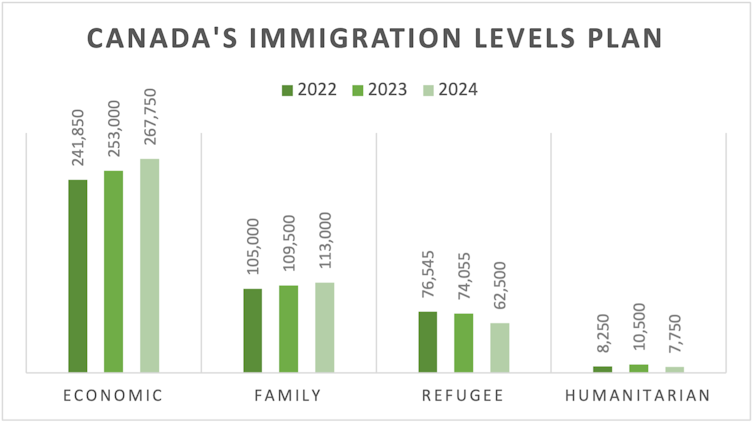
Usher: Backlash on international students to fund our system

Nugget in Usher’s year-end summary:

The second take-away from this year is the backlash against using international students to fund our system.  This is mainly because the higher rents in communities bordering the institutions most active in this scene are (correctly, I think) seen as a tax on non-home-owners being imposed for the dubious privilege of having a college or university in the neighborhood.  I’ve heard via the grapevine (because of course no official data will be available for another 18 months) that international students now make up 45% of the student body in Ontario colleges. Everyone (and I mean everyone) knows the current path is madness, but no one wants to be the first to leave the race for all those easy, easy dollars. Saner minds will eventually prevail on international students – ones that will try to focus on improving the quality of international education rather than the MOAR MOAR MOAR of the last few years – and when that happens, everyone will wonder how we allowed things to get out control in the first place.

Source: https://higheredstrategy.com/sayonara-2022/