For Hong Kongers, Canada is the beaten path out of China’s iron grip

While the number of returnees will be hard to determine, any new wave of Hong Kong immigrants will be captured by regular IRCC and related StatsCan data (1,545 in 2019, the last full year before COVID-19):

A second generation of Hong Kongers is heading to Vancouver and other Canadian cities for refuge from political uncertainty, but unlike their parents in the 1980s and 1990s, this time the move seems for good.

Cities such as Vancouver and Toronto are a magnet for those looking to escape as China tightens its grip on the territory of 7.5 million people. Some 300,000 already have Canadian citizenship after many families initially moved there before Hong Kong’s return from British to Chinese rule in 1997.

Source: For Hong Kongers, Canada is the beaten path out of China’s iron grip
Is ‘Cancel Culture’ The Future Of The GOP?

A reminder that “cancel culture,” like virtue signalling, identity politics, snowflakes and the like are common to both the right and left, just the targets being different:

“Cancel culture” is everywhere.

No, not cancel culture the phenomenon (that is, if you believe it is a phenomenon, an opinion that is itself contentious). Rather, “cancel culture” is everywhere — as in, the phrase that inundates you lately when you listen to a political speech or turn on cable news.

The phrase is so pervasive that it’s arguably background noise in American politics now — just part of the wallpaper, a pair of words you might easily (or, depending on your feelings, happily) breeze past every day without paying it any attention.

Republicans have for a long time used the phrase “cancel culture” to criticize the left. But lately they have seized on it aggressively, at times turning it on each other.

Ohio Rep. Jim Jordan has been defending his fellow Republican, Georgia Rep. Marjorie Taylor Greene, as she was stripped of her House committee assignments following her support of conspiracy theories including QAnon, as well as racist social media posts.​

“Everyone has said things they wish they didn’t say. Everyone has done things they wish they didn’t do,” Jordan said. “So who’s next? Who will the cancel culture attack next?”

The cancel culture attacks also came from moderates toward more conservative Republicans. Illinois Rep. Adam Kinzinger slammed Florida Rep. Matt Gaetz recently for the Donald Trump loyalist’s attacks on House GOP conference chair Liz Cheney of Wyoming, who voted to impeach the former president.​

“If you look at Matt Gaetz going to Wyoming, because — what — a tough woman has an independent view and he doesn’t want to go out and explain why he didn’t vote for impeachment?,” Kinzinger told NBC’s Chuck Todd. “That’s totally GOP cancel culture!”

Greene and Cheney, of course, still have congressional seats and sizable social media followings, and they appear regularly on national television. All of which raises the question of what exactly it means to be “canceled.”

In about half a decade, the phrase has gone from its slang origins to being laden with partisan political baggage. And the recent GOP fixation on cancel culture is, for some, a sign of a party that has strayed from its core tenets.

Where did “cancel” come from?

Six or seven years ago, the idea of “canceling” someone was largely used among younger people online, particularly on Black Twitter, as Vox’s Aja Romano has explained.

In that usage, “cancel” refers to a pretty unremarkable concept, says Nicole Holliday, assistant professor of linguistics at the University of Pennsylvania.

“It is used to refer to a cultural boycott,” she said. “We’ve had the term ‘boycott’ forever and ever. It just means, ‘I’m not going to put my attention or money or support behind this person or organization because they’ve done something that I don’t agree with.’ That is not new, that’s very old.”

In other words, it was just the marketplace of ideas at work.

But as the concept gained popularity, concerns grew, particularly among media and political elites, about the threat of online mobs shutting down speech. That perceived punitive atmosphere came to be known as “cancel culture,” and people on the left were often accused of perpetuating it.

“If people say, ‘hey, I personally don’t like this person, so I’m not going to buy the products,’ that’s one thing,” said Yascha Mounk, a political scientist and creator of the newsletter Persuasion, which has decried so-called “cancel culture.”

“But a lot of it is concerted efforts to force institutions to de-platform people,” he said. “It’s firing people for imagined or very minor offenses because of sort of online media mobs and so on.”

Mounk is especially concerned about the fact that even non-public figures have lost jobs as a result of online pile-ons, as he detailed in The Atlantic. To him, that is a clear sign things have gone too far.

The idea of a “cancel culture” is inherently controversial. What one person might see as being canceled for controversial statements, another might see as being held accountable for offensive or harmful views.

But now, even to some who decry “cancel culture” as a problem, the phrase has been overstretched to defend people like Marjorie Taylor Greene who have expressed offensive and violent views.

Mona Charen is policy editor at the right-leaning magazine The Bulwark, and worries people “canceling” each other stifles free expression. She wrote, for example, in defense of former New York Times writer Bari Weiss, after Weiss became the focus of the “cancel culture” debate when she resigned from the paper after outcry over some of her writings and online statements.

While Charen still worries about that, she also feels the phrase “cancel culture” has outgrown its usefulness.

“Honestly, I think we should probably retire the phrase ‘cancel culture’ at this point, because it’s losing its meaning when people just use it to mean, ‘I resent your drawing attention to my crazy ideas,'” she said.

Cancel culture and the GOP’s future

With the constant repetition of the phrase “cancel culture,” the idea of “cancellation” has strayed from what it once stood for.

Simultaneously, the GOP’s cancel culture fixation may be seen as a sign that the party is straying from what it once stood for, and instead fixating on non-substantive debates.

“There truly were 15 years ago differences of policy for which people would say, ‘Hey,’ for instance, ‘Arlen Specter, at what point are you still a Republican? Because you believe a lot of things that are counter to what many conservatives and many people who animate the party believe,'” said conservative author and CNN commentator Mary Katharine Ham.

Specter was a moderate Republican senator who eventually became a Democrat. In contrast, Ham points to the Arizona GOP’s recent decision to censure several of its most visible members, including conservative Arizona Gov. Doug Ducey.

“​Now, the condemnations in Arizona are for Doug Ducey and others not being sufficiently helpful to President Trump and those who support him,” she said.

In Ham’s opinion, yes, liberals have a cancel culture problem (and some liberals would counter that cancel culture doesn’t exist). But with GOP members censuring each other, Ham believes the right now has a cancel culture problem, too. And furthermore, that it translates to a numbers problem, if attacking each other means pushing away voters in a swing state like, say, Arizona.

Ham says it’s not clear how this tone might ever change from a fixation on a “cancel culture” war back to tenets like limited government and lower taxes.​

“Would I love to get back to talking about policy? Sure, but there is to some extent a need to recognize that that might not be what your voters want,” she said. “The way that social media is structured, you get a payout for high emotion, for clickability. And your 40-point tax plan is not emotional or clickable.”

The right shows no sign of letting go of attacking “cancel culture” on the left, either. It was even invoked by former President Trump’s lawyer in the impeachment trial on Tuesday.

And when the annual Conservative Political Action Conference is held later this month, it will be with theme: “America Uncanceled.”

Linguistic evolution and devolution

Language gets stretched like this all the time, UPenn’s Nicole Holliday says. In fact, there’s a term for it: “semantic bleaching.”​

“Semantic bleaching kind of refers to the process where words don’t have the meaning they had before,” she said. “They kind of come to mean nothing or something that is purely pragmatic, like just functional, but not really like laden with meaning.

“Semantic bleaching” has happened for nonpolitical words, like “literally,” and more political phrases, like “politically correct” and “woke” (a word NPR’s Sam Sanders eulogized in 2018).

As with the word “cancel,” both of those terms went from their original meaning to being political weapons used by people claiming concerns about free expression. Political correctness, for example, was an in-joke among liberals before it was a political cudgel.

“In the 70s and 80s, it was originally used by leftists kind of to make fun of themselves,” Holliday explains. “By the time it entered the mainstream in the 90s, everybody was using it as sort of an attack. It wasn’t any longer in the community that it originated in. And then I think we’re seeing the same thing kind of with ‘cancel.'”

“Cancel,” “woke,” and “political correctness” all also happen to be phrases that can be (and have been) used to sincerely debate the best way for a society to be inclusive. But that also is perhaps what made them so easily weaponizable: those original usages imply that there are ideas or words that are not inclusive — that for discourse be inclusive, some speech has to be excluded.

And that idea is bound to get some people very angry in a country that deeply prizes free speech, but does not agree on what “free speech” means.

Source: Is ‘Cancel Culture’ The Future Of The GOP?

Polish court rebukes Canadian historian for defaming alleged Nazi collaborator

Sigh….

A Polish court order that an eminent Canadian historian and his co-editor apologize for suggesting a man helped kill Jews during the Second World World has angered Jewish human rights activists in Canada and abroad.

They say the ruling against Jan Grabowski and Barbara Engelking is part of an ongoing effort to obscure Polish complicity in the genocide of Jews during the Holocaust.

Michael Levitt, head of Toronto-based Friends of Simon Wiesenthal Center for Holocaust Studies, called the ruling shocking and shameful.

“Poland cannot continue to bury the facts and silence Holocaust scholars,” Levitt said. “Its actions must be roundly rejected by Canada and the rest of the international community.”

The group said it was reaching out to senior government leaders urging them to speak out against “Holocaust distortion in Poland.”

At issue was a short passage in a 1,600-page book “Night Without End: The Fate of Jews in Selected Counties of Occupied Poland,” co-edited by Grabowski, a professor at the University of Ottawa, and Engelking, director of the Polish Center for Holocaust Research in Warsaw.

According to the passage, which Engelking wrote, Edward Malinowski robbed a Jewish woman during the war and contributed to the deaths of 22 other Jews hiding in a forest in Malinowo in Nazi-occupied Poland in 1943.

Malinowski’s niece, Filomena Leszczynska, 81, argued her uncle was a Polish hero who had saved Jews, and that the scholars had defamed her and her family. She demanded a retraction and 100,000 zlotys – about C$34,000 – in compensation.

Judge Ewa Jonczyk, of the District Court in Warsaw, ordered the authors to make a written apology for “providing inaccurate information” and “violating his honour.” The judge, however, stopped short of imposing monetary compensation, saying it could hinder academic research.

Nevertheless, Mark Weitzman, with the Los Angeles-based Simon Wiesenthal Center, said the ruling opened the door to further intimidation of Holocaust scholars and researchers.

“By ordering the scholars to ‘apologize,’ it puts both historians and victims on trial, and offers protection to the reputations of Poles and others who collaborated in the murder of Jews,” Weitzman said

Grabowski could not be reached for comment, although Engelking said they planned an appeal.

Grabowski, whose work on the Holocaust has attracted death threats, told The Canadian Press in 2017 that he would not allow fierce criticism of his research in Poland to deter him.

“I feel personally attacked but this is for me a much more dangerous and general problem that has to be dealt with,” Grabowski said. “It’s a pure and simple attack on basic academic freedoms, which we take for granted here in Canada. I’m dismayed.”

The Nazis slaughtered about three million Jews and another two million Christians in Poland during the war. While many Poles resisted the invaders, others collaborated with the Nazis.

Leszczynska was backed by the Polish League Against Defamation, a group that fights harmful and untruthful depictions of Poland. The league, which has previously attacked Grabowski’s work, is ideologically aligned with the ruling nationalist Law and Justice Party.

The researchers, however, viewed the case as an attempt to discredit their overall findings and discourage other researchers from investigating the truth about Polish involvement in the German mass murder of Jews.

Source: Polish court rebukes Canadian historian for defaming alleged Nazi collaborator

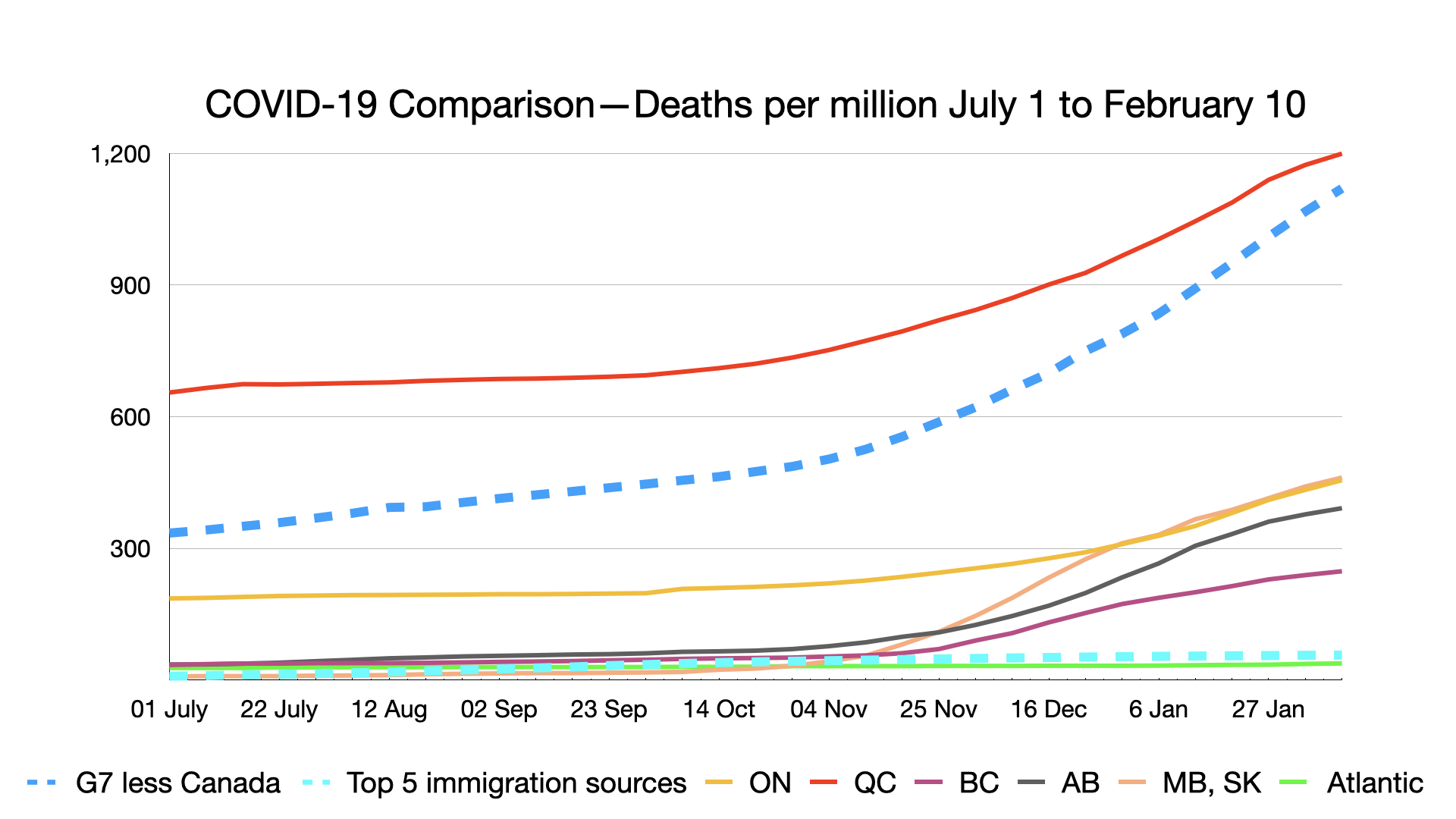
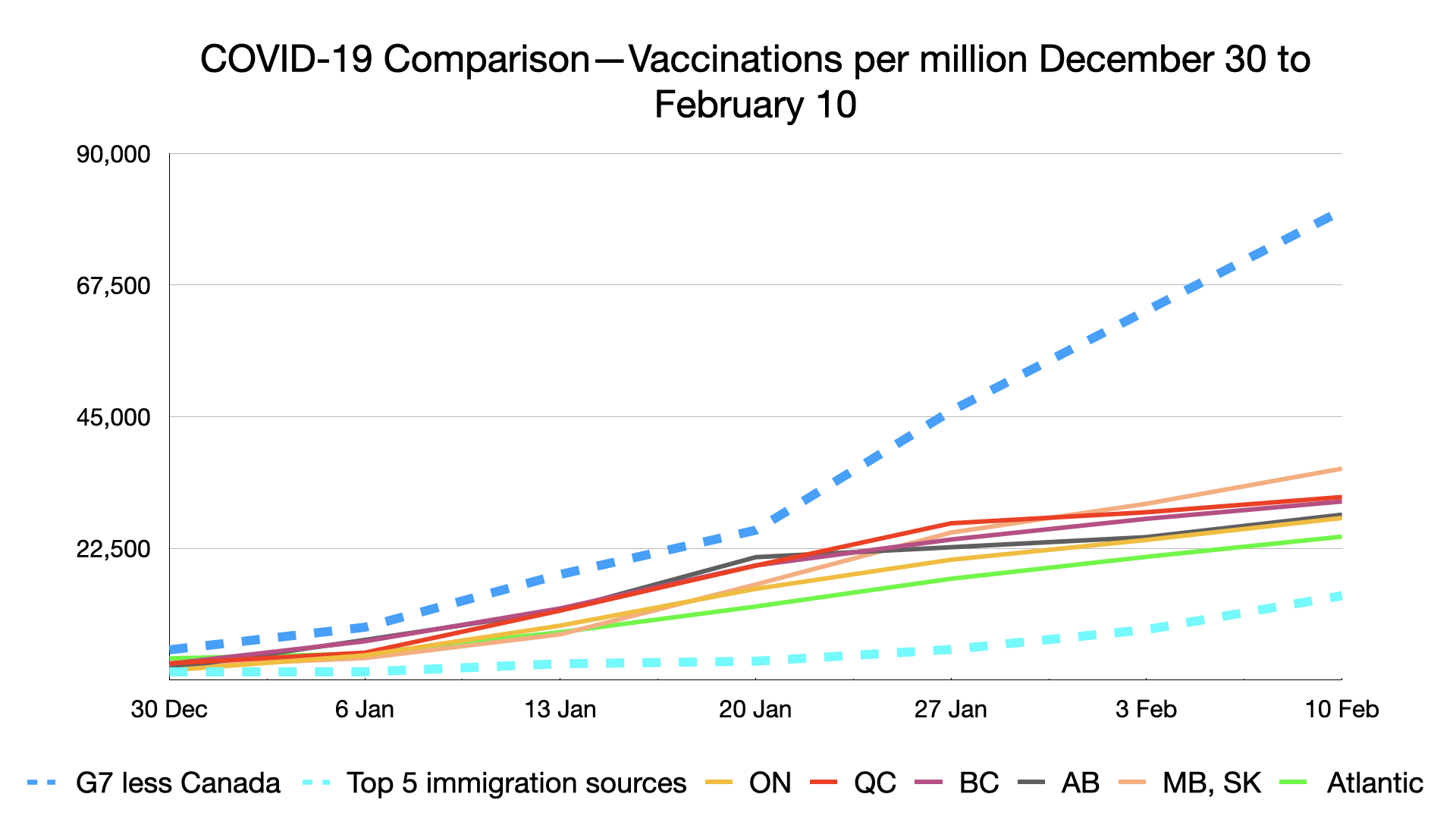
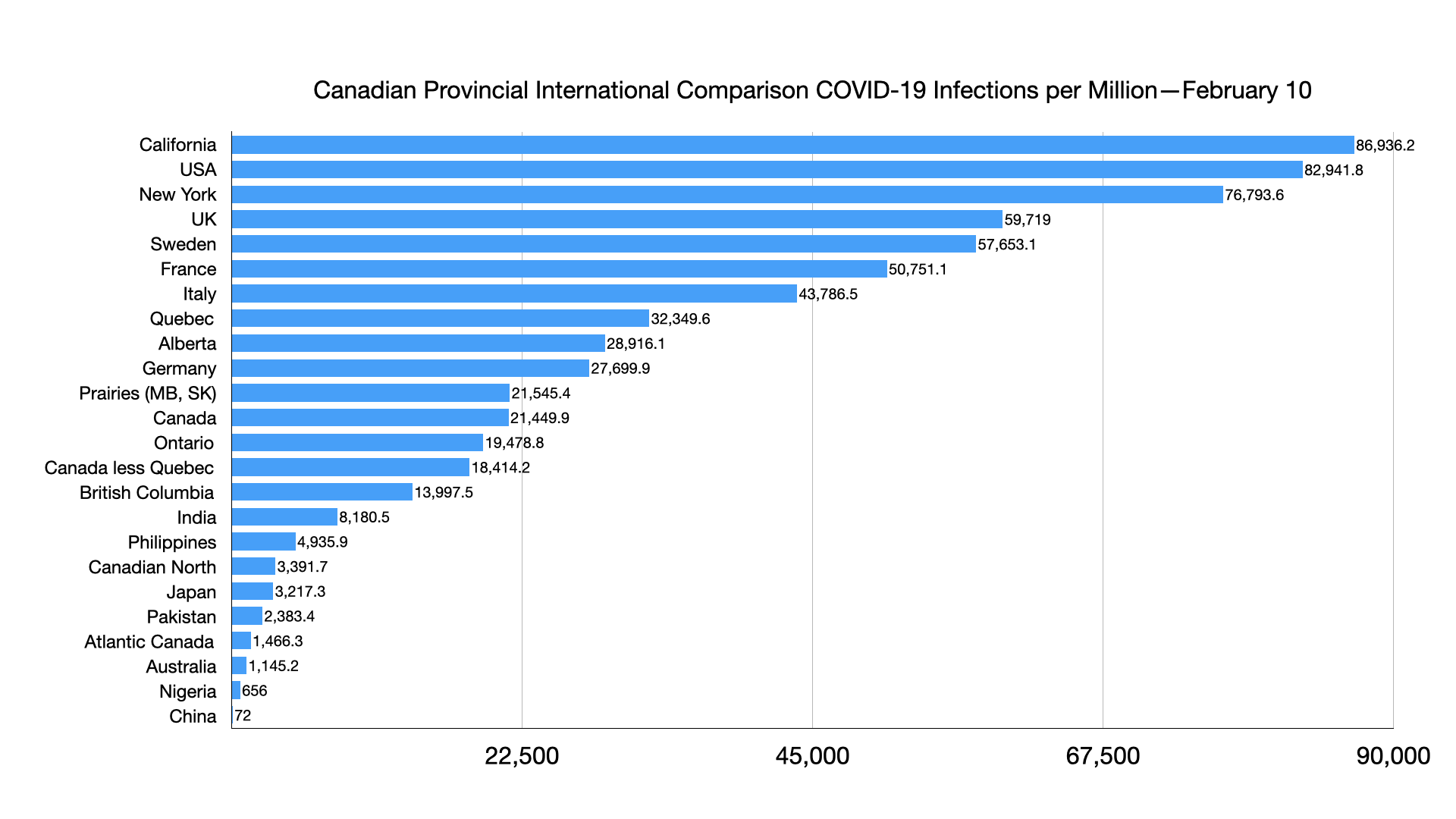
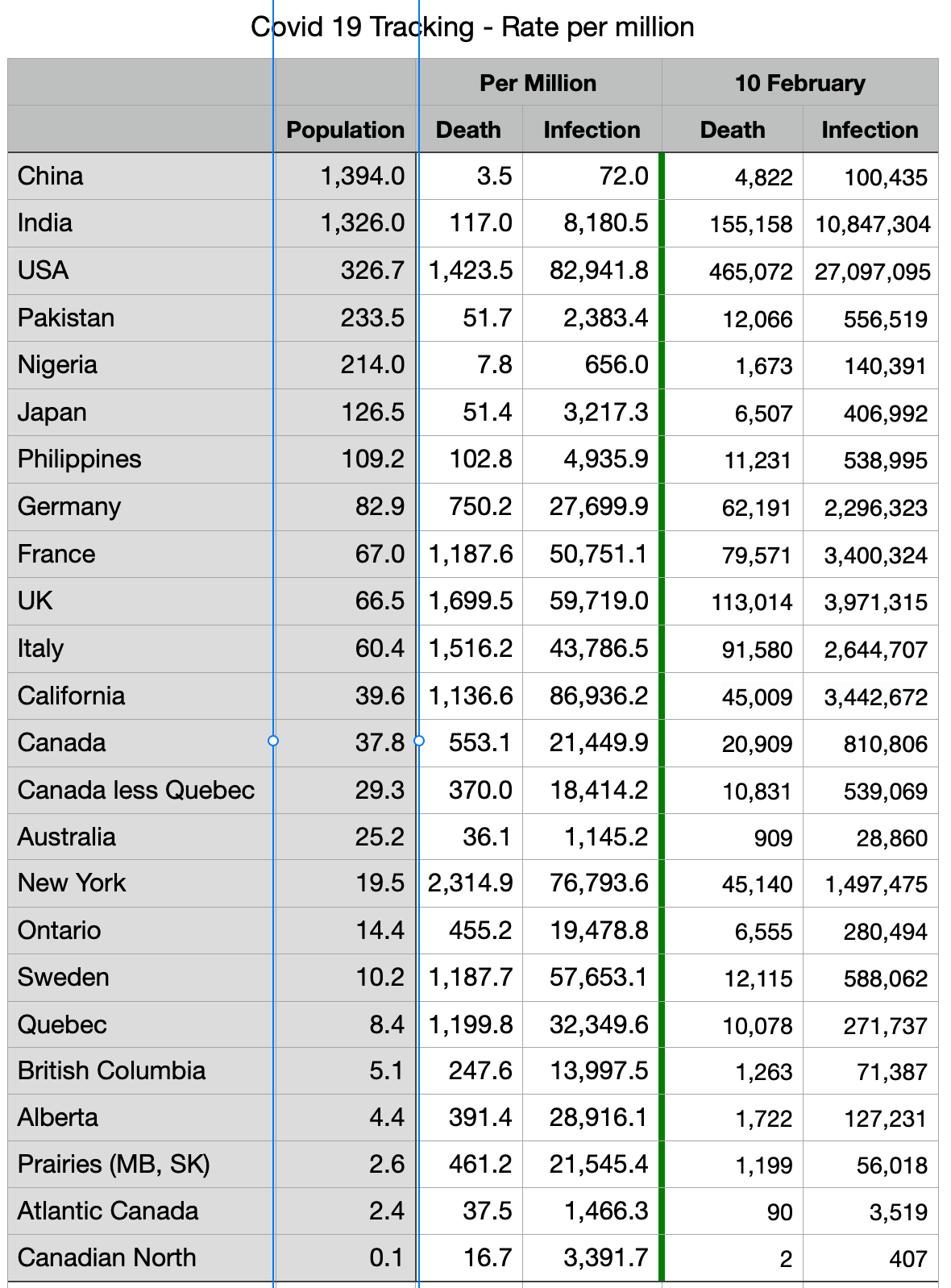
#COVID-19: Comparing provinces with other countries 10 February Update

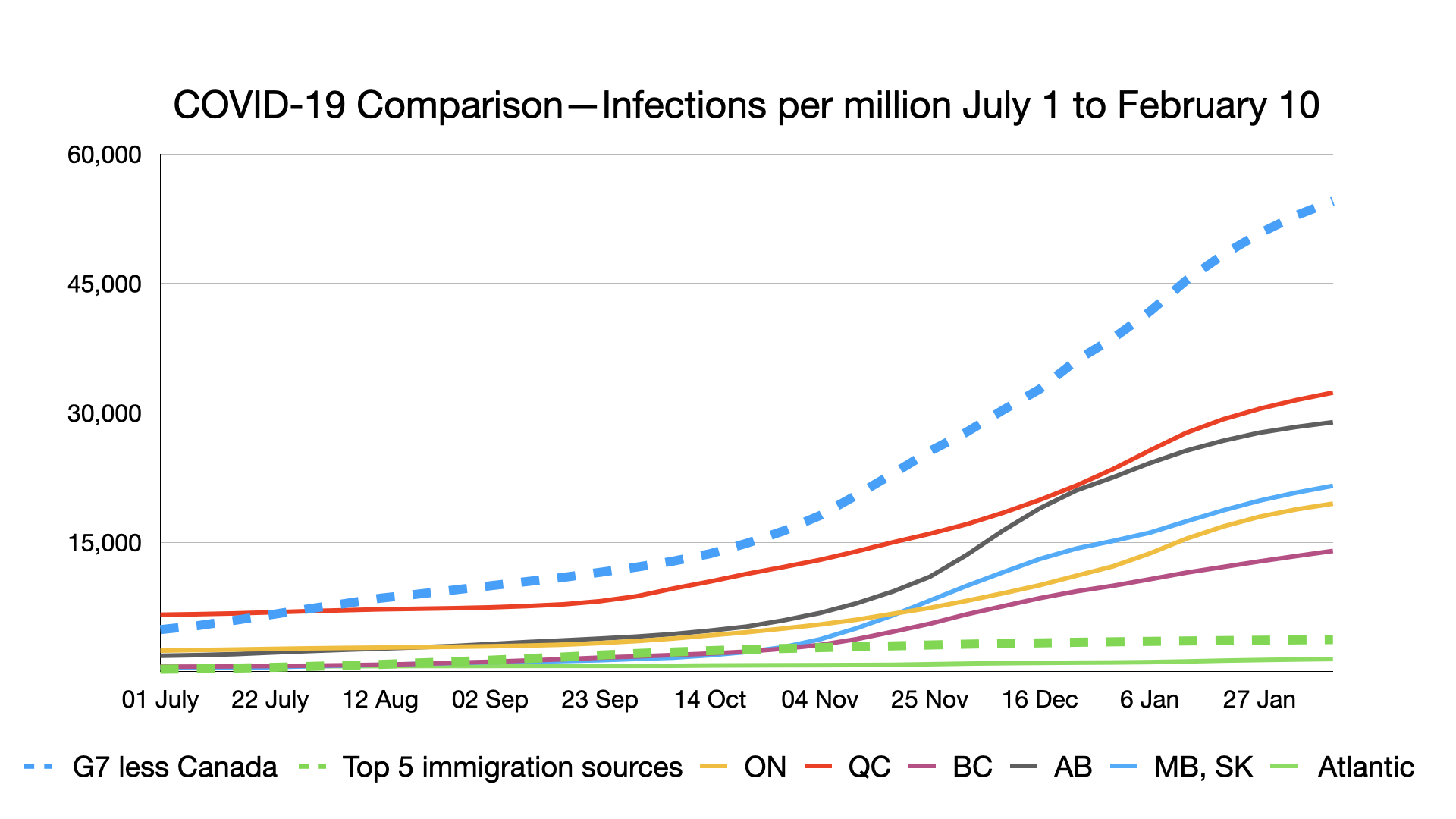
The latest charts, compiled 10 February.

Vaccinations: The gap between the leading G7 countries (UK, USA) and other EU countries continues to grow given the pause in deliveries to Canada, with the notable exception of the Canadian North and the Prairies behind slightly ahead of France.

Trendline charts

Infections per million: Alberta continues to be controlling the virus better than Quebec.

Deaths per million: G7 continues to close in on Quebec, Prairies continue to have similar rates to Ontario with Alberta death rates tapering off compared to Ontario and Prairies.

Vaccinations per million: Gap between G7 and Canada, driven by UK and USA, continues to widen. While not on the chart, Canadian North (NWT, Yukon and Nunavut) have the highest vaccination rates overall.

Weekly

Infections per million: Prairies move ahead of Canada total

Deaths per million: France marginally ahead of Sweden.

We are not visible minorities; we are the global majority

Debates over nomenclature divert attention from the substantive analysis of the disparities and differences between and among minority groups. Far better to analyse the reasons for such differences and possible policy responses to address them:

In the wake of the recent American insurrection, the federal government has now designated the Proud Boys and other white supremacist groups as terrorist entities. While this will make it harder for these groups to propagate their racist and hateful messages, we need to do much more to uproot the deeply embedded white supremacist foundations upon which Canada is built. 

Key to this is changing the way we think and talk about racialized people in this country. 

Many media outlets and government agencies like Statistics Canada still use the term “visible minority” to refer to non-Indigenous racialized people. Based on the official definition given in the federal Employment Equity Act, visible minority to refer to “persons, other than Aboriginal peoples, who are non-Caucasian in race or non-white in colour.”.

The problem with this term is that it constructs the identity of racialized people in relation to the dominant white population. Describing someone as a visible minority situates whiteness as the reference standard and the norm by which all people are judged. It is a term of disempowerment that promotes the othering of racialized peoples and implies subordination to white power structures. 

In this way, the continued use of visible minority works to sustain white supremacy. If we are to end white supremacy in this country, we need to change our discourse on race. This requires changing the way we think and speak about Canada’s racialized population. 

Instead of visible minority, we propose that government agencies and media outlets adopt the term “global majority” to refer to Canada’s racialized population. Global majority is a collective term that encourages those of African, Asian, Latin American, and Arab descent to recognize that together they comprise the vast majority (around 80 per cent) of people in the world. Understanding the truth that whiteness is not the global norm has the power to disrupt and reframe our conversations on race. 

The term global majority was coined by one of us (Campbell-Stephens) during a long career as an educator in the United Kingdom. Between 2003 and 2011, when working to address the underrepresentation of Black and Asian leaders in London schools, I recognized the need to reframe the dominant discourse on race in a way that would be affirming for racialized groups. 

Historically, it has been white people, specifically white men, who have held the power to categorize people in relation to themselves. This elite group never defined themselves for the minority they are, and instead acted with the confidence of a majority. 

But that time is coming to an end. Consequently, we should put an end to the language from this era and seek new affirming possibilities for those who have historically been marginalized. 

It is also worth noting that white Canadians of European decent, or “old-stock Canadians” as put by former prime minister Stephen Harper, will soon be a minority even within the borders of this very country. Indeed, in 2017 Statistics Canada projected that in less than two decades, half of the Canadian population will either be immigrants or the children of immigrants, most of Asian descent. 

As put by The Globe and Mail, by 2036, Canada will be “as brown as it is white.” It is this that strikes fear in the hearts of white supremacist groups like the Proud Boys who dread the day when they are no longer the dominant power brokers in society. 

Sustaining whiteness while it is in its death throes requires the continuation of deficit narratives that minorities, problematizes, and delegitimizes racialized people. Correctly describing the global majority as such, disrupts this narrative and moves racialized people from the margins to the centre. In the quest to end white supremacy, the time has come to recognize that we are not visible minorities. We are the global majority.

Source: https://www.thestar.com/opinion/contributors/2021/02/09/we-are-not-visible-minorities-we-are-the-global-majority.html

@MosaicInstitute: Through Our Eyes: Understanding the Impact of Online Hate on Ontario Communities

While not representative as organizations and individuals were invited, nevertheless the highlights from the interim report are interesting:

  • 92% of respondents felt uncomfortable because of negative on social media about their race and/or ethnic origin.
  • 42% of people felt unsafe because of negative on social media about their race and/or ethnic origin.
  • 76% of respondents had witnessed online hate speech towards Black, Indigenous, Jewish and/or Muslim communities.
    • Only 25% of people think that social media posts promoting physical violence against Black, Indigenous, Jewish, and Muslims communities are not increasing.
    • Most people who identify as Black, Indigenous, Jewish, or Muslim either feel unsafe or aren’t sure if they feel safe responding to offensive content online
    • Most people think that there is more harmful than helpful content about minorities on social media
  • 38% of Black, Indigenous, Jewish, and Muslim respondents felt unsafe due to somethingthe experienced online
  • 24% of respondents knew someone who had experienced online hate with respect to COVID-19
  • 1 in 5 respondents sought mental health support due to experiences with online hate
  • Respondents generally feel that social media is a public place, and therefore subject to Canadian law
  • Only 35% think that people should be allowed to send any kind of message that they want, regardless of whether it is discriminatory

Source: https://mosaicadmin.hypertextlabs.com/uploads/KEY_FINDINGS_Through_Our_Eyes_Research_The_Mosaic_Institute_59145c82f2.pdf

France’s New Public Enemy: America’s Woke Left

As noted in the article, the irony is that “many of the leading thinkers behind theories on gender, race, post-colonialism and queer theory came from France:”

The threat is said to be existential. It fuels secessionism. Gnaws at national unity. Abets Islamism. Attacks France’s intellectual and cultural heritage.

The threat? “Certain social science theories entirely imported from the United States,’’ said President Emmanuel Macron.

French politicians, high-profile intellectuals and journalists are warning that progressive American ideas — specifically on race, gender, post-colonialism — are undermining their society. “There’s a battle to wage against an intellectual matrix from American universities,’’ warned Mr. Macron’s education minister.

Emboldened by these comments, prominent intellectuals have banded together against what they regard as contamination by the out-of-control woke leftism of American campuses and its attendant cancel culture.

Pitted against them is a younger, more diverse guard that considers these theories as tools to understanding the willful blind spots of an increasingly diverse nation that still recoils at the mention of race, has yet to come to terms with its colonial past and often waves away the concerns of minorities as identity politics.

Disputes that would have otherwise attracted little attention are now blown up in the news and social media. The new director of the Paris Opera, who said on Monday he wants to diversify its staff and ban blackface, has been attacked by the far-right leader, Marine Le Pen, but also in Le Monde because, though German, he had worked in Toronto and had “soaked up American culture for 10 years.”

The publication this month of a book critical of racial studies by two veteran social scientists, Stéphane Beaud and Gérard Noiriel, fueled criticism from younger scholars — and has received extensive news coverage. Mr. Noiriel has said that race had become a “bulldozer’’ crushing other subjects, adding, in an email, that its academic research in France was questionable because race is not recognized by the government and merely “subjective data.’’ 

The fierce French debate over a handful of academic disciplines on U.S. campuses may surprise those who have witnessed the gradual decline of American influence in many corners of the world. In some ways, it is a proxy fight over some of the most combustible issues in French society, including national identity and the sharing of power. In a nation where intellectuals still hold sway, the stakes are high.

With its echoes of the American culture wars, the battle began inside French universities but is being played out increasingly in the media. Politicians have been weighing in more and more, especially following a turbulent year during which a series of events called into question tenets of French society.

Mass protests in France against police violence, inspired by the killing of George Floyd, challenged the official dismissal of race and systemic racism. A #MeToo generation of feminists confronted both male power and older feminists. A widespread crackdownfollowing a series of Islamist attacks raised questions about France’s model of secularism and the integration of immigrants from its former colonies.

Some saw the reach of American identity politics and social science theories. Some center-right lawmakers pressed for a parliamentary investigation into “ideological excesses’’ at universities and singled out “guilty’’ scholars on Twitter.

Mr. Macron — who had shown little interest in these matters in the past but has been courting the right ahead of elections next year — jumped in last June, when he blamed universities for encouraging the “ethnicization of the social question’’ — amounting to “breaking the republic in two.’’

“I was pleasantly astonished,’’ said Nathalie Heinich, a sociologist who last month helped create an organization against “decolonialism and identity politics.’’ Made up of established figures, many retired, the group has issued warnings about American-inspired social theories in major publications like Le Point and Le Figaro.

For Ms. Heinich, last year’s developments came on top of activism that brought foreign disputes over cultural appropriation and blackface to French universities. At the Sorbonne, activists prevented the staging of a play by Aeschylus to protest the wearing of masks and dark makeup by white actors; elsewhere, some well-known speakers were disinvited following student pressure.

“It was a series of incidents that was extremely traumatic to our community and that all fell under what is called cancel culture,’’ Ms. Heinich said.

To others, the lashing out at perceived American influence revealed something else: a French establishment incapable of confronting a world in flux, especially at a time when the government’s mishandling of the coronavirus pandemic has deepened the sense of ineluctable decline of a once-great power.

“It’s the sign of a small, frightened republic, declining, provincializing, but which in the past and to this day believes in its universal mission and which thus seeks those responsible for its decline,’’ said François Cusset, an expert on American civilization at Paris Nanterre University.

France has long laid claim to a national identity, based on a common culture, fundamental rights and core values like equality and liberty, rejecting diversity and multiculturalism. The French often see the United States as a fractious society at war with itself.

But far from being American, many of the leading thinkers behind theories on gender, race, post-colonialism and queer theory came from France — as well as the rest of Europe, South America, Africa and India, said Anne Garréta, a French writer who teaches literature at universities in France and at Duke.

“It’s an entire global world of ideas that circulates,’’ she said. “It just happens that campuses that are the most cosmopolitan and most globalized at this point in history are the American ones. ’’

The French state does not compile racial statistics, which is illegal, describing it as part of its commitment to universalism and treating all citizens equally under the law. To many scholars on race, however, the reluctance is part of a long history of denying racism in France and the country’s slave-trading and colonial past.

“What’s more French than the racial question in a country that was built around those questions?’’ said Mame-Fatou Niang, who divides her time between France and the United States, where she teaches French studies at Carnegie Mellon University.

Ms. Niang has led a campaign to remove a fresco at France’s National Assembly, which shows two Black figures with fat red lips and bulging eyes. Her public views on race have made her a frequent target on social media, including of one of the lawmakers who pressed for an investigation into “ideological excesses’’ at universities.

Pap Ndiaye, a historian who led efforts to establish Black studies in France, said it was no coincidence that the current wave of anti-American rhetoric began growing just as the first protests against racism and police violence took place last June.

“There was the idea that we’re talking too much about racial questions in France,’’ he said. “That’s enough.’’

Three Islamist attacks last fall served as a reminder that terrorism remains a threat in France. They also focused attention on another hot-button field of research: Islamophobia, which examines how hostility toward Islam in France, rooted in its colonial experience in the Muslim world, continues to shape the lives of French Muslims.

Abdellali Hajjat, an expert on Islamophobia, said that it became increasingly difficult to focus on his subject after 2015, when devastating terror attacks hit Paris. Government funding for research dried up. Researchers on the subject were accused of being apologists for Islamists and even terrorists.

Finding the atmosphere oppressive, Mr. Hajjat left two years ago to teach at the Free University of Brussels, in Belgium, where he said he found greater academic freedom.

“On the question of Islamophobia, it’s only in France where there is such violent talk in rejecting the term,’’ he said.

Mr. Macron’s education minister, Jean-Michel Blanquer, accuseduniversities, under American influence, of being complicit with terrorists by providing the intellectual justification behind their acts.

A group of 100 prominent scholars wrote an open letter supporting the minister and decrying theories “transferred from North American campuses” in Le Monde.

A signatory, Gilles Kepel, an expert on Islam, said that American influence had led to “a sort of prohibition in universities to think about the phenomenon of political Islam in the name of a leftist ideology that considers it the religion of the underprivileged.’’

Along with Islamophobia, it was through the “totally artificial importation’’ in France of the “American-style Black question” that some were trying to draw a false picture of a France guilty of “systemic racism’’ and “white privilege,’’ said Pierre-André Taguieff, a historian and a leading critic of the American influence.

Mr. Taguieff said in an email that researchers of race, Islamophobia and post-colonialism were motivated by a “hatred of the West, as a white civilization.’’

“The common agenda of these enemies of European civilization can be summed up in three words: decolonize, demasculate, de-Europeanize,’’ Mr. Taguieff said. “Straight white male — that’s the culprit to condemn and the enemy to eliminate.”

Behind the attacks on American universities — led by aging white male intellectuals — lie the tensions in a society where power appears to be up for grabs, said Éric Fassin, a sociologist who was one of the first scholars to focus on race and racism in France, about 15 years ago.

Back then, scholars on race tended to be white men like himself, he said. He said he has often been called a traitor and faced threats, most recently from a right-wing extremist who was given a four-month suspended prison sentence for threatening to decapitatehim.

But the emergence of young intellectuals — some Black or Muslim — has fueled the assault on what Mr. Fassin calls the “American boogeyman.’’

“That’s what has turned things upside down,’’ he said. “They’re not just the objects we speak of, but they’re also the subjects who are talking.’’

Source: https://www.nytimes.com/2021/02/09/world/europe/france-threat-american-universities.html?action=click&module=Top%20Stories&pgtype=Homepage

ICYMI: Hong Kong to teach elementary students about subversion and foreign interference

Yet another sign of the Chinese regime’s crackdown on Hong Kong:

Hong Kong has unveiled controversial guidelines for schools that include teaching students as young as six about colluding with foreign forces and subversion, as part of a new national security curriculum.

Beijing imposed a security law on Hong Kong in June 2020 in response to months of often violent anti-government and anti-China protests in 2019 that put the global financial hub more firmly on an authoritarian path.

The Education Bureau’s guidelines, released late on Thursday, show that Beijing’s plans for the semi-autonomous Hong Kong go beyond quashing dissent, and aim for a societal overhaul to bring its most restive city more in line with the Communist Party-ruled mainland.

Source: Hong Kong to teach elementary students about subversion and foreign interference

Trump And Miller Left Biden With Unfinished Immigration Business

Of note:

Donald Trump, Stephen Miller and the rest of the Trump immigration squad left the Biden administration with a lot of unfinished business, only some of which has garnered newspaper headlines. The Biden administration has moved quickly on several high-profile issues, including protection for refugees and DACA (Deferred Action for Childhood Arrivals) recipients. However, the list of immigration issues that requires attention after four years is long. Below are some of the most significant issues.

Stephen Miller’s Department of Labor Rule: Jyoti Bansal came to America on an H-1B visa. “I waited seven years for my employment-based green card [due to the per-country limit] and I wanted to leave my job and start a new company but couldn’t,” Bansal told me in an interview. “What is most frustrating about the green card process is you have no control over a major part of your life.”

In the final days of Donald Trump’s term, as part of a longstanding goal to price out of the U.S. labor market employment-based immigrants, international students and H-1B visa holders, White House adviser Stephen Miller and other members of the Trump immigration team pushed through a final rule on wages from the Department of Labor (DOL). The rule would significantly boost the required minimum or “prevailing” wage employers must pay employment-based immigrants and H-1B visa holders by 24% to 40% across a range of occupations, according to an analysis by the National Foundation for American Policy.

If the DOL rule had been in effect years ago, Jyoti Bansal likely would never have been able to come to America, nor would the many people who played critical roles in developing the Covid-19 vaccines and came to (or remained in) America on H-1B visas and employment-based green cards.

In 2007, Bansal received an employment authorization document (EAD) as part of the green card process. He later left his employer and started AppDynamics. The company, which monitors websites for clients such as HBO, has grown to employ over 2,000 people and was valued at $3.7 billion when Cisco acquired it in 2017.

The DOL final rule cites Donald Trump’s anti-immigration “Buy American and Hire American” executive order for the regulation’s “justification,” its “need” and the “Objectives of and Legal Basis for the Final Rule.” However, on January 25, 2021, President Biden revoked Trump’s “Buy American and Hire American” executive order. In other words, the authority cited for the DOL final rule by Trump’s Department of Labor no longer exists. The nation’s leading anti-immigration group, which has called for a “permanent pause” on immigration to America, has praised the DOL rule. This should not be a difficult choice for the Biden administration on what to do with the rule.

An Agenda on International Students: It is too soon to expect a full agenda from the Biden administration on international students. Rescinding the DOL wage rule would help attract students, since the rule makes it far less likely international students could get a work visa or permanent residence in the United States. There are other pressing student issues.

First, processing delays in Optional Practical Training (OPT) have bedeviled international students, particularly at the Texas Service Center Lockbox. Without a receipt, students can lose their status. (Attorneys have reported some improvements.) The Biden administration disbanded a last-minute effort by the Trump administration to establish a new unit to go after international students working on OPT, which may facilitate more targeted enforcement against bad actors, rather than a generalized effort against all students working on OPT.

Second, the Trump administration’s student policies left in place from 2020 may need to be adapted to the current situation. “After a concerted advocacy effort by the higher education community, the U.S. Department of Homeland Security (DHS) stated that international students should ’continue to abide’ by emergency pandemic guidance that allows them to take all or some of their courses online,” according to a letter from the Presidents’ Alliance on Higher Education and Immigration to Immigration and Customs Enforcement (ICE). “We strongly support this guidance because without it, a large number of international students still in the United States during the pandemic would have had to take classes in person or leave–neither tenable as COVID cases rise and the pandemic is still prevalent.

“However, DHS has still not issued additional guidance that would allow all international students, including those who were not already enrolled during the initial COVID-19 outbreak in March 2020 but have since enrolled or who will enroll, to enter and remain in the United States. Current guidance stipulates that if a new international student’s courses are online, they are prohibited from entering the United States or must depart the country. This policy is a substantial problem for programs with students living in different time zones.”

Universities would like updates to the policy, including “explicitly allowing initial international students to enter the country, as well as permitting existing students to remain in the United States when enrolled in online-only courses (as opposed to currently only allowing students enrolled in hybrid courses to enter).”

A recent survey found that during Fall 2020, “new enrollment of international students physically in the United States declined by 72%,” more than the 43% drop in foreign enrollment overall because students started online overseas.

If the Biden administration is looking for policy suggestions for a broader agenda on international students, NAFSA: Association of International Educators has put one together. The recommendations include a series of administrative and legislative actions to “establish a welcoming environment for international students and scholars.”

The Spouses of H-1B Visa Holders and Long USCIS Processing Times for Work Authorization: The Trump administration was unsuccessful in its plans to rescind the Obama administration’s rule on H-4 EAD (employment authorization document). A lawsuit (Kolluri v. USCIS) credibly alleges that USCIS put in place an unnecessary biometrics requirement to prevent the applicants, mostly women from India, from working in the United States. The California Service Center is taking up to two years to process an extension for work authorization. Another lawsuit charges current USCIS policies make it “mathematically” impossible for the spouses to continue working because extension applications cannot be processed in time.

Startup Visas and the International Entrepreneur Rule: The Biden administration’s outline on immigration legislation did not include a startup visa that would allow foreign nationals to gain green cards after demonstrating they have started a business that creates a threshold number of jobs. Congress can add that to any proposal. In the meantime, the administration can revive the International Entrepreneur Rule.

A letter from a coalition that includes the National Venture Capital Association, FWD.us, the Ewing Marion Kauffman Foundation, the National Immigration Forum and others asks DHS Secretary Alejandro N. Majorkas “to implement the International Entrepreneur Rule . . . . originally put in place at the end of the Obama Administration, would work similar to a Startup Visa by allowing world-class foreign entrepreneurs to launch high-growth companies in the United States by utilizing the parole authority of DHS.”

A new report from the Progressive Policy Institute finds implementing the International Entrepreneur Rule could lead to significant job creation. A study last year from the National Foundation for American Policy examined the international experience and concluded startup visas for foreign-born entrepreneurs can bring jobs and innovation to a country.

It may take years for the Biden administration to undo many of the immigration policies implemented over the last four years. Addressing some of the issues not making front-page news will improve the chances the effort will be successful.

Heather Scoffield: Waiting for COVID-19 vaccinations is no way to help jobless Canadians

Good overview with some breakdowns by visible minority groups and women:

It was never going to be “happy Friday” with new unemployment numbers for January on deck, but there were plenty of signs it was going to at least be “silver-lining Friday.”

Alas, it’s neither of those. The labour market in January was the bleak mid-winter we feared, especially if you’re young, or a person of colour, or female, or a part-timer — or, God forbid, all of those at once. And policy-makers seem poorly equipped to do much about it for now, except to counsel patience.

About 213,000 jobs disappeared in January as some of most populated areas in Canada — namely Ontario and Quebec — tightened up pandemic restrictions. It means that the second wave is taking a serious toll, eroding the employment gains of the summer and fall and making a quick recovery more elusive.

At our worst point last April, when a firm lockdown was in place, about 5.5 million people were without work or dealing with reduced hours because of the pandemic. Summer allowed many people to return to work or find new jobs, but we’ve lost ground in December and January. And now, there are still 1.4 million affected workers, many of them in the same groups of people who were hit by the first wave.

Canada’s unemployment rate rose to 9.4 per cent in January, up from 8.8 per cent in December.

Digging a bit deeper, Southeast Asians saw their unemployment rate rise by 7.6 percentage points in January to 20.1 per cent — one in five. Black Canadians are at 16.4 per cent unemployment, up 5.5 percentage points from a month earlier.

Of Black women who are holding onto their jobs, almost a third were working in the health-care sector, and a third of those were in low-paid positions such as orderlies or nurses’ aides. In other words, they are holding onto pandemic employment by taking on poorly paid and often dangerous positions.

Unemployment among young people rose 1.9 percentage points to 19.7 per cent, and the job losses were particularly striking among part-timers and working-age teenagers.

Women lost twice as many jobs as men in January, especially mothers of young children.

We’ve been here before. The first wave showed us the same disturbing patterns, as the pandemic restraints shut down businesses involved in accommodation, tourism, travel, arts and culture, and food services.

But there were some signs that maybe the second wave would be kinder, and that employers were learning how to roll with lockdowns and constantly changing constraints. More than 5.4 million people are working from home, the highest number ever. High-income jobs have stayed protected. Capital markets are surging, creating a wealth effect. Housing prices are up. Commodity prices are up. And the federal government has spent hundreds of billions of dollars trying to keep the economy afloat. Job postings, according to Indeed Canada, are looking a lot like they did a year ago, before the pandemic.

But solutions for workers in public-facing industries are few and far between.

“To state the obvious, we didn’t figure it out,” said Leah Nord, senior director of workforce strategies and inclusive growth at the Canadian Chamber of Commerce.

The Conservatives called the job losses “devastating,” and Leader Erin O’Toole committed to “charting a new course” that sees Canadians put to work by “reshoring” the manufacturing of our own essential goods, rather than importing them from China.

Prime Minister Justin Trudeau said the jobs report was “difficult” and, urging patience, pointed to all the income and business supports the federal government has provided to tide people over.

“We are there to support Canadians and we will continue to be until get through this, with income supports, with vaccines, with health measures, with the supports that people need,” he said.

But actual jobs while we continue to wait for the pandemic to be conquered? Not so much.

Business groups are pushing for the widespread adoption of rapid testing and contact tracing, so that public-facing firms can open up safely and bring their workforces back.

“We need to keep Canadians safe and working,” Nord says.

There’s no doubt that’s easier said than done. Contact tracing becomes cumbersome when case levels are high. And rapid tests can be clumsy and imprecise, leaving many provinces reluctant to deploy them widely. Nord also suggests more aggressive efforts to match job-seekers with job vacancies, and intense retraining programs for long-term unemployed people.

It’s clear that full-fledged recovery efforts can’t start until the pandemic is under control, and that’s certainly not imminent. In the meantime, we owe it to those same groups of unemployed people who are repeatedly pummelled by the pandemic to brainstorm some better answers.

Biding our time in the face of on-again-off-again vaccination schedules and new variants is not an answer.

Source: Heather Scoffield: Waiting for COVID-19 vaccinations is no way to help jobless Canadians