‘It’s a lot of lip service’: Black federal public servants hope ‘Floyd effect’ will finally drive change as anti-racism movement grips Canada

Didn’t know that the Public Service Employee Survey allowed this desegregation (not on public site so assume was special request).

Useful:

Black public servants, already more likely to report being victims of racial discrimination than the rest of the federal bureaucracy, are hoping the “Floyd effect” will help drive the changes for which they’ve spent years trying to gain traction.

“In some ways, this has had a positive effect in the amount of interest that it has generated and, you know, white people being woke for a moment in time about the realities of being Black in Canada and the rest of North America,” said Richard Sharpe, founder of the Federal Black Employee Caucus (FBEC).

Mr. Sharpe and FBEC have been inundated in the last couple of weeks with calls to speak to and help departments generate ideas to address anti-Black racism in their various organizations.

The documented killing of George Floyd in Minneapolis, Minn., by a police officer has affected white people and moved them to action to a scale Mr. Sharpe said he’s never seen in his lifetime. “We really feel a shift and we’re hoping to take advantage of that to make some progress on this work, maybe faster progress now that there’s some doors that have been opened for us,” he said.

Established in late 2017, FBEC’s primary objectives since its inception have been to get disaggregated employment equity data collected so that employees, employers, and policy-makers can all understand the landscape for Black federal bureaucrats, and to provide an element of support and unity for Black employees who are facing harassment and discrimination in the workplace.

It’s an issue Black public servants have long been raising, but now they’re starting to get some data to back it up. Last year, the annual Public Service Employee Survey for the first time allowed respondents to self-identify as a specific visible minority group, instead of all being lumped in to one category.

In a February interview with The Hill Times, Mr. Sharpe said FBEC had a role to play in making that happen. In the lead-up to the 2019 survey, the group met with 25 to 30 deputy ministers across the public service, he said, as well as the Public Service Management Advisory Committee.

Fifteen per cent of Black employees indicated they had been a victim of discrimination on the job in the past 12 months, compared to 11 per cent of non-Black visible minorities, and only eight per cent of the public service, overall.

Of those who said they had experienced discrimination, 75 per cent of Black employees said it was racial, compared to 52 per cent for non-Black visible minorities, and 26 per cent for the public service overall. A little more than half of the Black respondents who said they faced discrimination (54 per cent) said it was due to colour (30 per cent for non-Black visible minorities, 16 per cent overall). Black public servants who said they experienced discrimination were less likely than non-Black visible minorities to indicate it was discrimination based on national or ethnic origin—34 per cent of Black employees compared to 43 per cent for non-Black visible minorities.

For FBEC, the results were not surprising. Mr. Sharpe pointed to the fact that there are more than 13,000 people who Statistics Canada had said identified as Black who were working with or for the public service (including contractors). A little more than 6,200 of the 182,306 PSES respondents in 86 departments self-identified as Black in the survey, which was conducted between July 22 and Sept. 6, 2019.

Treasury Board President Jean-Yves Duclos (Québec, Que.) said the statistics are “proof that more information is not only needed, but is useful.” Speaking to The Hill Times after addressing FBEC’s Feb. 24 annual general meeting, Mr. Duclos said it’s “good news” that employees are now able to self-identify in the survey. “We can therefore work better and more effectively to address the challenges that are revealed by the study.”

Mr. Duclos said the numbers themselves, however, are “absolutely unacceptable,” and that the underlying conditions will be better understood with the data.

“And not only will we understand those conditions better, but we will also have the obvious responsibility to address those challenges, to make sure that things are changing,” he said. “Things have improved over the last years, but there is a lot more work to do and we’re totally committed to do it.”

In his remarks, Mr. Duclos—who hired the Trudeau government’s first Black chief of staff, Marjorie Michel—spoke of the federal government’s “broad policy and legislative framework” to support diversity and inclusion in the public service. Asked if, based on the baseline numbers of discrimination in the public service, there needs to be not a broad policy, but a very specific one for Black employees, Mr. Duclos said that in his current and previous portfolio (he was the families, children, and social development minister in the 42nd  Parliament) he frequently observed that diversity was not only a matter of justice and equity, but also one of efficiency, and led to better decision-making and better implementation those decisions.

“And the fact that Black employees tell us they are unable to be at their full potential is something of great concern to us,” he said. “I will certainly address those concerns and make sure that every federal employee, including Black employees, has the ability to make the fullest impact on our society.”

Black public servants ‘disappointed’ in lack of message from PCO

In the wake of Mr. Floyd’s death and the protests against anti-Black racism and police brutality that have exploded around the world, Mr. Sharpe said there was some disappointment that there hadn’t been any outreach or direct message of support for Black public servants from the top voices—including Privy Council Office Clerk Ian Shugart—despite an ask from FBEC.

FBEC held a general call with about 200 Black employees across the country on June 5. “A large majority of people—because we just let people talk about how they were feeling—felt quite hurt and disappointed that there was no message coming out on the part of the public service in support of them,” Mr. Sharpe said.

Mr. Sharpe said some departments and deputy ministers have taken the initiative and sent out messages, including Immigration, Refugees, and Citizenship Canada, whose associate deputy minister, Caroline Xavier, became the first Black woman to work at that level of the public service in February.

Mr. Duclos’ office did not respond directly to a question about whether the minister has reached out to Black public servants specifically in the weeks since Mr. Floyd’s death.

Another key member of the deputy minister community, Public Services and Procurement Canada’s Bill Matthews, also communicated his support to Black bureaucrats, Mr. Sharpe said.

Earlier this year, Mr. Matthews was named the Deputy Minister Ally for the UN Decade for People of African Descent within the public service. FBEC approached him for the role, which Mr. Sharpe said is necessary for the work they’re doing to be sustained at the executive level.

“I’ve been in government long enough to know that when the moment is done, and you don’t have presence around senior management tables on a regular basis, then you’re easily forgotten, and there’s another priority or another crisis that comes in and takes your place,” said Mr. Sharpe.

Though Mr. Matthews is “a white dude that doesn’t really have an equity background,” he has been supporting FBEC in a “full-throated way,” said Mr. Sharpe, and as a former comptroller general, he brings a high level of pragmatism to his engagements with the group and its quest for data.

“We’re a government that prides itself on informed decision making, but we have no data on a people that are sort of crying out for supports and addressing issues,” Mr. Sharpe said. “So, he found that to be something that needed to be addressed.”

And despite Mr. Matthews’ full plate as the coronavirus pandemic hit and the scramble to procure millions of pieces of personal protective equipment began, Mr. Sharpe said he has still been “remarkably available” for the short conversations with the group.

The need for better data prompted FBEC to also seek out its own. It launched a survey in May to dig into Black employees’ experiences with discrimination, harassment, and career progression. The 41-question study closes June 30, and is being completed in collaboration with independent researcher Gerard Etienne. Mr. Sharpe said more than 1,000 responses have already been collected, surpassing their expectations.

In a June 11 follow-up response to questions, Mr. Duclos’ office reiterated his commitment to better data collection and analysis. The Treasury Board Secretariat and Mr. Duclos “work with partners such as the Association of Professional Executives to lead shifts in mindsets and behaviours as the public service embraces diversity and inclusion,” his office said.

Earlier this year, FBEC was among a community working with the Canadian Human Rights Commission about its high dismissal rate for race-based complaints. “We’ve since been following up with Canadian Human Rights Commission, directly with the chief commissioner and her people, around ways in which we can use disaggregated race-based data and other processes to address the fact that the system’s not working for Black and racialized people,” Mr. Sharpe said.

FBEC has also been working with the Canada School of Public Service, following up after Mr. Sharpe publicly made comments in February noting that the school has a mandate to educate, but produces white managers and staff who perpetuate anti-Black racism.

They are now developing programming that includes the Black experience, the same way that programming already includes lived experience of other equity-seeking groups—as well as having discussions with executive trainers about including education about anti-Black racism.

“That’s the institutional stuff we’re talking about that departments can do and put in place that would help, we think, over the long term that would make us … more visible and put us in a position where we’re actually a legitimate part of the public service,” Mr. Sharpe said.

Source: ‘It’s a lot of lip service’: Black federal public servants hope ‘Floyd effect’ will finally drive change as anti-racism movement grips Canada

Time to act on newsroom inequality

From the Star’s Public Editor:

“For years, we at The Star have talked about, sometimes in terms of despair, the need to reflect the changing nature of this city… Our coverage has not been inclusive enough. One obvious solution would be to hire more reporters and editors of all colors and cultures. New perspectives and new contacts would clearly improve the breadth and scope of our coverage.”

1995: Toronto & the Star: Report of the Diversity Committee

How can it be that a generation – a quarter century — has passed and still the Toronto Star and newsrooms throughout North America have not come to terms with the reality and repercussions of predominantly white newsrooms that look nothing like the communities they seek to serve?

Certainly, journalists at all levels of news organizations have seemingly long understood that a more diverse newsroom can provide more representative, more accurate and more complete news coverage that is necessary in a just and equitable society. Yet, after all these years, the truth of this matter is found in statements released earlier this year by the Canadian Association of Black Journalists and Canadian Journalists of Colour.

“Canadian newsrooms and media coverage are not truly representative of our country’s racial diversity. We acknowledge that journalism outlets have made efforts to address this worrying gap, but glaring racial inequity persists.”

I am not the first person to note that the brutal police killing of George Floyd and the subsequent global protests against systemic equality and for racial justice have presented journalism with something of a “#MeToo” moment – a seemingly rapid and revolutionary recognition of the need for change and broad refusal to accept the status quo of a long simmering situation.

Indeed, as Canadians confront the broader realities and repercussions of systematic anti-Black and Indigenous racism in our own country, it is well past time for a “reckoning” within journalism, a time to listen, to learn and to examine journalism’s role in the damaging prevalence of systemic racism.

As many have also made clear, this is most of all, a time for action. To its credit, the Star and its parent company, Torstar, committed this week, in a statement sent to all staff, to “taking concrete measures to address inequality, exclusion and discrimination.”

That was followed by a memo to the newsroom from Star editor Irene Gentle, who endorsed well-justified calls to action by the CABJ and CJoC that hold newsrooms to account for racial equality in Canadian media.

“Calls on behalf of Black, Indigenous and journalists of colour are founded in principles of anti-racism, justice and accountability this newsroom has long stood for in its reporting but did not live up to in its internal make-up, organization and, at times, judgment,” Gentle said. “Words don’t matter without actions and these actions can only make us a better, more fair newsroom to work in, inspire more relevant, vital journalism and help make our ideals a reality.”

In an earlier note to staff, Gentle acknowledged that the Star’s newsroom is not representative of the communities it reports on, even as its own outstanding anti-racism reporting continues to expose systemic racism within other institutions and organizations such as education and police.

“Internally, we obviously cannot ignore our own deficits,” she said. “There are historical and financial reasons for this, but that, while a fact, is not an excuse.”

Among the actions the Star and Torstar news organizations have committed to are: voluntary surveys of newsroom demographics to measure employment diversity statistics, hiring and promoting of Black and Indigenous employees and other people of colour and diverse ethnic and religious backgrounds, training and mentoring of young and aspiring journalists of colour, including possible collaborations with journalism schools. Gentle also committed to establishing ongoing consultations with racialized and other communities through advisory groups.

“Some of these are underway or beginning. Others will require some time to set up and entrench,” Gentle said. “But we are committed to doing it because we, like all of you, know it is the right thing to do.”

The Star’s newsroom commitments are supported fully by the Torstar organization overall. In the memo to all staff, Torstar CEO John Boynton made clear the company “cannot just talk about appointing more committees, more task forces more study groups to look at these actions.”

“As a media company with a long history of championing equality for all, Torstar is uniquely positioned to learn from our past, to give voice to the present through our news coverage and providing opportunities in our pages and on our websites for frank, honest and open conversations about race and diversity and to help provide guidance and examples for future generations,” he said.

While I have been discouraged at knowing how long Canadian newsrooms have been talking about this issue, with so little real and necessary change happening. I am heartened by these statements of actions and our CEO’s words seeking accountability: “We will be – and we should be – held accountable for ensuring that we act. If we fail, please let us know.”

Indeed, equality and diversity are not simply “nice to have,” an exhaustive 2019 report from the Reuters Institute for the Study of Journalism on “the struggle for talent and diversity in modern newsrooms” tells us.

“More diversity and a better representation of the underlying population is not only a question of justness and fairness, it’s also a question of power, as the media still largely decide who gets to be heard in society and thus who gets to shape political and social issues,” that report states.

Within the Star, I believe there is strong understanding that this week’s commitment to action is just the beginning as we all listen to learn and understand our own roles in the perpetuation of newsroom inequity. I see need for ongoing discussion and debate among journalists, their employers and unions, people of colour from the wider community, journalism scholars and industry associations about newsrooms structures, and journalism’s practices, standards and values. Most important, as is happening throughout North America now, this time demands a rethinking about how journalism and its mission in a democracy that stands for universal human rights is defined — and more important, who defines it.

Whether we regard this moment as a reckoning or a revolution, the time for that is now.

We don’t need China to tell us Australian racism exists – just ask international students

From a student’s perspective:

Choosing to study abroad is as much a leap of faith as it is a financial commitment. The decision to uproot one’s life from the comforts of home is always made with the belief that the new place we have chosen to stake a formative portion of our lives will ultimately value our presence.

For many Chinese international students enduring the pandemic on Australian shores, that belief has been shaken. In the latest round of political sparring between China and Australia, the Chinese government has advised its citizens and students to reassess travel plans to Australia, citing a rise in racial discrimination and incidents of abuse towards people of Asian descent. Australia was quick to categorically reject the assertions as “disinformation”and “demonstrably untrue”. But political posturing rarely provides clarity on issues, and more often exposes the insecurities of the players rather than the intended show of strength.

Whether China’s caveat stems from a genuine concern for the wellbeing of its citizens or is part of a broader punitive strategy to condemn Australia’s push for an independent review into Covid-19’s origins will be dissected ad nauseam in the coming weeks. But instead of the preoccupation with how foreign powers choose to define Australian society, perhaps the more deserving and pressing matter for the government is to listen to the voices of those who live under its care.

Indictments don’t have weight without context, and whether or not it’s convenient for those in power to acknowledge, the pandemic has unearthed the reality of strained race relations that permeate Australian society. The Australian Human Rights Commission and Anti-Discrimination NSW have documented a surge in anti-Asian racism, while the Asian Australian Alliance has reported almost 400 racist incidents since April. Behind the dispassionate statistics is a traumatic inventory of lived experiences by the Asian Australian community: a bus driver verbally assaulted, two sisters spat at while crossing the street, a family’s home vandalised with hateful graffiti, an international student punched for wearing a face mask.

These racist sentiments were not spawned by Covid-19 – the virus merely amplified their potency and provided an unabashed avenue for their release. And yet, when China’s travel warnings were issued, Chinese international students quickly came to Australia’s defence, rebuking the notion that studying here was dangerous and expressing dismay that they were being used as bargaining chips in the escalating economic tug-of-war between China and Australia.

Bellegarde: Let’s just admit it: Canada has a racism problem

Good commentary:

As a Cree man, the outrage that has followed the police killing of George Floyd in Minneapolis resonates with my experience and my people’s demands for justice. Canadians cannot ignore the dangerous parallels that exist in how Canadian police officers interact with people of different ethnicities and how a distressingly high percentage of First Nations men and women end up either injured or dead at the hands of the people we expect to help and protect us.

Last week, a young mother, Chantel Moore, was killed by a local Edmunston, N.B. policeman who was supposed to be making a wellness check on her. She was reported to be holding a knife and in some emotional distress, but how a knock on the door turned into a confrontation in which the officer felt the need to discharge his weapon five times is hard to imagine. A day later came news that Chief Allan Adam was badly beaten and his wife roughed up during a routine traffic stop by RCMP officers in Fort McMurray in March. The pictures of Chief Adam’s battered face were disturbing, but it is the officers’ voices captured on tape and the speed with which the police escalated the confrontation that should alarm everyone. And Friday night, another First Nations man was shot dead by the Mounties, this time near Miramichi, N.B. The circumstances are always unique, but the resulting escalation and violent confrontation is not.

Until Friday, when Commissioner Brenda Lucki finally admitted her police force has a problem, the RCMP had insisted that its officers respond to situations in the same ways, regardless of whether the civilian on the other side is white, Black or First Nation. But the statistics simply don’t support this claim. Worse, the sentiment among police and First Nations youth is now rife with contempt and distrust.

Let’s spare ourselves another futile debate over whether systemic racism exists in Canada. There have been countless reports over the past 50 years, and the conclusion is always the same: First Nations face systemic racism in every aspect of life and from every institution of Canadian society. This is a fact. It should be clear to everyone by now that Canada’s unwillingness to address systemic racism is killing people. It’s killing Black people and it’s killing First Nations, Inuit and Métis people. We have to move past this unnecessary debate about whether or not systemic racism exists and we have to do it now.

While Prime Minister Justin Trudeau has made considerable efforts toward reconciliation and creating economic opportunities for First Nations, his government remains notably silent on dealing with systemic racism within the justice and corrections systems. Restorative justice delayed is restorative justice denied. It is clear this is not a problem that will heal itself.

Canadians spend so much money on policing despite knowing that it can’t solve the pressing social problems facing marginalized communities. In recent days, there have been mounting calls all over the world to “defund the police.” My question is this: When our young First Nations, in distress, call for help, are the police the right people to answer?

As a country, our focus must be on peace and justice more than law and order. Some would try to argue that the difference between those two philosophies is minimal, but I believe it is the difference between life and death. Instead of putting more guns and armoured cars in the hands of police forces, let’s try funding better schools and after-school sports programs that are proven to successfully reduce drug use and gang violence. Instead of more police officers, let’s focus on ones that are better trained, with higher compensation available to retain those with the best records for de-escalating conflict and not harming those they’re supposed to be helping.

The memory of Martin Luther King has been evoked many times over the past few weeks. One thing he said has always stood out to me: “The ultimate measure of a man is not where he stands in moments of comfort and convenience, but where he stands at times of challenge and controversy.” It is hard to imagine more challenging times than these, yet it is precisely now that we need Mr. Trudeau and his team to finish the job that they started.

Source: Let’s just admit it: Canada has a racism problem Perry Bellegarde

RCMP failing to diversify its workforce, new statistics show


Nothing new here as the RCMP (along with the Canadian Forces) has long struggled to improve representation of visible minorities and women (need to update above chart but doubt that overall picture has changed much):

A drive to make the RCMP’s workforce more diverse stalled last year as the Mounties struggled to become fully representative of the communities they police, newly available statistics show.

The national police force’s report on employment equity for 2018-19 says the diversity of the RCMP’s overall workforce had “not changed by any significant measure” from the previous year.

The proportion of women, visible minorities and people with disabilities also remained lower than the rates found in the general Canadian workforce, while the proportion of Indigenous employees was a notable exception.

“Diversity has traditionally been a challenge for police forces in Canada, and the RCMP is no exception,” says the report, recently tabled in Parliament.

The killing of George Floyd, a Black man, by police in Minnesota has set off a global wave of calls for law-enforcement agencies to fundamentally address entrenched racism and the oppression of minorities.

RCMP Commissioner Brenda Lucki has acknowledged her police force can improve. But she initially stopped short of endorsing Prime Minister Justin Trudeau’s assessment that the force, like all Canadian institutions, exhibits systemic racism.

On Friday, Lucki expressed regret for not doing so.

“During some recent interviews, I shared that I struggled with the definition of systemic racism, while trying to highlight the great work done by the overwhelming majority of our employees,” she said in a statement.

“I did acknowledge that we, like others, have racism in our organization, but I did not say definitively that systemic racism exists in the RCMP. I should have.

“As many have said, I do know that systemic racism is part of every institution, the RCMP included. Throughout our history and today, we have not always treated racialized and Indigenous people fairly.”

Trudeau said Friday that Lucki had already made strides within the RCMP but added that more needs to be done quickly across the country to ensure police officers, including Mounties, can better serve Canadians.

“There are some deep changes we need to make in our institutions, and we need to work with people who want to make those changes, who want to be part of the solution — and I know Commissioner Lucki is one of those,” Trudeau said.

The report says that on April 1, 2019, representation rates among regular RCMP members, as opposed to civilian employees, were 21.8 per cent for women, 11.5 per cent for visible minorities, 7.5 per cent for Indigenous people and 1.6 per cent for people with disabilities.

The numbers are fairly consistent with 2018 data for all police forces in Canada, the report notes.

“These results are not reflective of modern trends being observed in the Canadian population, and signal that a ‘one size fits all’ approach to attracting, selecting, developing and retaining diverse employees is not the most effective way of achieving diversity in the workforce,” the report says.

“The RCMP must continue to strive to increase the diversity of its workforce by removing barriers which inhibit attracting new employees who will bring a greater diversity of identities, backgrounds, experiences and expertise.”

Asked for comment on the report, the RCMP said that while year-over-year changes in diversity statistics will vary, the proportion of visible minorities among police officers has been increasing steadily for decades.

The RCMP’s modernization plan, spearheaded by Lucki, has identified a more representative employee base as critical to the force’s future.

“Delivering culturally relevant community policing solutions requires an in-depth understanding of the challenges people experience while accessing justice,” the equity report says.

“Making progress in this area requires meaningful dialogue with community leaders, enabled by a diverse workforce able to overcome differences and capable of building lasting relationships.”

The RCMP has tried to address employment-equity shortcomings through initiatives including an internal advisory council, fostering a better understanding of Indigenous traditions, and making the force’s uniform and grooming requirements more sensitive to the needs of different faith groups.

The force says it is also trying to attract candidates from different backgrounds through career fairs and a review of its application process to remove possible barriers. It has also developed a strategy to increase diversity at the executive levels in response to a recent audit.

Understanding common barriers such as privilege, bias, harassment and the glass ceiling is not difficult, the report says.

“Oftentimes, the real challenge is acknowledging that equity and inclusion-related issues must be addressed. This may mean accepting different approaches to conducting operations, which can lead to short- and long-term success.”

The report recommends a focus on identifying the “success factors” that contribute to a Mountie’s advancement to the highest officer ranks.

Reaching the executive level requires access to the right opportunities, networks and training, endorsement from other senior leaders, language skills and a balance between personal obligations and the increased demands of executive leadership, it says.

However, members of the underrepresented groups “are likely to face additional challenges” in this respect.

These factors point to a need to identify leadership potential early, so the organization is well-positioned to help promising members advance, the report says.

Source:  RCMP failing to diversify its workforce, new statistics show

Canadians have farmed out tragedy to the migrant workers who provide our food

Valid if somewhat imbalanced commentary on the vulnerability of temporary agriculture workers by Edward Dunsworth but yes, more and better regulation required. Permanent residency for seasonal work is more problematic:

On May 30, Bonifacio Eugenio Romero, a 31-year-old Mexican migrant farm worker in Windsor-Essex County, became the first known temporary foreign farm labourer to die from COVID-19 in Canada. One week later, a second Mexican migrant in Windsor-Essex, 24-year-old Rogelio Munoz Santos, met the same fate.

Elsewhere in Ontario, hundreds of farm workers have tested positive for the virus and dozens have been hospitalized, with the biggest outbreak occurring at the Scotlynn Group farm in Norfolk County, where about three-quarters of the migrant work force has contracted the novel coronavirus.

Lamentably, for these men and women, risking their lives in the course of their work is nothing new. Instead, in the half-century in which they have laboured in Canada, seasonal farm workers from the Global South have found themselves in a permanent state of risk – of illness, injury and death – while governments and employers have demurred on enacting meaningful reforms. These latest tragic deaths and the swell of infections during the pandemic are part of a rotten, decades-old regime of racial and economic apartheid and amount to nothing less than the systemic sacrifice of human lives at the altar of profit.

Mr. Eugenio Romero, Mr. Munoz Santos and the Scotlynn farm workers all came to Canada through the Seasonal Agricultural Worker Program (SAWP). Founded in 1966, the SAWP brings upward of 40,000 workers to Canada each year from Mexico, Jamaica and other Caribbean countries to work seasonal jobs in agriculture and food processing. Another 20,000 or so temporary farm workers enter Canada each year through other programs.

Participants in the SAWP are bound to their assigned employer, unable to freely change jobs. In most provinces, they are barred from joining or forming a union. They are often housed in cramped, if not downright appalling, conditions – perfectly suited for the spread of infectious disease. With their employment and immigration status effectively controlled by employers, migrants dependent on their minimum-wage Canadian incomes have a strong disincentive to speak out against abuses. And though many toil for decades in Canada, there is no pathway for SAWP workers to become permanent residents in the country that so desperately needs their labour. (A small permanent residency pilot program announced last year is open only to workers on year-round contracts, thus excluding the large majority.)

On top of it all, migrant farm workers’ jobs and living situations are highly dangerous and – as we are seeing now – sometimes even deadly.

This has been evident since the very founding of the SAWP. While none of the 264 Jamaicans who travelled to Canada in the program’s first year died on the job, 13 of them were chased out of their bunkhouse one night by a drunken, shotgun-toting friend of their boss, and forced to flee seven kilometres down a dark rural road. The program’s first fatalities came in 1967, its second year, when two of the 1,077 participants died in Canada from unknown causes.

In the decades since, dozens of workers have had their names added to this unenviable list, with countless more injured and taken ill. A Jamaican worker, who is unnamed in government reports, was killed by lightning strike in Beamsville, Ont., in 1973. Ned Peart, another Jamaican, was killed in 2002 on a tobacco farm in Brantford, Ont. In 2012, in Hampstead, Ont., a passenger van carrying 13 Peruvian and Nicaraguan poultry labourers returning home after a long day’s work collided with a truck driven by Christopher Fulton; David Armando Blancas Hernandez, Elvio Suncion Bravo, Enrique Arturo Arenaza Leon, Juan Castillo, Fernando Martin Valdiviezo Correa, Jose Mercedes Valdiviezo Taboa, Cesar Augusto Sanchez Palacios, Corsino Jaramillo, Lizardo Mario Abril and Oscar Walter Campomanes Corzo were killed, as was Mr. Fulton. Ivan Guerrero of Mexico drowned in 2014 while trying to fix a leak near his bunkhouse in Ormstown, Que., a year after recording a video in which he described being treated like a dog by his employer. Sheldon McKenzie, a Jamaican worker who suffered a severe head injury working at a tomato farm in Leamington, Ont., passed away months later in September, 2015. Zenaida, a Mexican woman whose last name was not made public, was killed in a hit-and-run in Niagara last summer. And now, Mr. Eugenio Romero and Mr. Munoz Santos.

Just as the Black Lives Matter movement has so poignantly implored us to do for victims of police violence, we should know – and say – their names.

Then and now, employers that have built a multibillion dollar industry on the backs of migrant labourers have demonstrated more concern for the financial costs of death and illness than with providing safer conditions for workers.

The primary response from growers to the two SAWP workers’ deaths in 1967 was to lobby the government on cost-sharing arrangements. “The employers … felt that they should not be held responsible for the costs of burial in case of the death of a worker,” a government memo tersely noted.

Amid the current pandemic, as a scathing June 8 report by the Migrant Workers Alliance for Change reveals, employers have illegally clawed back wages from quarantining workers, imposed draconian restrictions on their freedoms and required employees to live and work in wildly unsafe conditions.

Publicly, farmers have voiced opposition to quarantine rules, and stridently so in Norfolk County, the site of the Scotlynn outbreak. In recent weeks, Schuyler Farms – with the vocal support of many other area growers – launched a legal challenge against local health unit regulations that prohibit more than three workers sharing accommodations during their two-week quarantine upon arrival in Canada. Even with the Scotlynn outbreak in full effect, Schuyler has pushed forward with the challenge, decrying the threat to crops and calling the requirement “arbitrary.”

Meanwhile, Scotlynn chief executive Scott Biddle saw it fit to give a newspaper interview last week lamenting the loss of 450 acres of asparagus, even as seven of his employees lay in hospital beds – two in intensive care – with COVID-19.

For their part, governments in both Canada and migrant-sending countries have remained steadfastly disinterested in taking measures to better safeguard the health and safety of migrant workers, preferring to treat worker deaths and accidents as isolated incidents rather than as manifestations of systemic oppression.

To date, there has never been a single coroner’s inquest into the death of a migrant farm worker, despite significant pressure from victims’ families and advocacy groups such as Justicia for Migrant Workers over the years. Meanwhile, workers who have been incapacitated on the job in Canada are frequently sent back home and cut off from compensation payments, regardless of their employment prospects. And now, as Toronto Star uncovered, Jamaican workers leaving for Canada are required to sign waivers that release the Jamaican government from liability for any coronavirus-related “costs, damages and loss.”

Urgent changes are needed to protect migrant farm workers from COVID-19. But the coronavirus is merely the latest symptom of a decades-old illness for Canada’s migrant agricultural work force. To treat it properly will require a complete overhaul of the temporary foreign worker regime, a key component of which will be the granting of permanent residency status to all participants, as has been done for front-line migrant workers in many other countries during the pandemic.

Only then can Canada begin to correct the rank hypocrisy of treating essential workers as expendable and turn a page on this shameful part of our history.

Source: Canadians have farmed out tragedy to the migrant workers who provide our food

Breaking the law: How the state weaponizes an unjust criminal justice system

Good column by prominent criminal lawyer Marie Henein on systemic barriers within the justice system:

On June 6, Prime Minister Justin Trudeau took a knee during the Black Lives Matter demonstration on Parliament Hill. It was the correct show of support required of a political leader, acknowledging undeniable facts: a history, a present and – without change – a future of racism.

But if the Prime Minister is going to stop at a bended knee, then that is as ineffectual as sending out a “thoughts and prayers” tweet. To quote Shakespeare, it is sound and fury signifying nothing. A bended-knee photo-op is not enough. Not even close.

The history of racism, in the United States and Canada, manifests in an endless list of ways. I want to talk about the one I’ve known intimately: the criminal justice system. Its history and present is central to our understanding of how criminal justice, from police powers to sentencing, is part of the web that directly oppresses Black and Indigenous lives. Knowing this reveals the hollowness of Mr. Trudeau’s camera-ready genuflection.

Let’s start here. There is a rational reason that Black Lives Matter marches have been accompanied by demands to defund police, enforce police oversight and decrease the epidemic of mass incarceration. It is because the state’s weaponization of the criminal justice system for the purpose of racial marginalization has a long, well-documented history. Using the criminal law is a dependable and effective method to double down on marginalizing the marginalized and sidelining the racialized. Historically, criminalizing others, locking them up, is a weapon deployed to maintain social dominance. Drug laws, three-strikes rules, minimum sentences – much of it has been born from racism masquerading as law and order. That is just a plain, undeniable fact. It is and always has been the case.

Let me give you just one example of how this political three-card monte is played. One of the most notorious was U.S. president Richard Nixon’s declaration of a War on Drugs. While entrenched by president Ronald Reagan, it was in fact Mr. Nixon who first inspired it when, in 1971, he announced at a press conference that drug abuse was “public enemy number one in the United States.” But the declaration of war wasn’t really on drugs at all. John Ehrlichman, counsel and assistant to Mr. Nixon and a Watergate co-conspirator, later revealed the truth: “The Nixon campaign in 1968, and the Nixon White House after that, had two enemies: the anti-war left and Black people. … We knew we couldn’t make it illegal to be either against the war or Blacks, but by getting the public to associate the hippies with marijuana and Blacks with heroin, and then criminalizing both heavily, we could disrupt those communities. We could arrest their leaders, raid their homes, break up their meetings and vilify them night after night on the evening news. Did we know we were lying about the drugs? Of course, we did.”

Mr. Reagan was masterful in his use of the “war on drugs” mantra to whip up mass hysteria and fear with the nightly news showing crack dens and the arrests of Black men. Now the enemy was not only identified, it was real, palpable and there for everyone to see. President Bill Clinton later piled on with his three-strikes rule, proof that cracking down on crime, whether in Canada or the U.S., is something that has always found bipartisan support. You see, the marginalized are not a particularly important voting bloc for most politicians. The criminalization of drugs throughout U.S. history was and continues to be linked to race in the United States. The war on drugs led to the incarceration rate in the U.S. doubling and then tripling. The same patterns are true in Canada’s history of deploying criminal law to control Indigenous and Black communities as far back as colonial times; the incarceration trends of minorities in Canada mimic those of the U.S.

Criminalization and incarceration are the ultimate weapons in marginalization. Arresting someone, restricting their movements through a bail order, and handing out a conviction and hence a criminal record – incarcerating is a surefire way to push down and keep down a population. It guarantees a life of struggle and a burden that the majority of the white population does not suffer.

And it is not just the creation of criminal offences or the expansion of minimum jail sentences that serve this ulterior purpose. Police powers are often also mobilized by the state. Stop-and-frisks, carding and unlawful searches are all police tactics that are disproportionately visited on racial minorities. If you are Black or Indigenous, you are more likely to be forced to interact with the police.

If you practise criminal law, then you know that the majority of times that individuals are stopped by the police that they describe being harassed, the extent to which their privacy is intruded far exceeds the number of cases that ever make it to court. If a police officer improperly stops you, searches your car, degrades and humiliates you and finds nothing, your case and your experience often disappears from public view and into the ether. The vast majority of police interactions do not result in criminal charges. The police officer is often not sanctioned or dissuaded from doing this again. Nobody knows just how many law-abiding citizens are harassed by the state daily. So while the numbers we do have show that Indigenous and Black members of the community are disproportionately stopped and interfered with by the police, their experiences occur in the shadows. Unless there is a death that happens to be caught on video, or a crime alleged, nobody hears about it. But while it is hidden from view, those experiences are lodged in the collective and individual psyche.

The disproportionate impact on Black and Indigenous communities is staggering. Commentators frequently respond that more white men are killed by the police yearly than Black men. That claim is a complete distortion. A myriad of statistics demonstrate that both in Canada and in the U.S., a disproportionate percentage of the Black and Indigenous population is subjected to police violence. It is no answer to say more white people are killed or quote silly statistics about “white-on-white violence” compared to “Black-on-Black violence.” These are distracting, insidious talking points. They don’t tell you the one fact you need to know: If you are a Black or Indigenous man, you are more likely than a white man to be harassed by the police, stopped and searched by the police, arrested, held for bail and incarcerated. That is what matters. If you are Black or Indigenous, you do not drive, walk, live without the fear of state harassment or interference.

The disproportionate incarceration of racialized members of the community tells the story as well. In January, Canada’s Correctional Investigator Ivan Zinger confirmed that Indigenous people comprise more than 30 per cent of the federal inmate population; Indigenous women make up 42 per cent. This is a stunning overrepresentation within the prison population. “Over the longer term, and for the better part of three decades now, despite findings of Royal Commissions and National Inquiries, intervention of the courts, promises and commitments of previous and current political leaders, no government of any stripe has managed to reverse the trend of Indigenous overrepresentation in Canadian jails and prisons,” Dr. Zinger said. “The Indigenization of Canada’s prison population is nothing short of a national travesty.” Black Canadians are similarly overrepresented.

The overpolicing and overincarceration of racial communities is a critical point. It is the state that is “othering” a segment of the population. The criminal justice system provides an official government imprimatur that this group of people – “they,” the “accused” – are not like you. The message that is being sent is that they deserve less, are not to be trusted, must be corralled, segregated, stopped and removed from “civil” society. How else are we to be safe?

One of the most troubling aspects is that the police conduct that is inspiring demonstrations across not only this continent but the world is state conduct. Let me say that again because it is a significant point that must be understood: The conduct, the abuse, is visited upon members of our community by our own governments. It is sanctioned and financed by the state. The police officers are state actors and state funded. The criminal justice system is comprised largely of state actors paid for by the government. The jails are manned, funded, controlled by state actors. The offence, the outrage stems in no small part from our government’s role in the abuse of its own citizens. This travesty lays squarely at the feet of our government and the gross inaction of politicians, no matter what their political stripe.

So when the person who is the head of the state takes a knee conveniently in front of the cameras and has not and does not do anything to address the problem, well, what can I say? The person with power and privilege has failed to make the change that is in his hands to make. The state needs to do more than take the knee.

While it has sent well-wishing tweets every which way, the Canadian government has not taken any decisive action on criminal justice reform. The Harper government’s flourish of mandatory minimum sentences, which should have been abolished long ago, continues to thrive under the watch of the Liberals, notwithstanding their 2015 election promise to abolish them. More offences have found their way into the Criminal Code, not fewer. No serious attempt has been made to decriminalize, to improve the condition of jails, to look at restorative justice models – or, indeed, any evidence-based justice reform. Maybe that is because a tweet is easier to read than an expert report.

Even now, as every province and territory struggles to deal with the catastrophe that COVID-19 has visited on the criminal justice system, help from the federal government is non-existent. Today, incarcerated accused people cannot have a trial. Most cannot speak to their lawyers; many don’t even have lawyers. Legal aid – which provides the most marginalized, isolated and disenfranchised with the dignity of having a lawyer help them to have their voice heard in court – are in crisis and grossly underfunded across the country. And courthouses fill up more and more every day with the unrepresented, the underprivileged, and those with addiction and mental-health struggles. In Northern communities, Indigenous people who are accused of crimes and granted bail often choose to stay in jail because they cannot afford the transportation needed to return to their communities. And despite this catastrophic Hobson’s choice, not a single penny has been offered up by the Prime Minister in his doorstep news conferences.

It is not as though smart people haven’t been offering thoughtful policy options for our governments to consider for years. In Ontario alone, two reports were commissioned by the previous government to address carding and the investigation of police. The Independent Street Checks Review and the Independent Police Oversight Review were penned by the Honourable Justice Michael Tulloch, the first Black member of the Ontario Court of Appeal, who made practical, entirely achievable recommendations centred around the belief that, in order to gain any legitimacy, police need to have a vested interested in the communities they serve. His recommendations included investing more in community policing and less on use-of-force tactics and training; investing in community situational hubs where mental-health experts work in tandem with police to address mental-health issues; the creation of a central college of policing that would operate as an independent regulatory body to professionalize and demilitarize policing; changing the way that oversight boards are appointed; and mandating governance training. Very few of these pragmatic suggestions were ever taken up. And so the report sits, among all the others, waiting for someone, anyone, to take a look.

There are real things in policing and in the criminal justice system as a whole that can change immediately and begin to end its disproportionate burden on racialized communities. Wholehearted, reflective, meaningful changes – not incremental tweaks – are needed to tear down the foundations of institutions that have been built and thrived on a racist history, and replace them with approaches that protect all community members.

Criminal justice reform is a good place to start now. It is a good way to show marginalized communities that the state will refuse to use its power to abuse its own citizens. To show that the state will not put its knee on the neck of George Floyd until the breath is taken out of him. To show that the state will not choke Eric Garner for selling cigarettes on the street. To show that it will not shoot 12-year-old Tamir Rice for playing with a toy gun. To show that it will not take Indigenous people, such as Rodney Naistus or Neil Stonechild in Saskatchewan, and abandon them at the outskirts of the city with no clothes and leave them to freeze to death. To show that the state, when called to help people in a mental-health crisis, will not shoot Andrew Loku.

So the Prime Minister isn’t just anybody taking a knee. He is the representative of the state, a white man with all the power and privilege that is an unreachable fairytale to most, who has the ability and authority to change things. This is not a time for salutary gestures, carefully measured words and photo-ops, or inconsequential small tweaks. The time for gradual change has long passed. The Prime Minister’s chasm between gleefully putting on blackface and taking a knee can be readily filled with action. So instead of bending the knee, how about standing up? The Prime Minister needs to put his money where his march is.

Source: Breaking the law: How the state weaponizes an unjust criminal justice system: Marie Henein

‘We’re Not Racist’: French Police Say They’re Being Unfairly Criticized

Generally, people and organizations are reluctant to state they are racist or that systemic racism exists, France being no exception:

French police say they are being stigmatized during protests in France against police violence in the wake of George Floyd’s death.

On Thursday, police gathered in front of precincts across the country and threw down their handcuffs in a symbolic gesture against what they say is unfair criticism.

“The police in France have nothing to do with the police in the U.S., and we’re not racist,” said Fabien Vanhemelryck, the head of the main police union in France, as he joined dozens of police officers demonstrating Friday morning along the Champs-Élysées.

Just days after Floyd was killed while in police custody in Minneapolis, more than 20,000 Parisians defied a ban on gatherings during the pandemic to demand the truth about the death of a black Frenchman named Adama Traoré while in police custody in 2016.

The protesters said the French police, like their American counterparts, are endemically racist, a charge denied by many top officials in a country that likes to consider itself colorblind.

Mathieu Zagrodzki is a specialist on law enforcement and a lecturer at the University of Versailles. He says police violence in France cannot really be compared to the levels of violence in the U.S.

“French police kill from 10 to 15 people a year,” he says. “American police kill more than 1000.”

But Zagrodzki says both forces disproportionately target minorities.

A 2017 report by the French state civil liberties guardian, the Défenseur des Droits, says people perceived as black or Arab are 20 times more likely to be stopped by police than the general population.

“The difference with the U.S. and France is that in France I don’t fear for my life,” says Thierry Picaut, a black actor who participated in a rally this week.

Earlier this week, Interior Minister Christophe Castaner announced a ban on police use of chokeholds and said there would be zero tolerance for racism in law enforcement.

The police say they need the chokehold to restrain violent individuals and keep dangerous situations from escalating. Officers say Castaner has betrayed them.

Zagrodzki says strong police unions makes reform difficult to achieve – and he say French law-enforcement is in a state of crisis.

“The police paid a high toll in the terrorist attacks,” he says, referring to a series of bloody incidents in 2015. That was followed by the long and frequently violent “yellow vest” protests that all but paralyzed France for much of last year.

The strain on officers has been intense “They have worked more than 25 million hours of overtime in the past few years,” Zagrodzki says, “and the the number of suicides is very high.”

Source: ‘We’re Not Racist’: French Police Say They’re Being Unfairly Criticized

As Donald Trump tightens immigration rules, Indian tech students ditch the American Dream for Canada

Yet another article of the shift with some interesting data:

Indian students are slowly getting over their fascination with the US.

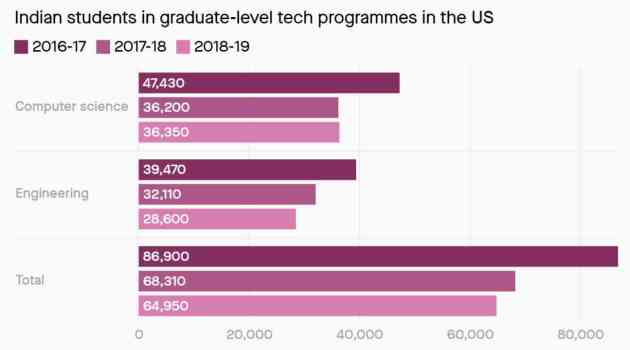
The number of Indians enrolled in graduate-level computer science and engineering courses at American universities declined by more than 25% between 2016-’17 and 2018-’19, according to an analysis of government data by the National Foundation for American Policy.

The key factors for this decline are “more restrictive immigrationand international student policies under the [Donald] Trump administration and the difficulty of obtaining green cards in the United States,” the think tank focused on public policy research on trade and immigration said in a report published on June 8.

Data: National Foundation for American Policy, US Department of Homeland Security, US Immigration and Customs Enforcement, special tabulations (2018) of the Student and Exchange Visitor Information System (SEVIS) database via Quartz

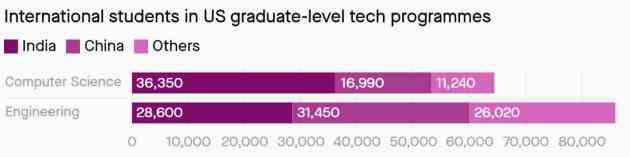
This decline is a massive hit to the entire international tech student population in the US, as Indians form an outsized proportion of the group.

Data: National Foundation for American Policy, US Department of Homeland Security, US Immigration and Customs Enforcement, special tabulations (2018) of the Student and Exchange Visitor Information System (SEVIS) database via Quartz

America’s loss

In a letter dated June 2, 21 members of the US Congress highlighted that international students and their families contributed approximately $41 billion to the US economy in 2018-’19 alone, despite making up just 5.5% of overall US college enrollments. This cohort subsidises tuition for many domestic students.

Moreover, “as a source of research assistants, graduate students help professors conduct research and retain top faculty,” the National Foundation for American Policy report said. “Without the ability to perform high-level research, many leading professors would move on to other careers, which would weaken American universities as a global centre for science.”

While the US is losing out on Indian talent, its neighbour is making strides.

Canada’s gain

National Foundation for American Policy’s research shows that the share of Indian students in Canada more than doubled between the academic years 2016-’17 and 2018-’19.

Data: Canadian Bureau for International Education, National Foundation for American Policy via Quartz

Unlike America’s hardline approach, Canada’s policies have been incentivising students. In June 2018, Immigration, Refugees and Citizenship Canada announced the Student Direct Stream for China, India, Vietnam, and the Philippines. Students from these four countries enrolled in any of the 1,400-plus designated learning institutes in Canada can fast-track their applications, as long as they pass English-language tests and prove they are financially stable.

While the US has suspended immigration due to coronavirus outbreak and is reconsidering the post-graduate work programme Optional Practical Training, Canada isn’t letting Covid-19 get in its way.

As of May 14, international students with valid study permits in Canada from before March 18 have been exempted from the travel restrictions contingent on passing health checks and following isolation protocols.

Not just students but even Indian working professionals have been flocking to Canada as Trump’s anti-immigration rhetoric builds up. Several Indian techies have been swapping Silicon Valley for the more immigrant-friendly neighbour.

“Canada is benefiting from a diversion of young Indian tech workers from US destinations, largely because of the challenges of obtaining and renewing H-1B visas and finding a reliable route to US permanent residence,” said Peter Rekai, founder of the Toronto-based immigration law firm Rekai LLP. The country even offers express entry for skilled immigrants.

Moreover, Canada allows permanent residents to apply for citizenship after six years. Indian permanent residents admitted into the country jumped up over 117% between fiscal years 2016 and 2019, National Foundation for American Policy found.

Source: As Donald Trump tightens immigration rules, Indian tech students ditch the American Dream for Canada

Immigration application system set for massive revamp after COVID-19

Looking forward to the details. Hopefully implementation will be closer to CERB than Phoenix:

A complete overhaul of how Canada processes immigration applications is in the works as the government braces for post-pandemic demand for migration to Canada.

Aging computer systems, paper applications and in-person interviews are among the things that must be adapted for the “new normal” after COVID-19, Immigration, Refugees and Citizenship Canada said in a tender posted to the government’s procurement website and marked “urgent.”

“When travel restrictions begin to ease, a significant surge of applications and support requirements is anticipated, putting tremendous demand on our global operations and supporting branches,” the tender request says.

“IRCC needs to act quickly to develop (i) updated and new strategies, and (ii) processes and digital systems to cope with the rapid change it is undergoing.”

Immigration to Canada came to a near-halt in March when borders around the world slammed shut to slow the spread of COVID-19.

Though some already authorized to enter Canada before the pandemic – temporary foreign workers and students – have still been able to arrive, thousands of others, including refugees, remain abroad, waiting for travel restrictions to lift.

Meanwhile, the government has closed or significantly scaled back many of its immigration operations, including all in-person interviews and the collection of biometrics, while many private visa centres around the globe that have contracts with Canada are also shuttered.

It’s effectively put the kibosh on new applications, and the uncertainty means the government has now abandoned even estimates on how long it will take to process them.

The department is trying to get through some of the applications, said spokesperson Nancy Caron.

“In the face of so many challenges, IRCC has made great efforts to adapt, for instance, by prioritizing applications from Canadians returning to Canada, vulnerable people and people who perform or support essential services,” she said in an email.

“We are processing those as quickly as possible.”

In its request, the department notes that among its challenges is operating while respecting physical-distancing protocols. The requirements make it harder to do everything from in-person interviews to citizenship ceremonies.

At least one virtual citizenship ceremony has already been held, for a researcher awarded a major grant to study the impact of the pandemic on supply chains, but the tender seeks guidance on more digital solutions for those and for traditional in-person interviews.

The Liberal government had intended to welcome as many as 371,000 new permanent residents in 2020, a number that will fall dramatically due to COVID-19.

A recent report from RBC Economics suggested the slowdown will have knock-on effects on the economy, noting among other things the $6 billion in tuition alone that international students contribute to the economy each year.

Source: Immigration application system set for massive revamp after COVID-19