How innovative news outlets are meeting the needs of immigrant communities

Ethnic media in the USA study:

At a time when all of journalism is in an existential crisis, the financial pressure on resource-deprived immigrant outlets is greater than ever. Yet the pandemic, and the protests over the killing of George Floyd, Breonna Taylor and dozens of others, have put innovative immigrant-serving digital outlets into overdrive, as reporters squelch rumors via WeChat and Facebook Live and beam interviews with local officials into living rooms via Roku and JadooTV boxes.

The most successful of these outlets – as measured by ballooning audience numbers – rely on tireless reporters and anchors with a direct line to listeners and viewers. Journalists like Mario Guevara with Mundo Hispánico in Atlanta have made it their business to maintain contact with immigrants using social media. Guevara listens to their questions, hears their complaints, and then gives them the critical information and support they need. That, rather than news flashes or push notifications, has become the lifeblood of immigrant media. Guevara, with nearly half a million Facebook followers on his personal account, recently livestreamed as he took a rubber bullet to his leg while interviewing Latino kids on why they were out protesting against the police.

For many immigrant communities, these outlets provide information they just can’t get from other sources. “The local media landscape is predominantly white,” said Mukhtar Ibrahim, the Somali-American editor of Sahan Journal in St. Paul. When he went to report on the protests and looting in Minneapolis, which occurred essentially in the backyard of many Somali residents, he was struck by how few journalists of color were covering the story. But he was not surprised. Most newsrooms in Minnesota, said Ibrahim, are “slow in making news coverage more inclusive, despite the increasing diversity and the rapid growth of Minnesota’s immigrant population.”

In contrast, immigrant outlets are vital sources of information for people from indigenous farmworkers to Chinese engineers to Somali Uber drivers. On the Chinese social media app WeChat, Houston Online documented empty Chinese-owned businesses well before most U.S. outlets were paying attention to the pandemic’s reach. Punjabi Radio USA in Northern California reported on dangerous rest stop conditions for truckers, one of their main listener groups. And as Queens emerged as an epicenter of coronavirus in the U.S., TBN24, a Bangladeshi digital television outlet with more than 2.7 million followers on Facebook alone, informed viewers about everything from how to get a stimulus check to how to connect with funeral homes.

The technology may be new, but today’s immigrant outlets build on a long history of serving their communities in crisis. During the 1992 Los Angeles civil unrest and riots, Radio Korea shut down all broadcasting operations and became a control center fielding hundreds of calls for help as businesses burned and police were nowhere to be found. These days, when the station does live programs, hosts will often collect comments and poll listeners via KakaoTalk, a social media popular in Korea, as well as run a YouTube live chat.

Radio Korea connects with listeners via KakaoTalk and live broadcasts on YouTube where there is active commentary.

Wielding new technologies can generate huge followings for immigrant media outlets, but these followers are not paying the bills. In coming months, while some immigrant outlets will surely go out of business, the nimble and the scrappy may yet show the way to survive and even thrive. They’ve embraced virtually cost-free digital platforms and delivery systems, so there’s not much room to slash expenses. On the revenue side, ads have plummeted dramatically. Still, glimmers of hope can be found in new models, from going the non-profit route to building auxiliary businesses that aren’t journalism, but fund it.

For the past year, the Center for Community Media has been studying news outlets serving immigrant communities for models of growth and innovation. The cross-currents that have battered community media outlets across the nation threaten their sustainability, and the Center for Community Media has responded by redirecting its mission to help outlets develop survival skills. This report is part of that effort. [A shorter “preview” version of this report was published by CCM in early April.]

We interviewed and surveyed more than 150 people in 30 states to identify outlets that are in the vanguard. The editors and reporters we spoke with come from around the world and have different strengths in radio, broadcast, print, and digital. Yet we found that the best of them have been successful at converging around multiplatform practices. In particular, we found that immigrant-serving news outlets are evolving in four key ways:

  • Wielding social media for community engagement. In recent years the internet decimated classified ads, shrinking revenues for many immigrant-serving newspapers, while social media that trafficked in rumors decimated their audiences. Now, successful immigrant-serving outlets are using social media as a way to offer verified information, cultivate community conversations, and respond to concerns. Live broadcasting is booming, with the unparalleled immediacy and shareability of bringing viewers to a news conference, community festival, or a drive-through coronavirus testing station. Some outlets are even operating primarily on social media platforms like WeChat, WhatsApp, YouTube, and Facebook.
  • Leveraging a small staff to reach big audiences. Media outlets serving immigrant communities have historically been relatively small operations, but with delivery technologies like livestreaming on Facebook or “micro-TV stations,” being small is no longer an impediment to being timely, and may even work in an outlet’s favor. One-person operations can report, produce and broadcast – and consequently boost audiences substantially at very low cost at a time when revenue models are challenged.
  • Globalizing both production and audiences. Increasingly, outlets are hiring staffers overseas to cut costs, while stateside reporters serve both the diaspora in the U.S. and home country audiences. The geolocation of audiences has shifted dramatically in recent years, as reverse migration, press restrictions overseas, and far-flung diasporas boost audiences for immigrant media based in the U.S. Dynamic outlets are becoming transnational enterprises. One Brazilian newspaper in Massachusetts reported it has 60% of its audience in the U.S. and 30% in Brazil while a Hmong outlet in Wisconsin reported 40% of its audience comes from outside of the U.S.
  • Diversifying business models and revenue streams. Even before the pandemic, immigrant media was feeling the pain of ad cuts. Now, though, a few are reporting that their funding sources are stable or even growing modestly. That’s thanks to a grab-bag of strategies, from operating as a non-profit to lining up grant funding to getting government advertising to targeting supplement funding sources. Our database shows 13 out of 50 outlets are non-profit, while a handful have put up e-commerce sites, developed a consulting business and even launched English-language classes to boost the bottom line.

You can read the Center For Community Media’s full report here, plus find case studies and a database.

Source: How innovative news outlets are meeting the needs of immigrant communities
The theory of immigrants and foreign investors driving Canada’s property market is about to be tested

Yes indeed although interestingly the article focusses almost exclusively on the high end of the market, not the middle class suburbs which are home to so many immigrants:

Christine Zhu, a Toronto-based realtor, has not facilitated a single purchase or sale on homes since the start of the COVID-19 pandemic. Her clientele are almost exclusively Chinese nationals whose kids are either already international students in Canadian universities and high schools in Ontario, or are looking to begin school this fall.

In a regular spring market, she would have processed at least eight sales every month, mostly condominium units that Chinese parents would purchase for their children, in addition to numerous rentals. This season she’s spending her days on the phone with landlords, negotiating on behalf of students who have gone back to China, and have no idea when they will return, leaving their leased apartments vacant.

“One of my clients went back to China for Chinese New Year, and didn’t come back because there were no flights. He’s been paying for so many months, so the mother asked me if I can help negotiate with the landlord,” Zhu said. “This landlord was nice, he gave a 30 per cent discount. That’s the best I could do.”

There are approximately 640,000 international students in Canada — over 50 per cent of them are Chinese and Indian nationals who make up a significant part of the rental market in Canada’s largest cities. In a typical summer season, tens of thousands of new foreign students, landed immigrants and non-permanent residents looking for work arrive in Canada, seeking some kind of housing, either to rent or buy.

But with international travel frozen, multiple realtors and housing experts the Financial Post spoke to over the course of the week say that the lack of the usual immigration and travel pattern is starting to have a noticeable impact on the housing markets of Toronto and Vancouver. In particular, vacancy rates are rising in downtown rental markets, pushing prices lower, while luxury homes that usually attract rich foreign investors are struggling to be sold leading to price drops or, in some cases, court-ordered sales.

“Net migration numbers have fallen off pretty sharply, and the vast majority of non-permanent resident newcomers fall into the rental market. We’re likely to see vacancy rates go back up, but more likely rents are going to flatten out even more,” said Robert Kavcic, senior economist at BMO Capital Markets.

In April, the numbers of permanent residents admitted to Canada declined by 80 per cent from the year prior — just 4,140 were processed and admitted compared to 26,900 in April 2019, according to Immigration, Refugees and Citizenship Canada.

In Toronto, condo rentals are on the decline, falling 2.2 per cent on average from April 2020 to May 2020, according to data from apartment hunting site PadMapper. In Vancouver, one-bedroom apartments decreased 5.6 per cent and two-bedroom units decreased 15.8 per cent, the largest decline across the country, May 2020 data from Rentals.ca showed.

Kavcic believes the decline is partly attributed to immigration, but it’s still too early to quantify.

Razia Husein, a Toronto realtor whose clients comprise mostly wealthy foreigners or permanent residents residing abroad, says that she’s had trouble selling downtown condo units that some investors would buy in bulk in a typical year.

“I sell 8 to 10 units, either pre-construction or newly built, to one buyer (in different properties). Some are from India, some are from the United Kingdom, some are from Trinidad. I tell my clients to not put all their eggs in one basket.”

This year, Husein says she’s trying to facilitate sales on the phone, but it’s proving to be difficult. “They need to get on a plane and come and see a unit, or see the area. So I’m just doing a lot of rentals right now, I usually manage these investors’ properties, and find them renters,” she added.

When home prices skyrocketed in Toronto and Vancouver in early 2017, the prevailing notion was that foreign money was driving price increases, prompting provincial governments of both cities to slap a 15 per cent foreign buyers’ tax on purchases.

But a January 2019 report released by Statistics Canada using data from the Canadian Housing Statistics Program found that changes in property prices could not really be associated with any specific socio-demographic or economic factor.

Immigrants, for example, owned proportionally fewer single-detached houses than Canadian-born owners in both cities, but in Vancouver, immigrant owners had larger homes in more expensive neighbourhoods. Just 4.95 per cent of single-detached properties were owned by immigrants in Vancouver, while in Toronto that number was 4.71 per cent. In both cities however, immigrants owned more condominium units than Canadian-born owners.

“This idea that foreigners are the reason for our housing prices going up, is going to be tested out right now. There are no flights, and so the rich investors that went away for the winter, they’ve not come back. Yet, I see the market for single-detached houses is roaring right now,” said a real estate agent in Toronto whose clients are mostly high networth Iranians.

But David Chen, a realtor with the Vancouver-based boutique real estate firm Stilhavn Real Estate Services, whose clients are primarily from mainland China, notes a different trend in the wealthy community of West Vancouver that he attributes to the travel freeze — mansions worth $5 million or more are struggling to be sold because rich foreign investors are not available to go house shopping at the moment.

“Local buying and selling has picked back up and is strong. But in West Vancouver, we’re seeing the biggest price drop in years. It’s not unusual to see court sales for some of the bigger homes — it used to be maybe one in 200 homes in West Vancouver were sold through the court system, but now that’s about one in 80,” Chen said.

Between April 2020 and May 2020, the average home price in West Vancouver fell from $2.8 million to approximately $1.7 million, although it seems to have picked back up recently. Six-bedroom homes, that were worth more than $4 million just six months ago, are now averaging at $2.2 million, according to data from MLS, crunched by the real estate site Zolo.ca.

Local builders, according to Chen, build huge mansions for foreign buyers who usually make their purchases in the spring or summer months, but demand has fallen this season.

There’s scant Canadian data available on foreign buyers recent purchasing habits, but information from the Chinese-based website Juwai.com, estimated that in the first quarter of 2020, Chinese nationals made 26.5 per cent fewer buyer enquiries on Canadian property than in the fourth quarter of 2019. In Toronto, Chinese buyers made 34 per cent fewer enquiries on real estate in the first quarter of 2019.

Whether or not the immigration effect on Canadian real estate — though still anecdotal — will last, is a question that Zhu believes relates in some part to how the Canadian government will deal with the pandemic going forward.

She operates a WeChat account with roughly 500 Chinese parents whose kids are international students in Canada and their primary concerns have been the way in which Canada has responded to the virus.

“The mothers are scared. For many of them, this is their only child studying abroad,” Zhu said. “In China, they feel COVID-19 is being handled well, and Canada is next to the United States which for some of them causes worry.”

In terms of death count, Canada has had roughly double the number of COVID-19 related deaths compared to China, according to official numbers from both countries’ governments. While there have been new surges of the virus in and around Beijing, the Chinese government, at least based on public information, appears to have effectively controlled the spread by rapidly boosting testing and contact tracing.

Chen says some of his clients from mainland China have held off on purchasing condos in Vancouver because of concerns that a shared building ventilation system could be a COVID-19 related risk. “They are just going to wait it out for now, at least until flights from China resume,” he said.

BMO’s Kavcic believes that ultimately the housing markets of Toronto and Vancouver, Canada’s two most expensive cities, will be driven less by the behaviour of foreign buyers, newcomers and international students and more by the tension between demand and availability.

“This is a very unique shock. It has pulled people out of the market. Listings have come down as quickly as sales have. So the question is how much pent-up demand versus pent-up listings will there be when things go back to normal?”

Source: The theory of immigrants and foreign investors driving Canada’s property market is about to be tested

Kerr: Renaming Dundas Street, or other landmarks, won’t help Black people

Agree. The symbolic is easier than the substantive, where the focus should be:

Would renaming COVID-19 make it less deadly? You know the answer.

But what about Dundas Street? Renaming it might “correct” a historical wrong – but would doing so make the underlying issue of systemic racism go away?

More than 14,000 people have signed a petition to rename the major arterial road named after Henry Dundas, a Scottish politician who obstructed the abolition of slavery in the late 18th century. The effort is serious enough that the city of Toronto will form a working group to examine the issue.

But the events that galvanized this movement to rename Dundas Street, along with other landmarks in Canada, are exactly why renaming efforts shouldn’t happen, at least not right away. We are still reckoning with racism and the many forms it takes, from workplace discrimination to police brutality, as seen in the deaths of George Floyd and Breonna Taylor. These killings have ignited protests and important conversations. Toronto’s board of health just declared anti-Black racism a public health crisis.

There are bold proposals in the zeitgeist to fix things: defund the police, give descendants of African slaves reparations, hire more Black people in leadership roles. Like them or not, these ideas would actually do something to change Black people’s lives. Renaming Dundas Street won’t.

Andrew Lochhead, who started the petition, argues that this is not an either-or situation. We can rename the street and implement policy to address systemic racism.

“I don’t want the issue of renaming streets to necessarily overtake that conversation, because I think they’re inextricably linked,” Mr. Lochhead told me over the phone.

“While I understand it’s a largely symbolic gesture … it’s not outside of investing in communities, it’s not disconnected from other causes like defunding the police.”

There is a connection, but until city councils can freeze time and print money, there is always a question of what to prioritize. With COVID-19 putting significant pressure on municipal budgets, the only option is to be pragmatic and focus on implementing policies that will have a tangible impact on Black lives. One way to do this is to give Black voices the authority to make change.

“Black people have been warning about police brutality for decades … it’s not the folks who were perpetuating the system who are going to lead,” Cheryll Case, an urban planner based in Toronto told me. Ms. Case wants to see the city hire a Black consultant to audit its planning process.

“The issue in planning is that it is not confronting privilege, nor is it confronting discrimination. And by ignoring those topics, you actually further deepen the wounds of discrimination and subjugation.”

In a city gasping for more affordable housing, Ms. Case suggests creating an incentive for developers that would defer certain costs if they build affordable units. According to Toronto’s 2016 census, Black people make up 9 per cent of the population, but account for 13 per cent of the residents of low-income neighbourhoods.

The Parliamentary Black Caucus made the need for better policy clear in a recent statement.

“This is not a time for further discussion – the Afro-Canadian community has spoken for many years and is no longer interested in continued consultation,” it read.

“Black Canadians are in a state of crisis: it is time to act. Words and symbolic gestures, while important, are not enough.”

The Caucus proposes that the government ban racial profiling from the RCMP, invest in Black heritage organizations and increase the number of government procurement contracts for Black-owned businesses.

These ideas look pretty on paper, but it might not be easy to turn them into laws, which is why political resources must be focused on policy, not symbolism. The true cost of renaming Dundas Street is all the time, effort and money that could have been spent helping Black communities in more tangible ways.

What about the financial costs? Mr. Lochhead told me he hasn’t “taken the time to look into” the price of renaming Dundas Street. I don’t know how much it will cost either, but last year, Toronto spent just under $2-million to change the names of two arts centres under its purview. In the city of Toronto, Dundas Street stretches from Etobicoke in the west end, all the way to the Beaches neighbourhood in the east end, and features some of the city’s busiest shopping districts. The cost of changing the street’s signage is going to add up, and those dollars are better spent elsewhere.

Every breath politicians waste on a renaming debate should be spent discussing how to combat racism in schools, or how to address discriminatory fare enforcement officers on the TTC. If Dundas Street or other roads in Toronto are renamed, but Black people are still being harassed on the streetcar routes that traverse them, what has really changed?

Source: https://www.theglobeandmail.com/opinion/article-renaming-dundas-street-or-other-landmarks-wont-help-black-people/

Ibbitson: Tens of thousands of Canadians won’t be born due to COVID-19

Some serious thinking needs to be done regarding alternatives to solely relying on immigration to address the aging demographics, as immigration alone, even at higher levels, won’t eliminate the trend.

One or two missed years won’t make much of a difference in the longer term, and a too quick return to the existing plan, at a time when large segments of our economy will likely take a number of years to recover, is setting up immigrants for failure.

Previous recessions have resulted in worse economic outcomes for immigrants that arrive during downturns:

One of the worst long-term consequences of the COVID-19 pandemic for Canada will be the tens of thousands who won’t be born, a loss to this country’s future.

To make up for that loss, and for the immigrants who were unable to come to Canada this year because of the lockdown, the federal government would need to increase its immigration target beyond 400,000 next year and in future years, which may be politically and logistically impossible.

The lost potential population – the work not done, goods not consumed, taxes not paid – will be felt for decades to come.

The Brookings Institution, a Washington think tank, released a report this month that concluded “the COVID-19 episode will likely lead to a large, lasting baby bust.”

Like most developed nations, the United States has a fertility rate well below the 2.1 children per woman needed to sustain the population. (The U.S. fertility rate is 1.7; Canada’s is 1.5.) Women are choosing to have fewer children, and to delay their first child until their late twenties or their thirties. (The mean age at which a woman has her first child in the U.S. is 27; in Canada, 29.)

Economic uncertainty can cause a woman to put off having her first child even longer, which may lead to her having fewer children than she originally intended. Examining past recessions and recoveries, the Brookings study found that “a one percentage point increase in the state unemployment rate led to a 0.9 per cent reduction in the birth rate.”

More than simple economic calculation is at work. “Economic pressures and uncertainty cause enormous pressure and stress within households and relationships,” said Judith Daniluk, professor emeritus at University of British Columbia, where she specializes in women’s sexuality and reproductive health.

“Surviving, much less rebounding from, this type of economic and existential crisis is challenging and takes time,” she told me, which can lead to “some women being unable to bear a child when they have regained their economic and relational footing, or in having fewer children than they had hoped.”

Based on projected unemployment levels resulting from the coronavirus lockdown, and a drop in fertility that accompanied the Spanish flu pandemic of 1918-19, the Brookings study concluded that “we could see a drop of perhaps 300,000 to 500,000 births in the U.S.” in 2021.

Since Canada has about one-tenth the population of the United States, and the unemployment rate is similar (13.3 per cent in May in the U.S.; 13.7 per cent in May in Canada), we can expect to lose on the order of 30,000 to 50,000 babies next year – the equivalent of West Vancouver (population 42,694) or Belleville, Ont. (population 50,720) in the number of babies not born.

The fewer babies that are born each year, the more immigrants who are needed to replace them. The alternative is a shrinking and aging population, with too few workers and taxpayers available to fill vacant jobs, to power the economy through consumption, and to support the pension and health-care needs of the elderly.

The Trudeau government had planned to welcome 341,000 permanent residents this year and 351,000 in 2021. But with the year half over, and immigration essentially frozen through border closings, Immigration Minister Marco Mendicino faces a difficult choice when he presents his immigration update this fall.

To prevent an overall drop in immigration, he will have to increase next year’s intake to compensate both for immigrants who didn’t arrive in 2020 and for babies not born.

But a target between, say, 400,000 and 500,000 would strain the resources of the department and of settlement services, and intensify protests from those who believe Canada is bringing in too many newcomers as it is.

Compensating for lost intake could be staggered over several years. Even so, we may be forced to accept that many thousands of people who should be with us in the years to come won’t be.

“That will be yet another cost of this terrible episode,” the Brookings report concludes.

To limit that cost, this Liberal government should do everything within its power to bring in as many new Canadians as it possibly can in the years ahead.

Source: https://www.theglobeandmail.com/politics/article-tens-of-thousands-of-canadians-wont-be-born-due-to-covid-19/

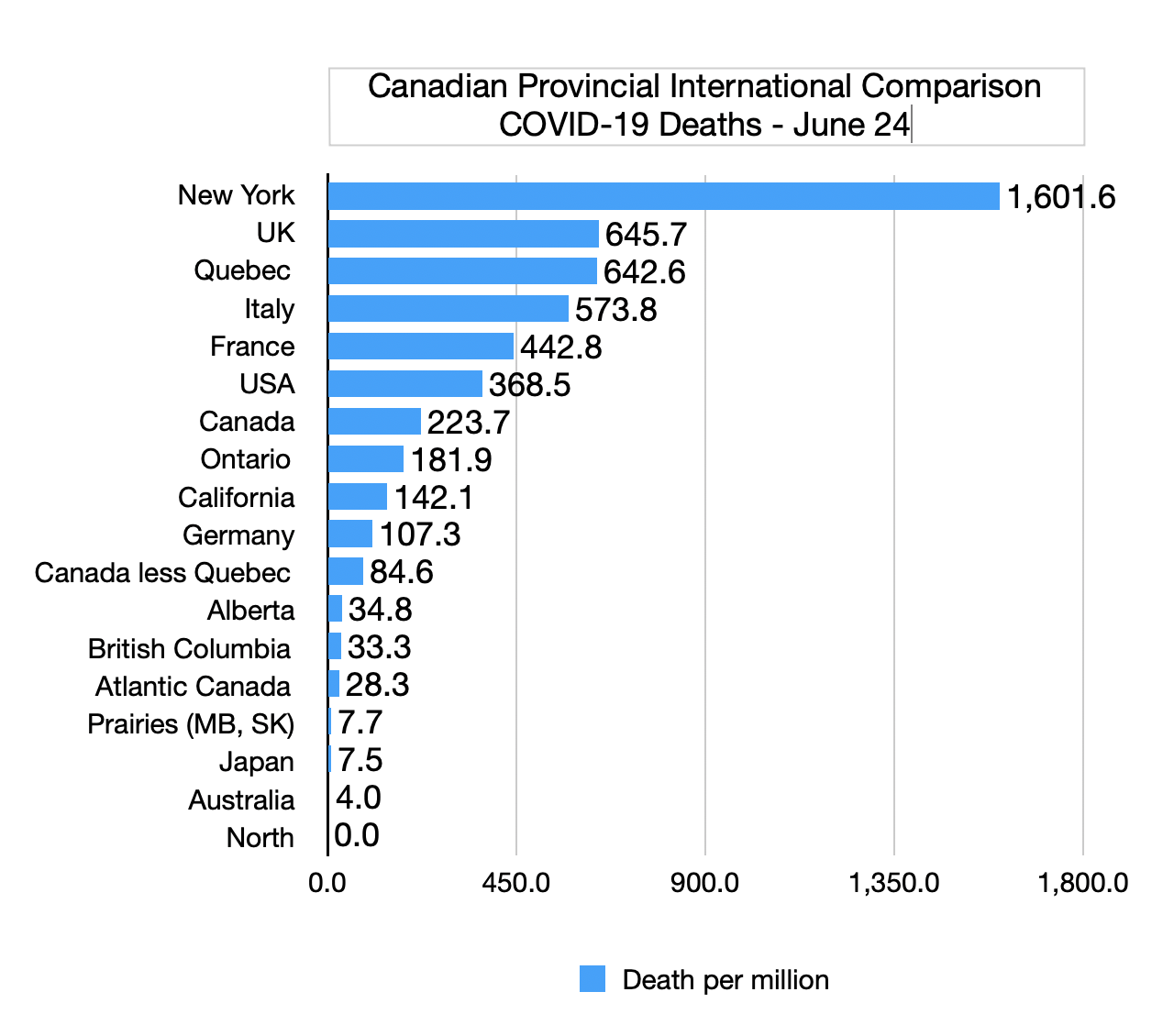
#COVID-19: Comparing provinces with other countries 24 June Update – Quebec deaths higher than UK

Latest update:


Online registrar threatens to drop anti-immigration website

Of note.

Brimelow, if I recall correctly, was mentioned by Paul Wells in his The Longer I’m Prime Minister as having an influence in his decision to replace the 2011 Census with the less accurate National Household Survey:

An internet registrar is threatening to delist a website that is a leading promoter of white nationalist and anti-immigration views, a move that could make the site accessible only to diehard users willing to use a special browser to find it on the dark web.

Network Solutions’ parent company, Web.com Group, notified a civil rights group on Friday that it has “taken steps” to terminate the company’s account for VDARE.com, which would make it unreachable on the public internet unless it can find another provider willing to register the domain name.

VDARE remained online Monday. The website has until Thursday to transfer the domain before Network Solutions may delete its services, a parent company lawyer said in a letter to a VDARE attorney last week.

In April and in May, the head of the Lawyers’ Committee for Civil Rights Under Law sent letters urging Network Solutions to drop VDARE. Kristen Clarke, the Washington, D.C.-based group’s president and executive director, wrote that VDARE peddles “anti-immigrant and anti-Black hate,” spreads misinformation about the coronavirus and encourages violence against migrants.

“This is part of our ongoing work to confront the ways in which hate activity festers online,” Clarke said Monday. “We know that many white supremacists and extremists are not organizing in basements. They are using these platforms and websites to spread their dangerous ideologies, target victims and incite violence.”

In Friday’s response to Clarke, a company attorney said VDARE’s content “does not represent the values of our organization” and violates its “Acceptable Use Policy.” The policy bars customers from using its domains “to display bigotry, racism, discrimination, or hatred in any manner whatsoever,” the same company attorney said in a letter to a VDARE lawyer last week.

VDARE founder and editor Peter Brimelow said his site’s content hasn’t changed in the 20 years that it has been a Network Solutions customer.

“Censorship is just intensifying,” he wrote in an email on Monday. “We’re still working on a replacement, but there is certainly a chance we’ll have to go dark for at least a couple of days. And anyway we have no confidence that any US-based site will stand up to the PC lynch mob for long.”

Many websites that publish white nationalist, white supremacist or anti-Semitic material have struggled to stay online or been booted off mainstream internet platforms, often after violent attacks by far-right extremists.

Google and GoDaddy yanked The Daily Stormer’s web address after the neo-Nazi website’s founder, Andrew Anglin, published a post mocking the woman killed when a man drove a car into a crowd of counterprotesters at a 2017 white nationalist rally in Charlottesville, Virginia.

Social media platform Gab, where the suspect in the Pittsburgh synagogue massacre spewed anti-Semitic messages before the 2018 shooting rampage, was briefly knocked offline after registrar GoDaddy and others dropped the site. Gab returned after a Seattle-based company, Epik, agreed to register it.

Users spewed anonymous hate on 8chan, an online message boar d, until a string of mass shootings by gunmen who posted manifestos on the site led to it getting forced offline in August 2019. The disruption ended when the imageboard relaunched in November under the new name 8kun.

This isn’t the first time VDARE has been dropped by a technology company. Facebook announced last month that it removed accounts linked to VDARE and other groups, including pages devoted to the QAnon far-right conspiracy theory.

Brimelow sued The New York Times Company in January, claiming the newspaper defamed him by referring to him as an “open white nationalist.” The suit seeks at least $5 million in damages.

Last Thursday, newspaper lawyers urged a federal court in New York to throw out the lawsuit, accusing Brimelow of playing “word games about how his fringe views should be characterized.”

“Brimelow has promoted theories at the heart of white nationalism and white supremacy, including that certain races are predisposed to commit crime and that IQ is linked to race,” they wrote.

Brimelow has denied that his website is white nationalist but acknowledged it publishes works by writers who fit that description “in the sense that they aim to defend the interests of American whites.”

Brimelow also operates a Connecticut-based nonprofit, VDARE Foundation, which raised more than $1.8 million in tax-exempt gifts, grants and contributions between 2014 and 2018, according to an IRS tax filing.

Source: Online registrar threatens to drop anti-immigration website

“Dreamers” in Canada need protection, too

It would be helpful having more accurate estimates on the numbers rather than the anecdotal wide range. The numbers are important to assess what policy approach or approaches are more appropriate and or needed:

Thursday’s long-awaited U.S. Supreme Court decision rejecting the Trump administration’s bid to end the DACA (Deferred Action for Childhood Arrivals) program was met with sighs of relief on both sides of the border. The plight of so-called “Dreamers” — youth and young people who were brought to the U.S. as children who remained with no legal immigration status — is a well-known and heartbreaking story. Despite most often having had no role in the decision to migrate, nor having remaining connection to their previous country, these young people are vulnerable to deportation. Anti-immigration advocates accuse them of “cheating the system.”

While we gasp at this close call in the U.S., the truth is that Canada is no better on this issue. In fact, non-citizens brought to Canada as children are perhaps in a worse position. We have no DACA-equivalent legislation to provide protection from deportation or temporary work authorization to our “Dreamers.” We do not even have a public discourse on the issue.

While the term “Dreamers” invokes idealistic accounts of overcoming odds and happy endings, the people this term refers to are in fact real people living real lives. Like other children, they have gone to school, made neighbourhood friends, and developed views of the world based on their Canadian lives.

As the pandemic has laid bare, while migrants are essential to our communities, they are so often exploited and excluded. Migrants face barriers to health care, education, decent work, family unity and equal rights. While legalization theoretically enables “Dreamers” to access K-12 education, many require the intervention of lawyers and community advocates to enforce that right. As they grow up, they discover they cannot work legally, access supports such as OHIP and OSAP, enrol at most universities and colleges (or if they are admitted, face elevated international fees). Without SIN numbers, they cannot access CERB or CESB. Seeking professional support or calling the police, always a perilous choice for racialized groups, risks exposure to immigration authorities.

These barriers not only close doors to opportunities that other Canadians take for granted, they force these young people into precarious employment, housing and social situations that make them vulnerable to abuse. To protect themselves and their families, they work to “fly under the radar.” Living as an undocumented person carries huge psychological weight. In this case, that weight is carried by children and youth.

Consider “Marla,” who was brought to Canada at the age of 4. She has lived in the GTA for 18 years. An academic star throughout school, she was completely unaware of her insecure immigration status and what that meant until she was mid-way through high school. The revelation was harsh. While her friends entered university, she had to abandon her own university ambitions and instead enter precarious factory employment.

Since 2012, DACA has enabled approximately 800,000 young adults to work lawfully in the U.S.. How many undocumented childhood arrivals do we have in Canada? We do not actually know. Estimates of the number of people living in Canada without legal immigration status vary from 20,000 to 500,000, but there is no estimate of those who arrived during childhood. The existence of childhood arrivals is seldom even acknowledged.

Therefore, hundreds, or perhaps thousands, of young people across the country are living in marginalization and vulnerability. They also cannot contribute to our communities and economies in the ways they wish. And this despite the significant investments we have made in them (e.g., education, emergency health care) — and they in us.

Do we need quantifiable numbers before we act? No. Agencies working with migrants and young people know of enough people like Marla to know their predicament is real.

If the Canadian government finally decides to provide protections to this special group, we must not blindly accept a DACA-like model. Despite applauding Thursday’s decision, we know that DACA is insufficient. It defers removals but does not provide a pathway to citizenship, effectively leaving young people in limbo. It also creates a hierarchy of entitlement due to strict inclusion criteria. A made-in-Canada solution would need to address these glaring deficiencies and embrace childhood arrivals as equal and welcome members of our society.

Trump administration extends work visa ban, creating uncertainty for Canadians

The Canadian angle (applies more broadly of course, with India likely being the country most affected):

The Trump administration said Monday that it is extending a ban on green cards issued outside the United States until the end of the year and adding many temporary work visas to the freeze — including those used heavily by technology companies and multinational corporations — tossing a cloud of uncertainty over thousands of Canadians, including cross-border workers and their families.

The administration cast the effort as a way to free up jobs in an economy reeling from the coronavirus. A senior official who spoke to reporters on condition of anonymity estimated the restrictions will free up to 525,000 jobs for Americans.

The ban, while temporary, would amount to major restructuring of legal immigration if made permanent, a goal that had eluded the administration before the pandemic. Long-term changes targeting asylum seekers and high-tech workers are also being sought.

Business groups pressed hard to limit the changes, but got little of what they wanted, marking a victory for immigration hardliners as Trump seeks to further solidify their support ahead of the November election.

The ban on new visas applies to H-1B visas, which are widely used by major American and Indian technology company workers and their families, H-2B visas for nonagricultural seasonal workers, J-1 visas for cultural exchanges and L-1 visas for managers and other key employees of multinational corporations.

There will be exemptions for food processing workers, which make up about 15 per cent of H-2B visas, the official said. Health care workers assisting with the coronavirus fight will continue to be spared from the green-card freeze, though their exemption will be narrower.

“In the administration of our nation’s immigration system, we must remain mindful of the impact of foreign workers on the United States labour market, particularly in the current extraordinary environment of high domestic unemployment and depressed demand for labour,” Trump wrote in his presidential proclamation.

Potential effect on Canadians

These moves could affect thousands of Canadians. They are far more severe than an earlier immigration announcement from Trump in April, which affected only applications for permanent immigration visas.

The new provisions touch work visas used by many Canadians. Canadians filed more than 4,000 H-1B applications in each of the last two years, and numerous others would get L1 business visas in a normal year, including executives working for cross-border companies.

Source: Trump administration extends work visa ban, creating uncertainty for Canadians

Police Researcher: Officers Have Similar Biases Regardless Of Race

Interesting study. But watching the visible minority officers doing nothing during the Floyd killing …:

One common recommendation for reducing police brutality against people of color is to have police departments mirror a given area’s racial makeup.

President Obama’s Task Force on 21st Century Policing recommended that law enforcement “reflect the demographics of the community”; the Justice Department and Equal Employment Opportunity Commission said diversity on police forces can help build trust with communities.

Rashawn Ray, a fellow at the Brookings Institution and a sociology professor at the University of Maryland, studies race and policing. He says that diversity helps but that “officers, regardless of their race or gender, have similar implicit biases, particularly about Black people.” Ray says it’s not enough to have Black cops in a Black neighborhood if they don’t know the area.

Ray and his University of Maryland colleagues have amassed policing data through tests and interviews with hundreds of officers. He talked with Morning Edition‘s Noel King about this research. Here are excerpts of that interview:

What kind of biases do police officers — implicit, explicit — say that they have?

The first big thing is that when officers take the implicit association test, they exhibit bias against Black people. They are more likely to make an association between Black people with weapons than they are with white people with weapons. We also know that officers speak less respectfully to Black people during traffic stops as well as during other sorts of settings. And they are particularly less likely to respect Black women in these encounters, even if they’re more likely to slightly use more force on Black men relative to other people.

I was talking to a former police officer whose job is now to recruit more Black and brown police officers into [the Minneapolis] force. It sounds like what you’re saying is if she is recruiting Black and brown officers from Phoenix or from Houston and bringing them over to Minneapolis, that is not likely to solve the problem.

That’s exactly right. So the optics look good, but we can’t make the assumption that simply because a person is Black that they’re going to know about the neighborhood. Part of the fundamental problem when it comes to policing that I’ve noticed is that when police officers interact with a white person, there is a pause, a slight pause, a slight benefit of the doubt. The reason why that exists is because subconsciously, implicitly, when they interact with that person, they see their neighbor, a parent at their kids’ school, and when they interact with a Black person, they are less likely to have what we call in sociology those “social scripts” that allow them to view people in those multitude of ways.

And if we’re going to change this, one big recommendation I have: Police officers need housing assistance that mandates that they live in the metropolitan area where they are policing. Because community policing isn’t about getting out, playing basketball with a kid in uniform. Community policing oftentimes is what you do when you’re not on duty. The way that you’re investing in a neighborhood.

Source: Police Researcher: Officers Have Similar Biases Regardless Of Race

Construction of Austrian Holocaust victims’ memorial begins

Long overdue:

Construction of Austria’s first public monument naming all the country’s Holocaust victims began on Monday, a further step by Adolf Hitler’s native land towards confronting an issue it has long struggled with.

For decades after World War Two, Austria denied responsibility for crimes committed by the Nazis, arguing that it was their first victim despite the enthusiasm with which many citizens had welcomed annexation by Hitler’s Germany in 1938.

The country now recognises that Austrians were perpetrators as well as victims of Nazi crimes but it has not confronted that chapter of its history as openly or directly as Germany.

“Berlin has one. Paris has one. Vienna had none. But the day has finally come today,” Oskar Deutsch, president of the Jewish Community (IKG), the body officially representing Austria’s Jews, said at a ceremony marking the start of construction work.

The new monument, located in a park next to Austria’s central bank, will comprise a ring of upright stone slabs around an island of trees, and will name all 64,259 Austrian victims of the Holocaust. It is due to be inaugurated in a year’s time.

“Remembering means commemorating the victims of the Shoah. This remembering and our history increase our responsibility, the responsibility daily and together to do everything to ensure that something like this never happens again,” said Deutsch.

Ironically, the project was first backed in 2018 by a previous coalition government of current Chancellor Sebastian Kurz’s conservatives and the far-right Freedom Party (FPO), which was founded in the 1950s by former Nazis and whose first leader had been an SS officer.

Although the FPO says it has abandoned its anti-Semitic past and now denounces the Holocaust, it has been plagued by racism and anti-Semitism scandals, and the IKG still refuses to deal with party officials. The FPO crashed out of government last year and Kurz now governs in coalition with the Greens.

There are Holocaust memorials in Vienna but the only one naming the Jews who lived in Austria and were murdered is in the city’s main synagogue.

Source: Construction of Austrian Holocaust victims’ memorial begins