Hospital patients in Canada lacking English need access to interpreters, study says

An inevitable consequence of living in a diverse society where a percentage will not be fluent enough to understand the language used by doctors. Good study documenting the issue and sorting out where the needs may be greatest:

Waking up with worsening pain had Surjit Garcha worried, but the red blisters on her stomach were so alarming that she went to her neighbour’s home to try to explain, in her limited English, that she needed help.

Garcha, who lives alone, doesn’t have the English skills to call her doctor’s office and felt more comfortable going to someone she trusts.

Her neighbour took her to the emergency department in Delta, B.C., where Garcha learned she had shingles, a viral infection that can include complications such as scarring and vision and hearing loss in older adults.

Garcha, now 82, said the intense pain was bad enough, but not being able to understand what was wrong with her made her feel even more vulnerable.”The employees who bring food to patients would leave it outside the door, because they could catch what I had and no visitors could come in my room,” she said in Punjabi about her experience three years ago.

Garcha’s only solace was that a nurse spoke Punjabi, but it wasn’t until her daughter arrived from Seattle the next day that she had any contact with a family member.

Interpreters trained in medical terminology are more often provided for patients in Canada’s larger centres, but a researcher from the University of Toronto said lack of access to interpretation could potentially result in unsafe health care through missed diagnoses and medical errors, suggesting language services should be a priority.

Dr. Shail Rawal, lead author of a study that includes data from Toronto General and Toronto Western hospitals, said patients with a chronic disease and limited English are more likely to return to the emergency room or be readmitted to hospital because of poorer understanding of discharge instructions and not taking medication as required, compared with those who are proficient in the language and were discharged with similar health concerns.

The study was published recently in the Journal of the American Medical Association and includes data for all patients discharged from the two hospitals with acute conditions, pneumonia and hip fracture, and chronic conditions heart failure and chronic obstructive pulmonary disease, between January 2008 and March 2016, amounting to 9,881 patients.

“We saw that if you had heart failure and limited English proficiency you were more likely to come back to the emergency room to be reassessed in 30 days after you were discharged,” said Rawal, an assistant professor in the University of Toronto’s department of medicine and a staff physician at the University Health Network, which includes the two hospitals.”Patients who had limited English proficiency and heart failure or chronic obstructive lung disease were more likely to be readmitted to hospital in the 30 or 90 days after discharge,” she said.

For those with pneumonia or hip fracture, the data showed no difference in return to hospital regardless of patients’ ability to speak English, Rawal said.

“Our thinking is that those are acute conditions that have a pretty standard treatment, whether it be surgery and then rehabilitation or a course of antibiotics, whereas the two chronic conditions require a lot of patient-centred counselling and patient management plans.”

Of the 9,881 patients:

  • 2,336 had limited proficiency in English.
  • Nearly 36 per cent spoke Portuguese.
  • Just over 23 per cent spoke Italian.
  • Cantonese, Mandarin and Chinese were the primary languages for about 14 per cent of patients.
  • Greek and Spanish were the least spoken languages.
  • 18.5 per cent of the study subjects’ languages were listed as “other.”

Rawal said patients at the two hospitals have around-the-clock access to interpretation in various languages by phone and in-person interpretation is also available but must be pre-booked and is typically offered during business hours.

“The quality of care or the level of access to interpretation, in my view, should not vary based on which hospital you happen to present at with your illness,” she said.

“Currently, that is the case, that depending on what hospital you go to in our city, in our province or across the country, you will have varying levels of access to professional interpretation services and I think that in a linguistically diverse country the language needs of patients and families should be met by institutions.”

Family members often step in to interpret and alleviate a patient’s anxiety but may end up having to rearrange their schedules while waiting for nurses, doctors or specialists to show up at the bedside, Rawal said.

However, she said previous research studies have shown that families are less accurate in their interpretation than professionals and sometimes may not wish to translate what a clinician is saying, perhaps to lessen the impact if the prognosis would be too upsetting.

Kiran Malli, director of provincial language services for the Provincial Health Services Authority in British Columbia, said patients in Vancouver and the surrounding area have access to 180 languages through interpreters who work at hospitals and publicly funded long-term care homes.

The top three languages are Cantonese, Mandarin and Punjabi, Malli said.

In-person and phone interpretation is provided without a pre-booked appointment. The health authority started a pilot project last year to provide services by phone to family doctors’ offices, she said.

Another pilot on video-remote interpreting at hospitals, which Malli said would greatly benefit patients needing sign language — which is already being provided — will also start soon and benefit those living in isolated parts of the province.

A few scattered grassroots programs were available in B.C. in the 1990s but the current standardized one didn’t start until 2003, she said.

“It was getting pretty evident that we needed to do something a little more than just pulling up any bilingual person or calling on the overhead paging [system] to say ‘If anybody speaks Cantonese could you please come to emergency,”’ Malli said of the current program’s genesis.

“Research shows us that as people get older, even if you know English when you’re younger, you tend to revert back to your mother tongue as you age,” she said, adding elderly people in medical distress tend to forget the English skills they have.

“I do think we are seeing more elderly patients for that reason,” she said.

It’s unfair for health-care staff to expect family members to act as interpreters because, just like English-speaking patients’ relatives, their role should be to support their loved ones and not to be burdened further, Malli said.

“If we are looking at equity, as family I should just be there to support my family member through whatever it might be rather than act as their language conduit,” she said.

Source: Hospital patients in Canada lacking English need access to interpreters, study says

Why universities are trying to recruit overseas students from as many places as possible

Clear demonstration of just how much a business this is and that like any trade, diversification needed to reduce risks of changes in demand or political factors (e.g., Saudi Arabian students after the infamous Tweet):

Canadian universities are riding a wave of popularity as destinations of choice for overseas students.

But the high-water moment comes with risks. Of 356,035 Canadian study permits issued to international students at post-secondary institutions in 2018 alone, 54.1per cent went to students from only two countries: India and China.

“The tide is high, but there’s no telling when the tide goes out,” says Craig Riggs, editor of ICEF Monitor, a leading industry publication that tracks global trends in higher education.

To safeguard against geopolitical uncertainties, and to counter stiff global competition for international students, Canadian universities are adding scholarships, hiring education agents, opening overseas offices, establishing overseas partnerships and recruiting alumni as word-of-mouth ambassadors. Fuelling the effort is a five-year, $148-million federal government plan, announced in August 2019, to expand study abroad by Canadian undergraduates, diversify where overseas students come from and where they study in Canada, and to support Canadian institutions in forming partnerships with their counterparts in other countries.

The goals of this plan differ from those of the federal government’s previous five-year international education strategy, announced in 2014, which emphasized growth. One reason: by 2018, the post-secondary sector had shot past the government’s goal to add 450,000 international students by 2022. For universities alone, recent growth in demand from overseas students has been remarkable. Last year, the federal government issued 120,000 permits for international students to attend university, a 50 per cent jump in volume from 2015. China and India were the top two sending countries for the post-secondary sector as a whole, but for universities they accounted for 48.5 per cent of total study permits last year.

The government’s new focus for the next five years, says Riggs, “is less on growth, more on diversification, and more on strengthening the quality of the students’ experience during and after their studies.”

In short, the hunt is on for top students—not only from China and India—to enrich campus life and spread the word back home about Canada as an attractive study destination.

By that measure, Kenya-born Odero Otieno fits the bill for any Canadian university.

One of six children whose parents never completed high school, the 24-year-old student from Homa Bay in western Kenya had a fistful of accomplishments before he chose to study abroad. He scored top marks on national high school exams in Kenya, became principal of a girl’s school in his home city and pursued several entrepreneurial ventures.

In 2016, he left Africa for the first time to study at McGill University on a full scholarship from the MasterCard Foundation Scholars Program for promising young leaders from Africa. A foundation partner since 2013, McGill plans to enrol 91 young African scholars over 10 years.

Last year, McGill recruited more than 12,500 students from 156 countries, led by China, the United States and France, but had a limited presence in Africa. No one country comprised more than 22 per cent of the total.

“This [relationship with MasterCard] is a way for us to really prime the pump in terms of getting [African] countries up in our participation,” says Fabrice Labeau, deputy provost of student life and learning at McGill. He describes sub-Saharan Africa as “clearly an under-represented region in terms of nationalities” at his university.

Otieno, who graduates next year with a bachelor in engineering and a minor in technological entrepreneurship, says the academic and emotional support from McGill and foundation staff helped him secure internships in Canada, the United States and Kenya. A stint at Google in San Francisco convinced him to build his own company, he says, not work for others.

This fall, he announced plans to open a Toronto-based company developing software for African consumers to use mobile phones to make cost-saving purchases from authorized pharmacies.

He credits McGill with building his confidence.

“Just the fact that I am a McGill student makes me think I am a global scholar or leader and makes me want to do so many things,” says Otieno. When he is back in Kenya, prospective students are eager to hear about his experiences in Canada and, on his return to Montreal, they follow him on Facebook for his posts about academic life on campus.

For universities, a single event last year underscored the reality that diversifying their sources for international students, however necessary, is not without pain.

In a 2018 diplomatic spat with Ottawa, the government of Saudi Arabia abruptly cancelled funding for its post-secondary students in Canada, ordering many to leave their studies.

“The Saudi experience galvanized [federal] government attention,” says Paul Davidson, president of Universities Canada, crediting the Prime Minister’s Office and senior trade officials for the new, muscular international education strategy. “It has been a challenge in a crowded public policy environment for people to recognize the economic value of international students.”

Their value is undisputed, adds Larissa Bezo, president and chief executive officer of the Canadian Bureau for International Education, whose members include universities, colleges, language schools and others recruiting from abroad.

“The more diverse the campus, the richer the learning environment,” she says. Students from abroad often supplement domestic class sizes, making it easier for universities to offer specialty courses. As well, says Bezo, international students who stay and work after graduation contribute to the economy.

They also represent a significant source of revenue.

“Why universities have been so active in recruiting internationally is that the demographics are not very favourable at all,” says Pedro Antunes, chief economist for the Conference Board of Canada. He cites the current demographic dip in the cohort of 17- to 24-year-old domestic students eligible for college or university. He expects a rebound in the population of 17- to 24-year-olds to begin in 2025.

For university leaders, the Saudi incident had consequences in and beyond the classroom.

“The impact on us was significant academically and financially, and reflects the importance of being able to have a diversified student population,” says Robert Summerby-Murray, president of Saint Mary’s University in Halifax. Of about 8,000 Saudi students in Canada, about 100 were studying at his school. The pullout translated to a $2-million loss in revenue, he adds.

What cushioned the financial blow for Saint Mary’s was its growing use of agreements with universities in prime markets such as Asia and Latin America for faculty and student exchanges. They often open doors to recruitment and have helped the school attract students from 115 countries. The school also relies on its own recruiters and overseas agents to visit high schools abroad to identify top candidates.

In Honduras, Mary Navas heard about Halifax when another Nova Scotia university paid a visit to her high school. She knew little of Canada’s East Coast and had turned down a scholarship to study in the United States largely because it was a top destination for many of her friends.

“I am into meeting new people and learning about new cultures,” she says.

In fall 2015, on her first day of class at Saint Mary’s Sobey School of Business, she recalls the professor asking students to name their homelands. “We had 15 countries in a class of 45 students,” she says. “That told me about the amazing opportunity [that] I was going to have here at Saint Mary’s … and that I had found what I wanted in intercultural learning.”

Currently president of her university’s student association, Navas plans to stay and work in Halifax after graduation next spring. When she talks to high school students in Honduras, she brings brochures from St. Mary’s to raise its profile. “At my high school, we mostly heard from the United States and not that much from Canada as a whole.”

At the University of Toronto, which has racked up record levels of applications from almost all parts of the world over the past six years, diversification is more than a numbers game, says Ted Sargent, vice-president, international.

“Our strategy on diversification reflects two goals: talent [spotting] and global engagement for all our students,” he says.

Last year, U of T announced an agreement with Tata Trusts, one of India’s biggest charitable organizations, for an urban research centre and entrepreneurship hub in India. “This is an opportunity for U of T faculty and students to engage reciprocally with leading scholars, students and entrepreneurs in India,” says Sargent.

With a fourfold increase in applications from India over the past five years, he adds, “it makes sense for us to increase our presence.” Over the same period, U of T also recorded a threefold rise in applications from Indonesia, a twofold jump from South Korea and a 52 per cent rise from Latin America, including Mexico.

The university, which generates 34 per cent of its revenues from international students, has other weapons for diversifying its international profile.

One is reputation: this year, U of T climbed three spots to number 18 in the Times Higher Education global university rankings, and for the fifth consecutive time it is No. 1 in Maclean’s ranking for reputation. Another is its introduction of globally competitive scholarships to attract international high achievers. The university’s Lester B. Pearson Scholarship Program, announced in 2017, provides $60,000 a year for tuition and other costs to an overseas student demonstrating academic excellence and leadership. The program selects 37 recipients a year and “was a great way to announce to the world the U of T’s global engagement strategy,” says Sargent.

Not every Canadian university has U of T’s resources or its location advantage.

At the University of Regina, students come from more than 100 countries, but mainly from India and China. Regina also saw a precipitous drop in Saudi student enrolment last year. Years ago, a once-reliable source of revenue dried up when Nigeria cancelled funding for its scholarship students.

Unpredictable events beyond a university’s control require officials to learn to be nimble, says Livia Castellanos, associate vice-president, international, at Regina.

In August, shortly after the federal government added Pakistan (and later Morocco and Senegal) to a select group of countries eligible for streamlined processing of study permit applications, Castellanos flew to Islamabad to meet Pakistani counterparts and Canadian trade officials to discuss recruitment opportunities for fall 2020.

“I never sit comfortably with the [student] population I have,” she says. “I am preparing the ground for the next market.”

As a mid-size Prairie university far from Canada’s major cities, Regina seeks out niche opportunities abroad. For example, when searching for top students, Castellanos makes a point of visiting smaller cities in Mexico that would likely be bypassed by larger institutional rivals in Canada. In one successful tactic, Regina invites students to attend for a semester before committing to a full-time program.

Earlier this year, Marco Aurélio dos Santos, a student at Santa Catarina State University in Joinville, Brazil, accepted a $7,200-scholarship from the Canadian government for young Latin American leaders. His semester-long scholarship was tenable at Regina, which had a partnership agreement with his university.

Last January, he left Brazil with temperatures of 30° C, arriving in Regina where the thermometer registered -26° C. “I had heard about Prairie hospitality, that it was a more comfortable environment and Regina was not a big city,” he says. “I decided I wanted to go there.”

Buoyed by support and encouragement from professors and staff, dos Santos decided to stay at Regina this fall for a two-year master’s degree in philosophy that he hopes could lead to a career in consulting.

Meanwhile, even small undergraduate universities set up overseas offices to raise their profiles.

In 2017, Vancouver Island University opened a recruitment office in Vietnam, adding to locations in Germany, China and India.

In 2017-18, VIU recruited 96 students from Vietnam (eligible for fast-track processing of student study permits to Canada); up from 12 in 2013-14.

“There has been a sea change,” says Philip Oxhorn, dean of international education at VIU. “Vietnam is beginning to emerge as a major centre of students.” This November, his office plans to open an office in Ecuador to capitalize on Latin American interest in study alternatives to the United States.

But for diversification to succeed, university officials recognize that they need to play a long game—to recruit the right students, give them a memorable campus experience and stay connected with them when they return home.

“It’s a virtuous cycle,” says Sean Van Koughnett, associate vice-president and dean of students at McMaster University. “We have to provide the best possible experience and that is going to be a recruitment tool for us.” Over the past six years, McMaster has expanded supports for overseas students before, during and after their studies.

In August, Marissa Amaradhasa arrived from Malaysia to begin her first-year studies at McMaster. At Toronto’s Pearson Airport, she and other incoming international students were greeted by a welcoming committee of Mac students dressed in orange shirts.

Later, university officials took Amaradhasa and fellow newcomers on a tour of Hamilton, complete with ice cream and roller-skating, helped them set up bank accounts and held orientation events to introduce them to academic and social life on campus. The university also offers a buddy system to connect freshmen and upper-year students from the same country.

“It’s been an amazing welcome,” says Amaradhasa, a first-time visitor to Canada. “It has helped make the transition as an international student very easy.”

Source: Why universities are trying to recruit overseas students from as many places as possible

Ethiopia: Nderitu – Ethiopia’s Chicken and Egg: Ethnicity or Citizenship? – AllAfrica

Interesting take from an Ethiopian perspective:

Does the 1995 ethnic federal constitution hinder Ethiopian Prime Minister Abiy Ahmed by entrenching ethnicity as an identity right from the preamble and demarcating states on ethnicity rather than geography? Last week, I argued it was partly responsible for the mushrooming of ethnic-based political parties, militias and even banks.

Liban Guyo engaged me in a lively discussion stating that the Ethiopian Constitution was crafted to accommodate demands for regional autonomy while managing inter-ethnic tensions.

Guyo said ethnic federalism, with security as the responsibility of central government, is embraced by groups such as the Oromo who suffered either real or imagined domination by the Amhara ethnic groups.

It was intended as a solution for social consequences of growing inequality and political powerlessness. With this in mind, Guyo said, Abiy is best placed to work towards a unitary system of government.

Throughout history, racial, ethnic and other groups such as women have organised to demand recognition on the basis of difference.

However, ethnic political mobilisation often informed by a shared history, language and sometimes religion raises different challenges for national citizenship.

Is the case of ethnic belonging and national citizenship that of the chicken and egg story? Which comes first and which is a subset of the other? Is it a threat to the citizenship and the nation when groups push for political recognition on the basis of ethnicity? In itself, ethnic-based social identity is not a problem.

However, it becomes a political problem because it identifies who we are but in the same breath, who we are not. It therefore makes it easy to be Oromo, if you are not Amhara, Hutu if you are not Tutsi, Kikuyu if you are not Luo and Dinka if you are not Nuer.

It becomes categorisation when ethnic identity marks boundaries between those in “our group” and those in “other.” This is dangerous for national citizenship and I will tell you why.

In circumstances where clear political divisions between ethnic groups exist, we perceive those in our group as similar in thought and behaviour. We also assume the “other” group thinks alike and what we know about one, applies to all of them.

For many people the immediate family and ethnic group, and not information from other sources, becomes the key shaper of opinions. We then pay more attention to differences, rather than commonalities. We translate this into actual discrimination against those who do not “belong” to our group.

This has important consequences on ethnic political identity as a source of violence. Identity- based conflicts such as witnessed in Northern Ireland and Myanmar, are very difficult to solve.

Leaders are often challenged to hold together a multi-ethnic society under a national identity. Citizenship in itself is an indicator of national cohesion when linked to efficient and non-discriminatory government services and policy practice in fields such as voting, stable economy, rule of law, and promoting equality of opportunity for diverse populations, in for instance, education and health.

It is the work of governments to budget for these services and grow economies. Contention usually begins when groups feel excluded from services as citizens especially when ethnic leaders appropriate state resources.

Ethnic federalism comes with challenges such as homogenizing and therefore weakening of national political parties and disaggregation of unions. This weakens citizenship.

Without a shared interconnected history, citizens see themselves as disconnected from the whole. The challenge for leaders is to lead citizens towards a common civic culture without devaluing ethnic identity or citizenship.

Resolving violent conflict, ethnic or otherwise, consumes immense resources that would otherwise be allocated to services such as education.

Ethiopia’s ethnic federal constitution lays a foundation for framing citizenship at the local level. Future governments may not escape from this variable in formulating national public policy and political programs.

What is guaranteed is that ethnic insecurity will require a political response that links the local to the national.

Source: Ethiopia: Nderitu – Ethiopia’s Chicken and Egg: Ethnicity or Citizenship? – AllAfrica

Only a fifth of Canadian mayors are women

Always striking that the diversity numbers for higher levels of government tend to be better than the municipal level, perhaps suggesting the role political parties play at the provincial and federal levels:

The idea that municipal politics are much more accessible to women is a persistent idea in Canada, despite research by scholars such as Erin Tolley and others that has challenged this idea. Part of the problem has been the overly positive media coverage around women in municipal leadership positions, and also the lack of data to either debunk or substantiate the claims. I created a database to look at the representation of women in municipalities, large and small, across the country. The reality is that we have a long way to go to reach parity.

News reports of recent municipal elections in Canada tended to exaggerate the involvement of women. In 2017, after Valérie Plante defeated incumbent mayor Denis Coderre, thus becoming the first female mayor of Montreal, there was an increase in the articles about the how many women were being elected at the municipal level. The Quebec newspaper La Presse, noting that the number of women mayors in the province increased from 144 in 2005 to an all-time high of 210 in 2017, enthused in its headline that it was “a record number.”

During the fall 2018 municipal elections in Ontario, the Windsor Star reported in a headline it was a “Historic night for female candidates in local municipal elections,” where 32 women put their names forward for council or mayor and 15 succeeded in their bids. The Globe and Mail and the CBC proclaimed the all-female city councils in two rural Ontario communities, Algonquin Highlands and Spanish. In New Brunswick, the CBC reported that more women were elected than in the past two elections, with 19 female mayors and 168 councillors. In Nunavut, Nunavut News stated that a new trend had emerged in the territory of young women in politics, as 24-year-old Ningeolaa Killiktee was elected mayor of Kimmirut and Pam Gross as mayor of Cambridge Bay in October 2018; Mila Adjukak Kamingoak was elected MLA in Kugluktuk in 2017. Finally, in the Northwest Territories, one media outlet stated that “Female candidates swept the municipal elections in the NWT,” and the CBC reported the victories of female mayoral candidates in Hay River, Inuvik, Fort Smith and Yellowknife.

While it is true there has been an increase in the number of women elected municipally across the country, the media has over-emphasized the presence of a few female mayors, giving the impression that we are much closer to reaching parity than we actually are. This over-optimistic coverage of Canada’s municipal elections is difficult to contradict, because of the lack of official national data on mayors across the country. Verifying the more recent numbers is especially problematic, as the Federation of Canadian Municipalities’ national verified data collection does not extend beyond 2015.

In order to verify the level of feminization of mayoral positions in the country, I created a database (which I am currently using in a handful of ongoing projects) of all mayors across Canada (including other heads of municipal governments such as chiefs, reeves, and heads of council). I identified every municipality in each of the 10 provinces and 3 territories after the municipal elections in fall of 2018. I used Statistics Canada’s 2016 census to identify population sizes. With the election results or municipal directories, I identified the mayors and their genders. When gender was not specified, I consulted newspaper articles and municipal websites. I excluded some municipalities when the mayoral positions had not been filled; for example, in the New Brunswick municipalities of Aroostook, Oakwood, Hanwell and Shediac.

In contrast to the optimistic tone of media coverage, my results show that, out of a total of 3,525 mayors, only 19.4 percent are women (figure 1).

The smallest proportions of female mayors are in Saskatchewan (13 percent), Manitoba (15 percent), Quebec (19 percent) and Alberta (20 percent), and the highest proportions are in Nunavut (32) and Nova Scotia (31 percent). It is, however, important to note that there are 25 mayors in Nunavut and 49 in Nova Scotia, which makes percentages more sensitive to single cases. As there are 1,124 mayors in Quebec, the percentage is not sensitive to single cases.

Clearly the figures show we are not close to achieving a parity zone at either the national or provincial levels.

My results also suggest that smaller municipalities are more likely to have women mayors, as the highest proportions of women mayors are in municipalities with populations of 10, 000 – 49, 999 residents (22 percent) and 9, 999 or less (19 percent) (figure 2). They also show that there are fewer female mayors in municipalities with populations of 50,000 residents or more. And in municipalities with populations of 100,000 residents or more there are even fewer: only 8 female mayors: Josée Néron (Saguenay), Sylvie Parent (Longueuil), and  Valérie Plante in Quebec; Kathryn McGarry (Cambridge), Marianne Meed Ward (Burlington), Bonnie Crombie (Mississauga), and Karen Redman (Waterloo) in Ontario; and Tata Veer (Red Deer) in Alberta).

Although some strides are being made toward gender parity at the municipal level, there is still a lot more work to be done. As my results show, mayoral positions remain largely inaccessible to women candidates, and this is without taking other variables, such as ethnicity and sexual orientation into account, and using a binary measure of gender.

Source: Only a fifth of Canadian mayors are women

Cash-for-passport schemes raise issues of ‘conflict and cooperation’

Yet another study highlighting the potential for abuse and an overly modest approach to regulate the practice:

An economic study into citizenship-for-sale schemes within the European Union has called for more cooperation between nation states and the main EU institutions.

The sale of national citizenship under such “golden passport” schemes comes with the benefit of EU citizenship, and is available to anyone prepared to pay the price.

If Member States are fully sovereign in their decisions on whether and how to award national citizenship, the study said, and if national citizenship comes with the added benefit of EU citizenship, then a market for golden passports for wealthy investors from outside the EU may emerge in which at least some nation states overuse their privilege of selling citizenship.

The study Passports for Sale: The Political Economy of Conflict and Cooperation in a Meta-Club by Kai A. Konrad and Ray Rees, focused on the political economy of citizenship-for-sale.

They approached the problem by looking at the European Union as a “club of nations” or meta-club – where each single country identified as a club of its own. In such a group, each single nation reserves the right to govern the admission of new individual members into its own club, but new members automatically benefit from the EU wide meta-club.

Member States have the sovereign right to decide whether or not to grant citizenship to anyone they choose. However, Malta, Cyprus and Bulgaria make “special use of this freedom” by offering “golden passport” programmes that enable wealthy investors from outside the EU to acquire European Union citizenship without discussion or oversight from other Member States.

Malta is also on the OECD short-list of countries whose residence or citizenship-by-investment schemes serve the “the purpose of income tax sheltering”.

The scheme has been mired in controversy from the beginning. Last week, PN MEP David Casa wrote to European Justice Commissioner Vera Jourová calling for the programme’s suspension after a fifth Maltese citizen who had acquired a golden passport was charged with criminal offences.

Earlier this year, the European Commission warned Member States to tighten security checks on wealthy investors applying for the cash-for-passport schemes, saying such applicants have opened the EU to risks of money laundering, corruption and organised crime.

The study pointed out that these schemes “raise political economy issues of conflict and cooperation at the European level, and have given rise to discussions and controversies between the central EU government level in Brussels and the individual Member States”.

The authors deliberately avoided addressing the ethical issue of golden passport programmes. Instead, they focused on the externalities that emerge inside a union where individual members sell their own membership, together with entry into the larger union.

“One important aspect of this is the extent to which new citizens move out of the countries that initially admitted them and into other countries that have had no say in the admission process, but may bear at least some of the cost”.

Explicit agreement over quotas on the number of passport sales each individual country may offer could help mitigate these concerns.

Source: Cash-for-passport schemes raise issues of ‘conflict and cooperation’

North Bay popular with immigrants

One of the test cases for the pilot:

The Rural and Northern Immigration Pilot scheduled to start in North Bay next year will accept a maximum of 100 applicants in its first year.

The 100-applicant maximum will apply to all 11 communities included in the federal pilot project, five of which — Sudbury; Sault Ste. Marie; Thunder Bay; Brandon, Man.; and Gretna-Rhineland-Altona-Plum Coulee, Man. — officially started Friday.

The second cohort, which includes North Bay, Timmins, Claresholm, Alta., West Kootenay, B.C., and Vernon, B.C., will begin accepting applicants Jan. 1, 2020, while the pilot in Moose Jaw, Sask. will start April 1, 2020.

The North Bay & District Chamber of Commerce is heading up the pilot locally.

Project lead and chamber vice-president of policy and communications Patti Carr said Immigration, Refugees and Citizenship Canada made the decision to reduce the maximum number of applicants to 100, from either 250 or 300 previously, to “make sure all the pieces are working.”

The program is over five years and the maximum number of applicants is expected to increase over time.

“Not only are people getting a full-time job offer, they’re moving here, they’re welcomed into the community and (need to) feel safe and feel like they’re welcome,” Carr said.

The pilot is designed to match employers with economic immigrants and provide them with a path to permanent residency.

The project locally will cover North Bay and 45 kilometres outside of the city into the surrounding areas.

As of this week, the chamber has received interest from more than 1,100 immigrants, Carr said, and has had direct contact with approximately 40 businesses.

The interest has included individuals from outside of the country, as well as local graduates who previously came as international students, have been offered employment in their field and want to stay.

The sectors in need of skilled labour include IT, health care, namely nursing homes and home care personal support workers, mining and manufacturing, architecture and aviation.

And while interest in the program has been large, Carr said starting off slower with a smaller number of applicants will ensure the project is successful and that incoming immigrants and their families are comfortable in the community and ultimately stay.

“I’m really excited for the whole region, because I didn’t expect that we would be taking all these people in North Bay proper.”

Source: North Bay popular with immigrants

House-hunting as an Asian immigrant in Vancouver means navigating racism

Account how some of the general narratives about Chinese and Chinese Canadians play out at the individual level. Although stating that her car is a Porsche (no shame, she works hard, and a good reporter) perhaps a detail that reduces empathy:

When my mother graduated from high school in Hong Kong in the 1970s, she and her friends did not have the luxury of going straight to college or spending a “gap year” travelling the world.

At age 18, she worked as a secretary all day and attended class in the evenings to earn a degree in business administration, while also studying English and shorthand.

She made 500 HKD a month, which was roughly equivalent to $80 Canadian at the time. Adjusted for inflation, that would still be less than $500 Canadian a month. My dad was working long hours, meanwhile, as a salesman for commission.

In my parents’ first home as a married couple, they lived in a flimsy shack on the rooftop of a high-rise building, which they jokingly referred to as their penthouse. It was better than when they bunked with their parents and siblings, with both families stuffed into 200-square-feet studios.

They saved fastidiously. My mom socked away half her salary each month and invested the money. Since she was constantly upgrading her skills at night, she also jumped jobs to double and triple her salary. By the time I was born, she had a fairly comfortable government job and my dad had moved up the ranks to general sales manager.

Yet they gave it all up to start over again in their early 30s. After selling their apartment, my parents moved to Canada, in hopes of giving their children a more secure future in a democratic country.

I’m now the same age they were when they settled in Vancouver. Even though I haven’t been quite as disciplined, because I followed their example of jumping jobs and working multiple gigs at once, I’ve saved enough and I’m looking for a home of my own.

Searching for a condo in Vancouver as an Asian immigrant is a fraught and emotional experience. Why? Because there is a class struggle centred around housing affordability happening in the Lower Mainland — and it’s led to outright racism, ageism, classism and xenophobia.

If you chat with any Asian person in Vancouver, they’re likely to say they’ve noticed an uptick in racism, of people who voice their assumptions that they are recent migrants with bucketloads of cash and are driving up the real estate prices for “locals” and “real Canadians.”

Earlier this year, a stranger confronted and raged at me that my Porsche had almost struck her. I was dumbfounded. I commute an hour to work on public transit every day. Other times, people have simply shouted: “Chink!” at me, as I walked down the street.

At an apartment pre-sale event in Burnaby, I saw a one-bedroom that cost less than $450,000, and I couldn’t help blurting out, “Wow, that’s pretty cheap!”

It was a very crowded exhibition hall and immediately, everyone around shot dagger eyes at me and one white lady made a furious sound that sounded like “Eeuarrrckk!” then hissed under her breath, “Go back to China, bitch.”

And that’s just what I get as a young person. My parents are both boomers and immigrants, and even though they are so law-abiding they wouldn’t jaywalk, let alone engage in seedy real-estate fraud, they represent the most popular scapegoats for soaring real-estate prices in this city.

At best, it’s an unhealthy “us” versus “them” dynamic — at worst, it’s bigotry.

“I would never sell to a ‘housewife’ from China,” someone wrote to me in response to my first house-hunting story. The insinuation was that these people are undeserving of homes in Vancouver.

It makes me sad to see valid frustration about rising unaffordability lead to ugly attitudes toward people who are eager to become Canadians. My first job as a teenager was working as an English tutor, where I was mostly employed by “astronaut families.” Usually, it is the father who stays and works in the home country, planning to make money and join his family later, while his wife and children move abroad. The astronaut mothers that I knew were devoted to their kids’ educations, hiring multiple tutors and music teachers in ardent hope of helping them build bright futures in a new land.

Source: House-hunting as an Asian immigrant in Vancouver means navigating racism

Explained: The ‘values test’ that immigrants to Quebec, Canada must now pass

Interesting that the test is getting picked up in Indian media:

Quebec, Canada’s largest province, will soon require potential immigrants to take a “values test” as part of a new policy. Quebec is the only province in Canada where French speakers are in a majority.

“Effective January 1, 2020, a new selection condition related to the learning of democratic values and Québec values expressed in the Québec Charter of Human Rights and Freedoms will come into effect in order to promote better integration of immigrants into Québec society,” a statement issued by Quebec’s immigration department said.

According to Canada statistics, there are over 22,000 (includes non-immigrant, immigrants and non-permanent residents) Indians in Quebec, and as of 2016, there were about 17,800 Indian immigrants (those who have Canadian citizenship) living in Quebec.

What is the values test?

The values test for immigrants was an election promise made by the ruling Coalition Avenir Quebec party. It will apply to immigrants in the “qualified worker” or “economic” category. Coalition Avenir Quebec is a rightwing nationalist and autonomist party that has been in power in the Quebec provincial government since 2018.

On Wednesday, the Montreal Gazette reported that Immigration Minister Simon Jolin-Barrette refused to make public the questions that would be asked in the values test, but released a sample of five questions out of a potential pool of about 100 drafted by a private consulting firm that the government has hired.

Candidates will be asked a total of 20 Multiple Choice Questions (MCQs) and will need to secure 75 per cent marks in order to pass. The test will last 90 minutes, and will be unsupervised, which means that candidates can take it remotely even from their homes.

While making the announcement, Jolin-Barrette said that the questions would not be very much tougher than those the immigrants answer to qualify for Canadian citizenship.

Candidates can prepare for the test by taking online tutorials in the language of their choice at no cost.

In case the candidate fails the test, he/she can retake it after a period of two weeks. If the candidate fails twice, he/she will need to take a course prescribed by the Minister in Quebec or take the test a third time and renounce to obtain the learning attestation by participating in the course. The candidate needs to take the test within 60 days following the date of the Minister’s request.

What questions were asked in the released sample?

The sample includes questions such as:

a) In Quebec, women and men have the same rights and this is inscribed in law. True or False

b) Choose the illustration or illustrations that indicate who is allowed to marry in Quebec. The illustrations depict: two men, two women, and one man, two women, a man and a woman, and two men and one woman

c) Identify which situations involved discrimination. A job refused: to a pregnant woman, to a person lacking the required diploma and to a person because of their ethnic background

d) Since March 27, 2019 by virtue of the secularism of state law, all new police officers may not wear religious symbols. True. False.

d) What is the official language of Quebec? French, Spanish, English, French and English.

What is the Quebec Charter of Human Rights and Freedoms?

The values test is based on the democratic values mentioned in the Quebec Charter of Human Rights and Freedoms.

As per the charter, “In exercising his fundamental freedoms and rights, a person shall maintain a proper regard for democratic values, state laicity, public order and the general well-being of the citizens of Québec. In this respect, the scope of the freedoms and rights, and limits to their exercise may be fixed by law.”

The Quebec charter was unveiled in 2013, with the aim of creating a secular society.

How has the idea of a values test been received in Canada?

An editorial in Le Journal De Quebec said: “I’m wondering. Here in Quebec, how many would pass this test of values? And how many disagree with the values that are presented as common to all Quebeckers? I am not sure that these values are shared by as many people as we think. I suspect that the results would be surprising, if not disturbing, depending on the language spoken, the religion of age and sex.”

Another editorial in the La Presse took a different line: “Whether we agree with the CAQ’s (Coalition Avenir Quebec) measures of identity or not, one thing remains: immigration is a two-way street. The host society has a responsibility, the newcomer has one too. The attestation of apprenticeship of Quebec values respects this principle.”

Source: Explained: The ‘values test’ that immigrants to Quebec, Canada must now pass

Fears of election meddling on social media were overblown, say researchers

Hype versus the reality (perhaps Canada not important enough…). The hype was in both mainstream and ethnic media:

Now that the election is over and researchers have combed through the data collected, their conclusion is clear: there was more talk about foreign trolls during the campaign than there was evidence of their activities.

Although there were a few confirmed cases of attempts to deceive Canadians online, three large research teams devoted to detecting co-ordinated influence campaigns on social media report they found little to worry about.

In fact, there were more news reports about malicious activity during the campaign than traces of it.

“We didn’t see high levels of effective disinformation campaigns. We didn’t see evidence of effective bot networks in any of the major platforms. Yet, we saw a lot of coverage of these things,” said Derek Ruths, a professor of computer science at McGill University in Montreal.

He monitored social media for foreign meddling during the campaign and, as part of the Digital Democracy Project, scoured the web for signs of disinformation campaigns.

Threat of foreign influence was hyped

“The vast majority of news stories about disinformation overstated the results and represented them as far more conclusive than they were. It was the case everywhere, with all media,” he said.

It’s a view mirrored by the Ryerson Social Media Lab, which also monitored social media during the campaign.

“Fears of foreign and domestic interference were overblown,” Philip Mai, co-director of the Social Media Lab, told CBC News.

A major focus of monitoring efforts during the campaign was Twitter, a platform favoured by politicians, journalists and partisans of all stripes. It’s where a lot of political exchanges take place, and it’s an easy target for automated influence campaigns.

“Our preliminary analysis of the [Twitter hashtag] #cdnpoli suggests that only about one per cent of accounts that used that hashtag earlier in the election cycle can be classified as likely to be bots,” said Mai.

The word “likely” is key. Any social media analyst will tell you that detecting bonafide automated accounts that exist solely to spread a message far and wide is incredibly difficult.

#TrudeauMustGo and other frenzies

A few times during the campaign, independent researchers found signs that certain conversations on Twitter were being amplified by accounts that appeared to be foreign. For example, the popular hashtag #TrudeauMustGo was tweeted and retweeted in large numbers by users who had the word “MAGA” in their user descriptions.

But this doesn’t mean those users were part of a foreign campaign, Ruths said.

“It’s very hard to prove that those MAGA accounts aren’t Canadian,” he said. “How can you prove who’s Canadian online? What does a Canadian look like on Twitter?”

Few Canadians use Twitter for news. According to the Digital News Report from the Reuters Institute for the Study of Journalism, only 11 per cent of Canadians got their news on Twitter in 2019, down slightly from 12 per cent last year.

Twitter’s most avid users tend to be politicians, journalists and highly engaged partisans.

Fenwick McKelvey, an assistant professor at Montreal’s Concordia University who researches social media platforms, said he feels journalists overestimate Twitter’s ability to take the pulse of the voting public.

“Twitter is an elite medium used by journalists and politicians more than everyday Canadians,” McKelvey told CBC News. “Twitter is a very specific public. Not a proxy for public opinion.”

In fact, most Canadians — 57 per cent — told a 2018 survey by the Social Media Lab that they have never shared political opinions on any social media platform.

Tweets for elites

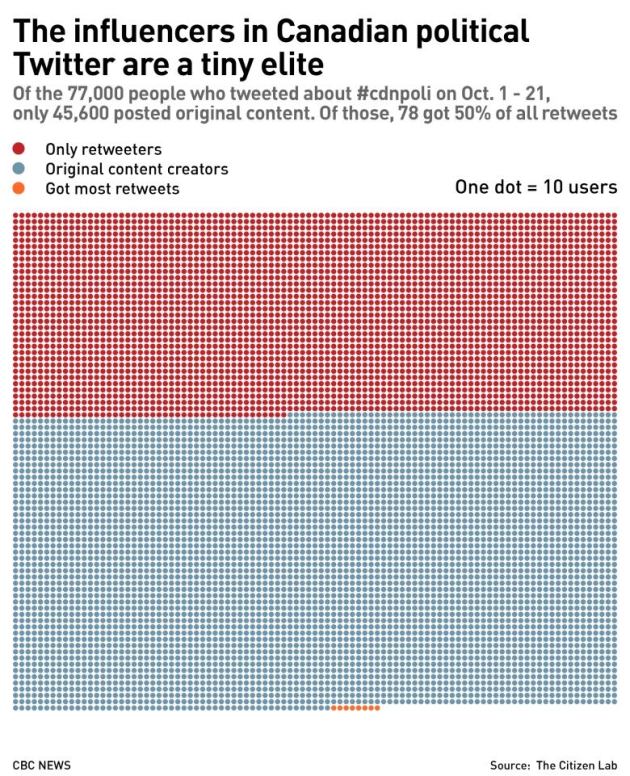
For an idea of just how elitist Twitter can be, take a look at who is driving its political conversations. For some of the major hashtags during the election — like #cdnpoli, #defundCBC and the recently popular #wexit — just a fraction of users post original content. The rest just retweet.

And the users who get the most retweets, the biggest influencers, represent an even tinier sliver of Twitter users, according to data from the University of Toronto’s Citizen Lab, another outfit that monitored disinformation during the campaign.

“What we thought was a horizontal democratic space is dominated by less than two per cent of accounts,” said Gabrielle Lim, a fellow at the Citizen Lab.

“We need to take everything with a grain of salt when looking at Twitter. Doing data analysis is easy, but we’re bad at contextualizing what it means,” Lim said.

So why this focus on Twitter if it’s such a small and unrepresentative medium for Canadians? Because it’s easy to study. Unless a user sets an account to private, everything posted on Twitter is public and fairly easy to access.

On the other hand, more popular social networks like Facebook make it much harder to harvest user content at scale. A lot of misinformation may also be shared in closed channels like private Facebook groups and WhatsApp groups, which are nearly impossible for outsiders to access.

But even taking into account those larger social media audiences, the evidence shows that Canadians are getting their news from a variety of sources, Lim noted.

Although the threat posed by online disinformation to Canadian democracy was overblown in the context of the 2019 campaign, Ruths said he still believes it was important to be alert, just as it’s important to go to the dentist even if no cavities are found.

And he suggests that journalists looking for evidence of bot activity apply the same level of rigour as the people doing the research.

“We saw a lot of well-intentioned reporting,” he said. “But finding suspected accounts is not the same as finding bots. Saying that MAGA accounts don’t look like Canadians’ doesn’t mean they’re not.”

Source: Fears of election meddling on social media were overblown, say researchers

Asylum seekers turned away by Canada at the border will get the chance to explain why they feel U.S. is unsafe for refugees

A case to watch given its implications for both asylum seekers and the government:

She knocked on Canada’s door and begged for protection. Instead, she was turned away, handcuffed and jailed — and no one even cared to ask her why she fled her native Burundi.

Then, in a cold cell at Clinton Correctional Facility in upstate New York, she was handed a flimsy prison jumpsuit and put in solitary confinement while waiting for the results of a mandatory TB test. Behind two panes of glass, she ate, slept and used the toilet in plain sight of the guards and anyone walking by. She was held for 51 days.

More than four years after the “horrific” detention experience she said still haunts her, this asylum seeker and others like her who were turned away by Canada at the Canada-U.S. border will finally have their day in court to explain why they feel the United States is not a safe country for refugees.

Starting Monday in Toronto, the Federal Court of Canada will hear a constitutional challenge to the Canada-U.S. Safe Third Country Agreement, under which both countries consider themselves a safe haven for refugees and agree to block would-be claimants from attempting to enter either country at official border crossings. Arguments will be heard over five days before Justice Ann Marie McDonald.

The Burundian woman, who cannot be named but spoke to the Toronto Star, will be one of the witnesses.

“I preferred death in my country than this treatment like a criminal in the U.S. If I were to die, I should die at home,” she said.

The bilateral pact, implemented in 2004, was originally touted by both Canadian and U.S. officials as a way to curb “asylum shopping.” However, critics have long argued that the U.S. asylum system is cruel and inhumane, especially now under President Donald Trump.

Trump’s anti-migrant policies have spurred an influx of so-called irregular migrants skirting asylum restrictions by crossing outside of Canada’s official ports of entry, where restrictions apply. More than 50,000 asylum seekers have come here that way via the U.S. over the past two years. Once here, after passing initial medical and security screenings, refugees can work and access health care pending a decision on their asylum claims.

In 2007, three advocacy groups — the Canadian Council for Refugees, Amnesty International and the Canadian Council of Churches — took Ottawa to federal court and successfully had the U.S. declared unsafe for refugees, but the decision was later overturned on appeal, largely on the grounds that the groups failed to find a lead individual litigant who was directly impacted by the policy.

After Trump’s election in November 2016 with an anti-immigration agenda, Canadian and American non-governmental organizations and refugee lawyers renewed their effort to challenge the legality of the asylum restrictions.

In 2017, they connected with a Salvadoran woman in the U.S. who sought asylum after she was raped and threatened by the notorious Mara Salvatrucha gang in El Salvador, and agreed to be the lead litigant.

The other litigants include a Syrian family of four and a young Ethiopian woman, all of whom were denied access to asylum in Canada. The three Canadian rights groups also enlisted nine other witnesses, including the Burundian woman, to provide evidence in support of the litigants’ arguments.

“This litigation is significant because this is a way for us to collectively take a position on the human rights abuses and violations against refugees and migrants in North America,” said Janet Dench of the Canadian Council for Refugees.

“Canadians are horrified by what’s been happening in the U.S., with (migrant) children separated from their families, refugees turned away at the Mexico border, the Muslim travel ban and all these measures in the U.S. The litigation is a way of standing up against these policies we don’t and can’t approve of.”

The litigants are expected to present evidence of human rights violations and Canadian Charter breaches in U.S. detention and asylum practices, and highlight the impact of the Safe Third Country Agreement on the most vulnerable refugees fleeing gender-based persecution and gang violence, who are singled out by the Trump administration to be excluded from the U.S. refugee definition.

“Refugee claimants that Canada turns away at our borders are exposed to grave risks of detention and mistreatment in the U.S.,” the litigants claim in their court submissions. “Refugee claimants are being detained indefinitely, in conditions that are nothing short of cruel and unusual, simply for seeking protection.”

In response to the claim, the Canadian government said the Canada-U.S. agreement is no different from similar deals in other refugee-receiving countries in response to rising global migration and forced displacement. Ottawa conducts regular reviews of the pact in order to ensure fair access to asylum, it said in a written response to the litigants’ claims.

“Claimants are returned to a highly developed asylum system that grants protection to large numbers of persons every year, and is subject to both administrative and judicial checks and balances,” it argued. “The U.S.A. complied with its international refugee protection and human rights obligations, notwithstanding debate both in the U.S.A. and internationally with respect to certain aspects of American policies and practices.”

However, the Burundian witness, who is only identified as “Morgan” because her identity is protected by the court, told the Star in an interview her experience in the U.S. tells a different story.

“With their accents, and English not being my first language, I had tremendous difficulty understanding them. They were treating me like I was trying to commit a crime,” recalled Morgan, 28, who said she had been threatened by government militia in Burundi after she and the civilian group she belonged to reported voter registration fraud in the 2015 election. Her cousin, also a member of the group, was shot and killed, she said.

“(American officials) were accusing me of fraud because my visa was for students. But I never intended to lie. All I wanted to do was leave a country where I could die any time,” added Morgan, who said getting a student visa was the only way she could get to the U.S. as a pathway to Canada.

Morgan, who has a degree in business administration back home, said she wanted to flee to French-speaking Canada, but since Ottawa does not have a visa post in Burundi she went to the U.S. consulate instead. She arrived in Pittsburgh in May 2015, before taking an overnight bus to Plattsburgh, N.Y., and from there to the official Canadian border post at Lacolle, Que.

She said she did not know about the asylum restrictions and was denied entry to Canada and detained in the U.S.

In addition to the lack of privacy in detention, Morgan said U.S. officials were “aggressive and rude” and did not help her fill out forms. She said with the one call she was allowed from jail she contacted a friend of a friend in the U.S., who found her a lawyer.

After 51 days behind bars, including 10 days in solitary confinement, she was released and had to couch-surf at the homes of people she barely knew while waiting for an asylum hearing to be scheduled. She said she was unable to support herself because immigration officials held her ID and she couldn’t get a work permit.

More than a year later, Trump won the U.S. presidential election, leaving Morgan to wonder if she would ever get asylum south of the border. When she learned people were bypassing the asylum restrictions at Canadian border crossings, she followed in the footsteps of those “irregular migrants” by crossing at Roxham Rd. in Quebec in August 2017.

However, she is still deemed inadmissible and ineligible to seek asylum in Canada because she had already been denied entry once — in 2015. Meanwhile, Canada cannot deport her to Burundi because of the current humanitarian crisis there.

“I am a victim who needs protection. It doesn’t make sense to call the U.S. a safe country,” she said. “I see how bad the consequences of this agreement are. I still can’t apply for refugee status in Canada because of this. This has to stop.”

Source: Asylum seekers turned away by Canada at the border will get the chance to explain why they feel U.S. is unsafe for refugees